 Farming tambaqui (Colossoma macropomum) using byproducts from the Amazon bioeconomy: nutritional composition, digestibility and attractiveness
ABSTRACT
The Amazon bioeconomy produces byproducts that have potential as ingredients in aquaculture feed. This study aims to evaluate nutritional composition, digestibility, and attractiveness of six regional byproducts - Artisanal Fish Waste Meal (FM), Defatted Brazil Nut Meal (BN), Cassava Leaf Meal (CL), Decaffeinated Guarana Bagasse (GB), Defatted Murumuru Meal (MU), and Defatted Ucuuba Meal (UC) - for use as tambaqui (Colossoma macropomum) feed. The byproducts had diverse nutrient profiles, with FM providing significantly more digestible protein and energy, followed by BN and CL. Attractiveness tests indicate that CL and BN are approached more rapidly and consumed more readily. BN and CL have potential as plant-based alternatives, due to their digestibility and attractiveness to the fish. In contrast, GB and UC were limited in both digestibility and feeding stimulation. We suggest that the byproducts FM, BN, and CL can easily be integrated into tambaqui diets, supporting sustainable aquaculture practices in the Amazon. Additional research can determine how to optimize processing and inclusion to fully exploit the functional properties of these ingredients while ensuring cost-effective and environmentally friendly fish farming.
Keywords:
aquaculture; Brazil nut; cassava; circular bioeconomy; feeds
RESUMO
A bioeconomia da Amazônia gera subprodutos agroindustriais com potencial para utilização como ingredientes na alimentação aquícola. Este estudo avaliou a composição nutricional, a digestibilidade e a atratividade de seis subprodutos regionais - Farinha de Resíduos de Peixe Artesanal (FM), Farinha Desengordurada de Castanha do Brasil (BN), Farinha de Folha de Mandioca (CL), Bagaço Descafeinado de Guaraná (GB), Farinha Desengordurada de Murumuru (MU) e Farinha Desengordurada de Ucuuba (UC) - para uso na alimentação do tambaqui (Colossoma macropomum). Os subprodutos apresentaram perfis nutricionais variados, com a FM fornecendo níveis significativamente mais altos de proteína e energia digestível, seguida pela BN e CL, que ofereceram aproximadamente 200 g kg⁻¹ de proteína digestível. Os testes de atratividade mostraram variações significativas, com CL e BN promovendo menores tempo de aproximação e maiores taxas de ingestão dos grânulos. BN e CL mostraram-se promissoras como fontes alternativas vegetais, devido à boa digestibilidade e atratividade. Em contrapartida, GB e UC apresentaram limitações relacionadas à digestibilidade e ao estímulo alimentar, possivelmente devido à presença de fatores antinutricionais. Os resultados destacam o potencial de integração de FM, BN e CL em rações para tambaqui, contribuindo para práticas aquícolas sustentáveis na Amazônia. No entanto, são necessárias pesquisas adicionais para otimizar os processos de preparo e os níveis de inclusão, maximizando as propriedades funcionais dos ingredientes e promovendo a piscicultura sustentável.
Palavras-chave:
castanha do Brasil; aquicultura; mandioca; bioeconomia circular; ração
INTRODUCTION
Sustainable development strategies of the Amazon region favor using bioeconomy (Ellwanger et al. 2023). Within the bioeconomy sector, fish aquaculture has been gaining importance and reliability, especially considering the adverse effects of climate extremes on traditional fishing (Furtado et al. 2023). A critical challenge for traditional Amazonian communities is to develop sustainable production systems that compensate for nutritional deficits caused by declining fish stocks (Tregidgo et al. 2021). Transitioning from fishing to aquaculture offers an alternative pathway for economic and social development in regions where fish stocks no longer meet population demands (FAO 2024).
Despite favorable climate, abundant water, and a diversity of species, aquaculture in the Amazon faces significant challenges. Production costs, particularly those associated with feed, hinder the competitiveness of the sector (Lima et al. 2020). Regional research efforts have evaluated alternative feed ingredients to increase productivity, reduce costs, and diversify raw materials for fish feed processing (Felix and Silva et al. 2020; Hilsdorf et al. 2021; Monteiro dos Santos et al. 2022). The use of byproducts as feed ingredients depends on several factors, including production volume, cost, nutritional composition, palatability, and digestibility for the target species (Glencross 2020).
Tambaqui Colossoma macropomum Cuvier (1818), a native omnivorous fish, is the most common species cultivated in Amazonian aquaculture (Lima et al. 2020). Its adaptability to diverse production systems, tolerance to high stock densities, and ability to withstand low dissolved oxygen levels make it a good candidate for aquaculture expansion (Wood et al. 2017; Dos Santos et al. 2020; Frisso et al. 2020; Izél-Silva et al. 2020). Tambaqui are remarkably able to consume a variety of items from regional sources, including agriculture, aquaculture, and fisheries (Guimarães et al. 2014; Aride et al. 2017; Buzollo et al. 2018; Aride et al. 2020).
Diets including byproducts from cassava (Manihot esculenta Crantz) processing have sustainable benefits with juvenile tambaqui, yielding growth performance comparable to commercial feeds (Aride et al. 2016; Matos-Dantas et al. 2024). Also, residues from non-timber extraction (e.g., Brazil nut (Bertholletia excelsa Humb. & Bonpl.)) are viable potential alternatives (Santos et al. 2010; Da Costa et al. 2022). Limited information is available regarding the tambaqui ability to digest and assimilate energy, nutrients, and minerals from these ingredients to make them viable and useful alternatives.
Other agro-industrial byproducts from the rich biodiversity of the Amazon have potential as feed because of their nutrient profiles, such as cassava leaf meal, defatted murumuru palm (Astrocaryum murumuru Mart.) meal, defatted ucuuba (Virola surinamensis Rol.) a nutmeg meal, and decaffeinated guarana (Paullinia cupana Kunth) bagasse (Hisano et al. 2013; Medeiros et al. 2018). However, in addition to nutritional composition, palatability and digestibility in vivo - essential characteristics for aquaculture feeds (Glencross 2020) - must be tested. Given the tendency of the tambaqui to accept a variety of food items, the large-scale availability of agro-industrial byproducts in the region, and the importance of accessible feed solutions for family fish farming, this study measured nutritional composition, and tested digestibility and attractiveness of six regional byproducts as ingredients in the diet of tambaqui (Colossoma macropomum).
MATERIALS AND METHODS
Ethics authorizations
Experiments to test digestibility and attractiveness were carried out at the Aquaculture Station of the Instituto Nacional de Pesquisas da Amazônia (INPA) under the authorization of the Ethics Committee Use of Animals in Research of INPA (No. 020/2020, SEI 01280.000410/2020-76).
Experimental design and fish acclimatization
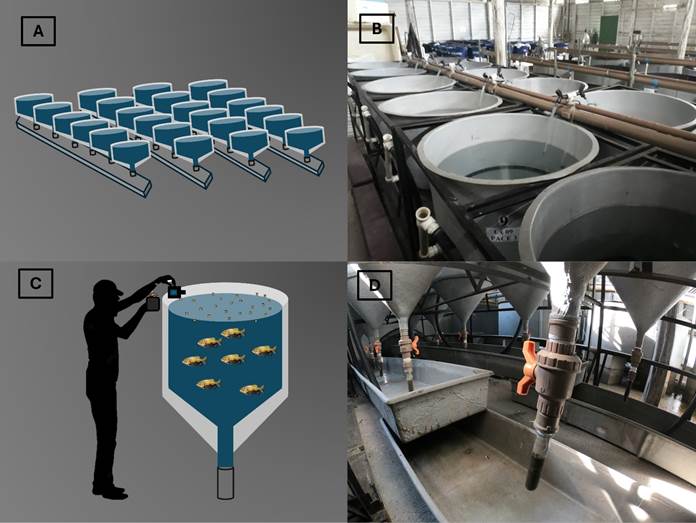
A completely randomized experimental design with seven treatments (a reference diet, and six test diets), in triplicate, was carried out in conical tanks (200 L volume) positioned to avoid the fish having visual contact with people during handling and data collection (Figures 1a-c). Tanks had continuous aeration, and daily renewal of 30% of the water volume.

Experimental design. A) Graphical representation of the structure of conical tanks; B) Digestibility tank system; C) Graphical representation of the attractiveness data collection; D) Fish feces collection system.
Once fish were placed in the tanks, acclimatization to the experimental setup lasted ten days, during which time they were provided feed twice a day with commercial feed (32% crude protein) until apparent satiety. During acclimatization, feces from the first seven days of collection were discarded because intestinal transit time of the tambaqui (Silva et al. 2003, Reis et al. 2009) allowed us to avoid influence of diet prior to the experiment. Two weeks of collection is the period during which the apparent digestibility coefficients of a new diet offered reach stable levels in rainbow trout Oncorhynchus mykiss Walbaum (1792) (Staessen et al., 2020). We defined a 30-day fecal collection period based on intestinal transit time, digestion stabilization, and sample volume required for analysis.
Origin, processing, and yield of byproducts
Raw materials were sourced from agro-industries in the Brazilian Amazon: artisanal fish waste meal (FM), cassava leaf meal (CL), and decaffeinated guarana bagasse (GB) from Maués, Amazonas, Brazil; defatted Brazil nut meal (BN), defatted murumuru meal (MU), and defatted ucuuba meal (UC) were collected from Ananindeua, Pará, Brazil (Table 1). Ingredients were dried and ground to an average grain size of 1 mm using a hammer mill (MSC280, Vieira, SP, Brazil).
Analysis of nutritional composition
Dry matter was obtained by the gravimetric method of heating the samples to 105 °C (method 934.01) in an oven (model 3632, Alfamare, MG, Brazil). The ethereal part was extracted using petroleum ether solvent extraction (method 920.39) in a goldfish extractor (model TE-044-8/50, Tecnal, SP, Brazil). The ash was then incinerated at 450 °C (942.05).
Nitrogen was measured using the Kjeldahl method (AOAC 1995, method 984.13) in a nitrogen distiller (model TE-0364, Tecnal, SP, Brazil). Neutral detergent fiber (NDF) and acid detergent fiber (ADF) were calculated following Mertens et al. (2002), both ash-free, in fiber determinator (model TE-149, Tecnal, SP, Brazil). Lignin was calculated using the ADF residue, following the method proposed by Robertson and Von Soest (1981).
Phosphorus concentration was measured by spectrophotometry (method 965.17) and calcium by titration of dry ash made alkaline with ethylenediaminetetraacetic acid (EDTA) (method 927.02). Gross energy was calculated by incinerating the samples in a bomb calorimeter (model C-2000, IKA, Guangzhou, China). Amino acids were measured using high-performance liquid chromatography (HPLC) (model 1290 infinity, Agilent Technologies, CA, USA).
Chromium oxide concentration was determined using the method proposed by Furukawa and Tsukahara (1966). All byproducts were measured following the Association of Official Analytical Chemists (AOAC 2005).
Determination of Apparent Digestibility
Digestibility (as the apparent digestibility coefficient, ADC) was measured from the feces with an in vivo experiment using chromium oxide labeled diets in the feed (Bureau and Hua, 2006). Test diets were formulated with 30% of the test ingredients in the reference diet (Table 2), processed in an extruder machine with a 4 mm matrix (model MX-80, Inbramaq, SP, Brazil) at an average temperature of 100°C, and dried in an oven at 60°C for eight hours (model TE-394/3, Tecnal, SP, Brazil).
In total, 240 tambaqui juveniles (58.62 ± 0.69 g) in 21 tanks, and individual feces collection system. Fish were fed twice daily (08:00 and 18:00 h) until apparent satiety. Tanks were cleaned and siphoned, and 15% of the water was renewed, 1 h after each feeding to avoid contamination of the collected material with leftover food. At that time, feces were removed while siphoning to avoid sample contamination by uneaten feed. Feces were collected (for ADC measurement) prior to feeding each day (07 :00 and 17:00 h), and was immediately stored at -20ºC. The collection period lasted 30 days. Feces samples were lyophilized (model LC3000, Terroni, SP, Brazil) to determine nutritional composition.
Water physical and chemical characteristics were within the comfort levels for tambaqui (Wood et al. 2017; Barroso et al. 2020; Carmo-Neves et al. 2020): temperature (27.71 ± 1.18 ºC), dissolved oxygen (4.33 ± 1.14 mg L-1), conductivity (132.08 ± 38.00 µS cm-1), pH (6.93 ± 0.35), total ammonia (1.74 ± 1.05 mg L-1), nitrite (0.23 ± 0.31 mg L-1), alkalinity (47.98 ± 7.60 mg.L-1 of CaCO3) and hardness (11.15 ± 6.83 mg.L-1 of CaCO3). Significant concentrations of ionized ammonia (NH3) were not detected.
ADC was calculated following Bureau and Hua (2006). For the ADC values of the six ingredients, the following formula was used: ADC of the ingredients (%) = ADCDIET TESTE + [(ADCDIET TEST -ADCDIET REFERENCE) × (0.7 × DREFERENCE / 0.3 × DINGREDIENT), where DREFERENCE and DINGREDIENT are nutrients (g kg -1) or gross energy (MJ kg-1) in the reference diet and test ingredient, respectively.
Attractiveness analysis
Behavior to determine attractiveness was filmed beginning three days after initiation of test diets (Glencross 2020). Fish were acclimated to the camera at feeding time for 10 days prior to data collection. For 15 days, 30 feedings were filmed, and attractiveness was calculated for each diet, following Kasumian and Sidorov (2012) and Hattori et al. (2021), but with 30 s interval of filming. High resolution filming (camera model Hero 5 Black, Go Pro, CA, USA) began 30 s after 3 g of feed (70 granules) was placed in the tank. Videos were analyzed in individual frames every 0.03 seconds using video editing Animotica© software. After analyzing the images, behavior was measured as follows: approximation time (AT: seconds until capture of the first grain), capture reactions (CR: number of projections or mouth openings with or without consumption during 30 s), grain intake (GI: percentage of grains that were ingested in 30 seconds in relation to the total offered, and grain ejection (GE, number of grains consumed and ejected back into the water).
Statistical analysis
Digestibility and attractiveness were analyzed among the feeding treatments using analysis of variance, assuming that the residuals meet the test assumptions for parametric analysis. When not, we used their non-parametric counterpart (Kruskal-Wallis). To rank treatments we used the parametric Tukey test or its non-parametric version. All analyses were performed with a significance level of 5% using Statistica 7© software.
RESULTS
There was wide variation in the proximal composition among the byproducts used to prepare the tested diets (Table 3). The crude protein content of the evaluated diets ranged from 108 to 556 g kg-1, and the ether extract content was greater than 100 g kg-1 in FM, BN, MU, and UC. Ingredients of plant origin had NDF concentrations greater than 300 g kg-1.
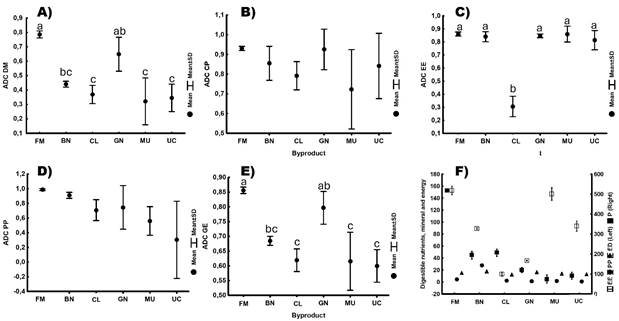
Digestible protein (DP) of FM was somewhat more than twice that of BN and CL, all of which were much greater than GB, MU and UC (Table 4). Digestible ethereal extract (fats) were lower in the CL than in other treatments (Figure 2c). The digestible phosphorus was 6.8 times higher in FM (27.41 g kg-1) than in BN (4.01 g kg-1), the other ingredients had values below 2 g kg-1 of digestible phosphorus (Figure 2d). The highest digestible energy (DE) values in FM, GB, and BN were 17.57, 16.13, and 15 MJ kg-1, respectively, while the lowest values were 12.46 and 12.63 MJ kg-1 for CL and UC (Figure 2f).
Apparent digestibility coefficient, digestible nutrient levels (g kg-1), and digestible energy (MJ kg-1) of test ingredients for Colossoma macropomum. Test ingredients: fish waste meal processed at low temperature (FM); defatted Amazon nut meal (BN); cassava leaf meal (CL); decaffeinated guarana bagasse (GB); defatted murumuru meal (MU); defatted ucuuba meal (UC). Variables: Apparent digestibility coefficient = Dry matter (ADC DM); Crude protein (ADC CP); Ethereal extract (ADC EE); Phosphorus (ADC PP); Gross energy (ADC GE); Digestible protein (DP); Digestible ether extract (DEE); Digestible phosphorus (DPP); Digestible energy (DE).
Apparent digestibility coefficient (ADC) of nutrients, minerals, and energy from byproducts of the Amazon bioeconomy. A) Dry matter; B) Crude protein; C) Ether extract; D) Phosphorus; E) Gross energy; and F) Nutrients, minerals, and digestible energy of byproducts.
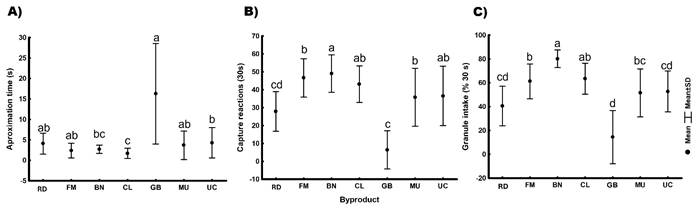
Attractiveness differed among most byproducts (Table 5). No granule ejection was observed. Approach time was much more rapid for CL (1.72 s) than GB (12.90 s). Reactions (CR) were greatest with BN, CL, FM and MU, while ingestion rate (GI) was greatest with BN and CL (Figure 3).
Attractiveness indicators of feeds with agro-industrial byproducts from the Amazon for Colossoma macropomum. Diets (meal): reference diet (RD); fish waste (FM); defatted Brazil nut (BN); cassava leaf (CL); decaffeinated guarana bagasse (GB); defatted murumuru (MU); defatted ucuuba (UC). Variables: Aproximation time (AT); Capture reactions (CR); Grain intake rate (GI).
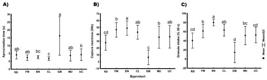
Indicators of attractiveness of byproducts from the Amazon bioeconomy for tambaqui, Colossoma macropomum. A) Aproximation time; B) Capture reactions; and C) Granule ingestion rate in 30 seconds
DISCUSSION
Using agroindustrial byproducts in aquaculture shows great potential because fish will readily eat and thrive on a variety of these products, some better than others. Utilization of byproducts (especially those higher in amino acids, e.g., FM, BN, and CL) shows great promise as an alternative for subsidizing small-scale fish production in riverside regions of the Amazon. In addition to supplementing raw materials that may be in short supply, and reducing production costs (Monteiro do Santos et al. 2023), this use can favor the diversification of the diet of animals in captivity, meeting a growing demand for healthier diets in inclusive production systems with low environmental impact (Medina et al. 2022). Thus, aquaculture in riverside regions can be an important tool in addressing the nutritional and economic deficit of the population, especially in times and regions with reduced fishing productivity (Tregidgo et al. 2021).
The inclusion of new ingredients in aquaculture feeds is subject to meeting chemical, technical and market criteria, with nutritional composition being one of the main factors in choosing a raw material (Glencross et al. 2020). The low ADC of dry matter in BN, CL, MU, and UC was attributed to the high concentration of non-starch polysaccharides. Most of these compounds are not affected by the heat treatments used in the dehydration of ingredients and the extrusion of feeds. However, advanced processing methods, such as fractionation, aqueous extraction, and the use of exogenous enzymes, may reduce these indigestible components and increase their nutritional value (Drew et al., 2007). In this study, minimal processing was applied to preserve the original composition of the raw materials, highlighting their nutritional potential.
Nutrient supply to farmed fish is influenced by the processing method of the feed ingredients and pellets (Sorensen 2012). The temperature of 70°C used in FM drying may have increased the protein ADC value for tambaqui. Our results are greater than the ADC of 0.78 (Buzollo et al. 2018) previously reported for commercial fish waste meal. The processing of waste from artisanal fishing chains and fish processing generates products of high biological value for aquatic animals (Silva et al. 2014; Yamamoto et al. 2021). Fish meals produced at low drying temperatures (70-90ºC) normally have ADC CP above 90% (Hardy and Tacon 2003). Prolonged exposure to high temperatures (> 100°C) causes intense oxidation of amino acids, reducing the digestibility and the chemical and sensory aspects of protein ingredients of animal origin (Zhao et al. 2019; Bhat et al. 2021). ADC results demonstrate that fishmeal produced in the artisanal process is readily absorbed by fish.
Fish waste is commonly used as an ingredient in aquaculture feed, but the sustainability of these co-products is often debated (Marchi et al. 2023; Frohn et al. 2024; Sarker et al. 2025). Replacing fishmeal with a plant-based ingredient has proven to be viable for tambaqui (Martins et al. 2020). Here, the plant-based BN and CL proved to have higher potential for inclusion in tambaqui diets, mainly because of their attractiveness and DP content (and DE in the case of BN). They may replace wheat bran with a high supply of protein and digestible energy (Buzollo et al. 2018). There are no other studies on CDA BN in fish, however, whole Brazil nut meal can be included at concentrations of 300 to 350 g kg-1 and maintain tambaqui health and growth rates (Santos et al. 2010; Da Costa et al. 2022). For Nile tilapia (Oreochromis niloticus Linnaeus 1758) shade-dried CL had an ADC of 0.89 (Hisano et al. 2013), which was higher than that for protein (0.79) in this study. Thus, these ingredients are potential, alternative, sources of amino acids for the nutrition of tambaqui juveniles.
Amino acids are important stimuli for initiating feeding in aquatic animals, and L-type cysteine, alanine, lysine, and proline induce food search and capture behaviors (Hara, 2006; Yu et al., 2021). L-lysine is an essential amino acid for fish, and because it is highly soluble in water, is among the first to stimulate fish sensory organs (NRC 2011). The higher concentration in CL, in relation to the other byproducts of vegetable origin, may have contributed to the greater attractiveness of the feed, which was indicated by less time required by the fish to approach this food item.
In addition to amino acids, lipids also modulate food choice and intake in fish (Cardoso et al. 2021; Roy et al. 2020, 2022). Fat is most recognized for stimulating (texture and smell) eating through the senses, and dietary fats activate the gustatory system (Gaillard and Kinnamon 2019). BN fat has 26% saturated fatty acids, 32% monounsaturated and 42% polyunsaturated fats (Serra et al. 2019). The concentration of digestible lipids in BN (~150 g kg-1) increased attraction of fish to the feed, providing more capture reactions and granule ingestion at the beginning of feeding than in animals fed the reference diet based on conventional ingredients.
Corn flour is one of the main sources of dietary energy for fish (Alkoei et al. 2024). The molecular structure of corn starch contributes to the extrusion process and the stability of the feed granules (Kannadhason et al. 2011). GB, together with FM and BN, provided DE levels (> 15 MJ kg-1) greater than by corn flour (Buzollo et al. 2018). The GB has a low concentration of fats, with the starchy reserves in the seeds responsible for supplying most of the DE (Dalonso and Petkowicz 2021). Inclusion of 300 g kg-1 of GB decreased attractiveness of the feed as this ingredient contains residual alkaloids (Santana et al. 2019) and approximately 14% of the tannin (Yamaguti-Sasaki et al. 2007; Marques et al. 2019). Incorporation of tannin levels above 30 g kg−1 can decrease the cumulative feed intake rates by fish (Omnes et al. 2017). The polyphenolic compound gives the feed an unpleasant taste thereby reducing intake (Becker and Makkar 1999), as we found with the longer approach time, low capture rate and ingestion rates by the fish during the first few seconds of feeding.
Antinutritional factors can negatively influence consumption, absorption of nutrients and energy from diets because of flavor, agglutination, formation of stable complexes or inhibition of digestive enzyme activity (Omnes et al. 2017). Similar to GB, UC was unattractive to tambaqui. This characteristic, in addition to the low ADC of DM, P, and DP content, demonstrates the low efficiency of both raw materials from the point of view of productive and environmental efficiency as a macro-ingredient. However, it is important to evaluate these byproducts with lower levels of inclusion, as well as in other functional products such as immunomodulatory and nutraceutical additives (Cardoso et al. 2021; Copatti et al. 2022), given the presence of molecules with antimicrobial, antioxidant, and protective effects against tissue damage (Fukumasu et al, 2006; Hiruma-Lima et al. 2009; Cordeiro et al. 2019).
CONCLUSIONS
We conclude that FM, BN and CL have the greatest potential for application in the manufacture of diets for family fish farming of tambaqui C. macropomum by providing easily absorbed proteins, and they have chemical characteristics that are more attractive and stimulate feed ingestion. Further studies evaluating processing techniques and inclusion levels are needed to make the most of the functional potential of the ingredients and promote healthy growth of the fish during farming.
ACKNOWLEDGMENTS
The authors would like to thank the Coordenação de Aperfeiçoamento de Pessoal de Nível Superior (CAPES) and Fundação de Amparo à Pesquisa do Estado Amazonas (FAPEAM) for the scholarship granted (88887.641288/2021-00). This research was financially supported by the FAPEAM (FAPEAM PAINTER+ / 116/ 2023), and Institutos Nacionais de Ciência e Tecnologia (INCT ADAPTA II) / Conselho Nacional de Desenvolvimento Científico e Tecnológico (465540/ 2014-7) / FAPEAM (062.1187 / 2017).
REFERENCES
- AOAC.,1995. Official methods of analysis (16th ed.). Washington, DC: Association of Official Analytical Chemists 771 p.
- AOAC., 2005. Official methods of analysis (18th ed. ). Washington, DC: Association of Official Analytical Chemists 816 p.
- Alkoei, A.S.; Jalali, S.M.A.; Jalali, S.A.H.; Kheiri, F. 2024. Effects of dietary corn and protein levels on physical properties of extruded feed pellets and growth performance of rainbow trout, Oncorhynchus mykiss. Journal of the World Aquaculture Society 55: 125-148.
- Aride, P.H.R.; Oliveira, A.T.; Oliveira, A.M.; Ferreira, M.S.; Baptista, R.B.; Santos, S.M.; et al 2016. Growth and hematological responses of tambaqui fed different amounts of cassava (Manihot esculenta). Arquivo Brasileiro de Medicina Veterinária e Zootecnia, 68: 1697-1704.
- Aride, P.H.R.; Oliveira, A.M.; Batista, R.B.; Ferreira, M.S.; Pantoja-Lima, J.; Ladislau, D.S.; et al 2017. Changes on physiological parameters of tambaqui (Colossoma macropomum) fed with diets supplemented with Amazonian fruit Camu camu (Myrciaria dubia). Brazilian Journal of Biology 78: 360-367.
- Aride, P.H.R.; Oliveira, A.M.; Ferreira, M.S.; Liebl, A.R.S.; Comassetto, L.E.; Ladislau, D.S. et al 2020. Growth and hematological responses of tambaqui, Colossoma macropomum fed different levels of rice, Oryza spp. Brazilian Journal of Biology 81: 962-968.
- Barroso, D.C.; Almeida-Val, V.M.F.; Val, A.L. 2020. Temperature and food availability alters the physiology and aerobic capacity of tambaqui (Colossoma macropomum). Comparative Biochemical Physiology -Part A Molecular Integrative Physiology 245: 110704.
- Becker, K.; Makkar, H.P.S. 1999. Effects of dietary tannic acid and quebracho tannin on growth performance and metabolic rates of common carp (Cyprinus carpio L.). Aquaculture 175: 327-335.
- Bhat, Z.F.; Morton, J.D.; Bekhit, A.E.D.A.; Kumar, S.; Bhat, H.F. 2021. Thermal processing implications on the digestibility of meat, fish and seafood proteins. Comprehensive Reviews in Food Science and Food Safety 20: 4511-4548.
- Bureau, D.P.; Hua, K. 2006. Letter to the editor of Aquaculture. Aquaculture 252: 103-105.
- Buzollo, H.; Nascimento, T.M.T.; Sandre, L.C.G.; Neira, L.M.; Jomori, R.K.; Carneiro, D.J. 2018. Apparent digestibility coefficients of feedstuff used in tambaqui diets. Boletim do Instituto de Pesca 44: 1-7.
- Cardoso, A.J.S.; Santos, W.V.; Gomes, J.R.; Martins, M.T.S.; Coura, R.R.; Oliveira, M.G.A.; et al 2021. Ginger oil, Zingiber officinale, improves palatability, growth and nutrient utilisation efficiency in Nile tilapia fed with excess of starch. Animal Feed Science and Technology 272: 2020.114756.
- Carmo-Neves, L.; Favero, G.C.; Beier, S.L.; Ferreira, N.S.; Palheta, G.D.A.; Melo, N.F.A.C.; et al 2020. Physiological and metabolic responses in juvenile Colossoma macropomum exposed to hypoxia. Fish Physiology and Biochemistry 46: 2157-2167.
- Carvalho, A.A.V.; Galdino, P.M.; Nascimento, M.V.M.; Kato, M.J.; Valadares, M.C.; Cunha, L.C.; et al 2010. Antinociceptive and antiinflammatory activities of Grandisin extracted from Virola surinamensis Phytotherapy Research: An International Journal Devoted to Pharmacological and Toxicological Evaluation of Natural Product Derivatives 24: 113-118.
- Copatti, C.E.; Felix e Silva, A.; Lorenzo, V.P.; Melo, J.F.B. 2022. Addition of essential oil from Lippia sidoides to the diet of tambaqui: An analysis of growth, metabolic and blood parameters, and intestinal enzymes. Aquaculture 560: 2022.738482.
- Cordeiro, R.M.; Ana, A.P.; Pinto, R.H.H.; da Costa, W.A.; Da Silva, S.H.M., de Souza Pinheiro, W.B.; et al 2019. Supercritical CO2 extraction of ucuúba (Virola surinamensis) seed oil: global yield, kinetic data, fatty acid profile, and antimicrobial activities. Chemical Engineering Communications 206: 86-97.
- Costa, E. S.; Hiruma-Lima, C. A.; Lima, E. O.; Sucupira, G. C.; Bertolin, A. O.; Lolis, S. F. et al 2008. Antimicrobial activity of some medicinal plants of the Cerrado. Phytotherapy Research: An International Journal Devoted to Pharmacological and Toxicological Evaluation of Natural Product Derivatives 22: 705-707.
- Da Costa, D.A.; De Oliveira, A.V.D.; Moreira, G.R.; De Souza, C.L.; Fernandes, L.F.; Silva, J.M.; et al 2022. Residue from the extraction of oil from the Brazil Nut in diets for Tambaqui juveniles / Resíduo da extração do óleo da Castanha do Brasil em dietas para juvenis de Tambaqui. Brazilian Journal of Development 8: 50115-50128.
- Dalonso, N.; Petkowicz, C.L.D.O. 2012. Guarana powder polysaccharides: Characterisation and evaluation of the antioxidant activity of a pectic fraction. Food Chemistry 134: 1804-1812.
- Dos Santos, R.B.; Izel-Silva, J.; Fugimura, M.M.S.; Suita, S.M.; Ono, E.A.; Affonso, E.G. 2021. Growth performance and health of juvenile tambaqui, Colossoma macropomum, in a biofloc system at different stocking densities. Aquaculture Research 52: 3549-3559
- Drew, M.D.; Borgeson, T.L.; Thiessen, D.L. 2007. A review of processing of feed ingredients to enhance diet digestibility in finfish. Animal feed science and technology 138(2): 118-136.
- FAO, Food and Agriculture Organization of the United Nations., 2024. World Fisheries and Aquaculture, Toward blue transformation FAO: Rome. 217p.
- Felix e Silva, A.; Copatti, C.E.; de Oliveira, E.P.; Bonfá, H.C.; Melo, F.V.S.T.; Camargo, A.C.; et al 2020. Effects of whole banana meal inclusion as replacement for corn meal on digestibility, growth performance, haematological and biochemical variables in practical diets for tambaqui juveniles (Colossoma macropomum). Aquaculture Reports 17: 100307.
- Frisso, R.M.; Matos, F.T.; Moro, G.V.; Mattos, B.O. 2020. Stocking density of Amazon fish (Colossoma macropomum) farmed in a continental neotropical reservoir with a net cages system. Aquaculture 529: 735702.
- Frohn, L.; Peixoto, D.; Guyomar, C.; Teixeira, C.; Terrier, F.; Aguirre, P.; et al 2024. Yeast extract improves growth in rainbow trout (Oncorhynchus mykiss) fed a fishmeal-free diet and modulates the hepatic and distal intestine transcriptomic profile. Aquaculture, 579: 740226.
- Fukumasu, H.; Avanzo, J.L.; Heidor, R.; Silva, T.C.; Atroch, A.; Moreno, F.S.; et al 2006. Protective effects of guarana (Paullinia cupana Mart. var. sor- bilis) against DEN-induced DNAdamage on mouse liver. Food and Chemical Toxicology 44: 862-867.
- Furukawa, A.; Tsukahara, H. 1966. On the acid digestion method for the determination of chromic oxide as an index substance in the study of digestibility of fish feeds. Bulletin of the Japanese Society of scientific fisheries 32: 502-508.
- Gaillard, D.; Kinnamon, S.C. 2019. New evidence for fat as a primary taste quality. Acta physiologica (Oxford, England) 226: e13246.
- Glencross, B.D. 2020. A feed is still only as good as its ingredients: An update on the nutritional research strategies for the optimal evaluation of ingredients for aquaculture feeds. Aquaculture Nutrition 26: 1871-1883.
- Guimarães, I.G.; Miranda, E.C.; Araújo, J.G. 2014. Coefficients of total tract apparent digestibility of some feedstuffs for Tambaqui (Colossoma macropomum). Animal Feed Science and Technology 188: 150-155.
- Hara, T.J. 2006. Feeding behaviour in some teleosts is triggered by single amino acids primarily through olfaction. Journal of Fish Biology 68: 810-825.
- Hardy, R.W.; Tacon, A.G.J. 2003. Fish meal: historical uses, production trends and future outlook for sustainable supplies In: Stickney, R.R., McVey, J.P. (Eds.), Responsible Marine Aquaculture. CABI Publishing, Wallingford, UK, pp. 311-325.
- Hattori, J.F.A.; Alves, D.R.S.; Oliveira, S.R.; Almeida, A.A.S.; Boscolo, W.R. 2021. Attractiveness and palatability of liquid hydrolysates for Dourado (Salminus brasiliensis) fingerlings. Aquaculture Research 52: 5682-5690.
- Hilsdorf, A.W.S.; Hallerman, E.; Valladão, G.M.R.; Zaminhan-Hassemer, M.; Hashimoto, D.T.; Dairiki, J.K.; et al 2021. The farming and husbandry of Colossoma macropomum: From Amazonian waters to sustainable production. Reviews in Aquaculture 14: 993-1027.
- Hisano, H.; Pietro, P.S.; Barros, M.M.; Pezzato, L.E. 2013. Composição bromatológica e digestibilidade aparente da parte aérea seca da mandioca na alimentação de tilápias-do-nilo. Pesquisa Agropecuária Brasileira 48: 1119-1123.
- Hiruma-Lima, C. A.; Batista, L. M.; Almeida, A. B. A.; Magri, L. P.; Santos, L. C.; Vilegas, W.; et al 2009. Antiulcerogenic action of ethanolic extract of the resin from Virola surinamensis Warb. (Myristicaceae). Journal of Ethnopharmacology 122: 406-409.
- Izel-Silva, J.; Ono, E.A.; Queiroz, M.N.; Dos Santos, R.B.; Affonso, E.G. 2020. Aeration strategy in the intensive culture of tambaqui, Colossoma macropomum, in the tropics. Aquaculture 529: 735644.
- Kannadhason, S.; Muthukumarappan, K.; Rosentrater, K. A. 2011. Effect of starch sources and protein content on extruded aquaculture feed containing DDGS. Food and Bioprocess Technology 4: 282-294.
- Kasumyan, A.O.; Sidorov, S.S. 2012. Effects of the long-term anosmia combined with vision deprivation on the taste sensitivity and feeding behavior of the rainbow trout Parasalmo Oncorhynchus mykiss Journal of Ichthyology 52: 109-119.
- Lima, C.A.S.; Machado Bussons, M.R.F.; Oliveira, A.T.; Aride, P.H.R.; Almeida-O’Sullivan, F.L.; Pantoja-Lima, J. 2020. Socioeconomic and profitability analysis of tambaqui Colossoma macropomum fish farming in the state of Amazonas, Brazil. Aquaculture Economics & Management 24: 406-421.
- Lourenço, L.F.H.; Santos, D.C.; Ribeiro, S.C.A.; Almeida, H.; Araujo, E.A.F. 2011. Study of adsorption isotherm and microbiological quality of fish meal type “piracuí” of Acari-Bodo (Liposarcus pardalis, Castelnau, 1855). Procedia Food Science 1: 455-462.
- Maciel e Silva, A.G.M.; Lima, S.C.G.; Oliveira, P.D.; Moraes, M.S.; Guimarães, C.M.C.; Silva, J.A.R.; et al 2021. Production, chemical composition, and fatty acid profile of milk from buffaloes fed with cupuaçu (Theobroma grandiflorum) cake and murumuru (Astrocaryum murumuru) cake in the Eastern Amazon. Animal Science Journal 92: e13576.
- Marchi, A.; Bonaldo, A.; Di Biase, A.; Cerri, R.; Scicchitano, D.; Nanetti, L.; et al 2023. Towards a free wild-caught fishmeal, fish oil and soy protein in European sea bass diet using by-products from fishery and aquaculture. Aquaculture, 573: 739571.
- Marques, L.L.M.; Ferreira, E.D.F.; Paula, M.N.; Klein, T.; Mello, J.C.P. 2019. Paullinia cupana: a multipurpose plant - a review. Revista Brasileira de Farmacognosia 29: 77-110.
- Martins, G.P.; Mazini, B.S.M.; Campos, M.A.F.; Oliveira, D.S.; Guimarães, I.G. 2020. Effect of replacing fish meal protein by crystalline amino acid and soy protein concentrate on growth, feed utilization, and metabolism of tambaqui Colossoma macropomum juveniles. Journal of the World Aquaculture Society 51: 1250-1269.
- Matos-Dantas, F.; Souza, Y. M.; Santana, T. M.; Dos Santos, D. K. M.; da Fonseca, F. A. L.; Gonçalves, L.U. 2024. A Sustainable Diet for Tambaqui Farming in the Amazon: Growth Performance, Hematological Parameters, Whole-Body Composition and Fillet Color. Animals 14: 1165.
- Medina, G.; Pereira, C.; Ferreira, J.; Berenguer, E.; Barlow, J. 2022. Searching for novel sustainability initiatives in Amazonia. Sustainability 14: 10299.
- Mertens, D.R.; Allen, M.; Carmany, J.; Clegg, J.; Davidowicz, A.; Drouches, M.; et al 2002. Gravimetric determination of amylase-treated neutral detergent fiber in feeds with refluxing in beakers or crucibles: Collaborative study. Journal of AOAC international 85: 1217-1240.
- Monteiro dos Santos, D.K.; Santana, T.M.; Matos-Dantas, F.; Farias, A.B.S.; Epifânio, C.M.F.; Prestes, A.G. et al; 2022. Defatted black soldier fly larvae meal as a dietary ingredient for tambaqui (Colossoma macropomum): Digestibility, growth performance, haematological parameters, and carcass composition. Aquaculture Research 53: 6762-6770.
- Monteiro dos Santos, D. K.; Rodrigues de Freitas, O.; Oishi, C. A.; Leão da Fonseca, F. A.; Parisi, G.; Gonçalves, L.U. 2023. Full-fat black soldier fly larvae meal in diet for tambaqui, Colossoma macropomum: Digestibility, growth performance and economic analysis of feeds. Animals 13: 360.
- Nascimento, T.M.T.; Buzollo, H.; Sandre, L.C.G.; Neira, L.M.; Abimorad, E.G.; Carneiro, D.J.2020. Apparent digestibility coefficients for amino acids of feed ingredients in Tambaqui (Colossoma macropomum) diets. Revista Brasileira de Zootecnia 49: e20190032
- NRC, National Research Council, 2011. Nutrient Requirements of Fish and Shrimp Washington, DC: National Academies Press. 376p.
- Oliva-Teles, A. 2012. Nutrition and health of aquaculture fish. Journal of fish diseases 35: 83-108.
- Omnes, M.H.; Le Goasduff, J.; Le Delliou, H.; Le Bayon, N.; Quazuguel, P.; Robin, J.H. 2017. Effects of dietary tannin on growth, feed utilization and digestibility, and carcass composition in juvenile European seabass (Dicentrarchus labrax L.). Aquaculture Reports 6: 21-27.
- Pinho, L.S.; Da Silva, M.P.; Thomazini, M.; Cooperstone, J.L.; Campanella, O.H.; Da Costa Rodrigues, C.E.; et al 2021. Guaraná (Paullinia cupana) byproduct as a source of bioactive compounds and as a natural antioxidant for food applications. Journal of Food Processing and Preservation 45(10): e15854.
- Robertson, J.B.; Van Soest, P.J. 1981. The detergent system of analysis. In: James, W.P.T.; Theander, O. (Eds.). The Analysis of Dietary Fibre in Food. Marcel Dekker, NY, Chapter 9: 123-158.
- Roy, J.; Mercier, Y.; Tonnet, L.; Burel, C.; Lanuque, A.; Surget, A.; et al 2020. Rainbow trout prefer diets rich in omega-3 long chain polyunsaturated fatty acids DHA and EPA. Physiology & behavior 213: 112692.
- Roy, J.; Baranek, E.; Mercier, Y.; Larroquet, L.; Surget, A.; Ganot, A.; et al 2022. Involvement of Taste Receptors in the Oro-Sensory Perception of Nutrients in Rainbow Trout (Oncorhynchus Mikyss) Fed Diets with Different Fatty Acid Profiles. Aquaculture Nutrition 2022(1): 1-20.
- Santana, Á.L.; Queirós, L.D.; Martínez, J.; Macedo, G.A. 2019. Pressurized liquid- and supercritical fluid extraction of crude and waste seeds of guarana (Paullinia cupana): Obtaining of bioactive compounds and mathematical modeling. Food and bioproducts processing 117: 194-202.
- Santos, O. V.; Corrêa, N.C.F.; Carvalho, R.N.; Costa, C.E.F.; França, L.F.F.; Lannes, S.C.S. 2013. Comparative parameters of the nutritional contribution and functional claims of Brazil nut kernels, oil and defatted cake. Food Research International 51(2): 841-847.
- Sarker, P.K.; Schoffstall, B.V.; Kapuscinski, A.R.; McKuin, B.; Fitzgerald, D.; Greenwood, C.; et al 2025. Towards sustainable aquafeeds: Microalgal (Nannochloropsis sp. QH25) co-product biomass can fully replace fishmeal in the feeds for rainbow trout (Oncorhynchus mykiss). Foods 14(5): 781.
- Serra, J.L.; Rodrigues, A.M.C.; Freitas, R.A.; Meirelles, A.J.A.; Darnet, S.H.; Silva, L.H.M. 2019. Alternative sources of oils and fats from Amazonian plants: Fatty acids, methyl tocols, total carotenoids and chemical composition. Food research international 116: 12-19.
- Silva, J.A.M.D.; Pereira Filho, M.; Oliveira-Pereira, M.I.D. 2003. Fruits and seeds consumed by tambaqui (Colossoma macropomum, CUVIER, 1818) incorporated in the diets: gastrointestinal tract digestibility and transit velocity. Revista Brasileira de Zootecnia 32: 1815-1824.
- Silva, J.F.X.; Ribeiro, K.; Silva, J.F.; Cahú, T.B.; Bezerra, R.S. 2014. Utilization of tilapia processing waste for the production of fish protein hydrolysate. Animal feed science and technology 196: 96-106.
- Silva-Reis, Y.; Leite, J.L.R.; Almeida, C.A.L.; Pereira, D.S.P.; Vidal, L.V.O.; Araujo, F.G.; et al 2019. New insights into tambaqui (Colossoma macropomum) feeding behavior and digestive physiology by the self-feeding approach: effects on growth, dial patterns of food digestibility, amylase activity and gastrointestinal transit time. Aquaculture 498: 116-122.
- Sørensen, M. 2012. A review of the effects of ingredient composition and processing conditions on the physical qualities of extruded high‐energy fish feed as measured by prevailing methods. Aquaculture nutrition, 18(3): 233-248.
- Staessen, T.W.; Verdegem, M.C.; Schrama, J.W. 2021. Time‐related changes in nutrient digestibility and faecal bile acid loss of rainbow trout (Oncorhynchus mykiss) as affected by dietary fat level and non‐starch polysaccharide level. Aquaculture Nutrition, 27(1): 129-141.
- Tacon, A.G.J.; Metian, M. 2008. Global overview on the use of fish meal and fish oil in industrially compounded aquafeeds: Trends and future prospects. Aquaculture 285: 146-158.
- Tregidgo, D.; Barlow, J.; Pompeu, P.S.; Parry, L. 2020. Tough fishing and severe seasonal food insecurity in Amazonian flooded forests. People and Nature 2(2): 468-482.
- Wood, C.M.; Souza-Netto, J.G.; Wilson, J.M.; Duarte, R.M.; Val, A.L. 2017. Nitrogen metabolism in tambaqui (Colossoma macropomum), a neotropical model teleost: hypoxia, temperature, exercise, feeding, fasting, and high environmental ammonia. Journal of Comparative Physiology B 187: 135-151.
- Yamaguti-Sasaki, E.; Ito, L.A.; Canteli, V.C.D.; Ushirobira, T.M.A.; Ueda-Nakamura, T.; Dias-Filho, B.P.; et al 2007. Antioxidant capacity and in vitro prevention of dental plaque formation by extracts and condensed tannins of Paullinia cupana Molecules 12: 1950-1963.
- Yamamoto, F.Y.; Chen, K.; Castillo, S.; Cruz, C.R.; Tomasso, J.R.; Gatlin, D.M. 2021. Growth and physiological effects of replacing fishmeal with dry-extruded seafood processing waste blended with plant protein feedstuffs in diets for red drum (Sciaenops ocellatus L). Animal feed science and technology 280: 115046.
- Yu, H.; Wang, X.; Kong, F.; Song, X.; Tan, Q. 2021. The attractive effects of amino acids and some classical substances on grass carp (Ctenopharyngodon idellus). Fish Physiology Biochemistry 47: 1489-1505.
- Zhao, D.; He, J.; Zou, X.; Xie, Y.; Xu, X.; Zhou, G. 2019. Influence of hydrothermal treatment on the structural and digestive changes of actomyosin. Journal of the Science of Food and Agriculture 99: 6209-6218.
Data availability
The data supporting the findings of this study are available upon reasonable request from the corresponding author, Paulo Adelino de Medeiros.
Edited by
-
ASSOCIATE EDITOR:
André Willerding https://orcid.org/0000-0002-0517-2835