
 Diel changes of fish assemblages in aquatic herbaceous banks in an Amazonian floodplain lake
ABSTRACT
Temporal partitioning of resources can shape biological assemblages on a nycthemeral scale. This phenomenon may arise from differences in activity of species or ecological interactions. This study investigated fish assemblages of aquatic herbaceous banks of Catalão Lake, Central Amazon, during daytime and nighttime periods, considering trophic position and activity pattern of species. Thirty-six samples were collected using a seine net (18 daytime hauls and 18 nighttime hauls). Eighty species were recorded, including 56 diurnal and 24 nocturnal species. Species richness, abundance, and exclusivity were higher at night. Non-piscivorous fishes dominated both diel phases, whereas piscivorous showed slightly higher relative abundance during the day. Results suggest that aquatic herbaceous banks are habitats temporally partitioned by fishes and function as zones of intense trophic activity. Temporal shifts in predator-prey composition and in diurnal and nocturnal species suggest that predator avoidance and intrinsic activity patterns are factors structuring these diverse assemblages.
KEYWORDS:
aquatic macrophytes; diversity; ichthyofauna; predation; trophic-dynamic
RESUMO
A partilha temporal de recursos pode moldar a estrutura das assembleias biológicas em uma escala nictemeral. Este fenômeno pode resultar de diferenças na atividade das espécies ou interações ecológicas. Assim, este estudo investigou as assembleias de peixes de bancos de herbáceas aquáticas do lago do Catalão, na Amazônia Central Brasileira, durante o dia e à noite, de acordo com a posição trófica e padrão de atividade das espécies. Trinta e seis amostragens com rede de cerco foram conduzidas, 18 lances de dia e 18 lances à noite. Foram registradas 80 espécies-56 diurnas e 24 noturnas. Riqueza, abundância e número de espécies exclusivas foram maiores à noite. Espécies não piscívoras predominaram em ambos períodos, enquanto piscívoras apresentaram abundância relativa ligeiramente maior durante o dia. Os resultados sugerem que bancos de herbáceas aquáticas são habitats partilhados temporalmente pelas assembleias de peixes e áreas de intensa atividade trófica. Mudanças temporais na proporção predador-presa e na proporção de espécies diurnas e noturnas sugerem que a evitação de predadores e padrões intrínsecos de atividade são fatores estruturantes das assembleias de peixes.
PALAVRAS-CHAVE:
macrófitas aquáticas; diversidade; ictiofauna; predação; dinâmica trófica
Availability of resources determines the presence and abundance of species and represents one of the primary factors structuring biological communities (Diamond 1988). In tropical regions, where biodiversity is very high, resource partitioning is a crucial mechanism that enables the coexistence of multiple species (Hill and Hill 2001). Resource partitioning may occur through differential use of habitat types, food resources, or diel periods of activity (Schoener 1974).
Temporal partitioning in resource use can produce marked differences in species composition and abundance across diel periods (Kronfeld-Schor and Dayan 2003). This nycthemeral variation has been well documented in fish assemblages from temperate zones, coral reefs, and estuary, and is often linked to foraging activity and predator avoidance (Arrington and Winemiller 2003; Yeoh et al. 2017). In Amazonian floodplains, aquatic herbaceous banks are recognized as important foraging areas and refuges from predators for many species (Petry et al. 2003). Phenological changes of plant stands along the hydrological cycle modify the food availability for fishes inhabiting those banks, which show omnivory and trophic plasticity as strategies to cope with the temporal changes in resources (Röpke et al. 2014). Herbaceous banks contribute to increased structural heterogeneity, influencing biodiversity, interspecific interactions, and overall ecosystem productivity (Thomaz and Cunha 2010). However, potential differences in the use of these habitats between daytime and nighttime periods remain poorly understood.
The dominant orders of the Amazonian ichthyofauna include Characiformes, Siluriformes, Cichliformes and Gymnotiformes (Sleen and Albert 2018). Characiformes and Cichliformes are predominantly diurnal, whereas Siluriformes and Gymnotiformes exhibit primarily nocturnal behavior. All four orders include species that utilize aquatic herbaceous banks for feeding, predator avoidance, or reproduction (Petry et al. 2003). The activity of both diurnal and nocturnal piscivores -together with environmental factors such as water quality- can shape the structure of fish assemblages in Amazonian floodplain lakes (Rodríguez and Lewis Jr. 1997).
This study compared diversity and composition of fish assemblages which occupy aquatic herbaceous banks during daytime and nighttime periods in a floodplain lake of Central Brazilian Amazon. We hypothesized that species richness and abundance would be greater at night. Diurnal species (e.g., Characiformes) are more vulnerable at night, and seek refuge in herbaceous banks (Lowe-Mcconnell 1987). This may consequently attract nocturnal predators in search of prey, resulting in increased fish richness and abundance.
The study was conducted from August 9th to 13th, 2023, during early falling-water period, in Catalão Lake -floodplain lake located at the confluence of the Negro and Solimões rivers (3º10’04’’S; 59º54’45’’W), in Central Brazilian Amazon. The Solimões river is the primary source of inflow into the lake, rendering it predominantly rich in suspended sediments and nutrients. Aquatic herbaceous banks dominated by Paspalum repens Ber. (Poaceae) were sampled -18 seine hauls at daytime and 18 seine hauls at nightime. To minimize spatial pseudoreplication, a minimum distance of 50 meters was maintained between sampling sites, and a maximum distance of 100 meters between paired day and night sampling sites. Large banks were occasionally sampled during the day and night, but respecting the minimum and maximum distances mentioned above. Access to the herbaceous banks was achieved with the use of a motorized boat, with the final approach conducted using paddles to reduce disturbance and fish escape.
Daytime samplings occurred between 09:00 and 11:00, while night samplings occurred between 20:00 and 22:00 on moonless nights to ensure minimal light interference. A seine net (12 m long, 3 m height, and 5 mm mesh size between opposing knots) was employed for fish capture. One seine haul was conducted per site, regardless of the size of the herbaceous bank. Nonetheless, sample sizes were consistent across sites, as they were constrained by the dimensions of the net used to encircle each bank or one representative portion of it. Captured specimens were sorted, identified with dichotomous keys (Queiroz et al. 2013) counted, and, whenever possible, returned alive to the environment. This study was approved by the Ethics Committee on the Use of Animals in Research (CEUA) of the National Institute for Amazonian Research (protocol number 033/2012).
Species richness (S, number of species) and abundance (N, number of individuals) were determined for each sample and analyzed using Generalized Linear Models (GLMs), with negative binomial distribution -appropriate for count data with overdispersion. Fish activity period (diurnal or nocturnal) and feeding guild (piscivorous or non-piscivorous) were classified based on secondary literature sources (Sabino and Zuanon 1998; Zuanon and Ferreira 2008; Sleen and Albert 2018). Relative abundance of individuals according to their activity and feeding guild was analyzed in separate models as a function of period (day or night) using a GLM with binomial distribution. The structure of fish assemblages for each diel period was evaluated through Principal Coordinates Analysis (PCoA), based on a Bray-Curtis dissimilarity matrix in which species abundance values were standardized with the Hellinger transformation. Homogeneity of multivariate dispersions (PERMDISP) was tested using the PCoA scores. Permutational Multivariate Analysis of Variance (PERMANOVA) was then applied to assess differences in assemblage structure between day and night samples. Analyses were performed in R 4.4.3 with the aid of the packages ‘MASS’, ‘vegan’, ‘tidyverse’, ‘FD’ and ‘ggplot2’ (R Core Team 2025).
A total of 2,257 fish specimens were collected, comprising eight orders, 30 families, 64 genera, and 80 species. Characiformes accounted for 72% of the total catch, encompassing 11 families, 28 genera, and 42 species. The 21 most abundant species represented 90% of the total catch and were recorded in both diel periods, except for Centromochlus heckelii, which was exclusively captured at night. Twenty-two species were represented by single individuals, of which seven were captured during the day and 15 at night. Forty-five species and 748 individuals were recorded in daytime samples, and 70 species and 1,509 individuals in nighttime samples. Night samples included 35 exclusive species (44%), while only 10 species (12%) were unique to the daytime period. Richness (GLM, Z = 4.15, p < 0.001) and abundance (GLM, Z = 3.0, p = 0.002) were both higher during nighttime period (Figure 1).
Across all samples, Characidae exhibited the highest species richness (16 species) and abundance (1,393 individuals), followed by Cichlidae (nine species, 525 individuals) and Serrasalmidae (10 species, 128 individuals). Most species of Characidae have small body sizes, with less than 10 cm of standard length. The most abundant species in both diel periods were Hemigrammus diagonicus (Nday = 145, Nnight = 648) and Mesonauta festivus (Nday = 259, Nnight = 185), which together accounted for 55% of the total catch.
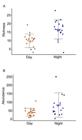
(A) Species richness and (B) abundance of fish collected from aquatic herbaceous banks in Catalão Lake during daytime and nighttime periods in the receding-water phase. Dots represent individual samples; vertical lines indicate standard deviation; horizontal bars denote the mean species richness and abundance for each period
Of the 80 fish species collected, 56 were classified as diurnal and 24 as nocturnal. Diurnal species dominated samples from both periods (mean relative abundance = 89.4%) and had a higher relative abundance during daytime (GLM, Z = -2.76, p = 0.005; Table 1; Figure 2a). For instance, Characiformes was the most abundant order in both periods, comprising 58% of individuals collected during the day (N = 438) and 79% at night (N = 1,190). Nocturnal species, mainly Gymnotiformes and Siluriformes, were predominantly recorded in nighttime samples (GLM, Z = 2.76, p = 0.005; Table 1; Figure 2b), with 20 species exclusive to this period. In contrast, only four nocturnal species -Hoplias malabaricus, Parapteronotus hasemani, Sternarchogiton nattereri, and Trachelyopterus porosus- were recorded in daytime samples.
Results of the Generalized Linear Models (GLMs) for relative abundance of diurnal, nocturnal fish, piscivorous and non-piscivorous, according to sampling period (day vs. night).
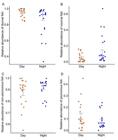
Relative abundance of fish with (A) diurnal activity, (B) nocturnal activity, (C) non-piscivore diet and (D) piscivore diet, collected from aquatic herbaceous banks in Catalão Lake during daytime (orange) and nighttime (blue) samplings. Dots represent individual samples; vertical lines indicate standard error; horizontal bars denote the mean relative abundance for each period.
The relative abundance of non-piscivorous individuals (mean = 89.5%) captured in herbaceous banks was consistently higher than that of piscivorous individuals (mean = 10.5%) across both diel periods (Figure 2cd). There was a slightly higher percentage of individuals with piscivore diet during daytime (mean = 9.6%) compared to nighttime (mean = 6.5%) (Table 1; Figure 2d). Even though, during nighttime sampling, the total number of individuals with piscivore diet (N = 97) was greater than in daytime sampling (N = 72).
The composition of fish assemblages differed between diel periods (PERMDISP, pseudo-F = 1.18, p = 0.33; PERMANOVA, pseudo-F = 5.34, p = 0.001). The first two axes of the Principal Coordinates Analysis (PCoA) explained approximately 35% of total variation in the assemblage structure (Figure 3). Daytime samples were associated with more negative scores along the two first PCoA axes, whereas nighttime samples corresponded to more positive values on these axes (Figure 3). Additionally, greater variability in assemblage structure was observed among the nighttime samples.
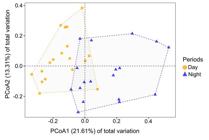
Principal Coordinates Analysis (PCoA) of the taxonomic composition of fish assemblages sampled from aquatic herbaceous banks during daytime and nighttime periods. Colored circles represent daytime samplings sites (n = 18), and colored triangles represent nighttime sampling sites (n = 18). The groups were delimited based on the smallest convex polygon that involves all points of each period.
The hypothesis that richness, abundance, and assemblage structure would differ between diel periods -with higher richness and abundance at night- was corroborated. Diurnal species, primarily from Characiformes and Cichliformes, dominated in both periods but were more abundant at night. Furthermore, non-piscivorous fishes were more abundant than piscivorous fishes in both daytime and nighttime samples, consistent with expected trophic structure in floodplain systems (Soares et al. 1986). Nonetheless, the results also underscore the importance of herbaceous banks as foraging grounds for both diurnal and nocturnal predators.
In floodplain environments characterized by high turbidity and low light penetration, fish assemblages commonly include high proportions of nocturnal taxa, such as catfishes (Siluriformes) and electric fishes (Gymnotiformes) (Bogotá-Gregory et al. 2020). These groups employ light-independent sensory systems -including chemoreception, tactile cues, auditory perception, and electroreception- for orientation and prey detection (Rodríguez and Lewis Jr. 1997), which possibly increase predation efficiency in structurally complex habitats such as aquatic herbaceous banks. On the other hand, it is possible that the lower relative abundance of piscivorous fish at night in the herbaceous banks results in a smaller individual risk of death to the diurnal prey fishes seeking refuge in that habitat, so contributing to the maintenance of such defensive strategy. However, the effects of habitat complexity on foraging efficiency of predators may involve different density-dependence mechanisms and vary according to the spatial scale (Johnson 2006), which can be even more complex in a high-diversity environment such as the Amazonian floodplains. Moreover, the effectiveness of such defensive strategies against a diversity of predators oriented by different stimuli (visual, chemical, tactile, electrical) remains to be tested.
In conclusion, the results of this study demonstrate that herbaceous banks constitute essential habitats for fish assemblages in floodplain lakes. These habitats are temporally shared among species, facilitating coexistence of taxa by possibly reducing competition for food and space. Additionally, the findings highlight the dynamic nature of trophic interactions within these habitats, challenging the traditional dichotomy that views herbaceous banks solely as refuges or as foraging zones for non-piscivorous species. Instead, they apparently emerge as key arenas of trophic activity shaped by diel cycles, structural complexity, and predator-prey dynamics, which should be further tested.
ACKNOWLEDGMENTS
This study was supported by Coordenação de Aperfeiçoamento de Pessoal de Nível Superior (CAPES), Brazil - Funding Code 001, and Fundação de Amparo à Pesquisa do Estado do Amazonas (FAPEAM/POSGRAD BADPI INPA).
REFERENCES
- Arrington, D.A.; Winemiller K.O. 2003. Diel changeover in sandbank fish assemblages in a neotropical floodplain river. Journal of Fish Biology 63: 442-459.
- Bogotá-Gregory, J.D.; Lima, F.C.T.; Correa, S.B.; Silva-Oliveira, C.; Jenkins, D.G.; Ribeiro, F.R.; et al 2020. Biogeochemical water type influences community composition, species richness, and biomass in megadiverse Amazonian fish assemblages. Scientific Reports 10: 15349.
- Diamond, J. 1988. Factors controlling species diversity: overview and synthesis. Annals of the Missouri Botanical Garden 75: 117-129.
- Hill, J.L.; Hill, R.A. 2001. Why are tropical rain forests so species rich? Classifying, reviewing and evaluating theories. Progress in Physical Geography 23: 326-354.
- Johnson, D.W. 2006. Predation, habitat complexity, and variation in density-dependent mortality of temperate reef fishes. Ecology 87: 1179 - 1188.
- Kronfeld-Schor, N.; Dayan, T. 2003. Partitioning of time as an ecological resource. Annual Review of Ecology, Evolution, and Systematics 34: 153-181.
- Lowe-Mcconnell, R.H. 1987. Ecological Studies in Tropical Fish Communities, Cambridge University Press, Cambridge. 382 p.
- Petry, P.; Bayley, P.B.; Markle, D.F. 2003. Relationships between fish assemblages, macrophytes and environmental gradients in the Amazon River floodplain. Journal of Fish Biology 63: 547-579.
- Queiroz, L.J.; Torrente-Vilara, G.; Ohara, W.M.; Pires, T.; Zuanon, J.A.S.; Doria, C.R.C. 2013. Peixes do rio Madeira 3 volumes, Dialeto Latin American Documentary, São Paulo. 1169 p.
- R CORE TEAM. R: A language and environment for statistical computing (4.4.3). R Foundation for Statistical Computing. Vienna, Austria, 2025.
- Rodríguez, M.A; Lewis Jr, W.M. 1997. Structure of fish assemblages along environmental gradients in floodplain lakes of the Orinoco River. Ecological Monographs 67: 109-128.
- Röpke, C.P.; Ferreira, E.; Zuanon, J. 2014. Seasonal changes in the use of feeding resources by fish in stands of aquatic macrophytes in an Amazonian floodplain, Brazil. Environmental Biology of Fishes 97: 401-414.
- Sabino, J.; Zuanon, J. 1998. A stream fish assemblage in Central Amazonia: distribution, activity patterns and feeding behavior. Ichthyological Exploration of Freshwaters 8: 201-210.
- Schoener, T.W. 1974. Resource partitioning in ecological communities: research on how similar species divide resources helps reveal the natural regulation of species diversity. Science 185: 27-39.
- Sleen, P.; Albert, J.S. 2018. Field Guide to the Fishes of the Amazon, Orinoco & Guianas Princeton University Press, Princeton. 465p.
- Soares, M.G.M; Almeida, R.G.; Junk, W.J. 1986. The trophic status of the fish fauna in Lago Camaleão, a macrophyte dominated floodplain lake in the middle Amazon. Amazoniana 9: 511-526.
- Thomaz, S.M.; Cunha, E.R. 2010. The role of macrophytes in habitat structuring in aquatic ecosystems: methods of measurement, causes and consequences on animal assemblages’ composition and biodiversity. Acta Limnologica Brasiliensia 22: 218-236.
- Yeoh, D.E.; Valesini, F.J.; Hallett, C.S.; Abdo, D.A.; Williams, J. 2017. Diel shifts in the structure and function of nearshore estuarine fish communities. Journal of Fish Biology 9: 1214-1243.
- Zuanon, J.; Ferreira, E. 2008. Feeding Ecology of Fishes in the Brazilian Amazon - A Naturalist Approach. In: Cyrino, J.E.P.; Bureau, D.P.; Kapoor, G. (Eds.). Feeding and Digestive Functions of Fishes Science Publishers, New Hampshire. p.1-34.
Data availability
The data that support the findings of this study are available, upon reasonable request, from the corresponding author, Diana Mayra Kohler.
Edited by
-
ASSOCIATE EDITOR:
Naraiana Benone https://orcid.org/0000-0003-4155-9938


