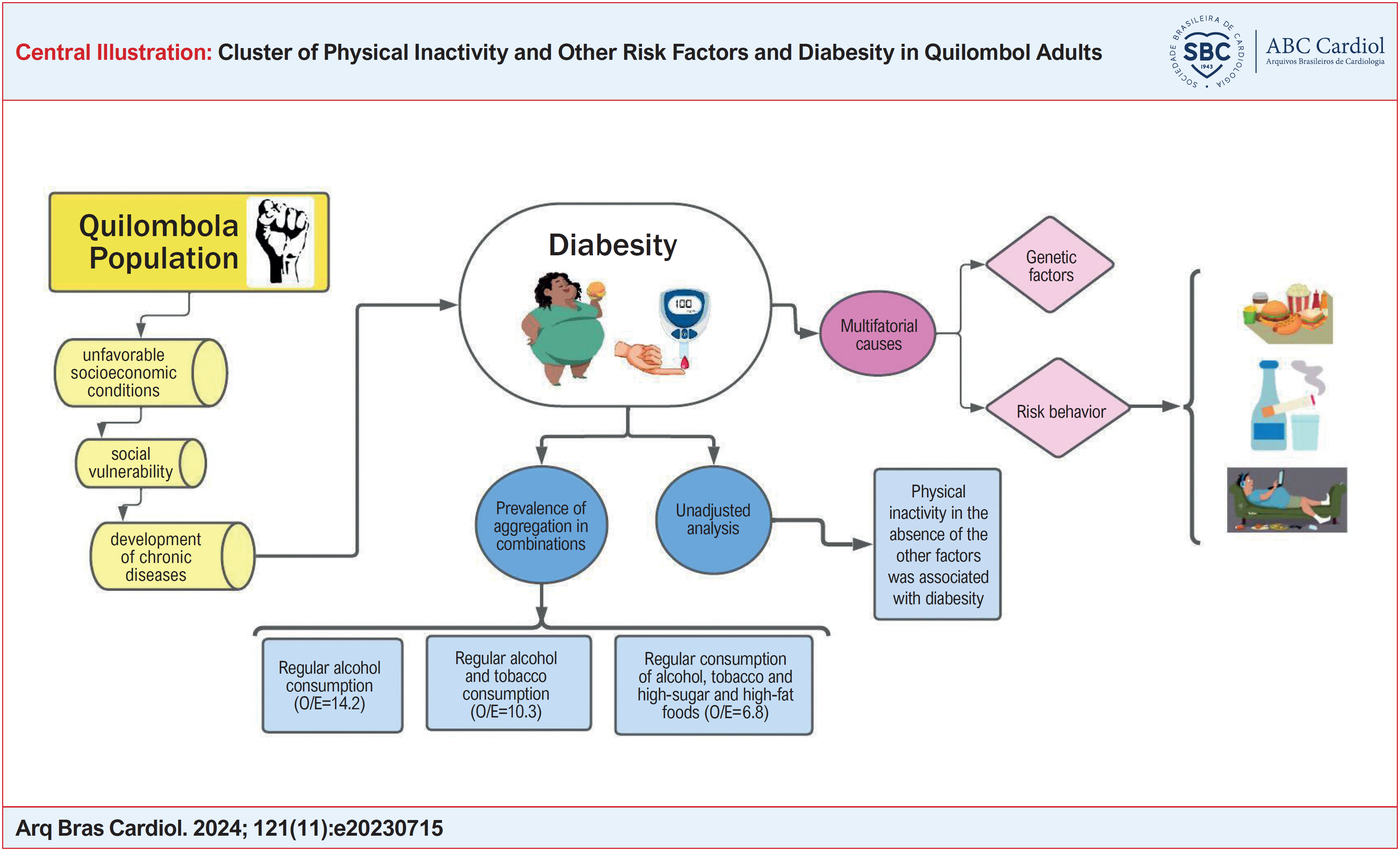
 Cluster of Physical Inactivity and Other Risk Factors and Diabesity in Quilombol Adults
ABSTRACT
Background: Diabesity is a condition characterized by the coexistence of type 02 diabetes and obesity. The causes are multifactorial, resulting from a complex interaction of genetic and behavioral factors. Among the behavioral factors, there are physical inactivity, inadequate eating habits and excessive consumption of alcohol and tobacco.
Objective: To investigate the clustering of physical inactivity and other risk factors and the association between risk factor combinations and the presence of diabesity in quilombola adults.
Methods: Cross-sectional study involving a sample of 332 middle-aged and older adults (≥ 50 years) selected among participants in the "Epidemiological Profile of Quilombolas in Bahia" study. Data were collected by interview and anthropometric assessment. Descriptive statistics, cluster analysis, and multinomial logistic regression procedures were used for data analysis.
Results: The highest prevalence of clustering was identified for the combinations of regular alcohol consumption in the absence of the other factors (O/E=14.2; 95%CI 0.87-1.15), followed by regular alcohol and tobacco consumption (O/E=10.3; 95%CI 0.64-0.95) and regular consumption of alcohol, tobacco and foods high in sugar and fat (O/E=6.8; 95%CI= 1.31-1.75). Unadjusted analysis revealed an association between physical inactivity in the absence of the other factors (OR=0.82; 95%CI 0.78-0.86) and diabesity.
Conclusion: Alcohol consumption was the most prevalent factor among the largest combinations evaluated. Furthermore, the presence of physical inactivity without the other behaviors analyzed and the absence of all behaviors were associated with diabesity only in unadjusted analysis.
Keywords:
Risk-Taking; Diabetes Mellitus; Obesity; Quilombola Communities
Resumo
Fundamento: A diabesidade é uma condição caracterizada pela coexistência de diabetes tipo 02 e obesidade. As causas são multifatoriais, resultantes de uma complexa interação de fatores genéticos e comportamentais. Entre os fatores comportamentais, destacam-se a inatividade física, os hábitos alimentares inadequados e o consumo excessivo de álcool e tabaco.
Objetivo: Investigar o agrupamento (clustering) da inatividade física e outros fatores de risco e a associação entre as combinações de fatores de risco e a presença de diabesidade em adultos quilombolas.
Métodos: Trata-se de estudo transversal com amostra composta por 332 adultos de meia idade e idosos (idade ≥ 50 anos), selecionados entre os participantes do estudo "Perfil epidemiológico dos quilombolas baianos". Os dados foram obtidos por meio de entrevistas e avaliação antropométrica. Para a análise dos dados, foram utilizadas estatísticas descritivas, análise de cluster e procedimentos de regressão logística multinominal.
Resultado: A maior prevalência de agrupamento foi identificada para as combinações de consumo regular de álcool sem a presença dos demais fatores (O/E=14,2; IC95%= 0,87-1,15), seguido de consumo regular de álcool e tabaco (O/E=10,3; IC95%= 0,64-0,95) e consumo regular de álcool, tabaco e alimentos ricos em açúcar e gorduras (O/E=6,8; IC95%= 1,31-1,75). Na análise bruta, foram observadas associações entre inatividade física sem a presença dos demais fatores (OR= 0,82 IC95%= 0,78-0,86) e diabesidade.
Conclusão: O consumo de álcool foi o fator mais prevalente nas maiores combinações avaliadas. Além disso, inatividade física, sem os outros comportamentos analisados, e a ausência de todos os comportamentos associaram-se à diabesidade apenas na análise bruta.
Palavras-chave:
Assunção de Riscos; Diabetes Mellitus; Obesidade; Quilombolas
Introduction
Diabesity is a term used to describe the adverse health effects of the simultaneous presence of two conditions: obesity and type 2 diabetes mellitus.1
Obesity is a prominent risk factor for type 2 diabetes since it triggers insulin resistance and metabolic complications.2,3 It is estimated that between 80 and 90% of individuals with type 2 diabetes are obese and the risk is directly linked to the increase in body mass index.4 Projections indicate that, by 2025, more than 300 million people will have obesity-associated type 2 diabetes mellitus.5
The causes of obesity and diabetes are multifactorial and are the result of a complex interaction between genetic and behavioral factors. Important behavioral factors include inadequate eating habits, excessive consumption of alcohol and tobacco, and physical inactivity.6,7
Physical inactivity is a serious public health problem and is responsible for more than three million deaths per year worldwide. Despite this, estimates indicate that one third of the world population older than 15 years does not meet the minimum recommendation of the World Health Organization (WHO), i.e., performing at least 150 minutes of physical activity per week.8
In addition to physical inactivity, inadequate eating habits seem to directly influence the development of obesity and type 2 diabetes mellitus. The increased consumption of processed carbohydrates with a high glycemic index can lead to hormonal changes that promote the accumulation of adipose tissue, exacerbate hunger, and reduce energy expenditure.9 On the other hand, the WHO recommends the consumption of fruits and vegetables in order to reduce the incidence of cardiovascular diseases and certain types of cancer, as well as to prevent and treat overweight and diabetes.10
Another risk behavior that deserves attention is tobacco consumption. Evidence indicates a significant association between smoking and a higher prevalence of overweight and obesity, as the metabolic effects of nicotine favor the accumulation of abdominal fat.11 Furthermore, smoking also promotes important metabolic changes involved in the development of type 2 diabetes. Nicotine has been shown to reduce the secretion of insulin, to increase plasma cortisol levels, and to induce cell dysfunction and apoptosis.12
Regarding abusive alcohol consumption, studies have shown that type 2 diabetes is caused by a direct action of alcohol13 or by other unhealthy behaviors observed in alcohol drinkers.6
According to the literature, the health-disease process is the result of the individuals’ living conditions, i.e., their habits and lifestyle, socioeconomic conditions, culture, and the environment where they live.14 From this perspective, it is evident that unfavorable socioeconomic conditions increase the susceptibility to risk behaviors15 and to the development of chronic diseases.16
Within this context, Brazilian studies on social inequalities that address race/skin color have demonstrated poor health outcomes in the black population.17,18
Among the different Brazilian black population profiles, the quilombola population faces a situation of social vulnerability,18 because of their difficult access to public policies and inadequate socioeconomic conditions.19,20
Furthermore, diabetes is known to affect black populations differently, influenced by genetic, environmental and behavioral factors, as well as by socioeconomic vulnerability.21,22 A similar scenario seems to apply to obesity.
Therefore, economic conditions can negatively influence the quality of life of adult and elderly quilombolas, who experience conditions that are unfavorable to healthy aging.23 Previous studies have investigated risk behaviors and the individual conditions of diabetes6 and obesity24 in adults and older adults. The results indicated that these conditions tend to occur simultaneously, a fact that has important short-, medium- and long-term health implications. However, studies analyzing combinations of risk factors related to diabesity are still incipient, especially in elderly quilombolas.
Within this context, the aim of the present study was to investigate physical inactivity and other risk factors, and the association between risk factor combinations and the presence of diabesity in adult quilombolas.
Methods
A population-based, cross-sectional, descriptive study involving a population of quilombo remnants from the microregion of Guanambi, Bahia, Brazil, was conducted from April to November 2016. The region is composed of 18 municipalities and had 42 certified quilombos during the sampling period, distributed across 10 of these municipalities.25
The sample size was calculated assuming a prevalence of unknown outcome of 50%, confidence interval of 95%, sampling error of 5%, and an effect size of 1.5 for a one-stage cluster sample; 30% for refusals and 20% for losses and confounding were added. Further details regarding the sample selection process have been published previously.26 For the present study, data of middle-aged and older adults (≥ 50 years) were included, and the sample consisted of 348 individuals (40.8% of the total population).
Data were collected by interview and anthropometric measurements, which were conducted by teams of healthcare workers and/or students according to their qualifications, after they had been trained in their respective function. The following data were collected: sex (male or female); age in complete years and categorized by age group (50 to 74 or ≥ 75 years); occupation (unpaid or paid work); marital status (with or without a partner); educational level (≤ 5 or > 5 years of schooling); tobacco consumption (yes: smokes or has smoked; no: never smoked); regular alcohol consumption (yes: drinks or sporadically drinks, no: never drinks); regular consumption of fruits and vegetables (yes: always, almost always, sometimes, no: never); consumption of foods high in sugar and fat (yes: always, almost always, sometimes, no: never); presence of diabetes (yes or no).
Physical activity was evaluated using the short version of the International Physical Activity Questionnaire (IPAQ),27 which assesses the weekly time spent in moderate or vigorous physical activity across different life domains (work, household tasks, transportation, and leisure). Subjects whose sum of moderate or vigorous physical activity in the different domains was less than 150 minutes per week were classified as insufficiently active.
Diabesity was classified based on the self-reported diagnosis of diabetes mellitus and the measurement of waist circumference.28 The presence of diabesity was defined when participants with a self-reported diagnosis of diabetes simultaneously had a waist circumference > 90 cm for men and > 80 cm for women.29
Descriptive statistics (simple and relative frequencies and measures of dispersion) were used for univariate analysis of the data. For bivariate analysis, Pearson's chi-square test was applied to compare the variables between men and women using the Statistical Package for the Social Sciences (SPSS version 22 for Windows).
The simultaneous presence or clustering of factors related to diabesity was analyzed by calculating the joint probability of the exhibited behaviors. The presence of clustering was evaluated by comparing the observed (O) and expected (E) prevalence. Clustering is defined when the O/E ratio > 1.0. For analysis of the association of the predictors with diabesity, the odds ratio (OR) was estimated from the binary logistic regression model.
The "Epidemiological Profile of Quilombolas in Bahia" study was approved by the Ethics Committee of Universidade Estadual do Sudoeste da Bahia (Opinion No. 1.386.019/2016) and was conducted following the Brazilian guidelines on research involving humans, in accordance with Resolution 466/2012 of the National Health Council.
Results
The mean age of the individuals included in the study was 61.4 ± 9.5 years and most of them were female (52.5%). The prevalence of physical inactivity, lack of fruit and vegetable consumption, alcohol consumption, smoking and consumption of high-sugar and high-fat foods was 23.6%, 41.8%, 25.6%, 47.9% and 89.9%, respectively. Furthermore, 17.8% of the respondents had diabesity (Table 1).
Association between sociodemographic characteristics and lifestyle-related risk factors in adult quilombolas living in the municipality of Guanambi, Bahia, Brazil
The results of Table 2 show the lack of associations between individual risk factors and the presence of diabesity.
Among the 32 possible combinations, cluster scores were obtained for six combinations. The highest scores were identified for the combinations of regular alcohol consumption in the absence of the other factors (O/E=14.2), followed by regular alcohol and tobacco consumption (O/E=10.3), and regular consumption of alcohol, tobacco and high-sugar and high-fat foods (O/E=6.8) (Table 3).
Observed and expected prevalence of the combinations of lifestyle-related risk factors in adult quilombolas living in the municipality of Guanambi, Bahia, Brazil
Evaluation of the association between all combinations of risk factors and the presence of diabesity revealed associations of diabesity with the absence of risk factors (OR=0.81; 95%CI 0.77-0.86) and with physical inactivity in the absence of the other factors (OR=0.82; 95%CI 0.78-0.86) only in the unadjusted analysis (Table 3).
Discussion
The results of the present study showed a prevalence of diabesity of approximately 18.0%. The highest cluster scores were observed for the combinations of alcohol consumption in the absence of other risk factors, followed by regular consumption of alcohol and tobacco, and regular consumption of alcohol, tobacco and high-sugar and high-fat foods. Furthermore, the absence of all risk behaviors was associated with a lower prevalence of diabesity only in the unadjusted analysis.
The prevalence of diabesity observed here was higher than that found in a study conducted on Spanish workers (10.0%).30 Although diabesity has been recognized for some time, few studies have evaluated its occurrence in specific population groups. On the other hand, studies conducted in Brazil31,32 and in other countries30,33 have continuously investigated the occurrence of type 2 diabetes mellitus and obesity.
In the black population, Brazilian studies have reported a prevalence of diabetes and obesity ranging from 9,8%34 to 23,5%35 and from 27,7%26 to 56,6%,32 respectively.
Among the behavior combinations evaluated, the presence of regular alcohol consumption among those with the highest cluster scores called attention. Moreover, the combinations of regular alcohol consumption with the consumption of tobacco and high-sugar/high-fat foods were prevalent among adult quilombolas.
Our results are in line with the findings of Cardoso, Melo and César36 who demonstrated associations between alcohol consumption and smoking in adult quilombola populations. It is worth mentioning that the continuous use of tobacco increases the risk of consuming alcoholic beverages36 and is a leading risk factor for non-communicable chronic degenerative diseases.37,38 These findings indicate the lack of access to health promotion activities, especially among populations living under unfavorable socioeconomic conditions.
Analysis of the data from the 2013 National Health Survey (PNS) involving urban populations showed that abusive alcohol consumption is associated with diabetes mellitus.6 In a study evaluating adult quilombolas, Campagna et al.39 demonstrated that being a former smoker has a negative impact on body weight and glycemic control and consequently increases the risk of diabetes.
Regarding food consumption patterns in Brazil, a previous study conducted by Levy-Costa et al.40 showed a decline in the consumption of basic and traditional foods, while the consumption of industrialized and high-fat foods had increased. Studies on quilombola communities have reported a low consumption of fruits and vegetables in these populations, which contributes to weight gain and an increase in cardiovascular risk.41,42
Queiroz et al.,32 who evaluated adult quilombolas in the region of Minas Gerais, showed a higher frequency of the intake of sweet foods (cakes, candies, and cookies) over one week compared to fruit and vegetable consumption. Exposure to poverty, a common condition among quilombola populations, favors the consumption of industrialized foods that are less costly but have a low nutritional value and are high in energy.43 The economic condition is an important factor that directly influences the life of quilombola families. Because the household income is often not sufficient, these families are unable to purchase highly nutritious foods, which negatively influence the health status of these individuals.44
In our study, the absence of risk behaviors was associated with the presence of diabesity only in the unadjusted analysis. This result somehow agrees with the findings of an international study conducted with Spanish workers that demonstrated a relationship of the prevalence of diabesity with exposure to a non-heart-healthy diet and lack of participation in exercise programs.30
Thus, in a multifactorial context, physiological mechanisms of aging such as higher abdominal fat deposition, in conjunction with risk behaviors – which contribute to an increase in proinflammatory cytokines and a reduction in high-density lipoprotein levels – are closely related to diabesity in this population.45,46
With regard to physical activity, Soares and Barreto42 reported a negative relationship between obesity and the level of physical activity in adult quilombolas. Pitanga et al.,47 who evaluated black adults aged 20 to 96 years living in the city of Salvador, Bahia, demonstrated an association between physical activity and diabetes mellitus.
The prevalence of physical inactivity in the quilombola population studied (23.6%) is similar to the 26.3% found among quilombolas in the municipality of Vitória da Conquista, Bahia.41 Regular physical activity is directly linked to health improvement and/or maintenance in individuals of all ages and is inversely associated with different health risk factors.48
Despite the incipient information about the association of risk behaviors with diabesity, it is well established in the literature that inadequate eating habits, alcohol and tobacco consumption and lack of regular physical activity are directly related to the increase in obesity and changes in glycemic indexes, and possibly contribute to the onset and aggravation of type 2 diabetes mellitus.34,42
According to the literature, the management of diabesity should consist of combined treatment strategies since both diabetes and obesity require actions that encourage lifestyle changes.49 Thus, healthcare professionals should design a multidisciplinary approach for diabetic and obese patients that addresses dietary changes and an active lifestyle.
Among the limitations of this study, we cite the fact that some variables were self-reported, which can cause possible memory bias. Another limitation is its cross-sectional design, which impairs the determination of a causal relationship between the factors studied. The strengths of this study are the inclusion of a representative sample of middle-aged and elderly quilombolas, communities that are still little investigated, and the use of previously validated assessment instruments. In addition, the study addresses a relevant problem, especially in this population that is characterized by a low educational level, low income, and insufficient access to health services.
Finally, the results of the present study showed that alcohol consumption was the most prevalent factor among the main combinations evaluated. The presence of physical inactivity, in the absence of the other factors, was associated with diabesity only in the unadjusted analysis.
Conclusion
Taken together, our findings reinforce the importance of obtaining data that will assist in early intervention in order to prevent and control weight gain and diabetes, together with investments in health promotion programs such as interventions that encourage healthy eating, physical activity, and restrict tobacco and alcohol.
-
Sources of funding
There were no external funding sources for this study.
-
Study association
This article is part of the thesis of master submitted by Poliana Santana Pereira, from Universidade Estadual do Sudoeste da Bahia (UESB) e Universidade Estadual de Santa Cruz (UESC).
-
Ethics approval and consent to participate
This study was approved by the Ethics Committee of the Universidade do Estado da Bahia - UNEB under the protocol number 1.386.019. All the procedures in this study were in accordance with the 1975 Helsinki Declaration, updated in 2013. Informed consent was obtained from all participants included in the study.
Acknowledgements
We would like to thank the Study Group on Epidemiology, Physical Activity and Health (GEAFS) of the State University of Southwest Bahia (UESB).
References
-
1 Guarisco G, Leonetti F. Covid-19 and diabesity: when a pandemia cross another pandemia. Eat Weight Disord. 2021 Jun;26(5):1283-1286. https://doi.org/10.1007/s40519-020-00958-9
» https://doi.org/10.1007/s40519-020-00958-9 -
2 Toplak, H, Leitner, DR, Harreiter, J, Hoppichler F, Wascher TC, Karin Schindler K, et al. „Diabesity" – Adipositas und Typ-2-Diabetes (Atualização 2019). Wien Klin Wochenschr 131 (Supl 1), 71–76 (2019). https://doi.org/10.1007/s00508-018-1418-9
» https://doi.org/10.1007/s00508-018-1418-9 -
3 Ng ACT, Delgado V, Borlaug BA, Bax JJ. Diabesity: the combined burden of obesity and diabetes on heart disease and the role of imaging. Nat Rev Cardiol. 2021 Apr;18(4):291-304. https://doi.org/10.1038/s41569-020-00465-5
» https://doi.org/10.1038/s41569-020-00465-5 -
4 Chawla R, Jaggi S. Medical Management of Diabesity. J Assoc Physicians India. 2019; 67(12):52-56 [acesso em 10 out 2022]. Disponível em: https://pubmed.ncbi.nlm.nih.gov/31801332/
» https://pubmed.ncbi.nlm.nih.gov/31801332/ -
5 Bhupathiraju SN, Hu FB. Epidemiology of Obesity and Diabetes and Their Cardiovascular Complications. Circ Res. 2016 27;118(11):1723-35. https://doi.org/10.1161/CIRCRESAHA.115.306825
» https://doi.org/10.1161/CIRCRESAHA.115.306825 -
6 Malta DC, Bernal RT, de Souza MF, Szwarcwald CL, Lima MG, Barros MB. Social inequalities in the prevalence of self-reported chronic non-communicable diseases in Brazil: national health survey 2013. Int J Equity Health. 2016; 15(1):153. https://doi.org/10.1186/s12939-016-0427-4
» https://doi.org/10.1186/s12939-016-0427-4 -
7 Pitanga FJG, Matos SMA, Almeida MDCC, Patrão AL, Molina MDCB, Aquino EM. Association between leisure-time physical activity and sedentary behavior with cardiometabolic health in the ELSA-Brazil participants. SAGE Open Med. 2019;7:2050312119827089. Doi: https://doi.org/10.1177/2050312119827089
» https://doi.org/10.1177/2050312119827089 -
8 Pratt M, Ramirez Varela A, Salvo D, Kohl Iii HW, Ding D. Attacking the pandemic of physical inactivity: what is holding us back? Br J Sports Med. 2020 Jul;54(13):760-762. https://doi.org/10.1136/bjsports-2019101392
» https://doi.org/10.1136/bjsports-2019101392 -
9 Ludwig DS, Ebbeling CB. The Carbohydrate-Insulin Model of Obesity: Beyond "Calories In, Calories Out". JAMA Intern Med. 2018;178(8):1098–1103. https://doi.org/10.1001/jamainternmed.2018.2933
» https://doi.org/10.1001/jamainternmed.2018.2933 -
10 World Health Organization. Global status report on noncommunicable diseases 2014. Geneva: WHO; 2014 [acesso em 12 nov 2022]. Disponível em: https://apps.who.int/iris/bitstream/handle/10665/148114/9789241564854_eng.pdf
» https://apps.who.int/iris/bitstream/handle/10665/148114/9789241564854_eng.pdf -
11 Faria C da S, Botelho C, Silva RMVG da, Ferreira MG. Tabagismo e obesidade abdominal em doadores de sangue. J bras pneumol. 2012; 38(3):356–63. Doi: https://doi.org/10.1590/S1806-37132012000300011
» https://doi.org/10.1590/S1806-37132012000300011 -
12 Sociedade Brasileira De Diabetes (SBD). Diretrizes da Sociedade Brasileira de Diabetes 2017-2018 / Organização José Egídio Paulo de Oliveira, Renan Magalhães Montenegro Junior, Sérgio Vencio. -- São Paulo : Editora Clannad, 2017 [acesso em 12 nov 2022]. Disponível em: https://edisciplinas.usp.br/pluginfile.php/4925460/mod_resource/content/1/diretrizes-sbd-2017-2018.pdf
» https://edisciplinas.usp.br/pluginfile.php/4925460/mod_resource/content/1/diretrizes-sbd-2017-2018.pdf -
13 Kim JY, Lee DY, Lee YJ, Park KJ, Kim KH, Kim JW, et al. Chronic alcohol consumption potentiates the development of diabetes through pancreatic β-cell dysfunction. World J Biol Chem. 2015;6(1):1-15. https://doi.org/10.4331/wjbc.v6.i1.1
» https://doi.org/10.4331/wjbc.v6.i1.1 -
14 Carvalho AI; Buss PM. Determinantes Sociais na Saúde, na doença e na intervenção. In: Giaconella L, Scorel S, Lobato LVC, Noronha JC, Carvalho A. I. (org.). Políticas e Sistema de Saúde no Brasil. Rio de Janeiro: FIOCRUZ, 2008, p. 125-156. (versão online https://pt.slideshare.net/gersonsouza2016/determinantes-sociais-na-sade-na-doena-e-na-interveno
» https://pt.slideshare.net/gersonsouza2016/determinantes-sociais-na-sade-na-doena-e-na-interveno -
15 Furtado BNS, Olinda RA de, Costa GMC, Menezes TN de. Fatores relacionados à capacidade física de membros superiores e inferiores de idosos quilombolas. Ciência & Saúde Coletiva 2021O;26(10):4591–602. https://doi.org/10.1590/1413-812320212610.11252021
» https://doi.org/10.1590/1413-812320212610.11252021 -
16 Barros MB, César CLG, Carandina L, Torre GD. Desigualdades sociais na prevalência de doenças crônicas no Brasil, PNAD-2003. Cien Saude Coletiva 2006;11(4):911–26. https://doi.org/10.1590/S1413-81232006000400014
» https://doi.org/10.1590/S1413-81232006000400014 -
17 Paixão M., Rosseto I., Montovanele F., Carvano LM. Laboratório de Análises Econômicas, Históricas, Sociais, e Estatísticas das Relações Raciais (LAESER). Relatório Anual das Desigualdades Raciais; 2009-2010: Constituição Cidadã, seguridade social e seus efeitos sobre as assimetrias de cor ou raça. 2010 [acesso em 12 nov 2022]. Disponível em: https://www.palmares.gov.br/wp-content/uploads/2011/09/desigualdades_raciais_2009-2010.pdf
» https://www.palmares.gov.br/wp-content/uploads/2011/09/desigualdades_raciais_2009-2010.pdf -
18 Araújo RLM de S, Araújo EM de, Silva HP de, Santos CA de ST, Nery FS, Santos DB dos S, et al. Condições de vida, saúde e morbidade de comunidades quilombolas do semiárido baiano, Brasil. Rev. Baiana Saúde Pública 2019; 43(1): 226-246. https://doi.org/10.22278/2318-2660.2019.v43.n1.a2988
» https://doi.org/10.22278/2318-2660.2019.v43.n1.a2988 -
19 Matos F, Vasconcelos LR, Rocha SV, Mussi, RF. Subdiagnóstico da Hipertensão Arterial em adultos quilombolas de região baiana, Brasil. Research, Society and Development 2021; 10(2): e37210211055. http://dx.doi.org/10.33448/rsd-v10i2.11055
» http://dx.doi.org/10.33448/rsd-v10i2.11055 -
20 Miranda S, Oliveira J, Sampaio C, Rodrigues Neto J. Artigos Cartografia das condições de trabalho de a informalidade e a saúde mental. Interface (Botucatu), 2021;25:e200478. https://doi.org/10.1590/interface.200478
» https://doi.org/10.1590/interface.200478 -
21 Holmes LJ, Hoissain J, Ward D, Opara F. Racial/ethnic variability in diabetes mellitus among United States residents is unexplained by lifestyle, sociodemographics and prognostic factors. ISRN Public Health,2012; e408079. https://doi.org/10.5402/2012/408079
» https://doi.org/10.5402/2012/408079 -
22 International Diabetes Federation. IDF DIABETES ATLAS Eighth edition 2017. [acesso em 10 out 2022]. Disponível em: http: https://diabetesatlas.org/upload/resources/previous/files/8/IDF_DA_8e-EN-final.pdf
» https://diabetesatlas.org/upload/resources/previous/files/8/IDF_DA_8e-EN-final.pdf -
23 Santos VC, Boery EN, Pereira R, Rosa D de OS, Vilela ABA, Anjos KF dos, et al.. Socioeconomic and health conditions associated with quality of life of elderly quilombolas. 2016;25(2):e1300015. Doi: https://doi.org/10.1590/0104-07072016001300015
» https://doi.org/10.1590/0104-07072016001300015 -
24 Streb AR, Duca GFD, Silva RP da, Benedet J, Malta DC. Simultaneidade de comportamentos de risco para a obesidade em adultos das capitais do Brasil. Ciênc saúde coletiva 2020Aug;25(8):2999–3007. Doi: https://doi.org/10.1590/1413-81232020258.27752018
» https://doi.org/10.1590/1413-81232020258.27752018 -
25 Fundação Palmares, 2016. Disponível em http://www.palmares.gov.br
» http://www.palmares.gov.br -
26 Mussi RFF, Queiroz BM, Petrósky BL. Overweight and associated factors in Quilombolas from the middle San Francisco, Bahia, Brazil. Cien Saude Colet. 2018;23(4):1193-200. https://doi.org/10.1590/1413-81232018234.03662016
» https://doi.org/10.1590/1413-81232018234.03662016 -
27 Matsudo S, Araújo T, Matsudo V, Andrade D, Andrade E, Oliveira LC, et al. Questionário Internacional de Atividade Física (IPAQ): um estudo de validade e reprodutibilidade no Brasil. Revista Brasileira de Atividade Física e Saúde, v.6, n.2, p.5-18, 2001. https://doi.org/10.12820/rbafs.v.6n2p5-18
» https://doi.org/10.12820/rbafs.v.6n2p5-18 -
28 Kalra S. Diabesity. J Pak Med Assoc, 2013;63(4):532-4 [acesso em 12 nov 2022]. Disponível em: https://pubmed.ncbi.nlm.nih.gov/23905459/
» https://pubmed.ncbi.nlm.nih.gov/23905459/ -
29 Lopez-Jaramillo P, Lahera V, Lopez-Lopez J. Epidemic of cardiometabolic diseases: a Latin American point of view. Ther Adv Cardiovasc Dis. 2011 Apr;5(2):119-31. https://doi.org/10.1177/1753944711403189
» https://doi.org/10.1177/1753944711403189 -
30 Ramírez-Manent JI, Altisench Jané B, Tomás Salvà M, Arroyo Bote S, González San Miguel HM, López-González ÁA. Influence of Educational Level and Healthy Habits on the Prevalence of Diabesity in a Spanish Working Population. Nutrients. 2022; 14(19):4101. https://doi.org/10.3390/nu14194101
» https://doi.org/10.3390/nu14194101 -
31 Malta DC, Bernal RTI, Iser BPM, Szwarcwald CL, Duncan BB, Schmidt MI. Factors associated with self-reported diabetes according to the 2013. Rev Saúde Pública 2017; 51(suppl 1): 12s. https://doi.org/10.1590/S1518-8787.2017051000011
» https://doi.org/10.1590/S1518-8787.2017051000011 -
32 Queiroz, P de SF, Miranda L de P, Oliveira PSD, Neto JFR, Sampaio CA, Oliveira TL et al. Obesidade abdominal e fatores associados em comunidades quilombolas do Norte de Minas Gerais, 2019. Epidemiologia e Serviços de Saúde 2021; 30(3). https://doi.org/10.1590/S1679-49742021000300023
» https://doi.org/10.1590/S1679-49742021000300023 -
33 Rehman T, Rajaa S, Kumar G, Jayalakshmy R. Prevalence and Factors Influencing Diabesity among Persons with Type 2 Diabetes Mellitus in Urban Puducherry: A Cross-Sectional Analytical Study. Indian J Community Med. 2020 Jul-Sep;45(3):315-319. https://doi.org/10.4103/ijcm.IJCM_324_19
» https://doi.org/10.4103/ijcm.IJCM_324_19 -
34 Pauli S, Bairros FS de, Nunes LN, Neutzling MB. Prevalência autorreferida de hipertensão e fatores associados em comunidades quilombolas do Rio Grande do Sul, Brasil. Ciênc saúde coletiva 2019;24(9):3293–303. Available from: https://doi.org/10.1590/1413-81232018249.28002017
» https://doi.org/10.1590/1413-81232018249.28002017 -
35 Führ NB, Silva YM, Coelho AM, Rutzen AT, Zanatta CM, Portela SN et al. Avaliação da Prevalência de Diabetes Mellitus tipo 2 e Hipertensão Arterial Sistêmica em uma População Quilombola do Norte do Rio Grande do Sul. VIII Seminário de Ensino, Pesquisa e Extensão da UFFS. Anais do SEPE. v. 8 n. 1 (2018) [acesso em 12 nov de 2022]. Disponível em: https://portaleventos.uffs.edu.br/index.php/SEPE-UFFS/article/view/10210
» https://portaleventos.uffs.edu.br/index.php/SEPE-UFFS/article/view/10210 -
36 Cardoso LGV, Melo APS, Cesar CC. Prevalência do consumo moderado e excessivo de álcool e fatores associados entre residentes de Comunidades Quilombolas de Vitória da Conquista, Bahia, Brasil. Ciênc saúde coletiva 2015;20(3):809–20. https://doi.org/10.1590/1413-81232015203.12702014
» https://doi.org/10.1590/1413-81232015203.12702014 -
37 Almeida-Filho N, Lessa I, Magalhães L, Araújo MJ, Aquino E, James SA, Kawachi I. Social inequality and alcohol consumption-abuse in Bahia, Brazil Interactions of gender, ethnicity and social class. Soc Psychiatry Psychiatr Epidemiol 2005; 40(3):214-222. https://doi.org/10.1007/s00127-005-0883-4
» https://doi.org/10.1007/s00127-005-0883-4 -
38 Oliveira SKM, Caldeira AP. Fatores de risco para doenças crônicas não transmissíveis em quilombolas do norte de Minas Gerais. Cad Saude Colet. 2016;24(4):420-7. https://doi.org/10.1590/1414-462X201600040093
» https://doi.org/10.1590/1414-462X201600040093 -
39 Campagna D, Alamo A, Di Pino A, Russo C, Calogero AE, Purrello F, Polosa R. Correction: Smoking and diabetes: dangerous liaisons and confusing relationships. Diabetol Metab Syndr. 2023 Jun 2;15(1):117. https://doi.org/10.1186/s13098-023-01099-6
» https://doi.org/10.1186/s13098-023-01099-6 -
40 Levy-Costa RB, Sichieri R, Pontes NS, Monteiro CA. Disponibilidade domiciliar de alimentos no Brasil: distribuição e evolução (1974-2003). Rev Saúde Pública 2005; 39:530-40. https://doi.org/10.1590/S0034-89102005000400003
» https://doi.org/10.1590/S0034-89102005000400003 -
41 Bezerra VM, Andrade ACS, Cesar CC, Caiaffa WT. Comunidades quilombolas de Vitória da Conquista, Bahia, Brasil: hipertensão arterial e fatores associados. Cad Saúde Pública. 2013;29(9):1889-902. https://doi.org/10.1590/0102-311X00164912
» https://doi.org/10.1590/0102-311X00164912 -
42 Soares DA, Barreto SM. Indicadores nutricionais combinados e fatores associados em população Quilombola no Sudoeste da Bahia, Brasil. Ciênc saúde coletiva 2015;20(3):821–32. https://doi.org/10.1590/1413-81232015203.03922014
» https://doi.org/10.1590/1413-81232015203.03922014 -
43 Frozi DS. Multidimensionalidade da pobreza em comunidades quilombolas: aspectos analíticos para a segurança alimentar e nutricional. In: Pinto AR, Borges JC, Novo MP, Pires PS, organizadores. Quilombos do Brasil: segurança alimentar e nutricional em territórios titulados. Brasília, DF: Ministério do Desenvolvimento Social e Combate à Fome; 2005 [acesso em 10 out de 2022]. Disponível em: https://fpabramo.org.br/acervosocial/wp-content/uploads/sites/7/2017/08/326.pdf
» https://fpabramo.org.br/acervosocial/wp-content/uploads/sites/7/2017/08/326.pdf -
44 Freitas DA, Caballero AD, Marques AS, Hernández CIV, Antunes SLNO. Saúde e comunidades quilombolas: uma revisão da literatura. Rev CEFAC [online]. 2011; 13(5):937-943. https://doi.org/10.1590/S1516-18462011005000033
» https://doi.org/10.1590/S1516-18462011005000033 -
45 Bey L.; Hamilton MT. Suppression of skeletal muscle lipoprotein lipase activity during physical inactivity: a molecular reason to maintain daily low‐intensity activity. The Journal of Physiology 2003; 551(2): 673–682. https://doi.org/10.1113/jphysiol.2003.045591
» https://doi.org/10.1113/jphysiol.2003.045591 -
46 Meneguci J, Sasaki JE, da Silva Santos Á, Scatena LM, Damião R. Socio-demographic, clinical and health behavior correlates of sitting time in older adults. BMC Public Health. 2015; 31(15): 65. https://doi.org/10.1186/s12889-015-1426-x
» https://doi.org/10.1186/s12889-015-1426-x -
47 Pitanga FJ, Lessa I, Barbosa PJ, Barbosa SJ, Costa MC, Lopes Ada S. Atividade física na prevenção de diabetes em etnia negra: quanto é necessário? [Physical activity in the prevention of diabetes in black ethnicity: how much is required?]. Rev Assoc Med Bras (1992). 2010;56(6):697-704. Portuguese. https://doi.org/10.1590/s0104-42302010000600021
» https://doi.org/10.1590/s0104-42302010000600021 -
48 Reimers CD, Knapp G, Reimers AK. Does physical activity increase life expectancy? A review of the literature. J Aging Res. 2012;2012:243958. https://doi.org/10.1155/2012/243958
» https://doi.org/10.1155/2012/243958 -
49 Wing RR; Look AHEAD Research Group. Does Lifestyle Intervention Improve Health of Adults with Overweight/Obesity and Type 2 Diabetes? Findings from the Look AHEAD Randomized Trial. Obesity (Silver Spring). 2021 Aug;29(8):1246-1258. https://doi.org/10.1002/oby.23158
» https://doi.org/10.1002/oby.23158
Edited by
-
Editor responsible for the review:
Gláucia Maria Moraes de Oliveira