Asymptomatic Non-Bacterial Thrombotic Endocarditis Leading to a Diagnosis of Pancreatic Cancer
Non-Infective Endocarditis; Pancreatic Neoplasms; Aortic Valve Insufficiency; Heart Valve Prosthesis
Endocardite não Infecciosa; Neoplasias Pancreáticas; Insuficiência da Valva Aórtica; Próteses Valvulares Cardíacas
Non-Infective Endocarditis; Pancreatic Neoplasms; Aortic Valve Insufficiency; Heart Valve Prosthesis
Endocardite não Infecciosa; Neoplasias Pancreáticas; Insuficiência da Valva Aórtica; Próteses Valvulares Cardíacas
Introduction
Non-bacterial thrombotic endocarditis (NBTE) is a phenomenon associated with sterile vegetations composed of fibrin and platelets aggregating on healthy heart valves. Most cases are diagnosed after death or in patients experiencing systemic embolization. Diagnosis relies on clinical suspicion and a compatible echocardiographic image. The correct treatment is long-term systemic anticoagulation to avoid arterial embolization, which often presents as multiple and recurrent ischemic strokes.1
The first antemortem report of NBTE as the initial presentation of underlying pancreatic cancer was published in 2008.2 However, incidental diagnosis of uncomplicated NBTE that leads to a subsequent discovery of carcinoma is rare.
Description
A 72-year-old male patient with a previous history of valvular heart disease presented for an elective consultation due to weight loss, fatigue, and depressive symptoms. His past medical history was characterized by biologic aortic valve replacement in 2014 due to severe aortic insufficiency. He also had mild mitral stenosis, without valvular replacement. There were no signs of coronary artery disease. He had recently received a diagnosis of major depressive disorder and was started on escitalopram 15 mg with minor improvement after 2 months. His other medications included enalapril 20 mg/day, metoprolol succinate 50 mg/day, and rosuvastatin 10 mg/day. Physical examination revealed blood pressure of 143/73 mmHg, heart rate of 62 beats per minute, and no fever. His weight was 78 kg, compared to the previous consultation of 88 kg, registered 6 months prior. Cardiac auscultation revealed regular rhythm, a systolic ejection murmur (grade 2/6) in aortic focus, and a diastolic murmur (grade 2/6) at the apex. Laboratory exams showed hemoglobin of 10.1 g/dL, platelets of 365,000/mm3 and normal leucocyte count (8,120/mm3 with 4% immature forms).
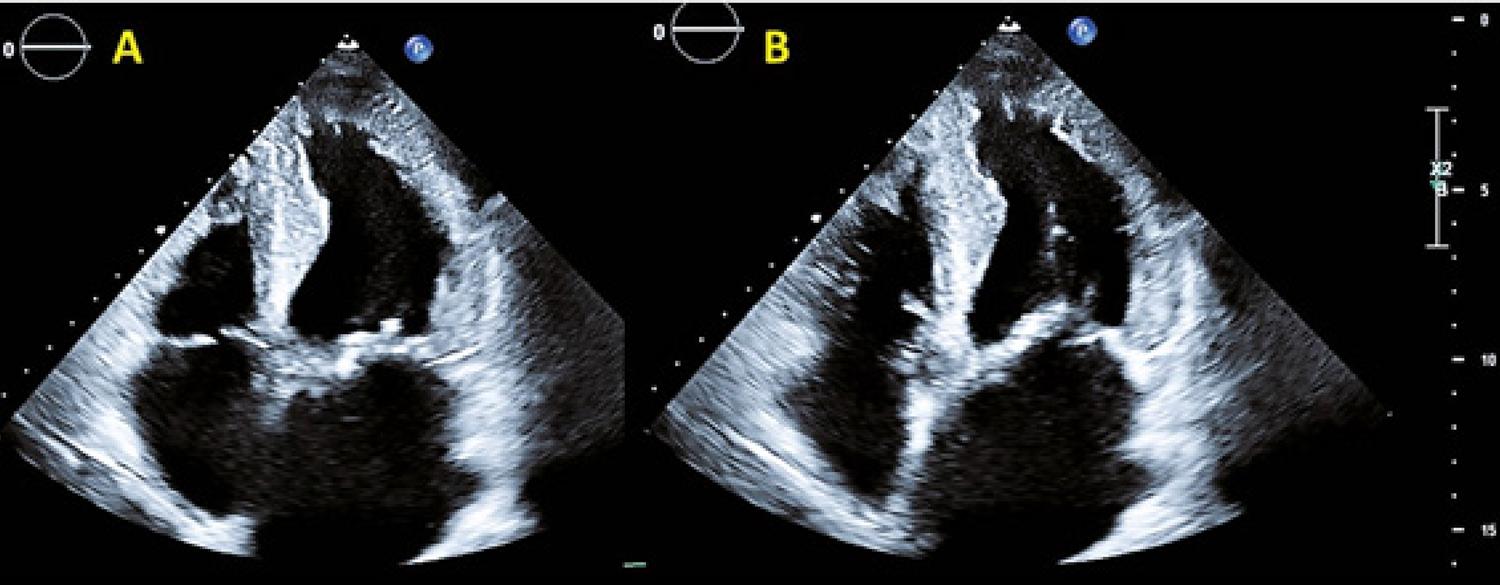
A transthoracic echocardiogram was performed, showing a 10 mm filamentous mobile echodense mass implanted on the anterior leaflet of the native mitral valve ( Figure 1 , Video 1 ). This valve also presented signs of moderate regurgitation and moderate stenosis (effective regurgitant orifice area of 0.29 cm2). The aortic bioprosthetic valve mobility was normal, and there was mild perivalvular posterior leak. There was also concentric left ventricular hypertrophy (septum and posterior wall of 14 mm), severe left atrial enlargement (volume of 77 ml/mm2) and left ventricular ejection fraction of 58%.

– Transthoracic echocardiogram (apical 4-chamber view) showing a 10 mm filamentous mobile echodense mass implanted on the anterior leaflet of the native mitral valve (A and B).
– Transthoracic echocardiogram (apical 4-chamber view) showing a 10 mm filamentous mobile echodense mass implanted on the anterior leaflet of the native mitral valve. http://abcimaging.org/supplementary-material/2025/3801/2024-0126_video_01.mp4
The patient was admitted for investigation with the main clinical suspicion of infective endocarditis. Multiple blood cultures were collected. The rheumatoid factor was negative, and there were no abnormalities in the urine analysis. The workup for bacterial endocarditis was negative. As a consequence, anticoagulation with low-molecular weight heparin was initiated. An abdominal computed tomography was also performed for additional investigation, revealing a large mass in the pancreas head, with extension to the superior mesenteric artery. The CA19-9 levels were 54.3 U/ml (normal values < 37 U/ml). A needle biopsy by echoendoscopy revealed the diagnosis of pancreatic adenocarcinoma. Complementary evaluation revealed absence of metastasis but an unresectable tumor. Anticoagulation was maintained despite the bleeding risks, considering the diagnosis of marantic endocarditis. After 4 weeks, echocardiogram was repeated, with complete disappearance of the filamentous mass in the mitral valve ( Figure 2 , Video 2 ). No signs of embolization were observed.

– New transthoracic echocardiogram (apical 4-chamber view) after systemic anticoagulation showing complete disappearance of the filamentous mass in the mitral valve.
– New transthoracic echocardiogram (apical four-chamber view) after systemic anticoagulation showing complete disappearance of the filamentous mass on the mitral valve. http://abcimaging.org/supplementary-material/2025/3801/2024-0126_video_01.mp4
The patient received 5 cycles of chemotherapy with nab-paclitaxel (Abraxane©) and gemcitabine.3 There was significant clinical improvement, with tumor size reduction. At this point, anticoagulation was switched to apixaban 5 mg twice daily. The oncology team also opted for complementary treatment with local radiotherapy (45 Gy × 25 cycles) with capecitabine (Xeloda©).4 During chemotherapy treatment, all cardiac medications were temporarily interrupted due to hypotension. In the following months, there was significant clinical improvement in his depressive symptoms, with weight maintenance and reduction of tumor dimensions. Progressive pancreatic and peritoneal disease was identified 13 months after chemoradiation. Chemotherapy was performed first with rechallenge of nab-paclitaxel and gemcitabine4 and after with modified FOLFIRINOX.5 The patient had poor response to treatments and died 24 months after the diagnosis of unresectable pancreatic adenocarcinoma.
Discussion
NBTE, also known as marantic or Libman-Sacks endocarditis, refers to a rare condition characterized by cardiac valve thickening or vegetation formation due to non-infective mechanisms.1 Although the exact pathogenesis is unknown, these lesions are not associated with an inflammatory response or bacteremia, and they commonly happen as the result of fibrin deposition and platelet aggregation. Several conditions are related to the formation of sterile vegetations, including hypercoagulable states, autoimmune diseases, and malignancy. Potential mechanisms responsible for this association are increased production of circulation cytokines and clotting factors, which cause endothelial damage and hypercoagulable state.6 , 7 According to contemporary reports, NBTE is more prevalent in females. Embolic complications are the most common presentation (up to 79%), with stroke representing the most common embolic event.
The diagnosis is currently based on echocardiographic image in association with a low index of clinical suspicion. Once the valvular lesion has been identified, investigation should be aimed at differentiating NBTE from infective endocarditis.1 Treatment consists of reducing the risk of systemic embolism, as well as identification and treatment of underlying conditions. Unless there is a clear contraindication, all patients with clinical diagnosis of NBTE should receive systemic anticoagulation.1 , 8
There is a well-known association of NBTE with malignancy, particularly adenocarcinomas of the pancreas and lung.9 , 10 Most reports are usually associated with advanced or metastatic disease, or they are diagnosed during a postmortem examination.11 - 13 The first antemortem report of NBTE as the initial presentation of underlying pancreatic cancer was published in 2008 by Smeglin et al.2 Since then, several case reports have been described, all in patients with advanced disease or embolic phenomena.13 , 14 The incidental finding of a sterile vegetation in a patient with depression and recent-onset weight loss makes our case report unique.
The incidence of depression is 2 to 3 times higher in patients with cancer compared to their healthy counterparts.15 The strikingly closed relationship between pancreatic cancer and major depression has been known since 1931, when Yaskin reported the association between this cancer and the triad of anxiety, depression, and “sense of impending doom.”16 One of the largest studies published in this field found a significantly increased risk of psychiatric diseases nearly a year before the cancer was diagnosed.17 Interestingly, our case presented a similar timeline, potentially contributing to an early diagnosis.
Regarding the echocardiographic image, there were potential differential diagnosis with NBTE, including papillary fibroelastoma, vegetations due to subacute bacterial endocarditis, or multiple large Lambl excrescences. Transthoracic echocardiography is the mainstay imaging modality to describe the vegetation. Cardiac imaging workup for papillary fibroelastoma, bacterial endocarditis, and NBTE is somewhat similar. Papillary fibroelastoma is being recognized as the most common primary tumor to arise in cardiac valves. It has a typical form of pedunculated mass with small fronds and a stalk. On the other hand, vegetations of infective and non-infective endocarditis are usually small (< 1 cm), broad-based, and irregular in shape.1 , 15 In the present report, although the image was not conclusive for differential diagnosis, the complete disappearance of the lesion with systemic anticoagulation and the absence of positive cultures and signs of embolization confirmed NBTE as the diagnosis.
The present case highlights the importance of correct diagnosis and investigation after diagnosis of NBTE without an underlying cause. It also emphasizes the management by a multidisciplinary team comprised of a cardiologist, thrombosis specialist, and oncologist.18
Conclusion
Marantic endocarditis (or NBTE) is a rare condition commonly associated with malignancy. Most cases have been reported in postmortem examination or in patients with advanced neoplastic disease. A high index of suspicion is necessary for a correct diagnosis. The echocardiographic image, associated with complementary exams to rule out infectious endocarditis is therefore required. Management requires prevention of systemic embolism with long-term systemic anticoagulation.
References
-
1 Hurrell H, Roberts-Thomson R, Prendergast BD. Non-Infective Endocarditis. Heart. 2020;106(13):1023-9. doi:10.1136/heartjnl-2019-315204.
» https://doi.org/10.1136/heartjnl-2019-315204 -
2 Smeglin A, Ansari M, Skali H, Oo TH, Maysky M. Marantic Endocarditis and Disseminated Intravascular Coagulation with Systemic Emboli in Presentation of Pancreatic Cancer. J Clin Oncol. 2008;26(8):1383-5. doi:10.1200/JCO.2007.12.9148.
» https://doi.org/10.1200/JCO.2007.12.9148 -
3 von Hoff DD, Ervin T, Arena FP, Chiorean EG, Infante J, Moore M, et al. Increased Survival in Pancreatic Cancer with Nab-Paclitaxel Plus Gemcitabine. N Engl J Med. 2013;369(18):1691-703. doi:10.1056/NEJMoa1304369.
» https://doi.org/10.1056/NEJMoa1304369 -
4 Mukherjee S, Hurt CN, Bridgewater J, Falk S, Cummins S, Wasan H, et al. Gemcitabine-Based or Capecitabine-Based Chemoradiotherapy for Locally Advanced Pancreatic Cancer (SCALOP): A Multicentre, Randomised, Phase 2 Trial. Lancet Oncol. 2013;14(4):317-26. doi:10.1016/S1470-2045(13)70021-4.
» https://doi.org/10.1016/S1470-2045(13)70021-4 -
5 Sawada M, Kasuga A, Mie T, Furukawa T, Taniguchi T, Fukuda K, et al. Modified FOLFIRINOX as a Second-Line Therapy Following Gemcitabine Plus Nab-Paclitaxel Therapy in Metastatic Pancreatic Cancer. BMC Cancer. 2020;20(1):449. doi:10.1186/s12885-020-06945-8.
» https://doi.org/10.1186/s12885-020-06945-8 - 6 Bick RL. Cancer-Associated Thrombosis: Focus on Extended Therapy with Dalteparin. J Support Oncol. 2006;4(3):115-20.
-
7 Liu J, Frishman WH. Nonbacterial Thrombotic Endocarditis: Pathogenesis, Diagnosis, and Management. Cardiol Rev. 2016;24(5):244-7. doi:10.1097/CRD.0000000000000106.
» https://doi.org/10.1097/CRD.0000000000000106 -
8 Habib G, Lancellotti P, Antunes MJ, Bongiorni MG, Casalta JP, Zotti DF, et al. 2015 ESC Guidelines for the Management of Infective Endocarditis: The Task Force for the Management of Infective Endocarditis of the European Society of Cardiology (ESC). Endorsed by: European Association for Cardio-Thoracic Surgery (EACTS), the European Association of Nuclear Medicine (EANM). Eur Heart J. 2015;36(44):3075-128. doi:10.1093/eurheartj/ehv319.
» https://doi.org/10.1093/eurheartj/ehv319 -
9 Quintero-Martinez JA, Hindy JR, El Zein S, Michelena MI, Nkomo VT, DeSimone DC, et al. Contemporary Demographics, Diagnostics and Outcomes in Non-Bacterial Thrombotic Endocarditis. Heart. 2022;108(20):1637-43. doi:10.1136/heartjnl-2022-320970.
» https://doi.org/10.1136/heartjnl-2022-320970 - 10 Quintela AG, Candela MJ, Vidal C, Román J, Aramburo P. Non-Bacterial Thrombotic Endocarditis in Cancer Patients. Acta Cardiol. 1991;46(1):1-9.
-
11 Chen L, Li Y, Gebre W, Lin JH. Myocardial and Cerebral Infarction Due to Nonbacterial Thrombotic Endocarditis as an Initial Presentation of Pancreatic Adenocarcinoma. Arch Pathol Lab Med. 2004;128(11):1307-8. doi:10.5858/2004-128-1307-MACIDT.
» https://doi.org/10.5858/2004-128-1307-MACIDT -
12 Rogers LR, Cho ES, Kempin S, Posner JB. Cerebral Infarction from Non-Bacterial Thrombotic Endocarditis. Clinical and Pathological Study Including the Effects of Anticoagulation. Am J Med. 1987;83(4):746-56. doi:10.1016/0002-9343(87)90908-9.
» https://doi.org/10.1016/0002-9343(87)90908-9 -
13 Jameson GS, Ramanathan RK, Borad MJ, Downhour M, Korn R, von Hoff D. Marantic Endocarditis Associated with Pancreatic Cancer: A Case Series. Case Rep Gastroenterol. 2009;3(1):67-71. doi:10.1159/000207195.
» https://doi.org/10.1159/000207195 -
14 Starobinska E, Robinson EA, Brucks E, Scott S. Marantic Endocarditis: Incidental Infarcts Leading to Diagnosis of Pancreatic Cancer. BMJ Case Rep. 2018;2018:bcr2018224529. doi:10.1136/bcr-2018-224529.
» https://doi.org/10.1136/bcr-2018-224529 -
15 Currier MB, Nemeroff CB. Depression as a Risk Factor for Cancer: From Pathophysiological Advances to Treatment Implications. Annu Rev Med. 2014;65:203-21. doi:10.1146/annurev-med-061212-171507.
» https://doi.org/10.1146/annurev-med-061212-171507 -
16 Yaskin JC. Nervous Symptoms as Earliest Manifestations of Carcinoma of the Pancreas. J Am Med Ass. 1931;96(20):1664-8. doi: 10.1001/jama.1931.02720460010003.
» https://doi.org/10.1001/jama.1931.02720460010003 -
17 Lu D, Andersson TM, Fall K, Hultman CM, Czene K, Valdimarsdóttir U, et al. Clinical Diagnosis of Mental Disorders Immediately Before and after Cancer Diagnosis: A Nationwide Matched Cohort Study in Sweden. JAMA Oncol. 2016;2(9):1188-96. doi:10.1001/jamaoncol.2016.0483.
» https://doi.org/10.1001/jamaoncol.2016.0483 -
18 Itzhaki Ben Zadok O, Spectre G, Leader A. Cancer-Associated Non-Bacterial Thrombotic Endocarditis. Thromb Res. 2022;213(Suppl 1):S127-S132. doi:10.1016/j.thromres.2021.11.024.
» https://doi.org/10.1016/j.thromres.2021.11.024
-
Study Association:
This article is part of the thesis of Postgraduate course in Cardio-Oncology submitted by Diego Chemello, from Instituto Nacional de Cardiologia.
-
Ethics Approval and Consent to Participate:
This study was approved by the Ethics Committee of the Universidade Federal de Santa Maria under the protocol number 83549924.0.0000.5346. All the procedures in this study were in accordance with the 1975 Helsinki Declaration, updated in 2013. Informed consent was obtained from all participants included in the study.
-
Sources of Funding:
There were no external funding sources for this study.
Edited by
-
Editor responsible for the review:
Marcelo Tavares