Major Depressive Disorder and Quality of Life in Patients With Coronary Artery Disease Assessed by Myocardial Perfusion Imaging
Abstract
Background: Major depressive disorder (MDD) may negatively influence cardiovascular prognosis, increasing the morbidity and mortality of patients with coronary artery disease (CAD). Thus, the psychometric assessment of these individuals may contribute to understanding how mental health impacts the pathophysiology of myocardial ischemia.
Objective: To evaluate the prevalence of MDD in patients with CAD undergoing stress and rest myocardial perfusion imaging (MPI) using the psychometric instrument Patient Health Questionnaire-9 (PHQ-9). As secondary objectives, to correlate quality of life (QoL) data obtained using the 12-Item Short Form Survey (SF-12) and Positive and Negative Affect Schedule (PANAS) instruments with the presence or absence of myocardial ischemia detected by MPI.
Methods: The SF-12, PHQ-9, and PANAS questionnaires were administered to 120 consecutive patients referred for MPI for CAD evaluation. The prevalence of MDD was assessed, and the results were correlated with MPI findings and QoL scale scores.
Results: A high prevalence of MDD was identified (58 cases; 48.3%), with no association with risk factors, age, or MPI findings. A significant rate of suicidal ideation was observed among the evaluated patients (15 cases; 12.5%), in addition to reduced QoL in 88.3% of patients (n = 106), with scores below 50 on the physical SF-12, and in 65% (n = 78), with scores below 50 on the mental SF-12, indicating poor perceived mental health.
Conclusion: These findings reinforce the need for a multidisciplinary approach in the management of patients with suspected CAD, including systematic mental health assessment, given the opportunities to improve outcomes during patient interactions with the health care system.
Keywords:
Major Depressive Disorder; Quality of Life; Myocardial Ischemia
Resumo
Fundamento: O transtorno depressivo maior (TDM) pode influenciar negativamente o prognóstico cardiovascular, aumentando a morbimortalidade de pacientes com doença arterial coronariana (DAC). Assim, a avaliação psicométrica desses indivíduos pode contribuir para a compreensão de como a saúde mental impacta a fisiopatologia da isquemia miocárdica.
Objetivo: Avaliar a prevalência de TDM em pacientes com DAC submetidos à cintilografia de perfusão do miocárdio (CPM) de estresse e repouso utilizando o instrumento psicométrico Patient Health Questionnaire-9 (PHQ-9). Como objetivos secundários, correlacionar os dados de qualidade de vida (QV) obtidos pelos instrumentos 12-Item Short Form Survey (SF-12) e Positive and Negative Affect Schedule (PANAS) com a presença ou ausência de isquemia miocárdica detectada pela CPM.
Métodos: Os questionários SF-12, PHQ-9 e PANAS foram aplicados em 120 pacientes consecutivos encaminhados para realização de CPM para avaliação de DAC. Foi avaliada a prevalência de TDM, e os resultados foram correlacionados com os achados de CPM e com as escalas de QV.
Resultados: Foi encontrada elevada prevalência de TDM (58 casos; 48,3%), sem associação com fatores de risco, idade ou achados da CPM. Observou-se taxa significativa de ideação suicida entre os avaliados (15 casos; 12,5%), além de redução da QV em 88,3% dos pacientes (n = 106), com pontuação inferior a 50 no SF-12 físico, e em 65% (n = 78), com pontuação inferior a 50 no SF-12 mental, indicando baixa percepção de saúde mental.
Conclusão: Esses achados reforçam a necessidade de abordagem multidisciplinar no manejo de pacientes com suspeita de DAC, incluindo avaliação sistemática da saúde mental, em virtude das oportunidades de melhoria de desfechos durante os contatos dos pacientes com o sistema de saúde.
Palavras-chave:
Transtorno Depressivo Maior; Qualidade de Vida; Isquemia Miocárdica
Introduction
Coronary artery disease (CAD) is the leading cause of death and disability in the United States and in developed Western countries. Approximately every 40 seconds, an individual experiences an acute myocardial infarction (AMI), with an estimated 720,000 new acute coronary events occurring annually.1 In 2021, CAD remained the leading cause of death worldwide, accounting for approximately 9.44 million deaths.2 In Brazil, 2021 data demonstrated an age-standardized CAD mortality rate of 67.1 per 100,000 inhabitants.3
Major depressive disorder (MDD) is associated with significant levels of disability and suffering for both patients and their families,4 and its appropriate treatment may contribute to restoring quality of life (QoL) and promoting well-being.5
Studies conducted in different care settings involving patients with CAD have demonstrated that fewer than half of individuals diagnosed with mental disorders had been previously identified and, among those diagnosed, only a proportion received specialized treatment with a psychiatrist or psychotherapy.6
MDD is a multifactorial condition capable of causing relevant physiological alterations. In myocardial perfusion imaging (MPI), some studies suggest the presence of reversible perfusion defects in patients with MDD, which may indicate episodes of transient myocardial ischemia.7
This study was based on the hypothesis that correlations exist between MDD symptoms and the main parameters obtained from stress and rest MPI. The primary objective was to identify the prevalence of MDD in patients referred for cardiovascular evaluation at a federal university hospital through the application of validated psychometric instruments. Additionally, the study aimed to evaluate the prevalence of MDD symptoms using the Patient Health Questionnaire-9 (PHQ-9) in individuals undergoing stress and rest MPI as well as to correlate these symptoms with QoL scores obtained using the 12-Item Short Form Survey (SF-12) and Positive and Negative Affect Schedule (PANAS) instruments, according to the presence or absence of myocardial ischemia.
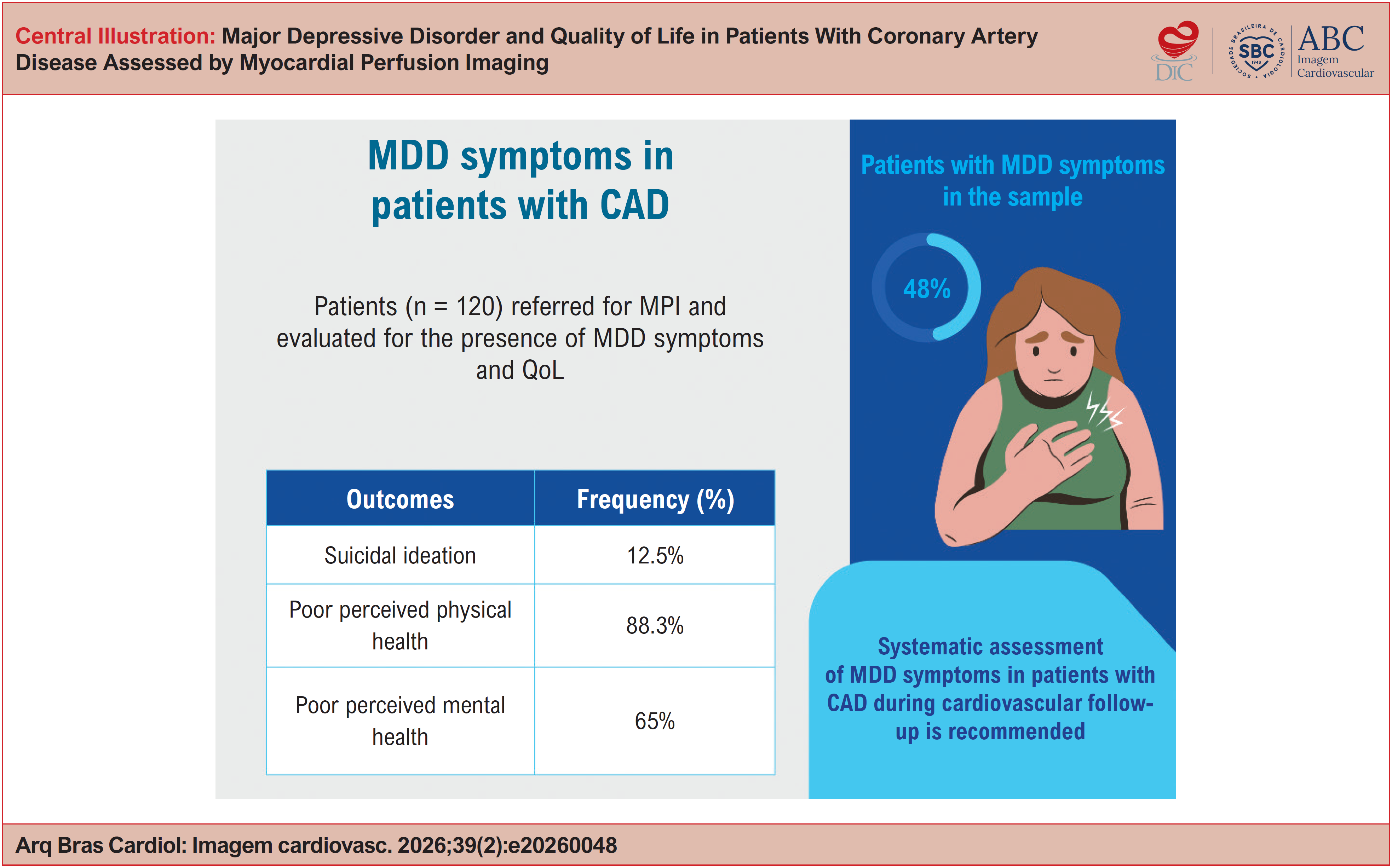
Major Depressive Disorder and Quality of Life in Patients With Coronary Artery Disease Assessed by Myocardial Perfusion Imaging. CAD: coronary artery disease; MDD: major depressive disorder; MPI: myocardial perfusion imaging; QoL: quality of life.
Associations between MDD symptoms and the main parameters obtained from stress and rest MPI were also investigated to provide an integrated understanding of the interaction between mental health, QoL, and cardiac perfusion abnormalities in this population.
Methods
Study design and population
This was a cross-sectional, observational, prospective analysis based on a primary quantitative database derived from a study conducted at a federal university hospital. Data were collected through structured interviews with closed-ended questions and the application of 3 instruments validated for use nationwide.
The sample was obtained by convenience sampling and included 120 consecutive adult patients undergoing MPI for CAD investigation at the university hospital. Data collection was performed between December 2018 and January 2019.
Information regarding sex, age, and history of systemic arterial hypertension, diabetes mellitus, obesity, dyslipidemia, family history of CAD, menopause, AMI, coronary artery bypass graft surgery, angioplasty with stent implantation, stroke, chronic kidney disease, aortic aneurysm, and vascular disease was collected from medical records.
Data regarding mental health assessment instruments, including SF-12, PHQ-9, and PANAS, as well as parameters obtained from MPI, were also collected. Statistical analysis sought to correlate MPI findings, such as the presence of ischemia, left ventricular ejection fraction (LVEF), and ventricular volumes, with MDD symptoms assessed using psychometric questionnaires.
The study complied with current ethical requirements and was approved by a human research ethics committee under CAAE 89721625.0.0000.5243.
Psychiatric and QoL assessment
The PHQ-9,8 PANAS,9 and SF-1210 scales were used to assess psychiatric symptoms. PHQ-9 was employed to evaluate MDD symptoms, whereas PANAS and SF-12 were used to assess QoL and emotional aspects.
PHQ-9
PHQ-9 is used for MDD diagnosis and symptom severity stratification.11 The instrument contains nine questions based on the diagnostic criteria of the Diagnostic and Statistical Manual of Mental Disorders, fifth edition.
Each item includes the following response options: "not at all," "less than 1 week," "1 week or more," and "nearly every day," corresponding to scores of 0, 1, 2, and 3, respectively. The total score ranges from 0 to 27 points and is classified as follows: i) absence of MDD (0-4 points); ii) mild MDD (5-9 points); iii) moderate MDD (10-14 points); iv) moderately severe MDD (15-19 points); and v) severe MDD (20-27 points).
PANAS
PANAS evaluates two dimensions of individuals’ emotional state: positive affect and negative affect.12 The instrument consists of 20 items distributed across two subscales with 10 questions each, one focused on positive emotions and the other on negative emotions.
Responses range from 1 ("very rarely or never") to 5 ("very frequently or always"). Results were calculated using the application recommended by the investigators responsible for validation of the instrument. Final scores range from 10 to 50 points, with higher values indicating greater intensity of positive or negative emotions.
12-Item Short Form Health Survey
SF-12 is a shortened version translated and validated into Portuguese from the 36-Item Short Form Survey (SF-36).10 It is a more objective instrument for assessing health-related QoL.
SF-12 consists of 12 items distributed across eight domains grouped into two main components: i) the physical component, which includes functional capacity, physical aspects, pain, and general health status; and ii) the mental component, related to mental health, emotional aspects, social aspects, and vitality.
SF-12 has a final score ranging from 0 to 100, in which 0 represents the worst general health status and 100 the best health status. It demonstrates performance similar to that of SF-36 in the assessment of health-related QoL and is widely documented medical literature, both in its original English version and in versions validated for different languages.
MPI acquisition and analysis
MPI examinations were performed using a single-detector gamma camera (Millenium MPR, GE HealthCare) equipped with a low-energy, high-resolution collimator. Tomographic images were acquired by single-photon emission computed tomography (SPECT), electrocardiogram-gated, using 64 projections and a 64 × 64 matrix.
After acquisition, images were reconstructed by filtered back projection using a Butterworth filter and processed using the e-Soft software, including the Cedars-Sinai and Emory Cardiac Toolbox packages. Global and segmental contractility analysis, as well as LVEF assessment, were performed by gated SPECT. The adopted myocardial segmentation model consisted of 17 segments.
The analyzed MPI variables included the presence of ischemia, defined as an area of radiotracer hypouptake on post-stress images with normalization on rest images, and the presence of fibrosis, defined as an area of persistent hypouptake on both post-stress and rest images. Post-stress and rest LVEF, as well as ventricular volumes under both conditions, were also evaluated.
Statistical analysis
Descriptive analysis was presented in tables, with categorical variables expressed as absolute and relative frequencies (%), and numerical variables presented using appropriate measures of central tendency and dispersion.
Inferential analysis included the following methods: the relationship between numerical MPI parameters and PHQ-9, SF-12, and PANAS scale scores, as well as other numerical variables, was evaluated using Spearman's correlation coefficient. Associations involving categorical variables were analyzed using the Mann-Whitney or Kruskal-Wallis tests. Comparisons between the presence of ischemia on MPI and numerical variables were performed using the Mann-Whitney U test, whereas associations with categorical variables were assessed using the chi-square test.
Data distribution normality was verified using the Shapiro-Wilk test and graphical inspection of histograms. Statistical analyses were performed using IBM SPSS Statistics for Windows, version 26 (IBM Corp., Armonk, N.Y., USA). Statistical significance was set at 5%.
The analyzed numerical variables did not demonstrate a normal (Gaussian) distribution, as shown by the Shapiro-Wilk test and graphical evaluation of histograms. Therefore, data were summarized using median and interquartile range (Q1-Q3), corresponding to the central 50% of observations between the first and third quartiles. The interquartile range was used as the measure of dispersion associated with the median, analogous to the use of standard deviation in relation to the mean.
Results
The overall profile of the 120 patients included in the study was described using numerical and categorical variables in the total sample. Numerical variables were presented using appropriate measures of central tendency and dispersion, whereas categorical variables were expressed as absolute and relative frequencies (%).
Table 1 presents the characterization of the analyzed demographic and clinical variables, including median, interquartile range (Q1-Q3), and statistical analysis of differences between groups classified according to PHQ-9 results. No statistically significant differences were observed among the analyzed variables when comparing patients with moderate/severe MDD and those with minimal/mild MDD.
Patients had a median age of 62 years and were predominantly female. Arterial hypertension was the most frequent comorbidity, identified in 82% of the sample. Among women, 48 were postmenopausal, and 44% of participants were smokers or had a history of tobacco use.
MDD was identified in a substantial number of patients: 58 individuals (48%) presented moderately severe/severe MDD. Among these patients, 15 (12.5%) reported suicidal ideation.
Correlation analysis was performed between MPI parameters, age, and scores from the PHQ-9, PANAS, and SF-12 instruments. Table 2 presents Spearman's correlation coefficient (r), the respective p values, and the number of cases included in each analysis involving MPI parameters, age, and psychometric scale scores.
No correlation was observed between post-stress LVEF and PHQ-9, PANAS, and SF-12 scores. Although patients demonstrated poor perceived physical and mental health, there was no direct relationship between these findings and the severity of MPI results.
A significant inverse correlation was observed between resting end-diastolic volume (REDV) and age (r = −0.225; p = 0.013; n = 120), indicating that older age was associated with lower REDV values in the analyzed sample. No statistically significant correlations, at the 5% level, were identified between the remaining MPI parameters and PHQ-9, SF-12, and PANAS scale scores.
Table 3 presents the description of MPI parameters according to score classifications as well as the respective p values obtained from statistical tests. MPI variables were expressed as median and interquartile range (Q1-Q3) and compared using the Mann-Whitney test when two groups were present and the Kruskal-Wallis test when 3 or more groups were analyzed.
Ventricular function variables obtained by MPI and their comparison according to PHQ-9 score classification
When analyzing the relationship between PHQ-9 scores and MPI parameters, no statistically significant correlations were identified.
Table 4 presents the distribution of PHQ-9 and SF-12 score classifications according to the presence or absence of ischemia on MPI as well as the respective p values obtained from statistical tests. Score classifications were expressed as absolute (n) and relative (%) frequencies and compared using the chi-square test.
Distribution of PHQ-9 and SF-12 scores according to the presence or absence of ischemia on MPI
No statistically significant association at the 5% level was observed between PHQ-9 and SF-12 score classifications and the presence of ischemia on MPI.
Discussion
The present study demonstrated a finding of high clinical relevance: 48% of patients referred for evaluation by MPI presented symptoms compatible with moderate to severe MDD according to the PHQ-9 score. Because of the high prevalence of MDD symptoms observed in the studied population, we believe that systematic assessment of these symptoms in patients referred for CAD investigation is essential, allowing early detection and appropriate management of this condition (Central Illustration).
Despite the high prevalence of MDD symptoms, no correlations were identified between MDD scores, QoL indices, and parameters obtained from MPI. No association was observed between MPI abnormalities and greater burden of MDD symptoms. Therefore, MPI did not prove to be an effective marker of cardiovascular severity in patients with MDD symptoms.
When comparing our results with Brazilian population-based data, the prevalence of moderately severe/severe MDD found in our sample (48%) was substantially higher than that reported in large national studies. In an epidemiological survey involving 49,658 Brazilian adults3 and based on PHQ-9, only 10.5% of individuals presented clinically relevant MDD, defined by a score ≥ 10, a significantly lower value than that identified in our clinical population.
Furthermore, although the population-based study demonstrated an unfavorable impact of MDD on cardiovascular health, reducing by 27% the likelihood of an individual presenting favorable cardiovascular health (odds ratio, 0.73; 95%CI, 0.62-0.86), no prevalence of MDD as high as that observed in our health care setting was identified. These contrasts suggest that patients with suspected or established CAD treated in an outpatient public health care setting present greater emotional and psychological burden, possibly influenced by factors such as recurrent chest pain, fear of future cardiovascular events, functional limitation, and uncertainty regarding prognosis.13
In addition, pathophysiological mechanisms related to the interaction between chronic inflammation, oxidative stress, and neuroendocrine activation in ischemic disease may contribute to this scenario.14 Thus, the nearly 4-fold higher prevalence of moderately severe/severe MDD observed in our cohort reinforces the hypothesis that individuals with CAD constitute a group with high psychosocial vulnerability, requiring systematic screening and integrated cardiometabolic and mental health management strategies.
Several studies have described physiological mechanisms supporting the relationship between MDD and cardiovascular disease. Activation of the hypothalamic-pituitary-adrenal axis in individuals with MDD promotes increased glucocorticoid secretion, associated with peripheral insulin resistance, hyperglycemia, and elevated blood pressure, all recognized cardiovascular risk factors.15
Increased glucocorticoid levels are also associated with greater secretion of proinflammatory interleukins, such as interleukin-6 and tumor necrosis factor-alpha. This exacerbated inflammatory response is associated with the risk of atherosclerosis and alterations in neurotransmitter release, which may contribute to worsening of MDD symptoms.16 In addition, a possible imbalance of the autonomic nervous system in patients with MDD could favor sympathetic hyperactivity, altering cardiac contractility and increasing susceptibility to arrhythmia development.16
Studies using MPI in patients with MDD demonstrated that this population presents greater susceptibility to emotionally induced myocardial ischemia, evidencing myocardial perfusion abnormalities in these individuals.17
The analyzed population also demonstrated poor overall perception of physical health. As observed in the physical component of the SF-12, 106 individuals (88.3%) presented scores below 50. Patients with MDD and CAD may present greater physical limitation, lower functional capacity, and higher prevalence of fatigue and low energy levels.18
Furthermore, 78 individuals (65%) presented poor perceived mental health, defined by scores below 50 in the mental component of the SF-12. Patients with this perception tend to present greater emotional and physical impact related to CAD,19 which may result in greater limitation of daily activities, poorer treatment adherence, and lower engagement in cardiovascular rehabilitation programs.20
The 2025 European Society of Cardiology Clinical Consensus Statement on mental health and cardiovascular disease21 reinforces that systematic assessment of MDD and other mental disorders should be incorporated into the routine care of patients with cardiovascular disease. The document recommends the use of validated tools, such as the Patient Health Questionnaire-2 and PHQ-9, for initial screening after cardiovascular events or in the presence of clinical suspicion, considering the high prevalence of these conditions and their negative prognostic impact.
In our study, a particularly high prevalence of moderately severe/severe MDD was observed among patients referred for MPI (48%), in addition to a substantial rate of suicidal ideation (12.5%), without association with clinical, demographic, or functional variables. In light of the ESC recommendations, our findings reinforce the urgent need to routinely incorporate structured mental health screening into cardiovascular care pathways, considering that psychological distress may be present even in the absence of traditional clinical markers, thereby requiring proactive strategies for identification and intervention aimed at risk reduction, improvement of QoL, and potential modification of clinical outcomes.21
Among the limitations of this study, the use of a convenience sample composed of patients referred for evaluation at a university hospital should be highlighted, which may have contributed to a greater burden of comorbidities in the analyzed population. Additionally, patients were evaluated during a period preceding the COVID-19 pandemic, a condition that in several studies was associated with worsening of mental health-related disorders.22
Conclusion
This study demonstrated a high prevalence of moderately severe/severe MDD in patients referred for cardiovascular evaluation by MPI. These patients should be identified early and receive follow-up and specific mental health guidance. The implementation of structured protocols for systematic screening of mental disorders in the context of cardiovascular evaluation may represent a relevant strategy for reducing cardiovascular risk, improving QoL, and potentially modifying the clinical outcomes of these individuals.
-
Sources of Funding
There were no external funding sources for this study.
-
Study Association
This article is part of the thesis of master submitted by Almeida GG, from Universidade Federal Fluminense.
-
Ethics Approval and Consent to Participate
This study was approved by the Ethics Committee of the CEP-UFF (Universidade Federal Fluminense) under the protocol number 7.768.804. All the procedures in this study were in accordance with the 1975 Helsinki Declaration, updated in 2013.
-
Use of Artificial Intelligence
The authors did not use any artificial intelligence tools in the development of this work.
Availability of Research Data
The underlying content of the research text is contained within the manuscript.
References
-
1 Martin SS, Aday AW, Allen NB, Almarzooq ZI, Anderson CAM, Arora P, et al. 2025 Heart Disease and Stroke Statistics: A Report of US and Global Data from the American Heart Association. Circulation. 2025;151(8):e41-e660. doi: 10.1161/CIR.0000000000001303.
» https://doi.org/10.1161/CIR.0000000000001303 -
2 GBD 2021 Causes of Death Collaborators. Global Burden of 288 Causes of Death and Life Expectancy Decomposition in 204 Countries and Territories and 811 Subnational Locations, 1990-2021: A Systematic Analysis for the Global Burden of Disease Study 2021. Lancet. 2024;403(10440):2100-32. doi: 10.1016/S0140-6736(24)00367-2.
» https://doi.org/10.1016/S0140-6736(24)00367-2 -
3 Bousquet-Santos K, Chen R, Kubzansky LD. A Sad Heart: Depression and Favorable Cardiovascular Health in Brazil. Prev Med. 2021;142:106378. doi: 10.1016/j.ypmed.2020.106378.
» https://doi.org/10.1016/j.ypmed.2020.106378 - 4 Groch MW, Erwin WD. SPECT in the Year 2000: Basic Principles. J Nucl Med Technol. 2000;28(4):233-44.
-
5 Habert J, Katzman MA, Oluboka OJ, McIntyre RS, McIntosh D, MacQueen GM, et al. Functional Recovery in Major Depressive Disorder: Focus on Early Optimized Treatment. Prim Care Companion CNS Disord. 2016;18(5). doi: 10.4088/PCC.15r01926.
» https://doi.org/10.4088/PCC.15r01926 -
6 Peltzer S, Müller H, Köstler U, Schulz-Nieswandt F, Jessen F, Albus C, et al. Detection and Treatment of Mental Disorders in Patients with Coronary Heart Disease (MenDis-CHD): A Cross-Sectional Study. PLoS One. 2020;15(12):e0243800. doi: 10.1371/journal.pone.0243800.
» https://doi.org/10.1371/journal.pone.0243800 -
7 Jiang W, Babyak MA, Rozanski A, Sherwood A, O’Connor CM, Waugh RA, et al. Depression and Increased Myocardial Ischemic Activity in Patients with Ischemic Heart Disease. Am Heart J. 2003;146(1):55-61. doi: 10.1016/S0002-8703(03)00152-2.
» https://doi.org/10.1016/S0002-8703(03)00152-2 -
8 Osório FL, Mendes AV, Crippa JA, Loureiro SR. Study of the Discriminative Validity of the PHQ-9 and PHQ-2 in a Sample of Brazilian Women in the Context of Primary Health Care. Perspect Psychiatr Care. 2009;45(3):216-27. doi: 10.1111/j.1744-6163.2009.00224.x.
» https://doi.org/10.1111/j.1744-6163.2009.00224.x -
9 Zanon C, Bastianello MR, Pacico JC, Hutz CS. Desenvolvimento e Validação de uma Escala de Afetos Positivos e Negativos. Psico-USF. 2013;18(2):193-202. doi: 10.1590/S1413-82712013000200003.
» https://doi.org/10.1590/S1413-82712013000200003 - 10 Ciconelli RM. Tradução para o Português e Validação do Questionário Genérico de Avaliação de Qualidade de Vida "Medical Outcomes Study 36-Item Short-Form Health Survey (SF-36)" [Thesis]. São Paulo: Universidade Federal de São Paulo, Escola Paulista de Medicina; 1997.
-
11 Kroenke K, Spitzer RL, Williams JB. The PHQ-9: Validity of a Brief Depression Severity Measure. J Gen Intern Med. 2001;16(9):606-13. doi: 10.1046/j.1525-1497.2001.016009606.x.
» https://doi.org/10.1046/j.1525-1497.2001.016009606.x -
12 Watson D, Clark LA, Tellegen A. Development and Validation of Brief Measures of Positive and Negative Affect: The PANAS Scales. J Pers Soc Psychol. 1988;54(6):1063-70. doi: 10.1037//0022-3514.54.6.1063.
» https://doi.org/10.1037//0022-3514.54.6.1063 -
13 Hanna MR, Caspi A, Houts RM, Moffitt TE, Torvik FA. Co-Occurrence between Mental Disorders and Physical Diseases: A Study of Nationwide Primary-Care Medical Records. Psychol Med. 2024;54(15):4274-86. doi: 10.1017/S0033291724002575.
» https://doi.org/10.1017/S0033291724002575 -
14 D’Oria R, Schipani R, Leonardini A, Natalicchio A, Perrini S, Cignarelli A, et al. The Role of Oxidative Stress in Cardiac Disease: From Physiological Response to Injury Factor. Oxid Med Cell Longev. 2020;2020:5732956. doi: 10.1155/2020/5732956.
» https://doi.org/10.1155/2020/5732956 -
15 Warriach ZI, Patel S, Khan F, Ferrer GF. Association of Depression with Cardiovascular Diseases. Cureus. 2022;14(6):e26296. doi: 10.7759/cureus.26296.
» https://doi.org/10.7759/cureus.26296 -
16 Huang L, Zhang L, Liu C, Xu Q, Qiu K. Interaction and Mechanisms of Depression and Cardiovascular Disease: A Mini-Review. PeerJ. 2025;13:e20148. doi: 10.7717/peerj.20148.
» https://doi.org/10.7717/peerj.20148 -
17 Burg MM, Meadows J, Shimbo D, Davidson KW, Schwartz JE, Soufer R. Confluence of Depression and Acute Psychological Stress among Patients with Stable Coronary Heart Disease: Effects on Myocardial Perfusion. J Am Heart Assoc. 2014;3(6):e000898. doi: 10.1161/JAHA.114.000898.
» https://doi.org/10.1161/JAHA.114.000898 -
18 Kohlmann S, Gierk B, Murray AM, Scholl A, Lehmann M, Löwe B. Base Rates of Depressive Symptoms in Patients with Coronary Heart Disease: An Individual Symptom Analysis. PLoS One. 2016;11(5):e0156167. doi: 10.1371/journal.pone.0156167.
» https://doi.org/10.1371/journal.pone.0156167 -
19 Kunschitz E, Friedrich O, Schöppl C, Maitz J, Sipötz J. Illness Perception Patterns in Patients with Coronary Artery Disease. Psychol Health Med. 2017;22(8):940-6. doi: 10.1080/13548506.2016.1271439.
» https://doi.org/10.1080/13548506.2016.1271439 -
20 Bueno H, Deaton C, Farrero M, Forsyth F, Braunschweig F, Buccheri S, et al. 2025 ESC Clinical Consensus Statement on Mental Health and Cardiovascular Disease: Developed Under the Auspices of the ESC Clinical Practice Guidelines Committee. Eur Heart J. 2025;46(41):4156-225. doi: 10.1093/eurheartj/ehaf191.
» https://doi.org/10.1093/eurheartj/ehaf191 -
21 Sun Y, Wu Y, Fan S, Dal Santo T, Li L, Jiang X, et al. Comparison of Mental Health Symptoms Before and during the Covid-19 Pandemic: Evidence from a Systematic Review and Meta-Analysis of 134 Cohorts. BMJ. 2023;380:e074224. doi: 10.1136/bmj-2022-074224.
» https://doi.org/10.1136/bmj-2022-074224
Edited by
-
Editor responsible for the review:
Marcelo Tavares