 Efficacy of tofacitinib in the treatment of refractory palmoplantar psoriasis (non-pustular): case report and literature review
Dear Editor,
Palmoplantar psoriasis is a chronic condition of the palms and/or soles, with a prevalence of 2%-40% among patients with psoriasis; however, specific epidemiological data are scarce. Although it can manifest in a localized form, it has a greater impact on quality of life compared to other areas. Its morphology varies from pustular lesions to erythematous-desquamative and hyperkeratotic plaques, or with overlapping lesions, being classified based on these phenotypes.1
Non-pustular palmoplantar psoriasis (NPPP), or hyperk-eratotic psoriasis, represents one of the most challenging psoriasis phenotypes in clinical practice.1 It is a recalcitrant type, even with available therapeutic advances. Further-more, the lack of parallelism in the clinical response of psoriasis vulgaris (PV) in relation to NPPP suggests a distinct pathogenesis, with reports of success with JAK inhibitors (JAKi) in the treatment of refractory NPPP.
In this text, the authors report a case of NPPP refractory to conventional and biological therapies with a complete response to oral tofacitinib. The authors also review analo-gous published cases and discuss relevant pathophysiological aspects.
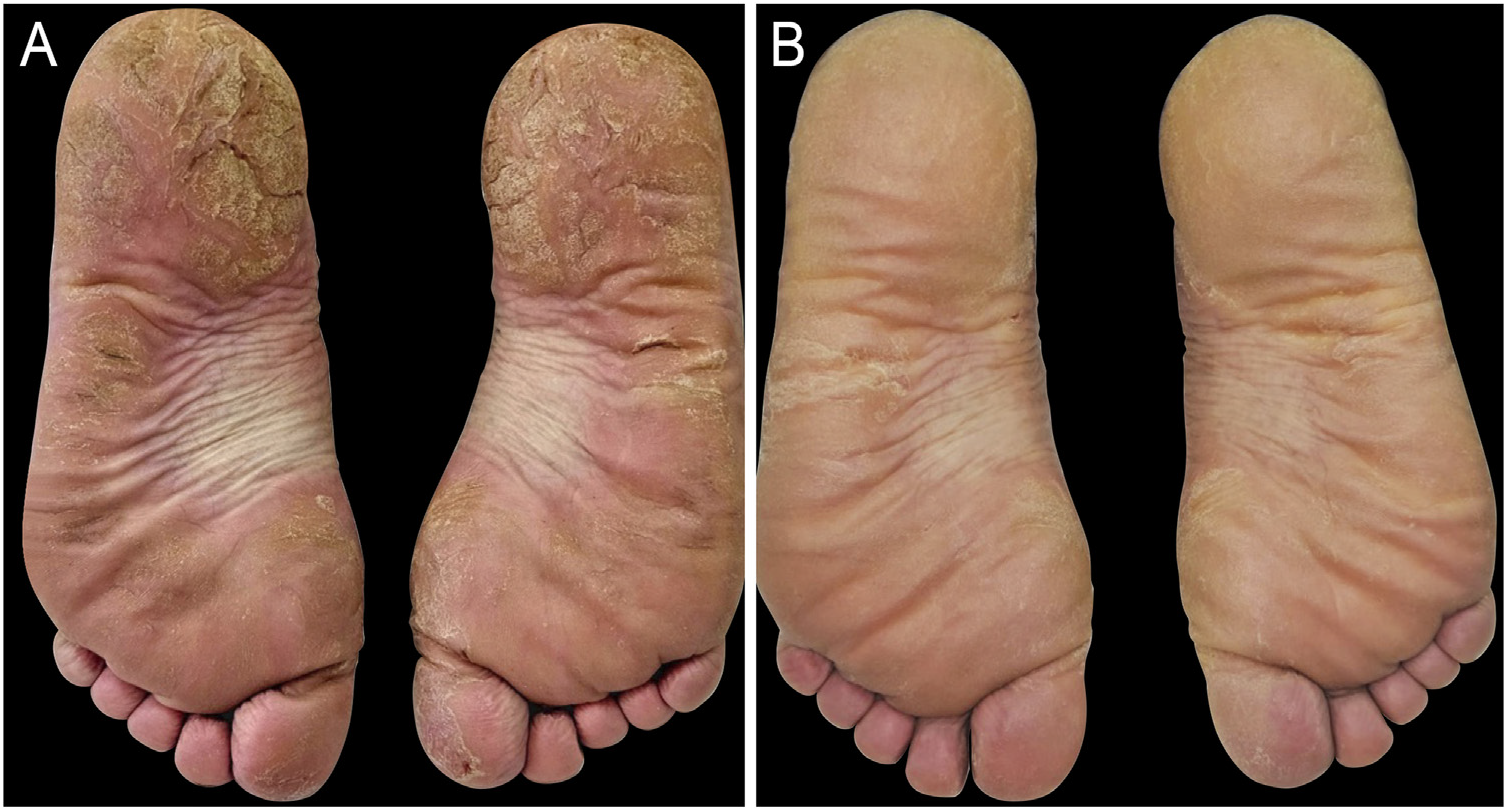
A 48-year-old woman was diagnosed with NPPP (hands and feet), in addition to discrete plaques on the scalp, for 14 years. She reported previous treatments with topical cor-ticosteroids, methotrexate (eight months), acitretin (eight months), adalimumab (five years), and secukinumab (three years), without a satisfactory response. On examination, she showed hyperkeratotic plaques and fissures on both soles (Fig. 1A). She reported being unable to perform physical activities or light walks.
Non-pustular palmoplantar psoriasis treated with oral tofacitinib. (A) Pre-treatment: Physician’s Global Assessment of Hands and/or Feet (hf-PGA) 4; modified Palmoplantar Psoriasis Area and Severity Index (m-PPPASI) 30; Palmoplantar Quality-of-Life Instrument (PPQLI) 38; and Dermatology Life Quality Index (DLQI) 7. (B) After 120 days of treatment: hf-PGA 2; m-PPPASI 3; PPQLI 23; and DLQI 0.
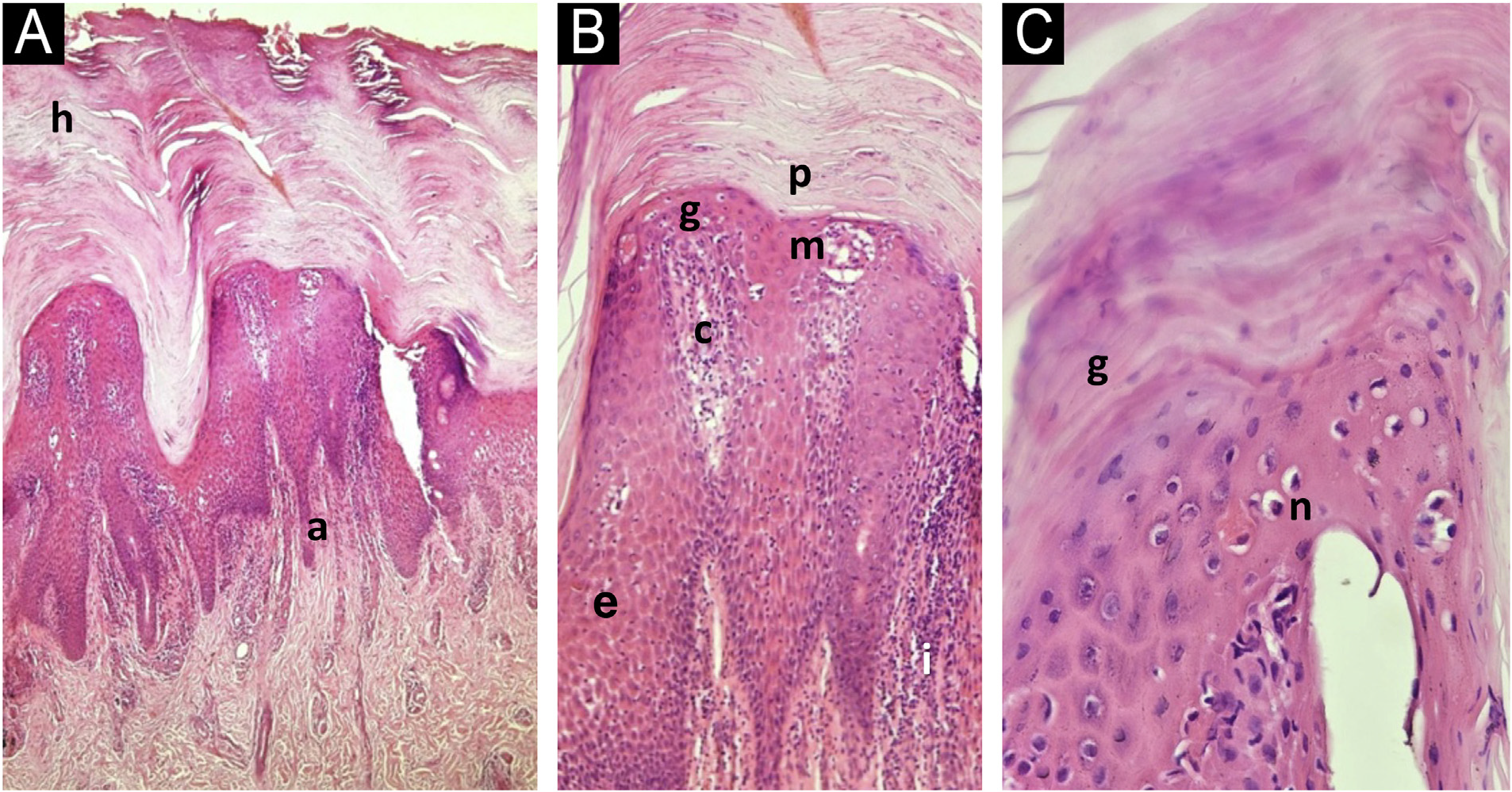
Histopathological examination of the palmar and plantar regions revealed chronic psoriasiform dermatitis, characte-rized by acanthosis with hypogranulosis and neutrophils in the epidermis, elongation of the interpapillary ridges with focal fusion, slight spongiosis, compact hyperparakerato-sis with neutrophils, elongated capillaries, and lymphocytic infiltration in the papillary dermis (Fig. 2). The search for fungi by periodic acid-Schiff staining was negative.

Histopathological examination of the plantar region. Panel A: Acanthosis, hyperkeratosis (h), elongation (a) of the epithelial ridges (Hematoxylin & eosin, ×100). Panel B: Proliferation of papillary capillaries (c), inflammatory infiltrate (i), parak-eratosis (p), hypogranulosis (g), intraepidermal microabscess (m), discrete spongiosis (e) (Hematoxylin & eosin, ×200). Panel C: Hypogranulosis, with the presence of intraepidermal and subcorneal neutrophils (n) (Hematoxylin & eosin, ×400).
Considering the refractoriness and quality of life impair-ment, tofacitinib 5 mg orally, twice a day, was prescribed after clinical screening and complementary examinations. Clobetasol 0.05% ointment was maintained in the first month of treatment.
After 30 days, improvement in erythema, desquamation, and pain in the feet was observed, with complete remission of the hand lesions. The plantar fissures healed in 45 days, allowing a full return to physical activities.
After 60 days of treatment, she developed an upper respiratory tract infection, prompting temporary drug sus-pension for seven days. Upon reintroduction, she reported a mild headache, which subsided with a dose reduction to 7.5 mg/day, taken once daily.
After 120 days of treatment, she showed significant improvement in plantar lesions, full functionality, with reso-lution of difficulty and pain when walking, running, climbing stairs, and standing barefoot, as well as a reduction in severity scores (Fig. 1B). The patient has been followed for 12 months, with a current dose reduction to 5 mg/day. No changes were observed in laboratory tests during follow-up. Topical medications and phototherapy constitute the first-line treatment in NPPP. However, most patients require systemic treatment, such as acitretin, methotrexate, and biologics. Biologics act on cytokines specific to the patho-physiology of psoriasis, including anti-TNFC, anti-IL-12/23, anti-IL-23, and anti-IL-17.2 The efficacy of these agents in NPPP, however, tends to be lower than in other forms of psoriasis.
Psoriasis is an immunologically based disease, with dis-tinct inflammatory circuits among its phenotypes. Th1/IFN-γ inflammation predominates in NPPP compared to PV and palmoplantar pustular psoriasis (PPP), which shows inflam-matory activity more associated with neutrophils.3
Tofacitinib is a JAKi, especially of JAK 1 and 3, and to a lesser extent JAK 2, which suppresses Th1, Th17 pathways, and innate immune cell signaling, reducing the expression of cytokines such as IFN-γ, IL-17A/F, IL-22, IL-23, and IL-36.4 This broad action may justify its effectiveness in refractory cases of NPPP.
Table 1 Reviews several reports of JAKi for the treat-ment of NPPP.5-9 There are also descriptions of therapeutic success in PPP, considered part of the psoriasis spectrum.7,10
Despite the clinical-histopathological correlation of the presented case, compatible with NPPP, it is important to recognize that some forms of psoriasis show an exuberant inflammatory phenotype and eczematous areas, which may simulate or even coexist with chronic palmoplantar eczema. The distinction between these entities is challenging, espe-cially when there is clinical overlap of fissures, erythema, pruritus, and hyperkeratosis. In these contexts, the diagnos-tic spectrum should include both NPPP and hyperkeratotic eczema of the palms and soles, whose differentiation may require an exercise in clinical, histopathological, and therapeutic response correlation.11 Furthermore, there are reports of modification of the psoriasis vulgaris phenotype to eczematous conditions after therapies with biologics.12 Therefore, JAKi, by modulating multiple inflammatory path-ways (such as IL-4, IL-13, IL-22, and IFN-γ), constitutes a therapeutic alternative considering the immunopathological complexity of these presentations.13
Regarding safety, tofacitinib requires vigilance regarding infections, updated vaccination status, and drug interac-tions. Caution should be exercised in patients with renal or hepatic failure, thrombophilia, cardiovascular risk, and neoplasms. Monitoring tests include complete blood count, lipid profile, liver and kidney function tests, and screening for viral and bacterial infections.14
Although oral tofacitinib has a satisfactory safety and efficacy profile, it has not been approved for psoriasis by the Food and Drug Administration due to side effects and the availability of other therapies. However, it was approved in 2012 for rheumatoid arthritis and subsequently for psori-atic arthritis, ulcerative colitis, juvenile idiopathic arthritis, and ankylosing spondylitis. Deucravacitinib is the only JAKi approved for moderate to severe plaque psoriasis; how-ever, there are no comparative studies evaluating other JAKi (e.g., tofacitinib, upadacitinib, abrocitinib, baricitinib) in the treatment of NPPP.
This case documents a significant clinical response in refractory NPPP, corroborating the therapeutic potential of JAKi and reinforcing the need for controlled studies for this specific phenotype.
Research data availability
Does not apply.
References
- 1 Farley E, Masrour S, McKey J, Menter A. Palmoplantar psori-asis: a phenotypical and clinical review with introduction of a new quality-of-life assessment tool. J Am Acad Dermatol. 2009;60:1024-31.
- 2 Huang IH, Wu PC, Chiu HY, Huang YH. Small-molecule inhibitors and biologics for palmoplantar psoriasis and palmoplantar pus-tulosis: a systematic review and network meta-analysis. Am J Clin Dermatol. 2024;25:347-58.
- 3 Wang CQ, Haxhinasto S, Garcet S, Kunjravia N, Cueto I, Gonzalez J, et al. Comparison of the inflammatory circuits in psoriasis vulgaris, non-pustular palmoplantar psoriasis, and palmoplantar pustular psoriasis. J Invest Dermatol. 2023;143:87-97.e14.
- 4 Miot HA, Criado PR, de Castro CCS, Ianhez M, Talhari C, Ramos PM. JAK-STAT pathway inhibitors in dermatology. An Bras Der-matol. 2023;98:656-77.
- 5 Valor-Méndez L, Sticherling M, Kleyer A, Schett G. Successful treatment of refractory palmoplantar psoriasis in a psoriatic arthritis patient with the JAK inhibitor tofacitinib. Clin Exp Rheumatol. 2021;39:228.
- 6 Muzumdar S, Leonardi C, Strober B. Tofacitinib for the treat-ment of refractory palmoplantar psoriasis: a case series. J Psoriasis Psoriatic Arthritis. 2021;6:93-8.
- 7 De Luca DA, Papara C, Hawro T, Thaçi D, Ständer S. Exploring the effect of deucravacitinib in patients with palmoplantar pustular psoriasis. J Dermatolog Treat. 2024;35:2399220.
- 8 Choi B, Li HO, Glassman SJ. Palmoplantar plaque psoriasis responsive to upadacitinib: a report of two cases. SAGE Open Med Case Rep. 2025;13, 2050313X251317763.
- 9 Hardy Q, Safa G. Upadacitinib for management of concomi-tant palmoplantar psoriasis and alopecia areata associated with common variable immunodeficiency. Ann Dermatol Venereol. 2025;152:103404.
- 10 Rijal H, Bouadi N, Dahlke E, Litvinov IV. Efficacy and safety of JAK inhibitors in treating refractory palmoplantar pustulosis and palmoplantar pustular psoriasis: a systematic review. J Cutan Med Surg. 2024;28:299-301.
- 11 Aydin O, Engin B, O˘guz O, Ilvan S, Demirkesen C. Non-pustular palmoplantar psoriasis: is histologic differentiation from eczematous dermatitis possible? J Cutan Pathol. 2008;35:169-73.
- 12 Lai FYX, Higgins E, Smith CH, Barker JN, Pink A. Morphologic switch from psoriasiform to eczematous dermatitis after anti-IL-17 therapy: a case series. JAMA Dermatol. 2019;155:1082-4.
- 13 Sardana K, Sharath S, Khurana A, Yadav A, Singh A, Yadav S, et al. Th1 and Th2 cytokine expression in hyperkeratotic chronic hand eczema and the role of tofacitinib, an oral JAK inhibitor. Arch Dermatol Res. 2024;316:682.
- 14 Shawky AM, Almalki FA, Abdalla AN, Abdelazeem AH, Gouda AM. A comprehensive overview of globally approved JAK inhibitors. Pharmaceutics. 2022;14:1001.
Edited by
-
Editor
Sílvio Alencar Marques.