 Development of an emulsifiable concentrate formulation using Sophora alopecuroides and Nicotiana tabacum crude alkaloidal extracts for the sustainable management of wheat aphids
ABSTRACT
Wheat aphids are a critical pest, threatening cereal production through rapid reproduction, damage, and disease transmission, and have developed resistance to synthetic insecticides, necessitating the development of eco-friendly alternatives. However, the broader-scale application of plant extracts is limited by their rapid biodegradability, limited persistence, and low yields of bioactive compounds. Moreover, traditional extraction and isolation methods for bioactive compounds require substantial amounts of plant material, resulting in minimal yields, which further constrain their feasibility. To overcome this, our study develops a simplified method for crude alkaloidal extraction, enhancing yields and providing a more efficient and sustainable approach. The presence of alkaloids in the crude extract was confirmed using the Wagner reagent test, Fourier Transform Infrared Spectroscopy (FTIR), and liquid chromatography-mass spectrometry (LC-MS) analysis. The crude alkaloidal extract emulsifiable concentrate formulation (CAE-EC) demonstrated potent insecticidal activity against the tested aphid species, with LC50 values ranging from 12.54 to 17.75mg/mL. Overall, there was concentration, and time-dependent mortality was observed, with a mean mortality of 98.66% at 30mg/mL 48 hours after application. Additionally, CAE-EC exhibited significant herbicidal activity against Amaranthus retroflexus, inhibiting root and shoot elongation by 33% and 91%, respectively. The electrical penetration graph (EPG) analysis suggested potential antifeedant activity of CAE-EC against wheat aphids. Furthermore, dynamic light scattering was used to characterize the polydispersity index and particle size of the emulsifiable concentrate. Notably, CAE-EC exhibited no phytotoxic effects on wheat plants, ensuring safe application. Given its minimal use of organic solvents and remarkable aphicidal and herbicidal activity, our EC formulation offers an up-and-coming eco-friendly alternative for managing wheat aphid populations.
Keywords:
botanical pesticides; alkaloids; emulsifiable concentrate; aphids; toxicity; EPG
RESUMO
Os pulgões do trigo são uma praga crítica, ameaçando a produção de cereais por meio de sua rápida reprodução, dos danos e da transmissão de doenças, e desenvolveram resistência a inseticidas sintéticos, o que torna necessário o desenvolvimento de alternativas ecologicamente corretas. No entanto, a aplicação em larga escala de extratos vegetais é limitada por sua rápida biodegradabilidade, baixa persistência e baixos rendimentos de compostos bioativos. Além disso, os métodos convencionais de isolamento de compostos bioativos requerem quantidades substanciais de material vegetal, resultando em baixos rendimentos e limitando ainda mais sua viabilidade. Para superar esse obstáculo, o presente estudo desenvolve um método simplificado para extração de alcaloides brutos, aumentando os rendimentos e proporcionando uma abordagem mais eficiente e sustentável. A presença de alcaloides no extrato bruto foi confirmada pelo teste com reagente de Wagner, espectroscopia de infravermelho com transformada de Fourier (FTIR) e análise por cromatografia líquida acoplada à espectrometria de massas (LC-MS). A formulação concentrada emulsionável do extrato alcaloidal bruto (CAE-EC) demonstrou potente atividade inseticida contra as espécies de pulgões testadas, com valores de CL50 variando de 12,54 a 17,75mg/mL. De modo geral, observou-se mortalidade dependente da concentração e do tempo, com uma mortalidade média de 98,66% a 30mg/mL, após 48 horas. O CAE-EC também exibiu atividade herbicida significativa contra Amaranthus retroflexus, inibindo o alongamento da raiz e da parte aérea em 33% e 91%, respectivamente. A análise do gráfico de penetração elétrica sugeriu potencial atividade antialimentar do CAE-EC contra pulgões do trigo. A dispersão dinâmica de luz foi utilizada para caracterizar o índice de polidispersão e o tamanho das partículas do concentrado emulsionável. O CAE-EC não apresentou efeitos fitotóxicos em plantas de trigo, garantindo sua aplicação segura. Considerando o baixo uso de solventes orgânicos e a sua expressiva atividade aficida e herbicida, a formulação EC oferece uma alternativa ecológica promissora para o controle de populações de pulgões do trigo.
Palavras-chave:
pesticidas botânicos; alcaloides; concentrado emulsionável; pulgões; toxicidade; EPG
INTRODUCTION
Wheat (Triticum aestivum L.) is the 2nd most widely cultivated cereal for human use worldwide (Chen et al., 2024; Gupta et al., 2023). The World Food Organization estimates that 778.6 million tonnes of wheat grain were produced worldwide in 2021-2022 (Hu et al., 2023). Its global production still needs to be enhanced to meet the growing demand worldwide (Rockström et al., 2017). The wheat aphids Rhopalosiphum padi, Sitobion miscanthus, and Schizaphis graminum (Hemiptera: Aphididae) are considered among the most critical pests and often pose a considerable threat to cereal production directly by feeding on plant sap and indirectly by transmitting plant diseases (Li et al., 2023a; Xu et al., 2022). Aphids are soft-bodied insects of the Aphidinae family that usually occur in colonies, feeding on the undersides of new shoots and leaves (Shih et al., 2023). These are included as one of the most devastating pests for sustainable cereal production after abiotic stress, and cause heavy yield losses annually across the globe (Bass and Nauen, 2023). The wheat aphid caused 35-40% direct yield losses by sucking the sap and 35-40% indirect losses by spreading the fungal and viral diseases (Faheem et al., 2019).
Pakistan ranks 8th among the world's wheat-growing countries, with an average annual production of 24.946 million tons and a 1.7% contribution to the country's gross domestic product (GDP). Wheat is growing as a rabi (winter) crop in Pakistan, sowing from October to December and harvesting from March to May (Hussain et al., 2024). Wheat aphids were not considered a significant pest in Pakistan, and the plant protection department recommended no insecticidal sprays (Saleem et al., 2023). However, the world has faced climate change in the recent decade, with Pakistan being one of the most affected countries (Ali et al., 2023). These changes threaten sustainable wheat production by changing the pest ecology, biology, and behavior (Bajwa et al., 2020). Similarly, in 2020, three wheat aphid species, S. miscanthus, R. padi, and S. graminum, were listed as class I wheat insect pests due to their extensive damage to the wheat crop in China (Li et al., 2023b). Therefore, selecting new, safe, less persistent products for eco-friendly and sustainable pest management is timely (Silva et al., 2023).
Botanical pesticides are considered a novel alternative to synthetic pesticides because they are less hazardous to mammals and the environment (Benelli et al., 2021). These include alkaloids, terpenoids, glucosinolates, limonoids, phenylpropanoids, lipids, and nonprotein amino acids, which are naturally occurring substances that act as a first line of defense against pest attacks (Howe and Jander, 2008). Among the bioactive compounds isolated from plants, alkaloids are the most studied as insecticidal candidates (Fowsiya and Madhumitha, 2020). Alkaloids can interfere with various insect biological activities, such as inhibiting acetylcholinesterase enzymes, redox imbalance, protein synthesis inhibition, and hormonal imbalance (Chowański et al., 2016).
The insecticidal potential of Sophora alopecuroides and Nicotiana tabacum is well-studied, and several commercial products have already been created based on the bioactive compounds found in the S. alopecuroides (Zhang et al., 2023; Zou et al., 2020), and N. tabacum (Akbar et al., 2023; Voula et al., 2023). Typically, plant extracts exhibit greater toxicity than isolated bioactive compounds (Enke and Nagels, 2011). Plant extracts contain hundreds of bioactive compounds with multiple modes of action, which can synergistically affect insect pests (Khorrami et al., 2018). The synergistic effects between the mixture compounds in the plant extracts can enhance the overall insecticidal activity and offer a wider range of pest control (Oparaeke et al., 2005). Furthermore, the joint combination of aloperine, sophocarpine, oxymatrine, and cytisine, isolated from S. alopecuroides, showed significant synergistic activity against Aphis craccivora compared to the individual alkaloid toxicity (Ma et al., 2018). However, isolating bioactive compounds requires substantial amounts of plant biomass, and the yield of these compounds is exceptionally low (Stéphane et al., 2021). Plant extracts contain hundreds of bioactive compounds with diverse modes of action and typically exhibit greater bioactivity than individual isolated bioactive compounds (Enke and Nagels, 2011). Moreover, the conventional methods for isolating bioactive compounds often require substantial amounts of plant material, resulting in minimal yields. To overcome this limitation, our current study focuses on extracting simple crude alkaloidal extracts with higher yields, providing a more efficient and sustainable approach. The primary objective of this investigation was to develop a simple and rapid extraction method for crude alkaloids from S. alopecuroides and N. tabacum, with the ultimate goal of creating eco-friendly biopesticides for managing wheat aphids, thereby bridging the gap between botanical pesticide research and product development. Furthermore, a crude alkaloid extract emulsifiable concentrate (CAE-EC) formulation was subsequently prepared and evaluated for its biological activities. The effect of CAE-EC on the feeding behavior of S. graminum was assessed using the insect electrical penetration graph (EPG). Additionally, the herbicidal activity of CAE-EC was evaluated against Amaranthus retroflexus, a common weed.
ETHICAL ASPECTS
Ethical approval was not required for this study as it involved only insect subjects.
MATERIALS AND METHODS
The aphid colony was regularly maintained on potted wheat plants at the Insect Pest Management Program (IPMP) laboratory, Pakistan Agricultural Research Centre (NARC), Islamabad, Pakistan. The culture was kept under controlled conditions at 26 ± 2°C, 60% relative humidity, and a photo period of 14-16 hours. For bioassays, 2nd or 3rd-instar nymphs were used.
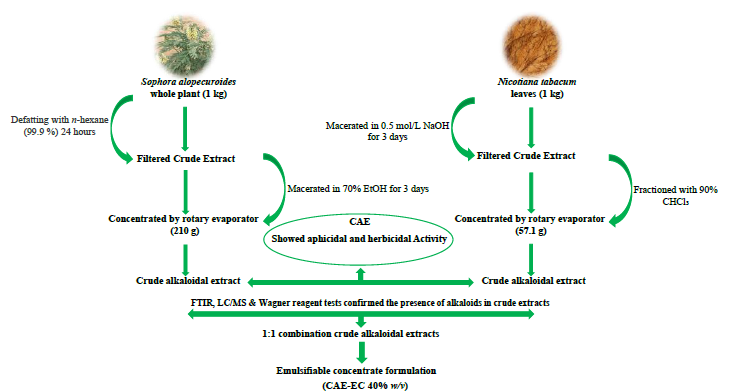
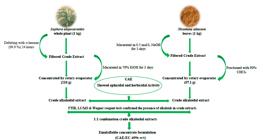
The crude alkaloids from S. alopecuroides and N. tabacum were extracted using a modified method formerly described by (Wang et al., 2022; Xiao et al., 2019), focusing on simple, crude alkaloidal extraction with higher yields. The plant material identification details were given in our previously published paper (Rizvi et al., 2019). Briefly, the S. alopecuroides whole plants (5 kg), collected before flowering from Skardu, Baltistan, in June 2022, were defatted with 90% n-hexane for 24 hours under room temperature to remove the steroidal compounds, oily substances, and fats, then macerated with 70% ethanol for 72 h in dark, and finally concentrated at 55°C under reduced pressure using a rotary evaporator (RE100-Pro Digital, Nanbei Instrument, China). In contrast, N. tabacum leaves, purchased from a local market in Peshawar, Pakistan, were macerated in 0.5 mol/L NaOH for 3 days, filtered, fractioned with 99% chloroform, and concentrated (Figure 1). The presence of alkaloids in the crude extracts was confirmed using the Wagner reagent test and further validated by liquid chromatography-tandem mass spectrometry (LC-MS/MS) analysis.
A simple mixing method was used to formulate the CAE-EC emulsifiable concentrate. Briefly, the oven-dried crude alkaloidal extracts were ground into a fine powder. Our preliminary studies indicated that a combination of crude alkaloidal extract of S. alopecuroides and N. tabacum has a significant synergistic effect on overall toxicity. Therefore, we used a 1:1 combination to create the emulsifiable concentrate formulation. To achieve a 40% w/v CAE concentration, 120 g of the powder was first dissolved in a minimal quantity of absolute ethanol. This mixture was then combined with 180 mL of Methyl Oleate (60% v/v), which served as the primary organic carrier. A surfactant blend of Tween 80 and Span 80 was integrated to reach a hydrophile-lipophile balance (HLB) of 12. The mixture was stirred for 50 minutes using a magnetic stirrer to ensure homogenization. Finally, the total volume of the formulation was adjusted to exactly 300 mL by adding the remaining necessary volume of Methyl Oleate or co-solvent. An identical formulation without the CAE was prepared as a blank control.
The Zetasizer Nano ZES (Malvern, UK) was used to measure the zeta potential, polydispersity index, and particle size of CAE-EC. A digital pH (Hanna Instruments, USA) and a viscometer (Movel Scientific Instrument Co., Ltd., China) were used to measure the physical parameters of CAE-EC. The CAE-EC was diluted in double-distilled water at a 1:20 v/v ratio.
The FTIR spectroscopy was used to confirm the presence of alkaloid functional groups in the crude extracts of S. alopecuroides and N. tabacum. The analysis was performed by mixing the dried powder of the crude extract with potassium bromide (KBr) to form a pellet. The FTIR spectra were recorded using an ABB FTLA 2000-100 spectrometer (Quebec, Canada) at a resolution limit of 16 cm-1.
The confirmation of alkaloids in crude extracts of S. alopecuroides and N. tabacum was carried out using LC-ESI-MS (Liquid Chromatography-Electrospray Ionization-Mass Spectrometry), Agilent Technologies, Santa Clara, CA, USA (Kaur et al., 2022). The crude extracts were centrifuged at 12000rpm for 15min before analysis to avoid any plant residues. Briefly, the HPLC system consisted of two pumps and an automated injector, and separation was achieved using a C-18column (Agilent Eclipse, 5μm, 15cm, 4.6 mm). The two mobile phases used were named A=0.1% formic acid in water and B=90% acetonitrile in water, with a flow rate of 500 µL/min. The LC conditions were 5% at 0−3 min in B, a linear increase from 5 to 20% between 3 and 25 min, 20 to 40% during 25-40 min, and from 40 to 50% between 40 and 55 min, finally, it reached 50 to 95% at 55-63 min. The water UPLC-TQD Mass spectrometer was utilized in a positive ionization mode. For the MS analysis, the data-dependent automatic switching between MS and MS/MS acquisition modes was used. The primary identification of the compounds was performed by comparing the MS/MS data with the mz Cloud database.
The contact toxicity of CAE-EC was evaluated by using the spraying method. Briefly, the CAE-EC was dissolved in tap water to achieve the following concentrations: 0.5, 1.5, 2, and 3 (w/v %) for contact toxicity assessment against selected aphid species, corresponding to concentrations of 5, 15, 20, and 30 mg/mL, respectively. Each infested with 50 aphids, potted wheat plants were sprayed with 3 mL of CAE-EC at the desired concentration using a Potter tower at a pressure of 0.5kg/cm2, resulting in a uniform deposit of 1.5µL/cm2 on each plant. The mortality data were recorded after 24 hours of treatment. In contrast, EC without CAE was applied in the control group. A probit analysis was used to construct the lethal concentrations of CAE-EC against the selected aphid species. To assess the toxicity of CAE-EC against the selected aphid species over different time intervals, the same method used for contact toxicity was employed, with 5, 15, and 30mg/mL concentrations of CAE-EC. Mortality data were recorded at 12, 24, and 48 hours post-treatment.
For evaluating the residual contact toxicity of CAE-EC, a 30mg/mL concentration was selected against selected aphid species, as this concentration resulted in the maximum mortalities being recorded in the contact toxicity test. Potted wheat plants were sprayed with 30 mg/mL and allowed to dry for 5 hours. Fifty aphids per plant were then released onto the dry residue (Bett et al., 2017). Acetamiprid (3mg/L), a widely used neonicotinoid insecticide for managing sucking insects, served as the positive control. Mortality data were recorded at 24, 48, and 72 hours post-treatment. All toxicity bioassays were conducted under controlled laboratory conditions, maintained at 26±2°C and 50-80% relative humidity. Each treatment, consisting of a single concentration, was replicated five times.
The herbicidal activity of CAE-EC at 0.25, 0.5, 1, 2, and 5mg/mL concentrations was evaluated against the common dicot weed A. retroflexus in a Petri dish (9 cm in diameter) by following the procedure previously stated by (Zhou et al., 2021). Briefly, different concentrations of CAE-EC were added to Petri dishes having twenty seeds of A. retroflexus and were incubated at 25°C±2°C in the dark. The average growth in response to each treatment was calculated as the percentage change in root and shoot length measured five days after treatment compared to the control. The phytotoxicity of CAE-EC at concentrations of 5, 10, 15, 20, and 30 mg/mL was evaluated against wheat plants at three growth stages: seedling, tillering, and grain-filling. For the assessment of phytotoxicity measurements, a damage rating scale previously described by (Rizvi et al., 2019). The mean necrosis (%) per leaf per plant was rated as follows: "−" (0% for no significant visible injury), slight "+" (1-25% damage), medium "++" (25-50% damage), and high "+++" (> 50% damage) (Rizvi et al., 2019). Each treatment, consisting of a single concentration, was replicated five times.
The feeding behavior of 2 to 3-day-old (postfinal-molt) adult apterous females of S. graminum was used for the EPG experiments. The feeding behavior was recorded using an EPG system (Giga-8 Model, Wageningen, The Netherlands) with adjustable voltage and an amplifier with a 109 Ω resistance (Gao et al., 2023). A single S. graminum specimen was attached to the system probe with a thin piece of gold wire (0.18 µm in diameter, 4-5 cm long) attached to its thorax with water-based silver glue, and the other end to a bronze nail directly inserted into the system probe. Adults of S. graminum were starved for one hour before the recording began and placed on the adaxial side of the third leaf of each plant. To evaluate the feeding behavior and pattern, S. graminum was exposed to three concentrations of CAE-EC (0.1, 1, and 5mg/mL). A copper plant electrode was inserted into the potted soil to configure the setup. All wiring was connected to the GIGA amplifier, allowing simultaneous recording during the prolonged experiment. The EPG system was directly connected to a computer, where waveform signals from 8 different channels were displayed on Stylet+d software, and the waveform data analysis was performed using Stylet+a software (Seo et al., 2009). The gain was adjusted to 76x from 50x on each channel when any activity was observed. All the treatments were replicated three times, and the means of successful waveform records were from S. graminum adults.
Probit analysis was used to construct the LC50 and LC90 of CAE-EC using SPSS 17.0. One-way analysis of variance (ANOVA) was used to compare toxicity among treatments at different time intervals. Tukey's test was used to calculate the significant difference among the treatments, and P-values less than 0.05 were considered statistically significant. The SPSS 17 software package was used to perform all the statistical analyses. Stylet+d software was used for EPG data analysis and non-parametric analysis, and the Kruskal-Wallis test was employed.
RESULTS
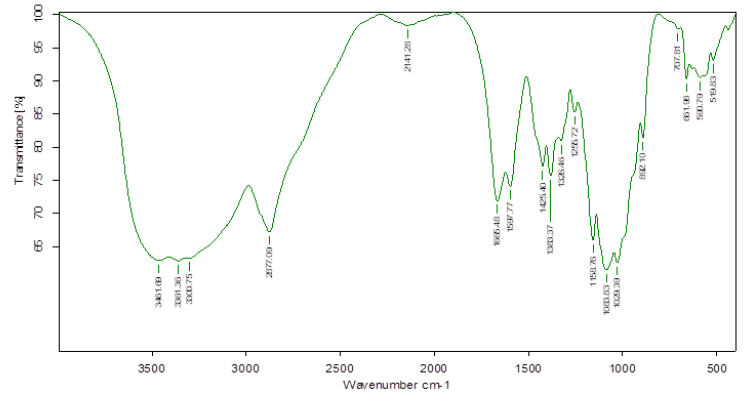
The FTIR analysis of the crude extract of S. alopecuroides and N. tabacum is presented in Figure 2. The results indicated characteristic FTIR peaks that serve as evidence for the presence of alkaloids in the crude extract. Specifically, the spectra exhibited N-H stretching vibrations at 3,361.36-3,461.69cm-1, C-H stretching at 2,877.09cm-1, and C=C and C=N stretching at 1,665.48cm-1. These findings confirm the presence of alkaloids and suggest that the crude extract is rich in alkaloids, validating the effectiveness of our simple alkaloid extraction method.

FTIR absorption spectra of KBr pellets of Nicotiana tabacum and Sophora alopecuroides crude extract powder.
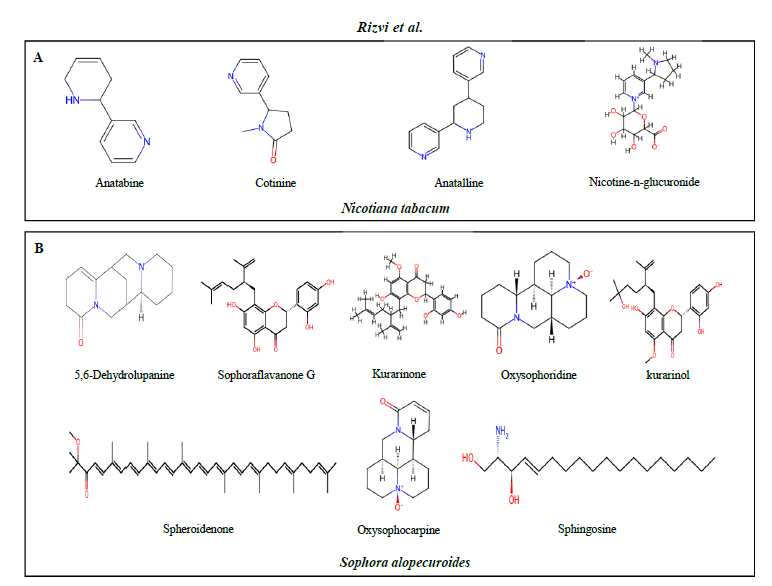
Confirmation of alkaloids in the crude extracts of S. alopecuroides and N. tabacum is presented in Table 1. The LC-MS analysis revealed the presence of several prominent alkaloids, including nicotine metabolites and derivatives from N. tabacum, such as anatabine, cotinine, anatalline, and nicotine-N-glucuronide. Conversely, S. alopecuroides extract yielded a distinct set of alkaloids, including 5,6-dehydrolupanine, sophoraflavanone G, kurarinone, oxysophoridine, kurarinol, spheroidenone, oxysophocarpine, and sphingosine. The extraction method employed in our study for alkaloids proved effective, with substantial amounts detected in the extracts. The crude alkaloid extract yields were notably high, with S. alopecuroides and N. tabacum yielding 21% w/w and 5.7% w/w, respectively. The presence of alkaloids in both extracts was confirmed through positive Wagner reagent tests and LC-MS analysis. The chemical structures of alkaloids identified in the crude extract by LC-MS are consistent with previous reports (Fig. 3).
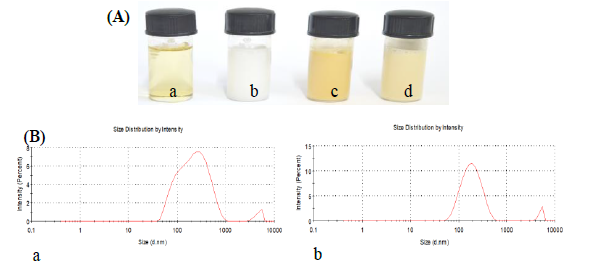
The dynamic light scattering (DLS) analysis revealed that the mean diameter of the EC was 267.2±3.86nm, with a PDI of 0.144, indicating a moderately monodisperse size distribution. In contrast, the CAE-EC had a mean diameter of 293.2±3.12nm, with a PDI of 0.106, suggesting a relatively monodisperse size distribution. Overall, the results indicate that the addition of crude alkaloids increases the mean particle size while maintaining a relatively uniform size distribution (Fig. 4B a-b). The physical appearance of the emulsifiable concentrate formulation diluted in distilled water is presented in (Fig. 4Aa- d). Upon dilution to 1:20, the EC formulation rapidly dissolved upon minor agitation. A minimal creamy layer developed at the surface of the beaker 24 h after dilution. However, this creamy layer was easily dispersed upon minor agitation. The pH of the CAE-EC was 6.0, while the pH of the EC without the crude alkaloid extract was 6.35. The viscosity of CAE-EC was 3.43 cP, slightly greater than that of EC without crude alkaloid extracts (4.34 cP).
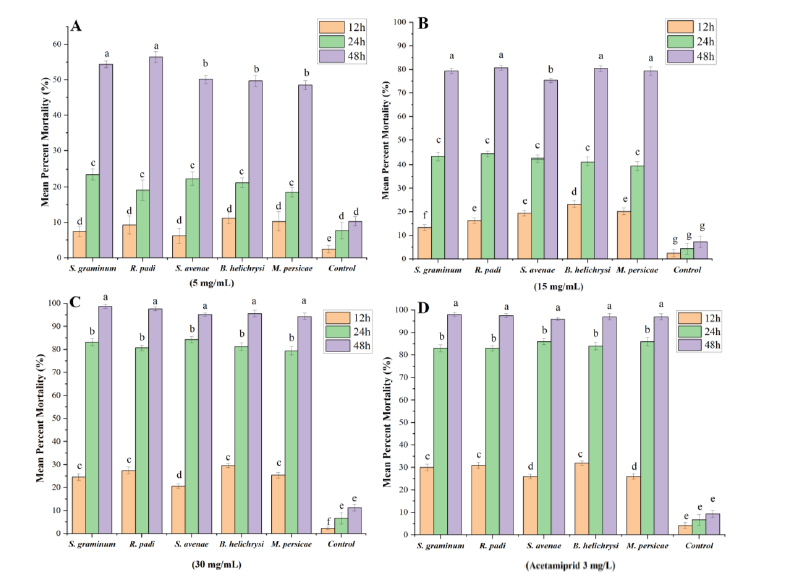
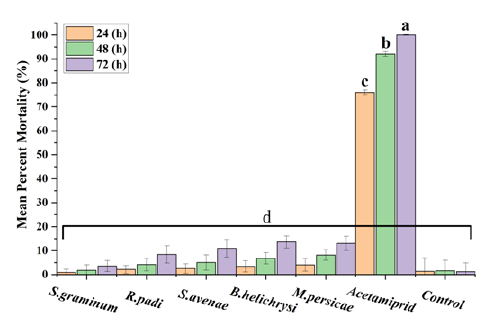
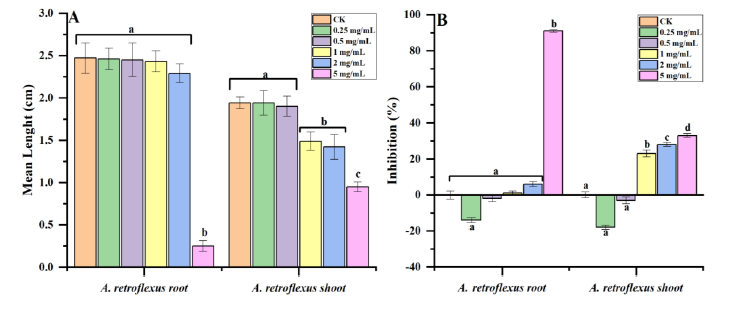
CAE-EC was acutely toxic to adults of treated aphid species, with LC50 values of 12.54mg/mL against Brachycaudus helichrysi, followed by 13.74, 13.96, 14.12, and 17.75mg/mL against R. padi, S. avenae, S. graminum, and M. persicae, respectively. The confidence intervals overlap, indicating no significant difference in CAE-EC toxicity among the tested aphid species. Furthermore, the LC50 value of acetamiprid, used as a positive control, was 0.35mg/L, which is significantly lower than the CAE-EC LC50 values (Table 2). The toxicity of CAE-EC increased gradually with increasing concentration and exposure time, indicating a concentration- and time-dependent nature of the toxicity effects (Fig. 5A-C). The CAE-EC at 5, 15, and 30mg/mL significantly reduced the aphid population compared to the control. At 30mg/mL, the maximum mean mortality of 98.66% was observed for S. graminum, followed by 97.54, 95.53, 95.12, and 94.33% for R. padi, B. helichrysi, S. avenae, and M. persicae, respectively. In contrast, in the control, only 9.34% mortality was observed 48 hours after application. Furthermore, the residual contact toxicity of CAE-EC against the selected species of aphids was significantly lower than that of contact toxicity (Fig. 6). The dry residue treatment of CAE-EC showed only 3-13 % mortalities after 48 h of treatment. However, acetamiprid caused 42.21%, 76.32%, and 98.2% mortality at 3mg/L at 3, 12, and 24 h after application, respectively. Moreover, the herbicidal activity of CAE-EC against A. retroflexus indicated a concentration-dependent effect (Fig. 7 A-B). The CAE-EC at 5mg/mL concentrations inhibited root and shoot elongation by 33% and 91%, respectively. Furthermore, the CAE-EC had no phytotoxic effects on wheat plants at three different growth stages.
Confirmation of alkaloids in the crude extract of S. alopecuroides and N. tabacum by LC/MS positive mode of analysis
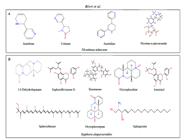
The chemical structures of alkaloids identified in crude extract by LC-MS, consistent with previous reports for (A) Nicotiana tabacum (Guo et al., 2011; Häkkinen et al., 2004; Weber et al., 2019; Zou et al., 2021), and (B) Sophora alopecuroides (Boozari et al., 2019; Huang et al., 2016; Lu et al., 2014; Wei et al., 2024; Wu et al., 2002).

Physical properties of CAE-EC Panel (A), the physical appearance of emulsifiable concentrate (a) EC without crude alkaloids, (b) EC diluted in 50mg/mL distilled water, (c) CAE-EC, (d) CAE-EC diluted in 50mg/mL distilled water. Panel (B), the size distribution intensity of EC in an aqueous solution: (a) EC without crude alkaloids, (b) CAE-EC.
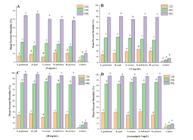
Mean percent mortalities of aphid species after 12, 24, and 48h after treatment caused by CAE-EC at (A) 5mg/mL, (B) 15mg/mL, (C) 30mg/mL, Acetamiprid 3mg/mL (D) as a positive control. Bars within a panel not labeled by the same letter are significantly different according to Tukey’s test (P<0.05). (D) Acetamiprid 3mg/L was used as a positive control.
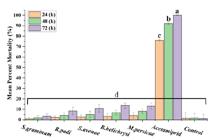
Mean percent mortalities of aphid species released on the dry residues of CAE-EC 30mg/mL concentration after 12, 24, and 48h. Acetamiprid 3mg/mL was used as a positive control. Bars within a panel not labeled by the same letter are significantly different according to Tukey’s test (P<0.05).
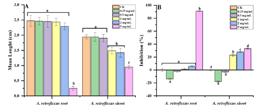
Herbicidal activity of CAE-EC on root and shoot elongation A. retroflexus after 7 days of treatments with CK, 0.25mg/mL, 0.5mg/mL, 1mg/mL, 2mg/mL, and 5mg/mL, (A) Mean root and shoot length of A. retroflexus, (B) Percent inhibition in root and shoot length of A. retroflexu. Bars within a panel not labelled by the same letter are significantly different according to Tukey’s test (P<0.05).
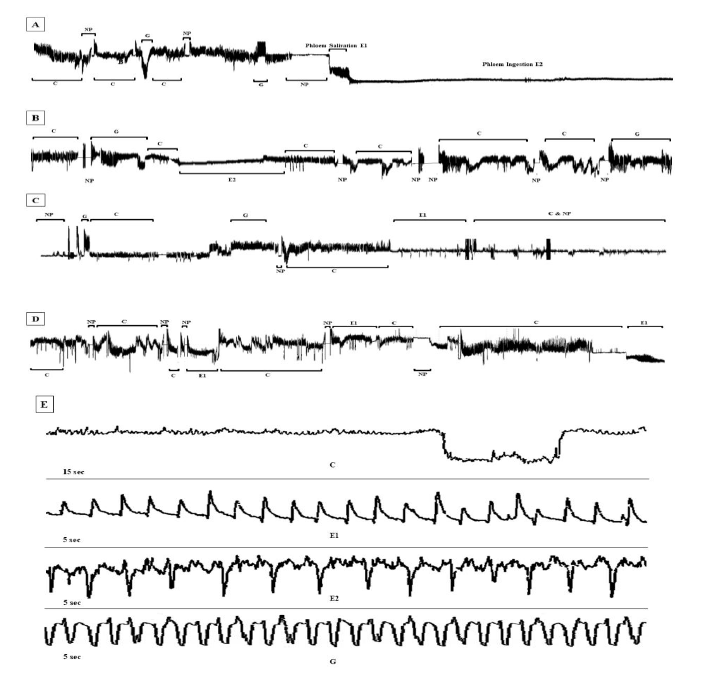
The alterations in the feeding behavior and pattern of S. graminum exposed to 0.1, 1, and 5mg/mL CAE-EC are presented in Figure 8A-E. The results indicated that S. graminum exposed to the desired concentrations of CAE-EC initiated probing behaviors but did not engage in phloem ingestion (E2) or xylem-associated activities (G), with a few insects failing to engage in any probing behavior (PD). In contrast, S. graminum feeding on untreated plants showed normal stylet functions, engaging in cell penetration (PD), pathway (C), phloem salivation (E1), phloem ingestion (E2), and xylem-associated (G) activities. The data indicated that the non-probing (NP) time of plants treated with 0.01mg/mL CAE-EC was 51.58 minutes, followed by that of plants treated with 1 or 5mg/mL CAE, which were 56.48 and 94.21 minutes greater than that of the control, respectively, where S. graminum took 23.01 minutes only. Similarly, the amount of E2 taken up by S. graminum was 288.45 min for the control, while the values at 0.01, 1, and 5mg/mL were 129.71, 143.63, and 163.68 min, respectively (Table 3).
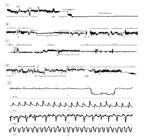
The electrical penetration graphs (EPG) of S. graminum feeding on treated and untreated plants. Overview of a four-hour recording by EPG of adult aphids (A) Control, (B) 0.1 (C), 1 and (D) 5mg/mL, (E) Waveforms representation is NP, non-probing; C, pathway phase; G, xylem feeding; E1, active salivation; E2, phloem ingestion; (E) waveforms exhibited by an aphid feeding on potted wheat plants.
DISCUSSIONS
Aphids are soft-bodied insects with suckling mouthparts, and they release honeydew while feeding, which promotes the growth of sooty mold and inhibits normal photosynthesis (Luo et al., 2022). In addition to feeding damage, aphids vector several deadly plant pathogens (Shih et al., 2023). Managing wheat aphids represents a major challenge due to their rapid reproduction ability and the significant crop losses they cause (Novák et al., 2024). Currently, carbamates, neonicotinoids, sulfoximines, and pyrethroids are widely used for their management (Kaleem et al., 2023). However, the massive reliance on these synthetic chemicals results in resistance and environmental pollution (Ikbal and Pavela, 2019). Therefore, eco-friendly novel alternatives for their management are needed. In this regard, we have evaluated the aphicidal activity of crude alkaloidal extracts from S. alopecuroides and N. tabacum as a novel tool for managing wheat aphids.
Alkaloids are among the most studied potential insecticidal candidates (Chowański et al., 2016). However, the isolation of bioactive compounds requires a large amount of plant biomass, and the yield of bioactive compounds is exceptionally low (Stéphane et al., 2021). Plant extracts, comprising hundreds of bioactive compounds with diverse modes of action, often exhibit greater bioactivity than individual isolated compounds due to synergistic interactions among multiple constituents, which can enhance overall toxicity (Enke and Nagels, 2011). The results of our current investigation reveal that a rapid and straightforward crude alkaloid extraction method from S. alopecuroides and N. tabacum achieves remarkably high yields, with S. alopecuroides and N. tabacum yielding 21% w/w and 5.7% w/w, respectively. The FTIR analysis of crude extract revealed characteristic peaks indicative of heterocyclic compounds, with N-H stretching vibrations around 3,500-3,000 cm-1 and C-H stretching around 2800-3000 cm-1, consistent with previous reports (Hu et al., 2024; Seçkin and Meydan, 2022; Vajjiram et al., 2017). Our study demonstrates the efficacy of a simple extraction process in isolating these alkaloids, as confirmed by FTIR and LC-MS analysis. The LC-MS analysis revealed several prominent alkaloids in N. tabacum and S. alopecuroides extract, consistent with previous literature that S. alopecuroides contains sophocarpine, oxysophocarpine, matrine, oxymatrine, cytisine, and aloperine (Wei et al., 2024; Boozari et al., 2019; Huang et al., 2016; Lu et al., 2014; Wu et al., 2002). Similarly, from the N. tabacum plant extract, predominant metabolites and derivatives of nicotine were reported, including myosmine, anatabine, noricotine, anabasine, nicotine, cotinine, and toosendanin ( Zou et al., 2021; Weber et al., 2019; Guo et al., 2011; Häkkinen et al., 2004).
Alkaloids serve as plants' first line of defense against arthropod attacks, interfering with various cellular and physiological activities of insects (Ali et al., 2019). Plant alkaloids, including matrine, piperine, camptothecin, nicotine, and berberine, have shown considerable insecticidal activity against various pests, including Diaphorina citri (Rizvi et al., 2024), Spodoptera exigua, and Leptinotarsa decemlineata (Lim et al., 2014). In our study, the aphicidal activity indicated that the CAE-EC formulation was acutely toxic to the selected aphid species, with LC50 values ranging from 12.54 to 17.75mg/mL when applied via contact to potted wheat plants. Meanwhile, the residual contact toxicity of CAE-EC was significantly lower than that of the contact toxicity. Overall, time- and concentration-dependent mortalities were observed. The average mortality rate of CAE-EC against the selected aphid species was 96.23%, slightly lower than that of acetamiprid, which caused 100% mortality at 3mg/L at 48 hours post-application. Similarly, (Wu et al., 2002) stated that the multiple combinations of anabasine, toosendanin, nicotine, sophocarpine, and aloperine between 0.1%-10% (w/v) had shown significant mortalities against Jacobiasca formosana, Lilioceris lilii, and Ectropis bhurmitra. Furthermore, the alkaloids matrine and sophocarpine present in S. alopecuroides have shown considerable mortality against various agricultural pests, and several matrine-based insecticides are currently commercialized in China (Huang et al., 2020). Regarding the mode of action of alkaloids against insects, the previous studies indicated neurotoxicity (Adamski et al., 2020). Our results align with those of (Puripattanavong et al., 2013), who found that an emulsifiable concentrate emulsion containing tobacco extract showed considerable toxicities against aphids and remained stable under various conditions. Similarly, emulsifiable concentrate formulations containing S. alopecuroides have a prolonged repellent effect against D. citri compared to the ethanolic extract (Rizvi et al., 2019). The results indicated that the CAE-EC formulation has potential as a novel alternative to synthetic insecticides against aphid species.
Plant extracts and essential oils at relatively high concentrations have been shown to cause insect mortality, while relatively low concentrations have demonstrated repellent and deterrent effects on arthropods (Gao et al., 2021; Liao et al., 2016). In our current study, the impact of sublethal concentrations of CAE-EC on the feeding behavior of S. graminum was evaluated using electric penetration graph (EPG) recordings. The feeding behavior and pattern indicated that the total duration of phloem sap ingestion and synchronized salivation were significantly shorter in the adult aphids exposed to the wheat plants treated with 0.1, 1, and 5mg/mL of CAE-EC than in the control aphids. The non-probing time of the aphids was greater than that of the control aphids. Furthermore, the salivation (E1) and sap-feeding (E2) durations of S. graminum significantly decreased with increasing concentrations of CAE-EC. Our results indicated that CAE-EC alters the feeding behavior of S. graminum. Similarly, the crude extracts of N. tabacum and Melia azedarach have shown antifeedant activity against Spodoptera litura (Venkateswarlu et al., 2013), and alkaloids from Sophora alopecuroides have shown antifeedant activity against Clostera anastomosi (Yang et al., 2006). Furthermore, sublethal concentrations of flonicamid, imidacloprid, cycloxaprid, and thiamethoxam significantly altered the non-probing time, phloem sap ingestion, salivation (E1), and sap-feeding (E2) activities in S. avenae (Aeinehchi et al., 2021), S. graminum (Gul et al., 2023), and A. gossypii (Koo et al., 2015). Our findings suggest that CAE-EC has a significant impact on the feeding behavior of S. graminum, providing a potential mechanism for its aphicidal activity.
CONCLUSIONS
Our current study evaluated the efficacy of crude alkaloid extract emulsifiable concentrate formulation containing S. alopecuroides and N. tabacum, as a novel alternative to synthetic insecticides for the sustainable management of wheat aphids. However, to fully assess its potential as an eco-friendly pest control candidate, further research is required to study its environmental impact and effects on non-targeted organisms. The simple, crude alkaloid extraction method employed in this study offers a more efficient and sustainable alternative to traditional methods of isolating single bioactive compounds, which typically require large amounts of plant biomass. Our process yields a higher recovery of crude alkaloids. It reduces the risk of insect resistance due to the synergistic activity of multiple compounds present in the crude extract, offering a distinct advantage over individual compounds. Therefore, the findings of our current study indicated that CAE-EC is an eco-friendly alternative for controlling wheat aphids.
ACKNOWLEDGMENTS
The authors are thankful to the Chinese Academy of Sciences (CAS) for support through the Young Visiting Scientist of the CAS President’s International Fellowship Initiative (Grant No. 2024PVC0036), a funding program designed to attract talented foreigners for scientific exchanges and research cooperation. Recognition is also due to the Public Sector Development Funds (PSDP) and the Productivity Enhancement of Wheat program of the Pakistan Agricultural Research Council (PARC), Pakistan. Furthermore, the authors express their sincere appreciation to King Saud University, Riyadh, Saudi Arabia, for support via the Ongoing Research Funding program (ORF-2025-112), and to Princess Nourah bint Abdulrahman University, Riyadh, Saudi Arabia, for funding through the Researchers Supporting Project (No. PNURSP2026R37).
REFERENCES
- ADAMSKI, Z.; BLYTHE, L.L.; MILELLA, L.; BUFO, S.A. Biological activities of alkaloids: from toxicology to pharmacology. Toxins, v.12, p.210, 2020.
- AEINEHCHI, P.; NASERI, B.; RAFIEE DASTJERDI, H. et al Lethal and sublethal effects of thiacloprid on Schizaphis graminum (Rondani)(Hemiptera: Aphididae) and its predator Hippodamia variegata (Goeze)(Coleoptera: Coccinellidae). Toxin Rev, v.40, p.1261-1271, 2021.
- AKBAR, R.; ALI, A.; KHATTAK, W.A. et al Biopesticidal potential of extracts of Nicotiana tabacum, Nicotiana rustica, A. galanga, Azadirachta indica and curcuma longa against Tribolium castaneum 2023. [Preprint].
- ALI, A.H.; ABDELRAHMAN, M.; EL-SAYED, M.A. Alkaloid role in plant defense response to growth and stress. In: JOGAIAH, S.; ABDELRAHMAN, M. (Eds.). Bioactive molecules in plant defense: signaling in growth and stress. Cham: Springer International Publishing, 2019. p.145-158.
- ALI, S.; BASIT, A.; MAKANDA, T.A. et al Improving drought mitigation strategies and disaster risk reduction through MODIS and TRMM-based data in relation to climate change over Pakistan. Environ. Sci. Pollut. Res, v.30, p.40563-40575, 2023.
- BAJWA, A.A.; FAROOQ, M.; AL-SADI, A.M. et al Impact of climate change on biology and management of wheat pests. Crop Prot, v.137, p.105304, 2020.
- BASS, C.; NAUEN, R. The molecular mechanisms of insecticide resistance in aphid crop pests. Insect Biochem. Mol. Biol, v.156, p.103937, 2023.
- BENELLI, G.; RIZZO, R.; ZENI, V. et al Carlina acaulis and Trachyspermum ammi essential oils formulated in protein baits are highly toxic and reduce aggressiveness in the medfly, Ceratitis capitata Ind. Crops Prod, v.161, p.113191, 2021.
- BETT, P.K.; DENG, A.L.; OGENDO, J.O. et al Residual contact toxicity and repellence of Cupressus lusitanica Miller and Eucalyptus saligna Smith essential oils against major stored product insect pests. Ind. Crops Prod, v.110, p.65-74, 2017.
- BOOZARI, M.; SOLTANI, S.; IRANSHAHI, M. Biologically active prenylated flavonoids from the genus Sophora and their structure-activity relationship-a review. Phytother. Res, v.33, p.546-560, 2019.
- CHEN, F.; JIANG, F.; OKLA, M.K. et al Nanoparticles synergy: enhancing wheat (Triticum aestivum L.) cadmium tolerance with iron oxide and selenium. Sci. Total Environ., v.915, p.169869, 2024.
- CHOWAŃSKI, S.; ADAMSKI, Z.; MARCINIAK, P. et al A review of bioinsecticidal activity of Solanaceae alkaloids. Toxins, v.8, p.60, 2016.
- ENKE, C.G.; NAGELS, L.J. Undetected components in natural mixtures: how many? What concentrations? Do they account for chemical noise? What is needed to detect them? Anal. Chem, v.83, p.2539-2546, 2011.
- FAHEEM, M.; SAEED, S.; SAJJAD, A. et al Spatio-temporal variations in wheat aphid populations and their natural enemies in four agro-ecological zones of Pakistan. PloS One, v.14, p.e0222635, 2019.
- FOWSIYA, J.; MADHUMITHA, G. A review of bioinsecticidal activity and mode of action of plant derived alkaloids. Res. J. Pharm. Technol, v.13, p.963, 2020.
- GAO, H.; YUAN, X.; LIN, X. et al Reducing expression of salivary protein genes by flonicamid partially contributed to its feeding inhibition of the brown planthopper on rice. J. Agric. Food Chem, v.71, p.6032-6038, 2023.
- GAO, S.; LU, R.; ZHANG, Y. et al Odorant binding protein C12 is involved in the defense against eugenol in Tribolium castaneum Pest. Biochem. Physiol, v.179, p.104968, 2021.
- GUL, H.; UL HAQ, I.; ULLAH, F. et al Impact of sublethal concentrations of flonicamid on key demographic parameters and feeding behavior of Schizaphis graminum. Ecotoxicology, v.32, p.756-767, 2023.
- GUO, J.; ZHOU, D.; GRIMM, S.W. Liquid chromatography-tandem mass spectrometry method for measurement of nicotine N-glucuronide: a marker for human UGT2B10 inhibition. J. Pharm. Biomed. Anal, v.55, p.964-971, 2011.
- GUPTA, P.K.; VASISTHA, N.K.; SINGH, S.; JOSHI, A.K. Genetics and breeding for resistance against four leaf spot diseases in wheat (Triticum aestivum L.). Front. Plant Sci., v.14, p.1023824, 2023.
- HÄKKINEN, S.T.; RISCHER, H.; LAAKSO, I. et al Anatalline and other methyl jasmonate-inducible nicotine alkaloids from Nicotiana tabacum cv. BY-2 cell cultures. Plant. Med., v.70, p.936-941, 2004.
- HOWE, G.A.; JANDER, G. Plant immunity to insect herbivores. Annu. Rev. Plant Biol, v.59, p.41-66, 2008.
- HU, S.; QIAO, B.; YANG, Y. et al Optimizing nitrogen rates for synergistically achieving high yield and high nitrogen use efficiency with low environmental risks in wheat production-evidences from a long-term experiment in the North China Plain. Eur. J. Agron, v.142, p.126681, 2023.
- HU, Z.X.; ZHANG, J.; ZHANG, T. et al Aloperine-type alkaloids with antiviral and antifungal activities from the seeds of Sophora alopecuroides L. J. Agric. Food Chem, v.72, p.8225-8236, 2024.
- HUANG, J.; LI, S.; LV, M. et al Non-food bioactive products for insecticides (II): Insights into agricultural activities of matrine-type alkaloid analogs as botanical pesticides. Ind. Crops Prod, v.154, p.112759, 2020.
- HUANG, Y.X.; WANG, G.; ZHU, J.S. et al Traditional uses, phytochemistry, and pharmacological properties of Sophora alopecuroides L. Eur. J. Inflam, v.14, p.128-132, 2016.
- HUSSAIN, D.; SALEEM, U.; ASRAR, M. et al A review on identification characters and IPM of wheat aphid by using non-conventional methods. Int. J. Trop. Insect Sci, v.44, p.419-432, 2024
- IKBAL, C.; PAVELA, R. Essential oils as active ingredients of botanical insecticides against aphids. J. Pest Sci., v.92, p.971-986, 2019.
- KALEEM R.M.U.; GAO, F.; SIKANDAR, A.; WU, H. Insights into the effects of insecticides on aphids (Hemiptera: aphididae): resistance mechanisms and molecular basis. Int. J. Mol. Sci, v.24, p.6750, 2023.
- KAUR, J.; DHIMAN, V.; BHADADA, S. et al LC/MS guided identification of metabolites of different extracts of Cissus quadrangularis Food Chem. Adv, v.1, p.100084, 2022.
- KHORRAMI, F.; VALIZADEGAN, O.; FOROUZAN, M.; SOLEYMANZADE, A. The antagonistic/synergistic effects of some medicinal plant essential oils, extracts and powders combined with Diatomaceous earth on red flour beetle, Tribolium castaneum Herbst (Coleoptera: Tenebrionidae). Arch. Phytopathol. Plant Prot, v.51, p.685-695, 2018.
- KOO, H.N.; LEE, S.W.; YUN, S.H. et al Feeding response of the cotton aphid, A phis gossypii, to sublethal rates of flonicamid and imidacloprid. Entomol. Exp. Appl., v.154, p.110-119, 2015.
- LI, D.; LI, Z.; LIU, Z. et al Climate change simulations revealed potentially drastic shifts in insect community structure and crop yields in China’s farmland. J. Pest Sci, v.96, p.55-69, 2023a.
- LI, T.; YANG, G.; LI, Q. et al Population dynamics of migrant wheat aphids in China’s main wheat production region and their interactions with bacterial symbionts.. Front. Plant Sci., v.14, p.1103236, 2023b.
- LIAO, M.; XIAO, J.J.; ZHOU, L.J. et al Insecticidal activity of melaleuca alternifolia essential oil and RNA-Seq analysis of Sitophilus zeamais transcriptome in response to oil fumigation. PloS One, 11, p.e0167748, 2016.
- LIM, S.J.; JEONG, D.Y.; CHOI, G.H. et al Quantitative analysis of matrine and oxymatrine in Sophora flavescens extract and its biopesticides by UPLC. J. Agric. Chem. Environ, v.3, p.64, 2014.
- LU, Z.G.; LI, M.H.; WANG, J.S. et al Developmental toxicity and neurotoxicity of two matrine-type alkaloids, matrine and sophocarpine, in zebrafish (Danio rerio) embryos/larvae. Reprod. Toxicol, v.47, p.33-41, 2014.
- LUO, K.; ZHAO, H.; WANG, X.; KANG, Z. Prevalent pest management strategies for grain aphids: Opportunities and challenges. Front. Plant Sci, v.12, p.790919, 2022.
- MA, T.; YAN, H.; SHI, X. et al Comprehensive evaluation of effective constituents in total alkaloids from Sophora alopecuroides L. and their joint action against aphids by laboratory toxicity and field efficacy. Ind. Crops Prod, v.111, p.149-157, 2018.
- NOVÁK, M.; PAVELA, R.; SPINOZZI, E. et al Lethal and sublethal effects of carlina oxide on the aphid Metopolophium dirhodum and its non-target impact on two biological control agents. J. Pest Sci, v.97, p.2131-2138, 2024.
- OPARAEKE, A.; DIKE, M.; AMATOBI, C. Evaluation of botanical mixtures for insect pests management on cowpea plants. J. Agric. Rural Dev. Trop. Subtrop, v.106, p.41-48, 2005.
- PURIPATTANAVONG, J.; SONGKRAM, C.; LOMLIM, L.; AMNUAIKIT, T. Development of concentrated emulsion containing Nicotiana tabacum extract for use as pesticide. J. Appl. Pharm. Sci., v.3, p.16-21, 2013.
- RIZVI, S.A.H.; LIU, Z.; OZUZU, S.A. et al Toxicity of delphinium brunonianum royle alkaloids against the adults of diaphorina citri and its mechanism study in insect SF9 cell line. Ind. Crops Prod, v.208, p.117826, 2024.
- RIZVI, S.A.H.; XIE, F.; LING, S.; ZENG, X. Development and evaluation of emulsifiable concentrate formulation containing Sophora alopecuroides L. extract for the novel management of Asian citrus psyllid. Environ. Sci. Pollut. Res, p.26, p.21871-21881, 2019.
- ROCKSTRÖM, J.; WILLIAMS, J.; DAILY, G.; NOBLE, A. et al Sustainable intensification of agriculture for human prosperity and global sustainability. Ambio, v.46, p.4-17, 2017.
- SALEEM, U.; ASRAR, M.; HUSSAIN, D. et al Efficacy of plant extracts and selective insecticides against wheat Aphid in Faisalabad, Pakistan. J. Innov. Sci, v.9, p.65-71, 2023.
- SEÇKIN, H.; MEYDAN, I. Synthesis and characterization of Sophora alopecuroides L. green synthesized of Ag nanoparticles for the antioxidant, antimicrobial and DNA damage prevention activity. Braz. J. Pharm. Sci, v.58, p.e20992, 2022.
- SEO, B.Y.; KWON, Y.H.; JUNG, J.K.; KIM, G.H. Electrical penetration graphic waveforms in relation to the actual positions of the stylet tips of Nilaparvata lugens in rice tissue. J. Asia-Pacif. Entomol, v.12, p.89-95, 2009.
- SHIH, P.Y.; SUGIO, A.; SIMON, J.C. Molecular mechanisms underlying host plant specificity in Aphids. Ann. Rev. Entomol., v.68, p.431-450, 2023.
- SILVA, S.A.; BEZERRA, G.C.; SILVA, P.V.V. et al Arbovirus vectors insects: are botanical insecticides an alternative for its management? J. Pest Sci, v.96, p.1-20, 2023.
- STÉPHANE, F.F.Y.; JULES, B.K.J.; BATIHA, G. et al Extraction of bioactive compounds from medicinal plants and herbs. In: ______ (Orgs.). Natural medicinal plants London: IntechOpen, 2021. p.1-39.
- VAJJIRAM, C.; VANITHA, A.; KALIMUTHU, K. Ftir and gc-ms analysis of bioactive compounds in ethanol extract of tobacco callus (Nicotiana tabacum). World J. Pharm. Res, v.6, p.530-545, 2017.
- VENKATESWARLU, P.; RAJU, K.S.; RAO, S.G.; PRASAD, J. Antifeedant effect of various aqueous leaf extracts against tobacco caterpillar, Spodoptera litura Fab. (Relatório de pesquisa). Proceedings of the National Academy of Sciences, India Section B: Biological Sciences 2013. V 87, 1229-1236p.
- VOULA, V.A.; DJOAH, Y.T; AKOUTOU, E.M., et al Insecticide effect on fresh tobacco leaves extract (Nicotiana tabacum) and cocoa pests (Theobroma cacao L.) in the locality of Nkoemvone South Cameroon. SSRN Electr. J., 2023. 16p. [Preprint].
- WANG, W.; YAO, J.; CAO, X. Alkaloids from tobacco leaves: isolation, alkaloid contents, and potential application as a natural pesticide against Bactrocera dorsalis. BioResources, v.17, p.1764-1780, 2022.
- WEBER, S.S.; KAMINSKI, K.P.; PERRET, J.L. et al Antiparasitic properties of leaf extracts derived from selected Nicotiana species and Nicotiana tabacum varieties. Food Chem. Toxicol., v.132, p.110660, 2019.
- WEI, S.; XIAO, J.; JU, F. et al A review on the pharmacology, pharmacokinetics and toxicity of sophocarpine. Front. Pharmacol, v.15, p.1353234, 2024.
- WU, C.A.; WU, H.; LEI, L. Compositions and methods for controlling pests using synergistic cocktails of plant alkaloids. United States Patent US6372239B1, deposited in 6 Sep. 2000, published in 16 Apr. 2002. Google Patents.
- XIAO, J.; PAN, Y.; ZHANG, L. et al High performance liquid chromatography determination and optimization of the extraction process for the total alkaloids from traditional herb Stephania cepharantha Hayata. Molecules, v.24, p.388, 2019.
- XU, T.; ZHANG, S.; LIU, Y. et al Slow resistance evolution to neonicotinoids in field populations of wheat aphids revealed by insecticide resistance monitoring in China. Pest Manag. Sci, v.78, p.1428-1437, 2022.
- YANG, Z.; ZHAO, B.; ZHU, L. et al Inhibitory effects of alkaloids from Sophora alopecuroids on feeding, development and reproduction of Clostera anastomosis. Front. Forestry China, v.1, p.190-195, 2006.
- ZHANG, B.; HAO, J.; SUN, Z. et al Non-food bioactive products for botanical pesticides: Insights into residue and dissipation kinetics of matrine-type alkaloids from Sophora alopecuroides. Ind. Crops Prod, v.192, p.116032, 2023.
- ZHOU, S.; ZOKIR, T.; MEI, Y. et al Allelopathic effect of Serphidium kaschgaricum (Krasch.) Poljak. volatiles on selected species. Plants, v.10, p.495, 2021.
- ZOU, J.; ZHAO, L.; YI, P. et al Quinolizidine alkaloids with antiviral and insecticidal activities from the seeds of Sophora tonkinensis Gagnep. J. Agric. Food Chem, v.68, p.15015-15026, 2020.
- ZOU, X.; AMRIT, B.; ABU-IZNEID, T. et al Current advances of functional phytochemicals in Nicotiana plant and related potential value of tobacco processing waste: a review. Biomed. Pharmacother, v.143, p.112191, 2021.
-
FUNDING
This project was supported by the Chinese Academy of Sciences (CAS) through the Young Visiting Scientist of the CAS President’s International Fellowship Initiative (Grant No. 2024PVC0036), a program designed to promote international scientific exchange and research cooperation. Additional funding was provided by the Public Sector Development Funds (PSDP), specifically for the Productivity Enhancement of Wheat program at the Pakistan Agricultural Research Council (PARC), Pakistan. The authors also acknowledge the support of South China Agricultural University and express their sincere appreciation to the Ongoing Research Funding program (ORF-2025-112) at King Saud University, Riyadh, Saudi Arabia, as well as the Princess Nourah bint Abdulrahman University Researchers Supporting Project (No. PNURSP2026R37), Princess Nourah bint Abdulrahman University, Riyadh, Saudi Arabia.
-
DATA AVAILABILITY STATEMENT
The research data are available within the article itself.
The research data are available within the article itself.