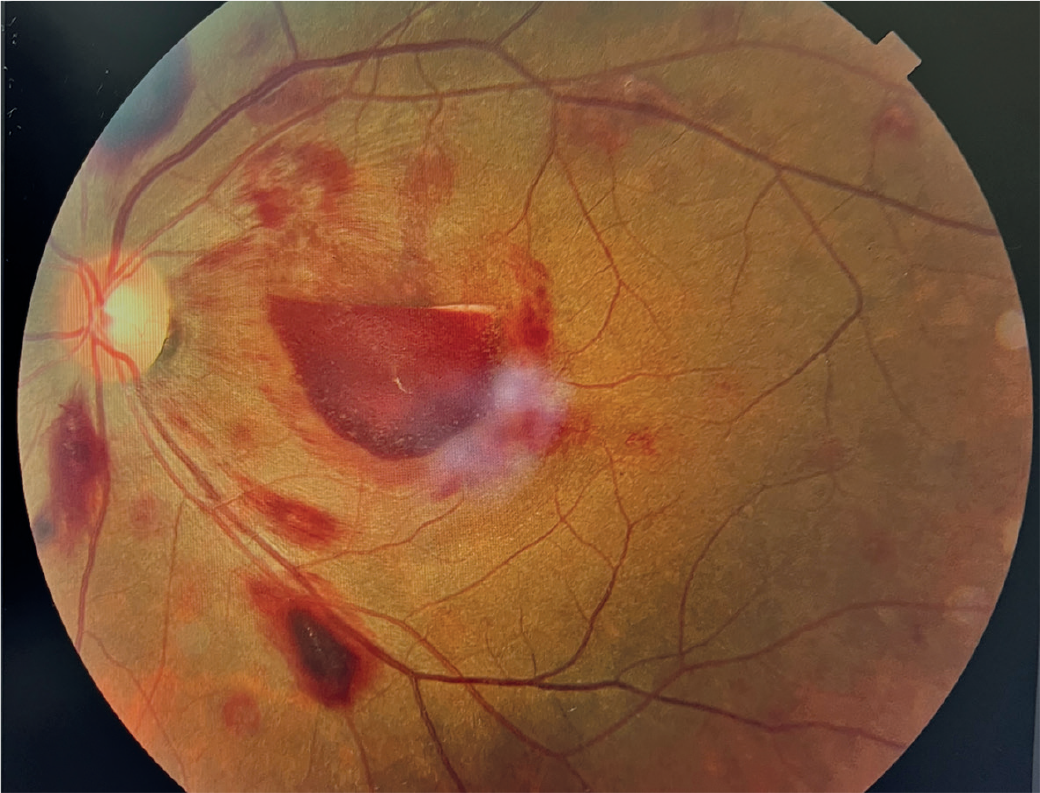
 Leukemic retinopathy
Leukemia is a systemic and heterogeneous(1) hematological disease, with retinal involvement as the most common ocular manifestation(2). Leukemic retinopathy (Figure 1) may arise from direct infiltration or hematologic abnormalities. These manifest as intraretinal or preretinal hemorrhages and cotton-wool spots(2). Treatment resolves the retinopathy within the first 2 months(2). Management should be individualized based on the patients’ underlying medical condition(1). If untreated, the sequelae include choroidal neovascularization and tractional retinal detachments(2).
-
Informed consent was obtained from all patients included in this study.
-
Funding:
This study received no specific financial support.
REFERENCES
-
1 Ghanbarnia M, Sedaghat S, Rasoulinejad SA. Leukemic retinopathy presenting as concurrent bilateral subhyaloid hemorrhage and subarachnoid hemorrhage in a patient with acute monocytic leukemia: a case report. J Med Case Rep. [Internet]. 2022 [cited 2024 Aug 21];16(1):466. Available from: https://pmc.ncbi.nlm.nih.gov/articles/PMC9758892/
» https://pmc.ncbi.nlm.nih.gov/articles/PMC9758892/ -
2 Beketova T, Mordechaev E, Murillo B, Schlesinger MD. Leukemic retinopathy: a diagnostic clue for initial detection and prognosis of leukemia. Creus [Internet]. 2023 [cited 2024 Sep 21];15(12):e50587. Available from: https://pmc.ncbi.nlm.nih.gov/articles/PMC10788118/
» https://pmc.ncbi.nlm.nih.gov/articles/PMC10788118/