Performance analysis of mortars with mixed recycled aggregates from demolition waste
Abstract
Given the generation of solid waste in the construction industry and its environmental impact, especially construction and demolition waste (CDW), it is necessary to seek sustainable alternatives for the sector. This study aims to analyze the performance of masonry and rendering mortars produced with mixed recycled aggregates from demolition waste, with the addition of lime and a plasticizing admixture. Ten mortar compositions were developed with different cement contents: 5 with lime, in the proportion 1:2:9 (cement: lime: sand), and 5 with plasticizing admixture (PA), in the proportion 1:3 (cement: sand). The tests of consistency index, specific mass, water absorption, tensile and compressive strength were the main tests performed as a basis for comparison. The results showed that mortars with recycled aggregates, especially when combined with PA and lower w/c ratios, presented better mechanical performance compared to the other compositions. In particular, the mortar composed entirely of recycled aggregate and PA exhibited higher mechanical strengths compared to compositions with natural aggregates, with increases in tensile strength ranging from 84% to 154%, and from 52% to 122% in compressive strength.
Keywords
Construction and demolition waste; Plasticizing admixture; Lime; Mortar
Resumo
Diante da geração de resíduos sólidos na construção civil e de seus efeitos causados no meio ambiente, especialmente os resíduos de construção e demolição (RCD), é necessário buscar alternativas sustentáveis para o setor. Este estudo tem como objetivo analisar o desempenho de argamassas de assentamento e revestimento produzidas com agregados reciclados mistos, provenientes de resíduos de demolição, com adição de cal e aditivo como agentes plastificantes. Foram desenvolvidas 10 composições de argamassas, com diferentes teores de cimento: 5 com cal, na proporção 1:2:9 (cimento: cal: areia), e 5 com aditivo plastificante (ADP), na proporção 1:3 (cimento: areia). Os ensaios de índice de consistência, massa específica, absorção de água, resistência à tração e compressão foram os principais realizados como base de comparação. Os resultados mostraram que as argamassas com agregados reciclados, especialmente quando combinadas com ADP e menores relação a/c, apresentaram melhor desempenho mecânico em comparação às demais composições. Em especial, a argamassa composta por completo com agregado reciclado e ADP apresentou maiores resistências mecânicas quando comparadas às composições naturais, com aumentos na tração variando de 84% a 154%, e de 52% a 122% na compressão.
Palavras-chave
Resíduos de construção e demolição; Aditivo plastificante; Cal; Argamassa
1 Introduction
In Brazil, Construction and Demolition Waste (CDW) represents a large share of the country’s solid waste (ABREMA, 2024), which poses a significant environmental challenge and requires solutions that combine technical efficiency, economic feasibility, and sustainability. In order to guide the management of this waste, Resolution No. 307 of the National Environmental Council (CONAMA) (Brazil, 2002) classifies CDW as Class A, allowing the reuse of said waste as recycled aggregates in the production of mortars and concrete.
The growing demand for construction materials, coupled with environmental pressures related to the extraction of natural resources, has led to an increase in the use of recycled aggregates as a sustainable alternative within the sector (Silva; Melo, 2023). Thus, the use of recycled aggregates in mortars emerges as an alternative to meet the high demand of the construction industry, since this material demonstrates adequate performance (Sampaio et al., 2025; Silva et al., 1997).
In order to be used in non-structural mortars, recycled aggregates must comply with the requirements established by NBR 15116 (ABNT, 2021a), which sets classification criteria and minimum performance requirements for their application in civil construction. Among these materials, Mixed Recycled Aggregate (MRA) stands out, since, when properly characterized, it can replace natural aggregate in proportions of up to 100% without compromising mortar performance (Levy, 2001). In an analysis of the influence of the fines content of mixed recycled aggregates on the properties of rendering mortars, Oliveira (2015) concluded that the partial replacement of natural aggregate with recycled aggregate may be feasible, reinforcing the possibility of its use as a material for rendering and laying masonry units.
This scenario is particularly relevant considering that, in conventional Brazilian construction, bedding, rendering, and fixing mortars are widely used in masonry works, being an essential part of the construction process (Sonvezzo, 2024). Therefore, investigating sustainable alternatives that maintain technical performance while contributing to the reduction of environmental impact is fundamental for the modernization of the construction sector.
Although several studies analyze the use of recycled aggregates in mortars, most of the literature still treats these materials in a generic way (Sampaio et al., 2025). Research evaluating the performance of mortars produced with recycled aggregates from an urban demolition event, with defined constructive characteristics and a predominance of ceramic materials, is still scarce. Furthermore, few studies compare the use of hydrated lime and plasticizing additives as strategies to ensure the workability of these mortars containing high levels of recycled aggregate.
In this context, the purpose of the present study is to analyze the performance of masonry and rendering mortars produced with mixed recycled aggregates derived from demolition waste of houses located in a neighborhood of the city of Maceió-AL affected by a ground subsidence process, with the addition of lime and a plasticizer admixture. The demolished buildings were situated on the slope of the Mutange neighborhood and consisted of single-story residences predominantly made of ceramic materials, such as blocks, bricks, and roof tiles. In this study, mortars composed with lime and mortars composed with plasticizing admixture were analyzed in order to provide alternatives for their composition and application, thereby contributing to the wider adoption of recycled materials.
Considering that a large portion of demolition waste is classified as mixed, due to the way it is generated, this study is expected to contribute to the technical literature by providing evidence on the potential use of recycled aggregates. Furthermore, it is believed that suitable mortars can be obtained for masonry applications, both for block bedding and rendering, by employing hydrated lime or plasticizing admixtures as plasticizing agents, practices that are very common in local buildings. In this way, the use of waste can be promoted in routine activities that do not require high performance levels, favoring the dissemination of recycled material usage.
2 Theoretical Framework
2.1 Recycled aggregates derived from Construction and Demolition Waste (CDW)
In Brazil, regulatory advances are being developed regarding the management of construction and demolition waste (CDW). One of the recent milestones is Decree No. 11,043, dated April 13, 2022, which established the National Solid Waste Plan (PLANARES). PLANARES sets strategic targets, including increasing the CDW recycling rate by 25% by 2040, reinforcing the need for sorting, recycling, and valorization of waste in the country (Brazil, 2022).
Recycled aggregates are obtained from the processing of construction and demolition waste and may consist of ceramic materials, concrete, mortars, and small fractions of secondary materials such as wood and steel, generally between 1% and 2% (Angulo, 2005). Studies show that, despite their limitations, these aggregates can exhibit satisfactory performance in cementitious mixtures, especially in non-structural applications (Oliveira, 2015; Vieira; Pedrosa, 2018; Santana; Pereira, 2020; Silva, 2024).
NBR 15116 (ABNT, 2021a) specifies criteria for the production, control, and acceptance of fine and coarse recycled aggregates intended for mortars and concretes produced with Portland cement. This standard establishes limits for water absorption, fines content, and granulometric requirements essential to ensure the adequate performance of recycled materials (Neville, 2016). Moreover, according to their composition, these aggregates can be classified, as per NBR 15116 (ABNT, 2021a), into three categories: Cementitious Recycled Aggregate (CRA), Concrete Recycled Aggregate (CoRA), and Mixed Recycled Aggregate (MRA). The latter is characterized by high variability, ranging from concrete fragments to significant proportions of ceramic materials. In the context of mortars, this distinction is essential, since each type exerts different influences on aspects such as absorption, workability, and mechanical performance (Angulo; Figueiredo, 2011).
Several authors (Leite, 2001; Oliveira, 2015; Neville, 2016; Silva, 2024) emphasize that granulometric composition is one of the most important factors in cementitious mixtures, as it determines not only the degree of compactness of the mixture but also its workability. Pileggi et al. (2003) pointed out that adequate particle size distributions favor void reduction and allow for more homogeneous mixtures with lower water-to-cement ratios, contributing to improved mechanical performance and greater durability. In addition, the water absorption of recycled aggregates is also a decisive parameter, since these materials present higher porosity and adhered mortar, which increases their absorption capacity (Leite, 2001). This characteristic can alter mortar consistency, increase water demand, and modify the effective water-to-cement ratio, directly impacting behavior in both the fresh and hardened states (Leite, 2001).
2.2 Mixed Recycled Aggregates (MRA)
Mixed recycled aggregates (MRA), such as those used in the present study, exhibit physical and microstructural characteristics different from those observed in natural aggregates. The high porosity of recycled aggregates plays a decisive role in the properties of mortars. Oliveira (2015) demonstrated that well-graded particle size distributions promote better particle packing, reducing porosity and increasing the cohesion of the mixture. This adjustment is particularly relevant when MRA replaces natural fine aggregate, since dimensional variability and fines content directly influence fresh-state behavior.
Studies indicate that more porous aggregates tend to adsorb part of the additive, reducing its dispersing action and requiring pre-saturation procedures to minimize efficiency losses (Evangelista; De Brito, 2010). Moreover, recent research indicates that combining optimized particle size distribution with strategies such as pre-wetting of the aggregate can reduce initial absorption and improve the mechanical and durability performance of mortars (De Brito; Kurda, 2021; Lima, 2024; Mora-Ortiz et al., 2021).
Recent studies have also highlighted an advantage in the use of MRA, namely the potential increase in mechanical strength at certain replacement levels (De Brito; Kurda, 2021). This behavior may be related to hydration kinetics favored by the water retained in the pores of the recycled aggregate, which is gradually released during the curing process (Silva; Santos; Almeida, 2022). According to the authors, this internal curing mechanism can contribute to more continuous and efficient cement hydration, especially at early ages. Furthermore, the “internal curing” effect provided by the water retained in the pores of recycled aggregates can act synergistically with plasticizers, promoting more continuous hydration of the paste (Chen et al., 2019).
2.3 Use of plasticizing admixtures and lime in mortars with recycled aggregate
Mortars intended for masonry applications – whether for bedding, rendering, or fixing – must exhibit characteristics such as plasticity, water retention, adhesion, and cohesion to ensure adequate performance in construction (Rodrigues, 2004). However, the incorporation of recycled aggregates into mortars presents performance challenges due to the material’s properties, which tend to increase water demand, reduce workability, and raise the porosity of the cementitious matrix. Thus, the use of lime and plasticizing admixtures are alternatives adopted to improve the plasticity and workability of conventional mortars, facilitating their application in masonry fixing, ceramic block bedding, and plaster coatings (Golaszewska et al., 2022).
Due to its fineness and its ability to retain water and fill voids, lime increases the cohesion, plasticity, and internal lubrication of mortar. This behavior favors molding and reduces exudation, important characteristics in mortars with recycled aggregates, which have greater porosity and absorption (Quarcioni, 2008).
The pre-wetting of recycled aggregates, in addition to reducing their initial water absorption, also ensures that the chemical admixture acts effectively within the cementitious matrix. This occurs because the procedure prevents the premature adsorption of the admixture by the aggregates (Oliveira, 2015), thereby guaranteeing the admixture’s efficiency in the mixture.
The combined use of plasticizers and particle size optimization strategies can enhance the performance of recycled mortars, allowing for reduced total porosity, improved cohesion, and increased mechanical strength, even at high replacement levels of natural aggregates with recycled ones.
2.4 Requirements of mortars for masonry execution
The standards NBR 13281-1 (ABNT, 2023a) and NBR 13281-2 (ABNT, 2023b) provide guidelines for the application of mortars in wall and ceiling coatings (Part 1) and for masonry bedding and fixing (Part 2). These standards define specific classifications that mortars must meet, including criteria such as fresh-state bulk density (DF), flexural tensile strength (Rf) and compressive strength, as indicated in Tables 1, 2 and 3.
The classifications established by the density criterion range from DF0 to DF4, with the DF categories representing ranges of fresh-state bulk density – varying from very lightweight mixtures (DF0, with density below 1400 kg/m³) to high-density mixtures (DF4, above 2000 kg/m³). The R categories, in turn, correspond to mechanical performance in the hardened state, classifying the material according to its flexural tensile strength, from R0 (very low strength, below 0.5 MPa) to R4 (high strength, above 3.0 MPa).
Furthermore, based on the results of bulk density tests, incorporated air content, and compressive and flexural tensile strengths, the standards also indicate the classification into which each mortar falls. Specifically, NBR 13281-1 (ABNT, 2023a) states that, for laying and fixing applications, inorganic mortars may be classified as: AAV – Masonry bedding for non-structural walls; AAE – Masonry bedding for structural walls; and AAF – Horizontal masonry fixing (wedging).
3 Method
3.1 Component materials
The materials used for the mixtures were: CP II Z-32 cement, fine natural sand (FNS), coarse natural sand (CNS), mixed recycled sand (MRS) derived from the processing of solid waste from demolition works, lime, plasticizing admixture (PA) – specifically intended for use in bedding and rendering mortars – and water from the public supply network. The materials were selected because they are easily found in the market and in local construction sites, thus allowing greater dissemination of the results in practical applications.
The cement used was Zebu General Use Cement CPII-F-32, in accordance with the requirements of NBR 16697 (ABNT, 2018), classified as Portland cement blended with limestone filler. The lime employed was hydrated lime, type CH-I, from the Damasceno brand, in compliance with the requirements of NBR 7175 (ABNT, 2003). According to this standard, the CH-I classification indicates hydrated lime of the highest purity and quality.
The additive used was manufactured by Vedacit. Based on the manufacturer’s data (Vedacit, 2022), it is a plasticizing admixture supplied in liquid form, with a density of 1.03 g/cm³, reddish-brown coloration, and a pH ranging between 9 and 13. In addition, the product is free of chlorides and volatile organic compounds (VOC). Regarding its composition, the additive has a chemical base consisting of natural resins. Its main function is to act as a plasticizer for bedding and rendering mortars.
To determine the properties of the sands, the tests listed in Table 4 were carried out, according to their respective methods and requirements. Tests No. 1 to 5 were performed exactly as described in the procedures and equations of the referenced standards.
In test No. 6, to evaluate the morphology and texture of fine recycled aggregate particles, representative samples of MRA were analyzed using scanning electron microscopy (SEM). The analysis was performed with a Shimadzu Superscan SSX-550 scanning electron microscope equipped with an anti-vibration stage, operating at a current of 10 mA.
For the test, the fraction of material retained on the 0.15 mm sieve was selected, allowing proper accommodation of the grains on the standard equipment holder, with an approximate diameter of 1 cm. Initially, the sample was metallized with gold particles using a Sanya Electron Quinck Coater, model SC-701, for 6 minutes, in order to increase the electrical conductivity of the surface and improve the quality of the images obtained.
The aim was to determine morphological parameters of the aggregates such as particle shape, surface texture, area, perimeter, and equivalent diameter. The analysis of these aspects allows inferences about possible influences on the rheological behavior of the mortars produced. It is considered that such characteristics, obtained from high-resolution SEM micrographs, enable a more detailed evaluation of granulometric properties compared to conventional sieve analysis, contributing to the optimization of particle size distribution.
3.2 Mix design and production
The mix proportions adopted in this study were 1:2:9 (cement: lime: sand) for mortars with lime, and 1:3 (cement: sand) for mortars with additive, both by volume. The dosages were chosen to reproduce the reality of local construction practices. The consumption of additive followed the manufacturer’s recommendation of 100 mL for each 50 kg of cement used, with the product diluted in the mixing water.
Silva (2024) conducted particle size distribution studies using the same fine natural sand (FNS), coarse natural sand (CNS), and mixed recycled sand (MRS) employed in the present work, and concluded that, for mortar production, the proportion of 60% natural aggregate + 40% recycled aggregate presented a particle size distribution compatible with the optimal zone defined by NBR 7211 (ABNT, 2022a). This proportion was adopted in the present study to develop 10 mortar mixtures, 5 containing lime and 5 containing additive, namely: 100% FNS, 100% CNS, 100% MRS, 60% FNS + 40% MRS, and 60% CNS+ 40% MRS.
To minimize the high water absorption effect caused by the porosity of CDW-derived aggregates, the pre-wetting process was applied to the recycled aggregates. Lima (2024) found that the ideal water compensation for pre-wetting is 80% of the aggregate’s water absorption capacity, relative to the mass of the material to be used, as presented in Equation 1.
Where:
is the amount of water required for pre-wetting (kg/m³);
is the amount of recycled aggregate (kg/m³); and
is the water absorption of the recycled aggregate (%), obtained according to NBR 16916 (ABNT, 2021b).
Thus, each sample was immersed and stirred in water for 15 minutes before being incorporated into the mixture. The pre-wetting water was considered as an additional amount, while the effective mixing water was adjusted to a fixed consistency according to the intended applications of the mortars.
Tables 4 and 5 present the material consumption, as well as the water-to-binder ratio (w/b) and the effective water-to-cement ratio (w/c), obtained according to Equations 2 and 3, which were based on NBR 15116 (ABNT, 2021a).
Where:
is the water-to-binder ratio;
is the effective water-to-cement ratio;
is the amount of effective water in the mixture, not considering the water absorption of the recycled aggregate (kg/m³);
is the amount of binder (kg/m³); and
is the amount of cement (kg/m³).
Furthermore, the consumption of materials was calculated converting volume traces into mass, from the unit masses of each component, and are also presented in Tables 5 and 6.
It is noted that the values obtained for the w/b and w/c ratios in the mixtures with PA indicate less water in the mixture when compared to mortars with lime, which implies that the use of the plasticizing admixture improved plasticity and workability. In addition, mortars with PA showed higher cement consumption per cubic meter of mixture.
It is worth emphasizing that the w/b and w/c ratios differ for mortars containing MRS. This difference is mainly related to the lower specific mass and higher porosity of recycled aggregates compared to natural ones. Thus, in mortars containing MRS, the w/b and w/c ratios presented higher values due to the need to compensate for water absorption by recycled aggregates and to ensure adequate consistency of the mixture.
The NBR 16541 (ABNT, 2016b) standard was adopted as a reference for the preparation of fresh mortar mixtures. Accordingly, after the pre-wetting procedure, all dry materials were added to the mortar mixer, which was operated at low speed while 75% of the water was added during the first 10 seconds. The low speed was maintained for 30 seconds and then increased to high speed for another 60 seconds. After this period, the mixture was allowed to rest for 90 seconds, during which the paddle and the sides of the mixer were scraped. Immediately afterwards, the equipment was operated again at low speed, and the remaining water was added during the first 10 seconds. The mixer remained in operation until completing a total of 60 seconds.
3.3 Tests on the mortars
3.3.1 Fresh state
In the post-production stage of the mortars, the consistency index test was carried out following the guidelines of NBR 13276 (ABNT, 2016a), determined by average diameter values within the margin of 26 cm ± 0.5 cm. Consistency was fixed in order to simulate the appropriate condition for mortar application in masonry, both for bedding and rendering.
Immediately afterwards, the bulk density test was performed, in accordance with NBR 13278 (ABNT, 2005a).
3.3.2 Hardened state
Subsequently, six prismatic specimens were molded, with dimensions of 4 cm × 4 cm × 16 cm, three of which were used for water absorption by capillarity tests, according to the guidelines of NBR 15259 (ABNT, 2005c), and three for tensile and compressive strength tests, according to the guidelines of NBR 13279 (ABNT, 2005b), both at the age of 28 days ± 24 h.
Finally, all the results of these tests were used as criteria for mortar classification, based on NBR 13281-1 (ABNT, 2023a) and NBR 13281-2 (ABNT, 2023b).
4 Results and discussion
4.1 Characterization of the aggregates
Figure 1 presents the particle size distribution curves of the three fine aggregates used: fine natural sand, coarse natural sand, and recycled sand.
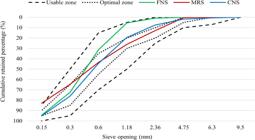
Particle size distribution curve of fine natural sand (FNS), coarse natural sand (CNS) and mixed recycled sand (MRS)
In the particle size analysis, the distribution of particle dimensions was evaluated, and as observed in Figure 1, CNS and MRS were predominantly within the optimal zone, while FNS remained in the usable zone. The ranges are in accordance with the limits suggested by NBR 7211 (ABNT, 2022a). Studies have stated that a good particle size distribution is essential to ensure mortars and concretes with good workability (Leite, 2001; Oliveira, 2015; Neville, 2016; Silva, 2024).
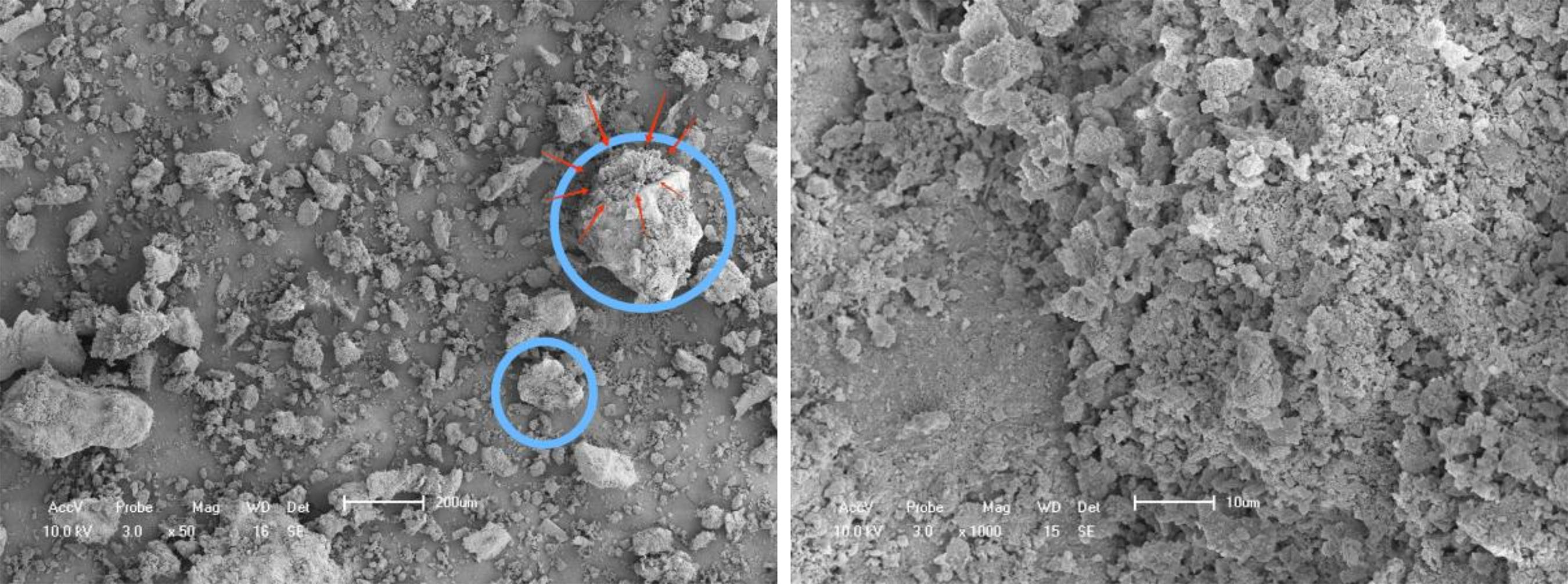
For the mixed recycled sand, its morphology was also evaluated. The microstructural analysis revealed greater adhesion of particles to the aggregate surface, characterized by a porous topography and high roughness, highlighted by arrows in Figure 2. The morphological evaluation of the grains indicated a predominance of particles with rounded contours, reduced longitudinal dimensions, and surface texture of moderate roughness, highlighted with circles in Figure 2, characteristics also observed by Santos (2025) in the characterization of the same recycled aggregate used in the present study.
According to Santos (2025), the microstructure of this aggregate presented intermediate characteristics between a material with apparent porosity and a material of denser nature. Previous studies that analyzed the microstructure of recycled aggregates by scanning electron microscopy (SEM), such as that conducted by Limbachiya et al. (2007), also reported the presence of porous and rough surfaces, as well as the occurrence of cement paste particles adhered to the grains, which corroborates the morphological observations identified in the samples analyzed in this study and presented in Figure 2.
The results of the other tests performed can be found in Table 7.
The bulk densities of the sands varied, according to Method A, from 1355 kg/m³ to 1607 kg/m³, and according to Method C, from 1103 kg/m³ to 1495 kg/m³. The results obtained for the recycled sand showed lower values than those of the natural aggregates, reflecting the higher porosity of the aggregate derived from demolition waste. Similar results were reported by other authors (Leite, 2001; Oliveira, 2015; Silva, 2024).
The specific density results, in the saturated surface dry condition, ranged from 2240 kg/m³ to 2521 kg/m³, and in the dry condition, from 2079 kg/m³ to 2505 kg/m³, with the recycled aggregate showing the lowest value, confirming its porous nature. Gómez-Sóberon (2002) states that this difference may vary by approximately 14% in dry density and 9% in saturated surface dry density. The results of this test showed the differences presented in Table 8, where one may observe that the average differences between the aggregate densities are similar to those reported by Gómez-Sóberon (2002).
As observed from the results, Evangelista and De Brito (2010) confirm that recycled aggregates, such as MRS, tend to have lower specific density, higher porosity, and greater heterogeneity compared to natural aggregates.
In turn, the water absorption results for fine and coarse natural sand were 1.20% and 0.60%, respectively, while the water absorption of recycled sand was higher than that of the natural sands, with a value of 7.70%. This behavior is related to the origin of the mixed recycled aggregate. Studies show that the water absorption of recycled aggregates depends on the composition of the waste from which they are derived (Angulo; Figueiredo, 2011). The authors report that cementitious materials can have absorption rates of up to 15%, and red ceramics up to 24%, the latter being the material that most influences the porosity of MRS. However, despite the high value, it is within the limit established by NBR 15116 (ABNT, 2021a), which prescribes a maximum limit of 12% for mixed recycled aggregates.
Regarding the fines content, coarse natural sand showed a higher value (2.68%) than fine sand (0.78%), reflecting the presence of more fine material. Furthermore, according to the criteria of NBR 15116 (ABNT, 2021a), the fines content of MRS (16.18%) exceeds the limit of 12% for protected concrete and 10% for unprotected concrete. De Brito and Kurda (2021) highlight that recycled aggregates tend to exhibit greater heterogeneity and higher fines content, directly affecting absorption.
Finally, the clay content of coarse natural sand (2.20%) was also higher than that of fine sand (1.08%). For recycled sand, according to NBR 15116 (ABNT, 2021a), values must be below 3.0% for use in cementitious mixtures. Therefore, the value obtained (4.38%) exceeds the permitted limit. This high clay content is related to the presence of ceramic materials in the MRS used. Literature indicates that excessive clay particles compromise the performance of mixtures, as these materials have a high water retention capacity, increasing water demand and matrix porosity (Evangelista; De Brito, 2010), which may affect durability.
Although the MRS used in this study presented excessive values in terms of fine particles and clay content, considering the restrictions of Brazilian standards, it was decided to proceed with the use of the material for the production of cementitious mixtures. These values are attributed to the origin of the material, since the waste came from the demolition of buildings predominantly made of ceramic block masonry and located on a slope, which may have led to soil contamination despite initial separation. It was also considered that this may reflect the reality of mixed recycled aggregates available in the market, especially in cases of small-scale building demolition, making this study a potential pathway for broader adoption of recycled aggregates in applications that do not require high performance.
4.2 Water absorption by capillarity
Following the recommendations of NBR 15259 (ABNT, 2005c), Tables 9 and 10 present the average results obtained in the water absorption by capillarity test of the three mortar specimens with lime and with plasticizing admixture, for testing times of 10 and 90 minutes.
In mortars with lime, the values ranged between 1.16 g/cm² and 1.92 g/cm² after 90 minutes of testing, while mortars with PA ranged between 0.29 g/cm² and 0.59 g/cm². It can be observed that an unexpected result occurred with the 100% MRS mortars, which presented lower water absorption compared to the other compositions, both in mortars with lime and in mortars with additive. Since this material has higher absorption compared to natural aggregates, it was expected that the same behavior would occur in the 100% MRS mortars. Mortars with partial replacement of natural aggregate by recycled aggregate also showed lower water absorption rates compared to mortars composed entirely of natural aggregates. In their work, Cuenca-Moyano et al. (2014) reported lower water absorption by capillarity in mortars as more recycled aggregate was incorporated, especially those pre-wetted. The authors highlight that this behavior is due to the greater number of recycled aggregate particles and lower effective w/c ratio, which led the cement paste to fill the pores, making the mortar more compact.
Analyzing the lime mortars after 90 minutes, the results revealed that those composed of fine natural sand (100% FNS and 60% FNS + 40% MRS) presented higher absorption indices. This behavior can be attributed to the finer particle size distribution of the sand used, which results in smaller pores and increases capillarity, leading to greater water absorption. Rodrigues (2004) states that the progression of water will be greater the finer the capillaries of the material.
Another important observation in this test was that, although the plasticizing admixture was incorporated to improve plasticity, it also provided benefits regarding water absorption, since all mortars with PA presented lower absorption values compared to those produced with lime.
The composition with recycled aggregate that showed the best performance in terms of water absorption was the mixture of 60% CNS + 40% MRS with plasticizing admixture, surpassing the 100% FNS mortar made exclusively of natural aggregate. According to Neville (2016), well-distributed particle sizes reduce voids, decreasing the formation of capillary pores in the cementitious matrix. Unlike FNS, CNS fell within the optimal zone of the particle size distribution curve, which may have contributed to reducing capillary porosity—a determining factor for water absorption.
Tables 11 and 12 present the average results obtained for the capillarity coefficient of the mortars analyzed.
4.3 Bulk density and air content
According to the recommendations of NBR 13278 (ABNT, 2005a), Table 13 presents the bulk density results of the mortars analyzed. In both mortar compositions (with lime and with PA), density showed higher values in the mixture containing 60% CNS + 40% MRS – 1939.53 kg/m³ in the mortar with lime and 1945.67 kg/m³ in the mortar with PA – and lower values in the mixture composed exclusively of fine natural sand (100% FNS) – 1837.51 kg/m³ when lime was used and 1861.85 kg/m³ when PA was used.
4.4 Mechanical performance
In accordance with the prescriptions of NBR 13279 (ABNT, 2005b), tensile and compressive strength tests were carried out. The reduction in water consumption and the increase in cement consumption directly contribute to the good performance of the mortar in the hardened state, so higher mechanical strength values are expected in these mortars. The results obtained are presented in Tables 14 and 15.
In general, mortars that incorporated recycled aggregates presented satisfactory mechanical performance, with emphasis on the formulation composed of 100% recycled aggregate, which achieved remarkable results in both tests. The superior performance of these mortars, especially in compressive strength, is related to their higher specific mass and lower void content.
Furthermore, when comparing the tensile and compressive strength results, it is evident that mortars produced with CNS and MRS showed superior mechanical performance compared to those formulated with FNS. A possible explanation is that the particle size distribution of FNS fell only within the usable range, whereas the distributions of CNS and MRS were within the optimal range, favoring grain packing. As discussed by Silva (2024), mixtures with greater granulometric continuity tend to achieve higher mechanical strengths due to improved packing and the consequent increase in unit mass.
From the analyses, it is clear that, compared to lime-based mortar, the incorporation of the plasticizing admixture considerably increased mechanical strength, both in tension and compression, in all formulations tested. The increase in strength ranged from approximately two to four times, suggesting that the use of plasticizing admixtures is highly effective in improving the mechanical strength of mortars, making them more suitable for applications requiring greater durability and resistance.
When comparing the tensile and compressive performance of mortars, both with lime and with plasticizing admixture, it is observed that the incorporation of recycled sand alone promotes significant gains in mechanical strength. This effect may be associated with the hydration kinetics intensified by the water retained in the pores of the recycled aggregate, which is gradually released during curing, favoring more complete and continuous hydration of the cementitious matrix (Chen et al., 2019). When recycled sand is used together with the plasticizing admixture, these benefits are enhanced. Thus, recycled aggregate not only proves to be viable but also potentially superior to natural aggregates in certain combinations, especially when combined with a plasticizing admixture.
4.4 Classification
Based on the results previously obtained in the bulk density and tensile and compressive strength tests, it was possible to classify the mortars according to the guidelines of NBR 13281-1 (ABNT, 2023a) and NBR 13281-2 (ABNT, 2023b). The mortars were classified according to the criteria in the fresh state – bulk density – and in the hardened state – compressive and tensile strength – as presented in Tables 16 and 17.
In the criterion of bulk density in the fresh state, all mortars produced with lime were classified as DF3, whose value ranges between 1800 and 2000 kg/m³ (ABNT, 2023a). In addition, it was observed that, regarding the tensile strength required for rendering mortars, the mortars remained in class R2, whose value ranges between 0.5 and 1.5 MPa (ABNT, 2023b).
Moreover, according to NBR 13281-1 (ABNT, 2023a), in the criterion of compressive strength, all compositions were classified as AAV (use in partition masonry) or AAF (use in infill masonry).
For the mortars produced with PA, in the criterion of bulk density in the fresh state, it was also classified as DF3, as occurred with the lime mortars. Regarding the strength criteria, it is observed that these mortars presented higher values than those composed with lime, possibly due to the higher cement consumption.
The mortar composed of 100% MRS deserves particular attention, as it achieved the AAE8 classification, corresponding to mortars intended for structural masonry with fbk blocks strengths ranging between 8 and 10 MPa (ABNT, 2023a), in addition to being classified as R4, which represents the highest tensile strength category for rendering mortars (ABNT, 2023b).
Compared to mortars produced with natural aggregates, the mortar composed solely of recycled aggregate (100% MRS) showed significantly superior mechanical performance. In relation to the mortar with 100% FNS, an increase of approximately 154% in tensile strength and 122% in compressive strength was observed. When compared to the mortar with 100% CNS, the increments were about 84% in tensile strength and 52% in compressive strength.
Therefore, these results are considerably superior to those found for the other compositions, indicating that recycled aggregate, combined with the use of plasticizer admixture and higher cement consumption, promoted significant gains in the mechanical performance of mortars.
5 Conclusions
The results obtained demonstrate that the plasticizing admixture, initially incorporated with the aim of improving the workability of the mortars, also contributed significantly to reducing water absorption. When comparing the mechanical performance of the mixtures, it was found that the replacement of natural aggregate with recycled sand promoted consistent gains in both tensile and compressive strength. This trend was even more evident when recycled sand was combined with the plasticizing admixture and lower w/c and w/b ratios, resulting in mortars with superior mechanical performance.
Another noteworthy point was the reduction in water absorption by capillarity in mortars that used recycled aggregates, when compared to mixtures with natural aggregates. This characteristic is particularly important in applications such as masonry unit bonding and rendering, as it is directly related to lower susceptibility to moisture-related pathologies, thereby promoting greater durability of buildings.
Regarding the mortars produced with hydrated lime, it was observed that, although they did not present the same mechanical gains and absorption reduction verified in the mixtures with plasticizing additive, all compositions met the classification criteria established by NBR 13281-1 (ABNT, 2023a). These results show that lime, acting mainly on the plasticity, cohesion and workability of mixtures with recycled aggregates, makes it possible to obtain technically adequate mortars for laying and coating applications.
Considering the implications associated with the high clay content present in the recycled aggregates used, further investigations focused on the durability performance of these mortars are necessary. The presence of clayey fines can influence water retention, porosity, and moisture transport mechanisms, factors directly related to the occurrence of pathological manifestations.
Thus, the results indicated that the combination of mixed recycled aggregates derived from demolition waste and plasticizing admixtures constitutes a technically and environmentally viable solution for the production of sustainable mortars, without compromising their essential performance properties. However, to consolidate the results obtained and deepen the understanding of the behavior of these mortars, further studies are necessary, with more detailed analyses of their microstructure.
-
Declaration of Generative AI and AI-Assisted Technologies in the Writing Process
During the preparation of this work the authors used Microsoft Copilot in order to check grammar issues and to improve readability. After using this tool/service, the authors reviewed and edited the content as needed and take(s) full responsibility for the content of the publication.
-
Financial Support
This study was supported by the Universidade Federal de Alagoas, a PIBIC scholarship funded by the Fundação de Amparo à Pesquisa do Estado de Alagoas (FAPEAL), and private funding from Braskem.
-
SILVA, Y. K. O.; MELO, C. V. A. de; MORAES, K. A. de M.; COUTO, M. S. de B. Performance analysis of mortars with mixed recycled aggregates from demolition waste. Ambiente Construído, Porto Alegre, v. 26, e152384, jan./dez. 2026. ISSN 1678-8621 Associação Nacional de Tecnologia do Ambiente Construído. http://dx.doi.org/10.1590/s1678-86212026000100989
Data Availability Statement
Research data is only available upon request.
References
- ANGULO, S. C. Caracterização de agregados de resíduos de construção e demolição reciclados e a influência de suas características no comportamento de concretos São Paulo, 2005. Tese (Doutorado em Engenharia de Construção Civil e Urbana) – Escola Politécnica, Universidade de São Paulo, São Paulo, 2005.
- ANGULO, S. C.; FIGUEIREDO, A. D. Concreto com agregados reciclados. In: ANGULO, S. C.; FIGUEIREDO, A. D. Concreto: ciência e tecnologia São Paulo: Ibracon, 2011.
- ASSOCIAÇÃO BRASILEIRA DE NORMAS TÉCNICAS. NBR 13276: argamassa para assentamento e revestimento de paredes e tetos: determinação do índice de consistência. Rio de Janeiro, 2016a.
- ASSOCIAÇÃO BRASILEIRA DE NORMAS TÉCNICAS. NBR 13278: argamassa para assentamento e revestimento de paredes e tetos: determinação da densidade de massa e do teor de ar incorporado. Rio de Janeiro, 2005a.
- ASSOCIAÇÃO BRASILEIRA DE NORMAS TÉCNICAS. NBR 13279: argamassa para assentamento e revestimento de paredes e tetos: determinação da resistência à tração na flexão e à compressão. Rio de Janeiro, 2005b.
- ASSOCIAÇÃO BRASILEIRA DE NORMAS TÉCNICAS. NBR 13281-1: argamassas inorgânicas: requisitos e métodos de ensaios: parte 1: argamassas para revestimento de paredes e tetos. Rio de Janeiro, 2023a.
- ASSOCIAÇÃO BRASILEIRA DE NORMAS TÉCNICAS. NBR 13281-2: argamassas inorgânicas: requisitos e métodos de ensaios: parte 2: argamassas para assentamento e argamassas para fixação de alvenaria. Rio de Janeiro, 2023b.
- ASSOCIAÇÃO BRASILEIRA DE NORMAS TÉCNICAS. NBR 15116: agregados reciclados para uso em argamassas e concretos de cimento Portland: requisitos e métodos de ensaio. Rio de Janeiro, 2021a.
- ASSOCIAÇÃO BRASILEIRA DE NORMAS TÉCNICAS. NBR 15259: argamassa para assentamento e revestimento de paredes e tetos: determinação da absorção de água por capilaridade e do coeficiente de capilaridade. Rio de Janeiro, 2005c.
- ASSOCIAÇÃO BRASILEIRA DE NORMAS TÉCNICAS. NBR 16541: argamassa para assentamento e revestimento de paredes e tetos: preparo da mistura para a realização de ensaios. Rio de Janeiro, 2016b.
- ASSOCIAÇÃO BRASILEIRA DE NORMAS TÉCNICAS. NBR 16697: cimento Portland: requisitos. Rio de Janeiro, 2018.
- ASSOCIAÇÃO BRASILEIRA DE NORMAS TÉCNICAS. NBR 16916: agregado miúdo: determinação da densidade e da absorção de água. Rio de Janeiro, 2021b.
- ASSOCIAÇÃO BRASILEIRA DE NORMAS TÉCNICAS. NBR 16972: agregados: determinação da massa unitária e do índice de vazios. Rio de Janeiro, 2021c.
- ASSOCIAÇÃO BRASILEIRA DE NORMAS TÉCNICAS. NBR 16973: agregados: determinação do material fino que passa pela peneira de 75 μm por lavagem. Rio de Janeiro, 2021d.
- ASSOCIAÇÃO BRASILEIRA DE NORMAS TÉCNICAS. NBR 17054: agregados: determinação da composição granulométrica: métodos de ensaio. Rio de Janeiro, 2022b.
- ASSOCIAÇÃO BRASILEIRA DE NORMAS TÉCNICAS. NBR 7175: cal hidratada para argamassas: requisitos. Rio de Janeiro, 2003.
- ASSOCIAÇÃO BRASILEIRA DE NORMAS TÉCNICAS. NBR 7211: agregados para concreto: requisitos. Rio de Janeiro, 2022a.
- ASSOCIAÇÃO BRASILEIRA DE NORMAS TÉCNICAS. NBR 7218: agregados: determinação do teor de argila em torrões e materiais friáveis. Rio de Janeiro, 2010.
- ASSOCIAÇÃO BRASILEIRA DE RESÍDUOS E MEIO AMBIENTE. Panorama dos resíduos sólidos no Brasil 2024 São Paulo: Abrema, 2024.
- BRAZIL. Conselho Nacional do Meio Ambiente. Resolução nº 307, de 05 de julho de 2002. Estabelece diretrizes, critérios e procedimentos para a gestão dos resíduos da construção civil. Diário Oficial da União: seção 1, Brasília, DF, 17 jul. 2002.
- BRAZIL. Decreto nº 11.043, de 13 de abril de 2022. Aprova o Plano Nacional de Resíduos Sólidos. Diário Oficial da União: seção 1, Brasília, DF, 14 abr. 2022.
- CHEN, F. et al Internal curing effect and compressive strength calculation of recycled clay brick aggregate concrete. Materials, v. 12, n. 11, p. 1815, 2019.
- CUENCA-MOYANO, G. M. et al Influence of pre-soaked recycled fine aggregate on the properties of masonry mortar. Construction and Building Materials, v. 70, p. 71-79, 2014.
- DE BRITO, J.; KURDA, R. The past and future of sustainable concrete: a critical review and new strategies on cement-based materials. Journal of Cleaner Production, v. 281, art. 123558, 2021.
- EVANGELISTA, L.; DE BRITO, J. Durability performance of concrete made with fine recycled concrete aggregates. Cement and Concrete Composites, v. 32, n. 1, p. 9-14, 2010.
- GOŁASZEWSKA, M. et al Comparative study of effects of air-entraining plasticizing admixture and lime on physical and mechanical properties of masonry mortars and plasters. Materials, v. 15, n. 7, p. 2583, 2022.
- GÓMEZ-SOBERÓN, J. Porosity of recycled concrete with substitution of recycled concrete aggregate: an experimental study. Cement and Concrete Research, v. 32, p. 1301-1311, 2002.
- LEITE, M. B. Avaliação de propriedades mecânicas de concretos produzidos com agregados reciclados de resíduos de construção e demolição Porto Alegre, 2001. 270 f. Tese (Doutorado em Engenharia) – Escola de Engenharia, Universidade Federal do Rio Grande do Sul, Porto Alegre, 2001.
- LEVY, S. M. Contribuição ao estudo da durabilidade de argamassas produzidas com agregados reciclados de resíduos de construção e demolição São Paulo, 2001. Tese (Doutorado em Engenharia) - Escola Politécnica, Universidade de São Paulo, São Paulo, 2001.
- LIMA, N. K. S. Análise da viabilidade do uso de agregado reciclado graúdo misto em concretos estruturais Maceió, 2024. Trabalho de Conclusão de Curso (Graduação em Engenharia Civil) – Centro de Tecnologia, Universidade Federal de Alagoas, Maceió, 2024.
- LIMBACHIYA, M. C. et al. Chemical: mineralogical characterization of coarse recycled concrete aggregate. Waste Management, v. 27, p. 201-208, 2007.
- MORA-ORTIZ, R. S. et al Effect of pre-wetting recycled mortar aggregate on the mechanical properties of masonry mortar. Materials, v. 14, n. 6, 1547, 2021.
- NEVILLE, A. M. Propriedades do concreto 5. ed. Porto Alegre: Bookman, 2016.
- OLIVEIRA, R. P. Estudo da influência do teor de finos dos agregados reciclados mistos nas propriedades das argamassas de revestimento Santa Maria, 2015. Dissertação (Mestrado em Engenharia Civil) – Centro de Tecnologia, Universidade Federal de Santa Maria, Santa Maria, 2015.
- PILEGGI, R. G.; STUDART, A. R.; PANDOLFELLI, V. C. Influence of particle size distribution on the rheological behavior of cement suspensions. Materials Research, v. 6, n. 3, p. 317-322, 2003.
- QUARCIONI, V. A. Influência da cal hidratada nas idades iniciais da hidratação do cimento Portland: estudo em pasta. São Paulo, 2008. Tese (Doutorado em Engenharia de Construção Civil e Urbana) - Escola Politécnica, Universidade de São Paulo, São Paulo, 2008.
- RODRIGUES, P. F. Compatibilidade entre as paredes e revestimentos. In: SEMINÁRIO DE ARQUITECTURA DE TERRA EM PORTUGAL, 2., Lisboa, 2004. Anais [...] Lisboa: FCT/UNL, 2004.
- SAMPAIO, T. R. S. et al. Emerging trends in the use of recycled sand in mortar: a systematic review. Buildings, v. 15, n. 21, p. 3841, 2025.
- SANTANA, T. S.; PEREIRA, C. H. A. F. Avaliação da influência da utilização de agregado miúdo reciclado em argamassas estabilizadas. Ambiente Construído, Porto Alegre, v. 20, n. 3, p. 305-318, jul./set. 2020.
- SANTOS, A. R. Estudo do uso de agregado reciclado de resíduo da construção e demolição em substituição parcial do agregado miúdo na produção de argamassa estrutural Maceió, 2025. Dissertação (Mestrado em Engenharia Civil) – Centro de Tecnologia, Universidade Federal de Alagoas, Maceió, 2025.
- SILVA, A. S. R. et al Argamassa inorgânica com o emprego de entulho reciclado. In: SIMPÓSIO BRASILEIRO DE TECNOLOGIA DAS ARGAMASSAS, 2., Salvador, 1997. Anais [...] Salvador: UFBA/ANTAC, 1997.
- SILVA, D. A.; MELO, C. E. L. Agregado reciclado, uma fonte sustentável de matéria-prima: uma revisão. Revista Principia, v. 60, n. 2, p. 370–386, 2023.
- SILVA, J. V. L. M. Análise da composição de agregados naturais e reciclados para a produção de argamassas Maceió, 2024. Trabalho de Conclusão de Curso (Graduação em Engenharia Civil) – Centro de Tecnologia, Universidade Federal de Alagoas, Maceió, 2024.
- SILVA, P. H. V.; SANTOS, W. J.; ALMEIDA, F. C. R. O estado da arte sobre o uso dos agregados reciclados como agentes de cura interna em concretos. In: ENCONTRO NACIONAL DE TECNOLOGIA DO AMBIENTE CONSTRUÍDO, 19., Canela, 2022. Anais […] Porto Alegre: ANTAC, 2022.
- SONVEZZO, C. S. Desempenho ambiental das argamassas estabilizadas no assentamento de blocos de alvenaria São Paulo, 2024. Dissertação (Mestrado em Engenharia de Construção Civil e Urbana) – Escola Politécnica, Universidade de São Paulo, São Paulo, 2024.
- VEDACIT. Vedalit aditivo plastificante para argamassa: ficha técnica do produto. São Paulo: Vedacit, 2022.
- VIEIRA, J. J. A.; PEDROSA, M. F. F. Utilização de resíduo de bloco de concreto como agregado na produção de argamassa de assentamento 2018. Relatório final de pesquisa (Iniciação Científica) – Centro Universitário de Brasília, Programa de Iniciação Científica.
Edited by
-
Editor-in-chief:
Enedir Ghisi