Thermoacoustic performance and CO2 capture potential in lightweight mortars with bacterial nanocellulose addition
Abstract
This study investigated the properties of lightweight mortars based on Portland cement, vermiculite, and bacterial nanofibrillated cellulose (BNFC), a sustainable biopolymer produced by bacteria. BNFC concentrations of 0.05%, 0.15%, and 0.25% were evaluated. The microstructure morphology was examined using scanning electron microscopy (SEM), while thermal analysis and CO2 capture studies were performed using differential thermal analysis and thermogravimetry (DTA/TG). The incorporation of BNFC slightly increased consistency (from 255 to 262 mm), maintaining workability, while reducing microporosity and promoting greater formation of cement hydration products. Considering that the effect of nanocellulose is more microscopic than macroscopic, a slight reduction in mechanical strengths was observed compared to the reference mixture. The addition of BNFC increased bulk density and thermal conductivity (from 0.48 to 0.63 W/m·K), while acoustic performance showed variations, with lower transmission loss at high frequencies. BNFC (at 0.25% content) contributed to CO2 capture by enhancing calcium carbonate formation, raising CaCO3 content from 0.10% to 6.03%. These results indicate that BNFC is a promising additive for lightweight mortars, capable of improving cohesion, durability, and functional efficiency.
Keywords
Bacterial nanocellulose; Lightweight mortar; Expanded vermiculite; CO2 capture
Resumo
Este estudo investigou as propriedades de argamassas leves à base de cimento Portland, vermiculita e celulose bacteriana nanofibrilada (BNFC), um biopolímero sustentável produzido por bactérias. Foram avaliadas concentrações de 0,05%, 0,15% e 0,25% de BNFC. A morfologia da microestrutura foi investigada por microscopia eletrônica de varredura (MEV), enquanto a análise térmica e o estudo da captura de CO2 foram realizados por análise térmica diferencial e termogravimetria (DTA/TG). A incorporação de BNFC aumentou levemente a consistência (de 255 até 262 mm), mantendo a trabalhabilidade, e promoveu redução de microporos e maior formação de produtos de hidratação de cimento. Considerando que o efeito da nanocelulose é mais microscópico do que macroscópico, observou-se uma leve redução nas resistências mecânicas em relação à mistura de referência. A adição de BNFC aumentou a densidade da massa aparente e a condutividade térmica (0,48 para 0,63 W/m·K), enquanto o desempenho acústico apresentou variações, com menor perda de transmissão em altas frequências. A BNFC (no teor de 0,25%) contribuiu para a captura de CO2 ao aumentar a formação de carbonato de cálcio, elevando o teor de CaCO3 de 0,10% para 6,03%. Os resultados indicam que a BNFC é um aditivo promissor para argamassas leves, capaz de melhorar coesão, durabilidade e eficiência funcional.
Palavras-chave
Nanocelulose bacteriana; Argamassa leve; Vermiculita expandida; Captura de CO2
1 Introduction
In recent decades, the construction sector has faced increasing challenges related to sustainability, energy efficiency, thermal and acoustic performance of buildings, as well as the need to reduce the environmental impact of its materials and processes (Knight; Cunningham; Miller, 2023). This sector is one of the largest consumers of natural resources and generators of solid waste worldwide, accounting for approximately 50% of global resource extraction (Moradikhou; Esparham; Jamshidi Avanaki, 2020). In this context, there is a strong demand for solutions that combine technical performance with lower environmental impact, fostering more sustainable construction practices(Araújo et al., 2020; Morsy; Aglan, 2007).
The urgent need to rethink traditional construction practices arises not only from environmental pressures but also from regulatory frameworks and growing social demand for healthier and more sustainable living spaces. Buildings are responsible for around 36% of global energy consumption and nearly 40% of CO₂ emissions related to energy use (Li et al., 2019). These figures highlight the strategic importance of developing novel construction materials capable of reducing both embodied and operational carbon. Moreover, the shift towards a circular economy model has reinforced the necessity of incorporating renewable, recyclable, and low-impact materials, which can simultaneously improve building performance and reduce ecological footprints (Benachio; Freitas; Tavares, 2020).
Within this scenario, bio-based materials have stood out as promising alternatives to conventional inputs, especially those derived from fossil sources, traditionally associated with high greenhouse gas emissions (Knight; Cunningham; Miller, 2023; Peter et al., 2022; Rocha; Farias; Siqueira, 2022). Among these innovative materials, bacterial nanofibrillated cellulose (BNFC) has attracted growing attention. BNFC is a natural biopolymer obtained through bacterial fermentation using renewable sources such as glucose, fructose, sucrose, or agro-industrial residues (Akhlaghi; Bagherpour; Kalhori, 2020; Keshk, 2014; Moon; Schueneman; Simonsen, 2016; Seydibeyoǧlu et al., 2013). BNFC forms a three-dimensional network of nanofibers with high crystallinity, large specific surface area, and excellent water retention capacity, making it a potential reinforcement for cementitious composites (Akhlaghi; Bagherpour; Kalhori, 2020; Dhali et al., 2021; Liang et al., 2022).
Nanocellulose can be classified into different types, the most common being CNC (Cellulose Nanocrystals), NFC (Nanofibrillated Cellulose), and BNFC (Bacterial Nanofibrillated Cellulose). CNCs consist of short, rigid crystals with high crystallinity, making them particularly suitable for localized reinforcement in composite materials due to their structural stability (Habibi; Lucia; Rojas, 2010). NFC is composed of longer, flexible fibrils capable of forming interconnected networks that enhance cohesion and strength in polymeric or cementitious matrices (Moon; Schueneman; Simonsen, 2016). BNFC, on the other hand, is produced by bacteria and features extremely fine fibrils, high purity, and a strong ability to densify matrices, improving the mechanical, thermal, and acoustic properties of composites. Even though it is produced by bacteria, BNFC retains CO₂ both through physical adsorption on the fibrils and via chemical interactions with ions and molecules present in the culture medium. This means that part of the atmospheric or medium carbon is “stored” in the material, making it potentially useful for carbon sequestration in composites.
The BNFC used in this study was produced by Nanobiocell (Joinville, Brazil) through an innovative biotechnological process involving various microorganisms of the genera Gluconacetobacter, Agrobacterium, Pseudomonas, Acetobacter, Alcaligenes, and Rhizobium. These bacteria ferment carbon-rich substrates, synthesizing pure cellulose nanofibrils directly in the liquid medium, eliminating the need for chemical treatments to remove typical plant cellulose impurities such as lignin and hemicellulose (Akhlaghi; Bagherpour; Kalhori, 2020; Keshk, 2014; Seydibeyoǧlu et al., 2013; Zinniel et al., 2002). This process results in cleaner production, with up to 90% lower water and energy consumption and the generation of biodegradable waste (Lahiri et al., 2021; Parte et al., 2020). Production can occur in static systems, forming surface films, or in agitated systems, generating dispersed particles, allowing the material characteristics to be tailored to the desired application (Keshk, 2014).
Recent studies have shown that, despite the beneficial properties of BNFC, its incorporation into cementitious composites can influence cement setting time. The presence of hydroxyl groups and residual sugars from the fermentation process may act as retarders, since these compounds have a high affinity for calcium ions (Ca²⁺), forming complexes that reduce their availability (Haque et al., 2022; Keshk, 2014). It is important to highlight that both plant-derived and bacterial nanocellulose present similar structural characteristics, sharing hydroxyl functional groups that interact with the cementitious matrix (Akhlaghi; Bagherpour; Kalhori, 2020). However, BNFC stands out as a more sustainable alternative due to its biotechnological origin. Thus, despite differences in origin, both exhibit the same capacity to interact with calcium ions, enabling carbon dioxide (CO₂) capture even at the nanoscale through the formation of calcium-based compounds such as C-S-H and CaCO₃, detected during thermal decomposition (Liang et al., 2022).
Another key component of the studied formulation is vermiculite, a natural mineral with low density and high porosity, widely used as a lightweight aggregate in mortars. Its incorporation reduces thermal conductivity and sound transmission, improving the thermoacoustic comfort and energy efficiency of buildings (Becker; Effting; Schackow, 2022). Moreover, according to Koksal, Gencel and Kaya (2015), vermiculite increases fire resistance and enhances the thermal performance of external walls, ensuring compliance with technical standards. The combination of BNFC and vermiculite offers significant potential for creating lightweight, durable, and sustainable cementitious composites.
Nevertheless, the practical application of BNFC in large-scale construction requires addressing several challenges. These include optimizing the dispersion of nanofibers within cementitious matrices, controlling the effects on setting time, and balancing cost–benefit ratios in comparison with conventional admixtures (Jonoobi et al., 2015). Furthermore, ensuring reproducibility in industrial-scale fermentation processes is crucial to guarantee the uniformity and reliability of the produced BNFC (Mautner et al., 2015). Addressing these barriers will determine whether BNFC can transition from laboratory research to real-world construction applications.
In addition to its technical foundation, this study aligns with the United Nations Sustainable Development Goals (SDGs), particularly SDG 9 (Industry, Innovation, and Infrastructure), by proposing clean and innovative technological solutions for cementitious composites; SDG 11 (Sustainable Cities and Communities), by contributing to more efficient, comfortable, and environmentally friendly buildings; and SDG 12 (Responsible Consumption and Production), by encouraging the rational use of natural resources and the adoption of sustainable construction practices (Raffay et al., 2025). The use of renewable materials such as BNFC and vermiculite represents a significant contribution to these goals, fostering low-impact and high-performance construction practices.
Thus, this study proposes the development and characterization of a lightweight mortar based on Portland cement, expanded vermiculite, and BNFC, with the aim of evaluating its physical, mechanical, thermal, and acoustic performance, as well as the potential of the added BNFC to capture atmospheric CO₂. The work seeks to broaden the understanding of BNFC effects in cementitious composites and provide insights for its large-scale application in the construction industry, consolidating the integration of technological innovation and environmental responsibility.
2 Methods
2.1 Materials
The materials used in the composition of the mortars were: Portland cement (CP II Z-32) with the addition of 6% to 14% pozzolanic material and 10% filler; hydrated lime type CH-III; fine river sand (quartz) as fine aggregate; and superfine expanded vermiculite as lightweight aggregate, with a thermal conductivity of 0.070 W/m·K at 23 °C. The chemical admixtures were the superplasticizer MC-Powerflow 4001 and the air-entraining agent Centripor 420, both from MC-Bauchemie. The physical properties of the mortar components are presented in Table 1.
The BNFC from Nanobiocell is produced via a biotechnological route that utilizes a microbial consortium to synthesize the biopolymer. Nanofibers form in a nutrient-rich environment containing carbon, nitrogen, and phosphorus, without the need for commercial culture media or chemical treatments, classifying the method as environmentally sustainable. The fibers exhibit nanometric dimensions and a high length-to-diameter ratio, which increases the number of accessible hydroxyl groups capable of forming strong hydrogen bonds with water during mortar mixing. For this study, BNFC was provided by Nanobiocell, a startup located in Joinville, SC, Brazil, as a 1% cellulose aqueous solution in 300 mL of water.
Figure 1 shows the characteristics of the BNFC used in this study. Panels "a," "b," and "c" display transmission electron micrographs, which reveal the morphology of BNFC classified as microfibrillated, with nanometric diameters ranging from 3 nm to 70 nm (Wulandari; Rochliadi; Arcana, 2016). The length could not be estimated due to the entanglement of microfibrils, resulting in an excessively high aspect ratio (L/D) that was not measurable. BNFC nanofibrils exhibit a high length-to-diameter ratio, which is directly associated with improved reinforcing potential (Akhlaghi; Bagherpour; Kalhori, 2020; Soares et al., 2024). Fourier Transform Infrared Spectroscopy (FTIR) confirmed the presence of functional groups consistent with cellulose, validating its nanocellulose nature (Li et al., 2019). X-ray Diffraction (XRD) analysis indicated a crystallinity index of 38.18%, characterizing BNFC as a predominantly amorphous material (Soares et al., 2024). Finally, Thermogravimetric Analysis (TGA) showed thermal stability in the range of 100–250 °C, demonstrating its ability to withstand elevated temperatures (Liang et al., 2024).

Characteristics of cellulose from the study: transmission electron microscopy of bacterial cellulose (a) Dispersed microfibrils at 500 nm scale; (b) Entangled particles at 200 nm scale; (c) Single microfibril at 200 nm scale; (d) FTIR; (e) XRD; (f) TGA
2.2 Experimental procedures
For the mortar production, four formulations were prepared: one reference mixture (MREF) and three with BNFC mixtures containing 0.05% (MBC05), 0.15% (MBC15), and 0.25% (MBC25), relative to the cement mass. All formulations maintained the mass ratio of 1:0.79:3:0.33 (cement:lime:sand:vermiculite), with 55% of the natural aggregate volume replaced by superfine expanded vermiculite. The water-to-cement ratio was fixed at 1.28, as the use of chemical admixtures allowed a 34% reduction in water demand. The composition of the mortars developed in this study is presented in Table 2.
The mortars were characterized regarding their mechanical and physical properties in the fresh and hardened states. In the fresh state, the consistency index was determined using the flow table test, according to NBR 13276 (ABNT, 2016a), to evaluate workability and fluidity. In the hardened state, prismatic specimens (4 × 4 × 16 cm) were molded and tested for flexural and compressive strength, in accordance with NBR 13279 (ABNT, 2005a) and C270 (ASTM, 2025), as well as for bulk density, according to NBR 13280 (ABNT, 2005b), in order to analyze compactness and porosity.
Thermal conductivity was measured using a Sensu meter (Model K10 N), following ISO 8301 (ISO, 1991) and C518 (ASTM, 2021). For each sample, two specimens with uniform thickness and flat surfaces were prepared. Each measurement was performed in duplicate under controlled room temperature (23 ± 2 °C) and relative humidity (50 ± 5%), applying a steady-state temperature gradient across the specimen.
For acoustic characterization, the sound transmission loss was measured using a Brüel and Kjær impedance tube, Type 4206, in accordance with E1050 (ASTM, 2024). Two tests were conducted: the first using 100 mm-diameter specimens in the frequency range of 50 to 1600 Hz, and the second with 29 mm-diameter specimens evaluated between 1600 and 6400 Hz. The specimens were carefully sanded to ensure uniform thickness consistent with each frequency range, and the lateral surfaces were sealed with conductive carbon tape to prevent sound transmission through the edges. The impedance tube was coupled with an acoustic wave-generating loudspeaker, with the specimens positioned between the tube and a rigid termination to minimize lateral losses and ensure acoustic confinement, as described by Becker, Effting and Schackow (2022) and Reis, Effting and Schackow (2023).
Additionally, micrographs of the samples were obtained using Scanning Electron Microscopy (SEM) to observe the cementitious matrix and hydration products. Analysis was conducted using a JCM-7000 from JEOL microscope operating at 15 kV in no-coated samples. The samples had different ages, with MREF and MBC15 at intermediate age and MBC05 and MBC25 at older ages. The analysis was performed with a JCM-7000 benchtop scanning electron microscope, operating under low vacuum (LV), enabling the observation of non-conductive samples without the need for metallic coating.
Thermogravimetric Analysis (TG) and Differential Thermal Analysis (DTA) were conducted using a Setaram Labsys DSC16 differential thermal analyzer, following the methodologies of Schackow, Correia and Effting (2020) and Sun et al. (2017), to investigate the thermal behavior of both the reference pastes and those containing nanocellulose, with particular focus on the mixture incorporating 0.25% BNFC. To minimize moisture uptake and enable reliable comparison of carbonation levels among the composites, the samples were stored in a desiccator for 14 days. They were subsequently ground 24 hours prior to testing to limit additional CO₂ absorption in the powdered state. TG/DTA measurements were carried out in a simultaneous thermal analysis system under continuous nitrogen flow, with a constant heating rate of 10 °C/min over the temperature range of 20–1000 °C.
3 Results and discussion
3.1 Consistency index, mechanical strengths, and physical properties
Table 3 presents the results obtained for the consistency index (CI), tensile strength (RT28), and compressive strength (RC28) at 28 days, as well as physical properties such as the bulk density of the dry sample (BD), water absorption (WA), and void index (VI) of the developed mortar mixtures.
All mixtures maintained the consistency index within the limits of NBR 16541 (ABNT, 2016b), which recommends a flow of 260 ± 5 mm, with values ranging from 255 to 262 mm, indicating good workability even with the addition of BNFC.
The tensile (RT28) and compressive (RC28) strengths at 28 days showed a slight reduction in the mixtures containing BNFC compared to the reference mixture (MREF), with compressive strength values ranging from 2.91 MPa (MBC05) to 3.11 MPa (MBC25), still above the minimum limit of 2.5 MPa established by C270 (ASTM, 2025). The MREF and MBC25 mixtures were classified as R3 (flexural tensile strength above 1.5 MPa), while MBC05 and MBC15 were classified as R2, according to NBR 13281-1 (ABNT, 2023).
Regarding physical properties, a gradual reduction in bulk density was observed with increasing BNFC content, from 1.34 g/cm³ (MREF) to 1.24 g/cm³ (MBC25), accompanied by changes in porosity and void index, which ranged from 31.57% to 30.36%, as well as a slight increase in water absorption. The presence of BNFC, combined with vermiculite, promoted densification of the microstructure, reducing micropores and enhancing the cohesion of the mortar, which contributes to greater durability and improved thermo-acoustic properties, even with a slight reduction in mechanical strengths (Becker; Effting; Schackow, 2022; Reis; Effting; Schackow, 2023).
3.2 Thermal and acoustic properties
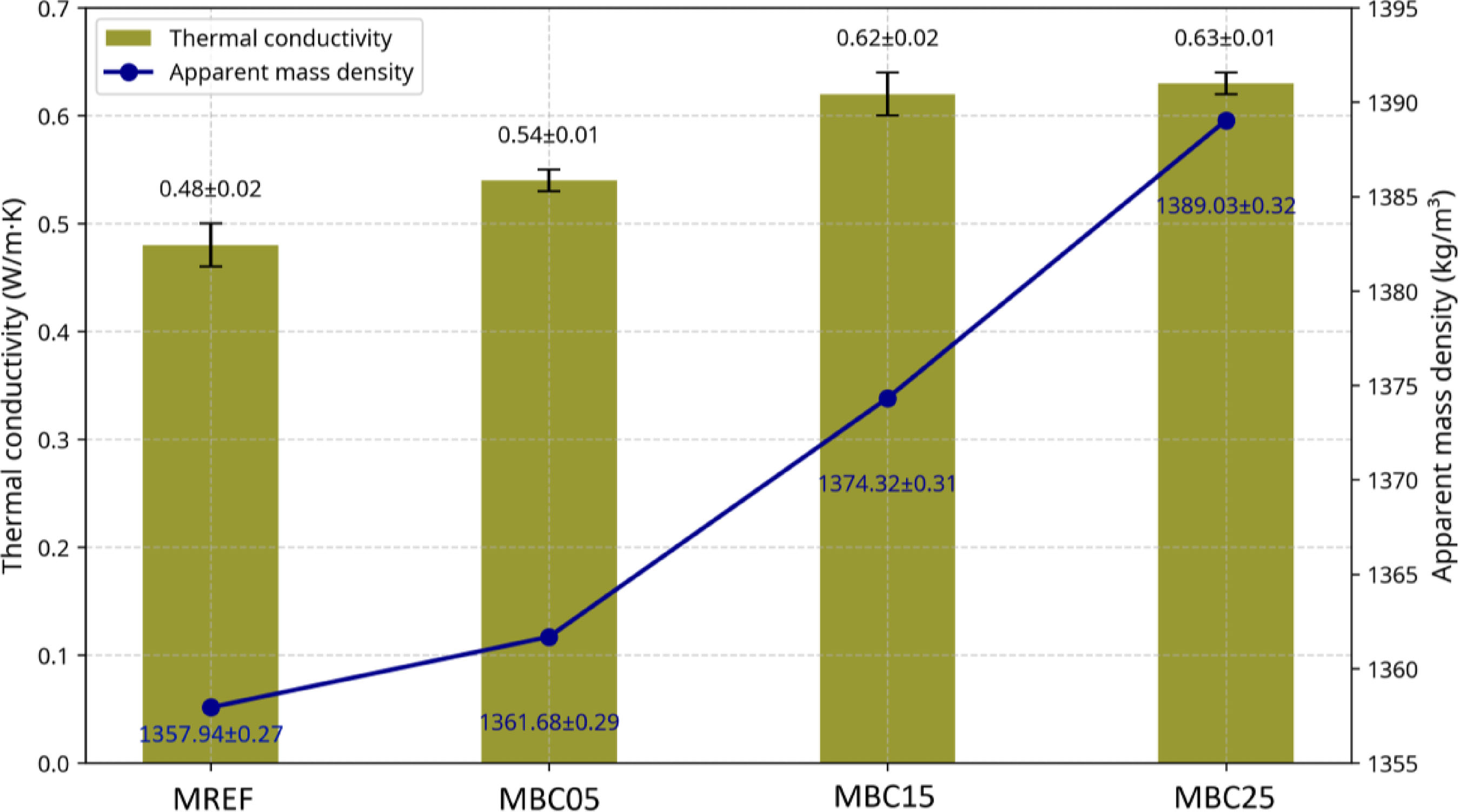
Figure 2 presents the results of thermal conductivity and bulk density of the developed mortars. According to NBR 13281-1 (ABNT, 2023), the mortars in this study were classified as DE1. The lightweight mortars exhibited hardened bulk densities between 1200 and 1400 kg/m³ (Reis; Effting; Schackow, 2023). The incorporation of BNFC increased the weight of the specimens and thermal conductivity by up to 31.3% compared to the MREF mixture, suggesting that BNFC influenced micropore refinement, promoted cement hydration, and densified the matrix. Becker, Effting and Schackow (2022) observed similar results when vermiculite was added to the mixture, while Sahlol et al. (2021) highlighted that, although BNFC has potential for thermal insulation, the microfibrils possess larger interstitial spaces that increase conductivity, making the material more sensitive to external temperature (Schackow et al., 2019).

Figure 3 presents the transmission loss acoustic of the developed mortars at low and high frequencies. Following the study by Cintra, Paiva and Baldo (2014), sound frequencies between 315 Hz and 1000 Hz were analyzed, as they encompass the most common environmental sounds. Although the Acoustic Mass Law provides a theoretical basis indicating that heavier materials tend to provide greater sound insulation, no direct comparison of specimen mass was performed; the observed variations in transmission loss are primarily frequency-dependent Becker, Effting and Schackow (2022). The results showed that in the 50–1400 Hz range, the MBC05 mixture exhibited the highest transmission loss. In the 1400–1600 Hz range, MBC05 stood out, while between 1600–6400 Hz, transmission losses fluctuated, except for MREF, which showed the lowest transmission loss, indicating a lower sound insulation capacity. Comparing the transmission loss results obtained using the impedance tube with the data from Becker, Effting and Schackow (2022) and Reis, Effting and Schackow (2023), MBC05 showed average acoustic insulation performance, with MBC05 performing best at low frequencies and MBC05 also at high frequencies. It is worth noting that the impedance tube method provides approximate transmission loss values, as it considers only normal incidence of acoustic waves, unlike the random incidence encountered in real environments (Scamoni; Piana; Scrosati, 2017).

The incorporation of BNFC in lightweight mortars demonstrates a complex interplay between microstructural modifications and the resulting thermal and acoustic behavior. The densification of the matrix and refinement of micropores, promoted by BNFC, enhances mechanical cohesion but can simultaneously increase thermal conductivity, as the presence of interstitial spaces in the nanofibrils facilitates heat transfer (Sahlol et al., 2021; Schackow et al., 2019). Acoustic performance is strongly frequency-dependent, suggesting that the distribution and homogeneity of BNFC, as well as sample thickness, critically influence sound insulation. While heavier or denser materials provide better sound insulation according to the Acoustic Mass Law, the impedance tube measurements reflect only normal incidence and may underestimate performance under random-incidence conditions. Comparisons with previous studies by Becker, Effting and Schackow (2022) and Reis, Effting and Schackow (2023) indicate that optimizing BNFC content and dispersion, together with aggregate selection and curing control, is essential to balance thermal, acoustic, and mechanical properties. These observations highlight the trade-offs inherent in designing multifunctional lightweight mortars and underscore the importance of targeted microstructural engineering to achieve practical performance objectives.
3.3 Microstructure analysis
3.3.1 Morphology and microstructure of mortars
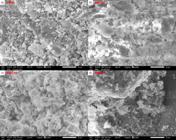
Figure 4 shows the surface of the developed mortars, where it can be observed that the presence of BNFC enhances the surface integrity compared to MREF. The MREF mixture exhibits voids on the mortar surface in contact with the aggregate and within the vermiculite, whereas the BNFC-containing mixtures display a more homogeneous microstructure. The addition of BNFC leads to a progressive reduction of pores, although some mixtures still present pores, possibly due to manual sanding. This effect is associated with an increased surface contact area, reinforcing surface cohesion and contributing to a more stable and durable matrix (Akhlaghi; Bagherpour; Kalhori, 2020).

Figure 5 shows a higher magnification, allowing differences in the evolution of hydration among the mixtures to be highlighted. It can be observed that MREF still contains partially unhydrated cement grains. The MBC05 and MBC15 mixtures exhibit a homogeneous distribution of hydration products; however, MBC05 shows better matrix formation, reflecting a more advanced progression of hydration reactions due to the age difference between the samples. MBC25, on the other hand, displays a lower amount of hydration products in the analyzed region, possibly because a specific surface area of the sample was observed, and not necessarily due to a lower cement reaction (Balea, 2019). Additionally, the formation of calcium hydroxide (CH) and hydrated calcium silicate gel (C–S–H) can be identified in the cementitious matrix, indicating that the mortar is still undergoing cement hydration reactions (Bai et al., 2023; Haque et al., 2022).
The presence of BNFC contributes to the formation of a denser matrix, reducing total porosity and internal voids, promoting a more uniform microstructure, decreasing the transition zone, and increasing the amount of hydration products, which reinforces the cohesion and strength of the mortar (Bai et al., 2023; Knight; Cunningham; Miller, 2023; Withana; Rawat; Zhang, 2024).
Moreover, the incorporation of BNFC appears to influence not only the microstructure but also the nucleation and growth of hydration products at the nanoscale. The nanofibrillar network of BNFC can act as a physical scaffold, guiding the deposition of C–S–H and CH crystals and reducing the formation of microcracks during the early stages of hydration. This templating effect enhances the interconnectivity of the hydration products, resulting in a more compact and mechanically resilient matrix (Zhang et al., 2022). In addition, BNFC can absorb water molecules due to its hydrophilic nature, locally maintaining the moisture required for continued hydration, which is particularly beneficial in mortars with a low water-to-cement ratio. The combination of these effects results in a denser and more uniform transition zone between the aggregate and the cement paste, minimizing weak points that could compromise long-term durability. Furthermore, the improved microstructure can enhance the mortar’s resistance to external aggressive agents, such as chloride penetration, contributing to an extended service life. These findings highlight that, even at low dosages, BNFC provides multifaceted reinforcement—mechanical, microstructural, and chemical—demonstrating its potential as an additive that simultaneously improves durability and performance while maintaining sustainability goals.
3.3.2 Influence of nanocellulose on CO₂ capture and calcium carbonate formation
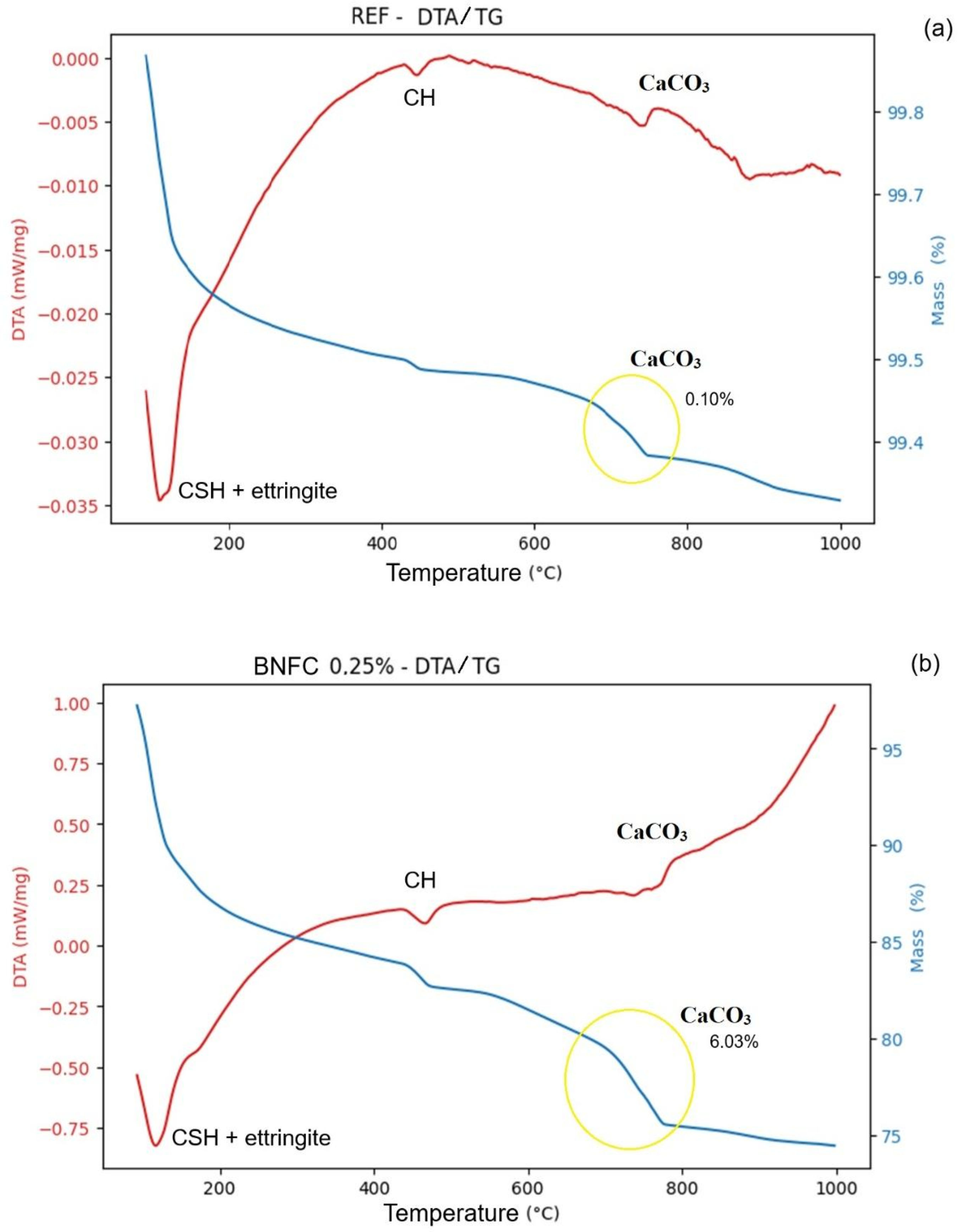
Figure 6 shows the DTA/TG curves of a reference paste, without nanocellulose, and a paste with 0.25% nanocellulose (the 0.25% concentration was chosen as it is the highest concentration adopted in this study). The loss of mass that extends from 90-130 ºC, corresponds to the decomposition of C-S-H and ettringite. At about 470-500 ºC occurs the CH decomposition. At peak between 750-800 ºC, there is the decomposition of calcium carbonate (CaCO3) (Bazaldúa-Medellín et al., 2015; Liang et al., 2022; Singh; Garg, 2006).
The DTA/TG data in Figure 6 indicate a significant difference in the mass loss attributed to CaCO₃ between two samples: a reference sample with a mass loss of 0.10% and a sample containing 0.25% nanocellulose with a mass loss of 6.03%. This disparity suggests that the sample with nanocellulose contains a substantially higher amount of calcium carbonate.
Carbonation is a chemical process in which carbon dioxide (CO₂) reacts with a material, usually a metal hydroxide, to form a carbonate. In the context of calcium-based materials, the most common reaction is between calcium hydroxide (Ca(OH)₂) and CO₂, resulting in the formation of calcium carbonate (CaCO₃) and water. This reaction is fundamental in various processes, such as concrete degradation and CO₂ capture. The enhancement of calcium carbonate formation in the samples from Figure 6 by nanocellulose is supported by the fact that, even after 14 days of testing and subsequent storage in a desiccator until analysis—which minimizes contact with atmospheric CO₂—the presence of nanocellulose resulted in a significant increase in CaCO₃ content.
The literature (Ho; Leo, 2021) suggests that nanocellulose can influence carbonation kinetics in several ways:
-
increased surface area: nanocellulose has a high surface area and a porous structure, which can facilitate CO₂ diffusion and adsorption. Greater CO₂ availability on the material’s surface can accelerate the carbonation reaction;
-
functionalization: chemical modification of nanocellulose, such as the incorporation of amino groups, can increase its affinity for CO₂. These functional groups act as adsorption sites for CO₂, concentrating it at the interface where the carbonation reaction (Zhu et al., 2024);
-
catalytic role: although not explicitly mentioned as a direct catalyst for CaCO₃ formation from Ca(OH)₂ and CO₂, nanocellulose can act as a template or substrate that favors nucleation and crystal growth of CaCO₃. The presence of hydroxyl groups on the nanocellulose surface can interact with calcium and carbonate ions, guiding CaCO₃ formation; and
-
moisture control: nanocellulose has the ability to retain water. The presence of moisture is crucial for carbonation because CO₂ dissolves in water to form carbonic acid (H₂CO₃), which then reacts with calcium hydroxide. Nanocellulose can create a humid microenvironment that promotes this reaction (Janakiram et al., 2019).
In summary, nanocellulose demonstrates considerable potential as an additive that can enhance CO₂ capture and subsequent calcium carbonate formation, which has important implications for the development of materials with carbon sequestration properties.
The contribution of nanocellulose to atmospheric CO₂ reduction can also occur simply by being trapped in concrete, through the concept of carbon sequestration. Nanocellulose is a biomass-derived material, i.e., from plants (including bacterial nanocellulose). During their growth, plants absorb CO₂ from the atmosphere via photosynthesis to build their structures, including cellulose.
When this cellulose is extracted and converted into nanocellulose, the carbon that was in the atmosphere remains “trapped” within the nanocellulose structure. If the nanocellulose were discarded and naturally degraded (e.g., in landfills) or burned, this carbon would be released back into the atmosphere as CO₂. However, when incorporated and “trapped” in a durable and stable matrix like concrete, nanocellulose acts as a carbon reservoir. The carbon it contains remains immobilized for a long time, preventing its return to the atmosphere. Thus, including nanocellulose in concrete also contributes to the net reduction of atmospheric CO₂, effectively transforming a biological material into a long-term carbon storage component.
In addition to the mechanisms previously described, the structural and chemical characteristics of BNFC further enhance its role in promoting calcium carbonate formation and CO₂ capture. The nanoscale dimensions of BNFC fibrils provide an extensive network of nucleation sites for CaCO₃ crystals, which not only accelerates the carbonation reaction but can also influence the morphology and stability of the resulting carbonate phases. Studies have shown that the alignment and high aspect ratio of nanocellulose fibrils facilitate the formation of more uniform and compact CaCO₃ microstructures, which may improve the mechanical and durability properties of the host matrix (Haque et al., 2022; Liang et al., 2022). Furthermore, the hydrophilic nature of BNFC promotes localized moisture retention within the cementitious matrix, creating microenvironments where dissolved CO₂ can more readily react with calcium ions. This effect is particularly relevant under partially saturated conditions, common in practical concrete or mortar elements, and can significantly influence long-term carbonation efficiency. Beyond the immediate chemical interactions, the incorporation of BNFC may also affect the diffusion pathways of CO₂ within the matrix. The fibrillar network can alter pore connectivity and tortuosity, allowing controlled CO₂ penetration that favors progressive and uniform carbonation. From an environmental standpoint, the combination of these effects highlights the dual function of BNFC: it not only improves the microstructural integrity of lightweight mortars but also actively contributes to carbon capture, transforming the cementitious composite into a carbon sink. This synergistic action aligns with current sustainable construction strategies, in which materials are designed not only for performance but also for long-term climate mitigation. Consequently, the integration of BNFC into cementitious composites represents a practical approach to enhancing both the functional properties of building materials and their environmental performance, supporting the development of low-carbon infrastructure and contributing to global CO₂ reduction.
4 Conclusions
The incorporation of BNFC into lightweight mortars demonstrated a positive impact on the material’s microstructure. The presence of BNFC promoted the formation of a denser and more homogeneous cementitious matrix, associated with the progression of hydration reactions and microstructural refinement, resulting in greater cohesion and reduced porosity. Although these effects contribute to improved durability and surface integrity, they also led to a slight increase in thermal conductivity, highlighting the need for adjustments to optimize thermo-acoustic properties. Mechanical strengths, despite a minor reduction compared to the reference mixture, remained within standard limits, ensuring satisfactory structural performance.
Furthermore, BNFC contributed to acoustic properties in a frequency-dependent manner, showing differentiated behavior across various frequency ranges: MREF exhibited higher transmission loss at low frequencies (50–1400 Hz), MBC05 at medium frequencies (1400–1600 Hz), and MBC15 at high frequencies (1600–6400 Hz). These results indicate that BNFC effectively reinforces the matrix, but improvements in sound insulation are relative to frequency and mixture composition, rather than absolute across all conditions.
Additionally, the presence of BNFC contributed to CO₂ capture by promoting the formation of calcium carbonate in calcium-based materials. Its high surface area and functional groups facilitate CO₂ adsorption and accelerate carbonation reactions. When incorporated into durable matrices such as mortar or paste, BNFC can act as a carbon reservoir, storing atmospheric CO₂ within its structure.
While this study demonstrates the technical performance and potential environmental benefits of BNFC, it should be emphasized that its full sustainability cannot be conclusively confirmed within the scope of this work, as detailed information on energy consumption, emissions, and waste from its production is not publicly available due to patent restrictions. Nevertheless, BNFC presents promising environmental potential due to its biotechnological production process, which reduces water and energy usage by up to 90% and eliminates chemical purification steps.
For future research, it is recommended to explore different BNFC contents, compare with other types of nanocellulose, evaluate durability under real exposure conditions, and investigate alternative mixing processes and extended curing times. Optimizing these parameters may enhance both performance and the environmental contribution of BNFC-containing mortars. Overall, integrating BNFC into cementitious composites offers opportunities to develop multifunctional, low-carbon building materials with potential applications in sustainable construction.
-
Declaration of Generative AI and AI-Assisted Technologies in the Writing Process
During the preparation of this work the author(s) used ChatGPT in order to to check grammar issues and to improve readability. After using this tool/service, the author(s) reviewed and edited the content as needed and take(s) full responsibility for the content of the publication.
-
Financial Support
This work was supported by FAPESC through a doctoral scholarship granted to Thalian Valente Soares (Public Call 19/2024). The author is also a beneficiary of financial support from CAPES – Brazil for presenting this work at a scientific conference (PROAP/AUXPE/CAPES, Process Nº. 88881.637705/2021-01). The authors are thankful for the Multi-User Facility infrastructure from Santa Catarina State University's Technological Sciences Center (CMU/CCT/UDESC).
-
SOARES, T. V.; EFFTING, C.; SCHACKOW, A. Thermoacoustic performance and CO2 capture potential in lightweight mortars with bacterial nanocellulose addition. Ambiente Construído, Porto Alegre, v. 26, e149890, jan./dez. 2026. ISSN 1678-8621 Associação Nacional de Tecnologia do Ambiente Construído. http://dx.doi.org/10.1590/s1678-86212026000101004
Data Availability Statement
Research data is available in the body of the article.
References
- AKHLAGHI, M. A.; BAGHERPOUR, R.; KALHORI, H. Application of bacterial nanocellulose fibers as reinforcement in cement composites. Construction and Building Materials, v. 241, 2020.
- AMERICAN SOCIETY FOR TESTING AND MATERIALS. C270-25: standard specification for mortar for unit masonry. West Conshohocken, 2025.
- AMERICAN SOCIETY FOR TESTING AND MATERIALS. C518-21: standard test method for steady-state thermal transmission properties by means of the heat flow meter apparatus. West Conshohocken, 2021.
- AMERICAN SOCIETY FOR TESTING AND MATERIALS. E1050-24: standard test method for impedance and absorption of acoustical materials using a tube, two microphones and a digital frequency analysis system. West Conshohocken, 2024.
- ARAÚJO, A. G. et al Sustainable construction management: a systematic review of the literature with meta-analysis. Journal of Cleaner Production, v. 256, 2020.
- ASSOCIAÇÃO BRASILEIRA DE NORMAS TÉCNICAS. NBR 13276: argamassa para assentamento e revestimento de paredes e tetos: determinação do índice de consistência. Rio de Janeiro, 2016a.
- ASSOCIAÇÃO BRASILEIRA DE NORMAS TÉCNICAS. NBR 13279: argamassa para assentamento e revestimento de paredes e tetos: determinação da resistência à tração na flexão e à compressão. Rio de Janeiro, 2005a.
- ASSOCIAÇÃO BRASILEIRA DE NORMAS TÉCNICAS. NBR 13280: argamassa para assentamento e revestimento de paredes e tetos: determinação da densidade de massa aparente no estado endurecido. Rio de Janeiro, 2005b.
- ASSOCIAÇÃO BRASILEIRA DE NORMAS TÉCNICAS. NBR 13281-1: argamassas inorgânicas: requisitos e métodos de ensaio: parte 1: argamassas para revestimento de paredes e tetos. Rio de Janeiro, 2023.
- ASSOCIAÇÃO BRASILEIRA DE NORMAS TÉCNICAS. NBR 16541: argamassa para assentamento e revestimento de paredes e tetos: preparo da mistura para realização de ensaios. Rio de Janeiro, 2016b.
- BAI, S. et al Effect of nanocellulose on early hydration and microstructure of cement paste under low and high water-cement ratios. Construction and Building Materials, v. 409, p. 133963, 2023.
- BALEA, A. Nanocelluloses: natural-based materials for fiber- reinforced cement composites. A critical review. Polymers, v. 11, n. 3, 2019.
- BAZALDÚA-MEDELLÍN, M. E. et al Early and late hydration of supersulphated cements of blast furnace slag with fluorgypsum. Materiales de Construcción, v. 65, n. 317, 2015.
- BECKER, P. F. B.; EFFTING, C.; SCHACKOW, A. Lightweight thermal insulating coating mortars with aerogel, EPS, and vermiculite for energy conservation in buildings. Cement and Concrete Composites, v. 125, p. 104283, 2022.
- BENACHIO, G. L. F.; FREITAS, M. do C. D.; TAVARES, S. F. Circular economy in the construction industry: A systematic literature review. Journal of Cleaner Production, v. 260, 2020.
- CINTRA, C. L. D.; PAIVA, A. E. M.; BALDO, J. B. Masonry mortars containing expanded vermiculite and rubber aggregates from recycled tires: relevant properties. Cerâmica, v. 60, n. 353, 2014.
- DHALI, K. e al A review of nanocellulose as a new material towards environmental sustainability. Science of the Total Environment, v. 775, 2021.
- HABIBI, Y.; LUCIA, L. A.; ROJAS, O. J. Cellulose nanocrystals: chemistry, self-assembly, and applications. Chemical Reviews, v. 110, n. 6, p. 3479-3500, 2010.
- HAQUE, M. I. et al A comparative investigation on the effects of nanocellulose from bacteria and plant-based sources for cementitious composites. Cement and Concrete Composites, v. 125, 2022.
- HO, N. A. D.; LEO, C. P. A review on the emerging applications of cellulose, cellulose derivatives and nanocellulose in carbon capture. Environmental Research, v. 197, 2021.
- INTERNATIONAL ORGANIZATION FOR STANDARDIZATION. ISO 8301: thermal insulation: determination of steady-state thermal resistance and related properties: heat flow meter apparatus. Geneva, 1991.
- JANAKIRAM, S. et al Manipulation of Fibril Surfaces in Nanocellulose-Based Facilitated Transport Membranes for Enhanced CO2 Capture. ACS Applied Materials and Interfaces, v. 11, n. 36, 2019.
- JONOOBI, M. et al Different preparation methods and properties of nanostructured cellulose from various natural resources and residues: a review. Cellulose, v. 22, n. 2, 2015.
- KESHK, S. M. A. S. Bacterial cellulose production and its industrial applications. Journal of Bioprocessing & Biotechniques, v. 4, n. 2, 2014.
- KNIGHT, K. A.; CUNNINGHAM, P. R.; MILLER, S. A. Optimizing supplementary cementitious material replacement to minimize the environmental impacts of concrete. Cement and Concrete Composites, v. 139, 2023.
- KOKSAL, F.; GENCEL, O.; KAYA, M. Combined effect of silica fume and expanded vermiculite on properties of lightweight mortars at ambient and elevated temperatures. Construction and Building Materials, v. 88, p. 175-187, 2015.
- LAHIRI, D. et al Bacterial cellulose: production, characterization and application as antimicrobial agent. International Journal of Molecular Sciences, v. 22, n. 23, 2021.
- LI, Y. L. et al. Energy consumption and greenhouse gas emissions by buildings: a multi-scale perspective. Building and Environment, v. 151, p. 240-250, 2019.
- LIANG, L. et al. Cellulose nanofibrils for the performance improvement of ultra-high ductility cementitious composites. Cellulose, v. 29, n. 3, 2022.
- LIANG, T. et al. An intelligent film based on self-assembly of funoran and Ophiopogon japonicus seed anthocyanins and its application in monitoring protein rich food freshness. Food Control, v. 159, 2024.
- MAUTNER, A. et al. Cellulose nanopapers as tight aqueous ultra-filtration membranes. Reactive and Functional Polymers, v. 86, 2015.
- MOON, R. J.; SCHUENEMAN, G. T.; SIMONSEN, J. Overview of cellulose nanomaterials, their capabilities and applications. Journal of The Minerals, v. 68, n. 9. 2016.
- MORADIKHOU, A. B.; ESPARHAM, A.; JAMSHIDI AVANAKI, M. Physical and mechanical properties of fiber reinforced metakaolin-based geopolymer concrete. Construction and Building Materials, v. 251, 2020.
- MORSY, M. S.; AGLAN, H. A. Development and characterization of nanostructured-perlite-cementitious surface compounds. Journal of Materials Science, v. 42, n. 24, 2007.
- PARTE, F. G. B. et al Current progress on the production, modification, and applications of bacterial cellulose. Critical Reviews in Biotechnology, v. 40, n. 3, 2020.
- PETER, S. et al. Nanocellulose and its derivative materials for energy and environmental applications. Journal of Materials Science, v. 57, n. 13, 2022.
- RAFFAY, M. R. M. et al. Monitoring and analyzing land use changes for sustainable development in Teluk Bahang, Penang, Malaysia: a GIS-based approach. Journal of Engineering and Applied Science, v. 72, n. 36, 2025.
- REIS, R. R.; EFFTING, C.; SCHACKOW, A. Cellulose nanofibrils on lightweight mortars for improvement of the performance of cement systems. Carbohydrate Polymer Technologies and Applications, v. 5, p. 100303, 2023.
- ROCHA, J. H. A.; FARIAS, L. D. N.; SIQUEIRA, T. P. L. Cellulose nanofibers (CNF) as reinforcement for cementitious matrices: a systematic literature review. Revista Alconpat, v. 12, n. 3, 2022.
- SAHLOL, D. G. et al Sustainable building materials assessment and selection using system dynamics. Journal of Building Engineering, v. 35, 2021
- SCAMONI, F.; PIANA, E. A.; SCROSATI, C. Experimental evaluation of the sound absorption and insulation of an innovative coating through different testing methods. Building Acoustics, v. 24, n. 3, 173–191, 2017.
- SCHACKOW, A. et al Análisis de la transmitancia térmica de las paredes y coberturas para construcciones utilizando hormigón ligero con vermiculita y EPS. Revista AIDIS de Ingeniería y Ciencias Ambientales: Investigación, Desarrollo y Práctica, v. 12, n. 1, 2019.
- SCHACKOW, A.; CORREIA, S. L.; EFFTING, C. Microstructural and physical characterization of solid wastes from clay bricks for reuse with cement. Environmental Engineering and Management Journal, v. 19, n. 4, p. 641-650, 2020.
- SEYDIBEYOǦLU, M. Ö. et al. Green polyurethane nanocomposites from soy polyol and bacterial cellulose. Journal of Materials Science, v. 48, n. 5, 2013.
- SINGH, M.; GARG, M. Reactive pozzolana from Indian clays-their use in cement mortars. Cement and Concrete Research, v. 36, n. 10, 2006.
- SOARES, T. V. et al. Application of bacterial nanofibrillated cellulose for performance improvement in vermiculite lightweight mortar. Construction and Building Materials, v. 449, 138474, 2024.
- SUN, J. et al. Effect of nano-SiO₂ on the early hydration of alite-sulphoaluminate cement. Nanomaterials, v. 7, n. 5, 2017.
- WITHANA, H.; RAWAT, S.; ZHANG, Y. X. Effect of nanocellulose on mechanical properties of cementitious composites: a review. Advanced Nanocomposites, v. 1, n. 1, p. 201–216, 2024.
- WULANDARI, W. T.; ROCHLIADI, A.; ARCANA, I. M. Nanocellulose prepared by acid hydrolysis of isolated cellulose from sugarcane bagasse. IOP Conference Series: Materials Science and Engineering, v. 107, n. 1, 2016.
- ZHANG, X. et al. Effect of cellulose nanofibrils on the physical properties and frost resistance of pervious concrete. Materials, v. 15, n. 22, 2022.
- ZHU, W. et al. Amino-functionalized nanocellulose aerogels for the superior adsorption of CO₂ and separation of CO₂/CH₄ mixture gas. Carbohydrate Polymers, v. 323, 2024.
- ZINNIEL, D. K. et al Isolation and characterization of endophytic colonizing bacteria from agronomic crops and prairie plants. Applied and Environmental Microbiology, v. 68, n. 5, p. 2198-2208, 2002.
Edited by
-
Editor-in-chief:
Enedir Ghisi
-
Guest editor:
Juliana Machado Casali Peruch