 Impact of sex in axial spondyloarthritis: insights from the Brazilian Registry of Spondyloarthritis
Abstract
Background Sex differences in axial spondyloarthritis (axSpA) are increasingly recognized, with women often reporting higher disease burden despite similar objective inflammatory markers. This study aimed to compare clinical features, disease activity, function, quality of life, and treatment patterns between men and women with axSpA and identify sex-specific predictors of disease outcomes using data from the Brazilian Registry of Spondyloarthritis (RBE).
Methods This was a cross-sectional, observational study based on data from the RBE, a nationwide multicenter cohort including 828 patients (568 men and 260 women) from 17 referral centers across Brazil. Standardized clinical and demographic data were collected using the REDCap platform. Disease activity (ASDAS-CRP, BASDAI), physical function (BASFI), spinal mobility (BASMI), and quality of life (ASQoL) were assessed with validated instruments. Sex-stratified multivariable linear regression models were constructed to identify independent predictors of each outcome.
Results Women presented higher disease activity (median BASDAI 4.5 vs. 3.2; ASDAS-CRP 2.2 vs. 1.9), greater functional limitation (BASFI 5.0 vs. 4.0), and poorer quality of life (ASQoL 9.0 vs. 7.0) compared to men, despite similar CRP levels. Psychological distress was more frequent in women, while men had worse spinal mobility (BASMI 4.0 vs. 3.5) and higher HLA-B27 positivity. Regression models revealed that shoulder and hip pain were relevant predictors of disease activity in both sexes, but psychological factors and work activity more strongly influenced outcomes in women. Men's disease burden was more associated with structural damage and cardiometabolic comorbidities.
Conclusions This study highlights distinct sex-related clinical patterns in axSpA. Women reported higher symptom burden, functional limitations, and reduced quality of life, largely influenced by subjective symptoms and comorbidities. Conversely, men presented greater structural impairment and different comorbidity profiles. These findings support the need for sex-informed clinical assessments and individualized management strategies in axSpA to tailor the care of these sex-specific disease trajectories, which may enhance equity and outcomes in real-world settings.
Keywords
Axial spondyloarthritis; Sex differences; Disease burden
Introduction
Axial Spondyloarthritis (axSpA) has historically been recognized to affect men more frequently and severely than women, with early studies estimating a tenfold higher prevalence of axial involvement in men vs. women [1, 2]. This sex disparity has decreased over time as the disease manifestations became better understood and diagnostic tools better interpreted. Recent data indicates a prevalence male: female ratio ranging from 1.2 to 2:1 [3]. This growing recognition of sex-based variation in axSpA, increasingly suggesting that the burden of axSpA in women may be underestimated, has prompted important clinical questions.
Women with axSpA often face a more complex journey to diagnosis. They are more frequently misdiagnosed, experience longer delays before receiving a correct diagnosis and tend to present with different initial symptoms compared to men [3, 4]. Their disease course may also differ, with unique challenges related to symptom burden, treatment response, and adherence, including leading women to be more likely to discontinue biologic therapies earlier than men [3, 4]. Despite these differences, sex-specific data on axSpA remain scarce, leaving many questions unanswered about how the disease truly manifests and progresses in women.
The need to better understand sex-based differences in axSpA has become especially urgent in the context of personalized medicine and equity-driven care. As the field moves toward more individualized treatment strategies, acknowledging and addressing these differences is essential to ensure that both men and women receive accurate diagnoses, timely interventions, and optimal disease management [5].
In this context, we must clearly differentiate the terms ‘sex’ and ‘gender.’ Although often used interchangeably, they represent distinct concepts: ‘sex’ refers to biological and physiological differences, whereas ‘gender’ encompasses social and cultural roles, expectations, and behaviors. This distinction is key to accurately interpreting disease patterns and outcomes [3]. For the purpose of this study, we refer specifically to ‘sex’ when comparing male and female patients with axSpA.
This study aims to investigate sex-based differences in the clinical presentation and disease burden in patients with axSpA. Drawing on data from the Brazilian Registry of Spondyloarthritis (RBE), the largest nationally representative cohort in Latin America, we aim to generate robust, sex-stratified evidence on axSpA to uncover clinically relevant differences that may support more accurate diagnoses, individualized treatment strategies, and equitable care for both men and women.
Methods
The RBE is a multicenter, observational, and prospective cohort that has enrolled patients with SpA from 17 centers representing all five geographic regions of Brazil, as described elsewhere [6]. Briefly, patients treated at referral centers could be included if they met the following inclusion criteria: (1) had a diagnosis of SpA by an expert rheumatologist (axSpA, psoriatic arthritis, enteropathic arthritis, reactive arthritis or undifferentiated SpA); (2) age greater than or equal to 18 years; and (3) were classified according to the ASAS axial or peripheral criteria [7, 8]. Data were collected using a standardized protocol on the REDCap platform and included demographic information, HLA-B27 status, and clinical disease parameters, including peripheral and axial involvement, patient and physician-reported outcomes, extra-musculoskeletal manifestations, comorbidities, and treatment history. Psychological distress was defined as the presence of depressive and/or anxiety symptoms, based on self-reported medical history, clinical diagnosis, or current use of antidepressant or anxiolytic medication prescribed by a physician. Disease activity was assessed using the Bath Ankylosing Spondylitis Disease Activity Index (BASDAI) [9] and the Ankylosing Spondylitis Disease Activity Score using C-reactive protein (ASDAS-CRP) [10]. Other validated instruments, such as Bath Anky-losing Spondylitis Functional Index (BASFI) [11], Bath Ankylosing Spondylitis Metrology Index (BASMI) [12], Ankylosing Spondylitis Quality of Life (ASQoL) [13, 14] and modified Stoke Ankylosing Spondylitis Spinal Score (mSASSS) [14] and ASAS NSAID intake score [15] were also measured. Tender and swollen joint counts, as well as enthesitis sites, were also assessed through a standardized physical examination. For the present analysis, only patients classified as having axSpA were included.
Statistical analysis
Descriptive statistics were computed for all variables. Continuous variables were summarized as medians and interquartile ranges, and categorical variables as frequencies and percentages. Comparisons between groups were performed using appropriate statistical tests according to data distribution and variable type. A p-value < 0.05 was considered statistically significant. Sex-stratified multivariable linear regression models were constructed to identify independent predictors of disease activity (ASDAS-CRP and BASDAI), spinal mobility (BASMI), physical function (BASFI), and quality of life (ASQoL). A multivariable binomial logistic regression model was used to identify factors independently associated with sex. In the initial model, male sex was set as the reference category. Consequently, odds ratios (ORs) below 1 reflected a lower likelihood among men and, indirectly, a higher likelihood among women. To facilitate interpretation and align the results with the study's focus on sex-related differences—particularly the burden observed in women—we inverted the ORs (1/OR). This transformation does not affect the underlying model, statistical significance, or confidence intervals, but allows results to be presented with female sex as the reference category, such that OR > 1 indicates an association with female sex.
Variables included in each model were selected based on clinical relevance and bivariate associations with p < 0.20. Model performance was assessed using R, R2, and adjusted R2. Results were reported as unstandardized beta coefficients with 95% confidence intervals. Missing data were assessed for all variables. Those included in the multivariable models had < 10% missingness, and no systematic patterns were identified. Therefore, we conducted complete case analyses without imputation. Statistical analyses were performed using SPSS (version 29.0.2.0) and Jamovi (version 2.6.26), and graphical outputs were generated with GraphPad Prism (version 10). All details of the statistical analysis are provided in the supplementary material.
Results
A total of 828 axSpA patients were included in the analysis, comprising 568 (68.6%) males and 260 (31.4%) females. Table 1 summarizes the demographic and clinical data of the sample, comparing men and women. Regarding demographic data, women had a later median age at symptom onset (29 years, IQR 19–34 vs. 27 years, IQR 21–38; p = 0.001) and age at diagnosis (37 years, IQR 30–47 vs. 35 years, IQR 27–44; p = 0.002), but shorter disease duration (16 years, IQR 9–26 vs. 18 years, IQR 10–28; p = 0.041) when compared to men. Despite these differences, diagnostic delay was similar between sexes (median 5 years, IQR 1–13 for both; p = 0.975). Although HLA-B27 positivity was more frequent among males (77.6% vs. 69.2%; p = 0.009; OR = 1.33, 95%CI 1.07–1.64), family history of SpA was more frequently reported by females (26.2% vs. 17.2%; p = 0.002; OR = 1.71, 95%CI 1.21–2.40).
Comparative analysis between male (n = 568) and female (n = 260) patients with AxSpA across demographic, clinical and disease-related variables
While axial symptoms presented similar frequencies in both sexes, active peripheral involvement was more common in females (25.3% vs. 19.1%; p = 0.040; OR = 1.43, 95%CI 1.01–2.02). Emphasizing this finding, upper limb arthritis was significantly more reported by females (21.6% vs. 14.8%; p = 0.010; OR = 1.58, 95% CI 1.11–2.25). Concerning extra-musculoskeletal manifestations, no statistically significant differences were found between the sexes. Regarding comorbidities, psychological distress was more prevalent among females (43.8% vs. 20.9%; p < 0.001; OR = 2.95 95%CI 2.16–4.01) while chronic kidney disease was more frequently reported by males (3.0% vs. 0.7%; p = 0.028; OR = 0.22, 95%CI 0.05– 0.96) (Table 1).
The prevalence of arterial hypertension, diabetes and obesity was similar between sexes. Psychological distress was more prevalent among females (43.8% vs. 20.9%; p < 0.001; OR = 2.95 95%CI 2.16–4.01) and chronic kidney disease was more frequently reported among males (3.0% vs. 0.7%; p = 0.028; OR = 0.22, 95%CI 0.05–0.96).
The overall proportion of physically active individuals did not differ significantly between sexes. However, a greater proportion of men reported engaging in physical exercise with higher frequency, specifically 4–7 times per week (45.7% vs. 29.9%). Regarding employment status, men were significantly more actively employed (48.9% vs. 32.3%; p < 0.001; OR = 0.27, 95% CI 0.17–0.41), as well as were more frequently retired due to disability (63.6% vs. 28.5%; p < 0.001; OR = 2.06, 95% CI 1.63–2.60) among those who were not currently working (Table 1).
There were no significant differences in prior treatment patterns. Regarding current treatments, sulfasalazine was more commonly used by men (16.0% vs. 10.7%; p = 0.029; OR = 0.62, 95%CI 0.40–0.95), and oral corticosteroid use was more frequent among women (4.5% vs. 2.1%; p = 0.042; OR = 2.18, 95%CI 1.01–4.70). Table 1 summarizes the demographic and clinical data of the sample, comparing men and women (Table 1).
Sex-stratified analysis of continuous clinical variables is presented in Table 2. Women had a later median age at symptom onset (29 years, IQR 21–38) compared to men (27 years, IQR 19–34) (p = 0.001) and were also diagnosed at an older age (37 years, IQR 30–47 vs. 35 years, IQR 27–44; p = 0.002). Despite these differences, diagnostic delay was similar between sexes (median 5 years, IQR 1–13 for both; p = 0.975). There were no significant differences in CRP levels, enthesitis count, mSASSS, ASAS NSAID intake score, swollen joint count (SJC), or tender joint count (TJC). However, VAS PGA (5.0, IQR 3.5–7.0 vs. 5.0, IQR 2.0–7.0; p < 0.001), pain (VAS 5.0, IQR 3.0– 7.0 vs. 4.0, IQR 2.0–7.0; p < 0.001), and VAS MGA (4.0, IQR 2.0–6.0 vs. 3.0, IQR 1.0–5.0; p = 0.006) were all higher in women.
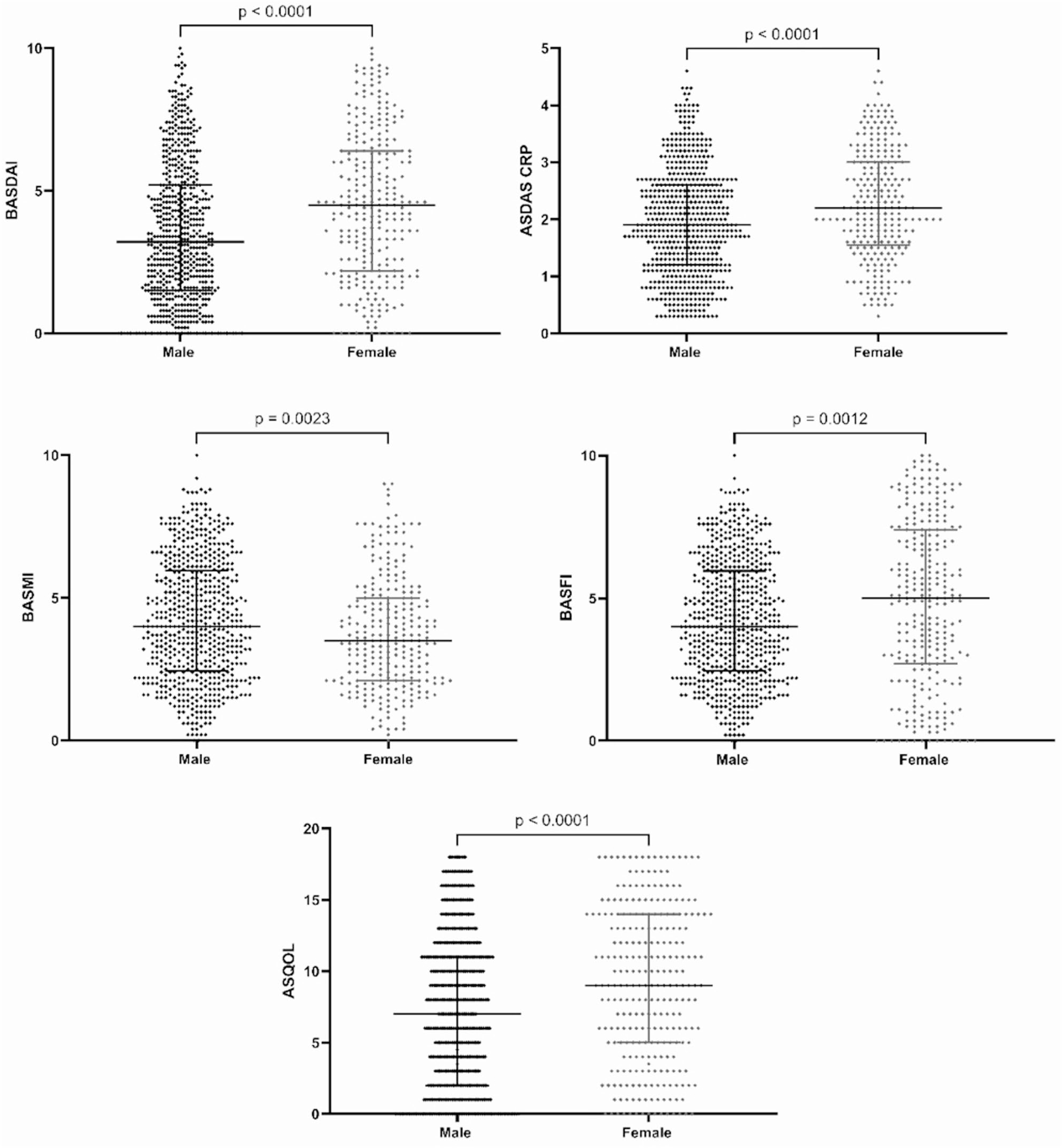
Sex-related differences in key clinical outcomes are illustrated in Fig. 1. Female patients had significantly higher disease activity scores, both by BASDAI (median 4.5 vs. 3.2; p < 0.0001) and by ASDAS-CRP (median 2.2 vs. 1.9; p < 0.0001). Functional impairment, assessed by BASFI (median 5.0 vs. 4.0; p = 0.0012), and quality of life, measured by ASQoL (median 9.0 vs. 7.0; p < 0.0001), were also worse in women. In contrast, spinal mobility assessed by BASMI was more restricted in men (median 4.0 vs. 3.5; p = 0.0023).
Sex-based comparison of disease activity, function, mobility, and quality of life in patients with axSpA. Dot plots illustrating sex differences in disease activity (BASDAI and ASDAS-CRP), functional status (BASFI), spinal mobility (BASMI), and quality of life (ASQoL) among patients with axSpA. Horizontal lines represent median and interquartile ranges; p-values reflect group comparisons using multiple comparisons post-hoc tests following ANOVA or Kruskal-Wallis analysis (95%CI). BASDAI: Bath Ankylosing Spondylitis Disease Activity Index. ASDAS-CRP: Ankylosing Spondylitis Disease Activity Score based on C-reactive protein. BASMI: Bath Ankylosing Spondylitis Metrology Index. BASFI: Bath Ankylosing Spondylitis Functional Index. ASQoL: Ankylosing Spondylitis Quality of Life questionnaire
Sex-stratified bivariate analyses showed that musculoskeletal manifestations, particularly shoulder and hip pain and respective functional limitations, reflecting root-joint involvement, were significantly associated with worse BASDAI, ASDAS-CRP, BASFI, BASMI, and ASQoL scores in both men and women. Among male patients, additional factors consistently associated with worse outcomes across multiple domains included physical inactivity, not currently working, active peripheral arthritis, and comorbidities such as hypertension, diabetes, smoking, and obesity. In female patients, psychological distress was significantly associated with higher BASFI and ASQoL scores, while obesity and reduced physical activity were also linked to worse ASQoL. Detailed results are presented in the supplementary material.
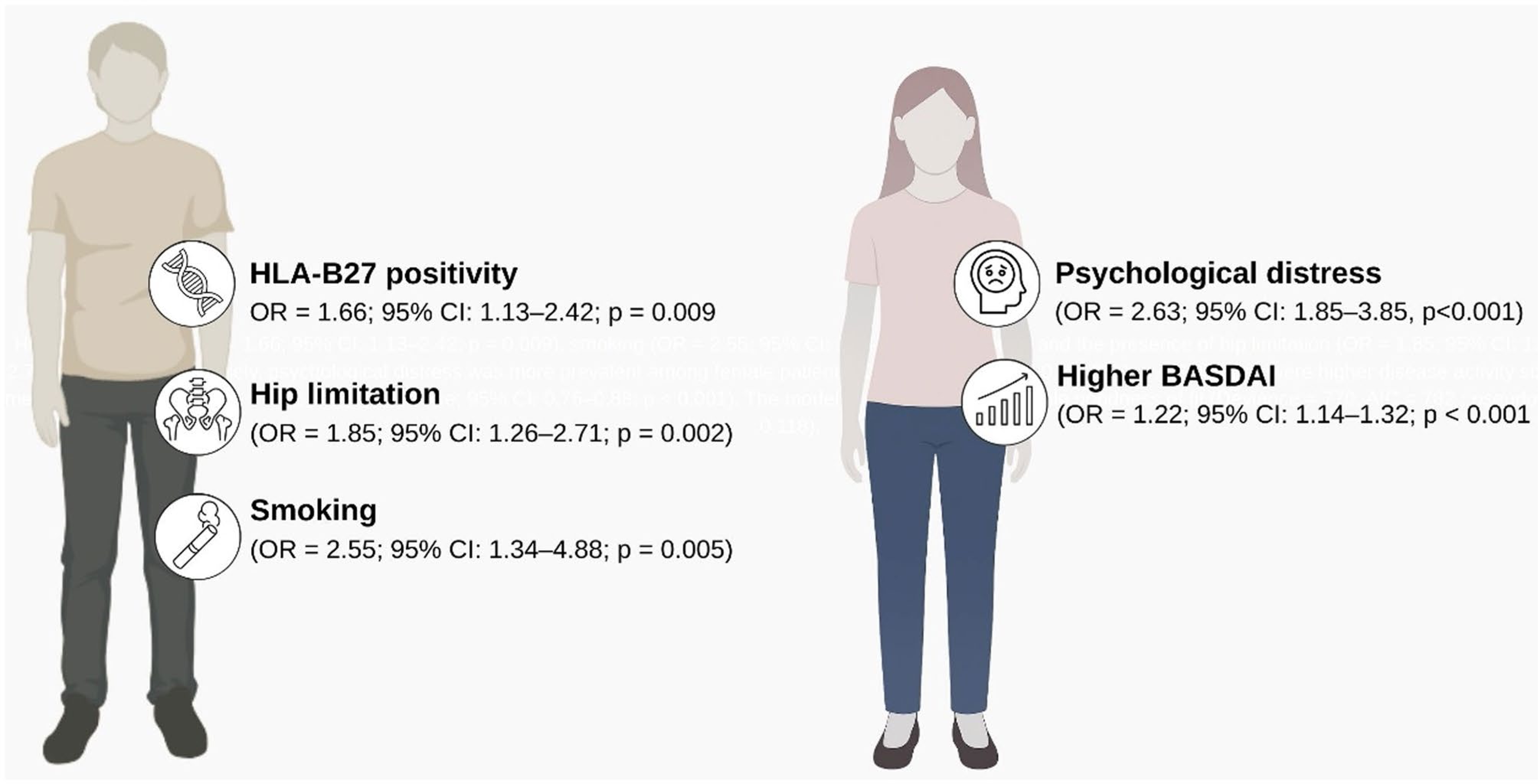
In the multivariable binomial logistic regression model, male sex was significantly associated with HLAB27 positivity (OR = 1.66; 95%CI 1.13–2.42; p = 0.009), smoking (OR = 2.55; 95%CI 1.34–4.88; p = 0.005), and hip limitation (OR = 1.85; 95%CI 1.26–2.71; p = 0.002). In contrast, female patients was associated with psychological distress (OR = 2.63; 95% CI: 1.85–3.85; p < 0.001) and with higher disease activity scores as measured by BASDAI (OR = 1.22 per unit decrease; 95% CI: 1.14–1.32; p < 0.001) (Fig. 2).
Independent variables associated with male and female sex in axial spondyloarthritis. Factors independently associated with male (left) and female (right) sex in patients with axial spondyloarthritis, based on multivariable binomial logistic regression analysis. Male sex was significantly associated with HLA-B27 positivity, hip limitation, and smoking, while female sex was associated with psychological distress and higher BASDAI scores. Model fit: deviance = 770; AIC = 782; pseudo R2 (Nagelkerke) = 0.118. OR = odds ratio; CI = confidence interval
In the multivariable binomial logistic regression model, male sex was significantly associated with HLAB27 positivity (OR = 1.66; 95%CI 1.13–2.42; p = 0.009), smoking (OR = 2.55; 95%CI 1.34–4.88; p = 0.005), and hip limitation (OR = 1.85; 95%CI 1.26–2.71; p = 0.002). In contrast, female patients was associated with psychological distress (OR = 2.63; 95% CI: 1.85–3.85; p < 0.001) and with higher disease activity scores as measured by BASDAI (OR = 1.22 per unit decrease; 95% CI: 1.14–1.32; p < 0.001) (Fig. 2).
Table 3 presents the results of multivariable linear regression models for key outcomes in axSpA, stratified by sex. For each outcome (BASDAI, ASDAS, BASFI, BASMI, and ASQOL), the variables retained in the final models differed between men and women, highlighting distinct patterns of association. Model fit, as expressed by adjusted R2, ranged from 0.398 to 0.710 across models, with similar performance in both sexes overall. However, the specific predictors and the strength of their associations varied, suggesting sex-specific pathways influencing disease outcomes in axSpA.
Sex-specific multivariable linear regression models for key axial spondyloarthritis outcomes
Discussion
This study provides significant evidence of sex-specific differences in the clinical presentation, disease burden, and predictors of outcomes in axSpA using a large, nationwide Brazilian cohort. Our findings reinforce the concept that axSpA is not a homogeneous disease across sexes and suggest that personalized approaches to diagnosis and management are warranted.
The growing interest in investigating the presentation and evolution of axSpA in women has allowed us to find anatomical, clinical and functional differences that help to better characterize the disease. Anatomical factors, such as the shape of the pelvis and the different mechanical overloads observed in women, contribute to highlighting these differences [16, 17];
Sex-related differences in axSpA generally characterize distinct clinical presentations. While men frequently present more classic axial presentation associated with HLA-B27 positivity, women tend to have a higher frequency of peripheral involvement, upper limb arthritis, and dactylitis, and more often receive diagnoses of psoriatic arthritis or peripheral SpA, suggesting greater clinical heterogeneity among female patients with axSpA [18]. Our study also reinforced that lifestyle-related variables, especially alcoholism and smoking in men, played a role in disease evolution, as was previously shown in an international study [19].
Another significant difference between the sexes in axSpA is related to the disease assessment instruments. Women in our cohort reported significantly higher disease activity scores, as well as greater functional impairment and poorer quality of life compared to men, despite men having greater impairment in spinal mobility. This reinforces the perception of a more burdensome disease experience in female patients, especially in patient-reported measures such as fatigue and pain. While the BASDAI is entirely subjective, ASDAS incorporates C-reactive protein (CRP) as an objective marker, which has been thought to mitigate sex-related differences [20]. However, in our cohort, CRP levels were similar between men and women, yet ASDAS-CRP scores remained higher in women. A recent systematic review highlighted consistent evidence that women with axSpA report higher disease activity than men, particularly in subjective domains such as fatigue, pain, and functional limitations. Although the data on the mechanisms behind these differences are limited, they may stem from a combination of socio-cultural coping factors and biological influence, such as variations in hormonal profiles and immune responses, that contribute to sex dimorphism [21].
Importantly, the greater functional limitation and impaired quality of life reported by women draw attention to the broader impact of the disease on daily functioning and well-being, probably reflecting a complex interplay of biological and psychosocial factors. Supporting this notion, it was observed that spinal structural damage had limited explanatory power over physical function compared to disease activity and mobility, suggesting that subjective burden may indeed outweigh radiographic findings in shaping the patient experience, particularly in women [22]. This combined analysis of BASFI and ASQoL scores highlights a relevant sex-related paradox: although female patients reported significantly worse functional status and poorer quality of life, these impairments occurred despite better spinal mobility. This dissociation suggests that factors beyond axial structural damage, such as pain perception, peripheral manifestations, and psychological burden, may disproportionately affect functional capacity and overall well-being in women with axSpA. This contrasts with results from a Swedish study [23], which found no significant difference in BASFI scores between sexes in a cohort of 353 patients with r-axSpA. This may reflect differences in disease subtype and the higher burden of psychological distress among women, which can influence BASFI scores.
The associations observed in the regression models for the disease assessment instruments showed very interesting results when these models were stratified by sex. Hypertension and smoking were independently associated with worse spinal mobility (BASMI), and physical activity was negatively associated with functional limitation (BASFI) in men. In this group, ASQoL was shaped not only by functional and mobility indices but also by psychological distress, which was not observed in female patients. This may be explained by limited contrast in the model or possibly because its impact was indirectly captured through other variables such as BASFI and ASDAS. In contrast, women showed a more compact set of predictors concentrated on pain and function. All five outcomes were primarily influenced by core musculoskeletal variables such as BASFI, BASMI, ASDAS, and joint pain. No comorbidities or behavioral factors appeared as independent predictors in women. These findings are supported by the COMOSPA study, where cardiometabolic comorbidities were more frequent and more strongly associated with impaired physical function and structural outcomes in men, while psychosocial factors were more prevalent and impactful in women [24].
Although overall activity levels were similar, more men exercised 4–7 times per week. This was independently associated with lower disease activity, particularly in men. While the cross-sectional design limits causal inference, the finding reinforces the therapeutic role of regular exercise in axSpA management [25].
Treatment profiles were largely similar between sexes. However, a higher proportion of women had previously used TNF inhibitors and were currently on IL-17 inhibitors, suggesting a trend toward greater therapeutic escalation in female patients. These patterns may reflect more difficult disease control in women. Possible factors include subjective burden, comorbidities, or distinct axSpA phenotypes that influence treatment choices. Recent studies have also found lower response rates to bDMARDs [26] and shorter survival to bDMARDs [27, 28] in patients with axSpA.
This study has several limitations. One key limitation is how we defined psychological distress. We chose a broader definition that included self-report, previous medical diagnosis, or current use of antidepressants or anxiolytics. We did this because we wanted to capture a wide range of patients who might be experiencing psychological difficulties, even if they hadn't received a formal diagnosis. While this approach reflects the variability we see in clinical practice, it also means that we group together people with different types and levels of distress. This could have affected how strongly psychological distress was linked to other outcomes. That said, we believe this inclusive approach provides a more realistic picture of what's happening in routine care, especially given differences in mental health screening across centers. We recognize that having more detailed psychiatric assessments would have allowed for a more refined analysis, and we encourage future research in this direction.
Another limitation of our study is the absence of data on fibromyalgia frequency. This variable was not chosen because peripheral involvement, including enthesitis, is quite common in our patients with axSpA, and there is still considerable overlap between the endpoints of fibromyalgia and enthesitis, making it difficult to accurately distinguish between the two clinical situations. A recent study that evaluated 526 patients with axSpA, of which 38% were diagnosed with fibromyalgia, corroborates this statement [29]. The absence of formal fibromyalgia diagnosis in our dataset is an important limitation, given its known influence on patient-reported outcomes in axial spondyloarthritis. Fibromyalgia, particularly through mechanisms of central sensitization, can substantially amplify symptoms such as pain, fatigue, and functional impairment, independently of objective inflammatory activity. This overlap could lead to misclassification of disease burden, especially among patients with high PROMs but low inflammation markers. While the presence of widespread enthesitis may partially reflect underlying central sensitization, it is not a substitute for a clinical diagnosis of fibromyalgia. The inability to adjust for fibromyalgia may have biased the observed associations, particularly in women, where fibromyalgia is more prevalent and may contribute disproportionately to higher BASDAI, ASQoL, and psychological distress scores.
Because all participants were recruited from 17 tertiary referral centers, the cohort likely includes a disproportionate number of patients with more severe, refractory or complex presentations. This referral pattern may limit the external validity of our findings, particularly in relation to patients managed in primary care or community settings, where disease severity, comorbidity profiles, and access to specialized care may differ substantially.
Finally, it is important to note that the present findings are based on a binary classification of sex and do not include individuals from LGBTQIA + or transgender populations. Currently, data regarding the clinical presentation, disease burden, psychosocial impact, and treatment response in these groups are scarce. Further research is urgently needed to explore how gender diversity may influence the experience and management of axSpA, including potential differences in healthcare access, diagnostic delay, and psychosocial outcomes.
Nevertheless, our registry has several strenghts, including the use of validated outcome measures and standardized data collection procedures across centers, which reinforce the reliability of our findings. Furthermore, the large sample size and the multicenter, geographically diverse cohort reinforce the external validity of our results within a real-world Brazilian context.
In conclusion, our findings demonstrated that axSpA may be expressed through distinct biological and psychosocial pathways in men and women. While men were more likely to express markers of structural disease, such as HLA-B27 positivity and hip involvement, and showed a disease burden shaped by comorbidities and lifestyle factors, such as smoking, women exhibited a profile dominated by pain, functional impairment, and psychological distress. These patterns were consistent across descriptive and multivariable analyses, underscoring a fundamental divergence in how axSpA manifests and impacts patients’ lives. Rather than viewing sex as a confounding factor, our results suggest it acts as a lens through which illness is experienced. Integrating this perspective into care strategies is essential for delivering truly personalized and equitable treatment. In line with our earlier nationwide study, which reported more peripheral involvement and higher patient-reported activity in women and greater axial damage in men [30], the present analysis focusing on axSpA confirms these sex-specific patterns and adds new insights by identifying psychosocial and comorbidity-related pathways underlying these differences. Future research should explore longitudinal trajectories of disease activity and psychosocial burden, incorporating fibromyalgia screening tools and objective measures of inflammation such as imaging and biomarkers. Registry-based studies could also investigate the impact of treatment strategies on long-term quality of life and work productivity, particularly among under-represented subgroups.
-
Funding
This study was supported by the Brazilian Society of Rheumatology (Sociedade Brasileira de Reumatologia). The funder had no role in the conceptualization, study design, data collection, analysis, interpretation of data, decision to publish, or preparation of the manuscript.
-
Declarations
Ethics approval and consent to participateThe study was performed under the principles of the Declaration of Helsinki and approved by the Institutional Ethical Committee (Comissão de Ética para Análise de Projetos de Pesquisa – CAPPesq) of Hospital das Clinicas HCFMUSP, Faculdade de Medicina, Universidade de Sao Paulo, Brazil (CAAE: 49299415.7.1001.0068). Written informed consent was obtained from all participants.
-
Consent for publication
Not applicable.
-
Publisher's note
Springer Nature remains neutral with regard to jurisdictional claims in published maps and institutional affiliations.
Supplementary Information
The online version contains supplementary material available at https://doi.org/10.1186/s42358-026-00525-3.
Supplementary Material 1
Acknowledgements
Brazilian Society of Rheumatology and to all the Brazilian Registry of Spondyloarthritis investigators.
Data availability
The datasets used and/or analysed during the current study are available from the corresponding author on reasonable request.
References
- 1 Hart FD, Robinson KC. Ankylosing spondylitis in women. Ann Rheum Dis. 1959;18(1):15–23.
- 2 West HF. Aetiology of ankylosing spondylitis. Ann Rheum Dis. 1949;8(2):143–8.
- 3 Kohn SO, Azam A, Hamilton LE, Harrison SR, Graef ER, Young KJ, et al. Impact of sex and gender on AxSpA diagnosis and outcomes. Best Pract Res Clin Rheumatol. 2023;37(3):101875.
- 4 Jovani V, Blasco-Blasco M, Ruiz-Cantero MT, Pascual E. Understanding how the diagnostic delay of spondyloarthritis differs between women and men: A systematic review and metaanalysis. J Rheumatol. 2017;44(2):174–83.
- 5 Volkmann ER, Feghali-Bostwick C. Sex- and gender-based personalized medicine in rheumatology. Nat Rev Rheumatol. 2025;21(5):251–2.
- 6 Resende GG, Saad CGS, Marques CDL, Ribeiro SLE, de Oliveira Gavi MBR, Yazbek MA, et al. To be or not to B27 positive: implications for the phenotypes of axial spondyloarthritis outcomes. Data from a large multiracial cohort from the Brazilian registry of spondyloarthritis. Adv Rheumatol. 2024;64(1):33.
- 7 Rudwaleit M, van der Heijde D, Landewe R, Akkoc N, Brandt J, Chou CT, et al. The assessment of spondyloarthritis international society classification criteria for peripheral spondyloarthritis and for spondyloarthritis in general. Ann Rheum Dis. 2011;70(1):25–31.
- 8 Rudwaleit M, van der Heijde D, Landewe R, Listing J, Akkoc N, Brandt J, et al. The development of assessment of spondyloarthritis international society classification criteria for axial spondyloarthritis (part II): validation and final selection. Ann Rheum Dis. 2009;68(6):777–83.
- 9 Garrett S, Jenkinson T, Kennedy LG, Whitelock H, Gaisford P, Calin A. A new approach to defining disease status in ankylosing spondylitis: the bath anky-losing spondylitis disease activity index. J Rheumatol. 1994;21(12):2286–91.
- 10 Lukas C, Landewe R, Sieper J, Dougados M, Davis J, Braun J, et al. Development of an ASAS-endorsed disease activity score (ASDAS) in patients with ankylosing spondylitis. Ann Rheum Dis. 2009;68(1):18–24.
- 11 Calin A, Garrett S, Whitelock H, Kennedy LG, O’Hea J, Mallorie P, et al. A new approach to defining functional ability in ankylosing spondylitis: the development of the bath ankylosing spondylitis functional index. J Rheumatol. 1994;21(12):2281–5.
- 12 Jenkinson TR, Mallorie PA, Whitelock HC, Kennedy LG, Garrett SL, Calin A. Defining spinal mobility in ankylosing spondylitis (AS). The bath AS metrology index. J Rheumatol. 1994;21(9):1694–8.
- 13 Doward LC, Spoorenberg A, Cook SA, Whalley D, Helliwell PS, Kay LJ, et al. Development of the asqol: a quality of life instrument specific to ankylosing spondylitis. Ann Rheum Dis. 2003;62(1):20–6.
- 14 Creemers MC, Franssen MJ, van't Hof MA, Gribnau FW, van de Putte LB, van Riel PL. Assessment of outcome in ankylosing spondylitis: an extended radiographic scoring system. Ann Rheum Dis. 2005;64(1):127–9.
- 15 Dougados M, Simon P, Braun J, Burgos-Vargas R, Maksymowych WP, Sieper J, et al. ASAS recommendations for collecting, analysing and reporting NSAID intake in clinical trials/epidemiological studies in axial spondyloarthritis. Ann Rheum Dis. 2011;70(2):249–51.
- 16 Ziegeler K, Kreutzinger V, Proft F, Poddubnyy D, Hermann KGA, Diekhoff T. Joint anatomy in axial spondyloarthritis: strong associations between sacroiliac joint form variation and symptomatic disease. Rheumatology (Oxford). 2021;61(1):388–93.
- 17 Ulas ST, Proft F, Diekhoff T, Rios V, Rademacher J, Protopopov M, et al. Sex-specific diagnostic efficacy of MRI in axial spondyloarthritis: challenging the ‘One Size Fits All’ notion. RMD Open. 2023;9(4).
- 18 Benavent D, Capelusnik D, Ramiro S, Molto A, Lopez-Medina C, Dougados M, et al. Does gender influence outcome measures similarly in patients with spondyloarthritis? Results from the ASAS-perSpA study. RMD Open. 2022;8(2).
- 19 Navarro-Compan V, Garrido-Cumbrera M, Poddubnyy D, Bundy C, Makri S, Correa-Fernandez J, et al. Females with axial spondyloarthritis have longer diagnostic delay and higher burden of the Disease. Results from the international map of axial spondyloarthritis (IMAS). Int J Rheum Dis. 2024;27(12):e15433.
- 20 Fernandez-Carballido C, Jovani V, Catalan EB, Moreno-Ramos MJ, Sanz Sanz J, Gallego A, et al. Disease activity indexes might not capture the same disease aspects in males and females with ankylosing spondylitis: A real-world nationwide analysis. Front Med (Lausanne). 2022;9:1078325.
- 21 Blasco-Blasco M, Castrejon I, Jovani V, Pascual E, Ruiz-Cantero MT. Reviewing disease activity indices in spondyloarthritis from the sex perspective: A systematic review and metaanalysis. J Rheumatol. 2021;48(9):1395–404.
- 22 Penteado MPS, Resende GG, da Cruz Lage R, Tavares WC Jr., de Souza Bueno Filho JS, Ferreira GA. The burden of spine structural damage on function in patients with axial spondyloarthritis: Adaptation-Mediated uncoupling? J Rheumatol. 2024;51(8):765–71.
- 23 Hallstrom M, Klingberg E, Deminger A, Rehnman JB, Geijer M, Forsbladd’Elia H. Physical function and sex differences in radiographic axial spondyloarthritis: a cross-sectional analysis on bath ankylosing spondylitis functional index. Arthritis Res Ther. 2023;25(1):182.
- 24 Llop M, Gratacos J, Moreno M, Arevalo Salaet M, Calvet J, Berenguer-Llergo A, et al. Sex differential impact of comorbidities in spondyloarthritis: data from COMOSPA study. RMD Open. 2024;10(1).
- 25 Zhang M, Liang Z, Tian L, Han Y, Jiang X, Li Y, et al. Effects of exercise therapy in axial spondyloarthritis: A systematic Review, Meta-analysis, and Meta-regression of randomized trials. Arch Phys Med Rehabil. 2025;106(1):113–23.
- 26 Xie Y, Liu Y, Wu Q. Effect of gender and age on bDMARD efficacy for axial spondyloarthritis patients: a meta-analysis of randomized controlled trials. Rheumatology (Oxford). 2024;63(11):2914–22.
- 27 Remalante-Rayco P, Baja ES, Baskurt Z, Chim T, Panelo CIA, Osio-Salido E, et al. Impact of clinical subtype and sex on first-line biologic therapy discontinuation in axial spondyloarthritis. Ann Rheum Dis. 2025;84(4):584–93.
- 28 Lee S, Kang S, Kim H, Lee J, Kim MJ, Cha HS. Sex-specific disparities in disease activity scores among patients with axial spondyloarthritis and their implications for evaluating the response to tumor necrosis factor alpha inhibitor therapy. Arthritis Res Ther. 2024;26(1):90.
- 29 Hamitouche F, Lopez-Medina C, Gossec L, Perrot S, Dougados M, Molto A. Evaluation of the agreement between the ACR 1990 fibromyalgia tender points and an enthesitis score in patients with axial spondyloarthritis. Rheumatology (Oxford). 2023;62(8):2757–64.
- 30 de Carvalho HM, Bortoluzzo AB, Goncalves CR, da Silva JA, Ximenes AC, Bertolo MB, et al. Gender characterization in a large series of Brazilian patients with spondyloarthritis. Clin Rheumatol. 2012;31(4):687–95.
Edited by
-
Handling editor:
Marcos Renato de Assis