
 Mild and non-persistent fasting plasma glucose elevation in the first trimester of pregnancy is not associated with increased risk of gestational diabetes mellitus and adverse pregnancy outcomes
Abstract
Objective: To evaluate pregnancy outcomes in women with early gestational diabetes mellitus (eGDM) diagnosed by mild elevation of fasting plasma glucose (FPG) in the first trimester.
Subjects and methods: This prospective cohort study included 114 pregnant women with first trimester FPG <100 mg/dL (5.6 mmol/L). Women with FPG ≥92 mg/dL (5.1 mmol/L) and <100 mg/dL (5.6 mmol/L) were classified as having eGDM, and FPG was reassessed after approximately 3-4 weeks. Women whose repeated FPG was <92 mg/dL (5.1 mmol/L) were assigned to Group 1 (G1; n = 33) and did not receive eGDM treatment. These participants underwent an oral glucose tolerance test (OGTT) between 24-28 weeks of gestation and, depending on the results, initiated treatment as indicated. Women with eGDM and a second FPG 92-125 mg/dL (5.1-6.9 mmol/L) were assigned to Group 2 (G2; n = 31) and immediately started eGDM treatment. The control group (G3; n = 50) was composed by pregnant women with FPG <92 mg/dL (5.1 mmol/L) in the first trimester.
Results: G1 and G3 had lower pre-pregnancy body mass index, less chronic hypertension, lower rates of GDM history, and lower multiparity compared to G2. There was no significant difference in GDM diagnosis by OGTT between G1 and G3 (27.3% vs. 20.0%, p = 0.594). G3 gained more weight (10.2 ± 7.6 kg, 7.5 ± 6.4 kg, and 13.5 ± 6.1 kg for G1, G2, and G3, respectively; p = 0.001). Other outcomes between G1 and G3 were similar.
Conclusion: Women with eGDM diagnosed by mild, non-persistent FPG elevation in the first trimester had similar outcomes to those with normal early FPG.
Keywords:
Gestational diabetes mellitus; early gestational diabetes mellitus; fasting plasma glucose; first trimester
INTRODUCTION
Gestational diabetes mellitus (GDM), as defined by the World Health Organization (WHO), is a carbohydrate intolerance of variable severity first recognized during pregnancy and does not fulfill criteria for overt diabetes (1). The diagnosis is made using a 75-g oral glucose tolerance test (OGTT) between 24-28 weeks of gestation, with only one abnormal value required: fasting plasma glucose (FPG) ≥92 mg/dL (5.1 mmol/L) and <126 mg/dL (7.0 mmol/L); 1-hour ≥180 mg/dL (10.0 mmol/L); 2-hour ≥153 mg/dL (8.5 mmol/L) and <200 mg/dL (11.1 mmol/L). These cutoffs were established by the International Association of Diabetes and Pregnancy Study Groups (IADPSG) and the WHO, based on data from the Hyperglycemia and Adverse Pregnancy Outcomes (HAPO) study, which evaluated the relationship between maternal glucose and fetal outcomes (1-3). Although the HAPO study assessed women between 24-32 weeks of gestation and insulin resistance typically increases after late second trimester, FPG thresholds of ≥92 mg/dL (5.1 mmol/L) and <126 mg/dL (7.0 mmol/L) were extrapolated to all periods of gestation (1). The use of FPG ≥92 mg/dL (5.1 mmol/L) for early GDM diagnosis is not supported by first-trimester data, so neither FPG nor OGTT diagnoses in early pregnancy are evidence-based (4,5). In Brazil, the Ministry of Health recommends FPG at the first prenatal visit to detect overt diabetes. If FPG is ≥92 mg/dL (5.1 mmol/L) and <126 mg/dL (7.0 mmol/L), GDM is diagnosed without repeat FPG or OGTT (6).
To date, no studies have determined a clear cutoff for first-trimester FPG related to adverse maternal-fetal outcomes. The benefits of diagnosing and treating GDM before 24 weeks of gestation remain uncertain. One study reported that women diagnosed with GDM before 24 weeks had higher risks of pregnancy-induced hypertension, postpartum hemorrhage, postpartum glucose abnormalities, and their offspring had increased rates of prematurity, large-for-gestational-age, and neonatal intensive care unit (NICU) admission (7). A meta-analysis of 13 cohort studies found higher rates of perinatal mortality, neonatal hypoglycemia, and insulin use among women with early-onset GDM compared to late-onset GDM, as well as increased risk of NICU admission in developed countries (8). In a more recent trial, immediate treatment for GDM before 20 weeks in women with risk factors for hyperglycemia modestly reduced the incidence of a composite of adverse neonatal outcomes, particularly for those with higher glycemic values. The study also suggested that early treatment may increase risk of small-for-gestational-age (SGA) infants among women with OGTT results in the lower glycemic range (9).
Therefore, in addition to the uncertain benefits of early treatment, there is concern regarding overtreatment, undernutrition, and increased risk of SGA and NICU admission (9-12). In this study, we aimed to assess maternal-fetal outcomes in women with early GDM (eGDM) diagnosed by mild FPG elevation in the first trimester who did not undergo early intervention.
SUBJECTS AND METHODS
Study design
This was a prospective cohort study. Pregnant women attending prenatal outpatient clinics at a maternity school hospital in Brazil over a 16-month period (2016-2018) with FPG <100 mg/dL (5.6 mmol/L) in the first trimester were included (Figure 1). Pregnant women with FPG ≥92 mg/dL (5.1 mmol/L) and <100 mg/dL (5.6 mmol/L) were classified as having eGDM. According to institutional protocol, FPG was repeated approximately 3-4 weeks (13).

Women with eGDM whose second FPG was <92 mg/dL (5.1 mmol/L) were assigned to group 1 (G1) and did not receive eGDM treatment. They underwent routine prenatal care and a 75-g OGTT between 24-28 weeks of gestation. Those with any abnormal OGTT values (FPG ≥92 mg/dL [5.1 mmol/L]; 1-hour ≥180 mg/dL [10.0 mmol/L]; 2-hour ≥153 mg/dL [8.5 mmol/L]) began medical nutrition therapy (14). Blood glucose monitoring devices were provided only for patients on insulin therapy. Diet-treated women were assessed every 2 weeks with FPG and 1-hour post-breakfast plasma glucose. Insulin was initiated for those with FPG ≥95 mg/dL (5.3 mmol/L) and/or 1-hour post-breakfast plasma glucose ≥140 mg/dL (7.8 mmol/L) persisting after at least two weeks on diet. Insulin doses were adjusted every 1-2 weeks by an endocrinologist based on self-monitoring of blood glucose (six times daily) aiming for fasting and preprandial glucose <95 mg/dL (5.3 mmol/L) and 1-hour postprandial glucose <140 mg/dL (7.8 mmol/L) (15).
Women in G1 with normal 75-g OGTT between 24-28 weeks of gestation were followed up to the end of pregnancy, in regular prenatal care until delivery with no specific GDM intervention. Women with eGDM and a second FPG ≥92 mg/dL (5.1 mmol/L) and <126 mg/dL (7.0 mmol/L) were assigned to group 2 (G2) and, for ethical reasons, immediately began GDM treatment with medical nutrition therapy (14). Insulin was added if glycemic control was not achieved on diet alone. The control group (G3) comprised pregnant women with first trimester FPG <92 mg/dL (5.1 mmol/L), selected by convenience from the same outpatient clinics during the inclusion period for G1 and G2. All underwent a 75-g OGTT between 24-28 weeks of gestation. Those with abnormal OGTT values were treated for GDM (14). Women who presented normal OGTT continued standard prenatal care until delivery.
The FPG cutoff value of ≥92 mg/dL (5.1 mmol/L) was chosen per IADPSG recommendations for GDM diagnosis (2). The upper limit of <100 mg/dL (5.6 mmol/L) was chosen because some experts suggest that FPG above this threshold is associated with an increased likelihood of developing GDM at 24-28 weeks and presenting unfavorable maternal and fetal outcomes, warranting dietary intervention (plus insulin if necessary) (16,17). Some studies have corroborated this information, demonstrating that over 50% of patients with first-trimester FPG >99 mg/dL (5.5 mmol/L) later develop GDM after 24 weeks gestation (18,19). Regarding the sample size, as the prevalence of mild first trimester FPG elevation in this population is unknown, all eligible women attending the clinic during the 16-month period (2016-2018) were considered for inclusion. Exclusion criteria were prior diabetes mellitus, current GDM treatment, multiple pregnancy, uncontrolled hyperthyroidism, or prior bariatric surgery. All eligible patients agreed to participate.
The research was approved by the local ethics committee (CAAE no. 58475616.3.0000.5275), and all participants provided informed consent.
Data collection
At baseline, participants underwent interviews for clinical and anthropometric data. The International Physical Activity Questionnaire (IPAQ short form) (20,21) and a semi-quantitative food frequency questionnaire (22), both validated in Brazilian Portuguese, were administered. These were repeated between 24-28 weeks to detect changes in diet or activity potentially affecting outcomes. After delivery, maternal and fetal outcomes were obtained from medical records. Gestational age and expected delivery dates were established based on the last menstrual period. Ultrasonography (USG) dating was considered in cases where the date of the last menstruation was uncertain or differed by >5 days from the date obtained by USG performed between 6-13 weeks or >10 days from the date based on USG performed between 14-24 weeks.
Outcomes
Maternal outcomes included GDM diagnosis by 75-g OGTT between 24-28 weeks, need for insulin therapy, gestational weight gain, gestational hypertensive disorders (preeclampsia: systolic blood pressure ≥140 mmHg or diastolic blood pressure ≥90 mmHg on two or more occasions after 20 weeks with proteinuria [≥1+ dipstick or ≥300 mg24/h]; gestational hypertension: if the criteria for elevated blood pressure were met but without proteinuria; eclampsia: presence of seizures in preeclamptic patients), and cesarean section.
Perinatal outcomes included prematurity (delivery <37 weeks), APGAR <7 at 1 or 5 minutes, large-for-gestational-age (birth weight >90th percentile for sex and gestational age), small-for-gestational-age (birth weight <10th percentile), macrosomia (birth weight ≥4000 g), neonatal hypoglycemia (glucose <36 mg/dL [2.0 mmol/L] in the first 24 hours), shoulder dystocia or birth injury, NICU admission, hyperbilirubinemia (requiring phototherapy), polyhydramnios, and intrauterine fetal or neonatal death.
Statistical analysis
Data were analyzed using SPSS (v. 24.0, IBM Corporation, USA). Means and standard deviations or medians with ranges are reported for continuous variables; counts and percentages for categorical variables. Categorical variables were compared with chi-square or Fisher’s exact test (if expected frequency <5). Normality of continuous variables was assessed using the Shapiro-Wilk test. Parametric variables were evaluated with a Student’s t-test or analysis of variance (ANOVA), and nonparametric variables were evaluated with the Mann-Whitney U or Kruskal-Wallis test. Binary logistic regression (restricted to G1 and G2) was performed to assess whether higher NICU admission was associated with eGDM with early treatment (G2) or with other factors. Model variables were those with significant univariate differences (p < 0.05) between G1 and G2: pre-pregnancy body mass index (BMI), nulliparity, chronic hypertension, and lower carbohydrate intake at 24-28 weeks. Multiple linear regression (restricted to G1 and G2) was used to assess whether lower gestational age at birth was related to eGDM with early treatment (G2) or to other factors. Two models were constructed: the first included variables with significant univariate differences (p < 0.05) between G1 and G2; the second added insulin use (since insulin can influence delivery timing). Forward selection was used. Statistical significance was defined as p <0.05.
RESULTS
A total of 127 pregnant women were recruited. Of these, two were excluded due to spontaneous abortion immediately after the first FPG collection, one due to twin pregnancy, one owing to discontinuation of prenatal care at the Institution, and nine because they delivered in another hospital. At the end, 114 pregnant women were eligible for analysis: 33 in G1, 31 in G2, and 50 in G3 (Figure 1).
Baseline characteristics are presented in Table 1. G2 exhibited a higher pre-pregnancy BMI (30.7 ± 6.0, 26.8 ± 5.5, and 27.5 ± 5.6 kg/m2 [p = 0.017], for G2, G1, and G3, respectively), a greater prevalence of chronic hypertension (48.4, 21.2, and 18.0% [p = 0.008], for G2, G1, and G3, respectively) and a higher frequency of personal history of GDM (23.1, 4.8, and 2.8% [p = 0.023], for G2, G1, and G3, respectively) than the other groups, along with a lower prevalence of nulliparous women compared to G1 (29.0% vs. 54.5% [p = 0.047]). G1 and G3 had similar baseline characteristics.
Total daily caloric intake and macronutrient distribution at baseline and at 24-28 weeks’ of gestation are summarized in Table 2. Although overall caloric intake was similar across groups, women with early normal FPG (G3) had a higher percentage of lipid intake than the other groups at baseline (23.9 ± 5.0%, 24.0 ± 4.3%, and 26.7 ± 6.1% [p = 0.028], for G1, G2, and G3, respectively) and at 24-28 weeks (22.7 ± 3.8%, 24.2 ± 4.5%, and 26.7 ± 6.6% [p = 0.008], for G1, G2, and G3, respectively). At baseline, G2 consumed more carbohydrates than G3 (57.8% [41.6-76.0] vs. 51.4% [23.8-74.4] [p = 0.038], for G2 and G3, respectively), although this difference was not observed at 24-28 weeks. G1 and G2 had similar dietary patterns at baseline; however, at 24-28 weeks, G2 consumed less carbohydrate than G1 (54.8 ± 6.7% vs. 51.0 ± 4.9% [p = 0.025], respectively). Data on physical activity are described in Table 2. At baseline, G1 had a higher percentage of active patients than G3 (57.6% vs. 34% [p = 0.043], for G1 and G3, respectively). By the end of the second trimester, physical activity levels were similar across all groups.
Regarding maternal outcomes are detailed in Table 3. FPG, 1h-PG, and 2h-PG during the 75-g OGTT at 24-28 weeks were similar in G1 and G3. The incidence of GDM diagnosed by OGTT at 24-28 weeks was also similar between G1 and G3 (27.3% vs. 20.0% [p = 0.594]). Among women with GDM, a higher percentage of those in G2 (early intervention) required insulin to achieve glycemic control compared to those in G1 and G3 (51.6, 22.2, and 10.0% [p = 0.036], for G2, G1, and G3, respectively).
The G3 gained more weight than the other groups (10.2 ± 7.6, 7.5 ± 6.4, and 13.5 ± 6.1 kg [p = 0.001], for G1, G2, and G3, respectively), with more than half of the women in G3 exceeding the weight gain recommended by the Institute of Medicine (IOM) (30.3, 23.6, and 56.0% [p = 0.005], for G1, G2, and G3, respectively) (23,24). No significant difference was observed in weight gain between G1 and G2.
Rates of gestational hypertensive disorders and primary cesarean section were similar across all groups. Fetal and neonatal outcomes are listed in Table 3. G2 had a lower median gestational age at delivery (38.7 weeks [22.7-41.3 weeks], 38.0 weeks [24.7-40.7 weeks], and 39.1 weeks [22.1-41.3 weeks] [p = 0.011], for G1, G2, and G3, respectively) and a higher rate of NICU admission (12.9, 41.9, and 18.7% [p = 0.014], for G1, G2, and G3, respectively) than the other groups, but no difference was observed in the rate of prematurity. G1 presented similar fetal and neonatal outcomes to G3. Multivariate analysis (using data from G1 and G2 only) indicated that eGDM treatment (G2), pre-pregnancy BMI, nulliparity, chronic hypertension, and lower carbohydrate intake at 24-28 weeks were not predictors for gestational age at delivery or NICU admission. In model II, insulin use was associated with gestational age at delivery (standardized beta -0.397 [p = 0.018]) (Supplemental Table S1).
DISCUSSION
Our findings revealed that women with eGDM (diagnosed by mild, non-persistent FPG elevation in the first trimester) and fewer risk factors (e.g., obesity, multiparity, chronic hypertension) had outcomes comparable to those with early normal FPG, despite not receiving early intervention. To our knowledge, this is the first study to make such a comparison.
The group with eGDM that did not undergo early intervention showed similar fasting, 1-hour, and 2-hour plasma glucose values on the OGTT at 24-28 weeks to those with normal early FPG. The proportion diagnosed with GDM by OGTT at 24-28 weeks was also equivalent. Less than a third of G1 was diagnosed with GDM at 24-28 weeks and underwent intervention from then on, without worse outcomes. More than two-thirds of G1 would have undergone early intervention according to the current WHO GDM protocol, even in the absence of a GDM diagnosis by the present gold standard (75-g OGTT at 24-28 weeks). This is consistent with other studies showing that mild FPG elevations early in pregnancy (≥92 mg/dL [5.1 mmol/L] and <100 mg/dL [5.6 mmol/L]) are frequently not confirmed between 24-28 weeks, and fasting glucose generally declines throughout pregnancy across all pre-pregnancy BMI groups until the nineteenth week of gestation (18,19,25). Likewise, Cosson and cols. (17) showed that women with early fasting hyperglycemia (FPG between 92 mg/dL [5.1 mmol/L] and 125 mg/dL [6.9 mmol/L] before 22 weeks) and no risk factors are unlikely to develop GDM (17). In the TOBOGM study, GDM was newly diagnosed in 67% of women with eGDM who did not have early intervention; nevertheless, the control group in that study included women with risk factors, greater mean gestational age at screening (15.6 weeks), and higher initial FPG values (up to 109 mg/dL [6.0 mmol/L]) (9).
A question could be raised about the possibility that this first FPG of G1 would be slightly increased due to laboratory errors. Pre-analytical variables, such as the time between blood draw and centrifugation, are known to affect glucose measurement. Potter and cols. (26) noted that early centrifugation of 75-g OGTT samples can increase mean glucose readings and raise GDM diagnosis rates of 11.6-20.6%. In our study, all samples across groups were collected after overnight fasting in sodium fluoride tubes and analyzed under the same conditions and laboratory personnel.
It is also worth noting that although pregnant women in G1 did not undergo early intervention, these women gained less weight during pregnancy than those in G3, with most gaining weight below or within the threshold recommended by IOM (23,24). It is not clear if the lower weight gain favorably influenced the outcomes in G1, since it is not defined what is the appropriate weight gain cutoff to achieve better perinatal outcomes in pregnancies complicated or not by GDM (27,28). The rate of chronic hypertension in our study was higher compared with typical values reported in the pregnant population, which may be due to the fact that our maternity is a reference service for pregnant women with chronic hypertension.
Patients from G2 experienced lower gestational age at delivery and higher NICU admission rates than those in G1 or G3. While group allocation alone was not a predictor for NICU admission by multivariate analysis (examining G1 and G2 data only), the observed OR (2.65) suggests a trend potentially limited by sample size and number of events. Notably, the TOBOGM pilot study found an increased NICU admission rate among eGDM patients receiving early intervention (12). The lower gestational age at delivery in G2 likely reflects our institution’s protocol, which recommends interrupting pregnancy (by inducing vaginal delivery or cesarean section) in women with GDM in use of insulin at 38 weeks’ gestation. This was corroborated by the multivariate analysis (model II), in which only the use of insulin was associated with gestational age at birth. However, this difference did not translate into higher prematurity or adverse neonatal outcomes.
Moreover, previous studies have raised concerns regarding increased SGA incidence in eGDM cases given early treatment. In our study, there was no such increase in SGA in the early treatment group (9,12). Notably, G2 had a greater need for insulin compared to other groups, despite lower gestational weight gain, and similar findings have been reported elsewhere (7-9,29,30). This finding strengthens the position of some experts who defend early GDM diagnosis and treatment, positing that such patients present with more severe disease and may benefit from earlier intervention to reduce complications (17,31). However, there are concerns over potential overtreatment and resultant undernutrition (8,10-12,32). Our findings suggest that women with eGDM diagnosed by mild, non-persistent FPG elevation and with fewer risk factors had favorable outcomes even without early intervention, and their insulin use did not differ from control.
When we compared only the group that received early intervention (G2) with those with normal early FPG (G3), we noted that there were also no significant differences in most maternal-fetal outcomes. We speculate that this may be because G2 received early intervention protocol at our Institution. Another hypothesis is that even women with risk factors with mildly elevated FPG in the first trimester may evolve well throughout pregnancy, with or without early treatment. In the TOBOGM study, 33% of eGDM patients with risk factors who did not undergo early intervention no longer met criteria for GDM when assessed by the current gold standard (75-g OGTT at 24-28 weeks) (9). Future studies with larger sample sizes and dedicated designs should seek to address these questions.
Our study has some limitations, including the small number of patients, absence of formal sample size estimation, and the single-center, tertiary-care setting. For ethical reasons, we adhered to institutional protocols, initiating intervention for women with two early FPG readings ≥92 mg/dL (5.1 mmol/L). Nonetheless, this study’s strengths include the fact that it was conducted in a center where all participants received care from the same multidisciplinary team using a single protocol. Consequently, it was possible to perform a comparative analysis of various factors that could interfere in the evaluation of gestational outcomes.
In summary, this study found that women diagnosed with eGDM based on mild and non-persistent FPG elevation in the first trimester, and who did not receive early treatment, had outcomes similar to those with early normal FPG. These findings prompt reconsideration of glucose thresholds and the need for early intervention in pregnant women with fewer GDM risk factors. Larger, multicenter, well-controlled studies are warranted to evaluate the true benefit of early treatment for mild first-trimester FPG elevation.
SUPPLEMENTARY MATERIAL
-
Funding:
This research received no specific grant from any funding agency in the public, commercial, or not-for-profit sectors.
Acknowledgments:
The authors express their thanks to the women and families and the staff members of the Maternity School.
Data availability:
datasets related to this article will be avail-able upon request to the corresponding author.
REFERENCES
-
1 World Health Organization. Diagnostic criteria and classification of hyperglycaemia first detected in pregnancy: a World Health Organization Guideline. Diabetes Res Clin Pract. 2014;103:341-363. doi: 10.1016/j.diabres.2013.10.012.
» https://doi.org/10.1016/j.diabres.2013.10.012. -
2 Metzger BE, Gabbe SG, Persson B, Buchanan TA, Catalano PA, Damm P, et al. International Association of Diabetes and Pregnancy Study Groups Consensus Panel. International association of diabetes and pregnancy study groups recommendations on the diagnosis and classification of hyperglycemia in pregnancy. Diabetes Care. 2010;33:676-682. doi: 10.2337/dc09-1848.
» https://doi.org/10.2337/dc09-1848. -
3 Metzger BE, Lowe LP, Dyer AR, Trimble ER, Chaovarindr U, Coustan DR, et al. HAPO Study Cooperative Research Group. Hyperglycemia and adverse pregnancy outcomes. N Engl J Med. 2008;358:1991-2002. doi: 10.1056/NEJMoa0707943.
» https://doi.org/10.1056/NEJMoa0707943. -
4 McIntyre HD, Sacks DA, Barbour LA, Feig DS, Catalano PM, Damm P, et al. Issues With the Diagnosis and Classification of Hyperglycemia in Early Pregnancy. Diabetes Care. 2016;39:53-54. doi: 10.2337/dc15-1887.
» https://doi.org/10.2337/dc15-1887. -
5 American Diabetes Association. Classification and diagnosis of diabetes. In Standards of Medical Care in Diabetes 2017. Diabetes Care. 2017;40 Suppl.1(Suppl.1):S11-S24. doi: 10.2337/dc17-S005.
» https://doi.org/10.2337/dc17-S005. - 6 Organização Pan-Americana da Saúde. Ministério da Saúde. Federação Brasileira das Associações de Ginecologia e Obstetrícia. Sociedade Brasileira de Diabetes. Rastreamento e diagnóstico de diabetes mellitus gestacional no Brasil. Brasília, DF, OPAS, 2016.
-
7 Mustafa M, Bogdanet D, Khattak A, Carmody LA, Kirwan B, Gaffney G, et al. Early gestational diabetes mellitus (GDM) is associated with worse pregnancy outcomes compared with GDM diagnosed at 24-28 weeks gestation despite early treatment. QJM. 2021 Feb 18;114(1):17-24. doi: 10.1093/qjmed/hcaa167.
» https://doi.org/10.1093/qjmed/hcaa167. -
8 Immanuel J, Simmons D. Screening and Treatment for Early-Onset Gestational Diabetes Mellitus: A Systematic Review and Meta-analysis. Curr Diab Rep. 2017;17:115. doi: 10.1007/s11892-017-0943-7.
» https://doi.org/10.1007/s11892-017-0943-7. -
9 Simmons D, Immanuel J, Hague WM, Teede H, Nolan CJ, Peek MJ, et al.; TOBOGM Research Group. Treatment of Gestational Diabetes Mellitus Diagnosed Early in Pregnancy. N Engl J Med. 2023 Jun 8;388(23):2132-2144. doi: 10.1056/NEJMoa2214956.
» https://doi.org/10.1056/NEJMoa2214956. -
10 Langer O, Levy J, Brustman L, Anyaegbunam A, Merkatz R, Divon M. Glycemic control in gestational diabetes mellitus--how tight is tight enough: small for gestational age versus large for gestational age? Am J Obstet Gynecol. 1989 Sep;161(3):646-53. doi: 10.1016/0002-9378(89)90371-2.
» https://doi.org/10.1016/0002-9378(89)90371-2. -
11 Simmons D. Paradigm Shifts in The Management of Diabetes in Pregnancy: The Importance of Type 2 Diabetes and Early Hyperglycemia in Pregnancy: The 2020 Norbert Freinkel Award Lecture. Diabetes Care. 2021 May;44(5):1075-1081. doi: 10.2337/dci20-0055.
» https://doi.org/10.2337/dci20-0055. -
12 Simmons D, Nema J, Parton C, Vizza L, Robertson A, Rajagopal R, Ussher J, Perz J. The treatment of booking gestational diabetes mellitus (TOBOGM) pilot randomised controlled trial. BMC Pregnancy Childbirth. 2018 May 10;18(1):151. doi: 10.1186/s12884-018-1809-y.
» https://doi.org/10.1186/s12884-018-1809-y. -
13 Diabetes Mellitus. Rotinas Assistenciais da Maternidade-Escola da Universidade Federal do Rio de Janeiro. Available from: http://www.me.ufrj.br/images/pdfs/protocolos/obstetricia/diabetes_mellitus.pdf Accessed 28 March 2021.
» http://www.me.ufrj.br/images/pdfs/protocolos/obstetricia/diabetes_mellitus.pdf -
14 Terapia Nutricional em Gestantes com Diabetes. Rotinas Assistenciais da Maternidade Escola da Universidade Federal do Rio de Janeiro. Available from: http://www.me.ufrj.br/images/pdfs/protocolos/nutricao/terapia_nutricional_em_gestante_com_diabetes.pdf Accessed 6 February 2020.
» http://www.me.ufrj.br/images/pdfs/protocolos/nutricao/terapia_nutricional_em_gestante_com_diabetes.pdf -
15 American Diabetes Association. Management of Diabetes in Pregnancy. In Standards of Medical Care in Diabetes 2020 Jan;43(Suppl 1):S183-S192. doi: 10.2337/dc20-S014.
» https://doi.org/10.2337/dc20-S014. -
16 Cosson E, Carbillon L, Valensi P. High Fasting Plasma Glucose during Early Pregnancy: A Review about Early Gestational Diabetes Mellitus. J Diabetes Res. 2017;2017:8921712. doi: 10.1155/2017/8921712.
» https://doi.org/10.1155/2017/8921712. -
17 Cosson E, Vicaut E, Sandre-Banon D, Gary F, Pharisien I, Portal JJ, et al. Initially untreated fasting hyperglycaemia in early pregnancy: prognosis according to occurrence of gestational diabetes mellitus after 22 weeks gestation: a case-control study. Diabet Med. 2020;37:123-130. doi: 10.1111/dme.14141.
» https://doi.org/10.1111/dme.14141. -
18 Zhu WW, Yang HX, Wei YM, Yan J, Wang ZL, Li XL, et al. Evaluation of the value of fasting plasma glucose in the first prenatal visit to diagnose gestational diabetes mellitus in china. Diabetes Care. 2013;36:586-590. doi: 10.2337/dc12-1157.
» https://doi.org/10.2337/dc12-1157. -
19 Wei YM, Liu XY, Shou C, Liu XH, Meng WY, Wang ZL, et al. Value of fasting plasma glucose to screen gestational diabetes mellitus before the 24th gestational week in women with different pre-pregnancy body mass index. Chin Med J (Engl). 2019;132:883-888. doi: 10.1097/CM9.0000000000000158.
» https://doi.org/10.1097/CM9.0000000000000158. - 20 Matsudo SM, Araújo T, Matsudo V, Andrade D, Andrade E, Oliveira LC, et al. Questionário internacional de atividade física (IPAQ): estudo de validade e reprodutibilidade no Brasil. Rev Bras Atividade Física Saúde. 2001;6:5-18.
- 21 Matsudo SM, Matsudo VR, Araújo T, Andrade D, Andrade E, Oliveira L, et al. Nível de atividade física da população do estado de São Paulo: Análise de acordo com o gênero, idade, nível socioeconômico, distribuição geográfica e de conhecimento. Rev Bras Ciênc E Mov. 2002;10:41-50.
-
22 Silva LBG, Rosado EL, Padilha PC, Dias JR, Moreira TM, de Paula TP, et al. Food intake of women with gestational diabetes mellitus, in accordance with two methods of dietary guidance: a randomised controlled clinical trial. Br J Nutr. 2019;121:82-92. doi: 10.1017/S0007114518001484.
» https://doi.org/10.1017/S0007114518001484. -
23 Institute of Medicine (US), National Research Council (US). Weight gain during pregnancy: reexamining the guidelines. Rasmussen KM, Yaktine AL, editors. Washington (DC): National Academies Press; 2009. doi: 10.17226/12584.
» https://doi.org/10.17226/12584. -
24 Institute of Medicine (US), National Research Council (US). Implementing guidelines on weight gain and pregnancy. Washington (DC): National Academies Press; 2013. doi:10.17226/18410.
» https://doi.org/10.17226/18410. -
25 Corrado F, D’Anna R, Cannata ML, Interdonato ML, Pintaudi B, Di Benedetto A. Correspondence between first-trimester fasting glycaemia, and oral glucose tolerance test in gestational diabetes diagnosis. Diabetes Metab. 2012;38:458-461. doi: 10.1016/j.diabet.2012.03.006.
» https://doi.org/10.1016/j.diabet.2012.03.006. -
26 Potter JM, Hickman PE, Oakman C, Woods C, Nolan CJ. Strict Preanalytical Oral Glucose Tolerance Test Blood Sample Handling Is Essential for Diagnosing Gestational Diabetes Mellitus. Diabetes Care. 2020;43:1438-1441. doi: 10.2337/dc20-0304.
» https://doi.org/10.2337/dc20-0304. -
27 Viecceli C, Remonti LR, Hirakata VN, Mastella LS, Gnielka V, Oppermann ML, et al. Weight gain adequacy and pregnancy outcomes in gestational diabetes: a meta-analysis. Obes Rev Off J Int Assoc Study Obes. 2017;18:567-580. doi: 10.1111/obr.12521.
» https://doi.org/10.1111/obr.12521. -
28 LifeCycle Project-Maternal Obesity and Childhood Outcomes Study Group; Voerman E, Santos S, Inskip H, Amiano P, Barros H, Charles MA, et al. Association of Gestational Weight Gain With Adverse Maternal and Infant Outcomes. JAMA. 2019 May 7;321(17):1702-1715. doi: 10.1001/jama.2019.3820.
» https://doi.org/10.1001/jama.2019.3820. -
29 Sweeting AN, Ross GP, Hyett J, Molyneaux L, Constantino M, Harding AJ, et al. Gestational Diabetes Mellitus in Early Pregnancy: Evidence for Poor Pregnancy Outcomes Despite Treatment. Diabetes Care. 2016;39:75-81. doi: 10.2337/dc15-0433.
» https://doi.org/10.2337/dc15-0433. -
30 Bianchi C, de Gennaro G, Romano M, Battini L, Aragona M, Corfini M, et al. Early vs. standard screening and treatment of gestational diabetes in high-risk women - An attempt to determine relative advantages and disadvantages. Nutr Metab Cardiovasc Dis. 2019;29:598-603. doi: 10.1016/j.numecd.2019.02.007.
» https://doi.org/10.1016/j.numecd.2019.02.007. -
31 Ryan DK, Haddow L, Ramaesh A, Kelly R, Johns EC, Denison FC, et al. Early screening and treatment of gestational diabetes in high-risk women improves maternal and neonatal outcomes: A retrospective clinical audit. Diabetes Res Clin Pract. 2018;144:294-301. doi: 10.1016/j.diabres.2018.09.013.
» https://doi.org/10.1016/j.diabres.2018.09.013. -
32 Yasuda S, Inoue K, Iida S, Oikawa Y, Namba A, Isshiki M, et al. Differences in the birthweight of infants born to patients with early or mid-to-late-detected gestational diabetes mellitus who underwent guideline-based glycemic control. J Diabetes Complications. 2021;35:107850. doi: 10.1016/j.jdiacomp.2021.107850.
» https://doi.org/10.1016/j.jdiacomp.2021.107850.
-
Associated editor:
João Roberto de Sá https://orcid.org/0000-0003-3115-5606

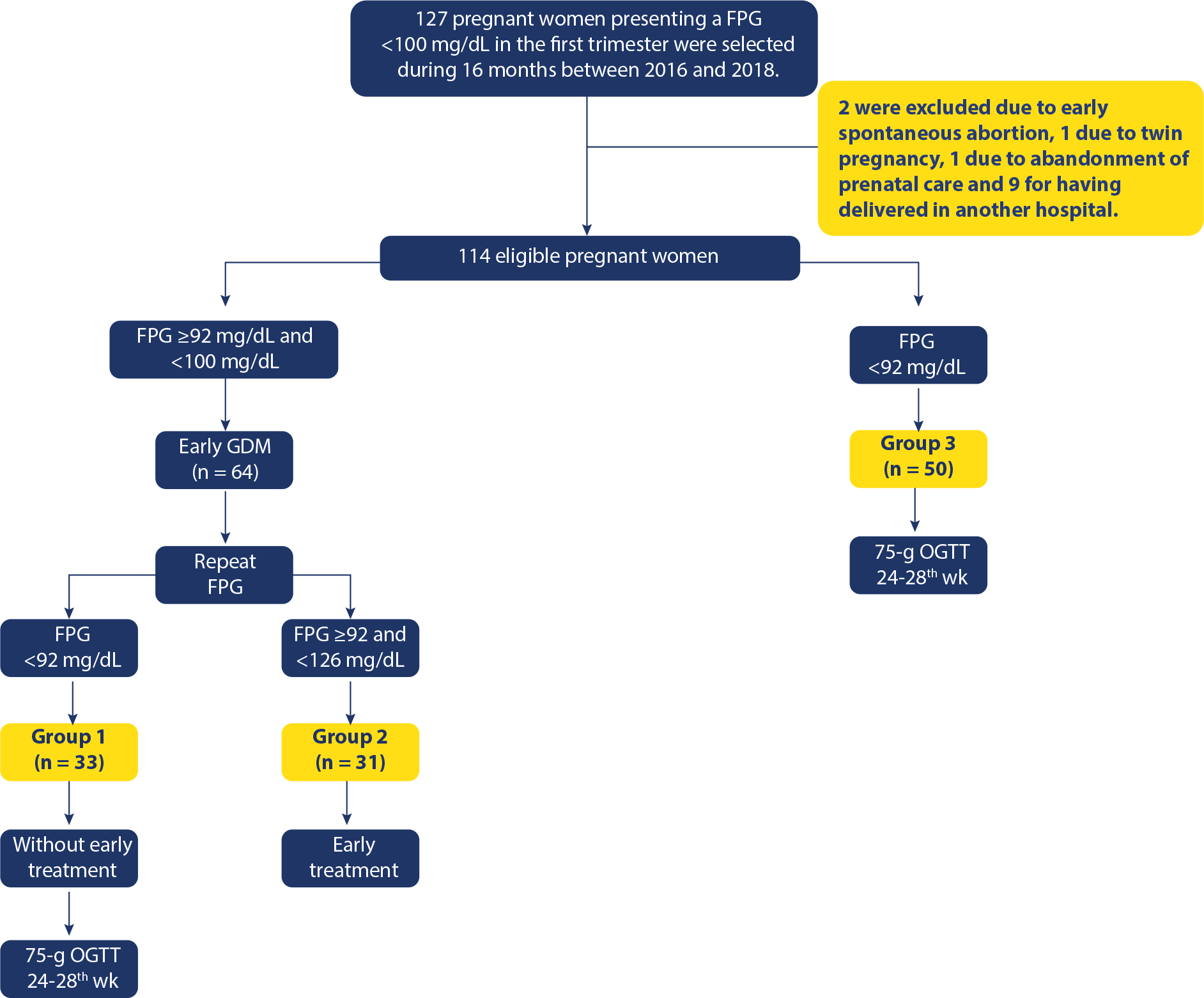 FPG: fasting plasma glucose; GDM: gestational diabetes mellitus; OGTT: oral glucose tolerance test.