 VALIDATION OF THE PAGE-B SCORE AS A PROGNOSIS OF DEVELOPMENT TO HEPATOCELLULAR CARCINOMA (HCC) IN CHRONIC HEPATITIS B, IN THE BRAZILIAN POPULATION
Context: Due to the potential risk for chronic and severe progression, hepatitis B virus (HBV) infection requires antiviral medications, such as Tenofovir (TDF) and Entecavir (ETV), to reduce the HBV viral load and prevent the risk of liver cirrhosis and hepatocellular carcinoma (HCC). The PAGE-B score is a simple and reliable tool for assessing the risk of developing HCC, although it has not yet been validated in Brazil.
Objective: To validate the PAGE-B risk score for predicting HCC development in HBV carriers in Brazil. To analyze the association between the PAGE-B score and demographic, laboratory, and HBV treatment variables.
Methods: An observational cohort. retrospective study. Study sample - 659 individuals with chronic HBV mono-infection treated with antivirals for at least 3 years at two reference centers in Brazil’s Northeast and Amazon regions. The PAGE-B score was used to analyze its association with sex, age, and platelet count, classifying each patient’s HCC risk as low, moderate, or high.
Results: The mean PAGE-B score was 12.77±5.63. PAGE-B scores were classified as low, moderate, and high in 206 (31.2%), 287 (43.5%), and 166 (25.3%) individuals, respectively. Among the 659 patients, 31 (4.7%) developed HCC, a higher frequency than reported in PAGE-B score validation studies from other countries. Of these patients, 29 were male, with a mean age of 57.4±12.6 years and lower platelet levels (<200,000 10³/mL). Patients who developed HCC had fibrosis stages: F0-F1:6 (19.3%); F2:2 (6.4%); F3:2 (6.4%); and F4:21 (67.7%). High-risk patients were treated with ETV (n=129, 32%) versus TDF (n=37, 14,4%), P<0.00.
Conclusion: The PAGE-B score demonstrated, in the Brazilian population, a performance similar to that observed in studies with European and Asian populations in terms of sensitivity, specificity, and predictive values for HCC prediction. Based on these results, the PAGE-B score can be used in the Brazilian population to predict the risk of HCC.
Keywords:
HBV; hepatocellular carcinoma; PAGE-B; risk score
•The PAGE-B score was validated in the Brazilian population to predict the development of hepatocellular carcinoma (HCC) in patients with chronic hepatitis B (HBV).
•A cohort study of 659 mono-infected HBV patients treated with antivirals for at least 3 years found that 31 (4.7%) developed HCC.
•High-risk patients (25.3% of the cohort) were predominantly male, with a mean age of 57.4 years, and had lower platelet counts (<200,000×103/mL).
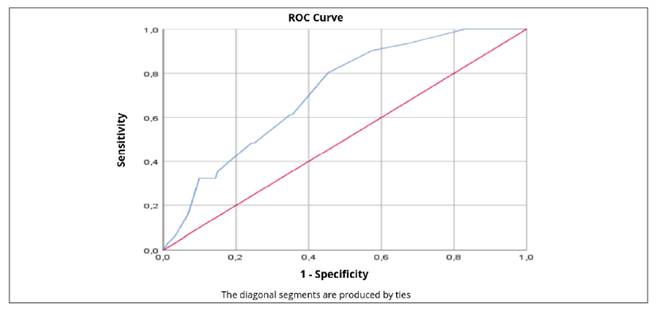
•The PAGE-B score demonstrated 80% sensitivity, 55% specificity, an 8% positive predictive value, and a 98% negative predictive value for predicting HCC.
 Thumbnail
 Thumbnail
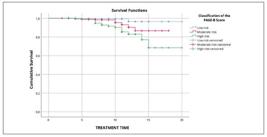
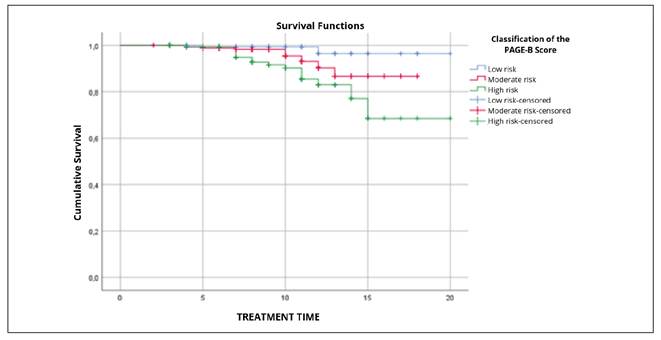 Low risk: blue line. Moderate risk: red line. High risk: green line. Low risk censoring: blue “+” symbol. Moderate risk censoring: red “+” symbol. High risk censoring: green “+” symbol.