
 Functional response of Telenomus remus (Hymenoptera: Scelionidae) to different egg densities of Spodoptera frugiperda (Lepidoptera: Noctuidae)
ABSTRACT
The parasitoid Telenomus remus Nixon (Hymenoptera: Scelionidae) is a natural enemy of lepidopteran pests, and several studies have been conducted to evaluate its efficiency on eggs of Spodoptera frugiperda (J. E. Smith) (Lepidoptera: Noctuidae). Functional response is an important parameter for assessing the potential of parasitoids. The objective of this work was to evaluate the harvesting behavior and the functional response of T. remus on eggs of S. frugiperda. We conducted the experiment in an acclimatized chamber at 25 ± 2°C, relative humidity 70% ± 10% and photophase of 12 hours. For harvesting behavior, we observed that a female takes 2.4 minutes, from the placement to the first cleaning, which is 44.7 seconds, to parasite one egg. The value of the quadratic coefficient was negative (P1 < 0.0005), so it can be assumed that the functional response of T. remus to eggs of S. frugiperda was type III. The results of attack rate (a’), handling time (Th ), and number of eggs parasitized at 24 hours by T. remus were, respectively, 0.00664 and 0.5649·h-1. The sex ratio of the parasitoid was influenced by host densities, with a ratio of 0.5 at 10 and 30 egg densities, but values were not differentiated from the density of 15 eggs. Our results can be helpful for developing field studies, enhancing the knowledge and possibilities for integrated pest management.
Keywords
parasitoid; biological control; behavior
Biological control is one of the pillars of integrated pest management, and in some cases, it is as effective as the use of insecticides. For example, the mass rearing of natural enemies and subsequent flood releases tend to reduce the damage caused by pests to crops, preventing their population from evolving quickly and with minimal damage to the environment. Agronomists and farmers can visualize this strategy as they consider the possible replacement of agrochemicals with an equally effective action plan (Parra et al., 2002).
Parasitoids are one of the main groups of biological control agents, being used on a large scale in biological control programs. The adoption of this strategy occurs mainly due to the need to reduce insecticide residues in food and in the environment, resulting from the improper use of such products. Among the parasitoid species in which they stand out in Brazil, Telenomus remus Nixon (Hymenoptera: Scelionidae) is one of the main ones, since this insect parasitizes eggs of important Lepidoptera, such as the fall armyworm Spodoptera frugiperda (J. E. Smith, 1789) (Lepidoptera: Noctuidae) (Parra; Coelho Jr., 2019).
The fall armyworm, a cosmopolitan and polyphagous pest, is one of the main pests in Brazil, reportedly resistant to various forms of control, especially Bt transgenic plants (Huang, 2021). The control of this pest is often carried out with chemical products with little monitoring criteria, which can be harmful to numerous non-target organisms, such as other arthropods, fish, birds, and mammals. In addition, the successive use of insecticides can cause the pest to resist the mechanisms of action employed, especially if they are not properly managed (Berg; Plessis, 2022).
Using T. remus as a biological control agent is advantageous due to its high dispersion and search behavior and the ability to parasitize the deep layers of the egg masses of S. frugiperda (Bueno et al., 2008; Figueiredo et al., 2002). The relationship between the consumption rate (parasitism in this case) and the host density is called the functional response (Fernández-Arhex; Corley, 2003). A natural enemy’s potential is evaluated using the functional response for various situations, such as a lack or excess of prey, in a natural, protected, or directed environment (laboratory). Fernández-Arhex and Corley (2003) indicate that most parasitoids used in biological control have a type-II response, but that there is no relationship between the type of functional response and success in biological control. However, this information can infer the role of a natural enemy in a system and its relationship with the pest of interest. Therefore, it is of paramount importance to determine the behavioral aspects and functional response of the parasitoid T. remus on S. frugiperda under laboratory conditions. Thus, the objective of this study was to evaluate the functional response of T. remus on different densities of S. frugiperda eggs, in addition to describing its behavior during parasitism.
The specimens of the parasitoid T. remus and the host S. frugiperda were kept under controlled temperature conditions of 25 ± 2°C, relative humidity of 70 ± 10% and photophase of 12 hours. First, with the aid of a video coupled to a player and monitor, the foraging and oviposition behavior of the parasitoid on host eggs was recorded, and the analysis subsequently was carried out. For this, an egg mass of approximately 100 eggs was deposited in a Petri dish (90 mm in diameter), then the female T. remus was placed in the dish, at which time the foraging behavior analyses began. The interaction between T. remus and the egg densities of S. frugiperda was evaluated using flat-bottomed test tubes (8.5 cm high × 2.4 cm in diameter) with five, 10, 15, 20, 25, 30, and 40 eggs, and a female of the parasitoid. The parasitoids were kept in contact with the eggs for 24 hours, and the evaluation of the number of parasitized eggs was carried out 14 days later. The experimental design was completely randomized, with three replicates.
The functional response was estimated in two steps. The first step refers to the type of functional response, which was determined through logistic regression of the proportion of parasitized S. frugiperda eggs (Na) by T. remus as a function of the original egg densities per parasitoid, the initial number of eggs (No), using the Proc CATMOD (SAS Institute), as follows: Na /No = exp(Po + P1 No + P2 No2 + P3 No3)/1 + exp(Po + P1 No + P2 No2 + P3 No3). Po, P1, P2, and P3 are the constant, linear, quadratic, and cubic coefficients, respectively. Initially, the cubic model was tested due to its ability to capture all possible variations of the functional response curves (Juliano, 2001).
The linear coefficient of the equation (P1) estimated from the proportion of preyed eggs by prey density was used to determine the type of functional response. The linear coefficient, when not significant, indicates a type-I functional response; when it is significant and negative, it indicates a type-II functional response; and when positive, a type-III functional response. There was no host replacement during the experiment, so the type of functional response was determined from the random equation proposed by Rogers (1972) (Eq. 1):
Where Na: Number of parasitized eggs; No: number of eggs supplied; a’: attack rate; Th: handling time; T: predator exposure time to prey (24 h).
The second step was to determine the parameters Th and a’ of the functional response, estimated by nonlinear regression using the least squares method, according to the program written by Juliano (2001). The experimental design was completely randomized, with three replicates per host density. The influence of S. frugiperda egg density on the sex ratio of T. remus and the influence of parasitism on the number of hatched S. frugiperda larvae were compared by Tukey’s test (p < 0.05).
When the female is introduced into the arena, she performs some steps during foraging (Fig. 1). First, the female flaps her wings to move in the direction of the egg mass, and 34 seconds are used to locate the host. Soon after, the female walks on the mass of eggs, drumming her antennae for 46 seconds, followed by oviposition for 3 seconds. Subsequently, the female spent 4 seconds to locate the next egg, and, after 12 seconds drumming over the egg, spent about 5 seconds to oviposit, followed by another 4 seconds to locate the next egg. On the third oviposition, the female spent about 10 seconds drumming and 50 seconds oviposition. At the end of the third oviposition, the female took 5, 2, and 2 seconds to clean the antennae, legs, and ovipositor, respectively.
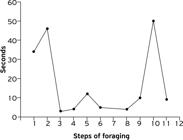
Foraging behavior of Telenomus remus on Spodoptera frugiperda eggs. Each step was measured in seconds according to the steps observed.
In addition, we observed that the insect cleaned its appendages every three ovipositions. Thus, a total cycle of 2.95 minutes was established considering the time of egg search, drumming, three ovipositions, and cleaning. If we consider the total time spent per egg, we obtain the total of 44.7 seconds per egg, a result that is very close to those obtained in previous studies (Schwartz; Gerling, 1974; Cave et al., 1987; Carneiro et al., 2010).
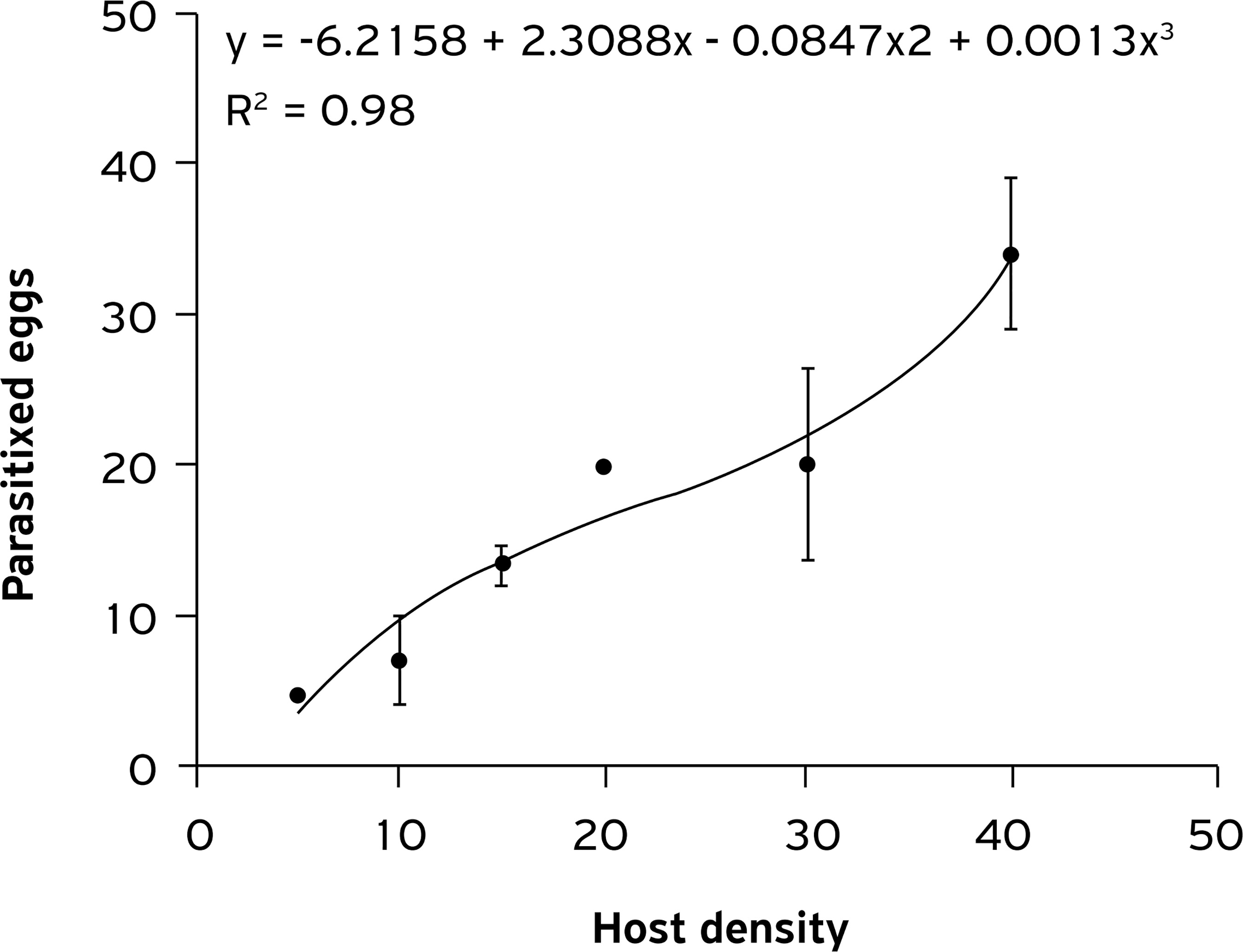
According to the result shown by the estimated parameters, the value of the quadratic coefficient was negative (p < 0.0005). Thus, it can be assumed that the functional response of T. remus to the eggs of S. frugiperda was type III (Table 1). The functional response of the parasitoid is shown in Fig. 2. The functional response type III of T. remus on S. frugiperda means that there is an increase in the proportion of parasitism until the inflection of the sigmoid curve, followed by a reduction in the proportion of parasitism. The variable used in our study was egg density, but other factors can also influence the type of functional response. There is a divergence in the results obtained by Carneiro et al. (2010), in which they observed a functional response of type II, but we attribute this divergence to the different egg densities used in the two studies.
Results of the logistic regression analysis of the proportion of Spodoptera frugiperda eggs parasitized by Telenomus remus females.
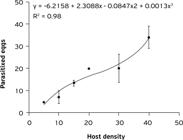
Average number of Spodoptera frugiperda eggs parasitized by Telenomus remus females at different densities for 24 hours.
Different hosts may affect populations of Trissolcus basalis Thompson differently regarding the number of females that emerged, but without altering their functional response (Allahyari et al., 2004). In addition, four species of Trissolcus parasitizing pentatomid eggs showed a type-III functional response, having an interesting potential for implementation in biological control programs (Laumann et al., 2008). Even so, other authors are more cautious, preferring not to consider the functional response alone to determine the potential of species for biological control programs (Lester; Harmsen, 2002).
The results of attack rate (a’), handling time (Th), and number of eggs parasitized in 24 hours by T. remus were 0.00664 and 0.5649·h-1, respectively (Table 2). No emergence of T. remus was observed at the density of 20 eggs of S. frugiperda. The sex ratio of the parasitoid was influenced by the host densities, with a ratio value = 0.5 observed in densities of 10 and 30 eggs, whose values were not different from the density of 15 eggs (F = 4.74; p < 0.05).
Regarding the number of hatched larvae, no difference was observed between the egg densities used (F = 0.917; p = 0.502) (Table 3). In this study, the functional response of T. remus parasitizing eggs for 24 hours was evaluated, but it is known that the time of exposure of the host to the parasitoid can influence the result (Xiang et al., 2020), so for a more complete knowledge, other parasitism periods should be evaluated. Another important detail is that, in previous studies, Morales et al. (2001) found that T. remus stabilizes its parasitism at the density of 150 host eggs, although their results are questioned by Carneiro et al. (2010).
Attack rate (a’) and handling time (Th) of Telenomus remus hosted by Spodoptera frugiperda eggs at different densities for 24 hours.
Sex ratio of Telenomus remus and number of hatched larvae of Spodoptera frugiperda at different densities for 24 hours.
Basic studies of interactions and behaviors between different trophic levels, such as functional response, help us to know the dynamics of biological control agents and their possible impact on the environment. Such studies can be useful in decision-making in integrated pest management programs. With the support of the data obtained in this study, field work, in which there is the interaction of more variables, should be developed to help decision-making in the use of biological control.
ACKNOWLEDGEMENTS
Not applicable.
-
Peer Review History: Double-blind Peer Review.
-
FUNDING
Coordenação de Aperfeiçoamento de Pessoal de Nível SuperiorFinance Code 001
-
ETHICAL APPROVAL
Not applicable.
AVAILABILITY OF DATA AND MATERIAL
The datasets generated and/or analyzed during the current study are available from the corresponding author on reasonable request.
REFERENCES
-
ALLAHYARI, H.; FARD, P.A.; NOZARI, J. Effects of host on functional response of offspring in two populations of Trissolcus grandis on the sunn pest. Journal of Applied Entomology, v.128, n.1, p.39-43, 2004. https://doi.org/10.1046/j.1439-0418.2003.00804.x
» https://doi.org/10.1046/j.1439-0418.2003.00804.x -
BERG, J.V.D.; PLESSIS, H. Chemical control and insecticide resistance in Spodoptera frugiperda (Lepidoptera: Noctuidae). Journal of Economic Entomology, v.115, n.6, p.1761-1771, 2022. https://doi.org/10.1093/jee/toac108
» https://doi.org/10.1093/jee/toac108 -
BUENO, R.C.O.F.; CARNEIRO, T.R.; BUENO, A.F.; PRATISSOLI, D.; FERNANDES, O.A.; VIEIRA, S.S. Tabela de vida de fertilidade de Telenomus remus Nixon (Hymenoptera: Scelionidae) criados em ovos de Spodoptera frugiperda Smith (Lepidoptera: Noctuidae) em diferentes temperaturas. Ecossistema, v.33, n.1-2, p.45-49, 2008. https://www.cabidigitallibrary.org/doi/full/10.5555/20103174963
» https://www.cabidigitallibrary.org/doi/full/10.5555/20103174963 -
CARNEIRO, T.R.; FERNANDES, O.A.; CRUZ, I.; BUENO, R.C. Functional response of Telenomus remus Nixon (Hymenoptera, Scelionidae) to Spodoptera frugiperda (JE Smith) (Lepidoptera, Noctuidae) eggs: effect of female age. Revista Brasileira de Entomologia, v.54, n.4, p.692-696, 2010. https://doi.org/10.1590/S0085-56262010000400023
» https://doi.org/10.1590/S0085-56262010000400023 -
CAVE, R.D.; GAYLOR, M.J.; BRADLEY, J.T. Host handling and recognition by Telenomus reynoldsi (Hym.: Scelionidae), an egg parasitoid of Geocoris spp. (Heteroptera: Lygaeidae). Annals of Entomological Society of America, v.80, p.217-223, 1987. https://doi.org/10.1093/aesa/80.2.217
» https://doi.org/10.1093/aesa/80.2.217 -
FERNÁNDEZ-ARHEX, V.; CORLEY, J.C. The functional response of parasitoids and its implications for biological control. Biocontrol Science and Technology, v.13, n.4, p.403-413, 2003. https://doi.org/10.1080/0958315031000104523
» https://doi.org/10.1080/0958315031000104523 -
FIGUEIREDO, M.L.C.; DELLA-LUCIA, T.M.C.; CRUZ, I. Effect of Telenomus remus Nixon (Hymenoptera: Scelionidae) density on control of Spodoptera frugiperda (Smith) (Lepidoptera: Noctuidae) egg masses upon release in a maize field. Revista Brasileira de Milho e Sorgo, v.1, n.2, p.12-19, 2002. https://doi.org/10.18512/1980-6477/rbms.v1n2p12-19
» https://doi.org/10.18512/1980-6477/rbms.v1n2p12-19 -
HUANG, F. Resistance of the fall armyworm, Spodoptera frugiperda, to transgenic Bacillus thuringiensis Cry1F corn in the Americas: lessons and implications for Bt corn IRM in China. Insect Science, v.28, n.3, p.574-589, 2021. https://doi.org/10.1111/1744-7917.12826
» https://doi.org/10.1111/1744-7917.12826 - JULIANO, S.A. Nolinear curve fitting: predation and functional response curves. In: SCHEINER, S.M.; GUREVITCH, J. (eds.). Design and analysis of ecological experiments 2nd. Ed. New York: Oxford University Press, 2001. p.178-196.
-
LAUMANN, R.A.; MORAES, M.C.B.; PAREJA, M.; ALARCAO, G.C.; BOTELHO, A.C.; MAIA, A.H.N.; BORGES, M. Comparative biology and functional response of Trissolcus spp. (Hymenoptera: Scelionidae) and implications for stink bugs (Hemiptera: Pentatomidae) biological control. Biological Control, v.44, n.1, p.32-41, 2008. https://doi.org/10.1016/j.biocontrol.2007.10.003
» https://doi.org/10.1016/j.biocontrol.2007.10.003 -
LESTER, P.J.; HARMSEN, R. Functional and numerical responses do not always indicate the most effective predator for biological control: an analysis of two predators in a two-prey system. Journal of Applied Ecology, v.39, n.3, p.455-468, 2002. https://doi.org/10.1046/j.1365-2664.2002.00733.x
» https://doi.org/10.1046/j.1365-2664.2002.00733.x -
MORALES, J.; GALLARDO, J.S.; VÁSQUEZ, C.; RÍOS, Y. Respuesta funcional de Telenomus remus (Hymenoptera: Scelionidae) a los huevos Spodoptera frugiperda (Lepidoptera: Noctuidae). Bioagro, v.13, n.2. p.49-55, 2001. https://www.redalyc.org/pdf/857/85713201.pdf
» https://www.redalyc.org/pdf/857/85713201.pdf - PARRA, J.R.; BOTELHO, P.S.M.; CORREA-FERREIRA, B.S.; BENTO, J.M.S. Controle biológico no Brasil: parasitóides e predadores São Paulo: Manole, 2002. 609p.
-
PARRA, J.R.; COELHO JR., A. Applied biological control in Brazil: from laboratory assays to field application. Journal of Insect Science, v.19, n.2, 2019. https://doi.org/10.1093/jisesa/iey112
» https://doi.org/10.1093/jisesa/iey112 -
ROGERS, D. Random search and insect population models. Journal of Animal Ecology, v.41, n.2, p.369-38, 1972. https://doi.org/10.2307/3474
» https://doi.org/10.2307/3474 -
SCHWARTZ, A.; GERLING, D. Adult biology of Telenomus remus [Hymenoptera: Scelionidae] under laboratory conditions. Entomophaga, v.19, n.4, p.483-492, 1974. https://doi.org/10.1007/BF02372784
» https://doi.org/10.1007/BF02372784 -
XIANG, C.; HUANG, J.; RUAN, S.; XIAO, D. Bifurcation analysis in a host-generalist parasitoid model with Holling II functional response. Journal of Differential Equations, v.268, n.8, p.4618-4662, 2020. https://doi.org/10.1016/j.jde.2019.10.036
» https://doi.org/10.1016/j.jde.2019.10.036
Edited by
-
Associate Editor:
Silvia Galleti https://orcid.org/0000-0002-0745-5716

 Source: Elaborated by the authors.
 Source: Elaborated by the authors.