 Identification of Tangible and Intangible Management Conservation in Historical Mosque
Abstract
Tangible and intangible management conservation is needed to conservator historical places, this research prioritizing tangible heritage implies that the mosque is managed as a heritage building. This research is a comprehensive analysis of the management and conservation of tangible and intangible heritage in historical mosques, focusing on examples from Japan and Indonesia. It highlights the challenges of balancing functionality and authenticity in managing historical mosques and emphasizes the importance of professional and transparent mosque management. The research explores the changes in the authenticity of tangible and intangible attributes in historical mosques and the different needs and values associated with them. It also discusses the history and changes in design, materials, and function of four historical mosques, including the assessment of their authenticity at the architectural level. The role and management of the mosques are identified as crucial factors in preserving tangible and intangible heritage. The paper offers valuable insights into the preservation and management of historical mosques and their tangible and intangible heritage.
Keywords:
Immaterial; Perceptible; Heritage
Resumo
Esta investigação examina a gestão e conservação do patrimônio tangível e imaterial em mesquitas históricas no Japão e Indonésia. Destaca os desafios de equilibrar funcionalidade e autenticidade na gestão de mesquitas históricas e sublinha a importância de uma gestão profissional e transparente de mesquitas. O estudo identifica mudanças na autenticidade de atributos tangíveis e intangíveis em mesquitas históricas e discute o papel e a gestão das mesquitas como fatores cruciais na preservação do patrimônio tangível e imaterial. Estudos de caso de mesquitas no Japão demonstram como incorporaram elementos culturais e servem como centros para a cultura islâmica, preservando o patrimônio tangível e imaterial. As fontes cobrem uma série de tópicos relacionados com a conservação e gestão de cidades islâmicas, mesquitas históricas e locais de patrimônio cultural, incluindo estudos de caso, diretrizes e investigação sobre vários aspectos da arquitetura de mesquitas, conservação do patrimônio e o papel das mesquitas em diferentes contextos culturais e urbanos.
Palavras-chave:
Material; Perceptível; Herança
1 Introduction
A historical mosque is a building with religious and heritage values, faced with the challenges of balancing act between functionality and authenticity. It is primarily managed to conserve tangible and intangible heritage (Mekonnen, Bires & Berhanu 2022). Prioritizing tangible heritage implies that the mosque is managed as a heritage building. However, when the emphasis is on conserving intangible heritage, it is being used as a mosque (Mahdy 2019). To ensure its continued functionality, the building underwent a series of adjustments and conservation efforts. Authenticity management encompasses various levels of conservation techniques, ranging from maintenance and preservation to restoration, reconstruction, adaptation, and necessary, demolition. Maintenance and preservation primarily include minimal alterations or additions to the building's form and materials. Demolition, on the other hand, comprises no conservation, as it entails the destruction of the old building and the construction of a new one, whether similar or different in architectural style (Truscott 2014).
Conservation efforts aimed at preserving this structure as a place of worship are evident in the study (Aziz & Zulkifli 2018). The Teluk Mamili Historical Mosque in Malaysia was successfully conserved through relocation from an uninhabited location to a residential area to restore its function as a mosque. This process included both restoration and adaptation of the form and structure of the historical mosque to fulfil the current building design requirements. In Saudi Arabia, the Alkhua Historical Mosque was approached from the perspective of preserving it as a historical building (Aziz & Zulkifli 2018). Conservation efforts focused on protecting its shape, environmental characteristics, and historical value. However, restoration was conducted to revive the function. The Haci Hasan Historical Mosque strikes a delicate balance between its role as a functioning religious site and its status as a historical building, as discussed in Tutal's 2018 study. The study emphasizes that the restoration efforts have centred on improving accessibility to the historic environment, effectively restoring the mosque to its original form. To accommodate disabled individuals, some architectural spaces were modified.
The paper contributes by emphasizing the importance of professional, accountable, and transparent mosque management through application-based techniques, aiming to educate administrators and improve human resource abilities (Aziz & Zulkifli 2018). It provides a classification of documentation for heritage building conservation, including historical records, previous drawings, historic texts, archaeological findings, historic photographs, oral history, and multimedia, as sources of evidence for historical research documentation (Husa & Harun 2023). It investigates key tensions around the concept of 'place' in conservation, including disconnections between heritage thought and practice, and the artificial distinction between 'tangible' and 'intangible' place heritage (Lesh 2020).
This research needs to be done because there is no previous study that discusses historical mosques as tangible and intangible heritage Another phenomenon related to the management of historical mosques includes institutions such as migrant Muslim communities from various countries, foreign governments, local community organizations, as well as organizations formed by local communities and governments. Therefore, this research identifies the authentication of tangible and intangible heritage as well as investigates the patterns of conservation management. This was achieved by examining examples of historical mosques managed by foreign governments, migrant Muslim communities, and local community organizations, as well as a combination of government and local community efforts. These include Tokyo Camii, Kobe Muslim Mosque, Menara Kudus, and Demak Grand Mosque, respectively. The objective of this study is to assess the effect of various institutions on the conservation management of historical mosques.
2 Literature Review
2.1 Managing Tangible and Intangible Heritage in Historical Mosque
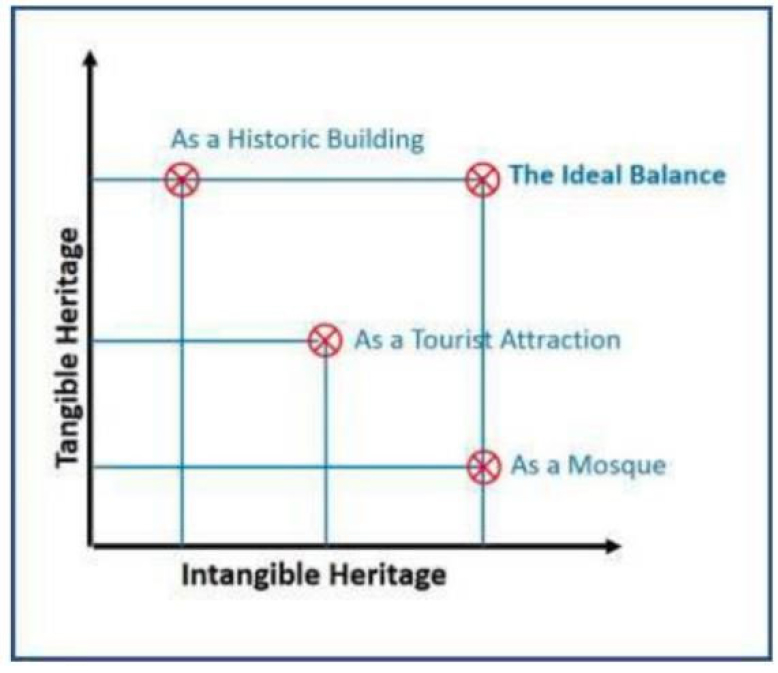
The ideal condition for managing a historical mosque, as proposed by (Mahdy 2019) is the ability to preserve and maintain the authenticity of both tangible and intangible heritage attributes. Achieving the ideal balance can be challenging because these attributes need to adapt to technological advancements and human civilization. In addition to the principle of balance, Mahdy suggested the application of additional principles, such as those about historic building preservation, tourist attraction development, and mosque functionality, as shown in Figure 1.
Principles on the role of historical mosques based on conservation attributes (Mahdy 2017).
Tangible attributes in historical mosques are conserved by maintaining authenticity, partially maintaining authenticity, and authenticity demolition. In Bangkok, Thailand, this conservation is based on the significance of the building, which is divided into three types of attributes, such as critical (no changes or restoration to the original form), important (modification while maintaining core quality), and neutral (changes are permissible) (Nakapan et al. 2021). A similar approach was observed in the conservation of tangible authenticity attributes in Pekayon, Jakarta, Indonesia, where they were categorized as Mostly Original, Partially New, and Mostly New (Syahid et al. 2020). Meanwhile, conservation in Negeri Sembilan, Malaysia, includes 4 approaches, such as abandoned mosques with no function, conserved with different functions, preserved original area, as well as no preservation and total change of design (Abd Rahim, Ismail & Abd Latip 2022).
Changes in the authenticity of tangible attributes occur due to the dominance of functional and religious values over authenticity, as exemplified in Yorubaland, Nigeria. Furthermore, historical mosque construction often included expansion through the addition of space to accommodate growing congregations. Additionally, attributes such as a dome, cupola, and slender minaret have been added, drawing inspiration from buildings in the Middle East (Sabri & Olagoke 2019). Changes in tangible aspects, such as architecture and function, were closely related to the conservation attitude of managers (Mahdy 2017). Meanwhile, authenticity conditions at the architectural level consist of four attributes, including Form- Design, Material-Substance, Use-Function, as well as Tradition-Technique (Song 2016).
Intangible heritage stems from the needs of both managers and visitors, categorized into 3 types, as follows (Dhannoon, Abdulqader & Al-Azawi 2022):
-
Religious needs were related to purity, focus, tranquillity, and simplicity in worship.
-
Spiritual needs entail a connection with God, inner peace, and community.
-
Cultural needs comprise educational, cultural, and social activities within the context of visual and civilizational challenges.
A complex of historical mosques in Turkey, consisting of the Mevlana Tomb and Selimiye Mosque, has an intangible cultural heritage in the form of the Sufistic ceremony known as the Mawlawi Semâ Ceremony. Initially, this ceremony had religious and spiritual significance, conveying symbols through spatial construction, sacred objects, and myths of the tomb. It served as a means of religious worship, connecting humans with God through art and literature, and was centred in places of education and artistic expression. Furthermore, the Mawlawi Semâ Ceremony has transformed into a practice with a heightened emphasis on spirituality and culture, persisting as a form of artistic and literary expression across a wide geographical expanse (Gultekin & Canbolat 2018). Changes in intangible heritage needs vary by region. For instance, in Malaysia, the Kapitan Keling Historical Mosque, managed by the Indian Muslim community, has both tangible and intangible values such as architecture, storytelling, and food festivals that reflect their identity. Therefore, intangible attributes were primarily geared towards fulfilling spiritual and cultural needs. These attributes were preserved even as the mosque has undergone modifications for heritage tourism (Azmi & Ismail 2016). Changes in needs are closely associated with the object and extent of authenticity of intangible heritage attributes. According to Zhou Zang and Ma (2015), the authenticity of the object and the extent were affected by personal emotional factors, personal economics, and attitude towards tradition.
-
Personal economics relates to the income generated due to the impact of intangible heritage.
-
Personal emotions relate to feelings of pride and identity, cohesion, as well as increased knowledge about the culture of the area.
-
Attitude towards tradition relates to adhering to original strict rituals and religious practices or integrating local culture and modern civilization.
This study aimed to identify changes in authenticity performed by managers based on the architectural level with attributes such as Form-Design, Material-Substance, and Use- Function. Meanwhile, intangible heritage was contingent on factors, such as personal emotional, personal economic, and attitude towards tradition. This investigation also identified conservation attitudes towards intangible and tangible heritage in historical mosque institutions.
3 Methodology and Data
This study employed a qualitative comparative approach, which involved comparing historical mosques. The mosques examined were Kobe Muslim and Tokyo Camii, both of which hold the distinction of being the oldest mosques in Japan. Additionally, Menara Kudus and Demak Grand were included, representing Indonesia with a specific focus on Central Java Province.
These mosques were selected for their status as the oldest in the region and the significant cultural values they hold within the context of both Islam and Hinduism. The changes in authenticity were identified based on in-depth interviews and document studies, such as information obtained from archive reports, literature reviews from official social media, news publications, and academic articles. The primary objective of this study is conservation management performed by the host or mosque institution.
4 Results
4.1 Tangible Value in Demak and Kudus Mosques
The architectural structure of Menara Kudus is considered a tangible heritage and receives protection from the regional conservation centre. Menara Kudus has an area of 5,000 m², comprising 8 buildings, such as a mosque, a central veranda, a front veranda, a women's prayer building, an auditorium and ablution area, a lounge, a minaret, 2 toilets, and 3 mausoleums. All buildings have a floor except for the minaret and the auditorium-ablution building, which have 2. Additionally, Demak Mosque covers an area of 12,752 m², including the main mosque, a veranda, a Women's Prayer Hall, 2 toilet and ablution buildings, 6 offices, a museum, 4 mausoleum buildings, and a minaret. It is important to note that only the main building has a second floor.
The main building of Demak Grand Mosque has maintained its form and design consistent with the Javanese style, making it an immovable heritage object. Demak Grand has managed to maintain-the design of the main building, consistent with the Javanese style. This includes a 3-tiered roof supported by 4 main pillars, classified as the structure of the masjid lambang templok building (Andriani et al. 2019). The main building becomes an immovable heritage object, despite the addition and replacement of new materials such as roof tiles, and new wood for the central pillars, doors, and windows. All the replaced old materials were preserved inside the museum building and served as immovable heritage objects. The building's function has remained constant, serving as both a community mosque and a place of pilgrimage.
Both mosques have tangible objects derived from ceremonies that are distributed to visitors, such as special clothes offered during the Buka Luwur ceremony at Menara Kudus. The presence of authentic structural elements, such as the Inner Paduraksa Gate, Outer Paduraksa Gate, and Menara Kudus, adds to the tangible value of the mosques. These tangible values contribute to the cultural and historical significance of the Demak and Kudus mosques.
4.2 Tangible Values in Kobe and Tokyo Mosques
The main prayer building of Kobe Muslim Mosque holds significant authenticity as a tangible heritage object due to its preservation of design, materials, and function, with only minor alterations. The architecture of historical mosques in Japan follows the style of their country of origin. Meanwhile, Indonesia exhibits a unique architectural style characterized by pyramid- shaped roofs. According to Martin Frisman's theory (Hakim 2008), the structure of Kobe Muslim has an Indian dome style with 4 minarets at the front and rear parts. Despite the building and dome showing the Indian Mughal style, the exterior is not decorated with red stone, marble, or mosaic tiles, as shown in Indian or Middle Eastern Islamic worship centres. However, the decoration follows a more Arabic style with finishes adorned with faded colours (Utaka 2016). The interior decoration leans towards Turkish style, with a pulpit and mihrab adorned with simple gold inscriptions and pure white marble walls. This is because the mosque was developed with the assistance of Indian Muslims (Yamashita 2022), Turkish-Tatar merchants (Isac 2015), and other Muslim migrants. Based on the theory of Martin Frisman (Hakim 2008), the main building of Tokyo Mosque follows the Turkish architectural style, characterized by a central dome, an attribute of the Ottoman Empire. This central dome was surrounded by 6 semicircular domes and a conical minaret, which resembled a smaller version of the Sultan Ahmed or Blue Mosque in Turkey. Turkish Cultural Center building is a 4-story structure designed in the traditional Turkish house style from the 1900s in Safranbolu, featuring projecting bays (cumba), wide roofs (saçak), and round tile (Ozaslan & Akalin 2011).
The architecture of the Tokyo Camii Mosque, including the building, ornaments, and calligraphy on the walls, can be considered new immovable tangibles. Tokyo Camii was subjected to institutional changes, transitioning from community management to oversight by the Turkish government. All aspects of the architecture and tradition have changed under the effect of Turkish culture. Tangible and intangible objects have been modified for transformation into the Islam Center in Japan. These were in line with the report by Morimoto, (1976) that constructing modern buildings and facilities as well as Japanese community participation in every activity established the centre of Islam in Japan. The demolition of the old mosque into a building with new forms and materials aimed to support the function of Tokyo Camii as an Islamic cultural centre. Currently, the architecture of the building, ornaments, and calligraphy on the walls can become new immovable tangibles. The internal Mosque Institution will oversee routine maintenance of tangible objects, while medium and heavy repairs were coordinated with the Ministry of Religious Affairs of the Turkish Government. Activities at Tokyo Camii were centred around engaging the local community. These activities have the potential to become intangible objects, such as Sohbet, Islamic book discussions, English café, cultural festivals, and mosque tours, because they serve as means of attracting Japanese people to the mosque. Similar activities were undertaken by Demak Grand, which have evolved into Intangible heritage (Ahmad 2017).
These tangible values contribute to the cultural and historical significance of the Kobe and Tokyo mosques. Tokyo Camii is gradually incorporating cultural elements, with a distinctive Turkish character. Activities in Indonesia have accommodated the fulfilment of religious, spiritual, and cultural needs by turning cultural ceremonies and traditions into sacred and spiritual celebrations.
4.3 Intangible Values in Kobe and Tokyo Mosques
In Kobe Muslim Mosque, the intangible heritage is preserved through the continuation of religious practices and traditions, such as Ramadan and Eid celebrations. Similar activities take place during Ramadan and Eid al-Fitr celebrations at both Tokyo Camii and Kobe Muslim, providing intangible value to both mosques. Tokyo Camii regularly organizes cultural and educational festivals on various themes and topics due to its role as a centre of Turkish culture. Communication tradition was upheld every month. One of such tradition imported from Turkey is Sohbet, which comprises discussions between adult men and youth on matters related to ethnicity, religion, or social status. Additionally, there were activities where the Qur'an and other Islamic knowledge were translated into the Japanese language. Despite still not being considered intangible heritage, these activities can be seen as the initial steps toward the development of Islamic literature in Japan. Tokyo Camii Mosque incorporates cultural elements, with a distinctive Turkish character, which adds to its intangible heritage. These intangible values contribute to the cultural and spiritual significance of the Kobe and Tokyo mosques.
5 Discussion
5.1 The Similarities and the Differences of Intangible Value
The similarities in intangible values among mosques include the following: Prayers and pilgrimage activities are held at the tomb of the Sufi or Sultan in both mosques as part of the ceremony. Both Demak Grand and Menara Kudus mosques distribute objects derived from ceremonies, which can be used as talismans for visitors. For example, Menara Kudus offers special clothes to invited guests and visitors during the Buka Luwur ceremony. Both mosques rely on charitable donations from visitors, underscoring the importance of maintaining ceremony and tradition to attract visitors to these historic mosques. These similarities in intangible values contribute to the cultural and spiritual significance of the Demak Grand and Menara Kudus mosques.
The differences in intangible values among mosques can be observed in the way they address spiritual and cultural needs, which influences the formation of intangible heritage. For example, activities at Kobe Muslim Mosque primarily focus on religious fulfilment, while Tokyo Camii Mosque gradually incorporates cultural elements with a distinctive Turkish character. Additionally, activities in Indonesia have accommodated the fulfilment of religious, spiritual, and cultural needs by turning cultural ceremonies and traditions into sacred and spiritual celebrations. These differences in addressing spiritual and cultural needs contribute to the formation of a distinct intangible heritage in each mosque.
A comparative analysis was conducted on the management of these attributes across 4 historical mosques, each associated with various institutions, namely the Muslim migrant community (Kobe Muslim), foreign government (Tokyo Camii), local community (Menara Kudus), and a partnership between local community and government (Demak Grand). The following is a summary of the main results.
First, the condition of authenticity at the architecture level was assessed based on attributes, such as Form-Design, Material-Substance, and Use-Function. Kobe Muslim had no changes and maintained the form, material, and function, thereby possessing only a building as a tangible heritage. Demak Grand was restored to its original form. In addition to the building, it also retained old materials as tangible heritage. Menara Kudus modified the shape of the building but maintained core attributes such as the minaret structure. Meanwhile, Tokyo Camii was subjected to the transformation of the entire building.
Secondly, the characterization of Sufi figures, Sultan/leaders, imams, and other significant figures is a vital factor in the transformation of religious, spiritual, and cultural activities into intangible heritage. Mosques managed by the Muslim migrant community and foreign governments lacked this characterization, as imams and leaders primarily focused on religious, community, and Islamic educational activities. On the other hand, those overseen by the local community and the collaborative effort between the community and local government underwent a process of characterization. In these cases, imams and leaders generated ideas, ceremonial traditions, and literary works as a means of adapting to local culture and environment. This media, born from the assimilation of Islam and local culture, formed the foundation for organizing religious, spiritual, or cultural activities within historical mosques in Indonesia. Consequently, these activities acquired local cultural significance and evolved into Intangible Heritage attributes.
Thirdly, in terms of preserving tangible and intangible heritage in historical mosques, the role and management played a crucial role. For instance, Kobe Muslim, managed by the Kobe Muslim community, emphasized the conservation of tangible heritage through a leadership focus on architectural preservation. Simultaneously, traditions such as Ramadan and Eid celebrations are upheld. Following a change in ownership to the Turkish government, Tokyo Camii was subjected to substantial changes in both architecture and tradition, positioning itself as a central hub of Islam in Japan. Both Menara Kudus and Demak Grand possessed tangible heritage in the form of building structures, safeguarded by regional conservation centres. Additionally, they preserved intangible heritage through important ceremonies and traditions cherished by the congregation, which were further supported by the economic contributions of visitors.
5.2 Final Factor of Tangible and Intangible
The final factor in the research is the role of the mosque institution in managing tangible and intangible heritage. This factor is contingent on the mosque's role within the community, and it forms the basis of the discussion in the study. The management of tangible and intangible heritage conservation is performed by the leaders, imams, and community forum, with the coordination of internal management and supervision by the local government. The preservation techniques used in conserving the architecture ensure that the form and function of the building remain the same, while activities and celebrations associated with religious events are managed by the mosque's leadership
Tangible value is related to the authenticity of an object. In Japan, objects with tangible heritage value are primarily immovable attributes, such as mosque buildings. In Indonesia, in addition to immovable tangible attributes, there is also movable heritage stored within the mosque buildings. A tangible heritage object in Kobe Muslim is the main prayer building. This structure holds significant authenticity due to its preservation of design, materials, and function, with only minor alterations, such as the addition of an air-conditioning system, the replacement of glass and chandeliers (Cabeza, de Gracia & Pisello 2018). This heritage value is attributed to the minor damage sustained by Kobe Muslims during the US Army airstrikes in 1945 or the Great Earthquake in the Kobe area in 1995. As a testament to its historical significance, the Hyogo Prefectural government has recognized it as a heritage building (Utaka 2016).
Tokyo Camii had a history in Japan but did not possess any objects with immovable or movable heritage. This is a relatively new construction completed in 2000. The architectural attributes, including Form-Design, Material-Substance, as well as Use-Function have undergone changes and developments. Additionally, the design was subjected to a total transformation. The original design of the old Tokyo Mosque resembled the Prophet's sanctuary in Madinah, with a Mamluk architectural style similar to Egyptian mosques. However, it was transformed into a Turkish architectural central-dome mosque. None of the old materials and substances were used in the reconstruction, and the function was expanded to serve as a mosque community and Islamic cultural center.
6 Conclusion
The paper provides a comprehensive analysis of the management and conservation of tangible and intangible heritage in historical mosque in Japan and Indonesia. It highlights the challenges of balancing functionality and authenticity in managing historical mosques and emphasizes the importance of professional and transparent mosque management. The study also explores the changes in the authenticity of tangible and intangible attributes in historical mosques and the different needs and values associated with them. The role and management of the mosques are identified as crucial factors in preserving tangible and intangible heritage. Overall, the paper offers valuable insights into the preservation and management of historical mosques and their tangible and intangible heritage.
This research includes the emphasis on professional, accountable, and transparent mosque management through application-based techniques, aiming to educate administrators and improve human resource abilities. It also provides a classification of documentation for heritage building conservation, including historical records, previous drawings, historic texts, archaeological findings, historic photographs, oral history, and multimedia, as sources of evidence for historical research documentation. Moreover, it investigates key tensions around the concept of 'place' in conservation, including disconnections between heritage thought and practice, and the artificial distinction between 'tangible' and 'intangible' place heritage. It identifies the authentication of tangible and intangible heritage and investigates the patterns of conservation management, providing valuable insights for the preservation and management of historical mosques.
7 References
- Abd Rahim, S.A., Ismail, N.H. & Abd Latip, N.S. 2022, ‘Analysis of Current Condition of Heritage Masjid in Negeri Sembilan’, PLANNING MALAYSIA, vol. 20.
- Ahmad, N. 2017, ‘Perayaan Grebeg Besar Demak Sebagai Sarana Religi Dalam Komunikasi Dakwah’, Jurnal Komunikasi Penyiaran Islam, vol. 1, no. 2, pp. 5-24.
- Andriani, R., Rohiim, I.A., Jannah, A.Z., Balqis, F.R. & Samudro, H. 2019, ‘Integrating Islamic Aspect for Achieving Local Wisdom Principles Design in Roof Shape of Mosque, Case Study: Demak Mosque’, Proceedings of the International Conference on Green Technology, vol. 9, no. 1, 79.
- Aziz, A.A. & Zulkifli, M.H. 2018, ‘The Relocation Conservation of Kampung Teluk Memali Mosque in KG. Gajah Perak to Ipoh, Perak, Malaysia’, Islamic Heritage Architecture and Art, vol. 2, pp. 181-92.
- Azmi, E. & Ismail, M.Z. 2016, ‘Cultural Heritage Tourism: Kapitan Keling Mosque as a Focal Point & Symbolic Identity for Indian Muslim in Penang’, Procedia - Social and Behavioral Sciences, vol. 222, pp. 528-38.
- Cabeza, L.F., de Gracia, A. & Pisello, A.L. 2018, ‘Integration of renewable technologies in historical and heritage buildings: A review’, Energy and Buildings, vol. 177, pp. 96- 111.
- Dhannoon, A.A., Abdulqader, O.Q. & Al-Azawi, A.A. 2022, ‘Influences of Intangible Needs on the Architectural Expression of Tangible Culture Heritage: Comparative Study between Mosque and Church’, International Transaction Journal of Engineering, vol. 13, no. 1, pp. 1-13.
- Gultekin, N.T. & Canbolat, A.N. 2018, ‘To Identification of Immovable and Intangible Cultural Values of Sacred Historical Buildings Together : Mevlana Tomb and Selimiye’, Journal of Current Researches on Social Sciences, vol. 8, no. 4, pp. 63-84.
- Hakim, N. 2008, ‘Mosque Architecture Past and Present’, in S. Rudolf , Sacred Buildings, Birkhäuser, Basileia, pp. 46-53.
- Husa, N.A.I. & Harun, S.N. 2023, ‘The Component of Historical Study Influencing Heritage Building Conservation Decision: A Literature Review’, International Journal of Academic Research in Business and Social Sciences, vol. 13, no. 6.
- Isac, A.A. 2015, ‘Types of Religious Identities Within Romanian Muslim Communities’, Journal for the Study of Religions and Ideologies, vol. 14, no. 41, pp. 148-73.
- Lesh, J. 2020, ‘Place and heritage conservation’, in N. Dunn, The Routledge Handbook of Place, Routledge, Abingdon, pp. 431-41.
- Mahdy, H. 2017, Approaches to the Conservation of Islamic Cities: The Case of Cairo, ICCROM-ATHAR Regional Conservation Centre in Sharjah, United Arab Emirates.
- Mahdy, H. 2019, ‘Guidelines for the Management of Historic Mosques’, International Conference on Mosque Architecture, vol. 10.
- Mekonnen, H., Bires, Z. & Berhanu, K. 2022, ‘Practices and challenges of cultural heritage conservation in historical and religious heritage sites: evidence from North Shoa Zone, Amhara Region, Ethiopia’, Heritage Science, vol. 10, no. 1, 172.
- Morimoto, A.B. 1976, ‘The Tokyo Mosque: Its History and Its Role in the Islamic Call Movement in Japan Abu Bakr’, Islamic Culture Forum, vol. 5.
- Nakapan, W., Pattanasirimongkol, A., Kannasoot, K. & Chaiyot, N. 2021, ‘Architecture of the Jawa Mosque in Bangkok and Its Javanese Style’, Angewandte Chemie International Edition, vol. 6, no. 11, pp. 951-2.
- Ozaslan, N. & Akalin, A. 2011, ‘Architecture and Image: The Example of Turkey’, Middle Eastern Studies, vol. 47, no. 6, pp. 911-22.
- Sabri, R. & Olagoke, O.A. 2019, ‘Rethinking the conservation of Afro-Brazilian mosque legacy’, Journal of Architectural Conservation, vol. 25, no. 1-2, pp. 49-71.
- Song, J. 2016, ‘The Three Levels of Authenticity in Heritage Conversation- Based Urban Regeneration’, Journal of Architecture and Planning (Transactions of AIJ), vol. 81, no. 727, pp. 1981-90.
- Syahid, M.A.A., Kurniawan, K.R., Jahja, N.A., Putra, A.P.D. & Subandrio, S. 2020, ‘The restoration of old mosques heritage in Pekojan, Jakarta’, IOP Conference Series: Earth and Environmental Science, vol. 402, no. 1, 012016.
- Truscott, M.C. 2014, ‘Burra Charter: The Australia ICOMOS Charter for Places of Cultural Significance (1999)’, in Encyclopedia of Global Archaeology, Springer New York, New York, pp. 1078-82.
- Utaka, Y. 2016, The Kobe Muslim Mosque: Experience of ‘Miracles’ - 1945, Archi- Cultural Interactions through the Silk Road 4th International Conference, Japan, 114.
- Yamashita, Y. 2022, ‘Islam and Muslims in ‘non-religious’ Japan: Caught in between prejudice against Islam and performative tolerance’, International Journal of Asian Studies, vol. 19, no. 1, pp. 81-97.
- Zhou, Q. (Bill), Zhang, J., Zhang, H. & Ma, J. 2015, ‘A structural model of host authenticity’, Annals of Tourism Research, vol. 55, pp. 28-45.
All data included in this study are publicly available in the literature.