 Epilithic diatom distribution as a potential bioindicator of nutrient enrichment in naturally acidic, low-order tropical creeks
Abstract:
Aim To investigate the influence of nutrients input from Mucugê city on the structure of diatom community from naturally acidic low-order, dystrophic creeks.
Methods From three naturally acidic low-order, dystrophic creeks in Chapada Diamantina, Northeast Brazil, we sampled six sites in each river in which we randomly selected rocks to collect epilithic diatoms. Simultaneously, we measured water temperature, conductivity, pH, oxygen saturation, total nitrogen, total phosphorus, dissolved organic carbon and silicate. We used a Principal Component Analysis to determine the ordination patterns of these environmental variables. We also assessed the relationships between the epilithic diatom communities and the environmental variables via a Canonical Correspondence Analysis.
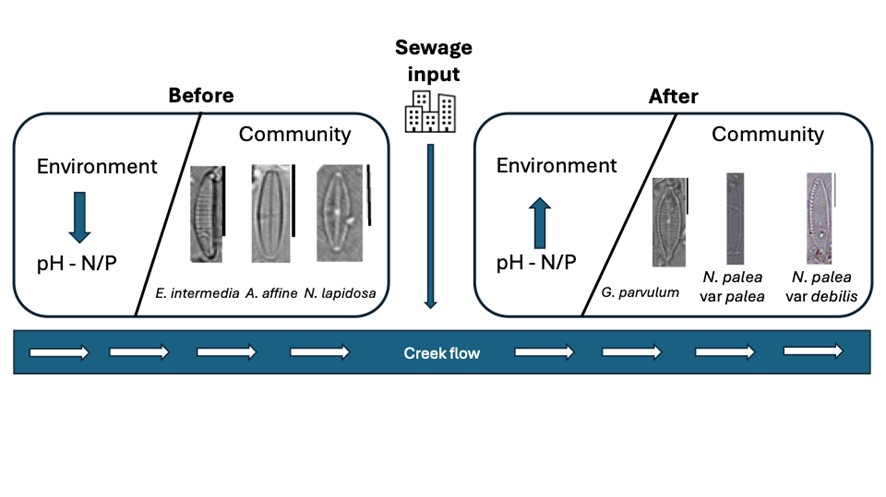
Results In two of these creeks, sewage inputs led to higher concentrations of phosphorus, nitrogen, and higher pH, which exerted a strong influence on the community structure of diatoms. Three species were shown to be highly tolerant to heavy organic pollution and eutrophication and even dominated the community in several sample sites influenced by sewage: (Gomphonema parvulum, Nitzschia palea var. debilis and Nitzschia palea var. palea).
Conclusions We conclude that sewage discharges determined strong effects on diatom community structure. Our results underscore the need for studies on tropical creeks’ epilithic diatoms, magnifying the autecological knowledge of them and amplifying their usage as ecological integrity index in tropical regions.
Keywords:
acidophilous diatoms; organic pollution; lotic systems; parks; Brazil
Resumo:
Objetivo Investigar a influência do aporte de nutrientes oriundos da cidade de Mucugê sobre a estrutura da comunidade de diatomáceas de riachos distróficos de baixa ordem naturalmente ácidos.
Métodos De cada um desses riachos, amostramos seis locais, nos quais coletamos rochas aleatoriamente para amostrar diatomáceas epilíticas. Simultaneamente, medimos a temperatura da água, condutividade, pH, saturação de oxigênio, nitrogênio total, fósforo total, carbono orgânico dissolvido e silicato. Utilizamos uma Análise de Componentes Principais para determinar os padrões de ordenação dessas variáveis ambientais. Também avaliamos as relações entre as comunidades epilíticas de diatomáceas e as variáveis ambientais através de uma Análise de Correspondência Canônica.
Resultados Em dois desses riachos, as entradas de esgoto levaram a maiores concentrações de fósforo, nitrogênio e pH mais elevado, o que exerceu forte influência na estrutura da comunidade de diatomáceas. Três espécies demonstraram ser altamente tolerantes à poluição orgânica e à eutrofização e até dominaram a comunidade em vários locais de amostragem influenciados por esgoto: (Gomphonema parvulum, Nitzschia palea var. debilis e Nitzschia palea var. palea).
Conclusões As descargas de esgoto determinaram fortes efeitos na estrutura da comunidade de diatomáceas. Nossos resultados ressaltam a necessidade de aumentar os estudos sobre as diatomáceas epilíticas dos riachos tropicais, ampliando o conhecimento da autoecologia das espécies de diatomáceas e amplificando sua utilização como índice de integridade ecológica em regiões tropicais.
Palavras-chave:
diatomáceas acidófilas; poluição orgânica; sistemas lóticos; parques; Brasil
1. Introduction
Freshwater ecosystems are increasingly threatened by untreated industrial and domestic wastewater, one of major environmental challenges faced globally by lotic ecosystems (Schwarzenbach et al., 2006). Among the most pervasive effects of this problem is eutrophication – the enrichment of water bodies with phosphorus and nitrogen – which can lead to alterations in aquatic structure and function of aquatic ecosystems (Miltner & Rankin, 1998; Dodds, 2006).
A traditional and important approach to monitoring these environmental impacts involves the use of bioindicators, particularly microalgae like diatoms (Lobo et al., 2016). Diatoms are microscopic, unicellular photosynthetic protists (microalgae) with silica cell walls, commonly found attached to submerged substrates (Round et al., 1990). Epilithic diatom communities form the base of aquatic food webs and are known for their sensitivity to physical and chemical changes in water (Pandey et al., 2018; Mbao et al., 2020). Due to their predictable ecological responses, diatoms are widely recognized as reliable indicators of water quality (Winter & Duthie, 2000; Cosgrove et al., 2004; Moravcová et al., 2013; Jakovljević et al., 2016; Caglar et al., 2017).
Although several indices have been developed for different regions of the world, it is always recommended that these indices be adapted to the ecological conditions of the region under study (Hürlimann & Niederhauser, 2007). Studies have demonstrated a great diversity of diatom species in aquatic environments of tropical regions (Metzeltin & Lange-Bertalot, 1998, 2007; Vyverman et al., 2007; Pierella Karlusich et al., 2025). With the advent and spread of SEM, species that were considered cosmopolitan are now considered species complexes, representing two or more species (Mann et al., 2004). The direct application of indices developed in high-latitude environments ignores the high diversity of tropical environments, as well as functional characteristics (high metabolic rates, for example). Although indices have already been developed for Brazil (Lobo et al., 2002; Lobo et al., 2004b; Silva-Lehmkuhl et al., 2022), considering the vast geographical area of the country and the environmental gradients present, regional adaptation of indices is necessary due to the differences in flora between regions responding to these gradients. Therefore, understanding the autecology – the study of interactions between an individual, a population, or a species and its environment - of the main species in the lotic systems are one step to develop regionalized indices.
In Brazil, most studies evaluating the relationship between diatom communities and water quality have focused on streams from subtropical region (Oliveira et al., 2001; Lobo et al., 2002, 2004a, b; Hermany et al., 2006; Salomoni et al., 2006; Lobo et al., 2010; Heinrich et al., 2014; Lobo et al., 2015; Salomoni et al., 2017), while ecosystems in Brazilian tropical regions remain relatively understudied (Lobo et al., 2020). In particular, naturally acidic low-order streams, such as those found in certain tropical highland regions, present unique environmental conditions – including low temperature, pH, and nutrient concentration. Understand how these communities respond to eutrophication is an important task since these kinds of ecosystems have been threatened by a new wave of diverse economic interests in these highlands, which in turn lead to increase of problems related to anthropogenic activities, as occurs in Chapada Diamantina.
Understanding how epilithic diatoms communities respond structurally to sewage pollution in naturally acidic streams is essential for the development of effective biomonitoring tools in tropical regions, especially in ecological sensitive and protected areas. Such knowledge can inform local conservation efforts and guide public policy regarding wastewater management.
Our objective was to compare the community structure of epilithic diatoms in naturally acidic and low-order streams in stretches with and without the influence of domestic sewage discharge in the same micro-basin. Considering the autoecology of diatoms, we expected that: i) increasing the abundance and dominance of species that are resistant to polluted environments (from high nutrients loading, which correspond to species member of the pollution spectrum of eutrophic systems) and ii) decreasing the dominance of acidophilous diatoms (species with an optimum pH between 5.5 and less than 7 – Mertens et al., 2025) in polluted sites.
2. Materials and Methods
2.1. Study area
We studied three low-order creeks (Piabinha, Mucugê, and Cumbuca), located in the Chapada Diamantina (CD) region, which is in the Western part of the central region of Bahia State (Brazil) (Figure 1). The CD area comprises the Northern region of the Espinhaço mountain ridge, with altitudes ranging from 900 m to 1,700 m (CPRM, 1994). The study area constitutes the Chapada Diamantina National Park and the Mucugê Municipal Park, which are both protected under Brazilian environmental legislation.

Sampling sites in Cumbuca (C1 to C6), Piabinha (P1 to P6) and Mucugê (M1 to M6) Creeks. The sampling sites M3 (the closest to the city of Mucugê), M4, M5, M6, C5 e C6 are influenced by domestic sewage from Mucugê City. A. South America with Bahia’s state geographical boundaries.
The creeks are in the high elevation areas (>900 m) of the Espinhaço Mountain ridge, which is part of the Sincorá Range. This Range is characterized as an orographic system, with a North-South orientation. Its constituting vegetation types include rocky mountain grassland, riparian forest, savannas, caatinga and forests (Harley, 1995; Giulietti, et al. 1996). The upstream sections of the Piabinha, Mucugê and Cumbuca creeks are in the same micro-basin, which is characterized by a geomorphology, geology, pedology, vegetation and water characteristics that are typical of the broader CD region (Jesus et al., 1985; CPRM, 1994; Harley, 1995; Giulietti et al., 1996). High altitude savannas and table mountains constitute the dominant phytophysionomic vegetation domains of CD (Giulietti et al., 1997).
Piabinha and Mucugê creeks are tributaries of the Cumbuca Creek, which is itself a sub-basin of Upper Paraguaçu River. These creeks are acidic (i.e, pH = 4.0-5.0) because of the surrounding soil’s low pH soil CPRM (1994). Both the Piabinha and the Mucugê are second-order creeks, while the Cumbuca is a third-order creek. Their respective length is 2.0, 3.3, and 4.8 km. Non-treated wastewater from the town of Mucugê (approximately 16,000 inhabitants in 2006; IBGE, 2020) is released in a section of Mucugê Creek (Figure 1). By contrast, the Piabinha and Cumbuca Creeks have not been subjected to this direct anthropogenic pressure. However, given the Mucugê Creek is a tributary of the Cumbuca Creek, two sites in this creek (C5 and C6) are exposed to these effluents of wastewater. These three creeks are composed of similar-type substrates, namely boulders and submerged rocks.
In the CD region, the annual rainfall reaches approximately 1000 mm, which is more intense during the summer (wet) than the winter (dry) seasons. The rain gauge stations 30JPR911 e 30JPR908, located in Mucugê city area, provided the following regional rainfall patterns: from October to April, the region experiences drier and cooler conditions; from May to September, it is characterized by wetter and warmer weather– INMET (2025). Over the bedrock structure that forms the Sincorá Range geology, the heavy rainfall typically yields high water surface runoffs that far exceeds the basal creek flow.
2.2. Sampling design
We sampled six sites along a longitudinal gradient (Figure 1) in each creek. Sampling in the Cumbuca and Piabinha Creeks involved the following sites: C1 to C6 and P1 to P6, respectively. The sites C5 and C6 were located after the confluence of the Mucugê and Piabinha Creeks. In Mucugê Creek, sampling sites were located where non-treated domestic sewage discharge is released (M1 and M2), but also near, and downstream from this point of discharge (M3, M4 and M5, M6, respectively). The sites C5 and C6 were located after the confluence of the Mucugê and Piabinha Creeks. In all these sites, we collected epilithic diatoms and water samples every three months, namely in August and November of 2005 and February and May of 2006. However, given a high discharge and water level (stage), we did not sample the M1 site in May of 2006.
2.3. Environmental variables
At each site, we measured water temperature (Temp), conductivity (Cond), pH and dissolved oxygen (DO), using a WTW Multi-Parameter probe 340i/SET ST41-3. We also took water samples to determine nutrients concentration specifically, total nitrogen (TN), total phosphorus (TP), silicates (Si), and dissolved organic carbon (DOC). We analyzed dissolved oxygen by Winkler method APHA (1995); total nitrogen and phosphorus according Koroleff (1976); silicate according Grasshoff et al. (1999); dissolved organic carbon according Embrapa (1979).
2.4. Diatom community
To sample diatoms, our protocol followed previous work (Whittier et al., 2007). Precisely, we randomly collected five submerged rounded or elliptical cobbles/boulders/pebbles, which corresponded to typical subsets of the local mineral benthic environment. By scraping off a 64 cm2 area of each stone (using a single toothbrush per sampling site), we sampled epilithic diatoms. To reduce the influence of microhabitat flow or sunlight incidence (sensuKelly et al., 1998), we randomly sampled cobbles/boulders from different channels sequences of each creek. Pool habitats were characterized by sand/mud bottom, with few rocks and pebbles, while riffle chiefly included rocks and pebbles. In total, we sampled 320 cm2 of submerged rock surface from each site, which we preserved using formaldehyde (4%). In the laboratory, water samples were treated with distilled H2O2, then mounted on permanent slides with Naphrax® (Refractive index = 1.73), according to Battarbee (1986) and ECS (2003). To conduct the taxonomic identification of diatom, we used an optical binocular microscope (Olympus CX31) with a photomicrography system (EvolutionTM LC Color Image-Pro Express® version 4.5.1.3), equipped with a 100x oil immersion objective (1000x magnification). Specific and infraspecific levels identifications were based on the following taxonomic keys: Schmidt (1874), Hustedt (1930), Huber-Pestalozzi (1942), Cleve-Euler (1955), Schmidt (1959), Hendey (1964), Patrick & Reimer (1975), Germain (1981), Krammer & Lange-Bertalot (1986, 1988, 1991), Metzeltin & Lange-Bertalot (1998), Rumrich et al. (2000), Metzeltin et al. (2005), and Metzeltin & Lange-Bertalot (2007). Diatom taxa were counted following transects across the slides, until reaching at least 500 valves. We counted only intact valves, or those with more than half the valve intact within the field of view Battarbee et al. (2001).
2.5. Statistical analysis
Prior to the analysis, we transformed the biological data (detailed below) by taken their fourth root. For the environmental data, given a zero-inflated distribution of the biological matrix, and because different units were used (i.e., physicochemical data) we standardized this data following Legendre & Legendre (1998). The biological data was composed by the relative abundance (%) of species from ‘common taxa’, specifically, those with a relative abundance of ≥2% in at least three samples or ≥5% in one of the samples. When the relative abundance of a taxon exceeded 50%, it was considered ‘dominant’, whereas it was considered ‘abundant’ when exceeding the average density of another taxon of the sample (Lobo & Leighton, 1986).
To understand the role each physicochemical variable (dissolved oxygen, pH, conductivity, total phosphorus, total nitrogen, silicate, dissolved organic carbon, and the ratio N/P, N/Si, and, Si/P) may have on the community structure, we performed a principal component analysis (PCA), which included all the environmental variables, and the influence of the sewage discharge as a binomial (i.e., present vs. absent) grouping factor. To detect potential dissimilarities among diatom communities, we performed an analysis of similarity (ANOSIM), based on Bray-Curtis dissimilarities matrix, which gives more importance to abundant species. This classification considered the influence of sewage discharge as a grouping factor, and the rivers as strata for permutation. The significance level was established as 5% (p=0.05). To identify the relative contributions of each taxon to the between-groups dissimilarity, we performed a similarity percentage (SIMPER) test, using the relative abundance of all taxa and grouping the samples according to the presence (i.e., presence vs. absence) of the sewage discharges.
To reveal whether the epilithic diatom communities varied as a function of the water quality (i.e., the influence of sewage), we used a Canonical Correspondence Analysis (CCA), following (Dela-Cruz et al., 2006). We evaluated the statistical significance of potential relationships between epilithic diatom community data and the environmental variables with a Monte Carlo analysis, with 999 unrestricted permutations. Variables were considered significant when p ≤ 0.05. All transformations, analysis and ordinations were performed with R v. 3.5.3 for Linux (R Core Team, 2019), with the packages vegan (Oksanen et al., 2019), and FactoMineR (Le et al., 2008) to ordinations and factoextra (Kassambara & Mundt, 2017) to visualize the data.
3. Results
3.1. Limnological data
The three creeks studied herein were characterized as naturally distrophic. In Mucugê, Cumbuca and Piabinha creeks, the average pH was 4.04 (± 0.22), 3.99 (± 0.18) and 3.98 (± 0.09), respectively. When considering all sites together, the pH ranged from 3.46 to 6.15. The 24 observations influenced by sewage discharges had increased nutrients loading and were less acidic than the 47 observations that were not under that influence (average pH of 4.38 [± 0.65] vs.4.10 [±0. 21], respectively; see Figure 2 and https://doi.org/10.48331/SCIELODATA.QXXCQO). The sites that were under the influence of sewage discharges were characterized by higher conductivity (average of influenced vs. not influenced sites: 42.38 [± 18.61] μS/cm vs. 33.36 [± 7.65] μS/cm, respectively), higher temperature (average of 24.27 °C [± 3.05] vs. 23.82 °C [± 3.49]) 201 but lower percentage of dissolved oxygen (average of 86.57% [±15.37] vs. 89.7% [±15.31]; see Figure 2 and table at https://doi.org/10.48331/SCIELODATA.QXXCQO).

Limnological parameters at Cumbuca, Mucugê, and Piabinha creeks. A = With sewage; B = No sewage; C = With sewage; D = No sewage; E = No sewage.
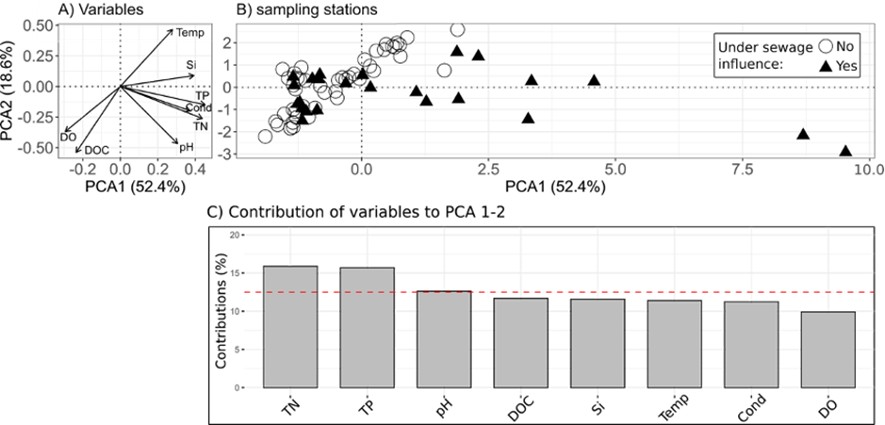
The average nutrient concentrations were also higher at sites exposed to sewage discharge; total phosphorus: (TP) 3.69 (± 4.56) vs. 0.87 (± 1.07) μM; nitrogen; (TN) 71.20 (± 60.94) vs. 30.92 (± 8.14) μM; silicates (Si): 2.55 (± 3.18) vs. 1.78 (± 1.95) μM, between sewage and sewage-free sites, respectively. By contrast, the mean concentration of dissolved organic carbon (DOC) was lower at the sites exposed to sewage discharge than in sewage-free sites: 14.48 (± 3.00) vs. 16.02 (± 5.07) μM. Together, the first two axes of the PCA explained 71.00% of the total variation of nutrient concentrations. The most important variables on these two axes were TP, TN and pH. These variables were the only ones to play a role beyond the expected average contribution (i.e., which is equal to 1/number of variables = 1/8 or 12.5%), Figure 3.

PCA ordination diagram of samples in the space of environmental variables. (A) Environmental variables of axes 1 and 2; (B) Samples: white circles represent samples not influenced by sewage discharge, while black triangles represent samples under influence of sewage; (C) The contribution of each variable to the variation of the first two axis is shown by the bar height; the dashed line represents the expected average contribution. TN = total nitrogen; TP = total phosphorus; DOC = dissolved organic carbon; Si = silicate; Temp = temperature; Cond = conductivity; DO = dissolved oxygen.
Variables with a larger contribution than this cutoff may be considered important contributors to the PC; Figure 3). PCA plots revealed that some samples influenced by sewage outputs were strikingly dissimilar from those not influenced by sewage.
This spread between sites mostly occurred on the first axis of the PCA. Nutrients and pH show positive relationships in areas exposed to sewage discharges. However, the samples not influenced by sewage discharges are mostly spread along the PCA’s second axis (near the center region) and the variables DOC, DO and Temp were the most important grouping factors.
3.2. Biological data
In total, we identified 128 taxa. From these, we registered 100 species in Cumbuca creek, 96 in Mucugê, and 94 in Piabinha Creek. Considering all samples, four species accounted for more than 5% of the total relative abundance. These species included Eunotia intermedia (16.83%); Achnanthidium affine (9.14%); Nupela cf. lapidosa (7.61%); Frustulia saxonica (5.24%), and Eunotia rhomboidea (5.21%). The most important species are indicated at Plates 1 to 4 (see at https://doi.org/10.48331/SCIELODATA.QXXCQO).
Significant dissimilarities in community composition were found among sampling sites (ANOSIM, R = 0.3682, p = 0.001). Permutations analysis also underscored the influence of sewage discharge as a significant structuring factor community composition. In fact, the diatom community structure measured herein diverged significantly as a function of exposure to sewage discharge. In fact, 54 taxa are responsible for the among-group divergence in community structure that occurred as a result of sewage discharge. These taxa responded strongly to this factor, with 90.43% of the between-group dissimilarity, derived from SIMPER tests (see table at https://doi.org/10.48331/SCIELODATA.QXXCQO).
3.3. The canonical correspondence analysis
Fifty taxa were considered abundant and were chosen to form the biological data matrix (Table S3 - Supplementary Material) used for the CCA. Relative to variations of epilithic diatom communities, the importance of each of the first four axes of the CCA (i.e., representing the cumulative proportion of variation explained by the data and the Monte Carlo permutation test) are presented in Table S4 (see table at https://doi.org/10.48331/SCIELODATA.QXXCQO). The low eigenvalues indicate low variation in taxa composition explained by the environmental variables. The constrained components explained 17.14% of the total variation of the community. From this constrained variation, 12.96% occurred on the first two axes. Only the first axis was considered significant by the Monte Carlo permutation test (after 999 permutations).
On the CCA’s first axis, the factors most responsible for variations in structure of the epilithic diatom communities (relative abundance) included the following: pH, total phosphorus and total nitrogen. However, of the variable tested, the Monte Carlo
Permutation test revealed that dissolved oxygen, pH and dissolved organic carbon yielded a significant effect (see table at https://doi.org/10.48331/SCIELODATA.QXXCQO).
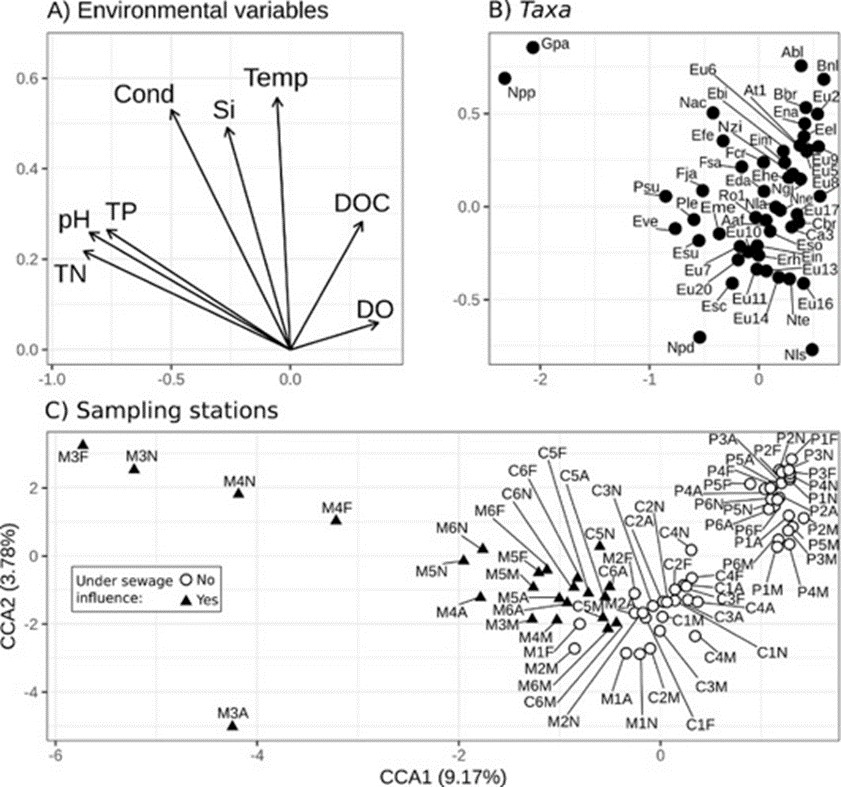
The CCA diagram revealed the role sewage discharges had in the creating two groups of epilithic diatoms. Specifically, one group of samples was influenced by sewage while the other was not. Overall, five subgroups were encompassed (Figure 4).
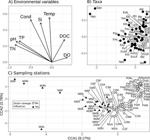
Ordination diagram of the CCA. All but four of the taxa codes can be found in Table S2 - Supplementary Material. Those that are not listed in Table S2 are: Abl (Achnanthidium blancheanum), Bnl (Brachysira cf. neoxilis), Eu16 (Eunotia sp. 16) and Nls (Nupela lesothensis). The first letter of each site represents the creek sampled (M, Mucugê; C, Cumbuca; P, Piabinha), while the number indicates the sampling sites, and the last letter represents the month of sampling (A, August 2005; N, November 2005; F, February 2006; M, May 2006). The thin dashed ellipse form groups composed of most impacted samples (subgroup 1A); the smooth circle indicates the lone impacted sample of M3A (subgroup 1C); the dotted ellipse represent groups composed by lesser impacted samples (subgroup 1B); the bold dashed ellipse groups samples of Mucugê and Cumbuca creeks not affected by sewage discharge (subgroup 2A); the smooth ellipse groups samples of Piabinha creeks the not affected by sewage discharge (subgroup 2B). See text for environmental variables codes and Tables S6, S7, and S8 (Supplementary Material, https://doi.org/10.48331/SCIELODATA.QXXCQO) for taxa CCA codes.
3.3.1. Group 1: Sampling sites exposed to sewage discharge
The ordination analysis suggests that the second and third quadrants of the CCA plot aggregate samples under the influence of sewage discharge. These samples are positively correlated with the variables’ total phosphorus, pH, conductivity, temperature and silicate, but negatively correlated with dissolved oxygen and dissolved organic carbon (Figure 4 A).
The group of samples influenced by sewage can be divided in three subgroups: one composed of the closest sampling sites, relative to the sewage outlet (subgroup 1A: M3N, M3F, M4N and M4F. These samples were collected in November 2005 and February 2006 and correspond to the most impacted sites. Yet, another group of sites were sampled monthly and further away from that outlet (subgroup 1B: M3M, M4M, M4A, M5N, M5F, M5M, M5A, M6N, M6F, M6M, M6A, C5N, C5F, C5M, C5A, C6N, C6F, C6M and C6A). Given the greater distance to the outlet, these sites were less impacted by sewage discharges. Finally, a single sample, M3A, forms the lone subgroup 1C, which is detached from the other samples and occurs in the third quadrant. Samples from the three subgroups were mostly scattered along the first axis, following a gradient of influence of sewage discharge (Figure 4 C; Figure 1).
The CCA analysis conducted on species plot (Figure 4 B) revealed a strong correlation between three taxa with the sites exposed to sewage discharge: N. palea var. palea, N. palea var. debilis and G. parvulum.
The subgroup 1A is the most distinct from the other subgroups (Figure 4 C), which can be explained by the relatively high abundances of N. palea var. palea and G. parvulum. The species N. palea var. palea only occurred at the sites influenced by sewage, namely, in all but four of the samples (C6A, C5N, C6N, C5F, C6F, C6M, M3A, M4A, M5A, M3N, M4N, M5N, M6N, M3F, M4F, M5F, M6F, M3M, M4M and M5M). While the mean relative abundance of this species in the entire group was only 5.36%, in M3F it reached 80.60% (February of 2006).
In November of 2005, the relatively high abundance of G. parvulum at sites M3 and M4 contrasted with that of other sampling sites. For instance, considering all samples together, this species’ average relative abundance was 1.38%. However, in samples exposed to sewage discharge; its average relative abundance reached 4.08%. This occurred in 13 of the 24 samples exposed to sewage discharge (M3A and M6A [August 2005]; C5N, M3N, M4N, M5N and M6N [November 2005]; C6F, M3F and M4F [February 2006]; C5M, C6M and M5M [May 2006]), but also in one sample not influenced by sewage (M2M [May 2006] with 0.40%). In most of these samples, the relative abundances of G. parvulum ranged from 0.20 to 1.80%.
However, in the samples M4N and M3N (November 2005, subgroup 1A), its relative abundance reached 37.00% and 53.40%, respectively. The sample M3A (August of 2005), which comprises the subgroup 1C, is the most peculiar sample. This sample was under influence of sewage discharge and negatively correlates with dissolved organic carbon and dissolved oxygen. In the CCA, its distance from the other groups is probably caused by the high relative abundance of N. palea var. debilis (96.60%). Such high relative abundance only occurred in two samples not influenced by sewage (i.e., C2A and M2M, with 0.20% and 0.40% of relative abundance, respectively) and in four other samples influenced by sewage, all of which were collected in August of 2005 (C5A, C6A, M4A and M5A, with 0.20%, 0.20%, 1.00% and 0.20%, respectively).
The SIMPER test pointed to Psamothidium levanderi as the most influential species in most of the samples (i.e., 56 of 71), with an average overall relative abundance of 3.32%. This species was mostly associated with the sampling sites exposed to sewage discharge, under which its relative abundances peaked at 9.05%, against 0.39% for the samples not influenced by sewage. Yet another species, Eunotia sudetica, mostly occurred in samples influenced by sewage discharge, which were collected in Cumbuca and Mucugê Creeks. Its average relative abundances were 3.08% and 1.66% in samples influenced and not influenced by sewage discharge, respectively.
3.3.2. Group 2: Sampling sites not exposed by sewage discharge
The results of our PCA shows that samples obtained from sites not exposed sewage discharge are mostly scattered along the second axis. The samples of group 2 may be divided in two subgroups. The first (subgroup 2A) is composed of samples from Cumbuca and Mucugê Creeks. Given their similarity in environmental characteristics, their biological communities are closely tied along the first axis, which contrast with samples of subgroup 1B. The other subgroup from this sampling (subgroup 2B) is composed by samples obtained from Piabinha Creek. In the first quadrant of the CCA diagram, these samples are clearly detached from the subgroup 2A and seem positively correlated with the variables dissolved organic carbon and dissolved oxygen (Figure 4 C). During the entire study, E. intermedia was a conspicuous member of the community
in all sampling sites. Overall, this taxon was the most abundant in this study with a mean relative abundance of 16.72%. Given its dominance, this species played a significant role in the relative dissimilarity between communities that was exerted by the selective influence of sewage discharge (SIMPER test; Table S2 - Supplementary Material).
The second most abundant taxa in this study (A. affine) occurred in 61 sites, with an average site-specific relative abundance of 9.17%. This taxon also exerted a strong effect on the between-group dissimilarity (Table S3 - Supplementary Material). For instance, in sites not influenced by sewage, its average abundance was relatively high (i.e., mean of 13.41%), which contrasts with sites under the influence of this factor (mean of 11.19%). However, in the CCA plot, this species appears near the centre region, most likely because of its relatively low average abundance in all the sampling sites of Piabinha Creek (3.10%), which were not influenced by sewage.
Yet another conspicuous species of sites free from the influence of sewage involves N. lapidosa, with 8.7% of the average abundance. Although this species was mostly sampled at sites not influenced by sewage discharge, it was also found in sewage-impacted sites but in lower relative abundance (5.6%). Its highest abundance was measured in Piabinha Creek (11.43%). Other species of lesser importance in terms of relative abundance were also more present in the sampling sites not influenced by sewage, including F. saxonica, Nupela neotropica, Nupela giluwensis, and Nupela zikae.
4. Discussion
Our analyses of environmental and diatom communities’ data provide indications that the sampling sites downstream from the sewage outlet are undergoing an eutrophication process. Sites closer to the outlet (M3 and M4) were characterized by higher levels of total phosphorus, nitrogen, and pH, which were the most important structuring variables between the two groups of samples (i.e., influenced and not influenced by sewage; Figure 2 C). The effect of sewage inputs was particularly evident during the summer season (February), when water level is low. The greater nutrients concentration at sites M3 and M4 increased the metabolic rates of the periphytic communities, including diatoms. This resulted in increasing the ambient pH during the illuminated hours of the day, because of lowering CO2 concentration. The high concentrations of nutrients of these sites have a clear effect on the community composition of epilithic diatoms, particularly when compared to the sampling site unexposed to sewage (Figure 4). The species N. palea var. palea, N. palea var. debilis and G. parvulum were dominant at the most eutrophic sampling sites (M3 and M4). Many studies have demonstrated how these species readily flower under eutrophic conditions, including those typically associated with sewage discharge (Dam et al., 1994; Duong et al., 2007; Kivrak & Uygun, 2012; Moro & Furstenberger, 1997; Ndiritu et al., 2006; Raschke, 1993; Solak et al., 2012; Watanabe et al., 1990).
A pattern identified in the samples of CD is the decreasing abundance in species of the genus Eunotia at sites influenced by sewage discharges. This genus is typically recorded in dystrophic environments, characterized by acidic waters, low nutrient concentrations, and brownish waters, as is typical of CD region (Spaulding et al., 2021). Sewage-free conditions are in fact prevalent in many parts of the Chapada Diamantina region. At high-altitude streams characterized by dystrophic conditions the periphytic communities are dominated by species such as E. intermedia and N. lapidosa (Costa et al., 2017; Leira et al., 2017; Ortiz-Lerín & Cambra, 2007; Potapova, 2010a; Wojtal, 2009). Other species are nonetheless abundant but in lesser concentration such as F. saxonica and N. neotropica, which are typical of oligotrophic, non-polluted waters (Kociolek & Graeff, 2011; Wojtal, 2009). We also found other acidophile species, namely N. giluwensis and N. zikae (Wojtal, 2009).
The inventory of diatoms communities in creeks not under the selective influence of sewage presented some surprises. Indeed, we found species under environment conditions for which they should be ill-adapted, based on previously published papers. For example, two species typical of oligotrophic conditions (P. levanderi and E. sudetica) were found in sites exposed to sewage discharge (Bahls, 2013; Blanco et al., 2017; Potapova, 2010b; Wojtal, 2004). Another example was A. affine, which is considered typical of alkaliphile and beta mesosaprobic waters (Solak et al., 2012), which was more abundant in sampling sites that are not influenced by sewage discharge. These potential contradictions underscore the need for further studies on the ecological tolerance and preferences of epilithic diatoms.
5. Conclusions
The use of epilithic diatoms as bioindicators to determine the potential effects of pollution by excess nutrient inputs is an effective approach to characterize the state of naturally acidic low-order creeks. We concluded that sewage discharges strongly influenced these creeks diatom communities, chiefly related to changes of dissolved nutrients concentration (nitrogen, and phosphorus) and pH. Downstream samples became dominated by species adapted to eutrophic and alkaline environments (e.g. N. palea var. debilis, N. palea var. palea and G. parvulum). These species are considered effective bioindicators of environments that are influenced by nutritional enrichments. In these samples, we also registered a decline in species adapted to oligotrophic and acidic environments (namely E. intermedia), which are naturally dominant under more pristine/reference conditions. These community changes confirm our basic hypotheses that the epilithic diatom community structure would be determined by sewage inputs. Nonetheless, we found some unexpected results, such as the high abundance oligotrophic conditions adapted species, such as P. levanderi and E. sudetica in eutrophic conditions. The autecology of many species from tropical regions are still in its infancy, which points for the necessity to further study the niche of these species. In turn, this will allow more precise use of epilithic diatoms as a bioindicator.
Acknowledgements
We would like to thank the Conselho Nacional de Desenvolvimento Científico e Tecnológico (CNPq - Grant N° 620151/2004-8) and the Fundação de Amparo à Pesquisa do Estado da Bahia (FAPESB - Grant N° 1278/2005) for financial support. We acknowledge the collaboration of the Mucugê Municipal City Hall, as well as the staff of Sempre Viva Municipal Park, the Instituto Botânico de São Paulo (Ecology Section) and LAMEB (Instituto de Biologia - UFBA) for the infrastructure provided during the study. We extend our appreciation to Mrs. Jorgelina Costa for her important contributions in terms of chemical analyses, Dr. Denise Bicudo, Dr. Carlos Bicudo and Dr. Fernanda Ferrari for their important contributions in terms of taxonomic analyses and Dr. Antoine Leduc for the English language revision, and his valuable advice.
-
Cite as:
Viana, J.C.C., et al. Epilithic diatom distribution as a potential bioindicator of nutrient enrichment in naturally acidic, low-order tropical creeks. Acta Limnologica Brasiliensia, 2026, vol. 38, e10. https://doi.org/10.1590/S2179-975X5424
Data availability
All the anonymized data supporting the results of this study has been made freely available on Scielo Dataverse at https://doi.org/10.48331/SCIELODATA.QXXCQO.
References
- American Public Health Association – APHA, 1995. Standard methods for the examination of water and wastewater. Washington, DC: APHA.
-
Bahls, L., 2013. Eunotia sudetica Diatoms of North America. Retrieved in 2019, April 1, from https://diatoms.org/species/eunotia_sudetica
» https://diatoms.org/species/eunotia_sudetica - Battarbee, R.W., 1986. Diatom analysis. In: Berglund, B.E., ed. Handbook of Holocene Palaeoecology and Palaeohydrology. Chichester: Wiley, 527-570.
- Battarbee, R.W., Jones, V.J., Flower, R.J., Cameron, N.G., Bennion, H., Carvalho, L., & Juggens, S., 2001. Diatoms. In: Smol, J.P., Birks, H.J.B., & Last, W.M., eds. Tracking environmental change using lake sediments, 3 - Terrestrial, algal, and siliceous indicators. Dordrecht: Kluwer Academic Publishers, 155-202.
-
Blanco, S., Pla-Rabès, S., Wetzel, C., & Granados, I., 2017. A new Psammothidium species (Bacillariophyta, Achnanthidiaceae) from Cimera Lake (Gredos Mountain Range), Central Spain. Cryptogam., 38(1), 17-29. https://doi.org/10.7872/crya/v38.iss1.2017.17
» https://doi.org/10.7872/crya/v38.iss1.2017.17 -
Caglar, M., Pala, G., & Selamoglu, Z., 2017. Study on epilithic diatoms in the Balikli Tohma Creek (Darende/Malatya in Turkey). Iran. J. Fish. Sci. 16(2), 858-868. Retrieved in 2019, April 1, from http://jifro.ir/article-1-2761-en.html
» http://jifro.ir/article-1-2761-en.html - Cleve-Euler, A., 1955. Die diatomeen von schwenden und finnland. Svenka Kungl: Vetenskapsakademiens Handlingar.
- Costa, L., Wetzel, C., Lange-Bertalot, H., Ector, L., & Bicudo, D., 2017. Taxonomy and ecology of Eunotia species (Bacillariophyta) in southeastern Brazilian reservoirs. In: Costa, L., Wetzel, C., Lange-Bertalot, H., Ector, L., & Bicudo, D., eds. Bibliotheca diatomologica. Stuttgart: J. Cramer.
- Companhia de Pesquisa de Recursos Minerais – CPRM, Parque Nacional da Chapada Diamantina, 1994. Informações básicas para a gestão territorial: diagnóstico do meio físico e da vegetação. Salvador: CPRM/IBAMA.
-
Cosgrove, J., Walker, D., Morrison, P., & Hillman, K., 2004. Periphyton indicates and effects of wastewater discharge in the near-coastal zone, Perth Western Australia. Estuar. Coast. Shelf Sci., 61(2), 331-338. https://doi.org/10.1016/j.ecss.2004.05.008
» https://doi.org/10.1016/j.ecss.2004.05.008 -
Dam, H.V., Mertens, A., & Sinkeldam, J., 1994. A coded checklist and ecological indicator values of freshwater diatoms from the Netherlands. Neth. J. Aquat. Ecol. 23(1), 117-133. https://doi.org/10.1007/BF02334251
» https://doi.org/10.1007/BF02334251 -
Dela-Cruz, J., Printchard, T., Gordon, G., & Ajani, P., 2006. The use of periphytic diatoms as a means of assessing impacts of point source inorganic nutrient pollution in south-eastern Austrália. Freshw. Biol., 51(5), 951-972. https://doi.org/10.1111/j.1365-2427.2006.01537.x
» https://doi.org/10.1111/j.1365-2427.2006.01537.x -
Dodds, W.K., 2006. Eutrophication and trophic state in rivers and streams. Limnol. Oceanogr., 51(1 part 2), 71-680. https://doi.org/10.4319/lo.2006.51.1_part_2.0671
» https://doi.org/10.4319/lo.2006.51.1_part_2.0671 -
Duong, T.T., Feurtet-Mazel, A., Coste, M., Dang, D.K., & Boudou, A., 2007. Dynamics of diatom colonization process in some rivers influenced by urban pollution (Hanoi, Vietnam). Ecol. Indic., 7(4), 839-851. https://doi.org/10.1016/j.ecolind.2006.10.003
» https://doi.org/10.1016/j.ecolind.2006.10.003 - Empresa Brasileira de Pesquisas Agropecuárias – Embrapa, 1979. Manual de métodos de análises de solo. Rio de Janeiro: Embrapa.
- European Committee for Standardization – ECS, 2003. Water quality-guidance standard for the routine sampling and pretreatment of benthic diatoms for rivers, EN 13946. Brussels: European Committee for Standardization.
- Germain, H., 1981. Flore des diatomées: eaux douce et saumâtres. Paris: Societé Nouvelle Dês Éditions Boubée.
- Giulietti, A.M., Harley, R.M., & Queiroz, L.P., 1996. Vegetação e flora da Chapada Diamantina, Bahia. In: Harley, R. M., ed. Anais da 4a Reunião Especial da SBPC. Feira de Santana: Universidade Estadual de Feira de Santana, 144-155.
- Giulietti, A.M., Pirani, J.R., & Harley, R.M., 1997. Espinhaço range region–eastern Brazil. In: Davis, S.D., Heywood, V.H., Herrera-Macbrydy, O., Villa-Lobos, J., & Hamilton, A.C., eds. Centers of plant diversity – A guide and strategy for their conservation. Cambridge: World Wide Fund for Nature/ World Conservation Union, 397- 404.
- Grasshoff, K., Kremling, K., & Ehrhardt, M., 1999. Methods of seawater analysis. Weinheim: Wiley-VCH, 3 ed.
- Harley, R.M., 1995. Introduction. In: Stannard, B.L., ed. Flora of the Pico das Almas Chapada Diamantina - Bahia, Brazil. Kew: Royal Botanic Gardens, 5-43.
-
Heinrich, C.G., Leal, V.L., Marilia, S., Düpont, A., & Lobo, E.A., 2014. Epilithic diatoms in headwater areas of the hydrographical subbasin of the Andreas Stream, RS, Brazil, and their relation with eutrophication processes. Acta Limnol. Bras., 26(4), 347-355. https://doi.org/10.1590/S2179-975X2014000400003
» https://doi.org/10.1590/S2179-975X2014000400003 - Hendey, N.I., 1964. An introductory account of the smaller algae of british coastal waters, Part.V – Bacillariophyta. London: Her Majesty’s Stationery Office.
- Hermany, G., Schwarzbold, A., Lobo, E.A., & Oliveira, M.A., 2006. Ecology of the epilithic diatom community in a low-order stream system of the Guaíba hydrographical region: subsidies to the environmental monitoring of southern Brazilian aquatic systems. Acta Limnol. Bras., 18(1), 9-27.
- Huber-Pestalozzi, G., 1942. Das phytoplankton des süsswassers: systematik und biologie. In: Thienemann, A., ed. Die Binnengewässer. Stuttgart: Schweizerbart'sche.
- Hürlimann J., Niederhauser P., 2007. Méthodes d’analyse et d’appréciation des cours d’eau. Berne: Office Fédéral de L’Environnement, 132 p., État de L’Environnement, no. 0740.
- Hustedt, F., 1930. Die Kieselalgen. In: Rabenhorst, L., ed. Kryptogamen Flora von Deutschlander, Osterreich und der Schweitz. London: Johnson Reprint Corp.
-
Instituto Brasileiro de Geografia e Estatística – IBGE, 2020. Retrieved in 2020, January 3, from https://www.ibge.gov.br
» https://www.ibge.gov.br -
Instituto Nacional de Meteorologia – INMET, 2025. Informações meteorológicas. Brasília, DF: INMET. Retrieved in 2025, August 26, from https://www.gov.br/inmet
» https://www.gov.br/inmet - Jakovljević, O.S., Popović, S.S., Vidaković, D.P., Stojanović, K.Z., & Krizmanić, J.Ž., 2016. The application of benthic diatoms in water quality assessment (Mlava River, Serbia). Acta Bot. Croat., 75(2), 199-205. https://doi.org/10.1515/botcro-2016-0032.
- Jesus, E.F.R., Falk, F.H., Ribeiro, L.P., & Marques, T.M., 1985. Caracterização geográfica e aspectos geológicos da Chapada Diamantina – Bahia. Salvador, BA: Centro Editorial e Didático da UFBA, 52 p.
-
Kassambara, A., & Mundt, F., 2017. factoextra: Extract and Visualize the Results of Multivariate Data Analyses. R package version 1.0.5. Retrieved in 2025, August 26, from https://CRAN.R project.org/package=factoextra
» https://CRAN.R -
Kelly, M.G., Cazaubon, A., Coring, E., Dell’uomo, A., Ector, L., Goldsmith, B., Guasch, H., Hürlimann, J., Jarlman, A., Kawecka, B., Kwandrans, J., Laugaste, R., Lindstrom, E.A., Leitão, M., Marvan, P., Padisák, J., Pipp, E., Prygiel, J., Rott, E., Sabater, S., Van Dam, H., & Vizinet, J., 1998. Recommendations for the routine sampling of diatoms for water quality assessments in Europe. J. Appl. Phycol., 10(2), 215-224. https://doi.org/10.1023/A:1008033201227
» https://doi.org/10.1023/A:1008033201227 - Koroleff, F. 1976. Determination of nutrients. In Grasshoff, K., ed. Methods of seawater analysis. New York: Verlag Chemie Weinheim, 117-181.
- Krammer, J., & Lange-Bertalot, H., 1986. Bacillariophyceae, Naviculaceae, Bacillariaceae, Epithemiaceae, Surirellaceae. In: Etil, H., Gerloff, I., Heynig, H., & Mollenhauer, D., eds. Süsswasserflora von Mittleeuropa. Stuttgart: Gustav Fischer.
- Krammer, J., & Lange-Bertalot, H., 1988. Bacillariophyceae, Bacillariaceae, Epithemiaceae, Surirellaceae. In: Etil, H., Gerloff, I., Heynig, H., & Mollenhauer, D., eds. Süsswasserflora von Mittleeuropa. Stuttgart: Gustav Fischer.
- Krammer, J., & Lange-Bertalot, H., 1991. Bacillariophyceae, Centrales, Fragilariaceae, Eunotiaceae. In: Etil, H., Gerloff, I., Heynig, H., & Mollenhauer, D., eds. Süsswasserflora von Mittleeuropa. Stuttgart: Gustav Fischer.
-
Kivrak, E., & Uygun, A., 2012. The structure and diversity of the epipelic diatom community in a heavily polluted stream (the Akarçay, Turkey) and their relationship with environmental variables. J. Freshwat. Ecol., 27(3), 443-457. https://doi.org/10.1080/02705060.2012.671147
» https://doi.org/10.1080/02705060.2012.671147 -
Kociolek, P., & Graeff, C., 2011. Frustulia saxonica Diatoms of North America. Retrieved in 2019, April 1, from https://diatoms.org/species/frustulia_saxonica
» https://diatoms.org/species/frustulia_saxonica -
Le, S., Josse, J., & Husson, F., 2008. FactoMineR: An R package for multivariate analysis. J. Stat. Softw., 25(1), 1-18. PMid:19777145. https://doi.org/10.18637/jss.v025.i01
» https://doi.org/10.18637/jss.v025.i01 - Legendre, P., & Legendre, L., 1998. Numerical ecology. Amsterdam: Elsevier, 2nd ed.
-
Leira, M., López-Rodríguez, M., & Carballeira, R., 2017. Epilithic diatoms (Bacillariophyceae) from running watersin NW Iberian Peninsula (Galicia, Spain). An. Jard. Bot. Madr., 74(2), 1-24. https://doi.org/10.3989/ajbm.2421
» https://doi.org/10.3989/ajbm.2421 - Lobo, E.A., Callegaro, V.L.M., & Bender, P., 2002. Utilização de algas diatomáceas epilíticas como indicadoras da qualidade da água em rios e arroios da região hidrográfica do Guaíba, RS, Brasil. Santa Cruz do Sul: Edunisc.
- Lobo, E.A., Bes, D., Tudesque, L., & Ector, L., 2004a. Water quality assessment of Pardinho River, RS, Brazil, using epilithic diatom communitys and faecal coliforms as biological indicators. Vie Milieu 54(2/3), 115-126.
- Lobo, E.A., Callegaro, V.L.M., Hermany, G., Bes, D., Wetzel, C.A., & Oliveira, M.A., 2004b. Use of epilithic diatoms as bioindicators from lotic systems in southern Brazil, with special emphasis on eutrophication. Acta Limnol. Bras., 16(1), 25-40.
- Lobo, E.A., & Leighton, G., 1986. Estructuras comunitarias de las fitocenosis planctonicas de los sistemas de desembocaduras de rios y esteros de la zona central de Chile. Rev. Biol. Mar., 22(1), 1-29.
-
Lobo, E.A., Wetzel, C.E., Ector, L., Katoh, K., Blanco, S., & Mayama, S., 2010. Response of epilithic diatom communities to environmental gradients in subtropical temperate Brazilian rivers. Limnetica 29(2), 323-340. https://doi.org/10.23818/limn.29.27
» https://doi.org/10.23818/limn.29.27 -
Lobo, E.A., Schuch, M., Heinrich, C.G., da Costa, A.B., Düpont, A., Wetzel, C.E., & Ector, L., 2015. Development of the Trophic Water Quality Index (TWQI) for subtropical temperate Brazilian lotic systems. Environ. Monit. Assess., 187(6), 354. PMid:25971521. https://doi.org/10.1007/s10661-015-4586-3
» https://doi.org/10.1007/s10661-015-4586-3 -
Lobo, E.A., Heinrich, C.G., Schuch, M., Wetzel, C.E., & Ector, L., 2016. Diatoms as Bioindicators in Rivers. In: Necchi, J.R.O., ed. River algae. Cham: Springer. https://doi.org/10.1007/978-3-319-31984-1_11
» https://doi.org/10.1007/978-3-319-31984-1_11 -
Lobo, M.T.M.P.S., Scalize, P.S., Kraus, C.N., da Silva, W.J., Garnier, J., da Motta Marques, D., Bonnet, M.P., & de Souza Nogueira, I., 2020. Biological index based on epiphytic diatom assemblages is more restrictive than the physicochemical index in water assessment on an Amazon floodplain, Brazil. Environ. Sci. Pollut. Res. Int., 27(10), 10642-10657. PMid:31939021. https://doi.org/10.1007/s11356-020-07658-y
» https://doi.org/10.1007/s11356-020-07658-y -
Mann, D.G., McDonald, S.M., Bayer, M.M., Droop, S.J.M., Chepurnov, V.A., Loke, R.E., Ciobanu, A., & du Buf, J.M.H., 2004. The Sellaphora pupula species complex (Bacillariophyceae): morphometric analysis, ultrastructure and mating data provide evidence for five new species. Phycologia 43(4), 459-482. https://doi.org/10.2216/i0031-8884-43-4-459.1
» https://doi.org/10.2216/i0031-8884-43-4-459.1 -
Mertens, A., van der Wal, J., Verweij, G., Pex, B., van Dulmen, A., & van Dam, H., 2025. A revised list of diatom ecological indicator values in The Netherlands. Ecol. Indic., 172, 113219. https://doi.org/10.1016/j.ecolind.2025.113219
» https://doi.org/10.1016/j.ecolind.2025.113219 -
Mbao, E.O., Gao, J., Wang, Y., Sitoki, L., Pan, Y., & Wang, B., 2020. Sensitivity and reliability of diatom metrics and guilds in detecting the impact of urbanization on streams. Ecol. Indic., 113, 106506. https://doi.org/10.1016/j.ecolind.2020.106506
» https://doi.org/10.1016/j.ecolind.2020.106506 - Metzeltin, D., Lange-Bertalot, H., & García-Rodríguez, F., 2005. Diatoms of Uruguay compared with other taxa from South America and elsewhere. In: Lange-Bertalot, H., ed. Iconographia diatomologica taxonomy. Ruggell, Liechtenstein: A.R.G. Gantner Verlag, Annotated Diatom Micrographs, vol. 15.
- Metzeltin, D., & Lange-Bertalot, H., 1998. Tropical diatoms of South America. In: Lange-Bertalot, H., ed. Iconographia Diatomologica. Konigstein: Koeltz Scientific Books, Diversity, Taxonomy, Geobotany, vol. 5.
- Metzeltin, D., & Lange-Bertalot, H., 2007. Tropical Diatoms of South America II. In: Lange-Bertalot, H., ed. Iconographia diatomologica - Annotated diatom micrographs. Ruggell, Liechtenstein: A.R.G. Gantner Verlag, Taxonomy-Biogeography-Diversity, vol. 18.
-
Miltner, R.J., & Rankin, E.T., 1998. Primary nutrients and the biotic integrity of rivers and streams. Freshw. Biol., 40(1), 145-158. https://doi.org/10.1046/j.1365-2427.1998.00324.x
» https://doi.org/10.1046/j.1365-2427.1998.00324.x -
Moravcová, A., Rauch, O., Lukavský, J., & Nedbalová, L., 2013. The response of epilithic diatom assemblages to sewage pollution in mountain streams of the Czech Republic. Plant Ecol. Evol., 146(2), 153-166. https://doi.org/10.5091/plecevo.2013.814
» https://doi.org/10.5091/plecevo.2013.814 - Moro, R.S., & Furstenberger, C.B., 1997. Catálogo dos principais parâmetros ecológicos de diatomáceas não-marinhas. Ponta Grossa: Editora UEPG.
-
Ndiritu, G.G., Gichuki, N.N., & Triest, L., 2006. Distribution of epilithic diatoms in response to environmental conditions in an urban tropical stream, Central Kenya. Biodivers. Conserv., 15(10), 3267-3293. https://doi.org/10.1007/s10531-005-0600-3
» https://doi.org/10.1007/s10531-005-0600-3 -
Oksanen, J., Blanchet, F.G., Friendly, M., Kindt, R., Legendre, P., McGlinn, D., Minchin, P.R., O’Hara, R.B., Simpson, G.L., Solymos, P., Stevens, M.H.H., Szoecs, E., & Wagner, H., 2019. vegan: Community Ecology Package. R package version 2.5-4. Retrieved in 2025, August 26, from https://CRAN.R-project.org/package=vegan
» https://CRAN.R-project.org/package=vegan -
Oliveira, M.A., Torgan, I.C., Lobo, E.A., & Scharzbold, A., 2001. Association of periphytic diatom species of artificial substrate in lotic environments in Arroio Sampaio basin, RS, Brazil: relationships with abiotic variables. Braz. J. Biol., 61(4), 523-540. PMid:12071309. https://doi.org/10.1590/S1519-69842001000400002
» https://doi.org/10.1590/S1519-69842001000400002 -
Ortiz-Lerín, R., & Cambra, J., 2007. Distribution and taxonomy notes of Eunotia Ehrenberg 1837 (Bacillariophyceae) in rivers and streams of Northern Spain. Limnetica 26(2), 415-434. https://doi.org/10.23818/limn.26.35
» https://doi.org/10.23818/limn.26.35 -
Pandey, L.K., Lavoie, I., Morin, S., Park, J., Lyu, J., Choi, S., Lee, H., & Han, T., 2018. River water quality assessment based on a multi-descriptor approach including chemistry, diatom assemblage structure, and non-taxonomical diatom metrics. Ecol. Indic., 84, 140-151. https://doi.org/10.1016/j.ecolind.2017.07.043
» https://doi.org/10.1016/j.ecolind.2017.07.043 - Patrick, R., & Reimer, C.W., 1975. The diatoms of United States, 23. Philadelphia: Academy of Natural Sciences.
-
Pierella Karlusich, J.J., Cosnier, K., Zinger, L., Henry, N., Nef, C., Bernard, G., Scalco, E., Dvorak, E., Acinas, S.G., Babin, M., Bork, P., Boss, E., Bowler, C., Cochrane, G., de Vargas, C., Gorsky, G., Grimsley, N., Guidi, L., Iudicone, D., Jaillon, O., Kandels, S., Karp-Boss, L., Karsenti, E., Not, F., Ogata, H., Pesant, S., Poulton, N., Sardet, C., Speich, S., Stemmann, L., Sullivan, M.B., Sunagawa, S., Wincker, P., Rocha Jimenez Vieira, F., Delage, E., Chaffron, S., Ovchinnikov, S., Zingone, A., & Bowler, C., 2025. Patterns and drivers of diatom diversity and abundance in the global ocean. Nat. Commun., 16(1), 3452. PMid:40216740. https://doi.org/10.1038/s41467-025-58027-7
» https://doi.org/10.1038/s41467-025-58027-7 -
Potapova, M., 2010a. Nupela lapidosa Diatoms of North America. Retrieved in 2019, April 1, from https://diatoms.org/species/nupela_lapidosa
» https://diatoms.org/species/nupela_lapidosa -
Potapova, M., 2010b. Psammothidium levanderi Diatoms of North America. Retrieved in 2019, April 1, from https://diatoms.org/species/psammothidium_levanderi
» https://diatoms.org/species/psammothidium_levanderi -
R Core Team 2019. R: A language and environment for statistical computing. Vienna: R Foundation for Statistical Computing. Retrieved in 2019, April 1, from https://www.R-project.org/
» https://www.R-project.org/ -
Raschke, R.L., 1993. Diatom (Bacillariophyta) community response to phosphorus in the Everglades National Park, USA. Phycologia 32(1), 48-58. https://doi.org/10.2216/i0031-8884-32-1-48.1
» https://doi.org/10.2216/i0031-8884-32-1-48.1 - Round, F.E., Crawford, R.M., & Mann, D.G., 1990. The diatoms: biology and morphology of the genera. Cambridge: Cambridge University Press.
- Rumrich, U., Lange-Bertalot, H., & Rumrich, M., 2000. Diatoms of the Andes. Ruggell: A.R.G. Gantner Verlag.
-
Salomoni, S.E., Rocha, O., Callegaro, V.L., & Lobo, E.A., 2006. Ephilithic diatoms as indicators of water quality in the Gravataí River. Hydrobiologia 559, 233-246. https://doi.org/10.1007/s10750-005-9012-3
» https://doi.org/10.1007/s10750-005-9012-3 -
Salomoni, S.E., Rocha, O., & Torgan, L.C., 2017. Seasonal and spatial variation of the epilithic diatoms: case study of an organic pollution gradient in a subtropical region of southern Brazil. Acta Limnol. Bras., 29(0), e1. https://doi.org/10.1590/s2179-975x1816
» https://doi.org/10.1590/s2179-975x1816 -
Schmidt, A., 1874. Atlas der diatomaceen-kunde. Leipzig: O.R. Reisland. https://doi.org/10.5962/bhl.title.64396
» https://doi.org/10.5962/bhl.title.64396 - Schmidt, A., 1959. Atlas der diatomaceen-kunde. Leipzig: O.R. Reisland.
-
Schwarzenbach, R.P., Escher, B.I., Fenner, K., Hofstetter, T.B., Johnson, C.A., von Gunten, U., & Wehrli, B., 2006. The challenge of micropollutants in aquatic systems. Science 313(5790), 1072-1077. PMid:16931750. https://doi.org/10.1126/science.1127291
» https://doi.org/10.1126/science.1127291 -
Silva-Lehmkuhl, A.M., Blanco, S., & Bicudo, D.C., 2022. A new Trophic Diatom Index for Tropical Reservoirs (TDIR). Hydrobiologia 849(21), 4651-4666. https://doi.org/10.1007/s10750-022-05003-7
» https://doi.org/10.1007/s10750-022-05003-7 -
Solak, C., Barinova, S., Ács, É., & Dayıoğlu, H., 2012. Diversity and ecology of diatoms from Felent creek (Sakarya river basin), Turkey. Turk. J. Bot., 36, 191-203. https://doi.org/10.3906/bot-1102-16
» https://doi.org/10.3906/bot-1102-16 -
Spaulding, S.A., Potapova, M.G., Bishop, I.W., Lee, S.S., Gasperak, T.S., Jovanoska, E., Furey, P.C., & Edlund, M.B., 2021. Diatoms.org: supporting taxonomists, connecting communities. Diatom Res., 36(4), 291-304. PMid:35958044. https://doi.org/10.1080/0269249X.2021.2006790
» https://doi.org/10.1080/0269249X.2021.2006790 -
Vyverman, W., Verleyen, E., Sabbe, K., Vanhoutte, K., Sterken, M., Hodgson, D.A., Mann, D.G., Juggins, S., Van de Vijver, B., Jones, V., Flower, R., Roberts, D., Chepurnov, V.A., Kilroy, C., Vanormelingen, P., & De Wever, A., 2007. Historical processes constrain patterns in global diatom diversity. Ecology 88(8), 1924-1931. PMid:17824422. https://doi.org/10.1890/06-1564.1
» https://doi.org/10.1890/06-1564.1 - Watanabe, T., Lima, M.A.M., Machado, V.M.N., & Paz, R.J., 1990. Caracterização limnológica do rio Gramame, João Pessoa (PB), Brasil: variáveis ambientais. Acta Limnol. Bras., 3, 363-389.
-
Whittier, T.R., Stoddard, J.L., Larsen, D.P., & Herlihy, A.T., 2007. Selecting reference sites for stream biological assessments: best professional judgment or objective criteria. J. N. Am. Benthol. Soc., 26(2), 349-360. https://doi.org/10.1899/0887-3593(2007)26[349:SRSFSB]2.0.CO;2
» https://doi.org/10.1899/0887-3593(2007)26[349:SRSFSB]2.0.CO;2 -
Winter, J.G., & Duthie, H.C., 2000. Epilithic diatoms as indicators of stream total N and total P concentration. J. N. Am. Benthol. Soc., 19(1), 32-49. https://doi.org/10.2307/1468280
» https://doi.org/10.2307/1468280 - Wojtal, A., 2004. New or rare species of the genera ‘Achnanthidium and Psammothidium’ (Bacillariophyceae) in the diatom flora of Poland. Pol. Bot. J., 49(2), 215-220.
-
Wojtal, A., 2009. Nupela marvanii sp. nov., and N. lapidosa (KrassKe) Lange–BertaLot in Poland with notes on the distribution and ecology of the genus Nupela (Bacillariophyta). Fottea 9(2), 233-242. https://doi.org/10.5507/fot.2009.024
» https://doi.org/10.5507/fot.2009.024
Edited by
-
Associate Editor:
Bárbara Dunck.