
 Diel dynamics and environmental influences on phytoplankton communities in an Andean lagoon: implications for management and conservation
Abstract:
Aim Lacustrine environments are unique locations to study temporal fluctuations derived from natural and artificial sources within a hydrographic basin. The objective of this study was to analyze the diel cycle of physicochemical parameters and their influence on the phytoplankton community structure in open waters, as well as, to evaluate the total phosphorus and nitrogen contents in the vicinity of fish tanks in the lagoon, and to identify the phytoplankton assemblage in the water column in a diel cycle in an open water area during the rainy and dry seasons.
Methods The epilimnion and hypolimnion zones of an open water area were assessed over 24 hours, starting at 10:00 on day one and finishing at 10:00 on day two, obtaining a total of 36 samples (9 samples at 3-hour intervals, in two lake zones, in two seasons). Sampling employed a Van Dorn sampling bottle, and the Morphologically Based Functional Groups (MBFG), Shannon-Weaver and Simpson Indices were employed to describe the identified genera.
Results Six of the seven parameters monitored registered higher values during the rainy season; only transparency was higher during the dry season. Fifteen genera distributed in nine classes were identified, with richness and diversity being higher in the rainy season.
Conclusions The MBFG and sinking properties of group and genera has influenced the vertical migration of phytoplankton. The daily cycle method effectively captured the fluctuations in physicochemical and phytoplankton parameters over a 24-hour period in both seasons in Chacas Lagoon.
Keywords:
Ceratium; daily cycle; Lake Titicaca basin; MBFG; vertical migration
Resumo:
Objetivo Ambientes lacustres são locações únicas para estudar as flutuações temporais derivadas de fontes naturais e artificiais dentro uma bacia hidrográfica. O objetivo deste estudo é analisar o ciclo diário dos parâmetros físico-químicos e sua influência na estrutura da comunidade fitoplanctônica em águas abertas, bem como, avaliar o conteúdo de fosforo e nitrogênio total nas proximidades de tanques de peixes na lagoa, e identificar a comunidade fitoplanctônica na coluna da água num ciclo diário em águas abertas durante a época de chuva e seca.
Métodos O epilimnion e hipolimnion em água aberta foi avaliada durante 24 horas, começando às 10:00 do dia um e terminando às 10:00 do dia dois, obtendo 36 amostras no total (9 amostras em um intervalo de três horas em duas zonas lacustres em duas épocas sazonais). A amostragem foi realizada com uma garrafa tipo Van Dorn, e a classificação funcional do fitoplâncton baseada na morfologia (MBFG - Morphologically Based Functional Groups), Indice de Shannon-Weaver e Simpson foram utilizadas para descrever os gêneros identificados.
Resultados Seis dos sete parâmetros monitorados registraram valores mais altos durante a época de chuva; somente a transparência foi maior durante a época seca. Quinze gêneros distribuídos em nove classes foram identificados, com uma riqueza e diversidade maior na época de chuva.
Conclusões A classificação MBFG e as propriedades de afundamento para cada grupo e gênero influenciaram a migração vertical do fitoplâncton. O método do ciclo diário capturou efetivamente as flutuações dos parâmetros físico-químicos e do fitoplâncton ao longo de um período de 24 horas em ambas as épocas na Lagoa Chacas.
Palavras-chave:
Ceratium; MBFG; ciclo diário; bacia do Lago Titicaca; migração vertical
1. Introduction
Hydrographic basins are suitable study units for inland water and terrestrial environments due to their unique characteristics and potential extrapolation to other areas and regions. Water bodies (lakes, lagoons, reservoirs, etc.) within these geographic areas present physical, chemical, or climatic variations which, due to natural events such as erosion, precipitation, and weathering (Cardoso-Silva et al., 2016; Biamont-Rojas et al., 2023a), could influence their hydrobiological characteristics, including primary production, biological community composition, and organic and inorganic elements (Caixeta et al., 2022; Qalmoun et al., 2022; Biamont-Rojas et al., 2023b). Additionally, anthropic activities occurring in the basin (industry, cattle ranching, agriculture, mining, dam building, etc.) not just the pollution in specific sites but a diffuse one as well, due to certain persistent elements or compounds use in different processes (Carneiro et al., 2020; Cui et al., 2020; Silva et al., 2020; Mamani Villalba et al., 2021) or within the same water body (fish farming, illegal sewage inlets, etc.) have the potential to modify limnological conditions, leading to ecological disequilibrium (Matamet & Bonotto, 2019; Martins et al., 2021; Silva et al., 2022; Biamont-Rojas et al., 2024).
Lacustrine environments, compared to steep sloped riverine environments also presented in the Andes region, due to their water retention time and flow rate, are more exposed to pollution occurrences (Brousett-Minaya et al., 2021; Ding et al., 2022; Khan et al., 2022; Tong et al., 2022). The hydrological regime is highly influenced by human activities, not just sewage disposal, but also water redirection for agricultural purposes or cattle raising. These variations in water availability patterns threaten life survival, as economic and social development relies on water quality and its conservation capacity (Lewandrowski et al., 2021).
Phytoplankton, which are the collective of photosynthetic microorganisms living in open water, are considered the major primary producers of water bodies (e.g., seas, lakes, ponds, lagoons, rivers) (Reynolds, 1984, 1992). Phytoplankton are closely related to environmental characteristics (physical, chemical, and climatic) (Kumar et al., 2020; Wu et al., 2023), as well as temporal (e.g., daily and seasonal) (Kim et al., 2020; Ye et al., 2023) and spatial (horizontal and vertical distribution in the water body) factors (Wirtz et al., 2022; Wirtz & Smith, 2020), resulting in alterations in their diversity and richness. This variety of genera and species can share similar ecological characteristics, that can explain their presence in the aquatic environment. Approaches, such as, the Morphologically Based Functional Groups (MBFG) classifies the genera according to their structural and sinking traits (Kruk et al., 2010). The seven groups not only indicate similar habitats in the water bodies, but also provide a better explanation of the aquatic environment.
Light and dark daily cycles trigger a sequence of alterations (e.g., temperature, dissolved oxygen, etc.) which can be analyzed by a diel assessment. These fluctuations can directly affect primary production or water column mixing, which also changes organism behavior (Guo et al., 2019; Sulawesty et al., 2020; Cereja et al., 2022). A diel or daily cycle analysis evaluates variations (physical or chemical) that may lead phytoplankton to present heterogeneous distribution patterns in the water column over a 24-hour period, indicating a vertical, spatial and physicochemical-based distribution (Kim et al., 2020; Kumar et al., 2020; Wirtz et al., 2022; Wu et al., 2023). This approach is widely used to assess biological (Conroy et al., 2020; Neff et al., 2020; Tsakalakis et al., 2022), chemical and physical aspects (Cyronak et al., 2020; He et al., 2022) in the water column.
Chacas Lagoon behaves differently during two distinct seasons. During the rainy season (November to March), it connects to the Coata River due to higher water levels. In contrast, during the dry season (April to October), the lagoon remains isolated from the river course. Previous studies (SUMA-MARKA, 2014) indicated low variability in physicochemical factors (dissolved oxygen, temperature, alkalinity, water hardness, pH, conductivity) throughout the year. However, human activities in the watershed (e.g., agriculture, cattle ranching, tourism, fish farming) affect water availability, increasing potential impacts on the environment. Fish farming has become increasingly relevant since 2000, with the construction of farm tanks leading to an expansion in their number by 2012. Consequently, nutrient influx into the system has increased due to poor management of the infrastructure. The shoreline of Chacas Lagoon is covered by Schoenoplectus tatora (Kunth), a macrophyte widely distributed in Lake Titicaca and water bodies within the basin (Iltis & Mourguiart, 1992), serving as essential habitat for numerous species of fish, birds, and amphipods, as well as, cattle feed.
Despite numerous studies describing the Andean phytoplankton community, no study has examined phytoplankton in this type of lagoon, which has minimal interaction with major water bodies, giving it unique characteristics within the Titicaca Basin. Several phytoplankton studies have been conducted in Lake Titicaca, exploring specific periods concerning its hydrobiology (Komárková et al., 2016; Lanza et al., 2024), mid-term community variations (Richerson et al., 1986), and DNA damage (Helbling et al., 2001), on both the Peruvian and Bolivian sides. However, none of them have examined the possible influence that physical and chemical parameters have on its distribution in a diel approach, using a minimally disturbed Andean lagoon as a model to explore its characteristics. This research provides a significant contribution to aquatic ecology in high-altitude tropical water bodies. The objectives of this study were: (1) to analyze the diel cycle of physicochemical parameters (dissolved oxygen, conductivity, pH, temperature, Secchi disk) and their influence on the phytoplankton community structure in open water during rainy and dry seasons. (2) to evaluate the total phosphorus and nitrogen contents in the vicinity of fish tanks in the lagoon. (3) to identify the phytoplankton assemblage in the water column in a diel cycle in an open water area during both seasons.
2. Material and Methods
2.1. Study site
The Chacas Lagoon is located in the province of San Roman, department of Puno, Peru (Figure 1). The area is divided by native communities known as Cochaquinray, Unocolla, Kokan, and Chacas. This micro-basin lies within the Coata River sub-basin, an important tributary to Lake Titicaca. The lagoon covers approximately 6.1 km2 with a perimeter of 12,193 m and a maximum depth of around 7.5 m. The rainy season occurs from November to March, while the dry season takes place from April to October (SENAMHI, 2024).

Chacas lagoon is located in the southeast area of Peru, belongs to the Coata river sub-basin, an important tributary to Lake Titicaca.
An open water (OW) site was monitored, located approximately 500 m from the shoreline near fish farming tanks (100 m). The OW sampling site had a maximum depth of 7.5 m. and a precipitation of 10 mm (March, 2015) during the rainy season and 0 mm (August, 2015) in the dry season (SENAMHI, 2024).
2.2. Sampling
The monitoring effort began with the construction of a thermal profile description. From this initial outcome, the epilimnion and hypolimnion zones were identified, and both water and phytoplankton samples were collected. In the open water (OW) area, the maximum depth was 7.5 m, and sampling occurred at 1 m and 4 m depths (representing the epilimnion and hypolimnion, respectively)
2.3. Water sampling
Water samples were collected during the rainy season (March 2015) and dry season (August 2015). A total of 36 samples were collected (9 samples at 3-hour intervals × 2 lake zones × 2 seasons, without replications), starting at 10:00 on day 1 and finishing at 10:00 on the following day for both seasons, using a Van Dorn sampling bottle. For total nitrogen (TN) and total phosphorus (TP), samples were collected only from the epilimnion zone to monitor nutrients generated in the tanks, resulting in a total of 18 samples taken in both seasons.
Conductivity, pH, and dissolved oxygen (DO) were measured using a multiparameter HACH model HQ40d, which was calibrated beforehand with HACH solutions provided by the same company. Total nitrogen (TN) was calculated using the Kjeldahl method, while total phosphorus (TP) was determined using EPA method 365.3 (U.S.EPA, 1978), based on specific reactions for the orthophosphate ion, involving Ammonium molybdate and antimony potassium tartrate in an acid medium to form an antimony-phospho-molybdate complex. Secchi disk measurements were conducted only during sunlight hours, at 10:00, 13:00, 16:00 (day 1), and 7:00, 10:00 (day 2).
2.4. Phytoplankton sampling and quantitative aspects
Water samples collected using a Van Dorn sampling bottle from the epilimnion and hypolimnion resulted in a total of 36 samples. These samples were preserved in a 2% formaldehyde solution for further quantitative and qualitative analysis. Genera recognition was conducted using phytoplankton guidelines for freshwater environments (Drouet et al., 1966; Hegewald et al., 1975; Lazzaro, 1980; Liberman & Miranda, 1985; Streble & Krauter, 1987; Bellinger & Sigee, 2010).
The quantitative analysis followed the procedure mentioned by Utermöhl (1958), which involves sedimenting 10 mL of the sample and waiting 24 hours to count the individuals using a phytoplankton inverted microscope (OPTOMA). The entire sedimentation chamber was counted (at 40X), and the data were expressed in terms of density, calculated according to MAGRAMA (2013) using the formula N=X(d/v), where N is the cell number in the sample (cells/mL), X is the number of counted cells, v is the sedimented sample in the chamber, and d is the dilution factor or sample concentration. The reason to count the entire chamber was due to have a better characterization of the environment.
2.5. Biological indices
Richness diversity (Equation 1) and abundance (Equation 2), explaining the taxon number or genera identified in the samples.
Shannon-Weaver index
Where, S= the number of genera and pi= is the rate of genera individuals to the total number of individuals in the sample.
Simpson Index
Where, ni= number of individuals of a certain taxon in the sample and n= total number of individuals in the sample
Biological descriptors
Some genera were considered, on regards its numeric diversity, and due to its representativeness to the local community. In this study, genera with a relative density ≥ 1% were considered as descriptors. These descriptors contribute to determine the structure and stability of the community (Ramírez R. & Bicudo, 2003).
2.6. Statistics
A Principal Component Analysis (PCA) was performed among all physicochemical data for both seasons. Data, except of pH, were log-transformed, prior analysis, and the calculation followed the method described in Davis (1986) and Harper (1999).
The Redundancy Analysis (RDA) is a technique of multivariate analysis where a matrix of response (variables in Y) is explained by a matrix of explanatory variables (variables in X). The X and Y matrices must be standardized to avoid the effect of the measurement units. RDA is developed in two steps: i) multivariate regression of Y on X, producing a matrix of fitted values (Ŷ), and ii) PCA of Ŷ to reduce its dimension in the called RDA components or redundancy axes. Previous the statistical analysis, the data were log-transformed (physicochemical, except of pH, and biological), then the implementation in PAST, the free statistical software Paleontological Statistics (PAST) Version 4.17, follows (Legendre & Legendre, 1998).
The indicator species analysis (IndVal) calculates the indicator value (fidelity and relative abundance) of species in clusters or types. The statistical significances (p values) of the indicator values are estimated by 9999 random reassignments (permutations) of sites across groups, and this means that significant p-values shows representative species in the analysis. The calculation was performed according to Dufrêne & Legendre, (1997) in PAST v. 4.17.
3. Results
3.1. Diel cycle of physicochemical parameters
The nine samples collected in this diel assessment (Table 1) higher variations are visible in the rainy season than in the dry season. Temperature showed a higher variation in the epilimnion during the dry season, it also presented lower temperatures in the same season. A similar case is observed by dissolved oxygen (DO) with higher variations in the dry season, additionally, minimum concentrations are lower in dry season for both zones (epilimnion and hypolimnion). With regards to pH, it presented a higher variation in the epilimnion during the rainy season, while in the dry season is almost constant. Conductivity, which is related to dissolved minerals in the water, showed higher mean values during the rainy season than in the dry season, however, the variation in both season stays quite similar.
Physical and chemical characteristics assessed during the diel cycle evaluation in Chacas Lagoon.
Regarding total nitrogen (TN), it presented a higher content variation during the rainy season and showed higher concentrations during the cycle assessed. On the other hand, it is possible to observe higher total phosphorus (TP) concentrations during the dry season, but a lower variation along evaluated cycle. It is possible to highlight that this lagoon is a phosphorus-limited environment presenting a N:P ratio of 150:1 during the rainy season and 15:1 in the dry season. Finally, transparency, which was measured by Secchi Disk during light hours, presented higher light penetration values and variations during the dry season.
During sunlight hours temperature increased in both epilimnion (14-15 °C) and hypolimnion (13.5-14 °C) from 10:00 to 16:00 during the rainy season, however in the dry season remained similar along the diel cycle with mean temperatures of 11.76 °C ± 1.27 (epilimnion) and 11.08 °C ± 0.39 (hypolimnion). Regarding DO, it presented a lower concentration at night hours in both epilimnion (6.15-6.7 mg.L-1) and hypolimnion (5.32-5.45 mg.L-1) during the rainy season, meanwhile, DO concentrations, in the hypolimnion (6.11-6.85 mg.L-1) were higher than the contents in the epilimnion (5.09-5.85 mg.L-1) during light and dark hours during the dry season. Conductivity, in the rainy season, slightly increased (350-360 µS.cm-1) during dark hours while pH decreased in the epilimnion, on the other hand, during the dry season both of them (pH and conductivity) increased in dark hours in the epilimnion (172.1-173.6 µS.cm-1) and hypolimnion (167.9-177.2 µS.cm-1).
3.2. Phytoplanktonic assemblage and diel cycle
Richness considered 15 genera distributed in 9 classes in both rainy and dry seasons (Table 2). Among the genera registered Scenedesmus (Meyen, 1829) was only observed in the epilimnion during the rainy season, meanwhile Spirogyra (Link in C. G. Nees, 1820) was identified during the dry season in the epilimnion and hypolimnion. The phytoplankton class with more genera registered was Cyanophyceae (Microcystis (Kützing, 1833); Lyngbya (Agardh Ex Gomont, 1892); Anabaena (Bory de Saint-Vincent ex Bornet & Flahault, 1886)) followed by Bacillariophyceae (Cocconeis (Ehrenberg, 1837); Navicula (Bory de Saint-Vincent, 1822); Diploneis (Ehrenberg ex Cleve, 1894)).
Taxa registered (Class and Genera), individuals density (ind.mL-1) during the diel cycle in both rainy and dry seasons at Chacas Lagoon and the morphologically based functional groups (MBFG) according to Kruk et al. (2010).
Density records considering the seasons assessed and vertical analysis (epilimnion and hypolimnion) (Table 3), indicates that rainy season shows higher density values compared to dry seasons. Ceratium (F.Schrank, 1793); Fragilaria (Lyngbye, 1819); Tribonema (Derbès & Solier, 1851); and Cocconeis demonstrated the highest density in both vertical zones during rainy and dry seasons. On the other hand, Lyngbya, Navicula and Anabaena showed the lowest densities in both seasons. Mallomonas (Perty, 1852); Oocystis (Nägeli ex A. Braun, 1855); and Staurastrum (Meyen ex Ralfs, 1848) also show a higher density, but to a lesser extent than the previous genera, in the rainy season.
The morphologically based functional groups (MBFG) approach (Kruk et al., 2010) was adopted to describe the phytoplankton genera in Chacas Lagoon. This morphological categorization resulted in six functional groups (from II to VII) descriptions; in this basis, seven genera were categorized in group IV, which describes organisms of medium size lacking specialized traits with a sinking velocity of 0.14 md-1. The second functional group is VI, in which four genera were considered, which describes non-flagellated organisms with siliceous exoskeletons with a sinking velocity of 0.68 md-1.
The indicator species analysis (IndVal) (Table 3) indicated that six genera (Ceratium, Tribonema, Microcystis, Oocystis, Mallomonas and Anabaena) were considered indicators during the rainy season, meanwhile, one of all genera, Pediastrum (Meyen, 1829), was considered indicator in the dry season.
3.3. Biological indices
Diversity trends along the sampled period (Figure 2) indicate the heterogeneity of genera occurrences during the diel cycle in the water column. Considering mean diversity values, the rainy season shows higher diversity. It is notable that in both seasons, hypolimnion values were higher than epilimnion outcomes. During the rainy season, peak values in the epilimnion were observed in the afternoon and part of the night, while in the hypolimnion, diversity was higher during the afternoon and dark hours. Conversely, the dry season diversity exhibited fluctuation in the daily cycle, with peaks in the morning, afternoon, and at night, in both the epilimnion and hypolimnion.

Shannon-Weaver index (bits.ind-1) fluctuation in a diel cycle with a temporal and vertical analyses. Dark and light blue correspond to rainy season (epilimnion and hypolimnion, respectively), while dark and light orange correspond to dry season (epilimnion and hypolimnion, respectively).
Simpson index (D) (Figure 3) outcomes also indicated a clear difference between the seasons, individuals found in the rainy season are more diverse in the habitat. A higher diversity was observed during the afternoon and part of the night in both zones (epilimnion and hypolimnion), while, in the dry season diversity peak values are distributed mainly in light hours in the epilimnion and hypolimnion, with certain high values in the middle of the night.

Simpson’s index fluctuation in a diel cycle with a temporal and vertical analyses. Dark and light blue correspond to rainy season (epilimnion and hypolimnion, respectively), while dark and light orange correspond to dry season (epilimnion and hypolimnion, respectively).
Regarding the vertical migration, how these genera are dealing with resources limitations, one of the characteristics we can observe is that higher concentrations of individuals are located in the epilimnion in both seasons. These calculations indicate that there is a higher dispersion of data in the epilimnion during the rainy season compared to the same zone in the dry season (Figure 4). The dispersion observed could be related to a higher concentration of resources available during the rainy season, increasing not only the density but the diversity.

Boxplot illustrating the density fluctuations (ind.mL-1) in the epilimnion and hypolimnion of all genera for the both seasons assessed in Chacas Lagoon. Data in dark and light blue correspond to the epilimnion and hypolimnion, respectively, in the rainy season. Data in dark and light orange correspond to the epilimnion and hypolimnion, respectively, in the dry season.
3.4. Biological descriptors
Considering the rainy season, Ceratium, Fragilaria, Tribonema, Cocconeis and Microcystis, represent more than 95% of total cell density. Regarding the dry season the genera previously mentioned represented 96% in the epilimnion and 88% in the hypolimnion. The low percentage in the hypolimnion is due to an increment in the Pediastrum cell density (7.7%). Two genera were marked a difference between the season assessed, Scenedesmus was exclusively spotted during the rainy season (epilimnion), while Spirogyra was registered in the dry season (epilimnion and hypolimnion).
3.5. Statistics
The first axis (1 and 2) of PCA (Figure 5) explained 91.95% of the variation among the physicochemical characteristics during the rainy and dry seasons. According to PCA, rainy values are related, in a major proportion, to conductivity, as well as to temperature, pH, Dissolved oxygen and total nitrogen. On the other hand, dry season values are correlated to Secchi disk and total phosphorus. Conductivity is a strong descriptor for hypolimnion outcomes in the rainy season, while values from the hypolimnion zone in the dry season are positively correlated to Secchi disk parameter.
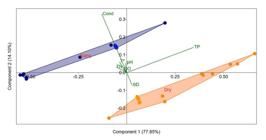
Principal Component Analysis for the mean values of physicochemical parameters. Dark and light blue and dots (Epilimnion and hypolimnion, respectively), represent rainy season values, Dark and light orange dots (Epilimnion and hypolimnion, respectively), represent dry season values. Cond = conductivity; T° = temperature; TN = total nitrogen; DO = dissolved oxygen; TP = total phosphorus; SD = Secchi disk.
The RDA (Figure 6), explains 29.4% of the variation between rainy and season outcomes, previously explored by the PCA, this analysis considers physical, chemical and biological records in both seasons. Considering a permutation test with n = 999, the results showed R2 = 0.332 (p-value = 0.006). The positive direction of Axis 1 is primarily associated with total phosphorus and Secchi disk depth, while the negative direction is associated with conductivity and temperature. For Axis 2, the positive direction is linked to Secchi disk depth and dissolved oxygen, while the negative direction is related to pH and total phosphorus.

Redundancy analysis for the mean physicochemical parameters and total number of individuals per genera registered during the diel cycle during rainy and dry season. Dark and light blue and dots (Epilimnion and hypolimnion, respectively), represent rainy season values, Dark and light orange dots (Epilimnion and hypolimnion, respectively), represent dry season values. Cond = conductivity; T° = temperature; TN = total nitrogen; DO = dissolved oxygen; TP = total phosphorus; SD = Secchi disk.
The biplot outlet indicates that five genera are positively correlated to dry season characteristics, meanwhile, the other genera are related to rainy characteristics. It was also observed that total nitrogen is positively related to rainy season, while phosphorus is related to dry season. Oocystis, Staurastrum and Ceratium are positively correlated to dissolved oxygen and temperature characteristics. On the other hand, Navicula and Scenedesmus are related to Secchi disk and total phosphorus.
Based on the IndVal results and the biological descriptor, six genera are relevant during the rainy season, while one of all genera is relevant during the dry season. Tribonema, Microcystis, Oocystis, and Mallomonas are associated with the rainy season, and Pediastrum is associated with the dry season, as clearly shown in the graphical results.
4. Discussion
4.1. Physicochemical characteristics
Weather conditions have an important influence on the physical and chemical characteristics, especially when talking about shallow aquatic ecosystems (Iltis et al., 1992; Rai, 2000; Diovisalvi et al., 2015). Understanding how weather events such as rainfall and wind impact parameters like dissolved oxygen, temperature, pH, conductivity, and nutrients is crucial for assessing ecosystem health and dynamics.
The nine samples collected in this diel assessment (Table 1) show higher variations in the rainy season than in the dry season. Studying diel cycles and seasonal variations in physicochemical parameters is essential for assessing ecosystem health and resilience to environmental changes. Diversity trends along the sampled period (Figure 2) indicate the heterogeneity of genera during the diel cycle.
Considering mean diversity values, the rainy season shows higher diversity. It is notable that in both seasons, hypolimnion values were higher than epilimnion outcomes. During the rainy season, peak values in the epilimnion were observed in the afternoon and part of the night, while in the hypolimnion, diversity was higher during the afternoon and dark hours. Conversely, the dry season diversity exhibited fluctuation in the daily cycle, with peaks in the morning, afternoon, and at night, in both the epilimnion and hypolimnion.
Six of the seven parameters observed were higher in the rainy season, where wind occurrences, typical of the season with precipitation storms (SENAMHI, 2024) in the afternoon, influenced the variation of physical parameters such as dissolved oxygen, temperature, pH, conductivity, and nutrients. On the other hand, the dry season presented higher temperatures during daylight hours, with nighttime temperatures remaining similar without wind or precipitation events (SENAMHI, 2024), but with very low environmental temperatures (-11.7 °C).
In the rainy season, dissolved oxygen (DO) concentrations were higher due to rainfall, water inflow, and wind. Regarding temperature in the water column, it remained quite similar throughout the diel cycle, as observed in other Andean water bodies (Richerson, 1992). Temperature plays a critical role in determining metabolic rates and habitat suitability for aquatic organisms. Conductivity and pH values were higher during the rainy season due to the transportation and incorporation of particulate material into the lagoon (Gervais et al., 1999; Beltrán Farfán et al., 2015). These parameters can provide insights into water quality and the presence of dissolved ions and contaminants. Secchi disk readings were notably higher in the dry season, which may be related to lower rainfall influence (SENAMHI, 2024) and lower incorporation of material from the watershed into the lagoon. Secchi disk measurements are commonly used to estimate water clarity and light penetration, which are essential for understanding aquatic habitat quality.
When observing the relationships among physicochemical parameters, pH is related to conductivity, similar to the characteristics recorded in the inner Bay of Puno in Lake Titicaca (Beltrán Farfán et al., 2015) due to natural and anthropic sources. Another positive relationship is observed between DO and pH in tropical (Loaiza et al., 2021) and subtropical (Kutlu et al., 2020) environments. Additionally, DO is correlated with total nitrogen (TN), a characteristic observed in tropical water bodies (Kutlu et al., 2020; Sui et al., 2022), due to rainfall events that result in a greater water volume entering the lake and transporting minerals from the watershed. An inverse relationship was reported in low-altitude tropical environments such as Lagoa Santa, Brazil (Figueredo & Giani, 2009). Furthermore, Secchi disk readings are inversely correlated with temperature, as observed during the dry season, which was also noted in the Uzuncayir reservoir (Kutlu et al., 2020).
4.2. Biological characteristics
Richness did not result as high as other similar Andean lacustrine environments (Cartuche et al., 2019; Van de Vyver et al., 2019). From the analysis, the genera diversity was remarked seasonally, because the higher diversity occurred during the rainy season in the hypolimnion. These events can be related to physicochemical parameter fluctuations along the diel cycle, with a possibility that increased water flow in tributaries may transport cells from other sites (e.g., the riverine zone, littoral areas, from the fish tanks, etc.). Additionally, diversity was higher in the rainy season, with an exception of night time when the index value decreases.
The Chacas Lagoon presented a phosphorus-limited condition, with a higher ratio during the rainy season than in the dry season. Even though, both nutrients (N and P) are essential for plant growth, their sources are different (Pieterse et al., 2003; Peñuelas & Sardans, 2022). On one hand, nitrogen is mainly related to ammonia, nitrite and nitrate (U.S. EPA, 2024), which in the case of Chacas lagoon these compounds are probably provided by fish farming tanks. On the other hand, phosphorus commonly is provided by agricultural fertilizers, organic wastes, etc. (USGS, 2024). However, the agricultural activities around the lagoon do not use agricultural fertilizers, organic wastes can be related to algae disease, some cattle that enters into the shoreline to eat algae or macrophytes. These situations can explain the differences in concentration of the nutrients in the water column. This can explain a major diversity and richness of Ceratium that rapidly adapted itself to organic matter and nutrient availability (Cavalcante et al., 2016).
Another aspect inferred from the diversity indices is the probable vertical migration along the diel cycle, with higher values in the epilimnion during daylight hours and in the hypolimnion during the dark hours. This phenomenon was clearly observed during the dry season. The descriptions based on the MBFG approach and the sinking properties of each genera are notable. Among the groups with a larger number of genera (IV and VI), group IV showed higher density in the hypolimnion during the day in the dry season, while group VI was more abundant in the hypolimnion at night during both the rainy and dry seasons. In the case of group IV, according to the MBFG, sinking velocity likely plays a fundamental role in these characteristics (Kruk et al., 2010), and another factor could be the increased light penetration during the dry season. Meanwhile, the genera in group VI, with an even higher sinking velocity, may be influenced by nutrient availability. Other groups (II, III, VII), exhibit distinct behaviors that are not comparable to one another.
Individually, three genera previously recognized as indicators can provide deeper insight into this high-altitude aquatic ecosystem. Pediastrum, belonging to group IV, was recorded in both zones and seasons; however, its presence was more prominent during the dry season in the hypolimnion. This could be related to sinking factors associated with its symmetry (number and distribution of fenestrations). According to the RDA, the genera is associated with dissolved oxygen, Secchi disk, and total phosphorus, a pattern also corroborated by the PCA, similar to findings by (Xiang et al., 2024). Fragilaria (group VI) was present in both seasons, with higher density during daylight hours in the epilimnion. Although the MBFG approach indicates that this group has a high sinking velocity, colony size must be considered, as smaller colonies have a lower sinking velocity (Padisák et al., 2003). Ceratium (group V), a strong swimmer, was found in both zones and seasons, with a higher concentration in the epilimnion. However, it can easily migrate to nutrient-rich layers, contributing to its success in the habitat. In this context, the MBFG approach was important in better describing the vertical migration or sinking of certain species. This was complemented by understanding the sinking properties of the genera and the factors that contribute to resistance during this process.
Ceratium is considered cosmopolitan due to its presence in both freshwater and marine environments (Carty, 2003). Ceratium has been widely reported in Peru, registering concentrations from 79 ind/mL (Poechos Lagoon) to 3,618 ind/mL (Lake Titicaca) (Mendoza-Carbajal et al., 2022). The densities reported in some Peruvian aquatic environments, compared to Brazilian ones, are lower such as, Jaguari reservoir (131,954 ind/mL) (Hackbart et al., 2015), Pedalinhos lake (10,170 ind/mL) (Silva et al., 2019), Faxinal reservoir (2,819 ind/mL) (Cavalcante et al., 2016). Ceratium has adapted itself, in the Peruvian context, to diverse physical and chemical characteristics, e.g., temperatures from 12.9 °C to 27.4 °C (Mendoza-Carbajal et al., 2022) and oxygen concentrations from 5.9 mg/L to 8.3 mg/L. When comparing the physicochemical characteristics to the reported in this study, temperature and dissolved oxygen could even be lower, 10.5 °C and 4.16 mg/L, during the dry season. Now, when referring to how Ceratium reach these environments, some authors indicate that it could have happened due to migratory birds (Mendoza-Carbajal et al., 2022) or aquatic insects or anthropic intervention (Dias & Tucci, 2020). Ceratium remains successfully in the system due to optimal adaptation to temperature, pH and nutrients demonstrating an increase in population during warm seasons and a reduction in cold ones, this was also observed by (Cavalcante et al., 2016) in two subtropical Brazilian reservoirs.
These insights into the seasonal variations in phytoplankton diversity and composition provide valuable context for understanding the complex dynamics of aquatic ecosystems. The observed patterns suggest a strong influence of physicochemical parameters and seasonal fluctuations on phytoplankton community structure, with implications for ecosystem health and management.
4.3. Nitrogen and phosphorus characteristics
It is possible to highlight that both total nitrogen and phosphorus can be considered as limiting factors of primary productivity in aquatic ecosystems. Nevertheless, fish farming activity, involving the infrastructure and management, has a place in this discussion. Fish food waste and fish feces are continuously incorporated into the water column due to artisanal building without following governmental guidelines (Mariano et al., 2010; Torres-Barrera & Grandas-Rincón, 2017). It is possible to infer that these materials impact directly on the equilibrium of this lagoon and can be easily transported spatially.
Certain genera in the Cyanophyceae class fix the atmospheric nitrogen into the water, increasing its concentration as well (Wurtsbaugh et al., 1992). It is also known that TN/TP ratio influences the primary production in water (Seip, 1994; Guildford & Hecky, 2000; Kolzau et al., 2014), which are directly related to dissolved oxygen depletion (Tomasetti & Gobler, 2020; Baxa et al., 2021). This study remarks the positive relation between TN to DO. Secchi disk is correlated to nutrients, nitrogen and phosphorus, which can provoke algal blooms if found in high concentrations, and conductivity, due to the suspended material in the water column, higher during the rainy season and lower in the dry season. The relative poverty of nitrates in the water from tributaries in the Titicaca Basin was widely discussed (Wurtsbaugh et al., 1985, 1992). This scenario changes when talking about areas with high anthropic pressure.
5. Conclusion
The diel cycle method effectively captured fluctuations in physicochemical parameters over a 24-hour period, offering valuable insights into the limnological dynamics of the Chacas Lagoon. Elevated levels of nutrients (TN, TP) during the rainy season suggest potential impacts from fish farming activities, highlighting the need for improved management practices to mitigate nutrient inputs. While the phytoplankton community exhibited higher diversity in the hypolimnion during the rainy season, further research is needed to elucidate the complex interactions between physicochemical parameters and phytoplankton dynamics.
The findings from this study have important implications for the management and conservation of Andean water bodies. Decision-makers should consider the observed phenomena in the diel cycle as a basis for developing effective policies to protect natural resources and maintain ecosystem health. Continuous monitoring programs are essential for tracking spatial and temporal fluctuations and informing adaptive management strategies to address emerging challenges.
Looking ahead, future research efforts should aim to deepen our understanding of Andean water bodies by investigating the underlying mechanisms driving phytoplankton dynamics and ecosystem responses to environmental change. By addressing knowledge gaps and implementing evidence-based management practices, we can work towards ensuring the long-term sustainability of these valuable aquatic ecosystems.
Acknowledgements
The authors would like to thank Conselho Nacional de Desenvolvimento Científico e Tecnológico (CNPq) (process 152474/2024-2), as well as, to Joel Zapana Estrada, Glubert Ramos, César Lipa Luque, Yosely Eliana Gonzáles Rivera and Olger Alvarez Quenallata for assisting in the sampling efforts during the rainy and dry seasons at Chacas Lagoon.
-
Cite as:
Biamont-Rojas, I.E. and Alfaro-Tapia, H.R. Diel dynamics and environmental influences on phytoplankton communities in an Andean lagoon: implications for management and conservation. Acta Limnologica Brasiliensia, 2024, vol. 36, e44. https://doi.org/10.1590/S2179-975X2524
References
-
Baxa, M., Musil, M., Kummel, M., Hanzlík, P., Tesařová, B., & Pechar, L., 2021. Dissolved oxygen deficits in a shallow eutrophic aquatic ecosystem (fishpond): sediment oxygen demand and water column respiration alternately drive the oxygen regime. Sci. Total Environ. 766, 142647. PMid:33082047. http://doi.org/10.1016/j.scitotenv.2020.142647
» http://doi.org/10.1016/j.scitotenv.2020.142647 -
Bellinger, E.G., & Sigee, D.C., 2010. Freshwater algae: identification and use as bioindicators. Chippenahm: John Wiley & Sons. http://doi.org/10.1002/9780470689554
» http://doi.org/10.1002/9780470689554 -
Beltrán Farfán, D.F., Palomino Calli, R.P., Moreno Terrazas, E.G., Peralta, C.G., & Montesinos-Tubée, D.B., 2015. Calidad de agua de la bahía interior de Puno, lago Titicaca durante el verano del 2011. Rev. Peru. Biol. 22(3), 335-340. http://doi.org/10.15381/rpb.v22i3.11440
» http://doi.org/10.15381/rpb.v22i3.11440 -
Biamont-Rojas, I.E., Cardoso-Silva, S., Alves de Lima Ferreira, P., Alfaro-Tapia, R., Figueira, R., & Pompêo, M., 2023a. Chronostratigraphy elucidates environmental changes in lacustrine sedimentation rates and metal accumulation. Environ. Sci. Pollut. Res. Int. 30(28), 72430-72445. PMid:37171726. http://doi.org/10.1007/s11356-023-27521-0
» http://doi.org/10.1007/s11356-023-27521-0 -
Biamont-Rojas, I.E., Cardoso-Silva, S., Figueira, R.C.L., Kim, B.S.M., Alfaro-Tapia, R., & Pompêo, M., 2023b. Spatial distribution of arsenic and metals suggest a high ecotoxicological potential in Puno Bay, Lake Titicaca, Peru. Sci. Total Environ. 871, 162051. PMid:36754329. http://doi.org/10.1016/j.scitotenv.2023.162051
» http://doi.org/10.1016/j.scitotenv.2023.162051 - Biamont-Rojas, I.E., Cardoso-Silva, S., Figueira, R., & Pompêo, M., 2024. Estabelecimento de valores referência para metais em sedimentos de reservatórios do Estado de São Paulo. In: Pompêo, M., Cardoso-Silva, S. Figueira, R., & Moschini-Carlos, V., eds. Limnologia de reservatórios: do clássico às novas abordagens. São Paulo: Instituto de Biociências, 74-87.
- Brousett-Minaya, M.A., Rondan-Sanabria, G.G., Chirinos-Marroquín, M., & Biamont-Rojas, I., 2021. Impacto de la Minería en Aguas Superficiales de la Región Puno - Perú. Fides Ratio 21, 187-208.
-
Caixeta, E.S., Meza Bravo, J.V., & Pereira, B.B., 2022. Ecotoxicological assessment of water and sediment river samples to evaluate the environmental risks of anthropogenic contamination. Chemosphere 306, 135595. PMid:35809747. http://doi.org/10.1016/j.chemosphere.2022.135595
» http://doi.org/10.1016/j.chemosphere.2022.135595 -
Cardoso-Silva, S., Ferreira, P.A.L., Moschini-Carlos, V., Figueira, R.C.L., & Pompêo, M., 2016. Temporal and spatial accumulation of heavy metals in the sediments at Paiva Castro Reservoir (São Paulo, Brazil). Environ. Earth Sci. 75(1), 1-16. http://doi.org/10.1007/s12665-015-4828-2
» http://doi.org/10.1007/s12665-015-4828-2 -
Carneiro, L., Ostroski, A., & Mercuri, E.G.F., 2020. Trophic state index for heavily impacted watersheds: modeling the influence of diffuse pollution in water bodies. Hydrol. Sci. J. 65(15), 2548-2560. http://doi.org/10.1080/02626667.2020.1828588
» http://doi.org/10.1080/02626667.2020.1828588 -
Cartuche, A., Guan, Z., Ibelings, B.W., & Venail, P., 2019. Phytoplankton diversity relates negatively with productivity in tropical high-altitude lakes from Southern Ecuador. Sustainability (Basel) 11(19), 5235. http://doi.org/10.3390/su11195235
» http://doi.org/10.3390/su11195235 -
Carty, S., 2003. Dinoflagellates. In: Wehr, J.D., & Sheath, R.G., eds. Freshwater Algae of North America. London: Academic Press, 685-714. http://doi.org/10.1016/B978-012741550-5/50021-0
» http://doi.org/10.1016/B978-012741550-5/50021-0 -
Cavalcante, K.P., Cardoso, L. de S., Sussella, R., & Becker, V., 2016. Towards a comprehension of Ceratium (Dinophyceae) invasion in Brazilian freshwaters: autecology of C. furcoides in subtropical reservoirs. Hydrobiologia 771(1), 265-280. http://doi.org/10.1007/s10750-015-2638-x
» http://doi.org/10.1007/s10750-015-2638-x -
Cereja, R., Chainho, P., Brotas, V., Cruz, J.P.C., Sent, G., Rodrigues, M., Carvalho, F., Cabral, S., & Brito, A.C., 2022. Spatial variability of physicochemical parameters and phytoplankton at the Tagus Estuary (Portugal). Sustainability (Basel) 14(20), 13324. http://doi.org/10.3390/su142013324
» http://doi.org/10.3390/su142013324 -
Conroy, J.A., Steinberg, D.K., Thibodeau, P.S., & Schofield, O., 2020. Zooplankton diel vertical migration during Antarctic summer. Deep Sea Res. Part I Oceanogr. Res. Pap. 162, 103324. http://doi.org/10.1016/j.dsr.2020.103324
» http://doi.org/10.1016/j.dsr.2020.103324 -
Cui, S., Yu, T., Zhang, F., Fu, Q., Hough, R., An, L., Gao, S., Zhang, Z., Hu, P., Zhu, Q., & Pei, Z., 2020. Understanding the risks from diffuse pollution on wetland eco-systems: the effectiveness of water quality classification schemes. Ecol. Eng. 155, 105929. http://doi.org/10.1016/j.ecoleng.2020.105929
» http://doi.org/10.1016/j.ecoleng.2020.105929 -
Cyronak, T., Takeshita, Y., Courtney, T.A., DeCarlo, E.H., Eyre, B.D., Kline, D.I., Martz, T., Page, H., Price, N.N., Smith, J., Stoltenberg, L., Tresguerres, M., & Andersson, A.J., 2020. Diel temperature and pH variability scale with depth across diverse coral reef habitats. Limnol. Oceanogr. Lett. 5(2), 193-203. http://doi.org/10.1002/lol2.10129
» http://doi.org/10.1002/lol2.10129 - Davis, J.C., 1986. Statistics and data analysis in geology. New York: John Wiley & Sons.
-
Dias, A.S., & Tucci, A., 2020. Ceratium furcoides (Levander) Langhans: first record in Nova Avanhandava reservoir, Southeast Brazil. Hoehnea 47, e742019. http://doi.org/10.1590/2236-8906-74/2019
» http://doi.org/10.1590/2236-8906-74/2019 -
Ding, S., Jiao, L., He, J., Li, L., Liu, W., Liu, Y., Zhu, Y., & Zheng, J., 2022. Biogeochemical dynamics of particulate organic phosphorus and its potential environmental implication in a typical “algae-type” eutrophic lake. Environ. Pollut. 314, 120240. PMid:36152715. http://doi.org/10.1016/j.envpol.2022.120240
» http://doi.org/10.1016/j.envpol.2022.120240 -
Diovisalvi, N., Bohn, V.Y., Piccolo, M.C., Perillo, G.M.E., Baigún, C., & Zagarese, H.E., 2015. Shallow lakes from the Central Plains of Argentina: an overview and worldwide comparative analysis of their basic limnological features. Hydrobiologia 752(1), 5-20. http://doi.org/10.1007/s10750-014-1946-x
» http://doi.org/10.1007/s10750-014-1946-x - Drouet, F., Hohn, M.H., Roback, S.S., Skuja, H., Spangler, P.J., Swabey, Y.H., & Whitford, L.A., 1966. Catherwood Foundation Peruvian-Amazon expedition. Monogr. Acad. Nat. Sci. Philadelphia 14, 1-495.
-
Dufrêne, M., & Legendre, P., 1997. Species assemblages and indicator species: the need for a flexible asymmetrical approach. Ecol. Monogr. 67(3), 345-366. http://doi.org/10.2307/2963459
» http://doi.org/10.2307/2963459 -
Figueredo, C.C., & Giani, A., 2009. Phytoplankton community in the tropical lake of Lagoa Santa (Brazil): conditions favoring a persistent bloom of Cylindrospermopsis raciborskii Limnologica 39(4), 264-272. http://doi.org/10.1016/j.limno.2009.06.009
» http://doi.org/10.1016/j.limno.2009.06.009 -
Gervais, F., Berger, S., Schönfelder, I., & Rusche, R., 1999. Basic limnological characteristics of the shallow eutrophic lake Grimnitzsee (Brandenburg, Germany). Limnologica 29(2), 105-119. http://doi.org/10.1016/S0075-9511(99)80058-9
» http://doi.org/10.1016/S0075-9511(99)80058-9 -
Guildford, S.J., & Hecky, R.E., 2000. Total nitrogen, total phosphorus, and nutrient limitation in lakes and oceans: is there a common relationship? Limnol. Oceanogr. 45(6), 1213-1223. http://doi.org/10.4319/lo.2000.45.6.1213
» http://doi.org/10.4319/lo.2000.45.6.1213 -
Guo, F., Jiang, G., Zhao, H., Polk, J., & Liu, S., 2019. Physicochemical parameters and phytoplankton as indicators of the aquatic environment in karstic springs of South China. Sci. Total Environ. 659, 74-83. PMid:30597471. http://doi.org/10.1016/j.scitotenv.2018.12.329
» http://doi.org/10.1016/j.scitotenv.2018.12.329 - Hackbart, V., Marques, A., Kida, B., Tolussi, C., Negri, D., Martins, I., Fontana, I., Collucci, M., Brandimarti, A., Moschini-Carlos, V., Cardoso-Silva, S., Meirinho, P., Freire, R., & Pompêo, M., 2015. Avaliação expedita da heterogeneidade espacial horizontal intra e inter reservatórios do sistema cantareira (Represas Jaguari e Jacarei, São Paulo)). In: Pompêo, M., Moschini-Carlos, V., Nishimura, P., Cardoso da Silva, S., & López Doval, J., eds. Ecologia de reservatórios e interfaces. São Paulo: Instituto de Biociências da Universidade de São Paulo, 96-108.
- Harper, D.A.T., 1999. Numerical palaeobiology: computer based modelling and analysis of fossils and their distributions. Chichester: John Wiley & Sons, Ltd.
-
He, H., Wang, Y., Liu, Z., Bao, Q., Wei, Y., Chen, C., & Sun, H., 2022. Lake metabolic processes and their effects on the carbonate weathering CO2 sink: insights from diel variations in the hydrochemistry of a typical karst lake in SW China. Water Res. 222, 118907. PMid:35944408. http://doi.org/10.1016/j.watres.2022.118907
» http://doi.org/10.1016/j.watres.2022.118907 - Hegewald, E., Bai-Jeeji, N., & Hesse, M., 1975. Taxonomische und floristische Studien an Planktonalgen aus ungarischen Gewässern. Algol. Stud. 13, 392-432.
-
Helbling, E.W., Villafañe, V.E., Buma, A.G.J., Andrade, M., & Zaratti, F., 2001. DNA damage and photosynthetic inhibition induced by solar ultraviolet radiation in tropical phytoplankton (Lake Titicaca, Bolivia). Eur. J. Phycol. 36(2), 157-166. http://doi.org/10.1080/09670260110001735308
» http://doi.org/10.1080/09670260110001735308 - Iltis, A., & Mourguiart, P., 1992. Higher plants: Distribution and biomass. In: Dejoux, C., & Iltis, A., eds. Lake Titicaca: a synthesis of limnological knowledge. Dordrecht: Kluwer Academic Publishers, 241-253.
-
Iltis, A., Carmouze, J.-P., & Lemoalle, J., 1992. Physico-chemical properties of the water. In: Dejoux, C., & Iltis, A., eds. Lake Titicaca: a synthesis of limnological knowledge. Dordrecht: Kluwer Academic Publishers, 89-97. http://doi.org/10.1007/978-94-011-2406-5
» http://doi.org/10.1007/978-94-011-2406-5 -
Khan, I., Zakwan, M., Pulikkal, A.K., & Lalthazula, R., 2022. Impact of unplanned urbanization on surface water quality of the twin cities of Telangana state, India. Mar. Pollut. Bull. 185, 114324. http://doi.org/10.1016/j.marpolbul.2022.114324
» http://doi.org/10.1016/j.marpolbul.2022.114324 -
Kim, Y., Youn, S.-H., Oh, H.J., Kang, J.J., Lee, J.H., Lee, D., Kim, K., Jang, H.K., Lee, J., & Lee, S.H., 2020. Spatiotemporal variation in phytoplankton community driven by environmental factors in the Northern East China Sea. Water 12(10), 2695. http://doi.org/10.3390/w12102695
» http://doi.org/10.3390/w12102695 -
Kolzau, S., Wiedner, C., Rücker, J., Köhler, J., Köhler, A., & Dolman, A. M., 2014. Seasonal Patterns of Nitrogen and Phosphorus Limitation in Four German Lakes and the Predictability of Limitation Status from Ambient Nutrient Concentrations. PLOS ONE 9(4), e96065. http://doi.org/10.1371/journal.pone.0096065
» http://doi.org/10.1371/journal.pone.0096065 -
Komárková, J., Montoya, H., & Komárek, J., 2016. Cyanobacterial water bloom of Limnoraphis robusta in the Lago Mayor of Lake Titicaca. Can it develop? Hydrobiologia 764(1), 249-258. http://doi.org/10.1007/s10750-015-2298-x
» http://doi.org/10.1007/s10750-015-2298-x -
Kruk, C., Huszar, V.L.M., Peeters, E.T.H.M., Bonilla, S., Costa, L., Lürling, M., Reynolds, C.S., & Scheffer, M., 2010. A morphological classification capturing functional variation in phytoplankton. Freshw. Biol. 55(3), 614-627. http://doi.org/10.1111/j.1365-2427.2009.02298.x
» http://doi.org/10.1111/j.1365-2427.2009.02298.x -
Kumar, R., Kumari, R., Prasad, C., Tiwari, V., Singh, N., Mohapatra, S., Merugu, R., Namtak, S., & Deep, A., 2020. Phytoplankton diversity in relation to physicochemical attributes and water quality of Mandakini River, Garhwal Himalaya. Environ. Monit. Assess. 192(12), 799. PMid:33263156. http://doi.org/10.1007/s10661-020-08768-3
» http://doi.org/10.1007/s10661-020-08768-3 -
Kutlu, B., Aydın, R., Danabas, D., & Serdar, O., 2020. Temporal and seasonal variations in phytoplankton community structure in Uzuncayir Dam Lake (Tunceli, Turkey). Environ. Monit. Assess. 192(2), 105. PMid:31915937. http://doi.org/10.1007/s10661-019-8046-3
» http://doi.org/10.1007/s10661-019-8046-3 -
Lanza, W.G., Hernández, V.C., Achá, D., & Lazzaro, X., 2024. Responses of phytoplankton and periphyton community structure to an anthropic eutrophication gradient in tropical high-altitude Lake Titicaca. J. Great Lakes Res. 50(2), 102294. http://doi.org/10.1016/j.jglr.2024.102294
» http://doi.org/10.1016/j.jglr.2024.102294 - Lazzaro, X., 1980. Etude du phytoplancton de la station de Chua (Lago Pequeño): physicochimie, production primaire, peuplements. Paris: ORSTOM.
- Legendre, P., & Legendre, L., 1998. Numerical Ecology (2nd ed). Amsterdam: Elsevier.
-
Lewandrowski, W., Stevens, J.C., Webber, B.L.L., Dalziell, E., Trudgen, M.S., Bateman, A.M., & Erickson, T.E., 2021. Global change impacts on arid zone ecosystems: seedling establishment processes are threatened by temperature and water stress. Ecol. Evol. 11(12), 8071-8084. PMid:34188872. http://doi.org/10.1002/ece3.7638
» http://doi.org/10.1002/ece3.7638 - Liberman, M., & Miranda, C., 1985. Contribución al conocimiento del fitoplancton del Lago Titicaca. La Paz: Instituto de Ecología, UMSA.
-
Loaiza, J.G., Rangel-Peraza, J.G., Sanhouse-García, A.J., Monjardín-Armenta, S.A., Mora-Félix, Z.D., & Bustos-Terrones, Y.A., 2021. Assessment of water quality in a tropical reservoir in mexico: seasonal, spatial and multivariable analysis. Int. J. Environ. Res. Public Health 18(14), 7456. PMid:34299908. http://doi.org/10.3390/ijerph18147456
» http://doi.org/10.3390/ijerph18147456 - MAGRAMA, 2013. Protocolo de análisis y cálculo de métricas de fitoplancton en lago y embalses. Madrid.
- Mamani Villalba, B.A., Biamont Rojas, I.E., & Calsin Quinto, B., 2021. Evaluación Ecotoxicológica mediante bioensayo con Daphnia Pulex en sedimentos del Río Suches, Cojata frontera Perú - Bolivia, 2019. Fides Ratio 22, 191-215.
- Mariano, M., Huaman, P., Mayta, E., Montoya, H., & Chanco, M., 2010. Contaminación producida por piscicultura intensiva en lagunas andinas de Junín, Perú. Rev. Peru. Biol. 17, 137-140.
-
Martins, T., Ferreira, K., Rani-Borges, B., Biamont-Rojas, I., Cardoso-Silva, S., Moschini-Carlos, V., & Pompêo, M., 2021. Land use, spatial heterogeneity of organic matter, granulometric fractions and metal complexation in reservoir sediments. Acta Limnol. Bras. 33, e23. http://doi.org/10.1590/s2179-975x3521
» http://doi.org/10.1590/s2179-975x3521 -
Matamet, F.R.M., & Bonotto, D.M., 2019. Identifying sedimentation processes in the Coata River, Altiplano of the Puno department, Peru, by the 210Pb method. Environ. Earth Sci. 78(22), 641. http://doi.org/10.1007/s12665-019-8662-9
» http://doi.org/10.1007/s12665-019-8662-9 -
Mendoza-Carbajal, L., Contreras, D., Baylón, M., Domínguez, A., Valdivia, E., Samanez, Z., Johnson, F., & Salazar-Torres, A., 2022. Especies invasoras de Ceratium Schrank, 1973 (Dinophyceae: Ceratiaceae) en cuerpos de agua continentales de Perú. Rev. Peru. Biol. 29(4), 1-6. http://doi.org/10.15381/rpb.v29i4.23765
» http://doi.org/10.15381/rpb.v29i4.23765 -
Neff, E., MacGregor, J., & Gedan, K.B., 2020. Effects of short-duration and diel-cycling hypoxia on predation of mussels and oysters in two tributaries of the chesapeake bay. Diversity (Basel) 12(3), 87. http://doi.org/10.3390/d12030087
» http://doi.org/10.3390/d12030087 -
Padisák, J., Soróczki-Pintér, É., & Rezner, Z., 2003. Sinking properties of some phytoplankton shapes and the relation of form resistance to morphological diversity of plankton: an experimental study. In Martens, K., ed. Aquatic biodiversity: a celebratory volume in honour of Henri J. Dumont. Netherlands: Springer, 243-257. http://doi.org/10.1007/978-94-007-1084-9_18
» http://doi.org/10.1007/978-94-007-1084-9_18 -
Peñuelas, J., & Sardans, J., 2022. The global nitrogen-phosphorus imbalance. Science 375(6578), 266-267. PMid:35050668. http://doi.org/10.1126/science.abl4827
» http://doi.org/10.1126/science.abl4827 -
Pieterse, N.M., Bleuten, W., & Jørgensen, S.E., 2003. Contribution of point sources and diffuse sources to nitrogen and phosphorus loads in lowland river tributaries. J. Hydrol. 271(1), 213-225. http://doi.org/10.1016/S0022-1694(02)00350-5
» http://doi.org/10.1016/S0022-1694(02)00350-5 -
Qalmoun, A., Bouzrarf, K., & Belqat, B., 2022. Assessment of the ecological status of the Oum Er-rabie River basin (Central Morocco) through physicochemical, bacteriological parameters and biotic indices. Biologia (Bratisl.) 77(9), 2533-2547. http://doi.org/10.1007/s11756-022-01128-1
» http://doi.org/10.1007/s11756-022-01128-1 -
Rai, A.K., 2000. Limnological characteristics of subtropical Lakes Phewa, Begnas, and Rupa in Pokhara Valley, Nepal. Limnology 1(1), 33-46. http://doi.org/10.1007/s102010070027
» http://doi.org/10.1007/s102010070027 - Ramírez R.J.J., & Bicudo, C.E.M., 2003. Diurnal, vertical, and among sampling days variation of dissolved O2, CO2, and pH in a shallow, tropical reservoir (Garças reservoir, São Paulo, Brazil)). Acta Limnol. Bras. 15(3), 19-30.
- Reynolds, C.S., 1992. Algae. In: Calow, P., & Petts, G., eds. The rivers handbook. Oxford: Wiley-Blackwell, 195-215.
- Reynolds, C.S., 1984. The ecology of freshwater phytoplankton. Cambridge: Cambridge University Press.
- Richerson, P.J., 1992. The thermal stratification regime in Lake Titicaca. In: Dejoux, C., & Iltis, A., eds. Lake Titicaca: a synthesis of limnological knowledge. Dordrecht: Kluwer Academic Publishers, 120-130. http://doi.org/10.1007/978-94-011-2406-5.
-
Richerson, P.J., Neale, P.J., Wurtsbaugh, W., René Alfaro, T., & Vincent, W., 1986. Patterns of temporal variation in Lake Titicaca: a high altitude tropical lake. I. Background, physical and chemical processes, and primary production. Hydrobiologia 138(1), 205-220. http://doi.org/10.1007/BF00027241
» http://doi.org/10.1007/BF00027241 -
Seip, K.L., 1994. Phosphorus and nitrogen limitation of algal biomass across trophic gradients. Aquat. Sci. 56(1), 16-28. http://doi.org/10.1007/BF00877432
» http://doi.org/10.1007/BF00877432 -
Servicio Nacional de Meteorologia e Hidrologia – SENAMHI, 2024. Datos hidrometeorológicos en Puno. Retrieved in 2024, March 18, from https://www.senamhi.gob.pe/main.php?dp=puno&p=estaciones
» https://www.senamhi.gob.pe/main.php?dp=puno&p=estaciones -
Silva, F.L., Stefani, M.S., Smith, W., Schiavone, D.C., da Cunha-Santino, M.B., & Bianchini Junior, I., 2020. An applied ecological approach for the assessment of anthropogenic disturbances in urban wetlands and the contributor river. Ecol. Complex. 43, 100852. http://doi.org/10.1016/j.ecocom.2020.100852
» http://doi.org/10.1016/j.ecocom.2020.100852 -
Silva, J.R.I., Montenegro, A.A.A., Farias, C.W.L. de A., Jardim, A., Silva, T.G.F., & Montenegro, S.M.G.L., 2022. Morphometric characterization and land use of the Pajeú river basin in the Brazilian semi-arid region. J. S. Am. Earth Sci. 118, 103939. http://doi.org/10.1016/j.jsames.2022.103939
» http://doi.org/10.1016/j.jsames.2022.103939 -
Silva, L.N., Medeiros, C.M., Cavalcante, K.P., & Cardoso, L. S., 2019. Invasion and establishment of Ceratium furcoides (Dinophyceae) in an urban lake in Porto Alegre, RS, Brazil. Acta Bot. Bras. 33(4), 654-663. http://doi.org/10.1590/0102-33062018abb0429
» http://doi.org/10.1590/0102-33062018abb0429 - Streble, H., & Krauter, D., 1987. Atlas de los microorganismos de agua dulce. Barcelona: OMEGA.
-
Sui, Q., Duan, L., Zhang, Y., Zhang, X., Liu, Q., & Zhang, H., 2022. Seasonal water quality changes and the eutrophication of Lake Yilong in Southwest China. Water 14(21), 3385. http://doi.org/10.3390/w14213385
» http://doi.org/10.3390/w14213385 -
Sulawesty, F., Yustiawati, & Syawal, M.S., 2020. Phytoplankton distribution in Ranggeh River and its relationship with physicochemical parameters. IOP Conf. Ser. Earth Environ. Sci. 535(1), 012024. http://doi.org/10.1088/1755-1315/535/1/012024
» http://doi.org/10.1088/1755-1315/535/1/012024 - SUMA-MARKA, 2014. Condiciones fisicoquimicas y bacteriológicas básicas de la laguna Chacas. Puno: Suma Marka ONGD.
-
Tomasetti, S.J., & Gobler, C.J., 2020. Dissolved oxygen and pH criteria leave fisheries at risk. Science 368(6489), 372-373. PMid:32327589. http://doi.org/10.1126/science.aba4896
» http://doi.org/10.1126/science.aba4896 -
Tong, Y., Huang, Z., Janssen, A.B.G., Wishart, M., He, W., Wang, X., & Zhao, Y., 2022. Influence of social and environmental drivers on nutrient concentrations and ratios in lakes: A comparison between China and Europe. Water Res. 227, 119347. PMid:36399843. http://doi.org/10.1016/j.watres.2022.119347
» http://doi.org/10.1016/j.watres.2022.119347 -
Torres-Barrera, N.H., & Grandas-Rincón, I.A., 2017. Estimación de los desperdicios generados por la producción de trucha arcoíris en el lago de Tota, Colombia. Cienc. Tecnol. Agropecu. 18(2), 247-255. http://doi.org/10.21930/rcta.vol18_num2_art:631
» http://doi.org/10.21930/rcta.vol18_num2_art:631 -
Tsakalakis, I., Follows, M.J., Dutkiewicz, S., Follett, C.L., & Vallino, J.J., 2022. Diel light cycles affect phytoplankton competition in the global ocean. Glob. Ecol. Biogeogr. 31(9), 1838-1849. http://doi.org/10.1111/geb.13562
» http://doi.org/10.1111/geb.13562 - U.S. Environmental Protection Agency – U.S. EPA, 1978. Method 365.3: Phosphorous, all forms (colorimetric, ascorbic acid, two reagent). Washington, D.C.
-
U.S. Environmental Protection Agency – U.S. EPA, 2024. Indicators: nitrogen. Washington, D.C.: National Aquatic Resource Surveys. Retrieved in 2024, March 18, from https://www.epa.gov/national-aquatic-resource-surveys/indicators-nitrogen
» https://www.epa.gov/national-aquatic-resource-surveys/indicators-nitrogen -
United States Geological Survey – USGS, 2024. Phosphorus and water. Retrieved in 2024, March 18, from https://www.usgs.gov/special-topics/water-science-school/science/phosphorus-and-water
» https://www.usgs.gov/special-topics/water-science-school/science/phosphorus-and-water - Utermöhl, H., 1958. Zur vervollkommer der quantitative phytoplankton methodik. Mitt. Int. Ver. Theor. Angew. Limnol. 9, 1-38.
-
Van de Vyver, E., Van Wichelen, J., Vanormelingen, P., Van Nieuwenhuyze, W., Daveloose, I., De Jong, R., De Blok, R., Urrutia, R., Tytgat, B., Verleyen, E., & Vyverman, W., 2019. Variation in phytoplankton pigment composition in relation to mixing conditions in temperate South-Central Chilean lakes. Limnologica 79, 125715. http://doi.org/10.1016/j.limno.2019.125715
» http://doi.org/10.1016/j.limno.2019.125715 -
Wirtz, K., & Smith, S.L., 2020. Vertical migration by bulk phytoplankton sustains biodiversity and nutrient input to the surface ocean. Sci. Rep. 10(1), 1142. PMid:31980670. http://doi.org/10.1038/s41598-020-57890-2
» http://doi.org/10.1038/s41598-020-57890-2 -
Wirtz, K., Smith, S.L., Mathis, M., & Taucher, J., 2022. Vertically migrating phytoplankton fuel high oceanic primary production. Nat. Clim. Chang. 12(8), 750-756. http://doi.org/10.1038/s41558-022-01430-5
» http://doi.org/10.1038/s41558-022-01430-5 -
Wu, N., Guo, K., Suren, A.M., & Riis, T., 2023. Lake morphological characteristics and climatic factors affect long-term trends of phytoplankton community in the Rotorua Te Arawa lakes, New Zealand during 23 years observation. Water Res. 229, 119469. PMid:36527869. http://doi.org/10.1016/j.watres.2022.119469
» http://doi.org/10.1016/j.watres.2022.119469 -
Wurtsbaugh, W., Vincent, W.F., Alfaro Tapia, R., Vincent, C.L., & Richerson, P.J., 1985. Nutrient limitation of algal growth and nitrogen fixation in a tropical alpine lake, Lake Titicaca (Peru/Bolivia). Freshw. Biol. 15(2), 185-195. http://doi.org/10.1111/j.1365-2427.1985.tb00191.x
» http://doi.org/10.1111/j.1365-2427.1985.tb00191.x -
Wurtsbaugh, W., Vincent, W.F., Vincent, C.L., Carney, H.J., Richerson, P.J., & Alfaro Tapia, R., 1992. Nutrients and nutrient limitation of phytoplankton. In: Dejoux, C., & Iltis, A., eds. Lake Titicaca: a synthesis of limnological knowledge. Dordrecht: Kluwer Academic Publishers, 147-156. http://doi.org/10.1007/978-94-011-2406-5
» http://doi.org/10.1007/978-94-011-2406-5 -
Xiang, L., Huang, X., Zhang, J., Huang, C., Schwalb, A., Zhang, J., Rudaya, N., Sun, M., Mu, X., Li, Y., Luo, D., Muhammad, F., Zhang, W., Wang, W., Wang, T., Zheng, M., Ren, X., Zhang, J., Zhang, E., Gou, X., & Chen, F., 2024. First Pediastrum-temperature transfer function and its application to mid-to-late Holocene reconstruction in Central Asia. Quat. Sci. Rev. 327, 108516. http://doi.org/10.1016/j.quascirev.2024.108516
» http://doi.org/10.1016/j.quascirev.2024.108516 -
Ye, F., Jun, W., Bo-wen, W.U., Jing, H.E., & Xiao-ping, Z., 2023. Seasonal variation characteristics of phytoplankton community in Gucheng Lake and the influential environmental factors. J. Ecol. Rural Environ. 39(8), 1042-1050. http://doi.org/10.19741/j.issn.1673-4831.2022.0174
» http://doi.org/10.19741/j.issn.1673-4831.2022.0174
Edited by
-
Associate Editor:
Bárbara Dunck Oliveira


