 Ichthyofauna of streams in Maringá municipality, Paraná, Brazil: an updated checklist, threats, and conservation perspectives
Abstract
Abstract
Aim The following list aims to provide the most recent taxonomic surveying of fish species inhabiting the Ivaí and the Pirapó/Parapanema river basins from the Maringá municipality, using material from the Coleção Ictiológica do Nupélia (NUP) and the available literature.
Methods We compiled all the available records of fish species housed in the NUP from the SpeciesLink database, and compared them with those in a previously published study.
Results The total number of species identified was 81, distributed across 24 families and six orders. The richest order is Characiformes, comprising 34 species. The data analysed reveal that 11 species are recorded as non-native, highlighting the alarming case of introduced species, especially by aquarium keeping. Regarding the threat categories analysed by the IUCN, only one species, Bryconamericus coeruleus, is considered Near Threatened. Further, a noteworthy feature is the presence of seven putative new species, which underlines the necessity for further studies to be conducted to facilitate a more complete understanding and description of the ichthyofauna of the region. The results of this study show that the fish species composition in the streams of the Maringá municipality is diverse and taxonomically complex.
Conclusions Further investigation is needed to address the aforementioned issues regarding conservation and possible species description. Furthermore, more surveys are needed in the Ivaí River basin to expand the species registry, especially in urban streams. We hope that the list of freshwater fish species from Maringá municipality will be a useful source of information for people who make decisions and for people who want to create plans to manage and protect the fish in the region.
Keywords:
fish; northern Paraná; non-native species; urban streams
Resumo
Resumo
Objetivo A lista a seguir pretende fornecer o levantamento taxonômico mais recente das espécies de peixes que habitam as bacias hidrográficas dos rios Ivaí e Pirapó/Parapanema, no município de Maringá, utilizando material da Coleção Ictiológica do Nupélia (NUP) e a literatura disponível.
Métodos Compilamos todos os registros disponíveis de espécies de peixes alojadas no NUP, a partir do banco de dados do SpeciesLink e os comparamos com um estudo publicado anteriormente.
Resultados O número total de espécies identificadas foi de 81, distribuídas por 24 famílias e seis ordens. A ordem mais rica é a Characiformes, compreendendo 34 espécies. Os dados analisados revelam que 11 espécies estão registradas como não nativas, destacando o caso alarmante de espécies introduzidas, especialmente por aquarismo. Em relação às categorias de ameaça analisadas pela IUCN, apenas uma espécie, Bryconamericus coeruleus, é considerada Quase Ameaçada. Além disso, uma característica digna de nota é a presença de sete supostas espécies novas, o que embasa a necessidade de se realizarem mais estudos para facilitar uma compreensão e descrição mais completas da ictiofauna da região. Os resultados deste estudo mostram que a composição das espécies de peixes nos riachos do município de Maringá é diversa e taxonomicamente complexa.
Conclusões São necessárias mais investigações para abordar as questões acima mencionadas relativas à conservação e possível descrição das espécies. Além disso, são necessárias mais pesquisas na bacia do rio Ivaí para ampliar o registro de espécies, especialmente em córregos urbanos. Esperamos que a lista de espécies de peixes de água doce do município de Maringá seja uma fonte útil de informação para tomadores de decisão e para pessoas que desejam criar planos para gerenciar e proteger os peixes da região.
Palavras-chave:
peixes; norte do Paraná; espécies não-nativas; riachos urbanos
1. Introduction
The Upper Paraná River basin drains an area of approximately 880,000 km2, representing 10.3% of Brazilian territory (Agostinho et al., 2007). It extends from the Planalto Central, near Brasília, southwards to the borders with Argentina and Paraguay. This region is characterized by numerous headwater streams and major tributaries that form a complex system of waterfalls and a diverse topography (Agostinho et al., 2004; Pagotto et al., 2012; Frota et al., 2016, 2021, 2022; Morais-Silva et al., 2018; Frota & Graça, 2025; Reis et al., 2025). Within the boundaries of Paraná State, the main tributaries of the Paraná River include the Paranapanema River – bordering São Paulo State and encompassing the Itararé, das Cinzas, and Pirapó sub-basins – as well as the Ivaí, Piquiri, and Iguaçu Rivers (Reis et al., 2020a).
Several researchers have documented fish species in the Paraná River basin (e.g. Graça & Pavanelli, 2007; Langeani et al., 2007; Cavalli et al., 2018; Frota et al., 2016, 2020; Ota et al., 2018; Jarduli et al., 2019; Reis et al., 2020a; Dagosta et al., 2024). These studies provided comprehensive compilations of freshwater fish species and discussed their geographic distribution, ecological characteristics, and taxonomic updates, while also proposed conservation policies. Despite these efforts, many headwater streams and small urban tributaries remain poorly studied or insufficiently understood.
Maringá is the third most populous municipality in the Paraná State and is notable for its numerous headwater streams, which originate within its boundaries. Moreover, the municipality is characterized by two major human activities that strongly influence urban watercourses. First, Maringá functions as an agro-industrial center, with a large proportion of soybean cultivation occurring within the municipality limits. Second, urbanization itself has an impact on watercourses. Both activities affect the environmental conditions of headwater streams, leading to alterations in their physical, chemical, and biological characteristics (Cunico et al., 2009; Pessoa et al., 2025). In this way, urban tributaries – especially first and second-order urban streams – are subject to anthropogenic impacts such as nutrients enrichment and channel modification, which favor the persistence of species tolerant to these altered conditions (Pessoa et al., 2025). These aforementioned issues can be designated collectively as 'the urban stream syndrome' (Walsh et al., 2005), which refers to streams exhibiting one or more of the following characteristics: elevated concentrations of contaminants and nutrients; changes in channel morphology; an altered hydrography; and a reduction in species richness and an increase in tolerant species.
In the context of environmental change, the introduction of non-native species represents a significant threat to native biodiversity (Vitule et al., 2009). This concern is supported by the findings of Cunico et al. (2009), who produced the first checklist of fish species from Maringá, documenting 38 species. The study reported the occurrence of non-native species, including Poecilia reticulata Peters, 1859, among the samples, suggesting the probable introduction of this and other non-native fish species. In that study, most voucher specimens were deposited in the Coleção Ictiológica do Nupélia (NUP), allowing the information to be used for future research. More than fifteen years later, additional species have been recorded in the tributaries within the boundaries of Maringá, providing new data and the opportunity to produce an updated checklist. In this context, the present study aims to provide an inventory of fish species from streams in the municipality of Maringá, Paraná, Brazil, encompassing the Pirapó and Ivaí River basins.
2. Materials and Methods
2.1. Study area
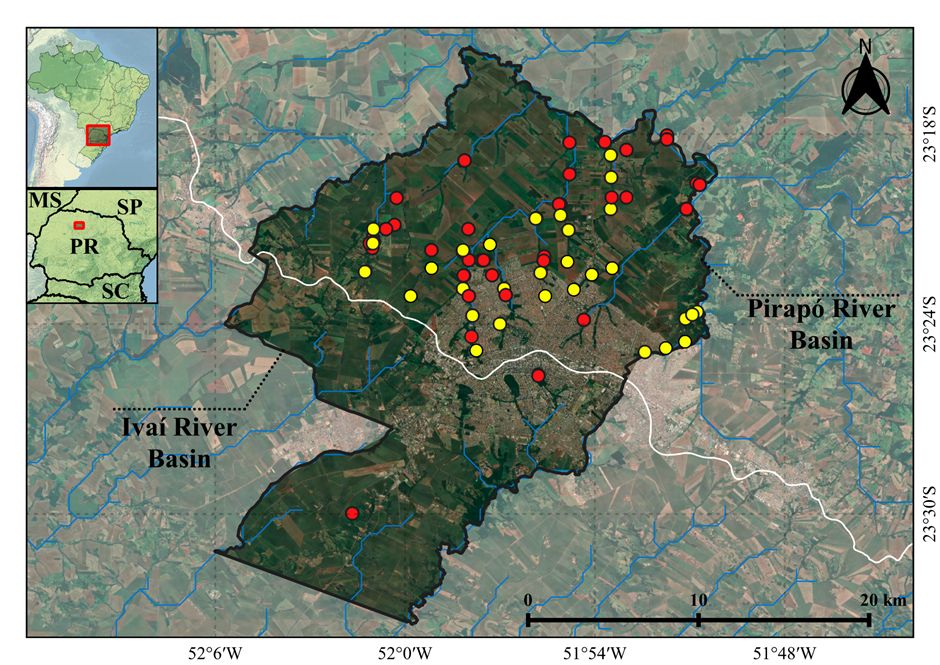
The Pirapó River drainage area is situated within the third plateau of Paraná State, extending over an area of 5,076 km2 (22°30' S/ 51°15' W; 23°30' S/ 52°15' W) (Maack, 2012). It encompasses the northern region within the state of Paraná. The river drains an area which is part of the Paranapanema sub-ecoregion, and is part of the Upper Paraná River System. The Ivaí River is a left bank tributary of the Paraná River in the Paraná State and has 35,845 km2 drainage area, which is approximately 685 km in length (Maack, 2012). The drainage of this basin has a dense network with many tributaries that compose its watershed, being the second largest in the Paraná State (Maack, 2012). This river is formed in the municipality of Ivaí by the confluence of the rivers Patos and São João (Santos et al., 2008), both in the State Park of Serra da Esperança, the divide between the second and third plateau of the Paraná State (Maack, 2012). Both rivers have headwaters and streams that comprise the municipality of Maringá, being part of the northwest region of the Paraná State (Figure 1).
Partial map of South America highlighting Brazil, Paraná State, and the limits of the municipality of Maringá (black lines in the bigger map). Yellow circles represent lots recorded by Cunico et al. (2009); red circles represent lots that were further recorded in the study area. White lines represent the limits of the Ivaí and Pirapó River basins. Abbreviations: PR, Paraná State; MS, Mato Grosso do Sul State; SP, São Paulo State; SC, Santa Catarina State.
2.2. Data collection
We compiled the records from the Maringá municipality housed in the Coleção Ictiológica do Nupélia (NUP), Maringá municipality, Paraná State, Brazil, available at SpeciesLink (2025) database, and compared them with the records of Cunico et al. (2009) for the same region (Figure 1). For each species, we cite its occurrence, specifying if it is native or non-native according to Reis et al. (2020a) or Ota et al. (2018), and the conservation status for each species uses the IUCN’s (2025) categories: Critically Endangered (CR), Endangered (EN), and Vulnerable (VU). A complete list is available in http://doi:10.48331/SCIELODATA.AP10VU.
Classification in taxonomic levels at family rank or higher ranks followed Fricke et al. (2025a). Modifications and updates in species names (as synonyms, validation) were accessed from Fricke et al. (2025b).
3. Results
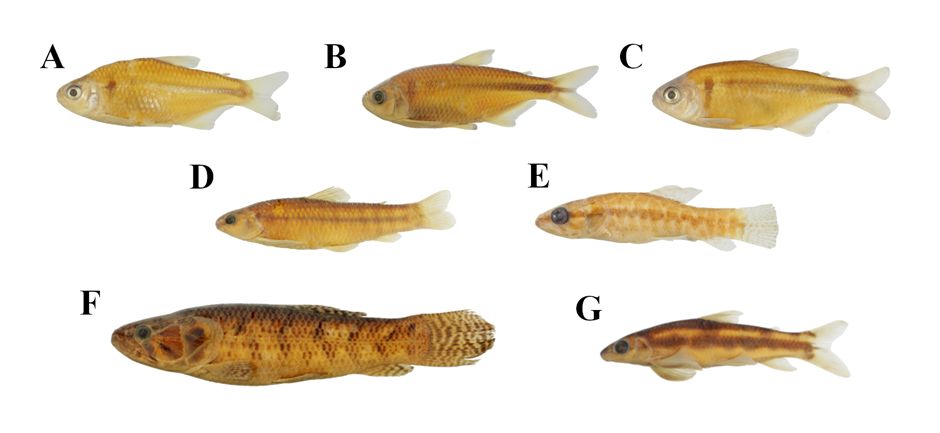
The focus of collection in the Pirapó River basin within Maringá municipality over the last 30 years has yielded a total of 538 lots housed in the NUP fish collection at the University of Maringá, Paraná, Brazil. Maringá streams house a total of 81 species distributed into 24 families and six orders. Characiformes are the richest order with 34 species (41.98%), followed by Siluriformes with 32 species (39.51%). Other orders comprise 15 species, 18.52% of the total species recorded for the region (Table 1). Seven possible new species are presented in Figure 2, and eleven species are non-native (7.36%). No species are under any threatened category of the IUCN. However, Bryconamericus coeruleus Jerep & Shibatta, 2017 is considered Near Threatened (NT).
List of fish species from the streams of Maringá municipality. Records of native and non-native species use Reis et al. (2020a) fish species list. IUCN Red List categories (no species are threatened): Least Concern (LC) and Near Threatened (NT). Even if the species are presented without the particle aff. on the IUCN website, putative new species are considered not available (NA). Losangle (♦) shows the same species captured in Cunico et al. (2009), “New” are new records added in relation to Cunico et al. (2009) after our analysis.
Probable new species from Maringá municipality streams: A) NUP 10585 Bryconamericus sp., 52.1 mm SL; B) NUP 6370 Psalidodon aff. fasciatus, 85.7 mm SL; C) NUP 13215 Psalidodon aff. paranae, 56.6; D) NUP 6007 Characidium aff. zebra, 59.2; E) NUP 5314 Hoplias aff. malabaricus, 30.3 mm SL; F) NUP 3833 Hoplias sp. 2, 157.7 mm SL; G) NUP 25206 Apareiodon aff. vladii, 47.5 mm SL.
4. Discussion
The fish fauna of streams in the municipality of Maringá exhibits relatively high species richness, especially considering that the sampled environments consist exclusively of low-order streams, in contrast to the broader Ivaí and Pirapó River basins. We recorded 81 species throughout all sampled rivers within the municipality of Maringá, whereas Frota et al. (2016) reported 118 species for the entire Ivaí River basin, and Pagotto et al. (2012) recorded 76 species for the Pirapó River basin. Moreover, our survey found 58 more species than those listed by Cunico et al. (2009) in tributaries of the Pirapó River drainage within the municipality of Maringá. Of the collected species, only Bryconamericus sp. was found exclusively in the tributaries of the Ivaí River basin in this study.
A detailed examination of the NUP fish collection revealed that some species were identical but listed under different names (see Table 1, third column). Conversely, five species reported by Cunico et al. (2009) were not confirmed in the NUP fish collection: Apareiodon sp., Hisonotus sp., Hypostomus aff. ancistroides (Ihering, 1911) (although H. ancistroides is on the current list, we did not find the proper lot could not be verified); Hypostomus aff. strigaticeps (Regan, 1908), Hypostomus sp. (specimens from Água Queçaba stream may correspond to H. strigaticeps). After excluding these five species and merging synonyms between the two lists, the most up-to-dated checklist of Maringá’s ichthyofauna includes 51 new records. Cyphocharax modestus was recorded for the Pirapó River Basin by Pagotto et al. (2012) but has not yet been registered by Reis et al. (2020a), such as the Bunocephalus hertzi (a paratype for the species) recently described. Additionally, in contrast to Reis et al. (2020a), Hoplosternum littorale can be considered native to the basin, following Langeani et al. (2007) and Ota et al. (2018).
Among the recorded taxa, seven are considered potential new species requiring further taxonomic investigation. Some belong to species complexes (i.e., morphologically similar groups that are genetically, geographically, and/or ecologically distinct). These include: (1) Characidium zebra, originally described from the Ireng River, Guyana (Eigenmann, 1909). Because of its general morphology common to species of the genus, having wide vertical bars along the side of the body, and a scaled isthmus. Characidium zebra complex occurs across several South American basins and probably complies several new species (Stabile pers. Comm.), and here we treated the population from the Upper Paraná River basin as C. aff. zebra. Similarly, (2) Hoplias malabaricus, whose type locality is probably in Suriname (Oyakawa, 2003), presents a broad distribution range and remarkable morphotypes variation throughout South American rivers. Bifi (2013) recognized a morphotype as H. cf. malabaricus for the Upper Paraná River basin, and here we treated it as H. aff. malabaricus. (3) Psalidodon paranae, described from the Tibagi River from Castro, in the Paraná State, Brazil [see Garutti & Britski (2000)], is known to display substantial variation in meristic characters commonly employed in species diagnoses within the genus. For this reason, we refer to highly variable specimens that retain the species’ diagnostic body pattern (ie., elongated shape, two humeral spots, and maximum body depth located one scale anterior to the origin of the dorsal fin) as P. aff. paranae; (4) Psalidodon fasciatus, with its type locality in the São Francisco River, differs from P. aff. fasciatus by the presence of an elongated dorsal fin on the first dorsal-fin ray of mature males (Melo, 2005; Melo & Buckup, 2006). The latter species complexes are found here (5) Apareiodon vladii, with its type locality in the Piquiri River basin (Pavanelli, 2006), not far from the sample points in this paper. Despite this, we considered the species as A. aff. vladii due to variation in premaxillary dentition, specifically the absence of pronounced median cusps.
In addition to these species complexes, we also identified (6) Hoplias sp. 2, which differs from members of the H. malabaricus group by presenting rounded margins formed by the scales at the base of the caudal peduncle, along with an abrupt reduction in scale size through mid to the tips of caudal-peduncle (Ota et al., 2018); and (7) Bryconamericus sp., distinguished from Bryconamericus species from the region by the body shape and height, the presence and configuration of the humeral blotch, and the dentition pattern of the premaxilla.
The introduction of non-native species into rivers already impacted by urbanization and physical alterations, poses as a major threat, as such degraded environments are often more vulnerable to biological invasions (Ricciardi, 2007, 2013; Simberloff et al., 2013; Daga et al., 2016; Garcia et al., 2018; Bueno et al., 2021). Non-native species are often found in urbanized areas, with introductions frequently linked to human activities (Esmaeili et al., 2010; Larentis et al., 2019). In many cases, this phenomenon reflects disregardless about the ecological consequences. A prominent example involves species associated with the aquarium trade or those intentionally released for mosquito control, such as Poecilia reticulata and Xiphophorus hellerii (Azevedo-Santos et al., 2017; Ota et al., 2018; Larentis et al., 2019).
Other examples include Steindachnerina brevipinna and Bryconamericus exodon, both non-native in the Upper Paraná River basin. The former appears to be associated with the construction and flooding of the Itaipu Reservoir, that submerged the Sete Quedas Falls, while the latter may have spread through the opening of the Piracema Channel (Júlio Júnior et al., 2009; Ota et al., 2018). Both species are now captured in tributaries far upstream from their probable points of introduction and are widespread elsewhere in the basin.
In addition, several non–native species are suspected to have been released in the rivers as live bait (e.g., Gymnotus inaequilabiatus, G. pantanal, G. sylvius, and Erythrinus erythrinus), while others likely escaped from fishponds or aquaculture activities in general (e.g., Oreochromis niloticus, and Coptodon rendalli) (Ota et al., 2018; Reis et al., 2020a). Another remarkable example is Iheringichthys labrosus, which is considered a non-native species by Ota et al. (2018) but considered native by Reis et al. (2020a), indicating ongoing uncertainty regarding the origin of some putative non-native species.
Some species that occur in streams of adjacent regions were not recorded in our samples (e.g., Ancistrus sp., Cambeva horacioi, Characidium sp., Hypostomus sp. 1). Their absence is most likely related to the limited sampling effort within the Ivaí River basin in the municipality of Maringá (see Figure 1). These taxa are considered restricted to the Ivaí River basin, reinforcing the high degree of endemism already documented for this drainage (Frota et al., 2016; Reis et al., 2020a, 2020b). Consequently, expanding ichthyological surveys to additional Ivaí River tributaries is expected to substantially increase the number of species recorded in the municipality of Maringá.
5. Conclusion
Our findings highlight that the Maringá’s streams ichthyofauna is both diverse and taxonomically complex, with a richness comparable to that of larger river basins. The possibility of seven new species highlights the importance of ongoing taxonomic investigations, particularly within poorly resolved species complexes. Meanwhile, the presence of multiple non-native species (e.g., introduced through aquarium releases, mosquito control, live bait, or aquaculture) illustrates how anthropogenic activities are reshaping local fish assemblages and increasing the ecological vulnerability of already impacted urban and rural streams. Furthermore, expanding ichthyological surveys, especially across additional tributaries of the Ivaí River basin, and in the Pirapó River basin in the municipality of Maringá, will not only refine the understanding of regional biodiversity and endemism but also provide critical information for the development of strategies to mitigate biological invasions and preserve native fish communities. With this updated checklist of freshwater fishes’ species from Maringá, we hope it will be a source of data for decision-makers and to be used in management and conservation plans in the region.
Acknowledgements
We are grateful to Marli Campos, Gabriela Reichardt and Marcelo H. F. Cardoso for technical support, Thiago H. Pedroso for identification of Bryconamericus and Piabarchus species, Nupélia and PEA for structure support, CAPES, CNPq, and FADEC for financial support. RCO has been supported by a technical scholarship (164/2024 PDI) from Fundação Araucária for the Research Project “NAPI Taxonline – Conservação da Biodiversidade e Aplicações Tecnológicas”. RBR has been supported by a postdoctoral scholarship from Fundação de Apoio ao Ensino, Extensão, Pesquisa e Pós–graduação (Fundep) UNIOESTE-Cascavel. WJG thanks the Conselho Nacional de Desenvolvimento Científico e Tecnológico (CNPq) for productivity scholarships granted (processes 305200/2018–6, 307089/2021–5, and 303571/2024–1). CSP is supported by Conselho Nacional de Desenvolvimento Científico e Tecnológico (CNPq) for produtivity scholarships granted (process 307124/2023-1).
Data availability
All research data analyzed in the research (supplementary material file) is available in the SciELO Dataverse Repository. Access is available for download. It can be accessed at http://doi:10.48331/SCIELODATA.AP10VU.
-
Cite as:
Oliveira, R.C. et al. Ichthyofauna of streams in Maringá municipality, Paraná, Brazil: an updated checklist, threats, and conservation perspectives. Acta Limnologica Brasiliensia, 2026, vol. 38, e4. https://doi.org/10.1590/S2179-975X7025
References
- Agostinho, A., Bini, L.M., Gomes, L.C., Júlio Júnior, H.F., Pavanelli, C.S., & Agostinho, C.S., 2004. Fish assemblages. In: Thomaz, S. M., Agostinho, A., & Hahn, N. S., eds. The upper Paraná river and its floodplain: physical aspects, ecology and conservation. Leiden: Backhuys Publishers, 223-246.
-
Agostinho, A.A., Pelicice, F.M., Petry, A.C., Gomes, L.C., & Júlio Júnior, H.F., 2007. Fish diversity in the upper Paraná River basin: habitats, fisheries, management and conservation. Aquat. Ecosyst. Health Manage. 10(2), 174-186. https://doi.org/10.1080/14634980701341719
» https://doi.org/10.1080/14634980701341719 -
Azevedo-Santos, V.M., Vitule, J.R.S., Pelicice, F.M., García-Berthou, E., & Simberloff, D., 2017. Nonnative fish to control Aedes mosquitoes: a controversial, harmful tool. Bioscience 67(1), 84-90. https://doi.org/10.1093/biosci/biw156
» https://doi.org/10.1093/biosci/biw156 - Bifi, A.G., 2013. Revisão taxonômica das espécies do grupo Hoplias malabaricus (Bloch, 1794) (Characiformes: Erythrinidae) da bacia do rio da Prata [Tese de doutorado em Ecologia de Ambientes Aquáticos Continentais]. Maringá: Universidade Estadual de Maringá.
-
Bueno, M.L., Magalhães, A.L.B., Andrade Neto, F.R., Alves, C.B.M., Rosa, D.M., Junqueira, N.T., Pessali, T.C., Pompeu, P.S., & Zenni, R.D., 2021. Alien fish fauna of southeastern Brazil: species status, introduction pathways, distribution and impacts. Biol. Invasions 23(10), 3021-3034. https://doi.org/10.1007/s10530-021-02564-x
» https://doi.org/10.1007/s10530-021-02564-x -
Cavalli, D., Frota, A., Lira, A.D., Gubiani, É.A., Margarido, V.P., & Graça, W.J.D., 2018. Update on the ichthyofauna of the Piquiri River basin, Paraná, Brazil: a conservation priority area. Biota Neotrop. 18(2), e20170350. https://doi.org/10.1590/1676-0611-bn-2017-0350
» https://doi.org/10.1590/1676-0611-bn-2017-0350 -
Cunico, A.M., Graça, W.J., Agostinho, A.A., Domingues, W.M., & Latini, J.D., 2009. Fish, Maringá urban streams, Pirapó River drainage, upper Paraná River basin, Paraná state, Brazil. Check List 5(2), 273. https://doi.org/10.15560/5.2.273
» https://doi.org/10.15560/5.2.273 -
Daga, V., Debona, T., Abilhoa, V., Gubiani, É.A., & Vitule, J., 2016. Non-native fish invasions of a Neotropical ecoregion with high endemism: a review of the Iguaçu River. Aquat. Invasions 11(2), 209-223. https://doi.org/10.3391/ai.2016.11.2.10
» https://doi.org/10.3391/ai.2016.11.2.10 -
Dagosta, F.C.P., Monção, M.S., Nagamatsu, B.A., Pavanelli, C.S., Carvalho, F.R., Lima, F.C., Langeani, F., Dutra, G.M., Ota, R.R., Seren, T.J., Tagliacollo, V., Menezes, N.A., Britski, H.A., & Pinna, M., 2024. Fishes of the upper rio Paraná basin: diversity, biogeography and conservation. Neotrop. Ichthyol. 22(1), e230066. https://doi.org/10.1590/1982-0224-2023-0066
» https://doi.org/10.1590/1982-0224-2023-0066 -
Eigenmann, C.H., 1909. Reports on the expedition to British Guiana of the Indiana University and the Carnegie Museum, 1908. Report no. 1. Some new genera and species of fishes from British Guiana. Ann. Carnegie Mus. 6(1), 4-54. https://doi.org/10.5962/p.331035
» https://doi.org/10.5962/p.331035 -
Esmaeili, H.R., Gholamifard, A., Teimori, A., Baghbani, S., & Coad, B.W., 2010. Xiphophorus hellerii Heckel, 1848 (Cyprinodontiformes, Poeciliidae), a newly introduced fish recorded from natural freshwaters of Iran. J. Appl. Ichthyology 26(6), 937-938. https://doi.org/10.1111/j.1439-0426.2010.01515.x
» https://doi.org/10.1111/j.1439-0426.2010.01515.x -
Fricke, R., Eschmeyer, W.N., & Fong, J.D., 2025a. Species by family/subfamily [online]. Retrieved in 2025, August 27, from http://researcharchive.calacademy.org/research/ichthyology/catalog/SpeciesByFamily.asp
» http://researcharchive.calacademy.org/research/ichthyology/catalog/SpeciesByFamily.asp -
Fricke, R., Eschmeyer, W.N., & van der Laan, R., 2025b. Catalog of fishes: genera, species, references [online]. Retrieved in 2025, August 27, from http://researcharchive.calacademy.org/research/ichthyology/catalog/fishcatmain.asp
» http://researcharchive.calacademy.org/research/ichthyology/catalog/fishcatmain.asp -
Frota, A., & Graça, W.J., 2025. Establishing new grid‐size‐dependent attributes to rank areas of endemism for conservation priorities. Cladistics 41(5), 493-512. PMid:40538062. https://doi.org/10.1111/cla.70002
» https://doi.org/10.1111/cla.70002 -
Frota, A., Deprá, G.D.C., Petenucci, L.M., & Graça, W.J.D., 2016. Inventory of the fish fauna from Ivaí River basin, Paraná State, Brazil. Biota Neotrop. 16(3), e20150151. https://doi.org/10.1590/1676-0611-BN-2015-0151
» https://doi.org/10.1590/1676-0611-BN-2015-0151 -
Frota, A., Ota, R.R., Deprá, G.C., Ganassin, M.J.M., & Graça, W.J., 2020. A new inventory for fishes of headwater streams from the rio das Cinzas and rio Itararé basins, rio Paranapanema system, Paraná, Brazil. Biota Neotrop. 20(1), 1-12. https://doi.org/10.1590/1676-0611-bn-2019-0833
» https://doi.org/10.1590/1676-0611-bn-2019-0833 -
Frota, A., Pacifico, R., & da Graça, W.J., 2021. Selecting areas with rare and restricted fish species in mountain streams of Southern Brazil. Aquat. Conserv. 31(6), 1269-1284. https://doi.org/10.1002/aqc.3566
» https://doi.org/10.1002/aqc.3566 -
Frota, A., Ganassin, M.J.M., Pacifico, R., Gomes, L.C., & Graça, W.J., 2022. Spatial distribution patterns and predictors of fish beta-diversity in a large dam-free tributary from a Neotropical floodplain. Ecohydrology 15(2), e2376. https://doi.org/10.1002/eco.2376
» https://doi.org/10.1002/eco.2376 -
Garcia, D.A.Z., Britton, J.R., Vidotto-Magnoni, A.P., & Orsi, M.L., 2018. Introductions of non-native fishes into a heavily modified river: rates, patterns and management issues in the Paranapanema River (Upper Paraná ecoregion, Brazil). Biol. Invasions 20(5), 1229-1241. https://doi.org/10.1007/s10530-017-1623-x
» https://doi.org/10.1007/s10530-017-1623-x - Garutti, V., & Britski, H.A., 2000. Descrição de uma espécie nova de Astyanax (Teleostei: Characidae) da bacia do alto Rio Paraná e considerações sobre as demais espécies do gênero na bacia. Comunicação Museu Ciências PUCRS Ser. Zool. 13, 65-88.
- Graça, W.J., & Pavanelli, C.S., 2007. Peixes da planície de inundação do alto rio Paraná e áreas adjacentes. Maringá: EDUEM, 241 p.
-
International Union for Conservation of Nature and Natural Resources – IUCN, 2025 [online]. Retrieved in 2025, August 27, from https://www.iucnredlist.org/
» https://www.iucnredlist.org/ -
Jarduli, L.R., Garcia, D.A.Z., Vidotto-Magnoni, A.P., Casimiro, A.C.R., Vianna, N.C., Almeida, F.S.D., Jerep, F.C., & Orsi, M.L., 2019. Fish fauna from the Paranapanema River basin, Brazil. Biota Neotrop. 20(1), e20180707. https://doi.org/10.1590/1676-0611-bn-2018-0707
» https://doi.org/10.1590/1676-0611-bn-2018-0707 -
Júlio Júnior, H.F., Dei Tós, C., Agostinho, Â.A., & Pavanelli, C.S., 2009. A massive invasion of fish species after eliminating a natural barrier in the upper rio Paraná basin. Neotrop. Ichthyol. 7(4), 709-718. https://doi.org/10.1590/S1679-62252009000400021
» https://doi.org/10.1590/S1679-62252009000400021 -
Langeani, F., Castro, R.M.C., Oyakawa, O.T., Shibatta, O.A., Pavanelli, C.S., & Casatti, L., 2007. Diversidade da ictiofauna do Alto Rio Paraná: composição atual e perspectivas futuras. Biota Neotrop. 7(3), 182-197. https://doi.org/10.1590/S1676-06032007000300020
» https://doi.org/10.1590/S1676-06032007000300020 -
Larentis, C., Baldasso, M.C., Kliemann, B.C.K., Neves, M.P., Zavaski, A.G., Sandri, L.M., Ribeiro, A.C., Xavier, D.P., Costa, G., & Delariva, R.L., 2019. First record of the non-native Xiphophorus hellerii (Cyprinodontiformes: Poeciliidae), in the Iguazu River Basin, Paraná, Brazil. J. Appl. Ichthyology 35(5), 1164-1168. https://doi.org/10.1111/jai.13965
» https://doi.org/10.1111/jai.13965 - Maack, R. 2012. Geografia física do estado do Paraná, 4th ed. Ponta Grossa: UEPG, 526 p.
- Melo, F.A.G. 2005. Revisão taxonômica do complexo de espécies Astyanax fasciatus (Cuvier, 1819) (Teleostei: Characiformes: Characidae) [Tese de doutorado]. Rio de Janeiro: Universidade Federal do Rio de Janeiro.
-
Melo, F.A.G., & Buckup, P.A., 2006. Astyanax henseli, a new name for Tetragonopterus aeneus Hensel, 1870 from southern Brazil (Teleostei: characiformes). Neotrop. Ichthyol. 4(1), 45-52. https://doi.org/10.1590/S1679-62252006000100003
» https://doi.org/10.1590/S1679-62252006000100003 -
Morais-Silva, J.P., Oliveira, A.V.D., Fabrin, T.M., Diamante, N.A., Prioli, S.M., Frota, A., Graça, W.J.D., & Prioli, A.J., 2018. Geomorphology influencing the diversification of fish in small-order rivers of neighboring basins. Zebrafish 15(4), 389-397. PMid:29653071. https://doi.org/10.1089/zeb.2017.1551
» https://doi.org/10.1089/zeb.2017.1551 -
Ota, R.R., Deprá, G. de C., Graça, W.J., & Pavanelli, C.S., 2018. Peixes da planície de inundação do alto rio Paraná e áreas adjacentes: revised, annotated and updated. Neotrop. Ichthyol. 16(2), 1-111. https://doi.org/10.1590/1982-0224-20170094
» https://doi.org/10.1590/1982-0224-20170094 - Oyakawa, O.T., 2003. Family Erythrinidae. In: Reis, R., Kullander, S., & Ferraris, C. J., eds. Check list of the freshwater fishes of South and Central America. Porto Alegre: Edipucrs, 238-240.
-
Pagotto, J.P.A., Veríssimo, S., Goulart, E., & Mise, F.T., 2012. Fishes (Osteichthyes : Actinopterygii) from the Pirapó River drainage, upper Paraná River basin, Paraná state, Brazil. Check List 8(3), 463-468. https://doi.org/10.15560/8.3.463
» https://doi.org/10.15560/8.3.463 -
Pavanelli, C.S., 2006. New species of Apareiodon (Teleostei: Characiformes: Parodontidae) from the Rio Piquiri, upper Rio Paraná basin, Brazil. Copeia 2006(1), 89-95. https://doi.org/10.1643/0045-8511(2006)006[0089:NSOATC]2.0.CO;2
» https://doi.org/10.1643/0045-8511(2006)006[0089:NSOATC]2.0.CO;2 -
Pessoa, L.A., Baumgartner, M.T., Frota, A., Garcia, T.D., Júnior, M.P.S., Pessoa, L.G.A., & Goulart, E., 2025. Urban land use homogenizes fish assemblages across mesohabitats in headwater streams. Aquat. Sci. 87(2), 34. https://doi.org/10.1007/s00027-025-01162-6
» https://doi.org/10.1007/s00027-025-01162-6 -
Reis, R.B., Stabile, B.H., Frota, A., Ferrer, J., Oliveira, A., & Graça, W.J., 2025. Recent dispersion routes between freshwater ecoregions evidence headwater captures in southern Brazil: a case study using cryptic species of the neotropical freshwater fish genus Cambeva (Siluriformes: Trichomycteridae). Hydrobiologia 852(4), 873-890. https://doi.org/10.1007/s10750-024-05731-y
» https://doi.org/10.1007/s10750-024-05731-y -
Reis, R.B., Frota, A., Fabrin, T.M.C., & Graça, W.J., 2020a. A new species of Cambeva (Siluriformes, Trichomycteridae) from the Rio Ivaí basin, Upper Rio Paraná basin, Paraná State, Brazil. J. Fish Biol. 96(2), 350-363. PMid:31725918. https://doi.org/10.1111/jfb.14204
» https://doi.org/10.1111/jfb.14204 -
Reis, R.B., Frota, A., Deprá, G. C., Ota, R.R., & Graça, W.J., 2020b. Freshwater fishes from Paraná state, Brazil: an annotated list, with comments on biogeographic patterns, threats, and future perspectives. Zootaxa 4868(4), 451-494. PMid:33311378. https://doi.org/10.11646/zootaxa.4868.4.1
» https://doi.org/10.11646/zootaxa.4868.4.1 -
Ricciardi, A., 2007. Are modern biological invasions an unprecedented form of global change? Conserv. Biol. 21(2), 329-336. PMid:17391183. https://doi.org/10.1111/j.1523-1739.2006.00615.x
» https://doi.org/10.1111/j.1523-1739.2006.00615.x -
Ricciardi, A., 2013. Invasive Species. In: Leemans, R., eds, Ecological systems. Springer: New York, NY, 5547-5560. https://doi.org/10.1007/978-1-4614-5755-8_10
» https://doi.org/10.1007/978-1-4614-5755-8_10 -
Santos, M.L., Lenzi, E., & Coelho, A.R., 2008. Ocorrência de metais pesados no curso inferior do rio Ivaí, em decorrência do uso do solo em sua bacia hidrográfica. Trends Ecol. Evol. 30(1), 99-107. https://doi.org/10.4025/actascitechnol.v30i1.3219
» https://doi.org/10.4025/actascitechnol.v30i1.3219 -
Simberloff, D., Martin, J.-L., Genovesi, P., Maris, V., Wardle, D.A., Aronson, J., Courchamp, F., Galil, B., García-Berthou, E., Pascal, M., Pyšek, P., Sousa, R., Tabacchi, E., & Vilà, M., 2013. Impacts of biological invasions: what’s what and the way forward. Trends Ecol. Evol. 28(1), 58-66. PMid:22889499. https://doi.org/10.1016/j.tree.2012.07.013
» https://doi.org/10.1016/j.tree.2012.07.013 -
SpeciesLink, 2025 [online]. Retrieved in 2025, August 27, from http://splink.cria.org.br
» http://splink.cria.org.br -
Vitule, J.R.S., Freire, C.A., & Simberloff, D., 2009. Introduction of non-native freshwater fish can certainly be bad. Fish Fish. 10(1), 98-108. https://doi.org/10.1111/j.1467-2979.2008.00312.x
» https://doi.org/10.1111/j.1467-2979.2008.00312.x -
Walsh, C.J., Roy, A.H., Feminella, J.W., Cottingham, P.D., Groffman, P.M., & Morgan 2nd, R.P., 2005. The urban stream syndrome: current knowledge and the search for a cure. J. N. Am. Benthol. Soc. 24(3), 706-723. https://doi.org/10.1899/04-028.1
» https://doi.org/10.1899/04-028.1
Edited by
-
Associate Editor:
Ronaldo Angelini.