 Performance of pineapple cultivars inoculated with Fusarium guttiforme isolates on different substrates
ABSTRACT.
Fusariosis in pineapples causes significant losses to producers. Knowing practices that reduce disease severity is important, as cultivation in Brazil mainly relies on the susceptible cultivar ‘Pérola’. Therefore, this study aimed to analyse the vegetative development and severity of fusariosis in different pineapple cultivars inoculated with Fusarium guttiforme isolates in various substrates. Isolates were collected and inoculated into ‘Pérola’ and ‘BRS Imperial’ cultivars planted in different substrates. Vegetative characteristics and disease severity were assessed. Evaluations were carried out fortnightly over 120 days. A randomised block design was used in a triple factorial arrangement 5 x 2 x 3 (five isolates x two cultivars x three substrates). Data were analysed using Sisvar software. The cultivars showed distinct vegetative development, with ‘Pérola’ being susceptible to all isolates, displaying reduced plant height, leaf D length and width, and number of active leaves. The pineapple leaf D is used to measure plant growth and nutritional status. Isolates 3 and 7 led to the death of several ‘Pérola’ plants. The substrate that favoured the highest disease severity was composed of sand and soil in a 3:1 ratio. The ‘‘BRS Imperial’’ cultivar showed resistance to all isolates and substrates. Finally, pineapple cultivation will develop better in substrates with favourable physico-chemical compositions and proper fertilisation. The ‘BRS Imperial’ cultivar is viable for producers as it is resistant to fusariosis and can withstand abiotic stress conditions.
Keywords:
Ananas comosus; vegetative growth; fusariosis; soil types
Introduction
Pineapple (Ananas comosus L. Merril var. comosus) is considered one of the most important tropical fruits, with its commercialisation expanding globally. The largest producers are Indonesia (over 32 tonnes), the Philippines, Costa Rica (over 29 tonnes each), and Brazil (over 23 tonnes) (Food and Agriculture Organization, 2022).
Pineapple stands out among the various fruit crops grown in Brazil, where it is sold primarily in its fresh form. It reached a total production of more than 15 million fruits, covering more than 64 thousand hectares of harvested land in the country (Instituto Brasileiro de Geografia e Estatística, 2022). Brazil's conditions for pineapple production present comparative advantages over competing countries due to favourable climatic conditions, good soil quality, and the extensive availability of land for cultivation (Leal et al., 2009).
The ‘Smooth Cayenne’ and ‘Pérola’ cultivars are the most widely grown worldwide and in Brazil, respectively. However, several factors influence the final production of this crop, including diseases. Fusariosis (Fusarium guttiforme Nirenberg and O'Donnell) is the disease responsible for the most significant economic losses, causing up to 100% damage to fruit production (Ventura & Zambolin, 2002).
This disease causes variable losses in fruit production; infection occurs at all phenological stages of the crop, causing rot in the affected tissues, with exudation of gummy matter from the affected region (Ventura & Zambolin, 2002). The most characteristic symptoms of the disease are morphological changes, as well as exudation of gummy or resinous substance, affecting not only the fruit, but also the entire plant and its seedlings that are used as planting material (Pissarra et al., 1979).
This pathogen penetrates its hosts through natural or harmful openings, and can infect all parts of the plant, but is most destructive when it occurs in the fruit. The fungus survives in suckers, seedlings and crowns that become infected while still attached to the mother plant. Infected planting material can be easily carried to the field, thus constituting the initial inoculum for a new planting area. Once introduced into an area, fusariosis is disseminated to new plants by rain splash, wind (Matos et al., 1981) and insects (Aguilar & Sanches, 1982; Costa & Lordelo, 1988).
In addition to fusariosis being the main disease in the crop in Brazil, there are several other factors that contribute to its increase, such as the type of soil used for planting. Although pineapple plants grow well in most types of soil, clayey soils (above 35% clay) can be used for planting pineapple plants, as long as they have good aeration and drainage conditions. Sandy soils can also be used for pineapple cultivation. However, they almost always require agricultural management practices that improve their water and nutrient retention capacity, which is usually low (Sanches & Matos, 2013).
However, studies relating the use of organic or non-organic substrates to the disease are still scarce. Alves & Nunes (2008), evaluating the survival of Fusarium subglutinans f. sp. ananas in soils, discovered that the sandy-textured Yellow Latosol, with 45.7% fine sand, 39.5% coarse sand, 8.7% silt, and 6.06% clay, was the one that most favored the development of the pathogen, therefore it is understood that a sandy-textured Yellow Latosol soil favors the disease fusariosis, due to the increase in the number of colonies observed in it.
In light of this, the objective of this study was to analyse the vegetative development and severity of fusariosis in different pineapple cultivars inoculated with Fusarium guttiforme isolates in various substrates.
Material and methods
The experiment was conducted in a greenhouse at the experimental field of the Mato Grosso State University, Carlos Alberto Reyes Maldonado - UNEMAT, Tangará da Serra Campus (14°39' S, 57°25' W, altitude 321 m) and in the Phytopathology Laboratory at the same campus's Centre for Agro-environmental Research and Development (CPEDA).
Three substrates were used: substrate 1: fine sand; substrate 2: soil and sand in a 3:1 ratio with added organic fertiliser (chicken manure), potassium chloride, lime, and monoammonium phosphate (MAP); and substrate 3: soil and sand in a 1:1 ratio. Substrate 2 was prepared two weeks before planting to allow the organic fertiliser to decompose.
A physical and chemical analysis of the substrates was performed. Soil was collected with the aid of an auger to a depth of 0-20 cm. Granulometric analysis (total dispersion) for the physical analysis was conducted according to Donagema et al. (2011). Based on the results, the three substrates were classified using the textural classification triangle of Santos et al. (2018) (Table 1). Chemical analysis (Table 2) was carried out following the methodology of Silva et al. (2009).
For planting, seedlings of the pup type from two pineapple cultivars were used: ‘Pérola’ (susceptible) and ‘BRS Imperial’ (resistant), measuring 15 to 30 cm, collected from the Active Germplasm Bank at the Mato Grosso State University campus located in Tangará da Serra.
Twelve isolates were collected from the region of Tangará da Serra, Mato Grosso State, Brazil, which were characterised by morphological analysis using a stereomicroscope and optical microscope, observing the production of hyaline macroconidia, characterised by having differentiated basal and apical cells. The presence of microconidia, generally obovoid, was also noted. However, the main characteristics of this pathogen are the production of microconidia in polyphialides, always in false heads, and the absence of chlamydospores (Kimati et al., 2005).
After morphological characterization, a pathogenicity test was carried out on detached D leaves using the contaminated toothpick technique with the fungus mycelium to select the most virulent isolates. Of the 12 isolates tested, the five most aggressive were 1, 3, 4, 6, and 7, which were used in this study. Subsequently, a spore suspension of each isolate was made from pure colonies grown on Petri dishes containing PDA medium and stored at 25ºC with a 12-hour photoperiod. A 20 mL aliquot of Sterile Distilled Water (SDW) was added, and scraping was done using a Drigalski spatula. The suspended material was adjusted to a concentration of 1.6 x 10⁵ conidia mL-1 using a Neubauer haemocytometer.
For inoculation, three to four holes were made in the plant's stem with a piercing instrument, followed by immersion for three minutes in the conidial suspension of each Fusarium guttiforme isolate (Souto & Matos, 1978). The planting was done in plastic pots 20 cm high, containing 3.5 kg of substrate, and kept in a greenhouse for 120 days with regulated temperature and humidity. The constant temperature was 25ºC, with daily irrigation by micro-sprinkling.
Assessments of fusariosis severity were carried out every 15 days after inoculation, totalling 8 evaluations, considering the adapted rating scale suggested by Santos et al. (2002), ranging from 0 to 5, where: 0 = No symptoms, 1 = Initial exudation, 2 = Mild exudation, 3 = Marked exudation, 4 = Necrotic basal leaves starting to wilt, 5 = Severe wilting with plant death.
The scores in each plot were converted into the Disease Index (DI) proposed by McKinney (1923), according to the equation below:
where DI = disease index; f = number of plants with a certain score; v = observed score; n = total number of plants evaluated; x = maximum score on the scale. Based on the DI over time for each plot, the Area Under the Disease Progress Curve (AUDPC) (Campbell & Madden, 1990) was calculated using the following formula:
where yi and yi+1 are the measurements taken at evaluations i and i+1, and ti and ti+1 correspond to the time in days at i and (i+1), and n represents the total number of evaluations (Shaner & Finney, 1977).
The following morphological descriptors were also evaluated: plant height: measured from the soil to the highest leaf; D leaf length: measured in centimetres from its insertion in the stem to the tip of the leaf; D leaf maximum width: measured from one margin to the other at the widest part of the leaf; and number of active leaves: counting the number of active leaves on the plant. Active leaves refers to leaves that are performing important physiological functions, such as photosynthesis, which is essential for plant growth and development. This morpho-agronomic characterization followed the pineapple germplasm characterization and evaluation catalogue (Queiroz et al., 2002), evaluated 120 days after planting.
A factorial scheme of 2 x 5 x 3 was used, with two pineapple cultivars, five fungus isolates, and three substrates, totalling 30 treatments plus an additional control (without fungus inoculation). The experimental design was a randomised block design (RBD) with three replications, with three plants per plot. For statistical analysis, the means were compared by the Scott-Knott test at 5% probability, using the SISVAR software (Ferreira, 2019), where data transformations of "√(Y + 0.5)" were performed to improve the normality of the data.
Results and discussion
There was a significant difference in relation to the isolates and genotypes for all variables, and there was also significance for the interaction between isolates × genotypes, except for the number of active leaves. This indicates that the isolates influence the vegetative characteristics of the plants, where the disease causes initial symptoms of leaf wilting, consequently reducing the length and width of the leaves and the height of the plants. The substrates also influenced the development of the cultivars, with poorer nutrient substrates leading to slow plant growth, which in turn interferes with the disease's development. In the interaction among the three factors, the influence was only observed for the severity of Fusarium wilt (Table 3).
The significant interaction between isolates × genotypes for vegetative variables and those related to Fusarium wilt demonstrates that the pathogenicity of the isolates, along with the presence or absence of nutrients in the soil, interferes with plant growth. The pineapple plant is considered to be demanding in mineral nutrients (Souza & Oliveira, 2021), and its nutritional status greatly influences its vegetative development, production, and fruit quality (Teixeira et al., 2002). Therefore, the combination of a nutrient-poor soil with pathogenic isolates hampers the plant's ability to defend against pest and disease attacks, affecting the severity and progress of the disease, which may be more severe in susceptible genotypes and with more pathogenic isolates.
In the severity variable, which corresponds to the score at 120 days post-inoculation, the significant interaction between substrate × genotype and isolate × substrate × genotype indicated that the severity of Fusarium wilt is influenced when interacting with other factors, where pathogenic isolates of Fusarium guttiforme may have their virulence inhibited when associated with resistant cultivars and appropriate substrates for the crop, thereby minimising disease symptoms (Table 4).
In the breakdown of the interaction between isolates × genotypes, the variables plant height, leaf length and width, severity, and AUDPC showed better results in the ‘BRS Imperial’ cultivar (Table 4). It is believed that since this cultivar is resistant to Fusarium wilt, its vegetative development is not influenced as observed in the ‘Pérola’ cultivar.
The most aggressive isolates regarding symptom expression in the susceptible genotype were 3, 4, and 7 for severity, and 3 and 7 for AUDPC, with the latter showing more pathogenicity, as they caused an increase in severity and consequently in the AUDPC of the disease, indicating significant progress in both variables when compared to the control. These same isolates also caused reductions in plant height, leaf length, and width in the susceptible cultivar, with isolates 3 and 4 statistically differing from isolate 7. This occurred because the symptoms of Fusarium wilt include curvature of the apex and shortening of the stem, alteration of the leaf rosette, death of the stem apex, and stunting (lack of development, with leaves appearing short, upright, hard, and brittle) (Matos & Sanches, 2007). Isolate 7, being one of the most pathogenic, caused the greatest reductions in the vegetative development of the ‘Pérola’ cultivar (Table 4).
Regarding the disease, isolate 6 behaved as the least virulent, not differing from the control, which also exhibited disease symptoms (Table 4). Since pineapple seedlings are generally infected in the early stages of development, while still attached to the mother plant that bears diseased fruit, symptoms in the initial stages of the disease are not very noticeable (Ventura & Zambolin, 2002). Perhaps this is why the control exhibited symptoms, serving as a control witness, demonstrating how the disease occurs in the field, and providing a comparison with the tested isolates.
As the main cultivars planted in Brazil are ‘Pérola’, for its sweeter and less acidic flavour, and Smooth Cayenne, due to its external characteristics and pulp colour, both susceptible to Fusarium wilt, the ‘BRS Imperial’ cultivar is recommended for planting in regions where Fusarium wilt is a limiting factor for production. Due to its resistance to the disease, planting this cultivar eliminates the need for fungicides, enabling a reduction in production costs, as well as contributing to lower environmental contamination and increased food security (Cabral & Matos, 2007).
Analysing the interaction between substrates × genotypes, it was significant for the variables plant height, leaf width, and severity of Fusarium wilt. Substrates 1 and 2, by causing greater disease severity and favouring pathogen development in the ‘Pérola’ cultivar (susceptible), ultimately reduced plant height and leaf width (Table 4). For the ‘Pérola’ genotype, substrates 1 and 2 promoted the disease more acutely, whereas substrate 3 had a milder effect.
For the resistant genotype, ‘BRS Imperial’, the three substrates did not influence severity and therefore did not affect the vegetative characteristics, indicating that any of the tested substrates could be used for this genotype. However, the nutritional needs of the plant should always be taken into consideration, as inadequate nutrition can influence production (Table 5). This demonstrates that the choice of substrate can impact disease severity, potentially becoming a limiting factor in the development and production of the crop.
The composition of substrate 3 (Table 1) aligns with the type of soil recommended for the crop, as Souza (1999) states that soils with a medium texture (15% to 35% clay) and more than 15% sand are most suitable for the crop, while soils with over 70% sand are also recommended, often requiring agricultural management practices to improve their water and nutrient retention capacity. Perhaps this is why it performed better in reducing disease (Table 5).
Substrate 2 (loamy sandy soil), while presenting adequate conditions for pineapple development, may have had poor aeration and drainage conditions, as higher amounts of clay and silt in the soil favour water retention, leading to waterlogging, which the pineapple is very sensitive to, potentially hindering its growth and production and promoting the onset of diseases. In contrast, substrate 1, composed solely of sand (sandy soil), does not meet the edaphic requirements of the crop (Table 1), as it promotes waterlogging and is nutrient-poor. These substrates, in addition to promoting pathogen development, hindered plant growth.
In their research, Alves and Nunes (2008), evaluating the survival of Fusarium subglutinans f.sp. ananas in soils, found that Yellow Latosol with a sandy texture, having 85.2% total sand, 8.7% silt, and 6.1% clay, was most conducive to pathogen development. Thus, it is understood that this type of soil favours Fusarium wilt by increasing the number of colonies present. These results are consistent with those observed in the present work for substrates 1 and 2 (Table 5).
Clayey soils with a texture above 35% clay can be used for pineapple planting, provided they have good aeration and drainage conditions, as occurs, for example, in most clayey Latosols. Sandy soils can also be used for pineapple cultivation but generally require agricultural management practices to enhance their water and nutrient retention capacity, which is usually low. The area must not remain waterlogged for extended periods, as very moist conditions can lead to disease outbreaks that may destroy the crop.
It is also known that a plant's nutritional status can increase or decrease its resistance to pests and diseases (Marschner, 1986), being one of the main factors responsible for triggering defence mechanisms. In this context, substrate 2, enriched with nutrients, was not effective in controlling the disease in the ‘Pérola’ genotype, presenting a severity similar to that of substrate 1, which did not contain nutrients. However, as ‘Pérola’ is a susceptible genotype, the disease will manifest itself regardless of its nutritional condition.
Another important factor is the pH of the substrates. The pH was alkaline in all of them (Table 2). It is crucial that the soil pH is maintained in the range of 4.5 to 5.5, which are the ideal values for pineapple cultivation. Higher pH values can limit the availability of micronutrients for the plant (zinc, copper, iron, and manganese) and contribute to the development of harmful microorganisms for the pineapple, such as fungi from the genus Phytophthora (Matos et al., 2006). However, the cultivar ‘Pérola’ is susceptible, which implies that, regardless of the soil pH, there is a high probability of symptom expression. Therefore, pH correction is not necessary in this case.
Relating the vegetative variables to the isolates and the severity of the disease (Tables 4 and 5), it can be noted that the cultivar ‘Pérola’ suffers more from these external factors, causing harm to the crop, which can lead to plant death. However, the cultivar ‘BRS Imperial’, being a resistant genotype to fusarium wilt, is not affected by the substrate factors and Fusarium isolates, which do not interfere with the growth of the plant or the aggressiveness of the disease. Therefore, this cultivar becomes interesting and viable for cultivation in areas where the disease is prevalent and in more acidic soils, in addition to having spiny-free leaves and being well-accepted due to the excellent physico-chemical characteristics of its fruits (Cabral & Matos, 2007; Viana et al., 2013).
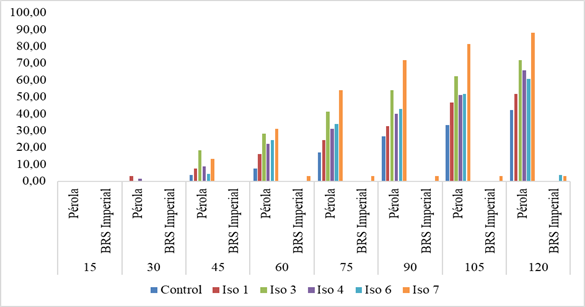
From the severity data, a progress curve for the severity of fusarium wilt in the two tested genotypes was constructed (Figure 1). This shows the susceptibility of the ‘Pérola’ genotype reaching nearly 90% severity, and the resistance of ‘BRS Imperial’, which did not even reach 4% concerning the tested isolates (Figure 1). This low severity of the disease in the resistant cultivar highlights its genetic resistance, demonstrating that the plant activated defence mechanisms upon contact with the pathogen, where even in the presence of more aggressive isolates, the combat against the pathogen was effective.
Progress curve of the severity of Fusarium wilt in the pineapple for the ‘Pérola’ and ‘BRS Imperial’ genotype in relation to the 5 tested isolates plus the control, compared to the evaluation days.
Factors such as inoculum pressure, pathogenicity, and cultivar susceptibility also affect the disease index. It is essential to understand the mechanisms of plant-pathogen interaction so that strategies can be established for selecting the best methods for disease management (Aquije et al., 2010). In a genotype susceptible to the disease, there are no barriers in the plant to prevent pathogen infection, as is the case in resistant genotypes; therefore, the development of the plant is compromised in susceptible cultivars. Thus, understanding the interactions discovered here is important for developing management strategies for Fusarium wilt.
Conclusion
The severity of Fusarium wilt is influenced by different substrates when they do not meet the demands of the crop, whether nutritional or in terms of the physical properties of the soil. The disease can worsen in susceptible genotypes, reducing the vegetative development of the plants and, depending on the pathogenicity of the isolates, may lead to plant death. Thus, these results are the first reports on the influence of substrates on Fusarium wilt and the vegetative development of plants with different pathogenic isolates, highlighting the need for complementary studies to clarify important questions for pineapple cultivation.
Data availability
Does not apply.
Acknowledgements
To the Foundation for Research Support of the State of Mato Grosso and the Mato Grosso State University.
References
- Aguilar, J. A. E. & Sanches, N. F. (1982). Disseminação de Fusarium moniliforme var. subglutinans do abacaxizeiro pela Trigona spinipes (Fabr. 1973) (Hymenoptera: Apidae) (Comunicado Técnico, 2). Embrapa/CNMF.
- Alves, G. A. R. & Nunes, M. A. L.. (2008). Sobrevivência de Fusarium subglutinans f. sp. ananas em solos. Revista de Ciências Agrárias, 49, 157-172.
-
Aquije, G. M. F. V., Zorzal, P. B., Buss, D. S., Ventura, J. A., Fernandes, P. M. B. & Fernandes, A. A. R.. (2010). Cell wall alterations in the leaves of fusariosis resistant and susceptible pineapple cultivars. Plant Cell Reports, 29(10), 1109-1117. https://doi.org/10.1007/s00299-010-0894-9
» https://doi.org/https://doi.org/10.1007/s00299-010-0894-9 -
Cabral, J. R. S. & Matos, A. P.. (2007). ‘Imperial’, a new pineapple cultivar resistant to fusariosis. Acta Horticulturae, 822, 47-50. https://doi.org/10.17660/ActaHortic.2009.822.3
» https://doi.org/https://doi.org/10.17660/ActaHortic.2009.822.3 - Campbell, C. L. & Madden, L. V. (1990). Introduction to plant disease epidemiology. Wiley.
- Costa, J. L. S. & Lordelo, S.. (1988). Papel da entomofauna na disseminação da fusariose do abacaxizeiro. Fitopatologia Brasileira, 13(1), 63-65.
- Donagema, G. K., Campos, D. V. B., Calderano, S. B., Teixeira, W. G. & Viana, J. H. M. (2011). Manual de métodos de análise de solo. Embrapa Solos.
-
Food and Agriculture Organization. (2022). Crops and livestock products. FAO. https://www.fao.org/faostat/en/#data/QCL
» https://www.fao.org/faostat/en/#data/QCL -
Ferreira, D. F.. (2019). Sisvar: a computer analysis system to fixed effects split plot type designs. Brazilian Journal of Biometrics, 37(4), 529-535. https://doi.org/10.28951/rbb.v37i4.450
» https://doi.org/https://doi.org/10.28951/rbb.v37i4.450 -
Instituto Brasileiro de Geografia e Estatística. (2022). Produção de abacaxi. IBGE. https://www.ibge.gov.br/explica/producao-agropecuaria/abacaxi/br
» https://www.ibge.gov.br/explica/producao-agropecuaria/abacaxi/br - Kimati, H., Amorim, L., Bergamin Filho, A., Camargo, L. E. A. & Rezende, J. A. M. (2005). Manual de fitopatologia Volume 2: doenças de plantas cultivadas (4. ed.). Ceres.
-
Leal, A. J. F., Hora, R. C. D., Tonin, T. A. & Boliani, A. C.. (2009). Viabilidade econômica do cultivo de abacaxi no arenito Caiuá, região noroeste do Estado do Paraná. Acta Scientiarum. Agronomy, 31(2), 353-358. https://doi.org/10.1590/S1807-86212009000200024
» https://doi.org/https://doi.org/10.1590/S1807-86212009000200024 - Marschner, H. (1986). Mineral nutrition in higher plants. Academic Press.
- Matos, A. P., Aguilar, J. A. E. & Neiva, L. P. A.. (1981). Método para determinar a disseminação de Fusarium moniliforme var. subglutinans no abacaxizeiro. Pesquisa Agropecuária Brasileira, 16(3), 337-339.
- Matos, A. P., Reinhardt, D. H. R. C., Cunha, G. A. P., Cabral, J. R. S., Souza, L. F. S., Sanches, N. F. & Almeida, O. A. (2006). A cultura do abacaxi (2. ed. rev. e amp.). Embrapa Informação Tecnológica.
- Matos, A. P. & Sanches, N. F. (2007). Manejo das principais doenças do abacaxizeiro. In L. S. Poltronieri & J. R. Verzignassi (Eds.), Fitossanidade na Amazônia: inovações tecnológicas. (pp. 73-90). Embrapa Amazônia Oriental.
- McKinney, H. H.. (1923). Influence of soil, temperature and moisture on infection of wheat seedlings by Helminthosporium sativum. Journal of Agricultural Research, 26(5), 195-217.
- Pissarra, T. B., Chaves, G. M. & Ventura, J. A.. (1979). Sintomatologia da fusariose (Fusarium moniliforme Sheld. var. subglutinans Wr. & Rg.) do abacaxizeiro. Fitopatologia Brasileira, 4, 255-263.
- Queiroz, C. R. P., Lorenzoni, M. M., Ferreira, F. R. & Cabral, J. R. S. (2003). Catálogo de caracterização e avaliação de germoplasma de abacaxi. Embrapa Recursos Genéticos e Biotecnologia.
- Sanches, N. F. & Matos, A. P. (2013). Abacaxi: o produtor pergunta, a Embrapa responde (Coleção 500 Perguntas, 500 Respostas, 2. ed. rev. e ampl.). Embrapa.
-
Santos, B. A., Zambolim, L., Ventura, J. A. & Vale, F. X. R.. (2002). Severidade de isolados de Fusarium subglutinans f. sp. ananas sensíveis e resistentes ao benomyl, em abacaxizeiro. Fitopatologia Brasileira, 27(1), 101-103. https://doi.org/10.1590/S0100-41582002000100018
» https://doi.org/https://doi.org/10.1590/S0100-41582002000100018 - Santos, H. G., Jacomine, P. K. T., Anjos, L. H. C., Oliveira, V. A., Lumbreras, J. C, Almeida, J. A., Araujo Filho, J. C., Oliveira, J. B. & Cunha, T. J. F. (2018). Sistema brasileiro de classificação de solos. Embrapa.
- Shaner, G. & Finney, R. E.. (1977). The effect of nitrogen fertilization on the expression of slow-mildewing resistance in knox wheat. Phytopathology, 67, 1051-1056.
- Silva, F. C., Abreu, M. F., Pérez, D. V., Eira, P. A., Abreu, C. A., Raij, B. V., Gianello, C., Coelho, A. M., Quaggio, J. A., Tedesco, M. J., Silva, C. A. & Barreto, W. O. (2009). Métodos de análises químicas para avaliação da fertilidade do solo. In F. C. Silva (Ed.), Manual de análises químicas de solos, plantas e fertilizantes. (pp. 23-57). Embrapa Informação Tecnológica; Embrapa Solos.
- Souto, G. F.. (1978). Método para avaliar resistência a Fusarium monflifonne var. subglutinans em abacaxi. Revista Brasileira de Fruticultura, 1(2), 23-30.
- Souza, L. F. S. & Oliveira, A. M. G. (2021). Calagem e adubação para o abacaxizeiro. In A. L. Borges (Ed.), Recomendações de calagem e adubação para abacaxi, acerola, banana, citros, mamão, mandioca, manga e maracujá. (pp. 95-122). Embrapa.
- Souza, L. F. S. (1999). Exigências edáficas e nutricionais. In G. A. P. Cunha, J. R. S. Cabral & L. F. S. Souza (Orgs.), O abacaxizeiro: cultivo, agroindústria e economia. (pp. 67-82). Embrapa Comunicação para Transferência de Tecnologia.
-
Teixeira, L. A. J., Spironello, A., Furlani, P. R. & Sigrist, J. M. M.. (2002). Parcelamento da adubação NPK em abacaxizeiro. Revista Brasileira de Fruticultura, 24(1), 219-224. https://doi.org/10.1590/S0100-29452002000100047
» https://doi.org/https://doi.org/10.1590/S0100-29452002000100047 - Ventura, J. A. & Zambolim, L. (2002). Controle das doenças do abacaxizeiro. In L. Zambolim, F. X. R. Vale, A. J. A. Monteiro & H. Costa (Eds.), Controle de doenças de plantas: fruteiras (v. 1, pp. 445-509). UFV.
-
Viana, E. S., Reis, R C., Jesus, J. L., Junghans, D. T. & Souza, F. V. D.. (2013). Caracterização físico-química de novos híbridos de abacaxi resistentes à fusariose. Ciência Rural, 43(7), 1155-1161. https://doi.org/10.1590/S0103-84782013005000075
» https://doi.org/https://doi.org/10.1590/S0103-84782013005000075
Edited by
-
Associate Editor in charge:
Alessandro Lucca BracciniCarlos Alberto Scapim