 Bradyrhizobium japonicum doses and fertilizer from cupuaçu residues: seedling quality, chlorophyll content, and photosynthetic efficiency in Mezilaurus itauba
ABSTRACT.
This study evaluates the optimal dose for maximum technical efficiency of Bradyrhizobium japonicum (B. japonicum), both with and without a fertilizer derived from cupuaçu residues (FERCup), on the early growth, seedling quality, and physiological metrics of Mezilaurus itauba in the northern Amazon. We assessed several parameters: shoot height (SH, cm), stem diameter (SD, mm), shoot dry mass (SDM, g plant-1), root dry mass (RDM, g plant-1), total dry mass (TDM, g plant-1), Dickson Quality Index (DQI), chlorophyll a (CHL a, μg mL-1), chlorophyll b (CHL b, μg mL-1), total chlorophyll (CHL total, μg mL-1), Nitrogen Balance Index (NBI), specific leaf area (SLA, cm² g-1), and leaf area ratio (LAR, m² g-1). A B. japonicum dose of 0.30 mL L-1, with or without FERCup, enhanced seedling quality and robustness in M. itauba under the study conditions. Including FERCup at these doses significantly improved the morphological traits of the M. itauba seedlings. Additionally, B. japonicum doses of 0.2 and 0.4 mL L-1 with FERCup positively impacted all physiological indices in M. itauba seedlings 180 days post-transplant.
Keywords:
Itaúba; leaf area; organomineral; nitrogen-fixing bacteria; physiological indices
Introduction
Itaúba (Mezilaurus itauba), a member of the Lauraceae family, is distinguished by its economic value derived from its wood and essential oil production. Predominantly found in Roraima, M. itauba thrives in the Amazon region (Smiderle & Souza, 2022). Owing to its durability and resistance, the wood is extensively utilized in civil construction, furniture making, boat building, and lathe-turned items.
Moreover, M. itauba is listed as an endangered species in the national flora database, highlighted by Franciscon and Miranda (2018). It is also included on the red list of the (Centro Nacional de Conservação da Flora, 2023) and the (International Union for Conservation of Nature, 2023). The high demand for its wood underscores its economic importance for cultivation in agroforestry systems and use in forest restoration projects, as noted by Ferreira et al. (2017).
Successful forest restoration relies on the availability and quality of seedlings, which necessitate mass production and acclimatization for effective field establishment (Gianluppi et al., 2023). Producing seedlings in forest nurseries offers a conducive environment with optimal light, temperature, and water conditions, fostering higher photosynthetic rates and enhancing seedling quality (Smiderle et al., 2022).
Simultaneously, the strategic use of mineral, organic, and organomineral fertilizers is crucial (Smiderle et al., 2024; Sousa et al., 2021; Menegatti et al., 2020; Leal et al., 2020; Magalhães et al., 2017). Fertilizers derived from organic matter-such as leaves, twigs, branches, and fruit peels-benefit soil health by activating soil biota, enhancing nutrient availability, preserving moisture, and improving soil physical properties (Bargaz et al., 2018; Dueñas et al., 2020).
Application of nitrogen-fixing bacteria like Bradyrhizobium japonicum (Rhizobium sp.) has been particularly advantageous, as they engage in a symbiotic relationship with plants, fixing atmospheric nitrogen into ammonium (Ferraro et al., 2023; Camuel et al., 2023; Jarecki, 2023), thus aiding amino acid formation crucial for host plant health (Weisany et al., 2013). In exchange, plants supply these bacteria with carbohydrates, essential for their nitrogen-fixing activity (Jin et al., 2022; Holík et al., 2019).
Recent studies in the Northern region of Brazil have shown that foliar and soil applications of nitrogen-fixing bacteria in native forest species like Cordia alliodora increase chlorophyll content, stomatal conductance, and leaf area when grown in forest nurseries (Souza et al., 2023a). However, the efficacy of Bradyrhizobium japonicum and a cupuaçu-based organomineral compound in enhancing M. itauba seedling production remains unverified.
Based on the above, this study aims to determine the optimal dose of B. japonicum, with and without the cupuaçu residue fertilizer, on the initial growth, seedling quality, and physiological indices of M. itauba in the northern Amazon, Brazil.
Material and methods
The study was conducted from January to June 2023 at a seedling nursery operated by Embrapa Roraima in Boa Vista, Roraima State, Brazil. The nursery is situated at an elevation of 60 meters above sea level, at latitude -1°38'29" N and longitude 60°58'11" W. The local climate, classified as tropical monsoon (Am) according to Köppen’s system, experiences an average annual rainfall of 1,808 mm, peaking at 365 mm in June and dropping to 26 mm in February (Souza et al., 2023a).
Itaúba (Mezilaurus itauba) fruits were collected from 22 naturally occurring mother plants at the coordinates 1°38'29" N latitude and 60°58'11" W longitude in the municipality of Caracaraí, Roraima State, Brazil. Following fruit collection, the seeds were extracted, processed, and sown in beds of medium sand, and maintained under manual irrigation with four daily watering events. Thirty days post-sowing, the seedlings reached a uniform height of approximately 5.0 cm and were then transplanted into 2-liter bags filled with a substrate mixture of sand, soil, carbonized rice husk, and organic compost in equal proportions (1:1:1:1), as detailed in Table 1.
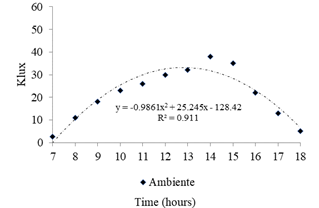
The experiment was conducted in a nursery under 50% shade net. Illuminance values were recorded throughout the experiment, both in the morning and afternoon, as depicted in Figure 1.
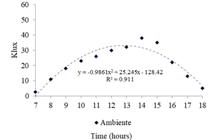
Illuminance recorded in the environments throughout the entire production period of itaúba (Mezilaurus itauba) seedlings.
The average daily temperature was recorded at 28 ± 3°C with relative humidity ranging from 60% to 80% during the growth period of M. itauba seedlings. Environmental conditions were monitored using a Lascar Electronics EasyLog USB-2 data logger, which has a measurement range of 0-100% relative humidity and -25 to 80°C, with a resolution of 0.5% relative humidity and sensitivity of ±3.5% relative humidity, ±2°C. Irrigation was manually adjusted to the substrate's field capacity, which was determined before the experiment to be 2 liters. The seedlings received a single afternoon application of a fertilizer made from cupuaçu residues (FERCup plant-1) using a 50 mL beaker at 4:30 p.m.
FERCup was produced from the composting of crop remains from a cupuaçu orchard, owned by a family farmer in Pacaraima, Roraima State, Brazil. The compost included leaves, twigs, and branches with witch’s broom symptoms from phytosanitary pruning, as well as discarded cupuaçu fruit peels and seeds. These materials were crushed and layered with manure in a 3:1 ratio inside wooden compost bins up to a maximum height of 1.5 m. The compost was turned every 5 days during the initial 15 days and subsequently every 10 days. It was watered during the first 14 days. The liquid residue drained from the composting process was collected in a connected water tank and later sampled for macronutrient and micronutrient analysis at SOLOCRIA Laboratório Agropecuário LTDA (Table 2).
The solution of B. japonicum (Rhizobium) was applied using an automatic graduated pipette into four small depressions, each 3 cm deep and located 2 cm from the plant collar. The experimental layout was a completely randomized design, structured as a 2 x 4 factorial arrangement, featuring treatments with and without FERCup application across four B. japonicum doses (0.0, 0.2, 0.4, and 0.6 mL L-1). Each treatment had five replicates, with each replicate comprising five seedlings (one per container).
At 180 days after transplanting (DAT), seedling shoot height (H) was measured with a graduated ruler, and collar diameter (CD) with a digital caliper.
For dry mass determination, seedlings were divided into roots and shoots. Roots were cleansed under running water, and then both roots and shoots were placed in kraft paper bags. These were dried in a forced-air circulation oven at 70ºC for 72 hours and subsequently weighed on an analytical scale (0.0001 g) to determine shoot dry mass (SDM, g plant-1), root dry mass (RDM, g plant-1), and total dry mass (TDM, g plant-1), which was the sum of SDM and RDM. The Dickson Quality Index (Dickson et al., 1960) was calculated using the following formula:
The doses of maximum technical efficiency (DMTE) for B. japonicum were determined by deriving and setting to zero the mean quadratic production functions that best fit the data, as described in Equations 1 and 2 (Tiesdale et al., 1993).
(1)
(2)
At 180 days after transplanting (DAT), the nitrogen balance index (NBI) was assessed using a Dualex chlorophyll meter. Measurements were taken between 9:00 and 11:00 a.m. on two fully expanded leaves from the apical third of each plant.
Leaf area (LA, m2 m-2) was measured using the Li-Cor LI3100C area meter. Leaf area ratio (FA, m² g-1) and specific leaf area (SA, cm² g-1) were calculated from instantaneous values according to the formulas FA = LA/TDM and SA = LA/leaf dry mass, based on methods outlined by Radford (1967) and Richards (1969).
All variables underwent mean comparison using the Tukey test at a 5% probability level, and quantitative variables were analyzed through regression to evaluate the effects of B. japonicum doses, both with and without the FERCup application. Data analysis was conducted using the Sisvar statistical package (Ferreira, 2024).
Results and discussion
Analysis of variance indicated significant interaction effects between the presence and absence of FERCup (F) and the doses (D) of Bradyrhizobium japonicum on shoot dry mass, root dry mass, and total dry mass of Mezilaurus itauba seedlings (p < 0.01; p < 0.05) (Table 3). These results suggest that these factors directly influence the biomass accumulation in M. itauba seedlings. Additionally, a significant individual effect of factor F was observed on plant height (H), collar diameter (CD), height increment (ΔH), shoot dry mass (SDM), root dry mass (RDM), total dry mass (TDM), and Dickson quality index (DQI). Factor D showed significant effects on all variables except for collar diameter (CD) (Table 3).
Variance analysis summary for effects of FERCup and Bradyrhizobium japonicum doses (0.0, 0.2, 0.4, and 0.6 mL L-1) on Mezilaurus itauba seedling height (H), collar diameter (CD), leaf area, shoot dry mass (SDM), root dry mass (RDM), total dry mass (TDM), Dickson Quality Index (DQI), and increments in height (ΔH) and collar diameter (ΔCD).
Our findings indicate that the estimated dose of maximum technical efficiency (DMTE) for M. itauba plant height was 0.28 mL L-1 of B. japonicum with the addition of FERCup (Figure 2A), achieving a maximum height of 31.03 cm. This represents a height gain of 7.1% compared to the control dose (zero dose with FERCup addition). Without the application of FERCup, the average height of M. itauba seedlings was 29.01 cm; however, the estimated DMTE for B. japonicum remained at 0.28 mL L-1 (Figure 2A).
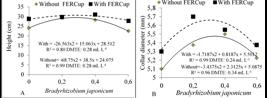
Averages of Mezilaurus itauba seedling height (A) and collar diameter (B) as a function of the Bradyrhizobium japonicum dose (0.0, 0.2, 0.4, and 0.6 mL L-1) with and without fertilizer from cupuaçu residues (FERCup) in itaúba (M. itauba) seedlings at 180 days after transplanting.
For the collar diameter of M. itauba seedlings, the DMTE with the addition of FERCup was 0.24 mL L-1 of B. japonicum, resulting in an average diameter of 5.70 mm (Figure 2B). This represents a mean gain of 12.3% compared to the control dose (zero dose of B. japonicum without FERCup). Conversely, without FERCup, the DMTE was 0.34 mL L-1, leading to an average collar diameter of 5.48 mm in M. itauba seedlings (Figure 2B).
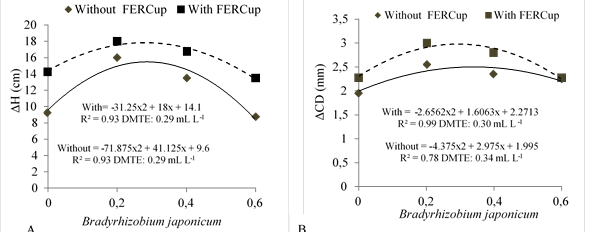
This finding indicates that B. japonicum up to the DMTE contributes to significant gains in collar diameter, irrespective of FERCup application. This was evident when comparing the control treatments at 0.0 mL L-1 with and without FERCup (Figure 1B). Effective symbiosis of B. japonicum was observed at 180 days after transplanting (DAT), with increases in both height (ΔH) and collar diameter (ΔCD) up to the DMTE of B. japonicum, with and without FERCup (Figure 2A and B). The presence of these symbionts, through biological nitrogen fixation and phytohormone biosynthesis, promoted progressive development in the stem diameter of M. itauba seedlings.
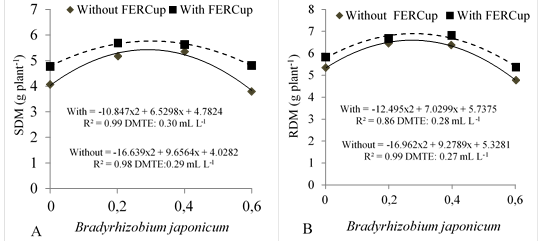
The interaction effects on SDM of M. itauba seedlings inoculated with B. japonicum and supplemented with FERCup (Figure 3A) showed significant results (Table 2). At a DMTE of 0.30 mL L-1 of B. japonicum with FERCup, there was a 6.3% increase in SDM compared to the DMTE of 0.29 mL L-1 without FERCup application (Figure 4A). Moreover, the same DMTE of 0.30 mL L-1 with FERCup application resulted in a 30.0% increase in SDM relative to the control that did not receive FERCup (Figure 4A).
For RDM, the DMTE was 0.28 mL L-1 of B. japonicum with FERCup application, achieving an RDM of 6.73 g plant-1 (Figure 4B). In contrast, without FERCup, the DMTE was 0.27 mL L-1, leading to an RDM of 6.60 g plant-1.
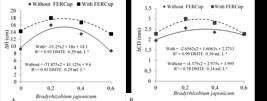
Average increases in (A) height (ΔH) and (B) collar diameter (ΔCD) of Mezilaurus itauba seedlings as a function of the Bradyrhizobium japonicum dose (0.0, 0.2, 0.4, and 0.6 mL L-1) with and without fertilizer from cupuaçu residues (FERCup) at 180 days after transplanting.
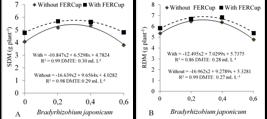
Averages of shoot dry mass (A) and root dry mass (B) of Mezilaurus itauba seedlings as a function of the Bradyrhizobium japonicum dose (0.0, 0.2, 0.4, and 0.6 mL L-1) with and without fertilizer from cupuaçu residues (FERCup) at 180 days after transplanting.
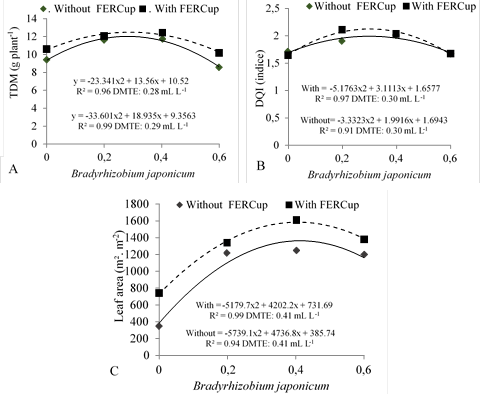
Regarding the TDM production of M. itauba seedlings (Figure 5A), gradual increases were observed up to a DMTE of 0.29 mL L-1 of B. japonicum with FERCup application. Selecting strains that enhance the effectiveness of nitrogen-fixing bacteria is crucial for bolstering seedling vigor and increasing TDM.
According to our findings, the highest DQI was achieved at the DMTE of 0.30 mL L-1 of B. japonicum with FERCup application, recording a DQI of 2.13. Without FERCup, the estimated DMTE was also 0.30 mL L-1 of B. japonicum, resulting in a DQI of 1.99 (Figure 4B). Both values fall within the ideal range proposed by Souza et al. (2023a).
The DMTE of 0.41 mL L-1 of B. japonicum with FERCup application was found to be the most effective, enhancing leaf area and chlorophyll content in M. itauba leaves. This combination effectively met the nutritional demands of the seedlings and supported the maintenance of physiological processes, positively influencing parameters such as nitrogen balance index (NBI), specific leaf area (SA, cm2 g-1), and leaf area ratio (FA, m2 g-1).
Nutritional indices in forest seedlings can serve as criteria for recommending genotypes that efficiently utilize soil ions, such as nitrogen (Smiderle et al., 2024). In this study, the determination of NBI in M. itauba leaves revealed significant interactions between B. japonicum and FERCup doses, with notable individual effects of B. japonicum doses on NBI.
Specifically, a B. japonicum dose of 0.40 mL L-1 led to a 32.11% increase in NBI compared to the zero dose with FERCup. Moreover, seedlings without FERCup at the same dose of 0.40 mL L-1 of B. japonicum exhibited a 30.35% increase in NBI compared to the control without FERCup (Table 4). These improvements were crucial for the synthesis of photoassimilates, amino acids, and proteins, significantly contributing to the total biomass of M. itauba seedlings.
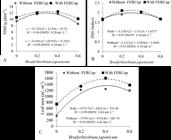
Averages of total dry mass (A), Dickson quality index (B), and leaf area (C) of Mezilaurus itauba seedlings as a function of the Bradyrhizobium japonicum dose (0.0, 0.2, 0.4, and 0.6 mL L-1) with and without fertilizer from cupuaçu residues (FERCup) at 180 days after transplanting.
Averages of chlorophyll a (CHL_a, μg mL-1), chlorophyll b (CHL_b, μg mL-1), total chlorophyll (CHL_total μg mL-1), nitrogen balance index (NBI), specific leaf area (SA, cm2 g-1), and leaf area ratio (FA, m2 g-1) in Mezilaurus itauba leaves as a function of the Bradyrhizobium japonicum dose (0.0, 0.2, 0.4, and 0.6 mL L-1) with and without fertilizer from cupuaçu residues (FERCup) at 180 days after transplanting.
The specific leaf area (SA) values were comparable between the B. japonicum doses of 0.2 mL L-1 and 0.4 mL L-1 when applied with FERCup (Table 4). SA is an indicator of biomass allocation strategy, reflecting the leaf area available per unit of photoassimilates invested, crucial for light capture.
The light intensity within the screened nursery varied between 2.7 and 38 lux (Figure 4), which positively influenced light energy absorption, essential for maintaining high photosynthetic rates. This environment contributed to increases in SA and leaf area ratio (FA, m2 g-1) (Table 4).
During the growth period, the average temperature in the nursery was 28 ± 3°C. Under these conditions, the B. japonicum treatments, both with and without FERCup, demonstrated favorable impacts on the morphophysiological traits of M. itauba seedlings.
It is noteworthy that B. japonicum can enhance root growth and volume, thus improving water and nutrient absorption and leading to increased biomass production in forest seedlings (Souza et al., 2023b). This effect was evident in our study, particularly at the B. japonicum doses of 0.2 and 0.4 mL L-1 with FERCup. However, these results may vary across different species, indicating that tailored supplementation for native forest species could better equip them to withstand environmental adversities (Smiderle et al., 2023; Souza et al., 2023b; Smiderle et al., 2021).
The combination of B. japonicum and FERCup, along with adequate micronutrient supply (Table 2), was highly effective in promoting the superior quality of M. itauba seedlings (Figure 5B). The DQI, which assesses sturdiness and balanced biomass distribution among plant organs (Menegatti et al., 2022), was approximately 1.00 for native forest seedlings in Roraima (Souza et al., 2023a; Smiderle et al., 2023). Additionally, Smiderle et al. (2023) highlighted that root volume is a critical biomass allocation parameter, correlated with the growth rate of Hymenaea courbaril. In our study, biological nitrogen fixation (BNF) established by symbiosis between M. itauba roots and B. japonicum played a pivotal role in biomass allocation, crucial for achieving a high DQI.
Moreover, nutrient availability, particularly under the application of FERCup (Table 2), significantly affects growth variations in M. itauba seedlings. With optimal nutrition, the plants exhibit high chlorophyll and NBI values, allocating more nitrogen to the leaves (Table 4) and enhancing carbon fixation efficiency.
The ambient light conditions described in Figure 1, combined with FERCup at doses of 0.2 mL L-1 and 0.4 mL L-1 of B. japonicum, effectively supported plant nutrition to significantly enhance biomass, sturdiness, and photosynthetic capacity through increases in specific leaf area (SA), leaf area ratio (FA), and chlorophyll production (Table 4).
This plasticity in M. itauba seedlings facilitates rapid colonization of open spaces and optimal utilization of available soil resources, making this species ideal for revegetation projects and restoration of degraded areas.
Conclusion
The dose of maximum technical efficiency (DMTE) of 0.30 mL L-1 of Bradyrhizobium japonicum, with and without the addition of cupuaçu residue fertilizer (FERCup), significantly enhances quality and robustness of Mezilaurus itauba seedlings under the conditions studied. The inclusion of FERCup at the DMTE of B. japonicum has been shown to promote positive enhancements in the morphological traits of M. itauba seedlings. Doses of B. japonicum at 0.2 and 0.4 mL L-1, when combined with FERCup, positively affect all physiological indices measured in M. itauba seedlings at 180 days after transplanting.
Data availability
Does not apply.
References
-
Bargaz, A., Lyamlouli, K., Chtouki, M., Zeroual, Y. & Dhiba, D.. (2018). Soil microbial resources for improving fertilizers efficiency in an integrated plant nutrient management system. Frontiers in Microbiology, 9(1606), 1-25. https://doi.org/10.3389/fmicb.2018.01606
» https://doi.org/https://doi.org/10.3389/fmicb.2018.01606 -
Camuel, A., Teulet, A., Carcagno, M., Haq, F., Pacquit, V., Gully, D., Pervent, M., Chaintreuil, C., Fardoux, J., Horta-Araujo, N., Okazaki, S., Ratu, S. T. N., Gueye, F., Zilli, J., Nouwen, N., Arrighi, J., Luo, H., Mergaert, P., Deslandes, L. & Giraud, E.. (2023). Widespread Bradyrhizobium distribution of diverse Type III effectors that trigger legume nodulation in the absence of Nod factor. The ISME Journal, 17(9), 1416-1429. https://doi.org/10.1038/s41396-023-01458-1
» https://doi.org/https://doi.org/10.1038/s41396-023-01458-1 -
Centro Nacional de Conservação da Flora. (2023). Mezilaurus itauba in Lista Vermelha da flora brasileira versão 2012.2. Centro Nacional de Conservação da Flora. http://cncflora.jbrj.gov.br/portal/pt-br/profile/Mezilaurusitauba
» http://cncflora.jbrj.gov.br/portal/pt-br/profile/Mezilaurusitauba -
Dickson, A., Leaf, A. L. & Hosner, J. F.. (1960). Quality appraisal of white spruce and white pine seedling stock in nurseries. Forest Chronicle, 36(1), 10-13. https://doi.org/10.5558/tfc36010-1
» https://doi.org/https://doi.org/10.5558/tfc36010-1 -
Dueñas, J. F., Camenzind, T., Roy, J., Hempel, S., Homeier, J., Suárez, J. P. & Rillig, M. C.. (2020). Moderate phosphorus additions consistently affect community composition of arbuscular mycorrhizal fungi in tropical montane forests in southern Ecuador. New Phytologist, 227(5), 1505-1518. https://doi.org/10.1111/nph.16641
» https://doi.org/https://doi.org/10.1111/nph.16641 -
Ferraro, A. C., França, A. C., Machado, C. M. M., Aguiara, F. R., Oliveira, L. L., Braga Neto, A. M. & Oliveira, R. G.. (2023). Commercial characteristics of coffee seedlings produced with different sources of phosphorus and plant growth-promoting bacteria. Brazilian Journal of Biology, 83, 1-8. https://doi.org/10.1590/1519-6984.270262
» https://doi.org/https://doi.org/10.1590/1519-6984.270262 -
Ferreira, D. F.. (2024). Sisvar: A guide for its Bootstrap procedures in multiple comparisons. Ciência e Agrotecnologia, 38(2), 109-112. https://doi.org/10.1590/S1413-70542014000200001
» https://doi.org/https://doi.org/10.1590/S1413-70542014000200001 -
Ferreira, M. S., Santos, J. Z. L., Tucci, C. A. F. & Costa, L. V.. (2017). Crescimento inicial de itaúba e macacaúba em recipientes de diferentes tamanhos. Ciência Florestal, 27(2), 499-508. https://doi.org/10.5902/1980509827731
» https://doi.org/https://doi.org/10.5902/1980509827731 -
Franciscon, C. H. & Miranda, I. S.. (2018). Distribution and rarity of Mezilaurus (Lauraceae) species in Brazil. Rodriguésia, 69(2), 489-501. https://doi.org/10.1590/2175-7860201869218
» https://doi.org/https://doi.org/10.1590/2175-7860201869218 -
Gianluppi, D., Smiderle, O. J., Souza, A. G. & Maia, S. S. (2023). Práticas para semeadura direta em área de cerrado melhorado: Emergência, sobrevivência e crescimento inicial de espécies florestais. International Seven Multidisciplinary Journal, 2(5), 834-850. https://doi 10.56238/isevmjv2n5-003
» https://doi.org/https://doi 10.56238/isevmjv2n5-003 -
Holík, L., Hlisnikovský, L., Honzík, R., Trögl, J., Burdová, H. & Popelka, J.. (2019). Soil microbial communities and enzyme activities after long-term application of inorganic and organic fertilizers at different depths of the soil profile. Sustainability, 11(12), 1-14. https://doi.org/10.3390/su11123251
» https://doi.org/https://doi.org/10.3390/su11123251 -
International Union for Conservation of Nature. (2023). The IUCN red list of threatened species (Version 2018-2). . http://www.iucnredlist.org.
» http://www.iucnredlist.org. -
Jarecki, W.. (2023). Soybean response to seed inoculation or coating with Bradyrhizobium japonicum and foliar fertilization with molybdenum. Plants, 12(13), 1-14. https://doi.org/10.3390/plants12132431
» https://doi.org/https://doi.org/10.3390/plants12132431 -
Jin, C., Wu, X., Zhuo, Y., Yang, Y., Li, T., Jin, F., Lee, H. & Jin, L.. (2022). Genomic insights into a free-living, nitrogen-fixing but non nodulating novel species of Bradyrhizobium sediminis from freshwater sediment: Three isolates with the smallest genome within the genus Bradyrhizobium. Systematic and Applied Microbiology, 45(5), 126353. https://doi.org/10.1016/j.syapm.2022.126353
» https://doi.org/https://doi.org/10.1016/j.syapm.2022.126353 -
Leal, Y. H., Sousa, V. F. O., Dias, T. J., Silva, T. I., Leal, M. P. S., Souza, A. G., Lucena, M. F. R., Rodrigues, L. S. & Smiderle, O. J.. (2020). Edaphic respiration in bell pepper cultivation under biological fertilizers, doses and application times. Emirates Journal of Food and Agriculture, 32(6), 434-442. https://doi.org/10.9755/ejfa.2020.v32.i6.2118
» https://doi.org/https://doi.org/10.9755/ejfa.2020.v32.i6.2118 -
Magalhães, C. A. S., Morales, M. M., Rezende, F. A. & Langer, J.. (2017). Eficiência de fertilizantes organominerais fosfatados em mudas de eucalipto. Revista Scientia Agraria, 18(4), 80-85. https://doi.org/10.5380/rsa.v18i4.52247
» https://doi.org/https://doi.org/10.5380/rsa.v18i4.52247 -
Menegatti, R. D., Souza, A. G., & Bianchi, V. J. (2022). Nutritional status of ‘BRS Rubimel’ peach plants in the nursery as a function of the rootstock. Acta Scientiarum. Agronomy, 44(1), 1-12. https://doi.org/10.4025/actasciagron.v44i1.54327
» https://doi.org/https://doi.org/10.4025/actasciagron.v44i1.54327 -
Menegatti, R. D., Souza, A. G. & Bianchi, V. J.. (2020). Nutritional efficiency for nitrogen, phosphorus and potassium in peach rootstocks. Journal of Plant Nutrition, 44(2), 228-237. https://doi.org/10.1080/01904167.2020.1806306
» https://doi.org/https://doi.org/10.1080/01904167.2020.1806306 -
Radford, P. J. (1967). Growth analysis formulae: their use and abuse. Crop Science, 7(3), 171-175. https://doi.org/10.2135/ cropsci1967.0011183X000700030001x
» https://doi.org/https://doi.org/10.2135/ cropsci1967.0011183X000700030001x - Richards, F. J. (1969). The quantitative analysis of growth. In F. C. Steward (Ed.), Plant physiology. Academic Press.
-
Smiderle, O. J., Souza, A. G., Menegatti, R. D., Dias, T. J. & Montenegro, R. A.. (2021). Shading and slow release fertiliser affect early growth in seedlings of Pau-marfim. Floresta e Ambiente, 28(1), 1-8. https://doi.org/10.1590/2179-8087-FLORAM-2020-0023
» https://doi.org/https://doi.org/10.1590/2179-8087-FLORAM-2020-0023 -
Smiderle, O. J. & Souza, A. G. (2022). Cartilha de sementes de espécies florestais em Roraima. Embrapa Roraima. https://www.infoteca.cnptia.embrapa.br/infoteca/bitstream/doc/1149583/1/I-A5-Cartilha-De-Sementes-e-Mudas-1.pdf
» https://www.infoteca.cnptia.embrapa.br/infoteca/bitstream/doc/1149583/1/I-A5-Cartilha-De-Sementes-e-Mudas-1.pdf -
Smiderle, O. J., Souza, A. G., Maia, S. S., Reis, N. D., Costa, J. S. & Pereira, G. S. (2022). Do Stimulate® and Acadian® promote increased growth and physiological indices of Hymenaea courbaril seedlings? Revista Brasileira de Fruticultura, 44(2), 1-10. https://doi.org/10.1590/0100-29452022872
» https://doi.org/https://doi.org/10.1590/0100-29452022872 -
Smiderle, O. J., Souza, A. G. & Maia, S. S. (2023). Do doses of controlled-release fertilizer and container volume influence the quality of Hymenaea courbaril seedlings? Revista Brasileira Fruticultura, 45, 1-7. https://doi.org/10.1590/0100-29452023249
» https://doi.org/https://doi.org/10.1590/0100-29452023249 -
Smiderle, O. J., Souza, A. G., Lima-Primo, H. E. & Fagundes, P. R. O.. (2024). Efficiency of organomineral fertilizer and doses of Azospirillum brasilense on the morphophysiological quality of Mezilaurus itauba seedlings. Brazilian Journal of Biology, 84, 1-8. https://doi.org/10.1590/1519-6984.279851
» https://doi.org/https://doi.org/10.1590/1519-6984.279851 -
Sousa, N. C., Lisboa, B., Vargas, L. K., Bordignon, S. A. L. & Beneduzi, A.. (2021). Composto orgânico à base de salvínia para a produção de mudas de grandiúva. Pesquisa Florestal Brasileira, 41, 1-7. https://doi.org/10.4336/2021.pfb.41e201801746
» https://doi.org/https://doi.org/10.4336/2021.pfb.41e201801746 -
Souza, A. G., Smiderle, O. J. & Maia, S. S. (2023a). Do Stimulate® and Ascophyllum nodosum seaweed promote the morphophysiological characteristics of Cordia alliodora seedlings? Australian Journal of Crop Science, 17(5), 447-452. https://doi.org/10.21475/ajcs.23.17.05.p3832
» https://doi.org/https://doi.org/10.21475/ajcs.23.17.05.p3832 -
Souza, A. G., Smiderle, O. J., Maia, S. S. & Dias, T. J. (2023b). Do Azospirillum brasilense application methods and doses influence the quality of Cordia alliodora seminal seedlings? Scientia Forestalis, 51, 1-9. https://doi.org/10.18671/scifor.v51.14
» https://doi.org/https://doi.org/10.18671/scifor.v51.14 - Tiesdale, S. L., Nelson, W. L. & Beaton, J. D. (1993). Soil fertility and fertilizers (5th ed.). Macmillan.
- Weisany, W., Raei, Y. & Allahverdipoor, K. H.. (2013). Role of some of mineral nutrients in biological nitrogen fixation. Bulletin of Environment, Pharmacology and Life Sciences, 2(4), 77-84.
Edited by
-
Associate Editor in charge:
Alessandro Lucca BracciniCarlos Alberto Scapim