 Figuil limestone as a calcium source for Japanese quail: effects on growth, carcass, egg production, and blood biochemical parameters
ABSTRACT.
The poultry feed industry in Cameroon faces high costs due to its dependence on imported ingredients like shellfish meal, a key calcium source. To promote animal feed self-sufficiency and reduce imports, this study evaluates Figuil limestone as a local alternative. The effects of replacing shellfish meal with limestone meal on Japanese quail (Coturnix japonica) were assessed in terms of growth, carcass traits, and reproduction. A total of 300-day-old quails were divided into 15 groups. Five diets with increasing substitution levels of shell meal by limestone meal (0, 25, 50, 75, 100%) were tested, with each treatment replicated three times. At 7 weeks, six birds per batch were sampled for biochemical and carcass analysis. Results showed that feed intake increased with limestone inclusion, while growth, carcass, and organ traits remained unaffected. A 50% substitution level improved the laying rate (24.9±2.2%) compared to the control (20.0±6.9%), though control birds had heavier eggs (12.1±0.1 g). Limestone also increased Haugh Units and edible content but reduced shell thickness. Biochemical parameters showed no significant differences. The study concluded that Figuil limestone can be an effective substitute for shellfish meal in quail diets, with 50% replacement level being the most effective during the early laying period.
Keywords:
mineral supplement; shellfish; calcium carbonate; growth; laying; Coturnix japonica
Introduction
Malnutrition affects over a billion people worldwide, with sub-Saharan Africa as one of the region’s most severely affected. Projections indicate that the global population will reach 9.1 billion by 2050, creating an urgent need to increase animal protein production to meet rising nutritional demands (Alaimo et al., 2020). In many developing countries, including those in Africa, meat consumption remains below recommended levels, highlighting the importance of exploring alternative protein sources to improve food security. Therefore, Japanese quail (Coturnix japonica) are a promising option, as they grow quickly, are highly resistant to disease, require little feed and produce many eggs (Kayang et al., 2004; Bakst, 2017), which also offer notable nutritional and therapeutic benefits (Jeke et al., 2018). However, the high cost of feed often accounting for up to 80% of total production expenses remains a major constraint in poultry farming (INRA, 1989; Mallick et al., 2020).
Among essential nutrients from feed, calcium (Ca) is critical in poultry diets. It supports skeletal development, eggshell formation, muscle function, nerve transmission and enzymatic activity (Klasing, 2005). Calcium metabolism is closely interrelated with phosphorus (P) and vitamin D, and imbalances can adversely affect nutrient absorption, bone health, and overall performance (Li et al., 2017). The efficiency with which calcium is assimilated varies depending on its source, solubility, particle size and bioavailability (Gilani et al., 2022; Walk et al., 2022), all of which directly influence growth, reproductive performance, egg production and quality, as well as mineral metabolism (Li et al., 2017). In laying birds, calcium comprises over 95% of the mineral content of the eggshell. Adequate calcium intake improves shell thickness, egg quality, hatchability and productivity (Souza et al., 2016; Attia et al., 2020). Studies on Japanese quail have shown that the source, level and particle size of calcium significantly affect growth performance, reproduction and physiological parameters. The optimal dietary calcium level for growth and bone development is between 0.75 and 0.87%, though higher levels are required to maximise bone density (Pourmollaei et al., 2025). Less soluble calcium sources, such as coarse oyster shell, reduce calcium intake and lower blood calcium levels, negatively impacting growth. However, they may trigger an increased expression of the calbindin gene, thus suggesting a physiological adaptation to reduced calcium availability (Bagheri et al., 2022). In laying quail, calcium levels of 2.5-3% have been associated with improved egg production and shell quality. In addition, calcium premix has been found to be more effective in older birds (Sultana et al., 2007).
Despite the importance of calcium, sourcing it sustainably remains challenging. In Cameroon, shellfish meal is the main dietary calcium source in poultry feed. However, it is expensive and largely imported, which makes it dependent on marine ecosystems and raises concerns about its sustainability and accessibility for smallholder farmers (Cashion et al., 2017). To address this issue, locally available alternatives such as Figuil limestone, which is abundant in northern Cameroon, are increasingly being used as informal calcium supplements. However, its use remains largely unstandardized and has not been scientifically evaluated in terms of nutritional composition, bioavailability and effects on animal performance.
Previous research has shown that the source and level of dietary calcium can influence zootechnical and reproductive outcomes in quail. While Vieira et al. (2012) and Souza et al. (2016) found limited effects of changes in calcium (Ca) and phosphorus (P) levels on egg production despite differences in feed intake, other studies, such as those by Brandão et al. (2007) and Attia et al. (2020) reported improvements in laying rate and egg weight with optimised calcium supplementation.
In line with Cameroon’s national strategies for feed autonomy and import substitution, evaluating the potential of Figuil limestone as a dietary calcium source is a valuable opportunity. Preliminary mineralogical assessments have revealed Figuil limestone to be rich in calcium carbonate (Djanabou et al., 2025). However, its biological efficacy in monogastric animals, such as Japanese quail, is not well inferred. Due to their short life cycle and high productivity, Japanese quail are an ideal model for evaluating alternative mineral sources (Minvielle, 2004).
Therefore, this study aims to evaluate the effects of replacing conventional shellfish meal with Figuil limestone meal on growth performance, carcass traits, egg production and blood biochemical parameters in Japanese quail reared in the Sudano-Guinean zone of Cameroon. By exploring the nutritional potential of this underutilised local resource, the study seeks to promote more sustainable poultry production and enhance food security in areas with limited resources.
Materials and methods
Ethical approval
Experimental protocols used in this study were endorsed by the ethics committee of the University of Ngaoundéré, in Cameroon, and complied strictly with internationally recognized standard on ethical directives for the use and care of laboratory animals, which is specified in the European Community Directive 86/609/EEC, from November 24, 1986.
Study area
The study was carried out from August to October 2020 in Ngaoundéré, the headquarter of the Adamawa Region in Cameroon. Ngaoundéré is a cosmopolitan town located on the Adamawa plateau (7-8°N and 13-14°E) in the Sudano-Guinean ecological zone of Cameroon.
Materials and trial execution
Limestone, processed by a locally based company, is initially collected and undergoes primary crushing at the Biou quarry in Figuil, northern Cameroon. The crushed material is transported to a processing facility, where it is transformed into a powder. The limestone characteristics and composition can be seen in a previous study made by Djanabou et al. (2025).
A total of 300 day-old, unsexed Japanese quail, with an average body weight of 6.91 ± 0.72 g, were randomly divided into 15 groups of 16 birds each to ensure uniformity across batches. At three weeks of age, the birds were sorted by sex, and 12 per batch (six males and six females) were selected for the experimental phase. The sex was identified by breast plumage colour, with males showing uniform reddish-brown and females lighter with black spots. The birds were organized in cages with 28 birds m-2 made from wooden planks and fine wire mesh suitable for their small size.
Using a standard growth feed formulation as a basis, five experimental diets (T0, T25, T50, T75, and T100%) were made by replacing shellfish meal with limestone meal at levels of 0, 25, 50, 75, and 100%, respectively. The limestone incorporation levels used in the experimental feed were based on previous studies and industry standards that identify optimal calcium requirements for Japanese quail (Dale, 1994; Vieira et al., 2012; De Souza et al., 2016), to ensure nutritional adequacy while testing substitution. Each of the five diets was randomly assigned to three replicates using a completely randomized design comprising of five treatments and three repetitions. Feed and water were provided ad libitum throughout the study period. All birds were kept under identical conditions.
The composition of the experimental diets, expressed as a percentage, are presented in Table 1 below.
Data collection
Growth parameters
Feed intake: feed was weighed at the beginning of the week and distributed daily. The remains of each experimental unit were also weighed every 7 days, using a 1 g precision electronic scale with 5000 g capacity, and subtracted from the amount of feed distributed to obtain the feed intake.
Body weight: at the beginning of the trial and every 7 days thereafter, all birds were weighed in the morning between 8 and 10 a.m., using an electronic balance with a 500 g capacity and 0.01 g accuracy. Weekly weight gain was obtained by calculating the difference between two consecutive body weights.
Feed intake and weight gain data were used to calculate the feed conversion ratio by dividing the feed intake by the weight gain in the same period.
Carcass ccharacteristics
At 7 weeks of age, three males and three females per batch (a total of nine males and nine females per treatment) were slaughtered for carcass evaluation following the method described by Santhi and Kalaikannan (2017). Data were collected on carcass, liver, heart, gizzard, head, thigh, breast, wing, and legs.
Based on the collected data, the following parameters were calculated:
Carcass weight = Body weight - (head + legs + blood + feathers + viscera) weight.
-Carcass yield (%) = [Carcass weight (g)/Body weight (g)] x 100
-Relative weight of parts or organs (%) = [(Weight of parts or organs (g))/(Body weight (g))]x100
Testes and egg’s characteristics
After quails had been slaughtered, testes were collected and weighed together and separate using an electronic scale with a capacity of 500 g and 0.01 g accuracy. Subsequently, the diameter and height were measured using a digital Vernier caliper with a range of 150 mm and accuracy of 0.01 mm. From the data collected, the following calculations were made:
-Shape index = Diameter /Height
-Weight ratio = [Weight (g)/(Testicle weight (g)] x 100
-Gonadosomatic Index (%) = [ Testes weight (g)/Body weight (g)] x 100
At 7 weeks of age, eggs were collected and counted. Their weight, diameter, and height were measured using a precision electronic balance (500 g capacity, 0.01 g accuracy) and a digital caliper (150 mm range, 0.01 mm accuracy). These measurements were then used to calculate the shape index and laying rate using the following formulas:
Testes shape index = Diameter /Height
Weekly laying rate (%) = [Number of eggs laid/(Number of females in reproduction x 7)] x 100
External egg’s characteristics
Each egg was individually weighed using a Shimadzu UX4200H electronic scale (Poland), with capacity of 320 g and accuracy of 0.01 g. The egg’s large diameter and height were measured with a digital Vernier caliper (150 mm range, 0.01 mm accuracy). The Egg Shape Index was calculated by dividing the large diameter by the height and multiplying the result by 100.
Egg volume was measured using water displacement: each egg was submerged in a graduated cylinder containing a known volume of water, and the volume was determined by calculating the difference between the final and initial water levels (Markos et al., 2017).
Internal egg’s characteristics
A total of 30 eggs were randomly selected per treatment. Each egg was individually broken, and its contents gently spread on a glass surface measuring 40 by 20 cm. Yolk and albumen heights were measured using a tripod-mounted gauge, while yolk and albumen diameters, as well as dense albumen thickness, were determined using the previously described digital caliper attached to the tripod.
The albumen was separated from the yolk using a 60 mL syringe, and the yolk was weighed with an electronic scale (320 g capacity, 0.01 g accuracy). Eggshells were thoroughly rinsed with water to remove residual albumen, dried, and then weighed using the same electronic scale.
Eggshell thickness was measured at three locations: broad end, equator (middle), and narrow end, using fragments from each shell, following the method of Radu-Rusu et al. (2014). The final shell thickness was expressed as the average of these three values. All collected internal and external egg measurements and weights were used to calculate the following parameters:
Aw = Ew-(Yw+Sw); where Aw refers to albumen weight, Yw to yolk weight, Ew whole egg weight, and Sw for shell weight.
- Proportion of egg components (%) = [Shell, Yolk, or Albumen weight (g)/(Egg weight (g)] x 100
- Percentage of edible matter (%) = proportion of yolk + proportion of albumen
- Egg constituent index (%) = [(Yolk or Albumen height (mm))/(Yolk or Albumen diameter (mm))] x 100
- Haugh unit (HU) = 100 log (h+7.57 - 1.7p0.37)
h is albumen height (mm), p is egg weight (g), 7.57 is the albumen height correction factor, and 1.7 represents the egg weight correction factor (Haugh, 1937).
Blood collection and biochemical parameters determination
Blood samples were taken at the subjects’ bleeding in dry tubes with identifications (name of the batch and sex). After that, they were transported immediately to the laboratory. Blood was centrifuged at 3000 rpm for 10 minutes. Sera were then collected and transferred to Eppendorf tubes with the same identification codes as previously described.
Trials were performed manually, and the reading was done by RAYTO RT-9260 spectrophotometer, using commercial kits (SGMilalia). The tests included the determination of blood sugar, protein, calcium, and phosphorus levels by colorimetric technique (Kaplan & Pesce, 1996).
Statistical analysis
All data were expressed as mean ± standard deviation. A one-factor analysis of variance (ANOVA) (substitution level) was used following the general linear model to compare the means of growth, carcass characteristics, reproduction, and biochemical parameters. Significant differences between means were separated by Duncan's test at the 5% level of significance. Microsoft IBM SPSS Statistics 25.0 and Excel 2016 were used for data analysis and illustration, respectively.
Results
Quail production performance
Average growth performance of quail at the finisher stage
Substitution at 25% resulted in significantly (p<0.05) higher feed intake (720±2 g) compared with the other substitution levels (Table 2). Body weights were not significantly affected (p>0.05) by the substitution levels, although a slight increase was observed compared to the control (0% substitution). The highest body weight was recorded at the 25% substitution level. Similar observations were made for weight gain and feed conversion ratio, which remained comparable (p>0.05) regardless of substitution level.
Biochemical parameters of quail
The biochemical parameters of quail varied significantly (p<0.05) with the level of substitution of shellfish meal by local limestone meal (Table 3). Blood glucose levels were overall significantly affected by substitution levels (p<0.05), with the highest values observed at 75% substitution in males and 100% in females. In males, total protein levels showed a significant decrease (p<0.05) across all substitution levels compared to the control group (0% substitution). Conversely, in females, the lowest significant protein concentration was recorded in the control group (66.80 ± 0.20 g L-1), indicating an opposite trend. Limestone meal substitution also led to significant changes in blood calcium levels across the different diets. In females, serum calcium levels increased significantly compared to the 0% substitution group (13.80 ± 0.46 mg dL-1), with the highest value recorded at 25% substitution (16.33 ± 0.90 mg dL-1). Only in females the phosphorus levels were significantly affected. The highest values were observed at 75% (9.07 ± 0.34 mg dL-1) and 50% (9.02 ± 0.62 mg dL-1) substitution levels, while the lowest value was at 25% substitution (5.56 ± 0.90 mg dL-1).
Carcass characteristics and proportions of parts and organs
Carcass yield and proportions
Carcass, breast, and thigh proportions were significantly affected by the different levels of limestone substitution (p<0.05), regardless of sex (Table 4).
In males, the highest wing proportion was observed at 50% substitution (7.33 ± 0.21 g), significantly higher than the control (0%) (6.13 ± 0.18 g), though statistically similar to the value at 75% substitution (6.10 ± 0.08 g). In females, 50% substitution also resulted in the highest wing proportion (6.12 ± 0.46 g), significantly greater than those at the other substitution levels. The highest head proportion in males was recorded at 100% substitution (3.75 ± 0.28 g), compared to the lowest value at the control (3.42 ± 0.13 g). In contrast, in females, the highest head proportion was observed in the control group (3.18 ± 0.08 g), while the lowest was at 100% substitution (2.80 ± 0.19 g). Neck proportions in females did not differ significantly among substitution levels. In males, the highest value was observed at 75% substitution (6.18 ± 0.59 g), while the lowest was recorded at 25% (5.33 ± 0.06 g). Leg proportions in females were not significantly different across treatments. However, in males, 25% substitution induced the highest value (2.00 ± 0.03 g), whereas 100% substitution resulted in the lowest (1.70 ± 0.09 g). Back proportions were significantly higher at 25% substitution in both females (16.45 ± 1.15 g) and males (15.04 ± 0.98 g), and these values were statistically similar to those recorded at 75% substitution (15.83 ± 0.62 g and 13.96 ± 0.97 g, respectively).
Proportions of organs in relation to quail body weight
The substitution of shellfish meal with limestone meal had no significant effect (p>0.05) on liver, heart, and gizzard proportions relative to body weight in 7-week-old quail, regardless of sex (Table 5).
In males, abdominal fat was significantly higher in the control group (0% substitution) (0.88 ± 0.02 g) compared to all other treatments. For females, however, the highest abdominal fat values were observed at 100 and 75% substitution levels, while the lowest value was recorded at 50% substitution (0.14 ± 0.00 g) (p<0.05). Kidney proportions in females remained statistically similar across all substitution levels. In contrast, in males, kidney proportions increased significantly (p<0.05) with higher levels of limestone substitution. The relative weight of the ovarian cluster was higher in females who received the 0% substitution diet, although it was statistically similar to the value observed at 100% substitution. Both were higher than those recorded at intermediate substitution levels.
Testes characteristics
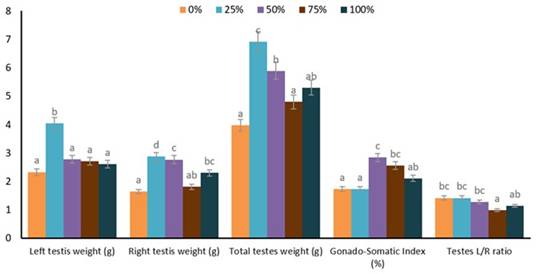
Substituting shellfish meal with limestone meal had a notable impact on the testicular characteristics of male quail (Figure 1). The highest testis weights were observed at the 25% and 50% substitution levels (p< 0.05), compared to the control group (0%), which showed values similar to those of the other treatments. In terms of the testis-to-body weight ratio, the control group recorded the highest significant value (1.42 ± 0.00%), although this was statistically similar to the 25% substitution group (1.28 ± 0.27%). The gonadosomatic index increased significantly at the 25 and 50% substitution levels compared to the control group. Values at the 75 and 100% substitution levels remained statistically similar to those of the control group. There was no significant effect of substitution levels on average testis height; however, a slight increase was observed, with the highest mean height recorded at 75% substitution (0.83 ± 0.09 mm). The highest testis diameter was observed at the 25% and 50% substitution levels, although these values were statistically similar to the 100% substitution level, which exhibited the lowest diameter overall. The highest average shape index values were recorded at the 25 and 50% substitution levels (0.77 ± 0.21 and 0.64 ± 0.00, respectively), compared to the control group (0.58 ± 0.04), which was similar to the values obtained from higher substitution levels.
Egg laying rate and characteristics
Substituting 50% of the shellfish meal with limestone meal resulted in the highest laying rate, whereas a 100% substitution yielded the lowest rate (see Table 6). The control diet (0% limestone) produced the heaviest eggs (12.05 ± 0.97 g) and eggs from all other substitution levels were statistically similar in weight. There was no significant effect of dietary substitution levels on egg volume, yolk diameter, or shape index. However, the yolk index and Haugh unit were significantly higher at the 50% substitution level. The highest albumen index was observed at 100% substitution (36.25 ± 9.49%), which was significantly higher than the control group (22.11 ± 3.71%), though similar to the value obtained at 75% substitution (35.67 ± 10.02%). Yolk percentages were not affected by substitution levels (p>0.05). The highest albumen proportion was recorded at 75% substitution (61.62 ± 4.42%), in comparison to the 50% substitution group (61.01 ± 3.86%), and was higher than the control group (57.56 ± 5.55%). Finally, the highest percentage of edible matter was obtained at the 75% substitution level, while the control group exhibited the lowest value.
Discussion
Average growth performance
Partial substitution of shellfish meal with local limestone meal, particularly at the 25% level, resulted in a significantly higher feed intake, suggesting improved feed palatability or acceptability. This improvement may be due to differences in texture, flavour, or calcium bioavailability between limestone and shellfish meal. These findings contrast with those of Pizzolante et al. (2007) and Pelicia et al. (2009), who reported no significant effect of calcium levels on feed intake in Japanese quail aged 39 to 57 weeks. However, Garcia et al. (2000) and Bagheri et al. (2022) indicate that both the source and particle size of calcium substantially influence feeding behaviour and nutrient assimilation. Bagheri et al. (2022) demonstrated that coarse oyster shells impaired calcium absorption, lowered blood calcium levels, and upregulated calbindin expression, a key calcium transport protein, while fine particles, though preferred by birds, worsened feed conversion. Recent meta-analyses (Proszkowiec-Weglarz and Angel, 2013; Wang et al., 2017) further support the idea that mineral sources affect feed intake through multiple physiological and sensory mechanisms.
Despite the increased feed intake at 25% substitution, performance metrics such as body weight, weight gain, and feed conversion ratio remained statistically unchanged (p>0.05), which indicates a decoupling between intake and efficiency. This may be attributed to suboptimal calcium bioavailability or nutrient imbalance. These results align with the findings of Sultana et al. (2007) and Vieira et al. (2012), who observed minimal effects of calcium source on growth performance when baseline requirements were met. Although limestone is recognized for its high calcium content and bioavailability (Dale, 1994; Djanabou et al., 2025), complete substitution did not enhance growth, implying that other dietary factors or mineral interactions may affect calcium utilization. The modest body weight increase observed at 25% substitution represents an optimal inclusion threshold in which calcium requirements are adequately met without compromising nutrient absorption, being consistent with the findings of Ceylan et al. (2023). Recently, Pourmollaei et al. (2025) defined optimal calcium levels for juvenile quail growth and bone development between 0.75 and 0.87%. These ranges support maximal weight gain, tibia ash content, and bone strength. The plateau in growth response observed here may reflect reaching these physiological thresholds beyond which additional calcium intake yields no further benefit.
Sex-related differences were also evident. Females exhibited higher body weights, and were likely related to reproductive investment, consistent with Djitie et al. (2015). Furthermore, blood biochemical parameters showed significant sex-specific variations, including elevated blood glucose in males (Abou-Kassem et al., 2019) and increased blood protein and calcium levels in females (El-Ghalid, 2009; Pavlik et al., 2009), which is possibly linked to steroid hormone secretion, especially estrogen. These physiological differences may also influence nutrient metabolism and growth responses to mineral substitutions.
Biochemical parameters
The substitution of shellfish meal with locally sourced limestone meal significantly (p<0.05) affected several blood biochemical parameters in Japanese quail, reflecting nutritional and physiological adaptations to changes in dietary calcium source. Notably, blood glucose levels increased significantly in both males and females at higher substitution levels 75% for males and 100% for females. This rise may indicate improved glucose utilization or a metabolic stress response to dietary modification, as calcium plays a key regulatory role in insulin secretion and muscle contraction (Garcia-Casal, 2006).
In males, total blood protein levels declined significantly across all substitution levels compared to controls, possibly reflecting alterations in nitrogen metabolism or protein turnover due to mineral imbalances that affect nitrogen retention or protein synthesis (Toghyani et al., 2013). Conversely, females exhibited increased blood protein levels with limestone substitution, particularly at partial replacement levels; supporting enhanced anabolic activities likely related to reproductive demands (Narváez-Solarte et al., 2005).
Serum calcium concentrations in females peaked at 25% substitution, which is consistent with calcium mobilization requirements for eggshell formation (Koutsos et al., 2006). This suggests that local limestone provided sufficient calcium bioavailability up to this inclusion rate. Phosphorus levels fluctuated significantly only in females, with the highest concentrations at 50 and 75% substitution, and the lowest at 25%. These changes reflect altered calcium-to-phosphorus ratios that influence phosphorus bioavailability and metabolism, which is essential for skeletal health and eggshell mineralization (Bakst, 2017; Bozkurt and Küçükyilmaz, 2015). Moreover, hormonal modulation during egg production may further contribute to these variations (Pelicia et al., 2009).
Overall, these findings underscore the importance of balanced mineral ratios and particle size in optimizing nutrient utilization and physiological regulation in Japanese quail.
Carcass characteristics
The substitution of shellfish meal with locally sourced limestone meal at varying levels significantly influenced carcass traits in Japanese quail (p<0.05), thus demonstrating that both mineral source and substitution rate critically affect body composition. The 50% limestone substitution group exhibited the highest wing proportions in both sexes, suggesting an optimal level where calcium bioavailability and dietary palatability enhance musculoskeletal development (Attia et al., 2013; Mahrose et al., 2020). This increase in wing mass at moderate substitution levels may be linked to improved skeletal and muscle growth mediated by enhanced calcium absorption and utilization (Nys and Le Roy, 2018). However, higher substitution rates (75 and 100%) did not sustain these benefits and, in some cases, led to reductions, which indicates a threshold beyond which limestone’s mineral form or matrix may limit nutrient availability or negatively affect feed intake, being consistent with findings in broilers (Pelicia et al., 2009; Vieira et al., 2012).
Sex-specific responses were evident: males showed a significant increase in head proportion at 100% substitution, while females had the highest head proportions in the control group (0% substitution). This sexual dimorphism likely reflects differential nutrient partitioning regulated by hormones and reproductive demands. Females allocate more resources toward reproduction at the expense of somatic growth, whereas males emphasize skeletal development (El-Ghalid, 2009; Djitie et al., 2015). Furthermore, neck and leg proportions were significantly altered in males but remained stable in females across substitution levels, suggesting heightened male sensitivity to dietary mineral changes. The highest back yield at 25% substitution for both sexes align with feed intake and growth data, which portrays as an optimal performance at this level. This reinforced the concept that moderate limestone inclusion optimizes carcass development without compromising metabolic efficiency (Makinde et al., 2013; Attia et al., 2013). The importance of limestone quality, including calcium content, particle size, and solubility, is underscored by Gilani et al. (2022), who reported global variability in these factors and found no strong correlation between particle size and solubility. Such variability may explain the biological responses observed with locally sourced limestone in this study.
Organ characteristics
Replacement of shellfish meal with limestone meal did not significantly affect liver, heart, or gizzard weights relative to body weight in 7-week-old Japanese quail, regardless of sex (p>0.05). This stability suggests that moderate dietary mineral substitutions do not impair visceral organ development or metabolic activity (Bonos et al., 2010; Siyadati et al., 2011).
Abdominal fat deposition displayed sex-dependent responses: males showed decreased fat at higher limestone substitution levels compared to controls, indicating possible improvements in lipid metabolism linked to calcium utilization (Attia et al., 2020). In contrast, females exhibited increased abdominal fat at 75 and 100% substitution, with the lowest fat at 50%, reflecting a non-linear, hormone-mediated regulation of lipid storage, particularly by estrogen during reproductive maturation (Wang et al., 2017; Abou-Kassem et al., 2019). Kidney proportions remained stable in females but increased significantly with substitution in males, possibly indicating renal adaptation to altered mineral loads or vitamin D metabolism (El-Ghalid, 2009; Pavlik et al., 2009). This sex-specific renal plasticity may be linked to calcium and phosphorus homeostasis, since reproductive organ development exhibited complex patterns. Ovarian weights peaked in both the control and 100% substitution groups, with intermediate levels showing reduced weights, which suggests biphasic adaptive responses to dietary calcium availability (Sultana et al., 2007; Nys and Le Roy, 2018). These fluctuations likely reflect transient disruptions in mineral balance or hormonal regulation, which is critical for reproductive organ growth.
In males, testicular development was most enhanced at 25 and 50% limestone substitution, with significantly greater testes weights and gonadosomatic indices than control or higher substitution groups. Morphometric parameters, including diameter and shape index, also peaked at moderate substitution levels, while testes height remained unchanged across treatments. These findings align with earlier observations of improved feed intake and body weight at 25% substitution, suggesting that moderate limestone inclusion optimizes nutrient availability for reproductive tissue development. The positive effects are likely due to enhanced calcium-dependent steroidogenesis and Sertoli cell proliferation, which are essential for spermatogenesis (Deviche et al., 2011; Perine et al., 2016; Pavlik et al., 2009). Conversely, higher substitution levels (75 and 100%) failed to improve and may even impair reproductive parameters, conceivably due to imbalanced mineral ratios or reduced palatability, which impact overall nutrient intake (Pelicia et al., 2009; Abou-Kassem et al., 2019).
Egg laying rate and characteristics
Substituting shellfish meal with limestone meal significantly influenced reproductive performance and egg quality in Japanese quail, with clear effects related to the substitution level. Egg production peaked at 50% limestone substitution, which poses as an optimal balance between calcium availability and dietary palatability. This finding supports earlier research by Pelicia et al. (2009) and Attia et al. (2013), who emphasize the importance of moderate dietary calcium levels for sustaining high egg production. However, at 100% substitution, the laying rate declined, possibly due to reduced feed intake or lower calcium bioavailability, despite internal egg quality remaining unaffected.
The egg weight was highest in the control group (0% substitution), but eggs from other substitution levels did not differ significantly in weight, indicating that limestone meal incorporation does not impair egg mass. This stability aligns with studies by Huss et al., (2008) and Mahrose et al., (2020). Additionally, parameters such as egg shape index, yolk diameter, and egg volume remained stable across treatments, consistent with Ouaffai et al. (2018), showing that external egg morphology is largely unaffected by limestone substitution.
Internal egg quality parameters showed notable improvements at moderate substitution levels. The yolk index and Haugh unit peaked at 50% substitution, reflecting enhanced albumen quality, viscosity, and freshness, in agreement with Williams (1992). Albumen proportion was elevated at 50 and 75% substitution levels compared to the control, suggesting improved protein metabolism or nutrient partitioning due to limestone inclusion (Çabuk et al., 2014). Interestingly, the highest albumen index values occurred at 100% substitution, which may indicate physiological adjustments to altered dietary mineral content. The percentage of edible matter was greatest at 75% substitution, highlighting benefits in nutrient utilization and overall egg composition findings supported by Wongdee et al. (2019).
Moura et al. (2020) demonstrated that calcium derived from eggshell powder could fully replace limestone without compromising performance or egg quality, but differences in albumen content and calcium excretion imply that calcium source-specific properties influence nutrient partitioning and economic efficiency. These factors are critical when formulating cost-effective diets using local mineral resources. Overall, while moderate limestone substitution (around 50%) optimizes egg production and quality, full replacement (100%) may reduce laying performance, likely due to imbalanced nutrient profiles or palatability issues that negatively impact feed intake and reproductive efficiency (Pizzolante et al., 2007).Therefore, this study shows that partially replacing shellfish meal with locally sourced limestone meal at 25 to 50% levels can improve growth, reproductive performance, carcass traits, and egg quality in Japanese quail without harming feed efficiency or organ development. Limestone at moderate levels enhanced feed intake, testicular growth, and egg production, making it a promising and cost-effective calcium source. Furthermore, higher substitution levels (75 and 100%) tend to reduce performance, likely due to lower calcium availability or changes in feed palatability. Differences between males and females in traits like fat deposition highlight the need to tailor mineral nutrition by sex and physiological stage.
Conclusion
This study demonstrates that partially replacing shellfish meal with locally sourced limestone (25 and 50%) in quail diets can improve growth, egg production, and reproductive traits without negatively impacting feed efficiency or organ development. These substitution levels optimize calcium availability, enhance feed intake, and support egg quality, especially during the onset of laying. However, higher substitution levels (75 and 100%) may reduce performance. The findings highlight the potential of Figuil limestone as a cost-effective and sustainable calcium source, which promotes feed autonomy. Further research is recommended to evaluate mineral digestibility and long-term reproductive effects.
Data availability
Download data is not yet available.
References
-
Abou-Kassem, D. E., El-Kholy, M. S., Alagawany, M., Laudadio V., Tufarelli V. (2019). Age and sex-related differences in performance, carcass traits, hemato-biochemical parameters, and meat quality in Japanese quails. Poultry Science, 98(4), 1684-1691. https://doi.org/10.3382/ps/pey543
» https://doi.org/https://doi.org/10.3382/ps/pey543 -
Alaimo, K., Chilton, M., Jones, S. J. (2020). Food insecurity, hunger, and malnutrition. In B. P. Marriott, D. F. Birt,V. A. Stallings, & A. A. Yates (Eds.), Present knowledge in nutrition: clinical and applied topics in nutrition (Vol. 2, pp. 311-326). Elsevier. https://doi.org/10.1016/B978-0-12-818460-8.00017-4
» https://doi.org/https://doi.org/10.1016/B978-0-12-818460-8.00017-4 -
Attia, Y. A., Abd El-Hamid, A. E., Ellakany, H. F., Bovera, F., Al-Harthi, M. A. & Ghazaly, S. A. (2013). Growing and laying performance of Japanese quail fed diet supplemented with different concentrations of acetic acid. Italian Journal of Animal Science, 12(37), 222-229. https://doi.org/10.4081/ijas.2013.e37
» https://doi.org/https://doi.org/10.4081/ijas.2013.e37 -
Attia, Y. A., Al-Harthi, M. A., & Abo El-Maaty, H. M. (2020). Calcium and cholecalciferol levels in late-phase laying hens: effects on productive traits, egg quality, blood biochemistry, and immune responses. Frontiers in Veterinary Science, 7, 1-17. https://doi.org/10.3389/fvets.2020.00389
» https://doi.org/https://doi.org/10.3389/fvets.2020.00389 -
Bagheri, R., Toghyani, M., Tabatabaei, S. N., Tabeidian, S. A., & Ostadsharif, M. (2022). Growth, physiological, and molecular responses of broiler quail to dietary source, particle size, and choice feeding of calcium.Italian Journal of Animal Science ,21(1), 74-85. https://doi.org/10.1080/1828051X.2021.2017361
» https://doi.org/https://doi.org/10.1080/1828051X.2021.2017361 - Bakst, M. R. (2017). Reproduction in Poultry. In C. G. Scanes, & R. A. Hill (Eds.), Biology of domestic animals (pp. 213-238). CRC Press.
-
Bonos, E. M., Christaki, E. V., & Paneri, P. C. (2010). Performance and carcass characteristics of Japanese quail as affected by sex or mannan oligosaccharides and calcium propionate. South African Journal of Animal Science, 40(3), 173-184. https://doi.org/10.4314/sajas.v40i3.2
» https://doi.org/https://doi.org/10.4314/sajas.v40i3.2 -
Bozkurt, M., & Küçükyilmaz, K. (2015). The role of boron in poultry nutrition Part II: compositional and mechanical properties of bone and egg quality. World’s Poultry Science Journal, 71(3), 483-492. https://doi.org/10.1017/S0043933915002184
» https://doi.org/https://doi.org/10.1017/S0043933915002184 - Brandão, P. A., Costa, F. G. P., Silva, J. H. V., Brandão, J. S., Nobre, J. G. S., & Goulart, C. C. (2007). Exigência de cálcio para codornas japonesas (coturnix coturnix japonica) em postura em postura postura. Acta Scientiarum. Animal Sciences, 29(1), 17-21.
-
Çabuk, M., Eratak, S., Alçicek, A., & Bozkurt, M. (2014). Effects of herbal essential oil mixture as a dietary supplement on egg production in quail. Hindawi Publishing Corporation, 2014, 1-4. https://doi.org/10.1155/2014/573470
» https://doi.org/https://doi.org/10.1155/2014/573470 -
Cashion, T., Le Manach, F., Zeller, D. & Pauly, D. (2017). Most fish destined for fishmeal production are food-grade fish. Fish and Fisheries, 18(5), 837-844. https://doi.org/10.1111/faf.12209
» https://doi.org/https://doi.org/10.1111/faf.12209 -
Ceylan, N., Koca, S., Yavaş, İ, & Çenesiz, A. (2023). Effects of lower dietary calcium and phosphorus on growth performance and bone mineralizatıon of broilers. Journal of the Hellenic Veterinary Medical Society, 74(3), 6063-6072. https://doi.org/10.12681/jhvms.30761
» https://doi.org/https://doi.org/10.12681/jhvms.30761 -
Dale, N. (1994). National research council nutrient requirements of poultry - ninth revised edition (1994). Journal of Applied Poultry Research, 3(1), 101. https://doi.org/10.1093/japr/3.1.101
» https://doi.org/https://doi.org/10.1093/japr/3.1.101 -
Deviche P., Hurley L. L., and Bobby F. H., (2011). Avian testicular structure, function, and regulation. In D. O. Norris, & K. H. Lopez (Ed.), Hormones and Reproduction of Vertebrates - Birds (Vol. 4, pp. 27-70). Elsevier. https://doi.org/10.1016/B978-0-12-374929-1.10002-2
» https://doi.org/https://doi.org/10.1016/B978-0-12-374929-1.10002-2 -
Djanabou, M., Djitie, F. K., Njimou, J. R., Lemougna, P. N., Kepdieu, J. M., Radu-Rusu, R. M., & Njintang, N. Y. (2025). Evaluating figuil limestone and shellfish as sustainable calcium sources for poultry nutrition: a comparative study with physicochemical characterization of quail eggshells. Journal of Research in Agriculture and Food Sciences, 2(2), 80-80. https://doi.org/10.5455/JRAFS.20250116113851
» https://doi.org/https://doi.org/10.5455/JRAFS.20250116113851 -
Djitie, K. F., Kana, J. R., Ngoula, F., Nana, N. F. C., & Teguia, A. (2015). Effect of crude protein level on growth and carcass in quail (Coturnix sp.) in the finishing phase in the Cameroon Highlands. Livestock Research for Rural Development, 27(8), 155. http://www.lrrd.org/lrrd27/8/koua27155.htm
» https://doi.org/http://www.lrrd.org/lrrd27/8/koua27155.htm -
El-Ghalid, O. A. H. (2009). Exogenous estradiol: blood profile, productive and reproductive performance of female Japanese Quails at different stages of production. Asian Journal of Poultry Science , 3(1), 1-8. https://doi.org/10.3923/ajpsaj.2009.1.8
» https://doi.org/https://doi.org/10.3923/ajpsaj.2009.1.8 -
Garcia, J., Murakami, A. E., Martins, E. N., & Furlan, A. C. (2000). Exigências nutricionais de cálcio e fósforo para codornas japonesas (Coturnix coturnix japonica) em postura. Acta Scientiarum. Animal Science, 22(3), 733-739. https://doi.org/10.4025/actascianimsci.v22i0.3141
» https://doi.org/https://doi.org/10.4025/actascianimsci.v22i0.3141 -
Garcia-Casal, M. N. (2006). Carotenoids increase iron absorption from cereal-based food in the human. Nutrition Research, 26(7), 340-344. https://doi.org/10.1016/j.nutres.2006.06.015
» https://doi.org/https://doi.org/10.1016/j.nutres.2006.06.015 -
Gilani, S., Mereu, A., Li, W., Plumstead, P. W., Angel, R., Wilks, G., & Dersjant-Li, Y. (2022). Global survey of limestone used in poultry diets: calcium content, particle size and solubility. Journal of Applied Animal Nutrition, 10(1), 19-30. https://doi.org/10.3920/JAAN2021.0015
» https://doi.org/https://doi.org/10.3920/JAAN2021.0015 - Haugh, H. (1937). A new method for determining the quality of an egg. US Poultry Magazine, 39, 27-49.
-
Huss, D., Poynter, G., & Lansford, R. (2008). Japanese quail (Coturnix japonica) as a laboratory animal model. Lab Animal, 37, 513-519. https://doi.org/10.1038/laban1108-513
» https://doi.org/https://doi.org/10.1038/laban1108-513 - Institut National de la Recherche Agronomique. (1989). L’alimentation des animaux monogastriques: porcs, lapins, volailles INRA.
-
Jeke, A., Phiri, C., Chitindingu, K., & Taru, P. (2018). Ethnomedicinal use and pharmacological potential of Japanese quail (Coturnix coturnix japonica) birds` meat and eggs, and its potential implications on wild quail conservation in Zimbabwe: a review. Cogent Food and Agriculture Informa Healthcare, 4(1), 1-12. https://doi.org/10.1080/23311932.2018.1507305
» https://doi.org/https://doi.org/10.1080/23311932.2018.1507305 - Kaplan, L. A., & Pesce, A. J. (1996). Interferences in chemical analysis. In L. A. Kaplan & A. J. Pesce (Eds.), Clinical chemistry: Theory, analysis, and correlation (2nd ed.). The C. V. Mosby Company.
-
Kayang, B. B., Vignal, A., Inoue-Murayama, M., Mmiva, L., Monvoisin, J., Ito, S., & Minvielle, F. (2004). A first génération microsatellite linkage map of the Japanese quail. Animal Genetics 35(3), 195-200. https://doi.org/10.1111/j.1365-2052.2004.01135.x
» https://doi.org/https://doi.org/10.1111/j.1365-2052.2004.01135.x -
Klasing, K. C. (2005). Poultry nutrition: a comparative approach. Journal of Applied Poultry Research , 14(2), 426-436. https://doi.org/10.1093/japr/14.2.426
» https://doi.org/https://doi.org/10.1093/japr/14.2.426 -
Koutsos, E. A., López, J. C. G., & Klasing, K. C. (2006). Carotenoids from in ovo or dietary sources blunt systemic indices of the inflammatory response in growing chicks (Gallus gallus domesticus). Journal of Nutrition, 136(4), 1027-1031. https://doi.org/10.1093/jn/136.4.1027
» https://doi.org/https://doi.org/10.1093/jn/136.4.1027 -
Li, X., Zhang, D., & Bryden, W. L. (2017). Calcium and phosphorus metabolism and nutrition of poultry: are current diets formulated in excess? Animal Production Science, 57(11), 2304-2310. https://doi.org/10.1071/AN17389
» https://doi.org/https://doi.org/10.1071/AN17389 -
Mahrose, K. M., Abol-Ela, S., Amin, R. M., & Abou-Kassem, D. E. (2020). Restricted feeding could enhance feed conversion ratio and egg quality of laying japanese quail kept under different stocking densities. Animal Biotechnology, 33(1), 141-149. https://doi.org/10.1080/10495398.2020.1810059
» https://doi.org/https://doi.org/10.1080/10495398.2020.1810059 -
Makinde, O. J., Sekoni, A. A., Babajide, S., Samuel, I. & Ibe, E. (2013). Comparative response of Japanese quails (Coturnix coturnix japonica) fed palm kernel meal and brewer’s dried grain-based diets. International Journal of Agriculture and Biosciences, 2(5), 217-220. http://www.ijagbio.com/pdf-files/volume-2-no-5-2013/217-220.pdf
» http://www.ijagbio.com/pdf-files/volume-2-no-5-2013/217-220.pdf -
Mallick, P., Muduli, K., Biswal, J. N., & Pumwa, J. (2020). Broiler poultry feed cost optimization using linear programming technique. Journal of Operations and Strategic Planning, 3(1), 31-57. https://doi.org/10.1177/2516600x19896910
» https://doi.org/https://doi.org/10.1177/2516600x19896910 -
Markos, S., Bereket, B., & Tess, A. (2017). Evaluation of egg quality traits of three indigenous chicken ecotypes kept under farmers’ management conditions. International Journal of Poultry Science , 16(5),180-188. https://doi.org/10.3923/ijps.2017.180.188
» https://doi.org/https://doi.org/10.3923/ijps.2017.180.188 -
Minvielle, F. (2004). The future of Japanese quail for research and production. World’s Poultry Science Journal , 60(4), 500-507. https://doi.org/10.1079/WPS200433
» https://doi.org/https://doi.org/10.1079/WPS200433 -
Moura, G. R. S., Reis, R. S., Mendonça, M. O., Salgado, H. R., Abreu, K. S., Madella, G. S., & Lima, M. B. (2020). Substitution of limestone for eggshell powder in the diet of japanese laying quails. Revista Brasileira de Saúde e Produção Animal, 21(1), 1-13. https://doi.org/10.1590/S1519-9940210152020
» https://doi.org/https://doi.org/10.1590/S1519-9940210152020 -
Narváez-Solarte, W., Rostagno, H. S., Soares, P. R., Silva, M. A., & Uribe Velasquez, L. F. (2005). Nutritional requirements in methionine + cystine for white-egg laying hens during the first cycle of production. International Journal of Poultry Science , 4(12), 965-968. https://doi.org/10.3923/ijps.2005.965.968
» https://doi.org/https://doi.org/10.3923/ijps.2005.965.968 -
Nys, Y., & Le Roy, N. (2018). Calcium homeostasis and eggshell biomineralization in female chicken. In D. Feldman (Ed.), Vitamin D (Vol. 1, pp. 361-382). Elsevier. https://doi.org/10.1016/B978-0-12-809965-0.00022-7
» https://doi.org/https://doi.org/10.1016/B978-0-12-809965-0.00022-7 -
Ouaffai, A., Dahloum, L., Fassih, A., Milagh, M., & Halbouche, M. (2018). Performances de croissance, de ponte et qualité de l’œuf chez la caille Japonaise (Coturnix coturnix japonica). Archivos de Zootecnia, 67(258), 168-176. https://doi.org/10.21071/az.v67i258.3651
» https://doi.org/https://doi.org/10.21071/az.v67i258.3651 -
Pavlik, A., Lichovnikova, M., & Jelínek, P. (2009). Blood plasma mineral profile and qualitative indicators of the eggshell in laying hens in different housing systems. Acta Veterinaria Brno, 78(3), 419-429. https://doi.org/10.2754/AVB200978030419
» https://doi.org/https://doi.org/10.2754/AVB200978030419 -
Pelicia, K., Garcia, G., Faitarone, A. B. G., Silva, A. P., Berto, D. A., Molino, A. B., & Vercese, F. (2009). Calcium and available phosphorus levels for laying hens in second production cycle. Brazilian Journal of Poultry Science , 11(1), 39-49. https://doi.org/10.1590/S1516-635X2009000100007
» https://doi.org/https://doi.org/10.1590/S1516-635X2009000100007 -
Perine, T. P., Marcato, S. M., Furlan, A. C., Grieser, D. D. O., Zancanela, V., Stanquevis, C. E., Benites, M. I. & Euzébio, T. C. (2016). Calcium requirement and vitamin D supplementation in meat-type quail at second stage of growth. Revista Brasileira de Zootecnia, 45(11), 655-660. https://doi.org/10.1590/S1806-92902016001100003
» https://doi.org/https://doi.org/10.1590/S1806-92902016001100003 -
Pizzolante, C. C., Garcia, E. A., Saldanha, E. S. P. B., Laganá, C., Faitarone, A. B. G., Souza, H. B. A., & Pelicia, K. (2007). Beak trimming methods and their effect on the performance and egg quality of Japanese quails (Coturnix japonica) during lay. Brazilian Journal of Poultry Science , 9(1), 17-21. https://doi.org/10.1590/S1516-635X2007000100003
» https://doi.org/https://doi.org/10.1590/S1516-635X2007000100003 -
Pourmollaei, F., Ghazaghi, M., Rokouei, M., Bagherzadeh-Kasmani, F., & Mehri, M. (2025). Calcium requirements in growing Japanese quail from 21 to 35 days post-hatch.Poultry Science ,104(2), 1-8. https://doi.org/10.1016/j.psj.2024.104700
» https://doi.org/https://doi.org/10.1016/j.psj.2024.104700 -
Proszkowiec-Weglarz, M., & Angel, R. (2013). Calcium and phosphorus metabolism in broilers: Effect of homeostatic mechanism on calcium and phosphorus digestibility. Journal of Applied Poultry Research , 22(3), 609-627. https://doi.org/10.3382/japr.2012-00743
» https://doi.org/https://doi.org/10.3382/japr.2012-00743 -
Radu-Rusu, R. M., Usturoi, M. G., Leahu, A., Amariei, S., Radu-Rusu, C. G., & Vacaru-Opriş, I. (2014). Chemical features, cholesterol, and energy content of table hen eggs from conventional and alternative farming systems. South African Journal of Animal Science , 44(1), 33-42. https://doi.org/10.4314/SAJAS.V44I1.5
» https://doi.org/https://doi.org/10.4314/SAJAS.V44I1.5 -
Santhi, D., & Kalaikannan, A. (2017). Japanese quail (Coturnix coturnix japonica) meat: characteristics and value addition. World’s Poultry Science Journal, 73(2), 337-344. https://doi.org/10.1017/S004393391700006X
» https://doi.org/https://doi.org/10.1017/S004393391700006X -
Siyadati, S.-A., Mirzaei-Aghsaghali, A., & Ghazvinian, K. (2011). Effect of varying ratio of energy and protein on live performance and visceral organs of male Japanese quail. Annals of Biological Research, 2(2), 137-144. Retrieved from http://scholarsresearchlibrary.com/archive.html (link does not give access to the material)
» http://scholarsresearchlibrary.com/archive.html -
Souza, D. S. , Calixto, L. F. L., Lemos, M. J., Silva Filho, C. A., Pinho, T. P., Machado, C. A., Melo, I. A., &Togashi, C. K. (2016). Quail performance and egg quality at the end of production fed with varying levels of calcium. Semina:Ciencias Agrarias, 37(4, Supl 1), 2395-2406. https://doi.org/10.5433/1679-0359.2016v37n4Supl1p2395
» https://doi.org/https://doi.org/10.5433/1679-0359.2016v37n4Supl1p2395 -
Sultana, F., Islam, M. S., & Abdur Rahman, H. (2007). Effect of dietary calcium sources and levels on egg production and eggshell quality of japanese quail. International Journal of Poultry Science , 6(2), 131-136. https://doi.org/10.3923/ijps.2007.131.136
» https://doi.org/https://doi.org/10.3923/ijps.2007.131.136 -
Toghyani, S., Dashti, G., Roudbari, N., Rouzbehani, S., & Monajemi, R. (2013). Lithium carbonate inducing disorders in three parameters of rat sperm. Advanced Biomedical Research, 2(1), 55. https://doi.org/10.4103/2277-9175.115793
» https://doi.org/https://doi.org/10.4103/2277-9175.115793 - Vieira, D. V. G., Barreto, S. L. T., Valeriano, M. H., Jesus, L. F. D., Silva, L. F. F., Mencalha, R., Barbosa, K. S., Mendes, R. K. V., Cassuce, M. R., & Melo, T. S. (2012). Calcium and phosphorus requirements for Japanese quails aged between 26 and 38 weeks. Revista Brasileira de Saúde e Produção Animal , 13(1), 204-213.
-
Walk, C. L., Wang, Z., Wang, S., Sorbara, J. O. B., & Zhang, J. (2022). Determination of the standardized ileal digestible calcium requirement of male Arbor Acres Plus broilers from day 25 to 42 post-hatch.Poultry Science ,101(11), 1-9. https://doi.org/10.1016/j.psj.2022.102146
» https://doi.org/https://doi.org/10.1016/j.psj.2022.102146 -
Wang, G., Kim, W. K., Cline, M. A., & Gilbert, E. R. (2017). Factors affecting adipose tissue development in chickens: a review. Poultry Science , 96(10), 3687-3699. https://doi.org/10.3382/ps/pex184
» https://doi.org/https://doi.org/10.3382/ps/pex184 -
Williams, K. C. (1992). Some factors affecting albúmen quality with reference to Haugh unit score. Poultry Science , 48(1), 6-16. https://doi.org/10.1079/WPS19920002
» https://doi.org/https://doi.org/10.1079/WPS19920002 -
Wongdee, K., Rodrat, M., Teerapornpuntakit, J., Krishnamra, N., & Charoenphandhu, N. (2019). Factors inhibiting intestinal calcium absorption: hormones and luminal factors that prevent excessive calcium uptake. The Journal of Physiological Sciences, 69(5), 683-696. https://doi.org/10.1007/s12576-019-00688-3
» https://doi.org/https://doi.org/10.1007/s12576-019-00688-3
Edited by
-
Associate Editor in charge:
Leandro Dalcin Castilha