 Technical note: Adaptation of fermentation bottles for in vitro study, use of filter bag and its effect on digestibility and methane production
ABSTRACT.
The in vitro fermentation technique has been used worldwide to study foods and feed additives in animal nutrition. There are many variations of equipment and procedures for studying digestibility and gas production. Given this, our objective was to adapt a simple, robust and low-cost fermentation bottle to simultaneously meet both requirements. The trial was performed in triplicate to evaluate the substrate incubation method (dispersed in the bottle, inside a filter bag and inside a filter bag with the addition of monensin). The adaptation of fermentation bottles has proven to be efficient for the study of in vitro fermentation because it is low cost, easy to operate, and notably allows the evaluation of fermentation products (SCFA and CH4) and digestibility to be performed simultaneously. We do not recommend the use of filter bags, as they significantly reduce IVDMD, SCFA and CH4 of the substrate by 12.6%, 18%, and approximately three times, respectively.
Keywords:
Feedstuffs; greenhouse gas; incubation; method; substrate
Introduction
The various in vitro gas production techniques that have been developed in a number of laboratories have resulted in a range of methods and apparatus to record gas production profiles (Rymer et al., 2005). The in vitro method is commonly used because of its convenience or when large-scale testing of feedstuffs is required (Ramin et al., 2013). Furthermore, the execution of experiments can be optimized because it reduces the use of animals, requires less physical structure, people and resources, in addition to producing information more quickly. Gas production, digestibility and degradability of food are highly correlated, and gas production in the in vitro technique is proportional to the microbial attack (Theodorou et al., 1994; Tagliapietra et al., 2012).
According to Rymer et al. (2005), the pressure transducer techniques are a simple approach to estimate fermentation kinetics of a feed, but a number of factors in its method of application could potentially affect the gas production profile of any feedstuff; however, the incubation of samples in filter bags has been little evaluated (Valente et al., 2015; Sampaio, et al., 2024). In many laboratories, digestibility and gas production tests are performed separately, which considerably increases the amount of materials, time, analyses and labor. We believe that with some adaptations in the apparatus and sampling the process will be more efficient, practical and realistic.
It is worth noting that the environmental effects of CH4 emissions, particularly for the greenhouse effect, have been increasingly studied, and strategies to reduce emissions are increasingly being pursued (Wanapat et al., 2015); therefore, as highlighted by Perna Junior et al. (2023), the study of ruminal fermentation to improve feed efficiency and reduce CH4 emissions from cattle is a challenge for nutritionists.
The objective of this study is to demonstrate that simple adaptations of the apparatus for studying in vitro fermentation can be interesting and feasible, in addition to demonstrating that the use of filter bags can generate dubious information, mainly about gas production.
Material and methods
This trial was conducted at the Ruminant Nutrition Laboratory of the College of Veterinary Medicine and Animal Science of the University of Sao Paulo, Pirassununga, SP, Brazil. All animals used in the present study were approved by the institutional Ethics Committee on Animal Use (protocol number 7333211118).
Experimental design and substrate
The effects of substrate incubation were evaluated in a completely randomized design in three replicates with the substrate incubated directly in the medium, inside non-woven bags, without and with monesin. Three rumen-fistulated Nellore cows were used as the inoculum source. The animals were kept in a tropical grass pasture with free access to water and mineral supplements without any nutritional additive. Ruminal liquid and solids were collected manually from three different points (cranial, median and caudal portions) and immediately preserved in bottles and thermal boxes to maintain anaerobiosis and temperature during transport. The inoculum was prepared by mixing 50% solid phase and 50% liquid phase of the collected ruminal content then homogenized in a blender for 10 s, and the resulting material was filtered in two overlapping layers of gauze according to Bueno et al. (2005).
The substrate used was totally mixed ration in a 50:50 (dry matter [DM] basis) roughage to concentrate ratio (Table 1). The Coast-cross (Cynodon ssp.) grass hay was ground in a Willey mill with a 1-mm sieve and used as roughage. The dose of monensin was 30 mg kg-1 of DM (Rumensin® 200, Elanco Animal Health). Substrates were analysed for dry matter (DM; ID 930.15), mineral matter (ash; ID 942.05), crude protein (CP; ID 954.01), neutral detergent fiber (NDF; ID 973.18) and acid detergent fiber (ADF; ID 973.18) according to Association of Official Agricultural Chemists [AOAC]. (1998).
Apparatus for in vitro fermentation
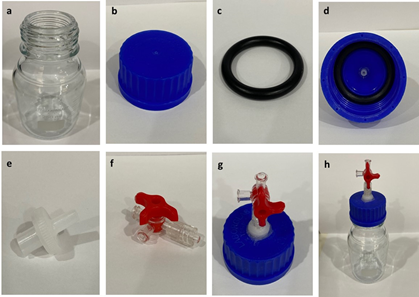
Glass bottles of 250 mL (64 x 64 x 143 mm) with a 45 mm screw cap (Laborglas, Brazil), sealing ring, syringe filter of 13 mm and 0.45 µm (Millex, Millipore, Brazil) and Luer-lock threeway stopcock (Descarpack, Brazil) were adapted and used as fermenters (Figure 1a-h), which allowed the sampling of gases and liquids at the same time. The substrates were weighed directly into the bottles or incubated using manufactured non-woven fabric filter bags (NWT, 100 g m2) of 5 x 5 cm that were sealed and palced into the bottles. The samples were put in the bags in the ratio of 20 mg DM cm2 of surface, according to Nocek (1988). Incubation was performed with 1 g of substrate, 25 mL of buffer solution (McDougall, 1948) and 25 mL of rumen inoculum. Twelve bottles were used: three ‘blank’ (without substrate), and three for each treatment of substrate in the medium, substrate inside a filter bag, and substrate inside a filter bag with monensin.
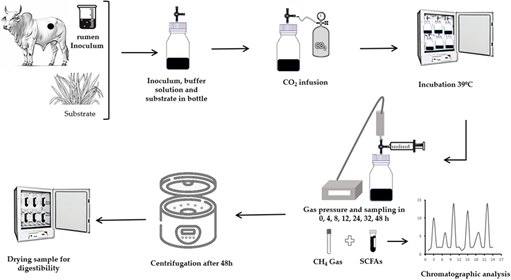
The in vitro fermentation technique was used to simultaneously study the kinetics of rumen fermentation, in vitro dry matter digestibility (IVDMD), production of short-chain fatty acids (SCFAs) and gases (Figure 2). The in vitro digestibility methodology of Tilley and Terry (1963) and the recommendations on gas production of Schofield (2000) were used.
The buffer solution was prepared the previous day with the addition of 5 mL of 5% urea solution and 5 mL of 5% glucose solution for each 300 mL of final solution, then kept at rest overnight in an oven at 39 °C with subsequent reduction of the pH of the solution to 6.8 to 6.9 by inflating CO2.
The assay was carried out in triplicate and incubated in an laboratory drying oven at 39 °C. The evaluations took place at 0, 4, 8, 12, 24, 32 and 48 hours, and three ‘blank’ (without sample) were incubated. The volume of gas generated was quantified by the displacement of the plunger of a 60 mL syringe and manually monitored by a pressure transducer (Universal Datalogger AG5000, Gênesis SM®, Barueri, SP, Brazil) that was coupled to the Luer-lock threeway stopcock, according to Theodorou et al. (1994). Then, using a 10 mL syringe and a 20 mm x 0.55 mm needle, a fraction of 9 mL of gas was sampled and packed in vacuum collection tubes (without additive) to determine the CH4 concentration by gas chromatography (Trace 1300, Thermo Fisher Scientific®, Rodano, Milan, Italy) according to Kaminski et al., 2003. In addition, 1 mL of the liquid content of each vial was sampled to quantify SCFAs (acetate, propionate and butyrate) by gas chromatography (Focus GC, Thermo Fisher Scientific®, Rodano, Milan, Italy) according to Erwin et al. (1961). After each moment of collection, the fermenters were ‘washed’ with CO2 to reestablish the anaerobic of the hadspace.
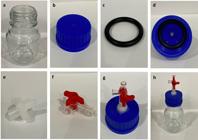
Representation of the apparatus for making fermenters (h), composed of 250 mL bottles 64 x 64 x 143mm (a) with a 45 mm screw cap (b) sealed with a rubber ring (c, d), with the cap adapted with the attachment of a syringe filter of 13 mm and 0.45 µm (e) and a Luer-lock threeway stopcock (f, g).
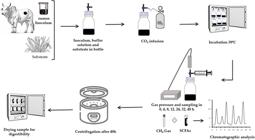
After the last evaluation moment (48 hours), the contents of the fermenters were transferred to 50 mL tubes and centrifuged at 1.6 × g for 15 min three times to determine the IVDMD. The supernatant was discarded and the residue dried in a forced ventilation oven at 55 °C for 72 hours; after drying the material was weighed on an analytical scale. Unlike Tilley and Terry (1963), the second stage of digestion with pepsin was not used. The degradation was calculated using the following formula:
where IVDMD: in vitro dry matter digestibility; W1: weight of the incubated sample; W2: weight of the residue; W3: weight of blank residue (inoculum)
After quantifying the fermentation products of the sample contained in each fermenter, each product was multiplied by its heat of combustion to express the CH4 production in relation to the total fermentation energy produced. Thus, the relative energy loss (REL) was the ratio between the energy of CH4 produced and the energy sum of all quantified fermentation products (CH4 and SCFA), expressed as a percentage.
The data were submitted to Gompertz’s non-linear sigmoidal model (France and Kebreab, 2008), according to the model below:
where: A, maximum production; B, integration constant (without biological meaning or indicates the lag time); e, exponential; k, specific production rate as a function of time; t, time in inflection point [ln(B) k-1]; y, concentration at inflection point (A/2.718281828).
Statistical analysis
All statistical analyses were performed using the SAS 9.4 (SAS Institute, Cary, NC). Means for all variables were obtained using the LSMEANS statement. For SCFA and CH4, production over time data was used in the Gompertz´s non-linear sigmoidal model. Results are reported as least square means and separated using the PDIFF structure, wherein significance was set at P ≤ 0.05.
Results and discussion
The method of Tilley and Terry (1963) is a reference for evaluating ruminal fermentation in vitro due to its high precision. The use of filter bags for substrate incubation has been widely applied in vitro (Ramin et al., 2013). According to Tagliapietra et al. (2012) and Sampaio et al. (2024), incubation with a filter bag decreased IVDMD, and as demonstrated in the present study, the IVDMD was reduced by 12.6% (Table 2).
Acetate fermentation products, total SCFA, and REL were reduced respectively by 37, 18 and 48% when compared to no bag incubation. Propionate, on the other hand, showed an increase of 30% for incubation with bag. Butyrate was reduced by 7.5% with bag and 49% with bag + mon, when compared to no incubation. The Ac:Pr ratio was reduced by 48% with bag and 56% with bag + mon, when compared to no bag incubation. The PF increased 31% with bag and 59% with bag + mon, when compared to no bag incubation (Table 2). This demonstrates that the fermentation intensity was reduced, probably due to the physical barrier caused by the use of the filter bag (Mertens, 1993), which can reduce the accessibility to the substrate by microorganisms. As demonstrated by Sampaio et al. (2024) who tested different substrate proportions with F57 (Ankon) and NWT filter bags.
Ionophores, more specifically monensin, have ability to change the products of ruminal fermentation. In the classic way, the use of monensin as a food additive usually reduces the concentrations of acetate and butyrate; however, it increases the concentration of propionate (Appuhamy et al., 2013). Although it was not the main objective of this study to discuss the effect of monensin, when we compared the treatments such as the use of bag, we found the differences in the concentrations described above. This suggests that the execution of the in vitro technique with the production of new apparatuses was not a limiting factor for the development of the fermentation process and demonstrates the sensitivity of the procedure in the study of feed additives.
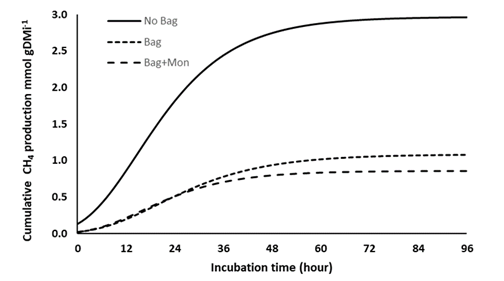
With the opportunity to sample SCFA at different times, it was possible to study the production behavior over time (Table 3). When the bag was not used for substrate incubation, the intensity of the fermentation responses was accentuated with the asymptote (A) for acetate and total SCFA being 67 and 26% higher, while the CH4 was about 3 times higher. Probably the use of the bag has a strong impact on the digestion of fibrous material, with this digestion being primarily responsible for the production of acetate and consequently of substrate for the CH4 production. Monensin demonstrated its classic effect of increasing propionate concentration and reducing CH4 (Table 3; Figure 3); however, if the use of monensin was in no bag incubation conditions, the fermentation dynamics would be altered, so we suggest further tests.

Cumulative CH4 production of in vitro fermentation for the substrate incubated dispersed in the bottle, inside the filter bag, and bag with monensin sodium (30 mg kg-1 of DM) submitted to Gompertz’s non-linear sigmoidal model. Estimated data up to 96 hours.
Conclusion
In this study, the adaptation of fermentation bottles was proven to be efficient for the study of in vitro fermentation due to its low cost, ease of use and especially because it offers the opportunity to simultaneously evaluate fermentation products (SCFA and CH4) and digestibility. We do not recommend the use of filter bags, as they significantly reduce IVDMD, AGCC and CH4 of the substrate by 12.6%, 18% and approximately three times, respectively.
Data availability
Data is available with the corresponding author and it will be made available on request.
Acknowledgements
The authors thank the Fundação de Amparo à Pesquisa do Estado de São Paulo (FAPESP, Brazil), for providing the financial support (201720084-5)
References
- Association of Official Agricultural Chemists (1998). Official methods of analysis of AOAC International (16th ed.).
-
Appuhamy, J. A. D. R. N., Strathe, A. B., Jayasundara, S. & De Vries, T. J.. (2013). Quantifying the effect of monensin dose on the rumen volatile fatty acid profile in high-grain-fed beef cattle. Journal of Animal Science, 91(1), 160-169. https://doi.org/10.2527/jas.2012-5591
» https://doi.org/https://doi.org/10.2527/jas.2012-5591 -
Bueno, I. C. S., Cabral Filho, S. L. S., Gobbo, S. P., Louvandini, H., Vitti, D. M. S. S. & Abdalla, A. L. (2005). Influence of inoculum source in a gas production method. Animal Feed Science and Technology, 123-124(1), 95-105. https://doi.org/10.1016/j.anifeedsci.2005.05.003
» https://doi.org/https://doi.org/10.1016/j.anifeedsci.2005.05.003 -
Erwin, E. S., Marco, G. J. & Emery, E. M.. (1961). Volatile fatty acids analyses of blood and rumen fluid by gas chromatography. Journal of Dairy Science, 44(9), 1768-1771. https://doi.org/10.3168/jds.S0022-0302(61)89956-6
» https://doi.org/https://doi.org/10.3168/jds.S0022-0302(61)89956-6 - France, J. & Kebreab, E. (2008). Mathematical modelling in animal nutrition. CAB International.
-
Kaminski, M., Kartanowicz, R., Jastrzebski, D. & Kaminski, M. M.. (2003). Determination of carbon monoxide, methane and carbon dioxide in refinery hydrogen gases and air by gas chromatography. Journal of Chromatography A, 989(2), 277-283. https://doi.org/10.1016/s0021-9673(03)00032-3
» https://doi.org/https://doi.org/10.1016/s0021-9673(03)00032-3 -
McDougall, E. I.. (1948). Studies on ruminant saliva. 1. The composition and output of sheep’s saliva. Biochemical Journal, 43(1), 99-109. https://doi.org/10.1042/bj0430099
» https://doi.org/https://doi.org/10.1042/bj0430099 - Mertens, D. R. (1993). Kinetics of cell wall digestion and passage in ruminants. In H. G. Jung, D. R. Buxton, R. D. Hatfield & J. Ralph (Eds.), Forage cell wall structure and digestibility. (pp. 535-570). ASA-CSSA-SSSA.
-
Nocek, J. E.. (1988). In situ and other methods to estimate ruminal protein and energy digestibility: A review. Journal of Dairy Science, 71(8), 2051-2069. https://doi.org/10.3168/jds.s0022-0302(88)79781-7
» https://doi.org/https://doi.org/10.3168/jds.s0022-0302(88)79781-7 -
Perna Junior, F., Nogueira, R. G. S., Ferreira Carvalho, R., Cassiano, E. C. O. & Rodrigues, P. H. M.. (2023). Use of tannin extract as a strategy to reduce methane in Nellore and Holstein cattle and its effect on intake, digestibility, microbial efficiency and ruminal fermentation. Journal of Animal Physiology and Animal Nutrition, 107(1), 89-102. https://doi.org/10.1111/jpn.13702
» https://doi.org/https://doi.org/10.1111/jpn.13702 -
Ramin, M., Krizsan, S. J., Jančík, F. & Huhtanen, P.. (2013). Short communication: Measurements of methane emissions from feed samples in filter bags or dispersed in the medium in an in vitro gas production system. Journal of Dairy Science, 96(7), 4323-4332. https://doi.org/10.3168/jds.2013-6556
» https://doi.org/https://doi.org/10.3168/jds.2013-6556 -
Rymer, C., Huntington, J. A., Williams, B. A., & Givens, D. I. (2005). In vitro cumulative gas production techniques: History, methodological considerations and challenges. Animal Feed Science and Technology, 123-124(1), 9-30. https://doi.org/10.1016/j.anifeedsci.2005.04.055
» https://doi.org/https://doi.org/10.1016/j.anifeedsci.2005.04.055 -
Sampaio, F. C., Souza, J. M. S., Soares, L. C. B., Oliveira, A. S., Pereira, D. H., Detmann, E., Tomich, T. R., Souza, J. M. C. & Batista, E. D. (2024). Can dispersion methods affect the in vitro ruminal evaluation of substrates with different fermentabilities? Revista Brasileira de Zootecnia, 53, Article e20230151. https://doi.org/10.37496/rbz5320230151
» https://doi.org/https://doi.org/10.37496/rbz5320230151 - Schofield, P. (2000). Gas production methods. In J. P. F. D'Mello (Ed.), Farm animal metabolism and nutrition. (pp. 203-232). CAB International.
-
Tagliapietra, F., Cattani, M., Hindrichsen, I. K., Hansen, H. H., Colombini, S., Bailoni, L. & Schiavon, S.. (2012). True dry matter digestibility of feeds evaluated in situ with different bags and in vitro using rumen fluid collected from intact donor cows. Animal Production Science, 52(5), 338-346. https://doi.org/10.1071/AN11206
» https://doi.org/https://doi.org/10.1071/AN11206 -
Theodorou, M. K., Williams, B. A., Dhanoa, M. S., McAllan, A. B. & France, J.. (1994). A simple gas production method using a pressure transducer to determine the fermentation kinetics of ruminant feeds. Animal Feed Science and Technology, 48(3-4), 185-197. https://doi.org/10.1016/0377-8401(94)90171-6
» https://doi.org/https://doi.org/10.1016/0377-8401(94)90171-6 -
Tilley, J. M. A. & Terry, R. A.. (1963). A two-stage technique for the in vitro digestion of forage crops. Journal of the British Grassland Society, 18(2), 104-111. https://doi.org/10.1111/j.1365-2494.1963.tb00335.x
» https://doi.org/https://doi.org/10.1111/j.1365-2494.1963.tb00335.x -
Valente, T. N. P., Detmann, E. & Sampaio, C. B.. (2015). Review: Recent advances in evaluation of bags made from different textiles used in situ ruminal degradation. Canadian Journal of Animal Science, 95(4), 493-498. https://doi.org/10.4141/cjas-2015-100
» https://doi.org/https://doi.org/10.4141/cjas-2015-100 -
Wanapat, M., Cherdthong, A., Phesatcha, K. & Kang, S.. (2015). Dietary sources and their effects on animal production and environmental sustainability. Animal Nutrition, 1(3), 96-103. https://doi.org/10.1016/j.aninu.2015.07.004
» https://doi.org/https://doi.org/10.1016/j.aninu.2015.07.004
Edited by
-
Associate Editor in charge:
Leandro Dalcin Castilha