
 Local Messages for a Global Agenda: Highlighting Territories and Justice at COP30
Abstract
Environmentalism has often failed to address, and at times has reproduced, colonial structures that marginalize Indigenous and local peoples. This historical exclusion reinforces the need for decolonial and inclusive approaches in addressing the interconnected crises of climate change, biodiversity loss, and ocean degradation. The protagonism of Indigenous and local communities, alongside the recognition of their knowledge systems and territorial experiences, is essential for shaping equitable global climate decisions. Policies, socio-environmental data, and solutions must be co-created locally, through transdisciplinary processes that foster genuine collaboration rather than extractive practices. Addressing the climate-biodiversity-ocean nexus requires multilevel and intersectorial governance grounded in equity and environmental justice, ensuring that responses are informed by and accountable to the realities of those most affected.
Keywords:
Indigenous and local knowledge; climate-biodiversity-ocean nexus; socio-environmental justice; transdisciplinarity; co-production
Resumo
O ambientalismo frequentemente deixa de abordar, e por vezes reproduz, estruturas coloniais que marginalizam povos indígenas e comunidades locais. Essa exclusão histórica reforça a urgência de abordagens decoloniais e inclusivas para enfrentar as crises interconectadas das mudanças climáticas, perda de biodiversidade e degradação oceânica. O protagonismo dessas comunidades, aliado ao reconhecimento de seus sistemas de conhecimento e experiências territoriais, é essencial para moldar decisões climáticas globais mais equitativas. Políticas, dados socioambientais e soluções devem ser co-criados localmente, por meio de processos transdisciplinares que promovam colaboração genuína e não práticas extrativas. Enfrentar o nexo clima-biodiversidade-oceano exige governança multinível e interseccional pautada na equidade e na justiça socioambiental, garantindo que as respostas sejam informadas e responsáveis perante as realidades daqueles mais afetados.
Palavras-chave:
Conhecimentos indígenas e locais; nexo clima-biodiversidade-oceano; justiça socioambiental; transdisciplinaridade; co-produção
Resumen
El ambientalismo a menudo no ha abordado, y en ocasiones ha reproducido, estructuras coloniales que marginan a los pueblos indígenas y a las comunidades locales. Esta exclusión histórica refuerza la necesidad de enfoques decoloniales e inclusivos para afrontar las crisis interconectadas del cambio climático, la pérdida de biodiversidad y la degradación oceánica. El protagonismo de las comunidades indígenas y locales, junto con el reconocimiento de sus sistemas de conocimiento y experiencias territoriales, es esencial para conformar decisiones climáticas globales más equitativas. Las políticas, los datos socioambientales y las soluciones deben ser cocreados localmente, mediante procesos transdisciplinarios que fomenten una colaboración genuina y no prácticas extractivas. Abordar el nexo clima-biodiversidad-océano requiere una gobernanza multinivel e interseccional basada en la equidad y la justicia ambiental, garantizando que las respuestas estén informadas por y sean responsables ante las realidades de quienes se ven más afectados.
Palabras-clave:
Conocimientos indígenas y locales; nexo clima-biodiversidad-océano; justicia socioambiental; transdisciplinariedad; coproducción
Introduction
The accelerating pace of the climate crisis demands a fundamental shift in how global governance frameworks engage with those most affected. Centralized, technocratic, and often militarized approaches-such as those historically implemented in Brazil’s coastal and marine zones-have not only failed to mitigate environmental degradation but have also intensified existing social inequalities. These models of top-down governance have largely excluded local actors from decision making, resulting in the erosion of territorial autonomy and the erosion of Indigenous and local knowledge systems (Renck et al., 2023). At the same time, institutional efforts aimed at building adaptive capacity to climate change - and carried out with no consideration for community contexts - often lead to undesirable results, further compromising social justice and equity; a situation that demands seeking other perspectives to engage local actors in climate governance (Cinner et al., 2018).
Climate change disproportionately impacts vulnerable coastal, marine, and Amazonian communities-through sea-level rise, ecosystem degradation, livelihood disruption, erosion of food security and people safety. Hence, it affects communities’ wellbeing in multiple dimensions (Dorji et al., 2023). Moreover, there is a growing recognition for the need for place-based, justice-centered responses (Ali et al., 2024).
Decolonial theory and southern ontologies (Ludwig et al., 2024) remind us that knowledge is situated and that the experiences of peoples historically excluded from global governance are not mere data points; they are sources of expertise and political agency. Indigenous and local peoples’ knowledge systems are essential not only for understanding climate impacts but for designing ethical, just, context-specific responses. Transdisciplinary co-production of knowledge, when conducted equitably, can serve as a means to bridge epistemological divides and realign climate science with the lived realities of those on the frontlines (Ligtermoet et al., 2025). Knowledge co-production may lead to actions towards new outcomes (Wyborn et al. 2019) and may be seen as a way of redistributing power amongst different knowledge systems (Zurba et al. 2022), thus fighting against epistemic injustice (Fricker, 2007).
The upcoming 2025 Conference of the Parties (COP) of the United Nations Framework Convention on Climate Change (UNFCCC), better known as COP30, will be hosted in the Brazilian Amazon. This event provides a critical opportunity to realign global climate agendas with local territorial realities. In fact, many environmentalists and scholars claim that global multilateral platforms for governance and policy coordination, such as the UNFCCC, adopt a multistakeholderism strategy, in which affected communities, disadvantaged groups and all interested parties or stakeholders are brought together to negotiate as equals. Under the guise of promoting cooperation and partnership, this strategy actually deepens the exploitation of vulnerable groups and people by the rich and powerful groups or actors. In practice, it enables powerful groups to exercise undue influences. Multistakeholderism fails to recognize that Indigenous peoples, local communities and even NGOs and research institutes do not have the same opportunities and conditions to influence the bids. In organizing open dialogues, they actually exclude the voices of those that are most affected by these impacts (Claeys et al., 2021).
Therefore, bluntly integrating local voices and knowledge systems into global negotiations is unacceptable. In this position paper, we present five key messages that emerged from the seminar “On the road to COP30: the ocean, biodiversity and the role of local knowledge in the climate agenda”, tackling this issue and proposing a more ethical and just development of resilient and context-specific climate solutions.The event brought together over 160 participants-including community leaders, government officials, legal experts, and scholars-from multiple Brazilian regions, notably the Marajó Archipelago (state of Pará), Ilhabela and Ilha Diana (state of São Paulo), and Canavieiras (state of Bahia). The messages were derived from detailed reports, graphic facilitation, and transcribed recordings from the seminar. They reflect a broad consensus among different stakeholders around the urgency of developing inclusive, decolonial, and participatory pathways for climate and ocean governance.
Together, these messages call for a radical rethinking of how policy is made: one that recognizes the epistemic legitimacy of indigenous and local knowledge, assumes the communities’ prerogative and protagonism in the debate on the impacts that affect them, confronts power asymmetries in climate negotiations, and prioritizes equitable governance at all scales.
Key Messages and Policy Implications
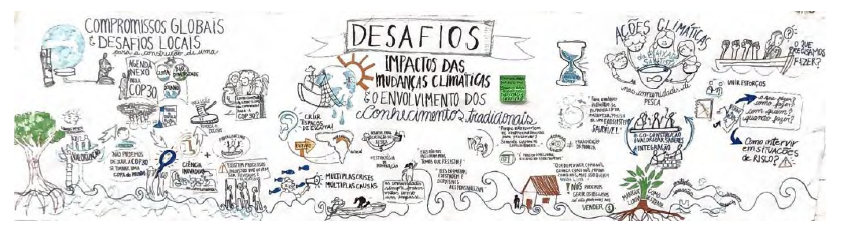
The messages presented below are more than policy suggestions-they are claims for epistemic justice, environmental democracy, and territorial self-determination. They emerge from territories that have long been marginalized in international negotiations, yet hold essential knowledge for better and more effective policies. We center the notion that knowledge is political, and that shifting who speaks, who decides, and whose realities count is central to climate justice (Figure 1).
Each message addresses a key tension in current climate/ocean/biodiversity nexus governance and offers a pathway toward reimagining global frameworks from the bottom up. Together, these messages demand that COP30 be more than a summit; it must be a turning point.

Visual synthesis of discussions from the seminar “On the Road to COP30,” highlighting global commitments, local challenges, and climate actions in Brazilian coastal and fishing communities. The illustration emphasizes the role of traditional knowledge, the urgency of inclusive and ecosystem-based responses, and the co-construction of solutions rooted in local realities
Message 1: Global Climate Decisions Must Be Guided by Territorial Realities
Issue: Communities living in coastal, marine, and Amazonian areas face the brunt of climate impacts.
Policy Implication: Ensure that international frameworks such as the UNFCCC meaningfully incorporate local knowledge and community experiences and demands into global decision-making processes. Create formal mechanisms for community consultation, deliberation, and representation at all negotiation stages, such that local communities truly participate in the construction of climate adaptation strategies and take central place in their leadership.
Message 2: Democratic, Inclusive Decision Making Is Essential
Issue: Territorial exclusion perpetuates policy failures and social injustice.
Policy Implication: Establish inclusive governance frameworks that guarantee the active participation of Indigenous peoples, local communities and all positionalities of interest, like women, youth, and local leaders in the formulation and implementation of climate policies. Recognize Free, Prior, and Informed Consent (FPIC) as a foundational principle.
Message 3: Transdisciplinary Science Must Be oriented towards territorial-based knowledge Co-Production
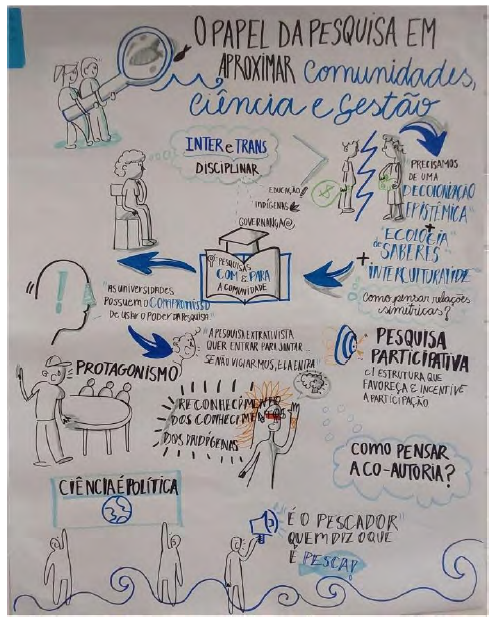
Issue: Research agendas are often pre-defined, science-oriented and extract data from communities without delivering benefits (Figure 2).
Policy Implication: Promote funding and institutional support for research co-produced with communities-from agenda-setting to dissemination. Mandate ethics protocols requiring community participation and benefit-sharing. Recognize local systems of monitoring and evaluation.

Illustrated synthesis exploring the role of research in connecting communities, science, and environmental governance. The visual emphasizes the need for inter- and transdisciplinary approaches, epistemic decolonization, intercultural dialogue, and recognition of Indigenous knowledge. It advocates for participatory, community-driven research that avoids extractivism and promotes co-authorship, symmetry in relationships, and political engagement by academic institutions
Message 4: The Climate-Biodiversity-Ocean Nexus Demands Intersectional and Decentralized Approaches
Issue: Centralized climate responses ignore interconnected dynamics and structural inequalities.
Policy Implication: Design climate actions that are multi-scale and intersectorial, addressing social, ecological, and economic vulnerabilities together. Prioritize investments in adaptation strategies led by and for vulnerable populations, particularly in coastal zones.
Message 5: Collaborative Governance is Key to Transformative Change
Issue: Technocratic processes limit democratic engagement.
Policy Implication: Encourage and institutionalize multi-actor coalitions, involving governments, NGOs, researchers, private sector, and communities, to co-develop climate and biodiversity policies. Reduce bureaucratic barriers to participation and fund participatory arrangements (e.g., non-extractive citizen science platforms, local forums).
Actionable Recommendations
Echoing the voices of multiple and legitimate stakeholders, the five messages/issues above require timely and expedited actions. Below, we give some recommendations on what, how, who, and when to operationalize them (Table 1).
Conclusions
To prevent the pervasiveness of multistakeholderism and the reduction of participation in a mere spectacle, COP30 must reflect the voices of those who face the impacts of climate disruption daily. The five messages presented here urge the global climate community to embrace a justice-based, locally anchored approach, building bridges between knowledge systems and reimagining futures through resistance, collaboration, and hope.
Acknowledgments
We express our sincere gratitude to the more than 160 participants who attended the seminar “On the Road to COP30: The Ocean, Biodiversity, and the Role of Local Knowledge in the Climate Agenda”, generously contributing their reflections, experiences, and critical perspectives on the intersections between climate, biodiversity, ocean governance, and traditional knowledge. This policy brief aims to expand the collective thinking that emerged from these dialogues, making it accessible to a broader audience. It is grounded in the content shared during the seminar, including the detailed policy report and the video recording of the event, available here: https://www.gov-oceano.eco.br/post/evento-em-santos-sobre-oceano-biodiversidade-e-justi%C3%A7a-clim%C3%A1tica-re%C3%BAne-mais-de-160-pessoas-e-gera-r The authors acknowledge the following grants: L.R.G.: grant 2022/10321-8; 2024/02023-2; and 2023/14819-3 from the São Paulo Research Foundation (FAPESP); V.R.: grant 2023/08372-6; 2023/14819-3 from the São Paulo Research Foundation (FAPESP); L.S.G.: grant 2024/14308-1 from the São Paulo Research Foundation (FAPESP); M.C.: grant 384748/2024-4 from the National Council for Scientific and Technological Development (CNPq) / Biodiversity Research Program - PPBio; C.N.E.H.: 465767/2014-1; 307223/2021-3; and 403083/2023-0 from the National Council for Scientific and Technological Development (CNPq); INC0006/2019 from the Bahia Research Foundation (FAPESB).
References
- ALI, S.; KHAN, Z. A.; AZHAR, M.; RAHEEM, I. Investigating the disproportionate effects of climate change on marginalized groups and the concept of climate justice in policy-making. Review of Education, Administration & Law, v. 7, n. 4, p. 369-381, 2024.
- CLAEYS, P.; DUNCAN, J.; MILGROOM, J. Multistakeholderism and the UN Food Systems Summit. Digital or Visual Media, 2021.
-
CINNER, J. E.; ADGER, W. N.; ALLISON, E. H.; BARNES, M. L.; BROWN, K.; COHEN, P. J.; GELCICH, S.; HICKS, C. C.; HUGHES, T. P.; LAU, J.; MARSHALL, N. A.; MORRISON, T. H. Building adaptive capacity to climate change in tropical coastal communities. Nature Climate Change, v. 8, n. 2, p. 117-123, 2018. DOI: https://doi.org/10.1038/s41558-017-0065-x
» https://doi.org/10.1038/s41558-017-0065-x -
DORJI, T.; MORRISON-SAUNDERS, A.; BLAKE, D. Understanding how community wellbeing is affected by climate change: Evidence from a systematic literature review. Environmental Management, v. 72, n. 3, p. 568-586, 2023. DOI: https://doi.org/10.1007/s00267-023-01833-w
» https://doi.org/10.1007/s00267-023-01833-w - FRICKER, M. Epistemic injustice: Power and the ethics of knowing. Oxford: Oxford University Press, 2007.
- LIGTERMOET, E.; MUNERA-ROLDAN, C.; ROBINSON, C.; SUSHIL, Z.; LEITH, P. Preparing for knowledge co-production: A diagnostic approach to foster reflexivity for interdisciplinary research teams. Humanities and Social Sciences Communications, v. 12, n. 1, p. 1-18, 2025.
-
LUDWIG, D.; BANUOKU, D. F.; BOOGAARD, B.; EL-HANI, C.; GURI, B. Y.; KRAMM, M.; RENCK, V.; RESSIORE, A.; ROBLES-PIÑEROS, J.; TURSKA, J. Southern ontologies: Reorienting agendas in social ontology. Journal of Social Ontology, v. 10, n. 2, p. 51-79, 2024. DOI: https://doi.org/10.25365/jso-2024-7691
» https://doi.org/10.25365/jso-2024-7691 -
RENCK, V.; LUDWIG, D.; BOLLETTIN, P.; REIS-FILHO, J. A.; PO LISELI, L.; EL-HANI, C. N. Taking fishers’ knowledge and its implications to fisheries policy seriously. Ecology and Society, v. 28, n. 2, 2023. DOI: https://doi.org/10.5751/ES-14104-280207
» https://doi.org/10.5751/ES-14104-280207 -
WYBORN, C.; DATTA, A.; MONTANA, J.; RYAN, M.; LEITH, P.; CHAFFIN, B.; MILLER, C.; VAN KERKHOFF, L. Co-producing sustainability: Reordering the governance of science, policy, and practice, 2019. DOI: https://doi.org/10.1146/annurev-environ-101718
» https://doi.org/10.1146/annurev-environ-101718 -
ZURBA, M.; PETRIELLO, M. A.; MADGE, C.; MCCARNEY, P.; BISHOP, B.; MCBETH, S.; DENNISTON, M.; BODWITCH, H.; BAILEY, M. Learning from knowledge co-production research and practice in the twenty-first century: Global lessons and what they mean for collaborative research in Nunatsiavut. Sustainability Science, v. 17, n. 2, p. 449-467, 2022. DOI: https://doi.org/10.1007/s11625-021-00996-x
» https://doi.org/10.1007/s11625-021-00996-x
Not applicable.

 Font: Marcela Dalete (based in workshop discussions), 2025
 Author: Marcela Dalete (based in workshop discussions), 2025