 PRIVATE HIGHER EDUCATION IN BRAZIL
Abstract
This study analyzes the rise of private higher education in Brazil, which has one of the highest shares of students enrolled in the private sector in the world (79.8% in 2024, considering its different types). It shows how this growth was an unintended consequence of the 1968 university reform and subsequent legislative changes that allowed for-profit institutions and government programs such as PROUNI and FIES. It examines the impact of the 2015 crisis, compares the public and private sectors in terms of admissions, size, fields, degrees, and modalities, and evaluates indicators of quality, equity, and efficiency. It also discusses specific policies for regulating the private sector with respect to teacher training, medical education, and distance education. The study concludes that Brazil is approaching the end of a cycle of expansion and that new regulations may restrict private growth, with consequences for accessibility and access.
Keywords:
higher education; private sector; Brazil.
Resumo
Este estudo analisa a ascensão do ensino superior privado no Brasil, que possui uma das maiores participações de estudantes no setor privado no mundo (79,8% em 2024 considerando seus diferentes tipos). Mostra como esse crescimento foi uma consequência não prevista da reforma universitária de 1968 e de mudanças legislativas que permitiram a criação de instituições com fins lucrativos e programas governamentais como o PROUNI e o FIES. Examina o impacto da crise de 2015, compara os setores público e privado em termos de admissão, tamanho, áreas, graus e modalidades, e avalia indicadores de qualidade, equidade e eficiência. Discute também políticas específicas para regular o setor privado em relação à formação de professores, educação médica e regulação da educação a distância. O estudo conclui que o Brasil se aproxima do fim de um ciclo de expansão e que novas regras podem restringir o crescimento do setor privado, com consequências para a acessibilidade e o acesso.
Palavras-chave:
ensino superior; setor privado; Brasil.
Resumen
Este estudio analiza el ascenso de la educación superior privada en Brasil, que tiene una de las mayores participaciones de estudiantes en el sector privado del mundo (79,8% en 2024, considerando sus diferentes tipos). Muestra cómo este crecimiento fue una consecuencia no prevista de la reforma universitaria de 1968 y de los cambios legislativos que permitieron instituciones con fines de lucro y programas gubernamentales como PROUNI y FIES. Examina el impacto de la crisis de 2015, compara los sectores público y privado en términos de admisión, tamaño, áreas, grados y modalidades, y evalúa indicadores de calidad, equidad y eficiencia. También analiza las políticas específicas para regular el sector privado en relación con la formación de docentes, la educación médica y la regulación de la educación a distancia. El estudio concluye que Brasil se aproxima al final de un ciclo de expansión y que nuevas reglas podrían restringir el crecimiento del sector privado, con consecuencias para la accesibilidad y el acceso.
Palabras clave:
educación superior; sector privado; Brasil.
1 INTRODUCTION
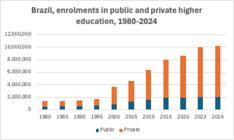
Brazil is among the countries with the highest proportion of students in private higher education, 79.8% according to the 2024 higher education census2, most of them attending distance-learning programs at for-profit institutions. Brazilian private education has been the subject of many studies describing its origins, expansion, quality, impact on social equity, and the logic behind the large emphasis on for-profit and distance education arrangements (Carvalhaes; Schwartzman, 2025; Cruz; Paula, 2018; Durham, 2004; Morais; Vasconcelos; Resende, 2024; Nunes; Carvalho; Albrecht, 2009; Salto, 2018; Sampaio, 2000; 2020; Sampaio; Limongi; Torres, 2000; Semesp, 2002)). Comparative studies on private higher education tends to focus on the different meanings the term “private” is used in different contexts (Altbach, 1999; Geiger, 1986; Levy, 2024); the great variety of private institutions, in terms of their origins, purposes, sources of support and internal organization (Gérard, 2024; Kinser; Levy; Silas Casillas; Bernasconi et al., 2010; Teixeira; Amaral, 2001); the broader impact of the private sector in terms of human capital formation and social equity (Gérard, 2024; Schendel; Mccowan, 2016) and public policies for the regulation of the sector (Levy, 2011). In this article, we present an overview of the policies that led to the expansion of private education in Brazil and compare the private with the public sector regarding their social and institutional differences
2 CONTEXT
Brazil never had the kind of Catholic universities that were created by the Spanish colonizers in places like Mexico, the Dominican Republic, Peru, Argentina, Chile, Cuba and many others. These, however, were not private institutions in the modern sense, given the lack of separation between State and Church at the time. The independence movements in the early 19th century were secular and either closed or turned most of the old Catholic universities into public, laic (Schwartzman, 1996). It was only in the 20th century that the Catholic universities reemerged, this time in cultural and ideological competition with the laic establishment. They were focused on their religious identity, but also played a role as elite institutions, providing prestigious degrees to the children of the richest families. In Brazil, the first universities were established in the 1930s, in the context of an agreement between the State and the Catholic Church to give to the latter the control of the country’s education institutions (Schwartzman; Bomeny; Costa, 2000). This project, however, did not materialize, and the first Catholic universities were created in the early 1940s in Rio de Janeiro and São Paulo as independent institutions.
Since the early 20th century, Brazil absorbed many immigrants from Italy, Japan, Germany and other European countries, who settled mostly in the Southern states of Rio Grande do Sul, Santa Catarina, Parana and São Paulo, and sought to establish their own education schools, often with the participation of the Catholic Church. These efforts to preserve their cultural identities were forcefully suppressed by the national government in the 1930s (Seyferth, 2002). However, a few community-based universities were established later in these regions with strong links with immigrant communities, such as the universities of Caxias do Sul (Italian), and Vale do Itajai, Blumenau and Vale dos Sinos (German). Protestant missionaries also started to arrive in Brazil since the late 19th century and founded the Mackenzie college that later became the Mackenzie University in São Paulo.
Despite Brazil’s large populations of African and Indigenous descent, the country has never developed educational institutions specifically intended for these groups, unlike the segregated systems established in South Africa or the United States. This can be explained by two seemingly contradictory factors: on the one hand, the deep social and economic inequalities separating light-skinned and non-white Brazilians; on the other, the absence of rigid racial boundaries and of explicitly discriminatory laws such as Jim Crow or apartheid. Since the abolition of slavery in 1888, all individuals, regardless of race or origin, have been legally allowed to enroll in higher education if qualified. In practice, however, very few Black, Indigenous, or even women students gained access until quite recently.
Private institutions played a crucial role in meeting the demand for higher education that gradually emerged in urban centers, particularly within the liberal professions of Law, Medicine, and Engineering. From the early 19th century, such education was primarily offered by a limited number of public schools located in Rio de Janeiro, São Paulo, Bahia, and Pernambuco. Brazil’s transition from a centralized Empire (until 1889) to a Republican regime significantly empowered local authorities, groups, and professional associations, granting them greater autonomy to establish their own educational institutions (Coelho, 1999; Nagle, 1974). Consequently, by the time the first public universities were founded in the 1930s in Rio de Janeiro and São Paulo, Brazil already possessed a substantial network of private and local higher education schools. These institutions uniquely combined roles as identity-shaping, semi-elite, and demand-absorbing entities. They typically operated as small, specialized teaching facilities, staffed by lawyers, medical doctors, and engineers who taught on a part-time basis, supplementing their primary professional activities. Notably, there were no higher education colleges in the Anglo-Saxon tradition, and research did not exist except in a few medical schools affiliated with hospitals.
2.1 The 1968 reform and the expansion of the private sector
The most important landmark in the history of Brazilian higher education, after the creation of the first universities in the 1930s, was the university reform legislation of 1968. That sought to introduce in Brazil the American research university model, with academic departments, full-time professors with doctoral degrees, research and graduate education, in contrast with the traditional professional schools. This reform had the technical support of the American Agency for International Development (USAID) but did not consider the adoption of American-style land-grant and community colleges. It was implemented by the military regime that came to power in 1964, but was not very different from earlier experiences at the universities of Brasilia and Minas Gerais that tried to break the mold of traditional institutions (Bomeny, 2016; Fonseca Oliveira; Faria Filho, 2019; Martins, 2009; Vechia; Gomes Ferreira, 2020; Veiga, 1985).
To implement this reform, it was necessary to establish graduate degree courses, create special programs with fellowships and incentives to educate a new generation of university professors with academic degrees, provide the universities with office and laboratory space and equipment, and increase their budget to pay for the new, fulltime staff. It was also necessary to set limits on the number and qualifications of students admitted to the new universities, so that they could keep high standards and not be overwhelmed by excessive teaching loads. In the 1970s, the “economic miracle” of those years allowed for growing investments in higher education and research that lasted until the early 1980s, when the economy entered a long period of stagnation (Schwartzman, 1991).
Beyond the federal system, a few Brazilian states developed their own public university networks. However, only São Paulo,the country’s richest and most populated state,managed to meet or exceed federal benchmarks, with institutions such as the University of São Paulo (USP), the University of Campinas (UNICAMP), and the State University of São Paulo (UNESP).
Though the reform did expand public higher education to some extent, it also made it more expensive and limited their growth. This was compounded by a growing demand for higher education that the 1968 reformers had not anticipated. Brazil’s student population jumped from roughly 27,000 in 1945 (out of a total population of 45 million) to 93,000 by 1960, and then to 425,000 by 1970. Faced with this unforeseen influx, the federal government was compelled to ease the academic standards it had established. As a result, a significant portion of public institutions, along with all private ones, effectively remained in their pre-reform role as teaching-only establishments.
Thus, in contrast with most other countries in the region, Brazil never had large, comprehensive national or regional universities that could absorb the demand for access that would accelerate after the 1970s. The adoption of the research model led to the creation of a significant graduate education and university research system which had no parallel in the region, precluded the expansion of private elite institutions and allowed for the creation of a large, demand-absorbing private sector which became probably the largest in the world.
2.2 Legislation allowing for-profit institutions
The expansion of the private sector was facilitated by legislation introduced in 1997, which allowed higher education institutions to operate as for-profit companies (Brasil; Presidência Da República, 1997). The rationale for this decision was that, although all private institutions were supposed to be philanthropic, in practice many of them operated as private companies in disguise, while benefiting from tax exemption as non-profit entities. The new legislation allowed them to choose to become for-profit companies, pay taxes and benefit from more flexibility in the administration and use of their resources, attract investments and distribute profits. In the following years, about half the private institutions opted for the for-profit status and grew much more rapidly than the philanthropic sector.
A new stimulus was given in the 2000s by the decision of the government of Luiz Ignácio Lula da Silva, of the left-leaning Workers’ Party (Partido dos Trabalhadores - PT), to stimulate access to higher education. Previously, the assumption was that the private sector should not receive public subsidies. In the political imagery on the left, public institutions were considered more progressive and socially oriented, and the private sector more conservative, capitalist and pro-market. Accordingly, in 2004 the Lula government prepared a proposal for a new regulation for higher education that would give more support to the public and impose additional restrictions to the private sector. This proposal, however, was never submitted to Congress (Castro; Schwartzman, 2005). As the government increased its revenues in the first years of the commodity boom, it decided to create new public universities and expand the existing ones.
Between 2010 and 2015, expenditures of the Ministry of Education in higher education almost doubled, from 26 to about 40 billion reais yearly. But the cost per student in the public sector, in terms of public expenditure, was more than twice the cost in the private sector, measured in terms of tuition prices), with the additional difference that the cost was on the students. It soon became clear that, to increase access significantly, it would be much more effective to stimulate the expansion of the private sector.
This was done through two mechanisms, Programa Universidade para Todos (PROUNI) and Fundo de Financiamento Estudantil (FIES). PROUNI was a program created in 2004 according to which for-profit institutions could forgo their taxes if they provided a certain number of places for free. The estimation is that PROUNI provided the equivalent of US$ 300 - 400 million a year to the private sector as tax relief (Felicetti; Cabrera, 2017; Haas; Pardo, 2017). FIES is a student loan program through which the Federal government pays the students’ fees to private institutions and is reimbursed by the students once they graduate. If the student defaults, the Federal Government absorbs the cost. FIES had existed since 1999 but was expanded in 2010. The estimation is that more than 60% of the beneficiaries never pay their debt (Moya, 2025). Expenditures on FIES reached about US$ 5 billion in 2016. Since 2015, new legislation led to a drastic reduction on new FIES loans, but existing contracts were kept while the students remained enrolled (Souza, 2022). With PROUNI and FIES, the provision of private higher education became an excellent business opportunity, tax free and government supported, attracting national and international investment funds with no previous experience in education.
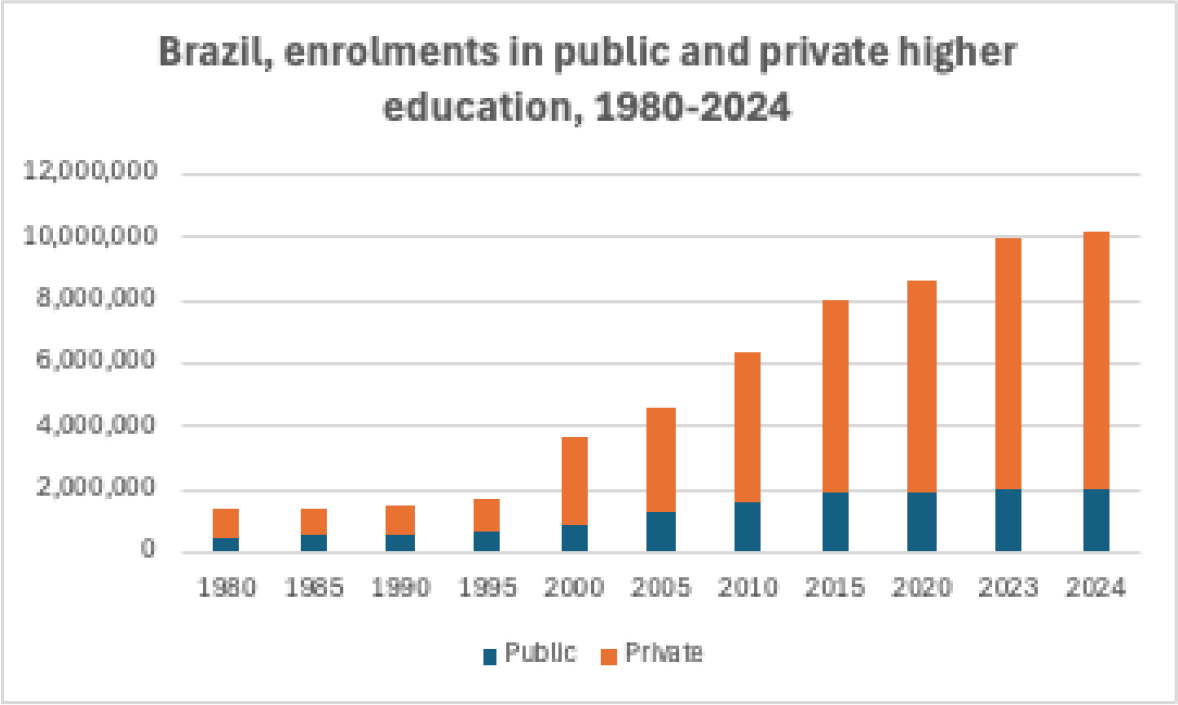
The federal institutions also benefited from a new program (Programa de Apoio a Planos de Reestruturação e Expansão das Universidades Federais - REUNI) of 2007, which provided existing institutions with resources to expand their facilities and hire more teachers if they agreed to admit more students. One result of REUNI was that many public universities started providing evening courses, which they did not have previously (Paula; Almeida, 2020), and enrolments in public institutions increased from 1.6 o about 2 million between 2010 and 2020.
In short, the expansion of private higher education is explained, first, the legislation allowing for for-profit institutions, and, in the second term of the Cardoso government, and second, by the subsidies to the private sector during the Lula-Dilma Rousseff periods. In both cases, these policies resulted from the inability of the public institutions to absorb the growing demand, in spite of the additional recourses provided after 2002.
2.3 The impact of the 2015 crisis
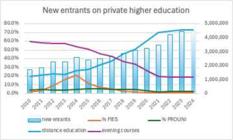
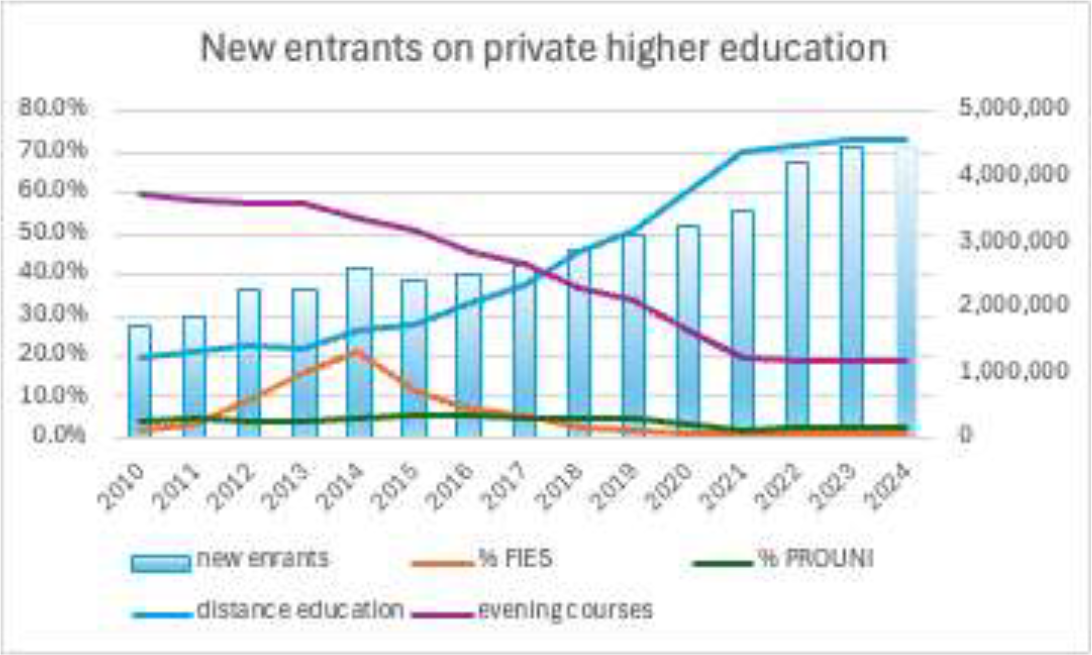
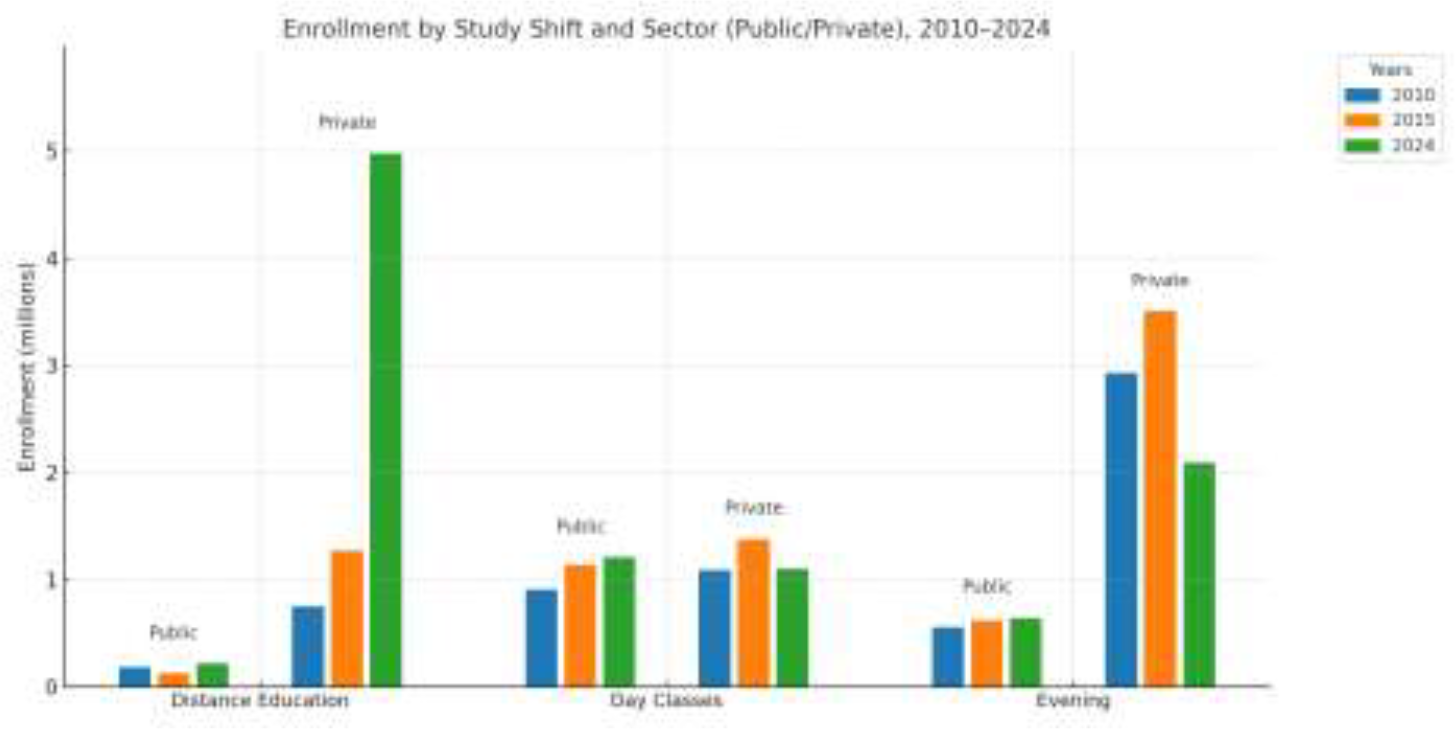
A significant turn in Brazil’s higher education occurred in 2015, when the country entered a deep crisis, with economic recession, corruption scandals and the impeachment of President Dilma Rousseff in 2016. One direct consequence was the reformulation of FIES, the student loan program, with the introduction of more stringent warranties for repayment. The number of new contracts fell from 733,000 to 287,000 from 2014 to 2015, and again to 201,000 in 2016 (Souza, 2022, p. 166). To compensate for the loss, the private institutions started to look for alternative sources for student loans, and to move the students to distance education, to get the benefits from economies of scale. The proportion of new students receiving FIES loans fell from 21.3% in 2014 to less than 1% in 2023, while the proportion of students in distance education went from 20% to 73% in the same period. The Brazilian private sector started working on distance education well before the COVID-19 pandemic and was therefore able to function during that period, when most public institutions suspended their classes (Pinheiro; Balbachevsky; Pillay; Yonezawa, 2023; Pinto, 2021).
Figure 2 shows the dramatic changes in the private sector since 2010. It grew first with the support of FIES and PROUINI, and since the 2015 crises shifted from evening to distance education, as compensation from the loss of public support.
3 CLASSIFICATION OF PRIVATE INSTITUTIONS
The assumption implicit in the 1968 reform was that all higher education institutions in Brazil should converge towards the “Humboldtian” model of autonomous, research-based universities. Instead, as they expanded, they diversified into a plurality of institutions of different identity status and purposes, following a path similar to the classic model of transition from elite to mass higher education described by Martin (Trow, 1972; 1973). This assumption was never changed, as can be seen since then in the unidimensional rankings created by the federal government in its attempts to assess and regulate the higher education sector. At the same time, it was necessary to recognize the existing differences and create a formal classification of institutions according to their legal status.
The main legal differentiation is between public and private institutions. Public institutions are established by law by the national, state or municipal governments. They are subsidized by their respective governments and not allowed to charge tuition. Academics and administrative staff are considered civil servants and hired according to the general regulations pertaining to their jurisdiction. In principle, the institutions are autonomous if they have university status, which most of them do, but their assets are considered public property and they are subject to strict rules regarding hiring and dismissing personnel, establishing salaries, making purchases and investing resources. The national government, through the Ministry of Education, is responsible for the administration of federal institutions, while state and municipal governments are responsible for financing and overseeing their own institutions. Private institutions, regardless of their location, depend on federal authorization to function. Within this broad framework, there are variations, issues of overlapping authorities and others that have been analyzed elsewhere and should not concern us here (Ranieri, 2019; 2024).
Regardless of ownership, higher education institutions are classified as universities, university centers, isolated faculties (colleges) and federal institutes. All of them can provide professional degree: bacharelado, a first degree lasting four to six years in liberal professions such as Law, Medicine, Engineering, Economics, etc.); teaching degrees (licenciatura) for schoolteachers, requiring a course program in education or three years in a specialized field plus one year of pedagogical studies; and vocational degrees (technological certificates, requiring two to three years of education). At the graduate level, they can provide master’s and doctoral degrees, which must be recognized by a national agency at the Ministry of Education (CAPES), and specialization courses, which are not regulated besides a minimum requirement of 360 teaching hours per year3.
To be a university, institutions need to teach in at least three broad areas of knowledge, to have at least four graduate degree course programs, to develop research, and to have at least one third of their academic staff with doctoral degrees and full-time working contracts. The main advantage of having a university status is that they free to create new courses or increase enrolment. Because of the high costs involved, only a few private institutions can meet these criteria, and most of those that do just do the minimum to pass the Ministry of Education’s thresholds.. Bending to the demands from the private sector, the legislation recognizes also the existence of “university centers” which also enjoy the freedom to create new courses and increase enrolment, but do not have to do research or provide graduate education nor to have full-time staff to the same extent. Colleges may teach only in one or two fields, are not required to do research or provide graduate education and depend on the Ministry of Education to create new course programs and set their vacancies. Federal institutes were created in 2008 by granting university status to a preexisting network of federal vocational schools in secondary education. They combine teaching and the secondary and higher education and are supposed to give more emphasis to vocational education.
Table 2 gives the proportion of students by types of institution and graduation degrees in 2024. Data on post-graduate education is provided by the Coordenação de Aperfeiçoamento de Pessoal de Nível Superior - CAPES, according to which there were 411 thousand students in total, of which 154 thousand in doctoral programs. Only 15% were in private institutions, most of those in MA programs. The Ministry of Education does not collect data on specialization and MBA courses. According to the National Household Survey of the Brazilian statistical office (PNAD contínua), there were 1.6 million students in such courses in 2024, 87% of which in the private sector.
The official classification fails to capture the wide diversity of institutions, both public and private, which differ significantly in size, governance, organization, mission, staffing, student composition, and outcomes such as research, human capital formation, and equity. Even the notion of an “institution” itself is ambiguous, as many are embedded within larger networks or “maintaining organizations” that vary in their degree of integration. In the public sector, the main maintaining institution is the Federal Ministry of Education, and there are also networks of institutions maintained by state governments, notably São Paulo and Rio de Janeiro. In the private sector, institutions belonging to the six largest for-profit companies, those enrolling at least 200,000 students, enrolled 31.5% of all students in 2023, or 3.14 million. All these groups are based in Brazil, but some of them are listed in stock exchanges and may have shares owned by foreign investors4. Another difficulty is that the data on professional (undergraduate) and graduate education are collected by separate agencies and are not fully compatible.
There is a strong emphasis, in the literature on quality assurance, on the need to develop a more complex view of the higher education sector, making use of empirical data beyond the legal and administrative norms, through which unidimensional interpretations and assessments could be replaced by multi-rankings based on different dimensions. Daniel C. Levy has proposed a broad classification of three main types of private institutions according to their identity (religious, ethnic, regional, gender, others), status (world-class, semi-elite, others) and purpose (demandabsorbing, product-oriented and others) (Levy, 2024). The widely known Carnegie Classification of higher education institutions in the United States groups them according to the degrees they provide, research, student access and student profiles, among others (Carnegie Foundation for the Advancement of Teaching, 2011; Mccormick, 2013). The proposals for a multi-ranking of European institutions put emphasis on separate measurements on learning, research output, knowledge transfer, international orientation, and others (Van Vught, 2009; Van Vught; Ziegele, 2012).
In a previous work, we combined the data from INEP, CAPES and other sources in a single data base at the institution level for the 2010-2020 period and came up with a typology of 9 different types, four of which in the private sector (Schwartzman; Bueno, 2023; Schwartzman; Silva; Coelho, 2021). The main criteria for the typology were the sector (public, private), intensity of research and graduate education, intensity of vocational education, and student enrollment. In the public sector we identified three types of institutions, two of which had more graduate education and research, differentiated by size, and a third category with institutions mostly dedicated to teaching. In the private sector we identified two clearly identified types, large institutions with more than 30 thousand students, most of them with distance education programs, and a large cluster of small colleges dedicated to one or a few course programs. The other categories were the community and confessional institutions and a residual category of private universities and university centers. We also identified two small additional types, institutions primarily dedicated to vocational education, and institutions dedicated primarily to graduate education and research.
A different classification, developed by Vieira, Rodrigues and Barbosa (Vieira; Rodrigues; Barbosa, 2025) used latent profile methods on 2010 and 2019 INEP data to identify nine distinct institution types. This typology integrated data on governance, educational profiles, research involvement, international outlook, and “third mission” activities. Most students belonged to three of these types: “large, virtualized,” “distributed and multifunctional,” and “Humboldtian” institutions.
Each of these classifications are valuable to the extent that they capture statistically significant differences among institutions, allowing the categories to be interpreted and used in a meaningful and analytically robust way. Table 3 below is an adaptation of the Schwartzman and Bueno classification for the private sector based on the Higher Education Census of 2024, distinguishing a) large private institutions, with more than 30,000 students; b) community and confessional institutions defined as such by the higher education census; c) other private universities and university centers; and d) private isolated schools or colleges not included in previous groups5.
Participants in the National Exam of Secondary Education (ENEM) by gender, father’s occupation and grades in mathematics
This classification captures important variations within the private sector. Large private institutions are mostly for profit, most students are in distance education, have a high number of students per teacher, few students in STEM fields, and a relatively high proportion of students in short-term, vocational courses. Community and confessional institutions are a small group, are not for profit (which does not mean that students do not have to pay), and their students are proportionally more white and younger that the others, suggesting a higher socioeconomic status. Otherwise, they are like the remaining universities and university centers, which are a mixed bag regarding the for-profit status and other characteristics. Isolated schools still hold a significant number of students in evening courses, suggesting that they are struggling to move to distance education.
This classification does not include a small but significant group of private institutions that have emerged in recent years positioning themselves as part of an elite segment. These are typically specialized institutions focused on fields such as economics, business administration, law, medicine, and engineering. They charge high tuition fees and are able to compete with the public sector for talented faculty by offering higher salaries, greater flexibility, and better working conditions, as well as higher academic standards and pedagogical innovations for students6.
4 PUBLIC AND PRIVATE HIGHER EDUCATION IN COMPARISON
4.1 Social composition
Admission to public universities is limited by competitive entrance examinations that favor students from educated families coming from selective middle schools. The National Exam of Secondary School (ENEM) enrolls each year about 4 million candidates, of which only about 250 thousand are admitted in a federal institution (Schwartzman; Knobel, 2016). Access to private higher education, however, is open to all who can afford tuition or obtain a scholarship or federal student loan. Most teaching takes place in the evening and, increasingly, through distance education.
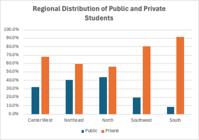
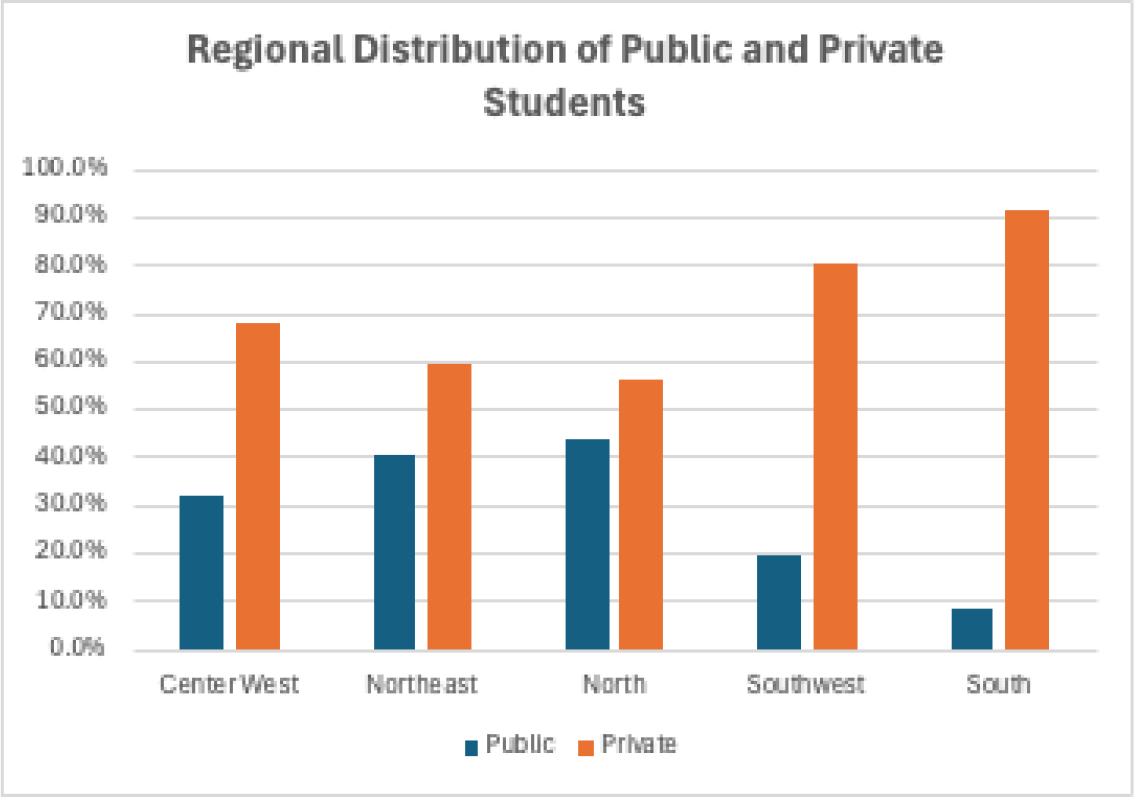
One might therefore expect students in public universities to come from higher socioeconomic backgrounds than those in the private sector. This pattern has been offset, however, by the expansion of less selective programs in the social sciences, education, and health professions, the introduction of evening courses in public institutions. In addition, the 2012 affirmative action law required that 50 percent of admissions in federal institutions be reserved for students from public schools, lowincome families, and non-white backgrounds (Schwartzman; Paiva, 2016). The public sector is also proportionally larger in poorer regions of the country, such as the Northeast, and smaller in the wealthier southern state (table 3). In the private sector, the main constraints on growth remain the need for students to pay tuition and the limited number of students coming from secondary education.
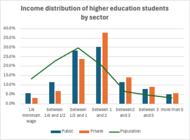
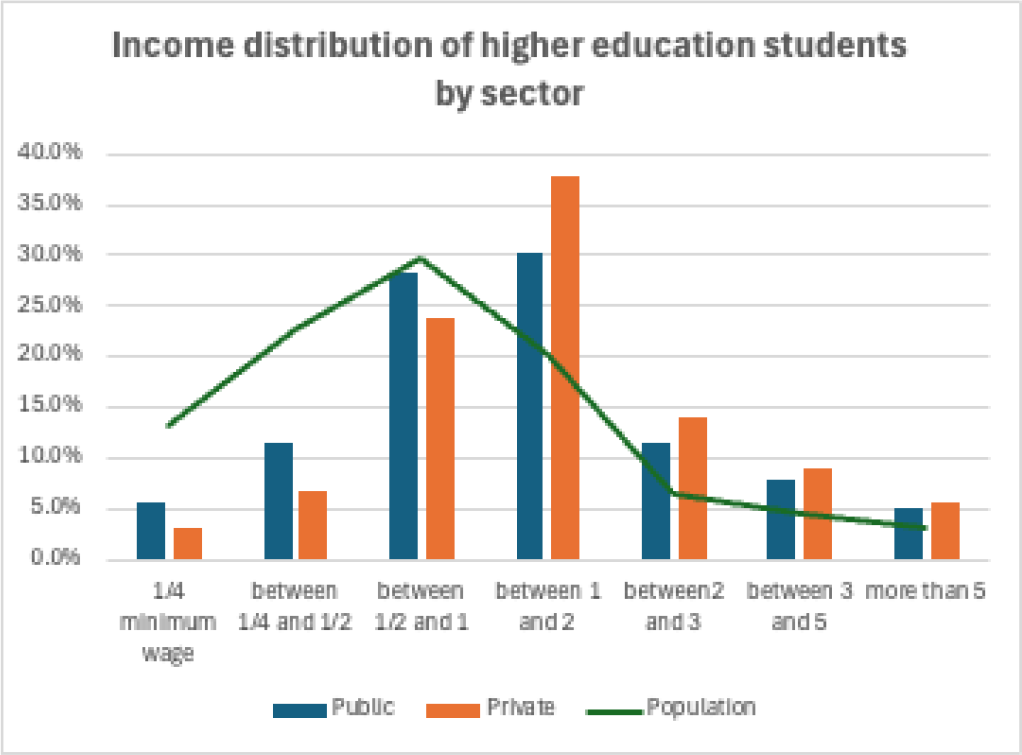
All these elements combine to make the two sectors similar in terms of the income distribution of their students in minimum wages7, with a larger proportion of poor students in the public sector and of richer students in the private.
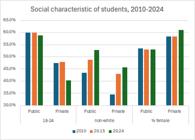
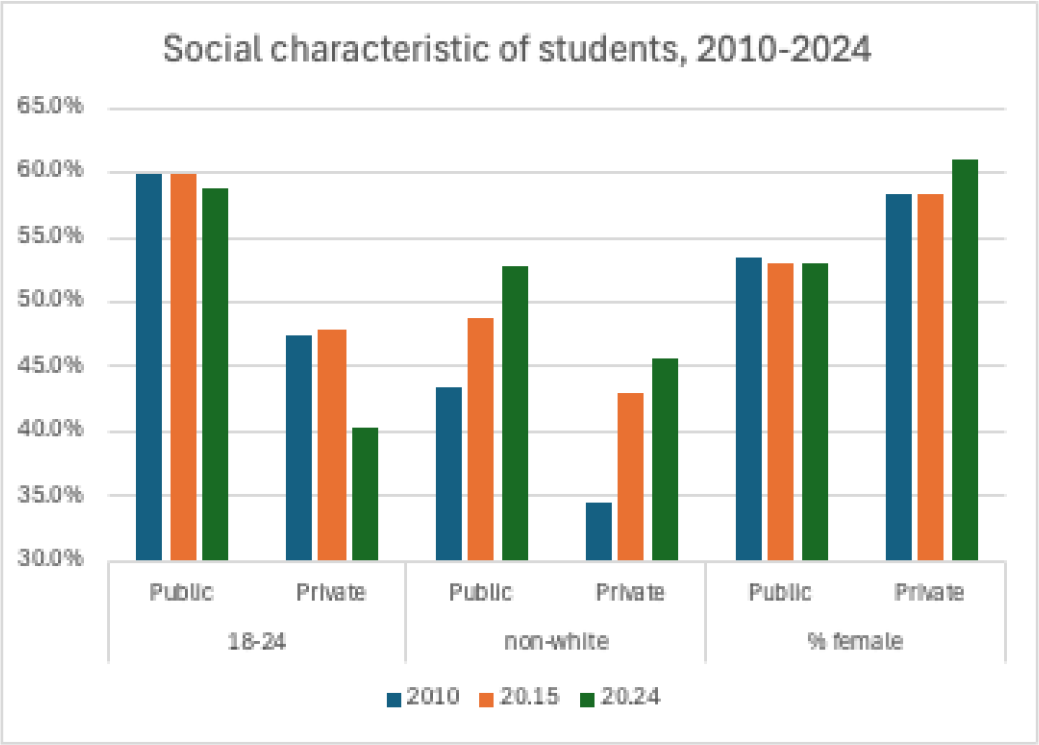
Social differences are more related to career choices than to the public - private divide. The yearly higher education census includes three social indicators, gender, age and “race”8. Figure 5 shows that, in general, students in the private sector are older, more white and more feminine than those in the public sector. Race is strongly correlated with income, and there are more non-white students in education, business and health services than in arts, social and natural sciences9. Some fields, such as education and health, are overwhelmingly feminine, while others, such as information technology and engineering, and more masculine. These gender differences occur in most countries, and have been attributed by a variety of social, cultural and even genetic conditions.
One contributing factor to the gender differences may be that there are more women from lower socioeconomic backgrounds in higher education than men, and they are more likely to enter careers such as teaching, health and administrative services that are academically less demanding. Evidence of that comes from the data on the participants in National Exam of Secondary Education (Exame Nacional do Ensino Médio - ENEM) which is used as a national entrance examination for public universities. Data show that women’s participation is higher for persons from lower socioeconomic backgrounds, that grades increase for all with higher SSE, and that women, in general, have lower grades in mathematics than men. So, they are more likely to enter in “feminine” professions where the admission thresholds are lower.
4.2 Fields of study
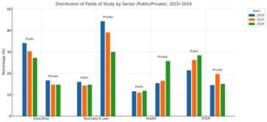
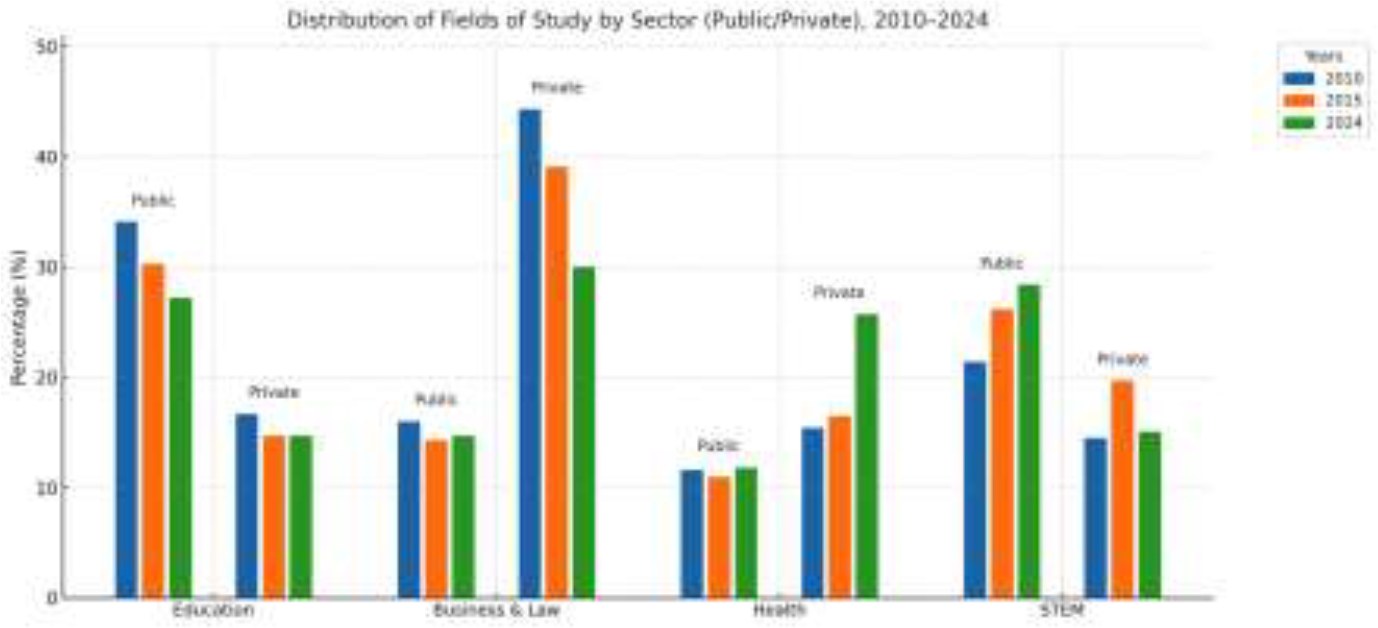
Overall, most higher education students gravitate towards service-oriented fields such as Education, Business and Law, and Health. Within the public sector, Education remains the predominant field, often appealing due to its accessibility and the prospect of stable public school employment. Conversely, the private sector traditionally saw Business and Law as its preferred area, though it’s crucial to note that the mandatory bar examination significantly limits career entry for many graduates from lower-cost private institutions (Dotta; Da Cunha Filho, 2014) An important recent shift in the private sector has been the notable increase in enrollment in Health Service programs, accompanied by a corresponding decline in Business and Law. The largest areas in health and wellbeing are preventive care and rehabilitation, with 35%, and nursing, 20%, with only about 5% in medicine. While STEM fields (Science, Technology, Engineering, and Mathematics) represent approximately 20% of enrollments, their presence is higher and growing in the public sector, yet lower and declining in the private sector.
4.3 Degree types
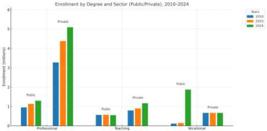
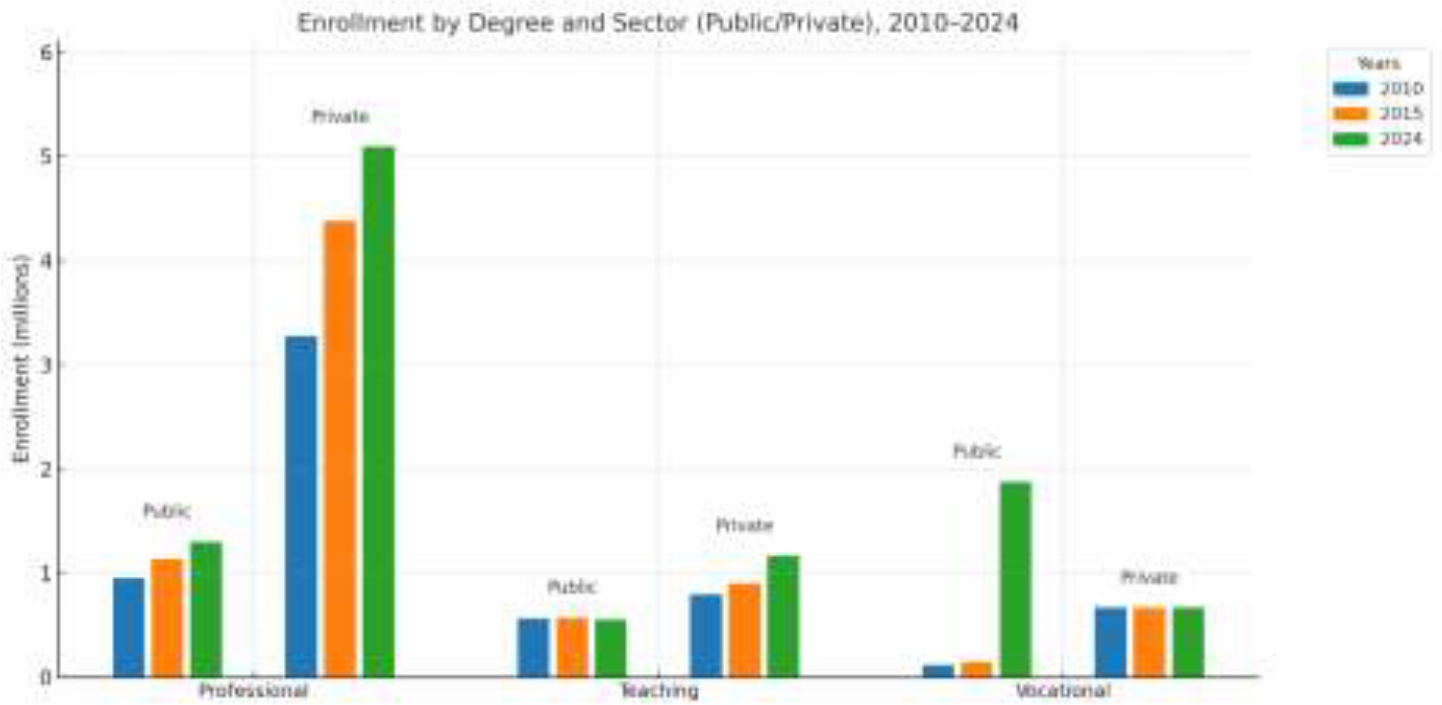
Most students in Brazil work for a professional degree (bacharelado), which lasts from four to 6 years depending on the fields. Teachers up to secondary education get a teaching license by completing a course in education or by an additional year of pedagogical studies after specialized studies in language, mathematics, or the social and natural science. A third option is a vocational degree (tecnológico) after two or three years of an applied or practical field. As Figure 7 shows, both sectors have increased the enrolments in professional degrees, the demand for teaching license has been somewhat reduced, and the private sector has been increasing the provision of vocational degrees.
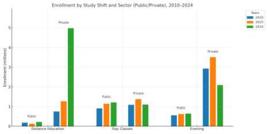
4.4 Teaching modalities
Most students in the public sector study during the day, with a small proportion in evening courses, and very few in distance education. This is very different in the private sector, where, in the past, most students were in evening courses, and where distance education started to increase in 2014 to become the largest segment since 2020.
5 SELECTED POLICY ISSUES
5.1 Regulation and quality assurance
The first higher education institutions in Brazil were established in the 19th century to regulate access to prestigious professions such as law, medicine, and engineering. National legislation governing higher education and the country’s first universities emerged in the 1930s. From the outset, these institutions operated under strict government oversight, which also extended to the regulation of professional practice (Abmes, 2017; Coelho, 1999; Schwartzman; Bomeny; Costa, 2000). Once an institution is created by law or administrative decree, the assumption is that the degrees granted by them meet the necessary requirements for the professional work. By the same principle, private institutions depend on the government’s authorization and supervision to function and are supposed to hold the same standards as the public ones. As the private sector expanded and diverged from the national model established by the 1968 university reform, this procedures for authorization and supervision of private institutions became ever more complex, and was aggravated by the lobby, coming from the private sectors, to free them from governmental requirements and oversight (Castro, 2015; Ranieri, 2000). The National System of Assessment of Higher Education, SINAES, created in 2004, is clearly not able to meet this purpose, but, so far, the Brazilian government was not able to come up with an alternative regulatory framework (OECD, 2018; Pedrosa; Amaral; Knobel, 2012).
5.2 Equity, efficiency and relevance
As the federal government started to invest heavily in the private sector trough Prouni and FIES, the question of whether higher education was becoming more equitable came to the fore. The quota system introduced in public universities, and the expansion of enrolments that took place since 2004, are presented as evidence that the system was becoming more equitable. Since the 2015 crisis, however, it became clear that the government’s ability to keep expanding its support to both public and private higher education has reached its limits, and that the system was much less efficient than it could be expected.
One measure of efficiency is the number of students that complete their course programs after a determined period. To measure this, INEP (2018) has created a data base with information about the flow of higher education students in different areas and sectors, based on the higher education census. The proportion of students concluding their studies after 5 years is extremely low, particularly for federal universities and for profit institutions, less than 30%. More important than the type of institution is the modality, distance education students evade much more, and field of study, the rates are lower for the hard sciences. One criticism of this methodology is that it does not consider the fact that students can change from one course program to another, or reenter higher education in different institutions, which means that it is probably not as bad (Silva; Mariano, 2021). In any case, the fact that a large proportion of students never conclude their course programs is cause of concern.
Another indication of efficiency is the student’s work opportunities and salaries when they complete higher education. Data from the National Household Survey (PNAD) for 2024 show that, on average, the earnings of persons with higher education are 2.7 times higher than those with just secondary school degrees. There are, however, important differences according to occupations and about 40% of those with higher education degrees work in middle or low-level activities. An analysis of the labor market incomes of a sample of students who entered higher education 2013 showed that the net wage gains for those attending public institutions was 31%, compared with 16% for those from the private sector, once controlled by other factors. There are also important differences by fields of study, with those from the arts and sciences not experiencing any significant gain (Estevan et al., 2024)10. We can conclude, therefore, that the higher education system in Brazilian is very inefficient both in terms of student flow and of professionalization, and there is no clear indication that the private sector is worse than the public one on this regard.
Three specific areas of concern related to the private sector have been at the fore recently, teacher education, medical education and distance education in general.
5.3 Teacher education
Currently, 75% of the students in primary school teacher education are in private, distance education programs. For middle and high school teachers, half are in public institutions, and most of those in the private sector are also in distance education programs. There are an abondance of primary school teachers, but specialized teachers for specialized subject matters are scarce. There is a consensus that the quality of the teacher education courses is not good, and one explanation may be the low quality of their previous education, rather than the quality of the course programs as such. In attempt to address this issue, the federal government has ruled that teacher education cannot be provided through distance education, and a National Teachers exam is being introduced in 2015.
5.4 Medical education
Medical education is another area in which the expansion of the private sector has led to public controversies and government’s attempts at regulation. The number of medical doctors in Brazil is small compared with the population, it is very difficult to be admitted in a qualified medical school, and most of those who graduate tend to live in the country’s riches towns. The number of medical schools increased from 181 to 407 between 2010 and 2023, most of which in the private sector, with the number of students increasing more than threefold. The concern is that these schools are not abiding but the strict standards of the profession. The Ministry of Education, at different points of time, has tried to limit the creation of new medical schools, based not only on considerations of merit, but also on the notion that new medical schools should not be allowed in regions where the number of medical doctors was already high. It is difficult to distinguish what, in these efforts, derived from genuine concerns about the quality of medical education and sheer attempts to protect the medical job market from too many new entrants. Presently, there are proposals to introduce a system of medical licensure like the one adopted for the legal profession, in which a university diploma needs to be complemented by a bar (Amaral; Norcini, 2023).
5.5 Distance education
In 2025 the Ministry of Education issued new legislation to regulate and set limits to the expansion of distance education in Brazil (Brasil, 2025). The new rules define three teaching modalities: a) in-person, with at least 70% of classes held face-to-face; b) semi-presential, with at least 30% of face-to-face classes plus at least 20% synchronous mediated classes; and c) distance, with at least 10% face-to-face and at least another 10% of synchronous mediated classes. Additionally, the rules mandate that five courses, Law, Medicine, Dentistry, Psychology, and Nursing, must be offered exclusively in person. Other courses in the healthcare field and for teacher training cannot be fully remote (they may be in-person or semi-presential). The rules also introduce new requirements regarding faculty qualifications, the functioning of campuses and distance learning centers (poles), student assessment methods, and partnerships.
The most immediate impact of these new rules will be a drastic reduction in the number of students enrolled in distance education courses, particularly in the private sector: from 4.9 million in 2023 to 2.8 million under the new rules, with 217,000 moving to in-person courses and 1.9 million transitioning to the new semi-presential model. The costs of this transition, to take place in two years, in addition to the costs of meeting the new requirements, will be very high and will make many courses unfeasible for both students and institutions.
Any policy aimed to restrain distance education should consider its impact on different segments of the population. A detailed econometric study shows that, for older, lower income students, distance education gives them more access, while it can be detrimental for younger students with higher socioeconomic backgrounds (Barahona; Dobbin; Fuenzalida; Otero, 2025). The notion that distance education, by itself, is bad, is not necessarily true, when compared with the evening courses they replaced. Large education institutions can invest more in course preparation, teacher materials and computer-based support for teachers and students than smaller, more traditional programs. And distance education programs can bring education who would not otherwise can study because of their place or residence, need to work, and lack of resources. In short, there are many problems of quality in Brazilian higher education but are not necessarily due just to the way or by whom the education is being provided.
6 FINAL CONSIDERATIONS
Brazil appears to be approaching the end of a cycle of higher education expansion, largely fueled by the growth of distance learning in the for-profit sector. Globally, shifts in the labor market,driven by artificial intelligence, automation, and the crisis of the welfare state, are pushing higher education institutions to explore new organizational models, diversified funding sources, and alternative teaching formats. These include micro-credentials, lifelong learning pathways, and stronger partnerships between universities, industry, and government. At the same time, demographic shifts and the declining value of traditional degrees may lead to reduced higher education enrollments worldwide.
While Brazil is also undergoing significant demographic changes, its population remains relatively young, and improvements in secondary education are likely to sustain demand for higher education in the near future. The new regulations on distance education, however, appear more aligned with a return to traditional, inperson teaching models than with preparing the country for the profound transformations underway in the labor market and the diminishing capacity of governments to regulate it.
The implementation of these regulations remains uncertain and is likely to face legal challenges. Furthermore, the social and political costs of making higher education more expensive and less accessible may become untenable as the presidential elections approach in November 2026. The private sector, more responsive to market dynamics, is likely to adapt more quickly than the public sector, which continues to struggle with institutional rigidity and fluctuating government support. Yet, marketdriven adaptations alone may fall short of meeting the growing demands for social equity and skill development that Brazil will increasingly require.
-
2
The Higher Education Census is carried on yearly by the National Institute of Education Statistics (INEP), from the Ministry of Education, based on information provided by the institutions. It is published in tabulated form and as microdata at the institution and course-program level. It does not include, however, data on graduate education and research, which is collected by another agency at the Ministry of Education, CAPES.
-
3
Different from the American and British systems, there are no undergraduate programs offering general or liberal arts education in Brazil. All first degrees provide professional qualifications are considered graduate level. Master’s, doctoral, and specialization programs are regarded as postgraduate studies.
-
4
This group includes IDUQS, Ânima Educação, Ser Educacional and Cogna Educação.
-
5
Since post-graduate education and research are negligible in the private sector except for a few institutions, we only used here information from INEP’s higher education census, and not from CAPES.
-
6
Some examples are Fundação Getúlio Vagas, with degree programs in economics, business administration, law and others; Insper, on economics, administration, engineering and computer sciences; and Ensino Einstein, on medicine.
-
7
The minimum wage in Brazil in 2023 was 1,320 Brazilian reais, approximately 272 US dollars per month.
-
8
Race, in Brazilian public statistics, is measured in terms of the person’s self-reported color - white, black, brown (“pardo”) and yellow. This is a very imprecise classification, and more recently a fifth category, indigenous, has been added to distinguish them from persons of oriental descendance, mostly Japanese. Sometimes the” black” and “brown” groups are lumped together as one category, “negroes”, used in statistics related to affirmative action policies. According to the 2024 National Household Survey (PNAD 2024/2), 42.2% of the respondents declared themselves white, 10.5% black, 46.3% brown, 0.6% yellow and 0.5% indigenous. “Whites” and Orientals had a median per capita family income close to 1.6 thousand reais, and backs and browns close to 1.1 thousand.
-
9
Data on race in the Higher Education Census is incomplete. In 2010, 91% of students did not report their racial identification; this proportion declined to 76% in 2015 and to 61% in 2024. Sample data from PNAD is more reliable. PNAD data for 2011 indicate that 31% of students enrolled in higher education identified as non-white. By 2014, the proportion of non-white students reached 41% in private institutions and 52% in public ones.
-
10
One limitation of the study is that the data include only those working in the formal economy as reported to RAIS (Relação Annual de Informações Sociais), which excludes about 25% of the persons with higher education degrees.
DATA AVAILABILITY
The data underlying the research text are available in the article.
References
-
ABMES. Ensino superior: legislação atualizada. Brasília: ABMES, 2017. v. 21. Disponível em: https://abmes.org.br/arquivos/publicacoes/legislacao21_web.pdf Acesso em: 26 fev. 2026.
» https://abmes.org.br/arquivos/publicacoes/legislacao21_web.pdf -
AMARAL, Eliana; NORCINI, John. Quality assurance in health professions education: role of accreditation and licensure. Medical Education, v. 57, n. 1, p. 40‑48, 2023. Disponível em: https://europepmc.org/article/MED/35851495 Acesso em: 26 fev. 2026.
» https://europepmc.org/article/MED/35851495 -
BARAHONA, Nano; DOBBIN, Cauê; OTERO, Sebastián. The effects of widespread online education on market structure and enrollment. NBER Working Paper, n. 34522, nov. 2025. Disponível em: https://www.nber.org/papers/w34522 Acesso em: 26 fev. 2026.
» https://www.nber.org/papers/w34522 -
BOMENY, Helena. Universidade de Brasília: filha da utopia de reparação. Sociedade e Estado, Brasília, v. 31 (n. esp.), p. 1003‑1028, 2016. Disponível em: https://periodicos.unb.br/index.php/sociedade/article/view/6228/5521 Acesso em: 26 fev. 2026.
» https://periodicos.unb.br/index.php/sociedade/article/view/6228/5521 -
BRASIL. Decreto nº 2.208, de 17 de abril de 1997 Brasília: Presidência da República, 1997. Disponível em: https://www.planalto.gov.br/ccivil_03/decreto/D2208.htm Acesso em: 26 fev. 2026.
» https://www.planalto.gov.br/ccivil_03/decreto/D2208.htm -
BRASIL. Instituto Nacional de Estudos e Pesquisas Educacionais (INEP). Evolução do ensino superior: 1980‑1998. Brasília: INEP, 1999. Disponível em: https://download.inep.gov.br/download/censo/1998/superior/evolucao_19801998.pdf Acesso em: 24 out. 2025.
» https://download.inep.gov.br/download/censo/1998/superior/evolucao_19801998.pdf -
CARNEGIE FOUNDATION. The Carnegie classification of institutions of higher education Menlo Park, 2011. Disponível em: https://carnegieclassifications.acenet.edu/carnegie-classification/ Acesso em: 27 fev. 2026.
» https://carnegieclassifications.acenet.edu/carnegie-classification/ -
CARVALHAES, Flavio; SCHWARTZMAN, Simon. Brazil’s private higher education: equity and distance learning. International Higher Education, n. 122, p. 19‑20, 2025. Disponível em: https://ejournals.bc.edu/index.php/ihe/article/view/20181 Acesso em: 27 fev. 2026.
» https://ejournals.bc.edu/index.php/ihe/article/view/20181 -
CASTRO, Cláudio de Moura; SCHWARTZMAN, Simon. Reforma da educação superior: uma visão crítica. Brasília: Funadesp, 2005. Disponível em: https://archive.org/details/OAnteprojetoDaLeiOrgnicaDaEducaoSuperiorUmaCrtica Acesso em: 27 fev. 2026.
» https://archive.org/details/OAnteprojetoDaLeiOrgnicaDaEducaoSuperiorUmaCrtica - COELHO, Edmundo Campos. As profissões imperiais: medicina, engenharia e advocacia no Rio de Janeiro, 1822‑1930. Rio de Janeiro: Record, 1999.
-
CRUZ, Andreia Gomes da; PAULA, Maria de Fátima Costa de. Capital e poder a serviço da globalização: os oligopólios da educação superior privada no Brasil. Avaliação: Revista da Avaliação da Educação Superior, Campinas, Sorocaba, v. 23, n. 3, p. 848‑868, 2018. Disponível em: https://periodicos.uniso.br/avaliacao/article/view/3506/3134 Acesso em: 26 out. 2025.
» https://periodicos.uniso.br/avaliacao/article/view/3506/3134 -
DOTTA, Alexandre Godoy; CUNHA FILHO, Valter F. da. A qualidade do ensino jurídico no Brasil: o processo de avaliação ENADE, Exame de Ordem e o Selo OAB Recomenda. Cadernos da Escola de Direito e Relações Internacionais, Curitiba, n. 20, p. 107‑111, 2014. Disponível em: https://www.researchgate.net/profile/AlexandreDotta-2/publication/343361276_A_QUALIDADE_DO_ENSINO_JURIDICO_NO_BRASIL_O_PROCESSO_DE_AVALIACAO_ENADE_EXAME_DE_ORDEM_E_O_SELO_OAB_RECOMENDA/links/6256689ecf60536e235951d0/A-QUALIDADE-DO-ENSINO-JURIDICO-NO-BRASILO-PROCESSO-DE-AVALIACAO-ENADE-EXAME-DE-ORDEM-E-O-SELO-OABRECOMENDA.pdf Acesso em: 27 fev. 2026.
» https://www.researchgate.net/profile/AlexandreDotta-2/publication/343361276_A_QUALIDADE_DO_ENSINO_JURIDICO_NO_BRASIL_O_PROCESSO_DE_AVALIACAO_ENADE_EXAME_DE_ORDEM_E_O_SELO_OAB_RECOMENDA/links/6256689ecf60536e235951d0/A-QUALIDADE-DO-ENSINO-JURIDICO-NO-BRASILO-PROCESSO-DE-AVALIACAO-ENADE-EXAME-DE-ORDEM-E-O-SELO-OABRECOMENDA.pdf - DURHAM, Eunice Ribeiro. Higher education in Brazil: public and private. In: BROCK; Schwartzman. The challenges of education in Brazil Oxford: Symposium Books, 2004. p. 147-178.
- ESTEVAN, Fernanda et al For‑profit higher education wage returns: evidence from Brazil. SSRN, 3 dec., 2024. Disponível em: For-Profit Higher Education Wage Returns: Evidence from Brazil by Fernanda Estevan, Renato Vieira, Pedro Teixeira, Mateus Rodrigues, Carlos Roberto Azzoni :: SSRN Acesso em: 27 fev. 2026.
- FELICETTI, Vera Lucia; CABRERA, A. Percurso na educação superior: o ProUni em foco. Ensaio, Rio de Janeiro, v. 25, n. 95, p. 308‑329, 2017. Disponível em: Percurso na educação superior: o ProUni em foco | Felicetti | Ensaio: Avaliação e Políticas Públicas em Educação Acesso em: 27 fev. 2026.
- GÉRARD, Etienne. Private higher education and inequalities in the Global South: lessons from Africa, Latin America and Asia. Cham, Springer Nature Switzerland, 2024.
-
HAAS, Celia Maria; PARDO, Rosangela da Silva. Programa Universidade para Todos (PROUNI): efeitos financeiros em uma instituição de educação superior privada. Avaliação: Revista da Avaliação da Educação Superior, Campinas; Sorocaba, SP, v. 22, n. 3, p. 718-740, 2017. Disponível em: https://periodicos.uniso.br/ojs/index.php/avaliacao/article/view/3142 Acesso em: 27 fev. 2026.
» https://periodicos.uniso.br/ojs/index.php/avaliacao/article/view/3142 -
INEP - Instituto Nacional de Estudos e Pesquisas Educacionais Anísio Teixeira. Microdados do Enem 2023 Brasília: INEP, 2024. Disponível em: https://download.inep.gov.br/microdados/microdados_enem_2023.zip Acesso em: 26 out. 2025.
» https://download.inep.gov.br/microdados/microdados_enem_2023.zip -
INEP - Instituto Nacional de Estudos e Pesquisas Educacionais Anísio Teixeira. Censo da Educação Superior: Microdados (edições disponíveis). Brasília: INEP, 2025. Disponível em: https://www.gov.br/inep/pt-br/acesso-a-informacao/dadosabertos/microdados/censo-da-educacao-superior Acesso em: 26 out. 2025.
» https://www.gov.br/inep/pt-br/acesso-a-informacao/dadosabertos/microdados/censo-da-educacao-superior -
KINSER, Kevin et al The Global Growth of Private Higher Education. ASHE Higher Education Report, San Francisco, v. 36, n. 3. 2010. Disponível em: https://eric.ed.gov/?id=EJ896397 Acesso em: 26 fev. 2026.
» https://eric.ed.gov/?id=EJ896397 -
LEVY, Daniel C. A world of private higher education. Oxford: Oxford University Press, 2024. Disponível em: https://academic.oup.com/book/58165 Acesso em: 27 fev. 2026.
» https://academic.oup.com/book/58165 -
LEVY, Daniel C. Public policy for private higher education: a global analysis. Journal of Comparative Policy Analysis: Research and Practice, v. 13, n. 4, p. 383-396, 2011. Disponível em: https://www.tandfonline.com/doi/pdf/10.1080/13876988.2011.583772 Acesso em: 27 fev. 2026.
» https://www.tandfonline.com/doi/pdf/10.1080/13876988.2011.583772 -
MARTINS, Carlos Benedito. A reforma universitária de 1968 e a abertura para o ensino superior privado no Brasil. Educação & Sociedade, Campinas, v. 30, n. 106, p. 15-35, jan./abr. 2009. Disponível em: https://www.scielo.br/j/es/a/RKsKcwfYc6QVFBHy4nvJzHt Acesso em: 27 fev. 2026.
» https://www.scielo.br/j/es/a/RKsKcwfYc6QVFBHy4nvJzHt -
McCORMICK, Alexander C. Classifying higher education institutions: lessons from the Carnegie Classification. Pensamiento Educativo: Revista de Investigación Educacional Latinoamericana, Santiago, v. 50, n. 1, p. 65-75, 2013. Disponível em: https://pensamientoeducativo.uc.cl/index.php/pel/article/view/26193 Acesso em: 26 fev. 2026.
» https://pensamientoeducativo.uc.cl/index.php/pel/article/view/26193 -
MORAIS, Ana Maria de Paula; VASCONCELOS, Silvinha; RESENDE, Marcelo. The market power of brazilian private higher education institutions: an efficiency-frontier approach. Munich: CESifo, 2024. (CESifo Working Paper, n. 11370). Disponível em: https://www.econstor.eu/bitstream/10419/305612/1/cesifo1_wp11370.pdf Acesso em: 27 fev. 2026.
» https://www.econstor.eu/bitstream/10419/305612/1/cesifo1_wp11370.pdf -
MOYA, Isabela. Fies tem inadimplência recorde e baixa ocupação de vagas: o que o MEC planeja fazer? O Estado de S. Paulo, São Paulo, 31 maio 2025. Disponível em: https://www.estadao.com.br/educacao/fies-tem-inadimplenciarecorde-e-baixa-ocupacao-de-vagas-o-que-o-mec-planeja-fazer/ Acesso em: 26 fev. 2026.
» https://www.estadao.com.br/educacao/fies-tem-inadimplenciarecorde-e-baixa-ocupacao-de-vagas-o-que-o-mec-planeja-fazer/ -
NAGLE, Jorge. Educação e sociedade na primeira república. São Paulo: Editora Pedagógica e Universitária, 1974. Disponível em: https://buscaintegrada.ufrj.br/Record/aleph-UFR01-000581105/Description Acesso em: 27 fev. 2026.
» https://buscaintegrada.ufrj.br/Record/aleph-UFR01-000581105/Description -
NUNES, Edson de Oliveira; CARVALHO, Márcia Marques de; ALBRECHT, Julia Vogel de. A singularidade brasileira: ensino superior privado e dilemas estratégicos da política pública. Documento de Trabalho n. 87. Rio de Janeiro: Observatório Universitário / Databrasil - Ensino e Pesquisa, 2009. Disponível em: http://www.observatoriouniversitario.org.br/documentos_de_trabalho/documentos_de_trabalho_87.pdf Acesso em: 27 fev. 2026.
» http://www.observatoriouniversitario.org.br/documentos_de_trabalho/documentos_de_trabalho_87.pdf -
OLIVEIRA, João Victor Fonseca; FARIA FILHO, Luciano. Educação e modernização: a UFMG na trajetória de um Projeto modernizante (1968-1974). Revista Contemporânea de Educação, Rio de Janeiro, v. 14, n. 29, jan./abr. 2019. Disponível em: https://repositorio.ufmg.br/server/api/core/bitstreams/162057d7-b66c-4436b64c-5f1e65f0bdc2/content Acesso em: 27 fev. 2026.
» https://repositorio.ufmg.br/server/api/core/bitstreams/162057d7-b66c-4436b64c-5f1e65f0bdc2/content -
PAULA, Camila Henriques de; ALMEIDA, Fernanda Maria de. O programa Reuni e o desempenho das Ifes brasileiras. Ensaio: Avaliação e Políticas Públicas em Educação, Rio de Janeiro, v. 28, n. 109, p. 1054-1075, out./dez. 2020. Disponível em: https://www.scielo.br/j/ensaio/a/5pvgF4sGMQsn89ZYSYfWHsh/?format=html Acesso em: 27 fev. 2026.
» https://www.scielo.br/j/ensaio/a/5pvgF4sGMQsn89ZYSYfWHsh/?format=html -
PINHEIRO, Rómulo et al The impact of Covid-19 on the institutional fabric of higher education: old patterns, new dynamics, and changing rules? Cham: Palgrave Macmillan / Springer International Publishing, 2023. Disponível em: https://doi.org/10.1007/978-3-031-26393-4 Acesso em: 27 fev. 2026.
» https://doi.org/10.1007/978-3-031-26393-4 -
PINTO, Francisco Ricardo Miranda. How COVID-19 has exacerbated inequality in higher education in Brazil. Journal of Contemporary Issues in Education, Edmonton, v. 16, n. 2, 2021. Disponível em: https://journals.library.ualberta.ca/jcie/index.php/JCIE/article/view/29467 Acesso em: 27 fev. 2026.
» https://journals.library.ualberta.ca/jcie/index.php/JCIE/article/view/29467 -
RANIERI, Nina Beatriz Stocco. Education federalism in Brazil: contradictions, challenges, and possibilities. In: RUSSO, Charles J.; MA, Leijun (org.). A comparative analysis of systems of education law. Singapore: Springer; Educational Science Publishing House, 2024. p. 53-62. Disponível em: https://link.springer.com/chapter/10.1007/978-981-97-1052-2_3 Acesso em: 27 fev. 2026.
» https://link.springer.com/chapter/10.1007/978-981-97-1052-2_3 - RANIERI, Nina Beatriz Stocco. O direito à educação e as competências dos entes federados no Brasil. In: Federalismo e Poder Judiciário. São Paulo: Escola Paulista de Magistratura (EPM), 2019. p. 439.
-
SALTO, Dante J. To profit or not to profit: the private higher education sector in Brazil. Higher Education, Dordrecht, v. 75, n. 5, p. 809-825, 2018. Disponível em: https://link.springer.com/article/10.1007/s10734-017-0171-8 Acesso em: 27 fev. 2026.
» https://link.springer.com/article/10.1007/s10734-017-0171-8 -
SAMPAIO, Helena. Ensino superior no Brasil: o setor privado. Cadernos de Pesquisa, São Paulo, v. 111, p. 203, dez. 2000. Disponível em: https://publicacoes.fcc.org.br/cp/article/view/640/658 Acesso em: 26 out. 2025.
» https://publicacoes.fcc.org.br/cp/article/view/640/658 -
SAMPAIO, Helena. Privatization of higher education in Brazil: old and new issues. In: SCHWARTZMAN, Simon (org.). Higher Education in Latin America and the Challenges of the 21st Century. Cham: Springer, 2020. p. 77-94. Disponível em: https://link.springer.com/chapter/10.1007/978-3-030-44263-7_6 Acesso em: 26 out. 2025.
» https://link.springer.com/chapter/10.1007/978-3-030-44263-7_6 -
SAMPAIO, Helena; LIMONGI, Fernando; TORRES, Haroldo. Equidade e heterogeneidade no ensino superior brasileiro São Paulo: NUPES/USP; Brasília: INEP, 2000. Disponível em: https://sites.usp.br/nupps/wpcontent/uploads/sites/762/2020/12/dt0001.pdf Acesso em: 26 out. 2025.
» https://sites.usp.br/nupps/wpcontent/uploads/sites/762/2020/12/dt0001.pdf -
SCHENDEL, Rebecca; MCCOWAN, Tristan. Expanding higher education systems in low-and middle-income countries: the challenges of equity and quality. Higher Education, Dordrecht, v. 72, n. 4, p. 407-411, 2016. Disponível em: https://doi.org/10.1007/s10734-016-0028-6 Acesso em: 27 fev. 2026.
» https://doi.org/10.1007/s10734-016-0028-6 -
SCHWARTZMAN, Luisa Farah; PAIVA, Angela Randolpho. Not just racial quotas: affirmative action in Brazilian higher education 10 years later. British Journal of Sociology of Education, v. 37, n. 4, p. 548-566, 2016. Disponível em: https://doi.org/10.1080/01425692.2014.973015 Acesso em: 27 fev. 2026.
» https://doi.org/10.1080/01425692.2014.973015 -
SCHWARTZMAN, Simon. A space for science: the development of the scientific community in Brazil. University Park, PA: Pennsylvania State University Press, 1991. Disponível em: https://www.psupress.org/books/titles/0-271-00740-0.html Acesso em: 27 fev. 2026.
» https://www.psupress.org/books/titles/0-271-00740-0.html -
SCHWARTZMAN, Simon. América Latina: universidades en transición. Washington: Organización de los Estados Americanos (OEA), 1996. Disponível em: https://www.schwartzman.org.br/simon/oea/sumario.htm Acesso em: 27 fev. 2026.
» https://www.schwartzman.org.br/simon/oea/sumario.htm -
SCHWARTZMAN, Simon; BOMENY, Helena Maria Bousquet; COSTA, Vanda Maria Ribeiro. Tempos de Capanema. Rio de Janeiro: Paz e Terra; Fundação Getúlio Vargas (FGV), 2000. Disponível em: https://archive.org/details/TemposDeCapanema Acesso em: 27 fev. 2026.
» https://archive.org/details/TemposDeCapanema -
SCHWARTZMAN, Simon; BUENO, André Correia. A new typology of higher education institutions in Brazil. ANNUAL CONFERENCE OF THE CONSORTIUM OF HIGHER EDUCATION RESEARCHERS (CHER), 35., 2023, Vienna. Anais [...]. Vienna: Vienna University of Economics and Business, 2023. Disponível em: https://archive.org/details/new-tipology-may-11 Acesso em: 27 fev. 2026.
» https://archive.org/details/new-tipology-may-11 -
SCHWARTZMAN, Simon; SILVA FILHO, Roberto Lobo; COELHO, Rooney R. A. Por uma tipologia do ensino superior brasileiro: teste de conceito. Estudos Avançados, São Paulo, v. 35, n. 101, p. 153-186, 2021. Disponível em: https://revistas.usp.br/eav/article/view/185108 Acesso em: 27 fev. 2026.
» https://revistas.usp.br/eav/article/view/185108 -
SEMESP - Instituto Semesp. Pesquisa de Mensalidades aplicadas no Ensino Superior 2025. São Paulo: SEMESP, 2025. Disponível em: https://www.semesp.org.br/pesquisas/pesquisa-de-mensalidadesaplicadas-no-ensino-superior-2025/ Acesso em: 27 fev. 2026.
» https://www.semesp.org.br/pesquisas/pesquisa-de-mensalidadesaplicadas-no-ensino-superior-2025/ - SEMESP - Sindicato das Entidades Mantenedoras de Estabelecimentos de Ensino Superior. Ensino superior particular no Brasil: diagnóstico, tendências e desafios. São Paulo: SEMESP, 2002.
-
SEYFERTH, Giralda. Colonização, imigração e a questão racial no Brasil. Revista USP, São Paulo, n. 53, p. 117-149, maio 2002. Disponível em: https://doi.org/10.11606/issn.2316-9036.v0i53p117-149 Acesso em: 27 fev. 2026.
» https://doi.org/10.11606/issn.2316-9036.v0i53p117-149 -
SILVA, Leonardo Barbosa; MARIANO, Alexsandro Souza. A definição de evasão e suas implicações (limites) para as políticas de educação superior. Educação em Revista, Belo Horizonte, v. 37, e26524, 2021. Disponível em: https://doi.org/10.1590/0102469826524 Acesso em: 27 fev. 2026.
» https://doi.org/10.1590/0102469826524 - SOUZA, Pedro Ivo. Fundos garantidores com participação da União. In: MENDES, Marcos (ed.). Para não esquecer: políticas públicas que empobrecem o Brasil. Rio de Janeiro: Autografia Edição e Comunicação Ltda., 2022. p. 143-173.
-
TEIXEIRA, Pedro; AMARAL, Alberto. Private higher education and diversity: an exploratory survey. Higher Education Quarterly, v. 55, n. 4, p. 359-395, 2001. Disponível em: https://doi.org/10.1111/1468-2273.00194 Acesso em: 27 fev. 2026.
» https://doi.org/10.1111/1468-2273.00194 - TROW, Martin. Problems in the transition from elite to mass higher education Berkeley: Carnegie Commission on Higher Education, 1973.
-
TROW, Martin. The expansion and transformation of higher education. International Review of Education, v. 18, p. 61-84, 1972. Disponível em: https://doi.org/10.1007/BF01450272 Acesso em: 27 fev. 2026.
» https://doi.org/10.1007/BF01450272 - VAN VUGHT, Frans A.; ZIEGELE, Frank (ed.). Multidimensional ranking: the design and development of U-Multirank. Dordrecht: Springer Science & Business Media, 2012.
-
VAN VUGHT, Frans. Diversity and differentiation in higher education. In: VAN VUGHT, Frans (ed.). Mapping the higher education landscape: towards a European classification of higher education. Dordrecht: Springer, 2009. p. 1-16. Disponível em: https://doi.org/10.1007/978-90-481-2249-3_1 Acesso em: 27 fev. 2026.
» https://doi.org/10.1007/978-90-481-2249-3_1 -
VECHIA, Ariclê; FERREIRA, António Gomes. Brazilian higher education in the 1960s and 1970s of the 20th century: international agreements and the reform of the Brazilian university. Encounters in Theory and History of Education, v. 21, p. 134- 155, 2020. Disponível em: https://doi.org/10.24908/encounters.v21i0.14267 Acesso em: 27 fev. 2026.
» https://doi.org/10.24908/encounters.v21i0.14267 - VEIGA, Laura da. Reforma universitária na década de 60: origens e implicações político-institucionais. In: BORI, Carolina E. et al (eds.). Universidade brasileira: organização e problemas. Revista da Sociedade Brasileira para o Progresso da Ciência, São Paulo, v. 37, n. 6, Suplemento Especial de Ciência e Cultura, p. 86-97, 1985.
-
VIEIRA, André; RODRIGUES, Leonardo; BARBOSA, Maria-Lígia. Measuring change in institutional diversity in higher education in Brazil. Higher Education Quarterly, v. 79, n. 2, p. e70022, 2025. Disponível em: https://doi.org/10.1111/hequ.70022 Acesso em: 26 out. 2025.
» https://doi.org/10.1111/hequ.70022
-
Section Editor:
Milena Pavan Serafim | Layout Editor: Silmara Pereira da Silva Martins

 Fonte: dados tabulados de (
 Source: tabulated from INEP, Censo da Educação Superior, 2010-2014
 Source: tabulated from Censo da Educação Superior - INEP, 2024
 Source: tabulated from PNAD contínua 2023
 Source: tabulated from INEP, Censo da Educação Superior, 2010-2023
 Source: INEP, Higher Education census 2010, 2015, 2024
 Source: INEP, Higher Education census 2010, 2015, 2024
 Source: INEP, Higher Education census 2010, 2015, 2024