 EDUCATIONAL POLICIES FOR SPECIAL AND INCLUSIVE EDUCATION: INITIAL AND CONTINUING TEACHER TRAINING
Abstract
This article is involved in scientific research that presents the identity and perceptions of the public that were impacted by the final product called “indicator manual”, produced by teachers from the Specialized Educational Service (AEE) and students from the Pedagogy course. The research was conducted in the Department of Education of a municipality in the interior of São Paulo. It aims to verify the public's conception of what educational policies could be like for the initial and continuing training of teachers, with an emphasis on inclusive education. The research employed a qualitative approach, and a questionnaire was used to collect data. This instrument is recognized as an effective data-collection method, particularly when administered online. It was administered to participants via an electronic form. Afterwards, the data collected by the researcher was analyzed with the Coordinator of the Special Education Area. The result involves transforming themes and reflections into future interventional/collaborative training meetings to construct indicators that strengthen teaching practice, targeting the Special Education audience, and revising guidelines, training processes, and educational policies.
Keywords:
special and inclusive education; teacher training; educational policies
Resumo
Este artigo está envolvido em uma pesquisa científica que apresenta a identidade e as percepções do público que foi impactado pelo produto final denominado “manual de indicadores”, produzido pelos participantes da pesquisa, nove professores do Atendimento Educacional Especializado (AEE) e noventa e oito discentes do curso de Pedagogia em estágio supervisionado. A pesquisa foi realizada em uma Secretaria da Educação de um município do interior de São Paulo. O objetivo foi identificar e analisar a percepção dos participantes em relação às políticas educacionais para a formação inicial e continuada de professores com ênfase na educação inclusiva. A pesquisa é qualitativa e foi usado como coleta de dados um questionário. Este instrumento é reconhecido como um método eficaz para a coleta de dados, principalmente quando administrado no formato on-line, e foi aplicado aos participantes por meio de um formulário eletrônico. Após a aplicação, a análise dos dados coletados pelas pesquisadoras foi realizada junto à Coordenadora da Área de Educação Especial (CAEE). O resultado consiste na transformação em temas e reflexões sobre as políticas públicas educacionais, visando à construção de indicadores que fortaleçam a prática docente voltada ao Estudante Público da Educação Especial (EPEE), sob a perspectiva da educação inclusiva. Além disso, envolve a revisão das diretrizes para a formação inicial de professores do curso de Pedagogia, bem como para os processos de formação continuada.
Palavras-chave:
práticas inclusivas; estágio supervisionado; pesquisa qualitativa
Resumen
El presente artículo presenta una investigación científica que analiza la identidad y las percepciones del público impactado por el producto final denominado “manual de indicadores”, elaborado por los participantes de la investigación: nueve docentes del Servicio de Atención Educativa Especializada (AEE) y noventa y ocho estudiantes del curso de Pedagogía en práctica supervisada. La investigación se llevó a cabo en una Secretaría de Educación de un municipio del interior del estado de São Paulo, Brasil. El objetivo fue identificar y analizar la percepción de los participantes en relación con las políticas educativas para la formación inicial y continua de docentes, con énfasis en la educación inclusiva. La investigación adoptó un enfoque cualitativo y utilizó como instrumento de recolección de datos un cuestionario. Este instrumento, administrado en formato electrónico, es reconocido como un método eficaz de obtención de información, en particular cuando se aplica en línea. Posteriormente, los datos recolectados fueron analizados por las investigadoras en colaboración con la Coordinadora del Área de Educación Especial (CAEE). Los resultados fueron organizados en temas y reflexiones sobre las políticas públicas educativas, con el propósito de construir indicadores que fortalezcan la práctica docente dirigida al Estudiante Público de la Educación Especial (EPEE), en la perspectiva de la educación inclusiva. Asimismo, incluye la revisión de directrices para la formación inicial de los estudiantes de Pedagogía, así como para los procesos de formación continua.
Palavras clave:
prácticas inclusivas; práctica supervisada; investigación cualitativa
1 INTRODUCTION
It is essential to understand the specificities of the population involved in a scientific study, highlighting those who will be impacted and will play a constructive role in the development of the results. In this research, indicators were analyzed that may serve as references for initial teacher education programs in higher education, particularly in Pedagogy degree courses and continuing education programs offered by regional education boards and departments of education, with a focus on special and inclusive education.
This study aims to discuss the relevance of initial teacher education as a fundamental pillar of inclusive education, while recognizing the multiple challenges that permeate its design and implementation. According to Mendes and Pereira (2023), the problem lies in the insufficiency of initial teacher education to adequately support Students Targeted by Special Education (STSE), stemming from the lack of curricular components that address inclusion in Pedagogy programs and the absence of practical experiences and pedagogical activities oriented towards this reality. In this perspective, Coimbra, Schlünzen, and Schlünzen Junior (2023) emphasize that the educational process must enable future teachers to understand that the principle of inclusion is grounded in the appreciation of diversity. Thus, they argue that higher education institutions should review their curricula to recognize inclusion as a transversal axis across all disciplines.
The analysis of weaknesses and opportunities in teacher education for inclusive education is essential to implementing educational practices that value diversity and ensure the right to access, permanence, and learning for all students. Therefore, the relevance of this study is justified by its pertinence in academic, social, and political contexts, as it contributes to the debate on the effectiveness of inclusive education policies and to the consolidation of more consistent and effective training proposals.
Based on this assumption, it is essential to examine the perceptions of teachers working in Specialized Educational Assistance (SEA) and of undergraduate students in Pedagogy, the focus of this study, regarding initial teacher education and professional development across their different approaches. This includes considering personal and academic aspects, understanding educational policies related to special and inclusive education, and the experiences lived within this context. In light of this need, this study aims to investigate the conceptions of teachers working in Specialized Educational Assistance (SEA) and undergraduate students in Pedagogy programs regarding educational policies, curricular guidelines, and experiences related to special and inclusive education, with the purpose of supporting initial and continuing education promoted by the Municipal Department of Education of a municipality in the Northwest region of the state of São Paulo.
2 RESEARCH CONTEXT
The participants in this study were organized into two groups, defined according to their academic background and professional practice. The first group, hereinafter referred to as Group 1, consists of nine teachers working in Specialized Educational Assistance (SEA), who participate weekly in continuing education meetings under the supervision of the Special Education Area Coordinator (SEAC). The second group, referred to as Group 2, consists of 98 undergraduate students enrolled in the Pedagogy teacher education program who undertake supervised internships in municipal schools affiliated with the Municipal Department of Education, working in early childhood education and the early years of elementary education. These student interns meet bimonthly to participate in training sessions guided by the SEAC. The meeting schedule is planned at the beginning of each academic year and officially disseminated by the Department. Both groups of participants are under the jurisdiction of the Municipal Department of Education of a municipality located in the interior of the state of São Paulo, where the research was conducted. The two groups are organized by the Municipal Department of Education under the supervision of the SEAC, and their training sessions take place on different dates.
The professional development of educators in this municipality is regulated in accordance with public education policy guidelines, as established in item II of the sole paragraph of Article 61 of Law No. 9,394/1996 (Brazil, 1996). Such regulation reflects the commitment of public administration to applying the constitutional principle of administrative morality to all actions related to policies and programs of continuing education within the municipal school system, as set forth in Ordinance No. 20 of 2021. Furthermore, according to Article 7 of Resolution CNE/CP No. 01/2020 (Brazil, 2020), the continuing education implemented by the local Municipal Department of Education adopts officially established principles and normative guidelines, as presented in Table 1.
Thus, the analysis of the profile of SEA teachers (Group 1) and undergraduate student interns in the Pedagogy program (Group 2) was conducted considering the training aspects adopted by the Municipal Department of Education under study, to understand the extent to which these guidelines influence their professional education and pedagogical practice.
3 METHODOLOGY
This study adopts a qualitative approach, examining formative experiences in depth to understand the meaning of lived experiences and perceptions throughout the academic trajectory, particularly in relation to teacher professional development within the context in which the phenomenon occurs. Rather than relying on numerical data, norms, and generalizations, the qualitative approach is based on descriptions, comparisons, and interpretations, as it “focuses on a level of reality that cannot be quantified, that is, it works with the universe of meanings, motivations, aspirations, beliefs, values, and attitudes” (Minayo, 2014, p. 152). In this study, the data were generated from the experiences and perceptions of SEA teachers and from the perspectives of undergraduate students in the Pedagogy program regarding the implementation of public educational policies for the inclusion of Students Targeted by Special Education (STSE).
The type of investigation is participatory action research, in which the researcher not only observes and evaluates but also contributes to problem-solving processes. The data collection instrument used was a questionnaire. According to Gil (2008), a questionnaire is a means of collecting structured, standardized information through questions directed at research participants, intended to obtain specific data for analysis and reflection on inclusive educational policies.
Although the use of online questionnaires in academic research presents limitations, such as low response rates, the risk of digital exclusion, and concerns regarding privacy and data quality, these challenges do not invalidate their potential (Chelghoum, 2024). On the contrary, online questionnaires offer broad geographical coverage, speed, low cost, and flexibility for participants, as well as anonymity and confidentiality in studies addressing sensitive topics. They also allow the integration of digital features and conditional logic, making data collection more dynamic and accurate (Nayak; Narayan, 2019; Pitura, 2023). Therefore, when carefully designed from an ethical and methodological perspective, they constitute a valuable and efficient tool for contemporary academic research.
Within the scope of this study, the questionnaire was developed in Google Forms and administered to the target population, taking into account the specificities of the two participating groups. The decision to apply the online questionnaire in a face-to-face setting was made to clarify potential doubts among respondents and to mitigate low response rates, as indicated in the literature.
The first researcher, together with the SEAC, administered the questionnaire to SEA teachers (Group 1) on a previously scheduled date, during continuing education meetings held by the Municipal Department of Education, in the SEAC coordination room. The details of the formative process undertaken by Group 1 participants are presented in Table 2.
Training pathway of SEA teachers with the Special Education Area Coordinator (SEAC) and the first autor
Undergraduate Pedagogy students (Group 2) participated in training sessions scheduled in advance, as described in Table 3. On the day the questionnaire was administered to this group, 68 participants were present, of whom 52 completed the questionnaire made available by the first researcher at the beginning of the session.
Training pathway of interns (Pedagogy undergraduate students) with the Special Education Area Coordinator (SEAC) and the first author
The use of this data collection method in the present study was approved by the Ethics Committee. CAAE Registration: 53970221.7.0000.5515, according to the analysis of the Research Ethics Committee on March 9, 2022. This study is part of a broader research project entitled “Joint development of indicators for teacher training policies in special and inclusive education.” Therefore, all ethical procedures were ensured and rigorously followed.
4 RESULTS AND DISCUSSION
4.1 Data collected from the research participants
Section 1 – Personal data
Group 1 – All teachers identified as female, with an average age of 37 years, considering the youngest (26 years) and the oldest (45 years) in relation to their academic qualifications. The SEA teachers reported holding a degree in Pedagogy and expressed interest in working in the teaching field.
Group 2 – Regarding sex/gender, 98.1% of students identified as female, and 1.9% as male. The average age of the students was 33 years (SD ≈ 10), considering the lowest age (18 years) and the highest age (58 years).
Among the 98 undergraduate students in Pedagogy, 6 (6.1%) reported having a previous undergraduate degree: 4 in Mathematics, 1 in History, and 1 in Languages (Portuguese and Modern Foreign Language – English). The distribution of activities undertaken by undergraduate students in Pedagogy during their supervised internships is shown in Table 4.
Activities of Pedagogy undergraduate students during supervised internships in schools of the municipality under study
Participants reported experiences related to interaction with children diagnosed with Autism Spectrum Disorder (ASD) and children with Intellectual Disability (ID), as well as with conditions not considered part of the Special Education Target Population (SETP), such as Attention Deficit Hyperactivity Disorder (ADHD). All students demonstrated, in their records, experience or familiarity with school routines, especially within the context of inclusive education.
As shown in Table 4, almost all students work as interns in municipal schools and are therefore divided into two groups based on their activities: one group assists students with atypical development or disabilities, while the other assists classroom teachers with a range of activities. Although all students have experience related to inclusive education, it is essential to analyze the articulation between theory and practice, as both are central components of initial teacher education in Pedagogy programs.
4.2 Information and data on participants’ prior knowledge
Section 2 – Personal and professional knowledge in the fields of special education and inclusive education
It is crucial that the guidelines of public policies related to special and inclusive education be considered fundamental in both initial and continuing teacher education curricula. It is necessary not only to develop a superficial understanding but also to conduct an in-depth analysis of the specificities that characterize education from multiple perspectives.
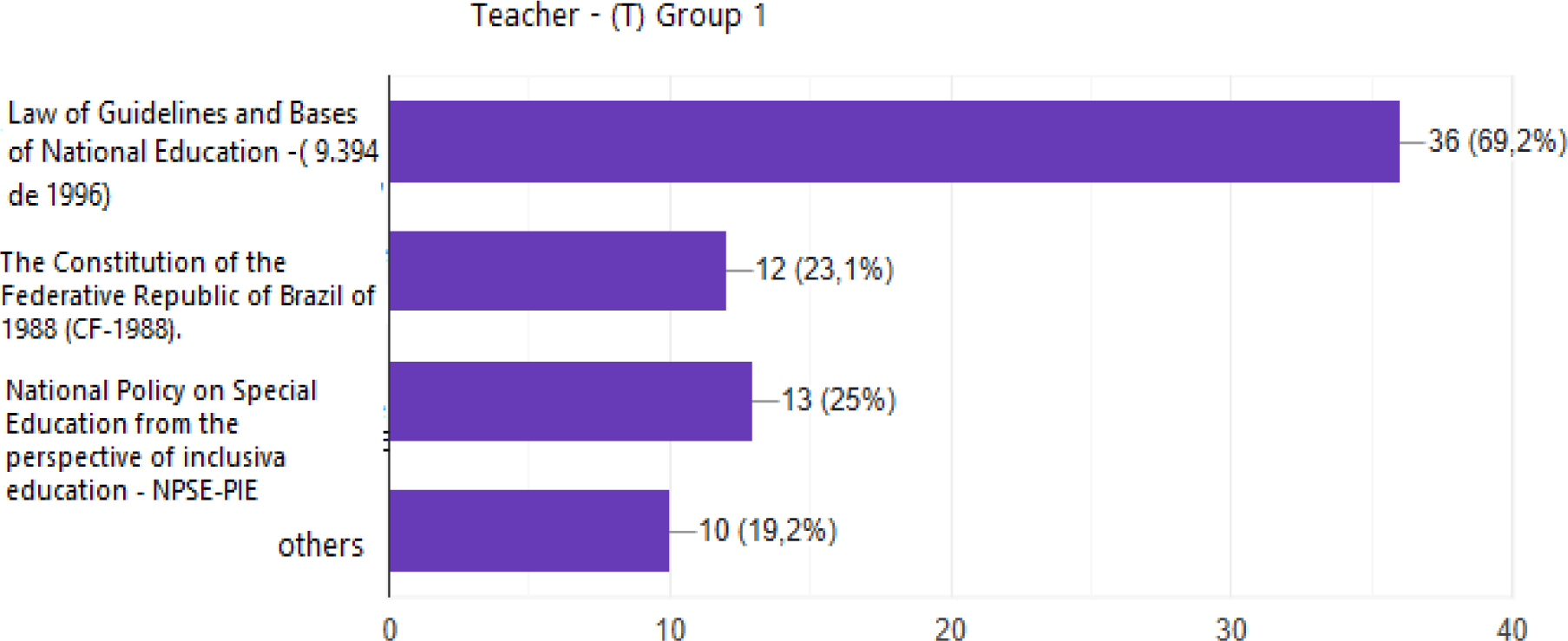
The most frequently addressed and integrated themes in initial teacher education programs, according to the content of specific courses, in order of importance, were: the Law of Guidelines and Bases of National Education (LDB) No. 9,394 (1996); the Federal Constitution of Brazil (1988); and the National Policy on Special Education from the Perspective of Inclusive Education (NPSE-PIE) (2008), as presented in Graph 1.

Level of knowledge of students and teachers regarding public policies underpinning special education and inclusive education
In Graph 1, it can be observed that teachers (100%) and students (69.2%) demonstrate a high level of knowledge regarding the Law of Guidelines and Bases of National Education (LDBEN – Law No. 9,394/1996), with an average of 84.5%. This is followed by knowledge related to the National Policy on Special Education from the Perspective of Inclusive Education (NPSE-PIE) (Brazil, 2008), reported by 80% of teachers and 25% of students, with an average of 52.5%. Regarding the Federal Constitution (Brazil, 1988) and other legislations, the results were approximately 20%.
Regarding the understanding of public policies related to special and inclusive education, greater emphasis is placed on the LDBEN (Law No. 9,394/1996). Both students and teachers working in SEA recognize this policy as highly relevant, confirming that it is widely discussed in initial teacher education programs. The Federal Constitution of 1988 and the NPSE-PIE (Brazil, 2008) are also cited as foundational policies that underpin special and inclusive education in Pedagogy programs. Public policies emerge from existing legislation and regulations, grounded in a process that includes reviewing prior laws, analyzing implemented policies, and continuously adapting to new social and environmental demands, all of which are based on constitutional principles. It is important to note that no other policies were mentioned.
The Pedagogy curriculum is designed to prepare future educators to understand teaching and learning processes, apply effective pedagogical practices, promote inclusion and diversity, and contribute to the continuous improvement of the educational system. The topics addressed include special and inclusive education, with courses covering a range of knowledge areas. Additionally, the contributions of Educational Sciences, History, Philosophy, and Sociology are highlighted as essential components of teacher education.
However, the effective integration of these disciplines into professional development remains a challenge, as their content often remains disconnected from pedagogical practice and the concrete demands of schools. In this context, the disciplines included in initial teacher education in Pedagogy are presented to enable teachers and students to evaluate their relevance and contribution to teacher education and practice. The selection of these disciplines was based on information obtained from the higher education institutions attended by the students (Group 2 participants), including the program level or semester. These institutions are linked to the same Municipal Department of Education that served as the research setting (Dugois; Schlünzen; Ferrari, 2023).
The general education disciplines and those specific to the Pedagogy program were analyzed based on the perceptions of SEA teachers and Pedagogy students, with consideration of their relevance to teacher education and inclusive pedagogical practice. The analysis included disciplines that contribute to training, those perceived as less relevant, and those that support current professional practice.
The results indicate that teachers attribute greater importance to disciplines directly related to inclusive education, especially Methodology and Practices of Inclusive Education and Learning Disorders, recognizing their applicability in the school context and in SEA work. Students also value these disciplines; however, they tend to emphasize Educational Psychology and Reading and Writing Practices more because of their direct relevance to internships and initial teacher education.
SEA teachers and Pedagogy students analyzed the disciplines using their syllabi and teaching plans, as well as official and public documents from higher education institutions, to assess their relevance to academic development and teaching practice, both in professional activities and in internship contexts. In this process, they also identified disciplines that are considered to have less impact on or contribute to training, as well as those that effectively support professional development.
Regarding disciplines in the field of Educational Sciences, such as History of Education, Philosophy of Education, and Sociology of Education, the data reveal low valuation, especially among teachers, who consider them to have limited relevance to inclusive practice. This perception suggests a weakness in the articulation between theoretical foundations and pedagogical applicability, which may compromise a broader understanding of the social role of schooling and citizenship education. The devaluation of these disciplines reflects a tendency to prioritize instrumental knowledge over critical reflection on education, potentially limiting the comprehensiveness of teacher education. In contrast, disciplines specific to inclusive education, such as Methodology and Practices of Inclusive Education and Learning Disorders, are widely recognized as essential because they provide direct support for teaching practice and internships. This valuation highlights a demand for training focused on immediate applicability, while also reinforcing the challenge of integrating, in an organic manner, the theoretical and critical contributions of Educational Sciences into inclusive pedagogical practices to avoid fragmented and utilitarian training.
Gatti (2010) emphasizes the importance of combining practical experience with theoretical knowledge in teacher education. She recognizes the fragmentation in teacher training and advocates integrating curricula aligned with this central purpose. Such pedagogical alignment is fundamental to strengthening educational practice at all levels of basic education. A disconnect is observed between disciplines in Educational Sciences and research, which provide the theoretical basis for knowledge construction and for the advancement of teacher education.
The main excerpts from students' and SEA teachers' responses regarding the disciplines, based on the previously mentioned characteristics, are presented below. Teachers are identified by the letter D followed by an underscore and a number corresponding to their order in the questionnaire (e.g., D_01), and students by the letters DI followed by an underscore and a number corresponding to their response order (e.g., DI_01).
Regarding the disciplines identified as most important for teacher education - such as Educational Psychology, Reading and Writing Skills, Methodology and Practices of Inclusive Education, and Learning Disorders - both teachers and students expressed their views as follows:
D_02 – It provided the necessary conditions for classroom practice when I began working at the school.
According to teacher D_02, the contributory disciplines were fundamental in the early stages of her teaching career, and the professionalization process following initial training was challenging. It is necessary to seek meaning through interaction with learning, as highlighted by Charlot (2013, p. 146): “Learning requires intellectual activity.” Only those who engage in an activity attribute meaning to it. Thus, when the training process is meaningful, it provides opportunities for both professional and personal development throughout one’s trajectory.
Regarding the excerpt from participant DI_18, in relation to the same characteristic of contributory disciplines, the following statement stands out:
DI_18 – Because these disciplines address the social and individual development of human beings and help us understand everyday issues.
Furthermore, in the statement of student DI_18, there is a clear emphasis on social dimensions in examining psychological development within a social context, considering aspects such as social interactions, cognition, and emotions, with the aim of healthy adaptation to the community.
Regarding the disciplines History of Education, Philosophy of Education, Sociology of Education, and Scientific Research Methodology, both teachers and students assessed them as having limited relevance for the preparation of future teachers, as indicated in the selected excerpts from their respective justifications.
The excerpts presented in Table 5 highlight the critique expressed by the teacher (D_03) and the students (DI_04 and DI_12) regarding the three disciplines, which are broadly grounded in the field of Educational Sciences. According to Libâneo (2000), Pedagogy is not the only field devoted exclusively to education; however, it distinguishes itself from the social sciences by its specific object and focus. The author also emphasizes that Pedagogy faces the challenge of lacking a rigid and well-defined conceptual structure, which often leads to the undervaluation of theories developed within the educational sciences. In the same vein, Coimbra, Schlünzen, and Schlünzen Junior (2023) underscore the need for academic disciplines to foster knowledge construction through pedagogical strategies such as project-based learning, enabling students to understand context and assign meaning to the theories studied.
Excerpts from teachers and students on the conceptual understanding of the disciplines of History of Education, Philosophy of Education, Sociology of Education, and Scientific Research Methodology
Finally, regarding the disciplines that directly contribute to the proposal in which participants are currently engaged, both groups reported convergent perceptions, thereby reinforcing the relevance of these disciplines for initial teacher education. Teacher D_04 emphasizes the importance of “recognizing and identifying students’ disorders and learning gaps in the classroom,” while students DI_02, DI_06, DI_31, and DI_52 report practical experiences that demonstrate the applicability of the acquired knowledge from working with students with disabilities to understanding children’s social development and systematically observing their behaviors and psychological needs within the school context.
Excerpts from students regarding the conceptual understanding of working with students in Special Education
The comparison of the reports indicates that both teachers and students share the view that Inclusive Education, Special Education, and pedagogical practices for these groups are central to teacher education. However, a critical analysis of the data reveals a structural limitation: Inclusive Education still occupies a limited space in the Pedagogy curriculum, receiving less emphasis than other subjects. This curricular gap, also highlighted by Gatti (2010) in her analysis of 71 Pedagogy teacher education programs across different higher education institutions in Brazil, demonstrates that the preparation of regular classroom teachers remains insufficient to ensure the minimum competencies required to promote access, retention, and full participation of students with special educational needs. Thus, although participants recognize the importance of inclusive education subjects, current training still presents gaps that may compromise the effective implementation of inclusive pedagogical practices.
Education aimed at inclusion, as a teaching modality, is highly relevant for teacher preparation and constitutes a fundamental component of the mandatory internship in Pedagogy programs. However, there are divergent opinions among students on this issue. Students and teachers working in Specialized Educational Services (SES) were asked about their positions on whether to support or oppose inclusive education as a beneficial approach for students with special educational needs.
Teaching practice is fundamental to the success of school inclusion, requiring the engagement and collaboration of all actors involved. In this context, all teachers demonstrated a commitment to supporting school inclusion and expressed support for this practice. Among the students, almost all (98.1%) expressed agreement with or support for Inclusive Education, while 1.9% expressed an opposing position. This trend is illustrated in the excerpts below:
Excerpts from teachers and students regarding support for or resistance to inclusive education
In the excerpts above, the teacher (D_02) and the student (DI_16) express agreement with inclusive education; however, they emphasize the importance of changes in the guidelines of initial teacher education programs, particularly in Pedagogy, as well as in government policies addressing this type of education. Meanwhile, student DI_46 presents an opposing view on inclusive education, citing a shortage of qualified professionals in this field.
In the analyzed excerpts, the teacher (D_02) and the students (DI_16 and DI_46) demonstrate support for inclusive education; however, their statements reveal conceptions that, to varying degrees, reproduce ableist perspectives. The statement by student DI_16, when using the expression “despite having disabilities,” reinforces a reductionist view that associates disability with limitation rather than with human diversity. This type of language is marked by ableism, as it implicitly compares people to so-called “normal” standards, naturalizing inequalities and reinforcing stigma. Similarly, student DI_46’s statement, which justifies opposition to inclusion on the grounds of a lack of qualified professionals, reflects a limited understanding of the distinction between Inclusive Education and Special Education, casting disability as an obstacle rather than recognizing structural and pedagogical barriers as central elements of exclusion.
Although teacher D_02 expresses support for inclusion, by conditioning it on the availability of material resources, continuing education, and specific methodologies, her statement also reveals the persistence of a view that understands disability as something that requires compensation rather than as a constitutive element of school diversity. Thus, inclusive education should be grounded in anti-ableist principles that value difference and develop the competencies of all students, while moving beyond labels and stereotypes. According to Lima et. al. (2024), inclusion should not be limited to adapting specific conditions but should instead expand possibilities for full and equitable participation.
The perception of adaptations as a “burden” or “obligation” reflects an ableist perspective, insofar as it places the responsibility for inclusion on the student with a disability rather than recognizing that ensuring accessibility is an inherent part of pedagogical work (Ferreira; Gesser; Böck, 2024). This type of discourse dehumanizes individuals by treating them as obstacles to the “normal” flow of the school, reinforcing the logic of covert exclusion (Areas; Roldi, 2023; Lorandi; Gesser, 2023).
The persistence of ableism in initial teacher education reveals curricular weaknesses and reproduces an exclusionary logic that naturalizes inequalities and compromises the meaning of inclusive education. Overcoming ableist beliefs in teacher education requires structural and methodological changes. In this regard, Ferreira, Gesser, and Böck (2024) suggest that this topic should be systematically addressed in teacher education, based on the social model of disability rather than the medical model, which associates disability with incapacity.
Therefore, the analyzed reports, although indicating recognition of the importance of inclusion, reveal contradictions that must be problematized. Such conceptions are fundamental for promoting critical reflections on training processes, educational policies, and pedagogical practices, to confront ableism and consolidate, within the school context, an effective and socially transformative inclusive education.
Agreement with or resistance to inclusion is a central element in an indicative evaluation of interventions, given the hierarchies and governance structures of managers and society. However, it is undeniable that significant progress has been made on this issue in recent times. We live in an era marked by coexistence with diversity. In this context, living alongside others, grounded in the recognition and appreciation of differences, becomes an essential condition of human experience. Still, it requires conceptual precision: being next to others is not the same as truly being with others (Mantoan, 2010).
The comments focus on identifying who is involved and valuing students in Special Education (EPEE), transforming learning into something that is not only inclusive but also attentive to individual differences within a framework of equality. Schlünzen et. al. (2020) present the Constructionist, Contextualized, and Meaningful (CCM) approach, which uses Project-Based Learning as a methodological strategy, enabling a comprehensive formative process across cognitive, social, political, affective, and emotional dimensions.
Finally, the conceptual understanding and attitudes regarding expectations of working as a teacher in Specialized Educational Services (SES) and in regular classrooms after completing the Pedagogy program were examined. It is important to note that there were differences in opinion between teachers and students.
Table 3 displays selected excerpts, explanations about initial encounters with students in Special Education, and experiences shared by SES teachers, along with their effects on professional, psychological, and emotional aspects. According to Wallon (1995, p. 140, our translation), “emotions are fundamentally systems of attitudes that respond to a given type of situation.”
Excerpts from teachers regarding the conceptual understanding of working with students in Special Education
The teachers expressed expectations that extended beyond professional boundaries, fostering an affective relationship and a sense of bonding across professional, emotional, and social dimensions, thereby promoting equality and respect for students in Special Education (EPEE). It is evident in their statements that there is a strong intention and eagerness to pursue professional qualifications, conduct research, and acquire specific knowledge about students’ disabilities to promote meaningful learning through innovative, flexible, and active methodologies. The intensity with which they position themselves regarding the development of plans or projects aimed at fostering specific skills related to each student’s uniqueness is notable, with a focus on equity, in accordance with the provisions of Opinion No. 13/2009 of the National Council of Education, Basic Education Chamber (CNE/CEB), particularly Article 13, which outlines the responsibilities of the Specialized Educational Services (SES) teacher: I – To identify, develop, produce, and organize services, pedagogical resources, accessibility resources, and strategies, considering the specific needs of students who are the target population of Special Education (Brazil, 2009, p. 7).
The statement by D_01 goes beyond the teaching process; as a professional, it reflects a commitment not only to teaching but also to learning and to fostering what can be overcome. Students find themselves in a context of diverse conceptions regarding expectations of teaching practice in inclusive education (Table 5), as most are beginning their professional experiences in school settings through internships.
Excerpts from students regarding their perspectives on working with students in Special Education (EPEE)
The concept of “knowledge” as it relates to students in Special Education (EPEE) recurs in the analyzed testimonies; however, its understanding reveals significant gaps in initial teacher education. Despite students’ intention to promote inclusion and value empathy, this stance proves limited when faced with concrete situations involving students with atypical conditions or disabilities, resulting in insecurity and a lack of preparedness. Two participants reported feeling unprepared to deal with certain challenges, attributing this difficulty to a lack of specific knowledge. Such fragility cannot be reduced to an individual shortcoming. Still, it must be understood as a reflection of structural deficiencies in initial training, which fail to provide adequate theoretical and practical tools for inclusive practice. Although there is recognition of the need for further specialization, this dependence highlights the precariousness of the training pathway. The advances observed, such as the development of interpersonal skills and sensitivity to individual differences, stem more from practical experience than from consistent curricular support, thus evidencing the insufficiency of training to ensure inclusion as a constitutive principle of teaching practice.
5 FINAL CONSIDERATIONS
The study on the identification and characterization of the participants in this research began with the personal and professional experience of the lead researcher of this article, who served as a professor at a private higher education institution in the interior of São Paulo between 2008 and 2021. During this period, she taught courses in Educational Sciences and Inclusive Education within the initial teacher education program in Pedagogy, interacting with students and colleagues. This experience enabled the observation of situations that raised concerns about practices in inclusive education, including a limited understanding of the policies that underpin it, insufficient engagement with foundational disciplines in Educational Sciences as contexts for interdisciplinarity and transversality, and a lack of alignment between theory and practice.
These elements supported the development of the data collection instrument, the questionnaire, aimed at identifying the perceptions of teachers working in Specialized Educational Services (SES) and students enrolled in initial teacher education in Pedagogy. Based on these data, the lead researcher, together with the Coordinator of Special Education (CAEE), outlined agendas for future meetings grounded in the Contextualized and Meaningful Constructionist (CMC) approach. In these meetings, teachers and students analyzed policies and curricular guidelines to develop collectively, within their professional contexts, indicators to strengthen and guide pathways to professionalization in inclusive education. In other words, this represents an opportunity to analyze formative processes of reflection-in-action and the theories addressed in Pedagogy programs, as well as to explore educators’ questions about their professional practice, thereby opening new possibilities for inclusion.
Regarding the curricular guidelines governing initial teacher education programs in Pedagogy, course syllabi and disciplinary content were made available at the outset of the study. Another issue to consider is the allocation of teaching responsibilities in higher education institutions. Faculty members are often required to meet their workload at their employing institution and may not always possess specific training or mastery of the syllabus for the assigned subject area. Even when they do, teaching may occur in ways that are disconnected from students’ lived realities. Such situations may undermine the quality of the training process and weaken student learning. With respect to the discipline “Scientific Methodology,” its role is to align students and instructors with scientific research, enabling them to understand themselves as capable of investigating their own practice through a reflective process, to comprehend their context of action, and to seek pathways toward becoming inclusive educators. According to the Brazilian National Education Guidelines and Framework Law (LDBEN, 1996, Art. 43), higher education aims to stimulate scientific studies and research to contribute to the advancement of education, science, technology, and cultural dissemination.
If the teaching profile is oriented toward research, it becomes essential to guide students in addressing their questions and exploring new perspectives. Schlünzen et al. (2020) demonstrated that, through the CMC approach, students can develop a solid knowledge base connected to their study context, leading to meaningful discoveries of learned content and concepts, as well as the construction of knowledge aligned with their interests using technology. Therefore, the practical and theoretical use of research methodology throughout the learning process becomes fundamental. In Pedagogy programs, it is common to explore technical and scientific principles for developing research projects.
The data collected through the questionnaire on perceptions of initial teacher education in Pedagogy, particularly regarding inclusive and special education within the participants' professional context, were analyzed by the lead researcher in collaboration with the CAEE of the Municipal Department of Education. These data were subsequently used as a basis for collaborative, intervention-oriented training meetings aimed at constructing a manual of indicators. This manual serves as an essential, highly useful tool for organizing educational practices for students with disabilities and atypical conditions, contributing to the improvement of both initial and continuing teacher education. Furthermore, it introduces innovations not only for the municipality studied but also as a reference for other regional and national contexts, thereby contributing to educational policies.
DATA AVAILABILITY STATEMENT
The data cannot be made publicly available. The data contain personal information about university students, and their public disclosure would violate the established privacy and confidentiality standards. However, if it is essential for research purposes, we may consider the possibility of anonymizing the data to enable their availability while ensuring the protection of the participants’ identities.
References
-
AREAS, K. A.; ROLDI, A. P. D. P. O (anti)capacitismo na formação básica de professores: um olhar para as pessoas com deficiência na perspectiva de políticas públicas. In: ALMEIDA, F. A. (org.). Educação especial e inclusiva: família, escola, políticas públicas e sociedade em pesquisa. Guarujá, SP: Científica Digital, 2023. v. 2, p. 8–25. E-book Disponível em: https://www.editoracientifica.com.br/books/chapter/230914569 Acesso em: 20 jul. 2024.
» https://www.editoracientifica.com.br/books/chapter/230914569 -
BRASIL. Conselho Nacional de Educação. Parecer CNE/CEB n° 13, de 3 de junho de 2009. Brasília, DF: Conselho Nacional de Educação, 2009. Disponível em: http://portal.mec.gov.br/dmdocuments/pceb013_09_homolog.pdf Acesso em: 5 abr. 2022.
» http://portal.mec.gov.br/dmdocuments/pceb013_09_homolog.pdf -
BRASIL. Conselho Nacional de Educação. Resolução CNE/CP n° 1, de 27 de outubro de 2020. Brasília, DF: Conselho Nacional de Educação, 2020. Disponível em: https://confenen.org.br/resolucao-cne-cp-no-1-de-27-de-outubro-de-2020/ Acesso em: 2 mar. 2024.
» https://confenen.org.br/resolucao-cne-cp-no-1-de-27-de-outubro-de-2020/ -
BRASIL. Constituição da República Federativa do Brasil de 1988. Brasília, DF: Presidência da República, 1988. Disponível em: http://www.planalto.gov.br/ccivil_03/Constituicao/Constituicao.htm Acesso em: 2 mar. 2024.
» http://www.planalto.gov.br/ccivil_03/Constituicao/Constituicao.htm -
BRASIL. Lei n° 9.394, de 20 de dezembro de 1996. Estabelece as diretrizes e bases da educação nacional. Brasília, DF: Presidência da República, 1996. Disponível em: http://www.planalto.gov.br/ccivil_03/leis/L9394.htm Acesso em: 5 abr. 2024.
» http://www.planalto.gov.br/ccivil_03/leis/L9394.htm -
BRASIL. Política Nacional de Educação Especial na Perspectiva da Educação Inclusiva. Inclusão: Revista da Educação Especial, Brasília: CIBEC/MEC, v. 4, n. 1, 2008. Disponível em: https://portal.mec.gov.br/seesp/arquivos/pdf/revinclusao5.pdf Acesso em: 28 abr. 2024.
» https://portal.mec.gov.br/seesp/arquivos/pdf/revinclusao5.pdf - CHARLOT, B. Da relação com o saber às práticas educativas São Paulo: Cortez, 2013.
- CHELGHOUM, A. Unveiling respondents’ collaboration in online questionnaire responses. ALTRALANG Journal, Oran, v. 6, n. 2, p. 377–388, 2024.
-
COIMBRA, A.C.; SCHLÜNZEN, E. T. M.; SCHLÜNZEN JUNIOR, K. Abordagem CCS na disciplina do curso de pedagogia: políticas educacionais, inclusão e TDIC. São Paulo: Pimenta Cultural, 2023. Disponível em: https://www.pimentacultural.com/livro/abordagem-ccs/ Acesso em: 12 set. 2025.
» https://www.pimentacultural.com/livro/abordagem-ccs/ - DUGOIS, R. C. M; SCHLÜNZEN, E. T. M.; FERRARI. F. A. A. Educação especial & inclusiva: ótica docente. Boa Vista: Iole Editora, 2023.
-
FERREIRA, S. M.; GESSER, M.; BÖCK, G. L. K. Narrativas de estudantes da educação básica sobre o capacitismo e o anticapacitismo presentes nas práticas pedagógicas na escola. Revista Brasileira de Estudos Pedagógicos, Brasília, v. 105, 2024. Disponível em: https://www.scelo.br/j/rbeped/a/6K78VLH8BBSNQLtgjTQ8kkc/?format=pdf⟨=pt Acesso em: 19 set. 2025.
» https://www.scelo.br/j/rbeped/a/6K78VLH8BBSNQLtgjTQ8kkc/?format=pdf⟨=pt - GATTI, B. A. Formação de professores no Brasil: características e problemas. Educação & Sociedade, Campinas, v. 31, n. 113, p. 1355–1379, out./dez. 2010.
- GIL, A. C. Métodos e técnicas de pesquisa social SP: Atlas, 2008.
- LIBÂNEO, J. C. Pedagogia e pedagogos: para quê? São Paulo: Cortez, 2000.
-
LIMA, C. S. S. et al. Exploring the application of the CCM approach and UDL as conceptual frameworks to enhance inclusive teacher training through Lesson Study. Revista Brasileira de Estudos Pedagógicos, v. 106, p. e6473, 2025. DOI: https://doi.org/10.24109/2176-6681.rbep.106.6473 Acesso em: 15 dez. 2025.
» https://doi.org/10.24109/2176-6681.rbep.106.6473 -
LORANDI, J. M.; GESSER, M. A produção científica sobre o capacitismo no ensino superior: uma revisão integrativa de literatura. Revista Educação Especial (Online), Santa Maria, v. 36, p. 1–23, 2023. Disponível em: https://periodicos.ufsm.br/educacaoespecial/article/view/68635 Acesso em: 18 set. 2025.
» https://periodicos.ufsm.br/educacaoespecial/article/view/68635 - MANTOAN, M. T. E. O atendimento educacional especializado na educação inclusiva. MEC. Inclusão: Revista de Educação Especial, v. 5, n. 1, jul./dez. 2010.
-
MENDES, F.; PEREIRA, A. R. Desafios na formação docente para a inclusão escolar. Educação e Sociedade, São Paulo, v. 44, n. 2, p. 223–238, 2023. Disponível em: https://www.scielo.br/j/es Acesso em: 10 set. 2025.
» https://www.scielo.br/j/es - MINAYO, M. C. de S. (org.). O desafio do conhecimento: pesquisa qualitativa em saúde. Rio de Janeiro: Hucitec, 2014.
-
NAYAK, M. S. D. P.; NARAYAN, K. A. Strengths and weaknesses of online surveys. IOSR Journal of Humanities and Social Science, Gurugram, v. 24, n. 5, p. 31–38, 2019. Disponível em: https://www.researchgate.net/publication/333207786_Strengths_and_Weakness_of_Online_Surveys Acesso em: 10 set. 2025.
» https://www.researchgate.net/publication/333207786_Strengths_and_Weakness_of_Online_Surveys -
PITURA, J. Using the e-questionnaire in qualitative applied linguistics research. Research Methods in Applied Linguistics, v. 2, n. 1, p. 100034, 2023. Disponível em: https://www.sciencedirect.com/science/article/abs/pii/S2772766122000313?via%3Dihub Acesso em: 18 set. 2025.
» https://www.sciencedirect.com/science/article/abs/pii/S2772766122000313?via%3Dihub - SCHLÜZEN, E. T. M. et al. Abordagem construcionista, contextualizada e significativa: formação, extensão e pesquisa no processo de inclusão. Paraná: Appris, 2020.
- WALLON, H. A evolução psicológica da criança Lisboa: Edições 70, 1995.
-
Section Editor: Rafael Angelo Bunhi Pinto | Layout Editor: Silmara Pereira da Silva Martins

 Source: the authors (2024).