Analysis of Mexican Cuscuta (Convolvulaceae) herbarium data to address their hosts, and the potential distribution of the most common species
Abstract:
Background: Cuscuta species are generalist parasites of agricultural, ornamental, and wild species. For Mexico, there is a lack of comprehensive information about the host diversity of Cuscuta, models predicting the distribution of the species, and the use of molecular methods for detecting cryptic species.
Objective: This study aimed to test if Cuscuta species have a high host diversity and broad potential distribution areas and show the utility of molecular methods for species identification.
Methods: We reviewed herbarium specimens (recording species name, the Mexican state, coordinates, altitude, hosts, and vegetation). We estimated the distribution area for six Cuscuta species with > 30 independent georeferenced reports. Finally, we collected three Cuscuta aff. corymbosa specimens and identified them molecularly.
Results: We found 2,533 records (56 species) of which Cuscuta corymbosa, C. tinctoria, and C. umbellata were the most frequent. Most of the 204 host species belong to Asteraceae, Euphorbiaceae, and Fabaceae. Of the six species modeled, those with the largest potential distribution areas were C. tinctoria and C. corymbosa. Molecular identification revealed that the specimens belong to three species, one unknown to the collection site (C. tolteca).
Conclusions: Cuscuta species appeared in all Mexican states, but it is necessary to increase the collection because several neotropical states have an unexpectedly low diversity. Their potential distributions are broad, showing well-defined biogeographical affinities. Molecular methods reveal underestimation in Cuscuta diversity.
Keywords:
Host plants; MaxEnt; Parasitic plants; Plant diversity; Plant-plant interactions
1. Introduction
Understanding the factors that determine species distribution is a primary goal of biogeography and ecology. Ecological niche modeling tools have improved the estimation of the effect of these factors on species distribution (e.g., Ren et al., 2020; Cai et al., 2022). The potential distribution maps can help improve the management and prediction of species presence in non-sampled localities, and it is the primary tool for predicting species response to climate change. However, few niche modeling has been done for several guilds and taxonomic groups, such as parasitic plants.
Parasitic plants obtain water and nutrients from their host plants, and the 4,500 worldwide known species (292 genera, 31 families) represent ca. 1% of the angiosperm diversity (Nickrent, 2020). These parasites may cause economic losses in crops; for example, in Africa, parasitic plants cause annual losses of 20%–80% of the yield and up to 200 million dollars in rice crops (Rodenburg et al., 2016). Several parasitic plants grow on a wide range of species (e.g., Orobanchaceae: Phtheirospermum; Convolvulaceae: Cuscuta), while others are host-specific (Orobanchaceae: Striga) (Yoshida, Shirasu, 2009).
Cuscuta (Convolvulaceae) is a cosmopolitan genus of parasitic plants with species in America, Asia, and Europe. The 220 species of Cuscuta are divided into four subgenera (Monogynella, Cuscuta, Pachystigma, and Grammica) (https://powo.science.kew.org/taxon/urn:lsid:ipni.org:names:30005574-2#children, consulted June 10th, 2024). Cuscuta plants have reduced vegetative parts and grow as a tangle of long, leafless, greenish to yellow/orange stems. They develop white gamosepalous flowers from which small dry capsules with numerous seeds are produced (Benvenuti et al., 2005). Identification based on Cuscuta morphology is difficult because there are few diagnostic traits; these are based on the stem, flower (e.g., shape of the style, stigma, and infrastaminal scales), and seed size or testa ornamentation. However, the species identity of the individuals is often uncertain (Monroy-Martínez, 2019), and molecular tools may aid identification (Costea et al., 2013; 2020).
Cuscuta species may have broad distributions (Ren et al., 2020; Cai et al., 2022) and a wide range of host species. In Mexico, Cuscuta species grow on horticultural crops and wild plants (Monroy-Martínez, 2019) and may cause economic losses. A recent study, based on published articles and herbaria specimens, reported 66 species of Cuscuta in Mexico (including one exotic species) (Rzedowski, González, 2023), while Plants of the Word Online report 67 species for Mexico (https://powo.science.kew.org/taxon/urn:lsid:ipni.org:names:30005574-2#children, consulted June 10th, 2024). These sources also differ in recognizing the presence of several species for Mexico, Plants of the Word Online did not map for Mexico Cuscuta cuspidata Engelm. and the exotic Cuscuta epithymum (L) L; while Rzedowski and González (2003) did not include in their list Cuscuta approximata Bab., Cuscuta cephalanthi Engelm., and Cuscuta pentagona Engelm. However, the similar species richness recorded in these sources points out that 30% of the worldwide diversity of Cuscuta is found in Mexico.
Being Cuscuta plants important parasites (Cai et al., 2022; Ren et al., 2020), a list of their hosts can help their management; however, such a list does not exist for Mexico, and only a few data can be seen in the literature; for example, there are data about the relation among Cuscuta californica complex, C. gracillima complex, C. sect. Denticulatae with some host species (García et al., 2018; Costea et al., 2020). However, no comprehensive overview shows modeled species distributions of Cuscuta in Mexico and the diversity of their host species. Species modeling will help to manage parasites and locate areas where Cuscuta could be present and cause crop damage (Ren et al., 2020; Cai et al., 2022).
We reviewed expert-validated herbarium information on Cuscuta species with the aim of (1). - Determining the number of hosts each species affects, (2). - Model the distribution of the most common species in Mexico and determine the climatic variables that best explain their distribution. Finally, (3). - we assayed molecular methods for identifying Cuscuta using three specimens of C. aff. corymbosa that we collected in the state of Morelos, Mexico.
2. Material and Methods
2.1 Data collection
We reviewed the data of the Cuscuta vouchers in the databases of the National Herbarium of Mexico (MEXU, https://www.ib.unam.mx/ib/colecciones-biologicas/herbario-nacional/; consulted 01/September/2023) and the North of Mexico Herbaria Network (https://herbanwmex.net/portal/; consulted 01/September/2023). These databases concentrate on information from 45 Mexican herbaria. We searched all the available information on the Cuscuta vouchers (n = 2533) (see the raw data in Table S1, in Supplementary Material). We looked for each voucher's species name, collection locality (state, altitude, latitude, longitude), vegetation type, and host species. Species names of all the plants were reviewed and homogenized according to the Missouri Botanical Garden database (https://www.tropicos.org/home; consulted: 16/November/2023). We used the list by Rzedowski and González (2023) as a reference of the valid Cuscuta species found in Mexico. Because of morphological similarities in Cuscuta species and to diminish identification error, we analyzed those records in which the species identification had been validated by an expert (M. Costea, I. García Ruíz, E. Carranza González, F. Felger). Duplicates (286 vouchers) were not considered for the analysis.
2.2 Ecological niche modeling
Except when mentioned, all analyses were performed in R 4.3.1 (R Core Team, 2023). From the total set of original voucher specimens, we exclusively used those with latitude and longitude data separated by at least 10 km to minimize spatial self-correlation and sampling biases related to areas of high environmental heterogeneity such as Mexico, avoiding duplicate vouchers. This spatial thinning was done with the library spThin (Aiello-Lammens et al., 2015). Once the clustered data were eliminated (thinned), only six species had sufficient data for modeling (≥ 30 spatially independent records) Cuscuta americana L., C. corymbosa Ruiz & Pavon, C. desmouliniana Yunck., C. tinctoria Mart. ex Engelm., C. tuberculata Brandegee, and C. umbellata Kunth (Table 1). In total, 50 species of the 56 initially considered were discarded. We used a minimum sample size of 30 because in statistical modeling, the number of independent variables must be smaller than the sample size (otherwise, there will be an independent variable explaining each experimental unit), and a large sample size allows the residuals to be normally distributed. Additionally, before the modeling, we explored the correlations between the independent variables, and here, again, a large sample size is better for detecting true patterns and achieving robust inferences (van Proosdij et al., 2016).
Species of Cuscuta with more than 80 herbaria records in Mexico. For each species, we show the total number of records, the number of available records for modeling their distribution (spatially independent between each other and with complete georeferencing data and validated by an expert), the number of Mexican States with records, host plants, the best model (Feature class/ regularization multiplier) after the ecological niche modeling analysis, potential distribution modeled. In this last variable, we also show the percentage of the Mexican territory suitable for the species occurrence. L = Lineal, Q = Quadratic, H = Hinge
The ecological niche modeling analyses followed the maximum entropy principle of species distributions in the software MaxEnt 3.4.4 (Phillips et al., 2006). This method estimates the distribution of each species, relating their occurrences with environmental variables (in this case, the climatic variables). The area of calibration of the models was restricted to Mexico, assuming that the species could occur in the entire country. With the library ENMeval (Kass et al., 2021) and for each species, we evaluated the parameterization and complexity (tunning) of three feature classes [linear (L), quadratic (Q), and hinge (H)] as well as their values of regularization multipliers (RM: 0.5 - 4). We used the Akaike information criteria (AICc) to select the best model for each species (i.e., the model with the lowest AICc) (Kass et al., 2021).
The best model of each species (the feature class with the best value of regularization multiplier and lowest AICc) and 10,000 background points were fitted in MaxEnt (Phillips et al., 2006). Eighty percent of each species’ occurrence records were used as training data and 20% as test data to evaluate the prediction capacity of each model. The default output map format in MaxEnt (Cloglog) indicated the probability of the species’ presence (1) or absence (0) (Phillips et al., 2017). Using the threshold maximum training sensitivity plus specificity (Max SSS) (Liu et al., 2013), we transformed the default maps into binary maps, showing the suitable and unsuitable areas. All maps were done at a resolution of 0.25 degrees. With the library raster (Hijmans et al., 2023), we estimated each Cuscuta species’ potential distribution area (Km2) in the binary maps.
The performance of each model was evaluated using the partial receiver operating characteristics curve (ROC > 0.7), which results from the ratio between the area under the curve (AUC) and that expected for a random distribution (Peterson et al., 2008). The AUC ratios were calculated with the library ENMGadgets (bootstrapping 50% of the test data, 500 iterations, 5% of error omission threshold). Values >1 in the AUC ratio suggest that a model has better performance than that expected by chance (minimum = 0, maximum = 2). With a z-test, we determined the probability of the AUC ratio (Peterson et al., 2008). The importance of each climatic predictor in each model was calculated by measuring its effect (percentage of contribution) in predicting the presence of the species when the variable is inserted into the model and by Jackknife validation (Phillips et al., 2017).
2.3 Molecular identification between Cuscuta species
In two localities, we collected stems of three individuals of Cuscuta. In San Andres de la Cal, Tepoztlan, Morelos (18° 58’ 15" N, 99° 08’ 00" W, annual precipitation = 1,098 mm, mean annual temperature = 18 °C; Vergara-Torres et al., 2010) we collected two samples of Cuscuta growing on Cucurbita pepo L (Cucurbitaceae) in a maize field and in secondary vegetation of lava flow. In Huitzilac, Morelos (19° 00´ 57´´ N, 99° 15´ 51´´ W, annual precipitation = 1,582 mm, mean annual temperature = 12.3 °C; Instituto Nacional de Estadística, Geografía e Informática, 2022), we collected one sample of Cuscuta growing on Ageratum sp. (Asteraceae), Lopezia sp. (Onagraceae), Phaseolus sp. (Fabaceae), Salvia sp. (Lamiaceae) and Simsia amplexicaulis (Cav.) Pers. (Asteraceae). Plant samples were kept at −70 °C (Revco™) until used DNA extraction.
Genomic DNA was isolated with the GeneJET Plant Genomic DNA Purification Mini Kit (Thermo Scientific™, EU, Lithuania). To check the purity of the DNA, 1% agarose gel electrophoresis was performed at 110 V for 30 minutes. Subsequently, the purified DNA was diluted with ultrapure water (Mili-Q) and stored at −20 °C until use.
The amplifications of the ITS regions were carried out with a forward primer (ITS1) and a reverse primer (ITS4) (White et al. 1990). For amplification of the trnL-F regions, the primers trnL-FC and trnL-FF were used (Table S3). The PCR was carried out in a thermal cycler (Perkin Elmer DNA Thermal Cycler) in a final volume of 50 μL composed of genomic DNA, primers (ITS1 and ITS4), 10X PCR buffer, MgCl2, dNTP’S, taq polymerase, and ultrapure water (Mili-Q) (Table S4). The PCR reaction was denatured initially at 94 °C for 5 minutes, followed by 35 cycles at 94 for 30 s, 55 °C for 30s, and 72 °C for 1 min, with a final extension of 72 °C for 7 minutes. The material was denatured initially at 94 °C for 30 seconds, followed by 30 cycles at 55 °C for annealing and a final extension at 72 °C for 7 minutes. The identity of the amplified ITS and trnL-F regions was verified by 1% agarose gel electrophoresis. The sample was electrophoresed at 110 V for 30 minutes.
DNA from the agarose gel was recovered with the Zymoclean™ kit (Gel DNA Recovery Kit) following the manufacturer's instructions. Using 1% agarose gel electrophoresis, the sample was run at 120 V for 20 minutes. The concentration of the DNA sample was analyzed in a spectrophotometer (NanoDropTM 200, Thermo Scientific), and purity was established using 260/280 nm ratio. Finally, in 0.5 mL microcentrifuge tubes, 7 μL of distilled water, 1 μL of oligos, and 9 μL of sample were added to obtain a final volume of 17 μL. The DNA-sequencing was performed using the Applied Biosystems 3130xl genetic analyzers at the Instituto de Biotecnología, UNAM, Mexico (http://www.ibt.unam.mx/sintesis/secuenciacion.html).
3. Results and Discussion
3.1 Cuscuta diversity and occurrence in political Mexican states
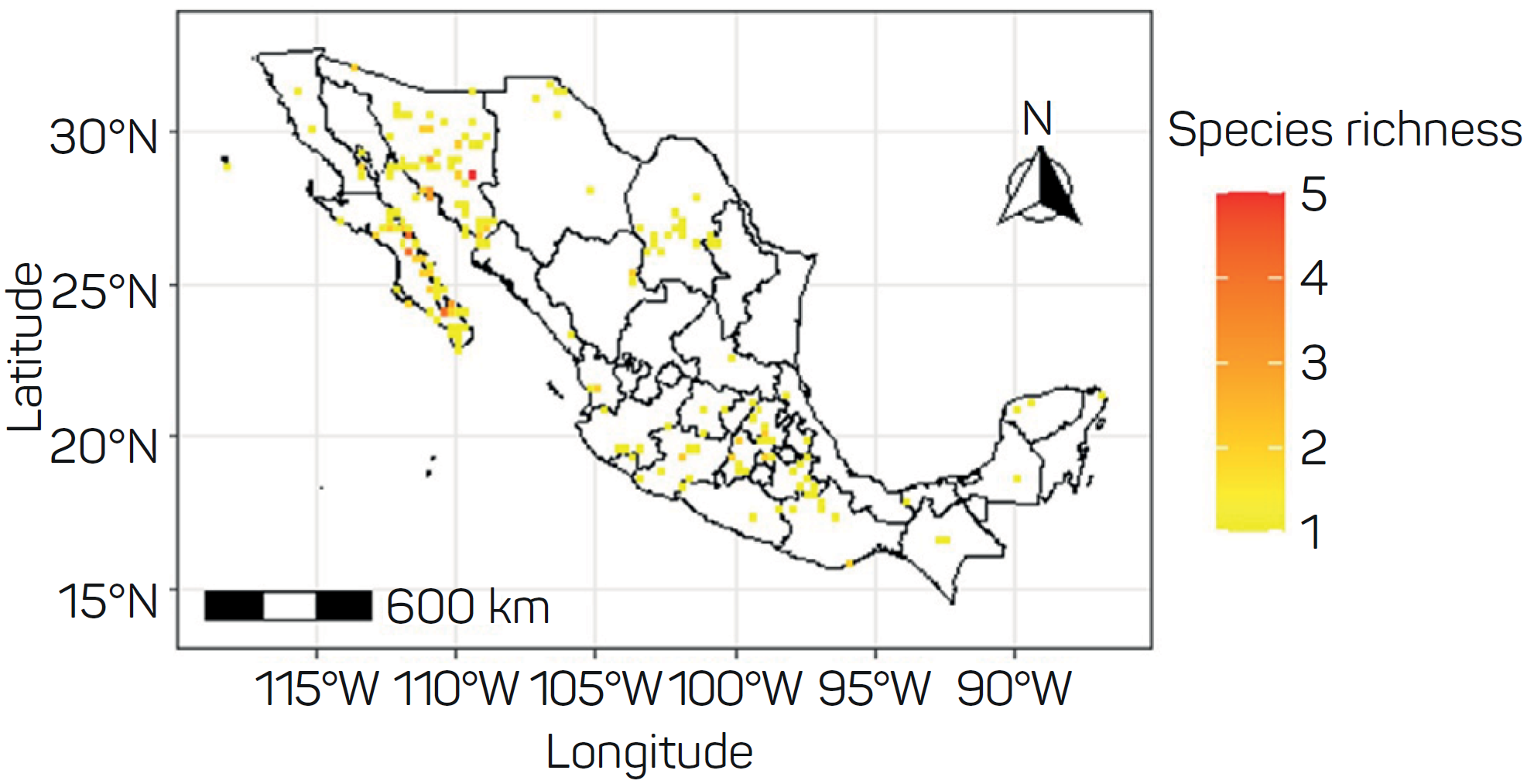
We found 2,533 records of Cuscuta in the herbaria (286 duplicates). Fourteen percent of the records (352 records) were identified until genus only, and the rest were identified until species (56 species, Appendix; Table S5). Cuscuta species were recorded in all Mexican states (Figure 1); species richness ranged from one species (Campeche) to 24 (Sonora) and from two (Campeche, Tlaxcala) to 431 records (Sonora; Table S5).
The genus Cuscuta has 220 species (https://powo.science.kew.org/taxon/urn:lsid:ipni.org:names:30005574-2#children, consulted June 10th, 2024), and we found 56 species, a lower number than the 66-67 species reported by Rzedowski and González (2023) and listed in Plants of the Word Online. Interestingly, we did not find vouchers of two species with restricted distribution but described more than a century ago (C. alata Brandegee, known from Sinaloa and described in 1909; and C. durangana Yunck, known from Durango, Hidalgo, Queretaro, San Luis Potosí, and described in 1922), and of eight species described in the last 15 years: C. azteca Costea & M.A.R.Wright (widespread), C. carnosa Costea & I.García (Durango), C. insolita Costea & García (Nayarit), C. modesta Costea & M.A.R.Wright (Coahuila, Zacatecas), C. montana Costea & Stefanov. (Durango), C. pacifica Costea & M.A.R.Wright (Baja California), C. timida Costea & Stefanov. (Hidalgo, Querétaro, San Luis Potosí, Veracruz), and C. tolteca (Hidalgo, Guanajuato, Querétaro) (Costea et al., 2013; Rzedowski, González, 2023; https://powo.science.kew.org/taxon/urn:lsid:ipni.org:names:30005574-2#children, consulted June 10th, 2024). Although herbaria are considered repositories of plant diversity, the specimens are not collected randomly but are biased depending on researchers’ interest and collection opportunities (Daru et al., 2018) and we could be observed in a certain way this bias. On the other hand, there is the possibility that the information referring to these species was not yet digitalized, and it would be necessary to review physically each herbarium considered for this study, specially local small herbaria.
Fifty-four percent of the Cuscuta species were reported for one (13 species), two (nine species), or three (eight species) Mexican states. Only 23% of species (13) had been collected for ten or more states (Appendix; Table S5). Nine species had over 80 records (Appendix; Table S5). Cuscuta corymbosa, C. tinctoria, and C. umbellata have the most records and the widest distribution (Appendix; Table S5).
We confirm the pattern found by Rzedowski and González (2023; 24%) and only 23% Cuscuta species are broadly distributed in Mexico. The documentation of a few species in most Mexican states could be due to under-sampling and under-identification problems. Because identification of Cuscuta is complex, which discourages their collection and results in many herbarium vouchers not being identified. We believe that under-sampling and under-identification occur because 14% of the herbarium vouchers lack species identification; for some species, there are few herbaria vouchers (21 species with one to ten vouchers, Appendix), and because of the low number of Cuscuta species in the neotropical states that contain the highest plant diversity in Mexico: Chiapas (ten), Oaxaca (16) and Veracruz (13). In contrast, the state of Sonora (24) is highly diverse. However, the herbarium records and potential distribution maps showed that two Cuscuta species had the widest geographical distribution and could be the main pests: C. corymbosa and C. tinctoria (Monroy-Martínez, 2019).
3.2 Cuscuta host diversity
We found 204 species of plants hosting Cuscuta (45 families, 141 genera; Appendix). The families with the most Cuscuta host species were Asteraceae (27 genera, 35 species), Fabaceae (20 genera, 27 species), Euphorbiaceae (seven genera, 16 species), Malvaceae (seven genera, 11 species), Amaranthaceae (four genera, ten species), Acanthaceae (seven genera, nine species), and Nyctaginaceae (three genera, nine species). The rest of the families had between one and six host species. The number of Cuscuta species hosted per plant family ranged from one to 18; only three families hosted more than ten Cuscuta species (18 in Asteraceae, 14 in Euphorbiaceae, and 12 in Fabaceae).
In general, few herbarium vouchers reported the identity of host species, underestimating the impact of Cuscuta. No host species were reported for 20 Cuscuta species (Appendix). For the rest of the Cuscuta species (38 species), the number of host families and species reported ranged from one to 12 and from one to 32, respectively. Nine species had ten or more host species: Cuscuta americana (12 families, 32 species), C. corymbosa (13 families, 16 species), C. macrocephala (nine families, 16 species), C. umbellata (six families, 13 species), C. legitima (four families, 12 species), C. erosa (six families, 11 species), C. tinctoria (seven families, 10 species), C. californica and C. costaricensis (six families, ten species). Another 16 Cuscuta species were hosted by species of at least two different families (two to four families, two- nine host species). The rest of the Cuscuta species (12) were reported to be parasitic of only one family (one – two host species).
Cuscuta's success may be associated with its fast growth, twining habit, and ability to be hosted by several plant species simultaneously (Heide-Jørgensen, 2008). Several studies show that Cuscuta species parasitize various host species. An extensive review reported 77 families of hosts and 300 genera, including monocots such Poaceae (31 genus) (Gaertner, 1950). In Hungary, 174 species (125 genera, 36 families) host Cuscuta campestris Yunck. (Baráth, 2021), and in India, 73 species (30 families) host Cuscuta species (Sarkar et al., 2017). More specific studies also report patterns of host range in Cuscuta sect. Californicae or C. sect. Denticulatae, where host range includes both exclusive and shared hosts (García et al., 2018; Costea et al., 2020). We found more than 200 host species for all the Cuscuta species found in the herbaria, but no single species has more than 50 hosts. Our data support that Cuscuta species have a wide host range because at least two different host families are reported for 47% of the species. However, there is a lack of host records for the rest of the species, or only a few hosts have been reported. In addition to herbarium records, we have observed during field collection of Cuscuta aff. corymbosa that the same species may parasite Bougainvillea sp., Ageratum sp., Lopezia sp., Vachellia farnesiana (L.) Wight & Arn., Pithecellobium dulce (Roxb.) Benth. and Cucurbita pepo L. The ability of Cuscuta species to be hosted by taxonomically distant species means they are not limited by specific hosts, which potentially may expand their distribution and increase their harmful effects on crops. Frequency was associated with the number of host species in our dataset: C. corymbosa and C. tinctoria had the highest number of host species (> 10) and the widest geographical distribution. However, the behavior of Cuscuta needs to be evaluated with more data from the rare species and considering that there are hosts in which the seedlings of Cuscuta establish (primary host) but later, through vegetative growth, invade neighbor hosts (secondary host) (Parker, 2012).
3.3 Ecological niche modeling
We found only one best model for Cuscuta tinctoria, C. tuberculata, and C. umbellata (Table S6). For C. americana, the three best models differed only in their regularization multiplier (RM), and we selected the model with the lowest RM value. However, in C. corymbosa, the three best models differed in both the feature class and the RM, and the same occurred in C. desmouliniana, with five (Table S6). In the last two Cuscuta species we used, the model with the lowest AICc.
The best models differed in performance from chance (partial ROC and AUC tests, Table 1). For the six Cuscuta species, the best model (Table 1) contained two or three climatic predictors with a significant (> 15%) contribution to the model (Table 2, Figure S1), and their inclusion generated an information gain (Figure S1). Two climatic predictors (mean temperature of the wettest quarter and annual precipitation) appeared among the most important predictors for four Cuscuta species (Table 2), followed by precipitation seasonality for three species. Three temperature predictors were among the most important for three Cuscuta species: annual mean temperature (C. tinctoria), mean diurnal range (C. corymbosa), and isothermality (C. tinctoria) (Table 2).
Climatic predictors in the ecological niche models of six Cuscuta species: relative contribution Values in bold correspond to the climatic predictors with the highest contribution values (> 15%), and those in red are the highest in each species model. Nt = Not tested.
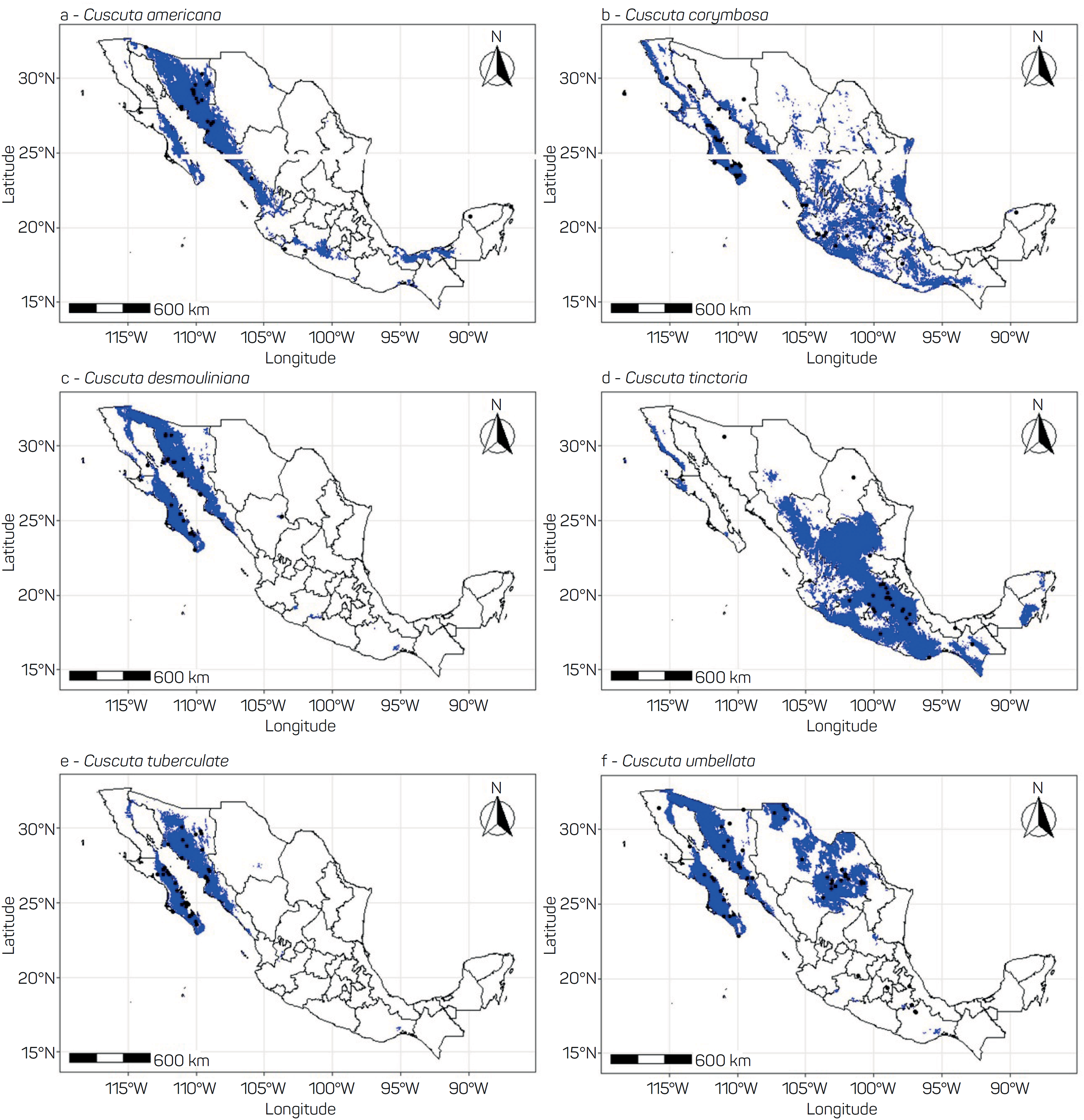
We found three distribution patterns (Figure 2). The first and second patterns were species related to the Nearctic biogeographical region of Mexico. The first group consisted of C. americana (mean temperature of wettest quarter), C. tuberculata (precipitation seasonality), and C. desmouliniana (annual precipitation), mainly distributed in northwestern Mexico (Figure 2a, c, e) and covering an area of less than 16% of the country (Table 1). The second pattern consisted of only one species, C. umbellata (annual precipitation) (Figure 2f), widely distributed in northern Mexico. Three main climatic variables explained this species’ distribution; two were rainfall variables (annual precipitation and precipitation seasonality). Cuscuta corymbosa and C. tinctoria (Figure 2b, d) form the last distribution pattern. These species had the widest distribution (> 20% of Mexico; Table 1).
Potential distribution of six Cuscuta species in Mexico (• The black dots represent the collection areas of the digital herbaria consulted).
It is not unusual that Cuscuta species have a broad distribution (Ren et al., 2020; Cai et al., 2022); but we suggest that our models must be taken with caution because we modeled the distribution of each Cuscuta species for the entire Mexico which could lead to an overestimated potential distribution. However, this strategy allows us to propose hypotheses of the distribution of the species that must be tested with new botanical exploration, but there is support for wide distributions. For example, even when we have collected few specimens in Morelos (see below), we find C. tolteca (previously only known for Hidalgo, Guanajuato, and Queretaro; Costea et al., 2013), this species was unknown to Morelos and is underrepresented in herbaria, but now our collection suggests a disjunct distribution. In addition to the under-sampling problem, Cuscuta species are host generalists (are not host-limited), and they could have a wide distribution. Still, our knowledge about their host amplitude is limited.
Every Cuscuta species had a unique set of climatic variables predicting its distribution (Ren et al., 2020; Cai et al., 2022). Cuscuta's fast-growing, twining habit makes them dependent on the rainy season to grow (Heide-Jørgensen, 2008). However, seed germination also depends on temperature, not only on the rainy season. The best germination temperature of C. europaea L is 15.5 °C, and for C. obtusiflora Kunth, it is between this temperature and 30 °C (Benvenuti et al., 2005). Unexpectedly, instead of being restricted to warm and rainy climates, four of the most frequent Cuscuta species showed a Nearctic distribution (distribution patterns one and two), where the climate is strongly seasonal. For these four north-biased species, the most significant variables predicting their distribution were annual precipitation (C. desmouliniana, C. umbellata), precipitation seasonality (C. tuberculata), and mean temperature of the wettest quarter (C. americana), suggesting that the variables associated with their growth (precipitation) were limiting their distribution. For C. americana, the temperature of the wettest quarter could be related to the germination process. The two northern distribution patterns observed in these four species were strongly associated with the ability of these species to inhabit low altitudes and strongly seasonal vegetation types, such as xerophytic shrub and tropical dry forest as well as mangrove and coastal dune vegetation (C. americana, C. desmouliniana, C. tuberculata), whereas C. umbellata, with a wider northern distribution, can inhabit dry environments like the Sonoran desert (Costea et al., 2012).
The wide distribution of C. corymbosa and C. tinctoria may be due to their high plasticity to many host plants and climates. Cuscuta tinctoria was the species with the lowest number of climatic variables needed to predict its distribution, and the most significant predictors (annual mean temperature and isothermality) suggest that this species depends on warm and less variable environments, biasing its distribution towards Mexican areas with a long-lasting rainy season or a high frequency of fog, such as those found in the high-altitude areas where it is found and in tall temperate forest (Montane cloud forest, Pine-oak forest, Coniferous forest). Cuscuta corymbosa has also been reported for inland montane forests, but it is more frequently found in lower altitudes; the most significant variables predicting its distribution (mean diurnal temperature range, annual precipitation, and precipitation seasonality) and its distribution map suggest that this species is mainly found in the widespread tropical dry forest of Mexico, a seasonal vegetation type where the rains are concentrated from May to September. A well-defined, short rainy season must cause C. corymbosa to concentrate its germination and growth in this period, but this also is true for their hosts. Hence, C. corymbosa prospers during the growing season of its hosts, which includes seasonal crops such as maize and sorghum.
3.4 Molecular identification between Cuscuta species
ITS markers identified one of the two samples collected in San Andres de la Cal. This sample corresponded to C. corymbosa var. stylosa (Choisy) Engelm. with 100% genomic concordance. The second San Andres de la Cal sample was identified with trnL markers as Cuscuta tinctoria var. aurea (Liebm.) Costea ex Engelm (100% genomic concordance). The sample collected in Huitzilac had 97.92% genomic concordance with Cuscuta tolteca Costea and Stefanov (Table 3), which was unknow for this region.
Sequences of the ITS and trnL-F region that have the highest percentage of identity in the NCBI nucleotide database.
Species identification of Cuscuta based on morphology is challenging because of their reduced architecture (e.g., lack of leaves, thin stems, diminutive flowers) and seasonal flowering behavior, leading to misidentification (Costea et al., 2013). Not surprisingly, 14% of the vouchers recorded are identified until genus only.
Molecular tools of plant systematics aid in the delimitation, identification, and detection of characteristic traits of Cuscuta species (Costea et al., 2013). With these methods, we could identify the three C. aff. corymbosa individuals that we collected. The results show that one individual was C. corymbosa, another was C. tinctoria, and the third was C. tolteca. The similarity in flower size and seed shape led to the initial identification, but the molecular data allowed us to discern the species between these individuals. The sympatric coexistence of C. corymbosa and C. tinctoria is unsurprising, as they have the widest distribution in Mexico. We believe that the coexistence of different Cuscuta species is common because well-curated duplicate vouchers (i.e., those identified by well-recognized specialists) and that belong to the same collection series (i.e., coming from the same locality) can contain different species, including Cuscuta sp. specimens.
We resolved our taxonomic doubts with molecular methods, which may help identify specimens with a doubtful identification in the herbaria (those left as Cuscuta sp.). Cuscuta sp. vouchers can be infertile, with wilting flowers, or showing uncommon trait variation (Costea et al., 2013). The fact that different species may exist inside the same collection series makes it impossible to generalize the identification of one voucher to the unidentified vouchers of the same collection series. This points out: a. - the need to facilitate the work of specialists, b. - the convenience of investing in molecular identification methods, and c. - the probability that Cuscuta species coexistence and hybridization may be frequent.
4. Conclusions
In Mexico, Cuscuta is highly diverse and could be the most diverse group of parasitic plants. Still, there is a need to identify undetermined vouchers in the herbaria and increase the collection and identification of their hosts and southern Cuscuta species, as the diversity pattern suggests that the highest diversity is in a Nearctic political state (Sonora). In contrast, the most common pattern in Mexico is the highest plant diversity in three Southern states (Chiapas, Oaxaca, and Veracruz).
Ecological niche modeling suggests three patterns of Cuscuta distribution: Nearctic species in northwestern Mexico, Nearctic species widely distributed in northern Mexico, and widespread species. These patterns could result from biogeographic processes isolating species in these different biogeographic regions where each species has evolved to adapt to the regional climate. Not surprisingly, the variables associated with precipitation most commonly determine Cuscuta distribution. However, the six species modeled have large distribution areas (> 10% of the Mexican territory). This extensive distribution could be associated with all Cuscuta species being generalist parasitic plants, even in small locations. But two species have the most extensive distributions, many host plants, and potentially represent the most significant crop risk: C. corymbosa and C. tinctoria.
Data availability
All relevant data generated or analyzed during this study are included in this published article and its supplementary information (Appendix, Supplementary material, Table S1 and in the weblink: https://www.researchgate.net/publication/398062492_aws-v043-AO000023-Mat-suppl)
Acknowledgements
The comments and criticism of A. Taketa, A.R. Jiménez-Aparicio, A.M. Corona-López, A. Mallory-Smith and two anonymous reviewers improved the manuscript. This study partially fulfills JMS-M's Ph.D. requirements in Natural Sciences at the Universidad Autónoma del Estado de Morelos, Mexico.
References
-
Aiello-Lammens ME, Boria RA, Radosavljevic A, Vilela B, Anderson RP. spThin: an R package for spatial thinning of species occurrence records for use in ecological niche models. Ecography. 2015;38(5):541-5. Available from: https://doi.org/10.1111/ecog.01132
» https://doi.org/10.1111/ecog.01132 -
Baráth K. Effect of species environment on host preference of Cuscuta campestris Plant Ecol. 2021;222(9):1023–1032. Available from: https://doi.org/10.1007/s11258-021-01158-w
» https://doi.org/10.1007/s11258-021-01158-w -
Barbosa AM. FuzzySim: applying fuzzy logic to binary similarity indices in ecology. Methods Ecol Evol. 2015;6(7):853-8. Available from: https://doi.org/10.1111/2041-210X.12372
» https://doi.org/10.1111/2041-210X.12372 -
Benvenuti S, Dinelli G, Bonetti A, Catizone P. Germination ecology, emergence and host detection in Cuscuta campestris Weed Res. 2005;45(4):270-8. Available from: https://doi.org/10.1111/j.1365-3180.2005.00460.x
» https://doi.org/10.1111/j.1365-3180.2005.00460.x -
Cai C, Xiao J, Wan J, Ren Z, Van Kleunen M, Li J. Implications of climate change for environmental niche overlap between five Cuscuta pest species and their two main Leguminosae host crop species. Weed Sci. 2022;70(5):543-52. Available from: https://doi.org/10.1017/wsc.2022.45
» https://doi.org/10.1017/wsc.2022.45 -
Costea M, ElMiari H, Farag R, Fleet C, Stefanović S. Cuscuta sect. Californicae (Convolvulaceae) revised: ´cryptic´ speciation and host range differentiation. Syst Bot. 2020;45(3):638–651. Available from: https://doi.org/10.1600/036364420X15935294613428
» https://doi.org/10.1600/036364420X15935294613428 - Costea M, Felger RS, Austin DF, Van Devender TR, Sánchez-Escalante JJ. Convolvulaceae of Sonora, Mexico. II: Cuscuta. J Bot Res Inst Texas. 2012;6(2):529-50.
-
Costea M, García-Ruiz I, Dockstader K, Stefanović S. More problems despite bigger flowers: systematics of Cuscuta tinctoria clade (subgenus Grammica, Convolvulaceae) with description of six new species. Syst Bot. 2013;38(4):1160-87. Available from: https://doi.org/10.1600/036364413X674887
» https://doi.org/10.1600/036364413X674887 -
Daru BH, Park DS, Primack RB, Willis CG, Barrington DS, Whitfeld TJS et al. Widespread sampling biases in herbaria revealed from large-scale digitization. New Phytol. 2018;217(2):939-55. Available from: https://doi.org/10.1111/nph.14855
» https://doi.org/10.1111/nph.14855 -
Fick SE, Hijmans RJ. WorldClim 2: new 1-km spatial resolution climate surfaces for global land areas. Int J Climatol. 2017;37(12):4302-15. Available from: https://doi.org/10.1002/joc.5086
» https://doi.org/10.1002/joc.5086 -
García MA, Stefanović S, Weiner C, Olszewski M, Costea M. Cladogenesis and reticulation in Cuscuta sect. Denticulatae (Convolvulaceae). Org Divers Evol. 2018;18(4):383-98. Available from: https://doi.org/10.1007/s13127-018-0383-5
» https://doi.org/10.1007/s13127-018-0383-5 - Heide-Jørgensen HS. Parasitic flowering plants. Leide: Brill; 2008.
-
Hijmans RJ, Van Etten J, Mattiuzzi M, Sumner M, Greenberg J, Lamigueiro O. Raster: Geographic data analysis and modeling. raster archive. 2023. Available from: https://CRAN.R-project.org/package=raster
» https://CRAN.R-project.org/package=raster -
Instituto Nacional de Estadística, Geografía e Informática – INEGI. Aspectos geográficos morelos 2021. Aguascalientes: Instituto Nacional de Estadística, Geografía e Informática; 2022[access October 18, 2023]. Available from: https://www.inegi.org.mx/contenidos/app/areasgeograficas/resumen/resumen_17.pdf
» https://www.inegi.org.mx/contenidos/app/areasgeograficas/resumen/resumen_17.pdf -
Kass JM, Muscarella R, Galante PJ, Bohl CL, Pinilla-Buitrago GE, Boria RA et al. ENMeval 2.0: redesigned for customizable and reproducible modeling of species niches and distributions. Methods Ecol Evol. 2021;12(9):1602-8. Available from: https://doi.org/10.1111/2041-210X.13628
» https://doi.org/10.1111/2041-210X.13628 -
Liu C, White M, Newell G. Selecting thresholds for the prediction of species occurrence with presence-only data. J Biogeog. 2013;40(4):778-89. Available from: https://doi.org/10.1111/jbi.12058
» https://doi.org/10.1111/jbi.12058 - Monroy-Martínez S. Identificación morfológica y molecular de siete especies del género Cuscuta L. de importancia agrícola y forestal en México [Master thesis]. Montecillo: Colegio de Posgraduados; 2019.
-
Nickrent DL. Parasitic angiosperms: how often and how many? Taxon 2020;69(1):5–27. Available from: https://doi.org/10.1002/tax.12195
» https://doi.org/10.1002/tax.12195 -
Parker C. Parasitic weeds: a world challenge. Weed Sci. 2012;60(2):269–276. Available from: https://doi.org/10.1614/WS-D-11-00068.15
» https://doi.org/10.1614/WS-D-11-00068.15 -
Peterson AT, Papeş M, Soberón J. Rethinking receiver operating characteristic analysis applications in ecological niche modeling. Ecol Modell. 2008;213(1):63–72. Available from: https://doi.org/10.1016/j.ecolmodel.2007.11.008
» https://doi.org/10.1016/j.ecolmodel.2007.11.008 -
Phillips SJ, Anderson RP, Dudík M, Schapire RE, Blair ME. Opening the black box: an open-source release of Maxent. Ecography 2017;40(7):887–893. Available from: https://doi.org/10.1111/ecog.03049
» https://doi.org/10.1111/ecog.03049 -
Phillips SJ, Anderson RP, Schapire RE. Maximum entropy modeling of species geographic distributions. Ecol Modell. 2006;190(3-4):231–259. Available from: https://doi.org/10.1016/j.ecolmodel.2005.03.026
» https://doi.org/10.1016/j.ecolmodel.2005.03.026 -
R Core Team. R: a language and environment for statistical computing. Vienna: R – Foundation for Statistical Computing; 2023[access January 20, 2024]. Available from: https://www.R-project.org/
» https://www.R-project.org/ -
Ren Z, Zagortchev L, Ma J, Yan M, Li J. Predicting the potential distribution of the parasitc Cuscuta chinensis under global warming. BMC Ecol. 2020;20:1-14. Available from: https://doi.org/10.1186/s12898-020-00295-6
» https://doi.org/10.1186/s12898-020-00295-6 -
Rodenburg J, Demont M, Zwart SJ, Bastiaans L. Parasitic weed incidence and related economic losses in rice in Africa. Agric Ecosyst Environ. 2016;235(1):306-17. Available from: https://doi.org/10.1016/j.agee.2016.10.020
» https://doi.org/10.1016/j.agee.2016.10.020 -
Rzedowski J, González EC. Sinópsis de la familia Convolvulaceae en México. J Bot Res Inst Texas. 2023;17(1):271-9. Available from: https://doi.org/10.17348/jbrit.v17.i1.1296
» https://doi.org/10.17348/jbrit.v17.i1.1296 - Sarkar AK, Dey M, Mazumder M. Host diversity of the parasitic genus Cuscuta in northern part of west Bengal, India. Biosc Disc. 2017;8(4):738-46.
-
van Proosdij AS, Sosef MS, Wieringa JJ, Raes N. Minimum required number of specimen records to develop accurate species distribution models. Ecography. 2016;39(6):542-52. Available from: https//doi.org/10.1111/ecog.01509
» https//doi.org/10.1111/ecog.01509 -
Vergara-Torres CA, Pacheco-Álvarez MC, Flores-Palacios A. Host preference and host limitation of vascular epiphytes in a tropical dry forest of central Mexico. J Trop Ecol. 2010;26(6):563-70. Available from: https://doi.org/10.1017/S0266467410000349
» https://doi.org/10.1017/S0266467410000349 -
Yoshida S, Shirasu K, Multiple layers of incompatibility to the parasitic witchweed, Striga hermonthica New Phytol. 2009;183(1):180-9. Available from: https://doi.org/10.1111/j.1469-8137.2009.02840.x
» https://doi.org/10.1111/j.1469-8137.2009.02840.x
Edited by
-
Editor in Chief:
Carol Ann Mallory-Smith
-
Associate Editor:
Arthur Arrobas Martins Barroso