 Isolation of Mutants Using Gamma Rays and Studying Genetics of Afila and 3-Flowers/Pedicel Attributes in Garden Pea (Pisum sativum L.)
Abstract
The present study was undertaken to induce desirable mutations through γ-irradiation. A set of Lincoln and Azad P-1 varieties of garden pea were exposed to different treatments using 60Co gamma cell to determine LD50 which was estimated at 100 Gy. The frequency of total mutants including lethal ones increased with higher doses of γ-radiation that also resulted in high mutagenic effectiveness and efficiency with few exceptions. A wide range of chlorophyll and viable morphological mutations were obtained in M2 generations that include desirable characters viz., waxy leaves, 3-flowers /pedicel, short inter-nodal distance, fasciation, tall plants, edible pod, exerted stigma, powdery mildew resistance, afila type and variations for seed coat colour etc. in both the varieties. The inheritance for afila and 3-flowers per pedicel mutant in Azad P-1 were governed by a single recessive gene, as F2 generation segregates in a ratio of 1:3 for both the traits.
Keywords:
γ-rays; induced mutation; mutagen effectiveness; Inheritance; Pisum sativum L
HIGHLIGHTS
Putative mutants for key morphological traits were obtained using irradiation.
The inheritance of afila and 3-flowers/pedicel is controlled by recessive gene.
Afila plants reduce lodging losses while 3-flowers/pedicel may enhance yield.
Mutants can be used directly as a variety or indirectly in hybridization programs.
INTRODUCTION
Garden pea (Pisum sativum L.), also known as sweet pea belonging to family Leguminosae is one of the principal vegetable crops of the temperate and sub-tropical areas of the world. Besides, being a rich source of health building substances viz., proteins, vitamins, minerals, and lysine (a limiting essential amino acid in cereals), it is a nitrogen fixing legume crop which is recommended for crop rotation due to its soil building properties, short growing periods and better returns. Pea is a self-pollinated diploid (2n = 14) annual crop widely used for mutagenic studies because it has few chromosomes and the initial lines for mutagenesis are mostly homogenous [1]. Genetic restructuring of germplasm is essential to identify the potential genotypes for use in future breeding programmes [2]. Induced mutations with gamma rays and improved treatment methods offers possibility for the induction of desired changes in various attributes that either cannot be found in nature or have been lost during evolution [3], which can be exploited as such or through recombination breeding [4]. Gamma rays are commonly used in plant breeding programmes because these are known for their simple application, good penetration, reproducibility, high mutation frequency and less disposal problems [5]. Gamma rays are well-known to influence plant development by affecting morphogenetic and cytological changes in cells and tissue [6]. Earlier worker also suggested the use of gamma radiation for obtaining diversity of new traits and forms in garden pea [7]. Mutation is a typical component of research work that modifies genetic makeup and look for desired changes to enhance the yield potential and certain fascinating characters. Mutations are usually recessive, deleterious and cause high mortality. Higher doses inevitably bring about mortality, high pollen & seed sterility and deleterious mutations. To avoid excessive loss of actual experimental materials the sensitivity test must be conducted to determine the LD50 (the safe dose at which half of the planting material survive) doses before massive irradiation treatment of similar materials are accepted [8]. Induced mutagenesis has been used in pea improvement in the past though there is a tremendous scope to utilize it successfully to obtain direct mutants or by following hybridization involving desirable mutants [9] which may surpass the static yield plateau besides having desirable horticultural traits. The knowledge on efficiency of mutagens being used is of basic importance for an efficient mutation breeding programme. Therefore, a systematic study of induced variability for chlorophyll and viable morphological mutations in M2 is the most dependable index in order to induce variability and utilize useful mutations for efficient crop improvement.
Seed yield of pea is mostly depending upon multiple flowers per pedicel and resistant cultivar to powdery mildew which leads to 10-65% seed yield losses under warmer and drier conditions [10-12]. Afila type pea was utilize for powdery mildew resistant breeding programme [13]. Cultivation of resistant cultivars along with high yield potential is always a priority for any breeding programme. To evolve high yielding and powdery mildew resistant cultivars of pea, information regarding inheritance of afila type and triple-flowering mutant is a pre-request.
Keeping this in view, the present investigation was undertaken with an objective to study the response of two garden pea varieties to different doses of 60Co gamma irradiation, induction of macro and micro mutational changes to obtain desirable mutants and inheritance of afila and triple-flowering mutants.
MATERIALS AND METHODS
The seeds of garden pea (Pisum sativum L.), cultivars ‘Lincoln’ and ‘Azad P-1’ were exposed to 14 different doses ranging from 75 Gy to 400 Gy with an interval of 25 Gy in 60Co gamma cells at Mutation Breeding Section, Nuclear Agriculture & Biotechnology Division, Bhabha Atomic Research Centre, Mumbai to standardize LD50. A set of 40 seeds each of 14 doses along with control (non-irradiated seeds) of both the varieties were assessed for germination percentage using the between paper method thrice on three different dates during January-February 2012 in seed germinator under laboratory conditions. The germination was recorded after 7th and 10th days of sowing. The mean values of three different germination experiments were used to work out LD50 using probit analysis. The LD50 values of gamma radiation for both the varieties were determined based on the probit analysis [14]. After calculation of LD50 using probit analysis, a set of 5000 dry seeds of both cultivars with moisture content of 12 per cent were irradiated. Based on the estimation of LD50, five different treatments each below LD50 (50Gy, 60Gy, 75Gy) at LD50 (100Gy) and above LD50 (125Gy) were settled and carried out at 60Co gamma cell, Nuclear Research Laboratory, Indian Agricultural Research Institute, New Delhi. The M1 generation was raised in the Vegetable Farm of Department of Vegetable Science and Floriculture, CSKHPKV, Palampur during 2011-12. All the surviving M1 plants were selfed and harvested individually to raise the M2 generation. Plant- to-row progenies of M2 generations (7180 progenies in Lincoln and 9289 in Azad P-1) were raised at Experimental Farm Department of Vegetable Science and Floriculture CSKHPKV, Palampur during 2012-13. Observations for chlorophyll mutations were noted critically right from emergence till the age of 3-4 weeks after germination (2 leaf stage) in the field as per identification and classification recommended by Gustaffason [15]. Viable macro mutations were scored throughout the life period of the crop as per identification and classification procedure recommended by Blixt [16]. Mutagen effectiveness and efficiency were calculated as per Konzak and coauthors [17].
Mutation effectiveness (gamma rays) = Mutation rate (M2 family basis)/ Dose in kR/Gy
Mutation efficiency = mutation rate/ per cent lethality or biological injury in M1.
Genetics of afila leaf type and 3-flowers per pedicel
Plant materials
To study the genetics of pea mutants obtained Azad P-1 with afila leaf type and 3-flowers per pedicel, they were crossed with Pb-89 (normal leaf and normal pod type) to develop F1 and F2 generations. All the parents were sown in crop season 2016-17 and crosses among the parents were attempted to develop F1’s. F1’s were raised and advanced into F2 during 2017-18.
Evaluation of the material
Parents, F1’s and F2 were sown at Vegetable Farm of Department of Vegetable Science and Floriculture, CSKHPKV, Palampur during 2018-19. Parents and F1’s were grown in two rows and F2’s in eight rows for afila leaf type and ten rows for triple-flowering type with the length of 2.5 m with 45 cm apart and 10 cm distance between plant-to-plant. The recommended package of practices were followed to raise the crop.
Data collection and analysis
The data was recorded on individual plant basis and plants of each cross were classified into two classes of each cross i.e. normal leaf type and afila leaf type, and normal flowering and triple-flowering type. Data was fit into different genetic ratios to find out the best fit ratio in order to know the genetics of afila leaf type and triple-flowering type. Chi-square (ꭕ2) test for goodness-of fit was tested for a probability (P) value = 0.05.
RESULTS AND DISCUSSION
Biological Damage due to irradiation
The response of genotypes Lincoln and Azad P-1 for gamma radiation treatments in relation to germination was studied and represented in Table 1 and Table 2.
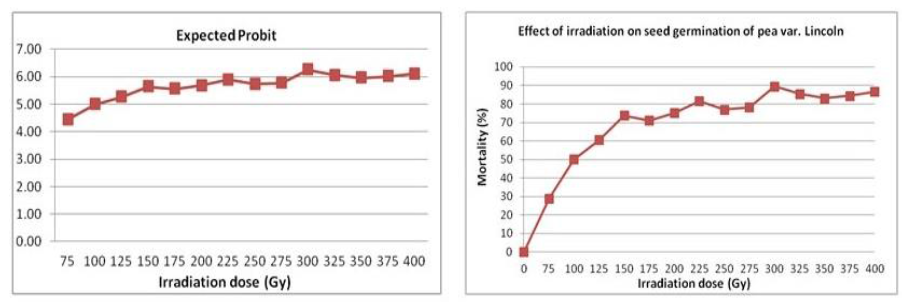
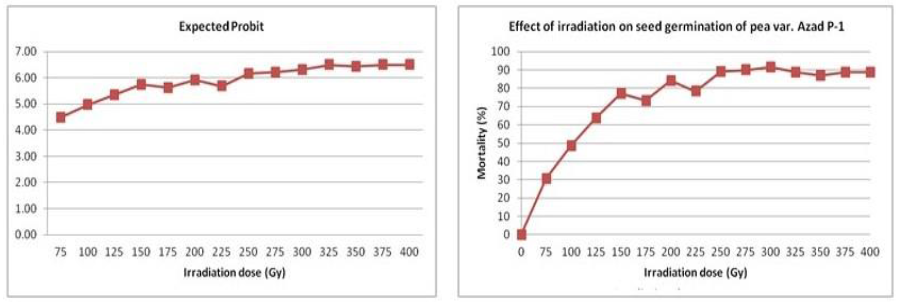
In M1 generation, results showed a dose dependent negative linear relationship between dose and germination percentage. The lethality or biological injury based on germination increased with increasing dose of gamma rays in both the varieties. The highest lethality was observed at 400Gy in both the cultivars. In Lincoln, germination percentage ranged from 10 per cent at 300 Gy to 67.50 per cent at 75 Gy while control treatment (no irradiation) showed 95 per cent germination. Similarly, in Azad P-1, germination ranged from 5.83 per cent at 400, 375 and 325 Gy to 60.83 per cent at 75 Gy while it was 87.50 per cent under no irradiation. The biological damage caused by mutagen can be estimated based on seed germination and plant survival. In present investigation, the germination percentage and plant survival rate were found to be greatly affected by the gamma irradiation in both the varieties. With the increase in gamma radiation dose, the germination percentage declined in both the varieties indicating deleterious effect of higher doses, which was also reported in garden pea [18-19], field pea [20], snake gourd [21], and green gram [22].
Empirical probits and approximate expected probits for mortality (germination) due to seed irradiation in pea var. Lincoln
Empirical probits and approximate expected probits for mortality (germination) due to seed irradiation in pea var. Azad P-1
LD50 Dose: Based on the probit curve analysis, the LD50 value for gamma rays in cultivar Lincoln was determined to be 105 Gy and 102Gy for cultivar Azad-P1 (Figure 1 and Figure 2). It means that approximately 50% of plant population would be dead if exposed to 100 Gy of gamma rays for both the varieties.
Effect of irradiation on seed germination; LD50 value based on probit analysis = 105 Gy i.e., approximately 100 Gy for Lincoln (A) Expected Probit, (B)
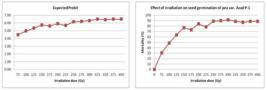
Effect of irradiation on seed germination; LD50 value based on probit analysis = 102 Gy i.e., approximately 100 Gy for Azad-P1 Expected Probit, (B)
Morphological Mutants
The frequency of mutants with desirable plant and pod types were observed under various treatments is presented in Table 3.
The frequency of viable mutants was observed to be higher with the doses upto 75 Gy and thereafter, it decreased with increasing the gamma radiation dose. However, the total mutants based on plant population (%) increased with increasing dose of gamma radiation rate in variety Lincoln i.e. 7.9 and 8.61% at 100 and 125 Gy, respectively in comparison to 6.1% at 75 Gy. Similarly, in Azad P-1, per cent viable mutants were 9.88 and 7.82% at 100 and 125 Gy, respectively than 7.29% at 75 Gy (Table 3).
Although there is no economic value of chlorophyll mutants, but these provides the most dependable indices for estimating the genetic effect of mutagen [23]. The frequency and spectrum of various types of chlorophyll mutations i.e., albina, albino, xantha, aurea, chlorina and chloritica are presented in Table S1 and Table S2 (https://www.documentador.pr.gov.br/documentador/pub.do?action=d&uuid=@gtf-escriba-tecpar@44adf5de-c485-49e3-ad33-20a7df158628). The albina mutants had complete absence of chlorophyll and could not survive after few days of germination. Albino had normal green leaves upto fifth node and totally white apex thereafter, was also a lethal mutation. Aurea (golden yellow colour seedlings) and xantha (pale yellow-coloured seedlings) mutants also could not survive after a few days of germination which might be due to a block in the chlorophyll synthesis [24]. Several types of chlorophyll deficiencies were also noticed in the form of light colouration of the leaves (chloritica) and yellowing of the leaf (chlorina) and persisted for throughout the growth period with weak plant stature which might be due to low efficiency of photosynthesis [25]. Higher frequency and spectrum of chlorophyll mutations were recorded under higher doses of gamma rays (Table 4).
Higher doses or concentrations of mutagens were more effective in inducing greater frequency of chlorophyll mutations in pea [26] and grass pea [27]. In general, the frequency of albina type was higher followed by albino type mutants in both the cultivars which agreed to the earlier finding [28]. The frequency of chloritica and chlorina was lower than albino and albina followed by xantha and aurea having very low frequency.
Desirable macro-mutations
In general, macro-mutations are used to evaluate the genetic effects of different gamma treatments. Breeding programs established based on the variability induced by mutagenic treatment are commonly used for improvement of the most productive and well-adapted varieties [1]. The possible cause of these macro mutations may be chromosomal aberrations, duplication and maybe point or gene mutation [29-30]. It was found that treatment 75 Gy was, in general, more effective in inducing horticulturally desirable mutations. A total of 63 mutants were obtained which were desirable for plant and pod type mutations. The highest number of mutants were observed at the dose of 75 Gy (approximately 27 per cent) followed by 60 Gy (22.22 per cent) and 50 Gy (20.63 per cent). The frequency of desirable macro-mutations was observed to be lower at higher doses of gamma rays, and even at LD50 dose (100 Gy) the share of desirable mutants was 15.87 per cent only followed by 14.29 per cent at 125 Gy. Various important mutants, which were useful for breeding programme, had also been reported earlier workers [31-33]. Some of the important and distinct types of mutants obtained are described in Table 4.
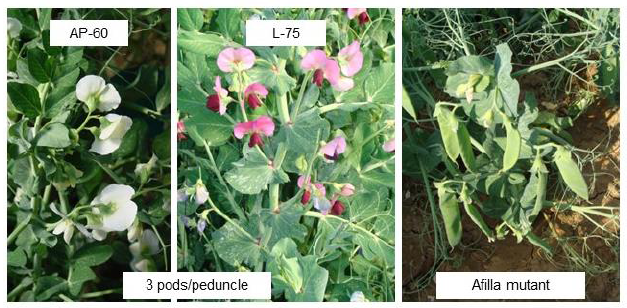
Waxy leaves mutants are of great significance for developing drought resistance varieties. Out of total 63 mutants, three mutants with waxy leaves were obtained i.e. two in variety Lincoln and one in variety Azad P-1. The leaf mutant with waxy leaf had been reported by earlier workers [34, 29, 35]. In general, pea varieties bear one or two flowers on each pedicel and rarely more than two. Therefore, it was significant to isolate mutants bearing 3 or more flowers on a pedicel. A total of three mutants with 3 or more flowers/pedicel on a pedicel were obtained of which two were obtained from the variety Azad P-1(Figure 3). Wild pea and most of the older cultivated varieties have tall vines, whereas most of modern varieties have shortened internodes [36]. This character plays a vital role in obtaining dwarf plant type which is of most desirable to minimize lodging losses during high rainfall or high irrigation regime. All the five mutants for short internodal distance were obtained from variety Azad P-1. Fasciation also known as cresting which is a rare condition of abnormal growth in which the apical meristem becomes elongated perpendicularly to the direction of growth. The flowers in fasciated garden pea are produced as a bunch (false umbel) on apical meristem of the plant and it was also reported that fasciation is associated with genetic mutation [37]. It is significant for uniform maturity and mechanical harvesting. Three mutants for fasciation were obtained from the variety Azad P-1 (Figure 3).
Tall garden pea is also called indeterminate or vining types. These types have longer productive season by producing flowers all over the season therefore yielding more by utilizing the vertical space. Tall garden pea usually needs trellis/frames to support their vines. Tallness is a desirable trait in areas with high rains and poor drainage, where the dwarf ones give lower yields due to various infections. Five tall mutants were derived from the experiment all of which were obtained from the variety Lincoln. Edible podded peas vary from the shelling peas in the sense that they do not have parchment layer in their shell making whole pod edible. They can be used in soups and can be eaten raw as well. Edible podded mutants were observed at lower doses of gamma rays (upto 75 Gy). Three such mutants were acquired from the cultivar Lincoln and one from the cultivar AP-1.

Purple flowered garden peas add beauty to the gardens and are important for the germplasm enhancement. Out of the total four purple flowers mutants obtained, one was from the cultivar AP-1 and three from Lincoln. Three mutants of plant having glossy appearance were obtained at very random doses of gamma radiation (50, 75 and 125 Gy). Two mutants were obtained from Lincoln and one from Azad P-1. Powdery mildew is a devastating disease of garden pea which causes huge losses to the farmers. To have germplasm for future breeding programmes, powdery mildew resistant mutants are vital. Five mutants resistant to powdery mildew were obtained at lower doses of gamma rays (upto 75 Gy) mostly in cultivar Lincoln. Four mutants were retrieved from variety Lincoln and one from Azad P-1. In afila type of mutants the leaves are modified into tendrils. Such mutants do not need trellis/stakes and are lodging proof due to their modified leaves. Many studies have reported afila types to be resistant to powdery mildew. All five mutants were obtained from cultivar Azad P-1 at the doses of 50, 75 and 100 Gy and rest of the two mutants were obtained at a dose of 60 Gy. Highest numbers of 11 desirable mutants were obtained for seed coat colour (17.46%), of which six mutants were acquired from Lincoln and five from Azad P-1.
Mutants with changes in reproductive systems
The practical use of these programmes is closely associated to the genetic structure and reproductive systems of different plant species [38]. Male sterility is one of the important parameters which can be used for breeding programmes for garden pea improvement. In peas, the first occurrence of male sterile mutant gene was recorded by earlier workers which form a vital part of the germplasm collection for hybrid development [39]. Nine mutants were found for this trait (5 from Lincoln and 4 from Azad P-1). In general, frequency of male sterile mutants increased with increase in dose of radiation. Male sterile mutants in garden pea when treated with different doses of gamma rays and EMS were also reported [40]. Gamma rays for induction of genic male sterility has been reported in chilli [41]. Selection of exerted stigma mutants can ease the breeding efforts for crossing of garden pea by allowing open/cross pollination. At dose of 60 Gy three mutants with exerted stigma were obtained (two were from Lincoln and one from Azad P-1).
Mutagenic effectiveness and efficiency
Mutagenic effectiveness reflects the rate of mutation in relation to dose of mutagens while mutagenic efficiency refers to the mutation rate in relation to lethality or biological injury. In mutation breeding where large populations are handled, estimation of mutagenic effectiveness and efficiency may help the breeders in identifying effective treated populations in early generation for reduction in cost of breeding and enhancing scope of selection [33]. The results obtained with respect to mutagenic effectiveness (M/kR or M/tc) and efficiency (M/L) of various doses of gamma rays on garden pea (Table 5) showed differential behavior in relation to mutagen and their dose.
Mutagenic effectiveness increased with increase in the dose of mutagens in both the cultivars except in highest dose of radiation i.e., 125 Gy. Mutagenic efficiency of gamma rays increased with increasing dose in both the cultivars. Thus, it would be seen that the higher mutagenic effectiveness and efficiency does not reflect the per se mutation frequency and cannot be used as an index for maximization of mutation rates [42].
Genetics of afila leaf and triple-flowering mutants
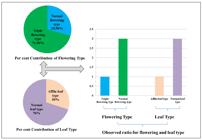
The results for genetics of leaf type and triple-flowering type mutant indicated that Pb-89 was normal leaf type and normal flowering type whereas, Azad P-1 mutant was afila leaf type and triple-flowering type. The data on various generation of the cross is given in Table 6, Table 7 and Figure 4. All the F1, 28 plants were normal leaf and flowering type and indicating that afila leaf type and triple-flowering types were recessive in nature. Genetics for afila leaf type indicating that 152 plants segregated into 46 afila leaf type and 106 normal leaf type in F2 generation, exhibited goodness of fit to the expected 1 afila leaf type and 3 normal leaf type plants with ꭕ2 value of 2.25 indicating that trait afila leaf type is controlled by single recessive gene.
Earlier reports also indicated the monogenetic recessive inheritance of afila type [43,16]. The number of flowers per pedicel is a genetically controlled trait, which may vary from one to many [44-45]. Most of the garden pea genotypes have single or double flower per node and shows very limited variation for this trait [46-47]. The development of multiple pods (three or more) per node appears an attractive option to increase the yield [48]. However, the use of this character for the yield improvement is depends upon the knowledge of number of genes controlling the trait. Genetics for triple-flowering type indicating that F2 generation consisting of 200 plants segregated into 59 triple-flowering type and 141 normal flowering type exhibited goodness of fit to the expected 1: 3 ratio of triple-flowering and normal flowering type plants with ꭕ2 value of 2.16 indicating that trait triple-flowering is controlled by single recessive gene. Earlier reports were also indicated that single recessive gene controlling the multi-flowering in Pisum [49-50]. The chi-square calculated values of both the traits were less than the ꭕ2 tabulated (3.84), suggesting the non-significant deviation from the monogenic ratio.
CONCLUSIONS
In this investigation it was found that there was reduction in germination percentage as the doses of gamma radiation increases. LD50 was settled at 100 Gy for both the cultivars. These optimum mutagen doses determined for the garden pea genotype could be useful while formulating garden pea mutation breeding programme for improvement of specific traits in garden pea. In addition, various mutants for horticulturally important traits were also obtained which enhance the available variability in the germplasm and contribute in the development of high yielding genotypes, clearly indicate a vital role of mutation breeding in crop improvement. The usefulness of a mutagen depends both on its mutagenic effectiveness and efficiency. The mutagenic effectiveness and efficiency generally increased with increasing dose of mutagens with exceptions in 125 Gy. Inheritance of afila and triple flowering type in Azad P-1 mutant were governed by a single recessive gene, as F2 generation segregates in a ratio of 1:3 for both the traits. It can be concluded from the present investigation that mutation breeding plays a vital role in pea improvement which is clear from the induction of useful variability particularly for a number of horticulturally desirable traits, which can contribute in the development of high yielding genotypes.
Acknowledgements
We are grateful to the Bhabha Atomic Research Centre (BARC), Trombay, Mumbai (India) for their financial grant to carry out the research.
REFERENCES
- 1 Kalapchieva S, Tomlekova N. Sensitivity of two garden pea genotypes to physical and chemical mutagens. J. BioSci. Biot. 2016 Sept; 5(2):167-71.
- 2 Sharma A, Kapoor P, Katoch V, Singh Y, Sharma JD. Development of powdery mildew resistant genotypes in garden pea (Pisum sativum L.) through generation mean analysis approach. Ind. J. Gen. Pl. Breed. 2013 Nov; 73:371-7.
- 3 Kharkwal MC, Shu QY. Induced plant mutations in the genomics era. Food and Agriculture Organization of the United Nations, Rome; 2009. 3 p.
- 4 Akbar A, Manzoor B. Radio sensitivity studies in basmati rice. Pakistan J. Bot. 2003 Jun; 35(2):197-207.
- 5 Roslim DI, Herman A, Fiatin I. Lethal dose 50 (LD50) of mungbean (V. radiata L. Wilczek) cultivar Kampar. SABRAO J. Breed. Gen. 2015 Dec; 47(4):510-6.
- 6 Khan WM, Muhammad Z, Akhtar N, Burni T, Younas A, Umar N. Gamma radiation induced mutation in M2 generation of Pea (Pisum sativum L.) Pure Appl. Biol. 2018 June; 7(2): 832-9.
- 7 Kosev V. Study of biological effect of application of gamma rays in pea varieties. Plant Sci. 2012 Jan; 49:54-9.
- 8 Talebi AB, Talebi AB, Jafarpour M. Identify the lethal dose of EMS and gamma radiation mutagenesis in rice MR219. 2nd Int. Conf. Environ. Sci. Biotechnol., IPCBEE, Singapore, 2012; 48:22-6.
- 9 Ahloowalia BS, Maluszynski M, Nichterlein K. Global impact of mutation- derived varieties. Euphytica, 2004 Feb; 135(2):187-204.
- 10 Heringa RJ, Vannorel A, Tazelaar MF. Resistance to powdery mildew in pea. Euphytica, 1969; 18:163-96.
- 11 Tiwari KR, Panner GA, Warkentin TD, Rashid KY. Pathogenic variation in Erysiphe pisi the causal organism of powdery mildew in pea. Can. J. Plant Pathol. 1997 Jan; 19(3):267-71.
- 12 Nagaraju V, Pal AB. Character analysis in garden pea lines with variable resistance to powdery mildew and rust diseases. Mysore J. Agr. Sci. 1990 Jan; 24(1):68-71.
- 13 Ondřej M, Dostálová R, Hýbl M, Odstrčilová L, Tyller R, Trojan R. Utilization of afila types of pea (Pisum sativum L.) resistant to powdery mildew (Erysiphe pisi DC.) in the breeding programs. Plant Soil Environ. 2003 Nov; 49(11):481-5.
- 14 Finney DJ. Statistical method in biological assay, Charles Griffin & Co.; 1978
- 15 Gustaffson A. The mutation system of chlorophyll apparatus, Lund Iniv. Arskr. 1940; 36(11):1-40.
- 16 Blixt S. Mutation in Pisum. Agri. Hort. Genet. 1972; 30:1-293.
- 17 Konzak CP, Nilan RA, Wanger J, Foster RJ. Efficient chemical mutagenesis. Radiation Bot. 1965; 5:49-70.
- 18 Kumari R, Singh Y. Effect of gamma rays and EMS on seed germination and plant survival of Pisum sativum L. and Lens Culinaris. Medic. Neo Bota. 1996; 4(1):25-9.
- 19 Ciftci CY, Turkan AD, Khawar KM, Atak M, Ozcan S. Use of gamma rays to induce mutations in four pea cultivars. Turkish J. Bio. 2006 Jan; 30(1):29-37.
- 20 Govardhan G, Lal GM. Mutagenic effectiveness and efficiency of gamma rays in field pea (Pisum sativum L.) Indian J. Pl. Sci. 2013; 2:73-6.
- 21 Sidhya P, Pandit MK. Mutagenic effectiveness and efficiency of gamma rays in snake gourd (Trichosanthes anguina L.) J. Appl. Natu. Sci. 2015 Dec; 7(2):649-51.
- 22 Rukesh AG, Rahuman MA, Latitia CS, Packiaraj D. Impact of gamma irradiation induced mutation on morphological and yield contributing traits of two genotypes of green gram (Vigna radiata L.) J. Pharma. Phytoch. 2017 Oct; 6(6):1229-34.
- 23 Gautam AS, Sood KC, Mittal RK. Mutagenic effectiveness and efficiency of gamma rays and ethyl methane sulphonate in rajmash (Phaseolus vulgaris L.). Legume Res. 1998; 21(3/4):217-20.
- 24 Blixt S. Quantitative studies of induced mutations in peas chlorophyll mutations. Agri. Hort. Genet. 1961; 19:1-402.
- 25 Ladygin VG, Kosobryukhov AA, Vaishyla OB. Pigment and gas exchange characteristics in leaves of chlorophyll mutants of Pisum sativum. Russian J. Pl. Physiol. 2004 Sept; 51(5):597-603.
- 26 Dhulgande GS, Ghogare DS, Dhale DA, Satpute RA. Mutagenic effects of gamma rays and EMS on frequency and spectrum of chlorophyll mutations in Pea (Pisum sativum L.) J. Ecobio. 2010; 2(8):4-7.
- 27 Das PK, Kundagrami. Frequency and spectrum of chlorophyll mutations in grass pea induced by gamma rays. Indian J. Gen. pl. breed. 2000; 60(2):239-41.
- 28 Sakin MA, Sencar O. The effects of different doses of gamma ray and EMS on formation of chlorophyll mutations in durum wheat (Triticum durum Desf.). Tar. Bilim. Derg. 2002 Jan; 8(1):15-21.
- 29 Singh VP, Yadav RD, Singh RM, Singh BD, Singh RB. Note on a golden yellow seed coat colour mutant of mungbean induced by gamma irradiation. Legume Res. 1982; 15:111-4.
- 30 Kharkwal MC, Pandey RN, Pawar SE. Mutation breeding for crop improvement.in plant breeding mendelian to molecular approaches. Jain HK & Kharkwal MC. Narosa Publishing House Pvt. Ltd. New Delhi; 2004. p. 601-45.
- 31 Wani MR, Khan S, Khozgar MI. An assessment of high yielding M3 mutants in green gram (Vigna radiata (L.) Wilczek). Romanian J. Bio. 2011; 56(1):29-36.
- 32 Mishra D, Singh B, Sahu R. Gamma Ray Induced Macro-Mutations in Greengram (Vigna radiata (L.) Wilczek). Int. J. Agri. Forest. 2013; 3(3):105-9.
- 33 Kumar A, Chaurasia AK, Marker S, Shukla PK, Rai PK, Verma PK, Bara BM. Effect of gamma radiation of macro mutations, effectiveness and efficiency under M2 generation in pea (Pisum sativum L.) Annals West Uni. of Timi., Bio. 2016 May; 19(1):71-6.
- 34 Gupta PK. Mutation breeding in mungbean. In Recent Advances in Mungbean Research. Asthana AN & Kim DH. Indian Society of Pulses Research, Kanpur, India; 1996. p. 124-36.
- 35 Chontira S, Sarajjapinun W, Srinives P. Gamma radiation induced mutations in mungbean. Sci. Asia. 2005 May; 31:251-5.
- 36 Smykal P. Pea (Pisum sativum L.) in biology prior and after Mendel’s discovery. Czech. J. Gen. Pl. Breed. 2014; 50(2):52-64.
- 37 Lerner BR. Fascinating fasciation. Purdue University extension. 2007.
- 38 Wani MR, Kozgar I, Tomlekova N, Khan S, Kazi G, Sheikh A, Ahmad P. Mutation breeding: A novel technique for genetic improvement of pulse crops particularly Chickpea (Cicer arietinum L.). In: Improvement of crops in the era of climatic changes. 2nd ed. Ahmad P, Wani, R, Azooz M & Tran L. Springer SCI + BUS Media New York; 2014. p. 217-48.
- 39 Nirmala C, Kaul MLH. Male Sterility in Pea I. Genes disrupting pre- and post-meiosis. Cytologia. 1991 Jun;56(4):587-95.
- 40 Sharma A, Plaha P, Rathour R, Katoch V, Singh Y, Khalsa GS. Induced Mutagenesis for Improvement of Garden Pea. Int. J. Veg. Sci. 2009 Nov; 16(1):60-72.
- 41 Devi AS, Mullainathan L. Physical and chemical mutagenesis for improvement of chilli (Capsicum annuum L.) World Appl. Sci. J. 2011 Jan; 15(1):108-13.
- 42 Kharkwal MC. Induced mutations in chick pea (Cicer arietinum L.) I. Comparative effectiveness and efficiency of physical and chemical mutagens. Indian J. Gen. Pl. Breed. 1998 May; 58(2):159-68.
- 43 Ivanov KV. Inheritance type of the leaves and productivity in different genotypes of pea (Pisum sativum L.). Pl. Breed. Seed Prod. 2014 Dec; 106(106):56-63.
- 44 Yarnell SH. Cytogenics of the vegetable crops, III. Legumes A. Garden peas Pisum sativum L. Bot Rev. 1962 Oct-Dec; 28(4):465-537.
- 45 Sinjushin AA, Belyakova AS. Ontogeny, variation and evolution of inflorescence in tribe Fabeae (Fabaceae) with special reference to genera Lathyrus, Pisum and Vavilovia. Flora, 2015 Feb; 211(1):11-7.
- 46 Yaxley JL, Jablonski W, Reid JB. Leaf and flower development in pea (Pisum sativum L.): Mutants cochleata and unifoliata. Ann. Bot. 2001 Aug, 88(2):225-34.
- 47 Sinjushin, A., Mutation genetics of pea (Pisum sativum L.): What is done and what is left to do. Ratar Povrt. 2013; 50(2): 36-43.
- 48 Gritton ET. Pea breeding. In: Breeding Vegetable Crops. Bassett MJ. AVI Pub. Comp. Inc. Connecticut, U.S.A. 1986.
- 49 Vilmorin Philipp-de. Mendelism and Pisum. Ivo Conf. Internat, de Genetique, Paris, 1911. p. 51.
- 50 Wellensiek SJ. Genetic monograph on Pisum. Biblio. Genet. 1925; 2:343-476.
-
Funding:
“This research was funded by Bhabha Atomic Research Centre (BARC), grant number 2011/35/BRNS/1500”.
-
Supplementary Material:
Supplementary material, Spectrum and frequency of induced chlorophyll mutations (Albina, Albino and Xantha) in M2 generations, is available in: <https://www.documentador.pr.gov.br/documentador/pub.do?action=d&uuid=@gtf-escriba-tecpar@44adf5de-c485-49e3-ad33-20a7df158628>