 Tolerance and Osmoregulation of Pumpkin Cultivars Exposed to Water Deficit
Abstract
Pumpkin (Cucurbita spp.) is a vegetable of great socioeconomic importance for the Brazilian semi-arid region, but its production faces challenges due to adverse edaphoclimatic conditions. Environmental stresses, such as water deficit, are limiting factors during seed germination and plant establishment. Therefore, this study aimed to select pumpkin cultivars that are more resistant when subjected to water deficit. The experiment was conducted in a completely randomized design, with four replicates of 25 seeds, in a 3 × 6 factorial scheme, combining three levels of water deficit (0.0, -0.15, and -0.3 MPa of polyethylene glycol, PEG 6000) and six Cucurbita spp. cultivars, including five pumpkin cultivars (“Tetsukabuto”, “Soberana”, “Kin”, “Bahiana Tropical”, and “Sergipana”) and one zucchini cultivar (“Adele”). The evaluated variables included germination, germination speed index, shoot and root length, shoot and root dry mass, total free amino acids, proline, total soluble sugars, and citrulline. The data were analyzed and subjected to cluster analysis and variance analysis compared by the Scott-Knott test (P ≤ 0.05). Water deficits of -0.15 and -0.3 MPa affect the initial growth of pumpkin cultivars, with negative impacts on germination, growth, biomass accumulation, and cellular osmotic homeostasis. The “Adele” cultivar stands out as the most tolerant to the -0.15 MPa water deficit, while “Tetsukabuto” is the most sensitive. Water deficit tolerance in pumpkins is related to the ability to accumulate metabolites such as proline, soluble sugars, and amino acids.
Keywords:
cucurbitaceae; osmoprotection; water stress.
HIGHLIGHTS
Water stress reduced germination and vigor, with variation among cultivars.
The accumulation of osmoprotectants aided in the response to water deficit.
Cultivars showed differences in growth and biomass under drought conditions.
INTRODUCTION
Water stress is one of the main limitations to crop productivity, especially in areas with scarce water resources, such as arid and semi-arid regions [1]. In the Brazilian semi-arid region, even during the rainy season, drought periods are frequent and, depending on their intensity and duration, cause significant damage to crops, resulting in low productivity [2].
Seed germination is conditioned by environmental factors, such as water availability, whose scarcity during sowing compromises the establishment of seedlings in the field [3]. Consequently, it negatively impacts plant growth and development as well as seed production [4].
Pumpkin (Cucurbita spp.) production is often limited by unfavorable environmental conditions, such as water deficit, which reduces plant height, number of leaves, fruit and seed weight, and affects physiological characteristics, such as antioxidant enzymes and photosynthetic pigments [5, 6, 7, 8]. The impairment of plant performance occurs in response to the overproduction of reactive oxygen species (ROS), causing damage to the plasma membrane [9]. The increase in ROS concentration in the cell, including the production of hydrogen peroxide (H2O2), is one of the main consequences of oxidative stress, with this compound being generated as a byproduct of respiratory and photosynthetic metabolic processes in plants [10].
Faced with these challenges, plants develop different mechanisms to avoid drought and adapt to water deficit. Morphological, biochemical, physiological, and molecular changes have been studied in different plant species [11], including alterations in gene expression regulated by epigenetic mechanisms, which modulate physiological responses essential for tolerance [12, 13]. Among these strategies, the accumulation of osmoregulators such as proline, sugars, glycine betaine, and proteins has been identified, as they play important roles in adaptation to water deficit [14].
Thus, the identification of physiological traits associated with drought tolerance, such as those evaluated in this study, represents a valuable tool for genetic improvement, enabling the detection of resistant genotypes through the analysis of their physiological activity during water stress [15]. The development and refinement of drought tolerance phenotyping protocols make it possible to establish selection criteria and strategies for the use of these resistance sources, strengthening the integration between genotype, environment, and phenotype in breeding programs [16].
Therefore, the selection of pumpkin cultivars resistant to water deficit is essential to face the challenges of modern agriculture, promoting sustainability and efficiency in the use of natural resources. Thus, the objective was to evaluate the tolerance and biochemical activity of different pumpkin cultivars under water deficit conditions.
MATERIAL AND METHODS
The research was conducted at the Seed Analysis Laboratory, affiliated with the Department of Agricultural and Forestry Sciences at the Federal Rural University of the Semi-Arid, Mossoró, RN (5°11’ S and 37°20’ W, 18 m altitude).
The experimental design was completely randomized in a 3 x 6 factorial scheme, with four replicates of 25 seeds each. The first factor consisted of three concentrations of polyethylene glycol (PEG 6000) at osmotic potentials corresponding to water deficit (0.0, -0.15, and -0.3 MPa), based on the guidelines proposed by [13], while the second factor corresponded to six pumpkin cultivars (“Tetsukabuto”, “Soberana”, “Kin”, “Bahiana Tropical”, “Sergipana”, and “Adele").
Before setting up the experiment, the seed water content was determined using the oven method at 105 ± 3 °C for 24 hours [14]. For this purpose, two samples of 4.5 ± 0.5 g were used. The water content was determined based on the wet mass, and the results were expressed as a percentage.
The pumpkin seeds were placed between two sheets of paper towels and covered with another sheet for germination, previously moistened with distilled water (0.0 MPa - control). The water deficit was imposed using PEG 6000 solutions, prepared according to the Villela and coauthors [17] table, at two levels of osmotic potential: -0.15 MPa and -0.3 MPa. The amount of solution used was equivalent to twice the dry mass of the paper [18]. Subsequently, the paper rolls were placed in transparent plastic bags and kept in a B.O.D type germination chamber at 25 °C, with an eight hour photoperiod.
There was no use of soil, agricultural substrate, pots, or field conditions; therefore, variables such as field capacity, soil moisture, stomatal conductance, or leaf water potential are not applicable to the adopted methodology, since the plants did not reach leaf development stages.
The variables analyzed were as follows:
a) First germination count (FGC): conducted on the fourth day after sowing, seedlings with developed radicles were counted.
b) Germination (G): corresponding to the percentage of germinated seeds on the eighth day after sowing until the development of seedlings [18].
c) Germination speed index (GSI): conducted alongside the germination test, with daily counts of the number of germinated seeds until the eighth day after the test was set up. Based on these data, the GSI was determined according to the methodology proposed by Maguire [19].
d) Shoot length (SL) and root length (RL) of seedlings: at the end of the germination test, ten normal seedlings were randomly selected, and the shoot length (measured from the collar to the apex of the seedling) and primary root length (measured from the base of the collar to the root tip) were measured using a ruler graduated in centimeters seedling -1.
e) Shoot dry mass (SDM) and root dry mass (RDM) of seedlings: after measuring the length, the seedlings were cut, placed in kraft paper bags, and dried in a forced-air oven at 65 °C. After drying, the seedlings were weighed on a precision scale (0.0001 g), and the results were expressed in mg seedling -1.
For the preparation of the extract for biochemical analyses, pumpkin seedlings were collected and stored in Falcon tubes. During extraction, the fresh mass of the seedlings was macerated in liquid nitrogen (-196 °C). After maceration, 0.2 g of the sample was weighed in triplicate, and the material was placed in hermetically sealed tubes. Subsequently, 1 mL of 60% alcohol was added, and the tubes were incubated in a water bath at 60 °C for 20 minutes. The samples were then centrifuged at 10,000 rpm for 10 minutes at 4 °C, repeating the procedure three times. Finally, the supernatant was collected for the determination of the following variables:
a) Total soluble sugars (TSS): quantified using the anthrone method [20], with a glucose standard curve, and the results expressed in mg of glucose g -1 of fresh mass.
b) Total free amino acids (TFAA): determined using the acidic ninhydrin method [21], based on a glycine standard curve, and the results expressed in μmol mg of glycine g -1 of fresh mass.
c) Free proline (FP): determined using the method described by Bates and coauthors [22], with the results expressed in µmol proline g -1 of fresh mass.
d) Free citrulline (FC): determined using the photometric method, with the results expressed in µmol citrulline mL -1 [23].
The data were submitted to ANOVA, and the means were compared using the Scott-Knott test (p ≤ 0.05) to evaluate the effects of the cultivars subjected to the osmotic potentials. Additionally, the results were subjected to cluster analysis using the hierarchical Ward’s Minimum Variance method, with Euclidean Distance as a dissimilarity measure, using the free software for univariate and multivariate statistical analysis PAST 4. The statistical analysis was performed using the Variance Analysis System software - SISVAR® [24].
RESULTS AND DISCUSSIONS
The analysis of variance indicated an interaction (p < 0.01) between the factors (cultivars × water deficit levels) for the first germination count, germination speed index, shoot length, root length, shoot dry mass, and root dry mass. An isolated effect between cultivars and osmotic potentials was observed for germination (p < 0.05) (Table 1).
Analysis of variance for the first germination count (FGC), germination (G), germination speed index (GSI), shoot length (SL), root length (RL), shoot dry mass (SDM), and root dry mass (RDM) of Cucurbita spp. cultivars under water deficit conditions
Overall, differentiated behavior was observed among the cultivars when subjected to water deficit. The reduction in the first germination count (FGC) and germination speed index (GSI) for all cultivars confirms that water deficit compromises the initial establishment of seedlings. However, at the -0.15 MPa level, the “Adele” cultivar achieved a the highest germination percentage, with a first germination count (FGC) at 52% and the higher germination speed index (11.36) (Table 2), suggesting greater germination capacity under moderate stress conditions. For the “Soberana” and “Kin” cultivars, no radicle emission was detected during the first germination count at four days, which reduced the germination speed index but did not compromise the final germination percentage at eight days (Table 2). This result indicates a delay in the onset of development, possibly related to greater sensitivity to water deficit in the early stages.
Means of the first germination count (FGC) and germination speed index (GSI) of Cucurbita spp. cultivars under water deficit conditions
The absence or low germination percentage of some cultivars under water deficit, followed by a significant reduction in the germination speed index, is attributed to limitations in water absorption and delays in essential metabolic processes for initial plant establishment [25, 4]. This pattern reinforces the importance of the imbibition phase for metabolic activation, a stage that proves more vulnerable in sensitive genotypes.
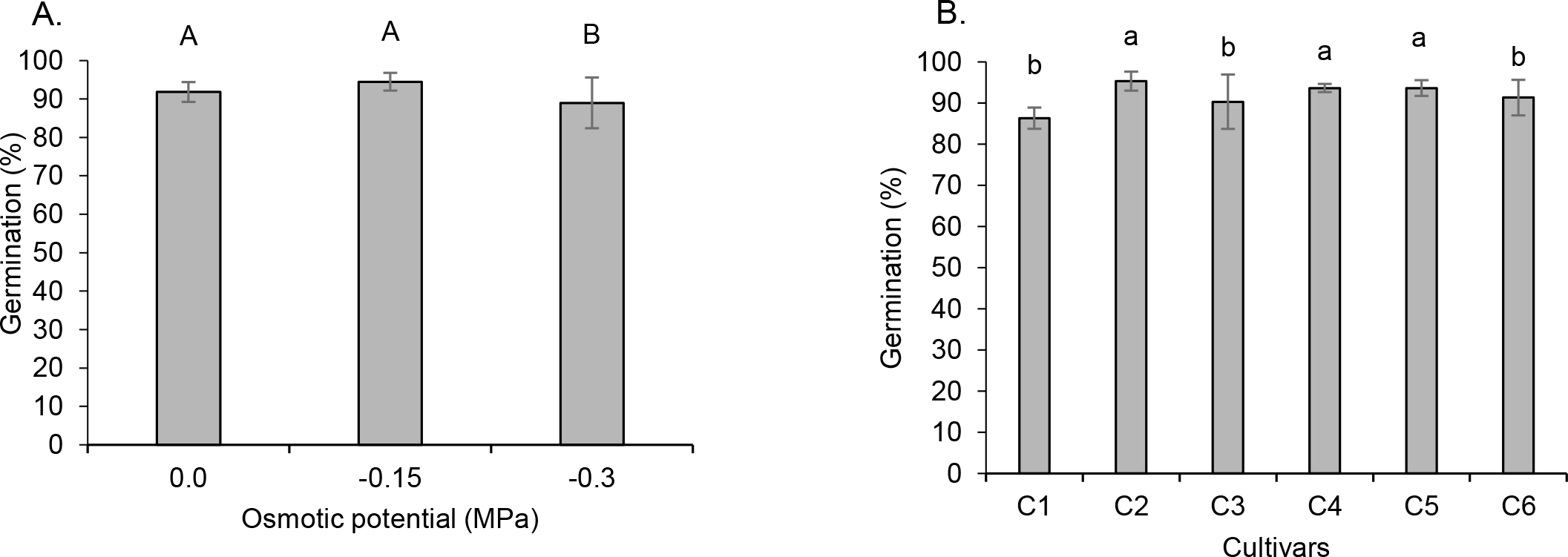
Analyzing the isolated effects of germination, it was observed that at the 0 MPa osmotic potential (no water stress), this variable reached values above 90%, not differing statistically from the -0.15 MPa potential (Figure 1A). However, under the more severe water deficit (-0.3 MPa), germination fell below 90%, differing statistically from the other levels. This reduction suggests that the seeds tolerate moderate decreases in water availability, but severe water limitation directly compromises viability or germination speed.

Germination of Cucurbita spp. seedlings under different water deficit levels (A) and cultivars (B). Means followed by the same lowercase letter (cultivars) and uppercase letter (osmotic potential) do not differ from each other by the Scott-Knott test at 5% probability. Standard error C1 = “Tetsukabuto”; C2 = “Soberana”; C3 = “Kin”; C4 = “Adele”; C5 = “Bahiana Tropical”; C6 = “Sergipana”.
Seven cucumber cultivars (“Compadre”, “Campeiro”, “Sliced Max”, “Prêmio”, “Diplomat”, “Runner”, and “Safira”) under a water deficit of -0.4 MPa were analyzed by De Souza Neta and coauthors [26], who observed variation in tolerance among them. These authors identified that PEG 6000 reduced germination speed but maintained germination rates above 80%, with the most affected variables at the higher water potential of -0.4 MPa.
For pumpkin cultivars, significant variation in germination was observed (Figure 1B). Cultivars C2 (“Soberana”), C4 (“Adele”), and C5 (“Bahiana Tropical”) achieved the highest germination percentages (above 90%). On the other hand, cultivars C1 (“Tetsukabuto”), C3 (“Kin”), and C6 (“Sergipana”) resulted in germination rates below 90%. This genotypic variation indicates that drought tolerance in Cucurbita spp. is not uniform and that certain cultivars have more efficient mechanisms to maintain germination under water restriction conditions.
The reduction in germination in some cultivars may be a result of a lower water absorption capacity by the seeds, a necessary and important requirement for the activation of basal metabolic processes, including respiration, transcription, and translation, or of accumulated oxidative damage during the germination process [27]. In this sense, genetic variability aligns with research emphasizing its potential in responding to water stress in Cucurbita species [28].
Regarding initial seedling growth, it was observed that water deficit levels reduced shoot length (SL) and root length (RL) (Table 3). For SL, a reduction was observed starting at -0.15 MPa for the “Soberana” and “Kin” cultivars, corresponding to 88.8% and 80.6%, respectively, reinforcing that moderate deficit is already sufficient to significantly inhibit the elongation of aerial tissues. This effect is expected, as water scarcity can compromise plant growth and development, negatively affecting physiological and biochemical processes [29].
Means of shoot length (SL) and root length (RL) of Cucurbita spp. cultivars under water deficit conditions
In Cucurbita pepo, a 65% reduction in fresh weight and a 35% reduction in seedling length were observed under water and salt deficit conditions compared to the control [30]. Similarly, Kurtar and coauthors [31], evaluating different irrigation regimes in watermelon rootstock (Citrullus lanatus var. citroides), also observed a negative effect of stress on various growth variables, such as leaf number, plant length, and fresh weight.
Increasing water deficit levels did not affect the RL of pumpkin cultivars, except for the Kin cultivar. Additionally, there was an increase in length when comparing the control with deficit levels. This behavior suggests that certain cultivars prioritize root growth over shoot growth, a typical strategy for seeking water at greater depths. At the moderate stress level (-0.15 MPa), although the “Soberana” cultivar showed lower RL, it did not differ from “Tetsukabuto” (Table 3). These results agree with studies evaluating the impact of water stress on different cucurbit species, such as pumpkins [32], watermelon [33], zucchini [28], and gourd [34], which found no reduction in root length but rather changes in root architecture. Thus, the maintenance or increase in RL can be interpreted as an adaptive mechanism to mitigate stress.
When plants are subjected to water deficit conditions, roots are the first organs to perceive the water restriction, transmitting the stress signal through the xylem to the shoot [35]. Under such conditions, seedlings exhibit less vigorous and concentrate their development on the root system, aiming to overcome the effects of the adverse environment by promoting the accumulation of osmolytes, such as proline, and enhancing water absorption [8].
Seedling dry mass was reduced with increasing water deficit levels. The “Soberana” and “Bahiana Tropical” cultivars showed the lowest results for this variable, with 80.5% and 51%, respectively, while the others did not differ statistically at the -0.15 MPa level (Table 4). Similar results were observed for root dry mass (RDM) in both cultivars at the same water deficit level (-0.15 MPa). On the other hand, the “Sergipana” cultivar maintained RDM with increasing water deficit levels (Table 4). This contrast shows that although some cultivars reduce growth, Sergipana maintained biomass allocation to the roots, possibly sustaining water supply and nutrient uptake under restrictive conditions.
Means of shoot dry mass (SDM) and root dry mass (RDM) (mg/seedling) of Cucurbita spp. cultivars under water deficit conditions
The reduction in plant biomass under stress conditions is directly related to the reduction of essential metabolic processes. Water deficit causes stomatal closure as a strategy to reduce water loss through transpiration; however, this also reduces the photosynthetic process, resulting in lower carbohydrate production, which is the basis for growth and dry biomass accumulation [36]. Additionally, cell growth is inhibited, as cell expansion depends on turgor, which is maintained by water absorption [37].
Changes in carbohydrate metabolism also occur, with reduced starch and soluble sugar synthesis, which are accumulated to act as osmolytes, aiding osmotic adjustment and cellular protection [27]. Although this is an adaptive response, the energy diverted to osmolyte synthesis could be used for growth, contributing to reduced dry biomass.
According to the analysis of variance, an interaction (p < 0.01) was observed between the factors cultivars and water deficit levels for the variables total soluble sugars, total free amino acids, free proline, and free citrulline (Table 5).
Analysis of variance for total soluble sugars (TSS), total free amino acids (TFAA), free proline (FP), and free citrulline (FC) of Cucurbita spp. cultivars under water deficit conditions
Biochemical analyses indicated that sugar content varied among treatments of different cultivars and water potential levels. The reduction of the water potential to -0.3 MPa resulted in a significant increase of 126.3%, 190.2%, and 895.1% in sugar content was observed for the “Tetsukabuto”, “Soberana”, and “Bahiana Tropical” cultivars, respectively, compared to the control (Table 6). These solutes play fundamental roles in osmotic adjustment and protection of cellular structures against damage. Therefore, for these cultivars, the accumulation of sugars under water deficit presents itself as one of the immediate responses of plants to promote osmotic adjustment, improve leaf water status, and thus maintain metabolic functionality [38].
Means of total soluble sugars (TSS) and total free amino acids (TFAA) of Cucurbita spp. cultivars under water stress conditions
The highest concentrations of amino acids were observed for the “Soberana” cultivar at the -0.15 MPa level, followed by “Adele” (Table 6). The proline content, an important indicator of water stress response, was higher at the -0.3 MPa level in the “Tetsukabuto” and “Soberana” cultivars, indicating a robust adaptive response associated with the mitigation of oxidative stress (Table 7). Proline is primarily synthesized through the glutamate or ornithine pathways [39, 40]. Furthermore, according to Zali and Ehsanzadeh [41], this process utilizes NADPH, whose degradation generates ATP, contributing to energy storage and helping to mitigate the effects of environmental stresses. Since it is an ATP-generating process, this is likely why the species can increase growth and the germination process even under water deficit, particularly in the Adele cultivar.
Means of free proline (FP) and free citrulline (FC) of Cucurbita spp. cultivars under water deficit conditions
In addition to acting as an osmolyte, L-proline plays additional roles during stress, acting as a metal chelator, a defense molecule against oxidation, and, most importantly, as a signaling molecule [42]. The accumulation of proline acts as an antioxidant by eliminating reactive oxygen species, protecting membranes and organelles, and activating antioxidant enzymes, allowing plants to integrate and respond to different stimuli [43]. Therefore, the differential accumulation of proline among cultivars indicates genetic variability in the ability to activate tolerance mechanisms, with more effective strategies for initial adaptation to water deficit.
In research evaluating heat stress tolerance in cucumber plants, it was observed that heat-sensitive plants, represented by the “Barracuda” cultivar, showed lower proline levels compared to tolerant plants [44]. This indicates that proline accumulation is correlated with the plant's ability to withstand intense heat conditions. Similar findings were reported by Jahan and coauthors [45] with increased proline content in response to water deficit in cucurbit genotypes. Proline’s ability to modulate abiotic stress has opened new possibilities for the genetic manipulation of crops, aiming at agricultural sustainability. These technological advances allow for the modification of proline-related genes, potentially improving productivity under adverse environmental conditions [46].
Regarding citrulline levels, an increase in content was also observed with increasing water deficit in all cultivars. These results suggest that citrulline may play an important role in the defense mechanisms against water deficit in cucurbits, thus being considered a marker of tolerance. The highest concentrations were identified in the “Tetsukabuto” cultivar, followed by “Adele” at the -0.3 MPa level (Table 7). The activation/deactivation of citrulline metabolism induced by drought plays an important role in physiological processes. Although still incipient, the identification of citrulline under abiotic stress conditions is not only important as a precursor of polyamines but also essential for growth, differentiation, and cell division. Additionally, it acts as an active osmolyte (protection), nitrogen transporter, and possibly a signaling molecule, reaffirming its usefulness as a biomarker for drought stress tolerance in cucurbits [47, 48].
Overall, it was found that the higher concentration sugars, amino acids, proline, and citrulline acted as mechanisms associated with maintaining osmotic potential and cellular protection, reflecting an attempt to improve osmotic adjustment mechanisms and stress resistance [49]. This behavior was even more pronounced in the “Tetsukabuto” and “Soberana” cultivars under severe water deficit conditions (-0.3 MPa).
Based on cluster analysis (Figure 2), Euclidean Distance was used as a dissimilarity measure of 30% among combinations of pumpkin cultivars (C) and osmotic potential levels (N). The first group (Group I) consisted of cultivars subjected to the 0.0 MPa osmotic potential level. This group reflects control conditions (no water deficit) and suggests that, in this scenario, the six cultivars had similar physiological and biochemical responses.

Dendrogram of dissimilarity of groups formed by the combination of water deficit levels (N) and cultivars (C) of Cucurbita spp. N0 = Control; N1 = -0.15 MPa; C1 = “Tetsukabuto”; C2 = “Soberana”; C3 = “Kin”; C4 = “Adele”; C5 = “Bahiana Tropical”; C6 = “Sergipana”
Groups II, III, and IV were formed by six cultivars evaluated under water deficit conditions (-0.15 MPa). The formation of Group II indicated that the “Adele” cultivar showed better physiological responses, possibly related to specific adaptations of this cultivar to mild water deficit conditions (-0.15 MPa), such as higher germination rates and solute accumulation for osmotic adjustment (Figure 2).
Group IV included the cultivars most sensitive to water deficit, with “Tetsukabuto” being the most affected (Figure 2). The separation of this cultivar into a distinct group indicated a divergent response to moderate water deficit compared to those in Group I. This separation demonstrates that, even under moderate deficit, there is a clear distinction in adaptive responses, and that physiological and biochemical parameters can be used as early indicators of tolerance.
The observation of the results indicates that the accumulation of osmolytes under water deficit was strongly associated with germination responses and initial seedling growth. Overall, cultivars that showed higher germination values and GSI (Germination Speed Index) under moderate deficit (-0.15 MPa), such as “Adele”, maintained more balanced osmolyte levels, suggesting a moderate use of resources for osmotic adjustment without excessively compromising initial establishment speed. On the other hand, under severe deficit (-0.3 MPa), cultivars such as “Tetsukabuto” and “Soberana” exhibited a marked increase in sugars, amino acids, and proline, indicating the activation of protective biochemical responses, but with a negative impact on germination and emergence speed, reflecting a prioritization of survival over rapid establishment.
The growth variables (SL and RL) and biomass (SDM and RDM) reinforce this pattern. The significant increase in proline, soluble sugars, and citrulline levels was generally related to the reduction in dry mass and shoot length, suggesting a metabolic shift toward maintaining osmotic homeostasis and protection against oxidative stress, at the expense of vegetative expansion. Similar observations were reported by [50], who found a reduction in growth parameters and a significant increase in free amino acids and proline in pumpkin plants under drought, confirming the trend observed in this study. The cultivar “Adele” stood out by increasing RL even under stress, albeit with low osmolyte accumulation, indicating a possible strategy based on preferential allocation of assimilates to the root system and greater water-use efficiency.
These observations reveal contrasting adaptive strategies: the “Adele” cultivar achieves satisfactory germination performance and osmolyte accumulation under moderate deficit but shows reduced growth under severe stress, except for RL; others, such as Tetsukabuto, respond with intense osmotic adjustment early on but with greater impairment of growth and biomass. This genotypic variation underscores the importance of selecting materials that combine stable germination and early growth with efficient osmolyte accumulation, aiming for greater resilience and productivity of Cucurbita spp. under water-limiting conditions.
CONCLUSION
Water deficits of -0.15 and -0.3 MPa affect the initial growth of pumpkin cultivars, with negative impacts on germination, growth, biomass accumulation, and cellular osmotic homeostasis. The cultivar “Adele” stands out as the most tolerant to the -0.15 MPa water deficit, making it a promising candidate as a potential parent in breeding programs aimed at developing more drought-tolerant cultivars. The “Tetsukabuto” cultivar, however, shows greater sensitivity and may serve as a comparison parameter in genotype selection and screening studies. One of the possible survival mechanisms for water deficit tolerance in pumpkins is the ability to accumulate osmoprotectant metabolites, such as proline, soluble sugars, and amino acids, which help maintain cellular turgor and reduce oxidative damage.
-
Funding:
The study was funded by the Conselho Nacional de Desenvolvimento Científico e Tecnológico (CNPq) and the Coordenação de Aperfeiçoamento de Pessoal de Nível Superior (CAPES - Financial Code 001).
-
Institutional Review Board Statement:
Not applicable.
-
Informed Consent Statement:
Not applicable.
Acknowledgments:
The authors thank the Conselho Nacional de Desenvolvimento Científico e Tecnológico (CNPq) for financial support, the Coordenação de Aperfeiçoamento de Pessoal de Nível Superior (CAPES) for the scholarship, and Sakata (Brasil) for donating the pumpkin seeds.
Use of Generative Artificial Intelligence
The authors declare that large language models and other generative artificial intelligence (AI) or AI-assisted technologies cannot be credited as authors and have not been listed as authors of this paper.
The authors declare that generative artificial intelligence (AI) or AI-assisted tools were used under full human supervision. The tool(s) and version(s) used, and their purpose, are described here: grammar correction, punctuation correction, and synonym suggestion. No confidential or sensitive data were uploaded to such tool(s), and all AI-assisted content was checked, corrected and approved by the authors, who take full responsibility for the integrity and originality of the manuscript.
Data Availability Statement:
Research data are available in the body of the manuscript.
REFERENCES
- 1 Seymen M, Dursun A, Yavuz D, Kurtar ES, Özbahçe A, Türkmen Ö. Evaluation of seed yield, oil and mineral contents inbred pumpkin lines (Cucurbita pepo L.) under water stress. Acta Sci. Pol.-Hortorum Cultus. 2020 Jun;19(3):89-99.
- 2 Alvalá RCS, Cunha APMA, Brito SSB, Seluchi ME, Marengo JA, Moraes OLL, et al. Drought monitoring in the Brazilian Semiarid region. An Acad Bras Cienc. 2019;91(1 Suppl):e20170209.
- 3 Saux M, Ponnaiah M, Langlade N, Zanchetta C, Balliau T, El-Maarouf-Bouteau H, et al. A multiscale approach reveals regulatory players of water stress responses in seeds during germination. Plant Cell Environ. 2020 Jan;43(5):1300-13.
- 4 Singh M, Thapa R, Kukal MS, Irmak S, Mirsky S, Jhala AJ. Effect of water stress on weed germination, growth characteristics, and seed production: a global meta-analysis. Weed Sci. 2022 Oct;70(6):621-40.
- 5 Shahidan N, Othman R, Jaswir I, Hasyun-Hashim YZ. Effect of abiotic stress under light and dark conditions on carotenoid content in pumpkin (Cucurbita moschata) calluses. Rev Sci Fondam Appl. 2018;9:861.
- 6 Safahani Langeroodi AR, Campiglia E, Mancinelli R, Radicetti E. Can biochar improve pumpkin productivity and its physiological characteristics under reduced irrigation regimes? Sci Hortic. 2019 Mar;247:195-204.
- 7 Seymen M, Yavuz D, Dursun A, Kurtar ES, Türkmen Ö. Identification of drought-tolerant pumpkin (Cucurbita pepo L.) genotypes associated with certain fruit characteristics, seed yield, and quality. Agric Water Manage. 2019 Jul;221:150-9.
- 8 Guirra KS, Torres SB, Leite MS, Guirra BS, Nogueira Neto FA, Rêgo ALB. Phytohormones on the germination and initial growth of pumpkin seedlings under different types of water. Rev Bras Eng Agric Ambient. 2020 Dec;24(12):827-33.
- 9 Sun Y, Wang C, Chen HYH, Ruan H. Response of plants to water stress: a meta-analysis. Front Plant Sci. 2020;11:978.
- 10 Kar M. Expression patterns of oxidative stress-related genes of Cucurbita pepo and relation to cellular H2O2 under short-term heavy metal stress. J Inst Sci and Tech. 2020;10(4): 2952-61.
- 11 Melo-Sabogal DV, Contreras-Medina LM. Elicitors and biostimulants to mitigate water stress in vegetables. Horticulturae. 2024 Aug;10(8):837.
- 12 Kumar S, Singh A. Epigenetic regulation of abiotic stress tolerance in plants. Adv Plants Agric Res. 2016 Nov;5(3):517-21.
- 13 Cheong J-J. Genetic and epigenetic changes in plants in response to abiotic stress. Genes. 2021 Oct;12(10):1603.
- 14 Sytar O, Kumari P, Yadav S, Brestic M, Rastogi A. Phytohormone priming: Regulator for heavy metal stress in plants. J Plant Growth Regul. 2019 Nov;38(2): 739-52.
- 15 Miransari M, Riahi H, Eftekhar F, Minaie A, Smith DL. Improving Soybean (Glycine max L.) N2 Fixation under Stress. J Plant Growth Regul. 2013 Apr;32(4): 909-21.
- 16 Soares GF, Ramos MLG, Pereira LF, Keller B, Muller O, de Lima CA, et al. Phenotyping for drought tolerance in different wheat genotypes using spectral and fluorescence sensors. Plants-Basel. 2025 Jul;14(14):2216.
- 17 Villela FA, Doni Filho L, Sequeira EL. [Table of osmotic potential as a function of polyethylene glycol 6000 concentration and temperature.]. Pesq Agropec Bras. 1991;1957-68. Portuguese.
- 18 Brasil. Ministério da Agricultura, Pecuária e Abastecimento. [Rules for seed analysis]. 1st ed. Brasília: MAPA/ACS. 2009. 399p. Portuguese.
- 19 Maguire JD. Speed of germination-aid in selection and evaluation for seedling emergence and vigor. Crop Sci. 1962 Mar;2(2): 176-7.
- 20 Yemm EW, Willis AJ. The estimation of carbohydrates in plant extracts by anthrone. Biochem J. 1954;57(3): 508-14.
- 21 Yemm EW, Cocking EC, Ricketts RE. The determination of amino-acids with ninhydrin. Analyst. 1955;80(948):209.
- 22 Bates LS, Waldren RP, Teare ID. Rapid determination of free proline for water-stress studies. Plant Soil. 1973 Aug;39(1):205-7.
- 23 Knipp M, Vasák M. A colorimetric 96-well microtiter plate assay for the determination of enzymatically formed citrulline. Anal Biochem. 2000 Nov;286(2):257-64.
- 24 Ferreira DF. Sisvar: a computer analysis system to fixed effects split plot type designs. Rev Bras Biom. 2019 Dec;37(4):529-35.
- 25 Ataíde GM, Borges EEL, Leite Filho AT. [Physiological and biometric changes in Melanoxylon brauna Schott seeds during germination at different temperatures.]. Rev Arv. 2016;40(1):61-70. Portuguese.
- 26 Souza Neta ML, Torres SB, de Paiva EP, Carvalho SMC, de Sousa Leite M, Guirra BS, et al. Osmotic adjustment and antioxidant activity of cucumber seeds pre-treated with stress attenuators and subjected to drought stress during germination. J Plant Growth Regul. 2024 Jan;43(6):1-15.
- 27 Taiz L, Zeiger E, Moller IM, Murphy A. [Plant physiology and development]. 6th ed. Porto Alegre: Artmed, 2017. 858p. Portuguese
- 28 Vasileva ES, Chipilski RR. Identification and characterization of drought tolerant local populations of Cucurbitaceae. Bulg J Agric Sci. 2022 Jan;28(3):417-24.
- 29 Seleiman MF, Al-Suhaibani N, Ali N, Akmal M, Alotaibi M, Refay Y, et al. Drought stress impacts on plants and different approaches to alleviate its adverse effects. Plants-Basel. 2021 Jan;10(2):259.
-
30 Bankaji I, Sleimi N, Vives-Peris V, Gómez-Cadenas A, Pérez-Clemente RM. Identification and expression of the Cucurbita WRKY transcription factors in response to water deficit and salt stress. Sci Hortic. 2019 Oct;256:108562.
» https://doi.org/108562 - 31 Kurtar ES, Seymen M, Yavuz D, Acar B, Metin D, Atakul Z, et al. Morphophysiological and biochemical investigation of the potential of citron watermelon (Citrullus lanatus var. citroides) rootstock under different irrigation regimes. Hortic Environ Biotechnol. 2024 Jul;65(6):1009-23.
- 32 Farzamisepehr M, Ghorbanli M, Tadji Z. Effect of drought stress on some growth parameters and several biochemical aspects in two pumpkin species. Irania J of Pla Phy. 2021 Mar;11:3731-40.
- 33 Mandizvo T, Odindo AO, Mashilo J, Sibiya J, Beck-Pay SL. Phenotypic variability of root system architecture traits for drought tolerance among accessions of citron watermelon (Citrullus lanatus var. citroides (L.H. Bailey). Plants-Basel. 2022 Sep;11(19):2522.
- 34 Mkhize P, Shimelis H, Mashilo J. Cucurbitacins B, E and I concentrations and relationship with drought tolerance in bottle gourd [Lagenaria siceraria (Molina) Standl.]. Plants-Basel. 2023 Oct;12(19):3492.
- 35 Khalid MF, Huda S, Yong M, Li L, Li L, Chen Z-H, et al. Alleviation of drought and salt stress in vegetables: crop responses and mitigation strategies. Plant Growth Regul. 2023 Oct;99(2):177-94.
- 36 Bashir SS, Hussain A, Hussain SJ, Wani OA, Zahid Nabi S, Dar NA, et al. Plant drought stress tolerance: understanding its physiological, biochemical and molecular mechanisms. Biotechnol Biotechnol Equip. 2021 Feb;35(1): 1912-25.
- 37 Ali O, Cheddadi I, Landrein B, Long Y. Revisiting the relationship between turgor pressure and plant cell growth. New Phytol. 2023 Dec;238(1):62-9.
- 38 Mahmood T, Abdullah M, Ahmar S, Yasir M, Iqbal MS, Yasir M, et al. Incredible role of osmotic adjustment in grain yield sustainability under water scarcity conditions in wheat (Triticum aestivum L.). Plants-Basel. 2020 Sep;9(9):1-13.
- 39 Trovato M, Mattioli R, Costantino P. Multiple roles of proline in plant stress tolerance and development. Rend Lincei.-Sci Fis Nat. 2008 Dec;19(14):325-46.
- 40 Verslues PE, Sharma S. Proline metabolism and its implications for plant-environment interaction. Arabidopsis Book. 2010 Apr;8:e0140.
- 41 Zali AG, Ehsanzadeh P. Exogenous proline improves osmoregulation, physiological functions, essential oil, and seed yield of fennel. Ind Crop Prod. 2018 Jan;111: 133-40.
- 42 Liang X, Zhang L, Natarajan SK, Becker DF. Proline mechanisms of stress survival. Antioxid Redox Signal. 2013 Aug;19(9):998-1011.
- 43 Renzetti M, Funck D, Trovato M. Proline and ROS: a unified mechanism in plant development and stress response? Plants-Basel. 2024 Dec;14(1):2-26.
- 44 El-Remaly E. Morphological, physio-biochemical, and molecular indications of heat stress tolerance in cucumber. Sci Rep. 2023;13(18729):1-13.
- 45 Jahan MSL, Kutty MS, Pradeepkumar T, Santhoshkumar AV, Suma A. Characterisation of wild and cultivated cucurbit species and their response to water deficit stress. Genet Resour Crop Evol. 2025 Apr;72:343-58.
- 46 Ghosh UK, Islam MN, Siddiqui MN, Cao X, Khan MAR. Proline, a multifaceted signalling molecule in plant responses to abiotic stress: understanding the physiological mechanisms. Plant Biol. 2022 Nov;24(2):227-39.
- 47 Joshi V, Fernie AR. Citrulline metabolism in plants. Amino Acids. 2017 Jul;49(9):1543-59.
- 48 Song Q, Joshi M, DiPiazza J, Joshi V. Functional relevance of citrulline in the vegetative tissues of watermelon during abiotic stresses. Front Plant Sci. 2020;11:512.
- 49 Saxena R, Kumar M, Tomar RS. Plant responses and resilience towards drought and salinity stress. Plant Arch. 2019 Sep;19:50-8.
- 50 Salim BBM, Abou El-Yazied A, Salama YAM, Raza A, Osman HS. Impact of silicon foliar application in enhancing antioxidants, growth, flowering and yield of squash plants under deficit irrigation condition. Ann Agric Sci. 2021 Dec;66(2):176-83.
-
Editor-in-Chief:
Bill Jorge Costa
-
Associate Editor:
Adriel Ferreira da Fonseca