 Food Introduction and Its Implications on the Development of Celiac Disease in Childhood
Abstract
This study investigated the relationship between food introduction and celiac disease development. This bibliographic review was conducted from May to June 2023 and covered publications from 2013 to 2023. The Virtual Health Library (VHL) and PubMed databases were used, with the following search terms: “Celiac Disease,” “Gluten enteropathy” (with the Boolean operator “OR”), “Infant,” “Preschooler” (also using the Boolean operator “OR”) and “Food Introduction.” A total of 28 articles were found and, after careful analysis, only 6 met the inclusion and exclusion criteria. These articles addressed topics such as the relationship between dietary patterns and the risk of celiac disease, the prevalence of the disease in children born before and after the epidemic in Sweden, the feasibility of introducing allergens and their relationship with breastfeeding, and the implications of introducing gluten into the diet and early weaning in celiac disease. The results of the study highlight the importance of further research into this topic to develop possible methods of prevention and intervention in the manifestation process of celiac disease. From the bibliographic review, it was possible to identify the variables that imply the development of celiac disease and refute the hypotheses of the direct influence of the early introduction of gluten in the diet on the manifestation of the disease.
Keywords:
gluten enteropathy; malabsorption syndrome; gastrointestinal disease; infant; preschool
HIGHLIGHTS
Early gluten exposure does not impact the celiac disease development in children.
There is an indirect link between breastfeeding, gluten exposure and celiac disease.
Gastrointestinal infections have an effect on the disease.
The protective effect of late gluten introduction is still a hypothesis.
INTRODUCTION
Introducing food to a baby is a significant step in their development. It marks the beginning of their transition from solely consuming breast milk or formula to gradually incorporating solid foods. The World Health Organization (WHO) recommends introducing solid foods around the age of 6 months, according to their guidelines published in 2023 [1]. However, the ideal age for this transition is not the only important factor to consider. Exposing the child to a variety of flavors, textures, and nutrients during this process promotes a healthy acceptance of new foods [2]. Moreover, the early and gradual introduction of allergenic foods into the baby's diet has been studied extensively as a way to prevent allergies [3] and other immunological reactions, such as those experienced by celiac patients.
Celiac disease is a chronic autoimmune disorder that affects the mucosa of the small intestine. This condition is triggered by the consumption of gluten, a type of protein found in wheat, barley, and rye grains. Only individuals with a genetic predisposition are affected by this condition [4]. The key genetic determinants are the HLA II genes DQA and DQB, which are highly variable and located in the major histocompatibility complex on chromosome 6.
This genetic disorder is considered to be the most common, with a prevalence of 0.5% to 1% in many populations [5]. Its diagnosis can be complicated due to the variety of symptoms that patients may experience. These symptoms are not only associated with gastrointestinal issues, such as chronic diarrhea, constipation, abdominal pain, and malabsorption of nutrients, but can also occur outside of the intestine, such as headaches, fatigue, osteoporosis, growth retardation, infertility, and even depression [6]. To manage symptoms and potential complications, the only effective approach post-diagnosis is complete avoidance of gluten in the patient's diet [7]. Additionally, as exposure to gluten can trigger the disease in those genetically predisposed, there are ongoing studies looking at the role of food introduction in this process.
In light of these factors, the purpose of this review is to examine research on the introduction of food and its guidance in relation to the development of celiac disease in infants.
MATERIAL AND METHODS
This study is categorized as a narrative literature review, which involves a process of selecting, synthesizing, summarizing, and interpreting the literature that has been published across various platforms, such as electronic journals and books. It is important to note that this process may be subject to the author's subjectivity. This type of study aids in consolidating a particular area of knowledge and provides fresh perspectives on the subject, both theoretically and contextually [8].
Between May and June 2023, data was collected from the Virtual Health Library (BVS) and PubMed databases. The search terms used were "Celiac Disease" and "Gluten Enteropathy" using the "OR" operator, as well as "Infant" and "Preschool" also using the "OR" operator, and "Food Introduction". Inclusion criteria included articles published in English from 2013 to 2023, of the types of clinical trials, randomized controlled, and cohort studies. Literature reviews were excluded.
After selecting articles that met the criteria, the stages of exploratory and selective reading were followed, with an emphasis on materials that fit the objectives of the study. Analysis of selected texts involved interpretive reading and writing.
For individual publication analysis, a script was developed that considered the authors, year of publication, objective, design, methods, results and conclusions.
RESULTS
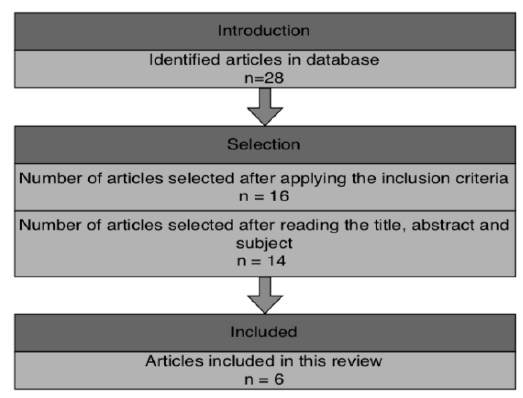
After conducting searches, 28 articles were found. The inclusion and exclusion criteria were applied, resulting in the selection of 6 articles for data analysis (Figure 1). The selected articles include prospective cohort studies, randomized clinical trials, observational cohort studies, cross-sectional screening, and population-based randomized controlled trials covering different topics related to food introduction instructions and the development of celiac disease. One of the articles evaluates the effect of gluten consumption on celiac disease development in children aged 11 to 36 months. Two articles investigate the effect of early gluten introduction on the disease's development, with one analyzing the relationship between childhood dietary patterns and celiac disease risk. One article looks at the prevalence of celiac disease in children born at different times in Sweden and the relationship with infant feeding. Another article examines the feasibility of introducing allergenic foods to breastfed children compared to those who received exclusive breastfeeding for up to 6 months. Finally, one article studied the relationship between infant feeding, hospitalization, HLA allele, rotavirus vaccination status, and celiac disease autoimmunity, as shown in Chart 1.
Articles that were identified in the Virtual Health Library (VHL) and Pubmed databases, according to their authors, year of publication, objective, design, method, results and conclusions.
DISCUSSION
Celiac disease is a complex condition influenced by genetic, environmental, and immunological factors. Environmental triggers such as exposure to gluten, the age at which it's introduced, breastfeeding, intestinal microbiota, and gastrointestinal complications, particularly viral infections, can all contribute to its development. The age at which infants are introduced to gluten in their diet is becoming increasingly important to study as it may impact the development of the autoimmune condition in predisposed patients. We can better guide prevention and intervention strategies for at-risk infants and children by identifying an ideal age for gluten introduction and ingested amount. This need for research has arisen due to estimates that approximately 30% of the world's population carries human leukocyte antigen genes, mainly HLA-DQ2, yet only 1% of the population develops celiac disease. Environmental factors are believed to play a significant role in this difference [9].
Between 1984 and 1996, Sweden experienced a high rate of celiac disease. As a result, the country revised its recommendations for introducing gluten into infants' diets. In 1984, the consumption of gluten began at 6 months of age and almost doubled in quantity. However, in 1996, the protocol changed, and gluten was introduced for 4 months alongside breastfeeding. A study was carried out on children born during these two periods, and it was observed that children born in 1997 had lower rates of celiac disease than those born in 1993. This led to the conclusion that the early introduction of gluten and breastfeeding prevented the development of the disease in children up to 12 years old. This evidence was widely accepted and supported by several authors. [10]. However, the studies that supported this theory were later disproven due to unreliable data. This was due to the limitations of the continuous variables used and the lack of information regarding the amount of gluten consumed by different age groups [9].
There has been a long-standing belief that the early introduction of gluten in a child's diet is linked to celiac disease. However, a recent study of 715 children at high risk for celiac disease from 5 European countries (Germany, Hungary, Italy, Spain, and Holland) found no direct correlation between the amount of gluten consumed during the first months of life and the development of the disease. The study analyzed gluten intake between 11 and 36 months of age and the pattern of daily gluten intake (MDGI) in relation to the development of celiac disease up to the age of 6. Surprisingly, the countries with the highest MDGI rates did not have the highest number of celiac cases, nor did the countries with the lowest gluten consumption have the lowest number of cases. For example, Spain had the lowest daily gluten consumption for children up to two years yet did not have the lowest number of cases in the same age group. In contrast, Hungary had the highest consumption but a lower number of cases than Spain [9].
A similar discovery was made in another study involving 944 children who tested positive for HLA-DQ2 or HLA-DQ8 and had at least one first-degree relative with celiac disease. The children were divided into two groups, one receiving a placebo and the other receiving 100mg of immunologically active gluten per day from the 4th to 6th month of life. The study analyzed the diagnosis of celiac disease in these children when they reached 3 years old, and the results showed that gluten intervention did not affect the frequency of disease development. The study also evaluated the idea that breastfeeding could protect against the development of celiac disease. It concluded that there was no correlation between the duration of breastfeeding and the onset of the condition, regardless of whether it was exclusive or not [11]. Additionally, the EAT study [12] refuted the belief held by some mothers that offering allergenic foods to infants would harm the reception of breast milk and lead to a shorter duration of breastfeeding.
According to studies conducted by Crespo-Escobar and coauthors (2017) [9] and Vriezinga and coauthors (2014) [11], there is no direct link between early gluten exposure and the development of celiac disease. However, they have discovered interesting facts that reveal a specific genotype's susceptibility to the condition. Those who are positive for HLA DQ2.2/DQ7 are at a higher risk of developing celiac disease when exposed to high levels of gluten. This genotype is more susceptible to external factors, as per Crespo-Escobar and coauthors (2017) [9]. Vriezinga and coauthors (2014) [11] have also identified that the influence of early introduction of gluten in the development of celiac disease in girls was related to a higher prevalence of homozygous HLA-DQ2 genotypes among them, which makes them more vulnerable to environmental factors. Both studies have concluded that there is a difference in celiac disease occurrence between males and females, with female children having a higher frequency.
A different study contradicted the belief that introducing gluten early on leads to celiac disease. Instead, it suggested delaying gluten intake to potentially prevent the onset of the disease. This approach aims to maintain the baby's health during a critical period of development. The study was conducted by Lionetti and coauthors in 2014 [13] and relates to the review by Pinto-Sánchez and coauthors (2016) [15], which determines the impossibility of making recommendations regarding the consumption of gluten when introducing food to infant, as the available data are not robust enough. This work points out the lack of evidence to consider that early exposure to gluten increases the risk of developing the disease, but discusses the hypothesis that late introduction has this role, concluding that more studies are needed to elucidate the confounding factors.
Kemppainen and coauthors (2017) [14] explored the relationship between breastfeeding and the introduction of gluten in an infant's diet in the development of celiac disease. These two factors play a role in the link between gastrointestinal infections and the onset of the celiac condition. In the TEDDY study, it was found that gastrointestinal infections occurring 3 months before seroconversion can induce celiac disease in individuals who are predisposed to it, especially those who are local carriers of non-HLA-DQ2 and breastfed for less than 4 months. Breastfeeding helps modulate this bond due to the passive immunization function of the child. Immunoglobulins A coat the intestinal mucosa and neutralize infectious agents, reducing the chance of contracting compatibility, especially viral infections, which can lead to celiac autoimmunity. Furthermore, early weaning increases the risk of gastrointestinal disorders and celiac disease. The interruption of breastfeeding is closely linked to the early introduction of gluten, and both factors cause modulating effects on gastrointestinal disorders. Additionally, the interval between exposure to gluten and gastrointestinal infection by rotavirus, considered the main trigger for celiac disease, influences the development of this autoimmune condition.
After conducting a thorough review, it has been discovered that recent studies on the topic at hand are lacking. Despite diligent searches for scientific literature and careful examination of the material found, there are still many unanswered questions. For instance, Szajewska and coauthors (2016) [16] have noted that there is insufficient data to determine the best recommendations for introducing gluten into infants' diets, as well as whether breastfeeding can aid in preventing celiac disease. Additionally, it is unclear whether there is any difference in the risk of developing the disease between children who were exclusively breastfed and those who were given formula. This is an important area for further research, as colostrum's role in the formation of intestinal microbiota [17] is closely related to celiac disease's pathogenesis [7].
CONCLUSION
After conducting a bibliographic review, it has been determined that the early introduction of gluten does not impact the development of celiac disease in predisposed children. The idea that a late introduction of gluten may offer some protection is still unproven, as has the hypothesis that late exposure may increase the risk of developing the disease. Additionally, simultaneous breastfeeding and gluten introduction do not delay or decrease the risk of developing autoimmunity, as previously believed.
However, there is an indirect connection between breastfeeding, gluten introduction, and celiac disease manifestation during the food introduction stage. This link is due to the effect that the gastrointestinal infections have on the disease, which has not yet been fully understood.
It is essential to conduct new studies on this topic to clarify the relationship between gluten introduction delay and celiac disease and to explain the connection with gastrointestinal infections. By advancing knowledge on this topic, it may be possible to provide forms of prevention and intervention in the process of developing celiac disease.
Acknowledgments
The authors are grateful to Conselho Nacional de Desenvolvimento Científico e Tecnológico (CNPq), Coordenação de Aperfeiçoamento de Pessoal de Nível Superior (CAPES), and Fundação Araucária - PR (TED 27/23) for the financial support.
REFERENCES
- 1 World Health Organization. Guideline for complementary feeding of infants and young children 6-23 months of age. Geneva: World Health Organization; 2023.
- 2 Nicklaus S. The role of food experiences during early childhood in food pleasure learning. Appetite. 2016 Sep 1;104:3-9.
- 3 Togias A, Cooper SF, Acebal ML, Assa’ad A, Baker Jr JR, Beck LA, et al. Addendum guidelines for the prevention of peanut allergy in the United States: Report of the National Institute of Allergy and Infectious Diseases-sponsored expert panel. J. Allergy Clin. Immunol. 2017 Jan 1;139(1):29-44.
- 4 Hill P, Holmes GK, Asquith P, Holmes G. British Society of Gastroenterology guidelines on the diagnosis and management of coeliac disease. Gut. 2015 Apr;64(4):691-2.
- 5 Geha R, Notarangelo L. Case Studies in Immunology: A Clinical Companion. 6th ed. New York: Garland Science, Taylor & Francis Group; 2012.
- 6 Therrien A, Kelly CP, Silvester JA. Celiac Disease: Extraintestinal Manifestations and Associated Conditions. J. Clin. Gastroenterol. 2020 Jan;54(1):8-21.
- 7 Caio G, Volta U, Sapone A, Leffler DA, Giorgio R, Catassi C, et al. Celiac disease: a comprehensive current review. BMC Med. 2019 Jul 23;17(1):23.
- 8 Elias CSR, Figueiredo RM, Rocha RA. [When does the end come? A narrative review on the end of the school period for mentally disabled students]. SMAD Rev. Eletrônica Saúde Ment. Álcool Drog. 2012;8(1):48-53.
- 9 Crespo-Escobar P, Mearin ML, Hervás D, Auricchio R, Gemma C, Gyimesi J, et al. The role of gluten consumption at an early age in celiac disease development: a further analysis of the prospective PreventCD cohort study. Am. J. Clin. Nutr. 2017 Apr 1;105(4):890-6.
- 10 Ivarsson A, Myléus A, Norström F, Pals MVD, Rosén A, Högberg L, et al. Prevalence of childhood celiac disease and changes in infant feeding. Pediatrics. 2013 Mar;131(3).
- 11 Vriezinga SL, Auricchio R, Bravi E, Castillejo MSG, Chmielewska A, Escobar PC, et al. Randomized Feeding Intervention in Infants at High Risk for Celiac Disease. N. Engl. J. Med. 2014 Oct 2;371(14):1304-15.
- 12 Perkin MR, Logan K, Marrs T, Radulovic S, Craven J, Flohr C, et al. Enquiring About Tolerance (EAT) study: Feasibility of an early allergenic food introduction regimen. J. Allergy Clin. Immunol. 2016 May 1;137(5):1477-86.e8.
- 13 Lionetti E, Castellaneta S, Francavilla R, Pulvirenti A, Tonutti E, Amarri S, et al. Introduction of Gluten, HLA Status, and the Risk of Celiac Disease in Children. N. Engl. J. Med. 2014 Oct 2;371(14):1295-303.
- 14 Kemppainen KM, Lynch KF, Liu E, Lönnrot M, Simell V, Briese T, et al. Factors That Increase Risk of Celiac Disease Autoimmunity After a Gastrointestinal Infection in Early Life. Clin. Gastroenterol. Hepatol. 2017 May 1;15(5):694-702.e5.
- 15 Pinto-Sánchez MI, Verdu EF, Liu E, Bercik P, Green PH, Murray JA, et al. Gluten Introduction to Infant Feeding and Risk of Celiac Disease: Systematic Review and Meta-Analysis. J. Pediatr. 2016 Apr;168:132-43.e3.
- 16 Szajewska H, Shamir R, Mearin ML, Ribes-Koninckx CR, Catassi C, Domellöf M, et al. Gluten Introduction and the Risk of Coeliac Disease: A Position Paper by the European Society for Pediatric Gastroenterology, Hepatology, and Nutrition. J. Pediatr. Gastroenterol. Nutr. 2016 Mar;62(3):507-13.
- 17 Davis EC, Wang M, Donovan SM. Gut microbiome and breast-feeding: Implications for early immune development. J. Allergy Clin. Immunol. 2022 Sep;150(3):631-42.