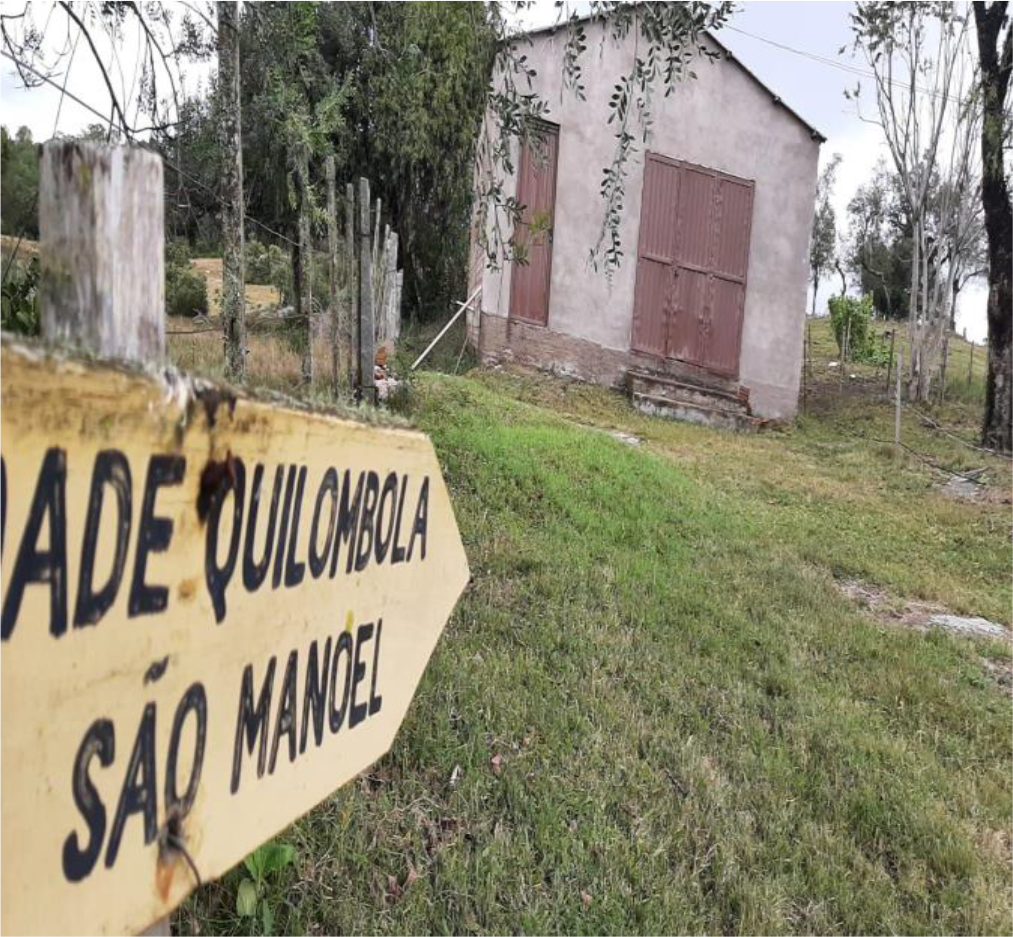
 Contemporary Quilombola Women: Matrimanagement and Ancestry in a Quilombola Community in the Southern Region of Brazil
ABSTRACT
This article stems from the exploration of the narratives of Black quilombola women from a remnant quilombo community in southern Rio Grande do Sul. The aim of this study is to recognize the trajectory of the quilombola women from the São Manoel/Dona Geraldina community, demonstrating how their strength enabled their children and grandchildren to access new life opportunities. Data collection involved narrative interviews and discussion circles with the women of the community, with analyses and discussions grounded in African Womanism and Matrimanagement theories. One of the outcomes of this study is the development of psychoQUILOMBOlogy, a health framework based on African and quilombola knowledge, created by quilombola students in the Psychology program. This study highlights the challenges that psychology still faces in addressing Black quilombola (re)existences, particularly in recognizing their contributions to psychology education and the formation of Black and quilombola women’s identities.
KEYWORDS:
Ancestry; Quilombola Women; Matrimanagement; Resistance
RESUMO
Este artigo nasce do acompanhamento das narrativas das experiências de mulheres negras quilombolas de uma comunidade remanescente de quilombos do sul do Rio Grande do Sul. O objetivo deste estudo é reconhecer a trajetória das mulheres quilombolas da comunidade São Manoel/Dona Geraldina, mostrando como a força dessas mulheres possibilitou que seus filhos/as e netos/as tivessem outras oportunidades de vida. A produção de dados contou com a realização de entrevistas narrativas e rodas de conversas com as mulheres da comunidade, sendo que as análises e discussões estiveram ancoradas nas teorias do Mulherismo Africano e Matrigestão. Como um dos desdobramentos desse estudo surge a psicoQUILOMBOlogia, um modo de fazer saúde partindo dos saberes e conhecimentos africanos e quilombolas, construído por um grupo de estudantes quilombolas no curso de Psicologia. Destacam-se os caminhos que a psicologia ainda tem a percorrer ao se deparar com (re)existências negro-quilombolas, principalmente no reconhecimento de suas contribuições para formação em psicologia e a formação de identidades das mulheres negras e quilombolas.
PALAVRAS-CHAVE:
Ancestralidade; Mulheres Quilombolas; Matrigestão; Resistência
“The Places I Was through, the Streets I Walked, Were Just to Find Myself Again”1- a Young Black Quilombola Becoming a Psychologist
This study stems from my undergraduate thesis in Psychology at the Federal University of Rio Grande (FURG), developed under the supervision of two professors who co-authored this paper and closely followed my academic trajectory. In order to underscore my journey as a young Black quilombola woman undergoing professional training in Psychology, the use of the first-person singular was intentionally adopted throughout the text.
As a black quilombola woman remaining from the São Manoel/Dona Geraldina Community located in Piratini, Rio Grande do Sul, where my family lives, a territory that was recognized by the Palmares Cultural Foundation in 2011, so, as a quilombola community, I was able to enter and remain in higher education through specific quotas for these students.
Since my childhood, the song by Racionais MC’s’ [Racionals MC’s] A vida é desafio [Life is a Chalenge] echoed in his ears, bringing reflections on the demand to be “twice as good” for being black. Today, it is possible to understand that the pressure to be “better” is the result of racism rooted in society, which constantly puts us to the test, demanding that we always demonstrate our dignity and value.
The diversity of experiences throughout my life path and also in Psychology, brought me back to a connection with my ancestry, rescuing a vital connection with my roots, transmitting values such as centrality in the family, spirituality and respect, reflected in everyday life. Black resistance and self-affirmation are intrinsic, rooted in the culture and history of the fight against slavery.
The São Manoel/Dona Geraldina community, located in Piratini, south of Rio Grande do Sul, began its organization in 2010, as an initiative of the municipality’s Pastoral Afro [Afro Pastoral], led by Sister Marisa and Eva Maria Pinheiro, who recognized the black presence in the community. region and its connection with the figure of Geraldina Rosa.
Belonging to this quilombola community was, and is, an essential part that shapes the identities of its members, as the quilombola struggle is marked by the constant search for dignity and equality in a society that still reproduces the inequalities of the past, a past of resistance and struggle for recognition and justice.

In March 2011, the community was recognized as a quilombo remnant by the Palmares Cultural Foundation. Registered as “São Manoel,” the members wanted to call her “Dona Geraldina” in honor of Dona Edite Rosa’s mother, the oldest in the community. In the same year, 23 families were registered as community members who contribute to maintaining the association and also to receive government benefits such as basic food baskets.
The community’s lands are divided into family plots acquired by inheritance or purchase. Monthly meetings deal with quilombola issues. At university, as a quilombola student, I remembered my ancestry and completed my degree, sealing my commitment to my African cultural and spiritual background, with black music playing a fundamental role in preserving my African identity, a way of resisting since ancient times. Genres such as soul, blues, rap and capoeira emerged as expressions of resistance and pride in African identity in the diaspora. The recovery of ancestry is also highlighted in contemporary cultural works, such as Beyoncé’s visual album “Black is King,” which celebrates Afro-diasporic history and reaffirms nobility and wealth da African heritage. Films like “Harriet” and “Black Panther” also contribute to this narrative, showing historical figures and African societies with a matriarchal basis.
This article also aimed to honor black quilombola women, my ancestors and who made my higher education possible. The study, at the same time as it aimed to understand how these women resist today, also opens up opportunities for future generations, exploring the importance of ancestry and reflecting on African matrimanagement.
SANKOFA: It Is Not Taboo to Go back and Look for What you Forgot - Methodology
Asking permission from my ancestors, I introduce myself here: I, Bruna Rosa Farias, am a black quilombola and axé woman, psychologist, bisexual, granddaughter of Edite and Leci, daughter of Cleni and sister of Letícia, my orí is governed by Oxum Doc who guards and guides my paths.
The research and writing of this article, carried out by me, was guided, discussed and revised, until its effective completion, in collaboration with two Federal University of Rio Grande - FURG professors, Rita Maciazeki-Gomes and Cassiane Paixão.
Therefore, based on this, knowing that oral tradition is vital to preserving the identity and ancestry of African people and their descendants, I understand that the griots, admittedly, are the guardians of black culture and transmit their knowledge from generation to generation. In the Dona Geraldina quilombola community, this tradition is maintained by women, who play fundamental roles in preserving local traditions. According to the pre-established itinerary and observation, the interviewees brought, despite the shyness,3 their experiences as black and quilombola women, which I divided according to the themes raised in the interviews and also observed throughout our lives and coexistence. The study, authorized by the University’s Ethics Committee, followed the guidelines established in Resolution 510/2016 of the National Health Council, under CAAE 47671521.0.0000.5324, with the participation of three quilombola women and my family members, Edite being my grandmother, Helena my aunt and Cleni my mother, who shared, through interviews and conversation circles around the table and stove, in the community, their experiences. The meetings took place in the territory of the São Manoel/Dona Geraldina community. The data were recorded in field diaries and analyzed based on the theoretical framework of African womanism and matrimanagement. Data analysis, recorded in a field diary, allowed a deeper understanding of the narratives in dialogue with theoretical concepts. The works resulting from these studies were sent to the community, seeking to value and share their stories and traditions and creating a collection for the community.
Of the Women Who Give Life and Make Up a Quilombola Community: African Womanism, Matrimanagement, Experiences and Resistance
Being a quilombola woman is synonymous with resistance. It means carrying in your identity, in your body, in caring for your family, in working in the countryside or in the hustle and bustle of the city, an ancestral history of great dignity. 4
Nilma Lino Gomes (2020)
During the period of slavery in Brazil, even with family separations, the enslaved came together and formed new communities, maintaining the connection with Africa and preserving knowledge. Three women, Edite, Helena and Cleni, from the São Manoel/Dona Geraldina community, inspired my path. Edite, my grandmother, whose mother Geraldina arrived at the Processo Freitas da Cruz farm in 1920, where she worked as a servant, having eight children with him. Edite married Didimo Jesus Farias, starting a family in the community. His daughters, including Cleni, my mother, followed his example, contributing to community life and educating their children, just like their mother and grandmother. Based on shared experiences and readings by black authors during my undergraduate studies, I recognize the origin and importance of the traditions of black families, strengthening the bond with quilombola ancestry. This connection is the basis of my identity and will be passed on to the next generations that descend from it.
In one of these theoretical readings, I was introduced to African womanism and matrimanagement and, when reading and researching more about it, I found several similarities with the costumes from my community, even if they do not identify as African, it is indisputable that they are.
African womanism is not an aspect of black feminism and not even an arm of Alice Walker’s womanism (Hudson-Weems, 2020, p. 44).5 African womanism seeks to focus on the experiences of struggles and desires of native African women and those of the diaspora, reiterating that diaspora,
refers to the process of displacement/dispersion, forced or not, of a people around the world. In the case of the African diaspora, forced immigration, during the transatlantic slave trade. Along with human beings, in these forced flows, ways of life, cultures, religious practices, languages and forms of political organization were embarked on tumbeiros (slave ships) that ended up influencing the construction of the societies to which enslaved Africans were destined. It is estimated that during the entire period of the slave trade, approximately 11 million Africans were transported to the Americas, of which around 5 million were destined for Brazil (Palmares Cultural Foundation, 2019).6
When forced to board ships, they were also forced to leave behind their lives, their customs, histories and, from this perspective, African Womanism (previously called Black Womanism), a term coined by Clenora Hudson-Weems in 1987 (2020, p. 42),7 emerges as a central component of the African worldview, aiming to recover their histories and identities.
According to Mazama (2001, apud Hudson-Weems, 2020, p. 67),8 “Clenora Hudson-Weems coined the term Africana Womanism in 1987 [earlier called Black Womanism] out of the realization of the total inadequacy of feminism and the like theories (e.g. Black feminism, African womanism, or womanism) to grasp the reality of African women, let alone give us the means to change that reality.” For Hudson-Weems, (Mazama, 2001, apud Hudson-Weens, 2020, p. 67),9 simply appropriating a Eurocentric theory and adding the “black” identity is, in addition to acquiring a whitened terminology, also acquiring its guidelines. Therefore, a new concept with its own terminology was necessary. However, it is important to emphasize that, as Anin Urasse (2019) reaffirms:
Although African womanism is treated as a THEORY by Nah Dove (and in fact it can be seen as a theory) what Cleonora Hudson says is that the concept AFRICAN WOMANISM arose when she began to study the history of black women in Africa and diaspora. She does not place herself, a priori, as the creator of the theory of African womanism. She places herself, rather, as the woman who NAMED THE BEING BLACK WOMAN. What the words AFRICAN WOMANISM attempt is, before creating an academic theory, to NAME the experience of being an African woman. And by what authority did she do this? With the authority of an academic? No. With the authority of reincarnated ancestors that we are.10
Humanity began in Africa, a fact that European colonization tries to erase to this day. Cheik Anta Diop dedicated himself to telling the story of the African people in his book The African Origin of Civilization: Myth or Reality originally published in 1955, but translated into English only in 1974.11 In his extensive research, he points out that Africa was the cradle of civilization/humanity and, therefore, of culture. Africa already had advanced tools about 50,000 years before European tools, and discoveries made in Egypt constantly test white-European supremacy by indicating that the Egyptians were not white and that Greece borrowed elements of its civilization from Egypt, even the cult of the gods (Diop, 1974).
Africa produced some matriarchal societies, but with the migration of these people, other patriarchal societies emerged, centered on the male sex. According to Nah Dove (1998, p. 8), with migration and the emergence of these patriarchal societies, matriarchy and the non-hierarchy between men and women were lost:
The concept of matriarchy highlights the complementarity aspect of the female-male relationship or the nature of the feminine and masculine in all forms of life, which is understood as nonhierarchical. Both the woman and the man work together in all areas of social organization. The woman is revered in her role as the mother who is the bringer of life, the conduit for the spiritual regeneration of the ancestors, the bearer of culture, and the center of social organization (Dove, 1998, p. 520).12
Motherhood in African societies is not an exclusive characteristic of the biological mother, or only of women. It is not limited to gender and blood. It is considered that another family member, or even a friend who cares, is affectionate and kind to the child can also be called a mother. It is even considered an honor. These values became fundamental to the survival of African peoples during the ongoing black holocaust. Motherhood, according to African Womanism, then refers to the responsibilities that the community has in raising and caring for these children. Nah Dove (1998) adds that:
However, although the role of women and mothering in the process of reproduction is critical to the continuation of any society and culture, in a patriarchal society, this role is not ascribed with the value that it bears in a matriarchal society (p. 8).13
With the diaspora, colonization and patriarchy, there was a disharmony in the precepts related to the feminine and masculine, bringing negative consequences in the contemporary world. The process of domination consisted of kidnapping and tearing Africans from their motherland. Acculturation culminated in the annihilation of the identities of the enslaved, changing their names, baptizing them in the European religion and prohibiting them from worshiping their original religions. Their traditions, such as musicality, were only allowed as long as white people were having fun with it and capoeira became a crime, thus erasing its roots and making Africans feel ashamed of their blackness.
European domination and acculturation over black Africans show that it is often not possible to relate the genetic composition of a people to a cultural group, because culture influences the behavior of a people and how they see themselves. As a result, the processes of colonial domination produced Eurocentric societies even with a large black presence. Although African people in diaspora genetically resemble African people, their minds have been imprisoned by Eurocentric concepts, values and beliefs, leading them to believe that they are inferior, as argued by Frantz Fanon (1983, p. 42) “bereft of all humanity.”14
According to Fanon (2008),15 in one of his works entitled Black skins, White Masks, this alienation of his humanity imposed by colonization, in which black people seek to be like white people, relate to white people, behave like white people , in a false idea of being finally accepted in that environment, causing psychological suffering by wanting to erase his African origin and have his humanity recognized. This alienation of black people is socially constructed as a control mechanism and is the great consequence of colonization. In her book African Womanism. Recovering Ourselves, originally published in 2003,16 recently translated into Portuguese, Clenora Hudson-Weems described eighteen specific characteristics on which African womanism is based:
African womanism brings to the forefront the role of African mothers as leaders in the struggle to regain, reconstruct, and create a cultural integrity that espouses the ancient Maatic principles of reciprocity, balance, harmony, justice, truth, righteousness, order, and so forth (…). It follows that one must be cognizant of the reciprocity of African female and male power relations prior to invasion. In this way, the construction of herstory moves toward an authentic representation of the African story (Hudson-Weens, 2020, pp. 35-36).
These characteristics come to break with the alienation of black people and the control mechanisms imposed by colonization. By detailing each characteristic we can better understand the African womanist experience:
-
1 and 2 - Self-nomination and Self-Denomination: It is crucial to name and define our identity and trajectory, rejecting external impositions. The African womanist, according to Hudson-Weems (2003),17 defines her reality without adhering to pre-established ideals, prioritizing cultural identity over individualism.
-
3 - Centrality in the family: The African woman values the family as a community, not limited to herself, but including her partner, children and grandchildren. Their struggle is collective, recognizing that their safety and survival are intrinsically linked to the well-being of their community.
-
4 and 5 - Harmony with men in the struggle/male compatibility: She collaborates with men in the search for racial equity, recognizing the importance of unity for survival in a hostile and racist society. Division based solely on gender is ineffective in the face of shared oppression.
-
6 - Flexible Roles: During slavery, gender roles were flexible, highlighting the need to adapt to reality. African women were not limited to the home, just as men often took on domestic tasks.
-
7 - Genuine Sisterhood between Women: Solidarity between women is fundamental, demonstrating mutual support and shared responsibility. This emotional connection is essential for facing challenges and promoting growth.
-
8 - Strength: African women have a long tradition of physical and psychological resistance, facing centuries of oppression. His strength lies in protecting his family, even in the face of historical and social adversity.
-
9 and 10 - Respect and Recognition: It is essential to cultivate self-esteem and demand respect, fundamental for healthy relationships. Recognition of one’s humanity is crucial to addressing racial, gender, and socioeconomic challenges.
-
11 and 12 - Totality and Authenticity: The African woman seeks to balance family, career and cultural authenticity, recognizing the importance of each aspect for her personal fulfillment.
-
13 - Spirituality: Spirituality is central in the life of the African woman, guiding her decisions and providing protection and connection with her cultural heritage.
-
14 - Respect for elders: Respect for elders is a striking characteristic, rooted in African culture and fundamental for the transmission of wisdom and strengthening the community.
-
15 - Adaptability: She is able to find creative solutions within financial limitations, prioritizing the family’s needs without sacrificing her creativity and personal success.
-
16 - Ambition: The African woman seeks personal growth with responsibility, recognizing that her ambitions directly impact her family and community.
-
17 and 18 - Maternal and Nurturing: The role of mother is central to the identity of African women, often prioritized to the detriment of other roles, such as wife or worker.
Therefore, these 18 pillars, together, empower African women and their people, without anyone giving up anything and rising as a community.
Understanding the dimension that is African womanism, we arrive at the point “matrimanagement.” In our womanist and Afrocentric view, the “mother/matriarch” (not in the biological maternal sense of gestating, as already mentioned, but of nurturing a people) is an indispensable point for the community. Like this:
It is essential to emphasize that the maternal-centered approach is not necessarily linked to physical-uterine pregnancy, but rather to a whole set of values and behaviors of gestating potential. When we start from a reality of generating power, we are defining the womanist struggle as the possibility of reintegrating black lives destroyed by integral racism.
This means, for example, when a Babalorixá takes care of those powers in the forms of abian, yawo and ebomis, he is exercising the African maternal-centered principle, which is in no way related to the physical womb, but rather to the mythical-ancestral womb. , based on the movement of an entire energy, which is feminine. There are countless examples that we can list, from midwives and herbalists, to aunts who take care of the erês in their own homes, in peripheral communities, so that parents can work, educators who manage the power of their students, etc. (Njeri & Ribeiro , 2019, pp. 600-601).18
There is no balance without her, the “mother.” In an African sense, it was present throughout the black holocaust, colonization and diaspora. She is power, she ratifies meaning to everything, she creates, she works, she educates, whether gestating or not. It is worth saying that our children have several mothers who take care of their physical, spiritual and educational needs. The mother fights for her own and for her own. To reiterate, matrimanagement is not generating a child in the womb (it’s not even necessary to have a womb), is to enhance the lives that the community has. Not only are the black woman in the quilombo a matrimanager, the man is also the mother, and together the black people are empowered, recovering ourselves and our African roots. Because, after all, in the African context, women and men have equal importance in the community and women are not relegated to an exclusively subordinate position:
women are not relegated to the background, as happens in Western thought. This comes from the fact that they have been an integral part of all African cultures since the beginning of time. Looking at ancient African societies, it is difficult to find any in which women did not occupy high positions (Asante, 2009, p. 104).19
Matriarchy or matrimanagement is linked to nurturing a people, a balance between genders and not a fight of who does more and deserves more. Moraes, Brito & Costa (2020), in their article “Mulherismo Africana: Proposta Enquanto Equilíbrio Vital A Comunidade Preta” [African Womanism: Proposal as a Vital Balance for the Black Community], exemplify matrimanagement:
A very cultural example in several homes in the black community: the fact that our mothers/grandmothers serve a plate of food to the whole family, not as a form of exploitation or servitude, but as only they will know how to share the food fairly and accurately within from home and, therefore, we think within the community (p. 302).20
Traditions were preserved, although, over time, their origin was lost in the memory of some griots, remaining only in the collective unconscious. Not long ago Cleni (my mother and active member of the quilombola community) served my father’s dish, as a teenager at the time I thought it was absurd, so much so that Cleni stopped serving it, but my African unconscious never allowed me to serve itme first and it is rare that we serve ourselves before the father. For us it is fair.
For Aza Njeri (2020) in her text for the blog Alma Preta Jornalismo [Black Soul Journalism] entitled “Vamos falar sobre Mulherismo Africana?” [Let’s talk about African Womanism?]
In a quick comparison based on Diop (1974), it can be stated that these are matriarchal characteristics: the balance between women and men in all areas of social organization; the origin in agrarian societies; xenophilia; the principle of complementarity. And it understands the woman/mother as the center of social organization, as the bearer of life and culture.21
Therefore, matrimanagement, as well as African womanism, is: the balance of the black woman with the black man, her balance with herself, her balance with her family, community and spirituality. In the life stories of Edite, Helena and Cleni, as well as in mine, consequently, there was a similarity. Even in different contexts (rural and urban), the preservation of African customs remains. They are present and will be daqui a alguns anos mesmo que essas women have already returned to Orum, which in Yoruba is a word that defines heaven or the spiritual world, and in Yoruba mythology it is parallel to Aiê, the physical world, and everything that exists in Aiê coexists in Orum.
Despite the paths that took them far from each other, they always participated in the lives of their families and helped each other. Family-centeredness has always been very strong for them. Individuality is not something that can be taught. In some cases, after becoming an adult, it is necessary to relearn how to separate yourself from the collective when some issues require more individuality. None of them turned a blind eye to what society imposes on black people and families. After all, they also suffered and continue to suffer, and recognition as quilombolas brought many discussions and reflections on racism into family conversations.
Family is the center “minha família é o que me fortalece” [my family is what strengthens me] says Cleni and “meu parceiro, meus filhos, meus netos, são meu motivo para viver e por quem lutar” [my partner, my children, my grandchildren, are my reason to live and fight for], says Helena. Despite colonialism having established patriarchy and machismo, crossing the constructions of the subjectivities of black men, black women know that black men do not reap the privileges of patriarchy and that their existence and that of the entire community permeates the care and advancement of all. The roles in this family are flexible, interpreting that nurturing the family is essential, as is nurturing the body and mind. The women are responsible and dedicate themselves to each other’s care, especially in uniting for the well-being of the oldest Edite. They are strong and firm (although obviously they need to allow themselves to fall apart in some situations) to endure the daily struggle for their family and community.
Spirituality is a legacy passed from mother to son always, they believe in a greater God, but Catholicism, African origin and spiritualism coexist, with extreme respect between each belief, the faith that moves them. Respect for elders is the strongest characteristic observed, as elders, like our griot, are an example/model of inspiration. Respect for what it represents for our community is its continuity. All members of the association have enormous respect and consideration for Edite. Quilombola matrimanagement prioritizes balance between men and women. The fight is collective and without hierarchies, everyone has equal importance, always considering the woman’s word as a principle, in her role as nurturer of an entire black community. Thus, the role of nurturing mother is above other roles.
Define Who We Are, What We Do and Where We Will Go: Paths to Consider for a Psychology that Respects Black-Quilombola (Re)Existences
The experiences of black and quilombola women, especially those interviewed here, contributed to the creation of a psychoQUILOMBology concept that highlights the word QUILOMBO, as for the creators of the concept Bruna and her colleague, quilombola psychologist Charlene Da Costa Bandeira, two black women and quilombolas, quilombo is the center and the quilombo that will bring about the recovery of ourselves. In this way, the traditional knowledge of the interviewees was integrated into psychology.
As a result, psychoQUILOMBology was developed in 2020, during the COVID-19 pandemic (Farias & Bandeira, 2020), a time when creators were then university students. The idea was to challenge black invisibility in academia. With the support of FURG professors, the online study group aimed to subvert the colonial logic in academic psychology. Inspired by Wade Nobles (2009) and Lucas Veiga (2019), we seek to include black epistemologies and ancestral knowledge, highlighting the importance of the quilombo as the center of our collective. Today, psychoQUILOMBology has expanded to a clinical space outside the university, offering accessible care. For Bruna, this journey redefined her trajectory as a psychologist, strengthening her bond with her ancestors and her black quilombola identity, enabling her to resist challenges and honor the women who shaped her history.
Our black and quilombola people have been and continue to be violated in so many ways, that it has become important to bring the text about this psychology model into the discussion. There are many possibilities and many black students, authors, psychology professionals who have been trying for years to insert our people as psyches/bodies to be cared for, but cared for in ALL their specificities and ancestral wounds. Racism works in a way that makes one believe that it does not exist, as if even saying the word would make it resurrect. However he never died. It is in the structure of this society that still condemns black people and quilombolas to the margins, poverty, hunger, unemployment, illiteracy, etc. So for Eurocentric psychology it was not interesting to create and take care of the mental health of the people it was designed to oppress.
Therefore, theories that value the decolonization of the unconscious are necessary, such as Nobles’ African Psychology (2009), which considers the use of faith, joy and beauty of the African people and does not agree with psychology that is dedicated to thinking only about the suffering, illness and symptoms of people. Thus he adds that:
The psychology of Africans derives from and is determined by a unique historical experience. The natural and instinctive human imperative of this psychology is to acquire the revolutionary impulse to achieve physical, mental and spiritual liberation. Therefore, what is obviously needed is a psychology centered on our African essence and integrity, which requires us to go beyond developing a black, or even “Afrocentric,” perspective on Western psychology. Fundamental to this task is to create and critique a body of ideas, theories and practices designed to promote the understanding, explanation and, when necessary, healing of African being, becoming and belonging in all historical and cultural expressions. contemporary developments. This is not a revised or rearranged European thought; seeks deep roots in African thought (p. 279).22
In the book Psicologia Social do Racismo Estudos sobre branquitude e branqueamento no Brasil [Social Psychology of Racism Studies on Whiteness and Whitening in Brazil] organized by Iray Carone and Maria Aparecida Silva Bento (2002), the whitening process/project that was established post-slavery is discussed. In his study Nobles (2009) also discusses this violence against us:
At this point, the African proverb that says “When a fool cannot darken ivory, he tries to lighten ebony” is informative. For more than four hundred years, Africans in Brazil knew that they were Africans and that the Portuguese were the enemies of freedom. They continually fought and died to free their people from slavery. The “whitening” process has been working for about 115 years. Evidently, one hundred years of “whitening” have caused more psychic harm to Africans than four hundred years of racist slavery and colonial domination (p. 287).23
In this way, this erasure of roots limits us and prevents us from healing ourselves, healing our own and living fully and psychology, by not considering these specificities, ends up inflicting yet another suffering, as we do not suffer like a white person and no matter how white we are we cannot be cured with the theory created by and for white people.
In Brazil, the Black Psychology of theoretical Lucas Veiga emerged, which is based heavily on Nobles’ theory and reaffirms, citing him together with Neusa Santos Souza (1983), that whitening is the main source of self-hatred among black people. The introjection of the national whitening policy into black subjectivities creates a debilitating psychological condition, because what the black person is and cannot be separated from undoing, the color of your skin, places you socially in a subordinate position (Veiga, 2019, p. 247). It is then understood that:
Racism has produced a clouded self-image, damaging the most fundamental ability to love: self-love. One of the directions of work in Black Psychology is to promote the recovery of love for oneself, for one’s history, for the people to which one belongs (Veiga, 2019, p. 247).24
Both theories speak to each other in a single cry “respect our existences, resistances and subjectivities.” Psychology needs to accept criticism and review itself, recognizing its racist bases and above all understanding that it does not have absolute knowledge about anyone.
I Have More than Many in Me, I Am One, but I Am Not Alone...
Here I intended to record the journey of quilombola women and the Dona Geraldina/São Manoel community with the firm intention of also recognizing and honoring them since, in June 2023, Edite returned to Orum. This article also shows that the colonial system can humiliate, dehumanize, inferiorize, subjugate, but it cannot control our minds, which even unconsciously keep our history, customs, memories. Enslavement is a crossing, but it is not what defines us. Our elders teach us to fight, to be proud of our race, to have values, not to conform to injustices.
Understanding the power of the quilombola women who constitute me and who also make me power, transformed my future. Just like up front I will transform the future of my descendants, as I am also becoming an ancestor. These women, men, children, my elders, are parts of me, the family and the quilombo is my center, they educated me, spiritualized me, gave me strength to resist, gave me the opportunity to be whatever I wanted be and even be what they dreamed of and couldn’t. Be them too, be many and not be alone.
I will always have these “many” in myself, I will always be physically one in Aiê, but I will never be alone because I am because they were, I dreamed because they dreamed that I would be a seed and germinate in this land. I will always be UBUNTU, an African philosophy based on “I am because we are” and I will be aware that I am part of something bigger that goes beyond my existence, I will always have a collective to respect and honor. I will always be SANKOFA and I will be able to return to my community if I get lost along the way.
Recovering myself is psychoQUILOMBology. It is my healing and wisdom through my ancestry!!! PsychoQUILOMBology is the center of my existence and made all the difference in my training as a quilombola psychologist.
Being able to talk about the quilombola women who did and continue to do everything possible and impossible for their families is one of the greatest honors that the Orixás could grant me, in addition to health and life for me and those who survive the adversities of life that encounter us. Maybe one day our descendants will read this article and also honor us here, as today I honor my ancestors and my people torn from Africa. If I am what I could be, it is because I am also them, yesterday, today and in Orum.
-
1
Parody to the chorus line of the song “Meu grande amor” [My great love] by the duo YOÚN composed by black artists Shuna and Gian Pedro.
-
2
Source: Image taken from the master’s thesis “Junto com nossos amigos aonde tem churrasco e chimarrão eu sou gaúcho de coração”: etnoarqueologia e memória do território da comunidade quilombola Fazenda Cachoeira em Piratini, Rio Grande do Sul” [Together with our Friends Where There is Barbecue and Chimarrão, I am a Gaucho at Heart”: Ethnoarchaeology and Memory of the Territory of the Quilombola Community Waterfall Farm in Piratini, Rio Grande do Sul] by Gil Passos de Mattos, Post Graduate Program, Federal University of Pelotas, Anthropology.
-
3
The interviewees were a little embarrassed, as they had never been in a so-called formal interview place, they brought few lines from the semi-structured questions, but my observation throughout their lives and their trajectories, which led me to the defended my final paper, allowed the theme to be sustained. What are a few speeches in front of a recorder compared to the daily teachings that these women brought?
-
4
In Portuguese: “Ser mulher quilombola é sinônimo de resistência. Significa carregar na identidade, no corpo, no cuidado com a família, na lida no campo ou na agitação do urbano uma história ancestral de muita dignidade.”
-
5
HUDSON-WEEMS, Clenora. Africana Womanism. Reclaiming Ourselves. London and New York: Routledge, [1987] 2003.
-
6
In Portuguese: “refere-se ao processo de deslocamento/dispersão, forçado ou não, de um povo pelo mundo. No caso da diáspora africana, uma imigração forçada, durante o tráfico transatlântico de escravizados. Junto com seres humanos, nestes fluxos forçados, embarcavam nos tumbeiros (navios negreiros) modos de vida, culturas, práticas religiosas, línguas e formas de organização política que acabaram por influenciar na construção das sociedades às quais os africanos escravizados tiveram como destino. Estima-se que durante todo período do tráfico negreiro, aproximadamente 11 milhões de africanos foram transportados para as Américas, dos quais, em torno de 5 milhões tiveram como destino o Brasil.”
-
7
See footnote 5.
-
8
See footnote 5.
-
9
See footnote 5
-
10
In Portuguese: “Apesar do mulherismo africana ser tratado como um TEORIA por Nah Dove (e de fato ele pode ser visto como teoria) o que a Cleonora Hudson diz é que o conceito MULHERISMO AFRICANA surgiu quando ela passou a estudar a história das mulheres pretas na África e na diáspora. Ela não se coloca, a priori, como criadora da teoria do mulherismo africana. Ela se coloca, antes, como a mulher que NOMEOU O SER MULHER PRETA. O que as palavras MULHERISMO AFRICANA tentam é, antes de criar uma teoria acadêmica, NOMEAR a experiência de ser uma mulher africana. E com que autoridade ela fez isso? Com a autoridade de uma acadêmica? Não. Com a autoridade de ancestrais reencarnadas que somos.”
-
11
DIOP, Cheikh Anta. The African Origin of Civilization. Myth or Reality. Translated from the French by Mercer Cook. New York, Wesport: Lawrence Hill & Company, [1955] [1967], 1974.
-
12
DOVE, Nah. African Womanism: An Afrocentric Theory. Journal of Black Studies, Vol. 28. No. 5. (May, 1998), pp. 515-539. Sage Publications, Inc. Available at: http://www.jstor.org/stable/2784792?origin=JSTOR-pdf. Last access on March 1st, 2025.
-
13
DOVE, Nah. African Womanism: An Afrocentric Theory. Journal of Black Studies, Vol. 28. No. 5. (May, 1998), pp. 515-539. Sage Publications, Inc. Available at: http://www.jstor.org/stable/2784792?origin=JSTOR-pdf. Last access on March 1st, 2025.
-
14
FANON, Frantz. The Wretched of the Earth. Preface by Jean-Paul Sartre. Translated by Constance Farrington. New York: Grove Press, 1963.
-
15
FANON, Frantz. Black Skins, White Masks. Translated from the French by Richard Philcox. New York: Grove Press, 1967.
-
16
See footnote 5.
-
17
See footnote 5.
-
18
In Portuguese: “É essencial ressaltar que a abordagem materno-centrada não necessariamente está ligada à gestação físico-uterina, mas, sim, a todo um conjunto de valores e comportamentos de gestar potências. Quando partimos de uma realidade de gestar a potência, estamos definindo a luta mulherista como a possibilidade de reintegrar as vidas pretas destroçadas pelo racismo de cunho integral. Isso quer dizer, por exemplo, quando um Babalorixá cuida daquelas potências em formas de abian, yawo e ebomis, ele está exercendo o princípio materno-centrado africano, que em nada se relaciona ao útero físico, mas, sim, ao útero mítico-ancestral, a partir da movimentação de toda uma energia, que é feminina. Inúmeros são os exemplos que podemos elencar, desde parteiras e erveiros, às tias que cuidam dos erês em suas próprias casas, nas comunidades periféricas, para que os pais possam trabalhar, educadores que gestam a potência de seus alunos etc.”
-
19
In Portuguese: “as mulheres não são relegadas ao segundo plano, como acontece no pensamento ocidental. Isso provém do fato de elas terem sido parte integrante de todas as culturas africanas desde o início dos tempos. Observando as sociedades africanas da antiguidade, é difícil encontrar alguma em que as mulheres não ocupassem altas posições.”
-
20
In Portuguese: “Um exemplo bem cultural em diversas casas da comunidade preta: o fato das nossas mães/avós servirem o prato de alimento para toda a família, não como forma de exploração ou servidão, mas como somente elas saberão repartir o alimento de forma justa e precisa dentro de casa e, assim, pensamos dentro da comunidade.”
-
21
In Portuguese: “Em uma comparação rápida baseada em Diop (2014) pode-se afirmar que são características matriarcais: o equilíbrio entre mulheres e homens em todas as áreas de organização social; a origem nas sociedades agrárias; a xenofilia; o princípio de complementaridade. E entende a mulher/mãe como o centro da organização social, enquanto portadora da vida e da cultura.”
-
22
In Portuguese: “A psicologia dos africanos deriva de uma singular experiência histórica e é por ela determinada. O imperativo humano natural e instintivo dessa psicologia é adquirir o impulso revolucionário para atingir a libertação física, mental e espiritual. Portanto, o que obviamente se faz necessário é uma psicologia centrada em nossas essência e integridade africanas, o que exige irmos além de desenvolver uma perspectiva negra, ou mesmo ‘afrocêntrica’, sobre a psicologia ocidental. Fundamental a essa tarefa é criar e criticar um corpo de idéias, teorias e práticas destinado a favorecer a compreensão, a explicação e, quando necessário, a cura do ser, do vir-a-ser e da pertença africanos em todas as expressões históricas e desdobramentos contemporâneos. Não se trata de um pensamento europeu revisado ou rearranjado; busca raízes profundas no pensamento africano.”
-
23
In Portuguese: Neste ponto, é informativo o provérbio africano que diz “Quando um tolo não consegue escurecer o marfim, ele tenta clarear o ébano.” Por mais de quatrocentos anos, os africanos no Brasil souberam que eram africanos e que os portugueses eram os inimigos da liberdade. Lutaram e morreram continuamente para libertar seu povo da escravidão. O processo de “embranquecimento” tem funcionado por cerca de 115 anos. Evidentemente, cem anos de “embranquecimento” causaram mais danos psíquicos aos africanos do que quatrocentos anos de escravidão racista e dominação colonial.
-
24
In Portuguese: “O racismo produziu uma autoimagem turva, prejudicando a mais fundamental capacidade de amar: o amor-próprio. Uma das direções de trabalho na Psicologia Preta é promover o resgate do amor por si mesmo, por sua história, pelo povo ao qual se pertence.”
-
Translated by Carlos Costa - carloscso239@gmail.com
-
Reviews
Due to the commitment assumed by Bakhtiniana. Revista de Estudos do Discurso [Bakhtiniana. Journal of Discourse Studies] to Open Science, this journal only publishes reviews that have been authorized by all involved.
Research Data and Other Materials Availability
The contents underlying the research text are contained in the manuscript.
References
-
ADÃO, Jorge Manoel; SANTOS, Franco Adriano dos. Educação escolar, tradição e oralidade Negro-Brasileira. Educação, Ciência e Cultura, 24(3), pp. 243-252, 2019. https://revistas.unilasalle.edu.br/index.php/Educacao/article/view/5370 Acesso em 17 abr. 2025.
» https://revistas.unilasalle.edu.br/index.php/Educacao/article/view/5370 - ASANTE, Molefi Kete. Afrocentricidade: notas sobre uma posição disciplinar. In: Nascimento, Elisa Larkin. (Org.). Afrocentricidade: uma abordagem epistemológica inovadora. São Paulo: Selo Negro, 2009. pp. 93-110.
-
BRASIL. Decreto n. 4.887, de 20 de novembro de 2003. Regulamenta o procedimento para identificação, reconhecimento, delimitação, demarcação e titulação das terras ocupadas por remanescentes das comunidades dos quilombos de que trata o art. 68 do Ato das Disposições Constitucionais Transitórias. Disponível em: https://www.planalto.gov.br/ccivil_03/decreto/2003/d4887.htm Acesso em: 08 fev. 2021.
» https://www.planalto.gov.br/ccivil_03/decreto/2003/d4887.htm - BENTO, Maria Aparecida da Silva. & CARONE, Iray. (orgs). Psicologia social do racismo. Estudos sobre branquitude e branqueamento no Brasil. Petrópolis, RJ, Editora Vozes, 2003.
-
CONAQ. Coordenação Nacional de Articulação das Comunidades Negras Rurais Quilombolas. Quilombo? Quem Somos Nós!. Site institucional Disponível em: https://conaq.org.br/quem-somos/ Acesso em: 02 abr. 2021.
» https://conaq.org.br/quem-somos/ - COSTA, Tiago Rodrigues. De Adodi a guardiães do espírito: o sankofar das relações afetivas e sexuais entre africanos homens em diáspora. 2018. 85f. Dissertação (Mestrado em Psicologia Social e Institucional) - Universidade Federal do Rio Grande do Sul, Porto Alegre, 2018.
- DEALDINA, Selma dos Santos. (org). Mulheres quilombolas Territórios de existências negras femininas. São Paulo, Sueli Carneiro: Jandaíra, 2020.
- DIOP, Cheikh Anta. A origem africana da civilização: mito ou realidade. Trad. de Mercer Cook. Westport: Lawrence Hill & Co., 1974.
- DOVE, Nah. Mulherismo africana. Uma teoria afrocêntrica. Tradução Wellington Agudá. Jornal de Estudos Negros 28(5), Sage Publications, Inc. Maio de 1998.
- FANON, Frantz. Pele negra, máscaras brancas. Tradução Renato da Silveira. Salvador, BA: Editora Edufba, 2008.
- FARIAS, Bruna Rosa. & BANDEIRA, Charlene da Costa. Grupo de Estudos de Psicoquilombologia: “Do Quilombo Eu Vim”. Projeto de Ensino - Departamento De Psicologia Vinculado ao Instituto de Ciências Humanas e da Informação - ICHI, Universidade Federal do Rio Grande - FURG, 2020. Não publicado.
- FLORES, Luiza Dias. Breve Relatório da Pesquisa: Comunidade São Manoel. Não Publicado. Acervo da Comunidade Piratini, 2016.
-
FCP. Fundação Cultural Palmares. Estrutura organizacional. Disponível em: https://www.palmares.gov.br/?page_id=95 Acesso em: 08 fev. 2021.
» https://www.palmares.gov.br/?page_id=95 -
FCP. Fundação Cultural Palmares. (2019). Diáspora africana, você sabe o que é?. Disponível em: https://www.palmares.gov.br/?p=53464 Acesso em: 08 fev. 2021.
» https://www.palmares.gov.br/?p=53464 -
GOMES, Maíra Neiva. A musicalidade negra como resistência. Portal Geledés 15 de jul. de 2017, 2017. Disponível em: https://www.geledes.org.br/musicalidade-negra-como-resistencia/ Acesso em 12 mar. 2021.
» https://www.geledes.org.br/musicalidade-negra-como-resistencia/ -
GOMES. Nilma Lino. Educação e identidade negra. Aletria: Revista de Estudos de Literatura, 9, pp. 38-47, 2002. D.O.I.: https://doi.org/10.17851/2317-2096.9.38-47 Acesso em 12 mar. 2021.
» https://doi.org/10.17851/2317-2096.9.38-47 - GOMES, Nilma Lino. Apresentação. In DEALDINA, Selma dos Santos (org). Mulheres quilombolas Territórios de existências negras femininas. São Paulo, Sueli Carneiro: Jandaíra, 2020.
- HUDSON-WEENS, Clenora. Mulherismo Africana: Recuperando a nós mesmos. Tradução de Wanessa A.S.P. Yano. 1o ed. São Paulo. Editora Ananse, 2020.
-
MORAES, Viviane Mendes de (Aza Njeri)., BRITO, Thiago Henrique Borges (Kwame Ankh) & COSTA, Walkiria Gabriele Elias da (Kulwa Mene). Mulherismo africana: proposta enquanto equilíbrio vital à comunidade preta. Ítaca, 0(36), pp. 281-320, 2020. Disponível em: https://revistas.ufrj.br/index.php/Itaca/article/view/31961 Acesso em 10 de março, 2021.
» https://revistas.ufrj.br/index.php/Itaca/article/view/31961 - MOURA, Clóvis. Rebeliões na Senzala Quilombos, insurreições, guerrilhas. São Paulo: Ciências Humanas, 1981.
- NASCIMENTO, Maria Beatriz. Beatriz Nascimento, quilombola e intelectual: Possibilidades nos dias da destruição. UCPA (Org.). Diáspora Africana: Editora Filhos da África, 2018.
-
NJERI, Aza & RIBEIRO, Katiúscia. Mulherismo africana: práticas na diáspora brasileira. In: Currículo sem fronteiras. 19(2) pp. 595-608, maio/ago. 2019. Disponível em: https://www.curriculosemfronteiras.org/vol19iss2articles/njeri-ribeiro.html Acesso em 15 mar. 2021.
» https://www.curriculosemfronteiras.org/vol19iss2articles/njeri-ribeiro.html -
NJERI, Aza. Vamos falar sobre Mulherismo Africana?. Sessão Quilombo. Alma Preta - Jornalismo Preto e Livre, 28 de jan. de 2020. Disponível em: https://almapreta.com.br/sessao/quilombo/vamos-falar-sobre-mulherismo-africana/ Acesso em 15 mar. 2021.
» https://almapreta.com.br/sessao/quilombo/vamos-falar-sobre-mulherismo-africana/ - NOBLES. Wade. Sakhu Sheti: retomando e reapropriando um foco psicológicoafrocentrado. In: Nascimento, Elisa. Larkin. (Org.) Afrocentricidade: uma abordagem epistemológica inovadora. São Paulo: Selo Negro, 2009. pp. 277-297.
- PINHEIRO, Eva Maria Dutra. Comunidade Quilombola Nicanor da Luz. Uma etnografia sobre saberes tradicionais e religiosidades. 2019. 195 f. Dissertação (Mestrado em Antropologia) - Universidade Federal de Pelotas, Pelotas, 2019.
- SOUZA, Neusa Santos. Tornar-se negro. As vicissitudes da identidade do negro brasileiro em ascensão social. Rio de Janeiro: Graal, 1983.
-
URASSE, Anin. O Mulherismo Africana é uma teoria?. Blog Pensamentos Mulheristas. 12 de abr. de 2019. Disponível em: https://pensamentosmulheristas.wordpress.com/2019/04/12/o-mulherismo-africana-e-uma-teoria/ Acesso em: 16 fev. 2021.
» https://pensamentosmulheristas.wordpress.com/2019/04/12/o-mulherismo-africana-e-uma-teoria/ -
VEIGA, Lucas Motta. (2019). Descolonizando a psicologia: notas para uma Psicologia Preta. Fractal: Revista de Psicologia, v. 31, n. esp., pp. 244-248, set. 2019. https://periodicos.uff.br/fractal/article/view/29000 . Acesso em: 18 abr.2025.
» https://periodicos.uff.br/fractal/article/view/29000
-
Editors in Charge
Beth BraitElizabeth CardosoMaria Helena Cruz PistoriPaulo Rogério StellaRegina Godinho de Alcântara
Review I
About the reviewerSCIMAGO INSTITUTIONS RANKINGSReview I
Thank you for the invitation to evaluate the work entitled “Contemporary Quilombola Women: Matrimanagement and Ancestry in a Quilombola Community in the Southern Region of Brazil.” I congratulate the authors for highlighting themes related to quilombism and ethnic-racial relations within Brazilian society, which are essential for the construction of an anti-racist and egalitarian society. The research is original, current and relevant to the field of Psychology and the discourse surrounding ethnic-racial relations in life and health, especially as it highlights basic aspects of quilombola culture and identity.
The text is well written, fluid and well structured. The theoretical-methodological issues are well explained and argued based on an adequate and current theoretical framework. All sections maintain coherence with the objective of the research: to understand the trajectory of quilombola women from the São Manoel/Dona Geraldina community, based on the theories of African Womanism and Matrimanagement, fundamental to the construction of psychoQUILOMBology.
I draw attention to just one aspect, which I indicate below: In view of the interviews and conversations held with quilombola women from the São Manoel/Dona Geraldina community, which enabled the understanding of the elements that constitute identity, quilombola cosmoperception and their ways of resisting racism and colonial structures, I suggest that the authors present some statements from the interviewees, which corroborate the understanding of these elements and enrich the research results. Finally, I recommend a textual review, with a view to grammatical correction, before publication. REVISIONS REQUIRED [Revised]
- peer review recommendation: accept
Review II
About the reviewerSCIMAGO INSTITUTIONS RANKINGSReview II
I begin by confirming my joy in being a reviewer for this text: it is constituted within theSankofa’s proposal: honor the past to shape the future. The entire text unfolds within what Professor and researcher Lélia Gonzalez dared to call Pretugues, that is, the marks of African languages that embellished the Portuguese spoken in the 16th century, when Brazil was invaded. This embarrassed mestizo language was courageously used as a concept from beginning to end, including for the interpretation of concepts. The work, in this logic, is impeccable: it narrates and confirms the importance of women in organizing new possible worlds. It is an example of the new epistemologies possible to combat epistemicide and give visibility to new knowledge that should be known by academia. However, in our understanding, even so that it does not create the possibility of “snags” for those who would like to see privileges perpetuated, it needs to undergo a careful review of the norms of the Portuguese language written in Brazil (it should have been Brazilian for some time), verbal agreement and formal organization of the text. But, it must be approved, seen, walked through. Congratulations! APPROVED WITH SUGGESTIONS [Revised]
- peer review recommendation: accept
Review III
About the reviewerSCIMAGO INSTITUTIONS RANKINGSReview III
I consider the article very relevant, especially as it is the result of the work of a quilombola psychology student. However, the text requires revision by the authors, especially in relation to grammatical aspects. In this sense, I make some considerations in the text itself, suggesting some changes that I believe are necessary for a better understanding of the article. I maintain the suggestion that the authors include the interviewees’ statements in the text, which may contribute to the understanding of the elements that constitute identity, quilombola cosmoperception, their ways of resisting racism and colonial structures, as well as their relationship with the theoretical aspects of the research. ACCEPTED
- peer review recommendation: accept