
 Digital Transformation and Organizational Ambidexterity: Evidence from a Regional Retail Firm
ABSTRACT
This paper aims to characterize actions taken by an incumbent firm to balance exploration and exploitation in the scenario of Digital Transformation (DT) in the retail sector. We adopted a qualitative approach in a single case study. Data were collected from interviews with managers, while content analysis techniques were used, to better understand the research findings. We found that the firm experienced a DT process motivated mainly by the change in consumer behavior, competitors' actions, and the event of the Covid-19 pandemic. There were changes in strategy, structure, and control systems, with scarce modifications in the organizational culture for the digital business to become a complement to the physical business. For actions of the incumbent business and exploration of the new business to occur simultaneously, the firm used ambidexterity by domain separation and sequential ambidexterity. The results of this study contribute to advancing knowledge, as they highlight the technological decisions, organizational changes, and strategies adopted by an incumbent firm to balance efforts between the physical and digital businesses.
KEYWORDS:
Digital Transformation; Organizational Ambidexterity; Exploration; Exploitation; Organizational Changes
RESUMO
O artigo objetiva caracterizar ações empreendidas por uma firma incumbente para balancear exploration e exploitation em meio ao processo de Transformação Digital (TD) no setor varejista. Adotou-se uma abordagem qualitativa, executada por meio de um estudo de caso único. A coleta de dados ocorreu por meio de entrevistas com gestores e técnicas de análise de conteúdo foram adotadas para melhor compreender os achados da pesquisa. Evidencia-se que a firma viveu um processo de TD motivada, principalmente, pela mudança no comportamento do consumidor, ações dos concorrentes e consequências da pandemia de Covid-19. Mudanças na estratégia, estrutura e sistemas de controle realizaram-se, com escassas modificações na cultura organizacional, caracterizando o negócio digital como um complemento ao físico. Para ações de manutenção dos negócios incumbentes e exploração de novos negócios ocorrerem simultaneamente, utilizou-se da ambidestria por separação de domínio e ambidestria sequencial. Os resultados contribuem para o avanço do conhecimento, ao evidenciarem decisões tecnológicas, mudanças organizacionais e estratégias adotadas por uma firma incumbente para balancear esforços entre negócios físicos e digitais.
PALAVRAS-CHAVE:
Transformação Digital; Ambidestria Organizacional; Exploration; Exploitation; Mudanças Organizacionais
1. INTRODUCTION
In a context where digitally and technologically capable companies achieve 6 % more revenue performance than their less digitalized peers (reaching up to a 16 % superiority in retail), Brazil is at a medium level of preparation for the digital future: it ranks 59th out of 134 countries listed in the Network Readiness Index (NRI) (Fundação Dom Cabral, 2021). In such a scenario, while incumbent firms - which operate traditional businesses, with little or no digital technology permeating their business model - seek to go digital and modify their strategies and capabilities, they face challenging statistics: about 50 % of the transformation initiatives fail to meet expectations (Bughin et al., 2021).
Given such conditions, it is essential to understand how incumbent firms deal with trade-offs that involve the union between their current business model, prominently relying on an analog (physical, face-to-face) context, and their new (eminently digital) business model, which involves an array of risks to be faced, and changes to be made. In this perspective, reaching organizational ambidexterity, that is, the appropriate balance between an approach that involves leveraging existing capabilities to ensure short-term survival (exploitation) and developing new capabilities to deftly face the future trends (exploration), becomes a challenge to be tackled towards Digital Transformation (TD) of business models (Gastaldi. et al., 2018; Nadkarni & Prugl, 2021; Volberda et al., 2021; Liu et al., 2023).
Within the DT framework, having an ambidextrous capability can help the firm make a smooth transition between incumbent and new businesses, and keep the firm up to speed regarding technological novelties (Plekhanov et al., 2023). In addition, adopting multiple initiatives and hybrid models of ambidexterity at the organizational level can provide better conditions for the incumbent firm to deal with the complexities of the transformation process (Jöhnk et al., 2022). However, despite the growing interest in conducting research on the themes of DT and ambidexterity, there are still some issues to be clarified.
The literature has been calling the attention for the importance of research that clarify the impact of TD on the interrelations between exploration and exploitation in the process of product selling (Li et al., 2024); what digital businesses strategies must be developed and what structural and technological conditions must provide support to them (Morton et al., 2022); how digital transformation initiatives can promote hybrid ambidexterity in the business unit, department, team or individual, and how dynamic ambidexterity occurs (Jöhnk et al., 2022); the extent to which incumbent firms must go in digital transformation, and what factors influence their resilience in the face of the changes and digital competition (Verhoef et al., 2021).
Towards contributing with new standpoints and evidence that meet the aforementioned gaps, our research problem was designed, broadly, as follows: how do incumbent firms balance exploration and exploitation approaches in favor of DT? To answer this question, this paper aims to characterize the actions by which an incumbent firm has managed to balance exploration and exploitation in the scenario of DT in the retail sector. In special, this study presents the motivations and uses of technologies inherent to the efforts towards DT; it discusses the main organizational changes and strategies adopted in the transformation process of the incumbent firm; and it investigates the ambidextrous approaches undertaken towards DT.
The results advance the understanding of the intersection between the themes of Organizational Ambidexterity and DT from different perspectives. In response to Li et al. (2024), the study described the importance of adopting digital technologies to enable exploration and exploitation approaches in a retail company. As suggested by Morton et al. (2022), the findings allowed identifying three strategies towards DT (driven by technology, market penetration, and value sharing) and their distinct characteristics.
In addition, to expand the research findings of Jöhnk et al. (2022), it was identified, at business unit and department levels, a model of hybrid ambidexterity different from that found by those authors, while it was possible to understand the dynamics of ambidextrous models in the researched context. In line with the concerns of Verhoef et al. (2021), it was possible to advance on how the DT changes (and their categories) occurred, the intrinsic motivations for the efforts made, and the specificities and directions of the DT process. Finally, this article’s relevance is justified, as it covers the Brazilian context and, unlike most studies on these themes (which favor large companies in developed countries), it drew attention to the importance of including medium-sized, regional, family companies.
This paper is structured as follows: after this introduction, the theoretical background and methodological procedures are presented. Then, the results are described and analyzed and, finally, the contributions, limitations, and suggestions for future research are outlined in the concluding section.
2 THEORETICAL BACKGROUND
2.1 Digital Transformation (DT)
DT relates to the changes imposed on society and firms by the introduction of digital technologies. Understanding this transformation requires systematizing actions for a transition to occur from the firm's analog context to a digital context. Its diagnosis involves identifying the reasons why firms go through digital transformation (transformational context), the dimensions that must be transformed for firms to reach the expected stage (transformation content) and, finally, how firms formulate and implement their DT strategies (transformation process) (Ismail et al., 2017).
Despite the diversity of studies developed on the topic of DT, there is still a relative conceptual ambiguity and difficulty in characterizing the phenomenon in a categorical way, both by academicians and practitioners (Warner & Wäger, 2019; Sousa-Zomer et al., 2020). Part of the difficulty seems to lie in the misunderstanding of certain terms used to designate DT, such as digitization, digitilization and digital transformation.
Digitization means encoding analog information in a digital format (Verhoef et al., 2021), while digitization focuses on the ability to make IT a 'pivot’ for advancing firm competitiveness and customer satisfaction (Fischer et al., 2020). Although digitization is more associated with operational actions, involving almost exclusively the internal environment, digitalization relates to tactical decisions (resource allocation and product development, for example) and strategic decisions, with a strong presence in the firm's environment.
In turn, DT condenses and potentiates the two previous terms at a higher level, changing the firm's business environment due to the connection that information technology generates (Fischer et al., 2020). Understanding these levels of transformation enables analyzing whether an effective transformation occurred in the analyzed case.
This study adopts the concept of Volberda et al. (2021), which defines DT as the use of digital technologies to enable the comprehensive change of the firm, reframing management models, forms (structures) and organizational routines to appropriate and create value in the business ecosystem.
DT comprises technical changes, as it considers adopting technologies to the firm’s context, and social changes, considering cultural and organizational changes, to support DT at a comprehensive level (Amankwah-Amoah et al., 2021; Kindermann et al., 2021; Ritala et al., 2021). It is important to point out that the DT phenomenon occurs unevenly in companies of different sizes (Becker & Schmid, 2020). These differences elucidate the nature of the transformations that occur in firms due to DT. It is important to distinguish between digital business strategy (DBS) and digital transformation strategy (DTS). DBS refers to the firm's basic intentions as to how emerging digital technologies will be used to create value in the firm's business and products, while DTS refers to changes and adaptations that the firm plans and makes to modify its internal context until it manages to execute the digital business strategy, by even considering collaboration interfaces between functional areas (Brown & Brown, 2019; Singh et al., 2020).
DTS directs the DT process, as it signals and guides the strategic path towards DT and towards the integration of digital technologies in the business, while DBS defines the business models and the added value introduced into the firm by digital technologies (Hess et al., 2016; Ismail et al., 2017). Both consider reusing firm’s resources and capabilities and implementing new digital resources towards the digital-based competitive environment (Bharadwaj et al., 2013; Vial, 2019). In light of the growth strategies of Ansoff (1957) and the importance of digital platforms for business expansion, Verhoef et al. (2021) propose the following business strategies: platform-based market penetration, platform diversification, and co-creation platform-based strategy. The latter highlights digital transformation as an opportunity to create stronger links with the environment and accelerate the firm's innovation, by means of knowledge transfer, thus converting customer knowledge into valuable assets for the firm (Chen, 2017; Oberländer et al., 2021).
Moreover, the work of Menz et al. (2021) highlights the strategy of creating shared value, with the interaction with complementary firms to jointly create and appropriate value. Tekic and Koroteev (No prelo), in turn, suggest a typology that contemplates four generic DT strategies according to the firm's level of mastery in managing digital technologies and the level of readiness of the firm's business model to support digital operations: disruptive, technology led, business model led, and proud to be analog. These typologies become useful to categorize how the digital transformation process occurs in the company selected for this research. As we analyze the literature, it becomes evident that empirical studies involving DT have relied on approaches with no specific theoretical lenses, which makes the analysis quite exploratory and dissociated from a development of knowledge linked to the thematic evaluation lines of the strategy area, and creates unsystematized frameworks, schemes and useful knowledge (Saariko et al., 2020; Fischer et al., 2020; Van Zeebroeck et al., 2021; Bughin et al., 2021; Volberda et al., 2021; Ritala et al., 2021; Amankwah-Amoah et al., 2021; Machado et al., 2021; Crisan & Stanca, 2021).
Considering that one of the tensions to be studied in the DT process is precisely the strategic conflict between using existing assets in the organization, which guarantee its operation and survival, and exploring new opportunities brought along by digital technologies in the environment (Volberda, et al., 2021), research that contemplates the balance between exploration and exploitation (March, 1991) is seen as being able to contribute to a better understanding of the DT phenomenon. The ability to manage these two approaches of the firm, managing the inherent tensions, and balancing the distribution of resources and efforts between exploration and exploitation with dexterity is what the literature calls Organizational Ambidexterity, which will be dealt with in the following section.
2.2 Organizational Ambidexterity
To remain competitive in the long term, the firm must, at the same time, take advantage of its internally developed capabilities and acquire new knowledge and capabilities to achieve opportunities that the environment provides throughout the business life cycle. This first approach characterizes as exploitation, that is, the use of certainties (businesses, capabilities, and knowledge) already developed in the organization, while exploration involves variation, research, prospecting for new businesses and markets, in short, novelty to be brought to the reality of the firm (March, 1991).
While exploitation is focused on the efficiency and use of resources to develop internal improvements, from an incremental innovation perspective, exploration emphasizes the development of new knowledge, as a more radically intense innovation (Ardito et al., 2020; Marín-Idarraga et al., 2016). In this perspective, ambidextrous capability can be understood as a dynamic capability, insofar as it implies not only the exploration and improvement of current resources in mature markets, but also recombining and reconfiguring assets for them to adapt to changes resulting from entering new markets and adopting new technologies (O'Reilly III & Tushman, 2008).
Dynamic capabilities have assumed a prominent role in response to the transformations resulting from technological disruptions (Warner & Wäger, 2019; Sousa-Zomer et al., 2020), and have allowed companies to create and capture value from innovation by constructing and properly aligning ecosystems, digital platforms, and business models (Teece, 2018; Helfat & Raubitschek, 2018). Dynamic capabilities are also relevant for the integration of physical and digital operations towards achieving electronic business (Daniel & Wilson, 2003; Li et al., 2018). There is a profusion of articles published on such theme, however, that cannot be said about the studies that investigate its microfoundations (Teece, 2007) under the logic of ambidexterity, which is, as Popadiuk et al. (2018) well point out, a research opportunity to be explored in future works.
Despite the need for such a balance for the organization’s long-term survival, exploration and exploitation have different natures of operationalization, they compete for scarce resources, and the exact level of each of these elements to be practiced by management is especially difficult to determine (March, 1991; Levinthal & March, 1993). This is subject to traps (Choi & Chandler, 2015) and tensions (Raisch et al., 2009) that must be addressed for ambidexterity to be achieved without compromising short- or long-term results.
The literature has shown approaches and conditions for ambidexterity to be possible, by means of company decisions regarding the conformation of its structure, activities, and context (Gibson & Birkinshaw, 2004; Gupta, Smith & Shalley, 2006; Andriopoulos & Lewis, 2009; Lavie, Stettner & Tushman, 2010; O'Reilly III & Tushman, 2008, 2011, 2013; Chen, 2017). With regard to ambidexterity approaches, in special, four of them stand out in the studies on the subject: sequential, contextual, structural, and domain separation.
Sequential ambidexterity involves engaging the firm in two temporally separated modes, one focused on exploitation and the other on exploration (O'Reilly III & Tushman, 2013) at the project level (Chen, 2017). This typology makes way for discussing the concept of punctuated equilibrium (Romanelli & Tushman, 1994; Gupta et al., 2006), which understands that the firm goes through long periods of stability discontinued by punctuated radical changes.
Contextual ambidexterity consists of developing an environment in which employees can autonomously conduct exploitation activities temporally reconciled with exploration activities (Gibson & Birkinshaw, 2004; O'Reilly III & Tushman, 2013; Chen, 2017) at the business unit level. Meanwhile, structural ambidexterity is understood as the simultaneous execution, at the corporate level, of exploration and exploitation activities in different units of the firm (O'Reilly III & Tushman, 2013; Chen, 2017). Finally, ambidexterity by domain separation refers to executing exploration and exploitation approaches in different domains within the same organizational unit (Gupta, Smith & Shalley, 2006; Lavie et al., 2010).
Although ambidextrous approaches are explained individually, they are not mutually exclusive. On the contrary, several authors have drawn attention to the importance of combining them to complement the constraints of each of them (Gupta et al., 2006; Raisch et al., 2009; Chen, 2017). Gibson and Birkinshaw (2004), and Jöhnk et al. (2022), highlight, for example, the relevance of the joint adoption of contextual and structural ambidexterity, which the latter authors call hybrid ambidexterity, to better deal with the tensions in search of balance between exploration and exploitation activities.
In line with the objective established in this study, the discussions presented in this section will be useful to drive the mechanisms by which the company investigated in this research developed an ambidextrous approach regarding its presence in incumbent (analog) businesses and in its new digital businesses.
3 METHODOLOGICAL PROCEDURES
The research strategy adopted was the single case study, the same adopted in several works in the field of DT (Becker & Schmid, 2020; Correani et al., 2020; Machado et al., 2021), as well as empirical studies based on the theoretical lens of ambidexterity (Andriopoulos & Lewis, 2009; Gastaldi et al., 2018; Sia et al., 2021).
To study the phenomenon of DT from the perspective of organizational ambidexterity, we selected a medium-sized family-owned incumbent company operating in the durable goods retail sector. The company has existed for 48 years, it operates in four states in the Brazil's Northeast region, and it has approximately 2,000 employees, 50 physical stores, and online sales channels. As a condition for data collection, by request of the research participants, the company's real name was suppressed. For illustration purposes, the company was named Nordeste Eletro Ltd.
The criteria for selecting this firm were: (i) firm size, as it differs from the other DT cases studied (large players), which allows looking at the phenomenon from another perspective; (ii) the relatively easy access to the research subjects, and; (iii) the changes that the company has gone through in the last 10 years towards DT (confirmed by the e-commerce manager at an interview conducted in October 2022).
As to the main criterion for selecting the research subjects, they had to occupy positions responsible for strategic decisions regarding the DT process. From November 2022 to January 2023, the following individuals were interviewed: Market Intelligence Supervisor (E1), Growth Marketing Supervisor (E2), Digital General Manager (CDO) (E3), Logistics Supervisor (E4), and Innovation Manager (E5). Four synchronal interviews were held online and one synchronal interview was conducted in person.
To build the theoretical framework, we searched the SCOPUS and Web of Science databases. In addition to papers considered seminal, we collected articles published between 2016 and 2024, by using the following keywords: digital transformation; ambidexterity; digital technology; exploration; exploitation; digital strategy; digital business strategy; digital business; organizational change. The abstracts of the articles were previously read to check their adherence with the purposes of the research and those that passed that filter were analyzed in full and coded to allow, later, a faster search for subjects relevant to the preparation of the final text.
For data collection and triangulation, in addition to the interviews, document analysis and non-systematic observations were done. The semi-structured interviews had 21 questions about motivation aspects, internal and external factors, adopted technologies, and changes and impacts of DT on the business; key decisions and strategies adopted over time, actors (internal and external), and customers' role, and; the role of ambidexterity in DT, including characteristics, initiatives, routines, and organizational structure.
Previously, in line with Creswell (2014), the instrument was submitted to four experts in DT and ambidexterity. Two of them replied and proposed specific changes as to terms used in the questions, and suggested that explanations be presented prior to asking the questions. The final interview script may be found on the Zenodo repository, at https://abrir.link/ZJREw.
The documents used were suggested by the company itself (photos, videos and podcasts of which firm managers participated) and they were accessed through internet searches, in line with the literature (Coraiola et al., 2013; Cho & Lee, 2014).
The number of interviewees relied on meeting the criteria adopted for data saturation proposed by Malterud, Siersma and Guassora (2016), as follows: (i) the work unveiled a research problem sufficiently laid out for a focused analysis, since the study concentrated on researching a specific aspect of a comprehensive phenomenon (ambidextrous performance in the DT process); (ii) data were accessed through a specific group of participants who knew the phenomenon well, that is, people at the managerial level who made decisions related to the phenomenon, the DT process; (iii) there were well-outlined theoretical lenses and approaches to access the understanding of the phenomenon - namely the lens of organizational ambidexterity and the theoretical approach to the DT phenomenon - which led to a more focused study; (iv) the access to the participants was good and the communication with them flowed smoothly, due to the intersubjective researcher-participant approach; (v) since the work focused on a single case, we sought to delve into a single object of analysis, that is, Nordeste Eletro Ltd.
Next, content analysis (Bardin, 1977) was run. The categories were defined a priori, and they included: (i) DT context; (ii) DT content; (iii) DT process; (iv) digital business models; (v) collaboration with the external environment towards DT and; (vi) ambidextrous efforts by the firm. Next, the collected data were pre-analyzed; data were explored for patterns across the interviewees' narratives, and dissonant points.
We found that the patterns identified were sufficiently contemplated by the predetermined categories. Then, we coded the excerpts based on their themes, and we allocated them to each of the defined objectives. Finally, we made inferences based on the data and systematized patterns, which generated notes on how the phenomenon of DT occurred.
4 ANALYSIS AND DISCUSSION OF THE RESULTS
This section is subdivided into: presenting the motivations and technologies associated with the DT process; discussing the main elements related to organizational changes, and; characterizing the efforts towards DT from an ambidextrous approach.
4.1 Motivations and Technologies for Digital Transformation
As we evaluate the possible motivations for the firm to enter the DT process, when we analyze the external context, we deduce that observing its competitors’ motion towards introducing sales in e-commerce, marketplaces and their own apps became the predominant aspect for Nordeste Eletro Ltd. to enter the digital market. Another motivation was the noticeable change in consumer behavior towards preferring shopping online, even before the outbreak of the Covid-19 pandemic. The company begins to perceive a loss of market share to competitors that introduced themselves in geographical areas where managers considered that the firm was consolidated, as can be learned from an interview segment, confirmed by the documents investigated:
I see they came from both sides, right? Internally, because we had been observing that our competitors had been operating on these digital channels for many years. Then, we also noticed that some customers began to migrate to our competitors because Nordeste Eletro Ltd. did not have a digital channel. (E1)
In line with Amankwah-Amoah et al. (2021), we understood that the Covid-19 pandemic propelled DT, as stated by E1: "So, what do we usually say? In March (of 2020), something came and pushed us forward. You know, when you push over a child [...] that is trying to crawl and, well, we got pushed over at the beginning of the pandemic".
Internally, we noticed that the top management’s encouragement towards embarking on the DT process was paramount. Then, the IT manager, who had previous experiences acquired while he worked for a competitor in the same market nationwide, proposed a series of changes and incorporated technologies into the company's portfolio, as described below.
They migrated their database from a centralized physical processor to a cloud, which resulted in greater mobility and flexibility for integrating systems and processes. In addition, a mobile application was created for salespersons at the physical store to do what is called assisted sale, which centralized inventory check, order placement, and online payment. For digital payments to be possible, online payment gateway solutions were adopted, which are solutions aimed at making payments on digital platforms by meeting security requirements.
To back up online sales, the firm adopted technologies focused on data analysis solutions, by using Business Intelligence as a set of tools for managerial data analysis. Logistics solutions were also incorporated to support the firm's product delivery operations, such as WMS (a category of software to automate logistics processes such as receiving, dispatching, and discharging warehouse orders).
The firm adopted telemetry to monitor the delivery fleet by joining forces with a federal public university to develop a delivery ‘routing’ system to automatically generate the best routes for delivery. In addition to those solutions, the firm adopted a chatbot as automation for online services, with the use of artificial intelligence to generate standardized responses to inputs entered by clients.
It becomes evident that the firm fulfills the content of Bharadwaj et al. (2013) and Vial (2019), who understand that there is an array of resources, assets and capabilities to be readjusted for DT to take place, managing to transform technologies into business opportunities (the so-called digital agility), and to systematically use data to promote strategic decisions.
In addition to the new digital sales channel, the firm subsequently entered a marketplace, a completely new business front and an additional source of revenue, since it consists of a business in which other firms (sellers) sell their products on a platform owned by another market player. Therefore, the firm is seen to have effectively penetrated new markets, as a platform for 'external sellers' to reach other markets, in this case, creating a new form of profit that relies on sales commissions applied to the amount of money made by partners. This aspect was identified both in the interviews and as we accessed the firm’s digital platform, and it was corroborated by the accessed documents.
In line with the studies of Amankwah-Amoah et al. (2021), Vial (2019), Saariko et al. (2020), Pagani (2013) and Machado et al. (2021), DT, through a marketplace, caused a change in the supply chain setup, since the company leaves the ‘end’ of the distribution chain and becomes an earlier link to that end, serving as a sales channel for sellers in this specific business.
Other forms of income arose, such as selling advertising space (banners) on the digital platform for marketplace partner companies to better position their product on the firm's channel. In addition, for the future, the firm intends to provide consultancy to its B2B clients to help them structure their operations and dissemination strategies and adapt to the digital business context.
As per Volberda et al. (2021), the firm has undergone DT, by using digital technologies to enable a comprehensive change, with the development of new business models, with the creation of routines associated with those businesses, and by reframing processes and structures to back up digital operations.
To do that, there were changes in human and organizational aspects, in line with Amankwah-Amoah et al. (2021), Ritala et al. (2021) and Kindermann et al. (2021). The characteristics of these changes, which involve the organizational structure, control systems, value framework, and business strategy will be discussed in the next subsection.
4.2 Changes Towards DT
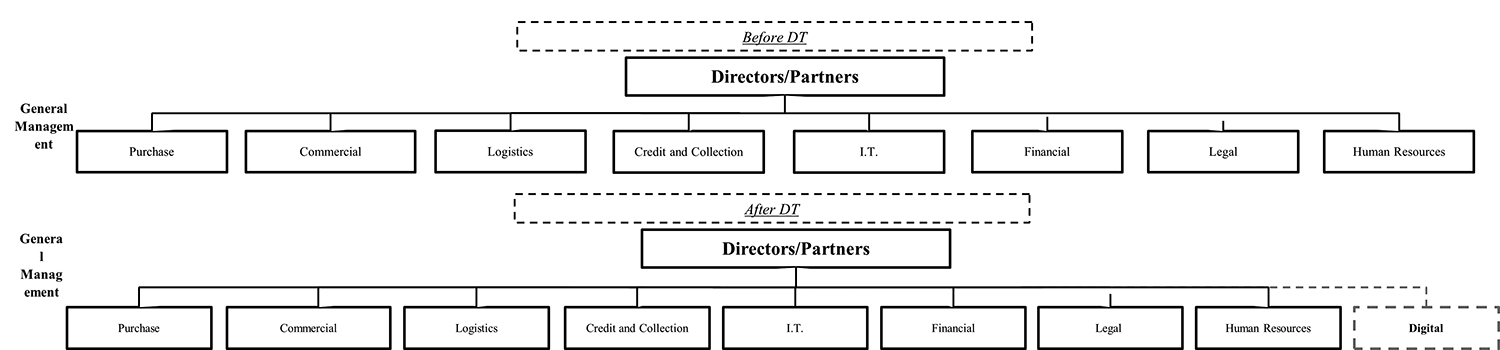
In the organizational structure, the change made had three main aspects: (i) in the business and strategy focused on the digital context, a specific functional general management was organized to report straight to the directors (digital general management), and existing functions were rearranged with a focus on the online business; (ii) for some other functions (logistics and finance, for example), processes were integrated to merge day-to-day operations, without setting up a division between incumbent business activities and new digital businesses, and; (iii) for functions in which online and offline processes are more clearly separated, positions were opened to meet the demands of the online operation. The changes align with Singh, Klarner and Hess (2020), who pay attention to the need for interaction of functional areas to achieve the digital business. Figure 1 illustrates the firm’s organization chart both before and after the transformation took place:
As can be seen in Figure 1, the rearrangement in the functional structure due to DT took place in a direct way: a specific area (digital general management) was introduced to take care of the firm's digital initiatives, which grouped its main activities: the development of digital strategies, the control of the results of that sales channel, and the management of cross-functional demands (for example, the joint development of systems with the IT Management).
In the firm's control systems, with the modifications made in the databases, Business Intelligence (BI) initiatives were introduced. This enabled dynamic ways of analyzing data, which allowed the firm to identify the number of people browsing the platform, the number of clicks and conversion rates up to closing, to potentiate new ways of managing operations.
Efforts were made to disseminate agile methodologies (scrum and lean) as ways to manage and organize the firm's operations incorporating a project management format to define and manage objectives, goals and deliveries. Such a practice was identified in the interviews, in the statements shared by managers, and found in other documents (podcasts and social network articles).
Unlike the ideas of Amankwah-Amoah et al. (2021), Vial (2019), Saariko et al. (2020), Pagani (2013) and Machado et al. (2021), the respondents have a perception that the firm's framework of beliefs and values did not change significantly. The participants understood that, except for the notion of the need to use technologies as work facilitators, the main elements of the organizational culture remained intact, namely: aspects such as values, rites, and shared beliefs.
This may arise from the approach taken to internally promote DT. To reduce the impact of the change, actions were planned to make employees aware that modifications in the processes would not imply deep structural changes but updates of the existing business. The staff's young age added to a culture open to change and error, also seem to have contributed to the purposes of the management team.
To overcome the resistance and fears of the company's operational staff, and to promote digital operation to physical store employees, the e-commerce team ran a campaign to sensitize those members of the staff, with training in new digital tools.
There were also a series of actions with employees from logistics and corporate area to show the competitive importance of the strategic transformation movement that was taking place, and what would be changed to sustain this new operation. On many occasions, temporary teams were formed to design processes involving the digital front, together with the traditional operation of the physical store. Such actions were exposed in the interviews and in complementary documents (photos and videos).
In the organizational strategy, the firm previously used a business strategy based on the regional permeability of its physical retail, through a physical face-to-face sales channel. Opportunely, a channel expansion strategy was adopted, which covered e-commerce at first. The logic was for the firm’s logistics distribution capacity to be used to operationalize a based business, a domain that still required an expansion of the firm's digital competence.
Under the logics of the typology of Tekic and Koroteev (No prelo), the firm has adopted a new strategic direction named “technology-oriented”, where businesses instrumentalized by digital technologies are introduced to complement the consolidated incumbent business. The purpose is not to commit intensely to a comprehensive change in its business fronts, stimulating a kind of ‘rebelliousness’, for alternative business models to emerge, to some extent tolerated under the umbrella of an eminently traditional company.
Then, the company used the digital fronts as a complement to its physical front, since it does not plan to focus on digital channels as the main source of revenue of the business, as this front is an expansion experience to new markets not served before, hitting consumers that focus on online shopping.
To that end, it invests in an omnichannel strategy, giving the consumer the chance to buy from both physical and digital channels, where both fronts are deeply integrated with technology. This position of the company can be due to its installed competence for product delivery, because of the emergence of its digital channels, with old and new competencies complementing each other in a new operation.
From the standpoint of the typology of Verhoef et al. (2021), it is possible to note the firm adopted a strategy focused on platform-based market penetration: a platform is developed to integrate products and services that external partners already offer. In this case, the marketplace created aimed to expand its existing product mix - which is limited to those that are sold in its physical stores and to a certain number of products sold online only per request of manufacturers and distributors - and to expand the service to other locations beyond its region of operation.
Then, the firm was able to expand the sales channel of its physical store products, and to create a new level of value generation and capture, which included partners in the value chain. This allowed for expanding its geographical coverage and take advantage of its assets related to the sedimentation of the brand in the states of Brazil's Northeast region, where it operates, while it reached new locations by delegating the delivery to the partner that is using its platform to sell. This can be noticed in E1’s statement: "since the delivery is done by a partner firm, I can deliver anywhere in Brazil […] we have sold to the states of Rio Grande do Sul, Minas Gerais […]".
As of the introduction of digital technologies, there was no substantial direct participation of suppliers, customers and partners in the co-creation of a value proposition plan designed for its digital strategy; they participated indirectly. In the case of suppliers, their participation in the strategy creation process was never mentioned, while customers had occasional participation as when they shared their feedback on the use of the mobile application in app stores, and when they informed of difficulties they had to the salespersons in physical stores.
Although complementary parties do not participate in the process of creating the digital business strategy, there are, in line with Menz et al. (2021), some actions that involve value sharing: when the company sells in its own marketplace products from external partners, and makes them responsible for delivering, the borders separating the value that each company creates and delivers are blurred, which produces a shared delivery.
It is important to highlight that, in line with what Warner and Wäger (2019) and Crisan and Stanca (2021) expose, when they argue that companies develop their digital strategies relying on the external and internal contexts, and with what Becker and Schmid (2020) point out as they demonstrate that companies of different sizes define their digital strategies in different ways, the company went through an emerging strategy development process and did not have a profound creation; it ran strategic development incrementally and reactively.
In the next subsection, we will describe the ambidextrous efforts for the firm to balance new and incumbent businesses.
4.3 Efforts towards DT from an ambidextrous approach
Regarding the company's incentives in favor of innovation or improvement actions in operations, the communications and reinforcements developed on a day-to-day basis usually exert a greater influence for the development of incremental improvement actions and support of incumbent businesses and initiatives than the development of stimuli that lead to radical innovation actions, for the introduction of new businesses or new initiatives.
In this sense, managers agree that, at a certain point, innovation was more radical when introducing digital technologies both to the internal public (such as the mobile sales application or BI data analysis), and in the opportunities for developing fronts straight for consumer service (e-commerce and marketplace). Therefore, there was a strong action of introducing radical innovations in a short period of time and, at that time, the firm sought to sustain such operations, making only incremental improvements.
Considering the narrative of the participants, we could identify that current businesses and new businesses coexist under the umbrella of Nordeste Eletro Ltd., a fact that emerges as evidence of the existence of an ambidextrous capability or, at least, an intention to achieve it, in line with what March (1991) and Marín-Idarraga et al. (2016) expose.
The incumbent businesses are maintained, and incremental improvement efforts are applied to maintain earnings, adhering to the logic of an exploitation approach. At the same time, an effort is made to prospect and introduce new businesses deals, towards a radical change that maintains long-term competitiveness, inherent in an exploration approach, which is in line with what is known as ambidexterity. The maintenance of the two business fronts is denoted both in the testimony of the participants and on-site observation.
As we analyzed the existing typologies of ambidexterity, we noticed that the firm took an initial path of separating the activities related to the digital business from others that contributed to sustaining incumbent activities. Setting up, within the same unit, a team focused on digital business provided greater focus on new businesses and on the challenges associated with exploration, which is typical of prospecting for new opportunities and dealing with ‘the new’. The rest of the team continued to work to maintain the incumbent business, proportionally more relevant to the firm's revenues, which adheres to an exploitation approach.
This perspective resembles the approach summarized by Lavie, Stettner and Tushman (2010) as ambidexterity by domain separation. In our specific case, we cannot see the separation in a specific business unit but, rather, in a functional unit separated from the other corporate areas to deal with the demands of the new business.
Other areas received a different treatment, which was similar to the definition of Chen (2017) for the sequential ambidexterity approach, in which members of those areas were involved in what was called squads (temporary project teams) to develop new solutions that affected the interface between the online sales area and the respective field of activity involved. The effort was specific and focused on thinking about a new solution to meet the digital business, under an exploration logic. Once the problem is solved, the squad dissolves and the solution is deployed as a standard for the previously raised need, from an exploitation perspective.
The evidence of simultaneous use of two categories of ambidexterity in the perception of Jöhnk et al. (2022) may be understood as hybrid ambidexterity. However, unlike the research finding of those authors, whose study detected contextual and structural approaches, in this investigation, as described in previous paragraphs, there was an evident combination of ambidexterity by domain separation and sequential ambidexterity.
As exploration activities seek to leverage the presence in new businesses and markets, in consonance with Raisch et. al (2009) and Marín-Idarraga et al. (2016), they help maintain the firm in the market in the long term and create inputs so that then new businesses, become fronts in a business portfolio that inspire, at a certain moment, actions to develop the exploitation approach, when they are institutionalized as installed businesses, which can be seen in this case, especially in the following lines:
It was this division [...] and the creation of this department, specific teams to deal with, [...] then, I think that, in 2022, maybe the second case began (temporal separation of activities), such as ‘look, you will be off the whole day, then you will be on for two days’ [...] and the next (the next approach they are seeking), the third, which is the integration perhaps of some departments, everything, of functions and this mutual management of the 2 fronts, right? (E4)
As presented by interviewee E4, the structures tend to merge, and the work required to operate the different channels (both physical and digital) tend to integrate, which completely internalizes the ambidextrous skills in Nordeste Eletro Ltd. to deal with both operations, at the same time, in an interaction perspective. This aligns with the integration view exposed by Raisch et al. (2009), and corroborates this aspect, which E5 evidences in his speech, when he says that “we do not want one to innovate and the other to operate on a day-to-day basis, everyone has to innovate”. E5 points out that innovating (creating new opportunities) and incrementing (continuously improving the operation) must be integrated perspectives.
The future direction of the firm intends to fit into the typology of contextual ambidexterity presented by Gibson and Birkinshaw (2004), insofar as those responsible for acting in the incremental improvement of operations (exploitation) and for developing innovations that sustain competitiveness in the long term (exploration) should be the same people, who, according to those authors, would be ambidextrous, while the leaders could influence them to balance efforts between incremental and radical innovation.
In general, Chen (2017) exposes that the exploration-oriented approach, typical of the introduction of digital business, is eminently emergent, that is, it forms from the lessons learned and experiences arising from the unstable market environment to which the firm is exposed. In this case, DT was not a strategic objective a priori but it became so due to the setbacks faced to make Nordeste Eletro Ltd. survive and to keep it competitive.
On the other hand, introducing other technologies to back up internal improvements characterizes the exploitation efforts, since it incrementally improves the existing businesses, expanding the base of tools to back up the operation of incumbent initiatives. The aforementioned process of DT run by Nordeste Eletro Ltd. not only instigated radical changes but, in a balanced way, instigated specific improvements in the existing structure of the firm.
While most of the technologies adopted can be categorized as exploitation actions, one initiative in special is considered an action closely linked to exploration: the development of a digital routing system. As the firm noticed a need to manage its delivery front, it sought a higher education institution to develop a digital functionality, which was introduced in the company in 2022. This action sees eye to eye with the concept of March (1991), as it involves variation, research - novelties to be brought to the firm.
In line with the contributions of O'Reilly III and Tushman (2008) and Luger, Raisch and Schimmer (2018), the company was in a turbulent environment, focusing on the development of an exploration approach, accentuating the perspective of change. When the external pressures of the business context cooled down, after the pandemics, the firm took advantage of the benefits of an ambidextrous approach, treating exploration and exploitation at the same time. Those authors determine preponderant factors for the ambidextrous approach to lead to a satisfactory result: using/sharing operational competencies by the two business fronts, and observing the strategic importance of both operations for the short and long-term survival of the company. In the context of the case-firm under review, it was possible to observe that:
(i) creating a specific team focused on digital business made it possible to focus more on new businesses and the challenges associated with prospecting for new opportunities, while the rest of the corporate team continued operating the incumbent businesses, the firm’s biggest source of revenues;
(ii) creating squads (in project format) to solve complex problems, which would require an interface between digital business areas and other areas more focused on incumbent businesses created the scenario for organizing actions for each of those fronts;
(iii) the process integration initiatives that maintained a similar base of operation between the digital operation and the physical operation allowed new and old businesses to coexist in harmony, by sharing a number of common processes without burdening the firm or demanding structural changes, which facilitated the coexistence of the two fronts in the same corporate direction;
(iv) sensitizing and training the operational personnel made digital initiatives coexist in harmony with physical initiatives, even complementing each other, allowing, for example, the salesperson himself to wait on the customer and conduct the payment process by digital means, or even wait on a customer on a digital medium, with the customer at home, but still close a sale by integrating aspects of the traditional (human) business with the digital business.
In this process, a question is raised as to what role leaders play for efforts to converge into an ambidextrous approach. By looking at the evidence raised, we can understand that the integration between the leaders of the functional areas, in a management committee, was key to keep the efforts directed to the two business fronts in the firm, as expressed by E1: “There was a committee that met weekly, […] one representative per area. As much as this representative spoke on behalf of the whole area, he had the commitment to inform the teams".
The leaders of the functional areas should align towards making the necessary integrations and adaptations so that the physical and digital businesses could coexist harmonically. This would allow managing culture, structure, and processes for the interactions of both exploration and exploitation to be contemplated and for their necessary differentiations to be supplied, thus keeping the umbrella business aligned in a homogeneous way and making the company able to smoothly operate in the ‘two modes’.
The aforementioned context adheres to the ideas of O'Reilly III and Tushman (2008, 2011), in relation to the importance for the firm to form a senior management team that takes over responsibilities to implement exploration and exploitation actions, by communicating relentlessly with employees; and to develop senior leaders’ skills to tolerate and resolve tensions that emerge from ambidexterity efforts. However, the results go against the proposal of the respective authors regarding engendering separate structures but they are aligned for exploration and exploitation. As it was possible to see in the analyzed case, there was no evidence of structural ambidexterity.
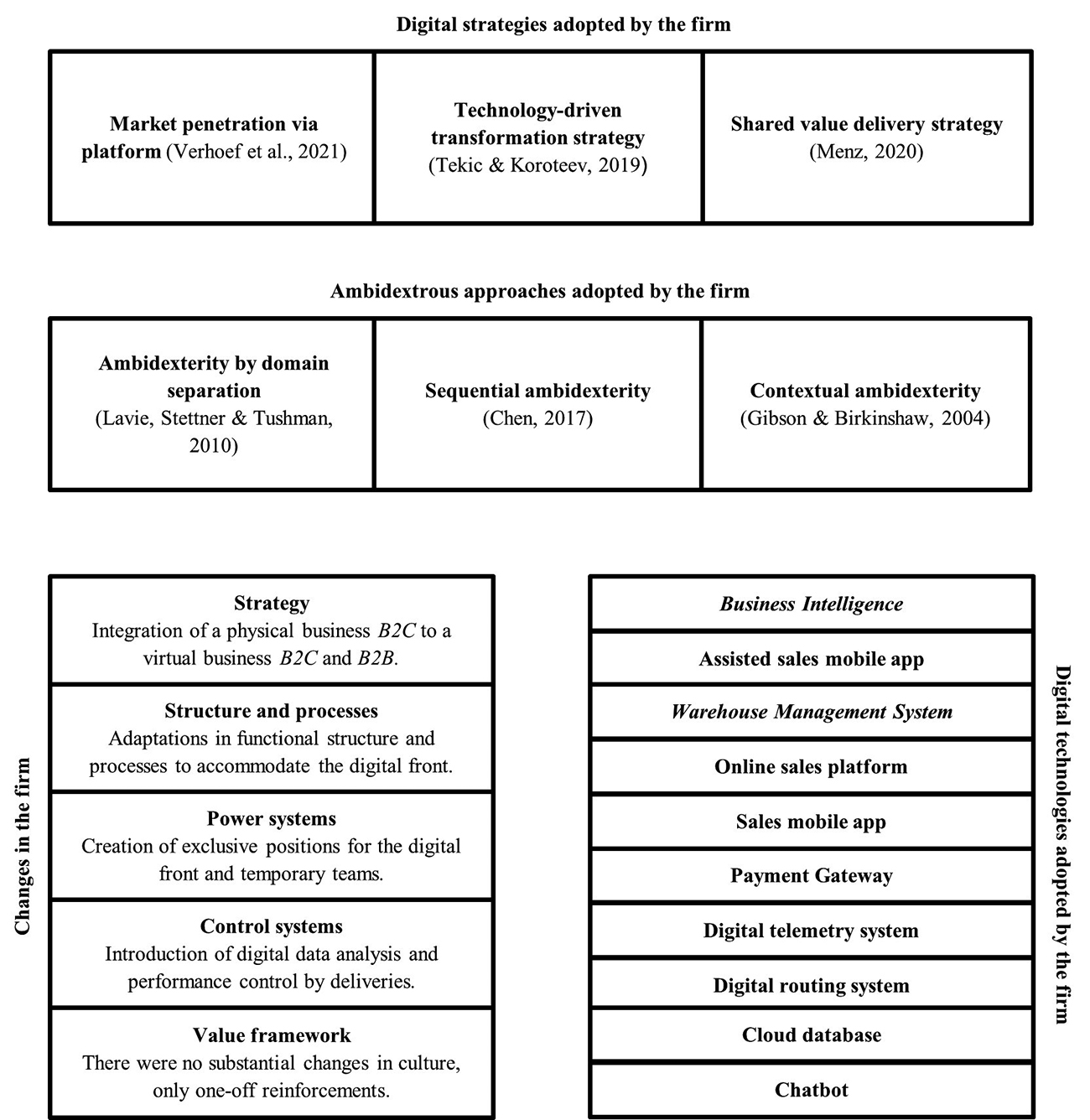
The commitment of the top management team becomes a key aspect for the tactical and strategic alignments to occur in the firm’s structure, since managing existing tensions between the new and the old businesses was delegated to functional managers, who, as a group, managed to execute a work system to integrate processes and structures. Figure 2 synthesizes the key findings of this study:
As shown in Figure 2, three main strategies related to the digital context were adopted: market penetration via platform (Verhoef et al., 2021), technology-driven transformation strategy (Tekic & Koroteev, No prelo) and shared value delivery strategy (Menz et al., 2021). Regarding the ambidexterity approaches adopted by the firm to balance the efforts between the digital and traditional business fronts, we identified the occurrence of ambidexterity by domain separation (Lavie, Stettner & Tushman, 2010), sequential ambidexterity (Chen, 2017) and contextual ambidexterity (Gibson & Birkinshaw, 2004).
Finally, it was possible to identify changes in strategy, structure, and processes, power systems, control systems, although no deep changes were identified in the value framework. From the perspective of the digital technologies adopted by the firm, we highlight the introduction of BI solutions, mobile application for sales and assisted sales, the introduction of a WMS solution, an online sales platform, payment gateway, digital telemetry system, routing system, cloud-hosted databases, and chatbots for service and sales.
5 CONCLUSIONS
This research contributes to advancing knowledge in various ways: firstly, it demonstrates the usefulness of the ambidextrous lens to understand DT processes in incumbent companies, by showing the need to have ambidextrous balance for investing in new businesses without compromising its current businesses.
Secondly, in line with the definition of Volberda et al. (2021), it elucidates how a family company that develops DT in an emergent way creates solutions to resolve the strategic conflict between using existing assets in the organization, which guarantee operation and survival, and exploring new opportunities created by digital technologies.
Thirdly, it confirms that changes deriving from DT takes place in different ways, depending on the firm size (Warner & Wäger (2019); Crisan & Stanca (2021); Becker & Schmid (2020). This implies making different strategic decisions from those of the major players in the market, trusting the digital front to ensure the growth and competitiveness of the firm in the short and long terms, while Nordeste Eletro Ltd. takes a digital turn to complement the physical front without fully embarking on the DT trend.
Our findings also contribute to management practice, as it shows that the DT process does not only take place in a deliberate, organized and ideal way, nor does it occur in a total and profound way. The process also involves partial transformation practices that are developed along the organizational trajectory and can mean an addition to the incumbent businesses, which are not always in a critical situation.
Managers that access this work will approach a framework of managerial, organizational and leadership technologies and practices that have contributed to the ambidextrous balance of a firm, and reflect on whether such practices apply to their organization's reality (See Figure 2). Among other contributions raised by this study, we may mention the following practices: structuring a focused team to proceed with DT and manage cross-functional needs, having moments for raising employees' awareness, and integrating processes related to physical and digital channels.
Moreover, evidence raised in this study also indicated that trade-off involves a decision: to add the physical operation to the digital operation. More than going different ways, it is possible for managers to integrate these two strategic channels to maintain the existence of the firm and ensure its survival, dynamically balancing each of the fronts according to the needs of the context and time.
As for the limitations of this work, much of the data and many of the facts collected by this research involved strategic steps taken by the company, so the managers chose not to share many of the paths they used to achieve the digital transformation the business. As another important limitation, it was not possible to conduct an interview with the company's IT manager, which limited the knowledge obtained on this front to an interview with the current innovation manager, who held the position of IT coordinator during part of the transformation period. Moreover, the fact that the investigation was conducted in a single company restricts its findings as compared to broader studies.
For this research path to be taken further, it is important that future research go deeper into several aspects. We suggest investigating the reasons why firms adopt DT to different intensities. In this work, we could understand that the confidence in the success of its physical front led the firm to seek complementarity, but what are the impacts of this choice in the long term? Another opportunity lies in studying the tensions that arise between physical and digital initiatives from a perspective of individual ambidexterity, when one and the same manager takes responsibility for both initiatives.
In addition, this work indicates the need to better understand the impacts of creating digital-driven teams on the adaptation of the firm to accommodate this new organizational configuration and potentialize its competitive importance: without a broader transformation at the corporate level, are structural changes enough for this business front to become an exponent in the firm's competitiveness?
References
- Amankwah-Amoah, J., Khan, Z., Wood, G., & Knight, G. (2021). Covid-19 and digitalization: The great acceleration. Journal of Business Research, 136(1), 602-611.
- Andriopoulos, C, & Lewis, M. W. (2009). Exploitation-exploration tensions and organizational ambidexterity: Managing paradoxes of innovation. Organization Science, 20(4), 696-717.
- Ansoff, H. I. (1957). Strategies for diversification. Harvard Business Review, 35(5), 113-124.
- Ardito, L., Petruzzelli, A. M., Dezi, L., & Castellano, S. (2020). The influence of inbound open innovation on ambidexterity performance: Does it pay to source knowledge from supply chain stakeholders? Journal of Business Research, 119, 321-329.
-
Fundação Dom Cabral (2021, March 2). Digital, a economia que move as empresas e o mundo: onde estamos e aonde podemos chegar, Nova Lima https://ci.fdc.org.br/AcervoDigital/E-books/2021/Digital %201/DIGITAL_01.pdf
» https://ci.fdc.org.br/AcervoDigital/E-books/2021/Digital %201/DIGITAL_01.pdf - Bardin, L. (1977). Análise de conteúdo Edições 70.
- Becker, W., & Schmid, O. (2020). The right digital strategy for your business: An empirical analysis of the design and implementation of digital strategies in SMEs and LSEs. Business Research, 13(1), 985-1005.
- Bharadwaj, A., El Sawy, O. A., Pavlou, P. A., & Venkatraman, N. (2013). Digital business strategy: toward a next generation of insights. MIS Quartely, 37(2), 471-482.
-
Brown, N., & Brown, I. From Digital Business Strategy to Digital Transformation - How? A Systematic Literature Review SAICSIT Conference 2019. Skusuza. https://dl.acm.org/doi/abs/10.1145/3351108.3351122
» https://dl.acm.org/doi/abs/10.1145/3351108.3351122 - Bughin, J., Kretschmer, T., & Van Zeebroeck, N. (2021). Digital Technology Adoption Drives Strategic Renewal for Successful Digital Transformation. IEEE Engineering Management Review, 49(3), 103-108.
- Chen, Y. (2017). Dynamic Ambidexterity: How Innovators Manage Exploration And Exploitation. Business Horizons, 60(3), 385-394.
- Cho, J. Y., & Lee, E. (2014). Reducing Confusion about Grounded Theory and Qualitative Content Analysis: Similarities and Differences. The Qualitative Report, 19(32), 1-20.
- Choi, T., & Chandler, S. M. (2015). Exploration, Exploitation, and Public Sector Innovation: An Organizational Learning Perspective for the Public Sector Human Service. Organizations: Management, Leadership & Governance, 39(2), 139-151.
- Coraiola, D. M., Sander, J. A., Maccali, N., & Bulgacov, S. (2013). Estudo de Caso. In Takahashi, A. R. W. (org.). Pesquisa qualitativa em administração: fundamentos, métodos e usos no Brasil (2a ed., pp. 307-342). Atlas.
- Correani, A., De Massis, A., Frattini, F., Petruzelli, A. M., & Natalicchio, A. (2020). Implementing digital strategy: Learning from the experience of three digital transformation projects. California Management Review, 62(4), 36-57.
- Creswell, J. W. (2014). Investigação qualitativa e projeto de pesquisa: escolhendo entre cinco abordagens (3rd ed.). Penso.
- Crisan, E. M., & Stanca, L. (2021). The digital transformation of management consulting companies: A qualitative comparative analysis of Romanian industry. Information Systems and e-Business Management, 19(1), 1143-1173.
- Daniel, E. M., & Wilson, H. N. (2003). The role of dynamic capabilities in e-business transformation. European Journal of Information Systems, 12, 282-296.
- Fischer, M., Imgrund, F., & Janiesch, C., Winkelmann, A. (2020). Strategy archetypes for digital transformation: Defining meta objectives using business process management. Information & Management, 57(1), 103262.
- Gastaldi, L., Appio, F. P., Corso, M., & Pistorio, A. (2018). Managing the exploration-exploitation paradox in healthcare: Three complementary paths to leverage on the digital transformation. Business Process Management Journal, 24(5), 1200-1234.
- Gibson, C. B., & Birkinshaw, J. (2004). The Antecedents, Consequences, and Mediating Role of Organizational Ambidexterity. The Academy of Management Journal, 47(2), 209-226.
- Gupta, A. K., Smith, K. G., & Shalley, C. E. (2006). The Interplay between Exploration and Exploitation. Academy of Management, 49(4), 693-706.
- Helfat, C. E., & Raubitschek, R. S. (2018). Dynamic and integrative capabilities for profiting from innovation in digital platform-based ecosystems. Research Policy, 47(8), 1391-1399.
- Hess, T., Matt, C., Benlian, A., & Wiesbock, F. (2016). Options for Formulating a Digital Transformation Strategy. MIS Quartely Executive, 15(2), 103-119.
- Ismail, M. H., Khater, M., & Zaki, M. (2017). Digital business transformation and strategy: What do we know so far? University of Cambridge.
- Jöhnk, J., Ollig, P., Rövekamp, P., & Oesterle, S. (2022). Managing the complexity of digital transformation - How multiple concurrent initiatives foster hybrid ambidexterity. Electronic Markets, 32(2), 547-569.
- Kindermann, B., Beutel, S., Lomana, G. G., Strese, S., Bendig, D., & Brettel, M. (2021). Digital orientation: Conceptualization and operationalization of a new strategic orientation. European Management Journal, 39(5), 645-657.
- Lavie, D., Stettner, U., & Tushman, M. (2010). Exploration and Exploitation Within and Across Organizations. Academy of Management, 4(1), 109-155.
- Levinthal, D. A., & March, J. G. (1993). The Myopia of Learning. Strategic Management Journal, 14, 95-112.
- Li, X., Li, J., Han, H., & Shi, J. (2024). Managing the exploitation/exploration paradox: The role of digital transformation. Applied Economics Letters, 32(8), 1069-1072.
- Liu, Q. R., Liu, J. M., & He, Z. P. (2023). Digital transformation ambidexterity and business performance. Journal of Enterprise Information Management, 36(5), 1402-1420.
- Li, L., Su, F., Zhang, W., & Mao, J. Y. (2018). Digital transformation by SME entrepreneurs: A capability perspective. Information Systems Journal, 28(6), 1129-1157.
- Luger, J., Raisch, S., & Schimmer, M. (2018). Dynamic balancing of exploration and exploitation: The Contingent benefits of ambidexterity. Organization Science, 29(3), 449-470.
- Machado, C. G., Winroth, M., Almstrom, P., Oberg, A. E., Kurdve, M., & Almashalah, S. (2021). Digital organisational readiness: Experiences from manufacturing companies. Journal of Manufacturing Technology Management, 32(9), 167-182.
- Malterud, K., Siersma, V. D., Guassora, A. D. (2016). Sample size in qualitative interview studies: Guided by information power. Qualitative Health Research, 26(13), 1753-1760.
- March, J. C. (1991). Exploration and exploitation in organizational learning. Organization Science, 2(1), 71-87.
- Marín-Idagarra, D. A., Hurtado-González, J. M., & Medina, C. C. (2016). The Antecedents of Exploitation-Exploration and Their Relationship with Innovation: A Study of Managers’ Cognitive Maps. Creativity and Innovation Management, 25(4), 18-37.
- Menz, M., Kunisch, S., Birkinshaw, J., Collis, D., Foss, N., Hoskinsson, R. E., & Prescott, J. E. (2021). Corporate Strategy and the Theory of the Firm in the Digital Age. Journal of Management Studies, 58(7), 1695-1720.
- Morton, J., Amrollahi, A., & Wilson, A. D. (2022). Digital strategizing: An assessing review, definition, and research agenda. The Journal of Strategic Information Systems, 31(2), 101720.
- Nadkarni, S., & Prugl, R. (2021). Digital transformation: A review, synthesis and opportunities for future research. Management Review Quarterly, 71(1), 233-341.
- Oberländer, A. M., Röglinger, M., & Rosemann, M. (2021). Digital opportunities for incumbents-A resource-centric perspective. The Journal of Strategic Information Systems, 30(3), 101670.
- O’Reilly III, C. A., & Tushman, M. L. (2011). Organizational Ambidexterity In Action: How Managers Explore And Exploit. California Management Review, 53(4), 5-22.
- O’Reilly III, C. A., & Tushman, M. L. (2008). Ambidexterity as a dynamic capability: Resolving the innovator's dilemma. Research in Organizational Behavior, 28(2), 185-206.
- O’Reilly III, C. A., & Tushman, M. L. (2013). Organizational Ambidexterity: Past, Present, And Future. Academy of Management Perspectives, 27(4), 324-338.
- Pagani, M. (2013). Digital Business Strategy And Value Creation: Framing The Dynamic Cycle Of Control Points. MIS Quartely, 37(2), 617-632.
- Popadiuk, S., Luz, A. R. S., & Kretschmer, C. (2018). Dynamic Capabilities and Ambidexterity: How are These Concepts Related? Revista de Administração Comtemporânea, 22(5), 639-660.
- Plekhanov, D., Franke, H., & Netland, T. H. (2023). Digital transformation: A review and research agenda. European Management Journal, 41(1), 821-844.
- Raisch, S., Birkinshaw, J., Probst, G., & Tushman, M. L. (2009). Organizational Ambidexterity: Balancing Exploitation and Exploration for Sustained Performance. Organization Science, 20(4), 685-695.
- Ritala, P., Baiyere, A., Hughes, M., & Kraus, S. (2021). Digital strategy implementation: The role of individual entrepreneurial orientation and relational capital. Technological Forecasting & Social Change, 171(1), 120961.
- Romanelli, E., & Tushman, M. L. (1994). Organizational Transformation as Punctuated Equilibrium: An Empirical Test. The Academy of Management Journal, 37(5), 1141-1166.
- Saariko, T., Westergren, U., & Blomquist, T. (2020). Digital transformation: Five recommendations for the digitally conscious firm. Business Horizons, 63(6), 825-839.
- Sia, S. K., Weill, P., & Zhang, N. (2021). Designing a Future-Ready Enterprise: The Digital Transformation of DBS Bank. California Management Review, 63(3), 35-57.
- Singh, A., Klarner, P., & Hess, T. (2020). How do chief digital officers pursue digital transformation activities? The role of organization design parameters. Long Range Planning, 53(3), 101890.
- Sousa-Zomer, T., Neely, A., & Martinez, V. (2020). Digital transforming capability and performance: A microfoundational perspective. International Journal of Operations & Production Management, 40(7/8), 1095-1128.
- Teece, D. J. (2007). Explicating dynamic capabilities: The nature and microfoundations of (sustainable) enterprise performance. Strategic Management Journal, 28(13), 1319-1350.
- Teece, D. J. (2018). Profiting from innovation in the digital economy: Enabling technologies, standards, and licensing models in the wireless world. Research policy, 47(8), 1367-1387.
- Tekic, Z., & Koroteev, D. (No prelo). From disruptively digital to proudly analog: A holistic typology of digital transformation strategies. Business Horizons, 62(1), 683-693.
- Van Zeebroeck, N., Kretschmer, T., & Bughin, J. (2021). Digital “is” Strategy: The Role of Digital Technology Adoption in Strategy Renewal. IEEE Transactions On Engineering Management, 1-15.
- Verhoef, P., Broekhuizen, T., Bart, Y., Bhattacharya, A., Dong, J., Fabian, N., & Haenlein, M. (2021). Digital transformation: A multidisciplinary reflection and research agenda. Journal of Business Research, 122(1), 889-901.
- Vial, G. (2019). Understanding digital transformation: A review and a research agenda. Journal of Strategic Information Systems, 28(2), 118-144.
- Volberda, H., Khanagha, S., Baden-Fuller, C., Mihalache, O., & Birkinshaw, J. (2021). Strategizing in a digital world: Overcoming cognitive barriers, reconfiguring routines and introducing new organizational forms. Long Range Planning, 54(5), 102110.
- Warner, K., & Wäger, M. (2019). Building dynamic capabilities for digital transformation: An ongoing process of strategic renewal. Long Range Planning, 52(3), 326-349.
-
DATA AVAILABILITY:
Additional materials useful for understanding this work are openly available at the site: https://zenodo.org/records/11480163.
Additional materials useful for understanding this work are openly available at the site: https://zenodo.org/records/11480163.

 Source: created by the authors.
 Source: created by the authors.