
 Analysis of Sustainable Development Goals (SDGs) Disclosure in ASEAN: Prioritization and the Impact on Firm Value
ABSTRACT
Implementation of Sustainable Development Goals (SDG) as a sustainability framework has opened rich opportunities for academic research in accounting to investigate firm’s SDG reporting. This study contributes to provide empirical evidence on association between SDG Disclosure and firm value in ASEAN context. This research explored variety of SDG disclosure targets in the sustainability report and examine the effect on firm value. There are 804 sustainability reports published during 2015-2021 analyzed in this study. Result revealed that all SDG targets have been addressed by the companies in their sustainability practice. However, some targets are more prioritized than other targets. Firms’ contribution towards SDG targets mostly focuses on providing decent works and economic growth, good health and well-being, implementing responsible production and consumption, and taking action toward climate change. Further, SDG disclosure is positive and significantly associated to an increase in firm value which means that it helps investor and wider stakeholder in firm valuation. The results support for evaluating the implementation and achievement of SDG in each country to determine future strategies.
Keywords:
Sustainable Development Goals; Sustainability Reporting; Firm Value
RESUMO
A implementação dos Objetivos de Desenvolvimento Sustentável (ODS) como uma estrutura de sustentabilidade abriu ricas oportunidades para a pesquisa acadêmica em contabilidade para investigar os relatórios de ODS da empresa. Este estudo contribui para fornecer evidências empíricas sobre a associação entre a divulgação dos ODS e o valor da empresa no contexto da ASEAN. Esta pesquisa explorou a variedade de metas de divulgação de ODS no relatório de sustentabilidade e examinou o efeito sobre o valor da empresa. Este estudo analisou 804 relatórios de sustentabilidade publicados no período de 2015 a 2021. Os resultados revelaram que todas as metas dos ODS foram abordadas pelas empresas em suas práticas de sustentabilidade. No entanto, algumas metas são mais prioritárias do que outras. A contribuição das empresas para as metas dos ODS se concentra principalmente em oferecer trabalho decente e crescimento econômico, boa saúde e bem-estar, implementar produção e consumo responsáveis e tomar medidas em relação às mudanças climáticas. Além disso, a divulgação dos ODS está positiva e significativamente associada a um aumento no valor da empresa, o que significa que ela ajuda o investidor e as partes interessadas mais amplas na avaliação da empresa. Os resultados ajudam a avaliar a implementação e a realização dos ODS em cada país para determinar estratégias futuras.
Palavras-chave:
Objetivos de desenvolvimento sustentável; relatórios de sustentabilidade; valor da empresa
1. INTRODUCTION
In 2015, the United Nations adopted The 2030 Agenda for Sustainable Development which contains actions that must be taken to maintain world peace and provide prosperity for human living and Earth now and in the future (United Nations, 2015). This agenda was effectively implemented in 2016, and state the seventeen targets of Sustainable Development Goals (hereinafter referred to as SDG). The SDG targets are: (1) no poverty, (2) zero hunger, (3) good health and well-being, (4) quality education, (5) gender equality, (6) clean water and sanitation, (7) affordable and clean energy, (8) decent work and economic growth, (9) industry, innovation, and infrastructure, (10) reduce inequalities, (11) sustainable cities and community, (12) responsible consumption and production, (13) climate action, (14) life below water, (15) life on land, (16) peace, justice, and strong institution, and (17) partnerships.
A survey by PwC (2016) on the level of companies' awareness of the SDGs and how they plan to engage with SDGs shows that awareness of the private sector to contribute to the SDG agenda is 92%. It shows that firms are likely to be involved in the implementation of SDG. Many firms transform their business model from a short-term orientation focusing on financial targets to a long-term orientation that focuses on social, economic, and environmental aspects (Scheyvens et al., 2016). Several companies also have used SDG as a framework for sustainable business operations (Bebbington & Unerman, 2018). As an impact of the implementation of the SDG framework within companies, there is a growing opportunity for academic research in accounting to investigate SDG reporting more deeply. Research related to the disclosure of SDGs in companies is essential to determine the extent to which organizations contribute to the implementation of SDG agenda in the context of their respective policies (Bebbington & Unerman, 2018).
Prior studies discussed literature review and descriptive analysis on potential SDG reporting topics (Bebbington & Unerman, 2018; Betti et al., 2018; Biermann et al., 2017; Pineda-Escobar, 2019; Scheyvens et al., 2016; Taylor et al., 2018; Terama et al., 2016). Čičak, J. (2023) investigated SDG reporting in public sectors and found that the Global Reporting Initiative (GRI) standard is the most suitable framework for reporting SDG. Izzo et al. (2020) documented that companies in the Italian context have introduced SDG contribution qualitatively in their reports. Rosati & Faria (2019a) analyzed the determinants of SDG disclosure at the country and organizational levels. However, the measurement of SDG in the study only explores the disclosure based on whether the company reports or not report the SDG target. Such measurement did not reflect the extent of SDG implementation within the company. More precise measurement showing the number of SDG targets is needed to show a variety of SDG targets addressed by the company. More varied methods such as archival studies also contribute to the development of SDG disclosures in sustainability reports (Hales et al., 2016).
In regards to the potential value relevance of SDG disclosure, Accenture (2018) found that 87% of CEOs believed that SDG could add value to the firms. This is likely to happen as higher numbers of investors are considering the financial and non-financial performance of the firms. Investors allocate more of their portfolios to companies that have higher non-financial performance (Bauer & Smeets, 2015). This shows that the existence of SDGs disclosure in company reports can provide relevant information for investors. Investors may provide higher value to companies that implement more SDG practices. Previous research investigated the relationship between SDG and firm value. Ito (2018) examines the relationships using theoretical analysis distinguishing the firm value as cash-based value which is derived from the discounted cash flow method incorporating the magnitude of cash flow, market risk, and life span of the corporation, and recognized value derived by considering the investors’ utility to SDGs contribution in addition to cash-based value. The results show that reporting on SDG is positively related to firm value. Other research has shown an empirical relationship such as Ramos et al. (2022), however, it only covered a limited number of samples with one-year data. Lawati & Hussainey (2022) added a longer data span of more than one year, but the sample was limited to financial institutions using the Middle East developing country context. There is a need to look at the impact of SDG disclosure on firm value in a wider data span with non-financial institutions in developing countries in ASEAN.
ASEAN is an organization committed to creating a region of peace, freedom, and shared prosperity under different social, economic, cultural, and political aspects (ASEAN Secretariat, 2020). ASEAN member countries are actively engaging in the former agenda of the Millenium Development Goals which has been transformed into Sustainable Development Goals. Data revealed that the poverty rate in developing countries in the region decreased dramatically from 1999 to 2015, while the level of prosperity increased steadily (International Monetary Fund, 2018). It showed that people, the planet, and prosperity have become a concern for various parties, including private sectors in ASEAN regions. They are working together for a sustainable future life.
Moreover, there is a positive trend toward regulation for the quality of sustainability disclosure for private sectors. For example, in Indonesia, recently financial institutions and listed companies have been mandated to publish sustainability reports. In Thailand as well as in Malaysia, more companies publicly informed their contribution towards SDG sustainable development or sustainability reports. This condition has opened up an opportunity to provide information for better monitoring of SDG progress and aid better policymaking at the country level and regional level in ASEAN. Therefore, this study contributes to business practice by exploring to what extent companies implement and report SDG targets in the sustainability reports to see whether certain SDG targets are prioritized by the companies, and investigates whether SDG disclosure adds value to companies in ASEAN. This study also aids policymakers in assessing the progress of SDGs to direct future strategy in SDG achievement and confirms to investors the need for non-financial performance related to SDGs in assessing firm value. This study contributes to disclosure literature by providing evidence that supports stakeholder and signaling theory.
2. LITERATURE REVIEW& HYPOTHESES DEVELOPMENT
SDG disclosure is defined as the practice of publicly reporting how a company integrates the SDG into its business (Rosati & Faria, 2019b). It is often disclosed in the companies’ sustainability reports. SDG disclosure is important for the monitoring of progress and achievement (Agarchand & Laishram, 2017; Anasi et al., 2018) which will be held annually at the High-Level Political Forum on Sustainable Development. It plays an important role in communicating sustainability activities to stakeholders (Helfaya et al., 2023)
In today's competitive market, decision-makers need to consider the external, community, and natural contexts, e.g. de Villiers & Marques (2016) and Gao et al., (2016). Firm decision-makers who embrace the SDGs will benefit their funding providers and many other stakeholders in the long run (Bose et al., 2024). These benefits include reducing inequality and ensuring workforce diversity; addressing climate change; protecting the environment; gaining social acceptance; and satisfying stakeholders, such as customers, employees, suppliers, communities, reputation, strong long-term relationships, and so forth (Adams, 2017; Bose & Khan, 2022; Endrikat et al., 2014).
This is in line with the stakeholder theory, which postulates that a company must acknowledge the existence of parties affected by its activities and fulfill the interests of all parties. The stakeholders are putting pressure on companies to be responsible for any impacts from their business. Their welfare will affect their preferences for establishing interactions with the company (Harrison et al., 2010). A strong interaction between the company and stakeholders creates competitive advantages that are useful for future threats (Platonova et al., 2018) as well as add value to the company's sustainability performance (Harrison et al., 2010). Companies, thus, need to respond to the needs and requirements of stakeholders by providing environmental and social business practice (Chernev & Blair, 2015), such as sustainability reports.
The sustainability report is a tool to show a company’s positive engagement in society and the environment (Flammer, 2013). The sustainability report, including SDG disclosures, is aimed at building the company’s legitimacy. Quality sustainability reporting enhances the capability to overcome situations that might threaten a company’s reputation (Platonova et al., 2018). It supports stakeholders in estimating future economic, social, and environmental benefits (Du et al., 2017). This means that investing in companies with better sustainability performance will provide a sustainable profit in the future. Investors and fund managers allocate more of their portfolios to companies which is more socially responsible (Bauer & Smeets, 2015) and have better social performance (Borgers et al., 2015). , investors will add higher value to companies that have quality sustainability practices and performance. This will enhance the company's reputation, leading to improved firm performance (Li et al., 2018). The company, thus, should focus on stakeholders' satisfaction and enhance positive connections with them, which may be achieved by offering stakeholders the application of SDG in the company's sustainability practices.
In addition to stakeholder theory, the signaling theory (Michael Spence, 1973) suggests that companies are likely to disclose voluntary information through various channels in situations where information asymmetry occurs. This is aimed to distinguish the companies from others and to indicate that the companies have a stand-out value. Companies that seek sustainability are more likely to engage in disclosing favorable information to signal their commitment to stakeholders (Wang et al., 2018) and to gain a competitive advantage (Maas et al., 2014). This is because it increases investor confidence and reduces the asymmetry of information between different parties (de Villiers & Marques, 2016; Gao et al., 2016). This implies that when a profit-seeking firm voluntarily improves its sustainability performance and discloses sustainability information, the market perceives the firm as open and transparent to investors and caring for broader stakeholder groups (Ozkan et al., 2023).
Although prior research that analyses the impact of SDG disclosures on firms' value is limited, its results show that SDG disclosures enhance the market value of companies (Bose et al., 2024). This is consistent with other literature that empirically suggest SDG disclosure may contribute to higher performance. For example, Muhmad & Muhamad (2021), examined 56 articles indexed in Web of Science (WoS) and Scopus and found that around 96% of those articles found a positive association between sustainability practices and the financial performance of companies. Similarly, Emma & Jennifer (2021) explicitly examined SDG reporting and found evidence of the positive effect of SDG reporting on performance in controversial sectors as well as in environmentally sensitive industries. Recently, Helfaya et al. (2023) investigates the influence of environmental goals disclosure (EGD), which is part of SDG, on the sustainability ratings and financial worth of Egyptian corporations. It has been found that EGDs enhance sustainability scores and corporate value. Companies which publish a higher number of EGDs have a greater probability of being part of the Egyptian Sustainability Index and achieving a high ranking, which is favored by the capital market.
The positive impacts of SDG disclosures indicate that SDG reporting helps shareholders and creditors assess the companies’ performance before making investment decisions (Dhaliwal et al., 2011). When companies are more transparent and report more SDG targets, shareholders give higher added value to the companies because shareholders will include the potential economic, social, and environmental benefits in the future in firm valuation (Abdulrahman Anam et al., 2011). Moreover, organizations that exhibit better sustainability performance are more likely to provide detailed information regarding their performance (Nicolo’ et al., 2024). This demonstrates their dedication to achieving the SDGs (García Meca & Martínez Ferrero, 2021). Consequently, it is possible that the market value of firms would increase because of an increase in the level of SDG disclosure by firms operating globally. Therefore, this study proposes the following hypotheses:
-
Hypotheses 1 (H1): SDG disclosure is positively associated with firm value.
3. RESEARCH METHOD
This study employed archival research. The sample of this research were public companies in ASEAN, including Indonesia, Malaysia, Thailand, Philippines, and Singapore. Data were taken from company sustainability reports available at https://database.globalreporting.org/ and company websites, and it was sorted based on those who submitted sustainability reports in https://www.corporateregister.com/ during 2015-2021. This series of data provides a wider data span since SDG was first launched in 2015. It is aimed at looking at the trend in companies' SDG disclosure over time. Therefore, the year 2015 was included in the research to anticipate early SDG reporting. Other financial data was taken from Eikon Thomson Reuters and Datastream.
The independent variable used in this study is SDG disclosure (SDGR). Rosati & Faria (2019a) measured SDG disclosure using dummy variables 1 and 0, which indicated reporting and not reporting SDG. This study follows Gunawan et al. (2020), (Lawati & Hussainey, 2022) and Bose & Khan (2022) used a more precise measurement for SDG disclosure using the number of SDG targets (minimum 0 if no SDGs reporting and maximum of 17 if all 17 SDGs are reported). Thus, the results show in detail the SDG targets that were implemented in the company's sustainability practices. By reporting SDGs, companies have demonstrated their commitment to the SDGs by explicitly stating the goals as well as the actions that support those goals. SDG Disclosures are expected to reflect the extent of how much have the companies already put into consideration related to SDGs, the coverage of sustainable development issues that they already address, and how all of those have been integrated into the company’s business processes.
The dependent variable employed in this study is firm value which reflects the wealth of firms. To measure firm value, this study used Tobin's q (TOBQ). Following Hummel & Szekely (2022), control variables in this study are company size (SIZE), company leverage level (LEV), and company performance (ROA). These variables are used to control organizational characteristics related to firm value. To control country-specific variables that may be related to firm value, this study used the Gross Domestic Product (GDP) variable to reflect a country's economic level and investor protection (INV_PROTECT). A country with higher economic levels and investor protection is expected to have a positive impact on firm valuation. La Porta et al. (1998) categorized a country into common law and civil law to describe the effectiveness of law enforcement in protecting investors. It was argued that the common law system has stronger legal protection than civil law countries, thus it affects the firm valuation. The following table (Table 1) shows the operationalization and measurement of variables in detail:
The research model of this study followed Kuzey & Uyar (2017) with modifications as follows:
TOBQit+1= β0+ β1SDGRit+ β2SIZEit+ β3LEVit+ β4ROAit + β5 GDPit + β6 INV_PROTECTit +Fixed Country Effect + Fixed Industry Effect + ε
This study conducted two steps of data analysis. To investigate the variation of SDG disclosure within firms’ sustainability report, the researchers analyzed the SDG disclosure manually from the sustainability reports by counting the SDG targets which were reported explicitly. In the second step, the panel data were analyzed in STATA 14 with Random Effect Model (REM) regression. This model was employed as the data had specific characters that would be omitted if using OLS regression (Gujarati, 2003). The researcher conducted a series of test to make sure that the estimation result has been valid and reliable, including heteroscedasticity test, multicollinearity test, and autocorrelation test. The assumption testing result have been satisfied. The testing result showed that panel data in the study were homoscedastic and free of multicollinearity and autocorrelation.
4. RESULTS AND DISCUSSION
4.1. Variation of SDG Disclosure
The sample consisted of 192 public firms which published the sustainability reports and reported them in the database.globalreporting.org and https://www.corporateregister.com/ during 2015-2021. We omitted sustainability reports which were neither written in Indonesian Language nor English, and which had incomplete financial data. As a final result, 804 firm-year observations from companies in Indonesia, Malaysia, Philippines, Thailand, and Singapore were analyzed in this study. The detail result of sample selection procedure was presented in Table 2.
Based on the sample selection procedure in Table 2, Thailand has the highest number of companies publishing sustainability reports in the database followed by Malaysia, Indonesia, Singapore, and the Philippines. Several companies in Thailand did not only publish sustainability reports but also reported the Sustainable Development Report. On the contrary, the Philippines had the lowest number of sustainability report publications. These findings might be due to differences in the progress of sustainability reporting implementation among countries.
Data in Table 2 also shows that on average, more than half of the samples report their contribution to SDG in the sustainability report. This data shows that most companies already have awareness of their contributions to the SDGs. Based on the data, in the early years of SDG implementation, there had been a limited number of companies who reported their support toward SDG. Surprisingly, in recent years most companies have identified their priority support toward SDG targets. Singapore has the least companies that reported SDG. This is also an interesting finding as Singapore is the only developed country in ASEAN. This finding is partially consistent with (Arena et al., 2018) who found that Thailand reported more CSR disclosure in ASEAN. In this research, more companies in the developing countries in ASEAN disclosed SDGs.
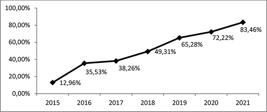
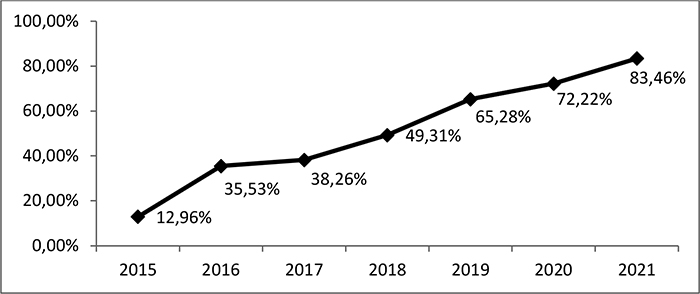
Figure 1 below shows the trend of SDG reporting over the year. When looking at the distribution of SDG contributions reporting during 2015-2021, data show that there has been a significant increase in terms of the number of companies reporting SDG. The lowest percentage was 12.96% in 2015. We can consider these companies as the companies that have high awareness of SDG so they did early reporting of SDG contribution in 2015. In 2016 and 2017, the percentage has doubled from the previous year. The significant positive increase continued until 2021 when more than 80% of companies reported SDG contributions. This trend might be due to the influence of country-level commitment to the SDG achievement factor. For example, Indonesia started to report Voluntary National Review to report SDG achievement in 2017, and during the years ahead, the regulator held SDG awards for companies that implemented SDG good practices. Therefore, more companies were adopting SDGs year by year.
Based on the statistical descriptive result in Table 3, SDG disclosure ranges from 0 to 17. This means that some of companies still do not report their contribution on SDG. On the contrary, some other companies identified that the sustainability practices have contributed to all SDG targets. In such companies, they might not prioritize certain targets that are linked to their business. On average, companies reported 5 SDG targets in the sustainability report. This is relatively low. However, it might be due to the likelihood that companies are concerned with SDG targets that are most relevant to their industry resulting from sustainability materiality assessment. In the process of sustainability materiality assessment, the first step is that companies conduct an overview of the organization's context, including its activities, business relationships, stakeholders, the context of all related entities, and minority interests. The companies identify the organization's actual and potential impact on the economy, environment, people, and human rights in short-term and long-term vision. The impacts are assessed according to their significance. Then, the companies prioritize the most significant impacts to address in the sustainability strategies. Companies might put priority on certain issues, which might be relatively limited, resulting in a low level of SDG target contributions in sustainability reports.
Next, we analyzed SDG targets that are mostly addressed by the companies to see how private sectors support SDG progress, which is presented in Figure 2. As seen in Figure 2, all SDG targets have been integrated in the company sustainability practice. However, companies have different focus of integrating the SDG targets as seen from the difference in frequency of each SDG disclosure.
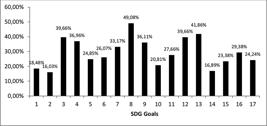
SDG targets that are mostly addressed in the company’s sustainability practices are respectively Goals 8, Goal 13, Goal 3, and Goal 12. This finding means that the company contributes more to providing decent work for society to increase economic growth as well as giving support for their good health and well-being. Those targets are the most relevant and feasible for the company to contribute given the role of the company in general is employing local workers and is responsible for increasing economic prosperity according to local wisdom. Consistent with Gunawan et al. (2020) who identified the types of sustainability activities based on the SDG framework in 2014-2016, Goal 3 and Goal 8 were SDG targets that are mostly implemented by companies. Moreover, the result also showed that companies now put effort into preventing the effects of climate change. This finding is in the opposite direction to prior research which found that companies rarely focus on this goal (Gunawan et al., 2020) which means that there is a shift in the focus of sustainability practice within the company. Companies are starting to focus on Climate Action to keep their business sustainable in the future.
Another SDG Goal that becomes companies’ concern is Goal 12 on responsible consumption and production. This might be due to the rising awareness from companies and pressure from stakeholders to implement good practices in the production and consumption cycle. Further, among all SDG targets, Goal 1, Goal 2, and Goal 14 are the least prioritized by the company. This is not surprising as private sectors act only a small portion in eradicating poverty and hunger. Most policies related to these goals are determined by each jurisdiction. Also, fewer companies address Goal 14 related to life under water since only certain types of industry might create direct and indirect impacts on water inhabitants.
4.2. Correlation Matrix
Table 4 presents the correlation matrix for each variable. In Table 4, it is shown that some variables have a positive correlation with firm value (TOBQ), namely SDG reporting (SDGR) and firm performance (ROA). A higher number of SDG targets reported in the Sustainability Report and higher firm performance are correlated to a higher firm value. On the other hand, firm size (SIZE), Growth Domestic Product (GDP), leverage (LEV), and level of investor protection (INV_PROTECT) have a negative correlation with firm value (TOBQ), which is surprisingly in the opposite direction as compared to most previous research. These findings indicate that there might be a positive association between the variable of interest SDG reporting and firm value, which will be analyzed further using regression analysis.
4.3. Regression Result
In the hypothesis, we proposed that SDG has become a framework for integrating sustainability practices into their business. Integrating comprehensive sustainability practice guidelines shows companies’ effort to fulfill a variety of stakeholders' needs. The higher SDG targets addressed by the companies means more companies are having positive impact on stakeholders. Therefore, reporting contributions toward SDG targets helps investors assess companies’ sustainability performance to predict future economic benefits. Better sustainability performance creates added value for stakeholders as the companies may have anticipation to mitigate risk in the future (Abdulrahman Anam et al., 2011). Therefore, the main hypothesis of this research is that SDG disclosure is positively associated with firm value.
To test the proposed hypothesis in this study, regression analysis was conducted using four models. Table 5 shows the result of regression analysis using different control variables. In model (1), the regression analysis only included organizational characteristics. The result showed a positive association between SDG disclosure and firm value. In model (2) the regression included institutional-level factors of growth domestic product (GDP) and investor protection (INV_PROTECT). Consistent with the model (1), the result also showed a positive association between SDG reporting and firm value. In model (2), we analyzed the data using country control while in model (4) was used the fixed industry effect. In both models (3) the result showed there is a positive association between SDG disclosure and firm value. The association is higher in p-value than in models (1) and 2), which is p<0.05 in the model (4). This means that the association is stronger.
Regression analysis further shows that firm size has significant negative association with firm value with p<0.01. This means that the bigger the company size, its firm value will decrease. On the other hand, leverage (LEV), economic condition (GDP), and investor protection (INV_PROTECT) does not have significant relationship with firm value. It shows that in this research, leverage is not necessarily incorporated in investors’ firm valuation. This finding is in contrast with correlation matrix result between leverage and firm value which showed a strong negative correlation. This finding implies that leverage and firm value were correlated but leverage has been unable to influence firm valuation. In contrast with previous control variable, firm performance (ROA) has a strong positive and significant association with firm value. In other words, investors give higher firm value to companies which have better firm performance. Lastly, data analysis shows that R-square is highest in model (4) by 34.94% after controlling fixed country and fixed industry effect, which is good. This means that the positive association of SDG disclosure toward firm value was resulted after considering the influence of country factor where the companies operate and the type of industry of which may give more impact toward people, planet, and prosperity.
Overall, data analysis using all models in this study shows that SDG disclosure is positive and significantly related to firm value. This means that the higher SDG target addressed by the companies in the sustainability report result in higher firm value. Therefore the hypothesis in this study is accepted. This finding is in line with the positive impact of sustainability disclosure in general toward firm value as stated by Kuzey & Uyar (2017) who found a positive relationship between sustainability disclosure and firm value. In accordance with Du et al. (2017) and Miralles-Quiros et al. (2017), SDG contribution information adds incremental value of company and it is value relevant for investors both for short term and long term benefit. By disclosing SDG contribution in the sustainability report, investor is better incorporate the information in the valuation.
4.4. Additional Analysis
Additional analysis was conducted to see whether there is difference in regression result between countries. The analysis tested the effect of SDG reporting (SDGR) toward firm value (TOBQ) using control variable firm size (SIZE), leverage (LEV), firm performance (ROA) and country economic condition (GDP). Investor protection (INV_PROTECT) was excluded as it is no longer necessary to control legal protection for each analysis. The result of regression is presented in Table 6.
Regression analysis shows that SDG reporting is significant and positively associated to firm value in Singapore with p<0.01 and in Malaysia with p<0.05. In Indonesia, Thailand, and Philippines, the analysis does not show similar result. This means that in Singapore and Malaysia, higher SDG reporting in Sustainability Report is likely to be followed by an increase in firm value. This is likely due to both countries are in the top rank of sustainability reporting in the world (KPMG International, 2022). In Malaysia, sustainability reporting has been mandatory to all listed companies since 2011. Therefore, subsequent to mandatory disclosure, information in the report is being more value relevant for investor, which is likely to be the reason why higher SDG reporting is associated to higher firm value. Similarly, in Singapore, the regulator implemented ‘comply or explain’ regulation which encourages companies to comply with sustainability reporting disclosure based on set of standards.
Consistent with Malaysia and Singapore, Thailand was also ranked in the highest rate of sustainability reporting in the world. However, regression result does not show any significant association between SDG reporting and firm value. Research revealed that in Thailand context, each scope of sustainability such as environment, social, and governance creates different influence on firm value. Environment and social scope are positively associated to firm value, while governance is in opposite direction (Noiang et al., 2023; Yordudom & Suttipun, 2020). As the scopes in SDG reporting in this study were not identified, it might lead to insignificant regression result. Similar to Thailand, data in Indonesia and Philippines also do not show any significant association between SDG reporting and firm value. This is not in line with previous studies which found a positive association (Aksan & Gantyowati, 2020; Carandang & Ferrer, 2020; Machmuddah et al., 2020). This means that SDG reporting is not taken into account by investors in firm valuation. Nevertheless, given that Indonesia and Philippines are still in infancy level in implementation of sustainability reporting, there is still limited availability and variability of data on sustainability reporting in both countries, which might become the cause of this different result.
5. CONCLUSIONS
This study investigates variations in SDG target disclosure in sustainability reports and examines the effect of SDG disclosure on firm value. Results revealed that SDG Disclosure in sustainability reports is moderately low in all sample countries. The integration of SDG targets is mainly focusing on providing Decent Work and Economic Growth, Climate Action, Good Health and Well-being, and Responsible Production and Consumption. Despite the low disclosure, private sector contribution towards SDG shows that firms are transforming to a more sustainable direction to meet stakeholders’ basic needs. These firms can also act as a benchmark for other firms to implement and report SDG targets and thus create global SDG contribution enhancement. For internal organizations, SDG implementation enables firms to put effort into increasing labor welfare, efficient use of resources, and considering sustainability issues in firms’ short-term and long-term policies.
Furthermore, data analysis revealed that SDG disclosure is found to have a positive and significant effect on firm value. This means that in the ASEAN context, investors give incremental value to the company which is more transparent in informing their contribution to SDG. It also indicates that investors do not only focus on short-term financial performance but also consider long-term performance in company valuations. Nonetheless, when dividing the analysis into country-level analyses, it is found that SDG reporting is only value-relevant in firm valuation located in Singapore and Malaysia.
This research provides several implications for theory and practice. This study enhances the theoretical comprehension of the influence of SDG (Sustainable Development Goals) disclosures on the value of companies by emphasizing the differences in various regions within Southeast Asia. The study shows that SDG disclosures have a positive impact on business value in Singapore and Malaysia, but they do not have a meaningful effect in Thailand, Indonesia, and the Philippines. he divergence between sustainability reporting and firm value implies that the relationship is context-dependent, influenced by factors, including GDP and financial performance. These findings contribute to the current body of research by highlighting the importance of a detailed and thoughtful approach to sustainability disclosures. They question the assumption that sustainability disclosures have the same impact in all markets and propose that enterprises should develop a customized strategy based on regional differences.
From a practical standpoint, our study provides interesting perspectives for investors. When making investment selections, investors should take into account the regional disparities emphasized in the study. SDG disclosures have a beneficial impact on the value of firms in Singapore and Malaysia. Therefore, investors in these countries can consider these disclosures as a factor when assessing possible investments. Companies that have strong reporting on the Sustainable Development Goals (SDGs) in these countries are likely to have greater transparency and dedication to sustainable practices. This can suggest long-term stability and ethical governance, making them appealing investment prospects.
Conversely, the minimal influence of SDG disclosures on the value of companies in Thailand, Indonesia, and the Philippines indicates that investors should not assign considerable importance to these disclosures when doing investment analysis in these countries. Alternatively, they may prioritize other financial and operational indicators when assessing companies in these nations. Moreover, investors have the opportunity to actively participate in improving firms' sustainability practices and reporting by engaging with them. This collaboration can increase awareness and progressively change market perceptions, ultimately resulting in a tighter connection between Sustainable Development Goal (SDG) disclosures and the value of the company in these specific locations.
This study is subject to several limitations. This study measured SDG disclosure using SDG targets that were addressed explicitly in the reports. Future research might do content analysis to analyze the narrative description of company sustainability practices in the reports and determine what SDG targets fits with such practices. This study also analyzed sustainability reports published in the Global Reporting Initiative database and in company websites. Some companies have not published their sustainability report. Therefore, future research using additional sources information such as annual report should improve data quantity, completeness, and enrich data analysis. Generalizability of this research is limited countries in ASEAN. Therefore, future research should examine other specific context with special characteristics to confirm generalization of the result.
References
- Abdulrahman Anam, O., Hamid Fatima, A., & Rashid Hafiz Majdi, A. (2011). Effects of Intellectual Capital Information Disclosed in Annual Reports on Market Capitalization. Journal of Human Resource Costing & Accounting, 15(2), 85-101.
- Accenture. (2018). Special Edition: Transforming Partnerships for the SDGs The UN Global Compact-Accenture Strategy CEO Study.
- Adams, C. A. (2017). Conceptualising the Contemporary Corporate Value Creation Process. Accounting, Auditing and Accountability Journal, 30(4), 906-931.
- Agarchand, N., & Laishram, B. (2017). Sustainable Infrastructure Development Challenges Through PPP Procurement Process: Indian Perspective. International Journal of Managing Projects in Business, 10(3), 642-662.
- Aksan, I., & Gantyowati, E. (2020). Disclosure on Sustainability Reports, Foreign Board, Foreign Ownership, Indonesia Sustainability Reporting Awards and Firm Value. Journal of Accounting and Strategic Finance, 3(1), 33-51.
- Anasi, S. N., Ukangwa, C. C., & Fagbe, A. (2018). University Libraries-Bridging Digital Gaps and Accelerating the Achievement of Sustainable Development Goals Through Information and Communication Technologies. World Journal of Science, Technology and Sustainable Development, 15(1), 13-25.
- Arena, C., Liong, R., & Vourvachis, P. (2018). Carrot or stick: CSR disclosures by Southeast Asian companies. Sustainability Accounting, Management and Policy Journal, 9(4), 422-454.
- ASEAN Secretariat. (2020). ASEAN Sustainable Development Goals Indicators Baseline Report 2020 ASEAN Secretariat.
- Bauer, R., & Smeets, P. (2015). Social Identification and Investment Decisions. Journal of Economic Behavior and Organization, 117, 121-134.
- Bebbington, J., & Unerman, J. (2018). Achieving the United Nations Sustainable Development Goals: An enabling role for accounting research. Accounting, Auditing and Accountability Journal, 31(1), 2-24.
- Betti, G., Consolandi, C., & Eccles, R. G. (2018). The Relationship Between Investor Materiality and the Sustainable Development Goals: A Methodological Framework. Sustainability (Switzerland), 10(7), 2248.
- Biermann, F., Kanie, N., & Kim, R. E. (2017). Global Governance by Goal-setting: The Novel Approach of the UN Sustainable Development Goals. Current Opinion in Environmental Sustainability, 26-27, 26-31.
- Borgers, A., Derwall, J., Koedijk, K., & ter Horst, J. (2015). Do Social Factors Influence Investment Behavior and Performance? Evidence from Mutual Fund Holdings. Journal of Banking and Finance, 60, 112-126.
- Bose, S., & Khan, H. Z. (2022). Sustainable development goals (SDGs) reporting and the role of country-level institutional factors: An international evidence. Journal of Cleaner Production, 335(December 2021), 130290.
- Bose, S., Khan, H. Z., & Bakshi, S. (2024). Determinants and Consequences of Sustainable Development Goals Disclosure: International Evidence. Journal of Cleaner Production, 434(February 2023), 140021.
- Carandang, J. C., & Ferrer, R. C. (2020). Effect of environmental accounting on financial performance and firm value of listed mining and oil companies in the Philippines. Asia-Pacific Social Science Review, 20(1), 117-134.
- Chernev, A., & Blair, S. (2015). Doing well by doing good: The benevolent halo of corporate social responsibility. Journal of Consumer Research, 41(6), 1412-1425.
-
Čičak, J. (2023). Sustainable Development Goals Reporting in Public Sector Organizations. In M Mihić, S Jednak & G Savić (Eds.), Sustainable Business Management and Digital Transformation: Challenges and Opportunities in the Post-COVID Era Springer. https://doi.org/10.1007/978-3-031-18645-5_23
» https://doi.org/10.1007/978-3-031-18645-5_23 - de Villiers, C., & Marques, A. (2016). Corporate Social Responsibility, Country-Level Predispositions, and The Consequences of Choosing A Level of Disclosure. Accounting and Business Research, 46(2), 167-195.
- Dhaliwal, D. S., Li, O. Z., Tsang, A., & Yang, Y. G. (2011). Voluntary nonfinancial disclosure and the cost of equity capital: The initiation of corporate social responsibility reporting. Accounting Review, 86(1), 59-100.
- Du, S., Yu, K., Bhattacharya, C. B., & Sen, S. (2017). The Business Case for Sustainability Reporting: Evidence from Stock Market Reactions. Journal of Public Policy and Marketing, 36(2), 313-330.
- Endrikat, J., Guenther, E., & Hoppe, H. (2014). Making sense of conflicting empirical findings: A meta-analytic review of the relationship between corporate environmental and financial performance. European Management Journal, 32(5), 735-751.
- Flammer, C. (2013). Corporate Social Responsibility and Shareholder Reaction: The Environmental Awareness of Investors. Academy of Management Journal, 56(3), 758-781.
- Gao, F., Dong, Y., Ni, C., & Fu, R. (2016). Determinants and Economic Consequences of Non-financial Disclosure Quality. European Accounting Review, 25(2), 287-317.
- García Meca, E., & Martínez Ferrero, J. (2021). Is SDG Reporting Substantial or Symbolic? An Examination of Controversial and Environmentally Sensitive Industries. Journal of Cleaner Production, 298, 126781.
- Gujarati, D. N. (2003). Basic econometrics McGraw Hill.
- Gunawan, J., Permatasari, P., & Tilt, C. (2020). Sustainable Development Goal Disclosures: Do They Support Responsible Consumption and Production? Journal of Cleaner Production, 246, 118989.
- Hales, J., Matsumura, E. M., Moser, D. V., & Payne, R. (2016). Becoming Sustainable: A Rational Decision based on Sound Information and Effective Processes? Journal of Management Accounting Research, 28(2), 13-28.
- Harrison, J. S., Bosse, D. A., & Phillips, R. A. (2010). Managing for Stakeholders, Stakeholder Utility Functions, and Competitive Advantage. Source: Strategic Management Journal, 31(1), 58-74.
- Helfaya, A., Aboud, A., & Amin, E. (2023). An Examination of Corporate Environmental Goals Disclosure, Sustainability Performance and Firm Value - An Egyptian Evidence. Journal of International Accounting, Auditing and Taxation, 52(June), 100561.
- Hummel, K., & Szekely, M. (2022). Disclosure on the Sustainable Development Goals-Evidence from Europe. Accounting in Europe, 19(1), 152-189.
-
International Monetary Fund. (2018). World Economic Outlook: Challenges to Steady Growth https://www.imf.org/en/Publications/WEO/Issues/2019/08/30/World-Economic-Outlook-October-2018-Challenges-to-Steady-Growth-46081
» https://www.imf.org/en/Publications/WEO/Issues/2019/08/30/World-Economic-Outlook-October-2018-Challenges-to-Steady-Growth-46081 - Ito, H. (2018). Analysis of Impacts of SDGs Activities on Firm Value and Utility: Proposals of SDGs Finance and Indices in Japan. J-STAGE, 10(1), 42-56.
- Izzo, M. F., Ciaburri, M., & Tiscini, R. (2020). The challenge of sustainable development goal reporting: The first evidence from italian listed companies. Sustainability (Switzerland), 12(8), 3494.
- KPMG International. (2022). Big Shifts, Small Steps KPMG.
- Kuzey, C., & Uyar, A. (2017). Determinants of sustainability reporting and its impact on firm value: Evidence from the emerging market of Turkey. Journal of Cleaner Production, 143, 27-39.
- La Porta, R., Lopez-de-Silanes, F., Shleifer, A., & Vishny, R. W. (1998). Law and Finance. Journal of Political Economy, 106(6), 1113-1155.
- Lawati, H. Al, & Hussainey, K. (2022). Does Sustainable Development Goals Disclosure Affect Corporate Financial Performance? Sustainability, 14(13), 7815.
- Li, Y., Gong, M., Zhang, X. Y., & Koh, L. (2018). The impact of environmental, social, and governance disclosure on firm value: The role of CEO power. British Accounting Review, 50(1), 60-75.
- Maas, S., Schuster, T., & Hartmann, E. (2014). Pollution Prevention and Service Stewardship Strategies in the Third-Party Logistics Industry: Effects on Firm Differentiation and the Moderating Role of Environmental Communication. Business Strategy and the Environment, 23(1), 38-55.
- Machmuddah, Z., Sary, D. W., & Utomo, S. D. (2020). Corporate Social Responsibility, Profitability and Firm Value: Evidence from Indonesia. The Journal of Asian Finance, Economics and Business, 7(9), 631-638.
- Michael Spence. (1973). Job Market Signaling. The Quarterly Journal of Economics, 87(3), 355-374.
- Miralles-Quiros, M. del M., Miralles-Quiros, J. L., & Arraiano, I. G. (2017). Are Firms that Contribute to Sustainable Development Valued by Investors? Corporate Social Responsibility and Environmental Management, 24(1), 71-84.
- Muhmad, S. N., & Muhamad, R. (2021). Sustainable business practices and financial performance during pre- and post-SDG adoption periods: A systematic review. Journal of Sustainable Finance & Investment, 11(4), 291-309.
- Nicolo’, G., Zampone, G., De Iorio, S., & Sannino, G. (2024). Does SDG Disclosure Reflect Corporate Underlying Sustainability Performance? Evidence from UN Global Compact Participants. Journal of International Financial Management and Accounting, 35(1), 214-260.
- Noiang, C., Technology, I., Phoprachak, D., Technology, I., Charoenkitthanalap, S., Technology, I., & Dampitakse, K. (2023). Sustainable development disclosure towards firm value through financial strength among enlisted firms in Stock Exchange of Thailand during COVID-19 outbreak. Central European Management Journal, 13(3), 12.
- Ozkan, A., Temiz, H., & Yildiz, Y. (2023). Climate Risk, Corporate Social Responsibility, and Firm Performance. British Journal of Management, 34(4), 1791-1810.
- Pineda-Escobar, M. A. (2019). Moving the 2030 agenda forward: SDG implementation in Colombia. Corporate Governance (Bingley), 19(1), 176-188.
- Platonova, E., Asutay, M., Dixon, R., & Mohammad, S. (2018). The Impact of Corporate Social Responsibility Disclosure on Financial Performance: Evidence from the GCC Islamic Banking Sector. Journal of Business Ethics, 151(2), 451-471.
- Ramos, D. L., Chen, S., Rabeeu, A., & Rahim, A. B. A. (2022). Does SDG Coverage Influence Firm Performance? Sustainability (Switzerland), 14(9).
- Rosati, F., & Faria, L. G. D. (2019a). Addressing the SDGs in Sustainability Reports: The Relationship With Institutional Factors. Journal of Cleaner Production, 215, 1312-1326.
- Rosati, F., & Faria, L. G. D. (2019b). Business contribution to the sustainable development agenda: Organizational factors related to early adoption of SDG reporting. Corporate Social Responsibility and Environmental Management, 26(3), 588-597.
- Scheyvens, R., Banks, G., & Hughes, E. (2016). The private sector and the SDGs: The need to move beyond ‘business as usual’. Sustainable Development, 24(6), 371-382.
- Taylor, J., Vithayathil, J., & Yim, D. (2018). Are Corporate Social Responsibility (CSR) Initiatives such as Sustainable Development and Environmental Policies Value Enhancing or Window dressing? Corporate Social Responsibility and Environmental Management, 25(5), 971-980.
- Terama, E., Milligan, B., Jiménez-Aybar, R., Mace, G. M., & Ekins, P. (2016). Accounting For The Environment As An Economic Asset: Global Progress and Realizing The 2030 Agenda For Sustainable Development Sustainability Science, 11(6), 945-950.
-
United Nations. (2015, October 21). Transforming Our World: The 2030 Agenda for Sustainable Development https://sdgs.un.org/2030agenda
» https://sdgs.un.org/2030agenda - Wang, Z., Hsieh, T. S., & Sarkis, J. (2018). CSR Performance and the Readability of CSR Reports: Too Good to be True? Corporate Social Responsibility and Environmental Management, 25(1), 66-79.
- Yordudom, T., & Suttipun, M. (2020). The Influence of ESG Disclosures on Firm Value in Thailand. GATR Journal of Finance and Banking Review, 5(3), 108-114.
Edited by
-
EDITOR-IN-CHIEF (UNTIL 12/31/2024)
Bruno Felix https://orcid.org/0000-0001-6183-009X
-
EDITOR-IN-CHIEF (AS OF 01/01/2025)
Marcia Juliana d’Angelo, https://orcid.org/0000-0003-1436-5812
-
ASSOCIATE EDITOR
Verônica de Fátima Santana, https://orcid.org/0000-0002-9105-7488
Not applicable.

 Source: Survey data.
 Source: Survey data.