
 Formulating Creative Industry Competitiveness Enhancement Strategies in Banda Aceh, Indonesia Using an Analytical Hierarchy Process
ABSTRACT
This study aims to formulate strategic steps fopr increasing the competitiveness of the creative industry, especially the craft subsector in Banda Aceh, Indonesia. The primary data in this study were obtained through interviews and questionnaires for stakeholders who have an interest in, and understand the development of, creative industries in Banda Aceh. Data analysis used a multi-criteria approach (MCA) with the Analytical Hierarchy Process (AHP) method and the Expert Choice application. The study results determined 3 (three) main strategies for increasing competitiveness, namely: chance, the role of government, and demand conditions, each having important sub-criteria including technological tools, policies, and product variations. In addition, there must be established an an optimistic alternative as a priority strategy for increasing the competitiveness of the creative industry in the craft subsector in Banda Aceh. The study's contribution lies in offering actionable guidelines that creative industry stakeholders can implement in order to enhance the competitiveness of their sectors in both domestic and international markets.
KEYWORDS:
creative economy; craft subsector; Banda Aceh; competitive advantage; AHP
RESUMO
Este estudo visa formular passos estratégicos para aumentar a competitividade da indústria criativa, especialmente o subsetor artesanal em Banda Aceh, Indonésia. Os dados primários deste estudo foram obtidos através de entrevistas e questionários para partes interessadas que têm interesse e compreendem o desenvolvimento das indústrias criativas em Banda Aceh. A análise dos dados utilizou uma abordagem multicritério (MCA) com o método Analytical Hierarchy Process (AHP) e a aplicação Expert Choice. Os resultados do estudo concluíram 3 (três) estratégias principais para aumentar a competitividade, nomeadamente o acaso, o papel do governo e as condições de procura, tendo cada subcritério importante, incluindo ferramentas tecnológicas, políticas e variações de produtos. Além disso, precisa estabelecer uma alternativa optimista como estratégia prioritária para aumentar a competitividade da indústria criativa no subsector artesanal em Banda Aceh. A contribuição do estudo reside em oferecer diretrizes viáveis que as partes interessadas da indústria criativa podem implementar para aumentar a competitividade dos seus setores nos mercados nacionais e internacionais.
PALAVRAS-CHAVE:
Economia criativa; Subsetor artesanal; Banda Aceh; Vantagem competitiva; AHP
1. INTRODUCTION
The competitive advantage of a region originates from increasing the capacity of the industries within it to innovate and overcome the competition (Best, 2001, Duane Ireland and Webb, 2007, Chen et al., 2009). These industries must have competitiveness to strengthen their superior position over other similar industries and maintain their sustainability. Previous studies have shown that industries with competitiveness provide more economic benefits such as high returns (Kroll et al., 1999), improved marketing performance (Hajar and Sukaatmadja, 2016), improved firm financial performance (Majeed, 2011), and impact on employment (Atmaja, 2003). Thus, from a series of economic benefits, industrial competitiveness is expected to increase regional economic growth.
An industry that has a close relationship with the development of regional economic competitiveness is the creative industry. The creative industry is a new idea, concept, and talent that provides added economic value, and can trigger regional competitiveness (Saksono, 2012). It is an industry that focuses on skill and creativity and maximizes individuals’ skills, creativity, and talents in creating welfare and employment (Departemen-Perdagangan-RI, 2010) The creative industry is part of the creative economy. In this case, the creative economy is a process of its products and services, while the creative industry is a process of its business (Ginting et al., 2018). The government has encouraged the growth of the creative economy by establishing the Creative Economy Agency through the Presidential Regulation of the Republic of Indonesia Number 6 of 2015 on the Creative Economy Agency. It is expected that the creative industry is able to support the economy at the district/city level throughout Indonesia.
In Indonesia, the creative economy is managed by the Creative Economy Agency (Bekraf) as a non-ministerial institution under the responsibility of the President and the government in the tourism sector. Bekraf has the main task of assisting the President in formulating, stipulating, coordinating, and synchronizing creative economy policies relating to 18 subsectors designed for the long term until 2025. Those subsectors include (1) the animation sector; (2) architecture; (3) design; (4) photography; (5) music; (6) crafts; (7) the culinary sector; (8) Modes; (9) research and development; (10) publishing; (11) film; (12) advertising; (13) interactive games; (14) performing arts; (15) fine arts; (16) information technology; (17) television and radio; and (18) videos (Suparmin et al., 2017).
Indonesia has great potential for the development of the creative economy. As evidenced by the fact that, in 2020, the creative economy sector was able to contribute IDR 1,100 trillion to Indonesia’s Gross Domestic Product (GDP) (Indonesia's-Economic-Outlook, 2020). In Indonesia, the city of Aceh Besar and Banda Aceh are two regions with great potential in the creative economy, especially in the handicraft and culinary subsector (Toarik, 2022). In addition, according to the assessment, the creative industry in the handicraft subsector in Banda Aceh has the potential to penetrate the global market by having high-quality and very competitive products, such as songket drawstring bags, wallets, sarongs, and clothing with distinctive motifs. Hence, they deserve to be in the international market (Damkar, 2020). However, from an evaluation carried out by the Aceh Industry and Trade Office, the growth of the creative industry was still very low, i.e., 1.9%. This was due to the low interest and creativity of IKM (Small and Medium Industry) artisans in creating creative products and product diversification, not to mention the weakening rate of global economic growth (Renja-Indag, 2020). Thus, the IKM actors, especially locally-based creative industries, must be continuously empowered to increase product competitiveness in national and international markets.
The problem depicted from the aforementioned background is the low growth of the creative industry in Banda Aceh, even though it has great potential and decent quality to be developed in the international market. Therefore, it is necessary to conduct an in-depth study on how to increase the competitiveness of the creative industries in Banda Aceh. Success in increasing the competitiveness of a product requires the right strategy. Some previous literature formulated the strategies used to develop the creative economy in Indonesia. A study conducted by Daulay (2018) stated that the development of the creative economy is carried out through mutual collaboration between the three actors (business people, government, and academics) in designing and developing the creative economy. In this case, they used an aggressive strategy-the S-0 strategy-to use strength to take advantage of opportunities. Furthermore, the results of the study by Swastuti and Pudjiarti (2021) stated that the competitiveness of the creative economy can be increased through three important factors, namely, location characteristics, micro-meso-macro level performance, demand factors, technological factors, and tourism factors.
The two previous studies, conducted by Daulay (2018) and by Swastuti and Pudjiarti (2021), both employed qualitative research methods. As an additional step in further development, considering the integration of quantitative research methods can provide an additional dimension for measuring aspects related to the topic of creative economic research. Additionally, this study takes into account important external factors such as opportunities and support related to the industry and threats from competitors in similar industries.
Moreover, Porter (1980) stated that three Generic Strategies can be used to overcome the competition, including cost leadership, differentiation, and focusing services on certain markets (focus strategy). In addition, Wiersema and Treacy (1992) mentioned three strategies which can be implemented to increase competitiveness, namely, (1) operating efficiently and producing quality products (operational excellence), (2) creating closeness and intimacy with consumers (customer intimacy), and (3) being a leader in the same product (product leadership).
Another strategic model that can be used in building competitiveness is the diamond model proposed by Porter (1990). It is stated that a competitiveness strategy can be achieved from several dimensions, such as factor conditions, demand conditions, supporting and related industries, firm strategy and competition, the role of government, and opportunities. Meanwhile, Kotler and Maesincee (1997) added the dimension of social capital to increase competitiveness. Referring to some of the literature previously presented, this study attempts to formulate strategies and efforts to increase competitiveness in the creative industries, especially the craft subsector in Aceh. The conceptual model used in developing the strategy formulation refers to the diamond model by Porter (1990) and the additional method by Kotler and Maesincee (1997). The dimensions in Porter's Diamond Model (Porter, 1990) have also adopted literature from Porter (1980) and Wiersema and Treacy (1992). Furthermore, the conceptual model is developed from these dimensions into an operational model. Where the data collected were analyzed using a multi-criteria analysis approach (MCA = Multi-Criteria Analysis) to develop a strategy for the competitiveness of the craft industry, employing the Expert Choice application.
The strategy formulation that refers to Porter and Kotler’s diamond model is based on the fact that the diamond model was developed to increase competitiveness in certain areas and has business advantages over its competitors (Porter, 1980). This is very relevant to being applied to Banda Aceh, which is an area with potential excellence in the craft industry. The implementation of the diamond model in this study utilizes a quantitative research methodology to quantify the research findings in a more objective manner. In addition, the diamond model has never been used in research to formulate a creative industry competitiveness strategy in Banda Aceh. This study aims to formulate strategic steps to increase the competitiveness of the creative industry, especially the craft subsector in Banda Aceh. The study results concluded 3 (three) main strategies for increasing competitiveness, namely chance, the role of government, and demand conditions, and contained important sub-criteria including technological tools, policies, and product variations. In addition, there must be established an optimistic alternative as a priority strategy for increasing the competitiveness of the creative industry in the craft subsector in Banda Aceh. This research is expected to contribute to theoretical and practical implications. Theoretically, it contributes to scientific development in management, especially in building conceptual models of strategies for increasing industrial competitiveness. Meanwhile, practically, this research contributes to providing practical guidelines that can be applied to creative industry actors in increasing the competitiveness of their industries both in the national and international markets.
2. LITERATURE REVIEW
2.1. Resources-Based View (RBV) Theory
The resource-based view theory explains that a firm’s sustainable competitive advantage comes from a firm’s resources and capabilities that are valuable, rare, cannot be perfectly imitated, and cannot be replaced by competitors (Barney, 1991). Those resources and capabilities can be a set of tangible and intangible assets, including the firm’s management skills, organizational processes and routines, and the information and knowledge controlled by the firm. Industries or firms with dynamic capabilities, namely the specific processes firms use to turn their resource base into a source of competitive advantage (Eisenhardt and Martin, 2000). Resources, dynamic capabilities, and knowledge are closely related to building a sustainable competitive advantage (Barney et al., 2001).
RBV analyzes and interprets an organization’s resources to understand how an organization achieves a sustainable competitive advantage. RBV focuses on difficult-to-imitate firm attributes as a source of superior performance and competitive advantage (Barney, 1986). A resource, which cannot be easily transferred or purchased and requires an extended learning curve or a major change in the organizational climate and culture, is more likely to be unique to the organization and, therefore, more difficult for competitors to imitate. According to Conner (1991), variations in performance between firms depend on the ownership of unique inputs and capabilities. Resources are the firm’s input in activities; thus, internal resources and capabilities determine firms’ strategic choices when facing external business environment competition (Madhani, 2009).
Preliminary research only classifies firm resources into three categories: physical, monetary, and human (Ansoff, 1965). In this case, a more detailed description of the organizational resources, such as skills, knowledge, and technology (technical knowledge), is developed (Hofer and Schendel, 1978). Ray et al. (2004) understood firms' difficulty in changing their resources. They suggested that firms redesign processes, activities, and routines to enable them to have the ability to use resources efficiently and effectively in achieving a sustainable competitive advantage.
2.1.1. Competitive Advantage
A competitive advantage is gained when an organization develops or acquires a set of attributes (or takes actions) that enable it to outperform its competitors. Porter (1980) explains that competitive advantage is the core of a firm’s performance in the face of market competition and how a firm can create and maintain a competitive advantage in an industry. Thus, competitive advantage means having a low cost, differentiation advantage, or a successful focus strategy. In addition, Porter (1980) argues that competitive advantage grows fundamentally from the value a firm is able to create for its buyers, exceeding the costs it incurs in producing it.
Wang et al. (2011) classify three sources that can build a competitive advantage. First, technology and continuous innovation for products and services. Second, human resources that support competitive advantage. Third, an effective organizational structure will facilitate working relationships between various entities and improve work efficiency within organizational units. Some literature explains that the sources of competitive advantage, such as market orientation and product innovation, positively influence competitive advantage. In contrast, high learning orientation increases product innovation in building competitive advantage, in addition to market orientation, product innovation, and competitive advantage, which equally affect customer satisfaction (Lionora and Kusumawardhani, 2021, Digdowiseiso and Lestari, 2021). Furthermore, certain cultural aspects increase performance/competitiveness for bilateral trade; certain cultural aspects, including performance orientation, future orientation, institutional collectivism, gender egalitarianism, power distance, and uncertainty avoidance, improve bilateral trade performance, while assertiveness, humanitarian orientation, and in-group collectivism worsen performance (Mornah and MacDermott, 2016).
2.1.2. Competitiveness Strategy with Porter and Kotler Diamond Model
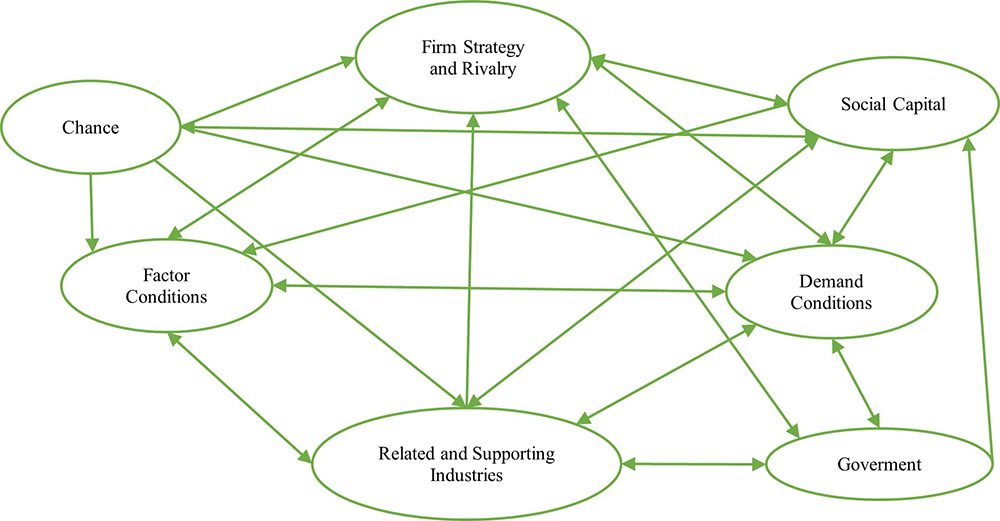
According to Porter (1990), the diamond model states that a competitiveness strategy can be achieved from several dimensions: factor conditions, demand conditions, supporting and related industries, firm strategy and competition, the role of government, and opportunities. Meanwhile, Kotler and Maesincee (1997) added a dimension of social capital to increase competitiveness. Furthermore, these dimensions are used to measure industrial competitiveness and then developed into an operational model. The factor condition dimension is built by elements of human resources, natural resources, and capital. The demand condition dimension is built by demand sources and quantities, product marketing, product quality, product design, and product variety. The dimensions of supporting and related industries are built by geographical location, procurement process, quality of supporting materials, and supporting material training. The dimensions of corporate strategy and competition are built by new products, reductions in product prices and production costs, and new technologies. The dimensions of the government’s role are built by facilitation programs, training, and policy. The chance dimension is built by technological tools and political conditions. The dimension of social capital is built by communication and interaction, familial, honesty, and rules. Diamond Porter and Kotler’s conceptual models is shown in Figure 1.

3. METHODOLOGY
This explanatory research paper is a descriptive study that aims to make systematic, factual and accurate descriptions of the facts and characteristics and relationships between the phenomena investigated (Sugiyono, 2012). The research location is in Banda Aceh, involving creative economy actors in the handicraft subsector. Data sources include primary data obtained from interviews and questionnaires. The respondents are stakeholders who relatively understand and are interested in selecting creative industry competitiveness strategies for the craft subsector in Banda Aceh, including related agencies, creative economy actors (craftsmen), and academicians. Stakeholders consisted of six respondents, namely one person from the Banda Aceh Industry and Trade Service officials, two people from the Banda Aceh Cooperatives and MSME Office officials, one person from the Banda Aceh Tourism Office official, one person from an academic institution-a lecturer at the Faculty of Economics and Business from Syiah Kuala University in Banda Aceh-and one creative industry actor in the craft subsector in Banda Aceh.
The selection of stakeholders is considered representative due to their understanding and knowledge of the conditions and competitive strategies that can be developed for the craft creative industry sector in Banda Aceh. For instance, stakeholders from the Department of Industry and Trade are responsible for conducting training and development of production, industrial business development, as well as monitoring and controlling existing industries in Aceh. Stakeholders from the Department of Cooperatives and MSME are tasked with formulating technical policies and carrying out operational technical activities in the field of cooperatives and MSME, where creative industry practitioners in the craft subsector are part of cooperative and MSME activities in Banda Aceh. Craft products are a key support for the tourism industry in Banda Aceh, hence this research also includes stakeholders from the Banda Aceh Tourism Department. Stakeholders from academia, represented by lecturers at Syiah Kuala University in Banda Aceh, are included due to their theoretical and empirical knowledge related to the creative industry in Banda Aceh. Meanwhile, stakeholders from the craft creative subsector serve as representations of the real conditions and issues faced by craft industry practitioners in Banda Aceh. The total of these six stakeholders is deemed relevant, as they have a relatively good understanding and vested interest in the selection of competitive strategies for the craft creative industry sector in Banda Aceh. There are two stakeholders from the Department of Cooperatives and MSME, which is different from the others, based on the fact that one person represents the cooperative field and the other represents the MSME field.
The data collected were analyzed using a multi-criteria analysis approach (MCA = Multi-Criteria Analysis) to develop a strategy for the competitiveness of the craft industry employing the Expert Choice application. In this case, stakeholder perceptions guide decision-making in handling the craft industry in Banda Aceh. Multi-Criteria Analysis (MCA) is a decision-making method used to select the best alternative from a set of options, by considering multiple, often conflicting, criteria. (Supriadi et al., 2018). The multi-criteria decision-making process is carried out using the Analytical Hierarchy Process (AHP) method, which decomposes problems by identifying the criteria and sub-criteria to be used. The main criteria in selecting a creative industry competitiveness strategy for the craft subsector refer to the models from Porter (1990) and Kotler and Maesincee (1997). The main criteria include factors of production, demand conditions, supporting industries, firm strategy and rivalries, the government’s role, opportunities, and social capital. This main aspect is divided into sub-criteria, three for factor conditions, six for demand conditions, four for supporting and competing industries, three for the role of government, two for opportunities, and five for social capital. The detailed main criteria and sub-criteria for evaluating the competitiveness of the creative industries are shown in Table 1.
Meanwhile, the AHP method analysis uses questionnaire responses derived from stakeholders who understand and are interested in selecting a competitive strategy for the creative industry in the craft subsector in Banda Aceh. Each questionnaire response has a score on a scale between 1 to 9. Values and definitions of quantitative opinions on a comparison scale are presented in the following Table 2.
4. RESULT AND DISCUSSION
The AHP model uses multiple criteria that form a hierarchical analysis process, aiming at the top position, followed by the main criteria, main sub-criteria, and problem alternatives. The research hierarchy is the basis for preparing questionnaires and processing data. Each of these sub-criteria is given a name. The research hierarchy is presented in Figure 2.

4.1. Pairwise Comparison of Criteria
This section compares the seven criteria for selecting a competitive strategy for the creative industry in the craft subsector in Banda Aceh. Referring to the results of the analysis, the order of the most important criteria is presented in Figure 3.

Figure 3 shows the criteria for determining the strategies for competitiveness of the creative industry in the craft subsector in Banda Aceh. The top three sequential priorities are chance (0.210), government’s roles (0.168), and demand conditions (0.146). Meanwhile, the lowest level of importance is the related and supporting industries (0.092).
Thus, the results of the analysis of the competitive strategy for creative industry, especially the craft subsector in Banda Aceh, which considers several criteria, show the “chance” factor became the most important. Chance refers to factors that can influence the opportunities of success for a creative industry in the craft subsector in Banda Aceh. Chance criteria can be understood as factors that create opportunities for firms or business actors to develop innovative products or services, meeting the market needs well. This is in line with Warglien and Arkhipov (2015), stating that superior and sustainable firm performance comes from opportunities that are not owned by other firms. Taking advantage of opportunities in the industry is an important part of business strategy. By identifying and taking advantage of existing opportunities, firms can increase growth, strengthen their position in the market, and gain a sustainable competitive advantage. Furthermore, the results of this study support previous studies which concluded that chance is a factor driving the main competitiveness of firms (Bhawsar and Chattopadhyay, 2015, Liu, 2017, Fang et al., 2018).
The results of the analysis show that the second highest strategy in increasing competitiveness is “government’s roles.”. This describes the government’s ability to provide support, incentives, and regulations to increase the competitiveness of the creative industry in the craft subsector in Banda Aceh. The development of small industries to have high competitiveness is not only borne by the actors themselves, but must obtain support from all stakeholders, one of which is the government (Wuryandani and Meilani, 2013, Utomo et al., 2021). Government support in both regulation and policy has been proven to increase the competitiveness of small and medium industries (Jeppesen, 2005). Furthermore, the results of this study strengthen the research by Anton et al. (2015) which states that, to increase the competitiveness of small and medium enterprises, they must be assisted by the government, so that business actors can access financial institutions and expand marketing networks.
The third priority strategy is to pay attention to “demand conditions.” The demand conditions refer to market conditions or the economic environment in which craft products in Banda Aceh are sold or consumed. Demand conditions are highly dependent on factors such as demand sources, demand quantities, product marketing, product design, and product variety. Roostika et al. (2015) argued that demand conditions determine and significantly influence business competitive advantage. Demand conditions can be key in establishing competitive advantage, especially when certain industry segments find a larger or more prominent market share at home than in foreign markets (Porter, 1990). By considering the demand conditions, firms can develop holistic and sustainable strategies to achieve a strong competitive advantage and adapt to changing market dynamics.
4.1.1. Pairwise Comparison of Sub-Criteria
There are sub-criteria of the seven criteria used in determining strategies increase competitiveness. This section presents a comparative analysis of the importance level between sub-criteria. The sequence of the criteria from the most to the lowest importance is chance, government role, demand conditions, strategy and firm, social capital, factor conditions, and related and supporting industries.
The results of the pairwise comparison analysis between the sub-criteria for the chance criteria with the sub-criteria for technological tools and political conditions are presented in Figure 4.

Figure 4 shows that the most important sub-criteria in the “chance” criterion is technological tools (0.579), followed by political conditions (0.421). Technology plays an important role in the competitiveness of the craft industry in Banda Aceh. The technology tool sub-criteria are a strategy for industry actors to have access to the latest technology, the ability to update or improve production equipment and machinery, and the ability to utilize digital and internet technology in product marketing and distribution. Firms that build competitive advantages through technology are oriented towards becoming leaders in their industry by offering products with the best performance, lowest cost, and highest quality (Morone, 1993). Technology has a competitive impact in two main ways: market advantage through differentiation or value addition and cost advantage through improvement of the economy of the system as a whole (Fleming, 1991). The results of this study are in line with several studies showing the proven role of technology as an effective strategy in increasing firm competitiveness (Haseeb et al., 2019, Saeidi et al., 2019, Khaddam et al., 2020, Nguyen and Timilsina, 2023).
The government’s role is the second most important criterion in selecting a strategy for the competitiveness of the craft industry in Aceh, with sub-criteria including policies, facilitation program, and training. The following figure presents the results of a pairwise comparison analysis between sub-criteria for the government’s role criteria.

Figure 5 shows that policy (0.505) is the first most important sub-criteria on the criteria for the government’s role in increasing the competitiveness of the craft industry in Banda Aceh. Then, the second and third sub-criteria are the facilitation program (0.253) and training (0.242). The policy refers to a series of actions taken by the government to create a conducive business climate for the development of the creative industry in the craft subsector in Banda Aceh. Government policies that support the development of creative industries include tax policies, incentives, regulations, and assistance programs available to creative industry actors. This also includes the government’s efforts to facilitate market access, research and development support, and the development of other supporting infrastructure for creative industry actors. In line with Saptana et al. (2022), to improve industrial competitiveness, government policies should be related to improving efficient production and logistics systems with the support of infrastructure, distribution, and marketing facilities, increasing access to market information, eliminating inefficiencies, and encouraging competitive market mechanisms. Appropriate government policies will be able to run linearly with other government roles in facilitation programs and training.
Furthermore, the criteria for demand conditions as a strategy for the competitiveness of the craft industry in Banda Aceh have several sub-criteria, including demand source, demand quantity, product marketing, product design, and product variety. The results of the pairwise comparison analysis between sub-criteria for the demand condition criteria are shown in Figure 6.
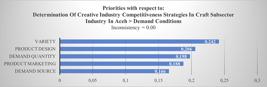
Figure 6 shows that the most important sub-criteria to the lowest level of importance in the “demand conditions” criteria are variety (0.242), product design (0.206), demand quantity (0.198), product marketing (0.188), and demand source (0.166). Variety is important in the strategy to increase the competitiveness of the creative industry in the craft subsector in Banda Aceh. Operationally, product variety can be measured through several indicators including number of products, product variety, and product innovation. Product variety is one of the keys to a firm’s competitiveness because it increases customer satisfaction and provides added value for consumers. In addition, it is important to manage product variety throughout the product life cycle from development to production, in order to meet customer needs precisely and efficiently (Elmaraghy et al., 2013).
Firm strategy and rivalry are the fourth most important criterion in determining the competitiveness strategy for the craft industry in Banda Aceh, having sub-criteria including price and cost reduction, new technology, and new products. The results of the pairwise comparison analysis between sub-criteria for the firm strategy and rivalry criteria are shown in Figure 7.

Figure 7 shows that price and cost reductions are the most important sub-criteria with a value of 0.361 from new technology (0.352) and new products (0.286) in the “firm strategy and rivalry” criteria. The price and cost reduction for the craft industry in Banda Aceh refers to efforts to lower product prices and production costs in order to maintain or increase its market share in the face of its competitors. Product price reduction can be done through pricing strategies such as discounts, promotions, or bundling to attract customers and compete with competitors in the market. Meanwhile, production cost reduction can be done by adopting more efficient technologies, optimizing the use of resources, and increasing overall operational efficiency. Price and cost reduction has been proven as a business strategy that can increase firm competitiveness (Yanto and Ariadi, 2020).
Social capital is the fifth most important criterion in choosing a strategy to increase the competitiveness of the creative industry in the craft subsector in Banda Aceh. The criteria for social capital have several sub-criteria, namely communication and interaction, familial, honesty, cooperation, and rules. The results of the pairwise comparison analysis between sub-criteria for the ‘social capital’ criterion are presented in Figure 8.
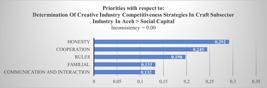
Figure 8 shows the order of the most important sub-criteria of the “social capital” criterion, starting from honesty (0.292), cooperation (0.245), rules (0.198), familial (0.133), and communication and interaction (0.132). Honesty is the main sub-criteria of social capital as a strategy to increase the competitiveness of the creative industry in the craft subsector in Banda Aceh. Honesty can be interpreted as the ability of the community and creative industry actors in the craft subsector in Aceh to behave honestly in conducting business interactions and transactions, and not to practice corruption and nepotism. This can be reflected in openness in providing information and commitment to fulfilling business agreements by adhering to ethical principles and good values. To maintain business competitiveness in an increasingly transparent world, honesty and professionalism are very important as a solution-based business practice and increase customer loyalty (Peppers, 2012).
Furthermore, the condition factor which is the 6th order criterion in the selection of a competitiveness strategy with sub-criteria includes: human resources, natural resources, and capital. The results of the pairwise comparison analysis between sub-criteria for the “condition factor” criteria are presented in Figure 9.

Figure 9 shows that the most important sub-criteria in the “condition factor” criterion is human resources (0.481), followed by natural resources (0.271) and capital (0.248). Human resources can be interpreted as a skilled, knowledgeable, and experienced workforce that contributes to the production, development, and marketing of creative products in the craft subsector in Banda Aceh. The competence of human resources is an important factor for increasing industrial competitiveness, especially having knowledge and skills in product innovation (Sedyastuti et al., 2021, Keir, 2023).
Related and supporting industries are the final criterion in selecting a competitive strategy for the creative industry in the craft subsector in Banda Aceh. The “related and supporting industries” criteria consist of sub-criteria for location, procurement process, quality of supporting materials, and material training. The results of the pairwise comparison analysis between sub-criteria for the “related and supporting industries” criteria are presented in Figure 10.

Figure 10 shows that the most important sub-criteria of the “related and supporting industries” criteria are material training (0.431), followed by quality of supporting materials (0.267), location (0.183), and procurement processes (0.119). Related and supporting industries are the existence of industries that are related to or support the creative industry in the craft subsector in Aceh. Material training is expected to improve the ability of workers to understand and use supporting materials properly and correctly. Thus, the supporting materials for the craft industry products are of good quality and help increase competitiveness.
4.1.2. Alternative Pairwise Comparisons
Furthermore, this section compares the selected pairs of alternatives to formulate a strategy to increase the competitiveness of the creative industry in the craft subsector in Banda Aceh. The presentation of the analysis is sorted according to the most to the lowest important criteria and sub-criteria. The results of the alternative pairwise comparison analysis of all criteria and sub criteria are presented in Table 3.
Comprehensive assessment should be done to find out the best alternative based on the respondents’ opinion (expert informants). The results of the graphical analysis are shown in Figure 11.

Pairwise Comparison Across Pairwise Alternative - Determination of Creative Industry Competitiveness Strategies in Craft Subsector Industry In Banda Aceh
The results of the alternative comparison show that the priority for determining the competitiveness strategy for the creative industry in the craft subsector in Banda Aceh is the optimistic strategy (0.471), followed by the pessimistic strategy (0.274) and moderate strategy (0.255). If viewed as a whole and sorted from the highest value to the lowest value, the advantages and disadvantages of each alternative can be classified. The advantages and disadvantages of each alternative strategy are shown in Table 4.
Table 4 shows that the optimistic strategy has strength in almost all sub-criteria, except political conditions. On the contrary, the pessimistic strategy only has 1 strength in the political condition, while the rest of the sub-criteria are weak. For a moderate strategy, there are no strong sub-criteria, while all sub-criteria are deficient. Thus, the determination of the most priority strategy in increasing the competitiveness of the creative industry in the craft subsector in Banda Aceh is determined by the “optimistic” strategy. Consideration in determining this strategy is supported by the advantages of an optimistic strategy, namely in almost all sub-criteria (as many as 24 sub-criteria) except for the political conditions. This result can also be interpreted that the craft subsector creative industry in Banda Aceh has good capabilities in the 24 sub-criteria, so it can be managed optimistically to increase business competitiveness.
This research convincingly reinforces the theoretical foundation of the Resource-Based View (RBV) (Barney, 1991, Eisenhardt and Martin, 2000) within the context of the creative industry, specifically the craft subsector in Banda Aceh. The study places emphasis on internal factors influencing industry competitiveness, encompassing aspects such as technology, government policies, and product variations. Through in-depth analysis, the research identifies sub-criteria with the most significant impact, such as technological tools, policies, and product variations. These findings illustrate the value, rarity, inimitability, and non-substitutability of resources and capabilities possessed by Banda Aceh's creative industry.
The strategic decision-making highlighted in this study, notably the prioritization of optimistic strategies, clearly aligns with the RBV concept. The chosen optimistic strategies demonstrate the exceptional utilization of internal resources and capabilities, in line with the RBV principle stating that a company's competitive advantage stems from unique and valuable internal resources.
Furthermore, the overwhelmingly positive assessment of Banda Aceh's craft industry's capabilities across most sub-criteria confirms that the industry has a robust foundation in terms of internal resources and capabilities. Consequently, this research not only affirms the relevance of the RBV theory within the context of the craft subsector of the creative industry in Banda Aceh but also strengthens the belief that sustainable competitive advantage can be achieved through the utilization of unique and valuable internal resources.
5. CONCLUSIONS
This study aims to formulate priority strategies to increase the competitiveness of the creative industry in the craft subsector in Banda Aceh. The research shows three main criteria to increase the competitiveness of the creative industries in the craft subsector are chance, government’s roles, and conditions of industrial demand. Of the three priority criteria, each of the most important sub-criteria is recommended. The chance criterion has the most important sub-criteria including technological tools, and the government’s roles produce the most important sub-criteria, i.e., policy. Furthermore, the demand condition criteria have the most important sub-criteria, i.e., product variety.
Moreover, the study results show the alternative strategy with the most advantages, i.e., optimistic. Optimistic strategies are the main priority over the pessimistic and moderate strategies. The optimistic strategy has advantages in almost all sub-criteria (24 sub-criteria) except for the political conditions sub-criteria. It can be interpreted that the craft industry in Banda Aceh has good capabilities in the 24 sub-criteria. The results of this study are in line with the RBV theory which carries the concept that a firm’s sustainable competitive advantage can be explained through the utilization of resources and capabilities that are valuable, rare, cannot be perfectly imitated, and cannot be replaced by competitors (Barney, 1991).
This study contributes by identifying key strategies to enhance the competitiveness of the craft subsector within the creative industry in Banda Aceh. These findings offer practical guidelines for industry practitioners and local governments, validating the Resource-Based View (RBV) theory, and providing in-depth insights into crucial factors such as technology and government policies. The outcomes of this study also have the potential to pave the way for further studies in this field, supporting the sustainable development of the creative industry in the region and possibly in similar contexts elsewhere.
Acknowledgement
This research was supported by the Institute for Research and Community Service, Universitas Terbuka, Indonesia.
Reference
- Ansoff, H. (1965). Corporate Strategy: An Analytic Approach to Business Policy for Growth and Expansion McGraw Hill.
- Anton, S. A., Muzakan, I., Muhammad, W. F., Syamsudin & Sidiq, N. P. (2015). An Assessment of SME Competitiveness in Indonesia. Journal of Competitiveness, 7(2), 60-74.
- Atmaja, I. G. P. K. (2003). Karakteristik penyerapan tenaga kerja subsektor hotel dan restoran di Kota Denpasar Universitas Gajah Mada, Yogyakarta.
- Barney, J. (1991). Firm Resources and Sustained Competitve Advantage. Jounal Of Management, 17(1), 99-120.
-
Barney, J., Wright, M., & David, J., Ketchen, J. (2001). The resource-based view of the firm: Ten years after 1991. Jounal Of Management, 27, 625-641. https://doi.org/10.1177/014920630102700601
» https://doi.org/10.1177/014920630102700601 - Barney, J. B. (1986). Strategic factor markets: Expectations, luck, and business strategy. Management Science, 32(10), 1231-1242.
- Best, M. H. (2001). The New Competitive Advantage The Renewal American Industry Oxford University Press.
-
Bhawsar, P., & Chattopadhyay, U. (2015). Competitiveness: Review, Reflections and Directions. Global Business Review, 16(4), 665-679. https://doi.org/10.1177/0972150915581115
» https://doi.org/10.1177/0972150915581115 -
Chen, Y.-S., Lin, M.-J. J., & Chang, C.-H. (2009). The positive effects of relationship learning and absorptive capacity on innovation performance and competitive advantage in industrial markets. Industrial Marketing Management, 38(2), 152-158. https://doi.org/10.1016/j.indmarman.2008.12.003
» https://doi.org/10.1016/j.indmarman.2008.12.003 - Conner, K. (1991). Historical comparison of resource-based theory and five schools of thought within industrial organization economics: Do we have a new theory of the firm? Journal of Management, 17(1), 121-154.
- Damkar. (2020). Wali Kota: Hasil Kerajinan Ekonomi Kreatif Dekranasda Banda Aceh Layak Go International Pemerintah Kota Banda Aceh.
- Daulay, Z. A. A. (2018). Strategi Pengembangan Ekonomi Kreatif Dengan Metode Triple Helix (Studi Pada UMKM Kreatif di Kota Medan). TANSIQ: Jurnal Manajemen dan Bisnis Islam, 2(1), 169-190.
- Departemen-Perdagangan-RI. (2010). Pengembangan Ekonomi Kreatif Indonesia 2025 (Rencana Pengembangan Ekonomi Kreatif Indonesia 2009 - 2015) Departemen Perdagangan Republik Indonesia.
- Digdowiseiso, K., & Lestari, R. (2021). Determinants of Competitive Advantage and Their Impact on Consumer Satisfaction at Chicken Restaurants in South Jakarta. Budapest International Research and Critics Institute-Journal (BIRCI-Journal), 4(4), 12047-12053.
-
Duane Ireland, R., & Webb, J. W. (2007). Strategic entrepreneurship: Creating competitive advantage through streams of innovation. Business Horizons, 50(1), 49-59. https://doi.org/10.1016/j.bushor.2006.06.002
» https://doi.org/10.1016/j.bushor.2006.06.002 - Eisenhardt, K. M., & Martin, J. A. (2000). Dynamic capabilities: What are they? Strategic Management Journal, 21(10-11), 1105-1121.
-
Elmaraghy, H., Schuh, G., ElMaraghy, W., Piller, F., Schönsleben, P., Tseng, M., & Bernard, A. (2013). Product variety management. CIRP Annals, 62(2), 629-652. https://doi.org/10.1016/j.cirp.2013.05.007
» https://doi.org/10.1016/j.cirp.2013.05.007 -
Fang, K., Zhou, Y., Wang, S., Ye, R., & Guo, S. (2018). Assessing national renewable energy competitiveness of the G20: A revised Porter's Diamond Model. Renewable and Sustainable Energy Reviews, 93, 719-731. https://doi.org/10.1016/j.rser.2018.05.011
» https://doi.org/10.1016/j.rser.2018.05.011 -
Fleming, S. C. (1991). Using Technology for Competitive Advantage. Research-Technology Management, 34(5), 38-41. https://doi.org/10.1080/08956308.1991.11670765
» https://doi.org/10.1080/08956308.1991.11670765 - Ginting, A. M., Rivani, E., & Saragih, J. P. (2018). Strategi Pengembangan Ekonomi Kreatif di Indonesia Jakarta. Yayasan Pustaka Obor Indonesia.
- Hajar, S., & Sukaatmadja, I. P. G. (2016). Peran Keunggulan Bersaing Memediasi Pengaruh Orientasi Kewirausahaan Terhadap Kinerja Pemasaran. E-Jurnal Manajemen Unud, 5(10), 6580-6609.
- Haseeb, M., Hussain, H. I., Kot, S., Androniceanu, A., & Jermsittiparsert, K. (2019). Role of Social and Technological Challenges in Achieving a Sustainable Competitive Advantage and Sustainable Business Performance. Sustainability, 11(14), 3811.
- Hofer, C., & Schendel, D. (1978). Strategy Formulation: Analytical Concepts West Publishing Company.
-
Indonesia's-Economic-Outlook. (2020). Indonesia’s Economic Outlook 2020 https://www.lpem.org/wp-content/uploads/2019/11/Indonesia-Economic-Outlook-2020.pdf
» https://www.lpem.org/wp-content/uploads/2019/11/Indonesia-Economic-Outlook-2020.pdf -
Jeppesen, S. (2005). Enhancing competitiveness and securing equitable development: Can small, micro, and medium-sized enterprises (SMEs) do the trick? Development in Practice, 15(3-4), 463-474. https://doi.org/10.1080/09614520500076100
» https://doi.org/10.1080/09614520500076100 - Keir, M. Y. A. (2023). Evidence from United Arab Emirates universities on effective human resources policies for employee perceived performance Acta logistica, 10(2), 279-289.
- Khaddam, A., Irtaimeh, H., & Bader, B. (2020). The effect of supply chain management on competitive advantage: The mediating role of information technology. Supply Chain Management, 8(3), 547-562.
- Kotler, P., & Maesincee, S. J. S. (1997). The Marketing of Nations, A strategic Approach to Building National Wealth The Free Press.
-
Kroll, M., Wright, P., & Heiens, R. A. (1999). The contribution of product quality to competitive advantage: Impacts on systematic variance and unexplained variance in returns. Strategic Management Journal, 20(4), 375-384. https://doi.org/10.1002/(SICI)1097-0266(199904)20:4%3C375::AID-SMJ15%3E3.0.CO;2-Y
» https://doi.org/10.1002/(SICI)1097-0266(199904)20:4%3C375::AID-SMJ15%3E3.0.CO;2-Y - Lionora, C. A., & Kusumawardhani, A. (2021). Determinan keunggulan bersaing. Jurnal Kajian Manajemen Bisnis, 10(2), 118-132.
-
Liu, C. (2017). International Competitiveness and the Fourth Industrial Revolution. Entrepreneurial Business and Economics, 5(4), 111-133. https://doi.org/10.15678/EBER.2017.050405
» https://doi.org/10.15678/EBER.2017.050405 - Madhani, M. P. (2009). Resource Based View (RBV): Concepts and Practices ICFAI University Press.
- Majeed, S. (2011). The Impact of Competitive Advantage on Organizational Performance. European Journal of Business and Management, 3(4), 191-197.
- Mornah, D., & MacDermott, R. (2016). Culture as a Determinant of Competitive Advantage in Trade. International Journal of Business and Economic Sciences Applied Research, 9(1), 69-76.
-
Morone, J. G. (1993). Technology and Competitive Advantage - The Role of General Management. Research-Technology Management, 36(2), 16-25. https://doi.org/10.1080/08956308.1993.11670886
» https://doi.org/10.1080/08956308.1993.11670886 - Nguyen, P. T., & Timilsina, B. (2023). Sources of sustainable competitive advantage and direction of development: A study on pharmaceutical SMEs. Acta logistica, 10(2), 331-344.
- Peppers, D. (2012). Extreme Trust: Honesty as a Competitive Advantage Portfolio/Penguin.
- Porter, M. E. (1980). Competitive Strategy Free Press.
- Porter, M. E. (1990). The Competitive Advantadge of Nations Free Press.
- Ray, G., Barney, J. B., & Muhanna, W. A. (2004). Capabilities, business processes, and competitive advantage: choosing the dependent variable in empirical tests of the resource-based view. Strategic Management Journal, 25(1), 23-37.
- Renja-Indag. (2020). Rencana Kerja 2021 Dinas Peridustrian dan Perdagangan Aceh Pemerintah Aceh.
- Roostika, R., Wahyuningsih, T., & Haryono, S. (2015). The Impacts Of External Competitiveness Factors In The Handicrafts Industry. Polish Journal Of Management Studies, 12(1), 166-176.
- Saaty, L. T. (1993). s. Pengambilan Keputusan Bagi Para Pemimpin : Proses Hierarki Analitik untuk Pengambilan Keputusan Dalam Situasi yang Komplek Gramedia.
-
Saeidi, P., Saeidi, S. P., Sofian, S., Saeidi, S. P., Nilashi, M., & Mardani, A. (2019). The impact of enterprise risk management on competitive advantage by moderating role of information technology. Computer Standards & Interfaces, 63, 67-82. https://doi.org/10.1016/j.csi.2018.11.009
» https://doi.org/10.1016/j.csi.2018.11.009 -
Saksono, H. (2012). Ekonomi Kreatif: Talenta Baru Pemicu Daya Saing Daerah. Jurnal Bina Praja, 4(2), 93-103. https://doi.org/10.21787/jbp.04.2012.93-104
» https://doi.org/10.21787/jbp.04.2012.93-104 -
Saptana, S., Ariningsih, E., Ashari, A., Gunawan, E., Perwita, A. D., Sukmaya, S. G., Saliem, H. P., Purba, H. J., Indraningsih, K. S., Pitaloca, A. D., & Hayati, N. Q. (2022). Competitiveness and impact of government policy on chili in Indonesia. Open Agriculture, 7(1), 226-237. https://doi.org/10.1515/opag-2022-0083
» https://doi.org/10.1515/opag-2022-0083 - Sedyastuti, K., Suwarni, E., Rahadi, D. R., & Handayani, M. A. (2021). Human Resources Competency at Micro, Small and Medium Enterprises in Palembang Songket Industry: Proceedings of the 2nd Annual Conference on Social Science and Humanities (ANCOSH 2020)
- Sugiyono. (2012). Metode Penelitian Bisnis Alfabeta.
- Suparmin Roniwijaya, P., Priyanto, S., & Setiadi, B. R. (2017). Eksplorasi Sub-Sub Sektor Industri Kreatif Di Pusat-Pusat Keramaian Kabupaten Kulon Progo: Prosiding Seminar Nasional Multidisiplin Ilmu dan Call For Paper Unisbank Ke-3 (Sendi_U 3)
- Supriadi, A., Rustandi, A., Komarlina, D. H. L., & Ardiani, G. T. (2018). Analytical Hierarchy Process (AHP) Teknik Penentuan Strategi Daya Saing Kerajinan bordir Deepublish.
- Swastuti, E., & Pudjiarti, E. S. (2021). Strategi Pengembangan Ekonomi Kreatif Mendukung Daya Saing Daerah Kota Tangerang. Jurnal Penelitian Administrasi Publik, 7(1), 25-40.
-
Toarik, M. (2022). Menparekraf Sandiaga Dorong Aceh Besar Teratas di Global Moslem Travel Index Investor.Id. https://investor.id/national/302268/menparekraf-sandiaga-dorong-aceh-besar-teratas-di-global-moslem-travel-index
» https://investor.id/national/302268/menparekraf-sandiaga-dorong-aceh-besar-teratas-di-global-moslem-travel-index - Utomo, M. N., Kaujan, K., & Cahyaningrum, W. (2021). Improving Competitiveness Of Small And Medium Enterprises Based On Local Leading Products In Tarakan City, Indonesia. Acta Logistica, 9(1), 63-74.
- Wang, W.-C., Lin, C.-H., & Chu, Y.-C. (2011). Types of Competitive Advantage and Analysis International Journal of Business and Management, 6(5), 100-104.
- Warglien, M., & Arkhipov, D. (2015). Chance and Competitive Advantage: Proceedings Academy of Management
- Wiersema, F. D., & Treacy, M. (1992). Customer intimacy and other value disciplines. Harvard Business Review, 71, 84-93.
-
Wuryandani, D., & Meilani, H. (2013). Peranan Kebijakan Pemerintah Daerah Dalam Pengembangan Usaha Mikro, Kecil, Dan Menengah Di Provinsi Daerah Istimewa Yogyakarta. Jurnal Ekonomi Kebijakan Publik, 4(1). https://doi.org/10.22212/jekp.v4i1.71
» https://doi.org/10.22212/jekp.v4i1.71 -
Yanto, A., & Ariadi, -. (2020). Analisis Strategi Bersaing dan Strategi Bertahan pada Industri Mikro dan Kecil Panganan Keripik Kemasan di Kecamatan Coblong Kota Bandung Jawa Barat Tahun 2020 Ditengah Situasi Sulit Penyebaran Pandemi COVID-19. Jurnal Sains Manajemen dan Akuntansi, 12(1), 37-53. https://doi.org/10.37151/jsma.v12i1.48
» https://doi.org/10.37151/jsma.v12i1.48
Edited by
-
EDITOR-IN-CHIEF
Talles Vianna Brugni https://orcid.org/0000-0002-9025-9440
-
ASSOCIATE EDITOR
Andson Aguiar https://orcid.org/0000-0003-4034-4134

 Source:
 Source:
 Source: Processed Primary Data (2023)
 Source: Processed Primary Data (2023)
 Source: Processed Primary Data (2023)
 Source: Processed Primary Data (2023)
 Source: Processed Primary Data (2023)
 Source: Processed Primary Data (2023)
 Source: Processed Primary Data (2023)
 Source: Processed Primary Data (2023)
 Source: Processed Primary Data (2023)