
 Capital Market Reaction to Mergers and Acquisitions Announcements
ABSTRACT
This study looks at the reaction of the capital market to announcements of mergers and acquisitions (M&A) on the Euronext and New York Stock Exchange (NYSE) markets. For this purpose, the market reaction corresponds to the impact that the M&A announcement has on the formation of abnormal returns. Based on a sample of 371 transactions between 2017 and 2022, the study uses the event study methodology to investigate the reaction of the capital market and the factors that influence it. The results reveal interesting patterns in both markets. While the amount paid in a transaction and political uncertainty do not show a statistically significant influence on the market reaction, transactions between companies in the same sector of activity, the size of the companies and experience in these transactions are shown to have a significant impact on the NYSE market, but not on Euronext. This study offers valuable practical implications for companies, helping them to optimize their acquisition strategies and choice of targets, and, for investors and shareholders, providing a basis for assessing the associated risks. Despite some limitations, such as the time frame, the study highlights the need for specific analysis and strategies in these operations.
Keywords:
Mergers and Acquisitions; Market Reaction; Study of Events; Euronext and New York Stock Exchange
RESUMO
Este estudo aborda a reação do mercado de capitais provocada pelos anúncios das operações de Fusão e Aquisição (F&A) nos mercados da Euronext e New York Stock Exchange (NYSE). Para o efeito, a reação de mercado corresponde ao impacto que o anúncio de F&A provoca na formação das rendibilidades anormais. Com base numa amostra de 371 operações entre 2017 e 2022, o estudo utiliza a metodologia do estudo dos eventos para investigar a reação do mercado de capitais e os fatores que a influenciam. Os resultados revelam padrões interessantes em ambos os mercados. Enquanto o valor pago numa operação e a incerteza política não demonstram uma influência estatisticamente significativa na reação do mercado, as operações entre empresas do mesmo setor de atividade, a dimensão das empresas e a experiência nessas operações mostram ter um impacto significativo no mercado de NYSE, mas não na Euronext. Este estudo oferece implicações práticas valiosas para empresas, auxiliando-as na otimização de estratégias de aquisição e escolha dos alvos, para os investidores e acionistas, proporcionando uma base para avaliar os riscos associados. Apesar de algumas limitações, como a limitação do espaço temporal, o estudo destaca a necessidade de análises e estratégias específicas nessas operações.
Palavras-chave:
Fusões e Aquisições; Reação do Mercado; Estudo dos Eventos; Euronext e New York Stock Exchange
1. INTRODUCTION
M&As are complex business events that play a significant role in the global economic landscape. The reaction of the capital market to these events has been a topic of substantial interest in academic and business literature (Healy et al. 1992; Lobo & Gomes, 2022). Consequently, many researchers have focused on M&A operations in recent decades, as well as their consequences (Kellner, 2024; Lu et al., 2022; Mal & Gupta, 2020; Panda & Joshipura, 2022; Reddy et al., 2019).
Studying the impact of M&A on shareholder profitability plays a key role in understanding corporate dynamics and shareholder value. The essential objective behind M&A is shareholder appreciation, making these operations one of the main means of corporate investment, having a substantial influence on investors and companies (Reddy et al., 2019).
Currently, a large part of the studies on this topic focus on the use of samples with emerging market countries (Panda & Joshipura, 2022). Although the NYSE is the largest stock exchange in the world, and Euronext is the largest stock exchange in Europe, we have not found any studies relating these two markets, making it crucial to investigate how these markets react to this type of announcement. This study therefore aims to fill this gap in the literature.
A predominant trend in previous studies has been to analyze the reaction of the capital market in isolation. Panda and Joshipura (2022) and Satapathy and Mohapatra (2020) investigated the effects of transaction announcements on an individual basis, i.e. the effect on the share prices of bidding companies or target companies. However, when the aim is to analyze the reaction of the market, it is essential to include both bidding and target companies in the sample. The main results of the existing literature suggest that M&A announcements have a statistically significant impact on the reaction of the capital market (Jain et al., 2018; Lu et al., 2022).
The main contribution of this study to the literature is because it uses a comprehensive approach, considering a sample that includes two of the largest stock exchanges in the world. While most previous studies (Gulati & Garg, 2022; Lobo & Gomes, 2022; Lu et al., 2022; Panda & Joshipura, 2022) have focused predominantly on country-specific analyses, this work seeks to overcome this limitation, allowing for a global and comparative analysis of the market's reaction to M&A announcements.
In short, the main objective of this article is to analyze the market reaction to M&A announcements on the Euronext and NYSE markets. The market's reaction is assessed by analyzing abnormal returns, which reflect the adjustments in investors' expectations to the information transmitted by the announcements. This method makes it possible to measure the magnitude and sign of the impact caused by M&A announcements, capturing how the market reacts to the announcements of operations. It also aims to investigate the impact of specific variables on market reactions. The amount paid in an M&A transaction (VPO) (King et al., 2021), related companies (ER) (Sankar & Leepsa, 2021), political uncertainty (IP) (Baker et al., 2016), company size (DIM) (Kyei-Mensah, 2019) and experience in M&A transactions (EXP) (Beitel et al., 2004) emerge as key variables that can be explored. Analyzing these variables will not only allow for a more holistic understanding of market dynamics but will also offer insights into how different factors can shape investor responses in scenarios as diverse as those presented by Euronext and NYSE.
The main research questions of this study are: i) does the capital market react to M&A announcements? and ii) what factors influence the capital market's reaction to M&A announcements? In order to answer the research questions, the event study methodology and panel data regression will be implemented.
2. LITERATURE REVIEW AND HYPOTHESIS FORMULATION
The literature on M&A focuses its studies on analyzing the performance of the companies involved in the operation (Healy et al., 1992). The performance of transactions is usually measured in terms of the market, i.e. how M&A announcements affect company share prices. When considering the role of information in market decision-making, it is imperative to analyze how M&A information is assimilated and interpreted by investors.
Signaling theory and organizational learning theory are two crucial theoretical approaches to understanding the dynamics of M&A and how the capital market reacts to these events. These theories provide a solid framework for understanding the motives behind M&A transactions, as well as the implications for the companies involved (Lu et al., 2022).
Signaling theory (Aalbers et al., 2021) suggests that companies send deliberate messages to the market through the disclosure of their actions. In the context of M&A, this implies that, through these transactions, companies are transmitting substantial information about their financial situation, growth strategies, and prospects. By adopting this theory, we recognize that these transactions are not just financial transactions, but strategic pieces of information designed to convey specific information to investors and other stakeholders (Spence, 2002).
The success of operations depends largely on the availability and quality of the information available to companies (Haunschild & Beckman, 1998). The information transmitted to stakeholders will serve as a basis for them to make the best decisions (Stiglitz, 2002). However, information asymmetry is a concern for all parties, particularly the principal in relation to the agent, since some company information is confidential and only a few people have access to it (Spence, 2002).
According to the assumptions of signaling theory, if M&A operations convey the companies' growth information, the capital market tends to react positively to the announcement of the operation (Ranju & Mallikarjunappa, 2019).
Organizational learning theory suggests that, after an operation has taken place, organizational knowledge is transferred with greater quality and transparency when the intervening companies operate in related fields. The effective transfer of knowledge depends largely on the bidding company's ability to absorb information (Hutzschenreuter et al., 2014). When learning is transferred efficiently, it can lead to an increase in company value.
Table 1 presents recent studies in the field of M&A, showing the authors, the sample, the period of analysis, the region where the studies were carried out, the methodology and theories used, and the main conclusions drawn from them.
2.1. Impact of the Transaction Value on Market Reaction
The deal value (VPO) in M&A is considered one of the main variables that can influence the reaction of the capital market. According to signaling theory, the VPO can be interpreted as a signal to investors about the quality of the transaction and the prospects for the success of the resulting company (Aalbers et al., 2021). If the VPO is deemed high relative to the market value of the companies involved, investors may interpret this as a signal that the resulting company will have a greater capacity to generate value in the future (King et al., 2021).
Chang (1998) concluded that there is an issue with investors’ analysis of the transaction value, as they cannot determine if the offer price is appropriate given the benefits the target company may bring to the acquiring company. The information asymmetry present in these cases can be reduced if companies disclose information transparently (King et al., 2021).
Thus, research hypothesis 1 predicts that a high VPO affects the capital market’s reaction to the announcement of an M&A transaction.
H1: In an M&A announcement, the VPO has a positive and significant impact on market reaction.
2.2. Impact of Acquisition Strategy on Market Reaction
Related firms (ER) face the same challenges and may have the same growth and expansion opportunities. Thus, the transfer of knowledge and all practices these companies possess becomes an easier task, since in these cases, the companies share the same organizational routines (Sankar & Leepsa, 2021). According to Jain et al. (2018), organizational learning theory suggests that companies have better learning capabilities through experience and can apply this knowledge to improve efficiency and quality. When M&As occur between companies operating in the same industry, they are likely to have similar structures, practices, and knowledge. Therefore, organizational learning may occur more rapidly.
Aguilera et al. (2020) observed that operations carried out by ER generate more value for shareholders compared to those between unrelated firms. However, Sankar and Leepsa (2021) found that operations involving ER can lead to problems related to change, as the companies may already have their own practices and routines that could be difficult to integrate.
The heterogeneity of results in prior studies makes it challenging to conclusively predict the expected signal for this hypothesis. Therefore, research hypothesis 2 proposes an in-depth analysis of the impact of such operations, characterized by the presence of ER, on the capital market reaction to an M&A announcement. Given the lack of consensus in the literature, the study seeks to identify whether operations between ER have a significant impact on market response, without anticipating the direction of this impact.
H2: In an M&A announcement, operations involving ER have a significant impact on market reaction.
2.3. Impact of Political Uncertainty on Market Reaction
IP refers to the instability of future government policies, such as regulatory changes, fiscal and trade policies, labor reforms, and other political decisions that may affect the economy in general (Baker et al., 2016). This may be a factor influencing the capital market reaction to F&A announcements.
Signaling theory plays a fundamental role in understanding the behavior of IP and its relation to capital market reaction to F&A announcements. According to signaling theory, IP can affect how investors perceive and react to F&A announcements, being seen as a signal of additional risk, and investors may adjust their expectations and valuations based on this signal (Aalbers et al., 2021).
Studies indicate that IP can have different effects depending on the markets and sectors being analyzed. Cao et al. (2019) concluded that IP has a negative effect on capital market reaction to F&A announcements. Finally, the study by Paudyal et al. (2021) shows that the value created by the announcement of an F&A transaction for acquiring companies is positively related to the IP prevailing in the market of the acquiring company. Given the different results presented in the literature, the expected signal for research hypothesis 3 cannot be predicted, and it is not possible to anticipate whether IP has a positive or negative impact on capital market reaction to F&A announcements.
Research hypothesis 3 predicts whether IP affects the capital market reaction to an F&A announcement.
H3: In an F&A announcement, IP has a significant impact on market reaction.
2.4. Impact of Firm Size on Market Reaction
Erel et al. (2015) argue that F&A transactions involving companies of larger DIM tend to generate more interest and expectations in the capital market compared to companies of smaller DIM. This happens because larger companies have greater market visibility and often receive more media coverage. Thus, a transaction involving larger DIM companies may be seen by the market as a signal that the operation can generate significant benefits, since larger companies typically have more resources to generate synergies (Kyei-Mensah, 2019).
However, it is essential to consider that an F&A involving companies of larger DIM may generate significant challenges in integrating these large entities. When acquiring smaller DIM companies, firms may face additional integration challenges due to differences in organizational and cultural structures (Danbolt et al., 2015). Costs associated with the transaction, such as restructuring expenses and staff training, may be higher when larger DIM companies are involved. These additional costs may be interpreted by the market as unexpected challenges, resulting in a more cautious reaction (Jain et al., 2018).
Given the varying results found in the literature, the expected signal for research hypothesis 4 cannot be predicted, which evaluates the impact of DIM on the capital market reaction to F&A announcements. Thus, research hypothesis 4 predicts whether DIM affects the capital market reaction to an F&A transaction announcement.
H4: In an F&A announcement, DIM has a significant impact on market reaction.
2.5. Impact of Previous Acquisition Experience on Market Evaluation
Organizational learning theory is based on the hypothesis that companies tend to better embed acquired practices when they are transmitted by experienced people already familiar with the ideas. EXP may influence the company’s ability to carry out a successful F&A and, therefore, affect the capital market’s evaluation of the transaction (Jain et al., 2018). Therefore, more experienced companies are better prepared to identify and evaluate investment opportunities and can negotiate more favorable terms.
Li et al. (2016) found evidence that, when companies with EXP are involved, transactions generate a positive and significant effect on capital market reaction. The accumulation of experience in conducting F&A enables companies to be better prepared to carefully plan the transaction and prevent possible cultural clashes (Beitel et al., 2004). However, the study by Tanna et al. (2021) contradicts this literature, as the authors concluded that EXP impacts the probability of transaction failure.
Research hypothesis 5 predicts that when companies with prior experience are involved in F&A operations, the capital market tends to react significantly to the announcement.
H5: In an F&A announcement, EXP has a positive and significant impact on market reaction.
3. METHODOLOGY
3.1. Sample
Since the objective of this article is to investigate the reaction of the capital market around the announcement date of F&A transactions, the event study methodology will be used. The event study methodology is based on the hypothesis that the market absorbs the message of a given event associated with the company neutrally and appropriately (Aalbers et al., 2021; Ranju & Mallikarjunappa, 2019).
In this study, the announcement of the F&A transaction is considered the event, and the announcement date is considered the event day, day zero. After identifying the event, it is essential to define the estimation window and the event window. The estimation window is considered the period before the event window and is used to calculate expected/normal returns. Several authors use an estimation window ranging from a maximum of 260 days before the announcement date to a minimum of 150 days before the announcement date (Cappa et al., 2022; Gulati & Garg, 2022). In this study, an estimation window of 180 days prior to the announcement date will be used: -180 (-210, -31). The event window corresponds to the period for analyzing abnormal returns, and in this study, the event window will cover the period (-5, +5), allowing the analysis of the market reaction in the period surrounding the announcement date.
To collect the data necessary for the empirical study, two databases were used. Data on the companies involved in the F&A transactions and the announcement date were obtained from the Zephry database. The daily closing prices of the companies’ stocks and the daily closing prices of the markets were extracted from the Eikon-Datastream database.
The study’s sample period covers from 2017 (a year with an increase in the number of transactions in the markets) to 2022. Only F&A transactions that were announced and subsequently completed will be considered. The transactions considered in the study must occur between companies listed on the Euronext market (Belgium, France, Ireland, Italy, Norway, Netherlands, and Portugal) or on the NYSE market.
The initial sample consisted of 1,272 transactions. After selecting the initial sample, events coinciding with the event window of the transactions, which could influence investors and affect the analysis of market reaction to the transaction announcement, were controlled and excluded. The controlled events are dividend distributions; financial results announcements; and other F&A announcements, whether national or international in nature (Mcwilliams & Siegel, 1997). After this selection process, 857 transactions were excluded, reducing the sample to 415 transactions.
Subsequently, an outlier analysis was performed to ensure that extreme values that could distort the analysis were removed, thus maintaining the integrity and representativeness of the final sample for a robust analysis (Mcwilliams & Siegel, 1997). The z-score method will be used for outlier identification. This method is applied in various fields, including finance, to identify extreme values in data sets.
In the scope of the NYSE and Euronext markets, an analysis will be conducted involving a total of 371 transactions that occurred between 2017 and 2022. Tables 2 and 3 provide a detailed analysis of the distribution of transactions over the years and the percentage of transactions by sectors of activity.
3.2. Econometric Model
The abnormal return of a stock, over a given period, is obtained through the difference between the observed return and the expected return (Aalbers et al., 2021; Brown & Warner, 1985; MacKinlay, 1997), as shown in equation 1:
Where Rit refers to the observed return of stock i in period t and E(Pit | Xt ) shows the expected return of stock i in period t, conditional on the information Xt .
The observed return is given by equation 2:
Where Pit corresponds to the price of stock i in period t and Pit-1 represents the price of stock i in period t-1.
The market model is the most used to calculate expected returns, as it accounts for the overall influence of the stock market, making the analysis of the market as a whole relevant, while the Capital Asset Pricing Model (CAPM) is used when one wants to measure a company’s cost of capital or calculate the expected return of an asset based on its systematic risk. The Buy-and-hold Abnormal Return (BHAR) is suitable for measuring long-term returns and the effects of holding an asset after a financial event (Brown & Warner, 1985; Lobo & Gomes, 2022). The market model relates the company’s return to the market return, with the expected return formula shown in equation 3:
The coeficient 𝛼 𝑖 represents the expected return of stock i when 𝑅 𝑚𝑡 is 0, 𝛽 𝑖 determines the sensitivity of the company´s return ( 𝑅 𝑖𝑡 ) to the market return, 𝑅 𝑚𝑡 corresponds to the market return and 𝜀 𝑖𝑡 is the error or residual, with 𝐸 𝜀 𝑖𝑡 =0 . The parameters 𝛼 𝑖 and 𝛽 𝑖 will be estimated by running an Ordinary Least Squares (OLS) regression of the company returns ( 𝑅 𝑖𝑡 ) on the market return ( 𝑅 𝑚𝑡 ). After estimating coefficient 𝛼 𝑖 and 𝛽 𝑖 , it is possible to calculate the expected return of the company and determine the abnormal return of a stock on a specific day.
The coeficient αi represents the expected return of stock i when Rmt is 0, βi determines the sensitivity of the company´s return (Rit ) to the market return, Rmt corresponds to the market return and εit is the error or residual, with E(εit = 0). The parameters αi and βi will be estimated by running an Ordinary Least Squares (OLS) regression of the company returns (Rit ) on the market return (Rmt ). After estimating coefficient αi and βi , it is possible to calculate the expected return of the company and determine the abnormal return of a stock on a specific day.
3.3.1. Dependent Variable
The average abnormal return of stocks (AARt ) is calculated by summing all abnormal returns (ARit ) on a specific day (t), divided by the number of stocks in the sample, as per equation 4:
In equation 4, AARt is the mean of abnormal returns and 𝑁 is the total number of stocks in the sample. After calculating AARt , it is essential to consider the average cumulative abnormal returns CAAR(t1 ,t2). This average is calculated by summing the average abnormal returns over the event window (t1 ,t2), as per equation 5:
After calculating AARt and CAAR(t1 ,t2 ) we are ready to proceed with statistical significance tests. Generally, significance tests are used to evaluate whether the observed difference between two or more samples is statistically significant.
To test the previously formulated research hypotheses, panel data regressions will be estimated, that is, the fixed effects model (MEF) and random effects model (MEA). Equation 6 represents the estimation by pooled OLS, equation 7 by MEF, and equation 8 by MEA:
The dependent variable is the cumulative abnormal return, CAAR, estimated over the short-term event window of -5 to +5 days (-5, 5).
The cumulative abnormal return (CAAR) is calculated as the sum of all abnormal returns (AAR) during the event window. This variable has been widely used in studies on capital markets’ reactions to various financial events, such as earnings announcements, dividends, and M&A, as well as in works specifically investigating the effects of M&A announcements on shareholder returns of the companies involved in the transaction (Jain et al., 2018; Reddy et al., 2019).
3.3.2. Independent Variables
This study seeks to understand the relationships between the observed variations in the dependent variables (CAAR) and the influences exerted by a set of specific independent variables. The independent variables considered are VPO, ER, IP, DIM, and EXP. The goal is to analyze how changes in these independent variables may affect the variation in the dependent variable, providing deeper insight into the underlying dynamics of this dataset.
The impact of VPO on the capital market reaction can be significant. Generally, the higher the VPO, the more likely the operation is viewed as a positive signal regarding future company performance, which tends to lead to a positive capital market reaction around the announcement date (King et al., 2021). The VPO of M&A is calculated through the natural logarithm of the total financial amount involved in the transaction (Aalbers et al., 2021).
According to the literature (e.g., Mitchell & Mulherin, 1996), entities involved in M&A operations are designated as ER when they belong to the same industry category. According to Aalbers et al. (2021), the choice of the target company should consider its industry, as different industries carry different risks. The relationship between companies is defined as a dummy variable, which assumes value 1 when the industries of the companies involved in the operation are the same, and 0 otherwise.
IP is defined as instability caused by political changes or uncertainties experienced in a country or region, which may be fostered by various factors. This variable can affect investors’ perception of economic instability in the country, possibly making them reluctant toward M&A operations (Paudyal et al., 2021). IP will be quantified according to an index developed by Baker et al. (2016), which was constructed based on three main components: News Frequency, Forecast Dispersion, and Surprise Scores. The combination of these three components results in an index capable of measuring IP, where a higher index value corresponds to greater political instability in the country. The indices were obtained through the Economic Policy Uncertainty platform developed by Baker et al. (2016).
DIM is a variable usually linked to the capital market reaction and is also associated with higher costs of operations, as larger companies tend to be more complex and structured. When companies with greater DIM are involved in operations, they tend to generate high expectations and relevance in the capital market (Erel et al., 2015). DIM is calculated using the natural logarithm of total assets.
EXP can be described as the number of M&A transactions in which the company has been involved in the past (Li et al., 2016). This is considered a relevant variable, since more experienced companies in M&A operations tend to have a better capacity to assess the risks associated with these transactions (Evans & Bahrami, 2020). This variable is defined as a dummy variable, assuming value 1 when companies were involved in more than one M&A transaction in the two years prior to the announcement date of the operation under study, and 0 otherwise.
3.3.3. Control Variables
Control variables were included in the models to isolate the effects of the independent variables and ensure that other relevant factors were considered in the analysis of the capital market reaction. These variables help control for data heterogeneity, ensuring that conclusions about the effects of M&A operations are precise and more robust (Lobo & Gomes, 2022; MacKinlay, 1997).
When more than two companies (NEMP) are involved in the operations, the capital market may react differently (Ahmed et al., 2023). This occurs because such operations become more complex, involving several variables that need to be considered, such as each company’s participation in the operation and the number of companies involved (Ahmed et al., 2023). Thus, the presence of multiple companies in M&A operations is expected to be negatively related to the capital market reaction (Jain et al., 2018). To characterize the composition of M&A operations, a binary dummy variable will be created. This variable assumes a value of ‘1’ when the operation exclusively involves two companies, and ‘0’ when more than two companies are included.
Market volatility (VOL) refers to the fluctuations in the prices of financial assets, such as stocks, over a given period. It is a statistical measure indicating the dispersion of price changes over time. The higher the VOL, the greater the price swings in the market (Guzella et al., 2023). Therefore, an inverse relationship between VOL and the capital market reaction is expected, since greater price variation may increase market uncertainty, negatively affecting the market’s response (Guzella et al., 2023).
The percentage change ratio of a security (CHG) provides valuable insight into the dynamics of the financial market in response to significant corporate events, such as M&A operations, reflecting market uncertainty and expectations regarding assets (Chuliá et al., 2019; Baker et al., 2016). More volatile securities, showing more pronounced price movements, may attract diverse investors seeking higher returns. Significant price changes may indicate that investors anticipate important events, such as announcements of M&A operations or others that could substantially impact asset prices. Hence, a direct relationship between CHG and the capital market reaction is expected, as a higher percentage change may be associated with increased perception of opportunity by investors (Baker et al., 2016).
The market efficiency ratio (REM) plays a fundamental role by providing a measure of trading activity relative to price volatility during the trading day. REM captures nuances in the market’s response to operations by considering not only the volume of shares traded during a period (VOLU) but also relating VOLU to the amplitude of price changes (Hassan & Giouvris, 2020). Due to scale issues for the study, this ratio will be standardized, resulting in the indicator REMN. This normalization helps avoid extremely large values and places all data on the same scale. It is expected that REMN has an inverse relationship with the capital market reaction, since a higher REMN may be associated with greater market inefficiency (Hassan & Giouvris, 2020).
Profit is one of the main indicators of a company’s financial performance and is also variable investors consider when making decisions. If the companies involved in the operation have shown consistent profits over economic periods, this may be viewed positively by investors. Thus, a positive relationship is expected between the capital market reaction to the announcement of operations and the companies’ profits (Ratcliffe & Dimovski, 2013). Profit can be represented by the EBIT margin indicator (MEBIT) (Ahmed et al., 2023). A direct relationship between MEBIT and the capital market reaction is expected, as companies with higher EBIT may be viewed more favorably by investors (Ratcliffe & Dimovski, 2013).
Including ROA as a control variable can be seen as a strategic decision to deepen the understanding of the market reaction to M&A announcements. This indicator is an essential financial measure relating net income to total assets, providing insight into operational efficiency and asset profitability (Ratcliffe & Dimovski, 2013). Accordingly, we expect ROA to have a direct relationship with the market reaction, as companies with higher ROA tend to generate more favorable market responses (Ratcliffe & Dimovski, 2013).
4. EMPIRICAL RESULTS
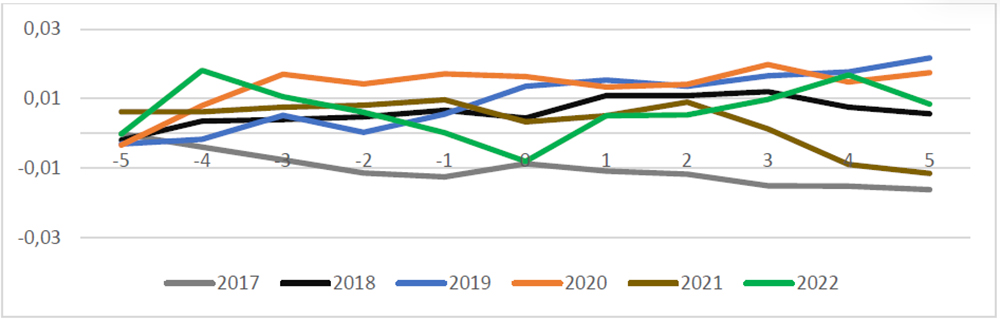
Figures 1 and 2 present the average CAAR over the event window from -5 to +5 days surrounding the announcement dates of the M&A operations.

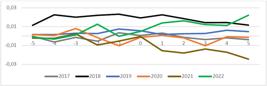
The figures show that the years 2019 and 2020 stand out in the Euronext market, and the year 2018 in the NYSE market, as the periods with the most positive CAAR around the M&A announcement dates, as indicated by the highest average values. In the Euronext market, the year 2017 shows the lowest CAAR, while in the NYSE market it was 2021 that registered this pattern.
To test for multicollinearity among the independent variables in a regression model, the VIF test is used. According to Diamantopoulos and Siguaw (2006), the VIF value should be below 3.3; if it exceeds 3.3, multicollinearity is present. The VIF values for the variables are all below 3.3, indicating that multicollinearity is not a concern.
The Hausman test was conducted following the methodology proposed by Hoechle (2007). The p-value of 0.3235 indicates that there is no significant systematic correlation between the unobserved variables (random effects) and the observed independent variables. Therefore, the random effects estimator is the appropriate choice.
Additionally, the Breusch and Pagan Lagrangian multiplier test was performed. The p-value of 0.000 suggests the presence of heteroscedasticity in the errors. Due to this heteroscedasticity, the panel data model with random effects (MEA) is considered more appropriate than the pooled OLS model (Breusch & Pagan, 1980).
The White test (1980) was also applied to evaluate heteroscedasticity in the MEA. The null hypothesis of this test suggests homoscedasticity, while the alternative hypothesis indicates heteroscedasticity. The p-value obtained was 0.5567, which means there is no statistically significant evidence to reject the null hypothesis, suggesting that the MEA does not present heteroscedasticity.
The Wooldridge test (2005) was used to analyze whether there is serial correlation in the errors over time. The null hypothesis assumes no first-order autocorrelation. Based on the p-value of 0.5722, there is no statistical support for the presence of first-order autocorrelation in the MEA errors.
Table 4 presents the regression results of the pooled OLS, fixed effects (MEF), and random effects (MEA) models, exploring the relationship between the dependent variable and the independent variables. Through these regressions, it is possible to analyze how the independent variables are associated with the CAAR variable. The coefficients shown in the table below indicate the significance and direction of the relationship between each independent variable and the CAAR.
For the variable VPO, in the Euronext market, we observe a negative relationship with CAAR. The p-value is 0.4370, demonstrating that VPO does not have a significant impact on the stock market reaction to M&A announcements, thus not supporting H1 and not corroborating the signaling theory (King et al., 2021). In the NYSE market, there is a positive relationship with CAAR. However, the p-value of 0.4440 also shows that VPO does not significantly impact the stock market reaction, not validating H1 and not supporting the assumptions of signaling theory (King et al., 2021). Chang (1998) pointed out that investors may face challenges when analyzing VPO. He concluded that there is an evaluation problem among investors, as they may find it difficult to determine whether the VPO is appropriate for the benefits the target company may bring to the acquiring company. Chang’s (1998) perspective suggests that the interpretation of VPO by investors can be a complex process subject to various variables, potentially explaining the lack of significance observed in this research context.
In the Euronext market, the ER variable has an inverse relationship with CAAR. Nevertheless, it is important to note that the associated p-value is 0.8640, significantly exceeding traditional significance levels (1%, 5%, and 10%). This result suggests there is not enough statistical support to validate H2, thus contradicting the expectations of organizational learning theory that M&A operations involving ER tend to generate a significant market reaction. The rejection of the hypothesis may suggest that this market is more diversified or less specialized, and competition within the same sector may not be a determining factor in market reaction. Conversely, in the NYSE market, the ER variable has a negative coefficient and a p-value of 0.0120. These results support H2, indicating that M&A operations with ER have a significant impact on stock market reaction (Sankar & Leepsa, 2021).
The coefficient presented for the IP variable in the Euronext market is negative, suggesting that higher IP experienced in countries tends to lead to a negative stock market reaction, as supported by studies from Cao et al. (2019) and Paudyal et al. (2021). However, in the NYSE market, the coefficient is positive, indicating that higher IP tends to result in a stronger stock market reaction, as suggested by Baker et al. (2016). The p-value for both markets is not statistically significant, indicating that IP does not have a significant impact on stock market reaction to M&A announcements, thus rejecting H3. The lack of statistical significance suggests that during this period, IP is not a determining or distinct factor in market reactions to M&A operations, which does not corroborate signaling theory assumptions. Cao et al. (2019) argue that investors and firms may adopt specific strategies to manage and mitigate risks associated with IP. Therefore, investors interpreting that firms are taking measures to address IP may reduce the direct impact on stock market reactions.
The DIM variable in the Euronext market has a direct relationship with market reaction, but the presented p-value exceeds traditional significance levels; therefore, H4 is rejected, concluding that the DIM variable does not affect market reaction, not supporting signaling theory assumptions. Investors in this market may be more interested in qualitative aspects, such as business strategy and management quality, rather than firms’ DIM. On the other hand, in the NYSE market, we observe a statistically significant and negative relationship between DIM and stock market reaction, indicating that firms with higher DIM may experience an unfavorable market response during M&A announcements (Kyei-Mensah, 2019). These results support H4, which states that firms with higher DIM may generate a significant stock market reaction (Jain et al., 2018). According to Ahmed et al. (2023), firms’ DIM has been considered a determining factor in stock market reactions to M&A announcements. A possible explanation for the statistically significant and negative relationship between these variables may be related to investors’ expectations regarding firms with higher DIM. Such firms typically face higher expectations, which may result in unfavorable market reactions if M&A announcements are not perceived as sufficiently strategic or impactful. It is also possible that the market views M&A by large firms with more skepticism, considering potential integration challenges and associated risks, contributing to a negative market reaction (Kyei-Mensah, 2019).
The EXP variable in the Euronext market shows a negative variation between variables, indicating that lower EXP tends to generate a positive stock market reaction (Tanna et al., 2021). However, the p-value of 0.2460 shows that this variable does not have a significant effect on market reaction. Thus, the data do not validate organizational learning theory conditions, and H5 is rejected. The hypothesis rejection may suggest that in this market, EXP with such transactions is not perceived as a significant advantage by investors. Other criteria, such as operational performance history, may be more relevant. In the NYSE market, the relationship between EXP and stock market reaction is positive, suggesting that firms with more EXP in M&A tend to generate a positive market reaction (Beitel et al., 2004), with a p-value of 0.0450. These results support H5, confirming that EXP significantly influences stock market reaction, validating organizational learning theory assumptions (Li et al., 2016).
In the NYSE market, statistically significant results for ER, DIM, and EXP reinforce the importance of these variables in dynamic markets, supporting organizational learning and signaling theories. In contrast, the absence of significance in Euronext may reflect structural and institutional market differences, highlighting the importance of contextualizing analyses and practical contributions of M&A operations.
Regarding control variables, in the Euronext market, the CHG variable showed a positive and statistically significant coefficient, as expected (Chuliá et al., 2019; Baker et al., 2016). Significant changes in stock prices may indicate that the market anticipates relevant events, such as M&A announcements, which have the potential to significantly influence security values, leading to more pronounced market responses (Baker et al., 2016).
In the NYSE market, results highlight three statistically significant variables: REMN, MEBIT, and ROA. The REMN variable showed a negative and statistically significant coefficient, consistent with the expected sign (Hassan & Giouvris, 2020), suggesting that lower REMN levels are associated with stronger stock market reactions. This behavior can be understood considering market efficiency theory, which states that more efficient markets quickly incorporate available information into stock prices (Hassan & Giouvris, 2020).
The MEBIT variable showed a positive and statistically significant relationship, suggesting that the market reacts positively when firms’ financial performance is higher, consistent with the expected sign. This result aligns with signaling theory, as solid financial performance metrics imply that firms have prospects to create value in future M&A operations (Ratcliffe & Dimovski, 2013).
The ROA variable showed a negative and statistically significant coefficient, contrary to the expected sign (Ratcliffe & Dimovski, 2013), suggesting that firms with higher ROA may generate a negative stock market reaction. Although counterintuitive, this result may indicate that the market interprets a high ROA value as a possible signal of overconfidence by the acquiring firm. This perception may raise uncertainties about the company’s ability to maintain performance after the M&A operation (Ratcliffe & Dimovski, 2013).
5. CONCLUSION
The main objective of this article was to analyze the stock market reaction to M&A announcements in the Euronext and NYSE markets. The empirical study involved 371 M&A transactions conducted between 2017 and 2022, selected according to predefined criteria. The results revealed important differences between the two markets regarding the statistical significance of the variables analyzed, highlighting the NYSE market as the primary focus of this study's contributions.
In the NYSE market, statistically significant results for the variables ER, DIM, and EXP reinforce the importance of specific dynamics influencing stock market reactions to M&A transactions. The results indicate a negative coefficient for the ER variable, accompanied by a statistically significant p-value. These findings suggest that M&A operations involving ER have a significant impact on stock market reaction and are consistent with previous studies (Sankar & Leepsa, 2021). For the DIM variable, we identified a negative but statistically significant relationship with market reaction, corroborating the assumptions of signaling theory. This result supports the hypothesis that firms with higher DIM may face an unfavorable response during M&A announcements. Regarding the EXP variable, there is a positive relationship between it and the market reaction, indicating that firms with greater EXP tend to generate a positive market response. The p-values were statistically significant, indicating that EXP plays a relevant role in stock market reactions, validating the principles of organizational learning theory (Lu et al., 2022).
The significant results for ER, DIM, and EXP in the NYSE market demonstrate that these variables exert an important impact in this context. This finding contributes to the literature by highlighting that, in highly developed markets such as NYSE, these variables play a fundamental role in market reactions to M&A announcements. These results validate organizational learning and signaling theories while also offering practical insights for companies and investors operating in this market.
On the other hand, in the Euronext market, none of the variables analyzed showed statistical significance. This absence may be associated with structural, regulatory, or cyclical characteristics of the European market that mitigate the effects of the studied variables. The lack of statistical significance in one market and its presence in other highlights how different institutional structures and investor profiles impact reactions to M&A transactions.
To the authors’ knowledge, this study stands out as pioneering in analyzing stock market reactions in both the NYSE and Euronext markets. By addressing these markets comparatively, we provide a unique perspective on how different variables influence market reactions in distinct contexts.
Our conclusions may assist various stakeholders in understanding the potential benefits linked to these transactions, as revealing market reaction patterns following M&A announcements can be used by companies to optimize their acquisition strategies. It can also help in understanding how the market responds to different transactions and in the selection of acquisition targets. Investors and shareholders may benefit from understanding the variables that influence market reactions, enabling a more informed assessment of risks and returns associated with firms involved in M&A operations.
We acknowledge that the absence of statistical significance for the variables in the Euronext market limits the generalization of the results. However, this limitation also opens the door for important reflections: the differences between the markets emphasize the need to deepen the study of variables in specific contexts. Future studies could extend the analysis period, incorporate other markets, and analyze specific industry sectors.
In summary, it is important to emphasize that the contributions of this study go beyond the specific markets analyzed. By offering insights into M&A dynamics, we contribute to the global understanding of these events, enriching the literature on the subject.
References
-
Aalbers, R. H. L., McCarthy, K. J., & Heimeriks, K. H. (2021). Market reactions to acquisition announcements: The importance of signaling ‘why’ and ‘where’. Long Range Planning, 54(6). https://doi.org/10.1016/j.lrp.2021.102105
» https://doi.org/10.1016/j.lrp.2021.102105 -
Aguilera, R. V., Crespí-Cladera, R., Infantes, P. M., & Pascual-Fuster, B. (2020). Business groups and internationalization: Effective identification and future agenda. Journal of World Business, 55(4), 101050. https://doi.org/10.1016/j.jwb.2019.101050
» https://doi.org/10.1016/j.jwb.2019.101050 -
Ahmed, R., Chen, Y., Benjasak, C., Gregoriou, A., Nahar Falah Alrwashdeh, N., & Than, E. T. (2023). The performance of bidding companies in merger and acquisition deals: An empirical study of domestic acquisitions in Hong Kong and Mainland China. Quarterly Review of Economics and Finance, 87, 168-180. https://doi.org/10.1016/j.qref.2020.09.003
» https://doi.org/10.1016/j.qref.2020.09.003 -
Baker, S. R., Bloom, N., & Davis, S. J. (2016). Measuring economic policy uncertainty. Quarterly Journal of Economics, 131(4), 1593-1636. https://doi.org/10.1093/qje/qjw024
» https://doi.org/10.1093/qje/qjw024 -
Beitel, P., Schiereck, D., & Wahrenburg, M. (2004). Explaining M&A success in european banks. European Financial Management, 10(1), 109-139. https://doi.org/10.1111/j.1468-036X.2004.00242.x
» https://doi.org/10.1111/j.1468-036X.2004.00242.x -
Breusch, T., & Pagan, A. (1980). The Lagrange Multiplier Test and its Applications to Model Specification in Econometrics. The Review of Economic Studies, 47(1), 239-253. https://doi.org/10.2307/2297111
» https://doi.org/10.2307/2297111 -
Brown, S. J., & Warner, J. B. (1985). Using daily stock returns. The case of event studies. Journal of Financial Economics, 14(1), 3-31. https://doi.org/10.1016/0304-405X(85)90042-X
» https://doi.org/10.1016/0304-405X(85)90042-X -
Cao, C., Li, X., & Liu, G. (2019). Political Uncertainty and Cross-Border Acquisitions. Review of Finance, 23(2), 439-470. https://doi.org/10.1093/rof/rfx055
» https://doi.org/10.1093/rof/rfx055 -
Cappa, F., Collevecchio, F., Oriani, R., & Peruffo, E. (2022). Banks responding to the digital surge through Open Innovation: Stock market performance effects of M&As with fintech firms. Journal of Economics and Business, 121, 106079. https://doi.org/10.1016/j.jeconbus.2022.106079
» https://doi.org/10.1016/j.jeconbus.2022.106079 -
Chang, S. (1998). Takeovers of privately held targets, methods of payment, and bidder returns. Journal of Finance, 53(2), 773-784. https://doi.org/10.1111/0022-1082.315138
» https://doi.org/10.1111/0022-1082.315138 -
Chuliá, H., Furió, D., & Uribe, J. M. (2019). Volatility spillovers in energy markets. Energy Journal, 40(3), 173-197. https://doi.org/10.5547/01956574.40.3.hchu
» https://doi.org/10.5547/01956574.40.3.hchu -
Danbolt, J., Siganos, A., & Vagenas-Nanos, E. (2015). Investor sentiment and bidder announcement abnormal returns. Journal of Corporate Finance, 33, 164-179. https://doi.org/10.1016/j.jcorpfin.2015.06.003
» https://doi.org/10.1016/j.jcorpfin.2015.06.003 -
Diamantopoulos, A., & Siguaw, J. A. (2006). Formative versus reflective indicators in organizational measure development: A comparison and empirical illustration. British Journal of Management, 17(4), 263-282. https://doi.org/10.1111/j.1467-8551.2006.00500.x
» https://doi.org/10.1111/j.1467-8551.2006.00500.x -
Dranev, Y., Frolova, K., & Ochirova, E. (2019). The impact of fintech M&A on stock returns. Research in International Business and Finance, 48, 353-364. https://doi.org/10.1016/j.ribaf.2019.01.012
» https://doi.org/10.1016/j.ribaf.2019.01.012 -
Erel, I., Jang, Y., & Weisbach, M. S. (2015). Do acquisitions relieve target firms’ financial constraints? Journal of Finance , 70(1), 289-328. https://doi.org/10.1111/jofi.12155
» https://doi.org/10.1111/jofi.12155 -
Evans, S., & Bahrami, H. (2020). Super-Flexibility in Practice: Insights from a Crisis. Global Journal of Flexible Systems Management, 21(3), 207-214. https://doi.org/10.1007/s40171-020-00246-6
» https://doi.org/10.1007/s40171-020-00246-6 -
Gulati, P. A., & Garg, S. (2022). Impact of merger on stock returns and economic value added (EVA) of the acquiring firms: a study from Indian corporate sector. International Journal of Emerging Markets, 19(3), 649-664. https://doi.org/10.1108/IJOEM-11-2021-1694
» https://doi.org/10.1108/IJOEM-11-2021-1694 -
Guzella, M., Castro, F. & Santana, V. (2023). Efeito da atenção do investidor na eficiência do mercado brasileiro de ações. Revista Contabilidade & Finanças, 34(93). https://doi.org/10.1590/1808-057x20231635.en
» https://doi.org/10.1590/1808-057x20231635.en -
Hassan, M., & Giouvris, E. (2020). Financial institutions mergers: a strategy choice of wealth maximisation and economic value. Journal of Financial Economic Policy, 12(4), 495-529. https://doi.org/10.1108/JFEP-06-2019-0113
» https://doi.org/10.1108/JFEP-06-2019-0113 -
Haunschild, P. R., & Beckman, C. M. (1998). When do interlocks matter? Alternate sources of information and interlock influence. Administrative Science Quarterly, 43(4), 815-844. https://doi.org/10.2307/2393617
» https://doi.org/10.2307/2393617 -
Healy, P. M., Palepu, K. G., & Ruback, R. S. (1992). Does corporate performance improve after mergers? Journal of Financial Economics , 31(2), 135-175. https://doi.org/10.1016/0304-405X(92)90002-F
» https://doi.org/10.1016/0304-405X(92)90002-F -
Hoechle, D. (2007). Robust standard errors for panel regressions with cross-sectional dependence. Stata Journal, 7(3), 281-312. https://doi.org/10.1177/1536867x0700700301
» https://doi.org/10.1177/1536867x0700700301 -
Hutzschenreuter, T., Kleindienst, I., & Schmitt, M. (2014). How mindfulness and acquisition experience affect acquisition performance. Management Decision, 52(6), 1116-1147. https://doi.org/10.1108/MD-07-2013-0376
» https://doi.org/10.1108/MD-07-2013-0376 -
Jain, S., Kashiramka, S., & Jain, P. K. (2018). Impact of Organizational Learning and Absorptive Capacity on the Abnormal Returns of Acquirers: Evidence from Cross-Border Acquisitions by Indian Companies. Global Journal of Flexible Systems Management , 19(4), 289-303. https://doi.org/10.1007/s40171-018-0193-9
» https://doi.org/10.1007/s40171-018-0193-9 -
Kellner, T. (2024). The impact of M&A announcements on stock returns in the European Union. International Review of Economics and Finance, 89, 843-862. https://doi.org/ 10.1016/j.iref.2023.10.034
» https://doi.org/ 10.1016/j.iref.2023.10.034 -
King, D. R., Wang, G., Samimi, M., & Cortes, A. F. (2021). A Meta-Analytic Integration of Acquisition Performance Prediction. Journal of Management Studies, 58(5), 1198-1236. https://doi.org/10.1111/joms.12636
» https://doi.org/10.1111/joms.12636 -
Kyei-Mensah, J. (2019). Stock liquidity, firm size and return persistence around mergers and acquisitions announcement. Investment Management and Financial Innovations, 16(2), 116-127. https://doi.org/10.21511/imfi.16(2).2019.10
» https://doi.org/10.21511/imfi.16(2).2019.10 -
Li, J., Li, P., & Wang, B. (2016). Do cross-border acquisitions create value? Evidence from overseas acquisitions by Chinese firms. International Business Review, 25(2), 471-483. https://doi.org/10.1016/j.ibusrev.2015.08.003
» https://doi.org/10.1016/j.ibusrev.2015.08.003 -
Lobo, B. F. S., & Gomes, L. M. P. (2022). Impact of M&A Announcements on Listed Firms in the Iberian Markets. Studies in Business and Economics, 17(3), 132-150. https://doi.org/10.2478/sbe-2022-0051
» https://doi.org/10.2478/sbe-2022-0051 -
Lu, H., Hong, J., Chen, Q., & Deng, P. (2022). Impact of overseas M&As on Chinese service enterprises’ market value. Service Industries Journal, 42(15-16), 1256-1276. https://doi.org/10.1080/02642069.2019.1608189
» https://doi.org/10.1080/02642069.2019.1608189 - MacKinlay, A. C. (1997). Event Studies in Economics and Finance. Journal of Economic Literature, 35(1), 13-39.
-
Mal, P., & Gupta, K. (2020). Impact of merger and acquisition announcements on stock return, volatility and liquidity of acquirers: Evidence from the indian banking sector. Management and Accounting Review, 19(1), 73-101. https://doi.org/10.1177/09722629251341029
» https://doi.org/10.1177/09722629251341029 -
McWilliams, A., & Siegel, D. (1997). Event studies in management research: Theoretical and empirical issues. Academy of Management Journal, 40(3), 626-657. https://doi.org/10.2307/257056
» https://doi.org/10.2307/257056 -
Mitchell, M. L., & Mulherin, J. H. (1996). The impact of industry shocks on takeover and restructuring activity. Journal of Financial Economics , 41(2), 193-229. https://doi.org/10.1016/0304-405X(95)00860-H
» https://doi.org/10.1016/0304-405X(95)00860-H -
Panda, M., & Joshipura, M. (2022). Impact of cross-border mergers and acquisitions on short-term gain to shareholders of target firms in India - effect of the mode of payment and industry relatedness. Afro-Asian Journal of Financeand Accounting, 12(5), 648. https://doi.org/10.1504/aajfa.2022.10051855
» https://doi.org/10.1504/aajfa.2022.10051855 -
Paudyal, K., Thapa, C., Koirala, S., & Aldhawyan, S. (2021). Economic policy uncertainty and cross-border mergers and acquisitions. Journal of Financial Stability, 56, 100926. https://doi.org/10.1016/j.jfs.2021.100926
» https://doi.org/10.1016/j.jfs.2021.100926 -
Ranju, P. K., & Mallikarjunappa, T. (2019). Spillover Effect of M&A Announcements on Acquiring Firms’ Rivals: Evidence from India. Global Business Review, 20(3), 692-707. https://doi.org/10.1177/0972150919837080
» https://doi.org/10.1177/0972150919837080 -
Ratcliffe, C., & Dimovski, B. (2013). An investigation into the drivers of Australian REIT merger and acquisition announcements. Journal of Property Investment and Finance, 31(5), 441-461. https://doi.org/10.1108/JPIF-02-2013-0012
» https://doi.org/10.1108/JPIF-02-2013-0012 -
Reddy, K., Qamar, M., & Yahanpath, N. (2019). Do mergers and acquisitions create value?: The post-M&A performance of acquiring firms in China and India. Studies in Economics and Finance, 36(2), 240-264. https://doi.org/10.1108/SEF-01-2018-0027
» https://doi.org/10.1108/SEF-01-2018-0027 -
Sankar, B. P. B., & Leepsa, N. M. (2021). Determinants of payment method in mergers and acquisitions: A study on indian companies. IndianJournal of Finance , 15(10), 44-62. https://doi.org/10.17010/ijf/2021/v15i10/166511
» https://doi.org/10.17010/ijf/2021/v15i10/166511 -
Satapathy, D. P., & Mohapatra, S. R. (2020). Effect of corporate goverance on acquiring firm performance: Evidence from construction industry. Journal of Critical Reviews, 7(8), 813-817. https://doi.org/10.31838/jcr.07.08.174
» https://doi.org/10.31838/jcr.07.08.174 -
Spence, M. (2002). Signaling in retrospect and the informational structure of markets. American Economic Review, 92(3), 434-459. https://doi.org/10.1257/00028280260136200
» https://doi.org/10.1257/00028280260136200 -
Stiglitz, J. E. (2002). Information and the change in the paradigm in economics. American Economic Review , 92(3), 460-501. https://doi.org/10.1257/00028280260136363
» https://doi.org/10.1257/00028280260136363 -
Talreja, S., Mirani, S. H., Qureshi, J. A., & Ahmed, F. (2020). Do pre & post merger integration matters in cross border merger & acquisition (CBM&A). Estudios de Economia Aplicada, 38(2). https://doi.org/10.25115/eea.v38i2.3294
» https://doi.org/10.25115/eea.v38i2.3294 -
Tampakoudis, I., Nerantzidis, M., Subeniotis, D., Soutsas, A., & Kiosses, N. (2020). Bank mergers and acquisitions in Greece: the financial crisis and its effect on shareholder wealth. International Journal of Managerial Finance, 16(2), 273-296. https://doi.org/10.1108/IJMF-02-2019-0080
» https://doi.org/10.1108/IJMF-02-2019-0080 -
Tanna, S., Yousef, I., & Nnadi, M. (2021). Probability of mergers and acquisitions deal failure. Journal of Financial Economic Policy, 13(1), 1-30. https://doi.org/10.1108/JFEP-09-2019-0182
» https://doi.org/10.1108/JFEP-09-2019-0182 -
White, H. (1980). A Heteroskedasticity-Consistent Covariance Matrix Estimator and a Direct Test for Heteroskedasticity. Econometrica, 48(4), 817-838. https://doi.org/10.2307/1912934
» https://doi.org/10.2307/1912934 -
Wooldridge, J. M. (2005). Simple solutions to the initial conditions problem in dynamic, nonlinear panel data models with unobserved heterogeneity. Journal of Applied Econometrics, 20(1), 39-54. https://doi.org/10.1002/jae.770
» https://doi.org/10.1002/jae.770
Edited by
-
EDITOR-IN-CHIEF (AS OF 01/01/2025)
Marcia Juliana d’Angelo https://orcid.org/0000-0003-1436-5812
-
ASSOCIATE EDITOR
Verônica de Fátima Santana https://orcid.org/0000-0002-9105-7488
The datasets related to this article will be available upon request to the author.

 Source: Elaborated by the author
 Source: Elaborated by the author