
 Impact of Perceived Corporate Social Responsibility on Consumer social Responsibility Intention in the Fashion Industry: An Extended Theory of Planned Behavior Perspective
ABSTRACT
Fashion companies often face pressure from stakeholders to address social and environmental issues. The purpose of this study is to examine the impact of consumers’ perceived corporate social responsibility on their intention to engage in consumer social responsibility. We extended the theory of planned behavior by exploring the mediating effects of personal norms on the relationship between perceived corporate social responsibility and consumer social responsibility. Drawing on a survey with 287 Vietnamese consumers and using 15 semi-structured interviews, the research results show that perceived corporate social responsibility is positively associated with consumer social responsibility intention. Moreover, factors in the extended theory of planned behavior model, including attitudes, subjective norms, perceived behavioral control and personal norms, positively mediate this association. Taken together, these findings provide important implications and suggestions for managers in fashion companies to improve corporate social responsibility efforts and promote consumer social responsibility.
KEYWORDS:
perceived corporate social responsibility; consumer social responsibility; theory of planned behavior; personal norms; Vietnam; JEL: M30; M31; M39
RESUMO
As empresas de moda frequentemente sofrem pressão das partes interessadas para tratar de questões sociais e ambientais. O objetivo deste estudo é examinar o impacto da percepção de responsabilidade social corporativa dos consumidores sobre sua intenção de participar da responsabilidade social do consumidor. A teoria do comportamento planejado foi ampliada ao explorar os efeitos mediadores das normas pessoais na relação entre a responsabilidade social corporativa percebida e a responsabilidade social do consumidor. Com base em uma pesquisa com 287 consumidores vietnamitas e 15 entrevistas semiestruturadas, os resultados da pesquisa mostram que a responsabilidade social corporativa percebida está positivamente associada à intenção de responsabilidade social do consumidor. Além disso, os fatores do modelo estendido da teoria do comportamento planejado, incluindo atitudes, normas subjetivas, controle comportamental percebido e normas pessoais, medeiam positivamente essa associação. Em conjunto, essas descobertas fornecem implicações e sugestões importantes para que os gerentes de empresas de moda aprimorem os esforços de responsabilidade social corporativa e promovam a responsabilidade social do consumidor.
PALAVRAS-CHAVE:
percepção de responsabilidade social corporativa; responsabilidade social do consumidor; teoria do comportamento planejado; normas pessoais; Vietnã; JEL: M30; M31; M39
1. INTRODUCTION
Corporate social responsibility (CSR) has attracted the attention of both businesses and researchers. CSR is defined as the voluntary integration of social and environmental concerns into a business's activities and its relationships with stakeholders. Businesses, including those in the fashion industry, have increasingly initiated CSR campaigns due to pressure from stakeholders (Yoon &Chung, 2018). However, not all companies are rewarded for being socially responsible ((Nyilasy et al., 2014) as the success of CSR significantly depends on consumers’ perception of and support for it through responsible consumption (Golob et al., 2019).
The literature provides evidence of the positive influence of consumers’ perceived CSR on responsible consumption (Golob et al., 2019). However, scholars have tended to develop models to study the impact of consumers’ perceived CSR on their purchase intention (Huang et al., 2019; Neumann et al., 2020). While these models have shed light on the mechanisms through which consumers’ perceived CSR can affect their buying decisions, they ignore the impact of perceived CSR on consumer behaviors that go beyond purchase decisions. Thus, they fail to explain how consumers’ perceived CSR induces consumer social responsibility (CNSR) - a concept that includes not only consumers’ responsible purchase but also responsible use and disposal of goods as well as the desire of consumers to minimize negative impacts and maximize positive impacts of their consumption on the environment and society. To mitigate this shortcoming, we examine the impact of perceived CSR on CNSR in the context of Vietnam’s fashion industry. The goal is to improve our understanding of the causal chain via which consumers’ perceived CSR influences their intention to engage in consumer social responsibility.
Previous studies on the impact of consumers' perceived CSR on responsible consumption have yielded different conclusions. Most research indicates that perceived CSR has a direct impact on responsible consumption behavior (Chen &Jai, 2018; Boronat-Navarro & Pérez-Aranda, 2019; Lira et al., 2022). For instance, Chen &Jai (2018) demonstrated that perceived CSR increases consumers' intentions to prevent food waste at restaurants. Boronat-Navarro &Pérez-Aranda (2019) analyzed consumer evaluations of various aspects of CSR and how these evaluations influence their support for CSR activities, as well as how consumers search for information about CSR, affecting these evaluations. Lira et al. (2022) showed that fashion consumers' perceived CSR is positively related to conscious consumption. Some recent studies have indicated that consumers' perceived CSR indirectly influences consumer social responsibility intentions. This means that there are mediating variables in the relationship between perceived CSR and consumer social responsibility intentions (Su et al., 2017; Dang et al., 2020; Huang et al., 2023). Therefore, it is essential to clarify how perceived CSR affects CNSR intentions and which factors play a mediating role in this relationship.
Building on the theory of planned behavior (TPB), we explore the direct relationship between two factors - perceived CSR and CNSR - as well as the mediating variables in this relationship. However, our paper extends the TPB by investigating the mediating role of personal norms. We argue that consumers are more likely to support a socially responsible company and perform consumer social responsibility if they perceive that the company's CSR activities align with their personal ethical norms.
Personal norms refer to the ethical obligations that an individual must adhere to and are determined by the individual's intrinsic ethical values (Bamberg et al., 2007). Many previous studies have shown that personal norms play a significant supporting role in predicting social and environmental behavior intentions (Hu et al., 2019; Liu et al., 2019), and they may even play a more prominent role than predictions of socially responsible behavior (Zhang et al., 2017). For instance, Kaiser et al. (2005) identified a positive relationship between personal norms and environmentally protective behavior. De Groot &Steg (2009) demonstrated that personal norms influence intentions for pro-social behavior. Klöckner (2013) found that both personal and social norms enhance individual intentions to engage in environmentally responsible behavior. Similarly, Golob et al. (2019) revealed that both personal and social norms have a direct impact on consumer social responsibility. However, very few studies have explored the mediating role of personal norms in the fashion industry. Therefore, we investigate the influence of perceived CSR on CNSR intentions of fashion consumers in Vietnam through personal norms.
This paper makes several contributions. First, we contribute to the literature on corporate social responsibility and consumer social responsibility by examining the impacts of consumers’ perceived CSR on consumer social responsibility. Previous research primarily focused on how consumers’ perceived CSR affects their purchase intention. Our study uncovers the effect of consumers’ perceived CSR on consumer social responsibility. Second, we propose and validate an extended TPB model to elucidate the mediating factors in the relationship between consumers’ perceived CSR and consumer social responsibility. Previous research mainly concentrated on the direct impact of perceived CSR on responsible consumption. Our study reveals both direct and indirect impacts. Third, our research context is the Vietnamese fashion industry, which differs from previous studies conducted mainly in developed countries. Vietnam is one of the world's top five largest textile and garment exporting nations. In 2022, the country’s export turnover of textile and garment achieved US$44 billion. In addition, the textile and garment industry is the fifth-largest industrial sector in the overall industrial structure of Vietnam with the average annual growth rate of 17% over the five-year period from 2015 to 2020 (Vinatex, 2023). Despite impressive revenue and growth rates, the Vietnamese fashion industry faces pressing environmental and social issues (Wang, 2005; Nguyen, 2017; Ortmann, 2017). With its unique cultural characteristics and large population, studying the perceptions and behaviors of Vietnamese consumers regarding CSR and responsible consumption is crucial for both domestic and international fashion businesses. However, limited research has been done in the Vietnamese fashion industry. Therefore, our study fills in the gap by examining the impact of consumers’ perceived CSR on CNSR intentions in a developing country like Vietnam.
2. LITERATURE REVIEW AND HYPOTHESIS DEVELOPMENT
2.1. Consumers’ perceived corporate social responsibility
Maignan (2001) defined consumers’ perceived corporate social responsibility (PCSR) as the consumers’ evaluation of the economic, legal, ethical, and philanthropic responsibilities of the firm or the degree of importance that consumers allocate to these responsibilities. Meanwhile, Wang & Juslin (2011) defined PCSR as the assessment of the consumers on the effectiveness of CSR activities based on their personal norms. Based on such definitions, we define PCSR as consumers’ evaluations of the importance and the effectiveness of CSR activities (Maignan, 2001; Wang &Juslin, 2011). Moreover, the measures of the PCSR construct were developed from (Maignan, 2001; Wang &Juslin, 2011). In this study, PCSR includes five items as follows:
-
PCSR1: Fashion businesses have plastic waste reduction campaigns.
-
PCSR2: Fashion businesses use environmentally friendly materials.
-
PCSR3: Fashion businesses promote sustainable consumption using green marketing
-
PCSR4: Workers in fashion businesses enjoy good working conditions and benefits.
-
PCSR5: Fashion businesses participate in charitable activities.
Previous studies have highlighted the impact of PCSR on consumers’ evaluations and behaviors. For instance, PCSR affects consumer satisfaction (Phillips et al., 2019), and intentions or behaviors to support businesses (Akbari et al., 2020) or social causes (Romani &Grappi, 2014; Mantovani et al., 2017). The results of these studies consistently show a positive relationship between PCSR and consumer behavioral intentions.
2.2. Consumer social responsibility
Webster Jr (1975) first defined the socially conscious consumer as “a consumer who takes into account the public consequences of his or her private consumption or who attempts to use his or her purchasing power to bring about social change”. He based this definition on the psychological construct of social involvement, arguing that the socially conscious consumer must be aware of social problems, must believe that s/he has the power to make a difference, and must be active in the community. Meanwhile, Muncy &Vitell (1992) defined consumer social responsibility (CNSR) as the moral principles and standards that guide the behaviors of individuals as they obtain, use, and dispose of goods and services. Mohr et al. (2001) defined socially responsible consumer behavior as “a person basing his or her acquisition, usage, and disposition of products on a desire to minimize or eliminate any harmful effects and maximize the long-run beneficial impact on society”. In this study, we adopted Mohr et al. (2001)’s definition of CNSR. The five items of CNSR were adapted from Soni et al. (2021) including:
-
CNSR1: I don't buy from fashion businesses that I know engage in child labor or discriminate against women.
-
CNSR2: I try not to use products that cause pollution or have a negative impact on the environment.
-
CNSR3: I often purchase products from fashion businesses that practice corporate social responsibility, even though they may be more expensive.
-
CNSR4: I make purchasing decisions based on corporate social responsibility criteria, not just on quality, price, and convenience.
-
CNSR5: I regularly recycle used fashion products.
Previous research has demonstrated that perceived CSR directly influence consumer social responsibility intention in various sectors such as hotels and tourism (Boronat-Navarro &Pérez-Aranda, 2019), restaurants (Chen &Jai, 2018), online retail (Dang et al., 2020), fashion (Kozar &Hiller Connell, 2013; Lira et al., 2022), and the beverage industry (Sinh &Tâm, 2022). For example, Dang et al. (2020) found that consumer perceptions of JD.com's CSR in China, a major online retailer, increased customer intentions and purchasing behavior. Kozar &Hiller Connell (2013) demonstrated that consumer knowledge and attitudes regarding social and environmental issues in the fashion industry are important predictors of consumers´ responsible purchasing behavior.
2.3. TPB theory and the relationship between perceived corporate social responsibility and consumer social responsibility
TPB was developed by Ajzen (1991). According to TPB, the consumer intention represents the motivation to engage in a particular behavior, and the stronger the intention, the more likely the consumer is to perform that behavior. The intention to engage in consumer social responsibility (CNSR intention) serves as the basis for consumers to enact socially responsible behavior. Intentions and behavior are influenced by three factors: attitude, subjective norms, and perceived behavioral control (Ajzen, 1991).
Attitude is defined as an individual's positive or negative emotional expression regarding the behavioral intention (Ajzen, 1991). Attitudes towards consumer social responsibility behavior depend on consumers' perceptions of social and environmental issues (Yeow et al., 2014). Moreover, previous experimental studies have shown that attitude is considered the strongest motivator for consumers' intentions to engage in environmental protection behaviors, such as waste separation (Zhang et al., 2019) and water conservation (Fu &Wu, 2018).
Subjective norms refers to the social pressure on an individual, which can influence whether they perform a specific behavior or not (Ajzen, 1991). Ajzen (1991) suggests that individuals form intentions to perform a behavior after considering the support from surrounding influential people such as family, friends, and so on and perceiving that many others are also engaging in similar behavior. Subjective norms has been identified as an important predictor of behavior among the factors in the TPB model (Read et al., 2013).
Perceived behavioral control is an individual's assessment of the ease or difficulty of performing a specific behavior. According to Ajzen (1991), perceived behavioral control stems from an individual's self-confidence and the favorable conditions for performing the behavior. The more resources and opportunities an individual perceives they have, the fewer obstacles they believe they will encounter when carrying out the behavior.
Based on TPB theory, recent researchers have demonstrated the indirect influence of consumer perceived CSR on their intentions to purchase or consume sustainable fashion products through mediating variables such as attitude, subjective norms, and perceived behavioral control. For example, Sun &Yoon (2022) showed that attitudes toward environmentally friendly products and ethical consumption consciousness positively impact the intention to purchase environmentally friendly products at a higher price. Bong Ko &Jin (2017) compared the green apparel consumption behavior of American and Chinese consumers based on an extended TPB model with two additional variables, which are human nature orientation and environmental knowledge. The research results indicated that subjective norms had the most direct impact on consumers' purchase intentions in both countries. While internal perceived behavioral control had a significant influence on American consumers' intentions to purchase, external perceived behavioral control was more important for Chinese consumers. Lira &Costa (2022) identified factors influencing slow fashion consumption, including conscious consumption intentions, ethical considerations in consumer behavior, and perceived behavioral control, with a particular emphasis on the role of perceived behavioral control. In addition, the study highlighted the influence of subjective norms on consumer attitudes and conscious consumption intentions. Based on these reasons, we propose the following hypotheses:
-
H1: Perceived CSR positively influence consumer social responsibility intention.
-
H2: Attitude mediates the relationship between perceived CSR and consumer social responsibility intention.
-
H3: Subjective norms mediates the relationship between perceived CSR and consumer social responsibility intention.
-
H4: Perceived behavioral control mediates the relationship between perceived CSR and consumer social responsibility intention.
-
H5: Consumer social responsibility intention positively influences consumer social responsibility behavior.
2.4. The mediating role of personal norms
Personal norms (PN) are defined as an individual's perception of the moral obligation to perform or abstain from a specific behavior (Schwartz, 1977). The measures of this construct were adapted from Ghazali et al. (2019) with four following items:
-
PN1: I feel an obligation to buy environmentally friendly fashion products whenever possible.
-
PN2: I feel I must advocate for workers in fashion businesses to have minimum working condition standards.
-
PN3: I feel responsible for conserving natural resources for future generations.
-
PN4: I feel that I should encourage everyone to use fashion products responsibly and dispose of them correctly.
In addition to the TPB factors, researchers have shown that personal norms influence consumer social responsibility intention (De Groot &Steg, 2009; Wang et al., 2016; Golob et al., 2019; Liu et al., 2019). For example, personal norms have a positive impact on intentions and behaviors related to energy conservation, household waste sorting, the use of reusable bags, recycling, food waste reduction, and responsible tourism.
Many previous studies have suggested that the TPB theory does not consider the ethical influences on behavior formation comprehensively. Thus, in this study, personal norms are integrated into the TPB model to build an extended TPB model. Personal norms play a significant supporting role in predicting social and environmental behaviors. Therefore, we propose the following hypothesis:
-
H6: Personal norms mediate the relationship between perceived CSR and consumer social responsibility intention.
So, Figure 1 illustrates the research model depicting the impact of perceived corporate social responsibility on consumer social responsibility intention.

3. METHODOLOGY
3.1 Sample and Scale
In order to determine exactly scale of construct of research model, we refined and adapted the method used by Hà & Thành (2021). The bootstrap procedure uses these sampling distributions as the foundation for confidence intervals and hypothesis testing. The software application used to analyze the data was Smart PLS 4. This program was chosen because it is the most suitable to test the statistical significance of various path analysis and mediating effect. We used reliable techniques based on the recommendations of Hair Jr et al. (2021)
All samples were thoroughly checked for both researcher and practitioner. For the measurement of CNSR-related constructs discussed in the research model, all the items are determined, as proposed by previous and current studies in the literature. The measurement items are determined based on the literature review and consultation with two researchers in the field of sustainable production and consumption.
After a pilot study, a total of 287 participants were recruited for the formal survey using the convenience sampling technique. All of the survey participants were at least 18 years old. The surveyed respondents were divided into 2 groups based on the contact method: group 1 (face - to - face) n = 70 respondents and group 2 (online) n = 217 respondents. The number of respondents meets the requirement of minimum sample size.
Next, we purposively selected 15 surveyed respondents who belong to diverse age groups and gender for semi-structured interviews. The interviews were conducted either in person or online from April to July 2023. The interview method could provide rich data and in-depth insights on consumer perception, attitude, and behavior.
We developed an interview guide which consists of four main sections: (1) Introduction of the research, (2) Profile information about the participants, (3) Insightful information on perceived CSR and consumer social responsibility, and (4) Conclusion. The interview questions revolved around issues related to consumer perceptions of CSR, attitudes towards socially responsible and irresponsible consumption behaviors, their intentions and behaviors in implementing consumer social responsibility, their capability to perform consumer social responsibility, and influencing factors such as subjective and personal norms. The interviews lasted from 30 to 60 minutes and were audio-recorded with the respondents’ permision.
Following Carson et al. (2001) guidelines on analyzing qualitative data in marketing, the key issues were summarized after each interview so as to adjust the interview questions for the subsequent participants. Then, interview transcripts were closely examined to identify common themes and patterns.
3.2 Model estimation
Structural equation modeling (SEM) was employed for several reason. First of all, there exists a mediating linkage between PCSR and CNSR in the conceptual model. The relationship among PCSR, ATT, SN, PN, PBC and CNSR forms a structural model. The second reason, CNSR is measured by a set of items, for more details CNSR1, CNSR2, CNSR3, CNSR4 and CNSR5 are the indicators that represent intention of customer about CSR. Each latent variable is measured by a set of indicators. The connection between CNSR intention and its indicators forms a measurement model. Therefore, our model consists of a structural model and a measurement model.
In a SEM model, there are primarily two methods for estimating the relationships (Rigdon et al., 2017). One is called CB-SEM, while the other is called PLS-SEM. Each is appropriate for a different research context, and researchers need to understand the differences to apply the correct method. Each is ideal for a unique study situation, and researchers must be aware of the distinctions between them to choose the proper technique (Rigdon et al., 2017). Following the instruction of Hair Jr et al. (2021), PLS-SEM is appropriate for our research for several reasons: (i) there exists a mediator in the model, (ii) the measurement model of CSR may be formative, (iii) we have to handle constructs with single-item measures, and (iv) distributional assumptions are not the concern of PLS-SEM.
When analyzing a path model with mediating variable, 3 main impacts, consisting of direct effect, indirect effect, and total effect. Based on SEM model, the relationship between latent variables is described by the following equations:
Direct effect = β1
Indirect effect = β2i* β3i
Total effect = β1 + β2i* β3i
The set of equations above explains a path model with endogenous variables in the estimated model: PCSR and CNSR intention. As a result, there are 3 equations. The direct influence of PCSR on CNSR is described in Equation (1) with structural coefficient denoted β1. In addition, we denoted β2i is a structural coefficient of the direct effect PCSR on ATT, SN, PN, PBC respectively, whereas β3i represents the impact of the interaction between ATT, SN, PN, PBC, and CNSR intention.
4. RESEARCH RESULTS AND DISCUSSION
4.1 Result of Path model estimation
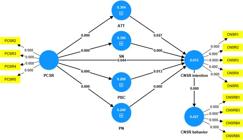
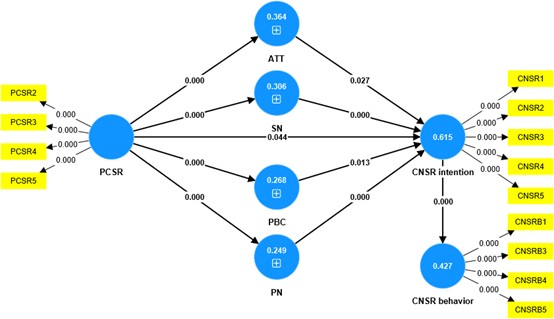
The research uses the Bootstrapping procedure proposed by Hair Jr et al. (2016), with 5000 random subsamples. The path coefficients related to the impact of the constructs in the conceptual model are significant, with a 95% confidence level (Table 1). Therefore, it can be concluded that the hypothesis of H1 and H5 are supported on data (Figure 2).
4.2 SEM estimation with mediators
In this study, ATT, PBC, PN and SN is viewed as mediating variables in the linkage between PCSR and CNSR intention. As can be seen from Table 1, both direct effect and indirect effect have a statistically significant, specifically PCSR influenced directly on CNSR intention with structural coefficient of 0.150 (P-value = 0.044 < 0.05), besides the impact of PCSR on CNSR via mediators as ATT, PBC, PN and SN was also statistically significant. Therefore, the research hypothesis there were exist mediating relationship between PCSR and CNSR intention, in other words ATT, PBC, PN and SN were considered as mediators in the linkage between PCSR and CNSR intention.
In order to analyze the strength of the mediation effect, we used the three-factor approach proposed by Zhao et al. (2010), which can determine how much of the indirect effect absorbs the direct effect. For this variance accounted for (VAF) , it is calculated how much of the direct path is absorbed. Based on the value of VAF, the following mediation effect conditions are given by Hair et al. (2014)
No mediation if 0 < VAF < 0.20;
-
Partial mediation of 0.20 < VAF < 0.80;
-
Full mediation if VAF > 0.80.
Given the values presented in Table 1, the VAF value of personal norms (denoted PN) means (0.155)/(0.155 + 0.150) = 0.508, this number indicates that it partially mediates the relationship between perceived CSR and CNSR intention. The same is true for ATT, PBC and SN. Finally, both direct impact and indirect impact were significant at same confidence level, therefore there was a partial mediating relationship between PCSR and CNSR.
4.3 Assessment of structural model quality
According to Hair Jr et al. (2016), PLS-SEM does not have a suitable measure for the whole model. Instead, the quality of the model is assessed through several main criterias, such as R2, f2 and Q2 (Stone- Geisser Indicator). The three main criteria refer to explanatory and predictive evaluations of endogenous structures. Results of R2 and Q2 are presented in Table 2, whereas the result of f2 is shown in Table 3. It can be seen from these tables that the structural model is a fit.
Firstly, the study examines the R² values of the endogenous latent variables. In behavior science research, the R2 value of 0.2 is considered high. All R2 values are more significant than the standard 0.2 (the minimum of R2 value and R2 adjusted are 0.249, 0.247 respectively), in which R2 values of 0.615 is higher than average value of 0.5.
Secondly, Q2 indicates the explanatory power and predictability of the endogenous latent variable. All values of Q² are higher than zero value (0); so the model has predictive relevance.
Lastly, f-square is the effect size of independent variables on the dependent variable. f2 values are 0.02, 0.15, and 0.35, respectively, representing small, medium, and significant levels. If the f2 value is less than 0.02, there is no effect of independent variables on the dependent variable. As can be seen from Table 3, the f2 value of all independent variables are higher than 0.02. Thus, all five exogenous constructs did impact on the construct of CNSR. The level of impact is medium.
4.4 Discussion
The survey results in table 1 show that PCSR has both direct and indirect impacts on CNSR intention. The hypothesis H1, regarding the direct effect of PCSR on CNSR intention was supported. In this research, consumers are more likely to engage in consumer social responsibility when they are aware of corporate social responsibility actions. This result is consistent with prior studies of Nguyen &Pervan (2020), Dang et al. (2020), Lira et al. (2022), and Su et al. (2017).
The hypothesis H5 on the relationship between CNSR intention and CNSR behavior was confirmed. In this way, consumers’ intention to perform consumer social responsibility is a crucial determinant of whether the behavior will occur. This result aligns with the TPB model (Ajzen, 1991).
Hypotheses H2, H3, H4, and H6, which refer to the indirect impact of PCSR on CNSR intention through mediating variables such as ATT, PBC, SN, and PN, were supported. Consumer perception of corporate social responsibility has an indirect and positive influence on their intention to perform consumer social responsibility. In the fashion industry, social pressure (i.e., subjective norms) and personal norms will increase when corporate social responsibility actions are perceived (Golob et al., 2018; Wan et al. (2022). In addition, considering higher perceived corporate social responsibility, consumers have a more positive attitude towards and are more capable of fulfilling their social responsibilities, as indicated by Neumann et al. (2020) and Lira & Costa (2022).
The interview data also confirm our survey results, showing that fashion consumers have a positive attitude towards responsibile consumption behavior. In addition, the intentions and behaviors of consumers are significantly influenced by others such as family, friends, and influencers. Consumers are also aware of their moral obligations towards the environment and society. They believe they are able to buy sustainable fashion, thus implementing consumer social responsibility. However, the interviews indicate that although consumers are concerned about corporate social responsibility, it is one of several criteria for choosing fashion products but not the top criterion. Consumers tend to choose fashion products based on product utility, design, style, and trendiness. Thus, the interview findings provide a nuanced understanding of the relationship between consumer perception of corporate social responsibility and consumer social responsibility.
While previous studies focused on mediating variables such as attitude, trust, perceived consumer effectiveness (Nguyen & Pervan, 2020; Neumann et al., 2020), price sensitivity (Lira et al., 2022), brand identification and word of mouth (Dang et al., 2020), consumption emotions and customer-company identification (Su et al., 2017), our research results indicate that attitude, perceived behavioral control, subjective norms, and personal norms play partial mediating roles between perceived corporate social responsibility and consumer social responsibility intention in the fashion industry.
5. IMPLICATIONS AND CONCLUSION
The study provides both theoretical and practical implications. From a theoretical point of view, this paper contributes to the debate about the relationship between perceived CSR and consumer social responsibility. Previous studies mainly focus on the impact of perceived CSR on purchase intention (Huang et al., 2019; Neumann et al., 2020). The present research reveals both direct and indirect effects of perceived CSR on consumer social responsibility intention. In addition, an important contribution of this study is found in its extended TPB model. The research results show that three constructs of the original TPB model mediate the effect between perceived CSR and consumer social responsibility. Additionally, the results indicate the mediating role of personal norms. It can be inferred that when consumers are aware of CSR, they will feel a moral obligation to engage in consumer social responsibility behavior and form a strong intention towards consumer social responsibility. Finally, this study was conducted in the context of the fashion industry of a developing country, which may differ from previous studies in developed countries.
From a managerial point of view, the results provide relevant implications for fashion businesses. It is essential for fashion companies to enhance their communications to improve consumer perception of CSR. Interview findings demonstrate that fashion companies could communicate about CSR in different channels such as company’s point of sale, website and social media. Another relevant implication for managers is related to companies’ social responsibility actions in the sense that they could promote consumer social responsibility through influencers. According to the interview findings, subjective norms (i.e., the views of other people including influencers) are important to Vietnamese consumers. Therefore, fashion businesses can adopt influencer marketing to encourage consumers to engage in consumer social responsibility. Furthermore, as price seems to be a barrier to young consumers when purchasing sustainable fashion, companies could apply sales promotion to encourage consumers to buy sustainable fashion products.
It is important to acknowledge that the study presents some limitations. First, the geographical scope of the research remains limited as it focuses on the fashion industry in Vietnam. Although Vietnam is one of the largest textile and garment producers and exporters in the world, the limitation in geographical scope prevents the authors from generalizing conclusions about the impact of consumers´ perceived CSR on consumer social responsibility for the rest of the world. Applications of the research results must take into consideration the different contexts. For future investigations, it is suggested to conduct a cross-country study. Second, although the number of survey respondents meets the requirement of minimum sample size, it is not possible to describe the sample as representative. Future research could consider the use of a larger sample and explore the impact of perceived CSR on social responsibility of different consumer groups. Finally, our study focuses mainly on TPB elements that mediate between perceived CSR and consumer social responsibility. Future studies could expand our research by exploring other mediating factors.
References
- Ajzen, I. (1991). The theory of planned behavior. Organizational behavior and human decision processes, 50(2), 179-211.
- Akbari, M., Mehrali, M., SeyyedAmiri, N., Rezaei, N., & Pourjam, A. (2020). Corporate social responsibility, customer loyalty and brand positioning. Social Responsibility Journal, 16(5), 671-689.
- Bamberg, S., Hunecke, M., & Blöbaum, A. (2007). Social context, personal norms and the use of public transportation: Two field studies. Journal of environmental psychology, 27(3), 190-203.
- Bong Ko, S., & Jin, B. (2017). Predictors of purchase intention toward green apparel products: A cross-cultural investigation in the USA and China. Journal of Fashion Marketing and Management: An International Journal, 21(1), 70-87.
- Boronat-Navarro, M., & Pérez-Aranda, J. A. (2019). Consumers’ perceived corporate social responsibility evaluation and support: The moderating role of consumer information. Tourism Economics, 25(4), 613-638.
- Carson, D., Gilmore, A., Perry, C., & Gronhaug, K. (2001). Qualitative marketing research Sage.
- Chen, H. S., & Jai, T.-M. (2018). Waste less, enjoy more: Forming a messaging campaign and reducing food waste in restaurants. Journal of Quality Assurance in Hospitality & Tourism, 19(4), 495-520.
- Dang, V. T., Nguyen, N., & Wang, J. (2020). Consumers' perceptions and responses towards online retailers' CSR. International Journal of Retail & Distribution Management, 48(12), 1277-1299.
- De Groot, J. I., & Steg, L. (2009). Morality and prosocial behavior: The role of awareness, responsibility, and norms in the norm activation model. The Journal of social psychology, 149(4), 425-449.
- Fu, Y., & Wu, W. (2018). Behavioural informatics for improving water hygiene practice based on IoT environment. Journal of Biomedical Informatics, 78, 156-166.
- Ghazali, E. M., Nguyen, B., Mutum, D. S., & Yap, S.-F. (2019). Pro-environmental behaviours and Value-Belief-Norm theory: Assessing unobserved heterogeneity of two ethnic groups. Sustainability, 11(12), 3237.
- Golob, U., Podnar, K., Koklič, M. K., & Zabkar, V. (2019). The importance of corporate social responsibility for responsible consumption: Exploring moral motivations of consumers. Corporate Social Responsibility and Environmental Management, 26(2), 416-423.
- Hair Jr., J.F., Black, W., Babin, B., & Anderson, R. (2014). Multivariate data analysis Pearson Education Limited.
- Hair Jr., J. F., Hult, G. T. M., Ringle, C.M., & Sarstedt, M. (2016). A primer on partial least squares structural equation modeling (PLS-SEM) Sage publications.
- Hair Jr., J. F., Hult, G. T. M., Ringle, C. M., & Sarstedt, M. (2021). A primer on partial least squares structural equation modeling (PLS-SEM) Sage publications.
- Hà, N. M., & Thành, V. H. (2021). Giáo trình phân tích dữ liệu: Áp dụng mô hình PLS - SEM NXB Kinh tế TP Hồ Chí Minh.
- Hu, H., Zhang, J., Wang, C., Yu, P., & Chu, G. (2019). What influences tourists' intention to participate in the Zero Litter Initiative in mountainous tourism areas: A case study of Huangshan National Park, China. Science of the Total Environment, 657, 1127-1137.
- Huang, S., Wang, X., & Qu, H. (2023). Impact of perceived corporate social responsibility on peer-to-peer accommodation consumers’ repurchase intention and switching intention. Journal of Hospitality Marketing & Management, 32(7), 1-24.
- Huang, Y. F., Do, M. H., & Kumar, V. (2019). Consumers' perception on corporate social responsibility: Evidence from Vietnam. Corporate Social Responsibility and Environmental Management, 26(6), 1272-1284.
- Kaiser, F. G., Hübner, G., & Bogner, F. X. (2005). Contrasting the theory of planned behavior with the value‐belief‐norm model in explaining conservation behavior 1. Journal of Applied Social Psychology, 35(10), 2150-2170.
- Klöckner, C. A. (2013). A comprehensive model of the psychology of environmental behaviour - A meta-analysis. Global environmental change, 23(5), 1028-1038.
- Kozar, J. M., & Hiller Connell, K. Y. (2013). Socially and environmentally responsible apparel consumption: Knowledge, attitudes, and behaviors. Social Responsibility Journal, 9(2), 315-324.
- Lira, J. S., & Costa, M. F. (2022). Theory of planned behavior, ethics and intention of conscious consumption in Slow Fashion Consumption. Journal of Fashion Marketing and Management: An International Journal, 26(5), 905-925.
- Lira, J. S., Silva Júnior, O. G., Costa, C. S. R., & Araujo, M. A. V. (2022). Fashion Conscious Consumption and Consumer Perception: A study in the local productive arrangement of clothing of Pernambuco. Brazilian Business Review, 19, 96-115.
- Liu, Y., Ge, Y., Xia, B., Cui, C., Jiang, X., & Skitmore, M. (2019). Enhancing public acceptance towards waste-to-energy incineration projects: Lessons learned from a case study in China. Sustainable Cities and Society, 48, 101582.
- Maignan, I. (2001). Consumers' perceptions of corporate social responsibilities: A cross-cultural comparison. Journal of business ethics, 30, 57-72.
- Mantovani, D., Andrade, L. M., & Negrão, A. (2017). How motivations for CSR and consumer-brand social distance influence consumers to adopt pro-social behavior. Journal of Retailing and Consumer Services, 36, 156-163.
- Mohr, L. A., Webb, D. J., & Harris, K. E. (2001). Do consumers expect companies to be socially responsible? The impact of corporate social responsibility on buying behavior. Journal of Consumer affairs, 35(1), 45-72.
- Muncy, J. A., & Vitell, S. J. (1992). Consumer ethics: An investigation of the ethical beliefs of the final consumer. Journal of Business research, 24(4), 297-311.
- Neumann, H. L., Martinez, L. M., & Martinez, L. F. (2020). Sustainability efforts in the fast fashion industry: Consumer perception, trust and purchase intention. Sustainability Accounting, Management and Policy Journal, 12(3), 571-590.
- Nyilasy, G., Gangadharbatla, H., & Paladino, A. (2014). Perceived greenwashing: The interactive effects of green advertising and corporate environmental performance on consumer reactions. Journal of business ethics, 125, 693-707.
- Nguyen, N., & Pervan, S. (2020). Retailer corporate social responsibility and consumer citizenship behavior: The mediating roles of perceived consumer effectiveness and consumer trust. Journal of Retailing and Consumer Services, 55, 102082.
- Nguyen, T. P. (2017). Workers’ strikes in Vietnam from a regulatory perspective. Asian Studies Review, 41(2), 263-280.
- Ortmann, S. (2017). Environmental governance in Vietnam: Institutional reforms and failures Springer.
- Phillips, S., Thai, V. V., & Halim, Z. (2019). Airline value chain capabilities and CSR performance: The connection between CSR leadership and CSR culture with CSR performance, customer satisfaction and financial performance. The Asian Journal of Shipping and Logistics, 35(1), 30-40.
- Read, D. L., Brown, R. F., Thorsteinsson, E. B., Morgan, M., & Price, I. (2013). The theory of planned behaviour as a model for predicting public opposition to wind farm developments. Journal of environmental psychology, 36, 70-76.
- Rigdon, E. E., Sarstedt, M., & Ringle, C.M. (2017). On comparing results from CB-SEM and PLS-SEM: Five perspectives and five recommendations. Marketing: ZFP-Journal of Research and Management, 39(3), 4-16.
- Romani, S., & Grappi, S. (2014). How companies’ good deeds encourage consumers to adopt pro-social behavior. European Journal of Marketing, 48(5/6), 943-963.
- Schwartz, S. H. (1977). Normative influences on altruism. In Advances in experimental social psychology (Vol. 10, pp. 221-279). Elsevier.
- Sinh, N. H., & Tâm, N. T. T. (2022). Tác động của nhận thức về doanh nghiệp và trách nhiệm xã hội của doanh nghiệp đến ý định mua của người tiêu dùng-Một nghiên cứu trong ngành nước giải khát. TẠP CHÍ KHOA HỌC ĐẠI HỌC MỞ THÀNH PHỐ HỒ CHÍ MINH-KINH TẾ VÀ QUẢN TRỊ KINH DOANH, 17(1), 103-115.
- Soni, M., Dawar, S., & Soni, A. (2021). Consumer social responsibility (CnSR): Antecedents and tool validation. World Journal of Science, Technology and Sustainable Development, 18(4), 422-437.
- Su, L., Swanson, S. R., Hsu, M., & Chen, X. (2017). How does perceived corporate social responsibility contribute to green consumer behavior of Chinese tourists: A hotel context. International Journal of Contemporary Hospitality Management, 29(12), 3157-3176.
- Sun, Z. Q., & Yoon, S. J. (2022). What Makes People Pay Premium Price for Eco-Friendly Products? The Effects of Ethical Consumption Consciousness, CSR, and Product Quality. Sustainability, 14(23), 15513.
-
Vinatex. (2023, month day). The role of the state's economy in building economic independence and deep international integration (from the perspective of the textile, leather, and footwear industries - the largest labor-intensive export sector in the country) https://vinatex.com.vn/wp-content/uploads/2022/12/TCDM_2022.12_2023.01.pdf
» https://vinatex.com.vn/wp-content/uploads/2022/12/TCDM_2022.12_2023.01.pdf - Wan, X., Zhang, Y., Mao, P., Li, H., Wang, R., Yi, X., & Zhao, X. (2022). How perceived corporate social responsibility and public knowledge affect public participation intention: Evidence from Chinese waste incineration power projects. Engineering, Construction and Architectural Management, 29(10), 4107-4131.
- Wang, H.-z. (2005). Asian transnational corporations and labor rights: Vietnamese trade unions in Taiwan-invested companies. Journal of business ethics, 56, 43-53.
- Wang, L., & Juslin, H. (2011). The effects of value on the perception of corporate social responsibility implementation: A study of Chinese youth. Corporate Social Responsibility and Environmental Management, 18(4), 246-262.
- Wang, S., Fan, J., Zhao, D., Yang, S., & Fu, Y. (2016). Predicting consumers’ intention to adopt hybrid electric vehicles: Using an extended version of the theory of planned behavior model. Transportation, 43, 123-143.
- Webster Jr, F. E. (1975). Determining the characteristics of the socially conscious consumer. Journal of Consumer research, 2(3), 188-196.
- Yeow, P., Dean, A., & Tucker, D. (2014). Bags for life: The embedding of ethical consumerism. Journal of business ethics, 125, 87-99.
- Yoon, B., & Chung, Y. (2018). The effects of corporate social responsibility on firm performance: A stakeholder approach. Journal of Hospitality and Tourism Management, 37, 89-96.
- Zhang, B., Lai, K.-h., Wang, B., & Wang, Z. (2019). From intention to action: How do personal attitudes, facilities accessibility, and government stimulus matter for household waste sorting? Journal of environmental management, 233, 447-458.
- Zhang, X., Geng, G., & Sun, P. (2017). Determinants and implications of citizens’ environmental complaint in China: Integrating theory of planned behavior and norm activation model. Journal of Cleaner Production, 166, 148-156.
-
Zhao, X., Lynch, J. G., Jr., & Chen, Q. (2010). Reconsidering Baron and Kenny: Myths and Truths about Mediation Analysis. Journal of Consumer research, 37(2), 197-206. https://doi.org/10.1086/651257
» https://doi.org/10.1086/651257
Edited by
-
EDITOR-IN-CHIEF
Bruno Felix https://orcid.org/0000-0001-6183-009X
-
ASSOCIATE EDITOR
Emerson Wagner Mainardes https://orcid.org/0000-0003-2525-275X
Not applicable.

 Source: Developed by the authors
 Source: Author’s calculation from SmartPLS 4