 Effect of relining and microwave disinfection on the dimensional stability of denture bases
ABSTRACT
Objective To evaluate the effect of microwave disinfection on dimensional stability of acrylic resin denture base and relined.
Material and Methods 24 maxillary complete dentures were assigned to 2 groups; GA - acrylic base (Power microwave, Vipi-Wave) and GR - relined (New Truliner). For all prosthesis the thickness of the base, reliner and tooth position were completely standardized. The intact and relined denture bases were divided into 3 groups and evaluated after: polymerization (C - control group); microwave disinfection (D); microwave disinfection + water storage for 14 days (D14). Microwave disinfection was performed for 3 min at 650W. The alteration of tooth position of each group was measured comparing the images imported to Image Tool software. The linear distance between different points marked on each side of the arch (canine, molar and incisor) made before polymerization served as baseline and after. Differences between the baseline and those subsequently were used to calculate the percent of dimensional changes.
Results The relined dentures without disinfection (GR-C) showed an average increase in tooth position distances of approximately 10.4% (± 5.2%), indicating dimensional expansion. Immediate microwave disinfection caused a significant decrease in distances in both acrylic base (GA-D: ~8.9% reduction ± 3.7%) and relined groups (GR-D: ~6.6% reduction ± 3.5%), reflecting material contraction. After disinfection plus 14 days water storage (D14), dimensional changes were minimal, close to control values (GA-D14: ~1.7% decrease ± 2.1%; GR-D14: ~0.9% decrease ± 1.7%).
Conclusion The microwave disinfection influenced tooth position regardless of relining.
KEYWORDS:
Acrylic resin; Complete denture; Dental prosthesis; Disinfection; Microwave
RESUMO
Objetivo Avaliar o efeito da desinfecção por micro-ondas na estabilidade dimensional da base de prótese total em resina acrílica e reembasada.
Material e Métodos Foram confeccionadas 24 próteses totais superiores, divididas em dois grupos: GA – base acrílica (Power Microwave, Vipi-Wave) e GR – reembasada (New Truliner). Para todas as próteses, a espessura da base, do material de reembasamento e a posição dos dentes foram completamente padronizadas. As bases das próteses, intactas e reembasadas, foram subdivididas em três grupos e avaliadas após: polimerização (C - grupo controle); desinfecção por micro-ondas (D); e desinfecção por micro-ondas seguida de armazenamento em água por 14 dias (D14). A desinfecção por micro-ondas foi realizada por 3 minutos a 650W. A alteração na posição dos dentes em cada grupo foi medida por meio da comparação de imagens importadas para o software Image Tool. A distância linear entre diferentes pontos marcados em cada lado do arco (canino, molar e incisivo) antes da polimerização serviu como referência para comparação com as medidas posteriores. As diferenças entre a referência inicial e as medidas subsequentes foram utilizadas para calcular a porcentagem de variação dimensional.
Resultados As dentaduras reembasadas, sem desinfecção (GR-C), apresentaram um aumento médio nas distâncias entre os dentes de aproximadamente 10,4% (± 5,2%), indicando expansão dimensional. A desinfecção imediata por micro-ondas causou uma redução significativa nas distâncias, tanto no grupo base acrílica (GA-D: redução de ~8,9% ± 3,7%) quanto no grupo reembasado (GR-D: redução de ~6,6% ± 3,5%), refletindo contração do material. Após a desinfecção, seguida de 14 dias de armazenamento em água (D14), as alterações dimensionais foram mínimas, próximas aos valores do controle (GA-D14: redução ~1,7% ± 2,1%; GR-D14: ~0,9% ± 1,7%).
Conclusão A desinfecção por micro-ondas influenciou a posição dos dentes independentemente do reembasamento.
PALAVRAS-CHAVE:
Resinas acrílicas; Prótese total; Prótese dentária; Desinfecção; Micro-ondas
INTRODUCTION
The primary objective of oral rehabilitation in edentulous patients is to restore masticatory function [1]. Long-term complete denture wearers often exhibit progressive alveolar bone resorption [2]. In such cases, reline technique improves retention and stability for the prosthesis to be more comfortable and healthier [3-5].
The use of toothpaste might scratch and cause irregularities on the surface of the dentures [6], which further facilitates the adherence of microorganisms. Consequently, there can be a high recurrence of fungal growth [7]. However, it has been shown that materials for reline are easily colonized and infected by microorganisms, mainly due to a higher porosity when compared to the complete denture base [8]. Therefore, it is frequently necessary for any methods of disinfection to avoid the problems caused by the contamination [9].
The literature shows some ways of chemical disinfection, such as glutaraldehyde, sodium hypochlorite, but these methods can cause prosthesis staining and oral tissue reactions [10,11] as an alternative method is to use the microwave energy for disinfection. This method can minimize the amount of microorganisms over the acrylic base, with lower operational costs, ease of use, and the patients can do this periodically (every 14 days) [12].
Nonetheless, the microwaves energy causes a heating on material that can promote dimensional changes. The effect of microwave disinfection on the dimensional stability of acrylic resins have produced conflicting results [13]. Basso et al. [14] and Mima et al. [15] reported that denture base acrylic resins maintained stability after microwave irradiation, whereas other authors reported significant dimensional changes when disinfected by microwaves [13,16,17].
Regarding dimensional change of base material, the controversy may be attributed to the differences between properties and composition of the acrylic resin denture base and the reline materials [18-20]. Moreover The disinfection procedure promotes dimensional change on dentures bases [11] Dyer and Howlett [21], found that after repairs with acrylic resin activated by microwave, the bases made from thermal activation resin presented dimensional changes.
It is known that implications of dimensional changes on denture bases would result in poor adaptation of the denture to its tissue, decrease of denture stability and retention, changes in dental positions. These factors may lead to occlusal disharmony and consequently instability of the prosthesis.
Given these concerns, it is appropriate to evaluate the dimensional changes in denture bases when relined materials are present and subjected to microwave disinfection. Therefore, the aim of this study is to assess the effect of microwave disinfection on the dimensional stability of both the acrylic resin denture base and the relined material.
MATERIAL AND METHODS
An edentulous model was obtained from the molding of metal standard brass cast, simulating an edentulous maxillary arch. One second model was also performed using the metal model with a previous relief to 1mm using a plate acetate, leaving about 1mm without relief only on the fornix region through the measurement of the distances.
A cast of both models was made in the areas of interest with a laboratory silicone Rhodorsil® (Bluestar Silicones, Beijin, China), allowing the production of all models in gypsum stone type III (Herodent, Vigodent S / the Ind. Com., Rio de Janeiro, RJ, Brazil). So, we had two types of models, one without relief and one with previous relief.
From these models were waxing (Wax nº7, Epoxiglass Ind Com), the bases experimental were standard with 2mm of thickness of wax for models not relieved, and 1mm for those receiving relief.
The artificial teeth were set up (Biolux CE0434- V17/ Biolux CE0434-P6, Vipi Dental Ltda., Pirassununga, SP, Brazil) following the reference of the alveolar ridge (Figure 1). Orthodontic pins of 0.8 square section were used in occlusal face were bonded with cyanoacrylate (Super Bonder®, Henkel Loctite, São Paulo, Brazil) in the top of lingual cusp and the middle of incisal face of the elements (first molars, canines and central incisors). After the wires fixation, their surfaces were cut tangent to the tooth face and then received a polishing with carborundum disk.
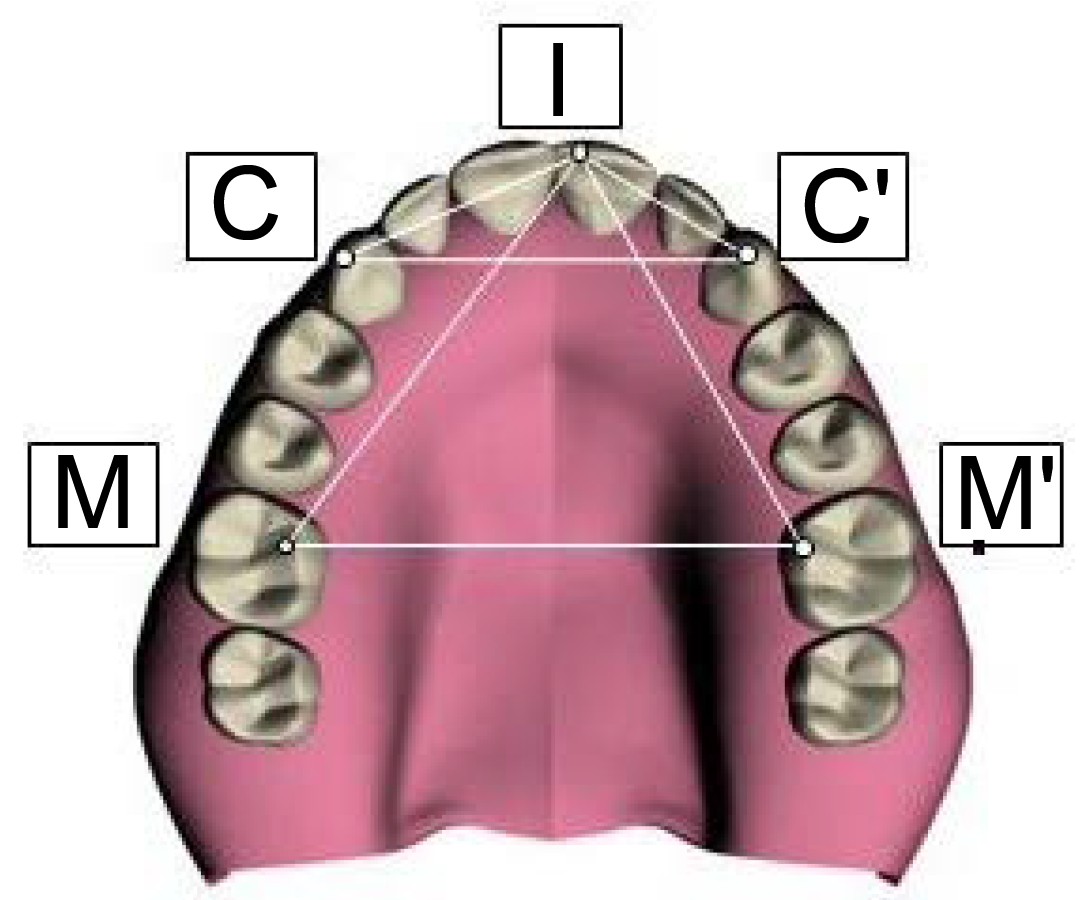
Example of measurements of distances between points measured between the artificial teeth. M-M'- 1st right molar to 1st left molar left, M-I - 1st molar right to central incisor; I-M' - 1st molar left to central incisor, C-C'- right canine to left canine; C-I - Right Canine to central incisor; I-C'- left canine to central incisor.
A mold of laboratory silicone (Rhodorsil®) was used in order to standardize the artificial teeth arrangement. The model and waxed prosthesis were enclosed in plastic flasks VIPI SNG (Vipi Dental Ltd., Pirassununga, Brazil) and filled with type II plaster (AsferIndustria e Comercio Ltda, São Caetano do Sul, SP, Brazil) at the base and type III plaster (Herodent, Vigodent S / A Ind. Com, Rio de Janeiro, RJ, Brazil) at the teeth.
After 24h, the flasks were opened and placed in hot water to soften and remove all wax and then proceed to the pressing of resin.
These steps followed standard procedures regarding inclusion of the acrylic resin thermally activated by microwave energy (VIPI WAVE, Vipi Dental Ltd., Pirassununga, SP. Brazil). The material was manipulated and then placed in the oven according to the manufacturer`s instructions.
Subsequently, the flasks were closed and placed in hydraulic press (Techno Machinery) pressing slowly and gradually, until no more resin flow. Pressure was stabilized in 1000Kgf for 30min. The next step was the activation of polymerization of the resin by microwave energy (Continental AW-30, BS Continental Amazon Ind. E Com Ltda, Manaus, AM, Brazil) with turntable, frequency 2450 megahertz (MHz) and maximum power of 900W. The cycle was 20% of the power of the oven for 20min followed by 60% power for 5min, as indicated by the manufacturer.
Completing the cycle, the flasks were bench cooled at room temperature for 2h. Deflasked, finished and stored in distilled water at 37 ± 2°C.
The dentures bases were divided into four groups (n = 6) as the following Table I: the reline dentures groups (GR-D, GR-D14 and GR-C) with thickness about 1mm were separated from the relief models finished and repositioned a new plaster model (without relief). The reliner agent New Truliner (Harry Bosworth Co, Skokie, Ill) was prepared according to the manufacturer. Uniform pressure was performed on the complete denture with a metallic weight of 1kg on the occlusal artificial tooth until the polymerization of the reline material.
For disinfection processes in the microwave, we adopted the protocol established by Mima et al. [15] in 2008. The dentures were individually immersed in 200ml of water, with a cycle of 3min of 650W.
Completed each cycle, waited for a period of 30min to reposition the prosthesis on the model and performed the respective images to be analyzed. In groups that disinfection interval was 14 days the dentures were placed in distilled water in the oven at 37 ± 2°C.
To measure the dimensional changes, the dentures were photographed with a digital camera with a resolution of 14 megapixel (Sony DSC-W330, Sony Corporation of America, New York, NY). The dentures were carefully repositioned on a plaster model previously to fix a standard distance position between camera and model in 15cm and the angle was at 90° in relation to another, determining an optical zoom of 1.6 times and occlusal view.
The scanned images were saved in a computer and processed with Imagetools (University of Texas Health San Antonio) version 3.0, to measure the distances between points, given in millimeters. All standard photographs were taken with a millimeter scale. For each image, the software was calibrated by scale, transforming the distances obtained into millimeters, before the measurements were recorded. The distances considered between a measuring point to another taking the line segments MM ', Mi, DC', IC, IC ', IM', as viewed in Figure 1.
The analysis was made by the difference in values of line segments obtained before and after the prosthesis is polymerized.
RESULTS
The data were transformed in percentage to enable the visualization of the results. Values below 100% show decreased measure and values above increase of initial distance.
Data were submitted to 3-way analysis of variance (ANOVA), considering 2 factors (treatment and disinfection) and their interactions. Since same-factor interactions were significant, differences were submitted to multiple comparison testing (Tukey HSD test at P = .05).
Analysis by ANOVA revealed significant differences in denture adaptation for the variables treatment and disinfection (Table I). When comparing the variables individually, there was no difference. The influences of variables were not depending on the locals where variations were measured (Table II and 3).
The mean values (± standard deviations) for the dimensional changes of all materials and experimental conditions are presented in Table III. In the control group, an increase of the distances was observed for GR-C (only relief) other groups had a percentage decrease of the distances, mainly for GA-D and GR-D.
DISCUSSION
The results of this study align with prior findings shows that microwave polymerization can induce dimensional changes in complete dentures. The average change of 1.09% observed in dentures made with microwave-polymerized acrylic resin is consistent with previous literature indicating distortion due to polymerization and material characteristics [14]. Notably, the relined dentures exhibited a significantly higher dimensional change (10.44% in Group GR-C), which is in agreement with Basso et al. [14], who attributed such alterations to the composition of reline materials, particularly the presence of isobutyl methacrylate.
Consani et al. [10] previously demonstrated that repeated microwave disinfection after water storage did not cause detrimental effects on base adaptation, which supports the lack of expressive dimensional changes observed in the GT-D14 and GR-D14 groups of the present study. Furthermore, earlier study using scanning devices and surface matching programs also found no significant 3D deformation patterns following water storage [22].
Previous studies have investigated different microwave disinfection cycles capable of achieving bacterial elimination without compromising denture characteristics or causing significant dimensional changes [13,14,16,17]. However, under the present study conditions, the disinfection procedure led to dimensional reductions across all measured regions, particularly in relined specimens.
The observed dimensional changes, particularly in relined dentures and after microwave disinfection, could have substantial clinical consequences. For example, the contraction seen in the GA-D and GR-D groups—ranging from −6.6% to −8.5%—resulted in decreased distances between teeth, which could compromise the retention and stability of dentures. An illustrative case showed a reduction in the molar-to-molar (M-M′) distance from 49.58mm to 45.17mm in one specimen, representing approximately 2mm of contraction on each side. Such displacements may lead to occlusal disharmony, necessitating critical occlusal adjustments, especially in the posterior palate region [10].
The clinical implications of the approximately 2mm reduction in molar–molar distance observed in some specimens should not be underestimated. Although such changes may appear numerically small, their impact on prosthetic performance can be clinically significant, particularly in complete dentures supported exclusively by mucosa. Changes of this magnitude may result in: Occlusal discrepancies, such as premature contacts or interferences; loss of retention due to inadequate adaptation of the denture base to the supporting tissues; reduced stability during mastication or function; and the need for occlusal adjustment or prosthesis remounting, as previously reported [23,24]
These alterations are consistent with the dimensional shrinkage inherent to the characteristics of the material and polymerization conditions, which may lead to distortion of the prosthesis base and displacement of artificial teeth. As previously reported by Kimpara and Muench [22], such dimensional changes can compromise the adaptation to the supporting tissues and the occlusal relationships established prior to final processing [23].
We will emphasize in the revised Discussion section that this phenomenon reflects not only the physical limitations of the polymeric materials used but also their potential clinical consequences, thus highlighting the importance of post-processing evaluation protocols such as clinical remounting.
These findings suggest that relined dentures, when subjected to microwave disinfection, may require reevaluation of occlusal contacts post-treatment to avoid compromised function and patient discomfort.
The pronounced dimensional changes in relined dentures (Group GR-C) can likely be attributed to the thin remaining base material (approximately 1mm) and the inherent properties of chemically activated reline acrylic resin, which is known to retain more residual monomer than heat-cured base resins [25]. Residual monomer adversely affects mechanical properties and may contribute to the observed distortion.
The microwave disinfection protocol (650W for 3 min) used in this study may also explain the contraction observed in GA-D and GR-D groups. Two main hypotheses support this finding: first, that increased temperature from microwave exposure enhances the conversion of residual monomers [26,27]; and second, that heating improves the diffusion of residual monomer molecules into the polymer chain, facilitating additional polymerization and resulting in material contraction [26,28].
Additionally, the storage of specimens in water may have influenced results through mechanisms of water absorption. Water acts on the polymer by diffusing between macromolecules, relieving stresses created during polymerization and leading to potential dimensional relaxation [29]. This may explain the stability observed in the GT-D14 and GR-D14 groups after delayed disinfection.
Despite the relevance of the findings, this study has limitations that should be considered. No mechanical simulation was performed to mimic the functional stresses of mastication, which could influence the dimensional behavior of denture bases. The sample size, although adequate for initial observations, was relatively small and not subjected to power analysis, limiting the generalizability of the findings.
Additionally, only one type of reline material was evaluated. Given the known variability in chemical compositions and behaviors across different products, future studies should investigate other reline formulations to assess whether similar dimensional changes occur.
CONCLUSION
Within the limitations of this study, microwave disinfection was effective but caused significant dimensional changes in denture bases, particularly in relined prostheses, leading to contraction and potential loss of adaptation. Water storage for 14 days appeared to mitigate these effects, possibly due to stress relaxation. Therefore, although microwave disinfection is practical, its use in relined dentures should be approached with caution due to the risk of distortion and the need for occlusal adjustments..
Acknowledgments
None.
Data availability
The data that support the findings of this study are available from the corresponding author upon reasonable request.
-
How to cite:
Carvalho PCK, Costa FC, Bourg NB, Borges ALS, Paes Júnior TJA. Effect of relining and microwave disinfection on the dimensional stability of denture bases. Braz. Dent. Sci. 2026;29(1):e4763. https://doi.org/10.4322/bds.2026.e4763
-
Funding
The authors received financial support from FAPESP (Process N. 52789-1).
-
Regulatory Statement
Not applicable.
REFERENCES
-
1 Martins PRV, Mukai MK, Costa B, Iegami C, Stegun RC. The influence of the retention feature in artificial teeth on its attachment to the thermoplastic resin denture base. Braz Dent Sci. 2023;26(3):1-6. https://doi.org/10.4322/bds.2023.e3770
» https://doi.org/10.4322/bds.2023.e3770 -
2 Şirin Sarıbal G, Ersu N, Canger EM. Effects of conventional complete dentures and implant-supported overdentures on alveolar ridge height and mandibular bone structure: 2-year and 6-year follow-up study. Clin Oral Investig. 2022;26(9):5643-52. https://doi.org/10.1007/s00784-022-04519-5 PMid:35488134.
» https://doi.org/10.1007/s00784-022-04519-5 -
3 Aydin AK, Terzioglu H, Akinay AE, Ulubayram K, Hasirci N. Bond strength and failure analysis of lining materials to denture resin. Dent Mater. 1999;15(3):211-8. https://doi.org/10.1016/S0109-5641(99)00038-X PMid:10551086.
» https://doi.org/10.1016/S0109-5641(99)00038-X -
4 Christensen GJ. Relining, rebasing partial and complete dentures. J Am Dent Assoc. 1995;126(4):503-6. https://doi.org/10.14219/jada.archive.1995.0215 PMid:7722112.
» https://doi.org/10.14219/jada.archive.1995.0215 -
5 Kamal MNM. Comparison between relining of ill-fitted maxillary complete denture versus CAD/CAM milling of new one regarding patient satisfaction, denture retention and adaptation. BMC Oral Health. 2025;25(1):18. https://doi.org/10.1186/s12903-024-05298-z PMid:39755611.
» https://doi.org/10.1186/s12903-024-05298-z -
6 Dovigo LN, Pavarina AC, Ribeiro DG, Oliveira JA, Vergani CE, Machado AL. Microwave disinfection of complete dentures contaminated in vitro with selected bacteria. J Prosthodont. 2009;18(7):611-7. https://doi.org/10.1111/j.1532-849X.2009.00489.x PMid:19523027.
» https://doi.org/10.1111/j.1532-849X.2009.00489.x - 7 Keng SB, Lim M. Denture plaque distribution and the effectiveness of a perborate-containing denture cleanser. Quintessence Int. 1996;27(5):341-5. PMid:8941817.
-
8 Emmer TJ Jr, Emmer TJ Sr, Vaidynathan J, Vaidynathan TK. Bond strength of permanent soft denture liners bonded to the denture base. J Prosthet Dent. 1995;74(6):595-601. https://doi.org/10.1016/S0022-3913(05)80311-7 PMid:8778383.
» https://doi.org/10.1016/S0022-3913(05)80311-7 -
9 Sesma N, Rocha AL, Laganá DC, Costa B, Morimoto S. Effectiveness of denture cleanser associated with microwave disinfection and brushing of complete dentures: in vivo study. Braz Dent J. 2013;24(4):357-61. https://doi.org/10.1590/0103-6440201302205 PMid:24173256.
» https://doi.org/10.1590/0103-6440201302205 -
10 Consani RL, Iwasaki RY, Mesquita MF, Mendes WB, Consani S. Effect of repeated simulated disinfections by microwave energy on the complete denture base adaptation. Open Dent J. 2008;2(1):61-6. https://doi.org/10.2174/1874210600802010061 PMid:19088884.
» https://doi.org/10.2174/1874210600802010061 -
11 Basavanna JM, Jujare RH, Varghese RK, Singh VD, Gaurav A. Effects of laboratory disinfecting agents on dimensional stability of three commercially available heat-cured denture acrylic resins in India: an in-vitro study. J Clin Diagn Res. 2016;10(3):ZC27-31. https://doi.org/10.7860/JCDR/2016/17542.7403 PMid:27134996.
» https://doi.org/10.7860/JCDR/2016/17542.7403 - 12 Silva MM, Vergani CE, Giampaolo ET, Neppelenbroek KH, Spolidorio DM, Machado AL. Effectiveness of microwave irradiation on the disinfection of complete dentures. Int J Prosthodont. 2006;19(3):288-93. PMid:16752628.
-
13 Seo RS, Vergani CE, Pavarina AC, Compagnoni MA, Machado AL. Influence of microwave disinfection on the dimensional stability of intact and relined acrylic resin denture bases. J Prosthet Dent. 2007;98(3):216-23. https://doi.org/10.1016/S0022-3913(07)60058-4 PMid:17854623.
» https://doi.org/10.1016/S0022-3913(07)60058-4 -
14 Basso MF, Giampaolo ET, Vergani CE, Machado AL, Pavarina AC, Ribeiro RC. Influence of microwave disinfection on the dimensional stability of denture reline polymers. J Prosthodont. 2010;19(5):364-8. https://doi.org/10.1111/j.1532-849X.2010.00583.x PMid:20345741.
» https://doi.org/10.1111/j.1532-849X.2010.00583.x -
15 Mima EG, Pavarina AC, Neppelenbroek KH, Vergani CE, Spolidorio DM, Machado AL. Effect of different exposure times on microwave irradiation on the disinfection of a hard chairside reline resin. J Prosthodont. 2008;17(4):312-7. https://doi.org/10.1111/j.1532-849X.2007.00277.x PMid:18086140.
» https://doi.org/10.1111/j.1532-849X.2007.00277.x -
16 Pavan SA, Arioli JN Fo, Santos PH, Mollo F. Effect of microwave treatments on dimensional accuracy of maxillar y acr ylic resin denture base. Braz Dent J. 2005;16(2):119-23. https://doi.org/10.1590/S0103-64402005000200006 PMid:16475605.
» https://doi.org/10.1590/S0103-64402005000200006 - 17 Thomas CJ, Webb BC. Microwaving of acrylic resin dentures. Eur J Prosthodont. 1995;3(4):179-82. PMid:8601161.
-
18 Machado AL, Vergani CE, Giampaolo ET, Pavarina AC. Effect of a heat-treatment on the linear dimensional change of a hard chairside reline resin. J Prosthet Dent. 2002;88(6):611-5. https://doi.org/10.1067/mpr.2002.129807 PMid:12488854.
» https://doi.org/10.1067/mpr.2002.129807 -
19 Urban VM, Machado AL, Oliveira RV, Vergani CE, Pavarina AC, Cass QB. Residual monomer of reline acrylic resins. Effect of water-bath and microwave post-polymerization treatments. Dent Mater. 2007;23(3):363-8. https://doi.org/10.1016/j.dental.2006.01.021 PMid:16620950.
» https://doi.org/10.1016/j.dental.2006.01.021 -
20 Sykora O, Sutow EJ. Comparison of the dimensional stability of two waxes and two acrylic resin processing techniques in the production of complete dentures. J Oral Rehabil. 1990;17(3):219-27. https://doi.org/10.1111/j.1365-2842.1990.tb00002.x PMid:2189970.
» https://doi.org/10.1111/j.1365-2842.1990.tb00002.x -
21 Dyer RA, Howlett JA. Dimensional stability of denture bases following repair with microwave resin. J Dent. 1994;22(4):236-41. https://doi.org/10.1016/0300-5712(94)90120-1 PMid:7962899.
» https://doi.org/10.1016/0300-5712(94)90120-1 - 22 Kimpara ET, Muench A. Influência de variáveis de processamento na alteração dimensional de dentaduras de resina acrílica. Rev Odontol Univ Sao Paulo. 1996;3(2):110-4.
-
23 Al-Quran FA. A clinical evaluation of the clinical remount procedure. J Contemp Dent Pract. 2005;6(1):48-55. https://doi.org/10.5005/jcdp-6-1-48 PMid:15719076.
» https://doi.org/10.5005/jcdp-6-1-48 -
24 Lee SY, Lai YL, Hsu TS. Influence of polymerization conditions on monomer elution and microhardness of autopolymerized polymethyl methacrylate resin. Eur J Oral Sci. 2002;110(2):179-83. https://doi.org/10.1034/j.1600-0722.2002.11232.x PMid:12013564.
» https://doi.org/10.1034/j.1600-0722.2002.11232.x -
25 Vallittu PK, Miettinen V, Alakuijala P. Residual monomer content and its release into water from denture base materials. Dent Mater. 1995;11(6):338-42. https://doi.org/10.1016/0109-5641(95)80031-X PMid:8595832.
» https://doi.org/10.1016/0109-5641(95)80031-X -
26 Polychronakis N, Polyzois G, Lagouvardos P, Andreopoulos A, Ngo HC. Long-term microwaving of denture base materials: effects on dimensional, color and translucency stability. J Appl Oral Sci. 2018;26(0):e20170536. https://doi.org/10.1590/1678-7757-2017-0536 PMid:29898184.
» https://doi.org/10.1590/1678-7757-2017-0536 -
27 Blagojevic V, Murphy VM. Microwave polymerization of denture base materials. A comparative study. J Oral Rehabil. 1999;26(10):804-8. https://doi.org/10.1046/j.1365-2842.1999.00456.x PMid:10564437.
» https://doi.org/10.1046/j.1365-2842.1999.00456.x -
28 Bettencourt AF, Neves CB, Almeida MS, Pinheiro LM, Oliveira SA, Lopes LP, et al. Biodegradation of acrylic based resins: a review. Dent Mater. 2010;26(5):e171-80. https://doi.org/10.1016/j.dental.2010.01.006 PMid:20189238.
» https://doi.org/10.1016/j.dental.2010.01.006 -
29 Lim SR, Lee JS. Three dimensional deformation of dry-stored complete denture base at room temperature. J Adv Prosthodont. 2016;8(4):296-303. https://doi.org/10.4047/jap.2016.8.4.296 PMid:27555899.
» https://doi.org/10.4047/jap.2016.8.4.296
Edited by
-
Editor:
João Maurício Ferraz da Silva