 Patient knowledge about assisted reproductive techniques in Brazil
Abstract
This study aimed to create and validate a questionnaire to evaluate the knowledge of patients regarding assisted reproduction norms by the Brazilian Federal Council of Medicine. Using a modified Delphi method, the questionnaire was reviewed by judges from the Technical Chamber of Assisted Reproduction of the Council in two rounds, ensuring clarity and relevance. After adjustments and 80% consensus, the pre-test was conducted with patients under treatment. The questionnaire was effective in measuring patient knowledge level, with potential for improving communication between physicians and patients. This process reinforces the application of bioethical principles, such as autonomy and beneficence, as they directly impact informed decision making by patients and contributes to the alignment with Federal Council of Medicine norms.
Keywords
Bioethics; Reproductive techniques assisted; Social control, formal; Surveys and questionnaires
Resumo
Este estudo buscou criar e validar um questionário para avaliar o conhecimento dos pacientes sobre as normativas de reprodução assistida do Conselho Federal de Medicina. Usando o método Delphi modificado, o questionário foi revisado por juízes da Câmara Técnica de Reprodução Assistida do Conselho em duas rodadas, para garantir clareza e pertinência. Após ajustes e consenso de 80%, realizou-se pré-teste com pacientes em tratamento. O questionário demonstrou-se eficaz em medir o nível de conhecimento dos pacientes, com potencial para aprimorar a comunicação entre médicos e pacientes. Esse processo reforça a aplicação de princípios bioéticos, como autonomia e beneficência, na medida em que impacta diretamente a tomada de decisão informada dos pacientes e contribui para o alinhamento com as normativas do Conselho Federal de Medicina.
Palavras-chave
Bioética; Técnicas reprodutivas assistidas; Controle social formal; Inquéritos e questionários
Resumen
Este estudio buscó crear y validar un cuestionario para evaluar el conocimiento de los pacientes sobre las normas de reproducción asistida del Consejo Federal de Medicina. Utilizando el método Delphi modificado, el cuestionario fue revisado por jueces de la Cámara Técnica de Reproducción Asistida del Consejo en dos rondas, para garantizar su claridad y pertinencia. Tras los ajustes y alcanzar un consenso del 80 %, se realizó una prueba previa con pacientes en tratamiento. El cuestionario demostró ser efectivo para medir el nivel de conocimiento de los pacientes, con potencial para mejorar la comunicación entre médicos y pacientes. Este proceso refuerza la aplicación de principios bioéticos, como la autonomía y la beneficencia, en la medida en que repercute directamente en la toma de decisiones informadas de los pacientes y contribuye a la alineación con las normas del Consejo Federal de Medicina.
Palabras clave
Bioética; Técnicas reproductivas asistidas; Control social formal; Encuestas y cuestionarios
Infertility is defined by the World Health Organization (WHO) as the inability to achieve pregnancy after 12 months of regular sexual intercourse without the use of contraception. It affects one in six people of reproductive age and has a significant impact on emotional, social, and financial well-being. Assisted reproductive technologies (ART) represent a milestone in modern medicine, allowing thousands of people to realize their dream of parenthood 1. The success of ART in humans is just over four decades old, marked by the birth of the first baby through in vitro fertilization (IVF) on July 25, 1978, in London, England. This revolutionary event marked the beginning of a new era in reproductive medicine, which has since made remarkable progress.
In Brazil, the first baby born with the aid of IVF techniques came into the world in 1984, a fact that consolidated the country as a regional reference in the ART area 2. The following decades saw significant advances in both technology and regulation, enabling more than 9 million births worldwide. ARTs have evolved beyond the treatment of infertility and have come to include fertility preservation for patients undergoing gonadotoxic medical treatments and family planning for those who wish to postpone motherhood or fatherhood, same-sex couples, and independent reproduction. A series of regulations has accompanied this progress 3.
The balance between scientific progress and respect for ethical issues is crucial to ensure that these technologies continue to serve human well-being and, thus, a more inclusive and equitable future for the treatment of infertility 4. While infertility is a global health problem, ART standards are defined by the regulatory bodies of each country. In Brazil, the Federal Council of Medicine (CFM) is the body responsible for regulating assisted reproductive techniques 5. Regulation in Brazil, led by the CFM, began in 1992 with Resolution 1,358/1992 6, which defined ethical standards for the use of ART. The regulation was updated in 2010, 2013, and 2015, in line with scientific and social advances, with the most recent publication in 2022 (CFM Resolution 2,320/2022 7), which updates the ethical standards for the use of these techniques in the country 6. In addition to the CFM, the National Health Surveillance Agency (ANVISA) regulates and monitors good practices in the area of human cells, tissues, and embryos. In 2022, the Collegiate Board Resolution (RDC) was updated to improve the regulation of this issue in Brazil, with a view to increasing the safety and quality of assisted human reproduction procedure 8.
While the impact of these advances is evident across public and private health systems, the Unified Health System (SUS) offers limited access to ART. In contrast, private clinics have expanded options and accessibility through continuous innovation and investment. This development reflects cultural and ethical changes and promotes debates on reproductive rights, bioethics, and the role of the State in regulating these practices 5. While the expansion of private-sector clinics and the pursuit of excellence have boosted Brazil’s recognition, the public sector should better integrate ART into the SUS to benefit low-income patients. Such efforts can improve population health, quality of life, and reproductive opportunities for many families 3.
In addition to the high costs of ART, which limit its availability, resources for diagnosis, prevention, and treatment remain undoubtedly scarce. A WHO report published in 2020 that assessed the cost of infertility treatment in low- and middle-income countries highlights the need for public policies that ensure more equitable access and prevent vulnerable families from being driven to financial ruin in the search for alternatives to form their families 9. In 2023, the WHO published another report according to which 17.5% of adults worldwide (or one in six people) will experience infertility at some point in their lives; the study found that the condition is a public health problem that affects countries of different economic levels equally, with a prevalence of 17.8% in high-income countries and 16.5% in low- and middle-income countries 10.
While CFM Resolution 2,320/2022 7 protects reproductive autonomy—as it requires the express consent of both partners for embryo implantation—it also guarantees the possibility of revocation before implantation. This approach prioritizes individual freedom, aligning with the principles of human dignity and family planning (Article 226, Paragraph 7, of the Constitution of Brazil 11), but frustrates the desire for parenthood of those who have no other options for having children, as in the case of cryopreserved embryos from couples who later divorce. The use of surplus embryos is another delicate point. This practice must have very clear regulations, as must the right to choose their destination—for example, donation must be practiced ethically and the rights of children generated by assisted reproduction techniques must be guaranteed, including the right to know their biological origins without compromising the privacy of donors 12.
Any changes in the legal area must seek to balance the principles of human dignity, autonomy of will, and protection, and reduce the possibilities of conflict. The recommendation is to develop policies that expand access to services, promote bioethical education for patients, and strengthen oversight, especially regarding human embryos.
Method
This work was developed as part of the Doctoral Program at the Faculty of Medicine of the University of Porto, Portugal. It is a cross-sectional study based on a questionnaire developed by the authors. The study was divided into two phases: the first was the development and validation of the questionnaire, and the second was a pre-test of its application to patients undergoing ART. All study participants in both phases signed an informed consent form in accordance with current ethical standards for research with humans.
Questionnaire development and validation process
The questionnaire aimed at assessing the knowledge of patients undergoing assisted human reproduction techniques regarding Brazilian regulations on the manipulation of in vitro produced embryos, as well as to gather personal opinions regarding their disposal. Since no validated instrument was available in Portuguese or any other language that could be translated, it was decided to develop and validate a questionnaire for use as an analytical instrument in this study. To this end, a methodology was sought that would enable the collective construction of a consensus through reflection on the practical experience of those working in assisted human reproduction in Brazil. Thus, a questionnaire was developed, and its validation was carried out in four phases using the modified Delphi methodology, in which the instrument is evaluated by judges over several rounds, who can make suggestions to improve it 13,14. Initially, a questionnaire containing 18 original, objective questions was developed.
Given that content validity analysis requires that the content be relevant 15, judges were asked to rate the clarity and relevance of each question on a Likert scale, which is a measure commonly used in Delphi studies 16. A 4-point Likert scale was used with the following range: 1 = clear and relevant; 2 = not clear and relevant; 3 = clear and not relevant; and 4 = not clear and not relevant. Each question had only one answer option, and at the end of the questionnaire, there was an empty text box to allow comments or justification of the choice. Three final questions were included about the judges’ level of education, the importance of completing the questionnaire, and the usefulness of this assessment instrument.
The judges were to be experts on the subject matter, so it was decided to invite members of the Technical Chamber of Assisted Reproduction of the CFM. These professionals work directly in the development of regulations related to the subject of this study’s instrument. The initial questionnaire was sent via email to the CFM, which was asked for permission to invite the Technical Chamber’s 23 members.
After obtaining CFM authorization, the 23 members of the Chamber were contacted by email and invited to serve as judges in the validation of the questionnaire. In accordance with the research guidelines for the Delphi survey method, they were informed of the study’s expectations regarding their participation, the time required, and the overall objective of their contribution, to promote relationships and encourage optimal responses across all validation rounds 17. Members who agreed to participate and provided consent were immediately referred to the first validation round. Members of the Technical Chamber of Assisted Reproduction who refused to participate after the first contact were excluded and were not invited to the next round. Eleven judges participated in the two rounds of instrument validation, and the responses were received anonymously.
Data analysis
The analysis of the judges’ responses was carried out using the content validity index (CVI), which was calculated by summing the responses of the experts who indicated that each item was clear and relevant, and dividing by the total number of responses. For this study, the ≥80% consensus level was chosen to guide changes to the questionnaire, in line with other investigations on questionnaire development in the health field 17. Based on the ≥80% consensus, the following procedure was applied: 1) questions with ≥80% consensus for “clear and relevant” were kept in their original form or minimally reformulated according to the judges’ suggestions; 2) if any question presented ≥80% consensus for the sum of “clear and not relevant” and “not clear and not relevant,” it would be excluded due to its irrelevance; 3) questions that did not fall into the categories described above, i.e., did not reach ≥80% consensus, but were considered relevant, would be submitted to a new round of evaluation after being edited based on the comments of the panel of judges in the previous round.
The stability of responses in a Delphi consensus tends to occur after two to four rounds 18. Therefore, the criterion for finalizing the rounds for this Delphi study was set at two rounds. If the judges did not reach ≥80% consensus on any item after two rounds, the item would be excluded, and the results would be presented and discussed, considering that each Delphi round allowed for documenting and analyzing divergent opinions.
The last validation phase aimed to administer the questionnaire (via email) to a group of patients undergoing assisted reproduction treatment at a reproductive medicine clinic in the city of São Paulo, serving as a pre-test, to evaluate the instrument’s clarity for patients. In this phase, the questions were answered using a 3-point Likert scale with the following range: 1 = yes; 2 = no; 3 = not sure. In the response form, patients received clear instructions on how to answer the questionnaire, including an estimated completion time of 15 minutes. Initially, 150 patients were contacted, and questionnaires were sent to them. Due to low participation, the questionnaire was sent to an additional 150 patients, bringing the total to 300 mailings over three months. In total, 17 responses were obtained.
Results
Round 1
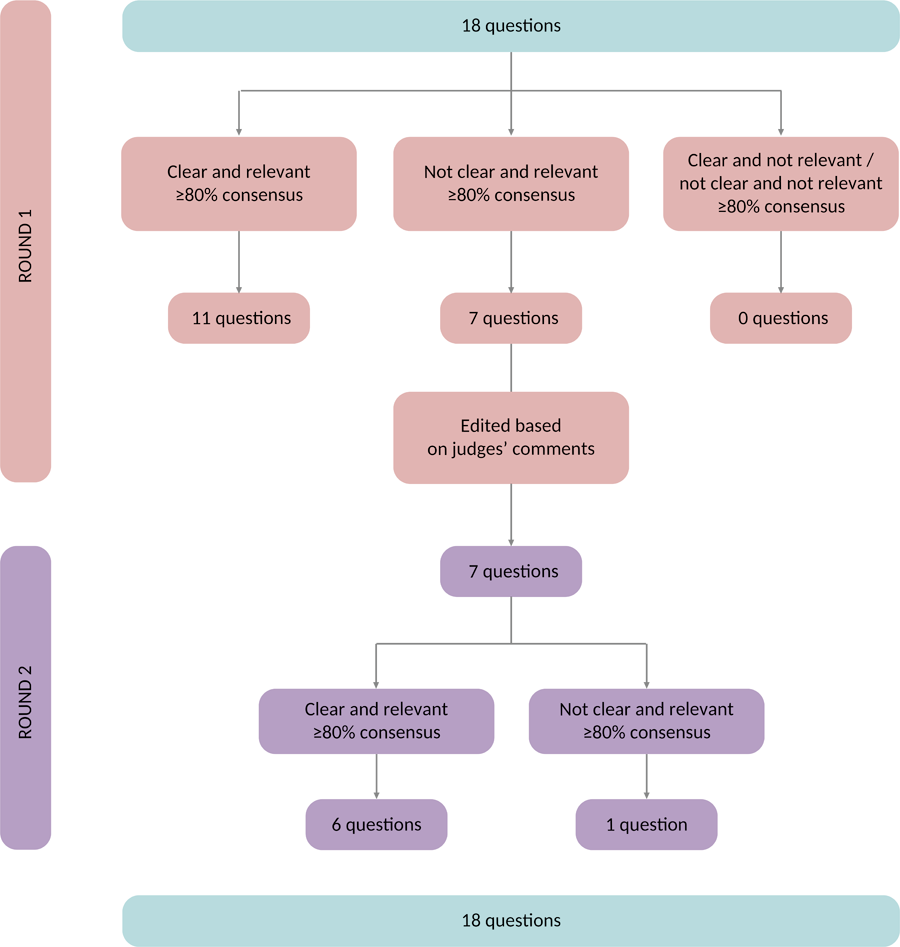
In the first round of evaluation, conducted by 11 judges, 11 questions achieved a CVI of at least 80%, while seven other questions did not obtain satisfactory agreement and were reformulated. The judges’ opinions and suggestions were incorporated into the reformulation of the questions (Figure 1). No question was considered irrelevant, and therefore no questions were excluded.

Flowchart of the questionnaire validation process by the judges using the modified Delphi method
Round 2
A second round of evaluation by the judges was performed, and the seven reformulated questions were sent to the 11 participating judges. In this stage, we achieved a consensus level ≥80% on the clarity and relevance of 6 of the 7 questions evaluated (Figure 1). One question (No. 8) achieved 70% consensus on clarity and relevance, and a decision was made to keep it with minimal modifications, considering the judges’ suggestions (Figure 1).
The final questionnaire resulted in 18 questions, as described in Chart 1. The mean content validity index of the questions included in the final questionnaire was 90%. Supporting the study’s relevance, all participating judges agreed that this questionnaire is a useful assessment instrument, and 91.7% found it easy to understand.
Questionnaire on knowledge regarding the handling and disposition of embryos produced by assisted reproductive techniques in Brazil
Pre-test of the questionnaire with patients
The questionnaire was administered to 17 women undergoing ART treatment cycles. The mean age of the women was 36.1±4.9 years, and most were White (70.6%) and had completed higher education (82.4%). Most women were in heterosexual relationships (88.2%), used their own eggs (82.4%), and were undergoing their first treatment cycle (87.5%).
The analysis showed that, in most questions, the patients were knowledgeable about the subject, with more than 75% answering “yes” (Chart 2). Questions 10, 11, and 12 were exceptions. However, we noticed that questions 10, 11, and 12 addressed personal issues related to the use of surplus embryos, while the others addressed knowledge of ART legislation.
Percentage of “yes” responses to questionnaire questions in the pre-test with patients undergoing in vitro fertilization cycles
Discussion
Bioethics, as an interdisciplinary field, seeks to answer the moral dilemmas that emerge from the use of biomedical technologies, such as assisted reproduction. Principles such as autonomy, beneficence, non-maleficence, and justice guide the analysis of decisions regarding the fate of cryopreserved embryos, in which clear, accessible information is a condition for informed consent and the patient’s active participation. The principle of justice seeks to guarantee the patient equitable access to technologies and the ethical implications of treatments available only in certain socioeconomic contexts. As a guarantee of fundamental human rights, within the scope of public health policies, the regulation of health services plays a central role in preventing the emergence of legal-political and legal-constitutional problems and in ensuring equal access for all patients 19.
The principles of beneficence and non-maleficence are related to each other and express concern about the consequences of decisions, such as embryo disposal and its relationship with the value attributed to human life. Autonomy, on the other hand, refers to the patient’s right to decide the fate of their embryos based on clear and complete information.
Questions about the legal and ethical aspects of embryo disposal are recurring, and the absence of specific legislation in Brazil exacerbates this scenario and increases the responsibility of clinical teams in guiding patients. This situation prompted us to conduct this study to assess patients undergoing in vitro fertilization procedures’ knowledge of Brazilian regulations administered by the Federal Council of Medicine and their perceptions of practices related to egg and embryo disposal.
During questionnaire validation in this study, the judges conducted two rounds of analysis. In the first round, seven questions showed consensus below 80% (CVI<0.8) and were carefully evaluated for the reasons for the disagreement. We reformulated these questions, recognizing that the people who would actually answer the study’s questionnaire would not be from the medical field. We made the language more accessible without altering the topic addressed in the original question or the sequence of the first questionnaire. After the second round, two of the seven reassessed questions reached 100% consensus, and five questions remained, with agreement rates between 70% and 90%. Even though they reached acceptable rates for questionnaire validation, the reasons for these disagreements were carefully evaluated in questions 5, 8, 13, 16, and 17.
Questions 5, 13, and 16 were considered “not relevant” by at least one judge. Question 5 concerns the placement of embryos in straws, as embryo transfer to the maternal uterus will be performed. We received a negative (not relevant) response, with the comment: “Embryos are not necessarily arranged in straws.” Question 16 addresses the financial costs of maintaining the frozen embryo, but there were no suggestions or comments on this topic. Question 13, which concerns the disposal of embryos in accordance with a specific document (informed consent form) provided by the assisted reproduction clinic/laboratory, as per CFM Resolution 2,320/2022 7, received the most suggestions from the evaluators. Four comments were presented: first, the question should contain a clearer statement about the time frame for embryo disposal; another commented only on disposal; a third judge suggested that the subject of embryo disposal and abandonment should be addressed more thoroughly, but in a generalized way, without any other specific comments; finally, a judge mentioned that some questions about embryo disposal and freezing were unclear, but suggested commenting on the issue related to the disposition of embryos in case of the death of both spouses.
Questions 8 and 17 received three negative responses (“not relevant”) from the judges. These questions relate to Law 11,105/2005 (Biosafety Law 20). Although three judges responded that the question was not relevant, only one comment related to the topic was obtained, according to which the Biosafety Law does not apply to the question posed, i.e., it does not address the abandonment of embryos with subsequent disposal if their financial support is suspended after the mandatory three-year period. This comment also relates to the suggestion in question 13 regarding the disposal of embryos. However, when the questionnaire was administered to patients, almost all responses (88.2%) indicated knowledge of the topic, suggesting that this is a subject addressed in consultations and of interest to patients.
This study’s findings support the formulation of public and institutional policies that integrate bioethics and regulation and promote alignment between medical standards and patients’ cultural and ethical diversity. The use of the validated questionnaire can contribute to a safer, more ethical, and humanized clinical practice, as well as serve as a reference for future educational and regulatory interventions in the field of assisted reproduction.
The study also included a pre-test, which consisted of administering a questionnaire to patients undergoing assisted reproduction treatment at a clinic in São Paulo. The pre-test aimed to assess patients’ understanding of the questionnaire, given that they presumably do not have the same technical knowledge as the judges who participated in the validation. Secondarily, the patients’ willingness to complete the questionnaire and the time spent doing so were evaluated. Furthermore, it would be possible to conduct an initial analysis of the responses to make adjustments to the questionnaire.
In this phase of the study, only the personal questions (questions 10, 11, and 12), which addressed decisions about using, donating, or discarding surplus embryos, showed divergence in responses. This variation in opinions is expected, since each patient has the autonomy to decide on the fate of their surplus embryos. However, ethical dilemmas can be cited after analyzing the data obtained, as ethical divergences may occur regarding the fate of surplus embryos—disposal, donation to other couples, or use in research—which demonstrates tension between legal regulations and the diversity of cultural and religious values of patients. Assessing patients’ knowledge is required to identify specific gaps in understanding of embryo disposal, such as legal requirements and ethical implications, since a lack of knowledge compromises patient autonomy and perpetuates inequalities in access to and decisions about surplus embryos. Furthermore, this study aims to provide support for policies that integrate bioethics and legislation and promote informed decisions that respect cultural and ethical diversity.
Bioethics plays an essential role by providing a theoretical framework for interpreting research results and proposing strategies that promote informed, responsible decisions aligned with the fundamental principles of human dignity. In summary, the methodology used to construct and validate the questionnaire proved effective, enabling the development of an instrument with high clarity and practical relevance. The content validity index of over 90% reinforces the instrument’s reliability for clinical and academic use. The results analysis demonstrates that, although patients have a good level of general understanding of assisted reproduction, doubts persist on specific and sensitive topics, such as embryo disposal, which highlights the need to improve communication between healthcare professionals and patients in the reproductive decision-making process.
Final considerations
Using the modified Delphi method, judges evaluated a questionnaire on the handling and fate of embryos produced by assisted reproduction in Brazil. With ≥80% consensus after two rounds, they agreed that the questions are clear and relevant. The pre-test confirms the instrument’s clarity and importance. This questionnaire can help improve patients’ perceptions of bioethics and assist healthcare organizations and professionals in identifying shortcomings in patient guidance, thereby ensuring conscious, ethical decision-making regarding embryos generated through ART.
The results of this study revealed that the questionnaire is an effective tool for identifying gaps and can significantly improve communication strategies between healthcare professionals and patients. The validated instrument supports safer, more ethical clinical practices and promotes autonomy, informed consent, and patient-centered care. While most patients have a good level of understanding of the general aspects of assisted reproduction, important doubts persist regarding the decision to discard or donate embryos and, therefore, their ethical and legal implications. The adoption of instruments such as this can contribute to more ethical, humane, and legally sound practices by promoting patient autonomy and empowerment. Its application is recommended in different contexts and populations, as well as its use as a basis for public policies and clinical guidelines in the field of assisted human reproduction.
ACK
We thank the Federal Council of Medicine and, in particular, the members of the Technical Chamber of Assisted Reproduction who served as evaluating judges in this study; the Instituto Gera for facilitating the administration of the validated questionnaire to patients; and Scientia Et al. Consultoria em Pesquisas Científicas for their support in data statistical analysis.
References
-
1 Infertility [Internet]. Geneva: World Health Organization; 2024 [acesso 20 maio 2025]. Disponível: https://bit.ly/4qtWNJ7
» https://bit.ly/4qtWNJ7 -
2 Fertilização in vitro gera mais de 10 milhões de bebês ao longo de 45 anos [Internet]. Belo Horizonte: Instituto Brasileiro de Direito de Família; 2023 [acesso 20 maio 2025]. Disponível: https://sl1nk.com/Z0ZqI
» https://sl1nk.com/Z0ZqI -
3 Leite TH. Análise crítica sobre a evolução das normas éticas para a utilização das técnicas de reprodução assistida no Brasil. Cien Saude Colet [Internet]. 2019 [acesso 20 maio 2025];24(3). DOI: 10.1590/1413-81232018243.30522016
» https://doi.org/10.1590/1413-81232018243.30522016 -
4 Silva JS, Almeida VFS, Rezende GO. Reprodução assistida: desafios e avanços da fertilização in vitro e inseminação artificial com perspectivas atuais e futuras. Revista FT [Internet]. 2024 [acesso 20 maio 2025];28(139):32-3. DOI: 10.69849/revistaft/ar10202410280932
» https://doi.org/10.69849/revistaft/ar10202410280932 -
5 Corrêa MCDV, Loyola MA. Reprodução e bioética: a regulação da reprodução assistida no Brasil. Caderno CRH [Internet]. 2005 [acesso 20 maio 2025];18(43):103-12. Disponível: https://bit.ly/3NvTfHL
» https://bit.ly/3NvTfHL -
6 Conselho Federal de Medicina. Resolução CFM nº 1.358, de 11 de novembro de 1992 [Internet]. Adota Normas Éticas para utilização das Normas Técnicas de Reprodução Assistida. Diário Oficial da União [Internet]. Brasília, p. 16053, 19 nov 1992 [acesso 20 maio 2025]. Seção 1. Disponível: https://bit.ly/49zFksP
» https://bit.ly/49zFksP -
7 Conselho Federal de Medicina. Resolução nº 2.320, de 1º de setembro de 2022. Adota normas éticas para a utilização de técnicas de reprodução assistida - sempre em defesa do aperfeiçoamento das práticas e da observância aos princípios éticos e bioéticos que ajudam a trazer maior segurança e eficácia a tratamentos e procedimentos médicos, tornando-se o dispositivo deontológico a ser seguido pelos médicos brasileiros e revogando a Resolução CFM nº 2.294, publicada no Diário Oficial da União de 15 de junho de 2021, Seção 1, p. 60. Diário Oficial da União [Internet]. Brasília, p. 107, 20 set 2022 [acesso 20 maio 2025]. Seção 1. Disponível: https://bit.ly/47pHIRs
» https://bit.ly/47pHIRs -
8 Agência Nacional de Vigilância Sanitária. Resolução da Diretoria Colegiada nº 771, de 26 de dezembro de 2022. Dispõe sobre as boas práticas em células germinativas, tecidos germinativos e embriões humanos, para uso terapêutico, e dá outras providências. Diário Oficial da União [Internet]. Brasília, 28 dez 2022 [acesso 20 maio 2025]. Seção 1. Disponível: https://bit.ly/4r9g4PX
» https://bit.ly/4r9g4PX -
9 Organização Mundial da Saúde. Infertilidade: uma ficha informativa. Genebra: OMS [Internet]; 2020 [acesso 27 jan 2025]. Disponível: https://bit.ly/4d4dhnq
» https://bit.ly/4d4dhnq -
10 Organização Mundial da Saúde. Uma em cada seis pessoas no mundo é afetada pela infertilidade. Genebra: OMS [Internet]; 2023 [acesso 27 jan 2025]. Disponível: https://bit.ly/4d8iYRo
» https://bit.ly/4d8iYRo -
11 Brasil. Constituição da República Federativa do Brasil de 1988. Brasília: Senado Federal [Internet]; 1988 [acesso 7 set 2025]. Disponível: https://bit.ly/49yq2ED
» https://bit.ly/49yq2ED -
12 Magalhães MC. Direito dos embriões e o novo Código Civil: reflexos no direito de família. Consultor Jurídico [Internet]. 2025 [acesso 20 maio 2025]. Disponível: https://bit.ly/40WLcHo
» https://bit.ly/40WLcHo -
13 Dias LM, Arantes AMB, Bezerra MR, Santos G, Santos AFJ, Tommaso ABG Di et al. Matriz de competências de medicina paliativa para o Geriatra. Geriatrics, Gerontology and Aging [Internet]. 2018 [acesso 20 maio 2025];12(4). DOI: 10.5327/Z2447-211520181800067
» https://doi.org/10.5327/Z2447-211520181800067 -
14 Tsang S, Royse CF, Terkawi AS. Guidelines for developing, translating, and validating a questionnaire in perioperative and pain medicine. Saudi Journal of Anaesthesia [Internet]. 2017 [acesso 20 maio 2025];11(Suppl 1):80-9. DOI: 10.4103/sja.SJA_203_17
» https://doi.org/10.4103/sja.SJA_203_17 -
15 Lynn MR. Determination and quantification of content validity. Nurs Res [Internet]. 1986 [acesso 20 maio 2025];35(6): 382-5. Disponível: https://bit.ly/4jQrlCd
» https://bit.ly/4jQrlCd -
16 Boulkedid R, Abdoul H, Loustau M, Sibony O, Alberti C. Using and reporting the Delphi method for selecting healthcare quality indicators: a systematic review. PLoS One [Internet]. 2011 [acesso 20 maio 2025];6(6):20476. DOI: 10.1371/journal.pone.0020476
» https://doi.org/10.1371/journal.pone.0020476 -
17 Hasson F, Keeney S, McKenna H. Research guidelines for the Delphi survey technique. J Adv Nurs [Internet]. 2000 [acesso 20 maio 2025];32(4):1008-15. Disponível: https://bit.ly/4sUuTrd
» https://bit.ly/4sUuTrd -
18 Keeney S, Hasson F, McKenna H. Consulting the oracle: ten lessons from using the Delphi technique in nursing research. J Adv Nurs [Internet]. 2006 [acesso 20 maio 2025];53(2):5-12:205-12. DOI: 10.1111/j.1365-2648.2006.03716.x
» https://doi.org/10.1111/j.1365-2648.2006.03716.x - 19 Nunes R, Canotilho G, Martins GO, Beleza TP. Regulação da Saúde. 4ª ed. Porto: Vida Económica; 2021.
-
20 Brasil. Lei nº 11.105, de 24 de março de 2005. Regulamenta os incisos II, IV e V do § 1º do art. 225 da Constituição Federal, estabelece normas de segurança e mecanismos de fiscalização de atividades que envolvam organismos geneticamente modificados - OGM e seus derivados, cria o Conselho Nacional de Biossegurança - CNBS. Diário Oficial da União [Internet]. 2005 [acesso 7 set 2025]. Seção 1. Disponível: https://bit.ly/3LNoZaO
» https://bit.ly/3LNoZaO
Edited by
-
Editor in charge:
Dilza Teresinha Ambrós Ribeiro
All data used or generated in this study are described and presented in full in the body of the article.