 Critical feeding window: Influence of delayed Artemia nauplii provision on Pyrrhulina brevis larviculture
ABSTRACT
This study aimed to evaluate the impact of delayed Artemia nauplii introduction on the larviculture of the Amazonian ornamental fish Pyrrhulina brevis. A completely randomized design with four treatments and four replicates was implemented. Larvae were subjected to varying delays in Artemia nauplii supply—0 (no delay), two, four, and six days—and were subsequently fed until the end of the 20-day experimental period. Growth performance, point-of-no-return, and intestinal and muscular histomorphometry were assessed at the end of the experiment. No differences in length, weight, uniformity or Fulton’s condition factor were observed between larvae with no delay and those with a two-day delay in Artemia nauplii supply (p > 0.05). However, total mortality occurred in larvae exposed to delays of four days or longer by the fifth day of experiment. Larvae without delay exhibited a survival rate of 86.25%, significantly higher than the 20% survival rate in those subjected to a two-day delay (p < 0.05). The point-of-no-return for P. brevis larvae was determined to be 2.69 days (9.69 days post-hatching). No differences were observed in intestinal or muscle histomorphometry among treatments (p > 0.05). These findings highlight that delaying Artemia nauplii supply critically reduces the survival of P. brevis larvae, potentially compromising the viability of larviculture production.
Keywords
Fasting; live prey; Ornamental fish farming; Point-of-no-return
RESUMO
Este estudo teve como objetivo avaliar o impacto da introdução tardia de náuplios de Artemia na larvicultura do peixe ornamental amazônico Pyrrhulina brevis. Um delineamento inteiramente casualizado com quatro tratamentos e quatro repetições foi implementado. As larvas foram submetidas a diferentes atrasos no fornecimento de náuplios de Artemia — 0 (sem atraso), dois, quatro e seis dias — e foram posteriormente alimentadas até o fim do período experimental de 20 dias. O desempenho produtivo, o ponto de não retorno e a histomorfometria intestinal e muscular foram avaliados ao final do experimento. Não foram observadas diferenças em comprimento, peso, uniformidade ou fator de condição de Fulton entre larvas sem atraso e aquelas com atraso de dois dias no fornecimento de náuplios de Artemia (p > 0,05), no entanto ocorreu mortalidade total nas larvas expostas a atrasos de quatro dias ou mais até o quinto dia de experimento. As larvas sem atraso apresentaram taxa de sobrevivência de 86,25%, significativamente superior aos 20% de sobrevivência nas larvas com atraso de dois dias (p < 0,05). O ponto de não retorno das larvas de P. brevis foi determinado em 2,69 dias (9,69 dias após a eclosão). Não foram observadas diferenças na histomorfometria intestinal ou muscular entre os tratamentos (p > 0,05). Esses achados destacam que o atraso no fornecimento de náuplios de Artemia reduz criticamente a sobrevivência das larvas de P. brevis, comprometendo potencialmente a viabilidade produtiva na larvicultura.
Palavras-chave
Jejum; Presas vivas; Piscicultura ornamental; Ponto de não retorno
INTRODUCTION
The primary challenges in ornamental fish farming are intricately linked to feeding and nutritional management. Existing rearing protocols often adopt feeding strategies originally designed for edible fish species (Campelo et al., 2021), which are poorly suited to the unique physiological and ecological requirements of ornamental fish. This mismatch can adversely affect survival rates (Oliveira et al., 2020b) and profitability, particularly in aquarium trade industry, in which ornamental fish are sold individually rather than by weight (Oliveira et al., 2022). The issue is especially critical in larviculture, in which the inherent fragility of larvae and suboptimal feeding practices frequently result in high mortality rates (Abe et al., 2022; Eiras et al., 2022). A key research focus in this area is optimizing the timing of initial feeding, as delays can severely impair larval development and survival (Motta et al., 2023).
The production of juvenile ornamental fish is increasingly adopting intensive systems (Araújo et al., 2021; Oliveira et al., 2022), in which larvae are introduced into controlled tank environments immediately after mouth opening (Ferreira et al., 2023; Santos et al., 2022). The success of these systems hinges on various factors, with the quality and availability of live prey being particularly critical (Abe et al., 2019; Eiras et al., 2022). While these systems provide enhanced control over environmental conditions (Pinheiro Junior et al., 2023; Reis et al., 2021), failures in live prey cultivation or improper timing in prey supply can result in larval starvation, severely compromising survival rates (Abe et al., 2022; Motta et al., 2023).
For many fish species, fasting is a natural physiological response to environmental changes caused by partial or complete food scarcity (Assis et al., 2020). While adult and juvenile fish have evolved strategies to mobilize energy reserves and endure extended periods without food (Porto et al., 2023), fish larvae exhibit heightened vulnerabilities. In both natural ecosystems and aquaculture settings, fluctuations in food availability frequently result in fasting episodes that can significantly impair larval growth and survival (Melo et al., 2020; Motta et al., 2023). Unlike their more developed counterparts, larvae possess limited energy reserves, making them highly susceptible to food deprivation; even brief periods of fasting can dramatically increase mortality risk (Abe et al., 2022; Xu et al., 2023).
Prolonged fasting can weaken fish larvae to the point in which they lose the ability to exhibit normal feeding behavior (Melo et al., 2020). Even if food becomes available, severely weakened larvae may be unable to resume feeding, ultimately leading to mortality (Motta et al., 2023). This critical threshold, known as point-of-no-return (PNR), was first described by Blaxter and Hempel (1963) as the stage at which the damage caused by fasting becomes irreversible, resulting in 50% of larvae mortality. Understanding the fasting effects on larval development and survival is essential for reducing rearing costs in aquaculture. Early mortality in fish farms is strongly influenced by the period during which larvae can withstand food deprivation before reaching the PNR (Garcia et al., 2020).
Pyrrhulina brevis (Steindachner, 1876), a member of the family Lebiasinidae, is native to the Amazon Basin and renowned in the ornamental fish trade for its unique morphological and behavioral characteristics (Oliveira et al., 2020b). This species commands high international market prices, reflecting its commercial importance (Pinheiro Junior et al., 2023). While captive farming of P. brevis has been established, production remains limited and inconsistent, largely due to insufficient scientific knowledge to refine and standardize rearing practices (Abe et al., 2022). As a result, the ornamental trade continues to rely predominantly on wild-caught specimens, exerting substantial pressure on natural populations and raising concerns about potential declines in wild stocks (Oliveira et al., 2020b).
High mortality rates in the early life stages of P. brevis are often attributed to inadequate feeding management, underscoring the critical need for a deeper understanding of this issue
(Abe et al., 2022; Oliveira et al., 2020b). Determining the PNR and evaluating larval growth, as well as intestinal and muscular development, in response to delayed feeding with Artemia nauplii are essential for identifying the duration of food deprivation that compromises survival and leads to economic losses. This study aimed to assess the effects of delayed Artemia nauplii feeding on the growth performance of P. brevis larvae, establish the PNR, and analyze intestinal and muscle histomorphometry to inform optimized feeding strategies.
MATERIAL AND METHODS
Fish and experimental design
The experiment was conducted at the Laboratório de Piscicultura, Instituto de Estudos Costeiros, Universidade Federal do Pará (UFPA), Brazil, in accordance with the guidelines of the Ethics Committee for the Use of Animals at UFPA (approval number: 5008250424). The P. brevis larvae were obtained through natural spawning from wild-caught broodstock maintained under controlled laboratory conditions. Eggs, deposited on a Terminalia catappa leaf used as a spawning substrate, were carefully collected and transferred to a hatchery. During the initial four days post-spawning, the larvae subsisted on their yolk sac. In the subsequent three days, they relied on microorganisms generated by the decomposition of the T. catappa leaf for nourishment.
A total of 320 larvae, seven days post-hatching, originating from a single breeding pair and a single spawning event, with a mouth size suitable for consuming Artemia nauplii as exogenous food (Abe et al., 2015), were used in this experiment. The larvae had an initial mean length of 4.25 ± 0.20 mm and a mean weight of 1.08 ± 0.12 mg (mean ± standard deviation). They were fed newly hatched Artemia nauplii at an initial concentration of 150 Artemia nauplii larvae-1 day-1, with prey concentration increasing by 50% every six days (Oliveira, 2022). Feeding was carried out four times daily, at 8, 11, 14, and 17 h, following a protocol adapted from Abe et al. (2015) and Oliveira et al. (2020b), with modifications to the feeding times.
Artemia nauplii were produced daily by incubating cysts in salinized water with a salinity of 35 g L-1, maintained at 28°C under artificial lighting for 24 hours with continuous aeration. After hatching, the live nauplii were collected by siphoning and rinsed through a 120-μm mesh sieve under running freshwater to remove residual salinity, and subsequently stored in freshwater. The mean nauplii density per milliliter was then determined, and the volume needed for each aquarium was calculated based on the required number of nauplii per experimental unit. This procedure adhered to the methodology described by Oliveira et al. (2022).
Before the experiment began, larvae were carefully transferred to the experimental units at the initial stocking density of 20 larvae L-1. The experimental setup consisted of 16 1-L plastic aquaria arranged in a completely randomized design, with four treatments and four replicates per treatment, conducted over a 20-day experimental period. The study investigated the effects of delayed Artemia nauplii provisioning during the initial feeding of P. brevis larvae, comparing a control group with no delay to treatments involving delays of two, four, and six days, followed by feeding with Artemia nauplii.
Water quality parameters were meticulously monitored throughout the experimental period. Dissolved oxygen levels were maintained at 6.40 ± 0.42 mg∙L-1, temperature at 26.22 ± 0.25°C, pH at 6.35 ± 0.35, and electrical conductivity at 0.17 ± 0.07 mS∙cm-1. These parameters were measured every three days using a portable multiparameter probe (HORIBA U-50; CA, United States of America). Total ammonia concentration was also assessed every three days using a colorimetric method (Labcon Test Kit; Alcon Industry and Commerce; SC, Brazil), with a mean value of 0.10 ± 0.07 mg∙L-1. All parameters were maintained according to the recommended ranges for P. brevis rearing, as outlined by Oliveira et al. (2020b).
Aquariums were continuously oxygenated using an individual aeration system, and the laboratory maintained a controlled 12-hour light/12-hour dark photoperiod under artificial lighting. Each experimental unit was cleaned twice daily (12 and 18 h) by siphoning the aquarium bottom to remove feces and uneaten feed. Larvae were monitored throughout the day, and dead individuals were promptly removed. Water quality was maintained by replacing 30% of the total volume in each aquarium during each cleaning session. During these maintenance routines, larvae were counted, and the food quantity was adjusted in response to any observed mortality.
Growth performance
At the conclusion of the 20-day experimental period, surviving fish were fasted for 12 hours to empty the gastrointestinal tract and subsequently anesthetized with an 80-mg L-1 solution of eugenol (Cordeiro et al., 2016). Fish were then individually measured using an electronic caliper (PANTEC-150; 0.01 mm precision; Brazil) and weighed with a precision analytical balance (GEHAKA AG200; accuracy of 0.0001 g; Brazil). Using the recorded final length (FL) and final weight (FW), the following growth performance parameters were calculated by Eqs. 1-2; Eqs. 3, 4 (Lugert et al., 2016); Eqs. 5, 6 (Abe et al., 2019) and Eq. 7 (Froese, 2006; Fulton, 1904):
The PNR was determined following the methodology described by Blaxter and Hempel (1963), which defines the PNR as the stage at which 50% of larvae reach an irreversible fasting threshold. At this critical point, larvae are unable to resume feeding even when food is available, ultimately resulting in their death. In this study, the PNR was identified as the point in which 50% mortality was observed within the treatment group.
Intestinal and muscle histomorphometry
During the final biometric analysis, two larvae per replicate were randomly selected and euthanized using a hyperconcentrated eugenol anesthetic solution (150 mg∙L-1), following Roubach et al. (2005), for subsequent histological and morphometric analyses, resulting in a total sample size of eight larvae per treatment (N = 8). For histological evaluation, multiple measurements were obtained from each individual; however, larvae were considered subsamples, and the replicate (aquarium) was defined as the experimental unit for statistical analysis. Accordingly, individual measurements were averaged within each replicate prior to analysis, avoiding pseudoreplication. Only larvae presenting biometric values within the mean range of their respective experimental units were included in the morphometric assessments.
These specimens were initially fixed in a 10% buffered formalin solution for 24 hours and subsequently preserved in 70% alcohol. For histological processing, larvae were embedded whole. Standard histological procedures were employed, including dehydration through a graded series of alcohol concentrations (70 to 100%), clearing in xylene, and embedding in paraffin (Santos et al., 2021). Semi-serial transverse cross-sections, 5-µm thick, were obtained from entire larvae using a microtome (LEICA RM2145; Germany), allowing the simultaneous visualization of intestinal structures and muscle fibers within the same section. Sections were stained with hematoxylin–eosin to produce permanent slides for analysis.
Slides were examined and photographed using an optical microscope (Axio Scope A1, Carl Zeiss Microscopy GmbH; Germany) at 40× magnification, equipped with a digital camera system (AxioCam HRc, Carl Zeiss; Germany). The identification of the intestine and muscle fibers was performed under light microscopy based on their anatomical position and morphological characteristics. Image analysis was performed with ImagePro-Plus 4.5.1 software (Media Cybernetics Products; United States of America). For each sample, measurements were taken from 50 intestinal villi to assess intestinal villus height (IVH), intestinal villus width (IVW), and intestinal villus perimeter (IVP) (Fig. 1a). Additionally, the cross-sectional diameter of 200 white muscle fibers per sample was measured in the epaxial musculature using the smallest diameter method (Dubowitz & Brooke, 1973) (Fig. 1b). Muscle fibers were classified into three diameter categories (< 10, 10–20, and > 20 μm) (Kojima et al., 2015), and the frequency of each class was expressed as a percentage of the total fibers measured.
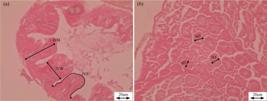
Photomicrograph illustrates (a) the measurements of height, width, and perimeter of the intestinal villi and (b) smaller diameter of muscle fibers of Pyrrhulina brevis larvae at 27 days post-hatching (40x, hematoxylin and eosin).
Statistical analysis
Statistical analyses were performed in the R environment (RStudio, version 2025.09.2+418). Residual normality was assessed using the Shapiro–Wilk’s test, and homogeneity of variances was evaluated using Levene’s test. When the assumptions of normality and homoscedasticity were met, comparisons between groups were conducted using Student’s t-test. Data that did not meet the normality assumption were transformed using the log (x + 1) function prior to analysis. In cases of heterogeneity of variances, Welch’s t-test was applied. All statistical tests were performed at a significance level of p ≤ 0.05. Polynomial regression analysis based on mean survival rate values was used to evaluate the relationship between feeding delay and larval survival and to determine the PNR.
RESULTS
Growth performance
Larvae subjected to four and six days of delayed Artemia nauplii provision experienced total mortality by the end of the fifth day of experiment. In contrast, larvae fed with Artemia nauplii without delay demonstrated a significantly higher survival rate of 86.25% (p < 0.05) compared to those with a two-day delay, which exhibited a survival rate of only 20%. This survival rate in the two-day delay group remained constant throughout the experiment (Fig. 2).
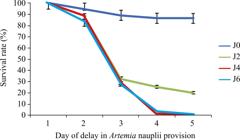
Survival rate of Pyrrhulina brevis larvae during the first five days under different delays in Artemia nauplii provision, followed by subsequent feeding. The delays are categorized as 0, two, four, and six days and are labeled as J0, J2, J4, and J6, respectively.
Biometric data were unavailable for larvae subjected to four and six days of delayed Artemia nauplii provision due to complete mortality following the fasting period, despite subsequent food availability. No differences were observed in length, weight, batch uniformity, or Fulton’s condition factor between larvae receiving Artemia nauplii immediately (0-day delay) and those with a two-day delay (p > 0.05). However, the survival rate was impacted by the delay in Artemia nauplii provision (p < 0.05) (Table 1).
Growth performance (mean ± standard deviation; n = 4) of Pyrrhulina brevis larvae subjected to delay in Artemia nauplii provision and subsequent feeding<tfn href="tfn01">*</tfn>.
A second-degree polynomial equation was fitted to the mean survival rate data (Fig. 3).
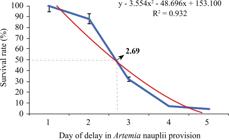
Point-of-no-return for Pyrrhulina brevis larvae expressed as days of delay in Artemia nauplii provision (days without food), and not as days post-hatching, followed by subsequent feeding.
The analysis revealed that the PNR for P. brevis larvae, defined as the stage at which the effects of food deprivation become irreversible, with 50% of the fasting larvae still alive, occurred after 9.69 days post-hatching (2.69 days of delayed Artemia nauplii provision) under an average temperature of 26.22 ± 0.20°C.
Intestinal and muscle histomorphometry
No differences were observed in intestinal villus height, width, or perimeter between larvae receiving Artemia nauplii immediately (0-day delay) and those with a two-day delay (p > 0.05) (Table 2).
Intestinal histomorphometry (mean ± standard deviation; n = 4 experimental replicates per treatment, based on two larvae per replicate) of Pyrrhulina brevis larvae subjected to delay in Artemia nauplii provision and subsequent feeding.
No differences were observed in the distribution of muscle fiber diameter classes between larvae subjected to 0 and two days of delay in Artemia nauplii provision (p > 0.05) (Table 3).
Frequency of muscle fiber diameter classes (mean ± standard deviation; n = 4 experimental replicates per treatment, based on two larvae per replicate) of Pyrrhulina brevis larvae subjected to delay in Artemia nauplii provision and subsequent feeding.
DISCUSSION
While decreasing food supply during initial feeding may offer economic benefits for the ornamental fish farming (Oliveira et al., 2020a), improper application can severely impact survival in fish larviculture, particularly in species sensitive to irreversible fasting (Garcia et al., 2020). In this study, the absence of biometric data for P. brevis larvae subjected to Artemia nauplii delays beyond four days (11 DPH) was attributed to complete mortality following the fasting period. Similarly, Piaractus mesopotamicus larvae experienced total mortality after eight days of fasting (13 days post-hatching) (Kojima et al., 2015). It is well-established that larval resistance to fasting depends on factors such as developmental stage, egg quality, and environmental conditions like temperature (Abe et al., 2022; Kojima et al., 2015). Both wild and captive fish larvae are thought to possess innate mechanisms to endure fasting (Garcia et al., 2020; Motta et al., 2023). However, prolonged fasting often leads to reduced growth due to physiological and metabolic adjustments that mobilize body energy reserves, prioritizing essential metabolic functions (Porto et al., 2023). In the case of P. brevis larvae, delays in Artemia nauplii supply beyond four days likely exhausted their energy reserves, resulting in malnutrition and mortality before refeeding could reverse the effects.
Although P. brevis larvae subjected to a two-day delay in Artemia nauplii supply displayed growth comparable to those not exposed to fasting, their survival rate was significantly lower, at only 20%. During the initial feeding stage, key organs in fish larvae are still undergoing development (Portella et al., 2014), making them particularly vulnerable to even brief fasting periods, which can cause severe or irreversible damage to the digestive system (Kojima et al., 2015). As a result, despite consuming live prey upon the resumption of feeding, larvae may be unable to effectively digest and assimilate nutrients, leading to substantial mortality (Aya et al., 2016). Similar findings have been reported about Leiopotherapon plumbeus (Garcia et al., 2020) and Oxyeleotris marmoratus larvae (Yusoff et al., 2023), for whom ingestion of food did not prevent significant survival reductions. In this study, it is likely that P. brevis larvae subjected to a two-day delay consumed the Artemia nauplii but were unable to efficiently utilize the nutrients, resulting in continued mortality even after prey availability was restored.
This study provides valuable insights into the biology of P. brevis larvae, particularly during the critical initial feeding phase, when Artemia nauplii are introduced. For P. brevis, this transition typically occurs at seven days post-hatching, when the larvae’s oral structures are adequately developed to ingest Artemia nauplii (Oliveira et al., 2020b). In the present study, a two-day delay in the provision of Artemia nauplii did not affect the growth, uniformity or Fulton’s condition factor of P. brevis larvae compared to those fed without delay. Similarly, Motta et al. (2023) reported no differences in the growth of Carassius auratus larvae subjected to feeding delays of 0 to eight days during the initial feeding phase. The authors attributed this result to high mortality rates, which reduced stocking density, and may have influenced the growth of the surviving individuals. In the present study, P. brevis larvae that survived a two-day delay in Artemia nauplii supply may have experienced a comparable effect, whereby early mortality reduced larval density and increased space availability, potentially favoring growth during the subsequent period of feeding with live prey.
Pyrrhulina brevis larvae subjected to a two-day delay in Artemia nauplii provision reached final sizes comparable to those of continuously fed larvae by the end of the experimental period. However, given the absence of biometric evaluations immediately after the fasting period, the lack of growth rate assessment during the fasting and refeeding phases, and the potential differences in larval density and prey competition between treatments, it is not possible to determine whether this outcome resulted from compensatory or accelerated growth. Furthermore, residual Artemia nauplii were not quantified, preventing inferences regarding hyperphagic responses following prey availability restoration. Previous studies have shown that fasting–refeeding cycles may induce morphophysiological adjustments that support growth recovery (Dawood et al., 2023; Elbialy et al., 2022; Kojima et al., 2015). However, under the present experimental conditions, such mechanisms cannot be conclusively demonstrated. Therefore, the similar final size observed between treatments should be interpreted as an endpoint outcome rather than evidence of compensatory growth.
The ability of fish larvae to capture and consume food diminishes with prolonged fasting (Fan et al., 2021; Melo et al., 2020), often resulting in mortality as they fail to learn feeding behaviors before reaching the PNR. In this study, the PNR for P. brevis larvae was identified as 2.69 days of delay in the supply of Artemia nauplii (9.69 days post-hatching) at the temperature of 26.22°C. Supplying Artemia nauplii on the 10th day post-hatching proved insufficient to sustain survival, as the larvae had already surpassed the PNR and were too weakened to feed effectively. It is highly probable that P. brevis larvae lost their capacity to locate and ingest food following a delay in Artemia provision. Even when food became available, their inability to consume it led to death, as observed in larvae subjected to fasting periods exceeding their PNR. A similar phenomenon was reported by Motta et al. (2023) in C. auratus larvae, for whom delayed exogenous feeding impaired their ability to search for, capture, and ingest food, directly reducing larval survival.
The gastrointestinal tract is among the first systems to exhibit deterioration in fasted larvae, and prolonged food deprivation may lead to irreversible structural damage and increased mortality (Yusoff et al., 2023). In the present study, no differences were observed in intestinal villus development between larvae subjected to 0 and two days of delay in Artemia nauplii supply at the end of the experimental period, suggesting a degree of morphological resilience to short-term fasting. Similar responses have been reported for Apistogramma cacatuoides, in which adequate prey availability promoted increases in villus length, width, and epithelial height, indicating enhanced absorptive capacity and improved nutritional status, whereas suboptimal feeding strategies impaired intestinal development (Zanfurlin‐Lima et al., 2024). Although inadequate feeding management during early larval stages is known to delay digestive tract maturation and compromise digestive efficiency (Piccinetti et al., 2015), histological evidence indicates that the reintroduction of live prey at appropriate levels and frequencies may allow partial or complete recovery of intestinal structures. However, the absence of sampling immediately after the fasting period limits the detection of transient intestinal damage, and thus short-term fasting-induced alterations in intestinal morphology cannot be ruled out. It is plausible that compensatory intestinal growth occurred following prey reintroduction, enabling recovery and further maturation of the digestive tract and resulting in similar villus morphometry at the end of the trial.
In this study, no significant differences were observed in the frequency distribution of muscle fiber diameter classes between larvae subjected to a 0- and a two-day delay in Artemia nauplii supply. Although delayed larvae tended to exhibit fewer small-diameter fibers and a higher proportion of intermediate-sized fibers, these differences were not statistically significant. Muscle growth during the larval stage involves both hyperplasia and hypertrophy, but early development is often dominated by hyperplasia, whereas hypertrophy becomes more pronounced after feeding is restored (Bango et al., 2025; Silva et al., 2017). In Colossoma macropomum larvae, Bango et al. (2025) showed that feeding restriction followed by refeeding preserves muscle development through compensatory hyperplastic and hypertrophic responses, resulting in a mosaic growth pattern. In this context, the absence of differences in P. brevis suggests that the two-day delay did not suppress hyperplastic potential nor limit subsequent hypertrophic growth once feeding was re-established. Thus, by the end of the experimental period, larvae subjected to the feeding delay likely achieved muscle fiber size distributions comparable to those of continuously fed larvae.
Abe et al. (2022) previously investigated the effects of short-term feed deprivation on P. brevis larvae, revealing that fasting significantly reduced both development rates and survival due to their immediate dependence on Artemia nauplii. The findings of the present study align with these results, demonstrating that delays in Artemia supply during the critical early feeding period lead to irreversible fasting and early mortality in P. brevis larvae. Similarly, Motta et al. (2023) highlighted that fasting during the larval stage is detrimental, as fish larvae heavily depend on consistent access to exogenous feed throughout larviculture. To prevent fasting-induced mortality, timely provisioning of Artemia nauplii is crucial in hatchery systems. These insights provide valuable guidance for optimizing rearing protocols for this important ornamental fish species, contributing to enhanced larval survival and overall hatchery success.
CONCLUSION
Delaying the provision of Artemia nauplii to P. brevis larvae has a pronounced negative impact on survival, emphasizing the critical importance of timely feeding. Immediate introduction of Artemia nauplii is essential to prevent the high mortality rates associated with delayed feeding, which can jeopardize the feasibility of larviculture production and compromise overall hatchery success.
ACKNOWLEDGMENTS
The authors gratefully acknowledge the Universidade Estadual do Oeste do Paraná and the Universidade Federal do Pará for providing the infrastructure necessary to conduct this study.
-
FUNDING
Coordenação de Aperfeiçoamento de Pessoal de Nível SuperiorGrant No.: 88,887.701,423/2022-00
-
DECLARATION OF USE OF ARTIFICIAL INTELLIGENCE TOOLS
We declare that no artificial intelligence tools were used in the preparation, writing, analysis, or interpretation of this manuscript.
DATA AVAILABILITY STATEMENT
The data will be available upon request.
REFERENCES
- Abe, H. A., Dias, J. A. R., Cordeiro, C. A. M., Ramos, F. M., & Fujimoto, R. Y. (2015). Pyrrhulina brevis (Steindachner, 1876) como uma nova opção para a piscicultura ornamental nacional: larvicultura. Boletim do Instituto de Pesca, 41(1), 113-122.
-
Abe, H. A., Dias, J. A. R., Sousa, N. C., Couto, M. V. S., Reis, R. G. A., Paixão, P. E. G., & Fujimoto, R. Y. (2019). Growth of Amazon ornamental fish Nannostomus beckfordi larvae (Steindachner, 1876) submitted to different stocking densities and feeding management in captivity conditions. Aquaculture Research, 50(8), 2276-2280. https://doi.org/10.1111/are.14108
» https://doi.org/10.1111/are.14108 -
Abe, H. A., Reis, R. G. A., Paixão, P. E. G., & Fujimoto, R. Y. (2022). Effect of short‐term fasting and re-feeding on growth performance of larvae and juveniles Pyrrhulina brevis, an amazon ornamental fish. Journal of Applied Aquaculture, 34(4), 894-906. https://doi.org/10.1080/10454438.2021.1904084
» https://doi.org/10.1080/10454438.2021.1904084 -
Araújo, L. M., Gonçalves Junior, L. P., Silva, W. S., & Luz, R. K. (2021). Salinity and prey concentration on larviculture of killifish Hypsolebias radiseriatus (Cyprinodontiformes: Rivulidae). Acta Scientiarum. Animal Sciences, 43(1), e52075. https://doi.org/10.4025/actascianimsci.v43i1.52075
» https://doi.org/10.4025/actascianimsci.v43i1.52075 -
Assis, Y. P. A. S., Porto, L. D. A., Melo, N. F. A. C. D., Palheta, G. D. A., Luz, R. K., & Favero, G. C. (2020). Feed restriction as a feeding management strategy in Colossoma macropomum juveniles under recirculating aquaculture system (RAS). Aquaculture, 529, 735689. https://doi.org/10.1016/j.aquaculture.2020.735689
» https://doi.org/10.1016/j.aquaculture.2020.735689 -
Aya, F. A., Nillasca, V. S. N., Garcia, L. M. B., & Takagi, Y. (2016). Embryonic and larval development of hatchery-reared silver therapon Leiopotherapon plumbeus (Perciformes: Terapontidae). Ichthyological Research, 63(1), 121-131. https://doi.org/10.1007/s10228-015-0481-8
» https://doi.org/10.1007/s10228-015-0481-8 -
Bango, A. A., Gonçalves, L. P., Freitas, T. M. D., Carmo, I. B. D., Silva, L. I. P. D., Moura, A. C. N., & Kojima, J. T. (2025). Food restriction in larviculture of Colossoma macropomum (Cuvier, 1818) reared in varying salinities. Acta Amazonica, 55, e55af24278. https://doi.org/10.1590/1809-4392202402782
» https://doi.org/10.1590/1809-4392202402782 -
Blaxter, J. H. S., & Hempel, G. (1963). The influence of egg size on herring larvae (Clupea harengus L.). ICES Journal of Marine Science, 28(2), 211-240. https://doi.org/10.1093/icesjms/28.2.211
» https://doi.org/10.1093/icesjms/28.2.211 -
Campelo, D. A. V., Moura, L. B., Oliveira, L. C. C., Melo, P. T. S., Eiras, B. J. C. F., Salaro, A. L., Zuanon, J. A. S., Brabo, M. F., & Veras, G. C. (2021). Manejo nutricional na larvicultura e alevinagem de peixes ornamentais amazônicos. In B. O. Mattos, J. P. Lima, A. T. Oliveira & P. H. R. Aride (eds.). Aquicultura na Amazônia: Estudos técnico-científicos e difusão de tecnologias (pp. 159-176). Ponta Grossa: Atena. https://doi.org/10.22533/at.ed.04221150312
» https://doi.org/10.22533/at.ed.04221150312 -
Cordeiro, N. I. S., Costa, D. C., Silva, W. S., Takata, R., Miranda‐Filho, K. C., & Luz, R. K. (2016). High stocking density during larviculture and effect of size and diet on production of juvenile Lophiosilurus alexandri Steindachner, 1876 (Siluriformes: Pseudopimelodidae). Journal of Applied Ichthyology, 32(1), 61-66. https://doi.org/10.1111/jai.12963
» https://doi.org/10.1111/jai.12963 -
Dawood, M. A. O., Amer, A. A., Gouda, A. H., & Gewaily, M. S. (2023). Interactive effects of cyclical fasting, refeeding, and dietary protein regimes on the growth performance, blood health, and intestinal histology of Nile tilapia (Oreochromis niloticus). Aquaculture, 573, 739620. https://doi.org/10.1016/j.aquaculture.2023.739620
» https://doi.org/10.1016/j.aquaculture.2023.739620 - Dubowitz, V., & Brooke, M. H. (1973). Muscle biopsy: A modern approach W. B. Saunders.
-
Eiras, B. J. C. F., Campelo, D. A. V., Moura, L. B., Sousa, L. M. D., Nunes, I. S., Oliveira, L. C. C. D., Magalhães, A., & Costa, R. M. D. (2022). Feeding rate and frequency during the first feeding of angelfish (Pterophyllum scalare - Schultze, 1823) and severum (Heros severus - Heckel, 1840) with Moina sp. Aquaculture, 553, 738106. https://doi.org/10.1016/j.aquaculture.2022.738106
» https://doi.org/10.1016/j.aquaculture.2022.738106 -
Elbialy, Z. I., Gamal, S., Al-Hawary, I. I., Shukry, M., Salah, A. S., Aboshosha, A. A., & Assar, D. H. (2022). Exploring the impacts of different fasting and refeeding regimes on Nile tilapia (Oreochromis niloticus L.): growth performance, histopathological study, and expression levels of some muscle growth-related genes. Fish Physiology and Biochemistry, 48(4), 973-989. https://doi.org/10.1007/s10695-022-01094-0
» https://doi.org/10.1007/s10695-022-01094-0 -
Fan, X., Wang, L., Wei, X., Zhang, J., Su, X., Cui, L., & Wang, Z. (2021). The impairment of continuous malnutrition on larval fish swimming performance at the mouth-opening stage. Aquaculture, 544, 737053. https://doi.org/10.1016/j.aquaculture.2021.737053
» https://doi.org/10.1016/j.aquaculture.2021.737053 -
Ferreira, A. L., Santos, F. A. C. D., Bonifácio, C. T., & Luz, R. K. (2023). Effects of live prey concentration, salinity, and weaning age on larviculture of Piaractus brachypomus reared in a recirculating aquaculture system. Tropical Animal Health and Production, 55(1), 99. https://doi.org/10.1007/s11250-023-03514-6
» https://doi.org/10.1007/s11250-023-03514-6 -
Froese, R. (2006). Cube law, condition factor and weight–length relationships: history, meta‐analysis and recommendations. Journal of Applied Ichthyology, 22(4), 241-253. https://doi.org/10.1111/j.1439-0426.2006.00805.x
» https://doi.org/10.1111/j.1439-0426.2006.00805.x - Fulton, T. W. (1904). The rate of growth of fishes Twenty-second Annual Report, Part III. Fisheries Board of Scotland.
-
Garcia, L. M. B., Sayco, M. J. P., & Aya, F. A. (2020). Point-of-no-return and delayed feeding mortalities in first-feeding larvae of the silver therapon Leiopotherapon plumbeus (Kner) (Teleostei: Terapontidae). Aquaculture Reports, 16, 100288. https://doi.org/10.1016/j.aqrep.2020.100288
» https://doi.org/10.1016/j.aqrep.2020.100288 -
Kojima, J. T., Leitão, N. D. J., Menossi, O. C. C., Freitas, T. M. D., Dal-Pai Silva, M., & Portella, M. C. (2015). Short periods of food restriction do not affect growth, survival or muscle development on pacu larvae. Aquaculture, 436, 137-142. https://doi.org/10.1016/j.aquaculture.2014.11.004
» https://doi.org/10.1016/j.aquaculture.2014.11.004 -
Lugert, V., Thaller, G., Tetens, J., Schulz, C., & Krieter, J. (2016). A review on fish growth calculation: Multiple functions in fish production and their specific application. Reviews in Aquaculture, 8(1), 30-42. https://doi.org/10.1111/raq.12071
» https://doi.org/10.1111/raq.12071 -
Melo, N., Carneiro, W. F., Albuquerque, A. S., Mansur, V. F., Paula, D. A. D. J., & Murgas, L. D. S. (2020). Performance and food behaviour of Brycon orbignyanus larvae submitted under food restriction. Aquaculture Research, 51(7), 2641-2648. https://doi.org/10.1111/are.14604
» https://doi.org/10.1111/are.14604 -
Motta, J. H. D. S., Ballester, E. L. C., Souza, A. B. D., Polese, M. F., Radael, M. C., Glória, L. S., Vidal Jr., M. V. (2023). Effect of periods of delayed first exogenous feeding in goldfish Carassius auratus (Linnaeus, 1758) larvae. Latin American Journal of Aquatic Research, 51(2), 338-342. https://doi.org/10.3856/vol51-issue2-fulltext-2993
» https://doi.org/10.3856/vol51-issue2-fulltext-2993 -
Oliveira, L. C. C. D. (2022). Estratégias alimentares na larvicultura do peixe ornamental amazônico Pyrrhulina brevis (Steindachner, 1876): Concentração de presas e transição alimentar [Masters dissertation, Programa de Pós-graduação em Aquicultura e Recursos Aquáticos Tropicais, Universidade Federal Rural da Amazônia]. http://www.repositorio.ufra.edu.br:8080/jspui/handle/123456789/1554
» http://www.repositorio.ufra.edu.br:8080/jspui/handle/123456789/1554 -
Oliveira, L. C. C. D., Costa, L. G. B., Eiras, B. J. C. F., Brabo, M. F., Veras, G. C., Moura, L. B., Salaro, A. L., & Campelo, D. A. V. (2020a). Feeding strategy induces compensatory growth in Heros severus fingerlings, an Amazonian ornamental fish. Aquaculture Reports, 18, 100436. https://doi.org/10.1016/j.aqrep.2020.100436
» https://doi.org/10.1016/j.aqrep.2020.100436 -
Oliveira, L. C. C. D., Silva Neto, E. D. A., Pinheiro Junior, A. D. S., Eiras, B. J. C. F., Veras, G. C., Moura, L. B. D., & Campelo, D. A. V. (2020b). Effect of prey concentrations and salinized water on initial development of Pyrrhulina brevis (Steindachner, 1876), an Amazonian ornamental fish. Research, Society and Development, 9(8), e381985582. https://doi.org/10.33448/rsd-v9i8.5582
» https://doi.org/10.33448/rsd-v9i8.5582 -
Oliveira, L. C. C. D., Silveira, B. G. D., Nascimento, E. T. D. S., Eiras, B. J. C. F., Moura, L. B., Salaro, A. L., Cordeiro, C. A. M., & Campelo, D. A. V. (2022). Salinized water as a strategy for increase stocking density in Heros severus larviculture, an Amazonian ornamental fish. Boletim do Instituto de Pesca, 48(1), e742. https://doi.org/10.20950/1678-2305/bip.2022.48.e742
» https://doi.org/10.20950/1678-2305/bip.2022.48.e742 -
Piccinetti, C. C., Donati, M., Radaelli, G., Caporale, G., Mosconi, G., Palermo, F., Cossignani, L., Salvatori, R., Lopez, R. P., & Olivotto, I. (2015). The effects of starving and feeding on Dover sole (olea solea, Soleidae, Linnaeus, 1758) stress response and early larval development. Aquaculture Research, 46(10), 2512-2526. https://doi.org/10.1111/are.12410
» https://doi.org/10.1111/are.12410 -
Pinheiro Junior, A. D. S., Oliveira, L. C. C. D., Eiras, B. J. C. F., Lima, W. D. S., Veras, G. C., Moura, L. B., Salaro, A. L., & Campelo, D. A. V. (2023). Effect of feeding frequency and water salinization on early development of Pyrrhulina brevis, an Amazonian ornamental fish. Acta Amazonica, 53(2), 107-113. https://doi.org/10.1590/1809-4392202200602
» https://doi.org/10.1590/1809-4392202200602 -
Portella, M. C., Jomori, R. K., Leitão, N. D. J., Menossi, O. C. C., Freitas, T. M. D., Kojima, J. T., Lopes, T. S., Clavijo-Ayala, J. A., & Carneiro, D. J. (2014). Larval development of indigenous South American freshwater fish species, with particular reference to pacu (Piaractus mesopotamicus): A review. Aquaculture, 432, 402-417. https://doi.org/10.1016/j.aquaculture.2014.04.032
» https://doi.org/10.1016/j.aquaculture.2014.04.032 -
Porto, L. D. A., Assis, Y. P. A. S., Amorim, M. P. S., Luz, R. K., & Favero, G. C. (2023). Physiological responses to long fasting followed by refeeding in juveniles of pirapitinga, Piaractus brachypomus Acta Amazonica, 53(3), 187-195. https://doi.org/10.1590/1809-4392202203111
» https://doi.org/10.1590/1809-4392202203111 -
Reis, R. G. A., Alves, P. C. J., Abe, H. A., Sousa, N. C., Paixão, P. E. G., Palheta, G. D. A., Melo, N. F. A. C., Fujimoto, R. Y., Luz, R. K., & Takata, R. (2021). Feed management and stocking density for larviculture of the Amazon ornamental fish L333 king tiger pleco Hypancistrus sp. (Siluriformes: Loricariidae). Aquaculture Research, 52(5), 1995-2003. https://doi.org/10.1111/are.15047
» https://doi.org/10.1111/are.15047 -
Roubach, R., Gomes, L. C., Fonseca, F. A. L., & Val, A. L. (2005). Eugenol as an efficacious anaesthetic for tambaqui, Colossoma macropomum (Cuvier). Aquaculture Research, 36(11), 1056-1061. https://doi.org/10.1111/j.1365-2109.2005.01319.x
» https://doi.org/10.1111/j.1365-2109.2005.01319.x -
Santos, F. A. C. D., Julio, G. S. D. C., Batista, F. S., Miranda, L. N. L., Pedras, P. P. C., & Luz, R. K. (2022). High stocking densities in the larviculture of Colossoma macropomum in a recirculating aquaculture system: Performance, survival and economic viability. Aquaculture, 552, 738016. https://doi.org/10.1016/j.aquaculture.2022.738016
» https://doi.org/10.1016/j.aquaculture.2022.738016 - Santos, K. R. P. D., Aguiar-Júnior, F. C. A., Antonio, E. A., Silva, F. R. D., Silva, K. T. D., Marinho, K. S. D. N., & Lima-Junior, N. B. D. (2021). Manual de técnica histológica de rotina e de colorações Universidade Federal de Pernambuco.
-
Silva, T. C. D., Rocha, J. D. M., Moreira, P., Signor, A., & Boscolo, W. R. (2017). Fish protein hydrolysate in diets for Nile tilapia post-larvae. Pesquisa Agropecuária Brasileira, 52(7), 485-492. https://doi.org/10.1590/S0100-204X2017000700002
» https://doi.org/10.1590/S0100-204X2017000700002 -
Xu, H., Wang, W., Nie, Z., Miao, X., & Li, Y. (2023). Delayed first feeding chronically impairs larval fish growth performance, hepatic lipid metabolism, and visceral lipid deposition at the mouth-opening stage. Marine Biotechnology, 25(1), 140-149. https://doi.org/10.1007/s10126-022-10187-z
» https://doi.org/10.1007/s10126-022-10187-z -
Yusoff, S. F. M., Ching, F. F., Kawamura, G., & Senoo, S. (2023). Growth performance and nutritional condition of marble goby (Oxyeleotris marmoratus) larvae fed under different onsets of first feeding. Aquaculture Research, 2023(1), 3948836. https://doi.org/10.1155/2023/3948836
» https://doi.org/10.1155/2023/3948836 -
Zanfurlin‐Lima, E., Abe, H. A., Gonçalves‐Junior, L. P., & Freitas, T. M. D. (2024). Feeding protocol for the Amazonian ornamental cichlid Apistogramma cacatuoides and a histological approach to the nutritional condition of larvae. Journal of Animal Physiology and Animal Nutrition, 108(6), 1867-1876. https://doi.org/10.1111/jpn.14020
» https://doi.org/10.1111/jpn.14020
Edited by
-
Section editor:
Fabiana Garcia https://orcid.org/0009-0002-3155-8886