 Low genetic variability in Prochilodus lacustris and Prochilodus nigricans from river basins of northern and northeastern Brazil
ABSTRACT
The genus Prochilodus is an important fish resource. The various species within this genus are morphologically very similar, making reliable taxonomic identification difficult and creating uncertainty regarding the exact status of the different forms. This study aimed to evaluate the genetic differentiation between two species of Prochilodus belonging to the same lineage from the Maranhão and Amazon River basins based on mitochondrial DNA markers (16S rRNA, COI, Cyt b) and nuclear (TROP) DNA sequences. A total of 151 samples were collected from the Maranhão and Amazon rivers, followed by DNA extraction, polymerase chain reaction, sequencing, and data analysis, with the gene fragments analyzed separately and concatenated. The results revealed a strong genetic similarity between the species, with low genetic divergence values (0 to 0.35%) for the genes under study.
Keywords
Maranhão; Neotropical region; Taxonomic; Migratory fishes; Hydrographic basin
RESUMO
O gênero Prochilodus é um importante recurso pesqueiro. As várias espécies desse gênero são morfologicamente muito semelhantes, dificultando a identificação taxonômica confiável e criando incerteza quanto ao status exato das diferentes formas. O objetivo deste estudo foi investigar duas espécies de Prochilodus pertencentes à mesma linhagem nas bacias dos rios Maranhão e Amazonas com base em sequências de DNA mitocondrial (16S rRNA, COI, Cyt b) e nuclear (TROP). O total de 151 amostras foi coletada dos rios Maranhão e Amazonas, coleta seguida de extração de DNA, reação em cadeia da polimerase, sequenciamento e análise de dados, com os fragmentos de genes analisados separadamente e concatenados. Os resultados revelaram forte similaridade genética entre as espécies, com baixos valores de divergência genética (0 a 0,35%) para os genes em estudo.
Palavras-chave
Maranhão; Região neotropical; Taxonômica; Peixes migratórios; Bacia hidrográfica
Introduction
The family Prochilodontidae are widely distributed in the freshwater environments of the Neotropical region (Taphorn, 1992; Turner et al., 2004). There are three prochilodontid genera (Ichthyoelephas, Semaprochilodus, and Prochilodus) and around 20 valid species (Castro & Vari, 2004). The genus Prochilodus is the most speciose, with 13 representatives (Castro & Vari, 2004).
The species Prochilodus lacustris (Steindachner, 1907) is endemic to the hydrographic basins of the Parnaíba, Mearim, and Tocantins rivers in northern Brazil (Cardoso et al., 2019; Garavello et al., 2010; Piorski et al., 2007; Piorski, 2010; Ramos et al., 2014), while Prochilodus nigricans (Spix & Agassiz, 1829) is endemic to the Amazon and Tocantins basins (Castro & Vari, 2004; Machado et al., 2017; Queiroz et al., 2013). These distributions have since been extended to other Maranhão basins, with P. lacustris found in the Itapecuru, Mearim, Turiaçu, and Pericumã river basins (Abreu et al., 2019; Barros et al., 2011; Limeira-Filho et al., 2023; Nascimento et al., 2016), and P. nigricans found in the Itapecuru, Mearim, and Turiaçu basins (Abreu et al., 2019). Both species represent significant fishery resources in their respective local areas.
The species P. lacustris can be distinguished from their congeners by traits such as scales with poorly defined cruciform subdivisions and a greater number of horizontal rows of scales between the origin of the pelvic fin and the lateral line (Castro & Vari, 2004). Prochilodus nigricans is characterized by dark, though inconspicuous, stripes on the back, while the caudal, dorsal, and anal fins exhibit several alternating dark and light spots (Mota & Ruffino, 1997). Consequently, the two species can only be distinguished by their striping patterns and meristic parameters (Castro & Vari, 2004). Traditional taxonomic approaches have relied on morphological characteristics for the delimitation of prochilodontid species, but this does not necessarily resolve the classification of some natural groups, as morphologically similar species can be assigned to the same nominal taxon (Bickford et al., 2007). Deciphering and defining the enigmatic diversity within a group of organisms has been challenging, being necessary the use of additional biological tools (Kress et al., 2015).
Given the limited morphological differentiation, molecular markers have indicated that these species form one of the problematic species complexes (Ferreira et al., 2016; Frable et al., 2016; Melo et al., 2016; Melo et al., 2018; Sales et al., 2018; Turner et al., 2004). Studies utilizing chromosomal and molecular markers have provided valuable information for the separation or union of closely related species and can often clarify the evolutionary history of populations, including problematic species. Melo et al. (2018) demonstrated low genetic divergence among Prochilodus lineages, high levels of genetic variability, and low levels of population structure, noting that one contributing factor is the migratory behavior of the species, which facilitates extensive gene flow between distinct populations (Godinho & Kynard, 2006).
Lopes et al. (2020) questioned the monophyly of P. nigricans, pointing out the existence of two mitochondrial lineages in the Amazon River basin. One lineage includes specimens of P. nigricans from the lowlands of Western Amazonia, while the second is considered a species complex encompassing what is described as P. nigricans from the highlands of Eastern Amazonia (Araguaia River, Upper and Middle Tapajos), P. britskii from Apiacá (Upper Tapajos), P. brevis from northeastern Brazil (the states of Ceará and Rio Grande do Norte), P. lacustris from the Parnaíba River, and P. rubrotaeniatus from the Upper Orinoco and Upper Essequibo basins. In other words, within this complex lineage, there are two distinct taxonomic units.
The uncertainties surrounding this scenario reinforce the need for further research using molecular tools for more reliable species delimitation. The mitochondrial markers most commonly used for phylogenetic studies include the Cytochrome c Oxidase Subunit I (COI) gene (Hebert et al., 2003; Hubert et al., 2008), the 16S rRNA gene (Palumbi et al., 1996), and the Cytochrome b (Cyt b) gene (Farias et al., 2001; Fraga et al., 2007; Santos et al., 2003). The nuclear Alpha-Tropomyosin gene (TROP) is also widely used in this type of research (Friesen et al., 1999). The combination of these molecular markers provides a powerful tool for verifying patterns of genetic diversity and identifying species.
This study aimed to evaluate the genetic differentiation between P. lacustris and P. nigricans in the hydrographic basins of Maranhão (Itapecuru, Pindaré, Turiaçu, Pericumã, and Mearim rivers) and Amazonas state (Xingu and Tapajós rivers), using mitochondrial and nuclear markers. The research sought to investigate whether these localities belong to the same lineage, as suggested by Lopes et al. (2020), elucidating persistent taxonomic uncertainties. After all, the precise identification of these species is a fundamental step for the proper management and successful conservation of fishery resources in both regions.
Material and methods
Sampling
A total of 151 specimens of Prochilodus were collected under the authorization of the Brazilian Institute for the Environment and Renewable Natural Resources (IBAMA) and the Chico Mendes Institute for Biodiversity and Conservation (ICMBIO) (No. 02012.004159/2006—Itapecuru River, ICMBIO No. 46367-1 —Pindaré River, Turiaçu River, Pericumã River, ICMBIO—MMA No. 42.119-2—Mearim River, ICMBio No. 81592-1—Munim River), including 125 samples of P. lacustris/P. nigricans from the Maranhão basins under protocol no. 47/2020.
This study was submitted to the Ethics Committee of the Universidade Estadual do Maranhão (UEMA), under protocol no. 47/2022, which included 26 samples of P. nigricans from the Tapajós River and the Xingu River (Amazon basin).
These samples were deposited in the Molecular Biology Laboratory in the Molecular Biology Genetics complex (GENBIMOL) at the Caxias Higher Education Center, UEMA. A total of 124 sequences were obtained and deposited on the National Center for Biotechnology Information (NCBI) platform for the 16S rRNA gene (PP916553-PP919955), 130 for the COI gene (PP917855-PP916185), 94 for the Cyt b gene (PP938653-PP938725), and 101 sequences for the TROP gene (BankIt2842185-Bankit2842194) (Fig. 1 and Table 1).

Sample localities, each data point indicates the place where the Prochilodus samples were collected.
The samples were collected using fishing gear such as trawls, gillnets, and cast net with varying mesh sizes (10 to 200 mm). The specimens collected during this study were euthanized by immersion in freezing water (Ashley, 2007), placed in individually labeled plastic bags, and transported on ice to the GENBIMOL at the Caxias Higher Education Center at UEMA. The fish were labeled and photographed, and muscle tissue samples were extracted for analysis. These samples were preserved in 90% alcohol and stored at -20°C. The specimens were then fixed in 10% formalin and conserved in 70% alcohol. Identification of the specimens was conducted using basic references (Britski et al., 1999; Piorski et al., 2007; Santos et al., 2004; Soares, 2005) and was confirmed by a specialist. Voucher specimens were deposited in the Museum of Zoology of the Universidade de São Paulo (MZUSP 104576) and Universidade Estadual de Londrina.
Extraction and amplification of the DNA
Total DNA was extracted using the Promega Wizard Genomic DNA Purification Kit, following the manufacturer’s instructions. The four molecular markers (16S rRNA, COI, Cyt b, and TROP) were amplified using polymerase chain reaction (PCR) with specific primers for each gene (Table 2).
Sequences and references of the primers used in the amplification of mitochondrial and nuclear fragments.
The PCRs were run in a final volume of 25 µL, which contained 2µL of the DNA (25ng/µL), 4 µL of total dNTP mix (1.25 mM), 2.5µL of 10x buffer solution, 0.5µL of MgCl2 solution (50 mM), 0.25µL of each primer (200µM), 0.2µL of Taq DNA polymerase (5U/µL, Invitrogen), and purified water to complete the final reaction volume. Samples were amplified using a specific cycle, as shown in Table 3.
Description of the cycles of each mitochondrial and nuclear region amplified in polymerase chain reaction.
The PCR products were purified with EXoSAP-IT, following the manufacturer’s recommendations, and sequenced using a Big Dye kit with Sanger et al.’s (1977) dideoxy nucleotide method. The products were precipitated and analyzed in an ABI Prism™ 3500 automatic sequencer (Applied Biosystems, United States of America).
Data analysis
The obtained sequences were manually edited and aligned using BioEdit software (Hall, 1999), in which chromatograms were visually inspected to assemble forward and reverse contigs and generate consensus sequences. Base-calling quality was assessed via Phred scores, and low-quality terminal regions (Q < 20) were trimmed to ensure sequence accuracy. To rule out the presence of nuclear and mitochondrial pseudogenes (NUMTs), the gene sequences were translated based on the vertebrate mitochondrial genetic code in MEGA (Kumar et al., 2018) fragments exhibiting premature stop codons, frameshifts, or anomalous indels were promptly discarded. Finally, the four markers were concatenated in SeaView4 (Gouy et al., 2010), and mean genetic distances were calculated in MEGA X under the Kimura 2-Parameter (K2P) substitution model.
The optimum evolutionary model for the construction of the Bayesian inference (BI) and maximum likelihood (ML) trees was generated in JModelTest2 (Darriba et al., 2012). The BI tree was generated in BEAST v.1.10.4 (Drummond et al., 2012; Suchard et al., 2018), using the Hasegawa-Kishino-Yano (HKY) algorithm, with a strict clock and Yule speciation process as prior. The analysis was run for 40,000,000 generations. The log files were then checked in Tracer v1.6 (Rambaut et al., 2014) to evaluate convergence and determine appropriate burn-in parameters. Convergence was considered adequate when the effective sample size (ESS) was at least 200. The tree generated in BEAST was summarized in TreeAnnotator v.1.10.4 (Suchard et al., 2018) to obtain the consensus tree, which was then visualized and edited in FigTree v1.4.2 (Rambaut, 2014) and the Inkscape image-editing software.
The ML tree from the concatenated data was generated in the PhyML 3.0 program (Guindon et al., 2010), using the general time reversible (GTR) algorithm, with support values estimated using 1,000 bootstrap replicates. For the separate genes (COI, 16S rRNA, Cyt b, and TROP), the neighbor-joining (NJ) and ML methods were used in the MEGA X program (Kumar et al., 2018), both employing the Kimura-2 parameter nucleotide substitution evolutionary model with 1,000 bootstrap replicates. Both trees were visualized and edited in FigTree v1.4.2 (Rambaut, 2014) and the Inkscape image editing software. Clades with a bootstrap percentage of at least 85% or a posterior probability of at least 0.95 were considered to be well supported.
Molecular operational taxonomic units (MOTUs) delimitation analyses for the COI gene were conducted using the following models: automatic barcode gap discovery (ABGD), assemble species by automatic partitioning (ASAP), Poisson tree process (PTP), and generalized model yule coalescent (GMYC). The ABGD test (Puillandre et al., 2012) was run on https://bioinfo.mnhn.fr/abi/public/abgd/ using the bank of aligned sequences and the Kimura-2-parameter (K2P) algorithm. The ASAP test (Puillandre et al., 2020) was conducted on https://bioinfo.mnhn.fr/abi/public/asap/asapweb.html using a genetic distance matrix created in MEGA X. The PTP (Zhang et al., 2013) was run on the web server https://species.h-its.org/, using the ML phylogenetic tree generated by RaxML v.8.29 (Stamatakis, 2014) as input. This program is available in CIPRES Science Gateway v3.3 (Miller et al., 2010). The GMYC (Fujisawa & Barraclough, 2013) was performed using the ultrametric consensus tree built in BEAST v1.8 software, which was submitted to the APE (Paradis & Schliep, 2019), SPLITS (Ezard et al., 2009), Paran (Dinno, 2009), and Mass (Venables & Ripley, 2002) packages available in R v.4.1.0 software (Venables & Smith, 2021).
GenBank sequences of the 16S rRNA, COI, and Cyt b genes of Semaprochilodus varii MZ051939/KX087058/KX086859 (Melo et al., 2016; Papa et al., 2021) and Semaprochilodus taeniurus KX086752/KX087052/KX086855 (Melo et al., 2016) were used as the outgroup for the mitochondrial analyses. For the TROP gene, Leporinus piau (EU181682) (Santos, 2007) was used to root the tree, as no sequences close to the Prochilodus genus were found for the gene, and Prochilodus lineatus (AY817275) (Calcagnotto et al., 2005) was obtained from GenBank to root the trees.
Population analyses were performed using DNAsp 6.1 software (Rozas et al., 2018). Relationships among the haplotypes were inferred from an unrooted haplotype network obtained from NETWORK 5.0.1.1 (http://www.fluxus-engineering.com) using the median-joining method (Bandelt et al., 1999).
Results
In this study, 124 sequences of the 16S rRNA gene were obtained, 139 for the COI gene, 94 for the Cyt b gene, and 101 sequences for the TROP. It was also possible to obtain 40 concatenated sequences. Haplotypic and nucleotide diversity varied considerably between the different markers (Table 4).
Genetic variation parameters in the sample populations of Prochilodus nigricans and Prochilodus lacustris. The number of sequences analyzed (N), informative sites for parcimonia (Pi), number of polymorphic sites (S), number of haplotypes (H), haplotypic diversity (Hd), base pairs (Pb) and nucleotide diversity (π) are given for each marker.
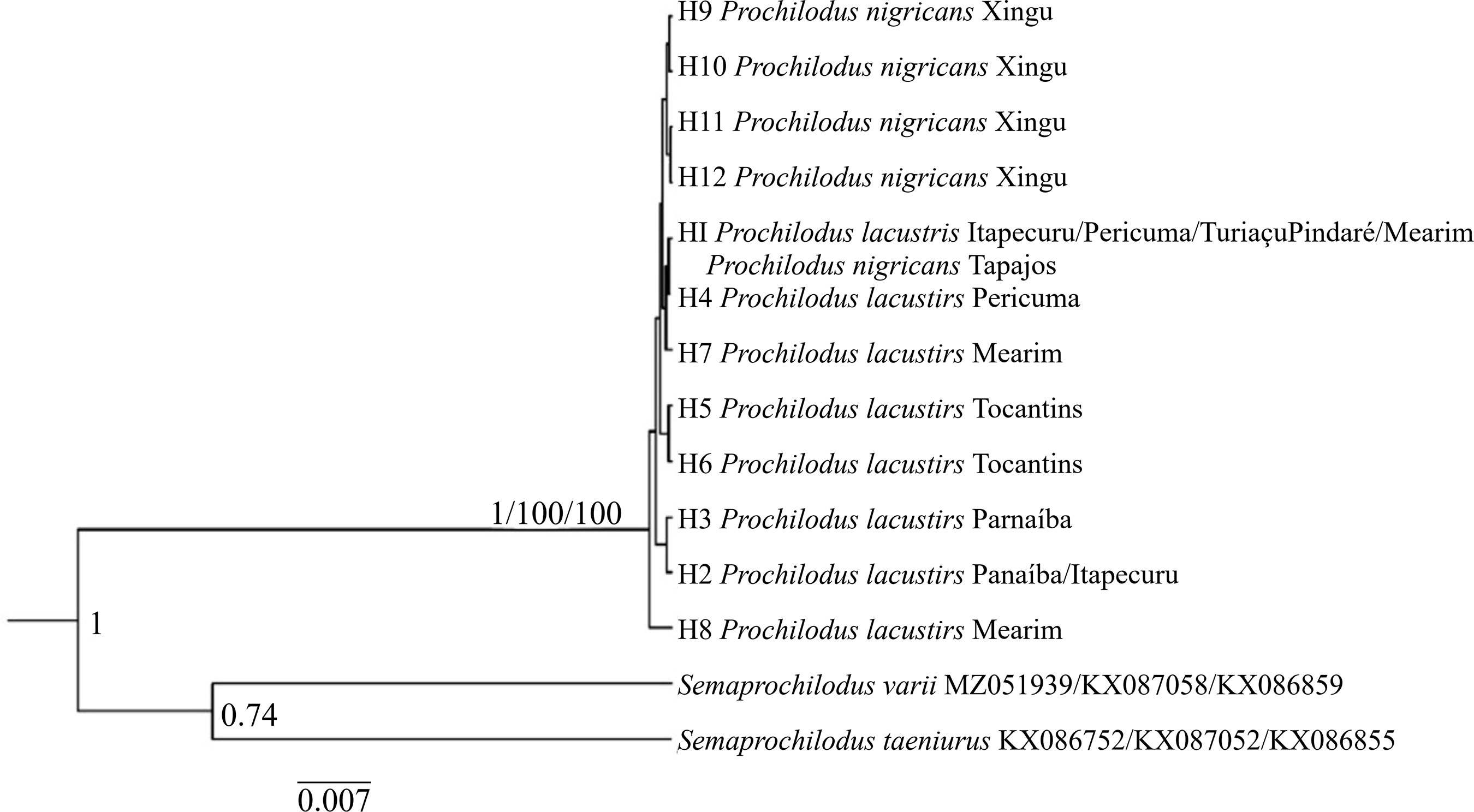
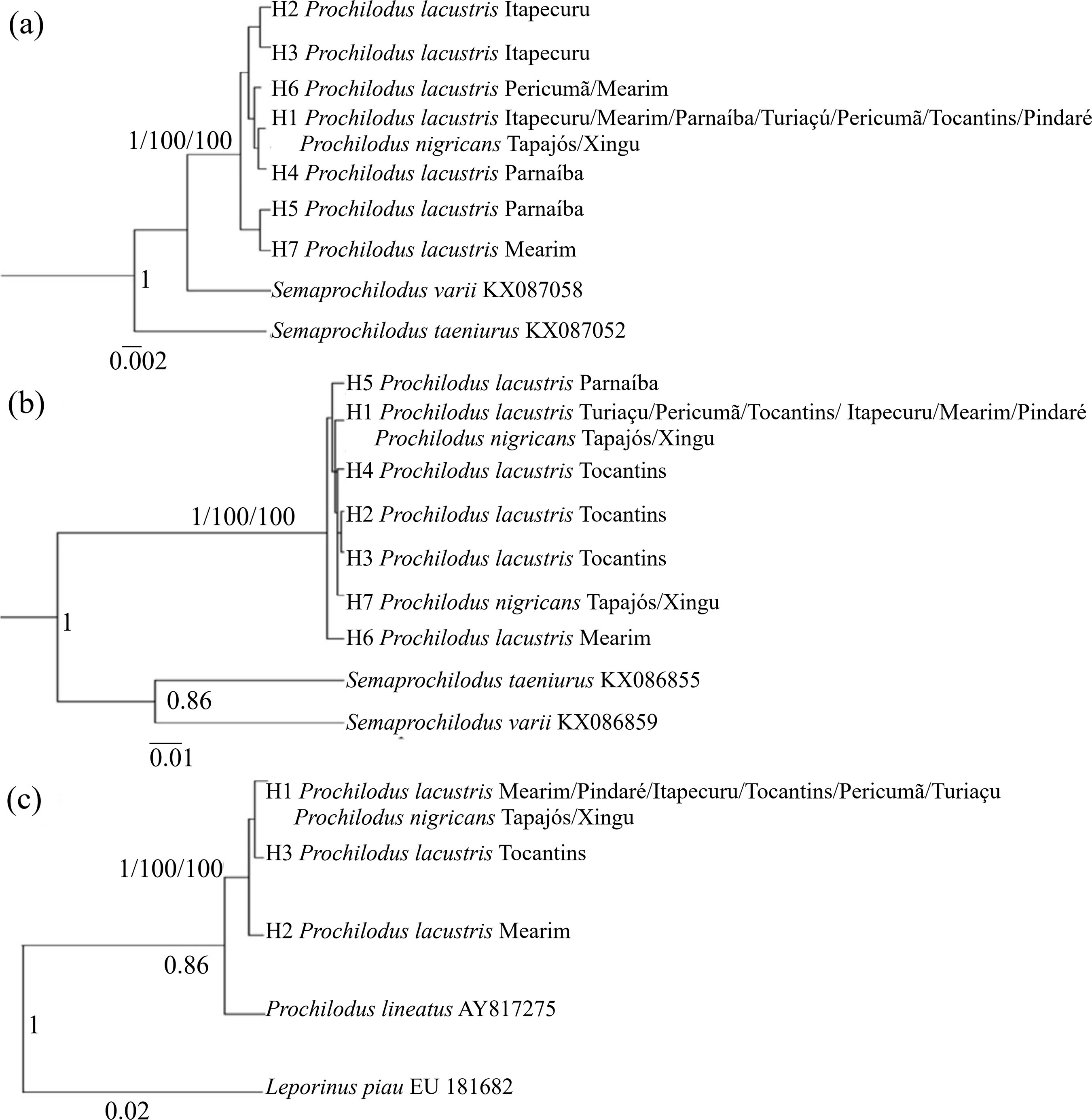
The phylogenetic analyses of the haplotypes (Table 5), based on the three alternative approaches (BI, ML, and NJ), all produced trees with a similar topology, that is, with a single cluster, with all the sequences of P. lacustris from Maranhão being grouped in a single clade with P. nigricans from the Amazon basin (Figs. 2, 3 and 4). The species delimitation analyses of the COI gene identified a single MOTUs based on the ABGD, ASAP, PTP, and GMYC models, which is consistent with a single group observed in the tree topology (Fig. 4).
Concatenated haplotype tree (COI, 16S rRNA, Cyt b and TROP) obtained using the Bayesian inference (BI), maximum likelihood (ML), and neighbor-joining (NJ) methods, using the general time reversible model for the ML and NJ models and the Hasegawa-Kishino-Yano for BI.
Haplotype trees for the (a) 16S rRNA, (b) Cyt b and (c) TROP genes obtained using the Bayesian inference (BI), maximum likelihood (ML) and neighbor-joining (NJ) methods using the Kimura-2 parameter model for the ML and NJ models and the Hasegawa-Kishino-Yano for (BI).
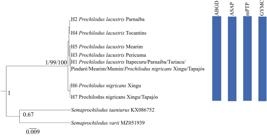
Haplotype tree and delimitation analysis for the COI gene obtained using the Bayesian inference (BI), maximum likelihood (ML) and neighbor-joining (NJ) methods using the general time reversible model for the ML and NJ models and the Hasegawa-Kishino-Yano for BI.
Haplotypes based on variation in COI, rRNA16S, Cyt b, and TROP genes in sample populations of Prochilodus lacustris and Prochilodus nigricans from the Maranhão and Amazon basins.
The genetic distance matrix for the genes analyzed revealed that the average divergence between the species ranged from 0 to 0.35%, this value being below 1% when compared to those from the Amazon, with average intraspecific divergence of 0% (Table 6).
Matrix of genetic distances between populations of Prochilodus lacustris and P. nigricans from the Maranhão and Amazon basins (Xingu and Tapajos), with values given as percentages.
The haplotype network revealed, once again, the formation of a single grouping of the sequences of P. nigricans from the Amazon basin with P. lacustris from the watersheds of Maranhão. Most of the haplotypes were shared between populations and only a few mutational steps differentiated the haplotypes, in other words, with few differences between the samples collected, thus confirming the results obtained by the COI gene analysis, reaffirming the low difference between the species analyzed (Fig. 5).
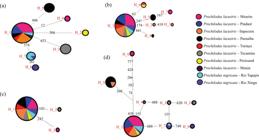
Haplotype network with genes (a) COI, (b) 16S rRNA, (c) TROP, and (d) Cyt b representing the dispersions of Prochilodus lacustris and Prochilodus nigricans for the Maranhão and Amazonas River basins (Xingu and Tapajos rivers).
Discussion
The findings of the present study, based on the analysis of mitochondrial and nuclear genes, indicate low levels of genetic divergence between P. lacustris and P. nigricans. This finding is consistent with the typical genetic patterns observed in other species of this genus, as shown in several studies employing various molecular markers (Ferreira et al., 2016; Frable et al., 2016; Lopes et al., 2020; Melo et al., 2016; Melo et al., 2018; Sales et al., 2018; Turner et al., 2004).
The phylogenetic analyses of the COI gene indicated the presence of only one haplogroup with a single MOTUs, based on results from the ABGD, ASAP, PTP, and GMYC models, which have been successfully used to delimit species in many previous studies (Fujisawa & Barraclough, 2013; Puillandre et al., 2012, 2020; Zhang et al., 2013), including fish taxa (Carvalho et al., 2019; da Silva et al., 2017; Guimarães, Lima et al., 2022; Guimarães, Rosso et al., 2022; Nogueira et al., 2021; Ochoa et al., 2020; Ramirez et al., 2017; Rossini et al., 2016; Silva-Santos et al., 2018; Souza et al., 2018).
The haplotype networks also revealed the existence of a single haplogroup, with haplotypes from all four markers being shared among the study populations. This finding does not support the differentiation of the two taxa, given the low divergence values (0–0.35%). Our study verified the lack of supported differentiation between the samples of P. lacustris from Maranhão (Itapecuru, Mearim, Pindaré, Parnaíba, Tocantins, Turiaçu, and Pericumã rivers) and the samples of P. nigricans from Amazonas (Tapajós and Xingu rivers). This conclusion is further reinforced by the analysis of multiple mitochondrial and nuclear genes to confirm the absence of differentiation. Lopes et al. (2020) and Melo et al. (2018) focused on sequences from the Tapajós, Araguaia, and Amazonas rivers, while our results also demonstrated high genetic similarities between P. lacustris and P. nigricans from the Xingu River.
The low divergence values recorded in the present study, alongside the high level of genetic similarity between the two taxa (P. lacustris and P. nigricans), suggest a low level of differentiation. Hebert et al. (2003) concluded that such scenarios may arise from the retention of ancestral polymorphism, recent speciation, or, in some cases, hybridization or introgression of mitochondrial DNA.
The distribution pattern and sharing of haplotypes found in our results align with the species’ migratory behaviors, which allow them to travel kilometers between rivers to spawn during the rainy season (Godinho & Kynard, 2006). This mobility facilitates extensive gene flow between distant populations (Melo et al., 2016; Sivasundar et al., 2001). There is strong evidence that prochilodontid migrations have resulted in high genetic diversity and low levels of population structure (Ferreira et al., 2016; Machado et al., 2017; Rueda et al., 2013; Sivasundar et al., 2001). Stanley (1979) suggested that migration and gene flow directly influence the conserved morphological state in this genus, raising questions about the migration patterns that affect diversification without corresponding morphological changes. However, studies on the genetic divergence of freshwater fishes indicate that the genetic patterns currently observed are strongly influenced by historical migration events and gene flow among species (Fonseca et al., 2017; Mondin et al., 2018). Understanding how historical events impact genetic diversity is crucial for predicting the persistence of populations under future environmental changes (Pauls et al., 2013).
It is also noteworthy that fish in this family exhibit strong homogeneity and conservation of the morphological characteristics used to distinguish different species (Frable et al., 2016). Some species in the genus Prochilodus show little morphological differentiation, and are distinguished primarily by bands, meristic values, and the biogeographical drainage in which they are generally endemic (Castro & Vari, 2004). The species P. lacustris and P. nigricans are distinguished only by radial subdivision patterns on body scales, which include overlapping counts of scales, lateral lines, the number of lines on the horizontal scale below the lateral line, and the number of lines on the proportion scale (Castro & Vari, 2004).
The low levels of genetic divergence and haplotype sharing among populations in the rivers of Maranhão can be attributed to the state’s extensive coastal plain geography. This geographical feature has likely facilitated hydrological and faunal exchanges across various basins through the capture of lateral tributaries and river mouths (Wilkinson et al., 2006). Historical events, including marine transgressions and regressions during the late Miocene and Pliocene, further influenced the composition of fish species in Maranhão (Abreu et al., 2019; Abreu et al., 2020; Albert et al., 2018; Lundberg et al., 1998; Soares Júnior et al., 2011), promoting similarities in fauna across basins (Abreu et al., 2019; Abreu et al., 2020). These factors explain the broad dispersal of P. lacustris beyond its endemic areas and underscore the connectivity among Maranhão’s river systems. Studies of certain fish species have identified haplotype sharing between basins in Maranhão (Carvalho-Costa et al., 2011; Fraga et al., 2014), suggesting dispersal events possibly driven by climatological and geological phenomena (Hubert et al., 2007).
In summary, analyses based on molecular markers (16S rRNA, COI, Cyt b, and TROP) revealed no sufficient genetic divergence between P. lacustris populations from the Maranhão river basins and P. nigricans from the Amazon Basin to support their distinction as separate species. The results indicated the presence of a single molecular lineage with low genetic variability, shared by both P. lacustris and P. nigricans.
ACKNOWLEDGMENTS
To the Programa de Pós-Graduação em Ciência Animal of UEMA, and GENBIMOL of the Centro de Estudos Superiores de Caxias of UEMA.
-
FUNDING
Fundação de Amparo à Pesquisa e ao Desenvolvimento Científico e Tecnológico do MaranhãoGrant No.: Public Notice 18/2023.Conselho Nacional de Desenvolvimento Científico e TecnológicoGrant No.: the universal notice (10/2023).
-
DECLARATION OF USE OF ARTIFICIAL INTELLIGENCE TOOLS
The authors of this manuscript declare that no artificial intelligence (AI) tools, large language models, or AI-assisted technologies were used in the writing, translation, data analysis, linguistic revision, or conceptual design of any part of this work. All content presented was generated, analyzed, and reviewed exclusively through the intellectual and technical effort of the listed authors, ensuring the originality and academic integrity of the manuscript in accordance with current ethical guidelines.
DATA AVAILABILITY STATEMENT
The sequences included in the present study are available from GenBank (https://www.ncbi.nlm.nih.gov/genbank/), accessed numbers PP917855-PP916185, PP916553-PP919955, PP938653-PP938725, and BankIt2842185-Bankit2842194. The voucher specimens used for the taxonomic diagnoses are deposited at the Museum of Zoology of Universidade Estadual de Londrina, in Londrina, PR, Brazil. The remaining specimens are held in the Molecular Biology Laboratory of the GENBIMOL complex of the Caxias campus of UEMA. The codes used in this study are available from the corresponding author on reasonable request.
REFERENCES
-
Abreu, J. M. S., Craig, J. M., Albert, J. S., & Piorski, N. M. (2019). Historical biogeography of fishes from coastal basins of Maranhão State, northeastern Brazil. Neotropical Ichthyology, 17(2), e180156. https://doi.org/10.1590/1982-0224-20180156
» https://doi.org/10.1590/1982-0224-20180156 -
Abreu, J. M. S., Saraiva, A. C. S., Albert, J. S., & Piorski, N. M. (2020). Paleogeographic influences on freshwater fish distributions in northeastern Brazil. Journal of South American Earth Sciences, 102, 102692. https://doi.org/10.1016/j.jsames.2020.102692
» https://doi.org/10.1016/j.jsames.2020.102692 -
Albert, J. S., Val, P., & Hoorn, C. (2018). The changing course of the Amazon River in the Neogene: Center stage for Neotropical diversification. Neotropical Ichthyology, 16(3), e180033. https://doi.org/10.1590/1982-0224-20180033
» https://doi.org/10.1590/1982-0224-20180033 -
Ashley, P. J. (2007). Fish welfare: current issues in aquaculture. Applied Animal Behaviour Science, 104(3-4), 199-235. https://doi.org/10.1016/j.applanim.2006.09.001
» https://doi.org/10.1016/j.applanim.2006.09.001 -
Bandelt, H. J., Forster, P., & Röhl, A. (1999). Median-joining networks for inferring intraspecific phylogenies. Molecular Biology and Evolution, 16(1), 37-48. https://doi.org/10.1093/oxfordjournals.molbev.a026036
» https://doi.org/10.1093/oxfordjournals.molbev.a026036 -
Barros, M. C., Fraga, E. C., & Birindelli, J. L. (2011). Peixes da bacia do rio Itapecuru, no estado do Maranhão, Nordeste do Brasil. Journal of Biology, 71(2), 375-380. https://doi.org/10.1590/S1519-69842011000300006
» https://doi.org/10.1590/S1519-69842011000300006 -
Bickford, D., Lohman, D. J., Sodhi, N. S., Ng, P. K., Meier, R., Winker, K., Ingram, K. K., Das, I. (2007). Cryptic species as a window on diversity and conservation. Trends in Ecology & Evolution, 22(3), 148-155. https://doi.org/10.1016/j.tree.2006.11.004
» https://doi.org/10.1016/j.tree.2006.11.004 - Britski, H. A., Silimon, K. Z. S., & Lopes, B. S. (1999). Peixes do Pantanal: manual de Identificação Embrapa.
-
Calcagnotto, D., Schaefer, S. A., & Desalle, R. (2005). Relationships among characiform fishes inferred from analysis of nuclear and mitochondrial gene sequences. Molecular Phylogenetic and Evolution, 36(1), 135-153. https://doi.org/10.1016/j.ympev.2005.01.004
» https://doi.org/10.1016/j.ympev.2005.01.004 -
Cardoso, R. L., Silva, M. H. L., Carvalho-Neta, R. N. F., Castro, A. C. L., Ferreira, C. F. C., Ferreira, H. R. S., & Santos, D. M. S. (2019). Aspects of reproductive biology of curimba Prochilodus lacustris (Pisces, Prochilodontidae) in a tropical lake in Northeastern Brazil. Journal of Applied Ichthyology, 1-13. https://doi.org/10.1111/jai.13868
» https://doi.org/10.1111/jai.13868 -
Carvalho, A. P. C., Collins, R. A., Martínez, J. G., Farias, L. P., & Hrbek, T. (2019). From shallow to deep divergences: mixed messages from Amazon Basin cichlids. Hydrobiologia, 832, 317-329. https://doi.org/10.1007/s10750-018-3790-x
» https://doi.org/10.1007/s10750-018-3790-x -
Carvalho-Costa, L. F., Piorski, N. M., Willis, S. C., Galetti Jr., P. M., & Ortí, G. (2011). Molecular systematics of the neotropical shovelnose catfish genus Pseudoplatystoma Bleeker 1862 based on nuclear and mtDNA markers. Molecular Phylogenetic and Evolution, 59(1), 177-194. https://doi.org/10.1016/j.ympev.2011.02.005
» https://doi.org/10.1016/j.ympev.2011.02.005 -
Castro, R. M. C., & Vari, R. (2004). Detritivores of the South American fish family Prochilodontidae (Teleostei: Ostariophysi: Characiformes): a phylogenetic and revisionary study (Smithsonian Contributions to Zoology, vol. 622). Smithsonian Books. https://doi.org/10.5479/si.00810282.622
» https://doi.org/10.5479/si.00810282.622 -
Darriba, D., Taboada, G. L., Doallo, R., & Posada, D. (2012). JModelTest2: more models, new heuristics and parallel computing. Nature Methods, 9, 772. https://doi.org/10.1038/nmeth.2109
» https://doi.org/10.1038/nmeth.2109 -
Da Silva, R., Peloso P. L. V., Sturaro, M. J., Veneza, I., Sampaio, I., Schneider, H., & Gomes, G. (2017). Comparative analyses of species delimitation methods with molecular data in snappers (Perciformes: Lutjaninae). Mitochondrial DNA Part A, 29(7), 1108-1114. https://doi.org/10.1080/24701394.2017.1413364
» https://doi.org/10.1080/24701394.2017.1413364 -
Dinno, A. (2009). Exploring the sensitivity of horn’s parallel analysis to the distributional form of simulated data. Multivariate Behavioral Research, 44(3), 362-388. https://doi.org/10.1080/00273170902938969
» https://doi.org/10.1080/00273170902938969 -
Drummond, A. J., Suchard, A. M., Xie, D., & Rambaut, A. (2012). Bayesian phylogenetics with BEAUti and the BEAST 1.7. Molecular Biology and Evolution, 29(8), 1969-1973. https://doi.org/10.1093/molbev/mss075
» https://doi.org/10.1093/molbev/mss075 -
Ezard, T., Fujisawa, T., & Barraclough, T. G. (2009). SPLITS: Species’ limits by threshold statistics R package version 1.0-18/r45. Retrieved from https://r-forge.r-project.org/projects/splits/
» https://r-forge.r-project.org/projects/splits/ -
Farias, I. P., Ortí, G., Sampaio, I., Schneider, H., & Meyer, A. (2001). Mitochondrial DNA phylogeny of the family Cichlidae: monophyly and fast molecular evolution of neotropical assemblage. Journal of Molecular Evolution, 48, 703-711. https://doi.org/10.1007/pl00006514
» https://doi.org/10.1007/pl00006514 -
Ferreira, D. G., Souza-Shibatta, L., Shibatta, O. A., Sofia, S. H., Carlsson, J., Dias, J. H. P., Makrakis, S., & Makrakis, M. C. (2016). Genetic structure and diversity of migratory freshwater fish in a fragmented Neotropical River system. Reviews in Fish Biology and Fisheries, 27, 209-231. https://link.springer.com/article/10.1007/s11160-016-9441-2
» https://link.springer.com/article/10.1007/s11160-016-9441-2 -
Fonseca, F. S., Domingues, R. R., Hallerman, E. M., & Hilsdorf, A. W. S. (2017). Genetic diversity of an imperiled neotropical catfish and recommendations for its restoration. Frontiers in Genetics, 8, 196. https://doi.org/10.3389/fgene.2017.00196
» https://doi.org/10.3389/fgene.2017.00196 -
Frable, B. W., Melo, B. F., Sidlauskas, B. L., Hoekzema, K., Vari, R. P., & Oliveira, C. (2016). Data on the multilocus molecular phylogenies of the Neotropical fish family Prochilodontidae (Teleostei: Characiformes). Data in Brief, ., 128-142. https://doi.org/10.1016/j.dib.2016.08.015
» https://doi.org/10.1016/j.dib.2016.08.015 -
Fraga, E., Schneider, H., Nirchio, M., Santa-Brigida, E., Rodrigues-Filho, L. F., & Sampaio, I. (2007). Molecular phylogenetic analyses of mullets (Mugilidae, Mugiliformes) based on two mitochondrial genes. Jornal of Applied Ichthyology, 23, 598-604. https://doi.org/10.1111/j.1439-0426.2007.00911.x
» https://doi.org/10.1111/j.1439-0426.2007.00911.x -
Fraga, E., Silva, L. M. M., Schneider, H., Sampaio, I., & Barros, M. C. (2014). Variabilidade genética em populações naturais de Leporinus piau (Anostomidae, Characiformes) da bacia do Rio Itapecuru. Revista Trópica, 8(2), 28-40. https://doi.org/10.0000/rtcab.v8i2.1121
» https://doi.org/10.0000/rtcab.v8i2.1121 -
Friesen, V. L., Congdon, B. C., Kidd, M. G., & Birt, T. P. (1999). Polymerase chain reaction (PCR) primers for the amplification of five nuclear introns in vertebrates. Molecular Ecology, 8(12), 2147-2149. https://doi.org/10.1046/j.1365-294x.1999.00802-4.x
» https://doi.org/10.1046/j.1365-294x.1999.00802-4.x -
Fujisawa, T., & Barraclough, T. G. (2013). Delimiting species using single-locus data and the generalized mixed yule coalescent (GMYC) approach: a revised method and evaluation on simulated datasets. Systematic Biology, 62(5), 707-724. https://doi.org/10.1093/sysbio/syt033
» https://doi.org/10.1093/sysbio/syt033 -
Garavello, J. C., Garavello, J. P., & Oliveira, A. K. (2010). Ichthyofauna, fish supply and fishermen activities on the mid-Tocantins River, Maranhão State, Brazil. Brazilian Journal of Biology, 70(3), 575-585. https://doi.org/10.1590/S1519-69842010000300014
» https://doi.org/10.1590/S1519-69842010000300014 -
Godinho, A. L., & Kynard, B. (2006). Migration and spawning of radio-tagged Zulega Prochilodus argenteus in a dammed Brazilian river. Transactions of the American Fisheries Society, 135(3), 811-824. https://doi.org/10.1577/T04-176.1
» https://doi.org/10.1577/T04-176.1 -
Gouy, M., Guindon S., & Gascuel, O. (2010). SeaView version 4: A multiplatform graphical user interface for sequence alignment and phylogenetic tree building. Molecular Biology and Evolution, 27(2), 221-224. https://doi.org/10.1093/molbev/msp259
» https://doi.org/10.1093/molbev/msp259 -
Guimarães, K. L. A., Lima, M. P., Santana, D. J., Souza, M. F. B., Barbosa, R. S., & Rodrigues, L. R. R. (2022). DNA barcoding and phylogeography of the Hoplias malabaricus species complex. Scientific Reports, 12(1), 5288. https://doi.org/10.1038/s41598-022-09121-z
» https://doi.org/10.1038/s41598-022-09121-z -
Guimarães, K. L. A., Rosso, J. J., González‐Castro, M., Souza, M. F., Díaz de Astarloa, J. M., & Rodrigues, L. R. (2022). A new species of Hoplias malabaricus species complex (Characiformes: Erythrinidae) from the Crepori River, Amazon basin, Brazil. Journal of Fish Biology, 100(2), 425-443. https://doi.org/10.1111/jfb.14953
» https://doi.org/10.1111/jfb.14953 -
Guindon, S., Dufayard, J.-F., Lefort, V., Anisimova, M., Hordijk, W., & Gascuel, O. (2010). New algorithms and methods to estimate maximum-likelihood phylogenies: assessing the performance of PhyML 3.0. Systematic Biology, 59(3), 307-321. https://doi.org/10.1093/sysbio/syq010
» https://doi.org/10.1093/sysbio/syq010 - Hall, T. A. (1999). BioEdit: a user-friendly biological sequence alignment editor and analysis program for Windows 95/98/NT. Nucleic Acids Symposium, 41, 95-98.
-
Hebert, P. D. N., Cywinska, A., Ball, S. L., & Ward, J. R. (2003). Biological identifications through DNA barcodes. Proceedings of the Royal Society B, 270(1512), 313-321. https://doi.org/10.1098/rspb.2002.2218
» https://doi.org/10.1098/rspb.2002.2218 -
Hubert, N., Duponchelle, F., Nuñez, J., Garcia-Davila, C., Paugy, D., & Renno, J. F. (2007). Phylogeography of the piranha genera Serrasalmus and Pygocentrus: implications for the diversification of the Neotropical ichthyofauna. Molecular Ecology, 16(10), 2115-2136. https://doi.org/10.1111/j.1365-294x.2007.03267.x
» https://doi.org/10.1111/j.1365-294x.2007.03267.x -
Hubert, N., Hanner, R., Holm, E., Mandrak, N. E., Taylor, E., Burridge, M., Watkinson, D., Dumont, P., Curry, A., Bentzen, P., Zhang, J., April, J., Bernatchez, L. (2008). Identifying Canadian freshwater fishes through DNA barcodes. PLoS One, 3(6), e2490. https://doi.org/10.1371/journal.pone.0002490
» https://doi.org/10.1371/journal.pone.0002490 -
Kress, W. J., García-Robledo, C., Uriarte, M., & Erickson, D. L. (2015). DNA barcodes for ecology, evolution, and conservation. Trends in Ecology & Evolution, 30(1), 25-35. https://doi.org/10.1016/j.tree.2014.10.008
» https://doi.org/10.1016/j.tree.2014.10.008 -
Kumar, S., Stecher, G., Li, M., Knyar, C., & Tamura, K. (2018). MEGA X: Molecular Evolutionary Genetics Analysis across Computing Platforms. Molecular Biology and Evolution, 35(6), 1547-1549. https://doi.org/10.1093/molbev/msy096
» https://doi.org/10.1093/molbev/msy096 -
Limeira-Filho, D., Moraes, P. S. S., Almeida, M. S., Silva, A. C. C., Silva, J. L. N., Farias-Rodrigues, L., Teixeira, B. R. S., Anjos, J. V. X., Birindelli, J. L. O., Barros, M. C., & Fraga, E. C. (2023). Fish diversity in the rivers that drain the Baixada Maranhense and the Mearim basin in northeastern Brazil. Brazilian Journal of Biology, 83, e273525. https://doi.org/10.1590/1519-6984.273525
» https://doi.org/10.1590/1519-6984.273525 -
Lopes, U., Galetti Jr., P. M., & Freitas, P. D. (2020). Hidden diversity in Prochilodus nigricans: A new genetic lineage within the Tapajós River basin. PLoS One, 15(8), e0237916. https://doi.org/10.1371/journal.pone.0237916
» https://doi.org/10.1371/journal.pone.0237916 - Lundberg, J. G., Marshall, L. G., Guerrero, J., Horton, B., Malabarba, M. C. S. L., & Wesselingh, F. (1998). The stage for neotropical fish diversification: a history of tropical South American rivers. In: Malabarba, L. R., Reis, R. E., Vari, R. P., Lucena, Z. M. S., & Lucena, C. A. S. (editors), Phylogeny and classification of Neotropical fishes (pp. 13-48). EDUPUCRS.
-
Machado, V. N., Willis, S. C., Teixeira, A. S., Hrbek, T., & Farias, I. P. (2017). Population genetic structure of the Amazonian black flannelmouth characin (Characiformes, Prochilodontidae: Prochilodus nigricans Spix & Agassiz, 1829): contemporary and historical gene flow of a migratory and abundant fishery species. Environmental Biology of Fishes, 100(1), 1-16. https://doi.org/10.1007/s10641-016-0547-0
» https://doi.org/10.1007/s10641-016-0547-0 -
Melo, B. F., Dorini, B. F., Foresti, F., & Oliveira, C. (2018). Little divergence among mitochondrial lineages of Prochilodus (Teleostei, Characiformes). Frontiers in Genetics, 9, 107. https://doi.org/10.3389/fgene.2018.00107
» https://doi.org/10.3389/fgene.2018.00107 -
Melo, B. F., Sidlauskas, B. L., Hoekzema, K., Frable, B. W., Vari, R. P., & Oliveira, C. (2016). Molecular phylogenetics of the Neotropical fish family Prochilodontidae (Teleostei: Characiformes). Molecular Phylogenetics and Evolution, 102, 189-201. https://doi.org/10.1016/j.ympev.2016.05.037
» https://doi.org/10.1016/j.ympev.2016.05.037 -
Miller, M. A., Pfeiffer, W., & Schwartz, T. (2010). Creating the CIPRES Science Gateway for inference of large phylogenetic trees. In: Proceedings of the Gateway Computing Environments Workshop, 1-8. https://doi.org/10.1109/GCE.2010.5676129
» https://doi.org/10.1109/GCE.2010.5676129 -
Mondin, L. A. D. C., Machado, C. B., Resende, E. K. D., Marques, D. K., & Galetti Jr., P. M. (2018). Genetic pattern and demographic history of Salminus brasiliensis: Population expansion in the Pantanal Region during the Pleistocene. Frontiers in Genetics, 9(1), 1. https://doi.org/10.3389/fgene.2018.00001
» https://doi.org/10.3389/fgene.2018.00001 - Mota, S. Q., & Ruffino, M. L. (1997). Biologia e pesca do curimatá (Prochilodus nigricans Agassiz, 1829) (Prochilodontidae) no Médio Amazonas. Revista Unimar, 19(2), 493-508.
-
Nascimento, M. H., Almeida, M. S., Veira, M. N., Limeira Filho, D., Lima, R. C., Barros, M. C., & Fraga, E. C. (2016). DNA barcoding reveals high levels of genetic diversity in the fishes of the Itapecuru Basin in Maranhão, Brazil. Genetics and Molecular Research, 15(3). https://doi.org/10.4238/gmr.15038476
» https://doi.org/10.4238/gmr.15038476 -
Nogueira, A. F., Oliveira, C., Langeani, F., & Netto-Ferreira, A. L. (2021). Molecular species delimitation of the genera Anodus, Argonectes, Bivibranchia and Micromischodus (Ostariophysi: Characiformes). Neotropical Ichthyology, 19(4), e210005. https://doi.org/10.1590/1982-0224-2021-0005
» https://doi.org/10.1590/1982-0224-2021-0005 -
Ochoa, L. E., Melo, B. F., García-Melo, J. E., Maldonado-Ocampo, J. A., Souza, C. S., Albornoz-Garzón, J. G., Conde-Saldaña, C. C., Villa-Navarro, F., Ortega-Lara, A., & Oliveira, C. (2020). Species delimitation reveals an underestimated diversity of Andean catfishes of the family Astroblepidae (Teleostei: Siluriformes). Neotropical Ichthyology, 18(4), e200048. https://doi.org/10.1590/1982-0224-2020-0048
» https://doi.org/10.1590/1982-0224-2020-0048 - Palumbi, S. (1991). The simple fool’s guide to PCR, version 2.0 University of Hawaii.
- Palumbi, S. R. (1996). Nucleic acids II: the polymerase chain reaction. In: Hillis, D., Moritz, C., & Mable, B. (Eds.), Molecular Systematics (pp. 205-247). Sinauer Associates.
-
Papa, Y., Bail, P. Y. L., & Covain, R. (2021). Genetic landscape clustering of a large DNA barcoding data set reveals shared patterns of genetic divergence among freshwater fishes of the Maroni Basin. Molecular Ecology Resources, 21(6), 2109-2124. https://doi.org/10.1111/1755-0998.13402
» https://doi.org/10.1111/1755-0998.13402 -
Paradis, E., & Schliep, K. (2019). Ape 5.0: an environment for modern phylogenetics and evolutionary analyses in R. Bioinformatics, 35(3), 526-528. https://doi.org/10.1093/bioinformatics/bty633
» https://doi.org/10.1093/bioinformatics/bty633 -
Pauls, S. U., Nowak, C., Bálint, M., & Pfenninger, M. (2013). The impact of global climate change on genetic diversity within populations and species. Molecular Ecology, 22(4), 925-946. https://doi.org/10.1111/mec.12152
» https://doi.org/10.1111/mec.12152 - Piorski, N. M. (2010). Diversidade genética e filogeografia das espécies Hoplias malabaricus (Bloch, 1794) e Prochilodus lacustris Steindachner, 1907 no nordeste do Brasil [PhD Thesis, Universidade Federal de São Carlos, São Carlos).
- Piorski, N. M., Castro, A. C. L., & Sousa-Neto, M. A. S. (2007). Peixes do cerrado da região sul maranhense. In Barreto, L. N. (ed.), Cerrado Norte do Brasil (pp. 177-212). USEB.
-
Puillandre, N., Brouillet, S., & Achaz, G. (2020). ASAP: Assemble Species by Automatic Partitioning. Molecular Ecology Resources, 21(2), 609-620. https://doi.org/10.1111/1755-0998.13281
» https://doi.org/10.1111/1755-0998.13281 -
Puillandre, N., Lambert, A., Brouillet, S., & Achaz, G. (2012). ABGD, Automatic Barcode Gap Discovery for primary species delimitation. Molecular Ecology, 21(8), 1864-1877. https://doi.org/10.1111/j.1365-294x.2011.05239.x
» https://doi.org/10.1111/j.1365-294x.2011.05239.x - Queiroz, L. J., Ohara, W. M., & Vari, R. P. (2013). Prochilodontidae. In: Queiroz, L. J. (ed.), Peixes do Rio Madeira (3 vols., pp. 140-146). Dialeto Latin American Documentary.
-
Rambaut, A. (2014). FigTree v1.4.2 Retrieved from http://tree.bio.ed.ac.uk/software/figtree/
» http://tree.bio.ed.ac.uk/software/figtree/ -
Rambaut, A., Suchard, M. A., Xie, D., & Drummond, A. J. (2014). Tracer v1.6 Retrieved from http://tree.bio.ed.ac.uk/software/tracer
» http://tree.bio.ed.ac.uk/software/tracer -
Ramirez, J. L., Birindelli, J. L., Carvalho, D. C., Affonso, P. R. A. M., Venere, P. C., Ortega, H., Carrillo-Avila, M., Rodríguez-Pulido, J. A., & Galetti Jr., P. M. J. R. (2017). Revealing Hidden diversity of the underestimated neotropical ichthyofauna: DNA barcoding in the recently described genus Megaleporinus (Characiformes: Anostomidae). Frontiers in Genetics, 8, 149. https://doi.org/10.3389/fgene.2017.00149
» https://doi.org/10.3389/fgene.2017.00149 -
Ramos, T. P. A., Ramos, R. T. C., & Ramos, S. A. Q. A. (2014). Ichthyofauna of the Parnaiba river Basin. Northeastern Brazil. Biota Neotropica, 14(1), e20130039. https://doi.org/10.1590/S1676-06020140039
» https://doi.org/10.1590/S1676-06020140039 -
Rossini, B. C., Oliveira, C. A. M., Melo, F. A. G. D., Bertaco, V. D. A., Astarloa, J. M. D. D., Rosso, J. J., Foresti, F., & Oliveira, C. (2016). Highlighting Astyanax species diversity through DNA barcoding. PLoS One, 11(12), e0167203. https://doi.org/10.1371/journal.pone.0167203
» https://doi.org/10.1371/journal.pone.0167203 -
Rozas, J., Sánchez-DelBarrio, J. C., Messeguer, X., & Rozas, R. (2018). DnaSP, DNA polymorphism analyses by the coalescent and other methods. Bioinformatics, 19(8), 2496-2497. https://doi.org/10.1093/bioinformatics/btg359
» https://doi.org/10.1093/bioinformatics/btg359 -
Rueda, E. C., Carriquiriborde, P., Monzón, A. M., Somoza, G. M., & Ortí, G. (2013). Seasonal variation in genetic population structure of sábalo (Prochilodus lineatus) in the Lower Uruguay River. Genetica, 141, 401-407. https://doi.org/10.1007/s10709-013-9739-0
» https://doi.org/10.1007/s10709-013-9739-0 -
Sales, N. G., Pessali, T. C., Andrade Neto, F. R., & Carvalho, D. C. (2018). Introgression from non-native species unveils a hidden threat to the migratory Neotropical fish Prochilodus hartii Biological Invasion, 20, 555-566. https://doi.org/10.1007/s10530-017-1556-4
» https://doi.org/10.1007/s10530-017-1556-4 -
Sanger, F., Nicklen, S., & Coulson, A. R. (1977). DNA sequencing with chain-terminating inhibitors. Proceedings of the National Academy of Sciences, 74(12), 5463-5467. https://doi.org/10.1073/pnas.74.12.5463
» https://doi.org/10.1073/pnas.74.12.5463 - Santos, G. S. A. (2007). Análise filogenética das espécies de Leporinus (Ostariophysi: Characiformes: Anostomidae) das Bacias do Prata e São Francisco [Masters thesis, Universidade Estadual Paulista “Júlio de Mesquita Filho”).
- Santos, G. M., Mérona, B., Juras, A. A., & Jégu, M. (2004). Peixes do Baixo Rio Tocantins: 20 anos depois da Usina Hidrelétrica Tucuruí Eletronorte.
-
Santos, S., Schneider, H., & Sampaio, I. (2003). Genetic differentiation of Macrodon ancylodon (Sciaenidae, Perciformes) populations in Atlantic coastal waters of South America as revealed by mtDNA analysis. Genetics and Molecular Biology, 26(2), 151-161. https://doi.org/10.1590/S1415-47572003000200008
» https://doi.org/10.1590/S1415-47572003000200008 -
Silva-Santos, R., Ramirez, J. L., Galetti Jr., P. M., & Freitas, P. D. (2018). Molecular evidences of a hidden complex scenario in Leporinus cf. friderici Frontiers in Genetics, 9, 47. https://doi.org/10.3389/fgene.2018.00047
» https://doi.org/10.3389/fgene.2018.00047 -
Sivasundar, A., Bermingham, E., & Ortí, G. (2001). Population structure and biogeography of migratory freshwater fishes (Prochilodus: Characiformes) in major South American rivers. Molecular Ecology, 10(2), 407-417. https://doi.org/10.1046/j.1365-294x.2001.01194.x
» https://doi.org/10.1046/j.1365-294x.2001.01194.x -
Smith, M. F., & Patton, J. L. (1993). The diversification of South American murid rodents: evidence from mitochondrial DNA sequence data for the akodontine tribe. Biological Journal of the Linnean Society, 50(3), 149-177. https://doi.org/10.1111/j.1095-8312.1993.tb00924.x
» https://doi.org/10.1111/j.1095-8312.1993.tb00924.x - Soares, E. C. (2005). Peixes do Mearim Instituto Geia.
- Soares Júnior, A. V., Hasui, Y., Costa, J. B. S., & Machado, F. B. (2011). Evolução do rifteamento e paleogeografia da margem atlântica equatorial do Brasil: Triássico ao Holoceno. Geociências, 30(4), 669-692.
-
Souza, C. R., Affonso, P. R. A. M., Bitencourt, J. A., Sampaio, I., & Carneiro, P. L. S. (2018). Species validation and cryptic diversity in the Geophagus brasiliensis Quoy & Gaimard, 1824 complex (Teleostei, Cichlidae) from Brazilian coastal basins as revealed by DNA analyses. Hydrobiologia, 809, 309-321. https://doi.org/10.1007/s10750-017-3482-y
» https://doi.org/10.1007/s10750-017-3482-y -
Stamatakis, A. (2014). RAxML Version 8: a tool for phylogenetic analysis and postanalysis of large phylogenies. Bioinformatics, 30(9), 1312-1313. https://doi.org/10.1093/bioinformatics/btu033
» https://doi.org/10.1093/bioinformatics/btu033 - Stanley, S. M. (1979). Macroevolution: pattern and process The John Hopkins University Press.
-
Suchard, M. A., Lemey, P., Baele, G., Ayres, D. L., Drummond, A. J., & Rambaut, A. (2018). Bayesian phylogenetic and phylodynamic data integration using BEAST 1.10. Virus Evolution, 4(1), vey016. https://doi.org/10.1093/ve/vey016
» https://doi.org/10.1093/ve/vey016 - Taphorn, D. C. (1992). The characiform fishes of the Apure River drainage, Venezuela. BioLlania.
-
Turner, T., McPhee, M. V., Campbell, P., & Winemiller, K. O. (2004). Phylogeography and intraspecific genetic variation of prochilodontid fishes’ endemic to rivers of northern South America. Journal of Fish Biology, 64(1), 186-201. https://doi.org/10.1111/j.1095-8649.2004.00299.x
» https://doi.org/10.1111/j.1095-8649.2004.00299.x -
Venables, W. N., & Ripley, B. D. (2002). Modern applied statistics with S (4th ed.). Springer. Retrieved from https://www.stats.ox.ac.uk/pub/MASS4/
» https://www.stats.ox.ac.uk/pub/MASS4/ - Venables, W. N., & Smith, D. M. (2021). The R Core Team. R version 4.1.0 Patched R: A Programming Environment for Data Analysis and Graphics. Foundation for Statistical Computing.
-
Ward, R. D., Zemlbak, T. S., Innes, B. H., Last, P. R., & Hebert, P. D. N. (2005). DNA barcoding Australia‘s fish species. Philosophical transactions of the Royal Society B, 360(1462), 1847-1857. https://doi.org/10.1098/rstb.2005.1716
» https://doi.org/10.1098/rstb.2005.1716 -
Wilkinson, M. J., Marshall, L. G., & Lundberg, J. G. (2006). River behavior on megafans and potential influences on diversification and distribution of aquatic organisms. Journal of South American Earth Sciences, 21(1-2), 151-172. https://doi.org/10.1016/j.jsames.2005.08.002
» https://doi.org/10.1016/j.jsames.2005.08.002 -
Zhang, J., Kapli, P., Pavlidis, P., & Stamatakis, A. (2013). A general species delimitation method with applications to phylogenetic placements. Bioinformatics, 29(22), 2869-2876. https://doi.org/10.1093/bioinformatics/btt499
» https://doi.org/10.1093/bioinformatics/btt499
Edited by
-
Section editor:
Leonardo Tachibana https://orcid.org/0000-0002-5847-8723