
 Community-based monitoring: facing the scarcity of data in a lagoon system in Southeast Brazil
ABSTRACT
Small-scale fisheries are essential for livelihoods, food security, and income generation. However, information on fishing in lagoon environments in Brazil is scarce and historically neglected, leaving this sector on the margins of management actions and public policies. This paper describes the experience of applying participatory methods to reveal the fisheries and fishing activities carried out between 2019 and 2023 in the Piratininga-Itaipu Lagoon System, in the metropolitan region of Rio de Janeiro, southeastern Brazil. The work included three stages: exploratory phase and fishers’ engagement, assisted fisheries self-monitoring program, and fishers’ validation and results assessment. The results showed that 40 fishers and 25 boats actively participate in the fisheries. The total production landed in 2022 was 52.2 tons, corresponding to 16.5 kg/hectare/year and 1,305.8 kg/fisher/year. These results indicated the socio-economic importance of the activity, contributing to the conquest of the right to territory by the Piratininga lagoon fishers. The effectiveness of the participatory techniques used reinforces the importance of collaboration between fishers and researchers in consolidating information on the lagoon fisheries systems.
Keywords
Small-scale fisheries; Coastal lagoon; Participatory methods; Unreported data
RESUMO
A pesca de pequena escala é uma importante atividade produtiva geradora de trabalho, renda e alimento, contudo informações sobre a pesca em ambientes lagunares no Brasil são escassas e historicamente negligenciadas, deixando esses ambientes à margem de ações de gestão e políticas públicas. Este trabalho descreve a experiência na aplicação de métodos participativos para revelar a atividade pesqueira desenvolvida entre 2019 e 2023 no Sistema Lagunar de Piratininga-Itaipu, na região metropolitana do Rio de Janeiro, sudeste do Brasil. O trabalho contemplou três etapas: exploratória e de engajamento da comunidade pesqueira; programa de automonitoramento assistido; e validação e análise participativa. Os resultados mostraram 40 pescadores ativos em 25 embarcações que pescam na Lagoa de Piratininga e ocasionalmente na Lagoa de Itaipu. A produção total em 2022 foi de 52,2 toneladas, correspondente a 16,5 kg/hectare/ano e 1.305,8 kg/pescador/ano. O trabalho revelou a importância socioeconômica da atividade contribuindo na conquista do direito ao território por parte dos pescadores. A eficácia de técnicas participativas utilizadas reforça a importância da colaboração entre pescadores e pesquisadores na consolidação de informações de sistemas pesqueiros lagunares.
Palavras-chave
Pesca de pequena escala; Lagoas costeiras; Métodos participativos; Pesca artesanal; Dados não reportados
INTRODUCTION
Small-scale fisheries contribute to an estimated 40% of the global catch and support 90% of the capture fisheries workforce (FAO, 2024). This activity supports over 490 million people and is vital to food security (FAO et al., 2023; Virdin et al., 2023). However, small-scale fisheries are difficult to track and manage, especially in developing countries, resulting in a lack of data (Mills et al., 2011), making it difficult to identify patterns of variation and temporal trends. Artisanal fishers typically use small boats and limited equipment, catering primarily to subsistence and regional markets (Arthur et al., 2021; Martinho, 2020; Smith & Basurto, 2019). Landings are usually dispersed and not concentrated in major regional ports (Machado et al., 2021), which can lead to underestimation of catches (Chuenpagdee, 2012; Pauly, 2016).
Potential obstacles to the implementation and maintenance of continuous fisheries monitoring programs include high costs, especially with qualified technical personnel in permanent activity (Mendonça, 2018). Furthermore, the Brazilian large territorial size, species diversity, and variety of capture methods are additional challenges to conventional fisheries monitoring (Santos et al., 2023). Thus, implementing alternative approaches, such as fisheries self-monitoring programs, in which fishers record their own catch data with guidance and supervision from technicians and researchers, can provide valuable and difficult-to-obtain fisheries information for small-scale production systems like this (Kinas & Wieczynski, 2020). Participatory methodologies, such as fisheries self-monitoring, have gained prominence as they promote the active involvement of fishing communities, integrating traditional ecological knowledge with scientific approaches. These strategies help strengthen local partnerships, enhance communication capacities, and foster mutual learning and co-management initiatives. In this context, self-monitoring programs contribute not only to more sustainable fisheries management but also to conflict mitigation and the empowerment of artisanal fishers within their territories (Bausero-Jorcin et al., 2024; Pereira et al., 2025).
Since 2011, Brazil lacks updated official fisheries statistics, hindering planning and management (MPA, 2023). Currently, fisheries monitoring initiatives in the South-Southeastern regions of the country are linked to environmental licensing, the core of which is to assess the impacts of oil and gas exploration activities. Since 2017, monitoring in Rio de Janeiro’s coastal region has focused on environmental licensing, often neglecting lagoon small-scale fisheries (FIPERJ, 2023). This situation reinforces the relevance of decentralized approaches and community-based data generation, especially in neglected ecosystems like coastal lagoons.
Although lagoon environments are resilient to anthropogenic pressures and are highly productive ecosystems, socioeconomically relevant and widely studied (Costa et al., 2021), knowledge about lagoon fishing is still limited (Pérez-Ruzafa & Marcos, 2012; Pérez-Ruzafa et al., 2020). Thus, the scarcity and dispersion of information hinder the knowledge and sustainable management of commercially important species (Mendes et al., 2016), such setting sustainable yields, establishing effective conservation strategies and effective monitoring regulations. Fisheries governance in Brazilian lagoon systems is structured across federal, state, and municipal levels. The Ministry of Fisheries and Aquaculture (MPA), reactivated in 2023, nowadays leads national policy and fisheries statistics, alongside the Ministry of Environment (MMA). At the state level, agencies like Instituto Estadual do Ambiente (INEA) oversee environmental licensing and monitoring. This institutional framework is supported by complementary legislation and has recently regained capacity for data-based management.
In this context, the present work aimed to characterize the fishing activity conducted by the fishing community of the Piratininga Lagoon (Niterói, RJ, Brazil), identify the species composition of the catch, estimate the production volume and fishery yield, and describe the associated value chain, whose information was revealed through the integration of participatory approaches and the implementation of the fisheries assisted self-monitoring program during the year of 2022.
MATERIAL AND METHODS
Study area
The Piratininga-Itaipu Lagoon System consists of two lagoons connected to each other and to the sea by a series of man-made channels (Fig. 1). It is in the municipality of Niterói, in the metropolitan region of Rio de Janeiro (Ferreira et al., 2023), the third-largest metropolitan area in South America and the 16th in the world (United Nations, 2019).
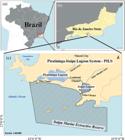
Study area indicating the Piratininga-Itaipu Lagoon System, main rivers, and connecting channels. Itaipu Marine Extractive Reserve is cross-hatched.
The Piratininga Lagoon, the largest in the system (2.9 km2), is connected to the Itaipu Lagoon (1 km2) through the artificial channel of Camboatá and, to the sea, through the underground tunnel of the Tibau, built in 2008 (Prestrelo & Monteiro-Neto, 2016). Since 2019, the Tibau channel has been obstructed, making it difficult to exchange water directly between the lagoon and the sea. Piratininga Lagoon is shallow (0.9 m) with moderate salinity (~20) and 12-day water residence. The Itaipu Lagoon, on the other hand, has a mean depth of 1.2 m (0.7 to 4 m), a mean salinity of 24, and a residence time of three days (Costa et al., 2021). The connection with the sea occurs through the Itaipu Channel (Fig. 1).
The Itaipu Lagoon and the adjacent sea area are part of the Itaipu Marine Extractive Reserve (RESEX-Mar Itaipu), a state-level protected area managed by INEA. Its aim is to support sustainable livelihoods of traditional fishing communities (INEA, 2023). Despite being connected to the Itaipu Lagoon and adjacent sea, the Piratininga Lagoon is not included in the limits of the RESEX-Mar Itaipu.
Research and data collection
This research is grounded in the principles of participatory action research, a methodological approach that emphasizes collaborative inquiry, local knowledge, and social transformation. Rather than testing predefined hypotheses, the process aimed to co-produce knowledge with fishers, integrating their experiences and priorities into the monitoring strategy (MacDonald, 2012; Reason & Bradbury, 2001). As such, the study prioritized descriptive, exploratory, and feedback-based methods that reflect the dynamics of artisanal fisheries and the governance challenges they face.
Research and data collection on the fishing activity in the Piratininga Lagoon was conducted between April 2019 and July 2023. The work was carried out in three stages: exploratory phase and fishers’ engagement, assisted fisheries self-monitoring program, and fishers’ validation and results assessment.
In all stages, qualitative-quantitative techniques, based on the participatory rapid appraisal, were applied. Adapted from the rapid rural appraisal (Chambers, 1981), these techniques consist of research methods aimed at the rapid and objective acquisition of information and scenarios about livelihood resources of traditional communities. Systematic and semi-structured strategies are used for data collection, involving the subjects of the investigative action, i.e., individuals engaged in the lagoon fisheries value chain. These approaches enhance partnerships between researchers and local fishers, facilitating the acquisition of information through knowledge of the reality from the perspective of its components (Chambers, 1994; Pido et al., 1997).
Exploratory phase and fishers’ engagement
The first stage, carried out between April 2019 and March 2020, consisted of identifying the existing fishing ports and fisheries landing sites around the lagoon system, quantifying the number of fishers and vessels, identifying the capture methods used, target species, and seasonality of the catches. Information was collected using participatory research tools adapted from participatory rapid appraisal, including cartography and seasonal calendars (Fig. 2). The data were systematically organized in electronic spreadsheets to document with the fieldwork protocol, including the number of participants interviewed across the survey. This information enabled to characterize the lagoon fishing and to identify the interviewed fishers, who were invited to record their fishing activities. All procedures were approved by the national ethical committee (Plataforma Brasil, Certificado de Apresentação para Apreciação Ética: 65027222.3.0000.8160).

Records of different stages of the development of the participatory methodology: (a) application of participatory rapid appraisal tools with a specialist fisher and engagement for the self-registration of his production; (b) cartographic tool for identification of fishing ports, boats, and number of fishers; (c) training of the fisheries monitor from the local association; (d) validate results in January 2023; (e) final presentation of the results and evaluation in July 2023.
The engagement of local fishers and traders enabled their direct participation, and as of July 2019, after receiving specific training, they began to record their fisheries production in printed forms, called self-monitoring notebooks. With the advent of the coronavirus pandemic, the notebooks were adapted to a digital version, which was used up to December 2021, when a following stage was introduced to monitor lagoon fisheries.
Assisted Fisheries Self-Monitoring Program
The Assisted Fisheries Self-Monitoring Program was carried out between February and December 2022, following the previous stage. The program had the direct collaboration of the local association (Associação de Pescadores e Amigos da Lagoa de Piratininga) and the participation of the local field monitor, a member of the association selected by peers, that was responsible for collecting fishing records and transmitting them to researchers. This included the composition of catches (categories of fish), landed volume (kg) and the first-sale value of the catch (in R$), as informed by the fishers during interviews. The field monitor received training and assistance from the research team throughout the period, and recorded information in a previously developed digital form, which was continuously improved over time. All monetary values were initially recorded in Brazilian reais (R$) and subsequently converted to U.S. dollars (US$) using the average exchange rate in 2022 (US$ 1 = R$ 5). For contextual reference, the minimum monthly wage in Brazil during this period was also considered.
Fishers’ validation and results assessment
After depurating, consolidating, and analysing the records, the results were presented to the fishers for validation in two moments: one in January 2023, and another in July 2023. The process was conducted in plenary meetings, in which participants should provide their opinion on the results, presented in the affirmative format. Therefore, participants would agree, disagree or abstain from providing an opinion. Validation used participatory voting with color-coded responses during plenary meetings.
The first meeting held on January 2023, aimed to validate the results obtained by the Assisted Fisheries Self-Monitoring Program. Statements that showed a frequency of agreement greater than 50% of the fishers present were considered validated. The search for a possible consensus was made through the debate of ideas, with the encouragement of the argumentation of
the divergent for collective analysis and final validation. On the second meeting conducted in July 2023, the results adjusted after discussions and consensus from the first meeting were presented once more for a final approval, and an individual evaluation form of the 2022 self-monitoring program was applied. Annual fish production was estimated (Tubino et al., 2021) by applying Eq. 1:
Where: NUPs: number of active production units (boats) in the period; Fisheries: mean annual fishing trips in the period per production unit; CPUE: mean fish caught per fishing trip (kg/trip).
RESULTS
In the first stage, 33 approaches were conducted involving 39 participants, which allowed: to identify the landing points in the lagoon system; to estimate the size of the fleet (number of vessels in operation), the number of active fishers and the fishing yield in each fishery. Between 2019 and 2021, fishers self-registered 62 landings, with mean fishing yield of 61.7 kg/monitored fishing trip.
In the second and main stage of the Assisted Fisheries Self-Monitoring Program, in 2022, 290 landings and a production of 15,841 kg were recorded, distributed in seven landing sites around the Piratininga Lagoon (Table 1). These values reflect structured monitoring only in 2022, earlier data were voluntary. Most of the production (91%) came from catches made in the Piratininga Lagoon, but fisheries catch from the Itaipu Lagoon were also recorded. Boats used were mostly rowboats; some motorized units operated in the Itaipu Lagoon.
Values of total fishery production monitored and estimated by category of fish recorded in 2022.
Gillnets (800–1,200 m in length and 35–55-mm mesh size) are the predominant fishing gear used in the catches and were employed in three modalities: lance (79.2%), troia, and mijuada.
Based on the production records of 25 boats and considering a frequency of three fishing trips per month per boat, we estimated that the fishers of the Piratininga Lagoon carried out 900 fishing trips in 2022 and caught 52.3 tons of fish. The volume of fish per fishing trip ranged from 31.1 to 72.8 kg (mean = 54.7 kg/fishing trip). According to the fishers, a good fishing trip may yield more than 60 kg, whereas a bad fishing trip would yield less than 40 kg. Normal catches ranged between 40 and 60 kg per fishing trip.
Ten categories of fish were recorded, in addition to the mistura, formed by various small fish. The most representative categories in volume were mullet, tilapia, and black drum, which together contributed to more than 90% of the total production. Shrimp catches were not reported during self-monitoring, so the annual self-declaration information was used. The estimated shrimp production indicated a share of just over 5% of the total (Table 1).
The highest fishing yields (i.e., above the mean for the period) were recorded in late summer and autumn. These yields were boosted by mullet catches between March and May and by black drum and tilapia catches in July. The monthly variation in fishing yield among these three categories of fish was lower for tilapia (41 kg/trip), followed by black drum (45.2 kg/trip). Mullet showed the highest yield in a single month (75 kg/trip).
Mullet fishery yields showed a marked seasonal variation, with higher values in the summer and spring months, declining strongly in the winter seasons. Tilapia showed yield throughout all seasons of the year, with a peak in June, when there was also an increase in black drum productivity. The highest black drum yields were recorded between autumn and winter, replacing mullet (Fig. 3).
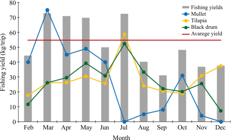
Monthly variation in total fishing yield (kg/trip) and of the three main categories of fish caught in the Piratininga-Itaipu Lagoon System during the year 2022. The mean yield for the entire period is indicated by the red line.
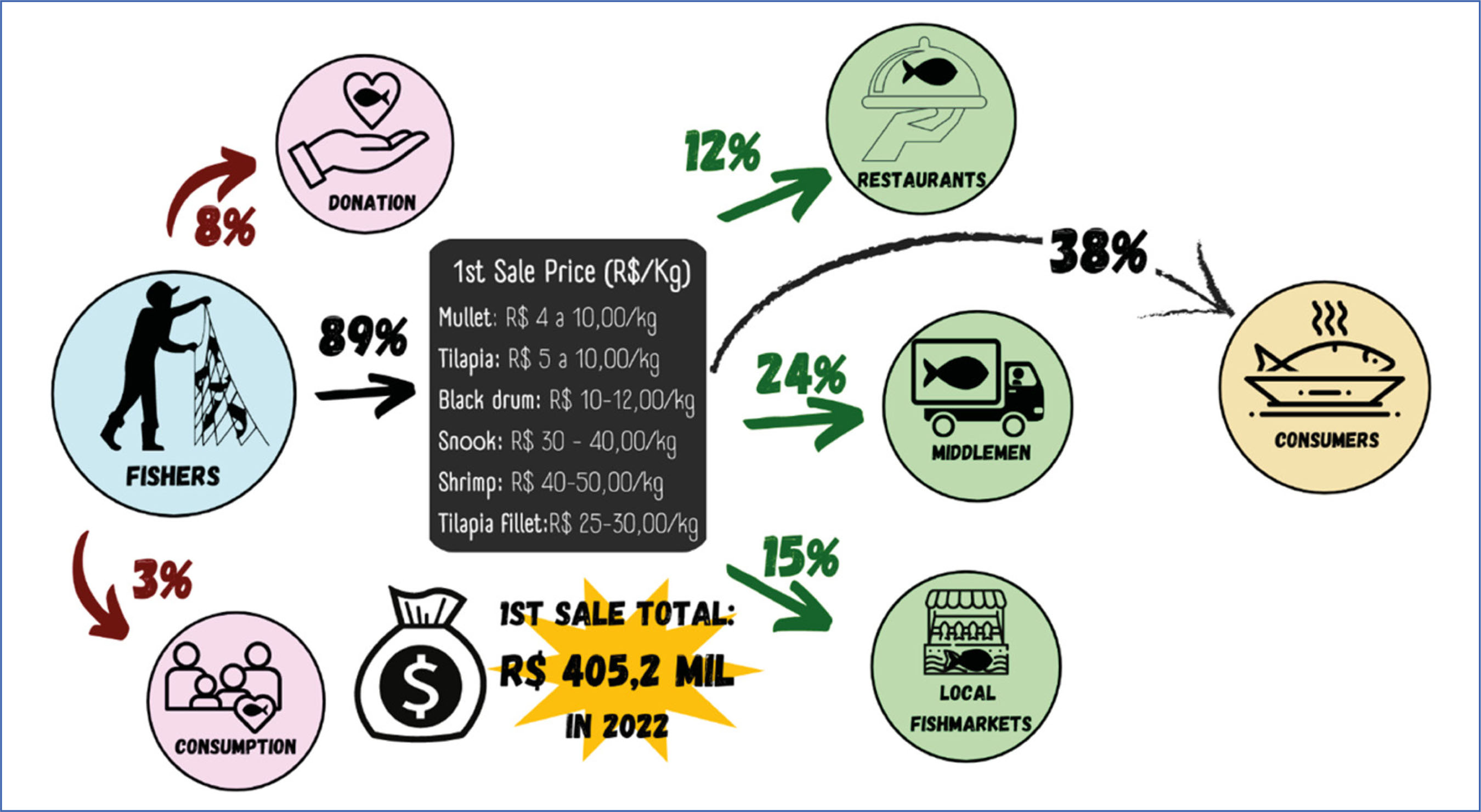
The distribution of lagoon fish production follows a value chain composed of five main actors: fishers, middlemen, local fish markets, restaurants, and final consumers. Most of the catch (89%) is commercialized, with sales occurring predominantly through direct transactions with consumers and middlemen. The remaining portion of the production is either donated or retained for household consumption by the fishers themselves (Fig. 4).

Commercialization flow of fishing production landed in the Piratininga Lagoon. Relative proportion of the volume (%) traded along the value chain associated with fishing in the Piratininga-Itaipu Lagoon System and estimated total revenue in 2022 based on first sale values (price table).
The first-sale prices indicated variations according to the species and size of the individuals. Mullet is sold between R$ 4 and R$ 10/kg (US$ 0.80–2; mean: R$ 4.55 ≈ US$ 0.91), tilapia between R$ 6–10 (US$ 1.20–2; mean: R$ 5.89 ≈ US$ 1.18), black drum between R$ 10–12/kg (US$ 2–2.40; mean: R$ 5.61 ≈ US$ 1.12), and shrimp between R$ 40–50/kg (US$ 8–10). The tray (20 kg) of mistura is sold at R$ 80 (≈US$ 16; mean: R$ 4/kg ≈ US$ 0.80) (Fig. 4). At least five fishers, specializing in catching tilapia, reported that process and sell the fillet at a price ranging from R$ 25 to R$ 30/kg (US$ 5–6/kg) (approximately 3 kg or eight fish). Considering the values of the first sale, it was possible to estimate that, in 2022, a revenue of R$ 405,200 (≈US$ 81,000) was generated for all the fish caught and sold by the Piratininga Lagoon fishers.
The storage of production represents a bottleneck in the production chain, which forces direct sales to the middleman when there is a lot of production. In these cases, fishers negotiate the kg value per fish unit, fish box, or total catch, which is locally called tide.
Twenty-three fishermen participated in the evaluation of the results of the Assisted Fishing Self-Monitoring Program during the validation meetings. Most of the statements presented, such as the number of fishermen, active vessels, number of landing ports, peak production season, were validated (81%), with a consensus level above 80%, reinforcing the quality of the results achieved. The non-validated issues related to: total production monitored in 2022, with consensus that this did not represent the total production; the number of fish mortality events that occurred, with one occurrence not recorded in April 2022; and the failure to report shrimp catches, due to fishermen’s fear of revealing to others the exact time and location of the shrimp, which has the highest price per kilogram.
The results of the final evaluation carried out with 11 fishermen and local leaders on the Assisted Fishing Monitoring Program indicated the importance of monitoring lagoon fishing and the recognition that the information contributed to the visibility of lagoon fishermen and their demands (82%). Despite strong community participation and the success of the 2022 monitoring cycle, the Assisted Self-Monitoring Program was suspended in February 2023. According to interviews, most fishers (80%) were unaware of the exact reasons for the interruption but identified several contributing factors, including the lack of financial resources (73%), the absence of technical assistance from researchers and partner institutions, and the discouragement caused by recurring fish mortality events. Additionally, fishers reported a temporary decline in fishing activity due to poor environmental quality in the lagoon, which further undermined the continuity of the monitoring effort. Notably, 82% of the respondents expressed interest in maintaining the program, highlighting its perceived relevance to the community. In response, proposals for the program’s reactivation have been submitted to local and regional stakeholders.
After the two validation rounds, the results were integrated into a representative scheme of the organization and dynamics of the local fishing activity, as a synthesis of the results obtained throughout the research (Fig. 5). This scheme reflects the reality of the 40 active fishers operating in the lagoon, comprising the entire local fishing community and all productive units currently in use. Among them, two are women, indicating the presence of female participation in local fishing activities.

Synthetic diagram of information on fishing developed in the Piratininga-Itaipu Lagoon System by the fishers of the Piratininga Lagoon used in the validation and feedback process.
DISCUSSION
In 2022, the total landed production was 52.2 tons, equivalent to 16.5 kg per hectare per year and 1,305.8 kg per fisher per year. These figures underscore the socio-economic relevance of the activity, contributing to the fishers of Piratininga Lagoon securing their territorial rights.
Small-scale fisheries in coastal lagoons are difficult to characterize and manage, particularly in developing countries where reliable data are scarce (Hilborn et al., 2020). This absence limits both fisheries governance and technical support, exposing juvenile-rich environments to mismanagement (Macedo et al., 2021). As such, alternative, locally grounded data sources are essential (Machado et al., 2021). By adopting participatory action research, this study integrated local diagnostics and fisher-led data collection to promote both knowledge co-production and community empowerment (MacDonald, 2012; Pido et al., 1997).
The Ministry of Fisheries’ renewed openness to community-generated data reinforces the relevance of initiatives like this one. In our case, participatory methods enabled us to estimate a production of 52 tons in 2022, a value consistent with Costa et al. (2021), who estimated 58 tons, reinforcing the reliability of these local approaches. As observed by Soares et al. (2022) in nearby Itaipu, direct sales to consumers increased during the pandemic, a trend mirrored in Piratininga, particularly through the commercialization of tilapia fillet following the closure of formal markets.
Mullet continues to sustain fishing in the lagoon, with mean yields of 55 kg/trip in 2022. Yet, overall productivity is low (16.5 kg/ha/year) compared to other Southwestern Atlantic systems in Brazil and Uruguay, up to 193.1 kg/ha/year (Pérez-Ruzafa & Marcos, 2012), reflecting the lagoon’s degraded conditions. Fishers associate summer die-offs with low oxygen in the shallow, eutrophic lagoon. Between 2018 and 2023, 12 mortality events were recorded, each reducing biomass and income. The October 2022 die-off alone resulted in an 8-ton loss, nearly two months of production.
After the Tibau Channel opened in 2011, salinity increased, favoring marine species. Its later blockage led to desalination and a resurgence of freshwater species, notably tilapia. According to fishers, tilapia introduced 30 years ago displaced native species like Geophagus brasiliensis and Ariidae catfish (Avella et al., 1993; Costa et al., 2021; Prestrelo & Monteiro-Neto, 2016). Even accounting for seasonal variation, production estimates from participatory monitoring closely aligned with historical figures, confirming the method’s ability to uncover the dynamics of overlooked fisheries.
This collaborative approach helped fishers identify critical challenges and demand actions such as water quality improvements, channel reopening, and formal inclusion in the General Fisheries Registry, steps deemed essential to safeguard their territories and livelihoods. Such demands reflect broader struggles for territorial rights and institutional recognition faced by artisanal fishing communities in Brazil (Machado & Diegues, 2015).
Fishery self-monitoring engages fishers in generating information about their activities and increases accountability and transparency in the management of fishery resources (Van Helmond et al., 2020). The involvement of fishers and technical-scientific institutions in the collection, organization, and analysis of fisheries data can provide current information, contributing to the management of fish stocks (Santos et al., 2023) and reducing costs, with broader and more regular fishing coverage (Zamboni et al., 2020). Our findings reinforce the potential of fisheries self-monitoring as an effective participatory tool to generate qualified data and support local fisheries governance. However, it is important to consider that fishers may show resistance to fully engaging in monitoring activities, particularly when these are perceived as regulatory mechanisms. As highlighted by Pereira et al. (2025), some fishers associate monitoring practices with external control, which may hinder trust and participation. Overcoming such challenges requires continuous dialogue, transparency, and community-led adaptation of protocols to ensure long-term engagement and legitimacy of the monitoring process.
Launched in 2020, the Projeto Pró-Sustentável initially disregarded fishers’ needs, offering limited infrastructure for their operations (Prefeitura de Niterói, 2023). This reflects a broader pattern of marginalization in urban planning, often linked to gentrification (Thompson et al., 2016).
Through public hearings and mobilization, fishers secured the inclusion of proper infrastructure in the project, such as five piers and fishing ranches, thanks in part to the data produced by the monitoring program. Similarly, after October 2022 fish mortality, presenting production records helped expand public aid tenfold, highlighting how locally generated data can support policy responsiveness (Alves et al., 2012).
Effective governance of shared resources requires collaborative mechanisms (Jentoft, 2023; Jentoft & Chuenpagdee, 2009; Ostrom, 2009). Although the RESEX-Mar Itaipu aims to support local fishers, Piratininga remains excluded. INEA’s 2023 resolution partially addresses this, but full inclusion is pending. Cases in Patos, Paraty, and Mediterranean lagoons show that participatory monitoring enhances both data quality and community engagement (Dias & Seixas, 2019; Pérez-Ruzafa et al., 2020). Ensuring continuity, however, demands stable funding and institutional commitment. Local management initiatives elsewhere in Brazil have demonstrated that participatory monitoring enhances sustainability and autonomy when supported over time (Castro & McGrath, 2003).
We recommend including Piratininga Lagoon in the RESEX-Mar Itaipu, investing in storage infrastructure, reactivating the Tibau Channel, and establishing a permanent mechanism for community-based monitoring. As one fisher noted:
“It helped us prove that fishing exists, and that the lagoon is alive. Monitoring helps organize the fishers”.
CONCLUSIONS
The integration of participatory methods and fisher-led self-monitoring proved to be an effective strategy for generating data on coastal lagoon fisheries, a sector often overlooked by traditional monitoring systems. The successful implementation of the Assisted Self-Monitoring Program in the Piratininga Lagoon highlighted its potential to reveal hidden fisheries dynamics and empower local communities through data ownership.
Although suspended due to limited support, its 2022 outcomes demonstrate its replicability in similar small-scale fishing contexts. However, its long-term effectiveness depends on stable funding, institutional commitment, and continued scientific collaboration, as many fishers are not yet fully prepared to carry out monitoring autonomously.
Considering these findings, assisted self-monitoring emerges as a promising alternative to address the chronic data scarcity affecting small-scale fisheries. Its broader adoption could contribute to more inclusive and equitable fisheries governance, while simultaneously strengthening the recognition and valorization of artisanal lagoon fishing communities in Brazil.
ACKNOWLEDGMENTS
The authors would like to thank the participation and collaboration of all the artisanal fishermen and fisherwomen of Associação de Pescadores e Amigos da Lagoa de Piratininga, the researchers of the Laboratório de Biologia do Nécton e Ecologia Pesqueira of the Universidade Federal Fluminense, Biologia Pesqueira e Modelagem Trófica de Ecossistemas Marinhos of the Universidade Federal Rural do Rio de Janeiro, laboratories, technicians from Cardume Socioambiental & Comunicação and associated partners for their collaboration. The realization of these projects represents compensatory measures established by the Conduct Adjustment Term of responsibility of the company PRIO, conducted by the Federal Public Prosecutor’s Office of the Rio de Janeiro State.
-
FUNDING
Pesquisa Marinha Project/Sistemas Lagunares do Leste Fluminense - SLLFGrant CP Nº 05/2016Educação Ambiental Project/ Pesca SolidáriaGrant CP Nº 03/2021Both projects supported by TAC Frade, a compensatory measure established by Conduct Adjustment Term responsibility of the PRIO, conducted by the Federal Public Ministry – MPF/RJ, with the implementation of the Fundo Brasileiro para a Biodiversidade – FUNBIO.
-
DECLARATION OF USE OF ARTIFICIAL INTELLIGENCE TOOLS
Artificial intelligence tools were used solely for text editing, writing assistance, and reference organization. They were not used for data generation, data analysis, interpretation of results, or formulation of conclusions.
DATA AVAILABILITY STATEMENT
All data sets were generated or analyzed in the current study.
REFERENCES
-
Abreu, M. D., Tubino, R. A., Monteiro-Neto, C., Marco, C., Penetra, E., Soares, J. B., Moretti, T., Costa, M. R., & Angelini, R. (2021). A técnica de investigação participativa valorização do conhecimento tradicional e engajamento local na pesquisa científica. In: M. R. Costa, C. Monteiro-Neto, R. A. Tubino & R. Angelini (eds.), Pesca e Sustentabilidade: passado, presente e futuro (pp. 94-109). AH Edições. Retrieved from https://ecopesca.uff.br/wp-content/uploads/sites/57/2024/10/Livro_SLLF_Pesca_Sustentabilidade.pdf
» https://ecopesca.uff.br/wp-content/uploads/sites/57/2024/10/Livro_SLLF_Pesca_Sustentabilidade.pdf -
Alves, D. C., Moura, R. L., & Vera, C. V. M. (2012). Estimativa da captura total: desenhos amostrais para pesca artesanal. Interci ê ncia, 37(12), 899-905. Retrieved from https://www.redalyc.org/pdf/339/33925592006.pdf
» https://www.redalyc.org/pdf/339/33925592006.pdf -
Arthur, R. I., Skerritt, D. J., Schuhbauer, A., Ebrahim, N., Friend, R. M., & Sumaila, U. R. (2021). Small-scale fisheries and local food systems: Transformations, threats and opportunities. Fish and Fisheries, 23(1), 109-124. https://doi.org/10.1111/faf.12602
» https://doi.org/10.1111/faf.12602 -
Avella, M., Berhaut, J., & Bornancin, M. (1993). Salinity tolerance of two tropical fishes, Oreochromis aureus and O. niloticus I. Biochemical and morphological changes in the gill epithelium. Journal of Fish Biology, 42(2), 243-254. https://doi.org/10.1111/j.1095-8649.1993.tb00325.x
» https://doi.org/10.1111/j.1095-8649.1993.tb00325.x -
Bausero-Jorcin, S., Gelcich, S., Gianelli, I., Jorge-Romero, G., Lezama, C., & Defeo, O. (2024). Assessing the performance of a participatory governance transformation in small-scale fisheries: A case study from Uruguay. Marine Policy, 160, 105964. https://doi.org/10.1016/j.marpol.2023.105964
» https://doi.org/10.1016/j.marpol.2023.105964 -
Castro, F., & McGrath, D. G. (2003). Moving toward sustainability in the local management of floodplain lake fisheries in the Brazilian Amazon. Human Organization, 62(2), 123-133. Retrieved from https://www.researchgate.net/profile/Fabio-De-Castro/publication/277363200_Moving_Toward_Sustainability_in_the_Local_Management_of_Floodplain_Lake_Fisheries_in_the_Brazilian_Amazon/links/579630d508ae33e89fad7bff/Moving-Toward-Sustainability-in-the-Local-Management-of-Floodplain-Lake-Fisheries-in-the-Brazilian-Amazon.pdf
» https://www.researchgate.net/profile/Fabio-De-Castro/publication/277363200_Moving_Toward_Sustainability_in_the_Local_Management_of_Floodplain_Lake_Fisheries_in_the_Brazilian_Amazon/links/579630d508ae33e89fad7bff/Moving-Toward-Sustainability-in-the-Local-Management-of-Floodplain-Lake-Fisheries-in-the-Brazilian-Amazon.pdf -
Chambers, R. (1981). Rapid rural appraisal: rationale and repertoire. Public Administration and Development, 1(2), 95-106. https://doi.org/10.1002/pad.4230010202
» https://doi.org/10.1002/pad.4230010202 -
Chambers, R. (1994). Participatory rural appraisal (PRA): Challenges, potentials and paradigm. World Development, 22(10), 1437-1454. https://doi.org/10.1016/0305-750X(94)90030-2
» https://doi.org/10.1016/0305-750X(94)90030-2 - Chuenpagdee, R. (2012). Global partnership for small-scale fisheries research: Too big to ignore. SPC Traditional Marine Resource Management and Knowledge Information Bulletin, 29, 22-25.
- Costa, M. R., Monteiro-Neto, C., Tubino, R. A., & Angelini, R. (eds.) (2021). Pesca e Sustentabilidade: passado, presente e futuro AH Edições.
-
Dias, A. C. E., & Seixas, C. S. (2019). Delineamento participativo do protocolo de monitoramento da pesca artesanal da comunidade de Tarituba, Paraty, RJ. Ambiente e Sociedade, 22, e00702. https://doi.org/10.1590/1809-4422asoc0070r2vu19L1AO
» https://doi.org/10.1590/1809-4422asoc0070r2vu19L1AO -
Ferreira, U. C. S., Jannuzzi, P. M., & Giannella, L. C. (2023). Mover-se na metrópole: movimentos pendulares na Região Metropolitana do Rio de Janeiro. Cadernos Metrópole, 25(57), 617-639. https://doi.org/10.1590/2236-9996.2023-5711
» https://doi.org/10.1590/2236-9996.2023-5711 -
Food and Agriculture Organization of the United Nations (FAO) (2024). The State of World Fisheries and Aquaculture 2024. Blue Transformation in action. FAO. https://doi.org/10.4060/cd0683en
» https://doi.org/10.4060/cd0683en - Food and Agriculture Organization of the United Nations (FAO), Duke University & WorldFish (2023). Illuminating Hidden Harvests: The contributions of small-scale fisheries to sustainable development FAO.
-
Fundação Instituto de Pesca do Estado do Rio de Janeiro (FIPERJ) (2023). Estatística Pesqueira do Estado do Rio de Janeiro Consulta On-line. Projeto de Monitoramento da Atividade Pesqueira no Estado do Rio de Janeiro. Fundação Instituto de Pesca do Estado do Rio de Janeiro (FIPERJ). Retrieved from http://pescarj.fundepag.br/
» http://pescarj.fundepag.br/ -
Hilborn, R., Amoroso, R. O., Anderson, C. M., Baum, J. K., Branch, T. A., Costello, C., de Moor, C. L., Faraj, A., Hively, D., Jensen, O. P., Kurota, H., Little, L. R., Mace, P., McClanahan, T., Melnychuk, M. C., Minto, C., Osio, G. C., Parma, A. M., Pons, M., Segurado, S., Szuwalski, C. S., Wilson, J. R., & Ye, Y. (2020). Effective fisheries management instrumental in improving fish stock status. Proceedings of the National Academy of Sciences, 117(4), 2218-2224. https://doi.org/10.1073/pnas.1909726116
» https://doi.org/10.1073/pnas.1909726116 -
Instituto Estadual do Ambiente (INEA) (2023). Reserva Extrativista Marinha de Itaipu INEA. Retrieved from http://www.inea.rj.gov.br/biodiversidade-territorio/conheca-as-unidades-de-conservacao/reserva-extrativista-marinha-de-itaipu/
» http://www.inea.rj.gov.br/biodiversidade-territorio/conheca-as-unidades-de-conservacao/reserva-extrativista-marinha-de-itaipu/ -
Jentoft, S. (2023). The image fallacy: rethinking the tragedy of the commons. International Journal of the Commons, 17(1), 174-183. https://doi.org/10.5334/ijc.1248
» https://doi.org/10.5334/ijc.1248 -
Jentoft, S., & Chuenpagdee, R. (2009). Fisheries and coastal governance as a wicked problem. Marine Policy, 33(4), 553-560. https://doi.org/10.1016/j.marpol.2008.12.002
» https://doi.org/10.1016/j.marpol.2008.12.002 -
Kinas, P. G., & Wieczynski, J. C. (2020). Posterior de Polya no monitoramento amostral de pescarias. Brazilian Journal of Biometrics, 38(2), 207-225. https://doi.org/10.28951/rbb.v38i2.441
» https://doi.org/10.28951/rbb.v38i2.441 -
MacDonald, C. (2012). Understanding participatory action research: A qualitative research methodology option. The Canadian Journal of Action Research, 13(2), 34-50. https://doi.org/10.33524/cjar.v13i2.37
» https://doi.org/10.33524/cjar.v13i2.37 -
Macedo, M. L. C., Santos, S. R., Abreu, M. D., Zecchim, H., Keunecke, K. A., Timoteo, G., & Vianna, M. (2021). Fishing in the largest perene hypersaline lagoon in South America, with notes on current regulations. Boletim do Instituto de Pesca, 47, e658. https://doi.org/10.20950/1678-2305/bip.2021.47.e658
» https://doi.org/10.20950/1678-2305/bip.2021.47.e658 -
Machado, A. M., Giehl, E. L. H., Fernandes, L. P., Ingram, S. N., & Daura-Jorge, F. G. (2021). Alternative data sources can fill the gaps in data-poor fisheries. ICES Journal of Marine Science, 78(5), 1663-1671. https://doi.org/10.1093/icesjms/fsab074
» https://doi.org/10.1093/icesjms/fsab074 - Machado, A. T., & Diegues, A. C. (2015). Territorial rights and small-scale fishing communities in Brazil: Between legislation and real life . Marine Policy, 51, 465-473.
-
Martinho, F. (2020). Artisanal fisheries: management and sustainability. In W. Leal Filho, A. M. Azul, L. Brandli, A. Lange Salvia & T. Wall (eds.), Life Below Water. Encyclopedia of the UN Sustainable Development Goals (pp. 1-11). Cham: Springer. https://doi.org/10.1007/978-3-319-71064-8_3-1
» https://doi.org/10.1007/978-3-319-71064-8_3-1 -
Mendes, A. B., Souza, R. C. C. L., & Silva, E. P. (2016). Percepção de alunos sobre a problemática ambiental da Lagoa de Araruama, Cabo Frio, Rio de Janeiro, Brasil. Revista Eletrônica do Mestrado em Educação Ambiental, 185-212. Retrieved from https://periodicos.furg.br/remea/article/view/5343/4352
» https://periodicos.furg.br/remea/article/view/5343/4352 - Mendonça, J. T. (2018). Monitoramento pesqueiro: Avaliação de estratégias de coleta. Atas CIAIQ2018 Investigação Qualitativa em Ciências Sociais, 3, 27-36.
-
Mills, D. J., Westlund, L., Graaf, G., Kura, Y., Willman, R., & Kelleher, K. (2011). Under-reported and undervalued: small-scale fisheries in the developing world. In R. Pomeroy & N. Andrew (eds.), Small-scale fisheries management: Frameworks and approaches for the developing world(pp. 1-15). Oxfordshire CABI International. Retrieved from https://hdl.handle.net/20.500.12348/1123
» https://hdl.handle.net/20.500.12348/1123 -
Ministério da Pesca e Aquicultura (MPA) (2023). Estatística pesqueira MPA. Retrieved from https://www.gov.br/mpa/pt-br/assuntos/cadastro-registro-e-monitoramento/monitoramento-da-aquicultura-e-da-pesca
» https://www.gov.br/mpa/pt-br/assuntos/cadastro-registro-e-monitoramento/monitoramento-da-aquicultura-e-da-pesca -
Ostrom, E. (2009). A general framework for analyzing Sustainability of social-ecological systems. Science, 325(5939), 419-422. https://doi.org/10.1126/science.1172133
» https://doi.org/10.1126/science.1172133 -
Pauly, D., & Zeller, D. (2016). Catch reconstructions reveal that global marine fisheries catches are higher than reported and declining. Nature Communications, 7, 10244. https://doi.org/10.1038/ncomms10244
» https://doi.org/10.1038/ncomms10244 -
Pereira, J. S., Santos, L. E., & Cardoso, A. T. C. (2025). Construção do monitoramento participativo e ecossistêmico da pesca na Reserva Extrativista Marinha Lagoa do Jequiá. Biodiversidade Brasileira, 15(2), 17-29. https://doi.org/10.37002/biodiversidadebrasileira.v15i2.2534
» https://doi.org/10.37002/biodiversidadebrasileira.v15i2.2534 -
Pérez-Ruzafa, A., & Marcos, C. (2012). Fisheries in coastal lagoons: An assumed but poorly researched aspect of the ecology and functioning of coastal lagoons. Estuarine, Coastal and Shelf Science, 110, 15-31. https://doi.org/ 10.1016/j.ecss.2012.05.025
» https://doi.org/10.1016/j.ecss.2012.05.025 -
Pérez-Ruzafa, A., Pérez-Marcos, M., & Marcos, C. (2020). Coastal lagoons in focus: Their environmental and socioeconomic importance. Journal for Nature Conservation, 57, 125886. https://doi.org/10.1016/j.jnc.2020.125886
» https://doi.org/10.1016/j.jnc.2020.125886 -
Pido, M. D., Pomeroy, R. S., Garces, L. R., & Carlos, M. B. (1997). A rapid appraisal approach to evaluation of community-level fisheries management systems: Framework and field application at selected coastal fishing villages in the Philippines and Indonesia. Coastal Management, 25(2), 183-204. https://doi.org/10.1080/08920759709362317
» https://doi.org/10.1080/08920759709362317 -
Prefeitura de Niterói (2023). Projeto Orla Piratininga Prefeitura de Niterói. Retrieved from https://www.prosustentavel.niteroi.rj.gov.br/wp-content/uploads/2024/11/POP.pdf
» https://www.prosustentavel.niteroi.rj.gov.br/wp-content/uploads/2024/11/POP.pdf -
Prestrelo, L., & Monteiro-Neto, C. (2016). Before–after environmental impact assessment of an artificial channel opening on a south‐western Atlantic choked lagoon system. Journal of Fish Biology, 89(1), 735-752. https://doi.org/10.1111/jfb.13012
» https://doi.org/10.1111/jfb.13012 -
Prestrelo, L., & Vianna, M. (2016). Identifying multiple-use conflicts prior to marine spatial planning: A case study of a multi-legislative estuary in Brazil. Marine Policy, 67, 83-93. https://doi.org/10.1016/j.marpol.2016.02.001
» https://doi.org/10.1016/j.marpol.2016.02.001 -
Reason, P., & Bradbury, H. (2001). Inquiry and participation in search of a world worthy of human aspiration. Handbook of action research: Participative inquiry and practice (pp. 1-14). Retrieved from https://www.peterreason.net/wp-content/uploads/Handbook_Introduction.pdf
» https://www.peterreason.net/wp-content/uploads/Handbook_Introduction.pdf -
Santos, J. P., Guimarães, E. C., Garciov-Filho, E. B., Brito, P. S., Lopes, D. F. C., Andrade, M. C., Ottoni, F. P., Dias, L. J. B. S., Anjos, M. R., Carvalho-Neta, R. N. F., Rodrigues, L. R. R., Nogueira, M. A. M. P., Pelicice, F. M., Agostinho, A. A., & Fearnside, P. M. (2023). Monitoramento da pesca no Brasil: como cumprir a agenda 2030 sem estatísticas da pesca? Biota Neotropica, 23(2), e20221439. https://doi.org/10.1590/1676-0611-BN-2022-1439
» https://doi.org/10.1590/1676-0611-BN-2022-1439 -
Smith, H., & Basurto, X. (2019). Defining small-scale fisheries and examining the role of science in shaping perceptions of who and what counts: a systematic review. Frontiers in Marine Science, 6, 236. https://doi.org/10.3389/fmars.2019.00236
» https://doi.org/10.3389/fmars.2019.00236 -
Soares, J. B., Costa, M. R., Monteiro-Neto, C., Loto, L., Abreu, M. D., & Almeida Tubino, R. (2022). Impacts of COVID-19 on the value chain of a small-scale fishery system in a tropical metropolitan city. Marine Policy, 140, 105068. https://doi.org/10.1016/j.marpol.2022.105068
» https://doi.org/10.1016/j.marpol.2022.105068 -
Thompson, C., Johnson, T., & Hanes, S. (2016). Vulnerability of fishing communities undergoing gentrification. The Journal of Rural Studies, 45, 165-174. https://doi.org/10.1016/j.jrurstud.2016.03.008
» https://doi.org/10.1016/j.jrurstud.2016.03.008 - Tubino, R. A., Abreu, M. D., Marco, C., Monteiro-Neto, C., & Costa, M. R. (2021). A produção pesqueira nos sistemas lagunares do leste fluminense. In M. R. Costa, C. Monteiro-Neto, R. A. Tubino & R. Angelini (eds.), Pesca e sustentabilidade: passado, presente e futuro (pp. 111-127). AH Edições.
- United Nations (2019). World Urbanization Prospects: The 2018 Revision (ST/ESA/SER.A/420) United Nations.
-
Van Helmond, A. T., Mortensen, L. O., Plet‐Hansen, K. S., Ulrich, C., Needle, C. L., Oesterwind, D., Kindt-Larsen, L., Catchpole, T., Mangi, S., Zimmermann, C., Olesen, H. J., Bailey, N., Bergsson, H., Dalskov, J., Elson, J., Hosken, M., Peterson, L., McElderry, H., Ruiz, J., Pierre, J. P., Dykstra, C., & Poos, J. J. (2020). Electronic monitoring in fisheries: lessons from global experiences and future opportunities. Fish and Fisheries, 21(1), 162-189. https://doi.org/10.1111/faf.12425
» https://doi.org/10.1111/faf.12425 -
Virdin, J., Basurto, X., Nico, G., Harper, S., Mancha-Cisneros, M. M., Vannuccini, S., Ahern, M., Anderson, C. M., Funge-Smith, S., Gutierrez, N. L., Mills, D. J., & Franz, N. (2023). Fishing for subsistence constitutes a livelihood safety net for populations dependent on aquatic foods around the world. Nature Food, 4, 874-885. https://doi.org/10.1038/s43016-023-00844-4
» https://doi.org/10.1038/s43016-023-00844-4 - Zamboni, A., Dias, M., & Iwanicki, L. (2020). Auditoria da pesca Brasil 2020: uma avaliação integrada da governança, da situação dos estoques e das pescarias Oceana Brasil.
Edited by
-
Section editor:
Welber Senteio Smith https://orcid.org/0000-0001-9803-7394


 Source: The authors.

 Source: The authors.
 APALAP: Associação de Pescadores e Amigos da Lagoa de Piratininga. Source: The authors.