 Adapting for sustainability: Understanding marine shrimp population dynamics and yield optimization in Brazilian coastal waters
ABSTRACT
Understanding the impact of exploitation patterns on yields is crucial for ensuring the sustainability of fishing activities. However, data availability can hamper the assessment of how close resources are to optimal exploitation. We gathered simple life history parameters of shrimp stocks in Brazil using published data and applied a yield per recruit model to determine the optimal combinations of first catch length and fishing mortality for maximizing yields. We evaluated five marine shrimp species, Farfantepenaeus subtilis, F. brasiliensis, F. paulensis, Xiphopenaeus kroyeri, and Litopenaeus schmitti, distributed across four major Brazilian regions (North, Northeast, Southeast, and South). A clear pattern emerged: stocks in Northeast demonstrated high yields with appropriate first catch lengths and fishing mortality rates, with only some cases 12% below the optimum level. In contrast, the Southeast region presented more concerning situations. Its fisheries employed very small first catch lengths, capturing individuals at early life stages, below the length of first maturation, harming reproduction and stock replenishment. Combined with high fishing mortality rates, this resulted in yields 37% below the optimal, indicating signs of growth overfishing.
Keywords
Shrimp fishing; Yield per recruit; Stock assessment; Fisheries management; Marine shrimp
RESUMO
Compreender o impacto dos padrões de exploração sobre o rendimento é crucial para garantir a sustentabilidade das atividades pesqueiras, no entanto a disponibilidade de dados pode dificultar a avaliação da proximidade dos recursos à exploração ótima. Reunimos parâmetros simples do ciclo de vida de estoques de camarão no Brasil utilizando dados publicados e aplicamos um modelo de rendimento por recruta para determinar as combinações ótimas de comprimento da primeira captura e mortalidade por pesca para maximizar o rendimento. Avaliamos cinco espécies de camarão-marinho, Farfantepenaeus subtilis, F. brasiliensis, F. paulensis, Xiphopenaeus kroyeri e Litopenaeus schmitti, distribuídas em quatro grandes regiões brasileiras (Norte, Nordeste, Sudeste e Sul). Um padrão claro emergiu: os estoques no nordeste apresentaram alta produtividade, com comprimentos de primeira captura e taxas de mortalidade por pesca adequados e apenas alguns casos 12% abaixo do nível ótimo. Em contraste, a Região Sudeste apresentou situações mais preocupantes. Essas pescarias empregaram comprimentos de primeira captura muito pequenos, capturando indivíduos em estágios iniciais de vida, abaixo do comprimento da primeira maturação, prejudicando a reprodução e a reposição dos estoques. Combinado com altas taxas de mortalidade por pesca, isso resultou em rendimentos 37% abaixo do ideal, indicando sinais de sobrepesca de crescimento.
Palavras-chave
Pesca de camarão; Rendimento por recruta; Avaliação de estoque; Gestão da pesca; Camarão-marinho
Introduction
Penaeid shrimp is a highly valuable fishery resource, inhabiting coastal and shallow waters and depending on estuarine and mangrove habitats during parts of its life cycle (NOAA Fisheries, 2019). Farfantepenaeus and Litopenaeus species typically use estuaries during the late larval and early settlement stages, later moving to coastal areas as juveniles and then to deeper waters for reproduction (Pickens et al., 2021; Whitfield, 2017). In contrast, Xiphopenaeus species develop mainly in shallow coastal zones with limited estuarine use (Pavanelli et al., 2010; Pescinelli et al., 2017). These groups also show distinct life-history traits, including specific patterns of growth, mortality, maturity, and longevity (Pavanelli et al., 2010; Pescinelli et al., 2017).
These species exhibit accelerated growth, rapidly reaching maturity and commercial sizes, which supports rapid biomass turnover and consistent revenue for fisheries, as profit per unit weight increases with individual size (Freire et al., 2020). This importance is reflected globally: shrimp account for roughly 16% of exported seafood, although recent market contractions (-1.6% in import volume and -5.9% in value) highlight the high volatility of the sector (FAO, 2025). Despite their economic importance, shrimp stocks are finite and remain vulnerable to increasing demand, high fishing pressure, and the lack of effective measures such as closed seasons, minimum size limits, and catch quotas (Gallaway et al., 2017; Watson et al., 2013). The early capture of individuals below the size at first maturation can intensify these impacts (Musiello-Fernandes et al., 2017). When effort becomes excessive, populations may decline and overfishing can occur, jeopardizing the fishery long-term sustainability (Pauly et al., 2002; Temming & Hufnagl, 2015).
Efforts to optimize fisheries exploitation have been intensified in recent decades, supported by international agreements that aim to maintain stocks at levels capable of producing high yields without compromising long-term sustainability (Mildenberger et al., 2022; United Nations, 1982). However, estimating such reference points requires catch, age, length, or effort data, which are often unavailable for many fisheries, including shrimp (Berkson & Thorson, 2015; Martell & Froese, 2013), due to factors such as low commercial value, restricted distributions, or limited capacity to collect reliable statistics (Zeller et al., 2016). In these data-poor contexts, life-history parameters become critical for understanding stock composition and the shared strategies of related species regarding growth, mortality, reproduction, migration, and habitat use (Secor, 2015), offering insights into abundance, productivity, and vulnerability to fishing (Begg et al., 1999; Kerr et al., 2017). Simple parameters describing growth, reproduction, selectivity, and mortality can characterize population dynamics and serve as inputs for predictive stock assessment models that evaluate how exploitation patterns influence yields (Gribble & Dredge, 1994; Temming & Hufnagl, 2015; Warahma et al., 2021).
Among these tools, yield per recruit (Y/R) analysis remains widely applied to estimate optimal combinations of age or length at first catch (Tc or Lc) and fishing mortality (F), or to identify the values that maximize yield at a given mortality level (Beverton & Holt, 1957; Pikitch, 1987; Ricker, 1975). Classical formulations rely on parameters such as asymptotic length (L∞), growth coefficient (k), first-catch length (Lc), and natural and fishing mortality (M and F), while more recent approaches incorporate additional information on gear selectivity and economic value to improve management insights (Gribble & Dredge, 1994; Pikitch, 1987).
In Brazil, several penaeid shrimp species support important coastal fisheries. The seabob shrimp Xiphopenaeus kroyeri (Heller, 1862), distributed from Virginia (United States of America) to southern Brazil, is small-sized but represents a major component of catches, especially in the Northeast (Holthuis, 1980; Silva et al., 2013). Recent taxonomic revisions indicate that Brazilian populations comprise multiple species, including Xiphopenaeus dincao and Xiphopenaeus baueri (Carvalho-Batista et al., 2019). The white shrimp Litopenaeus schmitti (Burkenroad, 1936), found from Cuba to Rio Grande do Sul (Brazil), reaches larger sizes and holds higher commercial value (Pérez-Farfante & Kensley, 1997). Industrial fisheries mainly target the “pink shrimp” complex, composed of Farfantepenaeus subtilis, distributed from the Caribbean to Cabo Frio (RJ, Brazil) and heavily exploited in the North (Aragão et al., 2015; Pérez-Farfante, 1978); Farfantepenaeus brasiliensis, ranging from North Carolina (United States of America) to southern Brazil and important in the Southeast (Leite Jr. & Petrere Jr., 2006); and Farfantepenaeus paulensis, with a more restricted distribution from Bahia (Brazil) to Argentina and commonly caught in the South (Leite Jr. & Petrere Jr., 2006; Zenger Jr. & Agnes, 1977).
Shrimp fisheries in Brazil are largely managed through closed seasons aimed at protecting recruitment, but the lack of biological and fishery data has limited the development of more refined measures, particularly those defining optimal harvest sizes (MAPA, 2019; SUDEPE, 1983). To address this gap, we compiled life-history parameters for white, seabob, and pink shrimp from published studies and used them to compare stock characteristics and perform Y/R analyses. By estimating the combinations of first-catch length and fishing mortality that maximize yield, this study provides simple, actionable benchmarks for optimizing exploitation in data-limited contexts. These results offer practical guidance for strengthening management strategies and improving the long-term sustainability of Brazilian shrimp fisheries.
Materials and methods
Species
Five shrimp species were evaluated: the pink category (F. subtilis, F. brasiliensis, and F. paulensis), seabob shrimp (X. kroyeri), and white shrimp (L. schmitti). Although X. kroyeri is recognized as multiple species nowadays, it was treated as a single group, because past population studies did not distinguish it.
Life-history parameters
Life-history data were obtained from scientific articles, technical reports, and theses/dissertations retrieved from public databases (Scopus, Google Scholar, Web of Science, and Scientific Electronic Library Online—SciELO). Searches used keywords such as “population dynamics,” “shrimp growth,” “shrimp mortality,” “shrimp reproduction,” and “shrimp life history,” and all years with available estimates were considered.
Growth, maturation, selectivity, and mortality parameters were compiled from published estimates. Growth was described using the von Bertalanffy parameters L∞ and W∞, the growth coefficient k, and t0 set to 0 to avoid unrealistic age estimates (Leite Jr. & Petrere Jr., 2006; Lopes et al., 2014; Silva et al., 2016). Maturation was represented by the length at first maturity (L50), corresponding to a 0.5 probability of reproductive capability. Selectivity was described by the length at first capture (Lc), indicating a 0.5 probability of retention by the fishing gear, and the recruitment length (Lr), marking entry into the fishable stock. Mortality parameters included fishing mortality (F), estimating removals due to fishing, and natural mortality (M), representing losses from natural causes.
Data availability varied among species and regions, which limited the application of models in cases in which parameters were missing (e.g., X. kroyeri, F. brasiliensis, and L. schmitti in the South). When M estimates were unavailable (L. schmitti and X. kroyeri in the North), values were obtained using the natural mortality tool (Cope & Hamel, 2022), based on L∞, W∞, longevity, and k, and the mean among methods was used in subsequent analyses.
Stocks
Stock units remain uncertain, but genetic, morphometric, and larval-dispersion evidence, including homozygosity patterns, morphometric similarity, and larval transport, suggests potential biomass flow and stock differentiation (Beacham et al., 2017). Studies have identified distinct stocks of L. schmitti over short distances influenced by the equatorial South current, as well as marked genetic differences between F. brasiliensis and F. paulensis in the Southeast–South regions (Gusmão et al., 2005; Luvesuto, 2006; Teodoro et al., 2015). Together, these findings indicate the existence of at least two or more stocks along the Brazilian coast, reinforcing the need to understand stock structure for proper exploitation and future management (Gusmão et al., 2013). Based on this evidence, we considered regional differentiation of stocks: F. subtilis in the North–Northeast; F. brasiliensis in the Southeast; F. paulensis in the Southeast–South; L. schmitti in the North, Northeast, and Southeast; and X. kroyeri in the North, Northeast, and Southeast.
Transformations
Estimates for males and females were combined into means for both sexes. Length estimates were primarily in carapace length (CL), but a standardization transformation to total length (TL) was calculated, assuming a linear biometric relationship between TL and CL for shrimp (Eq. 1):
Where: β0: the intercept; β1: the slope.
These parameters were provided for each species: F. brasiliensis and F. paulensis (Leite Jr. & Petrere Jr., 2006), F. subtilis (Silva et al., 2016), L. schmitti (Silva et al., 2019), and X. kroyeri (Lopes et al., 2014).
The asymptotic length (L∞) was converted to asymptotic weight (W∞) assuming a power biometric relationship between weight (W) and TL (Eq. 2):
Where: β0: the scale parameter; β1: the exponent parameter.
These parameters were provided for F. subtilis, L. schmitti, and X. kroyeri (Carvalho et al., 2015), and for the other pink species F. brasiliensis and F. paulensis (D’Incao & Calazans, 1978). These equations were useful in estimating the W∞ parameter for the model and maintaining the easy conversion of an output metric based on the TL of individuals.
The recruitment length (Lr) and first-catch length (Lc) were converted into relative ages of recruitment (Tr) and first catch (Tc) using the inverse von Bertalanffy growth equation (Eq. 3):
Where: L∞, k, and t0: growth parameters; L: the desired length to be converted to age (t).
Yield per recruit
The incorporation of the mean estimates of the life-history parameters for each stock considered here was used as input data in Y/R model (Beverton & Holt, 1957) seeking to relative yield to recruitment for a given F and Tc levels for the shrimp fisheries in Brazil (Eqs. 4 and 5).
Where: : the yield per recruit; Z: total mortality coefficient, i.e., Z = F + M.
Sensitivity analysis was used to evaluate how variations in fishing mortality (F) and age at Tc affect Y/R. Because the model assumes equilibrium and constant recruitment, some Y/R curves do not show a clear maximum; instead, they rise asymptotically, producing unrealistically high optimal F values and suggesting that effort could increase indefinitely without reducing yield. Although metrics such as F0.1 (Gulland & Boerema, 1973) were proposed to address this issue, they remain unsuitable for species with small L∞, high k, and high M, typical of shrimp, since they still yield excessively high F estimates. To avoid these unrealistic outcomes, we focused on identifying the initial high-yield plateau of the Y/R curve, restricting F and Tc to ranges commonly observed in shrimp fisheries. Projections outside realistic fishing conditions were not considered.
All analyses were performed in R (version 4.2.0; R Core Team, 2022), using the TropfishR package (Mildenberger et al., 2017) to fit the Y/R models. All code, along with the full spreadsheets containing life-history data and references, is available at https://github.com/silvamls/Shrimp-Yield-Per-Recruit.
Results
Life-history parameters
A total of 219 life-history parameter estimates were compiled and standardized. For F. subtilis, 36 estimates were obtained, evenly divided between the North and Northeast, with maturity (L50) being the most frequent (13 records), followed by growth parameters (L∞ and k, five each). F. brasiliensis contributed 17 estimates from the Southeast, with L∞, k, and L50 represented by three records each. For F. paulensis, 28 estimates were evenly distributed across the Southeast and South, mainly growth parameters (L∞ and k). L. schmitti accounted for 51 estimates, largely from the Northeast, dominated by maturity (L50) and growth parameters (L∞, k, t0), whereas the North and South regions contributed only two estimates each. X. kroyeri was the most data-rich species, with 87 estimates concentrated in the Northeast and Southeast, primarily L50 maturity records, followed by growth parameters (L∞, k, t0).
F. subtilis showed clear regional contrasts. Growth was slower in the North (k = 1.15 year-1) than in the Northeast (k = 1.74 year-1), and both Tr and Tc occurred earlier in the Northeast (Tr = 0.35; Tc = 0.34 years) than in the North (Tr = 0.76; Tc = 0.71 years). Fishing and natural mortalities (F and M) were also higher in the Northeast, indicating a more intensive exploitation pattern (Table 1).
Averages parameter estimations of asymptotic length L∞ (total length, cm) asymptotic weight W∞ (g), growth coefficient k (year-1), first maturation length L50 (total length, cm), recruitment length Lr (total length, cm), recruitment age Tr (years), length at first capture Lc (total length, cm), length at first capture Tc (years), fishing mortality F (year-1), and natural mortality M (year-1)<tfn href="tfn01">*</tfn>.
For F. brasiliensis, most parameters were estimated for the Southeast. Its asymptotic length (L∞ = 21.19 cm) was similar to F. paulensis (20.21 cm) in the same region, although k differed. Both species showed some of the earliest recruitment ages observed (Tr = 0.23 and 0.19∙years, respectively), accompanied by high fishing mortalities (F). F was slightly higher for F. paulensis (7.87∙year-1) than for F. brasiliensis (6.6∙year-1), and both species exhibited intense exploitation, with Lc well below L50.
For L. schmitti, parameters were mostly estimated in the North, Northeast, and Southeast. Individuals reached smaller sizes at slower rates in the North, with lower W∞ (25.90 g) compared to the Northeast (57.4 g) and Southeast (77.28 g), and lower k (1.30 versus 1.49 and 1.99∙year-1). Fishing mortality was the highest in the Southeast (4.9∙year-1) compared to Northeast (2.15∙year-1) (Table 1).
Xiphopenaeus kroyeri had estimates across all regions. Growth was the fastest in the Northeast (1.76∙year-1), and Tr and Tc the lowest (0.26 and 0.46 years). The Southeast followed with relatively high growth and early recruitment (W∞ = 15.02 g; k = 1.69∙year-1; Tr = 0.52; Tc = 0.53∙years). Northeast fisheries also showed the highest F (4.85∙year-1), exceeding the Southeast (3.7∙year-1), which contrasted with the pattern observed for the other species (Table 1). Across species and regions, Lc were generally below the lengths at first maturity (L50). The most pronounced mismatches occurred for F. brasiliensis and F. paulensis in the Southeast, where Lc was only ~48% of L50, indicating an overall widespread early capture (Table 1).
Yield per recruit
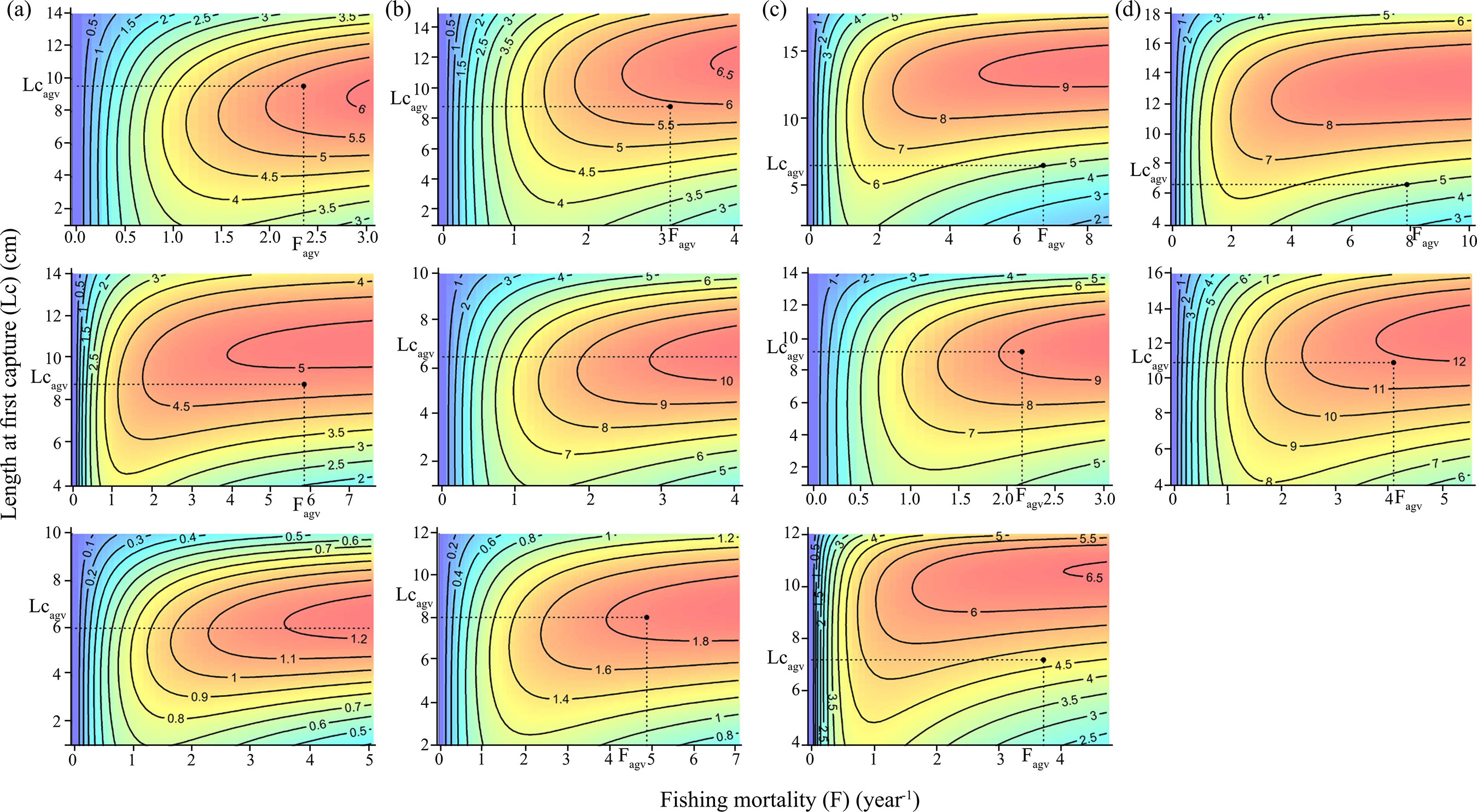
Across all stocks, the Y/R surfaces revealed well-defined regions of maximum yield associated with specific combinations of fishing mortality (F) and Lc. For F. subtilis, the North stock reached its highest Y/R (~6 g/recruit) at Lc ≈ 9 cm and F ≳ 2.8∙year-1, while in the Northeast the maximum (~6.5 g/recruit) occurred at Lc ≈ 12 cm and F ≳ 3.8∙year-1.
For F. brasiliensis in the Southeast, the peak Y/R (~9 g/recruit) was linked to Lc ≈ 13 cm and F ≳ 4.8∙year-1. F. paulensis exhibited similar patterns: in the Southeast, the highest Y/R (~8 g/recruit) occurred at Lc ≈ 12 cm and F ≳ 3.5∙year-1, while in the South (~5 g/recruit) it occurred near Lc ≈ 10 cm and F ≈ 4∙year-1. For L. schmitti, the maximum Y/Rs were observed at Lc ≈ 6.5 cm, F ≈ 2.9 year-1 in the North (~10 g/recruit); Lc ≈ 9 cm, F ≳ 1.9∙year-1 in the Northeast (~9 g/recruit); and Lc ≈ 12 cm, F ≳ 3.8∙year-1 in the Southeast (~12 g/recruit). For X. kroyeri, the North stock reached its maximum Y/R (~1.2 g/recruit) at Lc ≈ 6 cm and F ≈ 3.5∙year-1; the Northeast one (~1.8 g/recruit), at Lc ≈ 8 cm and F ≳ 3.9∙year-1; and in the Southeast, the highest Y/R (~6.5 g/recruit) occurred at Lc ≈ 10 cm and F ≳ 4.5∙year-1 (Fig. 1).
Yield-per-recruit isopleths for: (a) Farfantepenaeus subtilis, in the North, (b) Farfantepenaeus subtilis, in the Northeast, (c) Farfantepenaeus brasiliensis, in the Southeast, (d) Farfantepenaeus paulensis, in the Southeast, (e) Farfantepenaeus paulensis, in the South, (f) Litopenaeus schmitti, in the North, (g) Litopenaeus schmitti, in the Northeast, (h) Litopenaeus schmitti, in the Southeast, (i) Xiphopenaeus kroyeri, in the North, (j) Xiphopenaeus kroyeri, in the Northeast, and (k) Xiphopenaeus kroyeri, in the Southeast. The average observed exploitation, represented by the mean length at first capture (Lcavg, cm) and the mean fishing mortality (Favg, year-1), is shown as dotted reference lines.
Across regions and species, the Y/R analysis revealed marked contrasts between current exploitation patterns and potential yields (Fig. 1). For F. subtilis in the North (Fig. 1a), the average exploitation pattern produces 5.5 g/recruit, slightly below the maximum yield. However, the maintenance of the current Lc and increasing F to ~2.8∙year-1 would allow yields to reach 6 g/recruit, characterizing an underexploited condition. In the Northeast (Fig. 1b), F. subtilis shows high F and low Lc, resulting in reduced yields (5.5 g/recruit) and clear signs of growth overfishing (Table 2).
Summary of maximum yield-per-recruit (Y/Rmax, g/recruit) predicted from the isopleth surfaces and the yield generated under the observed exploitation pattern (Y/Robs, g/recruit) for each stock<tfn href="tfn01">*</tfn>.
For F. brasiliensis in the Southeast (Fig. 1c), the average pattern yields one of the lowest values observed (≈5 g/recruit), far from the potential maximum, driven by a combination of very high F and very low Lc, indicating severe growth overfishing. A similar pattern was observed for F. paulensis in the Southeast (Fig. 1d), where extreme F and low Lc also generate low yields (~5 g/recruit) and characterize growth overfishing. In the South (Fig. 1e), F. paulensis showed slightly lower yields (~4.5 g/recruit) than the maximum attainable, with overfishing still evident but less pronounced than in the Southeast.
For L. schmitti in the North (Fig. 1f), F estimates were unavailable, but the observed Lc combined with F ≈ 3 year-1 resulted in maximum yields (~10 g/recruit). In the Northeast (Fig. 1g), the fishery has generated yields compatible with the maximum predicted, indicating full exploitation without signs of yield loss. Conversely, in the Southeast (Fig. 1h), the high yield expected under optimal conditions is not achieved; the current exploitation level yields 11 g/recruit, only slightly below the maximum, indicating mild overfishing.
For X. kroyeri in the North (Fig. 1i), F information was lacking, but the average Lc would be compatible with maximum yields if combined with F > 3.5∙year-1. In the Northeast (Fig. 1j), the average exploitation pattern produces yields near the maximum predicted, characterizing a fully exploited stock without evident loss of yield. In contrast, X. kroyeri in the Southeast (Fig. 1k) generates only ~4.5 g/recruit, reflecting low yields and clear signs of growth overfishing.
Discussion
The availability of data remains a major challenge for many countries, especially for nations like Brazil, where political and economic issues limit the capacity to collect fisheries information (Musiello-Fernandes et al., 2017; Silva & Andrade, 2023; Zeller et al., 2016). Y/R analyses offer a practical alternative under low data availability, particularly for the data-poor shrimp fisheries in the country, as they can provide valuable management insights even with limited population-dynamic information (Beverton & Holt, 1957; Pikitch, 1987).
Shrimp fisheries along the Brazilian coast exhibit marked regional differences. In the North, the Amazon River supplies nutrient-rich suspended material that sustains productive estuarine artisanal fisheries, while industrial fleets operate offshore targeting F. subtilis (Aragão et al., 2015; Carvalho et al., 2015). In the Northeast, fisheries are predominantly artisanal, especially near the São Francisco River mouth, occurring in shallow waters (< 20 m); beach seines are used by non-motorized fishers, whereas motorized vessels employ double-rig trawls (Lopes et al., 2014; Silva et al., 2019). In the Southeast and South, industrial fleets exploit deeper areas targeting pink shrimps (F. paulensis and F. brasiliensis). In the South, artisanal fisheries also occur in the Patos Lagoon (Castilho et al., 2015; Eutrópio et al., 2013).
Estimating predictive yield per recruit across different combinations of Lc and fishing mortality (F) provides a simple basis for evaluating exploitation status and determining whether current fishing patterns approach optimal productivity. Clear regional contrasts emerged. In the North and Northeast, higher yields were generally associated with larger Lc values, often above the maturation length (Lc > L50), indicating that allowing shrimp to reproduce before capture enhances yield while keeping F at levels compatible with biological productivity. However, some stocks showed elevated fishing mortality, such as F. subtilis in the Northeast, resulting in growth overfishing. Similar high exploitation levels have been reported previously for this species in the region (Silva et al., 2015). In contrast, the industrial fishery for F. subtilis in the North did not show signs of growth overfishing under the average exploitation patterns used here. Other assessments have likewise suggested signs of recovery in this stock, with exploitation levels approaching, but not exceeding, biological limits (Aragão et al., 2015).
In the Southeast region, the exploitation patterns of several stocks revealed a persistent and concerning state of growth overfishing. The pink shrimp species F. brasiliensis and F. paulensis are particularly affected, as they have been harvested at very low Lc, well below their maturation size (Lc < L50). This results in substantial losses of somatic growth potential and limits the proportion of individuals that reach reproductive age.
Under the average exploitation patterns examined here, all these stocks require substantial increases in Lc, coupled with reductions in fishing mortality, to return to higher-yield regions of the Y/R surface. Notably, the fishing mortalities estimated for these species were the highest among all shrimp fisheries evaluated. Such elevated F values likely reflect decades of intense and largely uncontrolled fishing pressure, characterized by high extraction rates, growing fishing effort, and increases in fleet size, conditions long documented for these fisheries (D’Incao et al., 2002; MAPA, 2022; Santos, 2007).
Although most Lc values used in this study were derived from commercial fisheries and selectivity studies using commercial gear, some estimates originated from scientific surveys conducted over areas broader than the actual fishing grounds. This may introduce discrepancies between estimated Lc and the sizes effectively harvested by the fishery and should be considered when interpreting exploitation patterns. Importantly, the exploitation patterns (Lc and F) used here do not represent only present-day conditions but rather compile historical estimates. For F. subtilis, fishing mortality estimates span from the 1990s to the 2010s in the North, and from 2016 in the Northeast. For F. paulensis and F. brasiliensis in the Southeast and South, estimates range from the 1990s to the 2020s, consistently indicating increasing F through time. For X. kroyeri, most Lc and F values come from studies conducted mainly after the 2010s, with limited older information. For L. schmitti, Lc and F estimates were derived from studies from the 2010s in the Southeast and from more recent work (2019) in the Northeast (see Suppl. Mat. in https://github.com/silvamls/Shrimp-Yield-Per-Recruit). Therefore, the exploitation pattern adopted in this study combines older and more recent estimates (2010s–2020s) to derive average values, reflecting data availability for each species. Assuming exploitation patterns remained broadly comparable over time, these averages provide a practical approximation of expected yields for these fisheries.
The Y/R model is fundamentally a steady-state model, if fishing patterns have remained constant over long periods and that all individuals experience the same exploitation regime since recruitment (Sparre & Venema, 1998). Mortality is assumed to occur continuously following a knife-edge selectivity pattern, with abundance declining progressively from an initial cohort of recruits (Beverton & Holt, 1957). Although these methods rely on equilibrium assumptions such as constant recruitment and mortality rates, they remain valuable tools for exploring exploitation scenarios under data-limited conditions (Beverton & Holt, 1957; Rudd & Thorson, 2018; Sparre & Venema, 1998).
In this study, additional uncertainty arises from the compilation of life-history parameters derived from different sources, time periods, and methodologies, as well as from the assumption of regionally distinct stock units and the use of historical average exploitation patterns (F and Lc) that may not fully reflect current fishing conditions. Nevertheless, Y/R analyses provide robust reference points for management by identifying combinations of fishing mortality and size at first capture that maximize cohort yield. These reference patterns can inform management actions such as mesh-size regulation, effort control, vessel limitation, and seasonal closures (Melnychuk et al., 2021; Sparre & Venema, 1998; SUDEPE, 1983).
In Brazilian shrimp fisheries, the main management measure has been the enforcement of closed seasons aimed at protecting recruitment by allowing individuals to reach reproductive size or migrate from estuaries to offshore areas (MAPA, 2019; 2022; Musiello-Fernandes et al., 2017). In principle, this strategy reduces fishing mortality by limiting the capture of small individuals and preserving future yield potential. However, clear evidence of stock rebuilding remains limited, despite reported reductions in fishing effort, fleet size, and the adoption of more restrictive regulations in recent decades, particularly in the Southeast and South regions (D’Incao et al., 2002; MAPA, 2022; Musiello-Fernandes et al., 2017). Additional management tools include limited-entry systems, control of vessel numbers, and the establishment of no-trawl zones, especially in sensitive habitats such as mangroves (Aragão et al., 2015; MAPA, 2022). Gear-based measures, particularly the adjustment of minimum mesh sizes, can increase Lc and reduce growth overfishing, especially in estuarine areas with high concentrations of juveniles (Castilho et al., 2015; Eutrópio et al., 2013). The multispecific nature of trawl fisheries and the overlap of gear selectivity curves make mesh-size regulation particularly challenging: modifications intended to reduce the capture of smaller individuals of one species may inadvertently increase fishing pressure on larger or more valuable species (MAPA, 2022; Melnychuk et al., 2021; Musiello-Fernandes et al., 2017).
Based on the average exploitation patterns estimated in this study, the Southeast region appears to be the most affected. Despite the implementation of multiple regulatory measures, the observed exploitation pattern indicates losses in growth potential and persistent signs of overfishing. In contrast, the North and Northeast regions operate closer to maximum yield conditions, with no consistent evidence of severe overfishing, suggesting a lower immediate management urgency. Updated exploitation estimates are essential to properly evaluate these fisheries, particularly for assessing the effectiveness of existing management measures in the Southeast.
Conclusion
This study highlights clear regional differences in shrimp exploitation patterns along the Brazilian coast and their implications for sustainability. The North and Northeast regions generally operate closer to optimal yield conditions, with limited evidence of severe growth overfishing, whereas the Southeast faces critical challenges linked to the capture of immature individuals and elevated fishing mortality rates. In this region, effective management should prioritize increasing Lc and reducing fishing mortality. This research demonstrates the usefulness of data-limited approaches for fisheries assessment and emphasizes the need for updated evaluations and strengthened regulatory frameworks to support the long-term sustainability of Brazilian shrimp fisheries.
ACKNOWLEDGMENTS
Not applicable.
-
DECLARATION OF USE OF ARTIFICIAL INTELLIGENCE TOOLS
During the preparation of this manuscript, artificial intelligence (AI) tools based on OpenAI’s ChatGPT (GPT-5.3-mini) were used exclusively for language editing purposes, including grammar and English writing revision. These tools were not used for the development of the scientific content, data analysis, interpretation of results, or formulation of the study. All intellectual content, analyses, and conclusions presented in this manuscript were developed by the authors. The authors reviewed and edited all AI-assisted suggestions and take full responsibility for the content of the manuscript.
-
FUNDING
Conselho Nacional de Desenvolvimento Científico e TecnológicoGrant no.: 132646/2020-0Shrimp NE-N ProgramGrant no.: 445766/2015-8
DATA AVAILABILITY STATEMENT
The data that support the findings of this study are openly available in Shrimp-Yield-Per-Recruit repository at https://github.com/silvamls/Shrimp-Yield-Per-Recruit.
REFERENCES
-
Aragão, J. A. N., Cintra, I. H. A., & Silva, K. C. A. (2015). Pesca industrial do camarão-rosa na plataforma continental Amazônica: aspectos da dinâmica da população, avaliação do estoque e influência dos parâmetros ambientais. Acta Fisheries and Aquatic Resources, 3(1), 77-90. https://doi.org/10.2312/ActaFish.2015.3.1.77-90
» https://doi.org/10.2312/ActaFish.2015.3.1.77-90 -
Beacham, T. D., Wallace, C., MacConnachie, C., Jonsen, K., McIntosh, B., Candy, J. R., Devlin, R. H., & Withler, R. E. (2017). Population and individual identification of coho salmon in British Columbia through parentage-based tagging and genetic stock identification: an alternative to coded-wire tags. Canadian Journal of Fisheries and Aquatic Science, 74(9), 1391-1410. https://doi.org/10.1139/cjfas-2016-0452
» https://doi.org/10.1139/cjfas-2016-0452 -
Begg, G. A., Friedland, K. D., & Pearce, J. B. (1999). Stock identification and its role in stock assessment and fisheries management: an overview. Fisheries Research, 43(1-3), 1-8. https://doi.org/10.1016/S0165-7836(99)00062-4
» https://doi.org/10.1016/S0165-7836(99)00062-4 -
Berkson, J. E., & Thorson, J. T. (2015). The determination of data-poor catch limits in the United States: is there a better way? ICES Journal of Marine Science, 72(1), 237-242. https://doi.org/10.1093/icesjms/fsu085
» https://doi.org/10.1093/icesjms/fsu085 -
Beverton, R. J. H., & Holt, S. J. (1957). On the dynamics of exploited fish populations Chapman & Hall. https://doi.org/10.1007/978-94-011-2106-4
» https://doi.org/10.1007/978-94-011-2106-4 - Carvalho, A. S. S., Martinelli-Lemos, J. M., Nevis, A. B., & Isaac, V. (2015). Populational biology of three Penaeidae shrimps (Decapoda) in the Curuçá estuary on the northern coast of Brazil. Boletim do Instituto de Pesca, 41(4), 975-986.
-
Carvalho-Batista, A., Terossi, M., Zara, F. J., Mantelatto, F. L., & Costa, R. C. (2019). A multigene and morphological analysis expands the diversity of the seabob shrimp Xiphopenaeus Smith, 1869 (Decapoda: Penaeidae), with descriptions of two new species. Scientific Reports, 9, 15281. https://doi.org/10.1038/s41598-019-51484-3
» https://doi.org/10.1038/s41598-019-51484-3 -
Castilho, A. L., Bauer, R. T., Freire, A. M. F., Fransozo, V., Costa, R. C., Grabowski, R. C., & Fransozo, A. (2015). Lifespan and reproductive dynamics of the commercially important sea bob shrimp Xiphopenaeus kroyeri (Penaeoidea): Synthesis of a 5-year study. Journal of Crustacean Biology, 35(1), 30-40. https://doi.org/10.1163/1937240X-00002300
» https://doi.org/10.1163/1937240X-00002300 -
Cope, J. M., & Hamel, O. S. (2022). Upgrading from M version 0.2: An application-based method for practical estimation, evaluation and uncertainty characterization of natural mortality. Fisheries Research, 256, 106493. https://doi.org/10.1016/j.fishres.2022.106493
» https://doi.org/10.1016/j.fishres.2022.106493 - D’Incao, F., & Calazans, D. K. (1978). Relações biométricas do “camarão rosa” Penaeus paulensis Pérez-Farfante, 1967, na Lagoa dos Patos, RS, Brasil. Atlântica, 3, 57-66.
- D’Incao, F., Valentini, H., & Rodrigues, L. F. (2002). Avaliação da pesca de camarões nas regiões Sudeste e Sul do Brasil 1965–1999. Atlântica, 24(2), 103-116.
-
Eutrópio, F. J., Mariante, F. L. F., Ferreira Junior, P. D., & Krohling, W. (2013). Population parameters of the shrimp Xiphopenaeus kroyeri (Heller, 1862) (Crustacea, Penaeidae), caught by artisanal fisheries in Anchieta, Espírito Santo State. Acta Scientiarum Biological Sciences, 35(2), 141-147. https://doi.org/10.4025/actascibiolsci.v35i2.13408
» https://doi.org/10.4025/actascibiolsci.v35i2.13408 -
Food and Agricultural Organization (FAO) (2025). GLOBEFISH Quarterly Shrimp Analysis Retrieved from https://www.fao.org/in-action/globefish/home/globefish---quarterly-shrimp-analysis---may-2025/en
» https://www.fao.org/in-action/globefish/home/globefish---quarterly-shrimp-analysis---may-2025/en -
Freire, K. M. F., Rosa, L. C., Reis-Júnior, J., & Barreto, T. M. R. R. (2020). Understanding what is what in marine shrimp fisheries. Ocean and Coastal Research, 68, e20322. https://doi.org/10.1590/S2675-28242020068322
» https://doi.org/10.1590/S2675-28242020068322 -
Gallaway, B. J., Gazey, W. J., & Cole, J. G. (2017). An updated description of the benefits and consequences of red snapper shrimp trawl bycatch management actions in the Gulf of Mexico. North American Journal of Fisheries Management, 37(2), 414-419. https://doi.org/10.1080/02755947.2016.1271842
» https://doi.org/10.1080/02755947.2016.1271842 -
Gribble, N., & Dredge, M. (1994). Mixed species yield-per-recruit simulations of the effect of seasonal closure on a central Queensland coast prawn trawling ground. Canadian Journal of Fisheries and Aquatic Sciences, 51(5), 998-1011. https://doi.org/10.1139/f94-100
» https://doi.org/10.1139/f94-100 - Gulland, J. A., & Boerema, L. K. (1973). Scientific advice on catch levels. Fishery Bulletin, 71(2), 325-335.
-
Gusmão, J., Lazoski, C., & Solé-Cava, A. M. (2005). Population genetic structure of Brazilian shrimp species (Farfantepenaeus sp., F. brasiliensis, P. paulensis and Litopenaeus schmitti: Decapoda: Penaeidae). Genetics and Molecular Biology, 28(1), 165-171. https://doi.org/10.1590/S1415-47572005000100029
» https://doi.org/10.1590/S1415-47572005000100029 - Gusmão, J., Piergiorge, R. M., & Tavares, C. (2013). The contribution of genetics in the study of the sea-bob shrimp populations from the Brazilian coast. Boletim do Instituto de Pesca, 39(3), 323-338.
- Holthuis, L. B. (1980). FAO species catalogue (v. 1) FAO Fisheries Synopsis No. 125. FAO.
-
Kerr, L. A., Hintzen, N. T., Cadrin, S. X., Clausen, L. W., Dickey-Collas, M., Goethel, D. R., Hatfield, E. M. C., Kritzer, J. P., & Nash, R. D. M. (2017). Lessons learned from practical approaches to reconcile mismatches between biological population structure and stock units of marine fish. ICES Journal of Marine Science, 74(6), 1708-1722. https://doi.org/10.1093/icesjms/fsw188
» https://doi.org/10.1093/icesjms/fsw188 -
Leite Jr., J. R. N., & Petrere Jr., J. R. M. (2006). Growth and mortalities of the pink shrimp Farfantepenaeus brasiliensis Latreille, 1970 and F. paulensis Pérez-Farfante 1967 in Southeast Brazil. Brazilian Journal of Biology, 66(2a), 523-536. https://doi.org/10.1590/S1519-69842006000300019
» https://doi.org/10.1590/S1519-69842006000300019 -
Lopes, D. F. C., Silva, E. F. B., Peixoto, S. R. M., & Fréedou, F. L. (2014). Population biology of seabob shrimp Xiphopenaeus kroyeri (Heller, 1862) captured on the south coast of Pernambuco state, Northeastern Brazil. Brazilian Journal of Oceanography, 62(4), 331-340. https://doi.org/10.1590/S1679-87592014079706204
» https://doi.org/10.1590/S1679-87592014079706204 - Luvesuto, E. (2006). Análise genética e morfométrica da estrutura populacional do camarão branco Litopenaeus schmitti (Decapoda, Crustacea) na costa do Rio Grande do Norte, Brasil: Uma abordagem em fina escala (Tese de doutorado, Universidade Federal de São Carlos, Brasil).
-
Martell, S., & Froese, R. (2013). A simple method for estimating MSY from catch and resilience. Fish and Fisheries, 14(4), 504-514. https://doi.org/10.1111/j.1467-2979.2012.00485.x
» https://doi.org/10.1111/j.1467-2979.2012.00485.x -
Melnychuk, M. C., Kurota, H., Mace, P. M., Pons, M., Minto, C., Chato Osio, G., Jensen, O. P., de Moor, C. L., Parma, A. M., Little, L. R., Hively, D., Ashbrook, C. E., Baker, N., Amoroso, R. O., Branch, T. A., Anderson, C. M., Szuwalski, C. S., Baum, J. K., McClanahan, T. R., ... Hilborn, R. (2021). Identifying management actions that promote sustainable fisheries. Nature Sustainability, 4, 440-449. https://doi.org/10.1038/s41893-020-00668-1
» https://doi.org/10.1038/s41893-020-00668-1 -
Mildenberger, T. K., Berg, C. W., Kokkalis, A., Hordyk, A. R., Wetzel, C., Jacobsen, N. S., Punt, A. E., & Nielsen, J. R. (2022). Implementing the precautionary approach into fisheries management: Biomass reference points and uncertainty buffers. Fish and Fisheries, 23, 73-92. https://doi.org/10.1111/faf.12599
» https://doi.org/10.1111/faf.12599 -
Mildenberger, T. K., Taylor, M. H., & Wolff, M. (2017). TropFishR: an R package for fisheries analysis with length-frequency data. Methods in Ecology and Evolution, 8(11), 1520-1527. https://doi.org/10.1111/2041-210X.12791
» https://doi.org/10.1111/2041-210X.12791 - Ministério da Agricultura, Pecuária e Abastecimento (MAPA) (2019). Instrução Normativa n. 70, de 16 de dezembro de 2019 MAPA.
-
Ministério da Agricultura, Pecuária e Abastecimento (MAPA) (2022). Portaria SAP/MAPA n. 656, de 30 de março de 2022 MAPA. Retrieved from www.gov.br/ibama/pt-br/assuntos/biodiversidade/biodiversidade-aquatica/arquivos/defesos-marinho/2025-01-14_camaroes_portaria_sap_mapa_n-o-656_2002.pdf
» www.gov.br/ibama/pt-br/assuntos/biodiversidade/biodiversidade-aquatica/arquivos/defesos-marinho/2025-01-14_camaroes_portaria_sap_mapa_n-o-656_2002.pdf -
Musiello-Fernandes, J., Zappes, C. A., & Hostim-Silva, M. (2017). Small-scale shrimp fisheries on the Brazilian coast: Stakeholders perceptions of the closed season and integrated management. Ocean & Coastal Management, 148, 89-96. https://doi.org/10.1016/j.ocecoaman.2017.07.018
» https://doi.org/10.1016/j.ocecoaman.2017.07.018 -
NOAA Fisheries. 2019. Annual commercial landing statistics Office of Science and Technology. Retrieved from https://www.fisheries.noaa.gov/foss/f?p=215:200:3458588479033
» https://www.fisheries.noaa.gov/foss/f?p=215:200:3458588479033 -
Pauly, D., Christensen, V., Guénette, S., Pitcher, T. J., Sumaila, U. R., Walters, C. J., Watson, R., & Zeller, D. (2002). Towards sustainability in world fisheries. Nature, 418, 689-695. https://doi.org/10.1038/nature01017
» https://doi.org/10.1038/nature01017 -
Pavanelli, C. A. M., Mossolin, E. C., & Mantelatto, F. L. (2010). Maternal investment in egg production: environmental and population-specific effects on offspring performance in the snapping shrimp Alpheus nuttingi (Schmitt, 1924) (Decapoda, Alpheidae). Animal Biology, 60, 237-247. https://doi.org/10.1163/157075610X516466
» https://doi.org/10.1163/157075610X516466 - Pérez-Farfante, I. (1978). Western Atlantic shrimps of the genus Penaeus Fishery Bulletin, 76(3), 461-591.
- Pérez-Farfante, I., & Kensley, B. (1997). Penaeoid and Sergestoid shrimps and prawns of the world Mémoires du Muséum National d’Histoire Naturelle.
-
Pescinelli, R. A., Davanso, T. M., & Costa, R. C. (2017). Social monogamy and egg production in the snapping shrimp Alpheus brasileiro (Caridea: Alpheidae) from the southeastern coast of Brazil. Journal of the Marine Biological Association of the United Kingdom, 97(7), 1519-1526. https://doi.org/10.1017/S0025315416000904
» https://doi.org/10.1017/S0025315416000904 -
Pickens, B. A., Carroll, R., & Taylor, J. C. (2021). Predicting the distribution of penaeid shrimp reveals linkages between estuarine and offshore marine habitats. Estuaries and Coasts, 44, 2265-2278. https://doi.org/10.1007/s12237-021-00924-3
» https://doi.org/10.1007/s12237-021-00924-3 -
Pikitch, E. (1987). Use of a mixed-species yield-per-recruit model to explore the consequences of various management policies for the Oregon flatfish fishery. Canadian Journal of Fisheries and Aquatic Sciences, 44(Suppl. 2), s349-s359. https://doi.org/10.1139/f87-336
» https://doi.org/10.1139/f87-336 -
R Core Team (2022). R: A Language and Environment for Statistical Computing, version 4.2.0 R Foundation for Statistical Computing. Retrieved from https://www.R-project.org/
» https://www.R-project.org/ - Ricker, W. E. (1975). Computation and interpretation of biological statistics of fish populations Fisheries Research Board of Canada.
-
Rudd, M. B., & Thorson, J. T. (2018). Accounting for variable recruitment and fishing mortality in length-based stock assessments for data-limited fisheries. Canadian Journal of Fisheries and Aquatic Sciences, 75(7), 1019-1035. https://doi.org/10.1139/cjfas-2017-0143
» https://doi.org/10.1139/cjfas-2017-0143 - Santos, J. L. (2007). Pesca e estrutura populacional do camarão-branco Litopenaeus schmitti (Burkenroad, 1936) na região marinha e estuarina da Baixada Santista, São Paulo, Brasil (PhD thesis, Instituto de Pesca, São Paulo).
-
Secor, D. (2015). Migration ecology of marine fishes Johns Hopkins University. https://doi.org/10.1353/book.39942
» https://doi.org/10.1353/book.39942 -
Silva, C. N. S., Broadhurst, M. K., Medeiros, R. P., & Dias, J. H. (2013). Resolving environmental issues in the southern Brazilian artisanal penaeid-trawl fishery through adaptive co-management. Marine Policy, 42, 133-141. https://doi.org/10.1016/j.marpol.2013.02.002
» https://doi.org/10.1016/j.marpol.2013.02.002 -
Silva, E. F., Calazans, N., Nolé, L., Castelo Branco, T., Soares, R., Pessoa Guerra, M. M., Frédou, F. L., & Peixoto, S. (2016). Reproductive dynamics of the southern pink shrimp Farfantepenaeus subtilis in northeastern Brazil. Aquatic Biology, 25, 29-35. https://doi.org/10.3354/ab00653
» https://doi.org/10.3354/ab00653 -
Silva, E. F., Calazans, N., Nolé, L., Soares, R., Frédou, F. L., & Peixoto, S. (2019). Population dynamics of the white shrimp Litopenaeus schmitti (Burkenroad, 1936) on the southern coast of Pernambuco, north-eastern Brazil. Journal of the Marine Biological Association of the United Kingdom, 99(2), 429-435. https://doi.org/10.1017/S0025315418000322
» https://doi.org/10.1017/S0025315418000322 -
Silva, E. F., Calazans, N., Nolé, L., Viana, A., Soares, R., Peixoto, S., & Frédou, F. L. (2015). Population dynamics of the pink shrimp Farfantepenaeus subtilis (Pérez-Farfante, 1967) in Northeastern Brazil. Jour. Crus. Bio., 35(2), 132-139. https://doi.org/10.1163/1937240X-00002325
» https://doi.org/10.1163/1937240X-00002325 -
Silva, M. L. S., & Andrade, H. A. (2023). Reconstruction of shrimp catches in Brazil based on generalized linear models. Boletim do Instituto de Pesca, 49, e747. https://doi.org/10.20950/1678-2305/bip.2023.49.e747
» https://doi.org/10.20950/1678-2305/bip.2023.49.e747 - Sparre, P., & Venema, S. C. (1998). Introduction to tropical fish stock assessment, part i: manual FAO Fisheries Technical Paper, 1. FAO.
- Superintendência do Desenvolvimento da Pesca e Programa de Pesquisa (SUDEPE) (1983). Relatório da quarta reunião do Grupo Permanente de Estudos (GPE) sobre camarões SUDEPE.
-
Temming, A., & Hufnagl, M. (2015). Decreasing predation levels and increasing landings challenge the paradigm of non-management of North Sea brown shrimp (Crangon crangon). ICES Journal of Marine Science, 72(3), 804-823. https://doi.org/10.1093/icesjms/fsu194
» https://doi.org/10.1093/icesjms/fsu194 -
Teodoro, S. S. A., Terossi, M., Costa, R. C. & Mantelatto, F. L. (2015). Genetic homogeneity in the commercial pink shrimp Farfantepenaeus paulensis revealed by COI barcoding gene. Estuarine, Coastal and Shelf Science, 166(Part A), 124-130. https://doi.org/10.1016/j.ecss.2015.07.009
» https://doi.org/10.1016/j.ecss.2015.07.009 -
United Nations (1982). United Nations Convention on the Law of the Sea United Nations. Retrieved from http://www.un.org/Depts/los/convention_agreements/texts/unclos/unclos_e.pdf
» http://www.un.org/Depts/los/convention_agreements/texts/unclos/unclos_e.pdf -
Warahma, M., Nadiarti, N., Umar, M. T., La Nafie, Y. A., Priosambodo, D., Suwarni, & Parawansa, B. S. (2021). Population dynamics of mantis shrimp (Gonodactylus chiragra Fabricius, 1781) in Batukalasi waters, South Sulawesi, Indonesia. IOP Conference Series: Earth and Environmental Science, 763, 12038. https://doi.org/10.1088/1755-1315/763/1/012038
» https://doi.org/10.1088/1755-1315/763/1/012038 -
Watson, R. A., Cheung, W. W. L., Anticamara, J. A., Sumaila, R. U., Zeller, D., & Pauly, D. (2013). Global marine yield halved as fishing intensity redoubles. Fish and Fisheries, 14(4), 493-503. https://doi.org/10.1111/j.1467-2979.2012.00483.x
» https://doi.org/10.1111/j.1467-2979.2012.00483.x -
Whitfield, A. K. (2017). The role of seagrass meadows, mangrove forests, salt marshes and reed beds as nursery areas and food sources for fishes in estuaries. Reviews in Fish Biology and Fisheries, 27, 75-110. https://doi.org/10.1007/s11160-016-9454-x
» https://doi.org/10.1007/s11160-016-9454-x -
Zeller, D., Palomares, M. L. D., Tavakolie, A., Ang, M., Belhabib, D., Cheung, W. W. L., Lam, V. W. Y., Sy, E., Tsui, G., Zylich, K., & Pauly, D. (2016). Still catching attention: Sea Around Us reconstructed global catch data, their spatial expression and public accessibility. Marine Policy, 70, 145-152. https://doi.org/10.1016/j.marpol.2016.04.046
» https://doi.org/10.1016/j.marpol.2016.04.046 - Zenger Jr., J. R. H. H., & Agnes, J. L. (1977). Distribuição do camarão-rosa Penaeus brasiliensis e Penaeus paulensis ao longo da costa sudeste e sul do Brasil Série Documentos Técnicos, n. 21.
Edited by
-
Section editor:
Luis Felipe Duarte https://orcid.org/0000-0002-4658-4684