 From milk to waterways: a scientometric analysis of dairy wastewater treatment
Abstract
The dairy industry plays a crucial economic role worldwide but also contributes significantly to environmental pollution through the discharge of effluents. Effective management and treatment of these effluents are essential to reduce their environmental impact, prompting ongoing research into improved treatment methods. In this review, we analyze and summarize current trends in dairy wastewatertreatment technologies using a scientometric approach, with a focus on identifying prevalent treatment methods and emerging research directions. A comprehensive literature search was performed in the Web of Science (WoS) database using the keywords “dairy effluent” and “dairy wastewater” for publications spanning from 1945 to 2021. This initial search yielded 1,258 documents, which were manually refined to 1,191 relevant papers. The scientometric analysis, conducted using CiteSpace software and Microsoft Excel, categorized the publications by language, publication year, citation frequency, country, knowledge areas, keywords, and treatment methods (physical, chemical, and biological). The results indicated a significant growth in research on dairy effluent treatment, peaking in 2021 and projected to continue expanding through 2030. English emerged as the dominant publication language, and India was identified as the leading contributor. The focus of the research was predominantly on effluent treatment methods, with biological treatments accounting for 70% of the studies. Notable biological methods included bioreactor-based treatments, microalgae or aquatic plant cultivation, anaerobic digestion, microbial fuel cells, enzymatic processes, and techniques involving activated sludge and biofilters. These findings highlight critical trends in dairy effluent treatment and underscore the dominance and efficacy of biological methods. The insights provided can guide future research directions and support technological advancements aimed at sustainable and environmentally friendly effluent management practices.
Keywords:
dairy effluent; systematic review; effluent treatment
Resumo
A indústria de laticínios desempenha um papel econômico crucial em todo o mundo, mas também contribui significativamente para a poluição ambiental por meio do descarte de efluentes. A gestão e o tratamento eficaz desses efluentes são essenciais para reduzir seu impacto ambiental, o que tem impulsionado pesquisas contínuas para o aprimoramento dos métodos de tratamento. Nesta revisão, analisamos e resumimos as tendências atuais nas tecnologias de tratamento de efluentes de laticínios por meio de uma abordagem cientométrica, com foco na identificação dos métodos de tratamento predominantes e das direções emergentes de pesquisa. Foi realizada uma busca abrangente na base de dados Web of Science (WoS) utilizando os termos “dairy effluent” e “dairy wastewater” para publicações no período de 1945 a 2021. A busca inicial resultou em 1.258 documentos, os quais foram refinados manualmente para 1.191 trabalhos relevantes. A análise cientométrica, conduzida com o uso do software CiteSpace e do Microsoft Excel, categorizou as publicações por idioma, ano de publicação, frequência de citações, país, áreas do conhecimento, palavras-chave e métodos de tratamento (físico, químico e biológico). Os resultados indicaram um crescimento significativo na pesquisa sobre o tratamento de efluentes de laticínios, com um pico em 2021 e expansão projetada até 2030. O inglês se destacou como o idioma predominante nas publicações, e a Índia foi identificada como a principal contribuinte. O foco das pesquisas concentrou-se predominantemente nos métodos de tratamento de efluentes, com os tratamentos biológicos representando 70% dos estudos. Entre os métodos biológicos, destacaram-se os tratamentos baseados em biorreatores, cultivo de microalgas ou plantas aquáticas, digestão anaeróbia, células de combustível microbiano, processos enzimáticos e técnicas envolvendo lodos ativados e biofiltros. Esses achados ressaltam tendências críticas no tratamento de efluentes de laticínios e evidenciam a dominância e eficácia dos métodos biológicos. As percepções apresentadas podem orientar futuras direções de pesquisa e apoiar avanços tecnológicos voltados para práticas de gestão de efluentes sustentáveis e ambientalmente responsáveis.
Palavras-chave:
efluente de laticínio; revisão sistemática; tratamento de efluentes
1. Introduction
Dairy industries produce a wide variety of foods, generating effluents of diverse and complex compositions at the end of the production process. It contains everything from remains of milk and derivatives to chemicals used in the cleaning processes of machines, equipment, and the industry itself. These factors give this effluent a high organic load and polluting potential (Alalam et al., 2022; Carvalho et al., 2013).
Most small and medium-sized factories do not have well-established effluent treatment processes, and these wastes are disposed of in watercourses. If released without proper treatment, dairy effluents cause changes in water bodies and significant impacts on the ecosystem, such as eutrophication, the proliferation of microorganisms, foul odors, and the formation of toxic compounds (Elabras Veiga et al., 2022; Garg et al., 2020). Therefore, many methods are applied to reduce the polluting load of dairy effluents. Effluent treatments consist of a series of processes that eliminate contaminants. To select the appropriate treatment, it is necessary to detail the characteristics of the effluent to define the parameters and, from them, focus on what should or should not be removed (Azzolini and Fabro, 2013).
Given this, Effluent Treatment Stations generally use pre-treatment and primary treatment. Pretreatments apply physical processes, such as screening, to remove coarse solids. Primary treatments aim to remove suspended solids and floating matter using coagulation/flocculation, decantation, and flotation techniques (Deepa et al., 2022; Muniz et al., 2022). While the secondary ones are based on biological processes for removing organic matter, some examples are stabilization ponds, activated sludge, etc. (Kaur, 2021; Vasina and Basamykina, 2022). Finally, tertiary treatments focus on eliminating specific pollutants; they do not apply in all cases; they are advanced treatments that depend on the degree of water purification you want to achieve (Almeida Medeiros et al., 2025; Nunes et al., 2021).
Beyond regulatory compliance, properly treating dairy effluents before discharge into water bodies yields multidimensional benefits (Dineshkumar et al., 2025). Environmentally, it preserves aquatic biodiversity, maintains the self-purification capacity of rivers and lakes, and prevents soil and groundwater degradation in surrounding areas (Ahmad et al., 2019a; Trujillo-García et al., 2026; Ulery et al., 2004). Socially, it safeguards public health by reducing waterborne disease risks (Todd, 2024) and ensures that downstream communities retain access to safe water for consumption and agriculture (Boguniewicz-Zablocka et al., 2019). Economically, treated effluents can be repurposed for irrigation or industrial reuse (Ahmad et al., 2019b), and the biogas (Cruz et al., 2019) generated during biological treatment stages can serve as a recoverable energy source, contributing to reduced operational costs and to circular economy principles within the dairy industry.
The treatment of dairy effluents is also directly aligned with the United Nations 2030 Agenda for Sustainable Development. Responsible management of these wastewaters contributes to SDG 6 (Clean Water and Sanitation), by protecting freshwater resources and promoting adequate wastewater treatment (Stasinakis et al., 2022); SDG 3 (Good Health and Well-being), by reducing pollution-related health risks (Khanam et al., 2022); SDG 12 (Responsible Consumption and Production), by encouraging industries to minimize waste and recover resources (Mpongwana et al., 2026); and SDG 15 (Life on Land), by preventing the contamination of terrestrial ecosystems adjacent to discharge points (Raghunath et al., 2016). Integrating these goals into the planning and evaluation of effluent treatment systems reinforces that environmental engineering solutions are inseparable from broader sustainability commitments.
Despite the growing volume of research, existing reviews of dairy effluent treatment have been predominantly narrative in scope, typically synthesizing selected studies without quantitative mapping of the field’s structure or temporal dynamics (Joshiba et al., 2019; Karolinczak et al., 2021; Ramsuroop et al., 2024). No prior study has simultaneously applied citation burst detection, country collaboration network analysis, and trend projection to characterize the intellectual evolution of this research domain. This combination of methods allows for the identification of emerging research fronts, dominant technological paradigms, and geographic knowledge hubs in ways that conventional narrative reviews cannot provide.
Considering the importance of this topic and the variety of treatments that can be applied to dairy effluents, Scientometrics is a tool that can be used to relate the different studies on the subject. In this sense, this study presents a scientometric review of dairy effluents, describing the years and countries with the most publications and citations and the areas of knowledge. Also, an analysis of the principal treatments applied to dairy effluents, categorized according to the principle used, works that use different processes, individual treatments, or a combination of two or more to reduce the polluting load of this effluent.
2. Methods
A bibliometric search was conducted in the Web of Science (WoS) Core Collection database. The search string was applied to all fields (including topic, abstract, title and keywords) using the following expression: ("dairy effluent*" OR "dairy wastewater*"), combining terms with Boolean OR to maximize retrieval of relevant records. The search was restricted to the period from 1945 to 2021, with no language restriction, and encompassed five document types: Article, Conference Article, Review Article, Early Access, and Data Paper. Data were retrieved in mid-2022.
The Web of Science Core Collection was selected as the data source because it is one of the most comprehensive multidisciplinary citation databases available, indexing journals across the natural sciences, engineering, and social sciences with rigorous quality controls. Compared to alternative databases such as Scopus or Google Scholar, WoS provides superior coverage of high-impact journals in the environmental and biological sciences and offers standardized metadata fields that facilitate reproducible bibliometric analyses (Pranckutė, 2021). Although no single database achieves complete coverage of the scientific literature, WoS represents the most widely adopted source for scientometric research in this domain.
The search terms “dairy effluent*” and “dairy wastewater*” were selected because they represent the two most widely and consistently used designations for this type of industrial effluent in the peer-reviewed literature. Alternative terms such as “milk effluent,” “dairy industry wastewater,” or “cheese whey effluent” were not included in the primary search string because preliminary searches indicated that documents using only these terms without co-occurring use of the primary terms were predominantly of a different scope (e.g., focused on specific dairy byproducts rather than whole-plant effluent treatment), which would have reduced the thematic consistency of the corpus. The wildcard operator (*) was applied to capture plurals and variant endings.
The initial search returned 1,258 documents. Duplicate records were removed manually using the title name and DOI. Subsequently, two reviewers manually screened the titles and abstracts to exclude records that did not address dairy effluents as the primary subject. Documents were excluded if they: (i) used dairy-related terms only incidentally, (ii) focused on other types of agro-industrial effluents without specifically addressing dairy streams, or (iii) lacked sufficient methodological information to allow classification. This process excluded 67 records, resulting in a final corpus of 1,191 documents (Figure 1).

Bibliometric analyses were performed using CiteSpace (v.1.6.1-R3) and Microsoft Excel. CiteSpace was run with default configuration parameters, including time slicing, node type selection, pruning algorithm, and threshold criteria. Citation burst detection followed the algorithm described by Kleinberg (2003), identifying terms or countries with statistically significant increases in citation frequency over time. Documents were further manually classified by publication language, year, country of the corresponding author, Web of Science subject category, and keywords.
A secondary manual screening was applied to identify studies that employed effluent treatment methods. These studies were classified by treatment principle (physical, chemical, or biological) and subsequently grouped by specific treatment type. The projection of publications and citations from 2022 to 2030 was performed using the FORECAST.LINEAR function in Microsoft Excel, which applies ordinary least squares (OLS) linear regression to estimate future values based on the historical trend observed in the annual data from 1975 to 2021. Although publication growth in bibliometric datasets often follows an exponential trajectory, the linear model provided an adequate fit for the observed period (R2 = 0.911) and was adopted for its interpretive simplicity. Projected values represent the expected continuation of the historical trend, assuming a constant rate of growth.
3. Results
Data referring to the 1191 papers resulting from the survey were analyzed regarding the type of document, language, publications, and citations by year, countries, areas of knowledge, keywords, and number of citations. In addition, the types of treatments applied to the dairy effluent in each work were classified manually. Of the five types of classified documents (articles, conference articles, review articles, early access, and data articles), most are articles, representing 91.18%. The language with the most publications was English, with 97.4%.
3.1. Number of publications and citations per year
Figure 2 shows the number of publications on dairy effluents per year from 1975 (the year of the first publication referring to the surveyed data) until 2021; it is noted that the number of published works has increased since the 90s. Publications were observed in 2020 and 2021 (101 and 125, respectively). Furthermore, Figure 2 shows that the number of publications related to the treatment of effluents from dairy industries increased significantly from 1998 onwards, oscillating over a few years.

Temporal distribution of publications and citations from 1975 to 2022 and projection for subsequent years.
The year 2021 marked the most significant number of publications and citations within the dataset, which, when combined with the growth seen between 2018 and 2020, favors the estimate of continuous growth in subsequent years.
3.2. Number of publications by country
The publications related to dairy effluent were globally distributed in 86 different countries. The Asian continent contributed the most to the dataset, with more than 37% of the publications. In Figure 3, we have the global distribution of the published studies on dairy effluent.
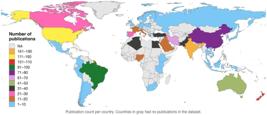
India has the highest number of publications (183), followed by the United States with 160 papers, New Zealand with 106, and Brazil with 94 publications. Additionally, the number of publications by country in Figure 4 shows the years with the highest citation peaks in 6 countries.

Countries with citation bursts within the dataset (1977-2021). The red lines show the duration of the burst.
The highest and first peak of citations was observed in the United States between 1991 and 2010 (strength = 13.28). New Zealand had the second most significant burst (strength = 12.79) from 1998 to 2008. Europe showed a large burst, with some of the newest citations within the dataset (1998-2018), while Poland showed a burst from 2017 to 2018.
Figure 5 shows the country collaboration network derived from CiteSpace analysis (n = 81 countries, e = 212 co-authorship links, density = 0.0654). The network has a modularity Q of 0.4027 and a weighted mean silhouette of 0.7769, indicating moderately well-defined collaborative clusters. CiteSpace identified six thematic clusters based on the predominant Web of Science subject categories of each country’s publication output. Cluster #0 (Agriculture, Multidisciplinary) groups countries with a strong tradition of land-applied effluent management, including New Zealand, Brazil, Spain, Ireland, Italy, Australia, and England. Cluster #1 (Microbiology) encompasses India, Iran, South Korea, and Canada, reflecting intensive biological treatment research. Cluster #2 (Chemistry, Multidisciplinary) includes China, Hungary, and Egypt, consistent with their focus on physicochemical and membrane-based approaches. Cluster #3 (Entomology) groups the USA, Turkey, and Poland. Cluster #4 (Energy & Fuels) includes France and Portugal, aligned with their research emphasis on anaerobic digestion and biogas recovery. Cluster #5 (Green & Sustainable Science & Technology) captures the remaining nodes oriented toward emerging circular economy approaches. Betweenness centrality analysis reveals that China (0.433) and the USA (0.384) function as the principal bridges across clusters, connecting otherwise separate research communities. The USA also holds the highest degree centrality (28 connections), confirming its role as the primary global collaborator, while India leads in absolute publication output (183 papers).

3.3. Keyword analysis
In addition to being essential for indexing research articles in databases, keywords reflect the theme of research publications. Thus, mapping all keywords within a set of publications can provide information on researchers' main research areas in each field. Figure 6 shows the most representative keywords among the 1191 publications on dairy effluent, classifying them according to the frequency with which they appear, and presents centrality data.

The keyword with the highest frequency and one of the highest centralities is "dairy wastewater" term, followed by "wastewater." The keyword performance appears in third place in terms of frequency and centrality, given that many studies use this term when evaluating the performance of treatments applied to dairy effluents. Next appears the term removal, which is related to removing contaminants from dairy effluents, and nutrient removal, such as nitrogen, the second keyword with the highest centrality.
Figure 7, in turn, provides data regarding the highest peaks in keyword citations. The highest peak observed was for the term constructed wetlands, between the years 1997 to 2013. The term dairy effluent appears to have the second highest peak of citations, which is related to this being one of the search terms in the scientometric research and the keyword wastewater. Other keywords that appear with considerable citation peaks are the terms "digestion," "nitrogen," and "activated sludge," which have been previously discussed in terms of how they are related to dairy effluents. Figure 7 shows some separation processes used in the treatment of dairy effluents that are among the keywords with the highest citation peaks, such as reverse osmosis, nanofiltration, ultrafiltration, and filtration.

3.4. Most relevant publications
Table 1 presents data related to the publications considered the most relevant in the research, considering the number of citations as the selection criterion. The titles of each work, authors, journal in which they were published, publication year, and journal's impact factor (IF) are shown.
The primary work, with 535 citations, was published in 2006 in the journal "Science of The Total Environment," with an impact factor of 10.75. The second most cited work was published in 2001 in the journal "Separation and Purification Technology," with an impact factor of 9.13. It addresses membrane fouling occurring in membrane bioreactors treating synthetic dairy effluent, with fouling being the primary limitation for developing this process.
The third work on the list was published in 2013 in the journal "Science of the Total Environment," with an impact factor of 10.75. It addresses the characterization and treatment of cheese whey wastewater. The other studies in Table 1 also discuss treatments applied to dairy effluents and can be easily found in the WoS database. From the cited works, it was possible to observe the various studies related to this type of effluent and its significance. These studies discuss the impacts that can arise from untreated dairy effluents, and they provide alternatives, often aiming to reduce the costs associated with treatment as well as enhance ease of application.
3.5. Publications by categories
The 1191 works resulting from the research were manually classified into six categories. Table 2 shows these categories, and the percentage of works included in each one. The largest group (Treatment) represents 70.95% (845 documents), which involved some form of treatment for dairy effluent, including biological and physicochemical. The second largest group, accounting for 14.61% (174), undertook treatment or some form of application for Agricultural Dairy Effluent (ADE), which is not the same as Dairy Effluent (DE). Since the present study focuses on works related to dairy industry effluents, where milk processing occurs, works concerning ADE were separated; however, they were not excluded from the research. ADE results from the washing milking parlors and can contain feces, urine, soil, feed, milk, and water.
The third group comprises works that obtained some kind of product from dairy effluent, totaling 72 articles (6.05%). The fourth group encompasses studies that characterized dairy effluent and works that assessed the environmental impacts caused by dairy effluents. There are 36 works in this group, which accounts for 3.02% of the total. The fifth group, in turn, focuses on review studies concerning dairy effluents, totaling 31 works, which correspond to 2.60% of the results. The sixth group consists of works that carried out treatment or some form of application for both whey and cheese whey, totaling 28 works (2.35%). Finally, only five works could not be categorized due to a lack of access to the abstract or full paper. These are older studies, dating back to the years 1975, 1976, 1984, and 1993, which may explain the need for more access to their content.
3.6. Types of treatment
The studies were classified in two different types of treatment: physicochemical and biological, with the second representing 70% of the dataset. Within the biological treatments, 8 different processes were found in the publications, as shown in Table 3.
Among the types of biological treatments found in Graph 3, 42% correspond to the use of Bioreactors, including the evaluation of performance, kinetics, modeling, and hydrodynamic analysis of these reactors for application in dairy effluents. Bioreactors are vessels where biological reactions involving microorganisms, enzymes, or living cells take place.
The second largest group comprises articles on the use of dairy effluents as a medium for cultivating microalgae or aquatic plants, totaling 138 works, corresponding to 23%. Another type of treatment evident from Table 3 is anaerobic digestion, accounting for 13% of the publications. A fourth group of treatments encompasses treatments using Microbial Fuel Cells (MFCs), with 49 studies (8%) representing the application of a sustainable and promising technology capable of converting the chemical energy present in wastewater into clean electrical energy, resulting in simultaneous wastewater bioremediation.
A total of 29 works employed enzymes for effluent treatment, accounting for 5% of the results. Considering that dairy effluent contains a significant amount of fat in its composition, treatments involving enzymes can facilitate its degradation. From the scientometric research, 4% of the works mention the use of the activated sludge process, including sludge characterization and operating conditions, denitrification potential, complete carbon source rates, and the utilization of activated sludge microbial isolates. The seventh group comprises 18 (3% of the results) articles that used Biofilters for dairy effluent treatment. Regarding biological processes for odor treatment, biofilters demonstrate high efficiency. Lastly, in the smallest category, 14 studies conducted microorganism cultivation from dairy effluents, accounting for 2% of the results.
4. Discussion
This dataset encompassed more than a thousand publications related with dairy effluents in the whole globe, with almost 98% of the studies published in English. This fact occurs not only because this language is considered a global language but also because the language in which an article is published can be considered an essential aspect in choosing the work to be cited by a given author. Therefore, publishing in English increases the chances of being awarded; it is also convenient that science can communicate through a single language, sharing knowledge and allowing researchers to cooperate through their research (Di Bitetti and Ferreras, 2017).
Even with some fluctuations, the dataset showed an exponential growth of publications and citations, especially in more recent years. These numbers represent the increased concern with waste management and new technologies that can minimize their environmental impacts; many methods have been studied to become increasingly efficient (Adesra et al., 2021; Stasinakis et al., 2022). In 1848 attention was turned to sewage treatment after a cholera outbreak in England led to about 25,000 fatalities. Released untreated sewage into water bodies led to large-scale water pollution because the rivers were short, and population growth was accelerating. Since 1950, great technological development and research have allowed the application of more sophisticated techniques for effluent treatment using kinetic growth studies and sizing calculations (Di Giacomo and Romano, 2022; Ma et al., 2020).
In 2009, there was a decrease in the number of publications on dairy effluents, which may be related to the attention paid to the Influenza A pandemic, which was declared to be in the process of international dissemination by the World Health Organization (WHO) in June 2009 (World Health Organization, 2020). The influenza A outbreak began in Mexico and quickly spread to countries worldwide, lasting until August 2010 (Lehto et al., 2024; Moore et al., 2021; Teixeira et al., 2020).
In 2021, there was a significant increase in publications, as seen in Figure 2. The UN Environment Program (UNEP) report highlights climate change, biodiversity loss, pollution, and waste. According to the report, 9 million people die annually because of pollution, in addition to 1 million species of plants and animals threatened with extinction; it also informs that 400 million tons of heavy metals and chemical products are released into the waters annually. The report also places the plans to resume the covid-19 pandemic as an opportunity to invest in the recovery of these impacts caused to nature (Lombardi et al., 2022, 2022; United Nations Organization, 2022).
The estimated increase in publications and citations on dairy effluents by 2030 also relates to the sustainable development goals established in 2015 at the United Nations General Assembly. According to the Federal Supreme Court website, the 2030 agenda of the United Nations Organization is a global plan for sustainable development with objectives and targets to be met by 2030. The increase in research aimed at reducing the environmental impacts caused by effluents and sustainable ways the use of natural resources can contribute to the fulfillment of these objectives (United Nations Organization, 2015).
With 183 publications on dairy effluents in the research period, India is the world's largest milk producer, with more than half of its production originating from buffaloes and a predominance of small-scale production. Most of this milk is consumed in the country, and as many Indians are vegetarians, they use milk as an essential source of protein. About 60% of the milk produced in India is used to obtain products such as ghee, butter, and curd (Landes et al., 2017).
In second place, with 160 publications on dairy effluents, is the United States, the world's third-largest producer of cow's milk. Some factors that contribute to this result are the large amount of land, the natural resources available, as well as the modern and efficient agricultural practices used in the country, where family production predominates, with most dairy farms managed by families (Fyfe et al., 2016; Gerber, 2010; Stasinakis et al., 2022; Von Keyserlingk et al., 2013).
In third place in the number of publications, New Zealand is an international reference in dairy production with high quality and reliability. It is responsible for 3% of the global output, exporting about 95% of its production (Bailey, 2017). Geographical isolation, soil conditions, climate, water, and high technology make New Zealand ideal for milk production. With irrigation systems and genetic improvement, the efficiency of the dairy system has increased significantly, ensuring high-quality raw material. Due to the large volume produced, the country must be concerned with waste generation from these processes, acting in their treatment and destination (Foote et al., 2015; Ledgard et al., 2020).
Brazil also stands out as a country of significant relevance for studies on dairy effluents (Rodrigues-Silva et al., 2025). The country ranks among the world's largest milk producers, with production concentrated in Minas Gerais, Rio Grande do Sul, Paraná, Goiás, and São Paulo, driven by both large-scale commercial operations and a substantial number of small family farms (Okano et al., 2014; Paixão et al., 2017; Telles et al., 2020). Despite this productive capacity, the sector faces considerable challenges regarding effluent management. The high organic load characteristic of dairy wastewaters, combined with limited treatment infrastructure in small and medium-sized processing facilities, frequently results in improper discharge into water bodies, with direct consequences for aquatic ecosystems and surrounding communities (Fagundes et al., 2024; Ribeiro and Aguiar, 2024). Brazilian environmental legislation, particularly the resolutions established by the National Environment Council (CONAMA), sets discharge standards for industrial effluents; however, compliance remains uneven across the production chain (CONAMA, 2011). Given the scale of dairy activity and the persistent gaps in wastewater management, Brazil represents a relevant context for research on effluent treatment technologies, and the relatively modest representation of the country in this dataset may reflect underreporting in the international literature rather than a lack of research activity at the national level.
Publication count alone does not fully capture scientific influence. When comparing productivity against citation impact (citations per paper), a markedly different picture emerges. France ranks 9th in publication output but achieves 48.4 citations per paper, the highest of any productive country in the dataset, followed by Spain (47.3), China (29.7), and Canada (24.8). New Zealand, the third most productive country (99 papers), achieves 24.0 citations per paper, reflecting the high international relevance of its field-scale dairy effluent management research rooted in a large-scale pastoral dairy industry (Bailey, 2017; Houlbrooke et al., 2004). India, while the most prolific contributor (183 papers), averages 22.7 citations per paper, suggesting that a substantial portion of its output targets applied or regional problems that attract moderate international citation. Poland (75 papers, 10.8 citations per paper) and Iran (60 papers, 16.9 citations per paper) represent high-productivity countries with lower citation impact, consistent with growing but still consolidating research communities. These contrasts underscore the importance of distinguishing between the scale of national output and its international scientific influence when interpreting country-level bibliometric data.
Analysis of the most productive journals reveals a clear disciplinary concentration across environmental engineering, water technology, and biotechnology. Bioresource Technology leads in absolute output with 66 papers and 3,107 total citations (47.1 citations per paper), reflecting the field’s strong orientation toward biological and biorefinery-based treatment approaches. Water Science and Technology ranked second in papers (51), while Water Research, despite publishing only 31 papers, achieved the highest total citation impact (1,923 citations; 62.0 citations per paper), underscoring its role as the field’s primary high-impact outlet. Science of the Total Environment (15 papers, 73.3 citations per paper) and Ecological Engineering (12 papers, 55.9 citations per paper) also show disproportionate citation impact relative to output, indicating that studies in these journals address broader environmental and ecological dimensions of dairy effluent management. The New Zealand Journal of Agricultural Research (28 papers, 28.6 citations per paper) reflects the prominent contribution of the New Zealand dairy sector to applied field-scale research. Collectively, the top 10 journals account for a substantial proportion of the total citation mass, consistent with Bradford’s Law of scattering (Brookes, 1985), whereby a small core of journals dominates scientific communication in a given field.
Considering the keywords in the publications, the term “removal” was one of the most frequent, related to the removal of contaminants from dairy effluents and nutrient removal, such as Nitrogen, which is the second keyword with the highest centrality (Khodadad Hosseini et al., 2021; Pang et al., 2020). Nitrogen is one of the nutrients present in dairy effluents, contributing to aquatic environments' eutrophication (Henares and Camargo, 2014; Taufer et al., 2016). However, the presence of nutrients also implies an application of these effluents as bio-fertilizers (Fan et al., 2017; Manono et al., 2016; McLeod et al., 2014), being an alternative to the use of chemical fertilizers and to treatments applied to effluents, reducing the necessary area and associated costs. Nitrogen is one of the main nutrients for plants, which is also absorbed through the soil. Generally, the amount of nitrogen in the soil is insufficient to supply what the plants need; therefore, it is necessary to apply nitrogen fertilizers (Bloom, 2015; Kang et al., 2023).
The keyword "anaerobic digestion" is the fifth with the highest centrality and the term digestion appears once again with one of the highest centralities. The anaerobic digestion process is one of the main treatments applied to dairy effluents, using micro-organisms to convert the organic matter present in the effluent into biogas (Wagemann and Tippkötter, 2019). Another treatment used among the most central keywords is the activated sludge process, which also uses microorganisms to degrade the organic matter in dairy effluents (Von Sperling, 2022). Related to this, keyword degradation also appears with one of the highest centralities.
The temporal distribution of citation bursts reveals a clear technological evolution in dairy effluent treatment research. During the early 2000s, research concentrated on conventional biological processes, reflected by the bursts of "activated sludge" (2005–2008) and "digestion" (2002–2011). A transitional phase emerged in the 2010s with the rise of membrane technologies, evidenced by bursts of "filtration" (2010–2016), "reverse osmosis" (2010–2017), "nanofiltration" (2012–2016), and "ultrafiltration" (2012–2017). Most recently, the burst cluster of "cultivation", "biodiesel", "biogas", "recovery", and "energy" (all 2018–2021) signals a paradigm shift toward resource recovery and circular economy principles, where dairy effluent is increasingly treated as a feedstock rather than a waste stream.
Emerging prominently in the literature from the 2010s onward, membrane-based processes represented a technological advance beyond conventional biological systems. Reverse osmosis concentrates substances of low molecular weight using high pressure; it can be used in desalination processes and as nanofiltration, which divides heterogeneous solutions and solutes dissolved in the liquid medium, separating molecules of average molar mass (Deshwal et al., 2021). There are also microfiltration membranes that separate particles in suspension (El Machtani Idrissi et al., 2023). Ultrafiltration (UF) performs fractionation of high molecular weight suspended solids, such as proteins present in milk (Lakra et al., 2021).
These filtration processes are common in membrane bioreactors (BRM) that combine biological reactions with membrane separation processes, which can be micro (MF) or ultrafiltration (UF), seeking to retain suspended solids. Compared to the activated sludge system, these reactors can operate with higher concentrations of suspended solids and older sludge. For this reason, there is less sludge production and, consequently, reduced costs with installation, treatment and final disposal, as well as reduced reactor volume. Also, the removal efficiency of micropollutants, organic pollutants, and slowly biode-gradable pollutants is higher for this type of reactor (Bernhard et al., 2006).
Representing the dominant paradigm from the early 2000s through the 2010s, biological treatments were the most predominant type within the dataset. Effluents from dairy industries contain a high concentration of biodegradable organic matter. As a result, biological treatment is the most used secondary treatment, with aerobic processes being more prevalent. Emphasis is placed on activated sludge, bio-logical filters, and aerated lagoons. The use of traditional biological processes to treat effluents from the dairy industry demonstrates effectiveness in achieving discharge standards required by current regulations (Joshiba et al., 2019; Stasinakis et al., 2022).
Biological treatment of effluents, whether aerobic or anaerobic, is facilitated by the action of biological agents such as bacteria, protozoa, and algae. This type of treatment stands as one of the most cost-effective and efficient alternatives for promoting organic matter degradation. In anaerobic treatment, bacteria are employed that do not require oxygen for respiration, differing from aerobic treatment, where microorganisms degrade organic substances through oxidative processes. Considering the compounds produced in processes the food industry is rich in organic load, leading to waste generation with a similar profile. It is advantageous to apply biological processes to these effluent treatments (Al-Tayawi et al., 2023; Das et al., 2024; Karolinczak et al., 2021; Ramsuroop et al., 2024).
The bioreactors were the most used method applied on the biological processes of dairy effluent treatment. Bioreactors are vessels where biological reactions involving microorganisms, enzymes, or living cells take place. Suitable conditions are provided to facilitate these biological reactions to achieve optimal efficiency. There are various bio-reactor configurations, considering the biological system of cell growth, metabolism, protein expression, etc., along with operational parameters such as pH, temperature, and agitation, among others. Through these controls, the desired functions of the organisms present can be favored (Meena et al., 2022; Sivaprakasam and Balaji, 2021).
Concentrated in the most recent burst period (2018–2021), valorization-oriented approaches such as microalgae cultivation reflect the field's shift toward circular economy principles. Using effluents for microalgae cultivation has proven to be a highly viable alter-native, as it reduces the cultivation costs associated with using expensive chemicals for algae growth. Microalgae are also known for their ability to bioremediate effluent toxins, lowering environmental risks of water body contamination by industrial effluents (Kumar et al., 2019). Dairy effluent contains high concentrations of nitrogen and phosphorus, which serve as the primary nutrient sources for microalgae. Hence, combining microalgae cultivation with dairy effluent provides a cost-effective bioremediation alternative and conserves freshwater usage. The algae biomass becomes a byproduct for fuels, feed, and the food industry, generating other value-added byproducts (Lage et al., 2019).
Another type of treatment evident is anaerobic digestion, accounting for 13% of the works. Anaerobic digestion technology has seen significant advancements in recent years, also tied to wastewater treatment and energy recovery from these pro-cesses. Anaerobic digestion is a microbial conversion process of organic material into biogas, primarily composed of methane and carbon dioxide. The process occurs naturally, and its technical application provides a renewable energy source. Moreover, organic matter is converted in multiple stages, offering the possibility to halt the reaction and block intermediates for use as raw materials in the chemical industry (Kumar Khanal et al., 2021).
Activated sludge, present in 4% of the documents, consists of a biological reactor where reactions for the removal of organic matter and, under certain conditions, nitrogenous matter occur using microorganisms. It is a widely used system due to its efficiency and greater operational flexibility. Regarding solid retention time, which refers to sludge age, the system can be classified into two fronts: conventional activated sludge and extended aeration activated sludge. In the conventional type, the sludge age varies from 4 to 10 days, resulting in biomass with high organic content, necessitating subsequent stabilization treatment. In extended aeration, the sludge age is longer, possibly up to 30 days, resulting in a higher number of microorganisms in the reactor's biomass. Conse-quently, sludge stabilization occurs in the aeration tank itself, eliminating the need for an additional sludge treatment stage (Shi et al., 2021; Sivaprakasam and Balaji, 2021; Smetana and Grosser, 2024; Tabelini et al., 2023).
Some studies also conducted microorganism cultivation from dairy effluents, accounting for 2% of the results. Some examples of relevant microorganisms are those that degrade and store oils and fats, considering that dairy effluents contain a significant number of oils, fats, and nutrients. They are readily employed for both isolation and growth of these microorganisms. One application of these microorganisms is the pro-duction of biodiesel, obtained through the transesterification of lipids. Furthermore, there's a search for new bacteria to achieve better lipid production yields by employing different carbon sources (Behera et al., 2019; Kumar et al., 2015).
Other types of microorganisms that can be isolated from dairy effluents are those that produce polymer-degrading enzymes. These enzymes can subsequently be commercialized, and the microorganisms can also be applied in effluent treatment (Osho et al., 2021; Porwal et al., 2015; Sambaraju and Sree Lakshmi, 2020). Another example is efficient microorganisms (EMs), characterized as beneficial, highly effective, non-pathogenic, and non-genetically modified organisms, including lactose-fermenting bacteria and yeasts (Ali et al., 2021; Boruszko, 2023). Their utilization has been expanded for water and effluent treatment as well as odor control.
5. Conclusion
It can be concluded that research conducted from 1945 to 2021 using the terms "dairy effluent" and "dairy wastewater" highlights English as the primary language encountered, with the majority of articles, and India as the country with the highest number of publications related to these terms. The highest peak of published works related to dairy effluents occurred in 2021, and there is an estimated growth in the number of publications and citations until 2030. The largest percentage of published works is related to effluent treatment, with biological processes standing out as the most prominent, comprising 70% of the total. Among the biological treatments, bioreactors, microalgae or aquatic plant cultivation processes, anaerobic digestion, microbial fuel cells, enzymes, and other studies involving activated sludge, biofilters, and microorganism cultivation were notable.
These results advance the field in four ways: (1) providing the first simultaneous application of citation burst detection, country collaboration network analysis, and trend projection to this corpus; (2) identifying three technological phases (biological consolidation (pre-2010), membrane expansion (2010–2017), and resource recovery (2018–2021)); (3) documenting a systematic divergence between national publication volume and citation impact; and (4) empirically confirming biological treatment dominance at 70.95% while identifying valorization approaches as the most dynamic emerging front. Future research should address field-scale performance validation, life cycle assessment of emerging technologies, and effluent management in small dairy facilities in emerging economies, contexts with direct implications for eutrophication control, freshwater biodiversity, and the attainment of SDG 6 (Clean Water and Sanitation) and SDG 15 (Life on Land).
Acknowledgements
Authors thank Coordination for the Improvement of Higher Education Personnel (CAPES).
Data Availability Statement
Research data is only available upon request.
References
-
ADESRA, A., SRIVASTAVA, V.K. and VARJANI, S., 2021. Valorization of dairy wastes: integrative approaches for value added products. Indian Journal of Microbiology, vol. 61, no. 3, pp. 270-278. https://doi.org/10.1007/s12088-021-00943-5 PMid:34294992.
» https://doi.org/10.1007/s12088-021-00943-5 -
AHMAD, T., AADIL, R.M., AHMED, H., RAHMAN, U., SOARES, B.C.V., SOUZA, S.L.Q., PIMENTEL, T.C., SCUDINO, H., GUIMARÃES, J.T., ESMERINO, E.A., FREITAS, M.Q., ALMADA, R.B., VENDRAMEL, S.M.R., SILVA, M.C. and CRUZ, A.G., 2019a. Treatment and utilization of dairy industrial waste: A review. Trends in Food Science & Technology, vol. 88, pp. 361-372. https://doi.org/10.1016/j.tifs.2019.04.003
» https://doi.org/10.1016/j.tifs.2019.04.003 -
AHMAD, T., AADIL, R.M., AHMED, H., RAHMAN, U., SOARES, B.C.V., SOUZA, S.L.Q., PIMENTEL, T.C., SCUDINO, H., GUIMARÃES, J.T., ESMERINO, E.A., FREITAS, M.Q., ALMADA, R.B., VENDRAMEL, S.M.R., SILVA, M.C. and CRUZ, A.G., 2019b. Treatment and utilization of dairy industrial waste: A review. Trends in Food Science & Technology, vol. 88, pp. 361-372. https://doi.org/10.1016/j.tifs.2019.04.003
» https://doi.org/10.1016/j.tifs.2019.04.003 -
ALALAM, S., CHAMBERLAND, J., GRAVEL, A., PERREAULT, V., BRITTEN, M., POULIOT, Y., LABRIE, S. and DOYEN, A., 2022. Valorization of Concentrated Dairy White Wastewater by Reverse Osmosis in Model Cheese Production. Dairy, vol. 3, no. 2, pp. 248-261. https://doi.org/10.3390/dairy3020020
» https://doi.org/10.3390/dairy3020020 -
ALI, M.N., YOUSSEF, T.F., ALY, M.M. and ABUZAID, A.G., 2021. Application of effective microorganisms technology on dairy wastewater treatment for irrigation purposes. Journal of Degraded and Mining Lands Management, vol. 8, no. 4, pp. 2917-2923. https://doi.org/10.15243/jdmlm.2021.084.2917
» https://doi.org/10.15243/jdmlm.2021.084.2917 -
ALMEIDA MEDEIROS, J., EDUARDO DE FARIAS SILVA, C., SANTOS, G.K.S., ALMEIDA ALVES DO NASCIMENTO, M., PIMENTEL DE ANDRADE, F., LUCIANO FERREIRA DE SÁ FILHO, M., MARIA VILLAR DA GAMA, B., VICTOR OLIVEIRA NASCIMENTO DA SILVA, J. and MARIA ROSAS GARCIA ALMEIDA, R., 2025. Tertiary treatment of dairy wastewater applying a microalga-fungus consortium. Environmental Technology, vol. 46, no. 3, pp. 370-386. https://doi.org/10.1080/09593330.2024.2357695 PMid:38820593.
» https://doi.org/10.1080/09593330.2024.2357695 -
AL-TAYAWI, A.N., SISAY, E.J., BESZÉDES, S. and KERTÉSZ, S., 2023. Wastewater treatment in the dairy industry from classical treatment to promising technologies: an overview. Processes, vol. 11, no. 7, pp. 2133. https://doi.org/10.3390/pr11072133
» https://doi.org/10.3390/pr11072133 - AZZOLINI, J.C. and FABRO, L.F., 2013. Monitoramento da eficiência do sistema de tratamento de efluentes de um laticínio da região Meio-Oeste de Santa Catarina. Unoesc & Ciência ACET, vol. 4, no. 1, pp. 13-60.
- BAILEY, A., 2017. Trends in dairy farming and milk production: the cases of the United Kingdom and New Zealand. In: DIRECTOR GENERAL OF THE INTERNATIONAL DAIRY FEDERATION – IDF, eds. Burleigh dodds series in agricultural science Sawston: Burleigh Dodds Science Publishing, pp. 267-290.
-
BEHERA, A.R., DUTTA, K., VERMA, P., DAVEREY, A. and SAHOO, D.K., 2019. High lipid accumulating bacteria isolated from dairy effluent scum grown on dairy wastewater as potential biodiesel feedstock. Journal of Environmental Management, vol. 252, pp. 109686. https://doi.org/10.1016/j.jenvman.2019.109686 PMid:31606715.
» https://doi.org/10.1016/j.jenvman.2019.109686 -
BERNHARD, M., MÜLLER, J. and KNEPPER, T.P., 2006. Biodegradation of persistent polar pollutants in wastewater: comparison of an optimised lab-scale membrane bioreactor and activated sludge treatment. Water Research, vol. 40, no. 18, pp. 3419-3428. https://doi.org/10.1016/j.watres.2006.07.011 PMid:16962630.
» https://doi.org/10.1016/j.watres.2006.07.011 -
BLOOM, A.J., 2015. The increasing importance of distinguishing among plant nitrogen sources. Current Opinion in Plant Biology, vol. 25, pp. 10-16. https://doi.org/10.1016/j.pbi.2015.03.002 PMid:25899331.
» https://doi.org/10.1016/j.pbi.2015.03.002 -
BOGUNIEWICZ-ZABLOCKA, J., KLOSOK-BAZAN, I. and NADDEO, V., 2019. Water quality and resource management in the dairy industry. Environmental Science and Pollution Research International, vol. 26, no. 2, pp. 1208-1216. https://doi.org/10.1007/s11356-017-0608-8 PMid:29098587.
» https://doi.org/10.1007/s11356-017-0608-8 -
BORUSZKO, D., 2023. Impact of effective microorganisms on the vermicomposting of sewage sludge. Desalination and Water Treatment, vol. 288, pp. 273-282. https://doi.org/10.5004/dwt.2023.29322
» https://doi.org/10.5004/dwt.2023.29322 -
BROOKES, B.C., 1985. “Sources of information on specific subjects” by S.C. Bradford. Journal of Information Science, vol. 10, no. 4, pp. 173-175. https://doi.org/10.1177/016555158501000406
» https://doi.org/10.1177/016555158501000406 -
CARVALHO, F., PRAZERES, A.R. and RIVAS, J., 2013. Cheese whey wastewater: characterization and treatment. The Science of the Total Environment, vol. 445–446, pp. 385-396. https://doi.org/10.1016/j.scitotenv.2012.12.038 PMid:23376111.
» https://doi.org/10.1016/j.scitotenv.2012.12.038 -
CONSELHO NACIONAL DO MEIO AMBIENTE – CONAMA, 2011 [viewed 7 April 2025]. Resolução CONAMA no 430, de 13 de maio de 2011 [online]. Available from: https://www.mma.gov.br/port/conama/legiabre.cfm?codlegi=646
» https://www.mma.gov.br/port/conama/legiabre.cfm?codlegi=646 -
CRUZ, I.A., DE MELO, L., LEITE, A.N., MELQUIADES SÁTIRO, J.V., SANTOS ANDRADE, L.R., TORRES, N.H., CABRERA PADILLA, R.Y., BHARAGAVA, R.N., TAVARES, R.F. and ROMANHOLO FERREIRA, L.F., 2019. A new approach using an open-source low cost system for monitoring and controlling biogas production from dairy wastewater. Journal of Cleaner Production, vol. 241, pp. 118284. https://doi.org/10.1016/j.jclepro.2019.118284
» https://doi.org/10.1016/j.jclepro.2019.118284 -
DAS, A., KUNDU, P. and ADHIKARI, S., 2024. Application of response surface methodology in optimization of process parameters for combined biological treatment of dairy wastewater using consortium of bacteria and microalgae. Environmental Quality Management, vol. 33, no. 4, pp. 73-90. https://doi.org/10.1002/tqem.22023
» https://doi.org/10.1002/tqem.22023 -
DEEPA, D., KEERTHANA, R., PRATHEEP KUMAR, R. and SURYAPRAKASH, R., 2022. Primary treatment of dairy wastewater using bio based natural coagualnts. Materials Today: Proceedings, vol. 60, pp. 616-621. https://doi.org/10.1016/j.matpr.2022.02.125
» https://doi.org/10.1016/j.matpr.2022.02.125 -
DESHWAL, G.K., AKSHIT., KADYAN, S., SHARMA, H., SINGH, A.K., PANJAGARI, N.R. and MEENA, G.S., 2021. Applications of reverse osmosis in dairy processing: an Indian perspective. Journal of Food Science and Technology, vol. 58, no. 10, pp. 3676-3688. https://doi.org/10.1007/s13197-020-04958-6 PMid:34471292.
» https://doi.org/10.1007/s13197-020-04958-6 -
DI BITETTI, M.S. and FERRERAS, J.A., 2017. Publish (in English) or perish: the effect on citation rate of using languages other than English in scientific publications. Ambio, vol. 46, no. 1, pp. 121-127. https://doi.org/10.1007/s13280-016-0820-7 PMid:27686730.
» https://doi.org/10.1007/s13280-016-0820-7 -
DI GIACOMO, G. and ROMANO, P., 2022. Evolution and prospects in managing sewage sludge resulting from municipal wastewater purification. Energies, vol. 15, no. 15, pp. 5633. https://doi.org/10.3390/en15155633
» https://doi.org/10.3390/en15155633 -
DINESHKUMAR, M., GHOSH, S.K., DEY, P.K. and DUTTA, A., 2025. Sustainable practices and performances of dairy effluent treatment in India. Journal of Solid Waste Technology Management, vol. 51, no. 1, pp. 86-110. https://doi.org/10.5276/jswtm/iswmaw/51SI1/2025.086
» https://doi.org/10.5276/jswtm/iswmaw/51SI1/2025.086 -
EL MACHTANI IDRISSI, D., ELIDRISSI, Z.C., ACHIOU, B., OUAMMOU, M. and ALAMI YOUNSSI, S., 2023. Fabrication of low-cost kaolinite/perlite membrane for microfiltration of dairy and textile wastewaters. Journal of Environmental Chemical Engineering, vol. 11, no. 2, pp. 109281. https://doi.org/10.1016/j.jece.2023.109281
» https://doi.org/10.1016/j.jece.2023.109281 -
ELABRAS VEIGA, L.B., DE SOUZA, S.L.Q. and VENDRAMEL, S.M.R., 2022. Environmental aspects in dairy processing. In: A.G. CRUZ, C.S. RANADHEERA, F. NAZZARO and A.M. MORTAZAVIAN, eds. Dairy foods Amsterdam: Elsevier, pp. 311-337. https://doi.org/10.1016/B978-0-12-820478-8.00008-0
» https://doi.org/10.1016/B978-0-12-820478-8.00008-0 -
FAGUNDES, C.M.C., SOUZA, S.L.Q. and VEIGA, L.B.E., 2024. Cleaner production in the dairy industry: good practices in a dairy plant in the municipality of Valença – Rio and Janeiro, Brazil. Food Science and Technology, vol. 44, pp. 11. https://doi.org/10.5327/fst.00240
» https://doi.org/10.5327/fst.00240 -
FAN, J., XIAO, J., LIU, D., YE, G., LUO, J., HOULBROOKE, D., LAURENSON, S., YAN, J., CHEN, L., TIAN, J. and DING, W., 2017. Effect of application of dairy manure, effluent and inorganic fertilizer on nitrogen leaching in clayey fluvo-aquic soil: A lysimeter study. The Science of the Total Environment, vol. 592, pp. 206-214. https://doi.org/10.1016/j.scitotenv.2017.03.060 PMid:28319708.
» https://doi.org/10.1016/j.scitotenv.2017.03.060 -
FOOTE, K.J., JOY, M.K. and DEATH, R.G., 2015. New Zealand dairy farming: milking our environment for all its worth. Environmental Management, vol. 56, no. 3, pp. 709-720. https://doi.org/10.1007/s00267-015-0517-x PMid:25900603.
» https://doi.org/10.1007/s00267-015-0517-x -
FYFE, J., HAGARE, D. and SIVAKUMAR, M., 2016. Dairy shed effluent treatment and recycling: effluent characteristics and performance. Journal of Environmental Management, vol. 180, pp. 133-146. https://doi.org/10.1016/j.jenvman.2016.04.058 PMid:27213866.
» https://doi.org/10.1016/j.jenvman.2016.04.058 -
GARG, S., RUMJIT, N.P., THOMAS, P., SIKANDER, LAI, C.W. and GEORGE, P.J., 2020. Green technologies for the treatment and utilisation of dairy product wastes. In: I. INAMUDDIN and A. ASIRI, eds. Sustainable green chemical processes and their allied applications Cham: Springer International Publishing, pp. 311-338. https://doi.org/10.1007/978-3-030-42284-4_11
» https://doi.org/10.1007/978-3-030-42284-4_11 - GERBER, P., 2010. Livestock in a changing landscape, Volume 2: Experiences and regional perspectives Washington, D.C: Island Press.
-
HENARES, M.N.P. and CAMARGO, A.F.M., 2014. Treatment efficiency of effluent prawn culture by wetland with floating aquatic macrophytes arranged in series. Brazilian Journal of Biology = Revista Brasileira de Biologia, vol. 74, no. 4, pp. 906-912. https://doi.org/10.1590/1519-6984.10413 PMid:25627602.
» https://doi.org/10.1590/1519-6984.10413 -
HOULBROOKE, D.J., HORNE, D.J., HEDLEY, M.J., HANLY, J.A. and SNOW, V.O., 2004. A review of literature on the land treatment of farm‐dairy effluent in New Zealand and its impact on water quality. New Zealand Journal of Agricultural Research, vol. 47, no. 4, pp. 499-511. https://doi.org/10.1080/00288233.2004.9513617
» https://doi.org/10.1080/00288233.2004.9513617 -
JOSHIBA, G.J., KUMAR, P.S., FEMINA, C.C., JAYASHREE, E., RACCHANA, R. and SIVANESAN, S., 2019. Critical review on biological treatment strategies of dairy wastewater. Desalination and Water Treatment, vol. 160, pp. 94-109. https://doi.org/10.5004/dwt.2019.24194
» https://doi.org/10.5004/dwt.2019.24194 -
KANG, J., DENG, Z., ZHANG, Z., CHEN, S., HUANG, J. and DING, X., 2023. Relative importance of soil properties and functional diversity to the spatial pattern of the forest soil nitrogen. Ecological Indicators, vol. 146, pp. 109806. https://doi.org/10.1016/j.ecolind.2022.109806
» https://doi.org/10.1016/j.ecolind.2022.109806 -
KAROLINCZAK, B., DĄBROWSKI, W. and ŻYŁKA, R., 2021. Evaluation of dairy wastewater treatment systems using carbon footprint analysis. Energies, vol. 14, no. 17, pp. 5366. https://doi.org/10.3390/en14175366
» https://doi.org/10.3390/en14175366 -
KAUR, N., 2021. Different treatment techniques of dairy wastewater. Groundwater for Sustainable Development, vol. 14, pp. 100640. https://doi.org/10.1016/j.gsd.2021.100640
» https://doi.org/10.1016/j.gsd.2021.100640 -
KHANAM, N., SINGH, A.A., SINGH, A.K. and HAMIDI, M.K., 2022. Water quality characterization of industrial and municipal wastewater, issues, challenges, health effects, and control techniques. In: S. MADHAV, P. SINGH, V. MISHRA, S. AHMED and P.K. MISHRA, eds. Recent trends in wastewater treatment Cham: Springer International Publishing, pp. 1-30. https://doi.org/10.1007/978-3-030-99858-5_1
» https://doi.org/10.1007/978-3-030-99858-5_1 -
KHODADAD HOSSEINI, E., DERAKHSHI, P., RABBANI, M. and MOORAKI, N., 2021. Pollutant removal from dairy wastewater using live Azolla filiculoides in batch and continuous bioreactors. Water Environment Research : A Research Publication of the Water Environment Federation, vol. 93, no. 10, pp. 2122-2134. https://doi.org/10.1002/wer.1586 PMid:34013663.
» https://doi.org/10.1002/wer.1586 -
KLEINBERG, J., 2003. Bursty and hierarchical structure in streams. Data Mining and Knowledge Discovery, vol. 7, no. 4, pp. 373-397. https://doi.org/10.1023/A:1024940629314
» https://doi.org/10.1023/A:1024940629314 -
KUMAR, A.K., SHARMA, S., PATEL, A., DIXIT, G. and SHAH, E., 2019. Comprehensive evaluation of microalgal based dairy effluent treatment process for clean water generation and other value added products. International Journal of Phytoremediation, vol. 21, no. 6, pp. 519-530. https://doi.org/10.1080/15226514.2018.1537248 PMid:30666880.
» https://doi.org/10.1080/15226514.2018.1537248 -
KUMAR KHANAL, S., LÜ, F., WONG, J.W.C., WU, D. and OECHSNER, H., 2021. Anaerobic digestion beyond biogas. Bioresource Technology, vol. 337, pp. 125378. https://doi.org/10.1016/j.biortech.2021.125378 PMid:34166927.
» https://doi.org/10.1016/j.biortech.2021.125378 -
KUMAR, S., GUPTA, N. and PAKSHIRAJAN, K., 2015. Simultaneous lipid production and dairy wastewater treatment using Rhodococcus opacus in a batch bioreactor for potential biodiesel application. Journal of Environmental Chemical Engineering, vol. 3, no. 3, pp. 1630-1636. https://doi.org/10.1016/j.jece.2015.05.030
» https://doi.org/10.1016/j.jece.2015.05.030 -
LAGE, S., KUDAHETTIGE, N.P., FERRO, L., MATSAKAS, L., FUNK, C., ROVA, U. and GENTILI, F.G., 2019. Microalgae cultivation for the biotransformation of birch wood hydrolysate and dairy effluent. Catalysts, vol. 9, no. 2, pp. 150. https://doi.org/10.3390/catal9020150
» https://doi.org/10.3390/catal9020150 -
LAKRA, R., CHOUDHURY, S. and BASU, S., 2021. Recovery of protein and carbohydrate from dairy wastewater using ultrafiltration and forward osmosis processes. Materials Today: Proceedings, vol. 47, pp. 1400-1403. https://doi.org/10.1016/j.matpr.2021.02.702
» https://doi.org/10.1016/j.matpr.2021.02.702 - LANDES, M., CESSNA, J., KUBERKA, L. and JONES, K., 2017. India’s dairy sector: structure, performance, and prospects Washington: USDA.
-
LEDGARD, S.F., FALCONER, S.J., ABERCROMBIE, R., PHILIP, G. and HILL, J.P., 2020. Temporal, spatial, and management variability in the carbon footprint of New Zealand milk. Journal of Dairy Science, vol. 103, no. 1, pp. 1031-1046. https://doi.org/10.3168/jds.2019-17182 PMid:31759588.
» https://doi.org/10.3168/jds.2019-17182 -
LEHTO, K.-M., LÄNSIVAARA, A., HYDER, R., LUOMALA, O., LIPPONEN, A., HOKAJÄRVI, A.M., HEIKINHEIMO, A., PITKÄNEN, T. and OIKARINEN, S., 2024. Wastewater-based surveillance is an efficient monitoring tool for tracking influenza A in the community. Water Research, vol. 257, pp. 121650. https://doi.org/10.1016/j.watres.2024.121650 PMid:38692254.
» https://doi.org/10.1016/j.watres.2024.121650 -
LOMBARDI, B., ORDEN, L., VARELA, P., GARAY, M., IOCOLI, G.A., MONTENEGRO, A., SÁEZ-TOVAR, J., BUSTAMANTE, M.Á., JULIARENA, M.P. and MORAL, R., 2022. Is dairy effluent an alternative for maize crop fertigation in semiarid regions? An approach to agronomic and environmental effects. Animals, vol. 12, no. 16, pp. 2025. https://doi.org/10.3390/ani12162025 PMid:36009616.
» https://doi.org/10.3390/ani12162025 -
MA, S., LIU, C., MA, L., GONG, C., YANG, D. and QU, B., 2020. Capacitive deionization technology and its application in circulating cooling sewage treatment: current situation and development trend. Desalination and Water Treatment, vol. 201, pp. 63-74. https://doi.org/10.5004/dwt.2020.26030
» https://doi.org/10.5004/dwt.2020.26030 -
MANONO, B.O., MOLLER, H. and MORGAN, R., 2016. Effects of irrigation, dairy effluent dispersal and stocking on soil properties of the Waimate District, New Zealand. Geoderma Regional, vol. 7, no. 1, pp. 59-66. https://doi.org/10.1016/j.geodrs.2016.01.002
» https://doi.org/10.1016/j.geodrs.2016.01.002 -
MCLEOD, M., AISLABIE, J., MCGILL, A., RHODES, P. and CARRICK, S., 2014. Leaching of Escherichia coli from stony soils after effluent application. Journal of Environmental Quality, vol. 43, no. 2, pp. 528-538. https://doi.org/10.2134/jeq2013.06.0256 PMid:25602654.
» https://doi.org/10.2134/jeq2013.06.0256 -
MEENA, M., YADAV, G., SONIGRA, P. and SHAH, M.P., 2022. A comprehensive review on application of bioreactor for industrial wastewater treatment. Letters in Applied Microbiology, vol. 74, no. 2, pp. 131-158. https://doi.org/10.1111/lam.13557 PMid:34469596.
» https://doi.org/10.1111/lam.13557 -
MOORE, T.C., FONG, J., ROSA HERNÁNDEZ, A.M. and POGREBA-BROWN, K., 2021. CAFOs, novel influenza, and the need for One Health approaches. One Health, vol. 13, pp. 100246. https://doi.org/10.1016/j.onehlt.2021.100246 PMid:33997233.
» https://doi.org/10.1016/j.onehlt.2021.100246 -
MPONGWANA, N., KUMARI, S., RAWAT, I., ZUNGU, P.V. and BUX, F., 2026. Resource recovery from dairy wastewater for circular-economy: a review of opportunities, challenges, and prospects. Environment, Development and Sustainability, pp. 25. https://doi.org/10.1007/s10668-026-07389-z
» https://doi.org/10.1007/s10668-026-07389-z -
MUNIZ, G.L., BORGES, A.C., DA SILVA, T.C.F., BATISTA, R.O. and DE CASTRO, S.R., 2022. Chemically enhanced primary treatment of dairy wastewater using chitosan obtained from shrimp wastes: optimization using a Doehlert matrix design. Environmental Technology, vol. 43, no. 2, pp. 237-254. https://doi.org/10.1080/09593330.2020.1783372 PMid:32544037.
» https://doi.org/10.1080/09593330.2020.1783372 -
NUNES, I.V.O., INOUE, C.H.B., RODRIGUES SOUSA, A.E., CARVALHO, J.C.M., GOMES, A.M.A. and MATSUDO, M.C., 2021. Tertiary treatment of dairy industry wastewater with production of Chlorella vulgaris biomass: evaluation of effluent dilution. Revista Brasileira de Ciências Ambientais, vol. 56, no. 2, pp. 365-373. https://doi.org/10.5327/Z21769478787
» https://doi.org/10.5327/Z21769478787 -
OKANO, M.T., VENDRAMETTO, O. and SANTOS, O.S., 2014. How to improve dairy production in Brazil through indicators for the economic development of milk chain. Modern Economy, vol. 05, no. 06, pp. 663-669. https://doi.org/10.4236/me.2014.56062
» https://doi.org/10.4236/me.2014.56062 -
OSHO, M.B., AWE-MATHIAS, C.A.K. and ONAJOBI, I.B., 2021. Biosynthesis and characterizations of extracellular enzymes of microbial isolates from dairy industrial effluent. Ife Journal of Science, vol. 23, no. 2, pp. 121-134. https://doi.org/10.4314/ijs.v23i2.13
» https://doi.org/10.4314/ijs.v23i2.13 -
PAIXÃO, M.G., LOPES, M.A., COSTA, G.M., SOUZA, G.N., ABREU, L.R. and PINTO, S.M., 2017. Milk quality and financial management at different scales of production on dairy farms located in the south of Minas Gerais state, Brazil. Revista Ceres, vol. 64, no. 3, pp. 213-221. https://doi.org/10.1590/0034-737x201764030001
» https://doi.org/10.1590/0034-737x201764030001 -
PANG, N., BERGERON, A.D., GU, X., FU, X., DONG, T., YAO, Y. and CHEN, S., 2020. Recycling of nutrients from dairy wastewater by extremophilic microalgae with high ammonia tolerance. Environmental Science & Technology, vol. 54, no. 23, pp. 15366-15375. https://doi.org/10.1021/acs.est.0c02833 PMid:33190494.
» https://doi.org/10.1021/acs.est.0c02833 -
PORWAL, H.J., MANE, A.V. and VELHAL, S.G., 2015. Biodegradation of dairy effluent by using microbial isolates obtained from activated sludge. Water Resources and Industry, vol. 9, pp. 1-15. https://doi.org/10.1016/j.wri.2014.11.002
» https://doi.org/10.1016/j.wri.2014.11.002 -
PRANCKUTĖ, R., 2021. Web of Science (WoS) and scopus: the titans of bibliographic information in today’s academic world. Publications / MDPI, vol. 9, no. 1, pp. 12. https://doi.org/10.3390/publications9010012
» https://doi.org/10.3390/publications9010012 -
RAGHUNATH, B.V., PUNNAGAIARASI, A., RAJARAJAN, G., IRSHAD, A., ELANGO, A. and MAHESH KUMAR, G., 2016. Impact of dairy effluent on environment—A Review. In: M. PRASHANTHI and R. SUNDARAM, eds. Integrated waste management in India: environmental science and engineering Cham: Springer International Publishing, pp. 239-249. https://doi.org/10.1007/978-3-319-27228-3_22
» https://doi.org/10.1007/978-3-319-27228-3_22 -
RAMSUROOP, J., GUTU, L., AYINDE, W.B., BASITERE, M. and MANONO, M.S., 2024. A review of biological processes for dairy wastewater treatment and the effect of physical parameters which affect their efficiency. Water, vol. 16, no. 4, pp. 537. https://doi.org/10.3390/w16040537
» https://doi.org/10.3390/w16040537 -
RIBEIRO, T.S. and AGUIAR, A., 2024. Performance evaluation of a wastewater treatment plant from a dairy in the state of Minas Gerais, Brazil: a case study. Environmental Monitoring and Assessment, vol. 196, no. 10, pp. 956. https://doi.org/10.1007/s10661-024-13140-w PMid:39299937.
» https://doi.org/10.1007/s10661-024-13140-w -
RODRIGUES-SILVA, F., RODRIGUES, D.A.S., VILELA, P.B., BASTOS, R.K.X., JØRGENSEN, N.O.G., NIELSEN, J.L., SCHLÜTER, L., STARLING, M.C.V.M. and AMORIM, C.C., 2025. Recycling nutrients: the promise and perils of wastewater use in global and Brazilian agriculture. Agricultural Water Management, vol. 321, pp. 109901. https://doi.org/10.1016/j.agwat.2025.109901
» https://doi.org/10.1016/j.agwat.2025.109901 -
SAMBARAJU, S. and SREE LAKSHMI, V., 2020. Eco-friendly treatment of dairy wastewater using garbage enzyme. Materials Today: Proceedings, vol. 33, pp. 650-653. https://doi.org/10.1016/j.matpr.2020.05.719
» https://doi.org/10.1016/j.matpr.2020.05.719 -
SHI, W., HEALY, M.G., ASHEKUZZAMAN, S.M., DALY, K., LEAHY, J.J. and FENTON, O., 2021. Dairy processing sludge and co-products: A review of present and future re-use pathways in agriculture. Journal of Cleaner Production, vol. 314, pp. 128035. https://doi.org/10.1016/j.jclepro.2021.128035
» https://doi.org/10.1016/j.jclepro.2021.128035 -
SIVAPRAKASAM, S. and BALAJI, K., 2021. A review of upflow anaerobic sludge fixed film (UASFF) reactor for treatment of dairy wastewater. Materials Today: Proceedings, vol. 43, pp. 1879-1883. https://doi.org/10.1016/j.matpr.2020.10.822
» https://doi.org/10.1016/j.matpr.2020.10.822 -
SMETANA, G. and GROSSER, A., 2024. The application of an upflow anaerobic sludge blanket reactor in the treatment of brewery and dairy wastewater: a critical review. Energies, vol. 17, no. 6, pp. 1504. https://doi.org/10.3390/en17061504
» https://doi.org/10.3390/en17061504 -
STASINAKIS, A.S., CHARALAMBOUS, P. and VYRIDES, I., 2022. Dairy wastewater management in EU: produced amounts, existing legislation, applied treatment processes and future challenges. Journal of Environmental Management, vol. 303, pp. 114152. https://doi.org/10.1016/j.jenvman.2021.114152 PMid:34861503.
» https://doi.org/10.1016/j.jenvman.2021.114152 -
TABELINI, D.B., LIMA, J.P.P., BORGES, A.C. and AGUIAR, A., 2023. A review on the characteristics and methods of dairy industry wastewater treatment in the state of Minas Gerais, Brazil. Journal of Water Process Engineering, vol. 53, pp. 103779. https://doi.org/10.1016/j.jwpe.2023.103779
» https://doi.org/10.1016/j.jwpe.2023.103779 -
TAUFER, G., MÜLLER, C.S. and HILGEMANN, M., 2016. Remoção de fósforo e nitrogênio em efluente de indústria de laticínios por eletrocoagulação. Scientia Plena, vol. 12, no. 9, pp. 27. https://doi.org/10.14808/sci.plena.2016.097202
» https://doi.org/10.14808/sci.plena.2016.097202 -
TEIXEIRA, P., SALVADOR, D., BRANDÃO, J., AHMED, W., SADOWSKY, M.J. and VALÉRIO, E., 2020. Environmental and adaptive changes necessitate a paradigm shift for indicators of fecal contamination. Microbiology Spectrum, vol. 8, no. 2, pp. 10-1128. https://doi.org/10.1128/microbiolspec.ERV-0001-2019
» https://doi.org/10.1128/microbiolspec.ERV-0001-2019 -
TELLES, T.S., BACCHI, M.D., COSTA, G.V.D. and SCHUNTZEMBERGER, A.M.S., 2020. Milk production systems in Southern Brazil. Anais da Academia Brasileira de Ciências, vol. 92, no. 1, pp. e20180852. https://doi.org/10.1590/0001-3765202020180852 PMid:32187276.
» https://doi.org/10.1590/0001-3765202020180852 -
TODD, E.C.D., 2024. Waterborne Diseases and Wastewater Treatment in Iraq. Journal of Food Protection, vol. 87, no. 1, pp. 100204. https://doi.org/10.1016/j.jfp.2023.100204 PMid:38070829.
» https://doi.org/10.1016/j.jfp.2023.100204 -
TRUJILLO-GARCÍA, B.S., SANDOVAL-HERAZO, M., ADAME-GARCÍA, J., MARÍN-PEÑA, O., NANI, G., SANGABRIEL-LOMELÍ, J., CRUZ-RIVERO, L. and SANDOVAL-HERAZO, L.C., 2026. Constructed wetlands as a nature-based solution for treating industrial dairy wastewater: a review. Environments, vol. 13, no. 3, pp. 133. https://doi.org/10.3390/environments13030133
» https://doi.org/10.3390/environments13030133 -
ULERY, A.L., FLYNN, R. and PARRA, R., 2004. Appropriate preservation of dairy wastewater samples for environmental analysis. Environmental Monitoring and Assessment, vol. 95, no. 1-3, pp. 117-124. https://doi.org/10.1023/B:EMAS.0000029892.53599.81 PMid:15195823.
» https://doi.org/10.1023/B:EMAS.0000029892.53599.81 - UNITED NATIONS ORGANIZATION, 2022. UNEP Annual report 2021 Nairobi: United Nations Environment Programme.
-
UNITED NATIONS ORGANIZATION, 2015 [viewed 21 March 2026]. 2030 Agenda for Sustainable Development [online]. Available from: https://sdgs.un.org/2030agenda
» https://sdgs.un.org/2030agenda -
VASINA, A.I. and BASAMYKINA, A.N., 2022. Local wastewater treatment plant for dairy production: challenges and solutions. IOP Conference Series. Earth and Environmental Science, vol. 988, no. 3, pp. 032077. https://doi.org/10.1088/1755-1315/988/3/032077
» https://doi.org/10.1088/1755-1315/988/3/032077 -
VON KEYSERLINGK, M.A.G., MARTIN, N.P., KEBREAB, E., KNOWLTON, K.F., GRANT, R.J., STEPHENSON, M., SNIFFEN, C.J., HARNER 3RD, J.P., WRIGHT, A.D. and SMITH, S.I., 2013. Invited review: sustainability of the US dairy industry. Journal of Dairy Science, vol. 96, no. 9, pp. 5405-5425. https://doi.org/10.3168/jds.2012-6354 PMid:23831089.
» https://doi.org/10.3168/jds.2012-6354 - VON SPERLING, M., 2022. Introdução à qualidade das águas e ao tratamento de esgotos Belo Horizonte: Editora UFMG.
-
WAGEMANN, K. and TIPPKÖTTER, N., 2019. Biorefineries Cham: Springer International Publishing, vol. 166. https://doi.org/10.1007/978-3-319-97119-3
» https://doi.org/10.1007/978-3-319-97119-3 -
WORLD HEALTH ORGANIZATION, 2020 [viewed 21 March 2026]. Report of the WHO-China Joint Mission on Coronavirus Disease 2019 (COVID-19), 16–24 February 2020 (updated 11 March 2020) [online]. Geneva: World Health Organization. Available from: https://www.who.int/docs/default-source/coronaviruse/who-china-joint-mission-on-covid-19-final-report.pdf
» https://www.who.int/docs/default-source/coronaviruse/who-china-joint-mission-on-covid-19-final-report.pdf
Edited by
-
Editor:
Ana Paula Peron


