 Sound characteristics and discrimination of two sympatric holocentrid fishes from the Southwestern Atlantic
Abstract
Holocentrid fishes produce sounds during specific events such as shelter defense, chases within schools, and situations of stress or threat, including the approach of predators, divers, or in response to handling. This study describes the sound parameters of two sympatric holocentrid species, Holocentrus adscensionis and Myripristis jacobus, from Northeastern Brazil and examines their relationship with morphometric characteristics. These sounds were short in duration (<100 ms), with variable numbers of pulses, pulse periods, and last pulse durations. Frequency parameters were all below 500 Hz. Species-specific acoustic properties were identified, with M. jacobus showing the highest differentiation rate (81.65%) and an overall classification accuracy of 70.25%. In M. jacobus, significant correlations were found between total length and sound parameters, particularly with dominant frequency (R2 = 0.50, p < 0.001). These findings expand the knowledge of the acoustic properties of holocentrids and reinforce the importance of further investigating sound production in marine organisms of the Southwestern Atlantic.
Keywords:
bioacoustics; Holocentridae; reef fish; sound parameters; species differentiation; species-specific sounds
Resumo
Peixes holocentrídeos produzem sons durante eventos específicos, como defesa de abrigo, perseguições em cardumes e situações de estresse ou ameaça, incluindo a aproximação de predadores, mergulhadores ou em resposta ao manuseio. Este estudo descreve os parâmetros sonoros de duas espécies simpátricas de holocentrídeos, Holocentrus adscensionis e Myripristis jacobus, do Nordeste do Brasil, e examina sua relação com características morfométricas. Esses sons apresentaram curta duração (<100 ms), com número variável de pulsos, períodos entre pulsos e duração do último pulso. Todos os parâmetros de frequência ficaram abaixo de 500 Hz. Propriedades acústicas específicas foram identificadas para cada espécie, com M. jacobus apresentando a maior taxa de diferenciação (81,65%) e uma precisão geral de classificação de 70,25%. Em M. jacobus, foram encontradas correlações significativas entre o comprimento total e os parâmetros sonoros, especialmente com a frequência dominante (R2 = 0,50, p < 0,001). Esses achados ampliam o conhecimento sobre as propriedades acústicas dos holocentrídeos e reforçam a relevância de aprofundar os estudos sobre a produção sonora de organismos marinhos no Atlântico Sudoeste.
Palavras-chave:
bioacústica; Holocentridae; peixes recifais; parâmetros sonoros; diferenciação de espécies; sons espécie-específicos
1. Introduction
Sound production in fish is a recognized process, occurring across various groups that use different mechanisms, and exhibiting the greatest diversity of sound-producing apparatuses among vertebrates (Burkenroad, 1931; Tavolga, 1971; Ladich and Fine, 2006; Fine and Parmentier, 2015). In teleosts, these sounds are produced by the excitation of the swimbladder, through a variety of sonic muscles, or by the stridulation of bones, such as teeth, fin rays, and vertebrae (Ladich and Fine, 2006; Parmentier and Diogo, 2006; Xavier et al., 2024). Each mechanism results in distinct characteristics in the emitted sounds, although frequency components are typically observed between 50 and 2000 Hz, with short sound durations (< 1 second) (Hawkins, 1993; Ladich, 1997; Fine and Parmentier, 2015; Erbe et al., 2016). Furthermore, fish are capable of producing different types of sounds, from tonal to pulsed calls (Rios et al., 2025). These sounds play essential roles in behavioral activities, including sexual attraction, territorial defense, predator alerts, social coordination in schools, and responses to disturbance, in both intra- and interspecific situations (Picciulin et al., 2006; Colleye and Parmentier, 2012; Longrie et al., 2013; Amorim et al., 2015).
In this context, the sounds emitted by teleost fish can exhibit species-specific acoustic properties, with variations in frequency, time, and intensity parameters, enabling species differentiation based on their sound signatures (Picciulin et al., 2021; Parmentier et al., 2022; Raick et al., 2023). This species-specific trait is relevant in complex marine environments where multiple species coexist, making sound differentiation crucial for effective communication and social interactions. An example of this was demonstrated by Xavier et al. (2024), who identified significant differences in the sound parameters of haemulid fishes that occur in the same habitat. Species-specific sounds were also observed by Banse et al. (2024a), who demonstrated the usefulness of sounds parameters for distinguishing species within holocentrid fishes.
Among these, holocentrid fishes (squirrelfish and soldierfish) are associated with reef environments, distributed across tropical and subtropical regions worldwide, and are also known for their ability to produce sounds (Nelson, 2006; Nair and Dineshkumar, 2016). They are divided into two subfamilies, Holocentrinae and Myripristinae, which include five and four genera, respectively, totaling 91 species (Dornburg et al., 2012; Banse et al., 2024a). The sounds produced by the group are generated by the contraction of sonic muscles inserted into articulated ribs associated with the swim bladder (Parmentier et al., 2011; Fine and Parmentier, 2015; Banse et al., 2024a). These sounds are emitted in response to hand-held stimuli and also during specific behaviors, such as shelter defense, chases within schools, and situations of stress or threat, including the approach of predators or divers (Salmon, 1967; Horch and Salmon, 1973). Furthermore, species within these genera are capable of producing various types of sounds, which have been described by Banse et al., (2024b) using onomatopoeic terms like knock, grunt, staccato, growl, thump, and clicking. These sounds have frequency components below 1000 Hz and last less than one second, although longer sounds may also be produced.
Previous studies, with sampling conducted in Guadeloupe, French Polynesia, Guam, Seychelles, and the Philippines, have shown that at least four genera of holocentrids are capable of producing sounds (Neoniphon Castelnau, 1875; Sargocentron Fowler, 1904; Holocentrus Scopoli, 1777; and Myripristis Cuvier, 1829). Currently, 33 species have been analyzed, with the genera Sargocentron and Myripristis being the most described, each with 11 species (Parmentier et al., 2011; Banse et al., 2024a). In addition to significant discrimination among these species based on their acoustic properties, indicating a species-specific nature of the sounds, it has also been observed that morphological traits, such as total length, may influence sound parameters. Significant positive or negative correlations have been identified in the genera Neoniphon, Sargocentron, and Myripristis, primarily between dominant frequency and sound duration parameters (Parmentier et al., 2011; Banse et al., 2024a).
When this context is brought to the Brazilian province, it is known that six genera (Sargocentron, Holocentrus, Myripristis, Ostichthys Cuvier, 1829, Corniger Agassiz, 1831, and Plectrypops Gill, 1862) and seven species [Sargocentron bullisi (Woods, 1955), Holocentrus adscensionis (Osbeck, 1765), Holocentrus rufus (Walbaum, 1792), Myripristis jacobus Cuvier, 1829, Ostichthys trachypoma (Günther, 1859), Corniger spinosus Agassiz, 1831, and Plectrypops retrospinis (Guichenot, 1853)] are present along the Brazilian coast (Floeter et al., 2023; Carvalho-Filho, 2024). Among them, H. adscensionis and M. jacobus, two sympatric species, are the most frequently recorded holocentrids in Northeastern Brazil (Bacurau and Molina, 2004; Pereira et al., 2014; Couto et al., 2024). Although the sound production of these species has already been documented and evaluated in other regions (Banse et al., 2024a), it remains unknown whether Brazilian specimens exhibit distinct variations in their sound parameters. Specific geographic characteristics of the Brazilian coast, such as fringing reefs close to the shoreline, discontinuous mesophotic formations, and strong terrigenous influence (Maida and Ferreira, 1997; Leão et al., 2003), may contribute to variation in sound signals. For example, Parmentier et al. (2009) observed notable variation in sound parameters among different populations of damselfishes when comparing populations of the same species from distinct geographic regions (Madagascar, Moorea, Rangiroa, and Hawaii). Additionally, assessing sound parameters from these populations may provide insights for phylogenetic interpretations, enabling the examination of potential similarities or divergences relative to the patterns already documented by Banse et al. (2024a). Furthermore, the sympatric occurrence of the species reinforces the importance of investigating whether their sound signals exhibit distinct patterns that allow interspecific discrimination, contributing to the understanding of ecological aspects of the group.
This study aims to describe the sound parameters of two sympatric species, H. adscensionis and M. jacobus, from Northeastern Brazil, assessing whether Brazilian specimens exhibit their own variations compared to what has been documented in other regions. In addition, the study investigates whether their sound signals display distinct patterns to allow interspecific discrimination and explores the relationship between these sound parameters and morphometric characteristics, contributing to broaden the existing knowledge available for the group. The specific objectives are: (1) to describe and discriminate the sound parameters of each species; and (2) to assess the correlation between total length and sound parameters within each species.
2. Materials and Methods
2.1. Animal sampling and data collection
The study was conducted in the northern portion of the Costa dos Corais Marine Protected Area (APACC), off the coast of the state of Pernambuco, Brazil. The APACC is the largest coastal conservation unit in the country, extending for 135 km along the northeastern shoreline (8°45'36" S, 35°06'45" W). Reefs within the area run parallel to the coastline and are in very close proximity to the beach. The area contains rich marine biodiversity, including approximately 25 species of algae, 17 species of coral, 39 species of invertebrates, and more than 100 species of reef fishes. Among these, the holocentrid species H. adscensionis and M. jacobus are observed sheltering in crevices or beneath ledges during the day, emerging into the surrounding area and sometimes forming large, static schools in the water column (Maida and Ferreira, 1997; Pereira et al., 2014; Carvalho-Filho, 2024).
The animals were sampled between September 2024 and February 2025, during the day. Although both species are known to be more active at night, daytime sampling was prioritized due to limited access to equipment and the high costs associated with conducting fieldwork at night. Efforts to locate the specimens were carried out by snorkeling in shallow reef areas, at depths ranging from approximately 0.4 to 1.5 meters. Once located, individuals were captured using a casting net (1.5 m in diameter, 3 cm mesh size) or fish traps made of nylon mesh (mesh size: 0.3 × 0.3 cm, dimensions: 90 × 90 cm). A total of 23 individuals were captured, including 12 H. adscensionis and 11 M. jacobus. The sex of the individuals was not determined, as these species are not known to exhibit sexual dimorphism, and no evidence to date indicates sex-based differences in sound production within holocentrids. To ensure that no individual was sampled more than once, each sampling site was visited only once, and all individuals present within that site were captured prior to the recording sessions. After capture, all individuals were transferred to a fishing basket for acclimation. Each specimen was then isolated in a galvanized steel cage measuring 40 cm in height, width, and length, with 1.5 cm mesh size. During the recordings, the cage was submerged (40 cm), with its base maintained at least 20 cm above the substrate, and up to 40 cm depending on tidal variation. The researcher stood next to the cage and manually positioned each specimen approximately 35 cm away from the hydrophone, at mid-depth within the cage (based on Xavier et al., 2024). Stimulation consisted of holding the fish flanks using two fingers placed on the upper portion of the body, around the midpoint of its length, to induce sound production.
Recordings were made in calm, nearshore areas chosen to minimize ambient, biological, and anthropogenic noise interference. Recordings took place during spring low tides (ranging from −0.2 m to −0.4 m relative to average sea level), during daylight hours, with a mean water temperature of 28.5 ± 0.2 °C, ranging from a minimum of 28.1°C to a maximum of 28.8°C. Each recording session lasted up to 3 minutes per individual. Sounds were recorded using a Zoom H2N recorder (16-bit stereo, WAV format, 44.1 kHz sampling rate) connected to an Aquarian Audio H2A hydrophone (useful frequency range from 10 Hz to 100 kHz; sensitivity −180 dB re 1 V/μPa). After the recordings, each individual was measured for total length to the nearest 0.1 cm using a flexible measuring tape. Measurements were taken with the fish positioned laterally on a flat surface, ensuring proper alignment of the snout at the zero mark before compressing the caudal fin to obtain a standardized total length value. After measuring, all individuals were immediately released at the capture site. The data collection was carried out in accordance with ethical guidelines, under the authorization of the Brazilian Government (MMA/ICMBio, permit no. 82961-1).
2.2. Sound and statistical analysis
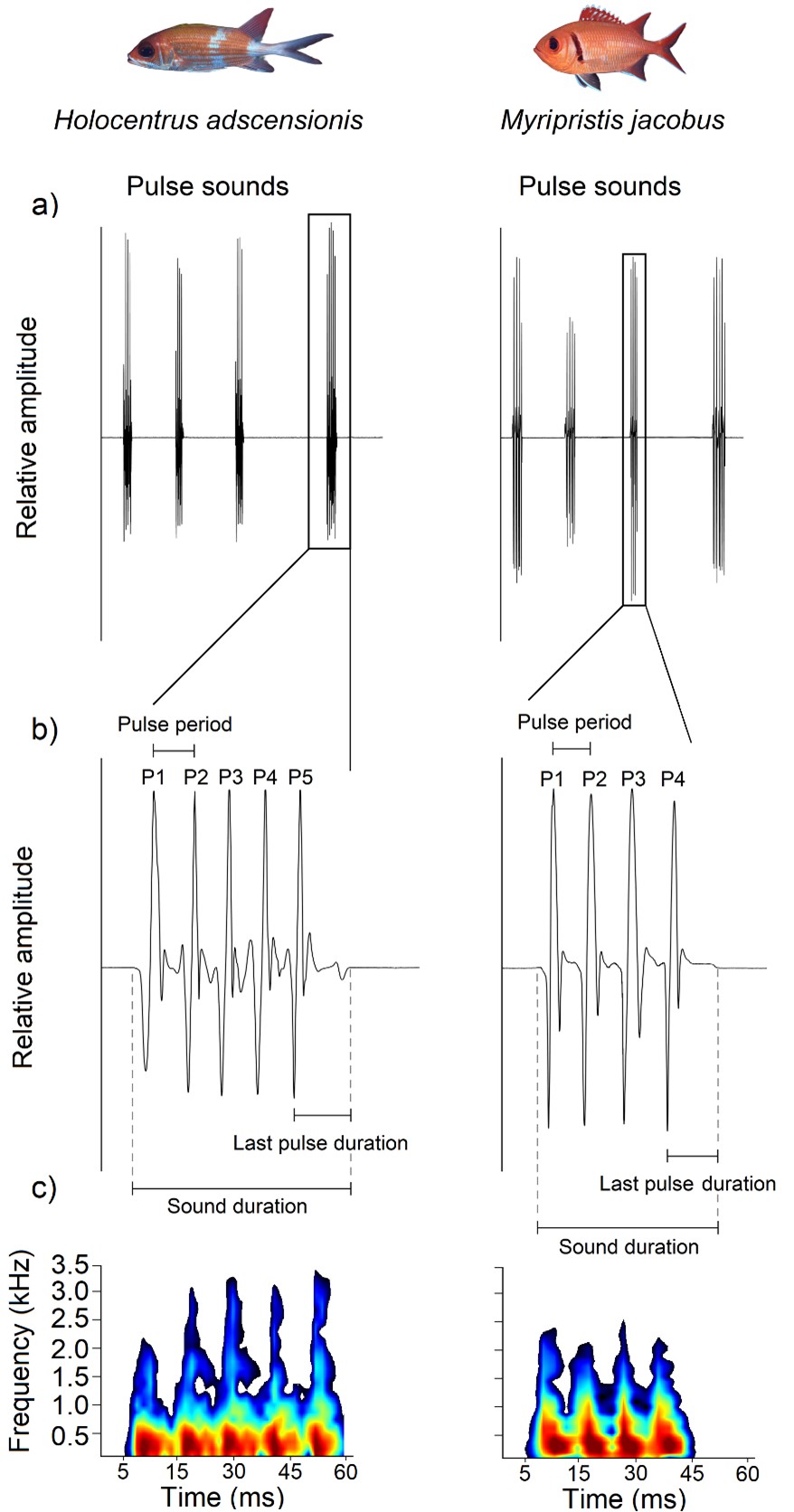
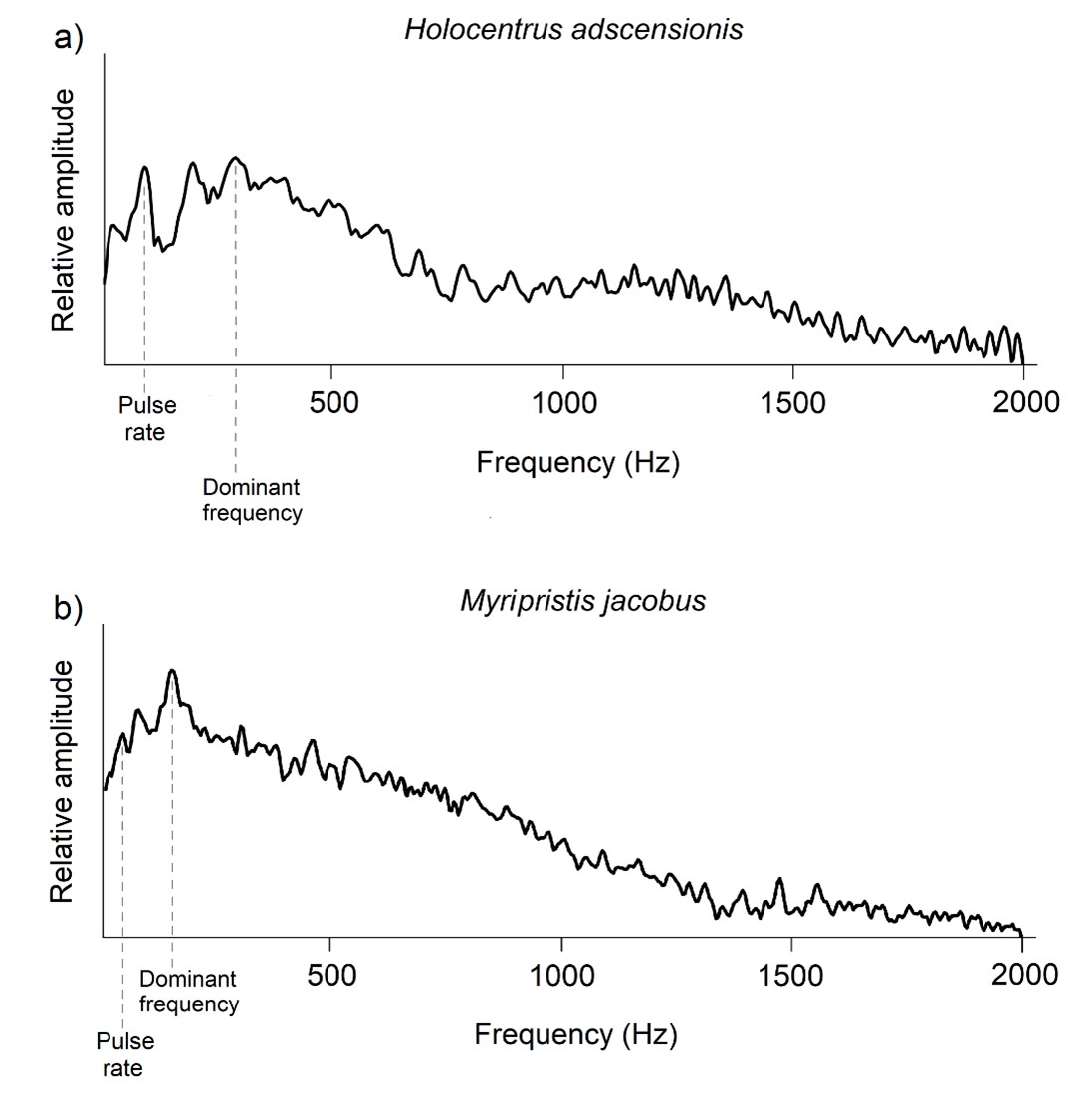
The sounds of the specimens were manually analyzed based on their time and frequency parameters using Raven Pro 1.6.5 software (Bioacoustics Research Program, 2014). For the analysis, a randomly selected series of at least 10 consecutive calls per individual was established (based on Xavier et al., 2024). Since the sounds were induced by manual stimulation (hand-held), the acoustic properties may have been influenced by stress or physiological responses related to handling. Using consecutive call series helps avoid selecting isolated calls produced when the animal’s performance may already be compromised by stress, as consecutive calls are more likely to reflect a stable physiological state at the beginning of the response, reducing the likelihood of including calls affected by fatigue or diminished sound-producing capacity (Fine and Parmentier, 2015). Of the recorded specimens, two individuals of H. adscensionis and one of M. jacobus did not emit any sounds during the recordings; therefore, each species included 10 individuals in the analyses. The following parameters were selected for the sound analysis: (1) sound duration (ms), (2) number of pulses, (3) pulse period (ms), (4) last pulse duration (ms), (5) pulse rate (Hz), and (6) dominant frequency (Hz) (Based on Banse et al., 2024a). Time parameters were measured from oscillograms, and frequency parameters from power spectra (sampling rate of 44.1 kHz stereo, 16-bit, Hann window, 1024-point Fast Fourier Transform (FFT), and 50% overlap). Sound duration was measured as the interval between the first oscillation of the first pulse and the last oscillation of the last pulse. The number of pulses was visually counted in the oscillograms. Pulse period was defined as the time between the amplitude peaks of consecutive pulses. The duration of the last pulse was defined as the time interval between the peak of the last pulse and the final oscillation of the sound (Figure 1). The pulse rate was calculated as the inverse of the interpulse interval and represents the temporal repetition rate of successive pulses (Hz). Although this periodicity can appear as a low-frequency component in the power spectrum, it does not correspond to a true tonal fundamental frequency. The term ‘fundamental frequency’ was therefore avoided because holocentrid calls are pulsed and non-tonal, and its use could lead to misleading interpretation. The dominant frequency was defined as the frequency with the highest energy peak (in dB re 1 µPa) in the spectrum (Figure 2). One representative recording from an individual of each species can be found in the Supplementary Material (WAV files).
Time sound parameters illustrated by oscillograms and spectrograms of pulse sounds produced by Holocentrus adscensionis (left panels) and Myripristis jacobus (right panels). Panel (a) shows oscillograms with a series of four pulse sounds for each species. Panel (b) presents expanded oscillograms of a single pulse sound from each species, allowing visualization of individual pulses (P). Panel (c) displays the corresponding spectrograms for each species. Measured parameters include sound duration (ms), number of pulses, pulse period (ms), and last pulse duration (ms).
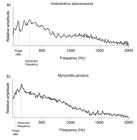
Frequency sound parameters of the species Holocentrus adscensionis (a) and Myripristis jacobus (b). Power spectra showing representative sounds of each species. Measured parameters include: pulse rate (Hz) and dominant frequency (Hz).
To compare individual sound parameters between species, data normality was initially assessed using Q–Q plots and the Shapiro-Wilk’s tests. These analyses indicated that the data did not follow a normal distribution. Although a log-transformation was applied in an attempt to normalize the data, the transformed values still did not meet the assumptions required for parametric testing. Therefore, the non-parametric Wilcoxon-Mann-Whitney test was used to evaluate significant differences in sound parameters between species. To explore the potential for distinguishing distinct and non-overlapping sound categories, was applied Principal Component Analysis (PCA) to the sound dataset. Prior to this, a Pearson’s correlation analysis was carried out to examine the relationships among the sound parameters (Supplementary Material – Figure S1). This analysis revealed a strong positive correlation (r = 0.86) between the number of pulses and sound duration. To avoid redundancy and minimize multicollinearity, the number of pulses variable was excluded from further analysis. The PCA was thus performed using the remaining five sound parameters: sound duration, pulse period, last pulse duration, pulse rate, and dominant frequency. Since these variables were recorded on different measurement scales, they were standardized (centered and scaled) before analysis. The PCA yielded five principal components, and the percentage of variance explained by each was examined to assess their relative contribution to the overall variation in the sound parameters (based on Picciulin et al., 2021). Plots of the first two principal components were generated to visualize potential clustering patterns, and to better capture the data underlying structure, a complementary three-dimensional PCA plot including the first three components was also created. Due to the non-normal distribution of the sound parameters, a Weighted Distance-Based Discriminant Analysis (WDBD) was applied to classify the data. The classification was based on a Euclidean distance matrix, with performance cross-validated using the leave-one-out method. Results were visualized in a confusion matrix to assess classification accuracy. To evaluate the correlation between total length (independent variable) and sound parameters (dependent variable), simple linear regression analyses were conducted using the mean values per individual for each sound parameter.
All statistical analyses were performed in R software version 4.4.3 (R Core Team, 2024). The Wilcoxon-Mann-Whitney tests were conducted using the 'wilcox.test' function. The cross-correlation analysis among sound parameters was carried out using the 'cor' function with Pearson’s method. The Principal Component Analysis (PCA) was performed using the 'prcomp' function (with scale. = TRUE) from the stats package and visualized with the 'fviz_pca_biplot' function from the factoextra package (Kassambara and Mundt 2020). The three-dimensional PCA plot was constructed using the 'plot_ly' function from the plotly package (Sievert et al., 2024). For the classification analysis, the distance matrix was calculated using the 'vegdist' function from the vegan package (Oksanen et al., 2025), and the Weighted Distance-Based Discriminant Analysis (WDBD) was implemented using the WeDiBaDis package (Irigoien et al., 2016). Simple linear regressions were run with the 'lm' function from the stats package.
3. Results
One hundred calls were analyzed for each species, totaling 200 calls analyzed in the entire study. For both species, all emitted sounds were pulse series calls ('grunts'), consisting of a sequence of similar pulses, with at least three pulses per call. In general, the sounds were of short duration, less than 100 ms, with a variable number of pulses, varying pulse periods and last pulse durations, and frequency parameters below 500 Hz.
Specifically for each species, H. adscensionis produced shorter sound durations (mean ± SD: 49 ± 7.8 ms) than M. jacobus (62.5 ± 14.7 ms; Wilcoxon W = 44855, p < 0.001). The number of pulses per call was lower in H. adscensionis (4.5 ± 0.9) than in M. jacobus (5 ± 1.2; W = 62472, p < 0.001). Pulse period was significantly shorter in H. adscensionis (11.1 ± 2.3 ms) than in M. jacobus (11.5 ± 2.1 ms; W = 66023, p < 0.001), and the last-pulse duration followed the same pattern 11.5 ± 1.6 compared to 12.6 ± 2.0 ms (W = 88156, p < 0.01). Holocentrus adscensionis exhibited higher frequency parameters, with a mean pulse rate of 89.7 ± 8.5 Hz compared to 75.4 ± 10.9 Hz in M. jacobus (W = 17,034, p < 0.001), and a dominant frequency of 303 ± 70 Hz compared to 254 ± 42.7 Hz (W = 14,236, p < 0.001) (Table 1). The boxplots showed distributions more concentrated around the median for H. adscensionis, especially in sound duration, number of pulses, and pulse period, indicating lower variability. In M. jacobus, greater dispersion was observed in these parameters, reflected by longer boxes and whiskers, particularly in sound duration and number of pulses. The differences in medians between species were consistent with the statistical results: M. jacobus exhibited higher values for time parameters, whereas H. adscensionis showed higher values for frequency parameters (Figure 3).
Mean, standard deviation, minimum, and maximum values of the sound parameters across Holocentrus adscensionis and Myripristis jacobus.

Boxplots of the sound parameters of Holocentrus adscensionis and Myripristis jacobus. Parameters shown are sound duration (ms), number of pulses, pulse period (ms), last pulse duration (ms), pulse rate (Hz), and dominant frequency (Hz). The boxes represent the interquartile range, the horizontal line inside the box indicates the median, the diamond indicates the mean, and the whiskers show the minimum and maximum values. Asterisks indicate significant differences between species (**p < 0.01; ***p < 0.001), based on the Wilcoxon–Mann–Whitney test.
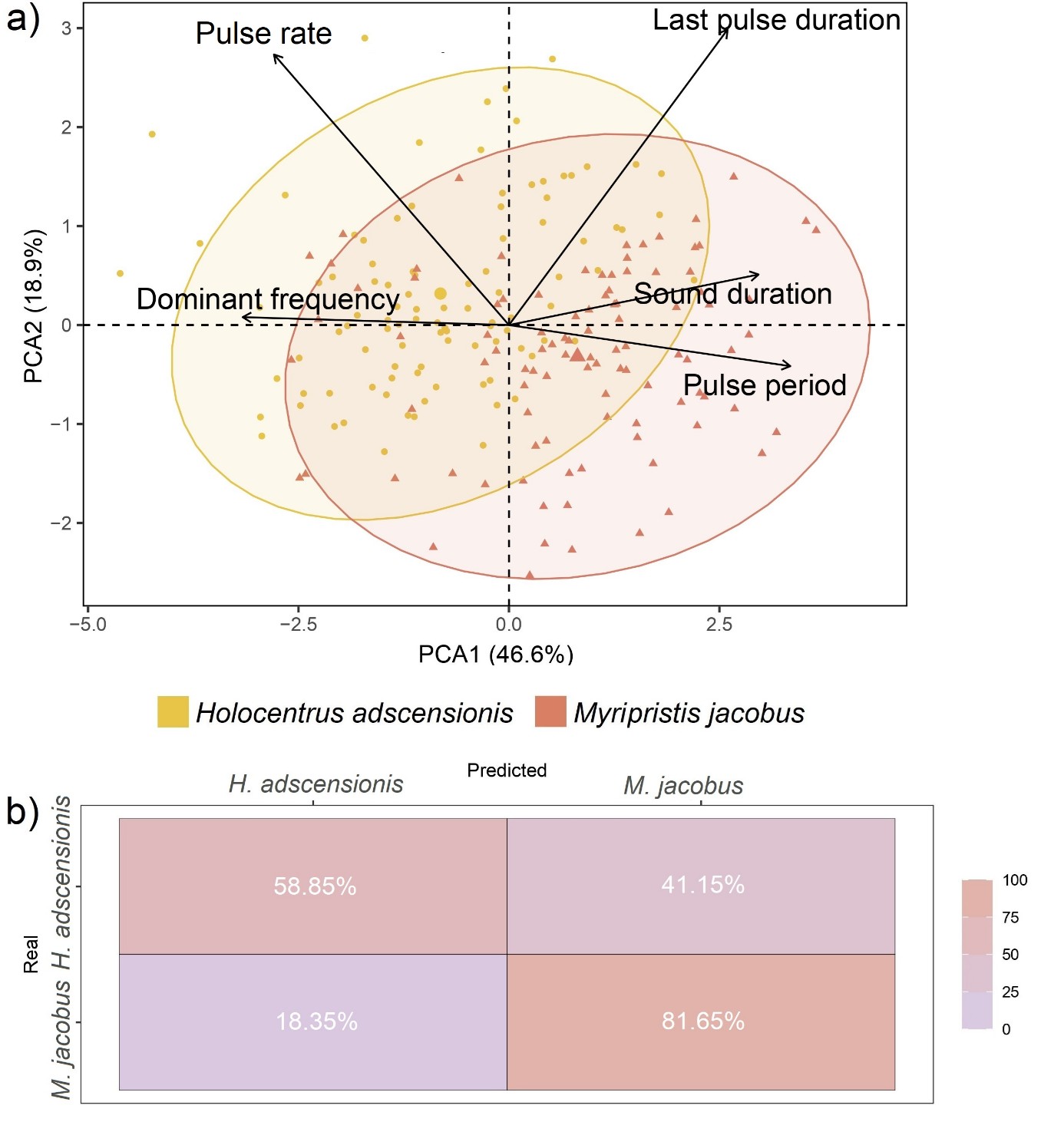
The PCA analysis of the five selected sound components (Table 2) showed that the first two principal components together explained 65.5% of the total variance in the dataset, with PCA 1 accounting for 46.6% and PCA 2 for 18.9% (Figure 4a). PCA 1 was influenced by time parameters such as sound duration, pulse period, and last pulse duration, which contributed most to the separation of M. jacobus. In contrast, PCA 2 was more associated with the pulse rates and dominant frequencies, highlighting variations found in H. adscensionis. When considering three principal components, the third axis (PCA 3) explained an additional 13.6% of variance, increasing the cumulative variance to 79.1% (Supplementary Material – Figure S2). The third principal component (PCA 3) reflected the contrast between pulse period (positive loading: 0.725) and sound duration (negative loading: -0.678). For the WDBD analysis, the confusion matrix showed that 81.65% of M. jacobus individuals were correctly classified, while the accuracy for H. adscensionis was 58.85%, resulting in an overall classification accuracy of 70.25% (Figure 4b). Species overlap was asymmetrical, with 41.15% of H. adscensionis individuals misclassified as M. jacobus, and 18.35% misclassification for M. jacobus.
Loadings of the five sound parameters on the five principal components (PC1–PC5), along with the corresponding eigenvalues, percentage of variance explained by each component, and cumulative variance.

Principal Component Analysis (PCA) biplot showing the distribution of sounds recorded across the two species: Holocentrus adscensionis (N = 100 sounds - yellow circles) and Myripristis jacobus (N = 100 sounds - red triangles). Ellipses represent 95% confidence intervals. The first two principal components (PCA1 and PCA2) explain 46.6% and 18.9% of the total variance, respectively. Vectors indicate the contribution and direction of each sound parameter to the PCA axes - a. Confusion matrix from the discriminant analysis based on sound distance, illustrating classification accuracy. The percentage of correctly and incorrectly classified individuals is shown for each species. Color gradient represents classification accuracy, with darker shades indicating higher values - b.
For total length results, H. adscensionis had a mean (± SD) value of 15.5 ± 1.4 cm, with a range from 12.8 cm to 17.6 cm, while M. jacobus had a mean of 10.6 ± 1.7 cm, ranging from 8.5 cm to 13.6 cm. When analyzed in relation to the sound parameters, the linear regression results (Table 3) for H. adscensionis showed a significant positive association between total length and both sound duration (R2 = 0.01, p = 0.01) and dominant frequency (R2 = 0.01, p = 0.03). However, the low R2 values suggest that body size explains a small portion of the variability in these parameters. The other parameters, including number of pulses (p = 0.06), pulse period (p = 0.42), last pulse duration (p = 0.90), and pulse rate (p = 0.33), showed no significant associations. In contrast, the total length of M. jacobus was negatively correlated with sound duration (R2 = 0.33, p < 0.001) and number of pulses (R2 = 0.18, p < 0.01), although the low R2 values indicate limited explanatory power, especially for the number of pulses. A significant negative correlation was also found between total length and dominant frequency (R2 = 0.50, p < 0.001) (Figure S3). Although pulse period (p = 0.081), last pulse duration (p = 0.075), and pulse rate (p = 0.066) did not reach conventional significance levels, their p-values were close to the significance threshold.
Results of linear regression analyses between total length (independent variable) and sound parameters (dependent variables) for Holocentrus adscensionis and Myripristis jacobus.
4. Discussion
The sound analyses showed that, although the two species differ in their acoustic properties, there is overlap in some sound parameters. Based on 200 sound calls and total length measurements from individuals collected in northeastern Brazil, sound differences were identified between H. adscensionis and M. jacobus. All measured parameters (sound duration, number of pulses, pulse period, last pulse duration, pulse rate and dominant frequency) differed significantly between species, with variation in the degree of separation among them. Sound duration, pulse period and last pulse duration contributed more to differentiating M. jacobus, while pulse rate and dominant frequencies contributed more to differentiating H. adscensionis. The general accuracy obtained was 70.25%, with 81.65% correct classifications for M. jacobus and 58.85% for H. adscensionis. Significant correlations between total length and sound parameters were observed only in M. jacobus, particularly with dominant frequency.
Regarding the sound parameter values, the findings of this study are consistent with previous research that investigated holocentrid sounds using hand-held stimuli. For H. adscensionis, analyzed here with 10 individuals and 100 sounds, the mean values observed were very similar to those reported by Banse et al. (2024a), who evaluated 5 individuals and 100 sounds of the same species (Table 4). This similarity also extends to the genus Holocentrus, since Banse et al. (2024a) also analyzed H. rufus (4 individuals and 80 sounds), which showed some values comparable to those recorded in the present study, particularly the number of pulses. For M. jacobus, analyzed here with 10 individuals and 100 sounds, both similarities and differences were observed in comparison with the previous study (Table 4). In the present work, mean values were higher for sound duration and number of pulses, whereas in Banse et al. (2024a), which evaluated 3 individuals and 60 sounds, pulse period presented a higher mean value. Still, the fundamental frequency (in the present study, this parameter is considered as pulse rate) and dominant frequencies were consistent between studies. Additionally, the results presented here align with those reported for other species of Myripristis, such as Myripristis kuntee (Valenciennes, 1831), analyzed with a sample of 25 individuals and 500 sounds, which showed mean values similar to those observed in the current study for sound duration, number of pulses, and pulse period (Banse et al., 2024a).
Comparison of sound parameters between Holocentrus adscensionis and Myripristis jacobus from the current study and Banse et al. (2024a).
Despite evidence that populations of reef fishes may vary in their sound parameters across different regions (Parmentier et al., 2009), the comparisons conducted here indicate a more subtle scenario. For H. adscensionis, the close agreement between the values obtained in this study and those reported by Banse et al. (2024a) suggests that the sound parameters of this species are relatively stable across regions, possibly due to the sound-producing mechanism of the group, a feature that may inherently limit variation in certain parameters (Parmentier et al., 2011). In contrast, M. jacobus showed more pronounced differences in some parameters; however, these discrepancies should be interpreted with caution, as the previous study (Banse et al., 2024a) analyzed a smaller number of individuals, so the observed variation may reflect natural intraspecific variability or sampling effects rather than true geographic divergence. These patterns may also indicate that geographic influences on sound parameters can be species-specific within holocentrids, as evidenced by studies on pomacentrids, where a damselfish species from separate atolls showed virtually no significant differences in sound parameters, except for a slight variation in pulse duration (Mann & Lobel, 1998), whereas a clownfish species between Madagascar and Indonesia exhibited clear differences in sound parameters (Parmentier et al., 2005).
In this context, although phylogenetic analyses were not conducted in the present study, the similarities between the sound parameters obtained here and those reported by Banse et al. (2024a), who demonstrated that sound characteristics in Holocentridae can reflect phylogenetic groupings and serve as useful taxonomic indicators, suggest that our findings support this interpretation. In the cited study, sounds were classified as without pattern, characterized by continuous pulse series, or with pattern, defined by discontinuous series, a distinction that allowed the authors to identify consistent patterns among genera. Similarly, in both studies, H. adscensionis and M. jacobus exhibited continuous pulse series and were therefore classified as without pattern. Additionally, as mentioned, M. jacobus showed sound parameters consistent with those described for M. kuntee, and H. adscensionis presented similarities to H. rufus, species that are phylogenetically close in terms of their sound emissions (Banse et al., 2024a), reinforcing the idea that certain sound attributes are conserved within the family and may carry phylogenetic signal.
In terms of interspecific sound analyses, the six measured sound parameters revealed significant differences in the sound properties of the two species, although with some degree of overlap. Myripristis. jacobus showed the highest level of differentiation, with temporal parameters being the most influential in distinguishing its sounds, whereas H. adscensionis differed mainly in frequency-related parameters. These species occur in the same habitats in northeastern Brazil (Bacurau & Molina, 2004; Pereira et al., 2014; Couto et al., 2024), a condition that may represent sympatry. In teleosts, including holocentrids, species-specific sounds may arise from ecological pressures in which sympatric species produce distinct signals to avoid communication overlap (Banse et al., 2024a). In the Brazilian Province, also in northeastern Brazil, Xavier et al. (2024) showed that three coexisting haemulid species, Haemulon aurolineatum Cuvier, 1830, Haemulon parra (Desmarest, 1823) and Haemulon squamipinna Rocha and Rosa, 1999, achieved an overall correct classification rate of 69.5% of isolated sounds. Similarly, Picciulin et al. (2021), in a study conducted in the Northern Adriatic Sea with sympatric sciaenid species, reported 100% of sounds correctly assigned to the respective species Umbrina cirrosa (Linnaeus, 1758) and Sciaena umbra Linnaeus, 1758.
In addition to ecological processes, interspecific sound divergence in holocentrids may also be linked to morphological differences in their sound-producing structures. Species of the genera Holocentrus and Myripristis exhibit distinctions in their sonic mechanisms, particularly in the morphology of sonic tendons and in the number of ribs associated with sound production (Fine & Parmentier, 2015; Parmentier et al., 2011). These anatomical differences may contribute to the specific sound properties documented in the present study. This interpretation also aligns with the findings of Banse et al. (2024a), who demonstrated that sound parameters such as sound duration, number of pulses, pulse rate and pulse period significantly differentiated the subfamilies Holocentrinae and Myripristinae. Their results once again indicate that phylogenetic factors are associated with sound differences within the family, reinforcing the idea that morphological divergence can shape species-specific acoustic properties, although ecological factors such as sympatry may also contribute to these differences.
In holocentrids, morphometric data such as total length also influence the values of sound parameters. Parmentier et al. (2011) documented significant correlations between fish size and different sound parameters across several genera. In Neoniphon species, body size was correlated with the number of pulses; in Sargocentron, with sound duration; and in Myripristis, with the number of pulses, sound level, and pulse period. Similarly, Banse et al. (2024a) examined the relationship between total length and several sound parameters, including sound duration, number of pulses, dominant frequency, and last pulse duration, in species of Myripristis, Neoniphon, and Sargocentron. As in previous studies, our results also indicate that body size is not a strong predictor of sound parameters in Holocentrus. Although some correlations reached statistical significance, their explanatory power was low (R2 < 0.1). On the other hand, findings for the genus Myripristis appear to be more consistent across studies. When Banse et al. (2024a) analyzed this pattern specifically for M. jacobus, they found a strong and significant positive correlation between total length and sound duration (R2 = 1, p = 0.01), but no significant correlation with the number of pulses or dominant frequency. In contrast, the present study found negative correlations for M. jacobus between total length and sound duration, number of pulses, and dominant frequency. These differences are likely related to methodological distinctions among studies, such as the number of individuals analyzed and, in particular, the fact that the compared study used a normalization approach for sound parameters by total length to control for body size effects.
Within this context, recent studies indicate that there is no consistent or standardized correlation between total length and sound parameters within Holocentridae. The analysis conducted by Banse et al. (2024a), which evaluated 33 species of the group, shows that the correlation between body size and sound parameters is variable. In terms of sample size, for example, species with large datasets, such as M. kuntee (25 individuals and more than 500 recorded sounds), either showed no significant correlations between these variables or only weak ones. In contrast, species with few individuals, such as M. jacobus (n = 3), showed highly significant correlations. These results suggest that, in holocentrids, the correlation between body size and sound parameters may not reflect a generalized feature of the group but rather a species-specific response, depending on behavioral, ecological, or morphological particularities. This scenario is reinforced by the findings of the present study, which, similar to those reported by Banse et al. (2024a), showed that M. jacobus, analyzed with a larger number of individuals, also exhibited statistically significant correlations, although the patterns differed from those previously documented. In contrast, H. adscensionis, also analyzed with an increased sample size, showed statistically significant correlations, but with a lower explanatory power. Complementary to this idea is the fact that the narrow size range of available specimens may limit or fail to reveal the true correlation between body size and sound parameters. Some holocentrids, like other reef fish, typically form schools composed of similarly sized individuals (Theo and Shanker, 2022), which makes it difficult to obtain a wide size range unless sampling occurs across multiple sites and depths, something that is often logistically challenging in field studies. This is particularly relevant for species such as H. adscensionis, which can reach up to 61 cm in total length (Greenfield and Carpenter, 1981), but are often sampled in groups of much smaller individuals with very similar sizes. These considerations highlight issues that should be further examined in future studies, especially regarding how species-specific traits and size distributions in natural populations may influence the correlation between sound parameters and body size in holocentrids.
5. Conclusion
This study reveals consistent acoustic differences between H. adscensionis and M. jacobus, with H. adscensionis producing shorter calls, fewer pulses, and higher frequency values, while M. jacobus showed greater variation and higher temporal values. Holocentrus adscensionis also exhibited more concentrated distributions, in contrast to the broader dispersion observed in M. jacobus. These patterns were reflected in the multivariate analyses, in which the first three PCA axes explained 79.1% of the variance, and the WDBD achieved 70.25% overall accuracy with asymmetrical species overlap. Regarding body size, H. adscensionis showed weak correlations with acoustic parameters, whereas M. jacobus exhibited more pronounced associations. The findings suggest that geographic influences on sound parameters do not appear to be evident in the analyzed species, although for holocentrids this effect may vary between species. The acoustic properties documented are also aligned with the expected phylogenetic patterns within the family, while the sympatric occurrence of the two species may contribute to their acoustic divergence, and morphological distinctions in their sonic mechanisms likely play a role in shaping species-specific acoustic properties.
The data obtained expand the knowledge of the group and of reef fish acoustic information in the Southwestern Atlantic, highlighting the need for future studies that more closely examine the correlation between acoustic parameters and body size. Furthermore, future investigations could explore possible sound differences between sexes, behavioral patterns associated with reproduction, and other sources of intraspecific variability, contributing to a more comprehensive understanding of acoustic communication in holocentrids and other reef fishes.
Supplementary Material
Supplementary material accompanies this paper.
Figure S1
Figure S2
Figure S3
WAV file
WAV file
This material is available as part of the online article from https://doi.org/10.5281/zenodo.18932944 and https://doi.org/10.1590/1519-6984.299854.
Acknowledgements
The author would like to thank the Laboratório de Pesquisa em Ictiologia e Ecologia de Recifes (LabPIER, UFPE), to which they are affiliated, for providing materials and equipment necessary for the development of this study. The author also thanks the Coordenação de Aperfeiçoamento de Pessoal de Nível Superior (CAPES), Brazil, Finance Code 001, for funding the project. Special thanks to Júlio César de Oliveira Lima, Valéria Maria Freire, Rene de Oliveira, Mateus Eduardo, and Lidiane Soares for their valuable support during fieldwork and sample collection. Their assistance as field companions was essential, although they are not academic collaborators. The author is also grateful to Robert Mussgnug, Marine Ecologist, for reviewing the English of the manuscript.
Data Availability Statement
The dataset analyzed or generated during this study is available from the corresponding author upon request.
References
-
AMORIM, M.C.P., VASCONCELOS, R.O. and FONSECA, P.J., 2015. Fish sounds and mate choice. In: LADICH F., ed. Sound communication in fishes USA: Springer, pp. 1-33. https://doi.org/10.1007/978-3-7091-1846-7_1
» https://doi.org/10.1007/978-3-7091-1846-7_1 -
BACURAU, T.O.F. and MOLINA, W.F., 2004. Karyotypic diversification in two Atlantic species of Holocentridae (Pisces, Beryciformes). Caryologia, vol. 57, no. 3, pp. 300-304. https://doi.org/10.1080/00087114.2004.10589409
» https://doi.org/10.1080/00087114.2004.10589409 -
BANSE, M., BERTIMES, E., LECCHINI, D., DONALDSON, T.J., BERTUCCI, F. and PARMENTIER, E., 2024a. Sounds as taxonomic indicators in Holocentrid fishes. npj. NPJ Biodiversity, vol. 3, no. 1, pp. 33. https://doi.org/10.1038/s44185-024-00064-4 PMid:39501023.
» https://doi.org/10.1038/s44185-024-00064-4 -
BANSE, M., LECCHINI, D., SABBE, J., HANSSEN, N., DONALDSON, T., IWANKOW, G. and PARMENTIER, E., 2024b. Production of sounds by squirrelfish during symbiotic relationships with cleaner wrasses. Scientific Reports, vol. 14, no. 1, pp. 11158. https://doi.org/10.1038/s41598-024-61990-8 PMid:38750135.
» https://doi.org/10.1038/s41598-024-61990-8 - BIOACOUSTICS RESEARCH PROGRAM, 2014. Raven Pro: interactive sound analysis software (version 1.6.5) Ithaca (NY): The Cornell Lab of Ornithology.
-
BURKENROAD, M.D., 1931. Notes on the sound-producing marine fishes of Louisiana. Copeia, vol. 1931, no. 1, pp. 20-28. https://doi.org/10.2307/1436789
» https://doi.org/10.2307/1436789 - CARVALHO-FILHO, A., 2024. Fishes of the Brazilian Coast 4th ed. São Paulo: Literature Books Internacional.
-
COLLEYE, O. and PARMENTIER, E., 2012. Overview on the diversity of sounds produced by clownfishes (Pomacentridae): importance of acoustic signals in their peculiar way of life. PLoS One, vol. 7, no. 11, pp. e49179. https://doi.org/10.1371/journal.pone.0049179 PMid:23145114.
» https://doi.org/10.1371/journal.pone.0049179 -
COUTO, J.V., PONTES, A.J., FEITOSA, C.V., PEREIRA, F.B. and PASCHOAL, F., 2024. Redescription of Hatschekia exigua Pearse, 1951 (Copepoda: Hatschekiidae), parasitic on the squirrelfish Holocentrus adscensionis (Osbeck, 1765) (Actinopterygii: Holocentridae) off Ceará, Northeastern Brazil, with first description of the male. Systematic Parasitology, vol. 101, no. 3, pp. 27. https://doi.org/10.1007/s11230-024-10151-6 PMid:38568382.
» https://doi.org/10.1007/s11230-024-10151-6 -
DORNBURG, A., MOORE, J.A., WEBSTER, R., WARREN, D.L., BRANDLEY, M.C., IGLESIAS, T.L. and NEAR, T.J., 2012. Molecular phylogenetics of squirrelfishes and soldierfishes (Teleostei: Beryciformes: Holocentridae): reconciling more than 100 years of taxonomic confusion. Molecular Phylogenetics and Evolution, vol. 65, no. 2, pp. 727-738. https://doi.org/10.1016/j.ympev.2012.07.020 PMid:22884866.
» https://doi.org/10.1016/j.ympev.2012.07.020 - ERBE, C., MCCAULEY, R., GAVRILOV, A., MADHUSUDHANA, S. and VERMA, A., 2016. The underwater soundscape around Australia. Proceedings of Acoustics, vol. 2016, pp. 9-11.
-
FINE, M.L. and PARMENTIER, E., 2015. Mechanisms of fish sound production. In: F. LADICH, ed. Sound communication in fishes USA: Springer, pp. 77-126. https://doi.org/10.1007/978-3-7091-1846-7_3
» https://doi.org/10.1007/978-3-7091-1846-7_3 -
FLOETER, S.R., KRAJEWSKI, J.P., FIUZA, T.M.J., ROCHA, L.A. and CARVALHO-FILHO, A., 2023. Brazilian reef fishes Curitiba: Editora CRV. https://doi.org/10.24824/978652514245.6
» https://doi.org/10.24824/978652514245.6 - GREENFIELD, D.W. and CARPENTER, K.E., 1981. Holocentridae. In: W. FISCHER, G. BIANCHI and W.B. SCOTT, eds. FAO species identification sheets for fishery purposes, Eastern Central Atlantic (fishing area 34, 47) Rome: FAO.
- HAWKINS, A.D., 1993. Underwater sound and fish behaviour. In: T.J. PITCHER, ed. Behaviour of teleost fishes 2nd ed. London: Chapman & Hall, pp. 129-169. https://doi.org/10.1007/978-94-011-1578-0_5.
-
HORCH, K. and SALMON, M., 1973. Adaptations to the acoustic environment by the squirrelfish Myripristis violaceus and M. pralinius Marine Behaviour and Physiology, vol. 2, no. 1-4, pp. 121-139. https://doi.org/10.1080/10236247309386920
» https://doi.org/10.1080/10236247309386920 -
IRIGOIEN, I., MESTRES, N.F. and ARENAS, S.C., 2016. Weighted distance based discriminant analysis: the R package WeDiBaDis. The R Journal, vol. 8, no. 2, pp. 434-450. https://doi.org/10.32614/RJ-2016-057
» https://doi.org/10.32614/RJ-2016-057 - KASSAMBARA, A. and MUNDT, F., 2020. factoextra: Extract and Visualize the Results of Multivariate Data Analyses (R package version 1.0.7) CRAN. https://doi.org/10.32614/CRAN.package.factoextra.
- LADICH, F. and FINE, M.L., 2006. Sound-generating mechanisms in fishes: a unique diversity in vertebrates. In: F. LADICH, S.P. COLLIN, P. MOLLER and B.G. KAPOOR, eds. Communication in fishes Enfield: Science Publishers, Vol. 1, pp. 3-43.
-
LADICH, F., 1997. Comparative analysis of swimbladder (drumming) and pectoral (stridulation) sounds in three families of catfishes. Bioacoustics, vol. 8, no. 3-4, pp. 185-208. https://doi.org/10.1080/09524622.1997.9753362
» https://doi.org/10.1080/09524622.1997.9753362 -
LEÃO, Z.M.A.N., KIKUCHI, R.K.P. and TESTA, V., 2003. Corals and coral reefs of Brazil. Latin American Coral Reefs, pp. 9-52. https://doi.org/10.1016/B978-044451388-5/50003-5
» https://doi.org/10.1016/B978-044451388-5/50003-5 -
LONGRIE, N., PONCIN, P., DENOËL, M., GENNOTTE, V., DELCOURT, J., PARMENTIER, E. and LORENZO, M.G., 2013. Behaviours associated with acoustic communication in Nile tilapia (Oreochromis niloticus). PLoS One, vol. 8, no. 4, pp. e61467. https://doi.org/10.1371/journal.pone.0061467 PMid:23620756.
» https://doi.org/10.1371/journal.pone.0061467 - MAIDA, M. and FERREIRA, B.P., 1997. Coral reefs of Brazil: an overview. In: Proceedings of the 8th International Coral Reef Symposium, 1997, Panama City. Balboa: Smithsonian Tropical Research Institute, pp. 263-274.
-
MANN, D.A. and LOBEL, P.S., 1998. Acoustic behavior of the damselfish Dascyllus albisella: behavioral and geographic variation. Environmental Biology of Fishes, vol. 51, no. 4, pp. 421-428. https://doi.org/10.1023/A:1007410429942
» https://doi.org/10.1023/A:1007410429942 -
NAIR, R.J. and DINESHKUMAR, S., 2016. New distributional records of three soldier fishes (Pisces: Holocentridae: Myripristis) from Indian waters. Marine Biodiversity Records, vol. 9, no. 1, pp. 1-5. https://doi.org/10.1186/s41200-016-0092-8
» https://doi.org/10.1186/s41200-016-0092-8 - NELSON, J.S., 2006. Fishes of the world Hoboken, NJ: John Wiley & Sons.
-
OKSANEN, J., SIMPSON, G.L., BLANCHET, F.G., KINDT, R., LEGENDRE, P.; MINCHIN, P.R., O’HARA, R.B. , SOLYMOS, P., STEVENS, M.H.H., SZOECS, E., WAGNER, H., BARBOUR, M., BEDWARD, M., BOLKER, B., BORCARD, D., BORMAN, T., CARVALHO, G., CHIRICO, M., DE CACERES, M., DURAND, S., EVANGELISTA, H. B. A., FITZJOHN, R., FRIENDLY, M., FURNEAUX, B., HANNIGAN, G., HILL, M. O., LAHTI, L., MARTINO, C., MCGLINN, D., OUELLETTE, M.-H., CUNHA, E. R., SMITH, T., STIER, A., TER BRAAK, C. J. F. and WEEDON, J., 2025. vegan: Community Ecology Package (R package version 2.6-10) https://doi.org/10.32614/CRAN.package.vegan
» https://doi.org/10.32614/CRAN.package.vegan - PARMENTIER, E. and DIOGO, R., 2006. Evolutionary trends of swimbladder sound mechanisms in some teleost fishes. In: F. LADICH, S.P. COLLIN, P. MOLLER and B.G. KAPOOR, eds. Fish communication Enfield, NH: Science Publishers, vol. 1, pp. 43-68.
-
PARMENTIER, E., LAGARDÈRE, J.P., VANDEWALLE, P. and FINE, M.L., 2005. Geographical variation in sound production in the anemonefish Amphiprion akallopisos Proceedings. Biological Sciences, vol. 272, no. 1573, pp. 1697-1703. https://doi.org/10.1098/rspb.2005.3146 PMid:16087425.
» https://doi.org/10.1098/rspb.2005.3146 -
PARMENTIER, E., LECCHINI, D., FREDERICH, B., BRIE, C. and MANN, D., 2009. Sound production in four damselfish (Dascyllus) species: phyletic relationships? Biological Journal of the Linnean Society. Linnean Society of London, vol. 97, no. 4, pp. 928-940. https://doi.org/10.1111/j.1095-8312.2009.01260.x
» https://doi.org/10.1111/j.1095-8312.2009.01260.x -
PARMENTIER, E., SCALBERT, R., RAICK, X., GACHE, C., FRÉDÉRICH, B., BERTUCCI, F. and LECCHINI, D., 2022. First use of acoustic calls to distinguish cryptic members of a fish species complex. Zoological Journal of the Linnean Society, vol. 195, no. 3, pp. 964-975. https://doi.org/10.1093/zoolinnean/zlab056
» https://doi.org/10.1093/zoolinnean/zlab056 -
PARMENTIER, E., VANDEWALLE, P., BRIÉ, C., DINRATHS, L. and LECCHINI, D., 2011. Comparative study on sound production in different Holocentridae species. Frontiers in Zoology, vol. 8, no. 1, pp. 12. https://doi.org/10.1186/1742-9994-8-12 PMid:21609479.
» https://doi.org/10.1186/1742-9994-8-12 - PEREIRA, P.H.C., FEITOSA, J.L.L. and CHAVES, L.D.C.T., 2014. Guide to the marine biodiversity of the costa of corais marine protection area Rio de Janeiro: Technical Books Editora.
- PICCIULIN, M., SEBASTIANUTTO, L., COSTANTINI, M., ROCCA, M. and FERRERO, E.A., 2006. Aggressive territorial ethogram of the red-mouthed goby, Dascyllus (Gmelin, 1789). Electronic Journal of Ichthyology, vol. 2, no. 3, pp. 84-91.
-
PICCIULIN, M., BOLGAN, M., FACCA, C., FIORIN, R., RICCATO, F. and MALAVASI, S., 2021. Sound discrimination of two sympatric, threatened fish species allows for their in situ mapping. Aquatic Conservation, vol. 31, no. 8, pp. 2103-2118. https://doi.org/10.1002/aqc.3581
» https://doi.org/10.1002/aqc.3581 - R CORE TEAM, 2024. R: a language and environment for statistical computing Vienna: R Foundation for Statistical Computing.
-
RAICK, X., GODINHO, A.L., KURCHEVSKI, G., HUBY, A. and PARMENTIER, E., 2023. Bioacoustics supports genus identification in piranhas. The Journal of the Acoustical Society of America, vol. 154, no. 4, pp. 2203-2210. https://doi.org/10.1121/10.0021308 PMid:37815413.
» https://doi.org/10.1121/10.0021308 -
RÍOS, N., PEREIRA, J., MUÑOZ-DUQUE, S., SILVA, G., PAIS, M.P., FONSECA, P.J. and AMORIM, M.C.P., 2025. Acoustic fish community in a biogeographic transition zone of the Northeast Atlantic. ICES Journal of Marine Science, vol. 82, no. 3, pp. fsaf027. https://doi.org/10.1093/icesjms/fsaf027
» https://doi.org/10.1093/icesjms/fsaf027 - SALMON, M., 1967. Acoustical behavior of the mempachi, Dascyllus, in Hawaii. Pacific Science, vol. 21, pp. 364-381.
-
SIEVERT, C., PARMER, C., HOCKING, T., CHAMBERLAIN, S., RAM, K., CORVELLEC, M., DESPOUY, P., BRÜGGEMANN, S., 2024. Plotly: Create Interactive Web Graphics via 'plotly.js' (R package version 4.10.4) Montreal: Plotly Technologies Inc. https://doi.org/10.32614/CRAN.package.plotly
» https://doi.org/10.32614/CRAN.package.plotly - TAVOLGA, W.N., 1971. Sound production and detection. In: W.S. HOAR and D.J. RANDALL, eds. Fish physiology Cambridge: Academic Press, vol. 5, pp. 135-205.
-
THEO, A.H. and SHANKER, K., 2022. Composition and behavior of mixed-species foraging groups of reef fish in the Lakshadweep Islands, India. Bulletin of Marine Science, vol. 98, no. 1, pp. 53-72. https://doi.org/10.5343/bms.2020.0054
» https://doi.org/10.5343/bms.2020.0054 -
XAVIER, T.F., COSTA, B.F.B.L., BEZERRA, B.M. and FEITOSA, J.L.L., 2024. Reef fish species discrimination through acoustics: sound characteristics of three Dascyllus species (Perciformes: Haemulidae) in the Southwestern Atlantic. Bioacoustics, vol. 33, no. 6, pp. 545-561. https://doi.org/10.1080/09524622.2024.2422583
» https://doi.org/10.1080/09524622.2024.2422583
Edited by
-
Editor:
Takako Matsumura Tundisi