 Morphophysiological responses of soybean seedling to bioinputs based on Bacillus spp.
Abstract
The high demand for soybeans in Brazil requires seeds with high physiological quality, enabling the establishment of vigorous seedlings. Abiotic stresses can limit seedling development. In this context, bio-inputs based on Bacillus spp. have stood out, acting in the promotion of root growth, nutrient availability, and induction of resistance. Thus, the objective was to evaluate the action of a commercial bio-input based on Bacillus spp. bacteria on the physiology of soybean seedlings. The bio-input was inoculated in sand substrate in trays, at concentrations of 0 (distilled water); 50; 100; 150 and 200 µL. Two hundred seeds were sown per treatment, with 4 repetitions. The emergence of soybean seedlings, length and dry mass, as well as gas exchange, chlorophyll a fluorescence, and anatomical and histochemical analysis of the leaves were analyzed. Doses between 100 and 150 µL were able to improve seedling performance, length, and biomass. All doses of the bio-input provided ideal values of potential quantum yield of PSII (Fv/Fm), close to 0.83, reaching a maximum at the estimated dose of 132.07 µL, with a peak of 0.77. The leaves of seedlings treated with the bio-input showed greater xylidine staining, indicating an increase in protein compounds and, consequently, expansion of intercellular spaces in the spongy parenchyma, in contrast to the control group, which showed less xylidine staining. Furthermore, a strong positive correlation was found between the potential quantum yield of PSII (Fv/Fm) and growth variables, including emergence (EM), shoot length (CA), root length (CR), shoot dry mass (MA), and root dry mass (MR). The bio-input was able to stimulate the initial growth of soybean seedlings, mainly at concentrations of 100 to 150 µL, although further studies are needed to validate its action under real cultivation conditions.
Keywords:
bacteria; growth; physiological performance; Glycine max; vigor
Resumo
A alta demanda de soja no Brasil necessita que as sementes tenham alta qualidade fisiológica, possibilitando o estabelecimento de plântulas vigorosas. Estresses abióticos podem limitar o desenvolvimento das plântulas. Nesse contexto, bioinsumos à base de Bacillus spp. têm se destacado, atuando na promoção de crescimento radicular, na disponibilização de nutrientes e na indução de resistência. Desse modo, objetivou-se avaliar a ação de um bioinsumo comercial à base de bactérias Bacillus spp. na fisiologia de plântulas de soja. O bioinsumo foi inoculado em substrato areia em bandejas, nas concentrações de 0 (água destilada); 50; 100; 150 e 200 µL. Foram semeadas 200 sementes por tratamento, com 4 repetições. Foram analisadas a emergência das plântulas de soja, o comprimento e a massa seca, além de trocas gasosas, fluorescência da clorofila a e análise anatômica e histoquímica das folhas. As doses entre 100 e 150 µL foram capazes de melhorar o desempenho das plântulas, comprimento e biomassa. Todas as doses do bioinsumo proporcionaram valores ideais de rendimento quântico potencial do PSII (Fv/Fm), próximos a 0.83, atingindo o máximo na dose estimada de 132.07 µL, com ápice de 0.77. As folhas das plântulas tratadas com bioinsumo apresentaram maior marcação por xylidine, indicando aumento de compostos proteicos e, consequentemente, expansão dos espaços intercelulares no parênquima esponjoso, em contraste com o grupo controle, que apresentou menor marcação por xylidine. Além disso, verificou-se forte correlação positiva entre o rendimento quântico potencial do PSII (Fv/Fm) e as variáveis de crescimento, incluindo emergência (EM), comprimento da parte aérea (CA), comprimento radicular (CR), massa seca da parte aérea (MA) e massa seca da raiz (MR). O bioinsumo foi capaz de estimular o crescimento inicial das plântulas de soja, principalmente em concentrações de 100 a 150 µL, sendo ainda necessários mais estudos para validar sua ação em condições reais de cultivo.
Palavras-chave:
bactérias; crescimento; desempenho fisiológico; Glycine max; vigor
1. Introduction
In Brazil, soybean (Glycine max (L.) Merrill) is a predominant crop, standing out as the country's main agricultural activity. According to FAO (2025), the total soybean production in 2024 was 144,473,768 tons. Given this context, the significant demand for soybeans in Brazil is clear. To meet it effectively, seeds must possess high physiological quality to ensure the establishment of vigorous seedlings. This initial stage is critical, as it ultimately determines the success or failure of the entire harvest (Finch-Savage and Bassel, 2016).
Factors such as climate change, water stress, and nutrient availability can compromise soybean development (Bagale, 2021; Staniak et al., 2023). In this context, bioinputs derived from bacteria of the genus Bacillus have gained prominence. These bacteria, known as Plant Growth-Promoting Rhizobacteria (PGPR) (Pirttilä et al., 2021), are naturally found in the soil and live in association with plant roots (Adedayo et al., 2022). Inoculation can be carried out in several ways: applied to the soil, on seeds, or directly onto the roots (Suharman et al., 2025; Lopes et al., 2021), where they promote development and contribute to plant health (Adedayo et al., 2022). Thus, they represent a promising alternative for agriculture.
These bacteria act by colonizing plant roots. Once established, they produce phytohormones such as auxins that stimulate root growth and facilitate nutrient uptake (Dame et al., 2021; Luo et al., 2022), thereby promoting seedling development. Furthermore, they protect seedlings by inducing systemic resistance and antagonizing pathogens (Blake et al., 2021; Dame et al., 2021).
Given this, studies have shown that Bacillus spp., alongside other microorganisms, can increase the emergence rate of soybeans under stress (Liu et al., 2023) and improve productivity parameters (Rafique et al., 2025), in addition to root size and dry mass (Vey et al., 2025). However, research specifically investigating the direct effect of Bacillus spp. on the initial development of soybean seedlings, particularly concerning physiological performance, remains scarce. Therefore, the objective of this study was to evaluate the action of a commercial Bacillus spp., based bioinput on the physiology performance of soybean seedlings.
2. Material and Methods
2.1. Plant material and treatments
The trials were conducted at the Seed Analysis Laboratory of the Federal Institute of Education, Science and Technology Goiano (IFGoiano), Rio Verde Campus, GO. Prior to the experimental setup, soybean seeds of the GNS 7400 IPRO cultivar, from the 2024/25 harvest, were characterized by determining their water content and performing a germination test, in accordance with Brasil (2025).
The experiment was conducted using a commercial bioinput formulated with Bacillus spp. bacteria, diluted in distilled water to obtain the following concentrations: 0 (control, distilled water only), 50, 100, 150, and 200 µL. Doses were determined based on the commercial product's recommendations.
Sand was used as the substrate, having been previously sieved and and sterilized in an oven at 200 °C for two hours (Brasil, 2025). Field capacity was then determined according to the methodology described in the Rules for Seed Analysis (RAS) for species of the Fabaceae family, which establishes sand wetting to 60% of its water retention capacity (Brasil, 2025).
The bioinput was inoculated directly into the sand substrate, which was distributed in Styrofoam trays (21 cm × 14 cm × 1.8 cm). For each treatment, two trays containing 4 kg of sand, moistened with 600 mL of the bioinput concentration, were used. The substrate was manually homogenized with the solution to ensure uniform inoculant distribution.
Next, 200 seeds per treatment were sown, distributed in four replicates of 50 seeds, at a depth of 1 cm in the substrate. Subsequently, the trays were covered with plastic bags to reduce moisture loss through evaporation and transferred to a germination chamber, where they remained for 12 days at a controlled temperature of 25 ± 0.5 °C.
2.1.1. Physiological parameters
-Emergence Test: On the eighth day after sowing, in a substrate containing the inoculant and maintained in a germination chamber, the number of emerged seedlings was counted. Seedlings with cotyledons above the substrate surface were considered emerged. Emergence was calculated according to the criteria described by Nakagawa (1999).
-Seedling Length: Ten seedlings were randomly selected per replicate. They were then washed in running water to preserve the integrity of the root system. Subsequently, the root and shoot length of each seedling were determined using a millimeter ruler (mm) (Brasil, 2025).
-Dry Mass: The seedlings used in the length test were designated for dry mass evaluation. The roots and shoots were placed separately on kraft paper in a forced-air oven at 80 °C, with forced air circulation, for 24 hours. The dry biomass was then weighed on an analytical balance (Nakagawa, 1999). The results were expressed in grams (g) per seedling.
2.1.2. Gas exchange
Using the same seedlings from the previous test, gas exchange was measured in fully expanded leaves of four seedlings per treatment. The net rate of photosynthesis (A, µmol CO2 m-2 s-1), stomatal conductance (gs, mol H2O m-2 s-1), and transpiration rate (E, mmol H2O m-2 s-1) were determined using an open-system infrared gas analyzer (IRGA) (LI-6800, LI-COR Inc., Lincoln, NE, USA). A, gs and E determinations were made between 8:00 AM and 11:00 AM under constant photosynthetically active radiation (PAR, 1000 µmol photons m-2 s-1) and temperature (25 °C).
2.1.3. Chlorophyll a fluoresce
Chlorophyll a fluorescence images were obtained using an Imaging-PAM modulated fluorometer (MAXI-Standard version, Heinz Walz). Concomitantly with the previous test, four seedlings per replicate were randomly selected. These seedlings were placed in the dark for at least 40 minutes to determine initial fluorescence (F0) and maximum fluorescence (Fm). F0 represents the minimum fluorescence yield excited by low-intensity modulated red light (3 μmol m-2 s-1), while Fm is the maximum fluorescence obtained by applying a saturating incident light pulse for 0.8 s (>6000 μmol m-2 s-1). Thus, it was possible to quantify the potential quantum yield of photosystem II (PSII) as Fv/Fm = (Fm-F0) /Fm. Subsequently, variables of the slow phase of fluorescence induction were obtained by applying continuous illumination for 30 s and a saturating light pulse to determine fluorescence (F). A further saturating pulse was used to obtain maximum fluorescence in the light (Fm'). This allowed for the estimation of the minimum fluorescence of plant tissue under illumination, F0/[((Fm − F0/Fm) + (F0/Fm')] (Oxborough and Baker, 1997). The effective quantum yield of light energy conversion in PSII, ΦII = (Fm' − F) /Fm', as well as the unregulated energy dissipation yield, ΦNO = F/Fm, were determined as described by Genty et al. (1989) and Hendrickson et al. (2004).
2.1.4. Anatomical and histochemical characterization
Samples were collected from the mid-leaf blade of four fully expanded leaves from each treatment on the same day as the previous tests. All collected material was then fixed in Karnovsky (1965) for 24 hours. Following this step, it was embedded by dehydration in ethanol and attached to historesin (Leica, Nussloch, Germany). Using a tabletop rotary microtome (Model 1508R, Logen Scientific, China), 5-μm-thick cross-sections were made and stained with toluidine blue for structural visualization and with Xylidine Ponceau (XP) for total protein identification (Kraus and Arduin, 1997; O'Brien et al., 1964; O'Brien and McCully, 1981). Finally, the slides were examined using an Olympus microscope (model BX61, Tokyo, Japan), equipped with a DP-72 camera for image capture, using the bright-field configuration.
2.1.5. Statistical analysis
The experimental design was completely randomized (CRD), with five treatments and four replications, totaling 20 experimental units. Data were subjected to analysis of variance (ANOVA) and polynomial regression analysis. Data on seed physiological potential, gas exchange parameters, fluorescence, and biochemistry were subjected to principal component analysis (PCA) and Pearson correlation (r). Statistical evaluations were conducted using R software version 3.6.0., version 4.4.1, and graphs were generated using the SigmaPlot program.
3. Results
3.1. Physiological responses of soybean seedlings to bacterial bioinput
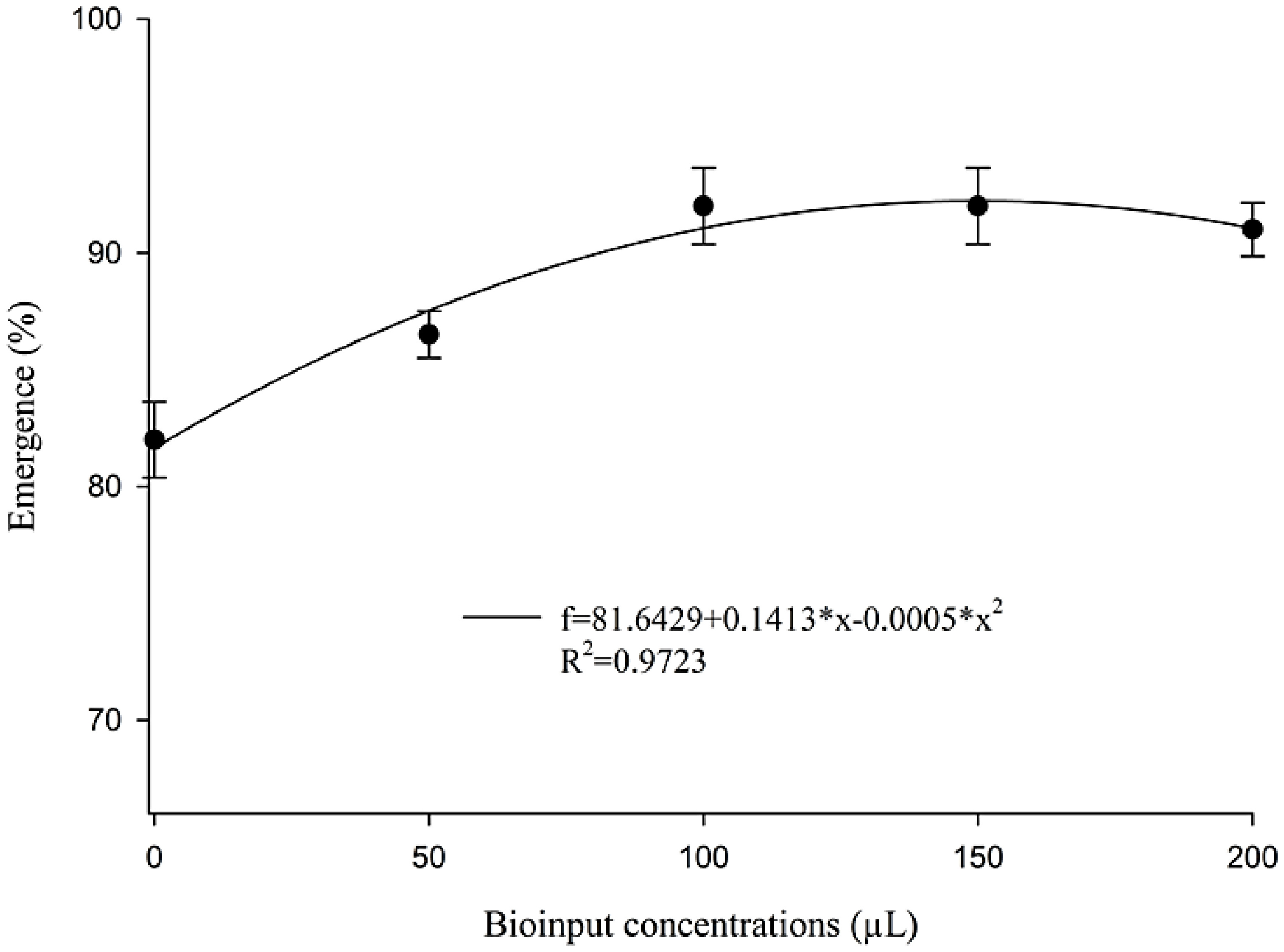
Soybean seedling emergence was influenced by the bioinput concentrations, exhibiting a quadratic behavior across the tested doses. The maximum emergence point was estimated at 141.3 µL, corresponding to 91.6% emergence, as calculated through the critical point of the regression equation. The observed values showed a progressive increase up to the doses of 100 and 150 µL, with emergence of approximately 91.0% and 91.5%, respectively, followed by a slight reduction at the dose of 200 µL (90.5%) (Figure 1).
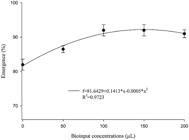
Emergence of soybean seedlings in substrate with bioinput based on Bacillus spp. at concentrations of 0; 50; 100; 150 and 200 μL. The asterisk indicates significance for p < 0.05 by the t-test.
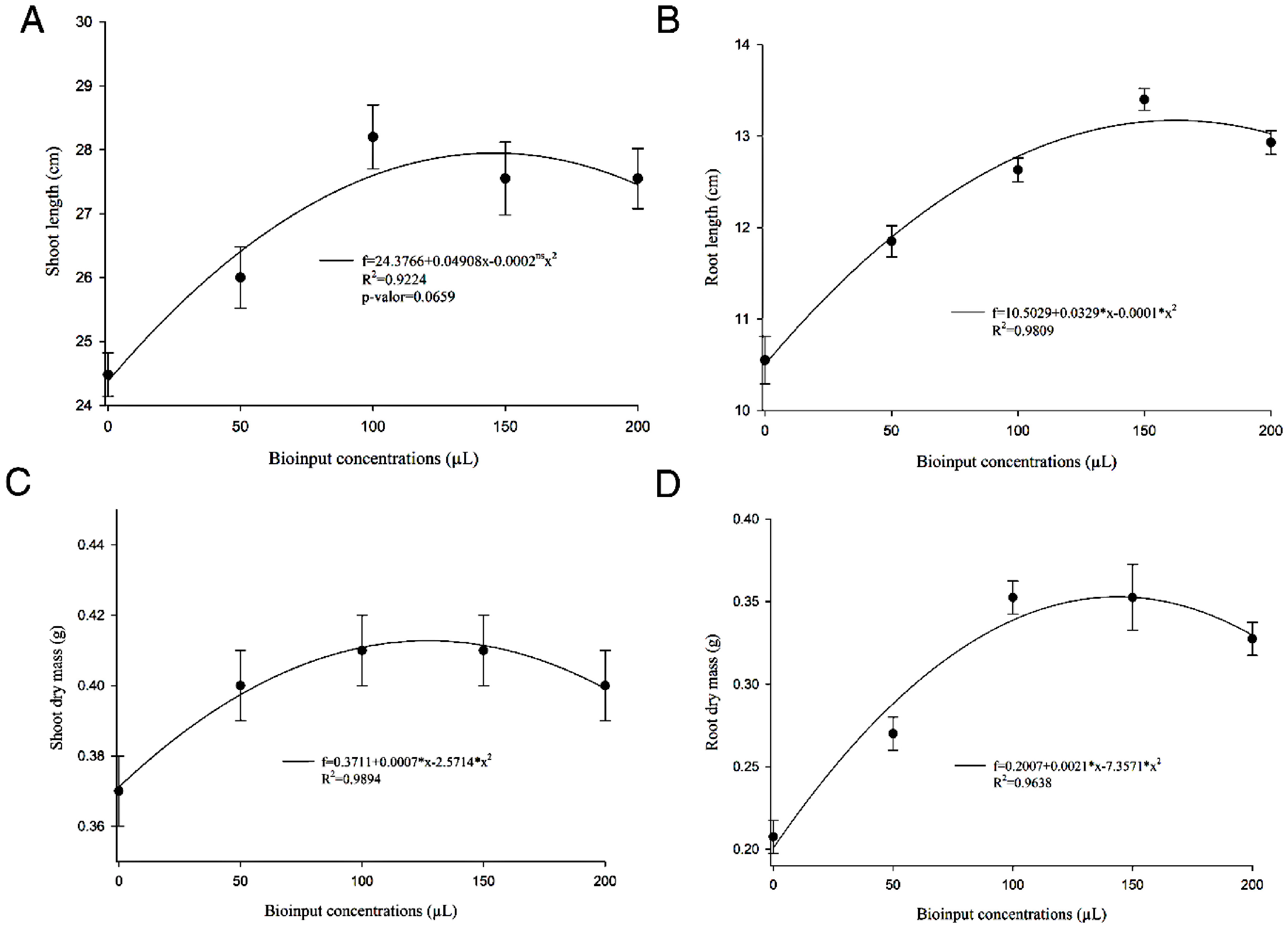
The variables shoot length (A), shoot dry mass (C), and root dry mass (D) showed a pattern similar to emergence (Figure 2), with the maximum point reached between doses of 100 to 150 µL, followed by a decline at the dose of 200 µL. Shoot length reached its estimated maximum point at 122.7 µL (27.4 cm), while for shoot dry mass and root dry mass, the estimated doses for maximum response were 136.1 µL (0.4188 g) and 142.7 µL (0.3506 g), respectively. Regarding root length (B), the maximum response was at 164.5 µL (13.2 cm), but it also showed a reduction at the dose of 200 µL.
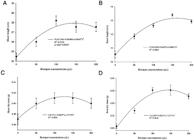
Shoot length (A); root length (B); shoot dry mass (C); and root dry mass (D) of soybean seedlings grown in substrate with bioinput based on Bacillus spp., at concentrations of 0; 50; 100; 150 and 200 μL. The asterisk indicates significance for p < 0.05 by the t-test; ns: not significant for p > 0.10.
3.2. Imaging fluorescence and seedling gas Exchange
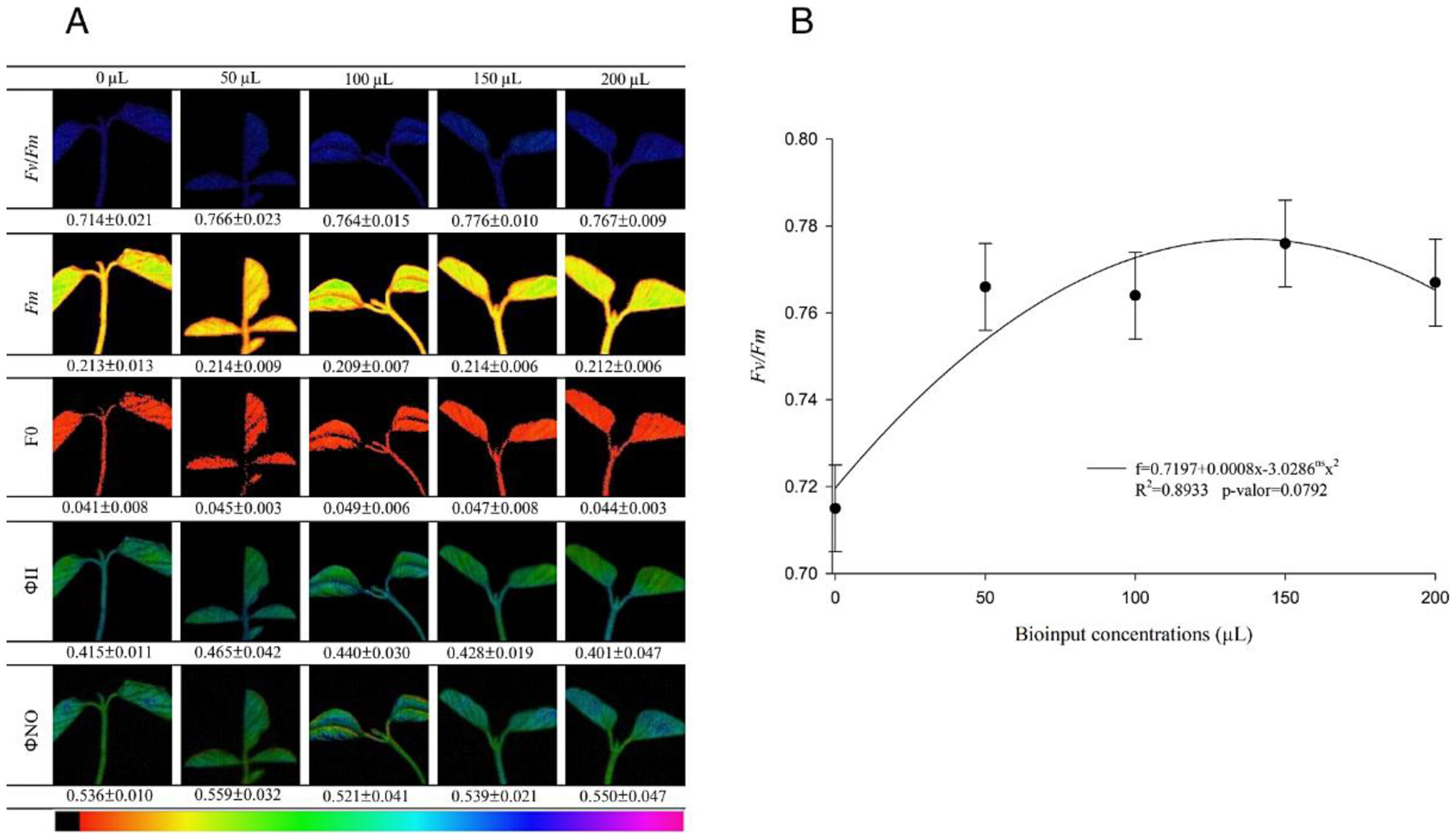
The potential quantum yield of PSII (Fv/Fm) (Figure 3B) was the only variable that showed differences among the doses, reaching its maximum at the estimated dose of 132.07 µL, with a peak of 0.77, followed by a decline. For the remaining variables, maximum fluorescence (Fm), minimum fluorescence (F0), effective quantum yield of PSII (ΦII), and quantum yield of non-regulated energy dissipation of PSII (ΦNO) (Figure 3A), the bioinput doses did not influence the observed mean values.

Minimum fluorescence (F0), maximum fluorescence (Fm), variation of the potential quantum yield of PSII (Fv/Fm), effective quantum yield of PSII (ΦII) and unregulated energy dissipation quantum yield of PSII (ΦNO) in soybean seedlings 12 days after sowing in substrate with bio-input based on Bacillus spp., at concentrations of 0; 50; 100; 150 and 200 μL (A); Variation of the potential quantum yield of PSII (Fv/Fm) as a function of different doses of bioinput (B). The asterisk indicates significance for p < 0.05 by the t-test; ns: not significant for p > 0.10.
For the analysis of gas exchange (Table 1), the data indicated that the bioinput doses did not cause significant changes in the evaluated parameters, as the mean values (± standard error) remained statistically homogeneous across all tested concentrations.
Transpiration rate (E); stomatal conductance (gs); and photosynthetic rate (A) in soybean seedlings 12 days after sowing in substrate with concentrations of 0; 50; 100, 150 and 200 μL of bio-input based on Bacillus spp.
3.3. Evaluation of anatomical and histochemical changes in soybean leaves
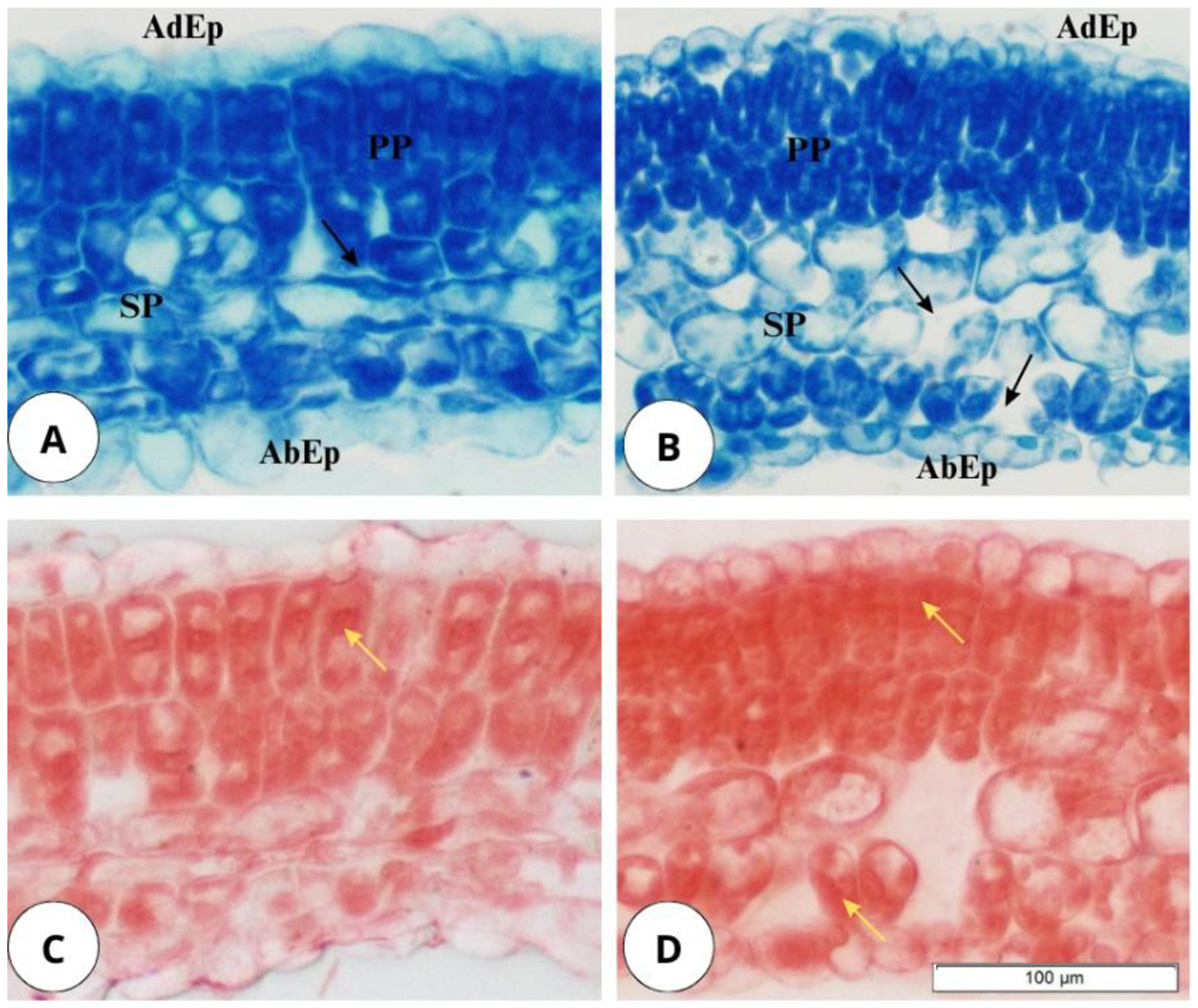
Soybean leaves possess an epidermis with rounded cells, where the cells on the adaxial surface are larger than those on the abaxial surface. The mesophyll is dorsiventral, featuring palisade parenchyma composed of two to three layers of elongated, cylindrical, and juxtaposed cells, situated beneath the adaxial epidermis (Figure 4A). The spongy parenchyma, in turn, consists of irregularly shaped and narrow cells, with intercellular spaces predominantly located near the abaxial epidermis (Figure 4B). In the leaves of seedlings grown in a bioinput-containing substrate (Figure 4B), an increase in intercellular spaces was observed within the spongy parenchyma cells. Conversely, in the leaves of control soybeans, a reduction in Xylidine Ponceau (XP) labeling was noted (Figure 4C), indicating a lower accumulation of protein compounds when compared to the leaves of soybeans grown in a substrate with 150 μL of bioinput (Figure 4D).
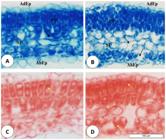
Leaf anatomy of soybean seedlings grown in a Bacillus spp. based bioinput at concentrations of 0 and 150 μL. Toluidine blue staining was performed for structural characterization (A and B). Xylidine staining was performed for protein identification (C and D). Control seedlings (A and D) and (B and C) grown in a substrate with 150 μL of bioinput. AdEp, adaxial epidermis; AbEp, abaxial epidermis; PP, palisade parenchyma; SP, spongy parenchyma. Black arrows indicate increased intracellular spaces. Yellow arrows indicate protein compounds. Scale bar: 100 µm.
3.4. Correlation between the doses applied and the variables analyzed
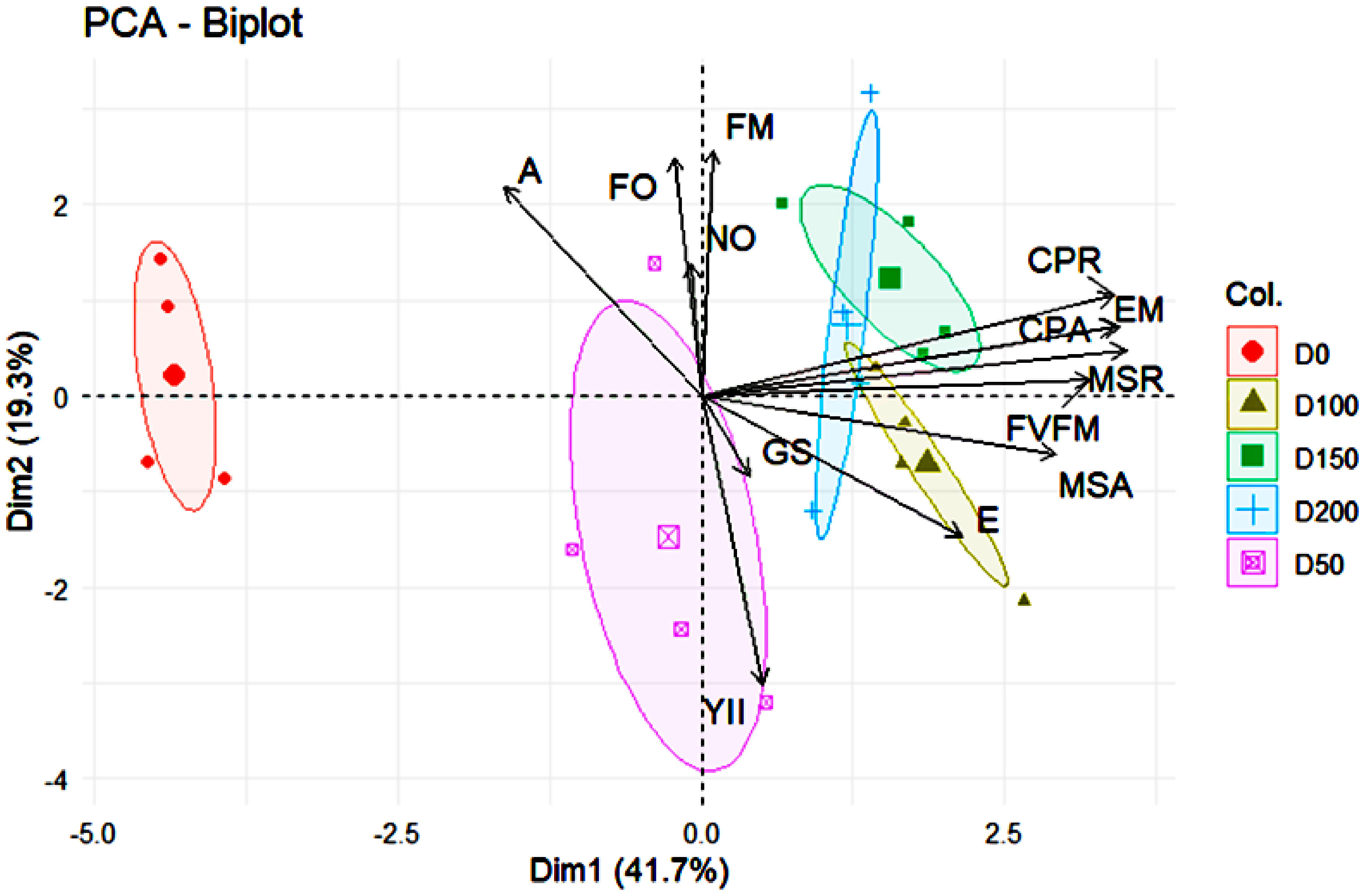
Principal component analysis (PCA) of the treatments and the 14 variables (Figure 5) revealed that PC1 (41.7%) and PC2 (19.3%) together explained 61% of the total accumulated variance. A correlation was observed among the vegetative development variables: root length (RL), shoot length (SL), emergence (EM), root dry mass (RDM), and shoot dry mass (SDM), associated with the potential quantum yield of PSII (Fv/Fm), transpiration rate (E), and stomatal conductance (gs), particularly at doses of 100, 150, and 200 μL.
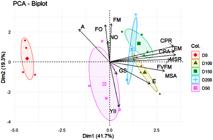
Principal component analysis (PCA) of vigor and physiology variables of soybean seedlings, emergence (EM), shoot length (CA), root length (CR), shoot dry mass (MA), root dry mass (MR), potential quantum yield of PSII (Fv/Fm), initial fluorescence (F0), effective quantum yield of PSII (ΦII), quantum yield of unregulated energy dissipation of PSII (ΦNO), maximum fluorescence (Fm), for gas exchange, photosynthetic rate (A), stomatal conductance (gs) and transpiration rate (E) in response to different concentrations of Bacillus spp. based bioinput in the substrate.
However, no significant relationship was detected with the variables effective quantum yield (ΦII), photosynthetic rate (A), minimum fluorescence (F0), maximum fluorescence (Fm), and non-regulated energy dissipation (ΦNO), which formed an independent axis from the applied concentrations.
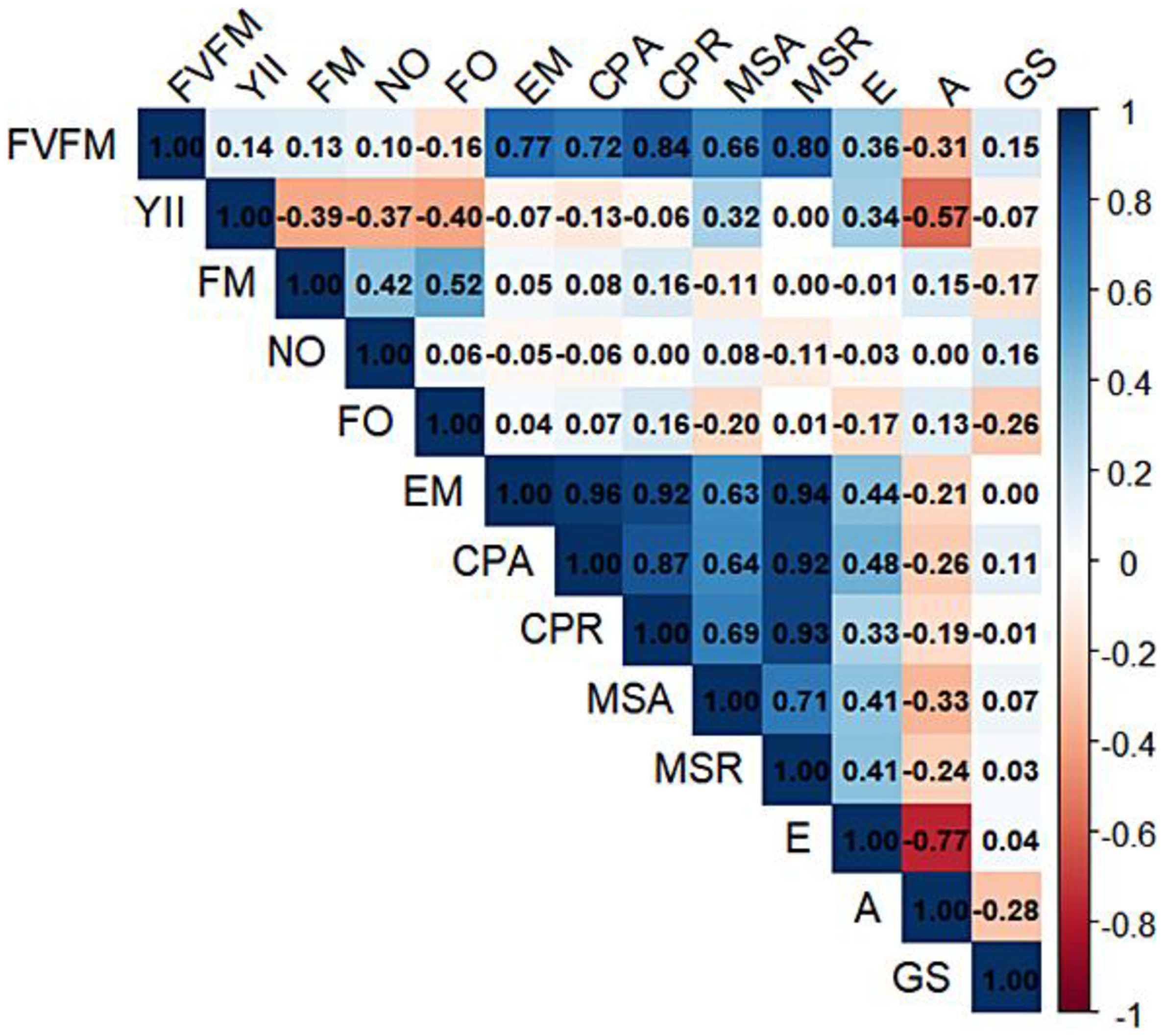
Pearsons correlation analysis (Figure 6) indicates a strong association between the potential quantum yield of PSII (Fv/Fm) and the variables emergence (EM), shoot length (CA), root length (CR), shoot dry mass (MA), and root dry mass (MR), with coefficients greater than 0.6. Among these variables, the most positive correlation was with root length (CR), with a value of 0.84. The variable emergence (EM) also showed a positive correlation with shoot length (CA), root length (CR), and root dry mass (MR), with coefficients greater than 0.9, with the highest correlation observed with shoot length (CA), with a value of 0.96. In addition to these correlations, a positive correlation was also observed with shoot dry mass (MA), with a value of 0.63. The variable root length (CR), in turn, showed a strong correlation with root dry mass (MR), with a value of 0.93.
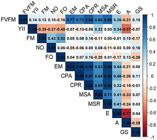
Pearson matrix of physiological quality data from soybean seedlings, emergence (EM), shoot length (CA), root length (CR), shoot dry mass (MA), shoot dry mass (MR), image fluorescence data, potential quantum yield of PSII (Fv/Fm), initial fluorescence (F0), effective quantum yield of PSII (ΦII), unregulated energy dissipation quantum yield of PSII (ΦNO), maximum fluorescence (Fm), for gas exchange, photosynthetic rate (A), stomatal conductance (gs) and transpiration rate (E). In response to different concentrations of Bacillus spp. based bio-input without substrate.
Regarding negative correlations, they were observed in the effective quantum yield of PSII (YII) with all variables, with the highest correlation being with the photosynthetic rate (A), with a value of -0.57. In addition, the transpiration rate (E) variable presented the highest negative correlation of the set, this correlation also being with the photosynthetic rate (A), with a value of -0.77.
4. Discussion
Doses between 100 and 150 µL provided the highest values for emergence, shoot length, shoot dry mass, and root dry mass. For root length, the maximum point was estimated at 164.5 µL, a dose higher than the optimal range for the other variables. This enhanced performance can be attributed to the ability of Bacillus spp. to promote plant growth (Etesami et al., 2023) by utilizing exudates released by plant roots (Valencia-Marin et al., 2024), thereby expanding the root absorption area. Additionally, the production of phytohormones such as auxins (Valencia-Marin et al., 2024) further contributes to this process by promoting cell division and elongation (Cortazar-Murillo et al., 2023).
Root and shoot dry matter are intrinsically correlated with plant growth in length (Figures 2A-D). A more developed root system provides a larger absorption area, consequently enhancing the capacity to acquire nutrients and water (Walne and Reddy, 2022). These resources are transported via xylem to the shoot, where they serve as substrates for the synthesis of new tissues (Taiz et al., 2017). This process results in increased total biomass, thereby contributing to overall plant growth.
In studies conducted by Xu et al. (2022) under controlled cultivation conditions, the bacterium B. aryabhattai significantly increased the dry mass of Arabidopsis plants by 135% compared to the control. In Cicer arietinum (chickpea), even under biotic stress caused by a pathogenic fungus, B. thuringiensis strains inhibited fungal activity and increased root biomass (Fátima et al., 2023). Similarly, in Zea mays (corn) grown in nutrient-deficient soil, three Bacillus species significantly enhanced total plant biomass, as well as root and shoot length (Sousa et al., 2021).
The potential quantum yield of PSII (Fv/Fm) is an indicator of the plant protection system. Values close to 0.83 are considered ideal for most plant species (Björkman and Demmig, 1987), reflecting a functional PSII without oxidative damage. In this study, treatments with bio-inputs showed values close to the ideal, reaching a maximum at the estimated dose of 132.07 µL, with a peak of 0.77. This result demonstrates that inoculation with Bacillus spp. did not cause any detriment or negative alteration in the photosynthetic machinery of the seedlings. Similar positive results, although obtained under stress, were elucidated by Al-Shammari et al. (2024), in which Fv/Fm values were higher in soybean plants cultivated with Bacillus under water stress conditions. For Olea europaea (Olive) plants subjected to drought and salinity stress, the same result was achieved, with the plants treated with the bacteria reaching optimal values and the control remaining with low values (Galicia-Campos et al., 2023), showing that Bacillus spp. is capable of protecting PSII.
In contrast to the bioinput's effect on PSII yield, no statistical differences were observed between doses for the other fluorescence variables (ΦII, ΦNO, F0, Fm) and gas exchange parameters (A, gs, E). This indicates that the bioinput did not directly influence photosynthetic efficiency or stomatal regulation. These results suggest that the seedlings may have allocated resources toward initial development, such as root establishment, leading to reduced investment in the photosynthetic system at this stage.
Thus, it is evident that the bioinput acted preferentially to protect PSII, without altering photosynthesis in developing leaves. This pattern is consistent with immature leaves, which have limited photosynthetic and photorespiration rates (Yang et al., 2019). The preferential allocation of resources to root development is evidenced by the increase in root length (Figure 2B), which may explain the stability in gas exchange, given that established seedlings can prioritize nutrient uptake (Cabeza et al., 2024).
Bacillus spp. can stimulate increased accumulation of molecules in leaf tissues, leading to anatomical modifications. In the present study, alterations in the spongy parenchyma structure were observed, characterized by enlarged intercellular spaces (Figures 4A and 4B). This was accompanied by increased xylidine-stained area (Figures 4C and 4D), suggesting greater accumulation of protein compounds. These effects may be mediated by the ability of Bacillus spp. to synthesize phytohormones, enzymes, and secondary metabolites (Poveda and González-Andrés, 2021), resulting in modulation of the leaf anatomical arrangement.
These findings align with Yarullina et al. (2022), who reported that a B. subtilis strain, in combination with salicylic and jasmonic hormones, increased the abundance of 14 stress response-related proteins in Solanum tuberosum (potato) leaves. Proteins play a crucial role in plant growth (Taiz et al., 2017), being continuously synthesized and secreted during this stage, while the cell wall expands and prepares for cell division.
The multivariate grouping of vigor variables CA, CR, EM, MA, and MR with Fv/Fm (Figure 5), along with the positive correlations among these parameters (Figure 6), indicates that the bioinput enhanced both photochemical efficiency and vegetative growth. These results are consistent with Ozfidan-Konakci et al. (2023), who demonstrated that B. pumilus improved growth and increased the potential quantum yield of PSII (Fv/Fm) in Triticum aestivum (wheat) plants under combined saline and arsenic stress.
5. Conclusion
Based on the results, using a substrate inoculated with a Bacillus spp. based bioinput can improve the vigor of soybean seedlings. This was observed through enhanced emergence, greater length, and increased dry mass. These results were more evident at concentrations between 100 and 150 μL. However, further studies are needed to confirm these effects under real-world field conditions.
Acknowledgements
The authors thank the Federal Institute of Education, Science and Technology Goiano (IFGoiano) - Rio Verde Campus, the Graduate Program in Agricultural Sciences - Agronomy (PPGCA-AGRO), the Goiás State Research Support Foundation (FAPEG), and the Coordination for the Improvement of Higher Education Personnel (CAPES) for granting a master's research scholarship, process number 202310267001076, notice 38/2022.
Data Availability Statement
The entire data set supporting the results of this study was published in the article itself.
References
-
ADEDAYO, A.A., BABALOLA, O.O., PRIGENT-COMBARET, C., CRUZ, C., STEFAN, M., KUTU, F. and GLICK, B.R., 2022. The application of plant growth-promoting rhizobacteria in Solanum lycopersicum production in the agricultural system: a review. PeerJ, vol. 10, e13405. https://doi.org/10.7717/peerj.13405 PMid:35669957.
» https://doi.org/10.7717/peerj.13405 -
AL-SHAMMARI, W.B., AL-HUQUIL, A.A., ALSHAMMERY, K., LOTFI, S., ALTAMIMI, H., ALSHAMMARI, A., AL-HARBI, N.A., RASHED, A.A. and ABDELAAL, K., 2024. Alleviation of drought stress damages by melatonin and Bacillus thuringiensis associated with adjusting photosynthetic efficiency, antioxidative system, and anatomical structure of Glycine max (L.). Heliyon, vol. 10, no. 14, e34754. https://doi.org/10.1016/j.heliyon.2024.e34754 PMid:39149001.
» https://doi.org/10.1016/j.heliyon.2024.e34754 -
BAGALE, S., 2021. Nutrient management for soybean crops. International Journal of Agronomy, vol. 2021, no. 1, pp. 3304634. https://doi.org/10.1155/2021/3304634
» https://doi.org/10.1155/2021/3304634 -
BJÖRKMAN, O. and DEMMIG, B., 1987. Photon yield of O2 evolution and chlorophyll fluorescence characteristics at 77 K among vascular plants of diverse origins. Planta, vol. 170, no. 4, pp. 489-504. https://doi.org/10.1007/BF00402983 PMid:24233012.
» https://doi.org/10.1007/BF00402983 -
BLAKE, C., CHRISTENSEN, M.N. and KOVÁCS, Á.T., 2021. Molecular aspects of plant growth promotion and protection by Bacillus subtilis Molecular Plant-Microbe Interactions: MPMI, vol. 34, no. 1, pp. 15-25. https://doi.org/10.1094/MPMI-08-20-0225-CR PMid:32986513.
» https://doi.org/10.1094/MPMI-08-20-0225-CR -
BRASIL. Ministério da Agricultura, Pecuária e Abastecimento. Secretaria de Defesa Agropecuária, 2025 [viewed 10 July 2025]. Regras para análise de sementes – RAS [online]. Brasília: MAPA. Available from: https://wikisda.agricultura.gov.br/ptbr/Laborat%C3%B3rios/Metodologia/Sementes/RAS_2024
» https://wikisda.agricultura.gov.br/ptbr/Laborat%C3%B3rios/Metodologia/Sementes/RAS_2024 -
CABEZA, A., CASAS, A.M., LARRUY, B., COSTAR, M.A., MARTÍNEZ, V., CONTRERAS-MOREIRA, B. and IGARTUA, E., 2024. Genetic control of root/shoot biomass partitioning in barley seedlings. Frontiers in Plant Science, vol. 15, pp. 1408043. https://doi.org/10.3389/fpls.2024.1408043 PMid:39687309.
» https://doi.org/10.3389/fpls.2024.1408043 -
CORTAZAR-MURILLO, E.M., MÉNDEZ-BRAVO, A., MONRIBOT-VILLANUEVA, J.L., GARAY-SERRANO, E., KIEL-MARTÍNEZ, A.L., RAMÍREZ-VÁZQUEZ, M., GUEVARA-AVENDAÑO, E., MÉNDEZ-BRAVO, A., GUERRERO-ANALCO, J.A. and REVERCHON, F., 2023. Biocontrol and plant growth promoting traits of two avocado rhizobacteria are orchestrated by the emission of diffusible and volatile compounds. Frontiers in Microbiology, vol. 14, pp. 1152597. https://doi.org/10.3389/fmicb.2023.1152597 PMid:37206331.
» https://doi.org/10.3389/fmicb.2023.1152597 -
DAME, Z.T., RAHMAN, M. and ISLAM, T., 2021. Bacilli as sources of agrobiotechnology: recent advances and future directions. Green Chemistry Letters and Reviews, vol. 14, no. 2, pp. 246-271. https://doi.org/10.1080/17518253.2021.1905080
» https://doi.org/10.1080/17518253.2021.1905080 -
ETESAMI, H., JEONG, B.R. and GLICK, B.R., 2023. Potential use ofBacillusspp. as an effective biostimulant against abiotic stresses in crops: a review. Current Research in Biotechnology, vol. 5, pp. 1-25. https://doi.org/10.1016/j.crbiot.2023.100128
» https://doi.org/10.1016/j.crbiot.2023.100128 -
FATIMA, R., MAHMOOD, T., MOOSA, A., ASLAM, M.N., SHAKEEL, M.T., MAQSOOD, A., SHAFIQ, M.U., AHMAD, T., MOUSTAFA, M. and AL-SHEHRI, M., 2023. Bacillus thuringiensis CHGP12 uses a multifaceted approach for the suppression of Fusarium oxysporum f. sp. ciceris and to enhance the biomass of chickpea plants. Pest Management Science, vol. 79, no. 1, pp. 336-348. https://doi.org/10.1002/ps.7203 PMid:36153706.
» https://doi.org/10.1002/ps.7203 -
FOOD AND AGRICULTURE ORGANIZATION OF THE UNITED NATIONS – FAO, 2025 [viewed 1 April 2026]. FAOSTAT: production/crops and livestock products [online]. Available from: https://www.fao.org/faostat/en/#data/QCL
» https://www.fao.org/faostat/en/#data/QCL -
FINCH-SAVAGE, W.E. and BASSEL, G.W., 2016. Seed vigour and crop establishment: extending performance beyond adaptation. Journal of Experimental Botany, vol. 67, no. 3, pp. 567-591. https://doi.org/10.1093/jxb/erv490 PMid:26585226.
» https://doi.org/10.1093/jxb/erv490 -
GALICIA-CAMPOS, E., GARCÍA-VILLARACO, A., MONTERO-PALMERO, M.B., GUTIÉRREZ-MAÑERO, F.J. and RAMOS-SOLANO, B., 2023. Bacillus G7 improves adaptation to salt stress in Olea europaea L. plantlets, enhancing water use efficiency and preventing oxidative stress. Scientific Reports, vol. 13, no. 1, pp. 22507. https://doi.org/10.1038/s41598-023-49533-z PMid:38110443.
» https://doi.org/10.1038/s41598-023-49533-z -
GENTY, B., BRIANTAIS, J.M. and BAKER, N.R., 1989. The relationship between the quantum yield of photosynthetic electron transport and quenching of chlorophyll fluorescence. Biochimica et Biophysica Acta. General Subjects, vol. 990, no. 1, pp. 87-92. https://doi.org/10.1016/S0304-4165(89)80016-9
» https://doi.org/10.1016/S0304-4165(89)80016-9 -
HENDRICKSON, L., FÖRSTER, B., FURBANK, R.T. and CHOW, W.S., 2004. Processes contributing to photoprotection of grapevine leaves illuminated at low temperature. Physiologia Plantarum, vol. 121, no. 2, pp. 272-281. https://doi.org/10.1111/j.0031-9317.2004.0324.x PMid:15153195.
» https://doi.org/10.1111/j.0031-9317.2004.0324.x - KARNOVSKY, M.J.A., 1965. Formaldehyde-glutaraldehyde fixative of high osmolarity for use in electron microscopy. The Journal of Cell Biology, vol. 7, pp. 137-138.
- KRAUS, J.E. and ARDUIN, M., 1997. Basic manual of methods in plant morphology Seropédica: EDUR.
-
LOPES, M.J.S., DIAS-FILHO, M.B. and GURGEL, E.S.C., 2021. Successful plant growth-promoting microbes: inoculation methods and abiotic factors. Frontiers in Sustainable Food Systems, vol. 5, pp. 1-13. https://doi.org/10.3389/fsufs.2021.606454
» https://doi.org/10.3389/fsufs.2021.606454 -
LIU, J., FIMOGNARI, L., DE ALMEIDA, J., JENSEN, C.N.G., COMPANT, S., OLIVEIRA, T., BAELUM, J., PASTAR, M., SESSITSCH, A., MOELBAK, L. and LIU, F., 2023. Effect of Bacillus paralicheniformis on soybean (Glycine max) roots colonization, nutrient uptake and water use efficiency under drought stress. Journal Agronomy & Crop Science, vol. 209, no. 4, pp. 547-565. https://doi.org/10.1111/jac.12639
» https://doi.org/10.1111/jac.12639 -
LUO, L., ZHAO, C., WANG, E., RAZA, A. and YIN, C., 2022. Bacillus amyloliquefaciens as an excellent agent for biofertilizer and biocontrol in agriculture: an overview for its mechanisms. Microbiological Research, vol. 259, pp. 127016. https://doi.org/10.1016/j.micres.2022.127016 PMid:35390741.
» https://doi.org/10.1016/j.micres.2022.127016 - NAKAGAWA, J., 1999. Vigor tests based on seedling evaluation. In: F.C. KRZYZANOWSKI, R.D. VIEIRA, J.B. FRANÇA-NETO and J. MARCOS-FILHO, eds. Vigor de sementes: conceitos e testes Londrina: ABRATES.
-
O’BRIEN, T.P., FEDER, N. and MCCULLY, M.E., 1964. Polychromatic staining of plant cell walls by toluidine blue O. Protoplasma, vol. 59, no. 2, pp. 368-373. https://doi.org/10.1007/BF01248568
» https://doi.org/10.1007/BF01248568 - O’BRIEN, T.P. and MCCULLY, M.E., 1981. The study of plant structure principles and selected methods Melbourne: Termarcarphi Pty. Ltda.
-
OXBOROUGH, K. and BAKER, N.R., 1997. Resolving chlorophyll a fluorescence images of photosynthetic efficiency into photochemical and nonphotochemical components-calculation of qP and Fv-/Fm-; without measuring Fo. Photosynthesis Research, vol. 54, no. 2, pp. 135-142. https://doi.org/10.1023/A:1005936823310
» https://doi.org/10.1023/A:1005936823310 -
OZFIDAN-KONAKCI, C., ARIKAN, B., ALP-TURGUT, F.N., BALCI, M., UYSAL, A. and YILDIZTUGAY, E., 2023. Halotolerant plant growth-promoting bacteria, Bacillus pumilus, modulates water status, chlorophyll fluorescence kinetics and antioxidant balance in salt and/or arsenic-exposed wheat. Environmental Research, vol. 231, no. Pt 1, pp. 116089. https://doi.org/10.1016/j.envres.2023.116089 PMid:37172678.
» https://doi.org/10.1016/j.envres.2023.116089 -
PIRTTILÄ, A.M., MOHAMMAD PARAST TABAS, H., BARUAH, N. and KOSKIMÄKI, J.J., 2021. Biofertilizers and biocontrol agents for agriculture: how to identify and develop new potent microbial strains and traits. Microorganisms, vol. 9, no. 4, pp. 817. https://doi.org/10.3390/microorganisms9040817 PMid:33924411.
» https://doi.org/10.3390/microorganisms9040817 -
POVEDA, J. and GONZÁLEZ-ANDRÉS, F., 2021. Bacillus as a source of phytohormones for use in agriculture. Applied Microbiology and Biotechnology, vol. 105, no. 23, pp. 8629-8645. https://doi.org/10.1007/s00253-021-11492-8 PMid:34698898.
» https://doi.org/10.1007/s00253-021-11492-8 -
RAFIQUE, M., NAVEED, M., MUMTAZ, M.Z., NIAZ, A., ALAMRI, S., REHMAN, S., SIDDIQUI, M.H. and MUSTAFA, A., 2025. Tripartite microbial augmentation of Bradyrhizobium diazoefficiens, Bacillus sp. MN54, and Piriformospora indica on growth, yield, and nutrient profiling of soybean (Glycine max L.). Frontiers in Microbiology, vol. 15, pp. 1437489. https://doi.org/10.3389/fmicb.2024.1437489 PMid:40124387.
» https://doi.org/10.3389/fmicb.2024.1437489 -
SOUSA, S.M., OLIVEIRA, C.A., ANDRADE, D.L., CARVALHO, C.G., RIBEIRO, V.P., PASTINA, M.M., MARRIEL, I.E., LANA, U.G.P., GOMES, E.A., 2021. Tropical Bacillus strains inoculation enhances maize root surface area, dry weight, nutrient uptake and grain yield. Journal of Plant Growth Regulation, vol. 40, no. 2, pp. 867-877. https://doi.org/10.1007/s00344-020-10146-9
» https://doi.org/10.1007/s00344-020-10146-9 -
SUHARMAN, U.F., ULFA, F., PATANDJENGI, B., MANTJA, K. and SYAKUR, A., 2025. Plant growth-promoting bacteria isolated from shallot-cultivated karst soils: functional traits and potential applications. Brazilian Journal of Biology, vol. 85, e299484. https://doi.org/10.1590/1519-6984.299484 PMid:41880465.
» https://doi.org/10.1590/1519-6984.299484 -
STANIAK, M., SZPUNAR-KROK, E. and KOCIRA, A., 2023. Responses of soybean to selected abiotic stresses: photoperiod, temperature and water. Agriculture, vol. 13, no. 1, pp. 146. https://doi.org/10.3390/agriculture13010146
» https://doi.org/10.3390/agriculture13010146 - TAIZ, L., ZEIGER, E., MØLLER, I.M. and MURPHY, A., 2017. Plant physiology and development 6th ed. Porto Alegre: Artmed, 888 p.
-
VALENCIA-MARIN, M.F., CHÁVEZ-AVILA, S., GUZMÁN-GUZMÁN, P., OROZCO-MESQUITA, M.C., DE LOS SANTOS-VILLALOBOS, S., GLICK, B.R. and SANTOYO, G., 2024. Survival strategies of Bacillus spp. in saline soils: key factors to promote plant growth and health. Biotechnology Advances, vol. 70, pp. 108303. https://doi.org/10.1016/j.biotechadv.2023.108303 PMid:38128850.
» https://doi.org/10.1016/j.biotechadv.2023.108303 -
VEY, R.T., JACQUES, R.J.S., PAVINATO, P.S., LÓPEZ-BAENA, F.J., SPANEVELLO, J.F., BRONZATTO, E.S., FULANETI, F.S., SANTOS, R.E., BRUM, L.N. and MARTIN, T.N., 2025. Phosphate solubilization capacity by bacteria in soybean crops. Brazilian Journal of Biology, vol. 85, e289630. https://doi.org/10.1590/1519-6984.289630 PMid:40638407.
» https://doi.org/10.1590/1519-6984.289630 -
WALNE, C.H. and REDDY, K.R., 2022. Temperature effects on the shoot and root growth, development, ad biomass accumulation of corn (Zea mays L.). Agriculture, vol. 12, no. 4, pp. 443. https://doi.org/10.3390/agriculture12040443
» https://doi.org/10.3390/agriculture12040443 -
XU, H., GAO, J., PORTIELES, R., DU, L., GAO, X. and BORRAS-HIDALGO, O., 2022. Endophytic bacterium Bacillus aryabhattai induces novel transcriptomic changes to stimulate plant growth. PLoS One, vol. 17, no. 8, e0272500. https://doi.org/10.1371/journal.pone.0272500 PMid:35921359.
» https://doi.org/10.1371/journal.pone.0272500 -
YANG, Y.J., ZHANG, S.B., WANG, J.H. and HUANG, W., 2019. Photosynthetic regulation under fluctuating light in field-grown Cerasus cerasoides: a comparison of young and mature leaves. Biochimica et Biophysica Acta. Bioenergetics, vol. 1860, no. 11, pp. 148073. https://doi.org/10.1016/j.bbabio.2019.148073 PMid:31473302.
» https://doi.org/10.1016/j.bbabio.2019.148073 -
YARULLINA, L.G., TSVETKOV, V.O., KHABIBULLINA, V.O., CHEREPANOVA, E.A., BURKHANOVA, G.F., ZAIKINA, E.A. and KALATSKAYA, J.N., 2022. Impact of Bacillus subtilis bacteria in combination with salicylic and jasmonic acids on Changing the proteome of potato leaves when infected by Phytophthora infestans (Mont.) De Bary and with a moisture deficit. Russian Journal of Plant Physiology: a Comprehensive Russian Journal on Modern Phytophysiology, vol. 69, no. 4, pp. 81. https://doi.org/10.1134/S1021443722040215
» https://doi.org/10.1134/S1021443722040215
Edited by
-
Editor:
Takako Matsumura Tundisi