 Study in wood of Ceiba pentandra (L.) Gaertn. from planting: chemical constituents and their biological importance
Abstract
Ceiba pentandra (Malvaceae) is a species popularly known in North Brazil as “sumaúma” that has attracted interest in phytochemical studies due to the diversity of classes of compounds biologically active. The objective of this study was to investigate the chemical constituents present in the wood residues of Ceiba pentandra and to evaluate the antibacterial activity of a purified sesquiterpene lactone against Xanthomonas citri subsp. citri. The isolated compounds were identified based on one-dimensional (1H and 13C) and/or two-dimensional (HSQC and HMBC) NMR analyses, the mixtures of fatty acid were characterized by GC-MS. The chemical constituents identified were steroids (cholest-4-en-3-one, stigmast-4-ene-3,6-dione, β-sitosterol, and stigmasterol); macrolides (des-O-methyl-lasiodiplodine and lasiodiplodine); isocoumarin (4-hydroxymelein); sesquiterpene lactone (isohemigosilicic acid lactone-2-methyl ether); and a mixture of fatty acids (palmitic acid, oleic acid, stearic acid, linoleic acid, and dihydrosterculic acid). The sesquiterpene lactone was evaluated against the bacterium Xanthomonas citri ssp. citri and demonstrated bactericidal and bacteriostatic activities at concentrations up to 400 µg mL-1. Our phytochemical study aggregated knowledge of this wood species originated from plantation sites and found activity bactericide to combat citrus canker.
Keywords:
macrolides; fatty acid; NMR; citrus canker; Malvaceae
Resumo
Ceiba pentandra (Malvaceae), popularmente conhecida no Norte do Brasil como “sumaúma” tem despertado interesse nos estudos fitoquímicos devido à diversidade de classes de compostos biologicamente ativos. O objetivo desse estudo foi investigar os constituintes químicos dos resíduos madeireiros de C. pentandra e avaliar a atividade antibacteriana de uma lactona sesquiterpênica purificada contra Xanthomonas citri subsp. citri. Os compostos isolados foram identificados com base nas análises de RMN unidimensional (1H e 13C) e/ou bidimensional (HSQC e HMBC), as misturas de ácidos graxos foram caracterizadas por GC-EM. Os constituintes químicos identificados foram os esteroides (colest-4-en-3-ona, estigmast-4-eno-3,6-diona, β-sitosterol e estigmasterol); macrolídeos (des-O-metil-lasiodiplodina e lasiodiplodina); isocumarina (4-hidroximeleína); lactona sesquiterpênica (ácido isohemigossílico lactona-2-metil éter); mistura de ácidos graxos (ácido palmítico, ácido oleico, ácido esteárico, ácido linoleico e dihidroestercúlico). O sesquiterpeno lactona foi avaliado frente a bactéria Xanthomonas citri ssp. citri e demostrou atividades bactericida e bacteriostática em concentrações de até 400 µg.mL-1. Nosso estudo fitoquímico agregou conhecimento sobre essa espécie de madeira originária de áreas de plantio e encontrou atividade bactericida no combate ao cancro cítrico.
Palavras-chave:
macrolídeos; ácido graxo; RMN; cancro cítrico; Malvaceae
1. Introduction
The species Ceiba pentandra (L.) Gaertn., belonging to the Malvaceae family, is known in the Amazon region as "sumaúma" or "samaúma," where it is called by indigenous peoples the "mother of trees" these trees reach dimensions close to 60 meters in height and 3 meters in diameter, making it one of the largest trees in Brazil (Carvalho, 2008). Presents basais tubulares roots known as “sapopemas” (from Tupi, meaning “flat root”), which are used as shelters by indigenous and riverine dwellers of the Amazon region (Souza et al., 2005). The roots produce sounds that resonate over long distances when touched like this, indigenous peoples use these touches to communicate with each other (Cantalice et al., 2020). It is considered a fast-growing tree with reproduction occurring mainly by cross-pollination. One of its propagation methods is seed dispersal by wind. This occurs when the fruit capsule falls to the ground and ruptures, releasing a mass of cotton-like fiber (known as “kapok”) that contains the seeds (Gribel et al., 1999).
The wood of “sumaúma” has a low basic density (0.32 to 0.34 g.cm-3) (Freitas and Vasconcellos, 2010) and is widely used in the production of plywood panels in the Brazilian Amazon, with high commercial value. In the Amazon, the species' habitat is terra firme forest and flooded areas and has been identified as having potential for planting in region Amazon, especially in agroforestry systems. Souza et al., (2010) evaluated native and exotic forest species in terra firme under full-sun planting conditions and found that C. pentandra stood out among the forest species with the best results in growth (height and diameter) and volume production indicating its high potential for timber purposes under these conditions, thus being considered one of the promising native species for commercial planting in the region.
Phytochemical studies reported on native specimens of C. pentandra demonstrate the diversity of secondary metabolites in different vegetative parts, such as fatty acids of seeds, fruits and leaves (Kaimal and Lakshminarayana, 1970; Kiran and Rao, 2014; Abouelela et al., 2018), steroids of bark, stem bark and leaves (Nelly et al., 2025; Onuh et al., 2024; Abouelela et al., 2018), triterpenes of bark and leaves (Nelly et al., 2025; Abouelela et al., 2018), sesquiterpenes of root bark and heartwood (Rao et al., 1993; Kishore et al., 2003), xanthones of inflorescences (Taiwo et al., 2024), flavonoids of leaves and stem bark (Aderogba et al., 2013; Onuh et al., 2024; Ngounou et al., 2000; Ueda et al., 2002; Nelly et al., 2025; Noreen et al., 1998), flavanolignans of aerial parts (Abouelela et al., 2020), as well as phenolic acids of bark stem and leaves (Nelly et al., 2025; Onuh et al., 2024; Aderogba et al., 2013).
In this paper, we present the results of a phytochemical study on C. pentandra wood from planting and antibacterial activity against Xanthomonas citri subsp. citri, the etiological agent of citrus canker.
2. Material and Methods
2.1. General methods
Nuclear Magnetic Resonance (NMR) was measured using spectrometers (Bruker Fourier-300; Bruker Avance- 400 MHz; Bruker Avance IIIHD- 500 MHz); chemical shifts (δ) were expressed in ppm and coupling constants (J) in Hertz. Gas chromatograph (GC) (Nexis GC2030, GCMS-QP2020 NX, Shimadzu). Column chromatography (CC) was performed with a silica gel 60 (230-400 mesh (Sigma-Aldrich, Gallen Switzerland) and Sephadex LH-20 (Sigma-Aldrich, Gallen Switzerland). Analytical TLC was performed with silica gel 60 F254 (0.25 mm) pre-coated aluminum sheets (Merck, Darmstadt, Germany) visualized using UV light (254 and 365 nm) and vanillin-sulfuric acid spray. Deuterium solvent (Merck, Darmstadt, Germany). Easydry-type microwave oven (Wu M. Gobler, capacity 0.7 m3).
2.2. Acquisition of woody residues, identification and drying
Ceiba pentandra was planted in 1992 at the Embrapa experimental research station in Manaus, Amazonas. The plantation was part of an experiment called "full-sun forest species trial in a terra firme ecosystem," which included 13 other species. The seedlings were planted at 3x3 m spacing, in four plots of 25 plants each. Wood samples from a specimen of plantation about 25 years old (SISGEN number A42EE82) were obtained from Embrapa Ocidental (2°53'36.3" S 59°58'23.0" W) and identified by comparison with samples available in the xylotheque of the National Institute for Amazonian Research (INPA). The wood residues were subjected to drying in a microwave oven of the Easydry type (Wu M. Gobler), with a capacity of 0.7 m3.
2.3. Extraction and isolation
The samples (1.2 kg) of Ceiba pentandra were ground and subjected to extraction with hexane and then with methanol for a period of 7 days at room temperature. The methanol extract (3.02 g) was fractionated over silica gel in a column (230-400 mesh; h (height) × Ø (diameter) = 25 X 2.5 cm) and eluted with hexane, hex:EtOAc and EtOAc yielding thirty-two fractions. Fraction 11 was fractionated over silica gel in the column (230-400 mesh; h X Φ = 21.5 X 0.6 cm) and eluted with CH2Cl2 resulting in the purification of compound 1 (2.3 mg). Fractions 12 (14.6 mg), 14 (23 mg), 16 (128 mg), 17 (94.2 mg), 18 (52 mg) and 21 (39.6 mg) were subjected to complementary chromatographic procedures. Fr. 12 was subjected to silica gel in column chromatography (230-400 mesh; h X Φ =15.2 X 0.6 cm), eluted with hex:EtOAc (7:3) to give compound 2 (4 mg). Fr. 14 was recrystallized in cold acetone to give compounds 3a and 3b (2.2 mg), and then the mother liquor, after drying, was chromatographed over a silica gel column (230-400 mesh; h X Φ =30 X 1.5 cm), eluted with CH2Cl2: EtOAc (98:2), which resulted in 15 sub-fractions. Sub-fraction 5 (5.4 mg) was fractionated over silica gel in a column (230-400 mesh; h X Φ =6.5 X 0.4 cm), eluted with CH2Cl2:EtOAc (98:2) to give compound 4 (3.5 mg). Fractions 15 to 22 (422.8 mg) showed a predominance of fatty acids in their composition, however, only fractions 16, 17, 18, and 21 were subjected to purification. Fr. 16 was chromatographed over Sephadex LH-20 (h X Φ =38.5 X 2.4 cm) and eluted with MeOH to give a mixture of fatty acids 5 (89.3 mg). Fr. 17 was fractionated over silica gel in a column (230-400 mesh; h X Φ = 38 X 1.8 cm) and eluted with CH2Cl2 resulting in 35 sub-fractions. Sub-fraction 11 provided the mixture of fatty acids 6 (50.4 mg) and sub-fraction 17 was recrystallized in cold hexane to give compound 7 (2.6 mg). Fractionation of fraction 18 over silica gel in the column (230-400 mesh; h X Φ = 38 X 1.3 cm), eluted with CH2Cl2:MeOH (98:2) resulted in the purification of compound 8 (3.6 mg). Fr. 21 was fractionated over silica gel in a column (230-400 mesh; h X Φ = 36 X 1.2 cm), eluted with CH2Cl2: EtOAc (98:2) to give compound 9 (1.5 mg).
2.4. Gas chromatography-mass spectrometry analyses
The analyses of the mixture of fatty acids were performed at a concentration of 1 mg/mL in hexane with a GC equipped with a split-splitless injector and an auto sampler. The fatty acid methyl esters (FAMEs) were separated using a fused silica capillary column SHRTx-5Sil-MS (30 m length, 0.25 mm internal diameter and 0.25 µm film thickness). Helium was used as carrier gas at 2 mL/min. Injection temperature was 260 °C, split mode, 1 µL, and the mass spectrometer ion source and interface temperatures were 230 and 280 °C, respectively. The chromatographic analysis started at 50 °C and increased at 20 °C/min until reaching 210 °C, where it remained for 18 min, and then increased to 230 °C at 20 °C/min and was maintained for 13 min. The total running time was 40 min. The mass spectra were obtained by electronic impact at 70 eV. Identification of the fatty acids was via the WILEY 275 and National Institute of Standards and Technology (NIST 3.0) databases.
The fatty acid profile samples were analyzed after derivatization to FAMEs. Thus, 20 mg of samples were mixed with 0.5 mL of chloroform:methanol (2:1; v/v) and 1 mL of 0.1 M NaOH in methanol. This mixture was heated to 60 °C for 30 min and then the reaction was stopped with the addition of 0.2 mL of distilled water, and the FAMEs formed were extracted with the addition of 1 mL of hexane. After stirring, the mixture was decanted and the isolated upper phase was collected, according to the methodology of Vasquez et al. (2021) with modifications. The procedure was repeated with the lower phase to recover the remaining FAMEs, and was shaken and left to stand for 30 min.
2.5. In vitro antibacterial assay
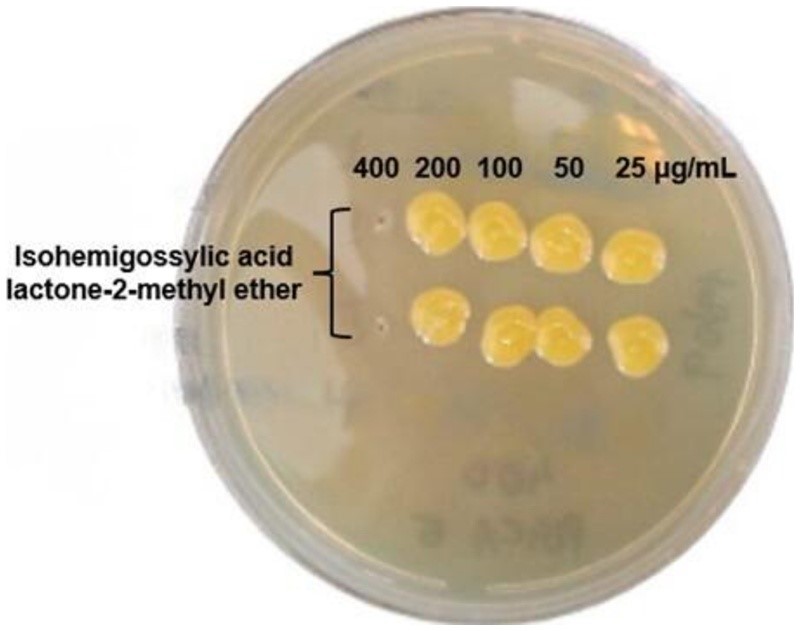
The antibacterial activity of compound 8 was measured by a slight modification of the of the microplate microdilution method. Compounds and positive control (copper sulfate) and dissolved in DMSO and then diluted with nutrient broth (NB). A bacterial suspension of 5 x 10⁵ CFU was prepared and inoculated into the 96-well plate. Serial dilutions were prepared in each well to make the final concentrations of 2000 a 0.98 μg/Ml. The plates were then incubated at 28 ºC for 72 h then revealed with a resazurin aqueous solution (30 μL; 0.02% w/v, Sigma Aldrich, St. Louis, MO, USA) to determine the minimum inhibitory concentration (MIC) of each compound. The experiments were performed in triplicate. To determine the Minimum Bactericidal Concentration (MBC), 10 μL of each well taken from the CIM assay was cultured on the surface of nutrient agar (NA) medium and incubated for 72 h at 28 ºC. The complete absence of bacterial growth was considered the MBC. Resazurin solution was used in an indicator. The experiments were performed in triplicate.
3. Results and Discussion
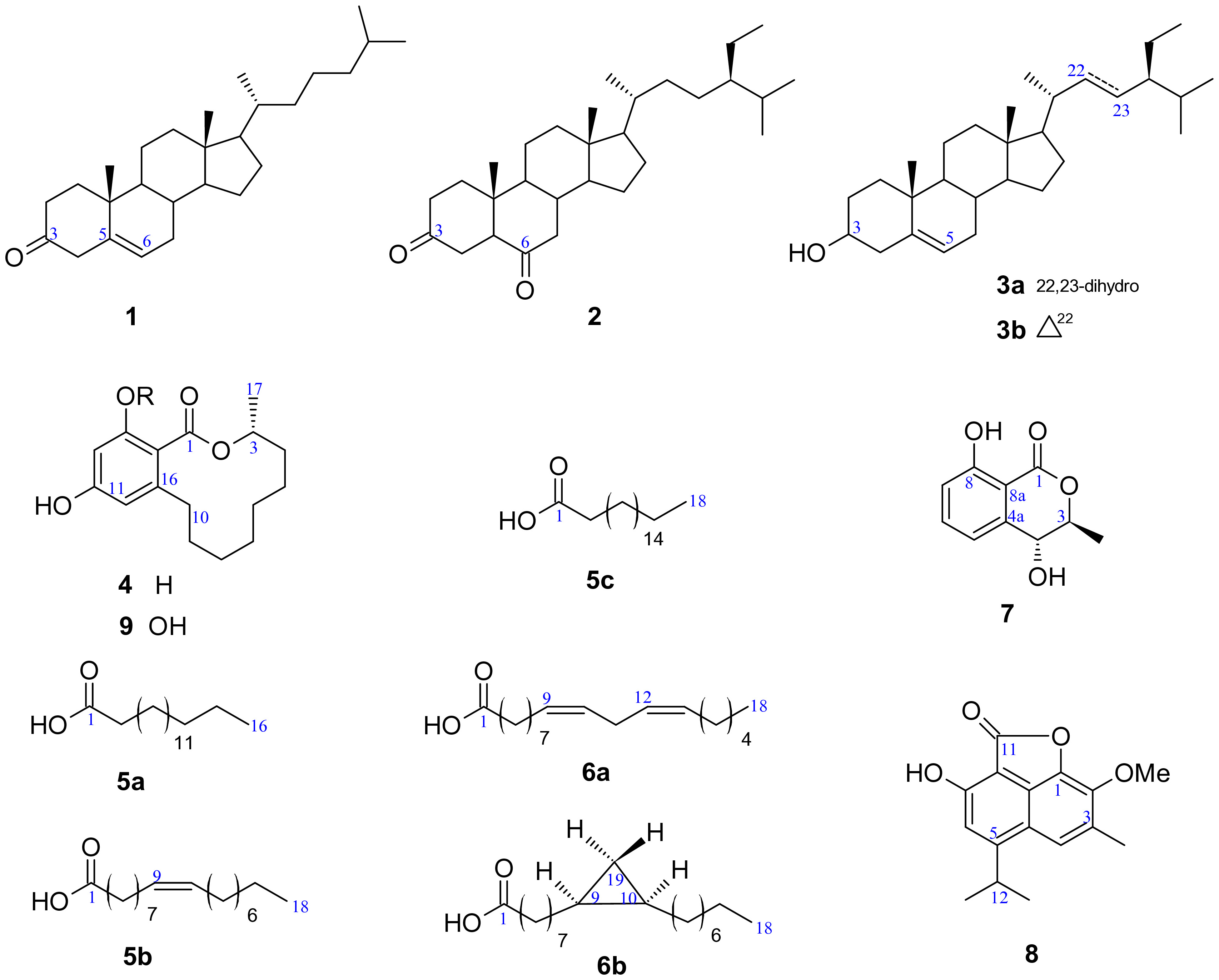
The chromatographic fractionations of the methanolic extract of the wood residues from C. pentandra resulted in the identification of steroids (1, 2, 3a and 3b), macrolides (4 and 9), fatty acid (5a, 5b, 5c, 6a and 6b), an isocoumarin (7) and a sesquiterpene lactone (8) (Figure 1). The structures of the isolated compounds were established based on 1H and 13C NMR spectra and comparison with literature data, the characterization of fatty acid methyl esters were characterized by GC and NMR.
The NMR spectra of compounds 1-3 showed characteristic steroid signals. The 13C NMR spectrum of 1 showed the presence of a carbon–carbon double bond (δ 171.9 and 123.7) and indicated the presence of conjugated carbonyl (δ 199.8), in the compound 2 the presence of a carbon–carbon double bond was observed at δ 161.1 and 125.5, and two conjugated carbonyls at δ 199.5 and 202.4. Thus, the cholestane-type steroid was identified as cholest-4-en-3-one (1) and the stigmastane-type steroid was identified as stigmast-4-ene-3,6-dione (2), both identified for the first time in C. pentandra. A mixture of β-sitosterol (3a) and stigmasterol (3b) has been widely found in various plant species, including C. pentandra (Abouelela et al., 2018; Onuh et al., 2024).
The 1H NMR spectra of 4 and 9 showed signals of aromatic m-coupled hydrogens at δ 6.20 (H-11) and 6.25 (H-13) of compound 4, at δ 6.24 (H-11) and 6.22 (H-13) of 9, as well as signals corresponding to long-chain methylenes (δ 3.26-1.42). 13C NMR spectrum of 4 indicated the presence of aromatics, seven methylene, methyl and an ester carbonyl carbon (at 171.8). The spectral data of compound 9 were similar to those of 4 except for the presence of methoxy. Thus, based on the data of NMR spectra data in 1D (1H, 13C and DEPT) and 2D (HSQC and HMBC), these macrolides were identified as des-O-methyl-lasiodiplodin (4) and lasiodiplodin (9), previously identified in Malvaceae (Rudiyansyah and Garson, 2006), as well as in other families of the plant kingdom, such as Fabaceae (Sousa et al., 2013), Moraceae (Chen et al., 2010), Boraginaceae (Yao et al., 1991; Xin-Sheng et al., 1983; Li et al., 2012), Euphorbiaceae (Cambie et al., 1991), Gentianaceae (Magadula et al., 2008) and Simaroubaceae (Mulholland et al., 2003), but reported here for the first time in the genus Ceiba.
The mixture of fatty acids such as palmitic acid (5a), oleic acid (5b), stearic acid (5c), linoleic acid (6a), and dihydrosterculic acid (6b) based on GC and NMR analyses. Tables 1 and 2 show the main fatty acids identified via GC analysis in fraction 16 and 17). The methanolic extract showed a high concentration of fatty acids in fractions 16 and 17 (4.62%) with a predominance of palmitic acid (fr 16) and dihydrosterculic acid (fr. 17).
In the 1H-NMR spectrum, the signal at δ 5.4–5.3 corresponds to olefinic hydrogens (–CH=CH–) of unsaturated fatty acids. The signal at δ −0.34 (dd) can be attributed to one cis hydrogen of the methylene moiety in the cyclopropane ring of dihydrosterculic acid (6b) while the trans hydrogen of the cyclopropane methylene unit was observed at δ 0.56. The 13C NMR spectrum showed typical carbon signals at δ 10.9 ppm for the methylene carbon and at 15.8 and 15.7 ppm for the methine carbons of the cyclopropane ring. These NMR data are in agreement with the literature (Knothe, 2006). The fatty acids from C. pentandra were found mainly in the seeds, in which were identified saturated, mono- and polyunsaturated in addition to cyclopropane fatty acids such as malvalic acid and sterculic acid (Montcho et al., 2018; Mondal, 2015; Kiran and Rao, 2014). However, the presence of methyl dihydrosterculate had not been previously reported in this species.
In our study with planting specimens, the high level of fatty acids found in wood residues may be related to the age of the tree, approximately 25 years old. Fatty acids are energy sources used by trees and play an important role in plant–pathogen interactions. Levels of fatty acids increase in response to various stresses abiotic and biotic stress, leading to increased plant defense and adaptation (Walley et al., 2013). The biosynthesis of fatty acids has much in common with the biosynthesis of macrolides, as their chemical mechanisms involved in chain extension are similar and the necessary precursors are acetyl coenzyme A (CoA) and malonyl-CoA (MCoA) units. Biosynthesis occurs via the acetate pathway and the main difference between their formation is that in the macrolide mechanism the reduction is variable, while the fatty acid product is reduced with each elongation of the chain (Hertweck, 2009).
The structure of compound 7 was established by 1D (1H NMR, 13C NMR) and 2D NMR (HSQC and HMBC) spectral analyses. The 1H NMR spectrum showed signals corresponding to three aromatic hydrogen atoms at δ 7.60 (H-6), 7.13 (H-5), and 6.93 (H-7) and two oxymethine hydrogens. Analysis of the 13C NMR spectrum revealed 10 signals, of which carbonyl group at δ 161.4, oxymethine carbons at δ 80.2 (C-3) and 68,2 (C-4), a methyl carbon at δ 17.3 (CH3) and carbons of the aromatic system (δ 161.6, 143.4, 136.5, 116.4 and 107.0). Based on the literature (Asha et al., 2004), compound 7 was identified as trans-4-mellein, has previously been isolated from two species of the genusDurioin the family Malvaceae (Rudiyansyah and Garson, 2006).
The structure of the sesquiterpene 8 was established by 1D (1H NMR, 13C NMR) and 2D NMR (HSQC and HMBC) spectral analyses. The 1H NMR spectrum displayed the presence of three methyl groups at δ 2.40 (3H, s, H-15) and δ 1.39 (6H, d, J= 6.8, H-13 and H-14), an isopropyl methine proton at δ 3.69 (sept, J = 6.8, H-12), a methoxy group at δ 4.31 (OCH3), two aromatic hydrogens at δ 6.99 and 7.51 (H-6 and H-4). The 13C NMR spectrum showed signals for 16 carbon atoms, including an ester carbonyl at δ 165.5 (C-11). Thus, the structure was identified as isohemigossylic acid lactone 2-methyl ether. The 1H and 13C NMR data are consistent with those reported by Puckhaber and Stipanovic (2001). This sesquiterpene lactone was previously isolated from the root bark of C. pentandra (Rao et al., 1993).
In this pioneering phytochemical study of a plantation specimen of C. pentandra, we identified steroids, macrolides, fatty acids (including those with cyclopropane rings), an isocoumarin, and a sesquiterpene lactone. A key finding of this study is the predominance of fatty acids across most of the methanol extract fractions.
Regarding the antibacterial activity, sesquiterpene lactone 8 exhibited activity against Xanthomonas citri subsp. citri (Xcc), with identical MIC and MBC values of 400 µg/mL, thereby demonstrating moderate bactericidal effects (Figure 2). The scarcity of literature reports on the antibacterial effects of isolated compounds against the Xcc bacterium supports the significance of the anti-Xanthomonas citri activity exhibited by the sesquiterpenes α-cadinol and spathulenol (Lima et al., 2025). These findings indicate the potential of this class of natural compounds as antimicrobial agents for the control of citrus canker.
4. Conclusion
Our phytochemical study on Ceiba pentandra (L.) wood has expanded the knowledge of this species from plantation sites. Molecules from different classes of secondary metabolites were identified, but the predominance of fatty acids which are uncommon in wood was evident. This suggests the importance of these compounds in defense and adaptation of the specimen.
Supplementary Material
Supplementary material accompanies this paper.
This material is available as part of the online article from https://doi.org/10.1590/1519-6984.301763
Acknowledgements
The authors are grateful for the financial support provided by the Fundação de Amparo à Pesquisa do Estado do Amazonas (FAPEAM) (No 01.02.016301.034412/2021-78) and for the scholarship granted to Maria da Paz Lima (Call No. 013/2022 – Produtividade - CT&I). Conselho Nacional de Desenvolvimento Científico e Tecnológico (CNPq) for the scholarship granted to Priscila B. A. Souza (No. 140089-2022-5).
Data Availability Statement
All data supporting the findings of this study are available in the article and the Supplementary Material.
References
-
ABOUELELA, M.E., ORABI, M.A., ABDELHAMID, R.A., ABDELKADER, M.S. and DARWISH, F.M., 2018. Chemical and cytotoxic investigation of non-polar extract from Ceiba pentandra (L.) Gaertn.: a study supported by computer based screening. Journal of Applied Pharmaceutical Science, vol. 8, no. 7, pp. 57-64. http://doi.org/10.7324/JAPS.2018.8710
» http://doi.org/10.7324/JAPS.2018.8710 -
ABOUELELA, M.E., ORABI, M.A., ABDELHAMID, R.A., ABDELKADER, M.S., DARWISH, F.M., HOTSUMI, M. and KONNO, H., 2020. Anti-Alzheimer’s flavanolignans from Ceiba pentandra aerial parts. Fitoterapia, vol. 143, pp. 104541. http://doi.org/10.1016/j.fitote.2020.104541 PMid:32151639.
» http://doi.org/10.1016/j.fitote.2020.104541 -
ADEROGBA, M.A., KAPCHE, G.D. and MABUSELA, W.T., 2013. Isolation and characterization of antioxidative constituents of Ceiba pentandra (KAPOK) leaves extract. Nigerian Journal of Natural Products and Medicine, vol. 17, no. 1, pp. 86-90. http://doi.org/10.4314/njnpm.v17i1.9
» http://doi.org/10.4314/njnpm.v17i1.9 - ASHA, K.N., CHOWDHURY, R., HASAN, C.M. and RASHID, M.A., 2004. Steroids and polyketides from Uvaria hamiltonii stem bark. Acta Pharmaceutica, vol. 54, no. 1, pp. 57-63. PMid:15050045.
-
CAMBIE, R.C., LAL, A.R., RUTLEDGE, P.S. and WOODGATE, P.D., 1991. Ent-14 [S], 16β, 17-trihydroxyatisan-3-one and further constituents from Euphorbia fidjiana. Phytochemistry, vol. 30, no. 1, pp. 287-292. http://doi.org/10.1016/0031-9422(91)84139-J
» http://doi.org/10.1016/0031-9422(91)84139-J -
CANTALICE, A.S., MAFORT, M.E. and MIRANDA, J.C., 2020 [viewed 10 October 2025]. A árvore sagrada da Amazônia. Ciência Hoje das Crianças [online], no. 314, pp. 11-13. Available from: https://www.researchgate.net/publication/344580386
» https://www.researchgate.net/publication/344580386 - CARVALHO, P.E.R., 2008. Espécies arbóreas brasileiras Porto Velho: Embrapa Rondônia. pp. 484-494.
-
CHEN, L.W., CHENG, M., PENG, C.F. and CHEN, I.S., 2010. Secondary metabolites and antimycobacterial activities from the roots of Ficus nervosa. Chemistry & Biodiversity, vol. 7, no. 7, pp. 1814-1821. http://doi.org/10.1002/cbdv.200900227 PMid:20658670.
» http://doi.org/10.1002/cbdv.200900227 -
FREITAS, J.A. and VASCONCELLOS, F.J., 2010 [viewed 10 October 2025]. Identificação prática de madeiras comerciais da Amazônia-Método macroscópico de comparação [online]. Manaus: INPA; CNPq; CTAmazônia. Available from: https://repositorio.inpa.gov.br/handle/1/36063
» https://repositorio.inpa.gov.br/handle/1/36063 -
GRIBEL, R., GIBBS, P.E. and QUEIRÓZ, A.L., 1999. Flowering phenology and pollination biology of Ceiba pentandra (Bombacaceae) in Central Amazonia. Journal of Tropical Ecology, vol. 15, no. 3, pp. 247-263. http://doi.org/10.1017/S0266467499000796
» http://doi.org/10.1017/S0266467499000796 -
HERTWECK, C., 2009. The biosynthetic logic of polyketide diversity. Angewandte Chemie International Edition in English, vol. 48, no. 26, pp. 4688-4716. http://doi.org/10.1002/anie.200806121 PMid:19514004.
» http://doi.org/10.1002/anie.200806121 -
KAIMAL, T.N.B. and LAKSHMINARAYANA, G., 1970. Fatty acid compositions of lipids isolated from different parts of Ceiba pentandra, Sterculia foetida and Hydnocarpus wightiana. Phytochemistry, vol. 9, no. 10, pp. 2225-2229. http://doi.org/10.1016/S0031-9422(00)85389-3
» http://doi.org/10.1016/S0031-9422(00)85389-3 -
KIRAN, C.R. and RAO, T.R., 2014. Lipid profiling by GC-MS and anti-inflammatory activities of Ceiba pentandra seed oil. Journal of Biologically Active Products from Nature, vol. 4, no. 1, pp. 62-70. http://doi.org/10.1080/22311866.2014.890064
» http://doi.org/10.1080/22311866.2014.890064 -
KISHORE, P.H., REDDY, M.V.B., GUNASEKAR, D., CAUX, C. and BODO, B., 2003. A new naphthoquinone from Ceiba pentandra. Journal of Asian Natural Products Research, vol. 5, no. 3, pp. 227-230. http://doi.org/10.1080/1028602031000105812 PMid:12931857.
» http://doi.org/10.1080/1028602031000105812 -
KNOTHE, G., 2006. NMR characterization of dihydrosterculic acid and its methyl ester. Lipids, vol. 41, no. 4, pp. 393-396. http://doi.org/10.1007/s11745-006-5110-x PMid:16808153.
» http://doi.org/10.1007/s11745-006-5110-x -
LI, H.M., TANG, Y.L., ZHANG, Z.H., LIU, C.J., LI, H.Z., LI, R.T. and XIA, X.S., 2012. Compounds from Arnebia euchroma and their related anti-HCV and antibacterial activities. Planta Medica, vol. 78, no. 1, pp. 39-45. http://doi.org/10.1055/s-0031-1280266 PMid:21984340.
» http://doi.org/10.1055/s-0031-1280266 -
LIMA, J.A., RAMOS, H.G., CHAVES, J.A., NASCIMENTO, C.C.D., QUEIROZ-JUNIOR, L.H.K., SILVA, D.F.D., AMARAL, J.C., DA SILVA, M.F.G. and LIMA, M.D.P., 2025. Chemical compounds from Ocotea neesiana (Miq.) Kosterm demolition wood and their effect on the growth of Xanthomonas citri subsp. citri. Journal of the Brazilian Chemical Society, vol. 36, no. 11, e20250118. http://doi.org/10.21577/0103-5053.20250118
» http://doi.org/10.21577/0103-5053.20250118 -
MAGADULA, J.J., MULHOLLAND, D.A. and CROUCH, N.R., 2008. Triterpenoids from Anthocleista grandiflora (Gentianaceae). Natural Product Communications, vol. 3, no. 6, pp. 1. http://doi.org/10.1177/1934578X0800300612
» http://doi.org/10.1177/1934578X0800300612 -
MONDAL, B., 2015. Physicochemical characteristics, fatty acid composition and nutritional evaluation of four minor oils. Journal of Microbiology, Biotechnology and Food Sciences, vol. 4, no. 4, pp. 301-305. http://doi.org/10.15414/jmbfs.2015.4.4.301-305
» http://doi.org/10.15414/jmbfs.2015.4.4.301-305 - MONTCHO, P.S., TCHIAKPE, L., NONVIHO, G., BOTHON, F.T.D., SIDOHOUNDE, A., DOSSA, C.P.A., BESSIERES, D., CHROSTOWSKA, A. and SOHOUNHLOUE, D.C.K., 2018. Fatty acid profile and quality parameters of Ceiba pentandra (L.) seed oil: a potential source of biodiesel. Journal of Petroleum Technology and Alternative Fuels, vol. 9, no. 3, pp. 14-19.
-
MULHOLLAND, D.A., CHEPLOGOI, P. and CROUCH, N.R., 2003. Secondary metabolites from Kirkia acuminata and Kirkia wilmsii (Kirkiaceae). Biochemical Systematics and Ecology, vol. 31, no. 7, pp. 793-797. http://doi.org/10.1016/S0305-1978(03)00033-4
» http://doi.org/10.1016/S0305-1978(03)00033-4 -
NELLY, J.N., ACHILLE, N.B., ARMEL, A.A.J. and EMMANUEL, H.N., 2025. Exploring the antidiabetic potential of Ceiba pentandra bark powder: chemical characterization and bioactivity of a new stigmastane. Pharmacological Research-Natural Products, vol. 7, pp. 100217. http://doi.org/10.1016/j.prenap.2025.100217
» http://doi.org/10.1016/j.prenap.2025.100217 -
NGOUNOU, F.N., MELI, A.L., LONTSI, D., SONDENGAM, B.L., CHOUDHARY, M.I., MALIK, S. and AKHTAR, F., 2000. New isoflavones from Ceiba pentandra. Phytochemistry, vol. 54, no. 1, pp. 107-110. http://doi.org/10.1016/S0031-9422(00)00035-2 PMid:10846755.
» http://doi.org/10.1016/S0031-9422(00)00035-2 -
NOREEN, Y., EL-SEEDI, H., PERERA, P. and BOHLIN, L., 1998. Two new isoflavones from Ceiba pentandra and their effect on cyclooxygenase-catalyzed prostaglandin biosynthesis. Journal of Natural Products, vol. 61, no. 1, pp. 8-12. http://doi.org/10.1021/np970198+ PMid:9461647.
» http://doi.org/10.1021/np970198+ -
ONUH, O.J., ANYAM, J.V., AGBIDYE, I.G. and IGOLI, J.O., 2024. Varvain glucoside from the stem bark of Ceiba Pentandra controls postharvest loss in Dioscorea alata tubers. Tropical Journal of Phytochemistry and Pharmaceutical Sciences, vol. 3, no. 4, pp. 290-297. http://doi.org/10.26538/tjpps/v3i4.7
» http://doi.org/10.26538/tjpps/v3i4.7 -
PUCKHABER, L.S. and STIPANOVIC, R.D., 2001. Revised structure for a sesquiterpene lactone from Bombax malbaricum. Journal of Natural Products, vol. 64, no. 2, pp. 260-261. http://doi.org/10.1021/np0004350 PMid:11430017.
» http://doi.org/10.1021/np0004350 -
RAO, K.V., SREERAMULU, K., GUNASEKAR, D. and RAMESH, D., 1993. Two new sesquiterpene lactones from Ceiba pentandra. Journal of Natural Products, vol. 56, no. 12, pp. 2041-2045. http://doi.org/10.1021/np50102a003 PMid:8133294.
» http://doi.org/10.1021/np50102a003 -
RUDIYANSYAH. and GARSON, M.J., 2006. Secondary metabolites from the wood bark of Durio zibethinus and Durio kutejensis. Journal of Natural Products, vol. 69, no. 8, pp. 1218-1221. http://doi.org/10.1021/np050553t PMid:16933881.
» http://doi.org/10.1021/np050553t -
SOUSA, L.M.D., GOIS, R.W.D.S., LEMOS, T.L., ARRIAGA, Â., ANDRADE-NETO, M., SANTIAGO, G.M., BRAZ-FILHO, R., COSTA, J.G.M. and RODRIGUES, F.F., 2013. Constituintes químicos e avaliação da atividade antibacteriana de Macroptilium lathyroides (L.) Urb. (Fabaceae). Química Nova, vol. 36, no. 9, pp. 1370-1374. http://doi.org/10.1590/S0100-40422013000900016
» http://doi.org/10.1590/S0100-40422013000900016 - SOUZA, C.R., LIMA, R.M.B., AZEVEDO, C.P. and ROSSI, L.M.B., 2005. Sumaúma (Ceiba pentandra (L.) Gaerth) Itacoatiara: Embrapa Amazônia Ocidental. 22 p.
-
SOUZA, C.R.D., AZEVEDO, C.P.D., LIMA, R.M. and ROSSI, L.M.B., 2010. Comportamento de espécies florestais em plantios a pleno sol e em faixas de enriquecimento de capoeira na Amazônia. Acta Amazonica, vol. 40, no. 1, pp. 127-134. http://doi.org/10.1590/S0044-59672010000100016
» http://doi.org/10.1590/S0044-59672010000100016 -
TAIWO, B.J., MILLER, A.H., FIELDING, A.J., SARKER, S.D., VAN HEERDEN, F.R. and FATOKUN, A.A., 2024. Ceibinin, a new positional isomer of mangiferin from the inflorescence of Ceiba pentandra (Bombacaceae), elicits similar antioxidant effect but no anti-inflammatory potential compared to mangiferin. Heliyon, vol. 10, no. 1, e23335. http://doi.org/10.1016/j.heliyon.2023.e23335 PMid:38332887.
» http://doi.org/10.1016/j.heliyon.2023.e23335 -
UEDA, H., KANEDA, N., KAWANISHI, K., ALVES, S.M. and MORIYASU, M., 2002. A new isoflavone glycoside from Ceiba pentandra (L.) Gaertner. Chemical & Pharmaceutical Bulletin, vol. 50, no. 3, pp. 403-404. http://doi.org/10.1248/cpb.50.403 PMid:11911207.
» http://doi.org/10.1248/cpb.50.403 -
VASQUEZ, W.V., HERNÁNDEZ, D.M., DEL HIERRO, J.N., MARTÍN, D., CANO, M.P. and FORNARI, T., 2021. Supercritical carbon dioxide extraction of oil and minor lipid compounds of cake byproduct from Brazil nut (Bertholletia excelsa) beverage production. The Journal of Supercritical Fluids, vol. 171, pp. 105188. http://doi.org/10.1016/j.supflu.2021.105188
» http://doi.org/10.1016/j.supflu.2021.105188 -
WALLEY, J.W., KLIEBENSTEIN, D.J., BOSTOCK, R.M. and DEHESH, K., 2013. Fatty acids and early detection of pathogens. Current Opinion in Plant Biology, vol. 16, no. 4, pp. 520-526. http://doi.org/10.1016/j.pbi.2013.06.011 PMid:23845737.
» http://doi.org/10.1016/j.pbi.2013.06.011 -
XIN-SHENG, Y., EBIZUKA, Y., NOGUCHI, H., KIUCHI, F., IITAKA, Y., SANKAWA, U. and SETO, H., 1983. Structure of arnebinol, a new ANSA-type monoterpenylbenzenoid with inhibitory effect to prostaglandin biosynthesis. Tetrahedron Letters, vol. 24, no. 23, pp. 2407-2410. http://doi.org/10.1016/S0040-4039(00)81939-5
» http://doi.org/10.1016/S0040-4039(00)81939-5 -
YAO, X.S., EBIZUKA, Y., NOGUCHI, H., KIUCHI, F., SHIBUYA, M., IITAKA, Y., SETO, H. and SANKAWA, U., 1991. Biologically active constituents of Arnebia euchroma: structure of arnebinol, an ansa-type monoterpenylbenzenoid with inhibitory activity on prostaglandin biosynthesis. Chemical & Pharmaceutical Bulletin, vol. 39, no. 11, pp. 2956-2961. http://doi.org/10.1248/cpb.39.2956 PMid:1799941.
» http://doi.org/10.1248/cpb.39.2956
Edited by
-
Editor:
Jairo Lizandro Schmitt