 Larvicidal and oviposition deterrent activities of Pongamia pinnata (L.) Pierre and Vitex trifolia (L.) leaves extracts against mosquito (Aedes aegypti Linnaeus 1762)
Abstract
The Aedes aegypti mosquito is the main vector of several dangerous diseases, including dengue fever (DF), chikungunya, Japanese encephalitis, West Nile fever, and yellow fever. Pongamia pinnata and Vitex trifolia are two multipurpose plant species that can be used for mosquito control. The present research aims to analyze the larvicidal and oviposition deterrent activities of P. pinnata and V. trifolia leaf extracts against Ae. aegypti. Pongamia pinnata and V. trifolia leaves were extracted using methanol, and the extracts were screened for phytochemical compounds. The extracts were tested for larvicidal and oviposition deterrent activities against Ae. aegypti at concentrations of 300, 400, 500, 800, 1000, 1500, and 2000 ppm with triplicates. Positive control (0.02% temephos) and negative control (0.01% Tween-80 in 0.5% aqueous acetone) were included. For larvicidal activity, 25 third-instar larvae were exposed to each test solution, and mortality was recorded after 24 and 48 hours. Lethal concentration 50% and 90% (LC50 and LC90) were calculated using Probit analysis. For oviposition-deterrent activity, 25 gravid female mosquitoes were placed in test cages. Eight ovitraps were placed in each cage, one for P. pinnata and another for V. trifolia test solutions. The number of eggs was counted under a dissecting microscope at 3 and 6 days. Results showed that both P. pinnata and V. trifolia leaf extracts contained phenols, tannins, flavonoids, steroids, alkaloids, and saponins. Terpenoids were only found in V. trifolia leaf extract. Larval mortality increased with increasing extract concentration. The highest larval mortality of 88% and 92% was achieved with concentrations of 2000 ppm and 1500 ppm for P. pinnata and V. trifolia extracts, respectively. The LC50 and LC90 after 24 hours of P. pinnata leaf extract were 891.41 ppm and 1252.25 ppm respectively while for V. trifolia leaf extract were 648.67 ppm and 1627.19 ppm respectively. Oviposition deterrent activity of P. pinnata leaf extract ranged from 7.02% - 19.33% at 300 – 2000 ppm, whereas V. trifolia leaf extract was 91.16 - 95.81% at 1500 – 2000 ppm. In conclusion, both P. pinnata and V. trifolia methanol leaf extracts exhibited dose-dependent larvicidal activity. Pongamia pinnata leaf extract showed low oviposition deterrent activity, with a mean of 11.59% at 300 – 2000 ppm. Vitex trifolia leaf extract showed high oviposition deterrent activity of 91.16 - 95.81% at 1500–2000 ppm.
Keywords:
mortality; ovitrap; probit; repellency; vector
Resumo
O mosquito Aedes aegypti é o principal vetor de diversas doenças perigosas, incluindo dengue, chikungunya, encefalite japonesa, febre do Nilo Ocidental e febre amarela. Pongamia pinnata e Vitex trifolia são duas espécies vegetais multiuso que podem ser utilizadas para o controle de mosquitos. A presente pesquisa teve como objetivo analisar as atividades larvicida e de dissuasão da oviposição de extratos foliares de P. pinnata e V. trifolia contra Ae. aegypti. As folhas de P. pinnata e V. trifolia foram extraídas com metanol e os extratos foram analisados quanto à presença de compostos fitoquímicos. Os extratos foram testados quanto às atividades larvicida e de dissuasão da oviposição contra Ae. aegypti em concentrações de 300, 400, 500, 800, 1000, 1500 e 2000 ppm, em triplicata. Foram incluídos um controle positivo (0,02% de temefós) e um controle negativo (0,01% de Tween-80 em acetona aquosa a 0,5%). Para avaliar a atividade larvicida, 25 larvas de terceiro instar foram expostas a cada solução de teste, e a mortalidade foi registrada após 24 e 48 horas. As concentrações letais 50% e 90% (CL50 e CL90) foram calculadas utilizando a análise Probit. Para avaliar a atividade de dissuasão da oviposição, 25 fêmeas grávidas de mosquitos foram colocadas em gaiolas de teste. Oito ovitrampas foram colocadas em cada gaiola, uma para a solução de teste de P. pinnata e outra para a solução de teste de V. trifolia. O número de ovos foi contado sob um microscópio estereoscópico aos três e seis dias. Os resultados mostraram que os extratos das folhas de P. pinnata e V. trifolia continham fenóis, taninos, flavonoides, esteroides, alcaloides e saponinas. Terpenoides foram encontrados apenas no extrato da folha de V. trifolia. A mortalidade larval aumentou com o aumento da concentração do extrato. A maior mortalidade larval, de 88% e 92%, foi alcançada com concentrações de 2000 ppm e 1500 ppm para os extratos de P. pinnata e V. trifolia, respectivamente. Os valores de CL50 e CL90 após 24 horas para o extrato da folha de P. pinnata foram de 891,41 ppm e 1252,25 ppm, respectivamente, enquanto para o extrato da folha de V. trifolia foram de 648,67 ppm e 1627,19 ppm, respectivamente. A atividade larvicida do extrato da folha de P. pinnata variou de 7,02% a 19,33% na faixa de 300 a 2000 ppm, enquanto para o extrato da folha de V. trifolia foi de 91,16% a 95,81% na faixa de 1500 a 2000 ppm. Em conclusão, ambos os extratos metanólicos das folhas de P. pinnata e V. trifolia exibiram atividade larvicida dose-dependente. O extrato da folha de Pongamia pinnata apresentou baixa atividade repelente à oviposição, com média de 11,59% na concentração de 300 a 2000 ppm. Já o extrato da folha de Vitex trifolia apresentou alta atividade repelente à oviposição, variando de 91,16% a 95,81% na concentração de 1500 a 2000 ppm.
Palavras-chave:
mortalidade; ovitrampa; probit; repelência; vetor
1. Introduction
The Aedes aegypti mosquito is the main vector of several dangerous diseases, including dengue, chikungunya, Japanese encephalitis, West Nile fever, and yellow fever (Chala and Hamde, 2021). Dengue is an arboviral disease caused by the dengue virus DENV with four serotypes 1- 4, and it belongs to the genus Flavivirus in the family Flaviviridae. Dengue fever (DF) is a slight flu-like condition, while dengue hemorrhagic fever (DHF) is a more severe and potentially fatal type, both are symptoms of DENV infection (Harapan et al., 2019). Dengue is passed to healthy individuals through bites from female Aedes mosquitoes infected with DENV (Corzo-Gómez et al., 2024). The virus is carried in the mosquito midgut, then spreads to the salivary glands, where it multiplies and is transmitted to another host via bites (Chowdhury et al., 2021). They adapt to the human environment and breed in dark places with clear, stagnant water, such as buckets, flower vases, tires, and bowls (Hossain et al., 2022).
Dengue disease has a rapid global spread with high incidence. With 100 – 400 million new cases annually, it is among the infectious diseases spreading most rapidly globally and has become prevalent in more tropical megacities (Brady and Hay, 2020). In Indonesia, the incidence rate of DHF was 0.05 cases per 100,000 person-years in 1968, and it increased sharply to 77.96 cases per 100,000 person-years in 2016 (Harapan et al., 2019). The 16-year dataset from 2007 to 2022 shows that DHF has disseminated throughout 34 provinces in Indonesia, with yearly case numbers varying between 10,000 and 30,000 (Gani et al., 2022).
The application of synthetic chemical insecticides like temephos for mosquito control may result in resistance. A study in Mexico finds that Ae. aegypti mosquitoes exhibit high levels of resistance to temephos, which has been used for over 50 years to control both larval and adult mosquitoes (Davila-Barboza et al., 2024). The resistance of Ae. aegypti to temephos has also been reported in Havana, Cuba (Piedra et al., 2024), as well as in some parts of Indonesia (Sofiana et al., 2023). Increasing mosquito resistance to insecticides requires higher doses, which leave residues in ecosystems. The residues are harmful to humans, detrimental to non-target species, and the ecosystem (Meier et al., 2024). Extracts from plants, containing various phytochemical compounds, serve as an alternative method for managing vectors due to their insecticidal and larvicidal activities, minimal residues, biodegradability, and reduced harm to non-target organisms, and environmental safety (Silverio et al., 2020).
Pongamia pinnata (L.) Pierre and Vitex trifolia (L.) are two multipurpose plant species that can be used for insect control. Pongamia pinnata is a tropical legume with a wide distribution from coastal habitats to areas of 1,200 meters above sea level (Degani et al., 2022). Some researchers have found that P. pinnata extracts have larvicidal activity against insect species. Aqueous leaf extract has larvicidal activity against the citrus butterfly Papilio demolues (Lingakari et al., 2023). Methanol leaf extract shows high larvicidal activity against Phenacoccus manihoti Matile-Ferrero (Tran et al., 2022), and Aedes vitatus (Madhavi and Mahesh, 2023).
Vitex trifolia is a shrub from the family Lamiaceae (previously categorized in Verbenaceae) that mostly grows in tropical and sub-tropical countries, including China, India, Indonesia, Sri Lanka, Australia, and Singapore (Kamal et al., 2022). Vitex trifolia is a small shrub with a height of 3.5 meters. The leaves are compound with three to five leaflets, are elliptical and pointed at the tip and base, and are hairy on the underside (Nisa et al., 2023). The species contains abundant secondary metabolites, such as terpenoids, flavonoids, lignans, phytosterols, and anthraquinones. Therefore, it is used in traditional medicine for various diseases, especially in Eastern Asian countries (Mottaghipisheh et al., 2024). The genus Vitex comprises 217 species (Kamal et al., 2022), and some species exhibit larvicidal activity against mosquito species. The essential oil from the genus Vitex has high larvicidal activities (Lukmiati et al., 2020). However, the essential oil yield from the leaves of V. trifolia is very low, ranging from 0.0147 to 0.0627% w/w (Arpiwi et al., 2020). Research on larvicidal and oviposition deterrent activities using methanol leaf extract from V. trifolia against Ae. aegypty is rarely found.
One recommendation for combating dengue disease is to conduct research on vector control (Jing and Wang, 2019). Aedes mosquito undergoes complete metamorphosis: egg, larvae, pupa, and adult mosquito. This research uses methanol leaf extracts from P. pinnata and V. trifolia to kill larvae and reduce the number of eggs deposited by females, thereby inhibiting the growth of Ae. aegypti. Methanol was chosen as a solvent because it offers higher efficacy than other solvents (Madhavi and Mahesh, 2023). The present research aims to analyze the larvicidal and oviposition deterrent activities of P. pinnata and V. trifolia methanol leaf extracts against third-instar larvae of Ae. aegypti and gravid female mosquitoes, respectively.
2. Materials and Methods
2.1. Sampling
Leaf samples of P. pinnata were harvested from Bukit Jimbaran, Udayana University Campus (115°10’15.2” S, 8°47’56.8” E), Badung Regency, Bali Province, Indonesia, at an elevation of 404 meters above sea level (masl). Vitex trifolia leaf samples were harvested from Mertasari Beach (115o14'58.91'' S, 8o42'39.86'' E) Denpasar, Bali Province, Indonesia, at an elevation of 6 - 12 masl. Sampling was conducted in March 2024, and 5 kg of fully expanded leaves from both species were collected in plastic bags.
2.2. Preparation of P. pinnata and V. trifolia leaf extracts
The leaf samples were rinsed with flowing tap water and air-dried on a lab bench at room temperature for 10 days. The dried leaf samples were ground into a fine powder using an electric grinder and sieved through a 40-mesh sieve. The leaf powders were macerated in 96% methanol at a powder-to-methanol ratio of 1:10 for 2 x 24 hours. The liquid phase was taken every 24 hours for 2 days, and the impurities were filtered using Whatman filter paper. The combined liquid phase was concentrated with a vacuum rotary evaporator at 40°C to obtain crude extract. The crude extracts were transferred to amber jars, tightly capped, and stored in a fridge until use.
2.3. Phytochemical screening of the extracts
Both P. pinnata and V. trifolia leaf extracts were qualitatively screened for chemical constituents using the method of Roghini and Vijayalakshmi (2018). Phenols and tannins were detected by adding the extracts to 1% ferric chloride (FeCl3), which turned the mixture color blue-black, indicating the presence of phenols, and then the mixtures were further treated with concentrated hydrochloric acid. The formation of brown precipitation indicates the presence of tannins. Flavonoids were tested using a Willstatter reagent, in which extracts were treated with magnesium (Mg) and concentrated hydrochloric acid (HCl). The formation of an orange-red color indicates the presence of flavonoids. Terpenoids and steroids were analyzed using the Liebermann-Burchard reagent, in which extracts were treated with anhydrous acetic acid and sulphuric acid. Formation of blue-green color confirms the presence of steroids, and formation of violet-red confirms the presence of terpenoids. Alkaloids were confirmed using three tests: the Wagner, Dragendorff, and Mayer reagents. The formation of brown, red, and white precipitates with the respective reagents indicates the presence of alkaloids. Saponins were analyzed by vigorously shaking with distilled water and adding hydrochloric acid (HCl). The formation of stable foams indicates the presence of saponins.
2.4. Mosquito rearing
An ethical clearance number 0819/UN14.2.2.VII.14/LT/2024 was issued by the Research Ethical Commission, The Faculty of Medical, Udayana University, Bali, Indonesia, on 14 March 2024 before conducting the research. A filter paper with Ae. aegypti eggs were dipped in well water. The eggs hatched into first instar larvae after 1-2 days. Larvae developed into second, third, and fourth instars within one week, then into pupae in water after 10 days. Pupae were removed from water and placed in a mosquito cage (30 x 30 x 30 cm), and the adults hatched after 1-2 days. Mosquitos were fed with guinea pig for blood meal and 10% sugar solution. The mosquito’s cages were kept at 27- 28 °C and 66 – 70% relative humidity.
2.5. Larvicidal activity
Pongamia pinnata and V. trifolia leaf extracts were tested for larvicidal activity against the third instar larvae of Ae. aegypti following a method by Anwar et al. (2022) with modifications in concentrations used. Stock solutions of P. pinnata and V. trifolia leaf extracts at 10,000 ppm were prepared using 0.01% Tween-80 and 0.5% aqueous acetone (Shoukat et al., 2020). Dilutions were prepared to achieve concentrations of 300, 400, 500, 800, 1000, 1500, and 2000 ppm, with triplicates. Negative control (0.01% Tween-80 in 0.5% aqueous acetone) and positive control (0.02% temephos) were included. The larvae of Ae. aegypti were rested in aquadest for 30 minutes prior to treatment to allow adaptation. Test solutions (200 mL) were poured into 500 mL plastic cups, and 25 third-instar larvae were added to each solution in triplicate. The number of dead larvae was counted after 24 and 48 hours. Larvae were considered dead if they did not move for 30 seconds after being touched with a blunt object or did not move under light exposure. Mortality was calculated using the formula (Equation 1) by Oliveros-Díaz et al. (2022) as follows:
The lethal concentration 50 and 90 (LC50 and LC90) of both P. pinnata and V. trifolia leaf extracts after 24 and 48 hours were calculated using probit analysis (Lei and Sun, 2018).
2.6. Oviposition deterrent activity
Twenty-five gravid female mosquitoes (Ae. aegypti) were fed mouse blood overnight and then transferred to a test cage (50 x 50 x 50 cm) following the method of Martianasari and Hamid (2019) with modifications. Eight ovitraps were placed in each cage, one for P. pinnata and another for V. trifolia test solutions. The ovitraps were plastic cups wrapped in black paper and filled with 100 mL of test solutions at 300, 400, 500, 800, 1000, 1500, and 2000 ppm, a negative control (0.01% Tween-80 in 0.5% aqueous acetone), and a positive control (0.02% temephos), with triplicates. A filter paper was inserted into each ovitrap for the female mosquito laying eggs. Sugar solution (10%) was added to the cage. The number of eggs was counted on the filter paper under the dissecting microscope at 3 and 6 days. Oviposition deterrent activity of the extracts was measured as effective repellency (ER) using the following formula (Equation 2):
Where ER is the effective repellency (%), NPC is the number of eggs in the positive control, and NT is the number of eggs in the test solutions.
2.7. Statistical analysis
Data on larvicidal and oviposition deterrent activities were examined using Analysis of Variance (ANOVA) at a 95% confidence level utilizing SPSS software. If significant differences were found among treatments, Duncan post hoc tests were performed for further analysis at the α = 5% level. The LC50 and LC90 values were determined through probit analysis
3. Results
3.1. Phytochemical screening of the extracts
Both P. pinnata and V. trifolia leaf extracts contained phenols, tannins, flavonoids, steroids, alkaloids, and saponins. Terpenoids were only found in V. trifolia leaf extract (Table 1).
3.2. Larvicidal activity
Mortality of larvae after being treated with P. pinnata and V. trifolia leaf extracts after 24 and 48 hours can be seen in Table 2. The negative control caused no mortality, while the positive control caused 100% mortality. Larval mortality increased with increasing extract concentration. Exposure of larvae to P. pinnata leaf extract for 24 hours at 300 and 400 ppm caused no mortality. Since then, mortality increased slowly to 20% and 28% at 500 and 800 ppm, respectively, and it increased gradually to 64% at 1000 ppm. Sharp increases occurred at 1500 and 2000 ppm with 80% and 88% mortality, respectively. Exposure of larvae to P. pinnata leaf extract for 48 hours resulted in higher mortality, with 100% mortality at 1500 and 2000 ppm.
Larvicidal activity of Pongamia pinnata and Vitex trifolia leaf extracts after 24 and 48 hours of exposure.
Larval mortality with V. trifolia leaf extract after 24 hours of exposure increased gradually from 16% to 32%, 46% and 62% at 300, 400, 500, and 800 ppm, respectively. A sharp increase occurred at 1000-2000 ppm with mortality of 84-92%. After 48 hours of exposure, 100% mortality was achieved with 1500 and 2000 ppm of V. trifolia leaf extracts.
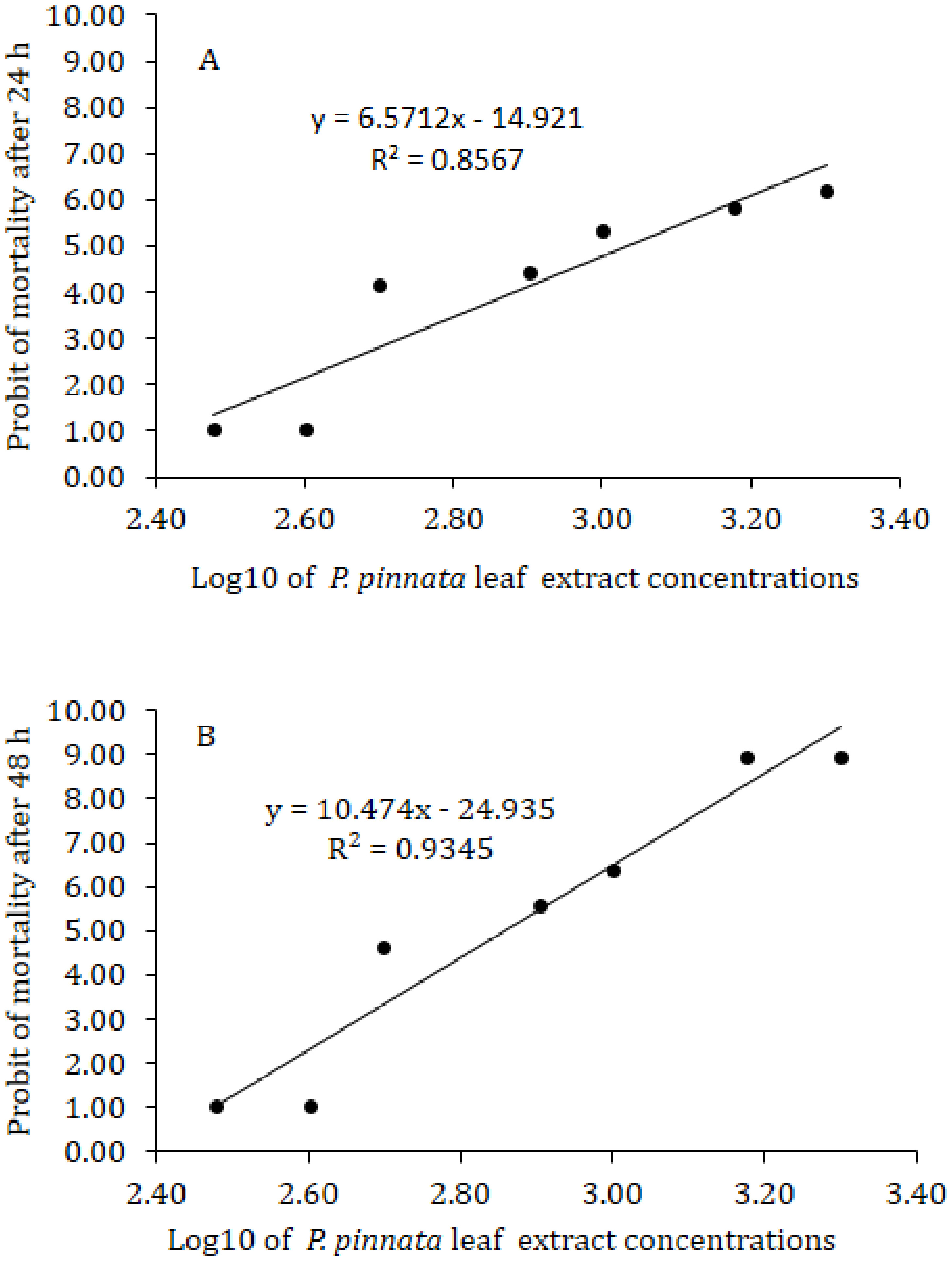
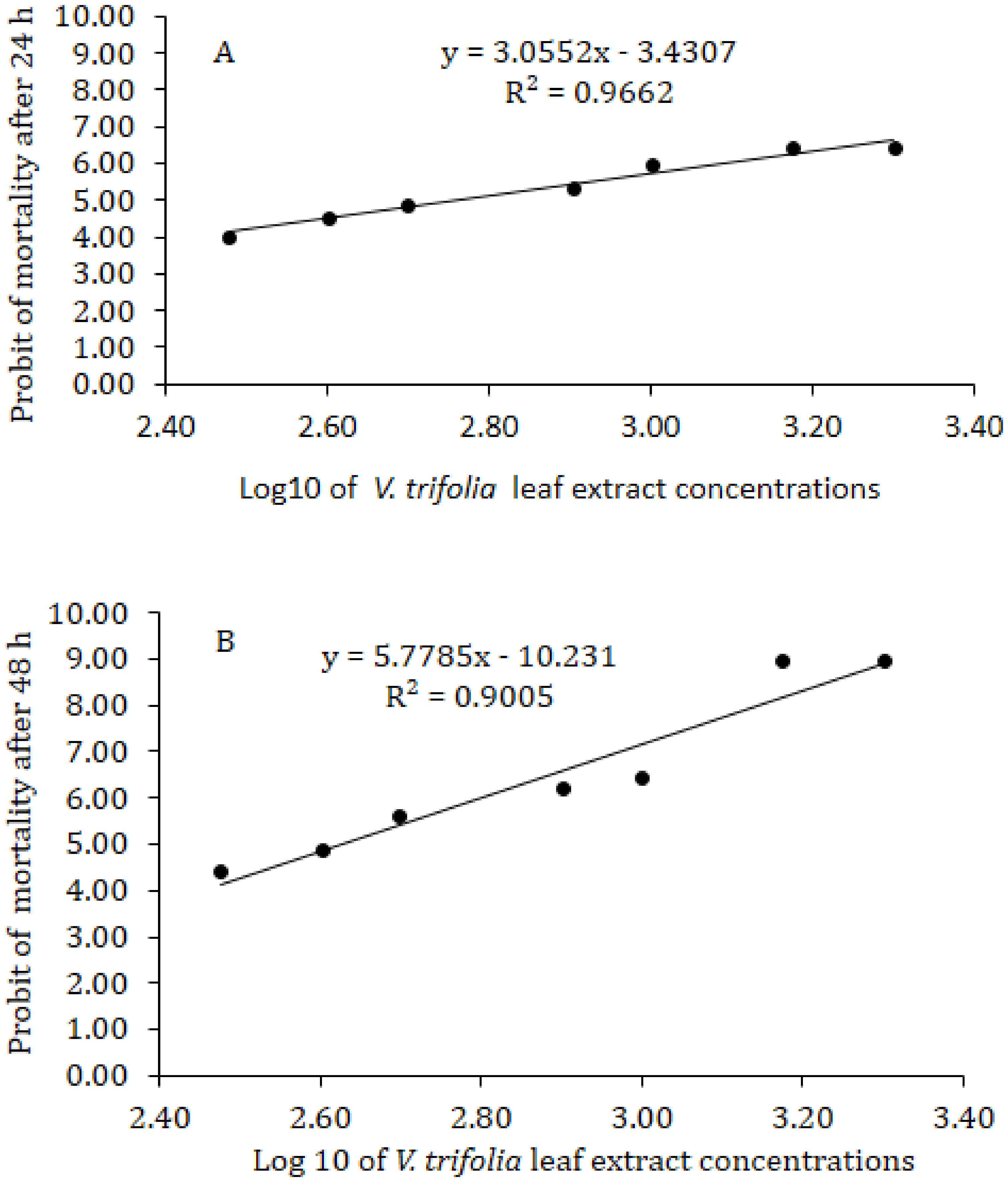
The LC50 and LC90 for both extracts (Table 3) were calculated using linear probit regression of larval mortality on log10 of the extract concentrations. The LC50 and LC90 of P. pinnata leaf extract after 24 hours of exposure were 891.41 ppm and 1252.25 ppm respectively, and after 48 hours of exposure, they decreased to 721.16 ppm and 955.51 ppm respectively. The LC50 and LC90 of V. trifolia leaf extract after 24 hours of exposure were 648.67 ppm and 1627.19 ppm respectively, and after 48 hours, they decreased to 453.82 ppm and 711.67 ppm respectively.
Lethal concentration 50 and 90 percent (LC50 and LC90) of P. pinnata and V. trifolia leaf extracts after 24 and 48 hours of exposure respectively, against larvae of Ae. Aegypti.
Probit transformation of larval mortality after 24 and 48 hours of exposure in P. pinnata leaf extract (Figures 11B) had the R2 value of 0.8567 and 0.9345, respectively. The probit transformation of larval mortality after 24 and 48 hours of exposure to V. trifolia leaf extract (Figures 22B) had R2 values of 0.9662 and 0.9005, respectively.
Probit transformation of larval mortality (A) after 24 hours, and (B) after 48 hours of exposure to Pongamia pinnata leaf extract.
Probit transformation of larval mortality (A) after 24 hours and (B) after 48 hours exposures with Vtiex trifolia leaf extract.
3.3. Oviposition deterrent activity
Oviposition deterrent activity of P. pinnata leaf extract (Table 4) were 7.02% - 19.33% with concentrations of 300 – 2000 ppm, with a mean of 11.59%, and this was lower than the negative control. The positive control (0.02% temephos) and the negative control had 0% and 39.84% oviposition deterrent activity, respectively.
Oviposition deterrent activity of P. pinnata leaf extract against Ae. aegypti after 3 and 6 days of treatment respectively, and the total number of eggs.
Oviposition deterrent activity of V. trifolia leaf extract (Table 5) was concentration-dependent. The lowest oviposition deterrent activity (0%) was observed in the positive control, while the highest (91.16%-95.81%) was observed at 1500–2000 ppm. The negative control had 41.18% oviposition deterrent activity.
Oviposition deterrent activity of V. trifolia leaf extract against Ae. aegypti after 3 and 6 days of treatment, respectively, and the total number of eggs.
4. Discussion
4.1. Larvicidal activity
The larvicidal activity of P. pinnata leaf extract against Ae. aegypti after 24 hours of exposure in the present study was 88% at 2000 ppm, which was much lower than in similar studies, likely due to differences in the larva species used. For example, Ae. vittatus larvae mortality of 100% is achieved at a concentration of 250 ppm (Madhavi and Mahesh, 2023), and larvae mortality of the citrus butterfly (Papilio demoleus) is 82.1% at 400 ppm (Lingakari et al., 2023). Vector species is one of the factors influencing the effectiveness of plant extracts' larvicidal activity (Shajahan et al., 2020). The lower larvicidal activity of P. pinnata leaf extract in the present study was due to the susceptibility of the different larval species used. The larvae of Ae. vittatus, and P. demoleus are probably more susceptible than Ae. aegypti to the P. pinnata leaf extract.
Vitex trifolia leaf extract caused faster and more larval mortality compared to P. pinnata leaf extract. Vitex trifolia leaf extract caused larval death at 300 ppm after 24 and 48 hours, while P. pinnata leaf extract caused larval death at a concentration of 500 ppm. At a concentration of 1500 ppm P. pinnata leaf extract killed 80%, while V. trifolia leaf extract killed 92% of larvae. The larval mortality data in Table 2 showed that the V. trifolia leaf extract had higher larvicidal activity than P. pinnata leaf extract. This was further supported by the lower values of LC50 after 24 and 48 hours of V. trifolia than P. pinnata leaf extract, indicating that V. trifolia leaf extract was more effective larvicidal than P. pinnata against Ae. aegypti. The presence of terpenoids in V. trifolia leaf extract probably has made it more toxic, it caused higher larvicidal activity than P. pinnata extract.
Plant extracts of the genus Vitex are known to have larvicidal activity against mosquito larvae (Lukmiati et al., 2020). Vitex negundo has larvicidal activity against Ae. aegypti with a much lower concentration of 250 ppm causes 99.8% larvae mortality after 24 hours of exposure (Gokulakrishnan et al., 2015). Leaf extract of V. negundo synthesized in silver nanoparticles at 100 ppm causes 71.66% larval mortality after 24 hours of treatment (George et al., 2024). Leaf extract of V. grandifolia has larvicidal activity against Anopheles gambiae (Azokou et al., 2013).
The mode of action of plant extract on mosquito’s larvae is via midgut damage (Abutaha et al., 2022; Aziz et al., 2021; Torawane et al., 2021). Extracts of four weed species (Cyathocline purpurea, Blumea lacera, Neanotis lancifolia, and Neanotis montholonii) cause midgut histology changes, including cytoplasmic swelling, cell membrane damage, distortion of the nucleus, loss of cell integrity, epithelial destruction, and separation of the basal lamina (Torawane et al., 2021).
The combination of Cinnamomum burmannii and Syzygium aromaticum extracts causes severe midgut cell damage in Culex pipiens, including damage to microvilli, the basal membrane, and epithelial cells (Abutaha et al., 2022). Leaf extract of Vitex ovate causes darker coloration in the midgut of Ae. aegypti larvae (Aziz et al., 2021). Pongamia pinnata and V. trifolia leaf extracts were rich in phenols, tannins, flavonoids, steroids, alkaloids, saponins, and terpenoids (in V. trifolia only). The phytochemical compounds in the present study may have damaged the larval midgut cells of Ae. aegypti, however, it needs to be confirmed. Phytochemical compounds in plant extract work synergistically as a larvicidal for mosquitoes (Harith et al., 2018). The more phytochemical compounds an extract contains, the higher its larvicidal activity (Barragán-Avilez et al., 2026). Among those phytochemicals, terpenoids from essential oils and plant extracts are better insecticides for larvicidal activity against mosquitoes, including Ae. aegypti (Silverio et al., 2020).
Lethal concentration that kills 50% and 90% of larvae (LC50 and LC90) indicates the efficacy of plant extracts in controlling the larvae. In the present study, the LC50 and LC90 of P. pinnata leaf extract after 24 hours were 891.41 ppm and 1252.25 ppm respectively, and these are much higher than a similar research by Sumathi et al. (2024), who found the LC50 and LC90 of P. pinnata methanol leaf extract after 24 h of exposure against Ae. aegypti are 101.36 ppm and 434.670 ppm respectively. The large discrepancy indicates that the P. pinnata leaf extract in the present study had lower larvicidal activity, probably due to differences in phytochemical composition among leaves collected from different locations. Pongamia pinnata leaf samples used in the present study were collected from Bukit Jimbaran, Udayana University Campus, Bali, Indonesia (115°10’15.2” S, 8°47’56.8” E), at an elevation of 404 masl. While Sumathi et al. (2024) take leaf samples from Tamil Nadu, India (8° 43' 3.2484'' N, 77° 44' 20.2056'' E) at an elevation of 47 masl. Both samples contain alkaloids, flavonoids, saponins, and phenols; however, terpenoids and glycosides were absent in the samples from Bukit Jimbaran, Bali, Indonesia, and tannins were absent in the samples from Tamil Nadu, India.
In another research with Juniperus communis (L.), elevation is one of the environmental factors that influences the number of phytochemical compounds. Generally, increasing elevations increase the number of phytochemicals. The highest levels of phenolics, tannins, and flavonoids are found at different elevations (Rawat et al., 2025). The difference in elevation between the present study and that of Sumathi et al. (2024) may be one reason for the differences in compound yields. Similar findings by Dhiman et al. (2025) indicate that elevations influence the phytochemical composition of Reinwardtia indica Dumort., with higher elevations increasing the number and amount of phytochemicals, particularly phenols, flavonoids, and tannins. In addition, soil properties, such as moisture content, soil pH, and available nutrients, vary with elevation and influence phytochemical composition (Rawat et al., 2025).
Concentrations and types of secondary metabolites in plants vary among species and environments. When plants of the same species grow in contrasting environments, their secondary metabolite concentrations and types may change. Secondary metabolites in plants are crucial for their defense mechanisms. Both biotic and abiotic environmental stressors can harm plants thriving in their natural environments. These environmental stressors cause plants to produce certain secondary metabolites which in turn, help them fight the negative impacts of biotic and abiotic stressors. The biotic factors include endophytic fungi and bacteria, pathogens, and herbivores, while abiotic factors include light, temperature, salinity, drought, and soil fertility (Alami et al., 2024).
4.2. Oviposition deterrent activity
Oviposition is one of the most significant phases of the mosquito life cycle. When choosing oviposition sites, gravid female mosquitoes exhibit a strong preference (Day, 2016). Oviposition deterrent activity, measured as percent repellency, showed that P. pinnata leaf extract had lower oviposition deterrent activity than the negative control but higher than the positive control. Pongamia pinnata leaf extract was ineffective in deterring Ae. aegypti mosquitoes from laying eggs where repellency was low (≤13.53%) and was not dose-dependent from 400 – 1000 ppm, although at 1500 ppm, it had slightly higher repellency of 19.33%. Based on phytochemical screening, the P. pinnata leaf extract contained phenols, tannins, flavonoids, steroids, alkaloids, and saponins, but it did not contain terpenoids. Similarly, the low larvicidal activity of P. pinnata leaf extract was attributed to the absence of terpenoids, which are known to be more effective at controlling mosquitoes than other phytochemicals (Silverio et al., 2020). Other research using ethanol leaf extract of Pometia pinnata shows dose-dependent oviposition deterrent activity, where the highest activity is 66.4% at 500 ppm (Suharyo et al., 2020). The positive control (0.02% temephos) had 0% oviposition deterrent activity, indicating it did not deter the mosquito from laying eggs.
On the other hand, V. trifolia leaf extract had high oviposition deterrent activity, and it was concentration-dependent, with concentrations of 1500 - 2000 ppm repelling 91.16–95.81% of mosquitoes from laying eggs. The oviposition deterrent activity of V. trifolia leaf extract is due to the presence of secondary metabolites, particularly terpenoids, which are the largest group of secondary plant metabolites. Terpenoids have diverse roles in plants, including oviposition and feeding deterrents, and direct toxicity (Divekar et al., 2022), which are found in extracts, essential oils, and purified fractions (Silverio et al., 2020). Vitexfolin D is a diterpenoid in the leaf extract of V. trifolia (Ainun et al., 2025). The essential oil from V. trifolia contains monoterpenes, such as cis-ocimene, α-thujene, cyclopentene, 3-isopropenyl-5,5-dimethyl, α-pinene, and β-pinene, which effectively repel Ae. aegypti from biting humans (Arpiwi et al., 2020). Essential oil from the wild plant Lantana camara (Verbenaceae) has oviposition deterrent activity of 85%, 59%, and 89% against Ae. aegypti, An. gambiae, and Cx. quinquefasciatus respectively. Since essential oils are volatile, the chemoreceptor of the mosquito’s antennae detects stimuli from chemical constituents, thereby repelling them from laying eggs. Mosquitoes search for suitable oviposition sites (Abbas et al., 2024). The media containing V. trifolia leaf extract in the present study were not suitable for Ae. aegypti to lay eggs for the reasons mentioned above.
Mosquito control activities using plant extracts are influenced by several factors, including plant species, plant parts, phytochemical constituents, and targeted mosquito species (Hillary et al., 2024). In the present study, Ae. aegypti was controlled using methanol leaf extracts of P. pinnata and V. trifolia, applied to larvae and adult mosquitoes. Larvae are the most vulnerable stage in mosquito metamorphosis, controlling them should be easier for several reasons. Larvae represent the most extended phase in the mosquito life cycle, more sensitive to phytochemical compounds, and easily localized (Silverio et al., 2020). In addition, control of oviposition deterrent activities combined to reduce the vector reproduction.
In conclusion, both P. pinnata and V. trifolia methanol leaf extracts exhibited dose-dependent larvicidal activity. The LC50 after 24 and 48 hours of V. trifolia leaf extract (648.67 ppm and 453.82 ppm respectively ) were lower than for P. pinnata (891.41 ppm and 721.16 ppm respectively), indicating higher larvicidal activity of V. trifolia. Vitex trifolia methanol leaf extract had oviposition deterrent activity with dose-dependent activity, and at 1500 ppm, it repelled 91.16% of gravid female Ae. aegypty mosquitoes from laying eggs. Pongamia pinnata methanol leaf extract had low oviposition deterrent activity (mean of 11.59%) at concentrations of 300–2000 ppm.
It is recommended that both P. pinnata and V. trifolia methanol leaf extracts can be integrated into dengue control programs in tropical countries. A practical method of larval control is encapsulation (Purkait et al., 2021). For controlling adult female mosquitoes, an ovitrap containing only V. trifolia leaf extract is recommended.
Acknowledgements
We would like to acknowledge the Ministry of Education and Culture, Republic of Indonesia, for funding this research through DIPA PNBP 2024, Udayana University, Denpasar, Bali, Indonesia, under the research scheme Hibah Unggulan Udayana, grant number B/255.335/UN14.4.A/PT.01.03/2024, dated 17 April 2024.
Data Availability Statement
The dataset generated in this manuscript available at https://www.researchgate.net/publication/397941872_DATASET and DOI: 10.13140/RG.2.2.16779.96803
References
-
ABBAS, M.G., AZEEM, M., BASHIR, M.U., ALI, F., MOZURATIS, R. and BINYAMEEN, M., 2024. Chemical composition, repellent, and oviposition deterrent potential of wild plant essential oils against three mosquito species. Molecules, vol. 29, no. 11, pp. 2657. https://doi.org/10.3390/molecules29112657 PMid:38893531.
» https://doi.org/10.3390/molecules29112657 -
ABUTAHA, N., AL-MEKHLAFI, F.A., AL-KHALIFA, M.S. and WADAAN, M.A., 2022. Larvicidal activity and histopathological changes of Cinnamomum burmannii, Syzygium aromaticum extracts and their combination on Culex pipiens. Saudi Journal of Biological Sciences, vol. 29, no. 4, pp. 2591-2596. https://doi.org/10.1016/j.sjbs.2021.12.035 PMid:35531167.
» https://doi.org/10.1016/j.sjbs.2021.12.035 -
AINUN, A.D.A., SJAM, S., SULAEHA, S. and FITRIYANTI, N.Z., 2025. Evaluating the repellent efficacy of a Vitex trifolia L. leaf powder botanical formulation against oriental fruit flies (Bactrocera dorsalis). Hayati Journal of Biosciences, vol. 32, no. 5, pp. 1251-1259. https://doi.org/10.4308/hjb.32.5.1251-1259
» https://doi.org/10.4308/hjb.32.5.1251-1259 -
ALAMI, M.M., GUO, S., MEI, Z., YANG, G. and WANG, X., 2024. Environmental factors on secondary metabolism in medicinal plants: exploring accelerating factors. Medicinal Plant Biology, vol. 3, no. 1, pp. e016. https://doi.org/10.48130/mpb-0024-0016
» https://doi.org/10.48130/mpb-0024-0016 -
ANWAR, R., HIDA, J.N., SUMANTO, D. and SAYONO, S., 2022. Evaluation of larvicidal activity of Kaempferia galanga extracts against Aedes aegypti larvae. Pakistan Journal of Biological Sciences : PJBS, vol. 25, no. 12, pp. 1040-1046. https://doi.org/10.3923/pjbs.2022.1040.1046 PMid:36978271.
» https://doi.org/10.3923/pjbs.2022.1040.1046 -
ARPIWI, N.L., MUKSIN, I.K. and KRISWIYANTI, E., 2020. Essential oil from Vitex trifolia as an effective repellent against Aedes aegypti. Biodiversitas, vol. 21, no. 10, pp. 4536-5444. https://doi.org/10.13057/biodiv/d211060
» https://doi.org/10.13057/biodiv/d211060 -
AZIZ, M., ARIF, E.I.H., DIMYATI, N.I.M., ISHAK, I.H., HAMDAN, R.H., SYAZWAN, S.A. and PENG, T.L., 2021. Larvicidal effect of Vitex ovata Thunb. (Lamiales: Lamiaceae) leaf extract towards Aedes (Stegomyia) aegypti (Linnaeus, 1762) (Diptera: Culicidae). Parasitologia, vol. 1, no. 4, pp. 210-217. https://doi.org/10.3390/parasitologia1040022
» https://doi.org/10.3390/parasitologia1040022 -
AZOKOU, A., KONÉ, M.W., KOUDOU, B.G. and TRA BI, H.F., 2013. Larvicidal potential of some plants from West Africa against Culex quinquefasciatus (Say) and Anopheles gambiae Giles (Diptera: culicidae). Journal of Vector Borne Diseases, vol. 50, no. 2, pp. 103-110. https://doi.org/10.4103/0972-9062.117481 PMid:23995311.
» https://doi.org/10.4103/0972-9062.117481 -
BARRAGÁN-AVILEZ, C., PAREJA-LOAIZA, J., DOMÍNGUEZ, K.G., BEATRIZ LÓPEZ-MONROY, B., AFLORES, A.E., SÁNCHEZ-BOLÍVAR, M., LUNA-CARRASCAL, J., PACHECO-LONDOÑO, L.C., GALÁN-FREYLE, N.J., QUIROZ, E.N., CASTELLANOS-ROMERO, K., MAESTRE-SERRANO, R., VALLE-MOLINARES, R. and ESPITIA-ALMEIDA, F., 2026. Phytochemical profiling and larvicidal activity of ethanolic extracts from Persea americana Mill. (Var. Lorena) against Aedes aegypti. Insects, vol. 17, no. 1, pp. 34. https://doi.org/10.3390/insects17010034 PMid:41598888.
» https://doi.org/10.3390/insects17010034 -
BRADY, O. and HAY, S.I., 2020. The global expansion of dengue: how Aedes aegypti mosquitoes enabled the first pandemic arbovirus. Annual Review of Entomology, vol. 65, no. 1, pp. 191-208. https://doi.org/10.1146/annurev-ento-011019-024918 PMid:31594415.
» https://doi.org/10.1146/annurev-ento-011019-024918 -
CHALA, B. and HAMDE, F., 2021. Emerging and re-emerging vector-borne infectious diseases and the challenges for control: a review. Frontiers in Public Health, vol. 9, pp. 715759. https://doi.org/10.3389/fpubh.2021.715759 PMid:34676194.
» https://doi.org/10.3389/fpubh.2021.715759 -
CHOWDHURY, A., MODAHL, C.M., MISSÉ, D., KINI, R.M. and POMPON, J., 2021. High resolution proteomics of Aedes aegypti salivary glands infected with either dengue, zika or chikungunya viruses identify new virus specific and broad antiviral factors. Scientific Reports, vol. 11, no. 1, pp. 23696. https://doi.org/10.1038/s41598-021-03211-0 PMid:34880409.
» https://doi.org/10.1038/s41598-021-03211-0 -
CORZO-GÓMEZ, J.C., ESPINOSA-JUÁREZ, J.V., BRIONES-ARANDA, A., CRUZ-SALOMÓN, A., OVANDO-ZAMBRANO, J.C. and ESQUINCA-AVILÉS, H.A., 2024. A review of botanical extracts with repellent and insecticidal activity and their suitability for managing mosquito-borne disease risk in Mexico. Pathogens, vol. 13, no. 9, pp. 737. https://doi.org/10.3390/pathogens13090737 PMid:39338928.
» https://doi.org/10.3390/pathogens13090737 -
DAVILA-BARBOZA, J.A., GUTIERREZ-RODRIGUEZ, S.M., JUACHE-VILLAGRANA, A.E., LOPEZ-MONROY, B. and FLORES, A.E., 2024. Widespread resistance to temephos in Aedes aegypti (Diptera: Culicidae) from Mexico. Insects, vol. 15, no. 2, pp. 120. https://doi.org/10.3390/insects15020120 PMid:38392539.
» https://doi.org/10.3390/insects15020120 -
DAY, J.F., 2016. Mosquito oviposition behavior and vector control. Insects, vol. 7, no. 4, pp. 65. https://doi.org/10.3390/insects7040065 PMid:27869724.
» https://doi.org/10.3390/insects7040065 -
DEGANI, E., ULLAH, I., PRASAD, M.V.R., PARADKAR, A., PENA, R., SOLTANGHEISI, A., ULLAH, I., WARR, B. and TIBBETT, M., 2022. A critical review of Pongamia pinnata multiple applications: from land remediation and carbon sequestration to socioeconomic benefits. Journal of Environmental Management, vol. 324, pp. 116297. https://doi.org/10.1016/j.jenvman.2022.116297 PMid:36174475.
» https://doi.org/10.1016/j.jenvman.2022.116297 -
DHIMAN, K., DHALARIA, R., VERMA, R., KUMAR, D., HASHEM, A., NAJLA, A., ALSHAIKH, N.A. and ABD-ALLAH, E.F., 2025. Altitudinal impacts on phytochemical composition and mycorrhizal diversity of Reinwardtia indica Dumort, a medicinally valuable herb. BMC Plant Biology, vol. 25, no. 1, pp. 306. https://doi.org/10.1186/s12870-025-06290-7 PMid:40059155.
» https://doi.org/10.1186/s12870-025-06290-7 -
DIVEKAR, P.A., NARAYANA, S., DIVEKAR, B.A., KUMAR, R., GADRATAGI, B.G., RAY, A., SINGH, A.K., RANI, V., SINGH, V., SINGH, A.K., KUMAR, A., SINGH, R.P., MEENA, R.S. and BEHERA, T.K., 2022. Plant secondary metabolites as defense tools against herbivores for sustainable crop protection. International Journal of Molecular Sciences, vol. 23, no. 5, pp. 2690. https://doi.org/10.3390/ijms23052690 PMid:35269836.
» https://doi.org/10.3390/ijms23052690 -
GANI, H., MAHARJA, R., SALCHA, M.A., GANI, H., WARDHANI, N., NURANI, N., GANI, N.F. and MAHARJA, R., 2022. Dengue hemorrhagic fever incidence in Indonesia using trend analysis test and spatial visualization. International Journal of Public Health Science, vol. 11, no. 4, pp. 1190-1201. https://doi.org/10.11591/ijphs.v11i4.21533
» https://doi.org/10.11591/ijphs.v11i4.21533 -
GEORGE, J.A., YING, J.Y., PAPPUSWAMY, M., BALASUBRAMANIAN, B., CHAUDHARY, A. and PAARI, K.A., 2024. Evaluation of toxicity of Vitex negundo L. synthesized silver nanoparticles against Aedes aegypti. Plant Science Today, vol. 11, no. 2, pp. 537-545. https://doi.org/10.14719/pst.2961
» https://doi.org/10.14719/pst.2961 - GOKULAKRISHNAN, J., BARANITHARAN, M., ABIRAMI, R., KAVIKUYIL, R., RAMYAA, R., DEEPAA, J. and BALUSELVAKUMAR, B., 2015. Larvicidal and ovicidal activities of Vitex negundo Linn. (Family:Verbenaceae) plant extracts against dengue mosquito, Aedes aegypti (Linn.) (Diptera: Culicidae). Life Science Archives, vol. 1, no. 1, pp. 66-71.
-
HARAPAN, H., MICHIE, A., MUDATSIR, M., SASMONO, R.T. and IMRIE, A., 2019. Epidemiology of dengue hemorrhagic fever in Indonesia: analysis of five decades data from the National Disease Surveillance. BMC Research Notes, vol. 12, no. 1, pp. 350. https://doi.org/10.1186/s13104-019-4379-9 PMid:31221186.
» https://doi.org/10.1186/s13104-019-4379-9 -
HARITH, S.S., MOHD, S.N.A.S., AZIZ, N.A., MYDIN, M.M. and NASIR, N.T.S., 2018. Phytochemical screening and larvicidal activity of Murraya koenigii leaves extracts against mosquito larvae. The Malaysian Journal of Analytical Sciences, vol. 22, no. 3, pp. 471-476. https://doi.org/10.17576/mjas-2018-2203-14
» https://doi.org/10.17576/mjas-2018-2203-14 -
HILLARY, V.E., CEASAR, S.A. and IGNACIMUTHU, S., 2024. Efficacy of plant products in controlling disease vector mosquitoes, a review. Entomologia Experimentalis et Applicata, vol. 172, no. 3, pp. 195-214. https://doi.org/10.1111/eea.13401
» https://doi.org/10.1111/eea.13401 -
HOSSAIN, M.S., RAIHAN, M.E., HOSSAIN, M.S., SYEED, M.M.M., RASHID, H. and REZA, M.S., 2022. Aedes larva detection using ensemble learning to prevent dengue endemic. BioMedInformatics, vol. 2, no. 3, pp. 405-423. https://doi.org/10.3390/biomedinformatics2030026
» https://doi.org/10.3390/biomedinformatics2030026 -
JING, Q. and WANG, M., 2019. Dengue epidemiology. Global Health Journal (Amsterdam, Netherlands), vol. 3, no. 2, pp. 37-45. https://doi.org/10.1016/j.glohj.2019.06.002
» https://doi.org/10.1016/j.glohj.2019.06.002 -
KAMAL, N., ASNI, N.S.M., ROZLAN, I.N.A., AZMI, M.A.H.M., MAZLAN, N.W., MEDIANI, A., BAHARUM, S.N., LATIP, J., ASSAW, S. and EDRADA-EBEL, R.A., 2022. Review. Traditional medicinal uses, phytochemistry, biological properties, and health applications of Vitex sp. Plants, vol. 11, no. 15, pp. 1944. https://doi.org/10.3390/plants11151944 PMid:35893648.
» https://doi.org/10.3390/plants11151944 -
LEI, C. and SUN, X., 2018. Comparing lethal dose ratios using probit regression with arbitrary slopes. BMC Pharmacology & Toxicology, vol. 19, no. 1, pp. 61. https://doi.org/10.1186/s40360-018-0250-1 PMid:30290834.
» https://doi.org/10.1186/s40360-018-0250-1 -
LINGAKARI, M., MADDALA, M. and BANDI, S., 2023. Larvicidal effect of Pongamia pinnata plant extracts against Papilio demoleus Linnaeus (Insecta: Lepidoptera: Papilionidae). Journal of Biological Control, vol. 37, no. 2, pp. 113-122. https://doi.org/10.18311/jbc/2023/32497
» https://doi.org/10.18311/jbc/2023/32497 - LUKMIATI, N., KARDELA, W. and IFORA, I., 2020. Larvicidal activity and efficacy of vitex species: A review. Science International, vol. 32, no. 4, pp. 493-500.
- MADHAVI, M. and MAHESH, L., 2023. Pongamia pinnata leaf extracts efficacy against the 4th instar larvae of Aedes vittatus (Insecta: Diptera: Culicidae). Journal of Medical Arthropodology & Public Health, vol. 3, no. 1, pp. 23-34.
-
MARTIANASARI, R. and HAMID, P.H., 2019. Larvicidal, adulticidal, and oviposition-deterrent activity of Piper betle L. essential oil to Aedes aegypti. Veterinary World, vol. 12, no. 3, pp. 367-371. https://doi.org/10.14202/vetworld.2019.367-371 PMid:31089304.
» https://doi.org/10.14202/vetworld.2019.367-371 -
MEIER, C.J., ROUHIER, M.F. and HILLYER, J.F., 2024. Chemical control of mosquitoes and the pesticide treadmill: a case for photosensitive insecticides as larvicides. Insects, vol. 13, no. 12, pp. 1093. https://doi.org/10.3390/insects13121093 PMid:36555003.
» https://doi.org/10.3390/insects13121093 -
MOTTAGHIPISHEH, J., KAMALI, M., DOUSTIMOTLAGH, A.H., NOWROOZZADEH, M.H., RASEKH, F., HASHEMPUR, M.H. and IRAJI, A., 2024. A comprehensive review of ethno medicinal approaches, phytochemical analysis, and pharmacological potential of Vitex trifolia L. Frontiers in Pharmacology, vol. 15, pp. 1322083. https://doi.org/10.3389/fphar.2024.1322083 PMid:38576489.
» https://doi.org/10.3389/fphar.2024.1322083 -
NISA, A., KURNIAWATI, A. and FARIDAH, D.N., 2023. Morphological characters, phenolic and flavonoid contents of Vitex trifolia accessions from Lamongan District, Indonesia. Biodiversitas, vol. 24, no. 3, pp. 1635-1641. https://doi.org/10.13057/biodiv/d240336
» https://doi.org/10.13057/biodiv/d240336 -
OLIVEROS-DÍAZ, A.F., PÁJARO-GONZÁLEZ, Y., CABRERA-BARRAZA, J., HILL, C., QUIÑONES-FLETCHER, W., OLIVERO-VERBEL, J. and CASTILLO, F.D., 2022. Larvicidal activity of plant extracts from Colombian North Coast against Aedes aegypti L. mosquito larvae. Arabian Journal of Chemistry, vol. 15, no. 12, pp. 104365. https://doi.org/10.1016/j.arabjc.2022.104365
» https://doi.org/10.1016/j.arabjc.2022.104365 -
PIEDRA, L.A., MARTINEZ, Y., CAMACHO, E., GARCIA, I., RODRIGUEZ, D., VANLERBERGHE, V. and MARQUETTI, M.D.C., 2024. Scientific Note. Temephos resistance status of Aedes aegypti populations from Havana, Cuba. Journal of the American Mosquito Control Association, vol. 40, no. 2, pp. 117-120. https://doi.org/10.2987/23-7164 PMid:38666434.
» https://doi.org/10.2987/23-7164 -
PURKAIT, A., MUKHERJEE, A., HAZRA, D.K., ROY, K., BISWAS, P.K. and KOLE, R.K., 2021. Encapsulation, release and insecticidal activity of Pongamia pinnata (L.) seed oil. Heliyon, vol. 7, no. 3, pp. e06557. https://doi.org/10.1016/j.heliyon.2021.e06557 PMid:33855235.
» https://doi.org/10.1016/j.heliyon.2021.e06557 -
RAWAT, P., DASILA, K., SINGH, M. and KUNIYAL, G.C., 2025. Influence of environmental factors on phytochemical compositions and antioxidant activity of Juniperus communis L. Discover Environment, vol. 3, no. 11, pp. 11. https://doi.org/10.1007/s44274-025-00189-8
» https://doi.org/10.1007/s44274-025-00189-8 - ROGHINI, R. and VIJAYALAKSHMI, K., 2018. Pytochemical screening, quantitative analysis of flavonoids and minerals in ethanolic extract of Citrus paradise. International Journal of Pharmaceutical Sciences and Research, vol. 9, no. 11, pp. 4859-4864. https://doi.org/10.13040/IJPSR.0975-8232.9(11).4859-64.
-
SHAJAHAN, A., HUSSIAN, M.I.Z., KUMAR, S.R. and AJINTHA, K., 2020. A review on plant phytochemicals potential for mosquito control. International Journal of Mosquito Research, vol. 9, no. 6, pp. 47-54. https://doi.org/10.22271/23487941.2022.v9.i6a.641
» https://doi.org/10.22271/23487941.2022.v9.i6a.641 -
SHOUKAT, R.F., SHAKEEL, M., RIZVI, S.A.H., ZAFAR, J., ZHANG, Y., FREED, S., XU, X. and JIN, F., 2020. Larvicidal, ovicidal, synergistic, and repellent activities of Sophora alopecuroides and its dominant constituents against Aedes albopictus. Insects, vol. 11, no. 4, pp. 246. https://doi.org/10.3390/insects11040246 PMid:32326460.
» https://doi.org/10.3390/insects11040246 -
SILVÉRIO, M.R.S., ESPINDOLA, L.S., VIEIRA, P.C., LOPES, N.P. and VIEIRA, P.C., 2020. Plant natural products for the control of Aedes aegypti: the main vector of important arboviruses. Molecules, vol. 25, no. 15, pp. 3484. https://doi.org/10.3390/molecules25153484 PMid:32751878.
» https://doi.org/10.3390/molecules25153484 -
SOFIANA, L., ROKHMAYANTI, R., MARTINI, M. and WULANDARI, D.A., 2023. Insecticide resistance of Aedes aegypti in Indonesia: a systematic review. International Journal of Public Health Science, vol. 12, no. 3, pp. 950-964. https://doi.org/10.11591/ijphs.v12i3.22843
» https://doi.org/10.11591/ijphs.v12i3.22843 -
SUHARYO, L., ARTHARI, R.K. and ROCHMAH, F.S.N., 2020. Oviposition deterrent activity and ovicidal effect of Pometia pinnata leaves extract against dengue vector, Aedes aegypti (Diftera: culicidae). E3S Web of Conferences, vol. 151, pp. 01013. https://doi.org/10.1051/e3sconf/202015101013
» https://doi.org/10.1051/e3sconf/202015101013 - SUMATHI, G., PUSHPANATHAN, T. and SELVARAJ, P., 2024. Insecticidal activity of crude extracts from Pongamia pinnata (L.) against Aedes aegypti (L.) and Culex quinquefasciatus (Say). International Journal of Entomological Research, vol. 9, no. 9, pp. 112-117.
-
TORAWANE, S., ANDHALE, R., PANDIT, R., MOKAT, D. and PHUGE, S., 2021. Screening of some weed extracts for ovicidal and larvicidal activities against dengue vector Aedes aegypti. Journal of Basic & Applied Zoology, vol. 82, no. 1, pp. 36. https://doi.org/10.1186/s41936-021-00233-y
» https://doi.org/10.1186/s41936-021-00233-y -
TRAN, D.H., NGUYEN, T.G. and BUI, N.H., 2022. Efficacy of the extract from pongam (Pongamia pinnata) leaves against the cassava pink mealybug (Phenacoccus manihoti Matile-Ferrero) under laboratory conditions. Research on Crops, vol. 23, no. 1, pp. 197-201. https://doi.org/10.31830/2348-7542.2022.027
» https://doi.org/10.31830/2348-7542.2022.027
Edited by
-
Editor:
Takako Matsumura Tundisi