 Diurnal variation in the chemical composition of Psidium decussatum DC. (Myrtaceae) essential oil.
Abstract
In this study, the influence of diurnal variation on the chemical composition of the essential oil from the leaves of Psidium decussatum DC., a species of the Myrtaceae family, was investigated. Samples were collected at 5 a.m., 12 p.m., and 6 p.m. The oil extraction method used was steam-assisted hydrodistillation with a Clevenger apparatus. The samples were analyzed by gas chromatography-mass spectrometry (GC-MS). Compound identification was performed by comparing the compounds with the NIST database. Variations in essential oil yield were observed, with higher values in the morning and afternoon and lower values at night. In total, 25 compounds were identified in the 5 a.m. sample and 20 compounds in the 12 p.m. and 6 p.m. samples. The morning sample showed greater chemical diversity. The 6 p.m. sample exhibited higher concentrations of eucalyptol and γ-terpinene. These differences may be associated with variations in light and temperature throughout the day, factors that influence the synthesis of secondary metabolites. It is concluded that the essential oil of P. decussatum varies both qualitatively and quantitatively according to the collection time. It is also concluded that the main constituents were eucalyptol, γ-terpinene, caryophyllene, L-α-terpineol, and linalool, with monoterpenes predominant in all samples. The main contribution of this study is to expand the chemical knowledge of a little-studied species. By providing detailed data on the chemical profile of endemic plants from the semi-arid region of Alagoas, this work supports the sustainable use and technological development of these plants.
Keywords:
molecules; volatility; terpenes; biosynthesis; industrial potential
Resumo
Neste estudo, investigou-se a influência da variação diurna na composição química do óleo essencial das folhas de Psidium decussatum DC., espécie da família Myrtaceae. As amostras foram coletadas às 5h, 12h e 18h. O método de extração do óleo foi a hidrodestilação por arraste a vapor utilizando um aparelho Clevenger. As amostras foram submetidas à cromatografia gasosa acoplada à espectrometria de massas (CG-EM). A identificação dos compostos foi realizada por meio da comparação com o banco de dados do NIST. Observaram-se variações no rendimento do óleo essencial, com valores mais elevados pela manhã e à tarde e mais baixos à noite. No total, 25 compostos foram identificados na amostra das 5h e 20 compostos nas amostras das 12h e 18h. Na amostra da manhã detectou-se maior diversidade química. Na amostra das 18h encontraram-se maiores concentrações de eucaliptol e de γ-terpineno. Essas diferenças podem estar associadas a variações de luz e temperatura ao longo do dia, fatores que influenciam a síntese de metabólitos secundários. Conclui-se que o óleo essencial de P. decussatum varia tanto qualitativamente quanto quantitativamente conforme o horário de coleta. Conclui-se, ainda, que os principais constituintes foram eucaliptol, γ-terpineno, cariofileno, L-α-terpineol e linalol, com predominância de monoterpenos em todas as amostras. A principal contribuição deste estudo é ampliar o conhecimento químico sobre uma espécie ainda pouco investigada. Ao fornecer dados detalhados sobre seu perfil químico, este trabalho subsidia o uso sustentável e o desenvolvimento tecnológico de plantas endêmicas da região semiárida de Alagoas.
Palavras-chave:
moléculas; volatilidade; terpenos; biossíntese; potencial industrial
1. Introduction
Essential oils (EO) are complex mixtures of volatile and lipophilic substances produced by the secondary metabolism of plants, which are found in different structures, such as leaves, flowers, fruits, and seeds. In plants, they perform essential functions, including protection against predators, attraction of pollinators, reduction of water loss, and thermal regulation (Bueno et al., 2023). These compounds can be isolated using various methods, including hydrodistillation, solvent extraction, and steam distillation, the latter being the most widely used on an industrial scale (Teixeira, 2021).
The chemical composition of essential oils is determined by genetics, but environmental factors can also influence it. As highlighted by Hazrati et al. (2022), conditions such as physiological stages of the plant, agronomic conditions, harvest time, and post-harvest management methods. This variability is also observed throughout the day, making the harvest schedule a determining factor in the final composition of essential oils (Santos et al., 2025). Previous studies reinforce that the interaction between genetics and environment results in dynamic chemical structures that are highly sensitive to external conditions (Formica et al., 2026).
In addition to their ecological importance, essential oils have broad industrial importance. They are commonly used in the perfume, cosmetics, food, and pharmaceutical industries and are valued for their medicinal potential (Trancoso, 2013). Due to their chemical complexity and natural variability, they represent a group of great scientific interest, whose expression and biosynthesis are directly related to physiological and environmental factors (Yokomizo and Nakaoka-Sakita, 2014).
Among the botanical families that produce essential oils, Myrtaceae stands out for its diverse species, which are rich in volatile compounds. Considered one of the most prominent angiosperm families, it currently comprises 130 to 150 genera and more than 5,650 species distributed throughout the world (Grattapaglia et al., 2012). Within this group, the genus Psidium L. includes approximately 130 species distributed across the Atlantic Forest, Amazon Forest, Caatinga, and Cerrado biomes (Peixoto et al., 2017). It has enormous economic importance due to its exotic fruits and leaves, rich in essential oils that exhibit diverse biological activities, including antimicrobial, antioxidant, insecticidal, and repellent properties (Branco et al., 2023).
Santos et al. (2023) report that different Psidium species investigated worldwide exhibit variation in the chemical composition of their essential oils. Such variation may be associated with factors such as extraction method, plant’s geographic origin, climate conditions, soil characteristics, the specific plant organ analyzed, plant age, seasonality, and circadian rhythm (Matos et al., 2025; Santos et al., 2023; Fernandes et al., 2020). Marques et al. (2023) reported that two simultaneous response patterns exist in the secondary metabolism of plants to environmental stimuli: the larger and slower-paced seasonal climatic variations and the smaller and faster daily climatic fluctuations, indicating that harvest time is an important parameter for EO production as the chemical composition of plants continuously changes throughout the day.
According to Fernandes et al. (2020), these variables influence both the qualitative and quantitative profiles of essential oil constituents. Consequently, establishing the optimal timing for plant material collection is essential to maximize the recovery of target bioactive compounds and ensure greater consistency in essential oil composition. Despite this relevance, most studies on the biological activities of essential oils from the genus Psidium focus on P. guajava L. and P. cattleyanum Sabine, highlighting the need for investigations into other, less-explored species.
In this context, the present study aimed to investigate the influence of collection time within the same day on the chemical composition of the essential oil extracted from the leaves of Psidium decussatum DC., a species of the Myrtaceae family endemic to Brazil. According to Fernandez and Amorim (2020), the species occurs in the Atlantic Forest and Caatinga biomes; however, there are no specific records of its occurrence in the Agreste region of Alagoas, nor studies evaluating the effect of diurnal variation on the chemical composition of its essential oil. The Agreste region of Alagoas represents an ecotonal area between these two biomes, and the species is found in the municipality of Arapiraca, where it is popularly known as “gavadinha.”
Thus, this study seeks to determine the most appropriate collection time to capture greater chemical diversity and identify possible diurnal variations in the essential oil composition, which may be relevant for future commercial and biotechnological applications. Evaluating this variability contributes to improving the quality of the extracted oil and to expanding scientific knowledge about still poorly studied species within this genus.
2. Materials and Methods
2.1. Extraction of volatile compounds from leaves
The leaves of Psidium decussatum, popularly known as “gavadinha”, were collected at latitude 9.7424444 and longitude 36.645104 in early May (autumn), under dry weather conditions, in the municipality of Arapiraca, Alagoas, Brazil. Collections were carried out at 5 a.m., 12 p.m., and 6 p.m. All samples were obtained from the same individual plant, which is approximately 10 years old. A voucher specimen of this individual was deposited in the MAC Herbarium of the Instituto do Meio Ambiente do Estado de Alagoas under registration number 71456. After each collection, the botanical material was placed in a thermal box and transported to the Center for Botanical Research and Studies (NEB) and to the Botany Laboratory of Campus I of the State University of Alagoas (UNEAL).
In the laboratory, the leaves were placed in a forced-air drying oven for five days at 35 °C. After drying, the leaves collected at each time point were ground separately using a previously sterilized blender. The extraction methodology was adapted from Trindade et al. (2021). Subsequently, the plant material was weighed on a precision digital balance, and 200 g of each sample were transferred into a 1 L flat-bottom glass flask using a funnel and a glass rod, followed by the addition of 600 mL of distilled water according to the adapted experimental protocol. The flask was then placed on a heating mantle and connected to a Clevenger-type apparatus.
Hydrodistillation was performed using the Clevenger apparatus, and after 5 hours of boiling, the essential oil was collected. The procedure was conducted carefully to ensure maximum preservation of volatile compounds. A calibrated pipette was used to optimize oil recovery and ensure accurate measurement. The collected essential oil was stored in amber glass bottles to protect it from light and oxidation, placed in thermal and refrigerated containers, and subsequently transported to the Laboratory of Technology and Control of Medicines (LABTCOM) at the Institute of Pharmaceutical Sciences (ICF/UFAL), where the identification of volatile compounds was carried out.
2.2. Compound analysis method
The analyses were carried out at the Institute of Pharmaceutical Sciences (ICF) of the Federal University of Alagoas (UFAL) using Gas Chromatography coupled with Mass Spectrometry (GC-MS). The identification of essential oil constituents was performed on a Shimadzu GCMS-QP2010 system equipped with an Rtx-5 capillary column (5% diphenyl / 95% dimethyl polysiloxane), 30 m in length and 0.25 mm internal diameter, with helium (He) as the carrier gas at a flow rate of 1 mL/min.
For the methodological procedure, an adaptation of the method previously described by Trindade et al. (2021) was implemented, extending the extraction time in order to maximize the detection of volatile compounds and improve chromatographic resolution by increasing peak separation.
The sample was prepared through successive dilutions. First, 100 µL of oil was diluted in 10 mL of hexane (C6H14). Then, 1 mL of this solution was diluted again in 10 mL of hexane. From the final solution, 1 µL was injected into the equipment.
The injector was kept at 250 °C, operating in split mode (1:100), and the detector was set at 250 °C. The total runtime was approximately 50 minutes. Oven temperature programming consisted of: an initial temperature of 60 °C held for 3 minutes; an increase of 5 °C/min to 200 °C, held for 6 minutes; followed by the rise of 5 °C/min to 250 °C, held for 3 minutes.
Mass spectra were obtained by electron impact at 70 eV. Compound identification was performed by comparing the obtained spectra with those in the instrument’s spectral library and with literature-reported Retention Indices (RI).
Compound identification was based on comparison of retention indices (determined relative to the retention times of an n-alkane series) using a mass spectrometry (MS) library. The NIST database was used to determine the compound's percentage composition. Only compounds with a similarity index above 90% were considered in the results.
2.3. Statistical analysis
The results were comparatively analyzed based on the relative percentage area of the identified compounds obtained by GC-MS.
3. Results
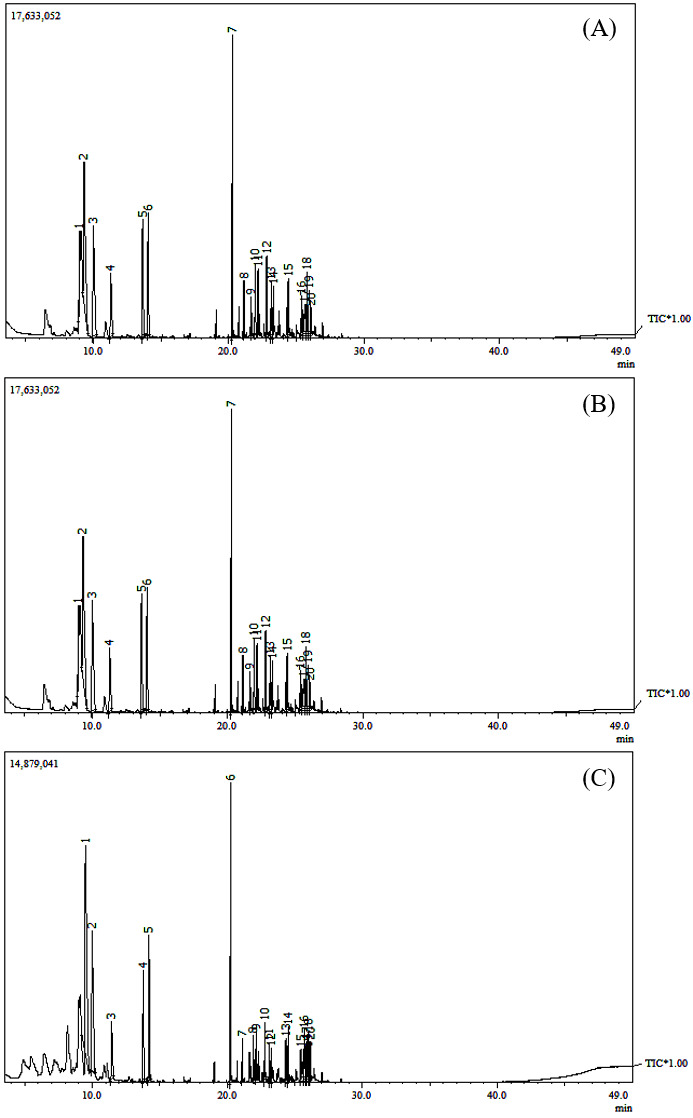
The chromatographic analysis of the essential oil of P. decussatum revealed that its chemical profile remained qualitatively similar, showing only changes in the concentrations of the compounds, as can be seen in Figure 1.

Chromatograms of the analyses: (A) sample collected at 5:00 AM, (B) sample collected at 12:00 PM, and (C) sample collected at 6:00 PM. Source: Authors, 2026.
The main compounds identified in the sample collected at 5 a.m. (Table 1), were Eucalyptol (22.90%), γ-Terpinene (10.38%), D-limonene (8.85%), and Caryophyllene (12.19%). The presence of L-α-Terpineol (6.02%), Linalool (4.10%), Humulene (1.63%), Naphthalene (2.49%), and Isoledene (2.45%) was also recorded, indicating a predominance of monoterpenes (approximately 52.25%) and sesquiterpenes (about 18.76%).
In the collection performed at 12 p.m. (Table 2), a variation in the concentration of the essential oil’s chemical compounds was observed, with Eucalyptol (18.50%), γ-Terpinene (13.10%), and Caryophyllene (12.68%) standing out as the major constituents. The sample contained 53.06% monoterpenes and 23.09% sesquiterpenes. The compounds L-α-Terpineol (7.36%) and Linalool (5.90%) also remained at relevant concentrations, suggesting stability in the presence of oxygenated monoterpenes and a slight quantitative variation among the collection periods.
In the sample collected at 6:00 p.m. (Table 3), Eucalyptol remained the predominant compound (29.24%), followed by γ-Terpinene (15.41%), Caryophyllene (11.17%), L-α-Terpineol (7.56%), and (–)-4-Terpineol (6.79%). In this sample, monoterpenes were predominant (63.41%), followed by sesquiterpenes (16.63%) and aromatic compounds (4.58%). Although the latter were present in lower proportions, their concentration was higher than that observed in the other collections.
Overall, Eucalyptol, γ-Terpinene, Caryophyllene, and L-α-Terpineol were the main constituents of the essential oil of P. decussatum, with concentrations varying with collection time. These diurnal fluctuations in chemical composition indicate that the collection period influences the essential oil's chemical profile, an important factor to consider in studies aimed at the biotechnological and pharmacological applications of the species.
4. Discussion
In the study by Silva et al. (2016), as in the present work, no significant qualitative variation in the essential oil compounds was observed throughout the day; rather, changes occurred in their concentrations. These findings corroborate the data obtained here, reinforcing the conclusion that the differences are mainly due to quantitative variations in the components. Similarly, Aygun et al. (2022), investigating a species of the Lamiaceae family also used for essential oil extraction, reported higher yields from collections conducted at night.
These results reinforce the conclusion of Souza et al. (2024), who highlighted the lack of consensus on the relationship between collection time and essential oil yield, making it difficult to establish a standardized harvesting protocol for aromatic plants (Oliveira et al., 2012). Such inconsistency occurs because each species (and even individual specimens) may exhibit distinct responses, underscoring the particularities inherent to different plant materials.
The results obtained for the essential oil of P. decussatum confirm what is widely described in the literature, demonstrating that essential oils are predominantly composed of terpenes and their derivatives (Felipe and Bicas, 2017). In all samples analyzed, monoterpenes and sesquiterpenes predominated, volatile compounds that play a central role in the aromatic profile of plants (Farkas and Mohácsi-Farkas, 2014). This pattern was especially evident in the samples collected at 12:00 p.m. and 6:00 p.m., in which monoterpene content exceeded 50%, with Eucalyptol, γ-Terpinene, L-α-Terpineol, and Linalool standing out.
In addition to contributing to the characteristic aroma, such compounds play essential ecological functions, acting in plant defense against pathogens and exhibiting antimicrobial activity (Bava et al., 2023; De Martino et al., 2015; Lutfi and Roque, 2014). Thus, the chemical composition observed across different collections of P. decussatum reflects the terpene-rich nature of the essential oils and reinforces their ecological importance and biotechnological and pharmacological potential.
Among the compounds identified, Eucalyptol stands out for its broad therapeutic potential. This monoterpene exhibits cardiovascular, antimicrobial, anti-inflammatory, and respiratory effects, being widely used in the treatment of asthma and chronic respiratory diseases, and showing efficacy against various pathogenic bacteria and fungi (Yao et al., 2025; Campos and Berteina-Raboin, 2022; Kazak, 2022). In a study by Roque-Flores et al. (2025), eucalyptol showed phytotoxic activity, primarily affecting root growth. Additionally, according to Bedoya-Pérez et al. (2014), it can act as both an olfactory attractant and a chemical defense compound, depending on the animal.
In the study by Baginska et al. (2023), γ-terpinene was highlighted for its antibacterial, antifungal, and antiviral properties. This compound has been shown to inhibit pathogenic microorganisms and improve air quality, demonstrating significant therapeutic and environmental potential (Oliveira, 2025). According to De Groot and Schmidt (2016), its concentration in commercial oils should not exceed 28% to ensure effectiveness in topical treatments and prevent allergic contact reactions. In the present study, γ-terpinene ranged from 13.10% to 15.41%, levels considered safe and supportive of the antimicrobial potential of P. decussatum essential oil.
Beyond its antimicrobial activity, γ-terpinene also affects ecological interactions, influencing larval feeding preference while exhibiting toxic effects that inhibit larval growth (Agliassa & Maffei, 2018). Additionally, when combined with α-pinene, it may function as an attractant or bait for pests in non-host plant species (Boncan et al., 2020), highlighting its potential role in plant–insect dynamics and pest management strategies.
Caryophyllene also exhibits broad bioactivity, including analgesic, anti-inflammatory, antioxidant, antimicrobial, gastroprotective, immunomodulatory, and hepatoprotective effects (Gyrdymova and Rubtsova, 2022; Aly et al., 2019). Its oxidized form, Caryophyllene oxide, has shown promise as an antiparasitic agent in the treatment of leishmaniasis, ascariasis, and colitis (Ferreira Júnior, 2022; Monzote et al., 2018; Pastor et al., 2015; Oh et al., 2014). Additionally, studies indicate that agroecological applications are possible due to their ability to inhibit the growth of invasive plant species (Tang et al., 2015).
L-α-Terpineol, a compound with a woody and citrus aroma widely used in fragrances and cosmetics, also presents important biological activities (Sales et al., 2020). Studies indicate its anti-inflammatory, antioxidant, antiproliferative, antidiarrheal, and antimicrobial potential, acting in the inhibition of inflammatory cytokines, combating tumor cells, and reducing intestinal motility (Ben Hamouda et al., 2025; Sales et al., 2020; dos Santos Negreiros et al., 2019; Nogueira et al., 2014). Additionally, it is effective against fungi and algae, making it a promising natural preservative and antifungal agent in agriculture and the food industry (An et al., 2019; Kong et al., 2019; Chen et al., 2019).
When associated with other compounds, L-α-terpineol can also act as an insect aggregation pheromone (Pineda-Ríos et al., 2021). It also influences soil ecology by promoting beneficial bacteria and suppressing pathogens (Ye et al., 2021), and enhances the pathogenicity of nematodes against subterranean termites (Zeng et al., 2023), reinforcing its ecological and biotechnological relevance.
Linalool, present in all collections, is widely used in the perfume, cosmetic, cleaning product, and food industries due to its pleasant aroma and pharmacological properties (Silva et al., 2024). This compound exhibits antiseptic, anti-inflammatory, anticancer, antifungal, antibacterial, and hepatoprotective activities (An et al., 2021). Its antimicrobial effects and potential as an antibiotic adjuvant highlight its relevance in combating microbial resistance.
Ecologically, volatile compounds such as linalool play an important role in mediating plant–insect interactions, acting as both attractants and defense signals (Raguso, 2016). In addition, linalool influences the behavior of various insects, including beetles, ants, butterflies, and mosquitoes, exhibiting significant repellent and insecticidal activity; for example, species such as Magnolia kobus and Ocimum forskolei, which emit high levels of linalool, show repellent effects against mosquitoes like Aedes albopictus and Aedes aegypti (Zhang et al., 2023).
D-limonene, one of the major constituents of the morning collection, exhibits potent antibacterial and antifungal activity, acting against a wide variety of microorganisms, including multidrug-resistant strains (Zapata-Zapata et al., 2022; Sieniawska et al., 2018; Thakre et al., 2018). It also shows synergistic effects with antifungals by inhibiting adhesion, biofilm formation, and morphological transition in Candida species (Ahmedi et al., 2022). Beyond its antimicrobial activity, D-limonene possesses antihelmintic, insecticidal, and repellent properties and is widely used as a natural botanical insecticide (Zhang et al., 2022a; Lam et al., 2020). Studies further highlight its antioxidant, anti-inflammatory, and analgesic potential (Blevins et al., 2022; Eddin et al., 2021; Amorim et al., 2016). Due to its high volatility and insect toxicity, D-limonene it is considered a green pesticide. It has been shown to repel insects such as B. tabaci, reducing feeding on host plants, and, together with linalool in Zanthoxylum bungeanum essential oil, exhibits strong toxic effects against insects (Wei et al., 2024).
The major compounds identified across the three collection times are generally associated with plant defense mechanisms, particularly acting as repellents and inhibiting larval development or the growth of competing/invasive plants, as previously discussed. However, during the night, there was an increase in the concentration of aromatic and attractant compounds. This pattern supports the findings of Lo et al. (2024), who reported that nocturnal shifts in the concentration of certain volatile compounds help guide pollinators, making olfactory cues especially important under low-light conditions.
However, some compounds showed higher concentrations during periods of greater light incidence, such as γ-terpinene, linalool, and L-α-terpineol, which reached their highest levels in the 12:00 p.m. collection. This finding reinforces previous reports by Paulus et al. (2019) and Bufalo et al. (2015), who stated that light intensity and collection time can influence essential oil production both quantitatively and qualitatively, as well as enhance the synthesis of secondary metabolites.
In agreement with these observations, Aygun et al. (2022) also reported that linalool reached its highest concentration in samples collected at 12:00 p.m., consistent with our results. Additionally, the authors found that eucalyptol was more concentrated in dried leaves than in fresh material, indicating that not only environmental factors, such as light intensity, but also physiological conditions and sample preparation methods can significantly influence the final chemical profile of the essential oil.
Beyond external conditions, such fluctuations may also be regulated by the plant’s circadian cycle, which controls the daily activation of metabolic pathways involved in terpene biosynthesis (Silva Junior et al., 2022). As stationary autotrophic organisms, plants synthesize these secondary metabolites in response to both biotic and abiotic stresses. In addition to coping with environmental fluctuations, herbivores, and pathogens, these compounds play essential ecological roles, acting in protection, defense against pests and diseases and attraction of pollinators (Lee and Ding, 2016).
The major compounds identified in this study have also been reported in other species of the genus Psidium, including eucalyptol, D-limonene, L-α-terpineol, γ-terpinene, and terpinen-4-ol (Alam et al., 2023; Elsayed et al., 2023; Zhang et al., 2022b). These findings indicate a certain chemical similarity within the genus, particularly regarding the presence of bioactive monoterpenes.
However, comparative studies also reveal important differences in the predominance of specific compound classes. De Souza et al. (2021), for example, identified β-caryophyllene as the major compound in another Psidium species, with a predominance of sesquiterpenes—a pattern distinct from the monoterpene predominance observed in P. decussatum. Such variations highlight both the chemical similarities and the diversity typically found among species within the genus (Silva et al., 2021).
5. Final Considerations
The collection time directly influenced the concentration of compounds in the essential oil of P. decussatum, with greater chemical diversity observed in the morning and a higher concentration of aromatic compounds at night, while the overall qualitative profile remained similar. These results indicate optimal collection periods for maximizing specific compounds and highlight the ecological and potential applied relevance of this species.
Although the findings expand current knowledge of P. decussatum and support its potential industrial, therapeutic, and ecological applications, this study has limitations, particularly regarding geographic scope and collection conditions. Therefore, further studies are needed to better understand the chemical variability and biological potential of this still poorly studied species.
Acknowledgements
We acknowledge FAPEAL (Research Support from the State of Alagoas) for the financial support through the PIBITI (Institutional Program for Scholarships in Technological Development and Innovation) undergraduate research scholarship. We also acknowledge the Institute of Pharmaceutical Sciences of the Federal University of Alagoas (UFAL) for its structural support in conducting the study, as well as Professor Irinaldo Diniz Basílio Junior and his scholarship students for their assistance in identifying the compounds.
Data Availability Statement
The data used and analyzed in this study are not publicly available. All datasets supporting the results presented are fully published within the article itself, ensuring transparency and allowing verification of the information discussed. Additionally, the datasets analyzed or generated during this research may be requested from the corresponding author.
References
-
AGLIASSA, C. and MAFFEI, M.E., 2018. Origanum vulgare terpenoids induce oxidative stress and reduce the feeding activity of Spodoptera littoralis. International Journal of Molecular Sciences, vol. 19, no. 9, pp. 2805. https://doi.org/10.3390/ijms19092805 PMid:30231481.
» https://doi.org/10.3390/ijms19092805 -
AHMEDI, S., PANT, P., RAJ, N. and MANZOOR, N., 2022. Limonene inhibits virulence-associated traits in Candida albicans: in-vitro and in-silico studies. Phytomedicine Plus : International Journal of Phytotherapy and Phytopharmacology, vol. 2, no. 3, pp. 100285. https://doi.org/10.1016/j.phyplu.2022.100285
» https://doi.org/10.1016/j.phyplu.2022.100285 -
ALAM, A., JAWAID, T., ALSANAD, S.M., KAMAL, M. and BALAHA, M.F., 2023. Composition, antibacterial efficacy, and anticancer activity of essential oil extracted from Psidium guajava (L.) leaves. Plants, vol. 12, no. 2, pp. 246. https://doi.org/10.3390/plants12020246 PMid:36678958.
» https://doi.org/10.3390/plants12020246 -
ALY, E., KHAJAH, M.A. and MASOCHA, W., 2019. β-Caryophyllene, a CB2-receptor-selective phytocannabinoid, suppresses mechanical allodynia in a mouse model of antiretroviral-induced neuropathic pain. Molecules (Basel, Switzerland), vol. 25, no. 1, pp. 106. https://doi.org/10.3390/molecules25010106 PMid:31892132.
» https://doi.org/10.3390/molecules25010106 -
AMORIM, J.L., SIMAS, D.L., PINHEIRO, M.M., MORENO, D.S., ALVIANO, C.S., DA SILVA, A.J. and FERNANDES, P.D., 2016. Anti-inflammatory properties and chemical characterization of the essential oils of four Citrus species. PLoS One, vol. 11, no. 4, pp. e0153643. https://doi.org/10.1371/journal.pone.0153643 PMid:27088973.
» https://doi.org/10.1371/journal.pone.0153643 - AN, P., YANG, X., YU, J., REN, X. and KONG, Q., 2019. α-Terpineol and terpene-4-ol, the critical components of tea tree oil, exert antifungal activities in vitro and in vivo against Aspergillus niger in grapes by inducing morphological damage and metabolic changes of the fungus. Food Control, vol. 98, pp. 42-53.
-
AN, Q., REN, J.N., LI, X., FAN, G., QU, S.S., SONG, Y., LI, Y. and PAN, S.Y., 2021. Recent updates on bioactive properties of linalool. Food & Function, vol. 12, no. 21, pp. 10370-10389. https://doi.org/10.1039/D1FO02120F PMid:34611674.
» https://doi.org/10.1039/D1FO02120F -
AYGUN, Y.Z., EREN, Y. and ERTEKIN, E.N., 2022. Diurnal variation of essential oil ratio and composition of some basil genotypes. Bangladesh Journal of Botany, vol. 51, no. 4, pp. 787-795. https://doi.org/10.3329/bjb.v51i4.63498
» https://doi.org/10.3329/bjb.v51i4.63498 -
BAGINSKA, S., GOLONKO, A., ŚWISŁOCKA, R. and LEWANDOWSKI, W., 2023. Monoterpenes as medicinal agents: exploring the pharmaceutical potential of p-cymene, p-cymenene, and γ-terpinene. Acta Poloniae Pharmaceutica, vol. 80, no. 6, pp. 879-892. https://doi.org/10.32383/appdr/178242
» https://doi.org/10.32383/appdr/178242 -
BAVA, R., CASTAGNA, F., PALMA, E., MARRELLI, M., CONFORTI, F., MUSOLINO, V., CARRESI, C., LUPIA, C., CENITI, C., TILOCCA, B., RONCADA, P., BRITTI, D. and MUSELLA, V., 2023. Essential oils for a sustainable control of honeybee varroosis. Veterinary Sciences, vol. 10, no. 5, pp. 308. https://doi.org/10.3390/vetsci10050308 PMid:37235392.
» https://doi.org/10.3390/vetsci10050308 -
BEDOYA-PÉREZ, M.A., ISLER, I., BANKS, P.B. and MCARTHUR, C., 2014. Roles of the volatile terpene, 1,8-cineole, in plant–herbivore interactions: a foraging odor cue as well as a toxin? Oecologia, vol. 174, no. 3, pp. 827-837. https://doi.org/10.1007/s00442-013-2801-x PMid:24122179.
» https://doi.org/10.1007/s00442-013-2801-x -
BEN HAMOUDA, S., ZAKRAOUI, O., SOUISSI, S., BOUZEYEN, R., ESSAFI, M. and ESSAFI-BENKHADIR, K., 2025. Deciphering the mechanisms underlying the antitumor effects of Eucalyptus essential oil and its component 3-Cyclohexene-1-methanol against human colon cancer cells. International Journal of Molecular Sciences, vol. 26, no. 18, pp. 8876. https://doi.org/10.3390/ijms26188876 PMid:41009443.
» https://doi.org/10.3390/ijms26188876 -
BLEVINS, L.K., BACH, A.P., CRAWFORD, R.B., ZHOU, J., HENRIQUEZ, J.E., RIZZO, M.D., SERMET, S., KHAN, D.M.I.O., TURNER, H., SMALL-HOWARD, A.L. and KAMINSKI, N.E., 2022. Evaluation of the anti-inflammatory effects of selected cannabinoids and terpenes from Cannabis sativa employing human primary leukocytes. Food and Chemical Toxicology : An International Journal Published for the British Industrial Biological Research Association, vol. 170, pp. 113458. https://doi.org/10.1016/j.fct.2022.113458 PMid:36228902.
» https://doi.org/10.1016/j.fct.2022.113458 -
BONCAN, D.A.T., TSANG, S.S.K., LI, C., LEE, I.H.T., LAM, H.M., CHAN, T.F. and HUI, J.H.L., 2020. Terpenes and terpenoids in plants: interactions with environment and insects. International Journal of Molecular Sciences, vol. 21, no. 19, pp. 7382. https://doi.org/10.3390/ijms21197382 PMid:33036280.
» https://doi.org/10.3390/ijms21197382 -
BRANCO, L.A., LAGINESTRA, B.F.A., GAZIM, Z.C., DA SILVA, G.R., MACHADO, M.A., SIMÕES, J.V.M., GONÇALVES, D.D. and PIAU JUNIOR, R., 2023. Atividades biológicas do óleo essencial de Psidium spp. Peer Review : Emerging Trends and Key Debates in Undergraduate Education, vol. 5, no. 8, pp. 335-345. https://doi.org/10.53660/394.prw1003
» https://doi.org/10.53660/394.prw1003 - BUENO, G. N., FIGUEIREDO, G.D., LOPES, E.S., OLIVEIRA, R.S.R. and SILVA, N.C.S., 2023. Extração e caracterização de óleos essenciais do cravo-da-índia (Eugenia caryophyllus). Journal of Exact Sciences, vol. 37, no. 1, pp. 8-10.
-
BUFALO, J., ZHELJAZKOV, V.D., CANTRELL, C.L., ASTATKIE, T., CIAMPA, L. and JELIAZKOVA, E., 2015. Diurnal effects on spearmint oil yields and composition. Scientia Horticulturae, vol. 182, pp. 73-76. https://doi.org/10.1016/j.scienta.2014.11.018
» https://doi.org/10.1016/j.scienta.2014.11.018 -
CAMPOS, J.F. and BERTEINA-RABOIN, S., 2022. Eucalyptol, an all-purpose product. Catalysts, vol. 12, no. 1, pp. 48. https://doi.org/10.3390/catal12010048
» https://doi.org/10.3390/catal12010048 -
CHEN, Y., WENG, Y., ZHOU, M., MENG, Y., LIU, J., YANG, L. and ZUO, Z., 2019. Linalool- and α-terpineol-induced programmed cell death in Chlamydomonas reinhardtii. Ecotoxicology and Environmental Safety, vol. 167, pp. 435-440. https://doi.org/10.1016/j.ecoenv.2018.10.062 PMid:30368137.
» https://doi.org/10.1016/j.ecoenv.2018.10.062 -
DE GROOT, A.C. and SCHMIDT, E., 2016. Tea tree oil: contact allergy and chemical composition. Contact Dermatitis, vol. 75, no. 3, pp. 129-143. https://doi.org/10.1111/cod.12591 PMid:27173437.
» https://doi.org/10.1111/cod.12591 - DE MARTINO, L., NAZZARO, F., MANCINI, L. and DE FEO, V., 2015. Essential oils from Mediterranean aromatic plants. In: V.R. PREEDY and R.R. WATSON, eds. The mediterranean diet: an evidence-based approach London: Elsevier, cap. 58, p. 649-661.
-
EDDIN, L.B., JHA, N.K., MEERAN, M.F.N., KESARI, K.K., BEIRAM, R. and OJHA, S., 2021. Neuroprotective potential of limonene and limonene-containing natural products. Molecules (Basel, Switzerland), vol. 26, no. 15, pp. 4535. https://doi.org/10.3390/molecules26154535 PMid:34361686.
» https://doi.org/10.3390/molecules26154535 -
ELSAYED, H.E., EL-DEEB, E.M., TAHA, H., TAHA, H.S., ELGINDI, M.R. and MOHARRAM, F.A., 2023. Essential oils of Psidium cattleianum Sabine leaves and flowers: anti-inflammatory and cytotoxic activities. Frontiers in Chemistry, vol. 11, pp. 1120432. https://doi.org/10.3389/fchem.2023.1120432 PMid:36814544.
» https://doi.org/10.3389/fchem.2023.1120432 -
FARKAS, J. and MOHÁCSI-FARKAS, C., 2014. Safety of foods and beverages: spices and seasonings. In: Y. MOTAJERMI, ed. Encyclopedia of food safety USA: Elsevier, p. 324-330, vol. 3: Foods, Materials, Technologies, and Risks. https://doi.org/10.1016/B978-0-12-378612-8.00290-0
» https://doi.org/10.1016/B978-0-12-378612-8.00290-0 -
FELIPE, L.O. and BICAS, J.L., 2017. Terpenos, aromas e a química dos compostos naturais. Química Nova na Escola, vol. 39, no. 2, pp. 120-130. https://doi.org/10.21577/0104-8899.20160068
» https://doi.org/10.21577/0104-8899.20160068 -
FERNANDES, C.C., REZENDE, J.L., SILVA, E.A.J., SILVA, F.G., STENICO, L., CROTTI, A.E.M., ESPERANDIM, V.R., SANTIAGO, M.B., MARTINS, C.H.G. and MIRANDA, M.L.D., 2020. Chemical composition and biological activities of essential oil from flowers of Psidium guajava (Myrtaceae). Brazilian Journal of Biology, vol. 81, no. 3, pp. 728-736. https://doi.org/10.1590/1519-6984.230533 PMid:32876175.
» https://doi.org/10.1590/1519-6984.230533 -
FERNANDEZ, E. and AMORIM, E., 2020 [viewed 20 November 2025]. Psidium decussatum (Myrtaceae) Rio de Janeiro: Centro Nacional de Conservação da Flora, Instituto de Pesquisas Jardim Botânico do Rio de Janeiro. Lista Vermelha da Flora Brasileira. Available from: https://proflora.jbrj.gov.br/html/Psidium%20decussatum_2020.html
» https://proflora.jbrj.gov.br/html/Psidium%20decussatum_2020.html -
FERREIRA JÚNIOR, W.D., 2022 [viewed 20 November 2025]. Atividade antifúngica do óleo essencial das folhas de Psidium guajava no controle de Colletotrichum truncatum Rio Verde: Instituto Federal de Educação, Ciência e Tecnologia Goiano. Trabalho de conclusão de curso. Repositório Institucional do Instituto Federal Goiano. Available from: https://repositorio.ifgoiano.edu.br/bitstream/prefix/2662/3/TCC%20WEBER%20DIAS%20FERREIRA%20JUNIOR.pdf
» https://repositorio.ifgoiano.edu.br/bitstream/prefix/2662/3/TCC%20WEBER%20DIAS%20FERREIRA%20JUNIOR.pdf -
FORMICA, V., ROMANO, D., VERDEGUER, M., ZINGALE, S., LEONI, F., CARLESI, S., BÀRBERI, P. and GUARNACCIA, P., 2026. Mild abiotic stresses improve essential oils yield and composition of Mediterranean medicinal and aromatic plants with minimal impact on plant growth: a systematic literature review. Italian Journal of Agronomy, vol. 21, no. 1, pp. 100079. https://doi.org/10.1016/j.ijagro.2025.100079
» https://doi.org/10.1016/j.ijagro.2025.100079 -
GRATTAPAGLIA, D., VAILLANCOURT, R.E., SHEPHERD, M., THUMMA, B.R., FOLEY, W., KÜLHEIM, C., POTTS, B.M. and MYBURG, A.A., 2012. Progress in Myrtaceae genetics and genomics: eucalyptus as the pivotal genus. Tree Genetics & Genomes, vol. 8, no. 3, pp. 463-508. https://doi.org/10.1007/s11295-012-0491-x
» https://doi.org/10.1007/s11295-012-0491-x -
GYRDYMOVA, Y.V. and RUBTSOVA, S.A., 2022. Caryophyllene and caryophyllene oxide: a variety of chemical transformations and biological activities. Chemické Zvesti, vol. 76, no. 1, pp. 1-39. https://doi.org/10.1007/s11696-021-01865-8
» https://doi.org/10.1007/s11696-021-01865-8 -
HAZRATI, S., BEIDAGHI, P., BEYRAGHDAR KASHKOOLI, A., HOSSEINI, S.J. and NICOLA, S., 2022. Effect of harvesting time variations on essential oil yield and composition of sage (Salvia officinalis). Horticulturae, vol. 8, no. 2, pp. 149. https://doi.org/10.3390/horticulturae8020149
» https://doi.org/10.3390/horticulturae8020149 - KAZAK, F., 2022. A bioactive compound: eucalyptol. In: H.A. DEVECI, ed. Functional foods and nutraceuticals: bioactive compounds Lyon: Livre de Lyon, pp. 125-138.
-
KONG, Q., ZHANG, L., AN, P., QI, J., YU, X., LU, J. and REN, X., 2019. Antifungal mechanisms of α-terpineol and terpene-4-alcohol as the critical components of Melaleuca alternifolia oil in the inhibition of rot disease caused by Aspergillus ochraceus in postharvest grapes. Journal of Applied Microbiology, vol. 126, no. 4, pp. 1161-1174. https://doi.org/10.1111/jam.14193 PMid:30614164.
» https://doi.org/10.1111/jam.14193 - LAM, N.S., LONG, X., SU, X. and LU, F., 2020. Melaleuca alternifolia (tea tree) oil and its monoterpene constituents in treating protozoan and helminthic infections. Biomedicine & Pharmacotherapy, vol. 130, pp. 110624.
- LEE, Y. L., & DING, P., 2016. Production of essential oil in plants: ontogeny, secretory structures and seasonal variations.Pertanika Journal of Scholarly Research Reviews, vol. 2, pp. 1-11.
-
LO, M.-M., BENFODDA, Z., MOLINIÉ, R. and MEFFRE, P., 2024. Volatile organic compounds emitted by flowers: ecological roles, production by plants, extraction, and identification. Plants, vol. 13, no. 3, pp. 417. https://doi.org/10.3390/plants13030417 PMid:38337950.
» https://doi.org/10.3390/plants13030417 - LUTFI, M. and ROQUE, N.F., 2014. Histórias de Eugênias. Química Nova na Escola, vol. 36, no. 4, pp. 252-260.
-
MARQUES, S.P.P.M., PINHEIRO, R.O., NASCIMENTO, R.A.D., ANDRADE, E.H.A. and FARIA, L.J.G., 2023. Effects of harvest time and hydrodistillation time on yield, composition, and antioxidant activity of mint essential oil. Molecules (Basel, Switzerland), vol. 28, no. 22, pp. 7583. https://doi.org/10.3390/molecules28227583 PMid:38005307.
» https://doi.org/10.3390/molecules28227583 - MATOS, C.H.C.D., CARVALHO, P.C.L., BOTELHO, A.O., FORIM, M.R., MATOS, A.P., CUNHA, G.O.S., ALVES, C.C.F. and CAZAL, C.M., 2025. Influence of extraction time and circadian rhythm on the content, chemical composition and antifungal activity of the essential oils from Callistemon viminalis (Myrtaceae) leaves. Journal of the Brazilian Chemical Society, vol. 36, no. 6, pp. e-20250021.
-
MONZOTE, L., GEROLDINGER, G., TONNER, M., SCULL, R., DE SARKAR, S., BERGMANN, S., BACHER, M., STANIEK, K., CHATTERJEE, M., ROSENAU, T. and GILLE, L., 2018. Interaction of ascaridole, carvacrol, and caryophyllene oxide from essential oil of Chenopodium ambrosioides L. with mitochondria in Leishmania and other eukaryotes. Phytotherapy Research : PTR, vol. 32, no. 9, pp. 1729-1740. https://doi.org/10.1002/ptr.6097 PMid:29672979.
» https://doi.org/10.1002/ptr.6097 - NOGUEIRA, M.N., AQUINO, S.G., ROSSA JUNIOR, C. and SPOLIDORIO, D.M., 2014. Terpinen-4-ol and alpha-terpineol inhibit production of IL-1β, IL-6 and IL-10. Inflammation Research: Official Journal of the European Histamine Research Society, vol. 63, no. 9, pp. 769-778.
-
OH, M.S., YANG, J.Y., KIM, M.G. and LEE, H.S., 2014. Acaricidal activities of β-caryophyllene oxide and structural analogues derived from Psidium cattleianum oil against house dust mites. Pest Management Science, vol. 70, no. 5, pp. 757-762. https://doi.org/10.1002/ps.3608 PMid:23861316.
» https://doi.org/10.1002/ps.3608 -
OLIVEIRA, A.R.M.F., JEZLER, C.N., OLIVEIRA, R.A., MIELKE, M.S. and COSTA, L.C., 2012. Determination of hydrodistillation time and harvest time in mint essential oil. Horticultura Brasileira, vol. 30, pp. 155-159. https://doi.org/10.1590/S0102-05362012000100026
» https://doi.org/10.1590/S0102-05362012000100026 -
OLIVEIRA, W.S., 2025 [viewed 20 April 2022]. Potencial antimicrobiano e antioxidante de óleos essenciais obtidos de diferentes genótipos de Lippia gracilis Schauer São Cristóvão: Programa de Pós-Graduação em Biotecnologia, Universidade Federal de Sergipe, 67 p. Dissertação de Mestrado. Repositório Institucional da Universidade Federal de Sergipe. Available from: https://ri.ufs.br/jspui/bitstream/riufs/23633/2/WESLEI_SILVA_OLIVEIRA.pdf
» https://ri.ufs.br/jspui/bitstream/riufs/23633/2/WESLEI_SILVA_OLIVEIRA.pdf -
PASTOR, J., GARCÍA, M., STEINBAUER, S., SETZER, W.N., SCULL, R., GILLE, L. and MONZOTE, L., 2015. Combinations of ascaridole, carvacrol, and caryophyllene oxide against Leishmania. Acta Tropica, vol. 145, pp. 31-38. https://doi.org/10.1016/j.actatropica.2015.02.002 PMid:25697866.
» https://doi.org/10.1016/j.actatropica.2015.02.002 -
PAULUS, D., VALMORBIDA, R. and RAMOS, C.E.P., 2019. Produtividade e composição química do óleo essencial de Ocimum × citriodorum Vis. de acordo com as variações ontogenéticas e diurnas. Journal of Applied Research on Medicinal and Aromatic Plants, vol. 12, pp. 59-65. https://doi.org/10.1016/j.jarmap.2018.12.004
» https://doi.org/10.1016/j.jarmap.2018.12.004 - PEIXOTO, A.L., CARRIJO, T.T. and TULER, A.C., 2017. Gênero Psidium (Myrtaceae). Rodriguésia, vol. 61, pp. 1323-1333.
-
PINEDA-RÍOS, J.M., CIBRIÁN-TOVAR, J., HERNÁNDEZ-FUENTES, L.M., LÓPEZ-ROMERO, R.M., SOTO-ROJAS, L., ROMERO-NÁPOLES, J., LLANDERAL-CÁZARES, C. and SALOMÉ-ABARCA, L.F., 2021. α-Terpineol: An Aggregation Pheromone in Optatus palmaris (Coleoptera: Curculionidae) (Pascoe, 1889) Enhanced by Its Host-Plant Volatiles. Molecules (Basel, Switzerland), vol. 26, no. 10, pp. 2861. https://doi.org/10.3390/molecules26102861 PMid:34065875.
» https://doi.org/10.3390/molecules26102861 -
RAGUSO, R.A., 2016. More lessons from linalool: insights gained from a ubiquitous floral volatile. Current Opinion in Plant Biology, vol. 32, pp. 31-36. https://doi.org/10.1016/j.pbi.2016.05.007 PMid:27286000.
» https://doi.org/10.1016/j.pbi.2016.05.007 -
ROQUE-FLORES, G., MACÍAS-RUBALCAVA, M.L., FUENTES-JAIME, J., BUSTOS-BRITO, C., SAAVEDRA-BARRERA, R.A. and ESQUIVEL, B., 2025. Bioprospecting and mode of action of volatile organic compounds from morphospecies of the endophytic fungus Hypoxylon anthochroum in the field of bioherbicides. World Journal of Microbiology & Biotechnology, vol. 41, no. 10, pp. 374. https://doi.org/10.1007/s11274-025-04603-4 PMid:41082008.
» https://doi.org/10.1007/s11274-025-04603-4 -
SALES, A., FELIPE, L.O. and BICAS, J.L., 2020. Production, properties, and applications of α-terpineol. Food and Bioprocess Technology, vol. 13, no. 8, pp. 1261-1279. https://doi.org/10.1007/s11947-020-02461-6
» https://doi.org/10.1007/s11947-020-02461-6 -
SANTOS NEGREIROS, P., COSTA, D. S., SILVA, V. G., LIMA, I.B.C., NUNES, D.B., SOUSA, F.B.M., ARAÚJO, T.S.L., MEDEIROS, J.V.R., SANTOS, R.F. and OLIVEIRA, R.C.M., 2019. Antidiarrheal activity of α-terpineol in mice. Biomedicine & Pharmacotherapy, vol. 110, pp. 631-640. https://doi.org/10.1016/j.biopha.2018.11.131
» https://doi.org/10.1016/j.biopha.2018.11.131 -
SANTOS, M.C.O., VASCONCELOS, L.C., MENDES, L.A. and FONTES, M.M.P., 2025. Avaliação da atividade citoprotetora do óleo essencial de Psidium myrtoides O. Berg. In M.M.P. FONTES and L.C. VASCONCELOS, orgs. Tópicos especiais em investigação sobre a atividade fitocitogenotóxica de compostos naturais Nova Xavantina: Pantanal Editora, pp. 17-26. https://doi.org/10.46420/9786585756549cap2
» https://doi.org/10.46420/9786585756549cap2 -
SANTOS, P.V.L., DA CRUZ, E.N.S., NUNES, J.A., MOURÃO, R.H.V., DO NASCIMENTO, W.M.O., MAIA, J.G.S. and FIGUEIREDO, P.L.B., 2023. Seasonal influence on volatile composition of Psidium friedrichsthalianum leaves, sampled in the brazilian Amazon. Horticulturae, vol. 9, no. 7, pp. 768. https://doi.org/10.3390/horticulturae9070768
» https://doi.org/10.3390/horticulturae9070768 -
SIENIAWSKA, E., SAWICKI, R., SWATKO-OSSOR, M., NAPIORKOWSKA, A., PRZEKORA, A., GINALSKA, G. and AUGUSTYNOWICZ-KOPEC, E., 2018. The effect of combining natural terpenes and antituberculous agents against reference and clinical Mycobacterium tuberculosis strains. Molecules (Basel, Switzerland), vol. 23, no. 1, pp. 176. https://doi.org/10.3390/molecules23010176 PMid:29342972.
» https://doi.org/10.3390/molecules23010176 - SILVA JÚNIOR, M.M., SILVA FILHO, J.D., AMONI, B.C., ELIAS, D.B.D., MELO, A.T., NUNES, R.M., 2022. Condições ambientais e horário da coleta influenciam na produção do óleo essencial das folhas de Lippia sidoides no litoral cearense.Research, Social Development, vol. 11, no. 17, pp. e64111738901.
-
SILVA, E.A.J., SILVA, V.P., ALVES, C.C.F., ALVES, J.M., SOUCHIE, E.L. and BARBOSA, L.C.A., 2016. Harvest time on the content and chemical composition of essential oil from the leaves of guava. Ciência Rural, vol. 46, no. 10, pp. 1771-1776. https://doi.org/10.1590/0103-8478cr20150947
» https://doi.org/10.1590/0103-8478cr20150947 -
SILVA, F.A., LUSTOSA, E.A., RODRIGUES, G.D.S., OLIVEIRA FILHO, A.A. and MEDEIROS, C.I.S., 2024. Ação antibacteriana do linalol contra Klebsiella pneumoniae e suas interações com a ATP sintase in silico. Revista Principia, vol. 61, no. 3, pp. 811-825. https://doi.org/10.18265/1517-0306a2022id7245
» https://doi.org/10.18265/1517-0306a2022id7245 -
SILVA, R.C., COSTA, J.S.D., FIGUEIREDO, R.O., SETZER, W.N., SILVA, J.K.R.D., MAIA, J.G.S. and FIGUEIREDO, P.L.B., 2021. Monoterpenes and sesquiterpenes of essential oils from Psidium species and their biological properties. Molecules (Basel, Switzerland), vol. 26, no. 4, pp. 965. https://doi.org/10.3390/molecules26040965 PMid:33673039.
» https://doi.org/10.3390/molecules26040965 - SOUZA, O.L.J., SOUZA, R.S., MARQUES, E.J., SILVA, M.C., BONESS, H.V.M. and VALE, V.L.C., 2024. Perfil químico e potencial biológico do óleo essencial de Psidium bahianum Landrum & Funch (Myrtaceae). Brazilian Journal of Biology, vol. 84, pp. e280487. PMid:38422301.
-
SOUZA, W.F.C., LUCENA, F.A., CASTRO, R.J.S., OLIVEIRA, C.P., QUIRINO, M.R. and MARTINS, L.P., 2021. Exploiting the chemical composition of essential oils from Psidium cattleianum and Psidium guajava and their antimicrobial and antioxidant properties. Journal of Food Science, vol. 86, no. 10, pp. 4637-4649. https://doi.org/10.1111/1750-3841.15889 PMid:34486118.
» https://doi.org/10.1111/1750-3841.15889 -
TANG, H.-Y., GAO, J.-M. and ZHANG, Q., 2015. Endophyte inspired chemical diversity from beta-caryophyllene. RSC Advances, vol. 5, no. 88, pp. 72433-72436. https://doi.org/10.1039/C5RA14243A
» https://doi.org/10.1039/C5RA14243A -
TEIXEIRA, G.A.S., 2021 [viewed 20 April 2022]. Estudo de processos convencionais de extração de óleos essenciais via revisão bibliográfica: uma base para um projeto industrial Cuiabá: Universidade Federal do Mato Grosso, 57 p. Trabalho de Conclusão de Curso. Available from: https://bdm.ufmt.br/bitstream/1/1858/1/TCC%202021%20Geovana%20Teixeira%20Alves%20da%20Silva.pdf
» https://bdm.ufmt.br/bitstream/1/1858/1/TCC%202021%20Geovana%20Teixeira%20Alves%20da%20Silva.pdf - THAKRE, A., ZORE, G., KODGIRE, S., KAZI, R., MULANGE, S., PATIL, R., SHELAR, A., SANTHAKUMARI, B., KULKARNI, M., KHARAT, K. and KARUPPAYIL, S.M., 2018. Limonene inhibits the growth of Candida albicans by inducing apoptosis. Medical Mycology, vol. 56, no. 5, pp. 565-578. PMid:29420815.
-
TRANCOSO, M. D., 2013. Projeto óleos essenciais: extração, importância e aplicações no cotidiano. Revista Práxis, vol. 5, no. 9, pp. pp. 89-96. https://doi.org/10.25119/praxis-5-9-609
» https://doi.org/10.25119/praxis-5-9-609 - TRINDADE, J.K.M., TRINDADE, I.T.M., ABEGG, M.A., CORRÊA, G.M. and CARMO, D.F.M., 2021. Chemical profile and antimicrobial activity of essential oil from Psidium guajava L. (Myrtaceae) varieties. Research Social Development, vol. 10, no. 10, pp. e211101018794.
-
WEI, Y., GAO, L., ZHANG, Z., LI, K., ZHANG, Z., ZHANG, D., CHEN, J., PENG, J., GAO, Y., DU, J., YAN, S., SHI, X. and LIU, Y., 2024. D-Limonene Affects the Feeding Behavior and the Acquisition and Transmission of Tomato Yellow Leaf Curl Virus by Bemisia tabaci. Viruses, vol. 16, no. 2, pp. 300. https://doi.org/10.3390/v16020300 PMid:38400075.
» https://doi.org/10.3390/v16020300 -
YAO, B., HE, B., PENG, J., SONG, X., ZHAO, R., SUN, Y. and ZHANG, Y., 2025. The comprehensive review of eucalyptol: synthesis, metabolism, and therapeutic applications in disease treatment. Molecular Biology Reports, vol. 52, no. 1, pp. 346. https://doi.org/10.1007/s11033-025-10461-y PMid:40153080.
» https://doi.org/10.1007/s11033-025-10461-y -
YE, C., LIU, Y., ZHANG, J., LI, T., ZHANG, Y., GUO, C., YANG, M., HE, X., ZHU, Y., HUANG, H. and ZHU, S., 2021. α-Terpineol fumigation alleviates negative plant-soil feedbacks of Panax notoginseng via suppressing Ascomycota and enriching antagonistic bacteria. Phytopathology Research, vol. 3, no. 1, pp. 13. https://doi.org/10.1186/s42483-021-00090-1
» https://doi.org/10.1186/s42483-021-00090-1 -
YOKOMIZO, N.K.S. and NAKAOKA-SAKITA, M., 2014. Atividade antimicrobiana e rendimento do óleo essencial de Pimenta pseudocaryophyllus var. pseudocaryophyllus (Gomes) Landrum, Myrtaceae. Revista Brasileira de Plantas Medicinais, vol. 16, no. 3, pp. 513-520. https://doi.org/10.1590/1983-084X/12_097
» https://doi.org/10.1590/1983-084X/12_097 -
ZAPATA-ZAPATA, C., LOAIZA-OLIVA, M., MARTÍNEZ-PABÓN, M.C., STASHENKO, E.E. and MESA-ARANGO, A.C., 2022. In vitro activity of essential oils distilled from Colombian plants against Candida auris and other Candida species with different antifungal susceptibility profiles. Molecules (Basel, Switzerland), vol. 27, no. 20, pp. 6837. https://doi.org/10.3390/molecules27206837 PMid:36296428.
» https://doi.org/10.3390/molecules27206837 -
ZENG, W., CHEN, T., CHEN, Y., YAN, X., WU, W., ZHANG, S. and LI, Z., 2023. α-Terpineol affects social immunity, increasing the pathogenicity of entomopathogenic nematodes to subterranean termites (Isoptera). Pesticide Biochemistry and Physiology, vol. 196, pp. 105621. https://doi.org/10.1016/j.pestbp.2023.105621 PMid:37945257.
» https://doi.org/10.1016/j.pestbp.2023.105621 -
ZHANG, L., SU, Q.-F., WANG, L.-S., LV, M.-W., HOU, Y.-X. and LI, S.-S., 2023. Linalool: a ubiquitous floral volatile mediating the communication between plants and insects. Journal of Systematics and Evolution, vol. 61, no. 3, pp. 538-549. https://doi.org/10.1111/jse.12930
» https://doi.org/10.1111/jse.12930 -
ZHANG, W., YU, L., HAN, B., LIU, K. and SHAO, X., 2022a. Mycorrhizal inoculation enhances nutrient absorption and induces insect-resistant defense of Elymus nutans. Frontiers in Plant Science, vol. 13, pp. 898969. https://doi.org/10.3389/fpls.2022.898969 PMid:35712553.
» https://doi.org/10.3389/fpls.2022.898969 -
ZHANG, X., WANG, J., ZHU, H., WANG, J. and ZHANG, H., 2022b. Chemical composition, antibacterial, antioxidant, and enzyme inhibitory activities of the essential oil from leaves of Psidium guajava L. Chemistry & Biodiversity, vol. 19, no. 5, pp. e202100951. https://doi.org/10.1002/cbdv.202100951 PMid:35344272.
» https://doi.org/10.1002/cbdv.202100951
Edited by
-
Editor:
Takako Matsumura Tundisi