 Determination of the candidate gene responsible for BEL (Blue Eye Leucistic) expression in the ball python (Python regius)
Abstract
The ball python, scientifically known as Python regius, is a popular exotic pet due to its beautiful colors and patterns. One of the most famous characteristics of the ball python is the white coloration seen in the blue-eyed leucistic (BEL) variant. This study indicates that the endothelin receptor type B (EDNRB) gene is a candidate gene responsible for the white color and blue eyes characteristic of the BEL. The results from quantitative PCR (qPCR) show an 11.83% difference in the cycle threshold (Ct) values between the wild type and the platinum complex group. This finding suggests that both alleles in the wild type carry normal EDNRB genes, while the platinum complex group shows that one of its alleles possesses a normal EDNRB gene, indicating a heterozygous condition. Notably, there were no qPCR products detected in the BEL, implying that it lacks a normal EDNRB gene. This is the first finding demonstrating that the EDNRB gene is the candidate gene which responsible for the BEL phenotype.
Keywords:
BEL; blue-eyed leucistic; ball python; Python regius and qPCR
Resumo
A píton-bola, cientificamente conhecida como Python regius, é um animal de estimação exótico popular devido às suas belas cores e padrões. Uma das características mais famosas da píton-bola é a coloração branca observada na variante leucística de olhos azuis (BEL). Este estudo indica que o gene do receptor de endotelina tipo B (EDNRB) é um gene candidato responsável pela cor branca e pelos olhos azuis característicos da variante BEL. Os resultados da PCR quantitativa (qPCR) mostram uma diferença de 11,83% nos valores do limiar de ciclo (Ct) entre o tipo selvagem e o grupo do complexo de platina. Essa descoberta sugere que ambos os alelos no tipo selvagem carregam genes EDNRB normais, enquanto o grupo do complexo de platina mostra que um de seus alelos possui um gene EDNRB normal, indicando uma condição heterozigótica. Notavelmente, não foram detectados produtos qPCR no BEL, o que implica que lhe falta um gene EDNRB normal. Esta é a primeira descoberta a demonstrar que o gene EDNRB é o gene candidato responsável pelo fenótipo BEL.
Palavras-chave:
BEL; leucística de olhos azuis; píton-bola; Python regius e qPCR
1. Introduction
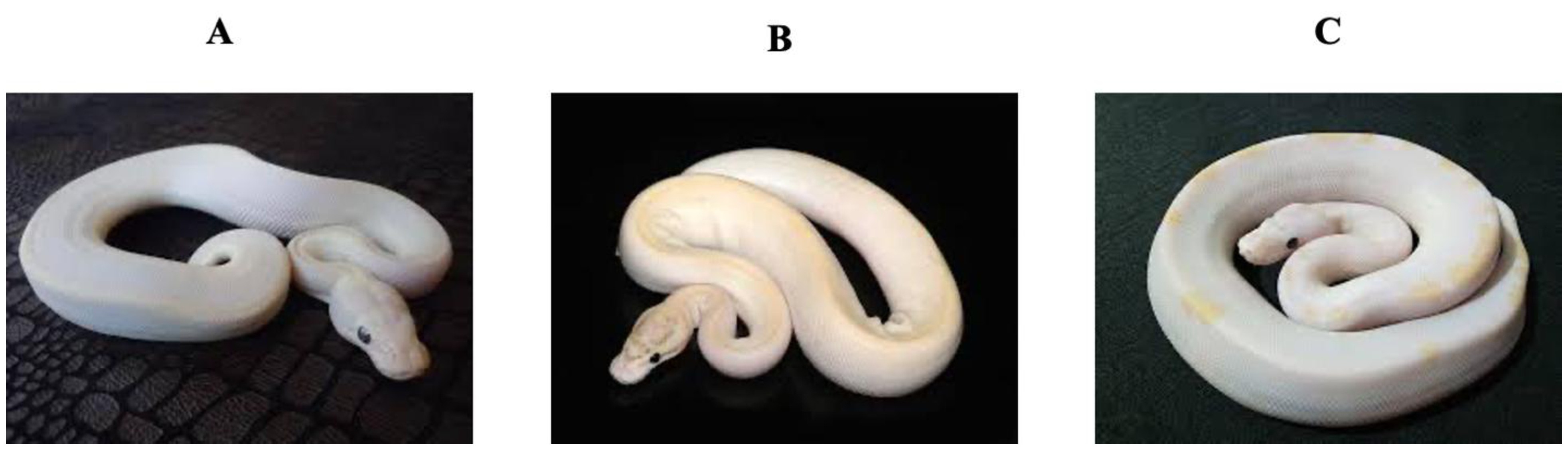
Ball pythons (Python regius) are famous exotic pets due to their beautiful colors and patterns, with a wide variety of these traits known as "morphs." One of the popular types of ball pythons is the white morph. There are several variations of white morphs, including the blue-eyed leucistic (BEL), Ivory, and Super fire, which are illustrated in Figure 1. The most well-known white morph in the market is the BEL, characterized by its solid white body and striking blue eyes. In contrast, the Ivory and Super fire morphs feature yellow patches along the middle of their backs and have black eyes. While in albino morph, the color of this morph is not all white like BEL; it contains yellow and white, unlike black and brown, which are found in the wild type. The majority cause of albinism is the mutation of the tyrosinase gene (Brown et al., 2022; Kokiattrakool et al., 2024).
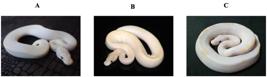
Another interesting morph with a large white patch in the body is piebald. This piebald trait is a recessive mutation (Ullate-Agote and Tzika, 2021; Kumsiri et al., 2025b) and is regulated by the tfec gene (Garvia-Elfring et al., 2023; Tzika, 2024). The tfec gene encodes a transcription factor that is part of the MITF (Microphthalmia-associated transcription factor) family, which also includes mitf, tfe3, and tfeb (Garvia-Elfring et al., 2023). These genes produce transcription factors that feature basic helix-loop-helix and leucine zipper domains, which are crucial for lysosomal signaling, metabolism, and pigmentation (Olsson et al., 2013). Piebald ball pythons exhibit a defect in the tfec gene. Since the piebald trait is recessive, the organism must be homozygous for the mutant TFEC genotype to express this characteristic.
But in BEL, mostly skin appears, which is due to the absence of pigment. The most interesting aspect of the BEL is its breeding. Normally, the parents of BEL are also BEL morph, but sometimes the parents of BEL are not BEL morph. There will be morphs in a group of platinum complexes, including Mojave, Butter, Lesser, Russo, Phantom, Special, and Bamboo, as shown in Figure 2. The ball pythons in a group of platinum complexes have yellow and brown coloration, with a pattern. However, the offspring of these individuals are all white with blue eyes. The underlying genetic mechanism for this phenomenon is currently not fully understood by scientists. But there is some evidence that occurs in the animals that have a phenotype similar to BEL, such as the Overo Lethal White Foal Syndrome (OLWFS), which is characterized by aganglionosis, a white or nearly white coat, and blue irises (Metallinos et al., 1998; Yang et al., 1998; Magdesian et al., 2009). The importance of the cause is the mutation of the endothelin receptor type B (EDNRB) gene (Santschi et al., 1998). An additional large structural variant, resulting in the complete loss of the EDNRB gene, is the cause of lethal recessive hypopigmentation syndrome in Cameroon sheep (Pauciullo et al., 2013), which is similar to OLWFS; homozygous lambs are white and blue-eyed (Lühken et al., 2012).
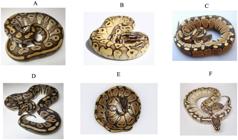
The ball pythons are in a group of platinum complexes. A is Mojave, B is Butter or Lesser, C is Russo, D is Phantom, E is Special, and F is Bamboo.
EDNRB, or endothelin receptor type B, is an active receptor for the endothelin (EDN) protein and belongs to class 1 (family A or rhodopsin-like) G protein-coupled receptors (GPCRs) with a seven-transmembrane spanning domain. The EDNRB gene is highly conserved, with more than 90% sequence similarity across vertebrates (Sakurai et al., 1992). This receptor is present in various tissues, including the central and peripheral nervous systems, and participates in multiple effector functions. Endothelin signaling pathways are essential for the development of neural crest-derived cell lineages. The EDNRB gene is initially expressed at the dorsal tip of the neural tube in vertebrates and subsequently in neural crest cells along both dorso-ventral and dorso-lateral pathways (Parichy et al., 2000). Multiple lines of evidence indicate that mutations in the EDNRB gene cause hypopigmentation or a complete lack of pigmentation. For example, in horses, the lethal white foal mutation is a recessive dinucleotide mutation that results in a missense change in the first transmembrane domain of the EDNRB protein (Yang et al., 1998). Affected foals are almost entirely white with pale blue eyes, and exhibit intestinal aganglionosis. Additional evidence has been observed in zebrafish, where three distinct mutant alleles—two with premature stop codons and one with a missense change—have been identified in the orthologous EDNRB gene, known as the rose mutation (Parichy et al., 2000). Adult zebrafish with the rose mutation display approximately half the number of stripe melanocytes compared to wild-type adults. These melanocytes are organized in dorsal stripes, while only ventral spots are present. Although endothelin defects have not yet been documented, somerosehomozygotes exhibit severely stunted growth, indicating the presence of further anomalies beyond the pigmentation defect (Krauss et al., 2014).
Therefore, this study aims to investigate the genetic basis responsible for the BEL phenotype in ball pythons by assessing the expression of the EDNRB gene using quantitative PCR (qPCR).)
2. Materials and Methods
2.1. Sampling
Before collecting samples, the ethical approval for this study was obtained from the Ethics Review Board for Animal Research at Rangsit University (RSU-AEC 001-2025). Ball python samples were sourced from commercial breeders in Thailand, specifically from Reptile Collector by Doc Javet and Morph Hunter, who provided shed skins. All samples were stored at -20°C to eliminate any potential insect larvae that might infest the sheds. The total collection included four wild-type ball pythons, four BELs (Blue-Eyed Leucistics), and eight ball pythons from the platinum complex group.
2.2. DNA extraction
For DNA extraction, a piece measuring 1.5 cm by 1.5 cm was taken from each shed sample and immersed in a lysis buffer consisting of 1M Tris-HCl (pH 7.5) and 10% SDS. A stirring rod was used to crush the shed samples, and the resulting solution was processed for DNA extraction. DNA extraction was conducted using the GF-1 Tissue DNA Extraction Kit (Vivantis, Selangor Darul Ehsan, Malaysia). After DNA extraction, the DNA was measured for concentration using the Nanodrop (Thermo Scientific, Massachusetts, USA). The extracted DNA solutions were subsequently stored at -20°C until further analysis.
2.3. qPCR reactions
The qPCR primers used in this study were designed and modified based on the EDNRB gene sequence reported in the previously described by Badial et al. (2018). The nucleotide sequences of each primer are listed in Table 1. Primers were designed using the equine EDNBR gene (Gene ID: 100033875) as a template due to the absence of nucleotide sequence data for the EDNRB gene inPython regius (ball python). Although a predictedPython bivittetus EDNRB sequence (XM_007424069.3) exists, it has not been experimentally confirmed. Bondurand et al. (2018) reported that the EDNRB genes are highly conserved, with more than 95% similarity across vertebrates. Given that both equine and snake species are vertebrates, the equine EDNRB gene was selected as the template for primer design. The Glyceraldehyde-3-phosphate dehydrogenase (GAPDH) gene was used as a reference gene (Sun et al., 2012).
The Luna Universal qPCR Master Mix (New England BioLabs, Massachusetts, USA) was used for the experiment. The qPCR amplification reaction mixture consisted of the Luna Universal qPCR Master Mix, 0.8 μM of the forward primer (EDNRB-F), 0.8 μM of the reverse primer (EDNRB-R), and 10 ng of extracted DNAt as the template. This combination resulted in a final reaction volume of 10 μl. The cycling conditions included an initial denaturation step at 95°C for 3 minutes, followed by 35 cycles comprising denaturation at 90°C for 30 seconds, annealing at 50°C for 30 seconds, and extension at 72°C for 30 seconds. The same cycling conditions were used for amplification of the GAPDH reference gene.
3. Results
3.1. Determination of the EDNRB gene responsible for the BEL characteristic
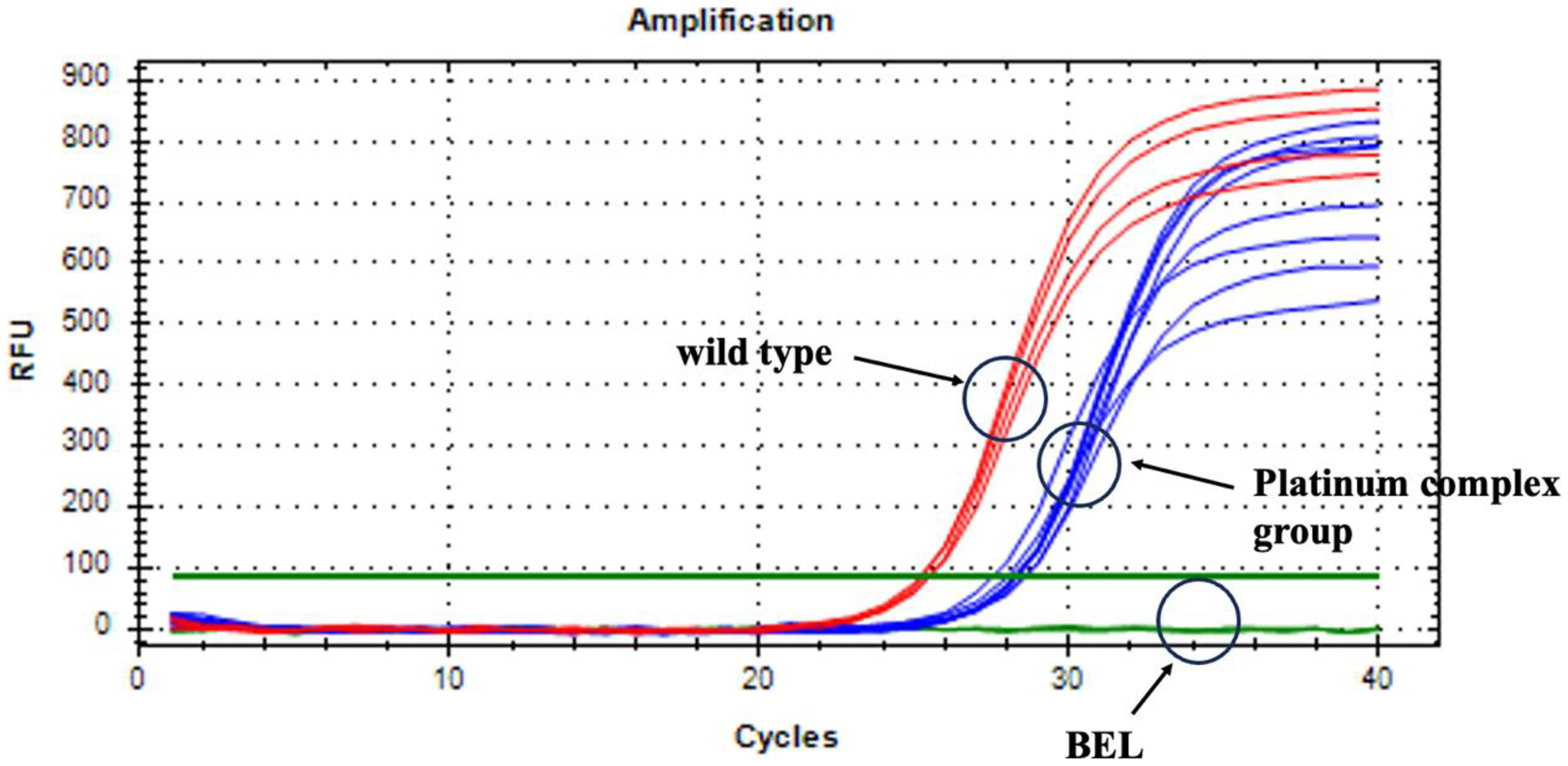
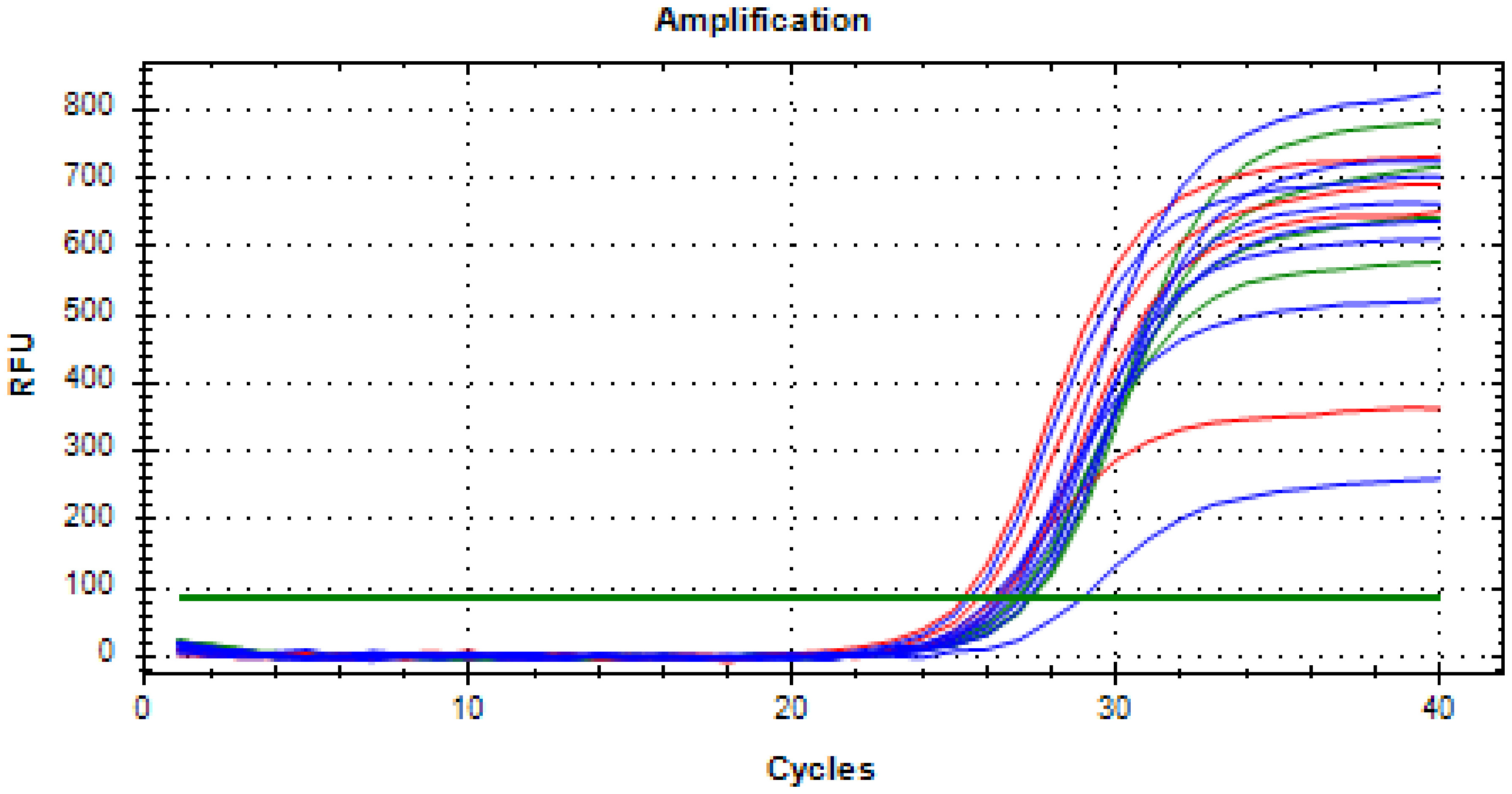
The difference in the threshold cycle (Ct) values for the wild type, platinum complex group, and BEL samples is shown in Figure 3 and Table 2. The Ct values of the GAPDH reference gene of the wild type, platinum complex group, and BEL are shown in Figure 4 and Table 3.
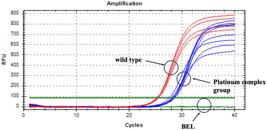
The graph of qPCR of EDNRB gene in wild type (red line), platinum complex group (blue line), and BEL (green line).
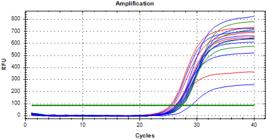
The graph of qPCR of GAPDH gene in wild type (red line), platinum complex group (blue line), and BEL (green line).
The average Ct value of the EDNRB gene for the wild type was 25.35±0.14, while the average Ct for the platinum complex group was 28.35±0.38. Using the t-test, these results indicated that the Ct value of the wild type was significantly different. The Ct value of the GAPDH gene for all samples (wild type, platinum complex, and BEL) ranges from 25.23 to 27.01, as shown in Figure 4. The average Ct value of the GAPDH gene for all samples is 25.83±0.83.
4. Discussion
The results presented in Figure 3 and Table 2 indicated 11.83% difference in the Ct values between the wild type and the platinum complex group. This finding suggests that both alleles of the wild type contain normal EDNRB genes, while the platinum complex group exhibits one normal EDNRB gene in only one of its alleles, indicating a heterozygous condition. And there was no appearance of a qPCR product in BEL, which meant that there was no normal EDNRB gene in BEL. This result is consistent with the findings of Kokiattrakool et al. (2024), who reported a 22.65% Ct difference between the wild type and heterozygous albino samples. Similarly, our findings align with those of Kumsiri et al. (2025b), which documented a 15.45% Ct difference between the wild type and heterozygous piebald specimens. The Ct of the GAPDH gene of all samples were not differ, as shown in Figure 4 and Table 3, because the GAPDH gene is a housekeeping gene that all wild type, platinum complex, and BEL have this gene. Therefore, this finding indicates that the EDNRB gene may play an important role in the expression of the BEL phenotype. There is considerable evidence indicating that the phenomenon of white skin (hypopigmentation), like BEL, is caused by mutations in the EDNRB gene and other genes, including the KIT, MITF, PAX3, and TRPM1 (Yang et al., 1998; Brooks and Bailey, 2005; Brooks et al., 2007; Bellone, 2010; Hauswirth et al., 2012). The frame overo spotting pattern in horses is caused by a missense mutation in the first exon of the EDNRB gene (Hauswirth et al., 2012; Rodseth et al., 2024). This mutation can lead to various pleiotropic effects, including a coat that is white or nearly white, as well as a condition known as ileocolonic aganglionosis, which occurs in individuals with the homozygous mutation (Yang et al., 1998; Bellone et al., 2010; Hauswirth et al., 2012). Additionally, the condition known as OLWFS, a genetic disorder that is inherited in an incompletely dominant manner and is homozygously lethal (Badial et al., 2018).
In addition to mouse models, mutants of the EDNRB gene have been identified in several other species, including rats, horses, zebrafish, sheep, pigs, and goats. A spontaneous homozygous mutation of the EDNRB gene has been observed in rats. This mutation consists of a 301 bp deletion that overlaps the boundary between exon 1 and intron 1 of the EDNRB gene, resulting in an aberrantly spliced mRNA and a non-functional protein (Ceccherini et al., 1995; Gariepy et al., 1996). Homozygous individuals exhibit pigmentation anomalies and megacolon. While the pigmentation phenotype is not rescued, the enteric phenotype is alleviated through the expression of the Dbh-EDNRG transgene (Gariepy et al., 1998). In horses, the lethal white foal mutation is a recessive dinucleotide mutation that causes a missense change in the first transmembrane domain of the EDNRB gene. (McCabe et al., 1990; Metallinos et al., 1998). Affected foals are nearly completely white with pale blue eyes and suffer from intestinal aganglionosis (Yang et al., 1998). Parichy et al. (2000) found three different mutation alleles of the EDNRB gene in zebrafish, which include two premature stop codons and one missense change.
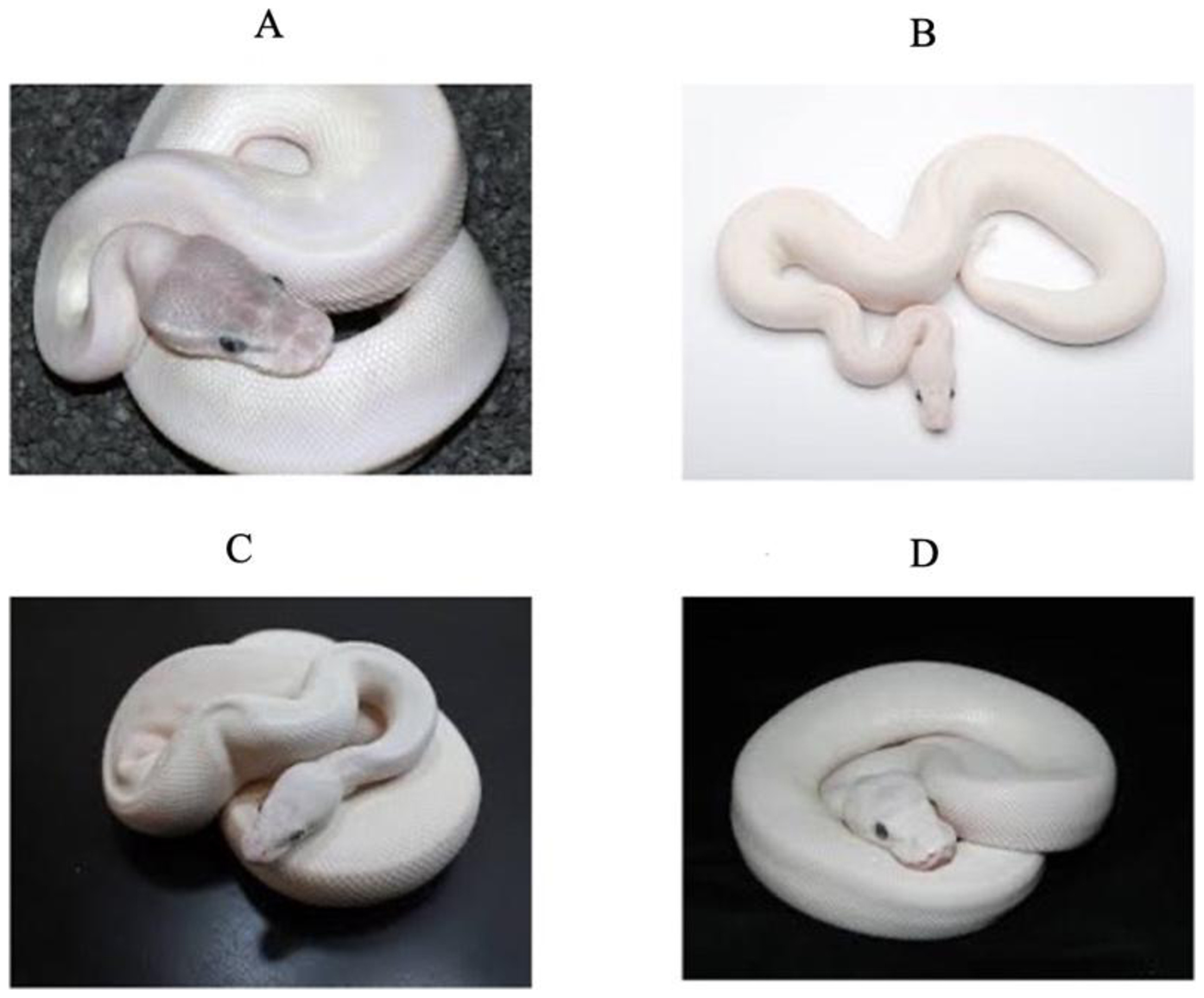
Another interesting aspect is that there is a variation observed within BEL phenotype. The BEL that the parents are both the Mojave morph called Super Mojave has pale black on the head, as shown in Figure 5. In contrast, other BEL, whose parents do not possess the Mojave morph, display an all-white color across the entire body. This phenomenon shows the difference in melanin synthesis. Kumsiri et al. (2025a) used qPCR to investigate the level of tyrosinase gene expression among albino, candy, and candino in ball python.
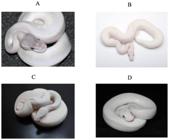
The variation of BEL. A is BEL (Mojave-Mojave), B is BEL (Butter-Butter), C is BEL (Butter-Mojave), and D is BEL (Phantom-Mojave).
Although leucism is broadly defined as the lack of melanin pigmentation in all or parts of the skin (or plumage) of an animal, but not in the soft parts (Parsons and Bonderup-Nielsen, 1995; Forrest and Naveen, 2000; Camacho et al., 2022). The color aberration may occur in all vertebrate classes (mammals, birds, fish, amphibians, and reptiles) (Krecsák, 2008; González-Ortegón et al., 2020; David, 2021). Besides the leucism and albinism, there are other white morphs of ball python, such as Ivory and Super fire, that are shown in Figures 1 and 6. Neither Ivory nor Super fire is completely white like BEL, but predominantly white and with a yellow line in the Ivory or dots at the back in the Super fire. Similar to BEL, the parents of both the Ivory and Super Fire morphs must also be either Ivories or Super Fires. However, breeders can create Ivories by mating two Yellow Bellies together and can produce Super Fires by mating two Fires together. Both Yellow belly and Fire have beautiful patterns, and the skin is yellow, brown, and black.
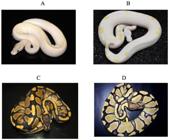
The white morph in the ball python and its parent. A is Ivory, B is Super fire, C is Yellow belly, and D is Fire.
While PCR and qPCR are powerful molecular techniques for distinguishing between homozygous and heterozygous forms of any gene (Kokiattrakool et al., 2024; Kumsiri et al., 2025b), they have several drawbacks, such as requiring expensive and complex equipment and being time-consuming (Kanchanaphum et al., 2013; Kanchanaphum, 2018). To address these limitations, Loop-Mediated Isothermal Amplification (LAMP) can be utilized. To enhance the efficiency of the LAMP technique, quantitative LAMP (qLAMP) has been developed. There are numerous applications of qLAMP as an alternative to qPCR. For instance, Kumsiri and Kanchanaphum (2020, 2021) used qLAMP to detect aflatoxin-producing Aspergillus in peanut and dried shrimp samples, as well as to identify the SRY gene in human male DNA from blood samples. Furthermore, the qLAMP conditions may be developed instead of qPCR for differentiation between homozygous and heterozygous forms of any gene.
This study contributes to the understanding of pigmentation genetics in reptiles, particularly in Python regius (ball python). To gain a better understanding of the gene responsible for BEL, future studies will examine DNA sequence or copy number variation (CNV) analysis to confirm the suspected deletion. Another future research will focus on identifying the gene responsible for the Ivory and Super Fire phenotypes.
5. Conclusion
This study is the first to report on the ball python and reveals that the EDNRB gene is the candidate gene for the BEL phenotype, as demonstrated through qPCR analysis. The findings indicate that both alleles in the wild type possess normal EDNRB genes. In contrast, the platinum complex group displays one normal EDNRB gene in only one of its alleles, suggesting a heterozygous condition. Additionally, no qPCR product was detected in the BEL phenotype, indicating the absence of a normal EDNRB gene in this variant.
Acknowledgements
We would like to sincerely thank Mr. Stewart Miller for critically correcting the English grammar. This study was supported by the Fundamental Fund, Thailand Science Research and Innovation (TSRI).
Data Availability Statement
The entire data set that supports the results of the study was published in the article itself.
References
-
BADIAL, P.R., TEIXEIRA, R.B.C., DELFIOL, D.J.Z., DA MOTA, L.S.L.S. and BORGES, A.S., 2018. Validation of high-resolution melting analysis as a diagnostic tool for endothelin receptor B mutation in American Paint horses and allele frequency estimation. Molecular and Cellular Probes, vol. 41, pp. 52-56. https://doi.org/10.1016/j.mcp.2018.08.002 PMid:30096357.
» https://doi.org/10.1016/j.mcp.2018.08.002 -
BELLONE, R.R., 2010. Pleiotropic effects of pigmentation genes in horses. Animal Genetics, vol. 41, suppl. 2, pp. 100-110. https://doi.org/10.1111/j.1365-2052.2010.02116.x PMid:21070283.
» https://doi.org/10.1111/j.1365-2052.2010.02116.x -
BELLONE, R.R., FORSYTH, G., LEEB, T., ARCHER, S., SIGURDSSON, S., IMSLAND, F., MAUCELI, E., ENGENSTEINER, M., BAILEY, E., SANDMEYER, L., GRAHN, B., LINDBLAD-TOH, K. and WADE, C.M., 2010. Fine-mapping and mutation analysis of TRPM1: a candidate gene for leopard complex (LP) spotting and congenital stationary night blindness in horses. Briefings in Functional Genomics, vol. 9, no. 3, pp. 193-207. https://doi.org/10.1093/bfgp/elq002 PMid:20353955.
» https://doi.org/10.1093/bfgp/elq002 - BONDURAND, N., DUFOUR, S., and PINGAULT, V., 2018. News from the endothelin-3/EDNRB signaling pathway: role during enteric nervous system development and involvement in neural crest-associated disorders. Development Biology, suppl. 1, pp. S156-S169.
-
BROOKS, S.A. and BAILEY, E., 2005. Exon skipping in the KIT gene causes a Sabino spotting pattern in horses. Mammalian Genome : Official Journal of the International Mammalian Genome Society, vol. 16, no. 11, pp. 893-902. https://doi.org/10.1007/s00335-005-2472-y PMid:16284805.
» https://doi.org/10.1007/s00335-005-2472-y -
BROOKS, S.A., LEAR, T.L., ADELSON, D.L. and BAILEY, E., 2007. A chromosome inversion near the KIT gene and the Tobiano spotting pattern in horses. Cytogenetic and Genome Research, vol. 119, no. 3-4, pp. 225-230. https://doi.org/10.1159/000112065 PMid:18253033.
» https://doi.org/10.1159/000112065 -
BROWN, A.R., COMAI, K., MANNINO, D., MCCULLOUGH, H., DONEKAL, Y., MEYERS, H.C., GRAVES, C.W. and SEIDAL, H.S., 2022. BIO306W Consortium. A community-science approach identifies genetic variants associated with three color morphs in ball pythons (Python regius). PLoS One, vol. 17, no. 10, pp. e0276376. https://doi.org/10.1371/journal.pone.0276376 PMid:36260636.
» https://doi.org/10.1371/journal.pone.0276376 -
CAMACHO, C., SAEZ-GOMEZ, P., HIDALGO-RODRIGUEZ, P., RABADAN-GONZALEZ, J., MOLINA, C. and NEGRO, J.J., 2022. Leucistic plumage as a result of progressive greying in a cryptic nocturnal bird. Scientific Reports, vol. 12, no. 1, pp. 3411. https://doi.org/10.1038/s41598-022-07360-8 PMid:35233024.
» https://doi.org/10.1038/s41598-022-07360-8 -
CECCHERINI, I., ZHANG, A.L., MATERA, I., YANG, G., DEVOTO, M., ROMEO, G. and CASS, D.T., 1995. Interstitial deletion of the endothelin-B receptor gene in the spotting lethal (sl) rat. Human Molecular Genetics, vol. 4, no. 11, pp. 2089-2096. https://doi.org/10.1093/hmg/4.11.2089 PMid:8589685.
» https://doi.org/10.1093/hmg/4.11.2089 - DAVID, B.Z., 2021. First report of partial leucism in the poison frog Epipedobates anthonyi (Anura: Dendrobatidae) in El Oro, Ecuador. Neotropical Biodiversity, vol. 7, pp. 1-4.
- FORREST, S. and NAVEEN, R., 2000. Prevalence of leucism in Pygoscelid penguins of the Antarctic Peninsula. Waterbirds, vol. 23, pp. 283-285.
-
GARIEPY, C.E., CASS, D.T. and YANAGISAWA, M., 1996. Null mutation of endothelin receptor type B gene in spotting lethal rats causes aganglionic megacolon and white coat color. Proceedings of the National Academy of Sciences of the United States of America, vol. 93, no. 2, pp. 867-872. https://doi.org/10.1073/pnas.93.2.867 PMid:8570650.
» https://doi.org/10.1073/pnas.93.2.867 -
GARIEPY, C.E., WILLIAMS, S.C., RICHARDSON, J.A., HAMMER, R.E. and YANAGISAWA, M., 1998. Transgenic expression of the endothelin-B receptor prevents congenital intestinal aganglionosis in a rat model of Hirschsprung disease. The Journal of Clinical Investigation, vol. 102, no. 6, pp. 1092-1101. https://doi.org/10.1172/JCI3702 PMid:9739043.
» https://doi.org/10.1172/JCI3702 -
GARVIA-ELFRING, A., SABIN, C.E., IOUCHMANOV, A.L., ROFFEY, H.L. and SAMUDRA, S.P., 2023. Piebaldism and chromatophore development in reptiles are linked to the tfec gene. Current Biology : CB, vol. 33, no. 4, pp. 755-763.e3. https://doi.org/10.1016/j.cub.2023.01.004 PMid:36702128.
» https://doi.org/10.1016/j.cub.2023.01.004 -
GONZALEZ-ORTEGON, E., DRAKE, P., QUIGLEY, D.T.G. and CUESTA, J., 2020. A Leucism in the European sardine Sardina pilchardus (Clupeidae). Ecological Indicators, vol. 117, pp. 106544. https://doi.org/10.1016/j.ecolind.2020.106544
» https://doi.org/10.1016/j.ecolind.2020.106544 -
HAUSWIRTH, R., HAASE, B., BLATTER, M., BROOKS, S.A., BURGER, D., DROGEMULLMER, C., GERBER, V., HENKE, D., JANDA, J., JUDE, R., MAGDESIAN, K.G., MATTHE WS, J.M., PONCET, P.A., SVANSSON, V., TOZAKI, T., WILKINSON-WHITE, L. and PENED, O., 2012. Mutations in MITF and PAX3 cause “splashed white” and other white spotting phenotypes in horses. PLOS Genetics, vol. 8, no. 4, pp. e1002653. https://doi.org/10.1371/journal.pgen.1002653 PMid:22511888.
» https://doi.org/10.1371/journal.pgen.1002653 -
KANCHANAPHUM, P., 2018. Time course of detection of human male DNA from stained blood sample on various surfaces by loop mediated isothermal amplification and polymerase chain reaction. BioMed Research International, vol. 22, pp. 2981862. https://doi.org/10.1155/2018/2981862 PMid:29765982.
» https://doi.org/10.1155/2018/2981862 - KANCHANAPHUM, P., SARATAPHAN, T., THIRASAN, W., and ANATASOMBOON, G., 2013. Development of Loop-mediated isothermal amplification (LAMP) of the SRY gene in human blood samples for sex determination. Rangsit Journal of Arts and Sciences, vol. 3, no. 2, pp. 129-135.
-
KOKIATTRAKOOL, W., SAENGCHARATUAONG, N., LUAPAN, J., SROYKHAM, W., KUMSIRI, R. and KANCHANAPHUM, P., 2024. Differentiation between wild type and heterozygous albino ball pythons (Python regius) by PCR and qPCR. Brazilian Journal of Biology, vol. 84, pp. e286676. https://doi.org/10.1590/1519-6984.286676 PMid:39383416.
» https://doi.org/10.1590/1519-6984.286676 -
KRAUSS, J., FROHNHOFER, H.G., WALDERICH, B., MAISCHEIN, H.M., WEILER, C., IRION, U. and NÜSSLEIN-VOLHARD, C., 2014. Endothelin signalling in iridophore development and stripe pattern formation of zebrafish. Biology Open, vol. 3, no. 6, pp. 503-509. https://doi.org/10.1242/bio.20148441 PMid:24857848.
» https://doi.org/10.1242/bio.20148441 - KRECSÁK, L., 2008. Albinism and leucism among European Viperinae: a review. Russian Journal of Herpetology, vol. 15, pp. 97-102.
-
KUMSIRI, R. and KANCHANAPHUM, P., 2020. A comparison of four molecular methods for detection of aflatoxin-producingAspergillusin peanut and dried shrimp samples collected from local markets around Pathum Thani province, Thailand. Scientifica, vol. 24, pp. 80451. https://doi.org/10.1155/2020/8580451 PMid:33425428.
» https://doi.org/10.1155/2020/8580451 -
KUMSIRI, R. and KANCHANAPHUM, P., 2021. Comparison of time course detection of human male DNA from blood stains on various objects on the surface in a natural environment, and in a laboratory using Loop-Mediated Isothermal Amplification (LAMP). Scientifica, vol. 2021, pp. 4811608. https://doi.org/10.1155/2021/4811608 PMid:34868696.
» https://doi.org/10.1155/2021/4811608 - KUMSIRI, R., SOPHONNITHIPRASERT, T. and KANCHANAPHUM, P., 2025a. Level of TRY gene expression in morph albino in ball python (Python regius). International Journal of Agriculture and Biosciences, vol. 14, no. 6, pp. 1240-1245.
-
KUMSIRI, R., YIN, N.N. and KANCHANAPHUM, P., 2025b. Discrimination between wild type and heterozygous piebald ball python (Python regius) by PCR and qPCR. Brazilian Journal of Biology, vol. 85, pp. e293718. https://doi.org/10.1590/1519-6984.293718 PMid:40561291.
» https://doi.org/10.1590/1519-6984.293718 -
LUHKEN, G., FLECK, K., PAUCIULLO, A., HUISINGA, M. and ERHARDT, G., 2012. Familiar hypopigmentation syndrome in sheep associated with homozygous deletion of the entire endot helin type-B receptor gene. PLoS One, vol. 7, no. 12, pp. e53020. https://doi.org/10.1371/journal.pone.0053020 PMid:23300849.
» https://doi.org/10.1371/journal.pone.0053020 -
MAGDESIAN, K.G., WILLIAMS, D.C., ALEMAN, M., LECOUTEUR, R.A. and MADIGAN, J.E., 2009. Evaluation of deafness in American Paint Horses by phenotype, brainstem auditory-evoked responses, and endothelin receptor B genotype. Journal of the American Veterinary Medical Association, vol. 235, no. 10, pp. 1204-1211. https://doi.org/10.2460/javma.235.10.1204 PMid:19912043.
» https://doi.org/10.2460/javma.235.10.1204 -
MCCABE, L., GRIFFIN, L.D., KINZER, A., CHANDLER, M., BECKWITH, J.B. and MCCABE, E.R., 1990. Overo lethal white foal syndrome: equine model of aganglionic megacolon (Hirschsprung disease). American Journal of Medical Genetics, vol. 36, no. 3, pp. 336-340. https://doi.org/10.1002/ajmg.1320360319 PMid:2363434.
» https://doi.org/10.1002/ajmg.1320360319 -
METALLINOS, D.L., BOWLING, A.T. and RINE, J.A., 1998. A missense mutation in the endothelin-B receptor gene is associated with Lethal White Foal Syndrome: an equine version of Hirschsprung disease. Mammalian Genome : Official Journal of the International Mammalian Genome Society, vol. 9, no. 6, pp. 426-431. https://doi.org/10.1007/s003359900790 PMid:9585428.
» https://doi.org/10.1007/s003359900790 -
OLSSON, M., STUART-FOX, D. and BALLEN, C., 2013. Genetics and evolution of colour patterns in reptiles. Seminars in Cell & Developmental Biology, vol. 24, no. 6-7, pp. 529-541. https://doi.org/10.1016/j.semcdb.2013.04.001 PMid:23578866.
» https://doi.org/10.1016/j.semcdb.2013.04.001 -
PARICHY, D.M., MELLGREN, E.M., RAWLS, J.F., LOPES, S.S., KELSH, R.N. and JOHNSON, S.L., 2000. Mutational analysis of endothelin receptor b1 (rose) during neural crest and pigment pattern development in the zebrafish Danio rerio. Developmental Biology, vol. 227, no. 2, pp. 294-306. https://doi.org/10.1006/dbio.2000.9899 PMid:11071756.
» https://doi.org/10.1006/dbio.2000.9899 -
PARSONS, G.J. and BONDERUP-NIELSEN, S., 1995. Partial albinism in an island population of Meadow Voles, Microtus pennsylvanicus, from Nova Scotia. Canadian Field Naturalist, vol. 109, no. 2, pp. 263-264. https://doi.org/10.5962/p.357626
» https://doi.org/10.5962/p.357626 -
PAUCIULLO, A., FLECK, K., LUHKEN, G., DI BERARDINO, D. and ERHARDT, G., 2013. Dual-color high-resolution fiber-FISH analysis on lethal white syndrome carriers in sheep. Cytogenetic and Genome Research, vol. 140, no. 1, pp. 46-54. https://doi.org/10.1159/000350786 PMid:23635529.
» https://doi.org/10.1159/000350786 -
RODSETH, E., SUMASGUTNER, P., TATE, G., NILSSON, J.F., WATSON, H., MARITZ, M.F., INGLE, R.A. and AMAR, A., 2024. Pleiotropic effects of melanin pigmentation: haemoparasite infection intensity but not telomere length is associated with plumage morph in black sparrowhawks. Royal Society Open Science, vol. 11, no. 4, pp. 230370. https://doi.org/10.1098/rsos.230370 PMid:38577209.
» https://doi.org/10.1098/rsos.230370 -
SAKURAI, T., YANAGISAWA, M. and MASAKI, T., 1992. Molecular characterization of endothelin receptors. Trends in Pharmacological Sciences, vol. 13, no. 3, pp. 103-108. https://doi.org/10.1016/0165-6147(92)90038-8 PMid:1315462.
» https://doi.org/10.1016/0165-6147(92)90038-8 -
SANTSCHI, E.M., PURDY, A.K., VALBERG, S.J., VROTSOS, P.D., KAESE, H. and MICKELSON, J.R., 1998. Endothelin receptor B polymorphism associated with lethal white foal syndrome in horses. Mammalian Genome : Official Journal of the International Mammalian Genome Society, vol. 9, no. 4, pp. 306-309. https://doi.org/10.1007/s003359900754 PMid:9530628.
» https://doi.org/10.1007/s003359900754 -
SUN, Y., LI, Y., LUO, D. and LIAO, D.J., 2012. Pseudogenes as weaknesses of ACTB (Actb) and GAPDH (Gapdh) used as reference genes in reverse transcription and polymerase chain reactions. PLoS One, vol. 7, no. 8, pp. e41659. https://doi.org/10.1371/journal.pone.0041659 PMid:22927912.
» https://doi.org/10.1371/journal.pone.0041659 -
TZIKA, A.C., 2024. On the role of TFEC in reptilian coloration. Frontiers in Cell and Developmental Biology, vol. 12, pp. 1358828. https://doi.org/10.3389/fcell.2024.1358828 PMid:38385026.
» https://doi.org/10.3389/fcell.2024.1358828 -
ULLATE-AGOTE, A. and TZIKA, A.C., 2021. Characterization of the leucistic Texas rat snake Pantherophis obsoletus. Frontiers in Ecology and Evolution, vol. 9, pp. 583236. https://doi.org/10.3389/fevo.2021.583136
» https://doi.org/10.3389/fevo.2021.583136 -
YANG, G.C., CROAKER, D., ZHANG, A.L., MANGLICK, P., CARTMILL, T. and CASS, D., 1998. A dinucleotide mutation in the endothelin-B receptor gene is associated with lethal white foal syndrome (LWFS); a horse variant of Hirschsprung disease. Human Molecular Genetics, vol. 7, no. 6, pp. 1047-1052. https://doi.org/10.1093/hmg/7.6.1047 PMid:9580670.
» https://doi.org/10.1093/hmg/7.6.1047
Edited by
-
Editor:
Takako Matsumura Tundisi