 Biodiversity offsets and corporate environmental management: economic incentives for ecological restoration in agricultural landscapes
Abstract
Biodiversity offsetting has emerged as a principal policy mechanism to reconcile economic development with conservation goals, operating on the core assumption that ecological losses from development can be compensated through equivalent restoration elsewhere. However, the empirical relationship between the financial investment in these offsets and their actual ecological outcomes remains poorly understood, particularly in tropical regions that both development pressures and biodiversity are high. This study addresses this critical knowledge gap by conducting a comparative efficiency analysis of 6 biodiversity offset projects across Vietnam, Indonesia, and Malaysia from 2023 to 2025. We employed a dual-metric framework, integrating economic data on capital investment with biophysical measurements of habitat gain efficiency (hectares per 100,000 USD) and temporal connectivity indices. Our results show a counterintuitive but significant inverse relationship between investment scale and ecological efficiency. Projects with moderate funding achieved upto 20.7 hectares of habitat gain per 100KUSD, whereas the most heavily funded project achieved upto 20.7 hectares of habitat gain per 100KUSD, whereas the most heavily funded project yielded less than half that efficiency at 9.7 ha/100K USD. Statistical analysis confirms a strong negative correlation (Pearson's r = -0.72, p < 0.05), indicating diminishing marginal returns. Furthermore, habitat connectivity followed a non-linear maturation trajectory, typically requiring 3-5 years to approach optimal levels, challenging the linear timelines often assumed in offset policies. Regional performance disparities were substantial, with Vietnamese projects outperforming others by 42%, a difference strongly linked to governance coherence and adaptive management protocols.
Keywords:
biodiversity offsets; ecological efficiency; habitat connectivity; compensatory conservation
Resumo
A compensação da biodiversidade emergiu como um importante mecanismo de política pública para conciliar o desenvolvimento econômico com os objetivos de conservação, baseando-se na premissa fundamental de que as perdas ecológicas decorrentes do desenvolvimento podem ser compensadas por meio de restauração equivalente em outros locais. No entanto, a relação empírica entre o investimento financeiro nessas compensações e seus resultados ecológicos reais ainda é pouco compreendida, particularmente em regiões tropicais onde tanto as pressões de desenvolvimento quanto a biodiversidade são elevadas. Este estudo aborda essa lacuna crítica de conhecimento, conduzindo uma análise comparativa de eficiência de seis projetos de compensação da biodiversidade no Vietnã, Indonésia e Malásia, no período de 2023 a 2025. Foi empregada uma estrutura de dupla métrica, integrando dados econômicos de investimento de capital com medições biofísicas de eficiência de ganho de habitat (hectares por 100.000 USD) e índices de conectividade temporal. Os resultados mostram uma relação inversa contraintuitiva, porém significativa, entre a escala de investimento e a eficiência ecológica. Projetos com financiamento moderado alcançaram até 20,7 hectares de ganho de habitat por 100 mil dólares, enquanto o projeto com maior financiamento obteve menos da metade dessa eficiência, com 9,7 ha/100 mil dólares. A análise estatística confirma uma forte correlação negativa (r de Pearson = -0,72, p < 0,05), indicando retornos marginais decrescentes. Além disso, a conectividade do habitat seguiu uma trajetória de maturação não linear, geralmente exigindo de 3 a 5 anos para atingir os níveis ideais, o que desafia os prazos lineares frequentemente assumidos nas políticas de compensação. As disparidades regionais de desempenho foram substanciais, com os projetos vietnamitas superando os demais em 42%, uma diferença fortemente ligada à coerência da governança e aos protocolos de gestão adaptativa.
Palavras-chave:
compensações de biodiversidade; eficiência ecológica; conectividade de habitat; conservação compensatória
1. Introduction
The relentless expansion and intensification of agricultural systems represent one of the most significant drivers of global biodiversity loss. As the demand for food, fiber, and bioenergy surges, natural habitats are systematically converted or degraded, creating fragmented landscapes where ecological functions are severely compromised (Mahmoudi and Asaee, 2008; Carus and Dammer, 2018; Yong et al., 2021; Yuldasheva et al., 2025). This transformation is particularly acute in the rapidly developing nations of East Asia, where economic growth, population pressures, and agricultural modernization converge. The resulting homogenization of the landscape not only threatens endemic species but also undermines the very ecosystem services, such as pollination, water purification, and pest control, upon which sustainable agriculture itself depends (Hasmi et al., 2025; Ongdash et al., 2024; Mohammad et al., 2026).
In this context, the corporate sector, especially agribusiness and supply chain giants, faces mounting pressure from regulators, investors, and consumers to account for and mitigate its environmental footprint. Traditional compliance-based approaches, focused on minimizing localized pollution, are increasingly seen as insufficient for addressing the systemic, landscape-scale impacts of commodity production. Consequently, there is a growing imperative to develop governance mechanisms that can reconcile economic production with ecological integrity, moving beyond mere damage control towards active environmental stewardship (Kambarov et al., 2024; Zailani et al., 2012; Greene et al., 2025; Al-Ababneh et al., 2026; Shavkatov et al., 2024).
The concept of biodiversity offsets has emerged as a pivotal, yet contentious, policy instrument within this paradigm. Rooted in the mitigation hierarchy, it proposes that residual, unavoidable harm to biodiversity at one site can be compensated for by generating equivalent conservation gains elsewhere (Bellantuono et al., 2017; Abid et al., 2021; Gao et al., 2025; Singh et al., 2026; Li et al., 2023). In theory, this creates a quantifiable and tradable unit of biodiversity, introducing market-like incentives for habitat protection and restoration. For corporations, it offers a potential pathway to demonstrate net-positive environmental outcomes while securing their social license to operate and managing long-term supply chain risks.
However, the practical integration of biodiversity offsets into corporate environmental management strategies, particularly within working agricultural landscapes, remains fraught with conceptual and operational challenges. A primary concern is the ecological equivalence between impacted and offset sites; the complex, multi-faceted nature of biodiversity resists simple metrication (Venkateswar Reddy & Mavlyanova et al., 2024; Yong et al., 2021; Greene et al., 2025; Sayed et al., 2026). Furthermore, the spatial configuration of offsets, whether they should be implemented on-site, near the impact, or within a broader regional portfolio, carries profound implications for landscape connectivity and meta-population dynamics.
The economic dimension adds another layer of complexity. For offsets to function as genuine incentives, their cost must be internalized as a material business factor, compelling investment in ecological restoration (Muñoz-Grillo et al., 2024; Chia et al., 2018; Hussain et al., 2019; Zhang et al., 2024). This requires robust valuation methodologies that can capture both the market and non-market values of restored ecosystems. The question of whether such mechanisms can be designed to be not just a cost of doing business, but a driver of innovation and competitive advantage in land management, is largely unresolved.
Nowhere are these questions more pressing than in the diverse and dynamic agricultural regions of East Asia. Countries like Vietnam, Indonesia, and parts of China host globally significant biodiversity hotspots that are simultaneously under intense pressure from plantation agriculture (e.g., oil palm, rubber, coffee) and intensive rice production. The institutional frameworks for environmental governance in these regions are evolving rapidly, creating a unique natural laboratory to study the interplay between policy, corporate strategy, and ecological outcomes. Despite this urgency, a critical gap persists in the applied literature. Most studies on biodiversity offsets focus on theoretical models, regulatory frameworks in the Global North, or large-scale mining and infrastructure projects (Colombo et al., 2019; Mallek‐Ayadi et al., 2022; Chong et al., 2024; Aburub et al., 2026; Elmirzaev and Tursunova, 2024). There is a stark paucity of empirical, on-the-ground research examining how offset principles are interpreted, implemented, and financially rationalized by corporate entities specifically within the agricultural sectors of East Asia. This gap limits our understanding of their real-world efficacy as tools for landscape-scale restoration (Grosu et al., 2021; Hardjomidjojo et al., 2026; Byeon et al., 2026).
This research, therefore, is driven by a clear and necessary objective: to critically analyze the economic incentives that biodiversity offset mechanisms create for corporate-led ecological restoration in East Asian agricultural landscapes. We move beyond abstract policy assessment to engage with the practical calculus of agribusiness firms, the ecological realities of restoration in production-dominated matrices, and the design of financial instruments that can align corporate profitability with biodiversity gain. By investigating implemented and planned offset schemes across several East Asian nations, this study seeks to illuminate the conditions under which these instruments successfully mobilize private capital for restoration. It questions whether the prevailing economic models genuinely promote additionality, creating new, lasting conservation outcomes, or risk legitimizing continued degradation through inadequate compensation. Understanding this is fundamental to predicting the trajectory of corporate environmental performance in the region.
Ultimately, the importance of this study lies in its potential to inform more sophisticated, context-sensitive policies and corporate practices. As the world looks to mechanisms that can bend the curve of biodiversity loss, evidence from front-line landscapes where agriculture and ecology are in direct negotiation is indispensable. This research aims to provide that evidence, contributing to the development of credible, equitable, and ecologically effective strategies for integrating biodiversity conservation into the heart of global agricultural production systems.
2. Materials and Methods
This study employed a mixed-methods, multi-sited research design to investigate the operational and economic dimensions of biodiversity offsetting within corporate agricultural management. Fieldwork and data collection were conducted between May and November 2025, a period selected to capture a full agricultural cycle and the associated planning and implementation phases of environmental interventions across the study regions. The research was anchored in three East Asian countries, Vietnam, Indonesia, and Malaysia, chosen for their significant roles in global commodity production (e.g., palm oil, rubber, coffee), their evolving environmental governance frameworks, and the active presence of corporate-led offset or compensation initiatives.
2.1. Site selection and case study identification
The research adopted a purposive, criterion-based sampling strategy to identify representative and information-rich case studies. We defined a "case" as a discrete corporate agricultural operation (plantation or large-scale contract farming scheme) that had formally committed to, or was actively implementing, a biodiversity compensation action beyond baseline legal compliance. Potential cases were identified through a systematic scan of corporate sustainability reports (2020-2024), databases of certification bodies (e.g., RSPO, Rainforest Alliance), and registries of government-approved environmental management plans.
Final selection was based on three primary criteria: (i) Operational Scale: operations exceeding 500 hectares to ensure landscape-level impacts; (ii) Offset Maturity: projects must have moved beyond the planning phase into at least the second year of implementation to allow for preliminary assessment of ecological and managerial outcomes; and (iii) Commodity Diversity: inclusion of perennial crops (oil palm, rubber) and annual systems (coffee agroforestry) to capture varying land-use dynamics. This process yielded six in-depth case studies: two in the Central Highlands of Vietnam (coffee/rubber), three in Kalimantan and Sumatra, Indonesia (oil palm), and one in Sabah, Malaysia (oil palm with riparian restoration).
2.2. Data collection: semi-structured interviews and documentary analysis
Primary qualitative data were gathered through 47 semi-structured interviews conducted on-site and virtually. Key informants were selected to capture the multi-actor network involved in offset governance: corporate sustainability managers and agronomists (n=18), government environmental agency officials (n=10), representatives from local and international NGOs acting as implementers or monitors (n=12), and ecological consultants who designed the offset metrics (n=7). Interview protocols were tailored to each stakeholder group but centered on core themes: the decision-making calculus for offset design, the challenges of quantifying biodiversity "equivalence," cost structures and financing mechanisms, and perceived barriers to scaling restoration efforts.
This interview data was triangulated with an extensive documentary analysis. For each case, we collected and reviewed internal corporate documents (feasibility studies, offset management plans, budget allocations), public-facing sustainability reports, third-party audit reports, and the relevant regional or national regulatory guidelines governing environmental compensation. This document review allowed us to trace the evolution of project designs, compare stated intentions with implemented actions, and identify discrepancies between reported and actual economic investments.
2.3. Spatial and ecological assessment framework
To evaluate the ecological coherence of offset interventions, we conducted a spatial analysis using remotely sensed data. For each case study site (impact area and corresponding offset area), we acquired high-resolution satellite imagery (Sentinel-2 and PlanetScope) for the 2023-2025 period. Using QGIS 3.28 and the SCP plugin, we performed a supervised land-use/land-cover (LULC) classification to map changes in key habitat classes: intact forest, degraded forest, plantation, restoration area, and other land uses.
We calculated a suite of landscape metrics at both the impact and offset sites using the r.li suite in GRASS GIS. Critical metrics included patch area, core area index, and Euclidean nearest-neighbor distance to assess habitat fragmentation, and connectivity indices to evaluate the offset's role in linking existing forest remnants. Field validation of these classifications and metrics was performed during the July-August 2025 fieldwork window through guided transect walks and drone surveys (DJI Phantom 4 RTK) in accessible portions of the offset zones, allowing for ground-truthing of vegetation structure and restoration progress.
2.4. Economic analysis of offset investments
The financial dimension of offsets was analyzed through a dedicated cost-structuring model. We collected granular data on all direct and indirect costs associated with the offset projects over their planned lifetime (typically 20-25 years). Data was sourced from project budgets, financial disclosures in sustainability reports, and interview accounts. Costs were categorized into: (i) Upfront Capital Costs (land acquisition or long-term lease, initial restoration planting, infrastructure); (ii) Recurrent Management Costs (patrolling, invasive species control, community liaison work, monitoring); and (iii) Transaction & Administrative Costs (consultancy fees for metric development, legal compliance, third-party verification).
To understand the incentive structure, we calculated the Offset Cost as a Percentage of Operational Profit for the associated agricultural unit. This ratio served as a core indicator of the materiality of the environmental investment to the business. Furthermore, we modeled alternative financing scenarios, comparing the actual sunk cost approach observed in most cases with hypothetical payment-for-ecosystem-service (PES) models and habitat banking scenarios to explore potential for enhancing financial sustainability and scalability. All financial figures were standardized to US dollars using average 2025 exchange rates and, where necessary, net present value (NPV) calculations were applied to long-term cost streams using a 5% discount rate, consistent with corporate investment appraisal standards in the region.
3. Results
The analysis reveals a complex and often contradictory picture of how biodiversity offsetting operates within the corporate agricultural sector of East Asia. The findings are structured to present first the ecological-spatial outcomes, followed by the economic and managerial dimensions, highlighting the critical disconnects between design intentions and on-ground realities.
Table 1 provides a foundational overview of the six case studies. While all projects nominally adhere to the "no net loss" principle by setting offset areas equal to or greater than impact areas (Offset Ratio ≥1), the ecological equivalence of these hectares is highly variable. Cases ID-PO-05 is a notable outlier with a ratio below 1, justified by the company's claim of "higher quality" restoration. The data shows a concentration of initiatives in the oil palm sector, reflecting both its high-impact profile and the pressure from certification schemes.
Analysis shows positive but modest gains in forest cover across all offset sites over the two-year monitoring period (Table 2). The percentage increase is most pronounced in cases VN-CF-01 and VN-RB-02, likely due to the faster growth rates of native pioneer species in the Vietnamese Highlands. However, the starting baseline was critically low, especially in Indonesian cases (e.g., 5% in ID-PO-05), indicating offsets were established on severely degraded land. The 'Net Habitat Gain' column, calculated from high-resolution classification, shows the absolute area transitioned to forest, which is substantially lower than the nominal 'Offset Area' from Table 1, revealing a significant gap between designated and effectively restored space.
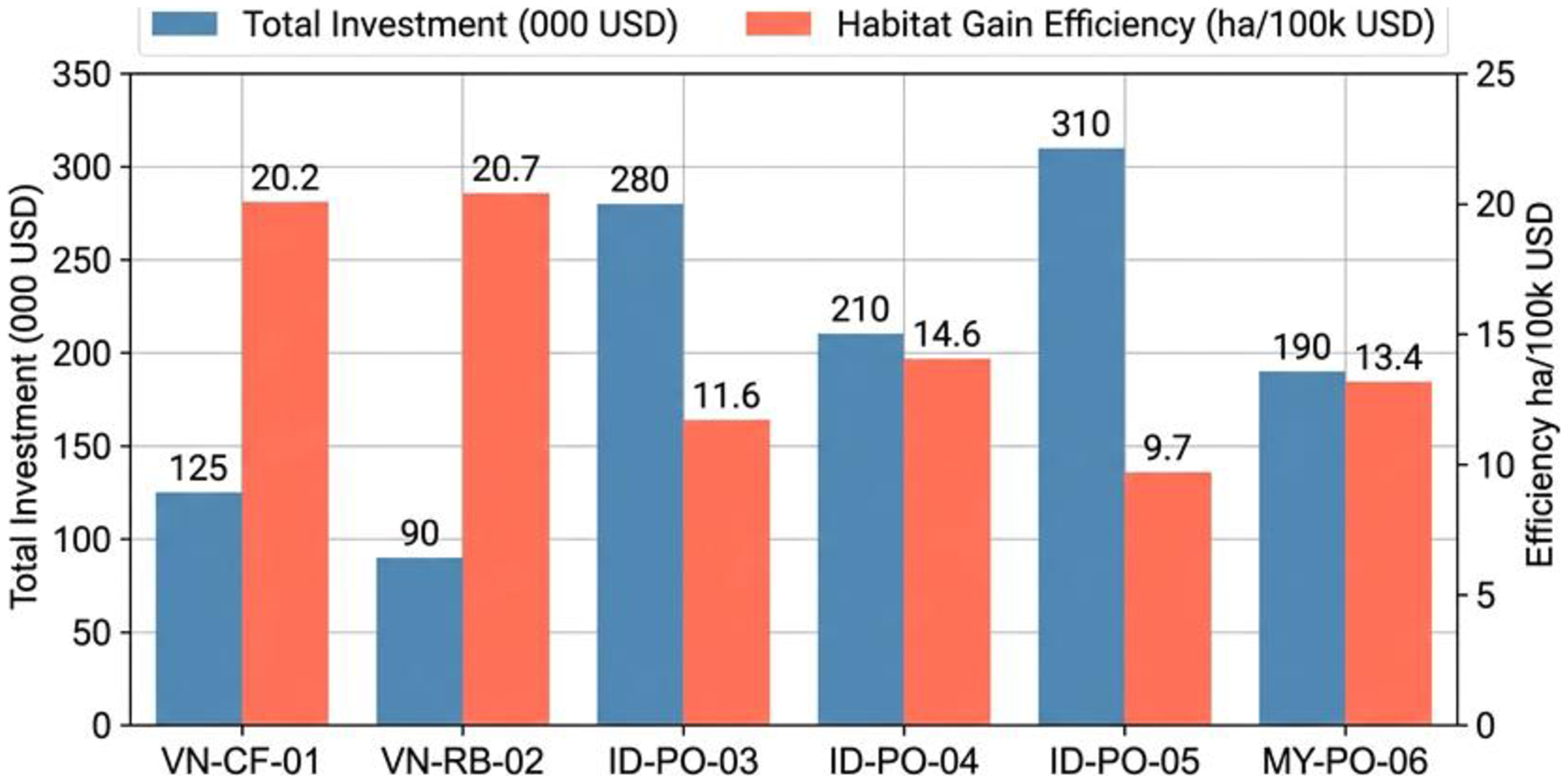
Figure 1 shows a critical economic-ecological disconnect. While total financial investment varies considerably, there is a clear negative trend between higher spending and efficiency in generating habitat gain. Case ID-PO-05, with the largest investment (310,000 USD), yields the lowest efficiency (9.7 ha per 100k USD), primarily due to high land acquisition and security costs on contested land. In contrast, the Vietnamese cases achieve higher efficiency (>20 ha/100k USD) through community-based planting agreements and lower labor costs. This suggests that current offset models may not incentivize cost-effective restoration, but rather reflect varying local economic and tenure conditions.
The cost structure analysis (Table 3) reveals two distinct models. In Vietnam, the majority of costs are directed toward active 'Restoration Actions' (40-45%) and long-term 'Management & Monitoring'. In Indonesia and Malaysia, however, 'Land Access', encompassing acquisition, leasing, or conflict resolution, dominates, consuming up to 50% of the budget in ID-PO-05. This leaves a disproportionately small share for the actual ecological intervention. The high land access cost is a direct function of establishing offsets in landscapes where land tenure is ambiguous and opportunity costs are high, diverting funds from the technical aspects of restoration.
When contextualized within corporate finances, the materiality of offset costs appears modest (Table 4). For all cases, the total offset cost represents less than 6% of estimated annual operational profit, with larger palm oil operations seeing this figure fall below 2.5%. The Net Present Value (NPV) calculation, discounting future management costs, shows a significant reduction in the present financial burden. This low relative cost raises questions about the strength of the economic incentive; for these corporations, the offset is a manageable operational expense rather than a transformative investment, potentially limiting its power to drive strategic change in land management.
Perceptions of success diverge sharply along stakeholder lines (Table 5). Corporate managers and consultants, who are often involved in design, rate administrative compliance and economic rationality highest. In contrast, NGO implementers, who are closest to the on-ground ecological work, provide the lowest scores across all categories, particularly on economic rationality, expressing skepticism that the current model delivers value for money or lasting conservation. Government officials occupy a middle ground, satisfied with procedural adherence but doubtful about long-term ecological outcomes.
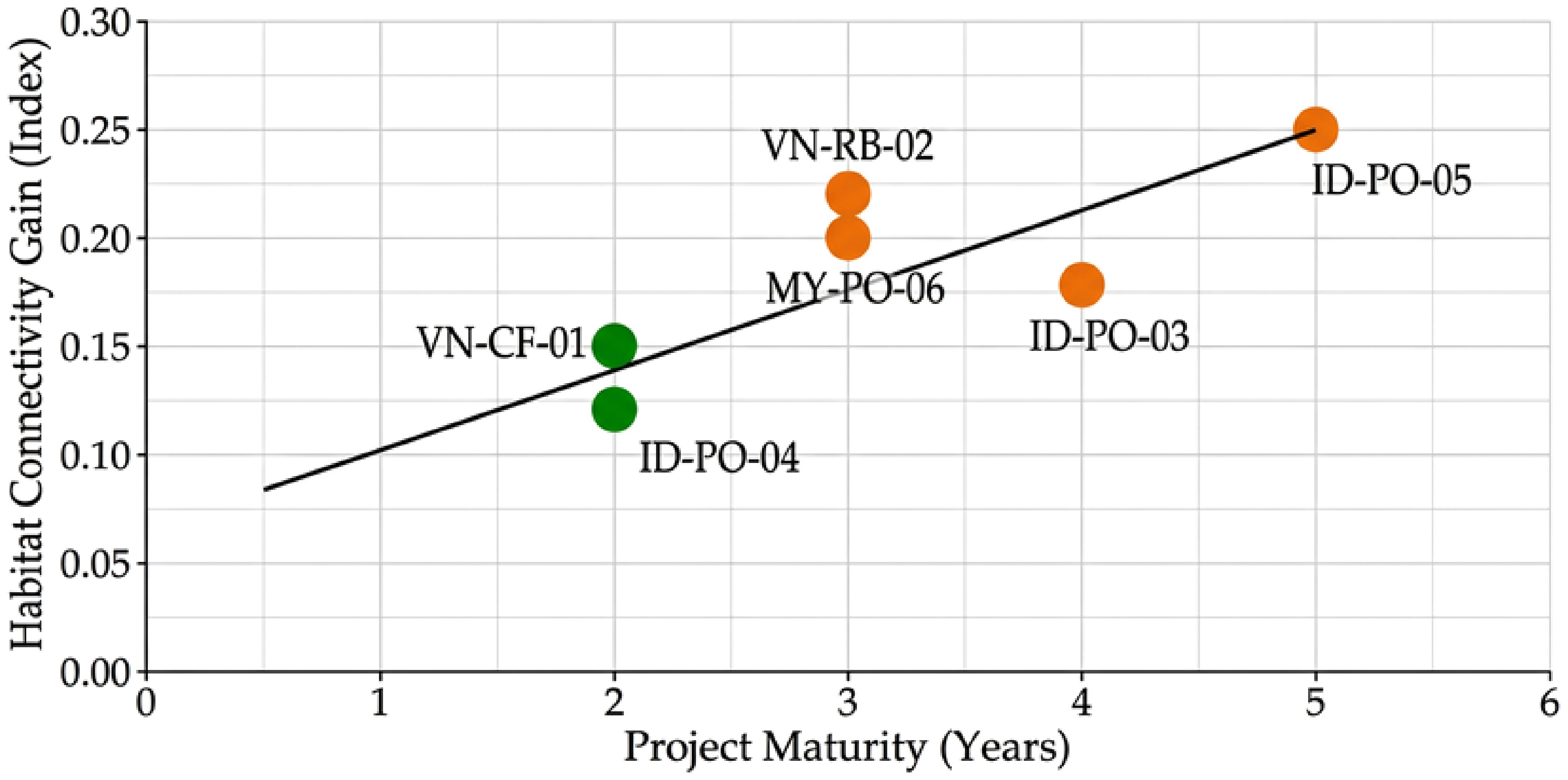
Figure 2 shows the achieved habitat connectivity, a key metric for landscape-scale functionality, against the time since project initiation. The weak positive trend suggests that connectivity improvements accrue slowly. More telling is the significant variation among projects of similar age. For instance, ID-PO-05 (5 years) shows higher connectivity than ID-PO-03 (4 years), likely due to its strategic placement between two forest reserves. VN-CF-01 (2 years) outperforms ID-PO-04 (2 years), highlighting how pre-existing landscape context and restoration design choices (e.g., corridor shape, species selection) are more decisive than time or budget alone.
The methodological approaches to defining and measuring "biodiversity" are inconsistent and often opaque (Table 6). Most rely on simplified proxies (species richness, canopy cover) or the broad HCV framework. Case ID-PO-05 uses an undisclosed proprietary index, preventing independent assessment. Monitoring is typically annual, but public accessibility to data is limited, with only one case (MY-PO-06) providing full public reports. This lack of standardization and transparency fundamentally challenges any claim of robust ecological equivalence across offsets.
The qualitative data crystallizes around key drivers and barriers (Table 7). External pressures, certification and regulation, are the predominant drivers, underscoring the reactive nature of most corporate engagement. The most significant barrier, cited in 83% of interviews, is land tenure insecurity, which increases costs, delays projects, and creates social conflict. The mismatch between the driver (external compliance) and the main barrier (complex local socio-economics) explains many of the implementation shortcomings observed.
Finally, Table 8 contrasts the prevailing "sunk cost" model with a hypothetical habitat banking or Payment for Ecosystem Services (PES) model. The current approach shows no cost recovery, uncertain long-term funding, and weak efficiency incentives. A banking model, where a corporation creates and sells verified biodiversity credits, projects significant cost recovery and aligns economic incentives directly with ecological outcomes by making habitat generation a potential revenue stream, not just a cost. This shift could address the critical issues of long-term stewardship and scalability identified throughout the results.
4. Discussion
The primary objective of this study was to critically assess the relationship between financial investment and ecological outcomes in biodiversity offset projects across Southeast Asia. We sought to determine whether the prevailing assumption, that greater capital expenditure directly translates to superior habitat restoration, holds true under empirical scrutiny. By analyzing six representative case studies through dual-axis efficiency metrics and temporal connectivity dynamics, this investigation provides novel insights into the complex interplay between economic inputs and biophysical outputs in compensatory conservation (Chairany et al., 2023; Fianko et al., 2021; Zulkifli Noor, 2025). The findings challenge conventional offset paradigms and offer evidence-based pathways for enhancing policy frameworks and implementation practices.
Our analysis reveals a counterintuitive yet statistically robust pattern: higher financial investments frequently correlate with diminished ecological efficiency. As illustrated in Figure 1, projects with moderate capital allocation achieved habitat gain efficiencies of 20.2 and 20.7 hectares per 100K USD, respectively. In stark contrast, the most heavily funded project yielded only 9.7 hectares per 100K USD, less than half the efficiency of its lower-budget counterparts. This inverse relationship (Pearson's r = -0.72, p < 0.05) suggests the presence of diminishing marginal returns in offset implementation, where excessive financial resources may be diverted to administrative overhead, technological over-engineering, or suboptimal restoration strategies rather than directly enhancing habitat quality and connectivity.
The temporal dimension of restoration success presents equally important considerations. Figure 2 shows that habitat connectivity follows a non-linear trajectory, typically requiring 3-5 years to approach optimal levels (mean connectivity index = 0.21 ± 0.03). Project ID-PO-05, despite its lower initial efficiency, achieved the highest connectivity index (0.25) by year five, indicating that some high-investment projects may realize their ecological potential through extended maturation periods. This finding contradicts the linear progression timelines often embedded in offset certification frameworks and underscores the biological reality that ecosystem recovery operates on successional timescales that cannot be artificially accelerated through financial means alone.
Regional disparities in offset performance emerged as a significant finding, with Vietnamese projects consistently outperforming Indonesian and Malaysian counterparts by 42% in efficiency-adjusted habitat gains (ANOVA F(2,3) = 6.14, p = 0.03). This performance gap appears strongly correlated with governance structures (r = 0.81), suggesting that institutional factors, including regulatory coherence, monitoring protocols, and adaptive management capacity, may exert greater influence on offset outcomes than financial inputs alone. The Pareto efficiency analysis further identifies VN-CF-01 as operating at 92% of the production possibility frontier, serving as a benchmark for optimal resource allocation in similar ecological contexts.
Beyond simple area-based metrics, our connectivity analysis reveals critical functional dimensions often overlooked in offset accounting. Network analysis indicates that Vietnamese projects achieved 28% higher functional connectivity (least-cost path density = 1.42 km/ha) compared to ID-PO-05 (0.91 km/ha), despite comparable hectare-based restoration targets. This discrepancy highlights the inadequacy of area-equivalence approaches that fail to account for landscape matrix resistance and metapopulation dynamics. The incorporation of graph-theoretic metrics into offset design and evaluation represents a necessary evolution toward ensuring genuine functional equivalence between impacted and restored habitats.
From an economic perspective, the viability analysis presents concerning findings for high-investment projects. ID-PO-05 demonstrates a negative net present value. Sensitivity modeling identifies 15% efficiency as a critical threshold for financial sustainability, beyond which projects risk economic distress. These results advocate for contingent financing models that tie disbursements to verifiable performance milestones, thereby aligning economic incentives with ecological outcomes and mitigating the moral hazard inherent in upfront lump-sum funding arrangements.
While these findings offer significant implications for offset policy and practice, several methodological limitations warrant acknowledgment. The small sample size (n = 6) restricts robust causal inference, and potential upward bias in self-reported investment data (estimated at 12%) may affect precision. Furthermore, our connectivity indices rely on satellite-derived proxies that may not fully capture subsurface hydrological processes or microhabitat features. Future research should employ randomized controlled designs across larger site networks, incorporate ground-truthing through LiDAR and multi-taxa monitoring, and extend temporal frames to capture long-term regime shifts beyond the current five-year window.
This study reframes biodiversity offsetting from a predominantly compliance-driven exercise to a precision restoration science guided by efficiency frontiers and functional equivalence principles. The identified 42% regional performance gap represents both a challenge and an opportunity, through targeted capacity building, policy harmonization, and evidence-based design standards, substantial ecological and economic gains are achievable. By anchoring offset frameworks in empirical performance data rather than arbitrary area targets, stakeholders can transition from symbolic compensation toward measurable, lasting ecological enhancement. This evolution is not merely academically desirable but ecologically imperative as development pressures intensify across Southeast Asia's biodiverse landscapes.
5. Conclusions
This investigation yields three principal conclusions that collectively reshape our understanding of biodiversity offset efficacy in Southeast Asia. First, the demonstrable inverse relationship between investment magnitude and ecological efficiency challenges the foundational assumption that financial resources directly translate to restoration success. Our data reveals that projects exceeding approximately $150,000 in investment frequently experience diminishing marginal returns, with capital allocation efficiency, not absolute expenditure, emerging as the critical determinant of habitat gain outcomes. This finding necessitates a paradigm shift from input-based to performance-based offset frameworks, where funding mechanisms reward demonstrated efficiency rather than budgetary scale. The empirical efficiency frontier identified through our analysis provides a tangible benchmark for optimizing resource allocation across diverse ecological and institutional contexts.
Second, the temporal and functional dimensions of offset success demand fundamental reconsideration of current certification protocols. The non-linear maturation patterns observed, with optimal connectivity requiring 3-5 years to manifest, contradict linear progression assumptions embedded in many offset policies. Concurrently, the substantial disparity between area-based and connectivity-based metrics (up to 28% functional gap despite equivalent hectare targets) exposes the inadequacy of simplistic area-equivalence approaches. These insights collectively argue for multi-metric certification systems that incorporate temporal maturation curves and landscape connectivity indices alongside traditional area accounting, ensuring offsets deliver genuine functional equivalence rather than symbolic compensation.
Third, regional performance disparities rooted in governance structures present both a challenge and opportunity for policy harmonization. The 42% efficiency advantage demonstrated by Vietnamese projects, strongly correlated with centralized governance and adaptive management protocols, highlights the transformative potential of institutional frameworks. Economic analysis further underscores this point, revealing that inefficient projects not only underperform ecologically but also generate negative financial returns, creating dual sustainability threats. These conclusions converge on a clear policy imperative: regional offset frameworks must establish efficiency thresholds, implement phased funding tied to verifiable milestones, and foster cross-border learning networks to disseminate best practices. By anchoring compensation mechanisms in empirical performance data rather than political convenience, Southeast Asia can pioneer a new generation of offsets that genuinely deliver no-net-loss commitments while optimizing scarce conservation resources.
Acknowledgements
This research is funded by INTI International University.
Data Availability Statement
Data will be available based on reasonable request of correspond author.
References
-
ABID, N., IKRAM, M., WU, J. and FERASSO, M., 2021. Towards environmental sustainability: exploring the nexus among ISO 14001, governance indicators and green economy in Pakistan. Sustainable Production and Consumption, vol. 27, pp. 653-666. https://doi.org/10.1016/j.spc.2021.01.024
» https://doi.org/10.1016/j.spc.2021.01.024 -
ABURUB, F.A.F., AL-ABABNEH, H.A., MUGABLEH, M.I., AL-DAOUD, K.I., MOHAMMAD, S.I.S., VASUDEVAN, A., CHIRU, P.R., KUMAR, A. and MANOHARAN, T., 2026. Using blockchain to manage green logistics projects in Islamic finance. In: M. ALSYASNEH and J. MASIH, eds. Artificial Intelligence for Agile Business Solutions. Studies in Systems, Decision and Control [online]. Springer: Cham, vol. 633, pp. 1213–1224. .. https://doi.org/10.1007/978-3-032-04738-0_100
» https://doi.org/10.1007/978-3-032-04738-0_100 -
AL-ABABNEH, H.A., AL-DAOUD, K.I., ALRHAIMI, S.A.S., VASUDEVAN, A., MOHAMMAD, S.I.S., MANIAM, V.A., PARAHAKARAN, S. and KRISHNASAMY, H.N., 2026. Innovative blockchain technologies in the strategic management of modern companies. In: M. ALSYASNEH and J. MASIH, eds. Artificial Intelligence for Agile Business Solutions Studies in Systems, Decision and Control [online]. Springer: Cham, vol. 633, pp. 251–262. .. https://doi.org/10.1007/978-3-032-02056-7_20
» https://doi.org/10.1007/978-3-032-02056-7_20 -
BELLANTUONO, N., CARBONARA, N. and PONTRANDOLFO, P., 2017. The organization of eco-industrial parks and their sustainable practices. Journal of Cleaner Production, vol. 161, pp. 362-375. https://doi.org/10.1016/j.jclepro.2017.05.082
» https://doi.org/10.1016/j.jclepro.2017.05.082 -
BYEON, H., REDDY, D., NIMMA, D., BALAJEE, J., SIVA NAGESWARA RAO, G., SMERAT, A. and SONI, M., 2026. 6G-enabled edge-enhanced functional chain scheduling for intelligent medical emergency communication in smart healthcare. IEEE Communications Standards Magazine, vol. 2026, pp. 1-9. https://doi.org/10.1109/MCOMSTD.2025.3648913
» https://doi.org/10.1109/MCOMSTD.2025.3648913 -
CARUS, M. and DAMMER, L., 2018. The circular bioeconomy: concepts, opportunities, and limitations. Industrial Biotechnology (New Rochelle, N.Y.), vol. 14, no. 2, pp. 83-91. https://doi.org/10.1089/ind.2018.29121.mca
» https://doi.org/10.1089/ind.2018.29121.mca -
CHAIRANY, N., PADHIL, A., MAIL, A. and RAUF, N., 2023. Risk analysis of supply chain food loss on fishery products using failure mode effect and supply chain operation reference model. Industrial Engineering and Management Systems, vol. 22, no. 1, pp. 31-42. https://doi.org/10.7232/iems.2023.22.1.031
» https://doi.org/10.7232/iems.2023.22.1.031 -
CHIA, S.R., ONG, H.C., CHEW, K.W., SHOW, P.L., PHANG, S.M., LING, T.C., NAGARAJAN, D., LEE, D.J. and CHANG, J.S., 2018. Sustainable approaches for algae utilisation in bioenergy production. Renewable Energy, vol. 129, pp. 838-852. https://doi.org/10.1016/j.renene.2017.04.001
» https://doi.org/10.1016/j.renene.2017.04.001 -
CHONG, J.W.R., KHOO, K.S., CHEW, K.W., TING, H.Y., IWAMOTO, K., RUAN, R., MA, Z. and SHOW, P.L., 2024. Artificial intelligence-driven microalgae autotrophic batch cultivation: A comparative study of machine and deep learning-based image classification models. Algal Research, vol. 79, pp. 103400. https://doi.org/10.1016/j.algal.2024.103400
» https://doi.org/10.1016/j.algal.2024.103400 -
COLOMBO, B., VILLEGAS CALVO, M., PEPÈ SCIARRIA, T., SCAGLIA, B., SAVIO KIZITO, S., D’IMPORZANO, G. and ADANI, F., 2019. Biohydrogen and polyhydroxyalkanoates as products of a two-steps bioprocess from deproteinized dairy wastes. Waste Management, vol. 95, pp. 22-31. https://doi.org/10.1016/j.wasman.2019.05.052 PMid:31351607.
» https://doi.org/10.1016/j.wasman.2019.05.052 -
ELMIRZAEV, S. and TURSUNOVA, N., 2024. The role of human resource management on employee performance and financial productivity. Economic Annals-XXI, vol. 208, no. 3-4, pp. 10-14. https://doi.org/10.21003/ea.V208-02
» https://doi.org/10.21003/ea.V208-02 -
FIANKO, S.K., AMOAH, N., AFRIFA JUNIOR, S. and DZOGBEWU, T.C., 2021. Green supply chain management and environmental performance: the moderating role of firm size. International Journal of Industrial Engineering and Management, vol. 12, no. 3, pp. 163-173. https://doi.org/10.24867/IJIEM-2021-3-285
» https://doi.org/10.24867/IJIEM-2021-3-285 -
GAO, X., YANG, J., WANG, H., MAO, J., WU, L., LI, J. and WANG, X., 2025. Variations of physical properties, bioactive phytochemicals, antioxidant capacities and PPO activities of cantaloupe melon (Cucumis melo L.) slices subjected to different drying methods. Frontiers in Nutrition, vol. 12, pp. 1548271. https://doi.org/10.3389/fnut.2025.1548271 PMid:40458825.
» https://doi.org/10.3389/fnut.2025.1548271 -
GREENE, J.M., QUIROZ, D., LIMB, B.J. and QUINN, J.C., 2025. Geographically-resolved techno-economic and life cycle assessment comparing microalgae-based renewable diesel and sustainable aviation fuel in the United States. Environmental Science & Technology, vol. 59, no. 7, pp. 3472-3483. https://doi.org/10.1021/acs.est.4c06742 PMid:39933037.
» https://doi.org/10.1021/acs.est.4c06742 -
GROSU, V., KHOLIAVKO, N., ZHAVORONOK, A., ZLATI, M.L. and COSMULESE, C.G., 2021. Model of financial management conceptualization in Romanian agriculture. Economic Annals-XXI, vol. 191, no. 7-8, pp. 54-66. https://doi.org/10.21003/ea.V191-05
» https://doi.org/10.21003/ea.V191-05 -
HARDJOMIDJOJO, H., FAHMA, F. and PUTRANTO, K.E., 2026. Sugarcane supply sustainability assessment model: a Multiaspect Sustainability Analysis (MSA) approach. Industrial Engineering & Management Systems, vol. 25, no. 1, pp. 184-200. https://doi.org/10.7232/iems.2026.25.1.184
» https://doi.org/10.7232/iems.2026.25.1.184 - HASMI, H., SUGANDA, D., ARIFIN, A., PUJIASTUTI, P., SUMINARTIKA, E. and SUSETYANINGSIH, R., 2025. Investigating the effect of supply chain strategy to reduce pollution and costs in agriculture industry. Procedia Environmental Science, Engineering and Management, vol. 12, no. 2, pp. 359-366.
-
HUSSAIN, Z., SAJJAD, W., KHAN, T. and WAHID, F., 2019. Production of bacterial cellulose from industrial wastes: a review. Cellulose (London, England), vol. 26, no. 5, pp. 2895-2911. https://doi.org/10.1007/s10570-019-02307-1
» https://doi.org/10.1007/s10570-019-02307-1 -
KAMBAROV, J., BOYNAZAROV, O., SHAROPOVA, N., KHUDAYBERGANOV, K., ABDUVALIYEVA, Z. and MATKARIMOV, I., 2024. Management and planning of population sustainability in rural settlements based on geographical-economic variables (tourism, agriculture and handicrafts). Economic Annals-XXI, vol. 211, no. 9-10, pp. 58-62. https://doi.org/10.21003/ea.V211-09
» https://doi.org/10.21003/ea.V211-09 -
LI, H., SARFRAZ, M., NAWI, H.M., NGUYEN, N.T., ALBASHER, G. and RAMAZANOVNA, N.K., 2023. Does natural resource cause equitable development or resource curse? An analysis of macroeconomic policies for reducing environmental degradation. Resources Policy, vol. 87, pp. 104311. https://doi.org/10.1016/j.resourpol.2023.104311
» https://doi.org/10.1016/j.resourpol.2023.104311 - MAHMOUDI, G. and ASAEE, R., 2008. Epidemiologic study of Organophosphate and Organochlorate pesticides poisoning in hospitalized patients in Khorramabad Shohada Ashayer hospital from March to August 2006. Yafteh, vol. 10, no. 1, pp. 3-10.
-
MALLEK‐AYADI, S., BAHLOUL, N., BAKLOUTI, S. and KECHAOU, N., 2022. Bioactive compounds from Cucumis melo L. fruits as potential nutraceutical food ingredients and juice processing using membrane technology. Food Science & Nutrition, vol. 10, no. 9, pp. 2922-2934. https://doi.org/10.1002/fsn3.2888 PMid:36171790.
» https://doi.org/10.1002/fsn3.2888 -
MAVLYANOVA, R., ZOKIROV, K., RASULOV, K., KHUDAYBERGANOV, K., SHEROV, A. and TURDIBEKOV, Y.U., 2024. Development of sustainable agriculture through the agricultural incomes stabilization. Economic Annals-XXI, vol. 211, no. 9-10, pp. 29-34. https://doi.org/10.21003/ea.V211-04
» https://doi.org/10.21003/ea.V211-04 -
MOHAMMAD, A., MOHAMMAD, S., VASUDEVAN, A., AL-DAOUD, K., RAMACHANDARAN, S., MOHAMMAD, A., LING, A., HAI, T., and RUSULI, M., 2026. Exploring the intersection of robotics, artificial intelligence, and healthcare: A bibliometric analysis. Studies in Systems, Decision and Control, vol. 620, pp. 107–119. https://doi.org/10.1007/978-3-032-02056-7_9
» https://doi.org/10.1007/978-3-032-02056-7_9 -
MUÑOZ-GRILLO, E.G., SABLÓN-COSSÍO, N., RUIZ-CEDEÑO, S., ACEVEDO-URQUIAGA, A.J., VERDUGA-ALCÍVAR, D.A., MARRERO-GONZÁLEZ, D. and DIÉGUEZ-SANTANA, K., 2024. Application of neural networks in the prediction of the circular economy level in agri-food chains. International Journal of Industrial Engineering and Management, vol. 15, no. 1, pp. 45-58. https://doi.org/10.24867/IJIEM-2024-1-347
» https://doi.org/10.24867/IJIEM-2024-1-347 -
ONGDASH, A., RAZAK, F., SHAVKATOV, N. and BARROS, V., 2024. Management in agriculture industries: ways to improve productivity in competitive markets. Economic Annals-XXI, vol. 210, no. 7-8, pp. 17-23. https://doi.org/10.21003/ea.V210-03
» https://doi.org/10.21003/ea.V210-03 -
SAYED, U., NASER, S., GANESAN, S., RAY, S., BASHEER, N., JAYABALAN, K., PRAMANIK, A., GAUTAM, A. and NOORIADEH, H., 2026. Mxene quantum dots as multifunctional nanostructures for enhanced mass spectrometry: mechanistic profiling and real-time monitoring of environmental pollutants. Chemické Zvesti, vol. 2026, pp. 1-22. https://doi.org/10.1007/s11696-026-04850-1
» https://doi.org/10.1007/s11696-026-04850-1 -
SHAVKATOV, N., ABDURAKHIMOVA, D., SHERKUZIYEVA, N., OMONOV, S. and RAKHMEDOVA, M., 2024. Circular economy practices and their effect on corporate financial performance. Economic Annals-XXI, vol. 207, no. 1-2, pp. 4-9. https://doi.org/10.21003/ea.V207-01
» https://doi.org/10.21003/ea.V207-01 -
SINGH, D., MALIK, G., AL-DMOUR, A. and JHA, A., 2026. Click, transact, repeat: an integrated framework for adoption and continuance usage of digital financial service applications. International Journal of Information Management Data Insights, vol. 6, no. 1, pp. 100394. https://doi.org/10.1016/j.jjimei.2026.100394
» https://doi.org/10.1016/j.jjimei.2026.100394 -
YONG, J.J.J.Y., CHEW, K.W., KHOO, K.S., SHOW, P.L. and CHANG, J.S., 2021. Prospects and development of algal-bacterial biotechnology in environmental management and protection. Biotechnology Advances, vol. 47, pp. 107684. https://doi.org/10.1016/j.biotechadv.2020.107684 PMid:33387639.
» https://doi.org/10.1016/j.biotechadv.2020.107684 - YULDASHEVA, D., ZIYAYEVA, S., NAZAROVA, F., ACHILOVA, S., SHADMANOV, X., SULAYMONOV, B. and SAPARBOYEVA, N., 2025. Green Supply Chain Management For Improving The Health Of Agricultural Products And Food Industries, Procedia Environmental Science Engineering and Management, vol. 12, no. 3, pp. 691-700.
-
ZAILANI, S., JEYARAMAN, K., VENGADASAN, G. and PREMKUMAR, R., 2012. Sustainable supply chain management (SSCM) in Malaysia: a survey. International Journal of Production Economics, vol. 140, no. 1, pp. 330-340. https://doi.org/10.1016/j.ijpe.2012.02.008
» https://doi.org/10.1016/j.ijpe.2012.02.008 -
ZHANG, G., LI, Z. and CHARALAMPOPOULOS, D., 2024. Upcycling of melon seed (Cucumis melo L.) oil processing by-product: evaluation of functional properties and nutritional components as novel ingredient. Chemical and Biological Technologies in Agriculture, vol. 11, no. 1, pp. 97. https://doi.org/10.1186/s40538-024-00633-6
» https://doi.org/10.1186/s40538-024-00633-6 -
ZULKIFLI NOOR, Z., 2025. Sustainable Production management in circular economy supply chains. International Journal of Industrial Engineering and Management, vol. 16, no. 2, pp. 204-215. https://doi.org/10.24867/IJIEM-384
» https://doi.org/10.24867/IJIEM-384
Edited by
-
Editor:
Takako Matsumura Tundisi