 Evaluating the stability and drought tolerance of maize hybrids using multi-environment and multi-trait analyses
Abstract
Drought remains a major constraint on maize productivity in tropical environments. Consequently, maize requires the identification of hybrids that combine high yield with stability across variable conditions. Ten tropical maize hybrids (eight promising candidates and two commercial checks) were evaluated across five environments (three optimal and two drought-stressed) using a randomized complete block design. Significant genotype, environment, and G × E effects (p < 0.01) were detected for nearly all traits, confirming substantial phenotypic variability. Drought stress reduced grain yield by 32.34%, primarily due to declines in ear weight and kernel size. Based on stress tolerance indices, GGE biplot, and WAASB analysis, hybrids G01, G02, and G08 were identified as the most drought-tolerant genotypes with broad stability. MGIDI further confirmed these selections, with G01 specifically achieving the lowest multi-trait distance to the ideotype under both optimal (1.12) and drought conditions (0.56). These results support the recommendation of these superior hybrids for deployment in tropical maize production systems prone to water deficit.
Keywords:
abiotic stress; stability statistics; simultaneous selection; tolerance indices; tropical maize
Resumo
A seca permanece como uma das principais limitações à produtividade do milho em ambientes tropicais, tornando imperativa a identificação de híbridos que combinem alto rendimento e estabilidade. Dez híbridos de milho tropical (oito candidatos promissores e duas testemunhas comerciais) foram avaliados em cinco ambientes (três sob condições ideais e dois sob estresse hídrico) utilizando o delineamento de blocos casualizados. Efeitos significativos de genótipo, ambiente e interação G x E (p < 0,01) foram detectados para quase todas as características, confirmando uma substancial variabilidade fenotípica. O estresse hídrico reduziu o rendimento de grãos em 32,34%, devido principalmente a decréscimos no peso da espiga e no tamanho do grão. Com base nos índices de tolerância ao estresse e nas análises GGE biplot e WAASB, os híbridos G01, G02 e G08 foram identificados como os genótipos mais tolerantes à seca e com ampla estabilidade. O índice MGIDI confirmou essas seleções, com o G01 alcançando a menor distância multivariada para o ideótipo tanto em condições ideais (1,12) quanto sob seca (0,56). Esses resultados sustentam a recomendação desses híbridos superiores para o cultivo em sistemas de produção de milho tropical sujeitos ao déficit hídrico.
Palavras-chave:
estresse abiótico; estatísticas de estabilidade; seleção simultânea; índices de tolerância; milho tropical
1. Introduction
Maize (Zea mays L.) is one of the most important cereal crops worldwide, serving as a fundamental source of food, feed, and industrial raw material (Erenstein et al., 2022). In Indonesia, maize has a dual role as a local food source and poultry feed, thereby increasing productivity and yield stability (Rozi et al., 2023). Maize productivity has been substantially increased over the past few decades to meet demand through crop and agronomic management technologies, genetic improvement, and advances in breeding. This approach could address the demand for maize by potentially narrowing the disparity between actual and potential yields in the long term, while also elevating the standard for the potential yield (Cooper et al., 2020; Fato et al., 2025).
However, climate change and environmental factors, which can contribute to abiotic stress, pose complex challenges for maintaining maize productivity and global food security (Rizwanullah et al., 2023). In tropical and subtropical regions, maize yield and agronomic performance remains highly variable across various environments owing to frequent exposure to abiotic stresses. Consequently, developing maize hybrids with improved tolerance and stability in diverse environments remains a major challenge for breeders (Dube et al., 2024; Supriadi et al., 2024). The abiotic stresses, particularly drought, affect maize during critical stages such as flowering and grain filling, resulting in disrupting the physiological processes essential for productivity, reduced yield components and grain yield. Drought stress is a primary constraint, with historical data showing that it can trigger global maize yield losses of 15% to 40%, and in severe tropical cases, reductions can exceed 70% if the stress occurs during the critical flowering stage. Consequently, there is an urgent need for integrative breeding strategies focused on enhancing yield stability and environmental resilience (Elmyhun et al., 2024; Dube et al., 2024; Bal et al., 2025).
The intricate nature of drought response is further compounded by genotype × environment interaction (GEI), which causes significant shifts in the relative performance of genotypes across varying moisture regimes. In drought-prone regions, GEI frequently accounts for a greater proportion of yield variance than the primary genetic effect, thereby complicating the selection of stable hybrids (Gonçalves et al., 2025). This phenomenon suggests that drought tolerance is a dynamic phenotypic expression rather than a static trait, necessitating a comprehensive evaluation of how GEI modulates adaptive traits under water-limited conditions. Ultimately, since performance under stress is a product of both genetic potential and environmental interaction, deciphering GEI is fundamental to identifying superior hybrids that bridge the gap between high yield potential and stress resilience (Supriadi et al., 2024; Yustiningsih et al., 2026).
Genotype × environment interaction (GEI) further complicates breeding progress by causing inconsistent genotype performance across diverse agro-ecological conditions, highlighting the necessity for multi-environment testing to reliably identify stable and high-performing hybrids (Bocianowski et al., 2024; Gonçalves et al., 2025). Traditional single-trait selection is often insufficient because drought tolerance is a complex, quantitative trait governed by multiple morphological and physiological components that respond differently across environments (Bal et al., 2025). Stress tolerance have become essential tools to address this in identifying genotypes that maintain high yield potential under both stress and non-stress conditions by quantifying the relative yield loss. However, relying solely on these indices or grain yield is often insufficient, as they do not fully account for the dynamic nature of GEI. As a result, relying solely on grain yield is insufficient, as high-yielding genotypes under optimal conditions may exhibit severe yield penalties under stress (Bhandari et al., 2024; Yustiningsih et al., 2026). Recent advances in quantitative genetics and statistical modeling, including GGE biplot, WAASB, and multi-trait selection indices such as MGIDI, enable simultaneous evaluation of yield, stability, and adaptive traits, improving selection accuracy and genetic gains under stress-prone environments (Nataraj et al., 2021; Azrai et al., 2025). Therefore, this study aimed to integrate drought tolerance screening using various tolerance indices with stability and multi-trait assessment for developing and selecting resilient maize hybrids suited to tropical regions, especially under drought stress.
2. Materials and Methods
2.1. Plant material
Ten hybrids, consisting of eight tropical maize hybrids derived from single-cross and two commercial varieties as check was used in this study. Eight promising hybrids selected for their high-yield potential in previous selection environments, including R0105 (G01), R0118 (G02), R0211 (G03), R0498 (G04), R0641 (G05), R0654 (G06), R0016 (G07), R0020 (G08), while two widely-marketed commercial hybrids used as checks: RSA002 (G09) and NK7328 – NK Sumo (G10). These genotypes are characterized by orange semi-dent kernels and adaptation to tropical lowland agro-ecologies. The details of the female and male parent each genotype were presented in Table 1.
2.2. Field of experiment
The experiments were conducted across five distinct environments representing two moisture regimes: optimum and drought-stressed conditions (Table 2). These environments included Bandar Kedungmulyo (Jombang in 2023; E01), Ngronggot (Nganjuk; E02), Banguntapan (Bantul; E03), Bandar Kedungmulyo (Jombang in 2024; E04), and Plosoklaten (Kediri; E05), spanning the 2023–2024 cropping seasons. These locations were selected to capture diverse agro-ecological conditions and rainfall regimes across lowland maize-producing areas of Java. The three irrigated environments (E01, E02, and E03) served as non-stress conditions where adequate irrigation was supplied throughout the growing season, while the two drought-stress environments (E04 and E05) were managed under controlled water deficit by limiting irrigation during the critical reproductive stage. The experimental sites were situated across diverse agroecological and agroclimatic zones, with elevations ranging from 55 to 220 m above sea level. The soil types across these five regions were identified as alluvial, grumosol, and andosol, representing the predominant soil characteristics of the study areas. Meteorological data such as rainfall and maximum and minimum temperatures were recorded daily using a local weather station. The average annual rainfall each sites ranging from 1310 to 1980 mm per year, while temperature approximately from 20.89 to 32. 90 °C. The description of experimental field was detailed in Table 2.
2.3. Experimental design and water management
The experiments in all environments were arranged in a randomized complete block design (RCBD) with three replications, with genotype and material were applied uniformly across all locations following identical agronomic management practices to ensure data consistency. Each plot consisted of four rows, each 5 m in length (14 m2), with a spacing of 75 cm between rows and 25 cm between plants. The two inner rows were used for data collection and border rows were maintained to minimize edge effects. Soil preparation was carried out through two plowings and one harrowing to achieve a fine tilth suitable for maize growth. Basal fertilization was applied uniformly across sites using manure.
Two seeds per hole were planted and seedlings were thinned to one plant per hole 10 – 12 days after planting (DAP). The standard agronomic practices were followed according to the Indonesian Ministry of Agriculture’s technical guidelines across all treatments, including fertilizer application, weeding and pest management. The fertilization was used twice: first application using urea (doses 200 kg ha−146% N) and NPK (doses 350 kg ha−1, 15% N, 15% P, and 15% K) at 10 – 14 DAP and second application used urea only (doses 200 kg ha−146% N) at 30 – 35 DAP. Weeding was done manually, and mulching involved raising the mounds and loosening the soil to improve soil aeration. The harvesting was performed at physiological maturity, which was identified by the formation of a black layer on the grain.
The water management for drought stress was followed according to International Maize and Wheat Improvement Center – CIMMYT (Zaidi, 2019). Irrigation was applied regularly in optimum irrigated environments (E01, E02 and E03) to maintain soil moisture near field capacity (70–90%) throughout the season. In the drought-stress environments (E04 and E05), a controlled water deficit was imposed at the reproductive stage by withholding irrigation from approximately 45 DAP to 80 DAP, beginning before anthesis and continuing until after silking, when maize is highly sensitive to drought. Soil moisture content in each plot was monitored every three days using a portable time-domain reflectometer (TDR) to maintain the targeted moisture levels of 30–40% of field capacity during the stress period and to verify adequate recovery after stress release.
2.4. Data collection
Ten samples of ears were randomly selected from each hybrid in the plot were used as source of data collection for yield component and yield. The observed traits consisted of ear weight (kg), ear length (cm), ear diameter (mm), number per ear rows, number of kernels per row, grain weight (kg), moisture content, weight of 1000 kernels (g), shelling percentage, and the grain yield (t ha-1), following Formula 1:
(1)
where MC is the actual grain moisture content at harvest, PS is the harvested plot size (14 m2), EW is ear weight per plot (kg), and SP is the shelling percentage.
2.5. Statistical analysis
The combined analysis of variance (ANOVA) was used to observe the interaction between genotype and environment of all traits, after the data were confirmed to satisfy the assumptions of normality of residuals and homogeneity of variances. Data were analyzed using a Linear Mixed Model (LMM) to estimate the variance components and obtain Best Linear Unbiased Predictions (BLUPs) for all traits. The ANOVA linear used the the following model (Formula 2):
where is the observed phenotypic value (e.g., grain yield) for the i-th genotype in the j-th environment, within the k-th replication/block; is the grand mean; is the effect of the i-the genotype (random effect); is the effect of the j-th environment (fixed effect); is the interaction effect between the i-th genotype and j-th environment (random effect); is the effect of the k-th replication nested within the j-th environment (random effect); is experimental error.
Several stress tolerance indices are used to determine the tolerance response of each hybrid, including tolerance index (TOL) (Rosielle and Hamblin 1981), stress susceptibility index (SSI) and stress tolerance index (STI) (Fernandez 1992), stress resistance index (SRI) (Lan 1998), and relative stress index (RSI) (Fischer and Wood, 1979), estimated according to the Formulas 3 to 7 below:
where is the mean yield of each hybrid under normal conditions; is the mean yield of each genotype under drought stress conditions; is the grand mean of yield under normal conditions; and is the grand mean of yield under drought stress conditions. Rank summary of genotypes from all tolerance indices using the ranking equation mean + standard deviation of ranking.
The stability analysis of grain yield was performed when the interaction between genotype and environment was significant. Stability was used in multivariate analysis, including genotype + genotype × environment (GGE) (Yan et al., 2000) and the weighted average of absolute scores from BLUPs (WAASB) (Olivoto et al., 2019), to identify the stable and high performance of hybrids based on grain yield.
The simultaneous selection was used for comparison of the selected hybrids based on tolerance and stability using uni-trait, and the selected hybrids using multi-traits based on the multi-trait genotype-ideotype distance index (MGIDI) (Olivoto and Nardino 2021). MGIDI was estimated based on the calculation steps and two-way best linear unbiased predictions (BLUPs) for each hybrid (row) and trait (column), followed by the Formula 8 below:
where is the multi-trait genotype-ideotype distance index for the ith genotype; is the score of the ith genotype for the jth factor (i = 1, 2, …, g; j= 1, 2, …, f), and is the score of the ideotype.
Lower MGIDI values indicated genotypes more proximal to the ideotype with optimal trait expressions. The relative strengths and weaknesses () were then determined by assessing the proportional contribution of the j-th factor to the total index value of the i-th genotypecalculated as follows (Formula 9):
where Dij is the distance between the ith genotype and the ideotype for the jth factor. The smallest contribution to a factor indicated that the corresponding trait was close to the ideotype.
The selection process was based on the concept of an ideotype, defined as a model plant that combines high yield potential with specific secondary traits for drought adaptation. Grain yield was assigned a weight of two (w = 2), while other yield components were weighted as one (w = 1), because grain yield is the primary economic trait and the ultimate indicator of drought tolerance in tropical maize. A higher weight ensures that the selection index prioritizes genotypes that maintain productivity under stress. The direction of selection was set to increase for all yield-related traits to maximize potential, whereas moisture content was set to decrease to promote early maturity and faster dry-down. The maize hybrids were selected with an intensity of selection of approximately 30% in this study.
All the above analysis was used Microsoft Excel and RStudio (R version 4.5.1). Microsoft Excel were used to calculate of tolerance indices, while RStudio was adopted for stability statistics and MGIDI using “metan” package (Olivoto and Lucio 2020).
3. Result
3.1. Combined analysis of variance and performance all traits
A combined analysis of variance across three normal conditions and two drought stress conditions for yield components and yield is presented in Table 3. The environment (E) factor significantly affected all traits, while the genotype (G) effect showed the same for all traits, except for moisture content. GEI was highly significant in this study for all traits, indicating the different responses of hybrids of maize to the different irrigation conditions. Substantial differences were observed between the normal (optimum irrigated) and drought-stressed environments across all measured traits (Table 4). The mean grain yield under optimum conditions was 10.29 t ha−1, whereas under drought stress it declined to 6.96 t ha−1, representing a reduction of 32.34%. Ear weight (−27.3%), grain weight (−28.6%), and weight of 1000 kernels (-21.79%) were also strongly affected by drought stress. Traits associated with ear morphology, such as ear length (−6.83%), ear diameter (−6.07%), number of ear rows (−3.40%), and number of kernels per row (−7.10%) showed moderate reductions.
Analysis of variation and the mean square for yield component and grain yield of maize under drought stress.
The comparison of performance yield components and yield under two difference environments conditions.
3.2. Analysis for drought tolerance of maize hybrids
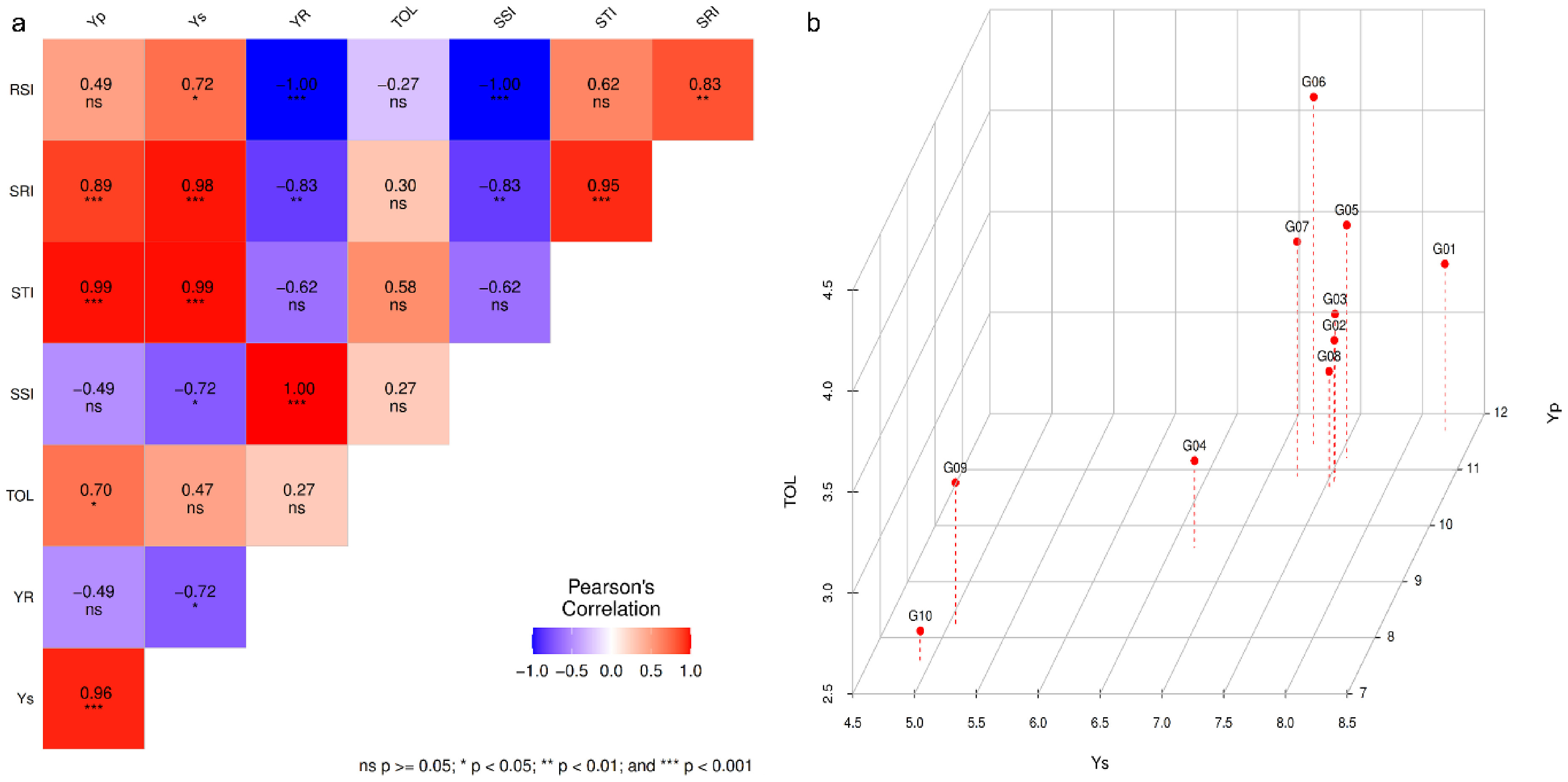
The tolerance index (TOL) varied from 2.65 (G10) to 4.22 (G06) (Table 5), which indicated that G10, G04, and G08 had the lowest TOL values. The stress susceptibility index (SSI) ranged from 0.89 to 1.20, and identified G01, G02, and G08 as the most drought-tolerant hybrids. Genotypes G01, G05, and G06 exhibited the highest STI (>0.75). The stress resistance index (SRI) and relative stress index (RSI) provided complementary insights into genotype stability, suggesting G01, G08, and G02 were the most tolerant to drought stress. Based on the combined ranking of all indices, G01, G02, and G08 consistently emerged as the most drought-tolerant hybrids.
Grain yield under optimal (Yp) and stress (Ys) conditions exhibited a strong positive correlation (r = 0.96***) (Figure 1a). SSI and yield reduction (YR) were strongly and positively correlated (r = 1.00***). However, these tolerance indices have a negative association with SRI and RSI, indicating that hybrids with higher SSI and YR values are more stress-susceptible, losing a higher proportion of yield under adverse conditions. Thus, lower SSI and YR values are desirable for stress tolerance selection. STI and SRI were highly and positively correlated, as well as with yield in both environments. The three-dimensional scatterplot of Yp, Ys, and TOL (Figure 1b) further visualizes the hybrid distribution across environments. G09 and G10 located at the lower end of the plot, displayed low yields in both environments. G06, G05, and G07 were the higher yield reduction among the hybrids, followed by G01. However, the grain yield mean of these hybrids were categorized as high across environment. Hybrids G01 occupied the upper region of the plot, representing high Yp and Ys, identifying this hybrid as the most superior genotypes.
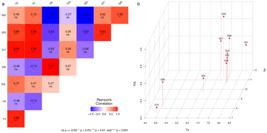
Drought tolerance indices for selecting tolerant maize hybrids: (a) The correlation among stress tolerance indices; (b) 3D scatterplot of yield under optimum and drought stress, and tolerance index.
3.3. Stability analysis using GGE Biplot and WAASB
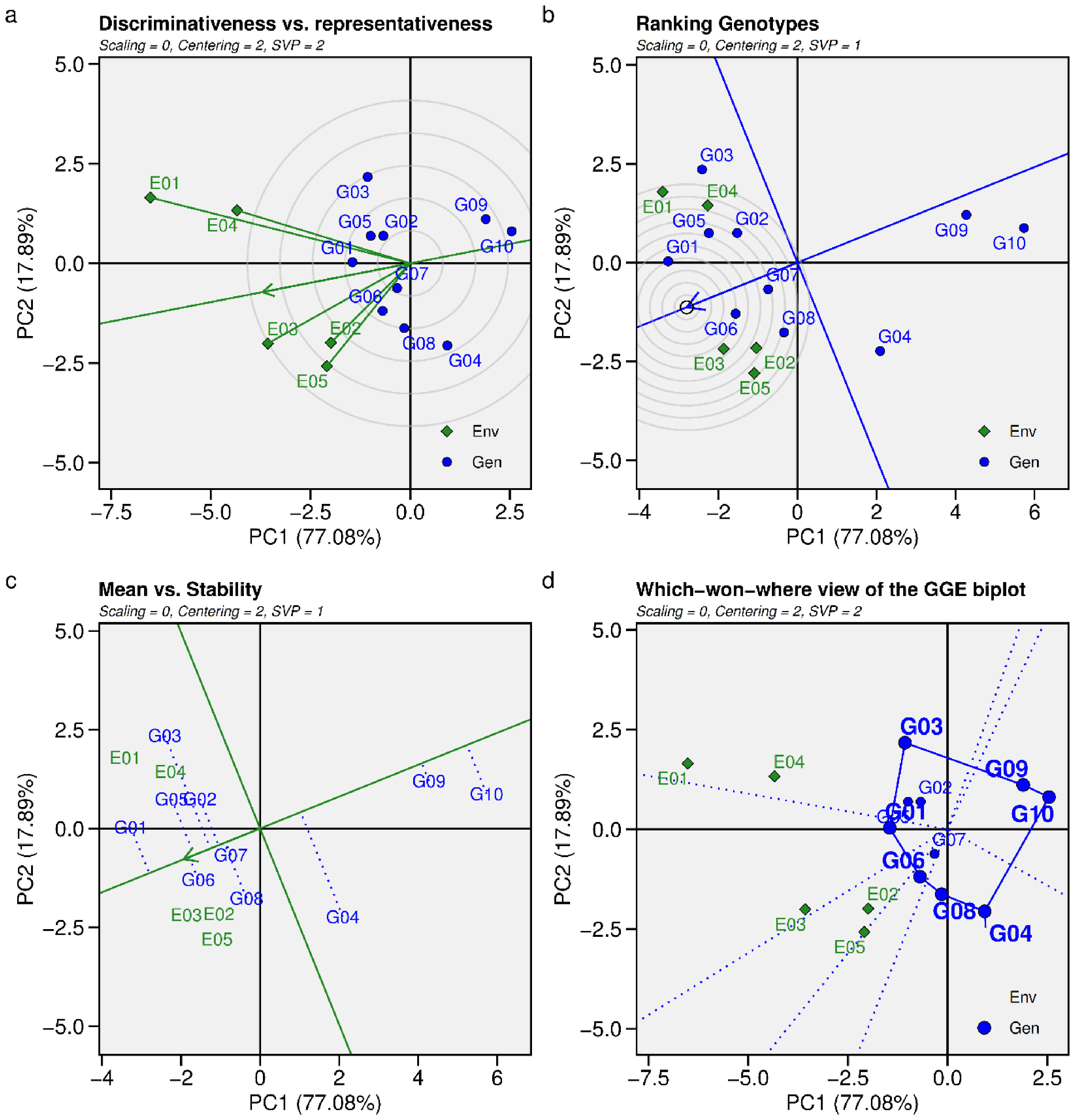
Genotype + genotype × environment (GGE) explains the variation in the first two principal components (PC1 ≈ 77.1% and PC2 ≈ 17.9%), capturing a substantial proportion of the total GGE variation, indicating that the biplot adequately represented the multi-environment structure (Figure 2). In this study, E01 appears more discriminating with longer vector, while E03 lies near the average-environment axis (AEA), indicating as representative environment. G01, G06, G07, and G08, followed by G02 and G05, occupy the leading positions on the AEA (highest mean performance across environments), with relatively modest distances from the axis, suggesting that these genotypes combine high mean yield. By contrast, G04, G09, and G10 are located at the opposite extreme of the average axis and at greater distances from it, reflecting low mean yield and marked instability. The which-won-where sectoring of the biplot indicates that different genotypes tend to perform best in various sectors/mega-environments. G01 was specifically adapted under E03, while G02, G03, and G05 adapted well in E01 and E04.
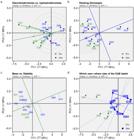
Genotype main effect (G) and genotype × environment interaction (GE) for grain yield of 10 maize hybrids evaluated across five experimental sites.
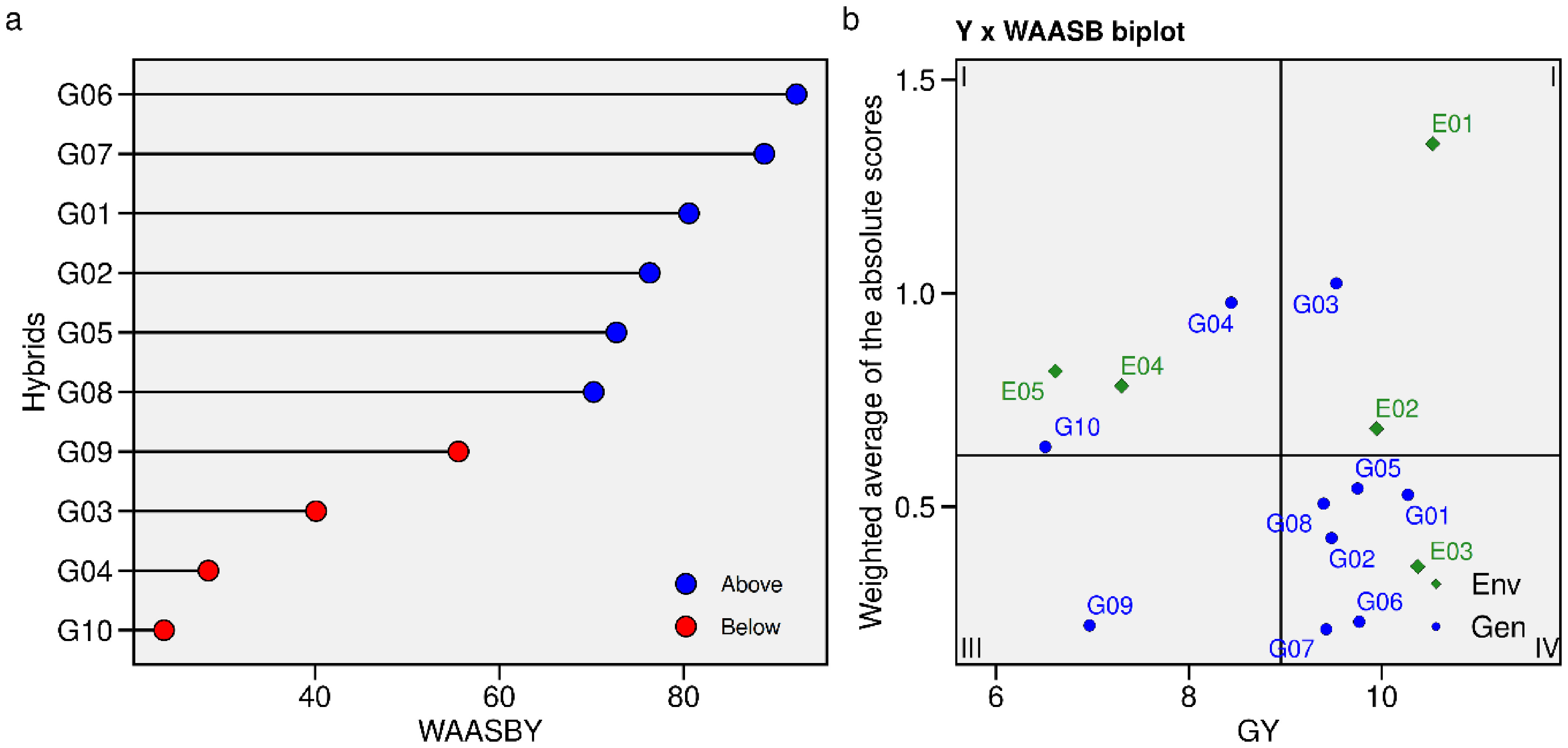
In the WAASB biplot (Figure 3), G06 and G07 clearly sit in quadrant IV, representing the favorable combination of low WAASB. G01 shows the highest yield but slightly moderate WAASB, indicating somewhat larger G × E deviations despite good absolute performance under stress (as shown by tolerance indices). G02, G05, and G08 were categorized in this quadrant also, indicating these hybrids were stable and high-yielding. G10, followed by G04, present both low mean yield and high WAASB, meaning these hybrids are unstable and poor-performing and therefore not suitable for broad recommendation.
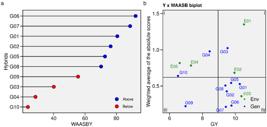
weighted average of absolute scores (WAASB) biplot showing the joint interpretation of mean grain yield and stability for 10 maize hybrids. (a) Estimated values of the WAASB and mean grain yield (WAASBY); (b) Biplot of the mean grain yield and the weighted average of absolute scores for the best linear unbiased predictions of the genotype-vs.-environment interaction.
3.4. Simultaneous selection for identifying high-superior of maize
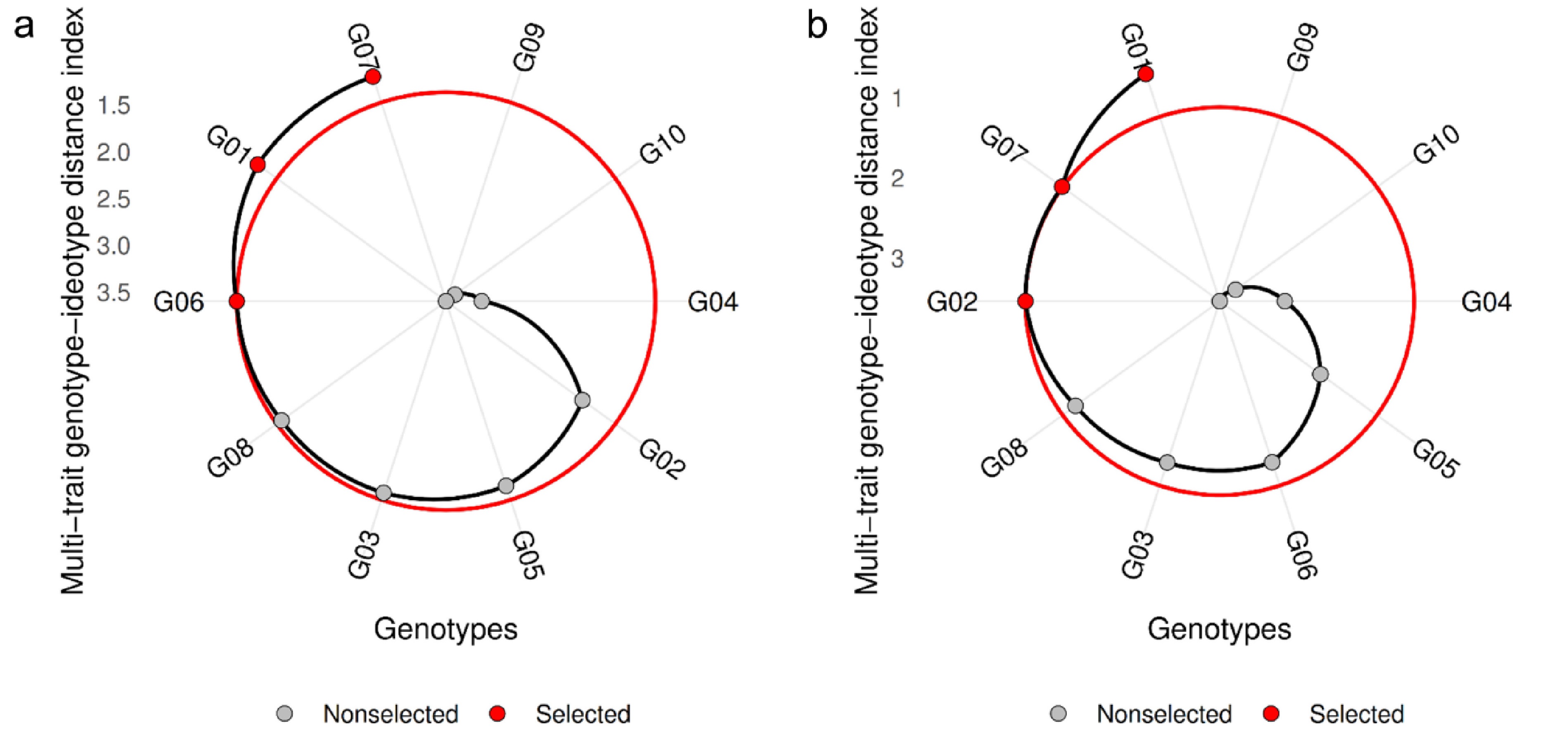
The multi-trait genotype–ideotype distance index (MGIDI) was used to identify superior hybrids based on a selection intensity of 30%, resulting in the selection of the top three performing genotypes in each environment conditions. The MGIDI ranking shifted but maintained a similar overall hierarchy of genetic merit under drought-stress conditions (Table 6). Under this selection pressure, the lowest MGIDI values were recorded for hybrid G07 (MGIDI = 1.08) under optimum conditions and hybrid G01 (MGIDI = 0.56) under drought stress, identifying them as the most superior genotypes. Figure 4 illustrates the selected hybrids (top 30%), identifying G07, G01, and G06 under optimum conditions (Figure 4a) and G01, G07, and G02 under drought conditions (Figure 4b), suggesting that these hybrids possess the most desirable combination of yield and ear morphology performance. In contrast, G09 (3.60) and G10 (3.48) were farthest from the ideotype and consistently performed poorly, confirming their inferior agronomic potential and limited breeding value.
Multi-trait genotype–ideotype distance index (MGIDI) values of ten maize hybrids evaluated under optimum and drought-stress conditions.
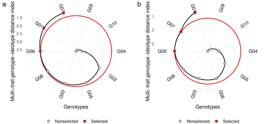
The ranking of hybrids based on MGIDI: (a) Optimum condition; (b) Drought stress condition.
Grain yield (GY), ear weight (EW), and grain weight (GW) exhibited the highest selection differentials, increasing by 0.81 t ha−1 (7.92%), 0.94 kg (7.79%), and 0.73 kg (7.32%), respectively, under optimum conditions (Table 7). These gains translated into strong genetic gains (SG = 6.24% for GY, 6.53% for EW, and 6.49% for GW), supported by their high heritability values (h2 = 0.79–0.89). Under drought-stress conditions, grain yield increased by 0.33 t ha−1 (4.79%) with a corresponding genetic gain of 2.20%, supported by moderate heritability (h2 = 0.46). Ear weight (EW), number of kernels per row (KR), and grain weight (GW) also demonstrated consistent selection differential and gain, improving by 5.09% (SG = 2.86%), 2.41% (SG = 2.37%), and 5.61% (SG = 2.21%), respectively.
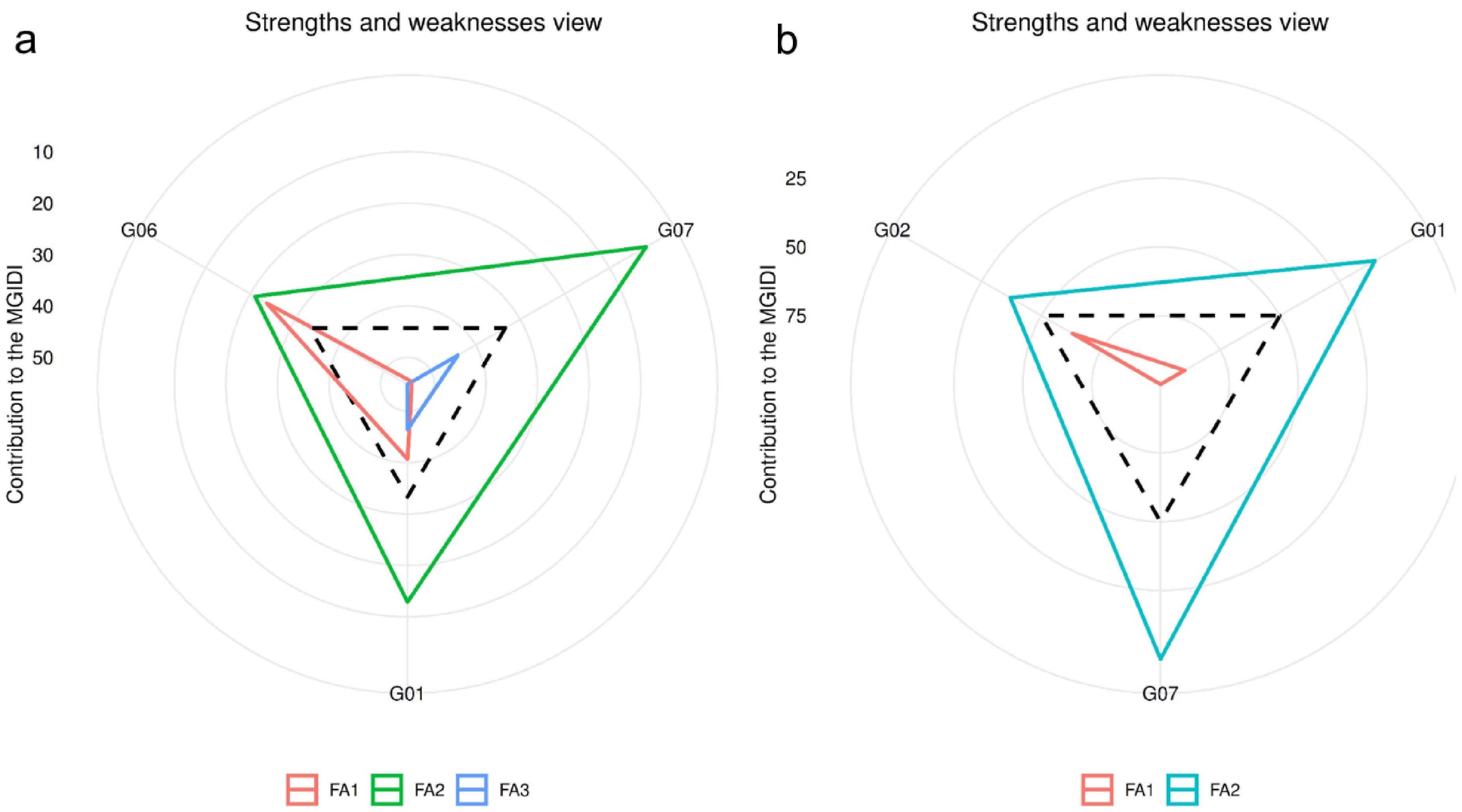
Figure 5 shows that G01, G07, and G06 (optimum conditions) show the largest contributions arise from FA2, which includes traits such as ear diameter, moisture content, and thousand-kernel weight, as well as (G01, G07 and G02 (drought stress conditions) have the same strengths arise from FA2 (moisture content, thousand-kernel weight, and shelling percentage). FA1 (grain yield components) was associated with G06 and G01 in optimum conditions, as well as G02 in drought stress, demonstrating strong performance in drought-responsive traits such as ear weight, kernel retention, grain weight, and yield.
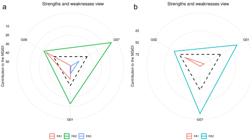
Strengths-and-weaknesses radar plots showing the contribution of each factor based on MGIDI: (a) Optimum condition; (b) drought stress condition.
4. Discussions
The yield components, especially grain yield, were the main traits in maize, and all the quantitative traits were influenced by multiple genes and a significant number of environments, resulting in varying performance of genotypes across environments (Uberti et al., 2023; Bocianowski et al., 2024). In this study, all traits were highly affected by environment, genotype and GEI, indicating a high variability of environment used, including the altitude, agro-ecology, and agro-climate. The significant GEI suggests that hybrid performance was not consistent across environments, emphasizing the need for stability and adaptability analyses to identify broadly adapted and drought-tolerant genotypes (Gonçalves et al., 2025).
The performance of maize under drought stress was lower than in optimum conditions, which reduced the grain yield of maize by 32.34%. This magnitude of yield loss aligns with previous reports on maize drought sensitivity under tropical conditions, where reductions of 30–70% are typically recorded (Elmyhun et al., 2024). Quantitatively, the 32.34% reduction in this study suggests that the evaluated hybrids, particularly G01 and G07, possess a relatively robust tolerance level compared to more susceptible tropical germplasm. Ear weight, grain weight, and weight of 1000 kernels were also strongly affected by drought, indicating that water deficit mainly disrupted kernel development and grain filling processes. Physiologically, drought stress during the reproductive phase (45–80 DAP) triggers ABA-mediated stomatal closure to minimize transpiration. While this mechanism preserves leaf water potential, it simultaneously restricts CO2 assimilation, thereby limiting the supply of photoassimilates required for kernel development. This reduction supply often leads to kernel abortion, especially at the apical end of the ear, which explains the observed decreases in kernels per row and ear weight in our stress treatments (Aslam et al., 2022; Wang et al., 2025).
Several stress tolerance indices were used by other studies (Bhandari et al., 2024), and the significant method was used to select the tolerant maize hybrids in this study. Lower TOL values reflect a smaller yield loss and therefore higher drought tolerance (Rosielle and Hamblin, 1981). However, TOL alone may favor low-yielding genotypes; thus, its interpretation must be complemented by other indices (Zendrato et al., 2024). The STI identifies genotypes with both high yield potential and stress tolerance (Fernandez, 1992). SSI, SRI and RSI provided complementary insights into the tolerant genotype. G01, G02, and G08 were selected based on the ranking summary of all indices, demonstrating superior drought resilience by sustaining yield under stress while maintaining high productivity in optimal environments.
The highly significant genotype × environment interaction (GEI) detected in the ANOVA provides a strong statistical justification for applying stability analysis tools. In this study, we combined the multivariate analyses using GGE biplot and WAASB for identifying superior and stable hybrids. The GGE biplot provided a comprehensive visualization of the genotype and genotype × environment interaction effects (Gonçalves et al., 2025). This insight is critical for breeding recommendations, especially for selecting genotypes for broad adaptability. While the GGE biplot identifies stability via distance from the average environment axis (AEA), the WAASB analysis provides a complementary, mixed-model-based stability metric that quantifies the magnitude of interaction deviations while retaining BLUP-based yield estimates (Olivoto et al., 2019). The combined use of GGE biplot and WAASB provided a robust framework for selecting genotypes that are both high-performing and reliable across variable environments (Nataraj et al., 2021; Danakumara et al., 2023;Supriadi et al., 2024). GGE and WAASB consistently identified the same hybrids (G01, G02, G05, G06, G07, and G08) as the best candidates for broad adaptation, combining high mean yield with low interaction deviations: depending on the breeder’s objective, these selected hybrids might be considered for specific adaptation or further testing.
The tolerance and stability analysis was used the main trait, grain yield, to select the tolerant and stable hybrids. In this study, we integrated the multi-traits for simultaneous selection using MGIDI. This method provided a robust assessment by incorporating all yield-related and agronomic traits into a unified selection metric (Olivoto and Nardino, 2021). This index enables a holistic interpretation of hybrid superiority by identifying genotypes closer to the ideotype (Azrai et al., 2025). G01 and G07 showed exceptional multi-trait adaptation, achieving the lowest MGIDI values in both environments. These hybrids likely possess increased kernel number, kernel mass, and improved assimilate allocation, consistent with reports emphasizing the importance of ear traits for yield improvement (Kosgei et al., 2025).
Across all analytical frameworks (tolerance indices, stability assessments, and MGIDI), G01 consistently emerged as the superior hybrid, demonstrating the strongest combination of drought resilience, yield stability, and multi-trait desirability. GGE and WAASB highlighted G06, G07, G02, G08, and G05 as stable, but G01 exhibited the highest yield potential even in the presence of GEI. MGIDI further consolidated G01’s superiority, recording the lowest MGIDI values (1.12 and 0.56) and demonstrating the strongest convergence toward the ideotype (Olivoto and Nardino, 2021). Notably, hybrids G09 and G10 performed poorly in all analyses, confirming their unsuitability for drought-prone environments. Overall, the convergence of results from stress indices, GEI-based stability tools, and the MGIDI framework underscores the robustness of G01, followed by G07, G02, G06, and G08, as the most promising hybrids for breeding and deployment in water-limited maize production systems.
5. Conclusions
Drought stress significantly reduced grain yield by 32.34% compared to optimal conditions, highlighting the critical need for stable hybrids. The integration of stress indices, GGE, WAASB, and MGIDI effectively identified G01 as the superior genotype, achieving the lowest multi-trait distance and maintaining high yield stability, followed by G02, G07 and G08. Practical implications for farmers and breeders suggest that these hybrids serve as elite candidates for new superior hybrids in drought-prone tropical lowlands. Future breeding programs should focus on integrating high-throughput physiological phenotyping to further accelerate genetic gains and enhance the efficiency of drought-resilience selection.
Acknowledgements
We thank to research and development team of PT Restu Agropro Jayamas (RAJA), Indonesia, for providing the genetic material for this study and for the technicians at each field location for helping with the experiments.
Data Availability Statement
Data presented in this study will be available on a fair request to the corresponding author.
References
-
AZRAI, M., AQIL, M., EFENDI, R., ANDAYANI, N.N., ZAINUDDIN, B., PABENDON, M.B., SITARESMI, T., ANSHORI, M.F., RIADI, M., YASIN, M., LAURENZE, R. and SYAM, A., 2025. Integrating multi-trait and multi-index approaches for identifying drought tolerant tropical maize genotypes. Frontiers in Sustainable Food Systems, vol. 9, pp. 1608307. https://doi.org/10.3389/fsufs.2025.1608307
» https://doi.org/10.3389/fsufs.2025.1608307 -
BAL, S.S., ADAK, A. and ERDAL, Ş., 2025. Exploring the interplay between drought resilience and yield in maize hybrids for drought-prone regions. Tropical Plant Biology, vol. 18, no. 1, pp. 39. https://doi.org/10.1007/s12042-025-09404-5
» https://doi.org/10.1007/s12042-025-09404-5 -
BHANDARI, R., PAUDEL, H., ALHARBI, S.A., ANSARI, M.J., POUDEL, M.R., NEUPANE, M.P., SOLANKI, P. and KUSHWAHA, U.K.S., 2024. Evaluating stress tolerance indices for their comparative validity to access terminal heat stress and heat drought tolerance of winter wheat (Triticum aestivum L.) genotypes. Journal of Agriculture and Food Research, vol. 18, pp. 101506. https://doi.org/10.1016/j.jafr.2024.101506
» https://doi.org/10.1016/j.jafr.2024.101506 -
BOCIANOWSKI, J., NOWOSAD, K. and REJEK, D., 2024. Genotype-environment interaction for grain yield in maize (Zea maysL.) using the additive main effects and multiplicative interaction (AMMI) model. Journal of Applied Genetics, vol. 65, no. 4, pp. 653-664. https://doi.org/10.1007/s13353-024-00899-4 PMid:39115751.
» https://doi.org/10.1007/s13353-024-00899-4 -
COOPER, M., TANG, T., GHO, C., HART, T., HAMMER, G. and MESSINA, C., 2020. Integrating genetic gain and gap analysis to predict improvements in crop productivity. Crop Science, vol. 60, no. 2, pp. 582-604. https://doi.org/10.1002/csc2.20109
» https://doi.org/10.1002/csc2.20109 -
DANAKUMARA, T., KUMAR, T., KUMAR, N., PATIL, B.S., BHARADWAJ, C., PATEL, U., JOSHI, N., BINDRA, S., TRIPATHI, S., VARSHNEY, R.K. and CHATURVEDI, S.K., 2023. A multi-model based stability analysis employing multi-environmental trials (METs) data for discerning heat tolerance in chickpea (Cicer arietinum L.) landraces. Plants, vol. 12, no. 21, pp. 3691. https://doi.org/10.3390/plants12213691 PMid:37960048.
» https://doi.org/10.3390/plants12213691 -
DUBE, S.P., SHAYANOWAKO, A.I.T., KUTU, F. and SIBIYA, J., 2024. Performance of tropical and subtropical maize inbred lines under well-watered and drought-stressed environments. Euphytica, vol. 220, pp. 139. https://doi.org/10.1007/s10681-024-03395-2
» https://doi.org/10.1007/s10681-024-03395-2 -
ELMYHUN, M., ABATE, E., ABATE, A., TEKLEWOLD, A. and MENKIR, A., 2024. Genetic analysis of tolerance to combined drought and heat stress in tropical maize. PLoS One, vol. 19, no. 6, e0302272. https://doi.org/10.1371/journal.pone.0302272 PMid:38900753.
» https://doi.org/10.1371/journal.pone.0302272 -
ERENSTEIN, O., JALETA, M., SONDER, K., MOTTALEB, K. and PRASANNA, B.M., 2022. Global maize production, consumption and trade: trends and R&D implications. Food Security, vol. 14, no. 5, pp. 1295-1319. https://doi.org/10.1007/s12571-022-01288-7
» https://doi.org/10.1007/s12571-022-01288-7 -
FATO, P., CHAÚQUE, P., SENETE, C., NHAMUCHO, E., SNELLER, C., MUTIGA, S., MUSUNDIRE, L., WEGARY, D., DAS, B. and PRASANNA, B.M., 2025. Genetic trends in seven years of maize breeding at Mozambique’s Institute of Agricultural Research. Agronomy, vol. 15, no. 2, pp. 449. https://doi.org/10.3390/agronomy15020449
» https://doi.org/10.3390/agronomy15020449 -
FERNANDEZ, G.C., 1992. Effective selection criteria for assessing plant stress tolerance. In: Proceedings of the International Symposium on Adaptation of Food Crops to Temperature and Water Stress, 1992, Taiwan. Shanhua: Asian Vegetable Research and Development Center, pp. 257-270. https://doi.org/10.22001/wvc.72511
» https://doi.org/10.22001/wvc.72511 -
FISCHER, R.A. and WOOD, J.T., 1979. Drought resistance in spring wheat cultivars. III.* Yield associations with morpho-physiological traits. Australian Journal of Agricultural Research, vol. 30, no. 6, pp. 1001-1020. https://doi.org/10.1071/AR9791001
» https://doi.org/10.1071/AR9791001 -
GONÇALVES, V.M., CREVELARI, J.A., CATARINA, R.S., SOUZA, Y.P. and PEREIRA, M.G., 2025. Adaptability and stability analysis via GGE biplot in single, double, and interpopulation maize hybrids. Scientific Reports, vol. 15, no. 1, pp. 5065. https://doi.org/10.1038/s41598-025-89416-z PMid:39934298.
» https://doi.org/10.1038/s41598-025-89416-z -
KOSGEI, T., MAKUMBI, D., MAGETO, E.K., KAVAI, H.M., OCHIENG, G.O., ADHIAMBO, C.A., KASANGO, J.S., KIMUTAI, J.J., KAMAU, R.M. and SSERUMAGA, J.P., 2025. Genetic analysis of ear, husk, and tassel traits in tropical maize under diverse environments. Frontiers in Plant Science, vol. 16, pp. 1618054. https://doi.org/10.3389/fpls.2025.1618054 PMid:40860733.
» https://doi.org/10.3389/fpls.2025.1618054 - LAN, J., 1998. Comparison of evaluating methods for agronomic drought resistance in crops. Xibei Nongye Xuebao, vol. 7, pp. 85-87.
-
NATARAJ, V., BHARTIYA, A., SINGH, C.P., DEVI, H.N., DESHMUKH, M.P., VERGHESE, P., SINGH, K., MEHTRE, S.P., KUMARI, V., MARANNA, S., KUMAWAT, G., RATNAPARKHE, M.B., SATPUTE, G.K., RAJESH, V., CHANDRA, S., RAMTEKE, R., KHANDEKAR, N. and GUPTA, S., 2021. WAASB-based stability analysis and simultaneous selection for grain yield and early maturity in soybean. Agronomy Journal, vol. 113, no. 4, pp. 3089-3099. https://doi.org/10.1002/agj2.20750
» https://doi.org/10.1002/agj2.20750 -
OLIVOTO, T. and LÚCIO, A.D., 2020. Metan: an R package for multi-environment trial analysis. Methods in Ecology and Evolution, vol. 11, no. 6, pp. 783-789. https://doi.org/10.1111/2041-210X.13384
» https://doi.org/10.1111/2041-210X.13384 -
OLIVOTO, T. and NARDINO, M., 2021. MGIDI: toward an effective multivariate selection in biological experiments. Bioinformatics, vol. 37, no. 10, pp. 1383-1389. https://doi.org/10.1093/bioinformatics/btaa981 PMid:33226063.
» https://doi.org/10.1093/bioinformatics/btaa981 -
OLIVOTO, T., LÚCIO, A.D.C., SILVA, J.A.G., MARCHIORO, V.S., SOUZA, V.Q. and JOST, E., 2019. Mean performance and stability in multi-environment trials I: combining features of AMMI and BLUP techniques. Agronomy Journal, vol. 111, no. 6, pp. 2949-2960. https://doi.org/10.2134/agronj2019.03.0220
» https://doi.org/10.2134/agronj2019.03.0220 -
RIZWANULLAH, M., YANG, A., NASRULLAH, M., ZHOU, X. and RAHIM, A., 2023. Resilience in maize production for food security: evaluating the role of climate-related abiotic stress in Pakistan. Heliyon, vol. 9, no. 11, e22140. https://doi.org/10.1016/j.heliyon.2023.e22140 PMid:38034722.
» https://doi.org/10.1016/j.heliyon.2023.e22140 -
ROSIELLE, A.A. and HAMBLIN, J., 1981. Theoretical aspects of selection for yield in stress and non-stress environments. Crop Science, vol. 21, no. 6, pp. 943-946. https://doi.org/10.2135/cropsci1981.0011183X002100060033x
» https://doi.org/10.2135/cropsci1981.0011183X002100060033x -
ROZI, F., SANTOSO, A.B., MAHENDRI, I.G.A.P., HUTAPEA, R.T.P., WAMAER, D., SIAGIAN, V., ELISABETH, D.A.A., SUGIONO, S., HANDOKO, H., SUBAGIO, H. and SYAM, A., 2023. Indonesian market demand patterns for food commodity sources of carbohydrates in facing the global food crisis. Heliyon, vol. 9, no. 6, e16809. https://doi.org/10.1016/j.heliyon.2023.e16809 PMid:37303576.
» https://doi.org/10.1016/j.heliyon.2023.e16809 -
SUPRIADI, D., BIMANTARA, Y.M., ZENDRATO, Y.M., WIDARYANTO, E., KUSWANTO, K. and WALUYO, B., 2024. Assessment of genotype by environment and yield performance of tropical maize hybrids using stability statistics and graphical biplots. PeerJ, vol. 12, e18624. https://doi.org/10.7717/peerj.18624 PMid:39624130.
» https://doi.org/10.7717/peerj.18624 -
UBERTI, A., REZENDE, W.M., CAIXETA, D.G., REIS, H.M., RESENDE, N.C.V., DESTRO, V. and DELIMA, R.O., 2023. Assessment of yield performance and stability of hybrids and populations of tropical maize across multiple environments in Southeastern Brazil. Crop Science, vol. 63, no. 4, pp. 2012-2032. https://doi.org/10.1002/csc2.20964
» https://doi.org/10.1002/csc2.20964 -
WANG, Z., YU, Y., CHEN, X., LI, Y., JONES, A., ROSE, R.J., RUAN, Y. and SONG, Y., 2025. Mitigating drought-associated reproductive failure in maize: from physiological mechanisms to practical solutions. The Crop Journal, vol. 13, no. 4, pp. 1022-1031. https://doi.org/10.1016/j.cj.2025.05.004
» https://doi.org/10.1016/j.cj.2025.05.004 -
YAN, W.K., HUNT, L.A., SHENG, Q.L. and SZLAVNICS, Z., 2000. Cultivar evaluation and mega-environment investigation based on the GGE biplot. Crop Science, vol. 40, no. 3, pp. 597-605. https://doi.org/10.2135/cropsci2000.403597x
» https://doi.org/10.2135/cropsci2000.403597x -
YUSTININGSIH, M., DINARTI, D., PURWOKO, B.S., SUWARNO, W.B., DARE, D. and SUPATA, I.D.A., 2026. Drought-tolerant selection model to identify prospective maize genotypes and support sustainable agroecological practices in the semiarid regions of East Nusa Tenggara, Indonesia. Ecohydrology & Hydrobiology, vol. 26, no. 1, pp. 100730. https://doi.org/10.1016/j.ecohyd.2026.100730
» https://doi.org/10.1016/j.ecohyd.2026.100730 - ZAIDI, P.H., 2019. Management of drought stress in field phenotyping. Mexico: CIMMYT .
-
ZENDRATO, Y.M., SUWARNO, W.B. and MARWIYAH, S., 2024. Multi-trait selection of tropical maize genotypes under optimum and acidic soil conditions. SABRAO Journal of Breeding and Genetics, vol. 56, no. 1, pp. 142-155. https://doi.org/10.54910/sabrao2024.56.1.13
» https://doi.org/10.54910/sabrao2024.56.1.13
Edited by
-
Editor:
Takako Matsumura Tundisi